
Submitted:
26 October 2026
Posted:
27 October 2026
You are already at the latest version
Abstract
Seed-priming is an essential phenomenon of today’s agricultural practices which is widely being utilized for better seed stand development of plants. Priming of seeds with essential plant growth regulators (PGRs) such as; hydrogen peroxide (H2O2), salicylic acid (SA), ascorbic acid (AsA), gibberellic acid (GA3), potassium nitrate (KNO3) including H2O priming treatment for 12 hours is highly beneficial to promote plant effectiveness under different environmental circumstances including artificial magnetism (north, south and north/south). The present study was carried out during September 2022 in Department of Botany, University of Balochistan, Quetta to investigate the physiological and biochemical attributes of two important plant species; Plantago ovata Forrsk. (Plantago) and Pisum sativum (pea) under artificial magnetism. Design of experiment was completely randomized design (CRD) comprising three replications. Results of different parameters portrayed that priming of seeds with essential PGRs is a novel technique to enhance plant growth and development. The overall accumulation of secondary metabolites such as; anthocyanin, soluble sugars and phenolics, tannins contents in pea plants showed significant (p < 0.05) variations except shoot tannin which showed non-significant (p > 0.05) results under artificial magnetic treatments in combination with supplementation of SA, KNO3, AsA and GA3 primed seeds as compared to plantago seedlings. Moreover, the status of nutrients, i.e., potassium in both shoots showed non-significant results by accumulating higher contents as compared to root, while in both plants seedlings, manganese content showed significant differences in root and shoot under priming. Astonishingly, the oxidative damage parameters (hydrogen peroxide and malondialdehyde) decreased by illustrating non-significant interactions among root and shoot. In overall study, pea seedlings performed very well under artificial magnetism by the pre-soaking of seeds with PGRs as compared to plantago seedlings. Therefore, the present study highly encourages the phenomenon of PGRs seed-priming along with artificial magnetic treatment for the better growth and development of plants seedlings and more importantly, pea and plantago.
Keywords:
artificial magnetism
; plantago
; secondary metabolites
; priming
; plant growth regulators
; nutrients
1. Introduction
Plantago ovata Forssk. (Plantago) is an herb that belongs to the family Plantaginacea. It is also known by several names such as (aspaghol, psyllium, and jiru) [1]. Plant medicinally has a potential role due to which it is grown throughout the world [2,3]. Seeds of Plantago are consumed to a greater extent as compared to leaves due to the presence of pharmaceutical compounds (amino acids, glycoside aucubin, and plantiose sugars) and secondary metabolites [4]. Pisum sativum (Pea) belongs to the family Fabaceae (legume family). Pea is an important plant due to their high usage throughout the globe as a nutritional enrichment and economically value-bale, distributed worldwide [5].
In the living environment, variations due to the magnetic field are one of the most important phenomena because several changes take place in living organisms when treated with the magnetic field [6]. Literature suggested that magnetic field treatment improves plants growth and developmental processes under both control and especially under abiotic environmental conditions such as salinity, drought, and temperature [7]. The moderate magnetic field stimulated seed germination-related parameters, MF improves seed germination by increasing the biochemical processes of the seed that led to enhancement in seed germination [8]. Many biochemical changes take place in seeds such as; seed vigor, protein production, and activity of antioxidants, etc when subjected to MF [9]. Similarly, effective seed germination is crucial for plant growth and yield. The pre-treatment of seed or seed priming is one of the new approaches that stimulate seed metabolic activities leading ultimately to an increase in the growth of seedlings [10]. The effects of priming depend upon the plant species and their various types, potential, and concentration of agents [11]. The priming method can increase the tolerance potential of plants under stress [12]. Seed priming improves seedling growth and plant health which provide resistance by activating genes expression that are involved in the production of hormones like GA3 and ABA [13].
However, there are plant hormones and signaling molecules which are utilized for seed priming, no doubt, well documented, are molecules that improve the germination process and early seedling emergences of plants [14]. Salicylic acid is one of the plant signaling molecules that are phenolics in nature, thus, influencing various attributes of plants i.e., seed germination, growth, physiological and many other developmental processes in plants under stress and control conditions [15,16]. Hydrogen peroxide is also a vital signaling molecule that plays many physiological and molecular processes in plants [17]. Salinity adversely affected the rice seedlings and the application of H2O2 helped to boost the growth of rice seedlings and provided resistance under salinity stress [18]. In the same manner, an experiment on milk thistle grown at two different altitudes of Balochistan, Pakistan under Cd+2 stress affected the morpho-physiological and biochemical parameters while hydrogen peroxide and SA application alleviated Cd+2 and improved growth of plants [19]. Seed with H2O2 priming showed better growth as compared to non-primed and hydro-priming [20].
Nutrient priming is priming of seed of osmotic solution of calcium, potassium, phosphorus etc that are very helpful in absorbing water, but without the production of radicle [21]. Potassium solution are widely being used in the agricultural crops, also known solution that is used to improve the germination, growth, and seedling attributes of grass family [22]. Priming of seeds with potassium has permanganate properties, which is strong oxidizing agent that can help better germination of seed [23]. Ascorbic acid is essential substance for plant growth and development. It is a part as co-factor that has many enzymes in plants by signal mediating essential for phytohormones production [24], and various physiological attributes as well [25]. Ascorbic acid has a role of cell division, cell expansion, hormones biosynthesis by modulating the plant sense regeneration of antioxidant and photosynthesis. AsA formed tocopherol formation that protect plants under abiotic stresses [26]. Gibberellic acid is also among plant growth regulators that has crucial role in plants growth and development such as, seed germination, stem formation, leaf flattening and development of both flowers and fruits [27] by breaking seed dormancy and improve the seed germination in many species, nutrient mobilization, and weakening of endosperm layer [28]. No doubt, in today’s world, green revolution is in its peak by accommodating world with essential foods and life liabilities. Therefore, these two plants also contribute to a great extent in agricultural practices. But there are various attributes which may not allow agricultural crops to flourish on its own until and unless a provoking mechanisms for plant’s germination and better improvement is tackled. Such strategies are the use of magnetism, priming and foliar supplementation of various PGRs which ultimately alter the growth and development of plants seedlings with early germination and more effectiveness in a complete life cycle. In this backdrop, the present study aims to evaluate the effects of artificial magnetism on plantago and pea seedlings by utilizing important PGRs for seed-priming treatments.
2. Materials and Method
- Experimental design and setup
Certified and viable seeds of plantago and pea were obtained from Balochistan Agricultural Research and Development Centre (BARDC), Quetta for the present experiment. A laboratory work/experiment was carried out to assess the potential role of seed priming in response to different magnetic fields treatments. The experiment was conducted during September, 2020 at Department of Botany, University of Balochistan (UoB), Quetta. A completely randomized design (CRD) with three replications was used as experimental design and setup. Plantago and pea plants seeds were primed with distilled H2O, Hydrogen peroxide (H2O2), Salicylic Acid (SA), Ascorbic Acid (AsA), Gibberellic Acid (GA3), Potassium Nitrate (KNO3) for 12 hours. After priming, the seeds were placed on filter paper and then placed in petri dishes labelled w.r.t treatment. Furthermore, different treatments of artificial magnetism as described by Pittman, (1962) with certain modification was used in comparison to control in Petri dishes. Screening of each compound/hormone was done prior to final setup of the experiment to select the best one level. In order to obtain data, plants were harvested and data was collected after 20 days of seed germination in order to document both physiological and biochemical attributes.
Determination of oxidative stress parameters
- Hydrogen peroxide (H2O2)
g of plant fresh sample was grinded into 1-2 mL of 0.1% (w/v) TCA under pre-chilled conditions. The tissues were crushed by putting on ice bath. The homogenized material was centrifuged at 12,000 rpm for 15 minutes. 0.1 mL (supernatant) was used and mixed with 0.5 mL of buffer of potassium phosphate (pH 7.0) and 1 mL solution of potassium iodide was thoroughly mixed. Finally, at 730 nm, the data absorbance was obtained using distilled water as blank [29].
- Malondialdehyde (MDA)
The method of Heath & Packer, [30] was used for the determination of MDA content in samples. 0.1 g of sample was grinded in 1 mL of (1% w/v) TCA which was centrifuged at 12,000 rpm for 15 minutes. 1 mL supernatant was obtained and mixed with 1 mL of 0.5% thiobarbituric acid in 20% TCA [0.5% in 20% (w/v TCA]. The sample was then kept in water bath at 95 °C for 50 minutes. This extracted sample was cooled on ice bath. At 532 and 600 nm, the absorbance was recorded by using 1% TCA as blank.
- Analysis of secondary metabolites
Anthocyanins
Determining anthocyanins, the method of Stark and Wray, [31] was used which involved 0.1g of plant sample, taken and extracted in 1-2 mL acidified methanol. The samples were placed in water bath at 50oC for one hour. The absorbance was measured at 535nm using spectrophotometer by utilizing acidified methanol as blank.
Soluble sugars
For determination of soluble sugar, plant samples of 0.1 g were taken which was then boiled in 5 ml of distilled water using water bath for almost 1 hour. Then 1 mL from this extract was taken and for the dilution, 9 mL of distilled water was added. 0.5 mL was taken which was added with anthrone reagent of 5 mL. This mixture was vortexed and placed at the water bath at 90oC for 20 minutes. At 620 nm, the absorbance was noted by the spectrophotometer. Distilled water was utilized as blank [32].
- Soluble phenolics
gram of plant sample was grinded into 1-2 mL of 80% acetone of 1 ml for the soluble phenolics determination. Water is added in test tube and 100 µL of sample which was added with 0.5 mL reagent of folin phenol, 2.5mL of 20% sodium carbonate (Na2CO3) was added. At 745 nm, the absorbance was denoted by using acetone of 80% as blank [33].
- Tannins
g of fresh plant samples was transferred into 2 mL of diethyl ether which was left for whole night. The solution was decanted and 70% of 1 mL acetone was added which was again left for overnight. 50 µL extract of tannin was taken in each test tube and the final volume was made by adding distilled water of 1 mL for each sample. After the dilution of sample, folin phenol reagent of 0.5 mL was also added which was mixed thoroughly by adding 2.5 mL of 20% solution of sodium carbonate and kept for about 40 minutes at room temperature. At 725nm, the absorbance was recorded by using acetone of 70% as blank.
Determination of nutrients
In order to determine the nutrient content in pea and plantago, both root and shoot were dried in oven at 75 °C. 0.1 gram of root and shoot samples were weighed and digested at 5 mL of nitric acid which was placed on the hot plate. The sample was diluted in distilled water up to 50 mL. While for the determination of potassium and manganese, atomic absorption spectrophotometer was used.
- Statistical analysis
The recorded data was statistically analyzed using “STATISTIX 8.1”. (Analytical software, Tallahassee, Florida), and the mean, SD, and graphs were generated by using the MS EXCEL. Furthermore, a post hoc test such as the least significant difference (LSD), was used, and the labels/alphabets were added to the graph bars of statistically significant attributes (p < 0.05).
3. Results
- Determination of oxidative damage parameters
Hydrogen peroxide (H2O2) content
Results obtained for H2O2 content of shoot and root of plantago and pea seedlings showed both significant (p < 0.05) and non-significant (p > 0.05) variations statistically respectively (Figure 1A,B). The obtained data revealed that the highest accumulation of H2O2 in pea seedlings was recognized in GA3 priming + north magnetism (696.43 μmol/g) and the minimum H2O2 accumulation was observed in AsA priming + N/S magnetic treatment (482.83 μmol/g). Further, data for plantago suggested the highest content of H2O2 in root was found in SA priming + N/S treatment (72.03 μmol/g) while the lowest amount of H2O2 was recorded in GA3 priming +/S magnetism (41.87 μmol/g) (Figure 1A).
Moreover, results obtained for shoot H2O2 in pea plants in comparison to root showed significant (p < 0.05) differences in both plants. Data for pea seedlings showed highest content of H2O2 in AsA priming + north magnetism (985.63 μmol/g) while the lesser content of H2O2 was obtained from control under north magnetism (616.35 μmol/g) treatment. Unlike pea seedlings, plantago showed diverse variations in different treatments of priming of seeds. The maximum amount of H2O2 in shoot of plantago was observed in KNO3 priming + south magnetism (92.26 μmol/g) and the minimum amount of H2O2 was observed in H2O2 priming + N/S magnetism (59.32 μmol/g) (Figure 1B).
The variations for H2O2 observed in both root and shoot of plantago and pea seedlings, showed a high degree of differentiation in overall accumulation of H2O2. Hydrogen peroxide showed highest amount in root of pea seedlings as compared to shoot. While in plantago, similar variations in both root and shoot was recorded by demonstrating that decrease in plantago seedling H2O2 content was recorded as compared to pea seedlings. (Figure 1A,B).
Malondialdehyde (MDA) content
Results obtained for MDA content of pea and plantago (root and shoot) showed statistically non-significant (p > 0.05) differences (Figure 1C,D). Data for root MDA content in pea seedlings revealed that GA3 priming + south magnetism (64.66 μmol/g) treatment having maximum amount of MDA content while control + north magnetism (39.18 μmol/g) treatment recorded the minimum MDA content in root. In comparison plantago seedlings recorded highest content of MDA in H2O2 priming + north magnetism (605.67 μmol/g) while lowest MDA content was observed in control conditions (no priming) under N/S magnetism (283.35 μmol/g) treatment (Figure 1C).
Data recorded for MDA content in shoot of pea plants showed maximum MDA accumulation in KNO3 priming + N/S magnetism (74.14 μmol/g) while minimum content was observed in KNO3 priming + north magnetic treatment (50.33 μmol/g). While different variations in plantago occurred by denoting SA priming + south magnetism (634.21 μmol/g) is the best treatment and control + south magnetism (249.45 μmol/g) showed the least treatment for overall accumulation of MDA content in shoot of both plants (pea and plantago) (Figure 1D).
The comparative analysis among root and shoot of both plants seedlings that concentration of MDA decreased in pea seedlings as compared to plantago. However, similar non-significant variations in the accumulation of MDA content in both root and shoot was observed. (Figure 1C, D).
- Determination of secondary metabolites
Anthocyanin content
Data regarding anthocyanin of root & shoot showed statistically significant (p < 0.05) data in pea and plantago seedlings (Figure 2A, B). Data for root anthocyanin content in pea seedlings showed maximum anthocyanin content in GA3 priming + north magnetism (0.36) while minimum content was observed in control + N/S magnetism (0.03) treatment. Moreover, in plantago, priming of seeds with AsA under north magnetism (0.35) showed remarkable anthocyanin content, while KNO3 priming + N/S magnetism (0.09) showed less content of anthocyanin in the root (Figure 2A).
Furthermore, data obtained for shoot anthocyanin content in pea seedlings showed maximum anthocyanin content in control + north magnetism (0.75) and minimum amount of anthocyanin accumulation was observed in H2O2 priming + north magnetism (0.09) treatment. While plantago showed remarkable variations in other PGRs by revealing that GA3 priming + north magnetism (0.34) improved by accumulating highest amount of anthocyanin and AsA priming + N/S magnetism (0.07) showed lesser accumulation of anthocyanin (Figure 2B).
In a nutshell, the results revealed that pre-soaking of plantago and pea seeds with GA3, AsA, H2O2 can mitigate the negative environmental impacts by promoting not only the early germination of both plants; but as well plays the potential role in increasing the anthocyanin content of root and shoot to a great extent. Comparatively, root recorded maximum anthocyanin content pea seedlings. Therefore, both plants performed very well to maximize the anthocyanin content by the application of PGRs which are essential in increasing secondary metabolites (Figure 2 A,B).
Soluble sugar content
Results recorded for soluble sugar content i.e., (root and shoot) showed significant (p < 0.05) results statistically in pea and plantago (Figure 2 C,D). It has been observed from determining the root soluble sugar (RSS) that maximum content was accumulated in H2O priming + N/S magnetism (16.70 μmol/g FWT), and minimum amount for RSS content was observed in SA priming + south magnetism (12.67 μmol/g FWT) treatment in pea seedlings. While in plantago, GA3 priming + south magnetism (16.48 μmol/g FWT) recorded highest RSS content, and H2O priming + north magnetism (9.53 μmol/g FWT) showed lowest amount of RSS content (Figure 2C).
Further, data obtained for shoot soluble sugar (SSS) illustrated great extent in H2O priming + south magnetism (16.70 μmol/g FWT) treatment, and the SA priming + north magnetic (8.48 μmol/g FWT) treatment showed lesser extent of SSS content in pea seedlings. In comparison, plantago seedlings also recorded greatest accumulation of soluble sugar in SA priming + south magnetism (16.57 μmol/g FWT), while H2O priming + N/S magnetism (8.48 μmol/g FWT) treatment showed minimum accumulation of SSS content (Figure 2D).
Keeping in consideration of above facts for pea and plantago seedlings in accumulation of soluble sugar, it can be of great significance that seeds treatment by growth promoting chemicals highly validates the maximization of secondary metabolites especially soluble sugar. Both root and shoot of pea and plantago seedlings astonishingly improved at a high rate in the accumulation of soluble sugar content; thus discovering the PGRs potentialities in physiological attributes (Figure 2C,D).
Soluble phenolics content
Data recorded for soluble phenolics contents i.e., (root and shoot) described statistically significant (p < 0.05) variations (Figure 3A,B). Results for root soluble phenolics (RSP) showed maximum content in GA3 priming + north magnetism (59.86 μmol/g FWT), while seed priming with SA under north magnetism (36.88 μmol/g FWT) showed minimum amount of phenolics content in pea plants. However, in plantago, H2O priming + north magnetism (13.47 μmol/g FWT) proved to be the best treatment in increasing the RSP accumulation, and SA priming + N/S magnetic (6.96 μmol/g FWT) treatment showed lowest content of soluble phenolics in root (Figure 3A).
Data for shoot soluble phenolics (SSP) in pea seedlings, showed greatest phenolics content in AsA priming + north magnetism (63.31 μmol/g FWT), and the H2O2 priming + north magnetism (40.33 μmol/g FWT) treatment, lowest amount of phenolics content was recorded. As in plantago, H2O priming + north magnetism (13.90 μmol/g FWT) proved to accumulate maximum SSP, while H2O2 priming + N/S magnetism (7.39 μmol/g FWT) recorded minimum amount of soluble phenolics in shoot (Figure 3B).
Data pertaining to this attributes revealed that seed-priming with GA3 improved RSP in pea plants under north magnetism treatment. More importantly, north magnetism treatment in combination with PGRs are highly recommended for the well establishment of plants especially in pea and plantago. As roots are the primary organs to get nutrients, important minerals which then prevail through aerials parts of plants; similarly, roots recorded higher soluble phenolics contents comparatively (Figure 3A,B).
Tannin content
Results recorded for tannin content in pea and plantago seedlings, showed both significant (p < 0.05) variations in root and non-significant (p > 0.05) differences statistically in shoot (Figure 3C,D). Data for root tannin content further demonstrated that AsA priming + north magnetism (55.03) showed maximum accumulation, while H2O priming + N/S magnetism (13.54) treatment recorded minimum content of tannin in pea seedlings. Similarly, AsA priming but with N/S magnetism (102.70) showed highest tannin content, and under control conditions, N/S magnetism (26.26) treatment recorded the least tannin accumulation in plantago seedlings (Figure 3C).
Furthermore, results for shoot tannin content recorded the maximum accumulation in AsA priming + north magnetism (55.03), while the KNO3 priming + north magnetism (13.83) treatment showed minimum tannin content in pea seedlings. In the same manner, AsA priming with N/S magnetism (101.81) proved to be the best treatment for the highest accumulation in root tannin, and GA3 priming + N/S magnetism (26.65) treatment recorded lowest amount of tannin content in the shoot of plantago seedlings (Figure 3D).
Concludingly, tannin content under north magnetism treatment along with AsA improved the accumulation of tannin in root of pea seedlings. While the same plant growth regulator (AsA) in combination with N/S magnetic treatment enhanced the tannin content in shoot in plantago, which showed that plants can highly accumulate secondary metabolites by the seed-priming with PGRs, but this fact can be without any doubt that magnetic treatment (north, south and N/S) support the accumulation of secondary metabolites i.e., tannin, soluble sugar, soluble phenolics and anthocyanins in pea and plantago plants. In both plants, root and shoot accumulated maximum amount of tannin by the priming of KNO3, SA and AsA treatment (Figure 3C,D).
- Determination of nutrients
Potassium (K+) content
Data obtained for K+ content of root & shoot of plantago and pea seedlings showed non-significant (p > 0.05) variations statistically (Figure 4A,B). Data for root potassium content in pea plants revealed that under control conditions, north magnetic treatment (0.46 mg/L) showed highest potassium content while SA priming + north magnetism (0.07 mg/L) showed lowest amount of potassium content in the root. However, SA priming which showed least amount of potassium content in the pea seedlings, proved to be the best treatment in plantago seedlings, i.e., SA priming + N/S magnetism (0.14 mg/L), and GA3 under south magnetism treatment (0.03 mg/L) showed the lowest amount in plantago root (Figure 4A).
Further, in shoot of pea seedlings, GA3 priming + south magnetism (1.18 mg/L) revealed maximum potassium content, while KNO3 priming + south magnetism (0.98 mg/L) treatment showed minimum potassium content. In the same manner, in plantago seedlings, SA priming + N/S magnetic (0.91 mg/L) treatment resulted highest content of potassium, and KNO3 under south magnetism (0.24 mg/L) showed lowest amount of potassium content in shoot (Figure 4B).
In a nutshell, it has been observed from the above results that in pea and plantago, potassium accumulation increased by the priming of various PGRs which are best source of enhancement in plant physiological and biochemical properties. As compared to root, shoot of seedlings showed highly significant variations. While plantago showed lesser amount of potassium content in root and shoot (Figure 4A,B).
Manganese (Mn) content
Data recorded for manganese content among root & shoot of pea and plantago seedlings showed significant (p < 0.05) data statistically (Figure 4C,D). Further results for pea root suggested that H2O2 priming + N/S magnetic (3.26 mg/kg) treatment maximum manganese accumulation, while H2O priming + N/S magnetism (6.47 mg/kg) treatment showed minimum accumulation of manganese. Furthermore, in plantago, the highest amount of manganese in root was recorded in GA3 priming + N/S magnetic treatment (2.59 mg/kg), and AsA priming under north magnetism (2.35 mg/kg) showed lowest amount of manganese content in root of plantago (Figure 4C).
While data recorded for shoot manganese of pea seedlings, showed highest accumulation in H2O priming + south magnetic (4.66 mg/kg) treatment and the AsA priming + south magnetism (1.38 mg/kg) has recorded the least accumulation of manganese in the shoot. Likewise, SA priming + north magnetism (2.49 mg/kg) proved to accumulate maximum amount of manganese content in plantago, while under control conditions, south magnetic (7.02 mg/kg) treatment showed minimum amount of manganese content in the shoot (Figure 4D).
Considering the overall variations in plantago and pea seedlings, it has been observed that both root and shoot content of manganese attribute showed highly remarkable variations in both plants, but pea seedlings showed greater accumulation of manganese as compared to plantago in both root and shoot. Similarly, this enhancement of manganese content was due to the priming of pea and plantago seeds with important PGRs which boosted up the overall concentration of manganese (Figure 4 C,D).
4. Discussion
The present experiment was carried out between two important plants i.e., pea and plantago. In order to investigate effectiveness of their seedlings growth, the use of different PGRs priming in combination with artificial magnetism treatment showed great degree of differentiation in the determination of secondary metabolites, oxidative damage parameters and nutritional status of both plants. Under north, south and north/south magnetic treatments, seedlings of plantago and pea improved the overall secondary metabolites and nutrients by the seed-priming with PGRs; most importantly; SA, AsA and GA3. However, a reduction in the oxidative damage parameters (H2O2 and MDA) was observed in control conditions along with no priming treatment, while somehow increased due to the PGRs supplementation (Figure 5). Oxidative stress arises due to the environmental stress consequences against the pathogens attack which lead to the generation of hydroxyl radicals and hydrogen peroxide along with the MDA content [34]. Naseer et al., [35] described that combination of foliar application of Fe, SA and artificial magnetism are highly important in reducing the H2O2 and MDA content in Pisum sativum L, while foliar treatment of SA reduced the content of MDA in shoot and root of pea plants under artificial magnetism. Similar findings were reported from Chen et al., [36] that a reduction was observed in both oxidative parameters (MDA and H2O2) in mungbean under 600 mT magnetic field. But it has been also reported from the experiment of Abdollahi et al., [37] that MDA content significantly enhanced under magnetic field in Citrus aurantifolia. Study on rice cultivars suggested that salinity stress has affected the overall concentration of MDA [38]. While Samad et al., [2] reported that there was a considerably higher MDA content in the roots of Plantago ovata L. as compared to shoots. This enhancement in MDA content was obviously the role of different PGRs such as; MLE, SA, TU, Proline which reduced the negative impacts of salinity stress. Likewise; the study also recommended the exogenous foliar supplementation of Proline as an effective the Reactive Oxygen Species (ROS) synthesis under salinity stress. However, in the present study, it was observed that H2O2 content in shoot decreased as compared to root. While both MDA and H2O2 content under control conditions decreased but by the application of PGRs, somehow oxidative stress parameters showed increase in their contents. Hence, H2O2 content showed minimum amount in plantago while MDA content denoted a reduction in pea seedlings (Figure 1A–D).
Diverse type of research in different plant species documented that magnetism is highly useful which can increase the secondary metabolites. In the growth phase, magnetic field treatment enhanced the overall accumulation of proteins, lipids, along with carbohydrates. Secondary metabolites specially phenolics compounds are reported as very important which protect plants by the extreme influence of oxidative stress. This helps plants to overcome under stressful conditions and provide defensive mechanism. Different studies suggested that phenolics accumulation in plants can also mitigate the negative impacts of salinity in Aegiceras corniculatum [39,40]. The recent study of Samad et al., [2] manifested the role of SA and Proline (PRO) foliar spray enhanced the soluble phenolics content in both root and shoot of plantago plants. The present study recorded a remarkable variation in soluble phenolics of pea seedlings as compared to plantago. comparatively root showed highest accumulation of phenolics content in root. Seed-priming with PGRs especially SA, H2O2 and AsA increased phenolics content under north and south magnetism as compared to N/S magnetic treatment (Figure 3A,B). While anthocyanin content showed highest significant variations in plantago by the foliar application of thiourea (TU) under salinity stress [2]. In the current study, anthocyanin showed minimum accumulation in both plants in root and shoot. In Plantago, AsA priming under north magnetism recorded highest amount of anthocyanin as compared to other treatments, while in pea seedlings, GA3 showed maximum content of anthocyanin under south magnetism (Figure 2A,B). Similarly, the foliar application of SA enhanced the soluble sugar content which is one of the most significant osmotic solutes [14]. The supplementation of SA further increased the soluble sugar content in tomato plants which were under the influence of NaCl stress [41]. More astonishingly, in pea plants, the accumulation of soluble sugar content under magnetic treatments also increase under salinity stress [35]. In the present experiment, an astonishing variation was observed in the accumulation of soluble sugar. Results revealed that hydro priming of pea seeds enhanced the soluble sugar content under N/S magnetic treatment, while the same treatment in plantago showed lowest soluble sugar content. Therefore, the data illustrate that hydro priming and PGRs treatment effected plants seedlings in both pea and plantago in a different manner, respectively (Figure 2C,D). Tannins are mainly found in soluble form that are reported to enhance the secondary metabolites concentration under various environmental impacts [42]. Similarly, Nizar et al., [19] also reported that in two diverse altitudes, there was an increased accumulation of tannins content under cadmium stress in milk thistle; comparatively root produced minimum tannin contents beside shoot because of seed priming with SA along with the foliar spray. However, in the present study, results for tannin content suggested that north magnetism and combination of N/S magnetism has a great impact on the overall accumulation of tannin content. Data further demonstrated that AsA priming of seeds performed very well under different magnetic treatment in accumulating high amount of tannin content in root and shoot of both plants, respectively (Figure 3C,D).
Nutrients are considered to be very significant processes in plant physiology which function in the activation of enzymes, macromolecules production, stomatal regulation and osmotic homeostasis [43,44]. Among nutrients, potassium is one of the best nutrients in plant which function in the growth of plant along with the development [45] which plays a crucial role in maintaining the osmotic pressure inside the vacuole that not only help in turgidity but also helps in activation of enzymatic reaction of various types [46]. While it’s deficiency causes a reduction in the content of chlorophyll along with carbon fixation in the process [47]. Furthermore, Granaz et al., [48] reported that root potassium content increased under de etiolation conditions by the application of TU as compared to root under salinity stress. The research experiment of Hamada, [49] suggested that there are limited reports for the nutrients content of milk thistle under abiotic conditions. But it has been reported that the PGRs supplementation was very much effective in improving the content of nutrients in plant tissues among various ecotypes of milk thistle plant. Comparatively, among PGRs, AsA was recognized as the most influential and effective in accumulating high nutrient content in root and shoot. While the study of Samad et al., [50] illustrated that salinity stress has hampered the nutrients status (K, Mg, Ca and NO3-2), but by the foliar application of PGRs predominantly MLE improved the nutrients contents in plantago which was followed by proline and thiourea. Manganese (Mn) also plays a significant role in various biological system which comprises of respiration, photosynthesis and the assimilation of nitrogen. It has a potential role in the elongation of root cell, tube growth of pollen along with the germination of pollen. Similarly, the growth of plant is reported to minimize when there is lack of manganese [51]. Shafique et al., [52] experiment reported that laser treatment increased the Mn accumulation of both shoots and roots in Moringa oleifera. The current experiment revealed that for highest accumulation of pea and plantago nutrients, PGRs are very crucial for growth and development by priming of seeds. Potassium and manganese showed remarkable variations in both plants by accumulating highest amount of nutrients. But, overall pea plants showed greater accumulation of potassium and manganese contents as compared to plantago. Shoot showed highest content of potassium as compared to the root of pea and plantago seedlings (Figure 4A–D).
5. Conclusions
In a nutshell, it has been well articulated from the present study that priming is a key phenomenon in which early germination of seeds takes place by improving overall attributes of plant seedlings. When pea and Plantago seeds were subjected to priming with different PGRs, the growth phase of seedlings showed improved variations by increasing secondary metabolites and nutrient contents in both root and shoot. While in combination with PGRs, artificial magnetic treatment i.e., north, south and north/south also played a significant impact by enhancing the physio-chemical contents of plants seedlings. Thus, the present study came up with the concluding point that for the better growth and development of plants; priming of PGRs under magnetism treatment are best. This will not only boost the physiological characteristics of plants, but also show resistance to biotic and abiotic conditions.
Author Contributions
Conceptualization, K.S; methodology, K.S; software, K.S.; validation, K.S, M.N, A.W, formal analysis, K.N, K.S, A.S and M.N, data curation, K.N, A.S, and M.N, ; writing—original draft preparation, K.N., K.S, A.S, and M.N ; writing—review and editing, K.S, K.N, A.S, M.N, T.I; supervision, K.S. All authors have read and agreed to the published version of the manuscript.
Data Availability Statement
Available on request from the corresponding author.
Acknowledgments
Authors thankful to the Department of Botany, University of Balochistan, Quetta for providing the facilities to conduct the present research.
Conflicts of Interest
All authors declare no conflict of interest.
References
- Shah, A.R.; Sharma, P.; Longvah, T.; Gour, V.S.; Kothari, S.; Shah, Y.R.; Ganie, S.A. Nutritional composition and health benefits of Psyllium (Plantago ovata) husk and seed. Nutr. Today 2020, 55, 313–321. [Google Scholar] [CrossRef]
- Samad, A.; Shaukat, K.; Ansari, M.-U.-R.; Nizar, M.; Zahra, N.; Naz, A.; Iqbal, H.M.W.; Raza, A.; Pesic, V.; Djalović, I. Role of foliar spray of plant growth regulators in improving photosynthetic pigments and metabolites in Plantago ovata (Psyllium) under salt stress–A field appraisal. Biocell 2023, 47, 523–532. [Google Scholar] [CrossRef]
- Sabzehzari, M.; Hoveidamanesh, S.; Modarresi, M.; Mohammadi, V. Morphological, anatomical, physiological, and cytological studies in diploid and tetraploid plants of Plantago psyllium. Plant Cell Tissue Organ Cult. (PCTOC) 2019, 139, 131–137. [Google Scholar] [CrossRef]
- Franco, E.A.N.; Sanches-Silva, A.; Ribeiro-Santos, R.; de Melo, N.R. Psyllium (Plantago ovata Forsk): From evidence of health benefits to its food application. Trends Food Sci. Technol. 2020, 96, 166–175. [Google Scholar] [CrossRef]
- Cantaro-Segura, H.; Huaringa-Joaquín, A. Interaction of triacontanol with other plant growth regulators on morphology and yield of field pea (Pisum sativum L.). Agron. Colomb. 2021, 39, 187–195. [Google Scholar] [CrossRef]
- Maffei, M.E. Magnetic field effects on plant growth, development, and evolution. Front. Plant Sci. 2014, 5, 445. [Google Scholar] [CrossRef] [PubMed]
- Novitskaya, G.; Molokanov, D.; Kocheshkova, T.; Novitskii, Y.I. Effect of weak constant magnetic field on the composition and content of lipids in radish seedlings at various temperatures. Russ. J. Plant Physiol. 2010, 57. [Google Scholar] [CrossRef]
- Ramesh, B.; Kavitha, G.; Gokiladevi, S.; Balachandar, R.K.; Kavitha, K.; Gengadharan, A.C.; Puvanakrishnan, R. Effect of extremely low power time-varying electromagnetic field on germination and other characteristics in foxtail millet (Setaria italica) seeds. Bioelectromagnetics 2020, 41, 526–539. [Google Scholar] [CrossRef] [PubMed]
- Sen, A.; Alikamanoglu, S. Effects of static magnetic field pretreatment with and without PEG 6000 or NaCl exposure on wheat biochemical parameters. Russ. J. Plant Physiol. 2014, 61, 646–655. [Google Scholar] [CrossRef]
- Jakovljević, D.; Stanković, M.; Bojović, B.; Topuzović, M. Regulation of early growth and antioxidant defense mechanism of sweet basil seedlings in response to nutrition. Acta Physiol. Plant. 2017, 39, 1–13. [Google Scholar] [CrossRef]
- Jisha, K.; Vijayakumari, K.; Puthur, J.T. Seed priming for abiotic stress tolerance: an overview. Acta Physiol. Plant. 2013, 35, 1381–1396. [Google Scholar] [CrossRef]
- Wang, X.; Cai, J.; Liu, F.; Dai, T.; Cao, W.; Wollenweber, B.; Jiang, D. Multiple heat priming enhances thermo-tolerance to a later high temperature stress via improving subcellular antioxidant activities in wheat seedlings. Plant Physiol. Biochem. 2014, 74, 185–192. [Google Scholar] [CrossRef] [PubMed]
- Malek, M.; Ghaderi-Far, F.; Torabi, B.; Sadeghipour, H.R. Dynamics of seed dormancy and germination at high temperature stress is affected by priming and phytohormones in rapeseed (Brassica napus L.). J. Plant Physiol. 2022, 269, 153614. [Google Scholar] [CrossRef] [PubMed]
- Azooz, M.M.; Youssef, A.M.; Ahmad, P. Evaluation of salicylic acid (SA) application on growth, osmotic solutes and antioxidant enzyme activities on broad bean seedlings grown under diluted seawater. Int. J. Plant Physiol. Biochem 2011, 3, 253–264. [Google Scholar] [CrossRef]
- Koo, Y.M.; Heo, A.Y.; Choi, H.W. Salicylic acid as a safe plant protector and growth regulator. Plant Pathol. J. 2020, 36, 1. [Google Scholar] [CrossRef] [PubMed]
- Shaukat, K.; Baksh, G.; Zahra, N.; Hafeez, M.B.; Raza, A.; Samad, A.; Nizar, M.; Wahid, A. Correction: Foliar application of thiourea, salicylic acid, and kinetin alleviate salinity stress in maize grown under etiolated and de-etiolated conditions. Discov. Food 2022, 2, 34. [Google Scholar] [CrossRef]
- Silva, P.C.C.; Azevedo Neto, A.; Gheyi, H.; Ribas, R.; Silva, C.; Cova, A. Seed priming with H2O2 improves photosynthetic efficiency and biomass production in sunflower plants under salt stress. Arid Land Res. Manag. 2022, 36, 283–297. [Google Scholar] [CrossRef]
- Roy, P.R.; Tahjib-Ul-Arif, M.; Akter, T.; Ray, S.R.; Sayed, M.A. Exogenous ascorbic acid and hydrogen peroxide alleviates salt-induced oxidative stress in rice (Oryza sativa L.) by enhancing antioxidant enzyme activities and proline content. Adv. Environ. Biol. 2016, 10, 148–155. [Google Scholar]
- Nizar, M.; Shaukat, K.; Zahra, N.; Hafeez, M.B.; Raza, A.; Samad, A.; Ali, Q.; Siddiqui, M.H.; Ali, H.M. Exogenous application of salicylic acid and hydrogen peroxide ameliorate cadmium stress in milk thistle by enhancing morpho-physiological attributes grown at two different altitudes. Front. Plant Sci. 2022, 12, 3157. [Google Scholar] [CrossRef] [PubMed]
- Hemalatha, G.; Renugadevi, J.; Eevera, T. Studies on seed priming with hydrogen peroxide for mitigating salt stress in rice. Int. J. Curr. Microbiol. App Sci. 2017, 6, 691–695. [Google Scholar] [CrossRef]
- Hardegree, S.P.; Van Vactor, S.S. Germination and emergence of primed grass seeds under field and simulated-field temperature regimes. Ann. Bot. 2000, 85, 379–390. [Google Scholar] [CrossRef]
- Hanegave, A.S.; Ravi, H.; Nadaf, H.; Biradarpatil, N.; Uppar, D. Effect of seed priming on seed quality of maize (Zea mays L.). Karnataka J. Agric. Sci. 2011, 24, 237–238. [Google Scholar]
- Grauda, D.; Lapiņa, L.; Jansone, B.; Jansons, A.; Rashal, I. Recovering genetic resources of some legume species of Latvian origin by plant tissue culture. In Proceedings of the Latvian Academy of Sciences Section B Natural, Exact, and Applied Sciences, 2013; pp. 224–228. [Google Scholar]
- Barth, C.; De Tullio, M.; Conklin, P.L. The role of ascorbic acid in the control of flowering time and the onset of senescence. J. Exp. Bot. 2006, 57, 1657–1665. [Google Scholar] [CrossRef] [PubMed]
- Farooq, M.; Irfan, M.; Aziz, T.; Ahmad, I.; Cheema, S. Seed priming with ascorbic acid improves drought resistance of wheat. J. Agron. Crop Sci. 2013, 199, 12–22. [Google Scholar] [CrossRef]
- Conklin, P.; Barth, C. Ascorbic acid, a familiar small molecule intertwined in the response of plants to ozone, pathogens, and the onset of senescence. Plant Cell Environ. 2004, 27, 959–970. [Google Scholar] [CrossRef]
- Cornea-Cipcigan, M.; Pamfil, D.; Sisea, C.R.; Mărgăoan, R. Gibberellic acid can improve seed germination and ornamental quality of selected Cyclamen species grown under short and long days. Agronomy 2020, 10, 516. [Google Scholar] [CrossRef]
- Pallaoro, D.S.; Avelino, A.C.D.; Camili, E.C.; Guimarães, S.C.; Albuquerque, MCdF. Condicionamento de sementes de milho com reguladores vegetais. J. Seed Sci. 2016, 38, 227–232. [Google Scholar]
- Velikova, V.; Yordanov, I.; Edreva, A. Oxidative stress and some antioxidant systems in acid rain-treated bean plants: protective role of exogenous polyamines. Plant Sci. 2000, 151, 59–66. [Google Scholar]
- Heath, R.L.; Packer, L. Photoperoxidation in isolated chloroplasts: I. Kinetics and stoichiometry of fatty acid peroxidation. Arch. Biochem. Biophys. 1968, 125, 189–198. [Google Scholar] [PubMed]
- Stark, D.; Wray, V. Anthocyanins: In: Methods in Plant Biology; Plant Phenolics; Academic Press: London, 1989. [Google Scholar]
- Yoshida, S.; Forno, D.; Cock, J.; Gomez, K. Laboratory manual for physiological study of rice. IRRI PO Box 1976, 933, 27. [Google Scholar]
- Julkunen-Tiitto, R. Phenolic constituents in the leaves of northern willows: methods for the analysis of certain phenolics. J. Agric. Food Chem. 1985, 33, 213–217. [Google Scholar] [CrossRef]
- Hasanuzzaman, M.; Bhuyan, M.B.; Zulfiqar, F.; Raza, A.; Mohsin, S.M.; Mahmud, J.A.; Fujita, M.; Fotopoulos, V. Reactive oxygen species and antioxidant defense in plants under abiotic stress: Revisiting the crucial role of a universal defense regulator. Antioxidants 2020, 9, 681. [Google Scholar] [CrossRef] [PubMed]
- Naseer, H.; Shaukat, K.; Zahra, N.; Hafeez, M.B.; Raza, A.; Nizar, M.; Qazi, M.A.; Ali, Q.; Al-Huqail, A.A.; Siddiqui, M.H. Appraisal of foliar spray of iron and salicylic acid under artificial magnetism on morpho-physiological attributes of pea (Pisum sativum L.) plants. PLoS ONE 2022, 17, e0265654. [Google Scholar] [CrossRef] [PubMed]
- Chen, Y-p; Li, R.; He, J.-M. Magnetic field can alleviate toxicological effect induced by cadmium in mungbean seedlings. Ecotoxicology 2011, 20, 760–769. [Google Scholar] [CrossRef] [PubMed]
- Abdollahi, F.; Niknam, V.; Ghanati, F.; Masroor, F.; Noorbakhsh, S.N. Biological effects of weak electromagnetic field on healthy and infected lime (Citrus aurantifolia) trees with phytoplasma. Sci. World J. 2012, 2012. [Google Scholar] [CrossRef] [PubMed]
- Abdelaziz, M.N.; Xuan, T.D.; Mekawy, A.M.M.; Wang, H.; Khanh, T.D. Relationship of salinity tolerance to Na+ exclusion, proline accumulation, and antioxidant enzyme activity in rice seedlings. Agriculture 2018, 8, 166. [Google Scholar] [CrossRef]
- Kumar, S.; Abedin, M.M.; Singh, A.K.; Das, S. Role of phenolic compounds in plant-defensive mechanisms. In Plant Phenolics in Sustainable Agriculture; 2020; Volume 1, pp. 517–532. [Google Scholar] [CrossRef]
- Parida, A.K.; Das, A.B.; Sanada, Y.; Mohanty, P. Effects of salinity on biochemical components of the mangrove, Aegiceras corniculatum. Aquat. Bot. 2004, 80, 77–87. [Google Scholar] [CrossRef]
- Shaukat, K.; Zahra, N.; Hafeez, M.B.; Naseer, R.; Batool, A.; Batool, H.; Raza, A.; Wahid, A. Role of salicylic acid–induced abiotic stress tolerance and underlying mechanisms in plants. In Emerging plant growth regulators in agriculture; Elsevier, 2022; pp. 73–98. [Google Scholar]
- Tiku, A.R. Antimicrobial compounds (phytoanticipins and phytoalexins) and their role in plant defense. In Co-Evolution of Secondary Metabolites; 2020; pp. 845–868. [Google Scholar] [CrossRef]
- Fageria, N.; Moreira, A. The role of mineral nutrition on root growth of crop plants. Adv. Agron. 2011, 110, 251–331. [Google Scholar] [CrossRef]
- Shahid, M.A.; Sarkhosh, A.; Khan, N.; Balal, R.M.; Ali, S.; Rossi, L.; Gómez, C.; Mattson, N.; Nasim, W.; Garcia-Sanchez, F. Insights into the physiological and biochemical impacts of salt stress on plant growth and development. Agronomy 2020, 10, 938. [Google Scholar] [CrossRef]
- Taiz, L.; Zeiger, E. Plant physiology, 4th edn; Sinauer Associates Inc. Publishers: Sunderland, MA, 2006. [Google Scholar]
- Maathuis, F.J.; Amtmann, A. K+ nutrition and Na+ toxicity: the basis of cellular K+/Na+ ratios. Ann. Bot. 1999, 84, 123–133. [Google Scholar] [CrossRef]
- Zhao, Z.; Chen, G.; Zhang, C. Interaction between reactive oxygen species and nitric oxide in drought-induced abscisic acid synthesis in root tips of wheat seedlings. Funct. Plant Biol. 2001, 28, 1055–1061. [Google Scholar] [CrossRef]
- Granaz, K.S.; Samad, A.; Nizar, M.; Baksh, G.; Chakar, M.; Rahim, W.A.; Ismail, T. Exogenous application of Plant Growth Regulators (PGRs) improves the nutritional status of Maize grown under salinity stress in response to Etiolation and De-etiolation conditions. [CrossRef]
- Hamada, A. Alleviation of the adverse effects of NaCl on germination, seedling, growth and metabolic activities of maize plants by calcium salts. Bull. Fac. Sci. Assiut Univ. 1995, 24, 211–220. [Google Scholar]
- SAMAD, A.; SHAUKAT, K.; NIZAR, M.; HAKEEM, A.; ALI, W.; RAHIM, M.C.; BILAL, M.; ISMAIL, T. ELUCIDATING THE POSSIBLE ROLE OF PLANT GROWTH REGULATOR IN IMPROVING NUTRITIONAL STATUS OF Plantago ovata UNDER SALINITY STRESS. Plant Cell Biotechnol. Mol. Biol. 2022, 48–58. [CrossRef]
- Hänsch, R.; Mendel, R.R. Physiological functions of mineral micronutrients (cu, Zn, Mn, Fe, Ni, Mo, B, cl). Curr. Opin. Plant Biol. 2009, 12, 259–266. [Google Scholar] [CrossRef] [PubMed]
- Shafique, H.; Jamil, Y.; ul Haq, Z.; Mujahid, T.; Khan, A.U.; Iqbal, M.; Abbas, M. Low power continuous wave-laser seed irradiation effect on Moringa oleifera germination, seedling growth and biochemical attributes. J. Photochem. Photobiol. B Biol. 2017, 170, 314–323. [Google Scholar] [CrossRef] [PubMed]
Figure 1.
Effects of various magnetic treatments on oxidative damage parameters; (A) root H2O2, (B) shoot H2O2, (C) root MDA, (D) shoot MDA content of Pisum sativum and Plantago ovata in response to the priming of different essential PGRs. Different alphabets/letters on bars represents statistically significant (p < 0.05) interactions according to the least significant difference test. Bars lacking the labels show non-significant interactions at (p > 0.05). *H2O: water; H2O2: hydrogen peroxide; GA3: gibberellic acid; KNO3: potassium nitrate; SA: salicylic acid; AsA: ascorbic acid; PGRs: plant growth regulators.
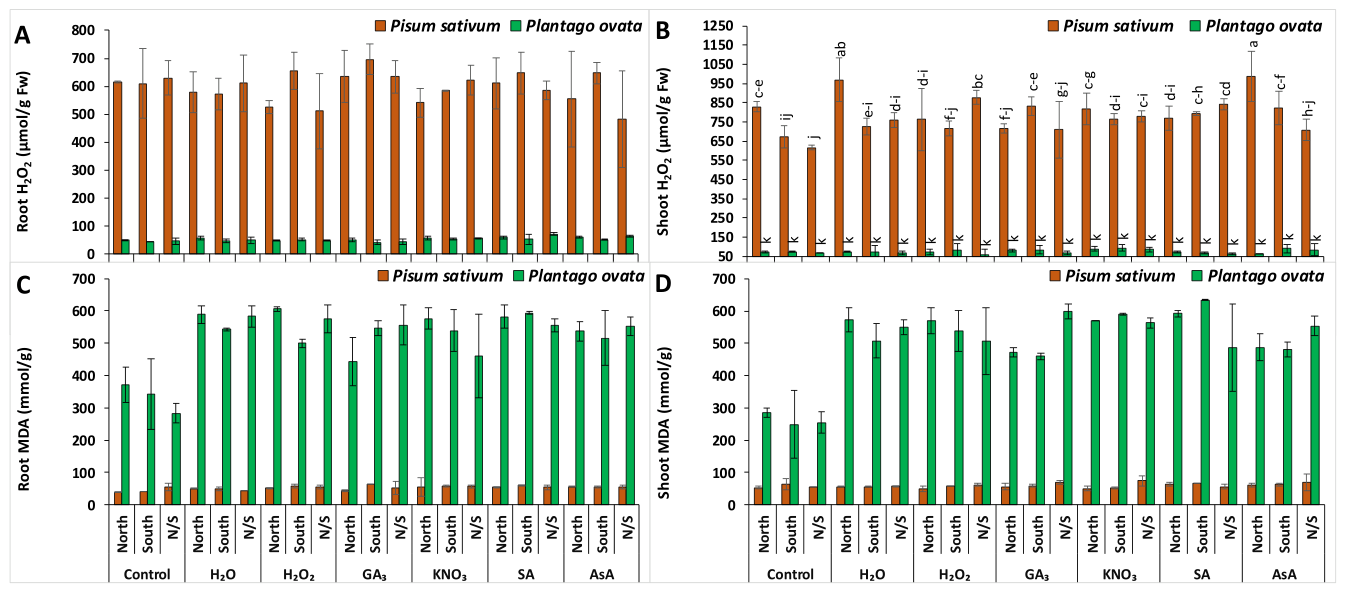
Figure 2.
Effects of various magnetic treatments on secondary metabolites; (A) root anthocyanin, (B) shoot anthocyanin, (C) root soluble sugar, (D) shoot soluble sugar content of Pisum sativum and Plantago ovata in response to the priming of different essential PGRs. Different alphabets/letters on bars represents statistically significant (p < 0.05) interactions according to the least significant difference test. *H2O: water; H2O2: hydrogen peroxide; GA3: Gibberellic acid; KNO3: potassium nitrate; SA: salicylic acid; AsA: ascorbic acid; PGRs: plant growth regulators.
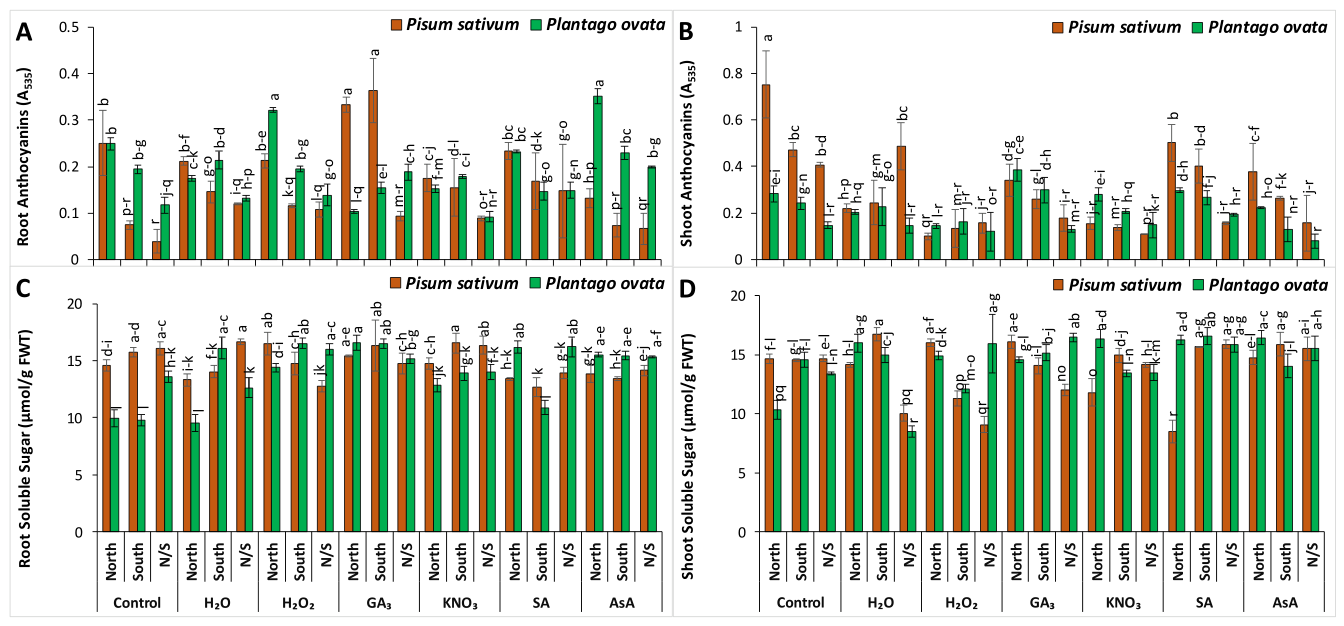
Figure 3.
Effects of various magnetic treatments on secondary metabolites; (A) root soluble phenolics, (B) shoot soluble phenolics, (C) root tannin, (D) shoot tannin content of Pisum sativum and Plantago ovata in response to the priming of different essential PGRs. Different alphabets/letters on bars represents statistically significant (p < 0.05) interactions according to the least significant difference test. Bars lacking the labels show non-significant interactions at (p > 0.05). *H2O: water; H2O2: hydrogen peroxide; GA3: Gibberellic acid; KNO3: potassium nitrate; SA: salicylic acid; AsA: ascorbic acid; PGRs: plant growth regulators.
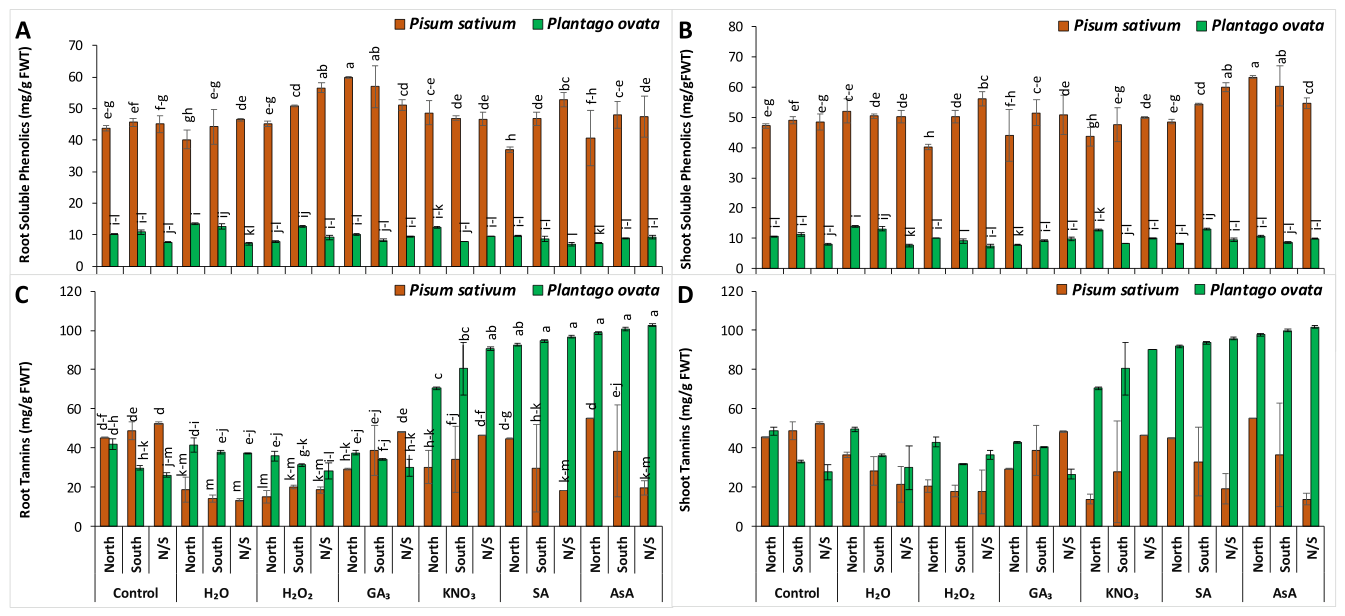
Figure 4.
Effects of various magnetic treatments on nutrients; (A) root potassium, (B) shoot potassium, (C) root manganese, (D) shoot manganese content of Pisum sativum and Plantago ovata in response to the priming of different essential PGRs. Different alphabets/letters on bars represents statistically significant (p < 0.05) interactions according to the least significant difference test. Bars lacking the labels show non-significant interactions at (p > 0.05). *H2O: water; H2O2: hydrogen peroxide; GA3: Gibberellic acid; KNO3: potassium nitrate; SA: salicylic acid; AsA: ascorbic acid; PGRs: plant growth regulators.
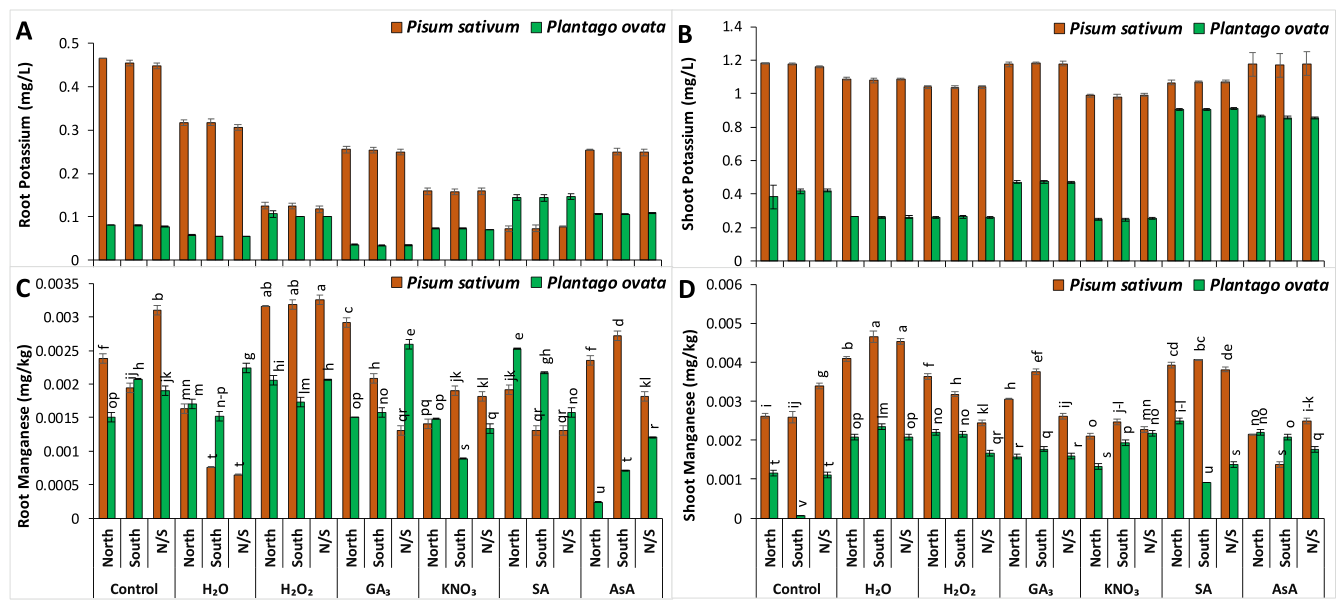
Figure 5.
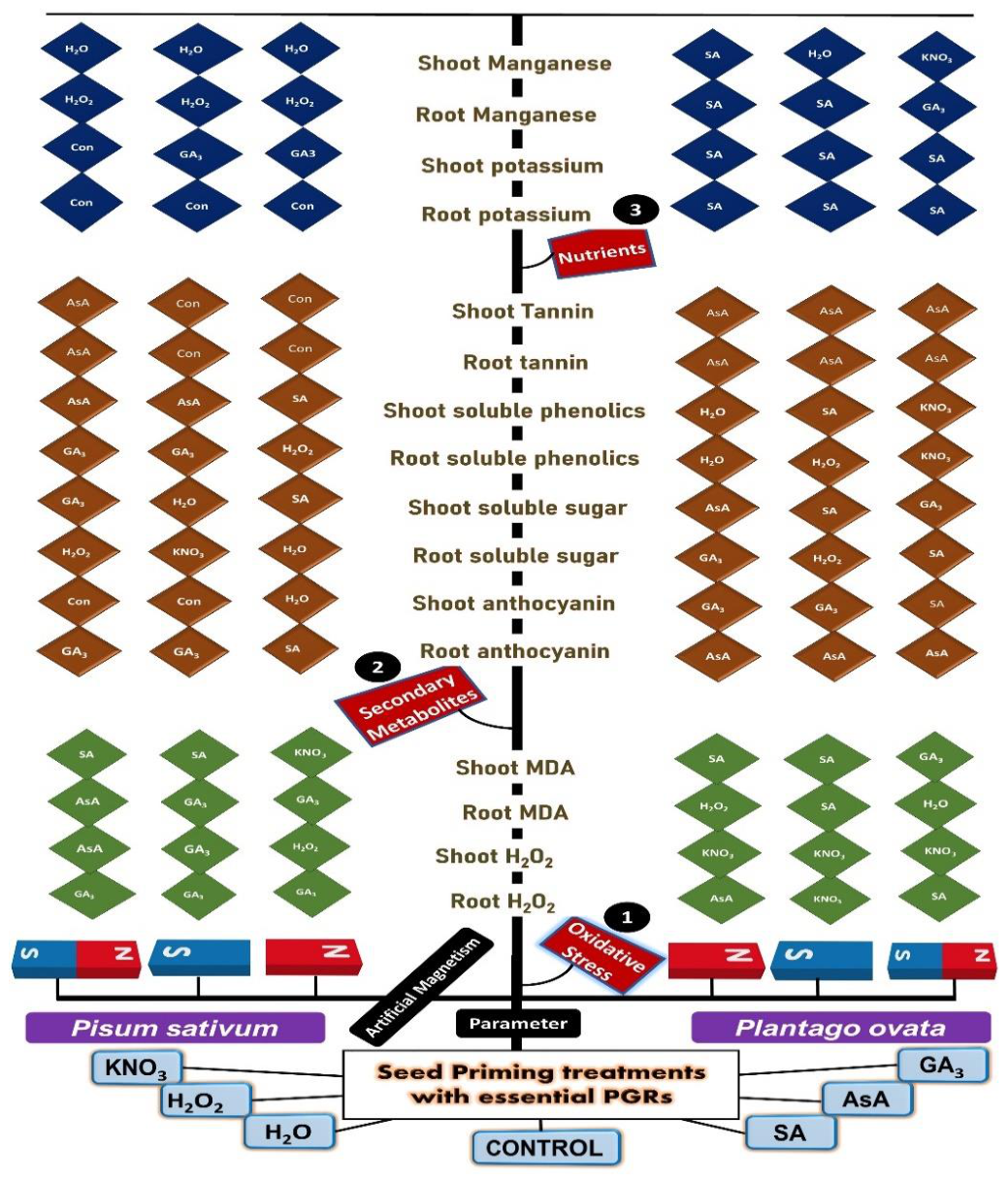
Comparison among most effective PGRs treatments of different physiological and nutritional parameters in Pisum sativum and Plantago ovata under Artificial magnetism (north, south and north/south). *The comparison between pea and plantago revealed significant variations in overall parameters analyzed. Two important plants seeds were subjected to PGRs i.e., KNO3, H2O2, SA, AsA, GA3 treatments under artificial magnetism (N, S and N/S). The parameters of oxidative stress, secondary metabolities and nutrients included both root and shoot showed significant (p < 0.05) and non-significant (p > 0.05) variations among treatments of PGRs. The overall results portrayed a clear understanding and a record of essential PGRs in the maximum accumulation of physiological and biochemical attributes. Resultantly, GA3 and KNO3 were most effective seed priming treatments in oxidative damage parameter by boosting in their contents as compared to control conditions, while in different secondary metabolities attributes, SA in pea and plantago, while AsA most importantly in plantago recorded the maximum content in both root and shoot. Finally, the priming of SA proved to accumulate higher nutrients content in plantago seedlings as compared to pea seedlings. Therefore, the present study recommends the use of PGRs priming in combination with artificial magnetism is very essential for better growth and development of plantago and pea seedlings by accumulating higher physiological and biochemical contents.
Disclaimer/Publisher’s Note: The statements, opinions and data contained in all publications are solely those of the individual author(s) and contributor(s) and not of MDPI and/or the editor(s). MDPI and/or the editor(s) disclaim responsibility for any injury to people or property resulting from any ideas, methods, instructions or products referred to in the content. |
© 2026 by the authors. Licensee MDPI, Basel, Switzerland. This article is an open access article distributed under the terms and conditions of the Creative Commons Attribution (CC BY) license (http://creativecommons.org/licenses/by/4.0/).
Copyright: This open access article is published under a Creative Commons CC BY 4.0 license, which permit the free download, distribution, and reuse, provided that the author and preprint are cited in any reuse.