

Submitted:
23 October 2026
Posted:
26 October 2026
You are already at the latest version
Abstract
Climate-driven expansion of Leishmania infantum and its phlebotomine vectors is reshaping the geography of leishmaniasis across Europe, while surveillance systems remain largely dependent on labour-intensive trapping and pathogen screening. We propose a hypothesis-driven framework in which surface environmental DNA (eDNA) collected from sand fly resting microhabitats is analysed using duplex droplet digital PCR (ddPCR) targeting both vector and parasite DNA. The approach is not intended to replace conventional entomological surveillance but to function as a first-tier triage tool for identifying locations where targeted trapping and pathogen investigations should be prioritised.The hypothesis is based on three observations: (i) adult sand flies aggregate at predictable sheltered resting sites; (ii) infected sand flies may harbour substantial parasite burdens, with each Leishmania parasite containing thousands of kinetoplast minicircle copies; and (iii) biological residues deposited at resting sites may contribute detectable quantities of vector and parasite DNA to environmental surfaces. We therefore hypothesise that repeated occupation of resting microhabitats could generate environmental DNA signals reflecting local vector–parasite co-occurrence.We outline a tiered interpretation framework and a falsifiable validation pathway combining controlled insectarium experiments and field investigations. Particular emphasis is placed on distinguishing environmental detection of parasite DNA from evidence of active transmission and on defining the analytical and ecological conditions required for reliable signal interpretation.If validated, surface eDNA surveillance could provide a scalable spatial risk surveillance component within integrated One Health surveillance systems, helping to prioritise entomological investigations in newly exposed or under-surveyed regions. Beyond operational surveillance, this framework may contribute to addressing a recurrent challenge in neglected tropical diseases: distinguishing true emergence from delayed detection in areas where transmission has historically been overlooked.
Keywords:
environmental DNA
; ddPCR
; Phlebotomus
; Leishmania infantum
; surveillance
; range expansion
Northward Shift, Static Surveillance
Leishmaniasis due to Leishmania infantum is regarded as a Mediterranean zoonosis, but this picture is changing rapidly under ongoing climate change. Phlebotomus (Larroussius) perniciosus, the primary proven vector of L. infantum in Western Europe, is expanding northwards i,ii. Climatic suitability models project further expansion toward central and northern Europe under mid-to-high emission scenarios, with the Rhine and Danube valleys as dispersal corridors iii [1]. These data suggest that the northern front of L. infantum transmission risk in Europe is broader and moving faster than previously appreciated. Simultaneously, Phlebotomus (Transphlebotomus) mascittii, the northernmost European sandfly species, recorded above 50°N in Germany [2] and reported in Belgium [3], has been shown to support L. infantum development to the transmissible stage [4,5].
In newly exposed zones beyond the Mediterranean focus, dedicated entomological monitoring infrastructure is typically absent, and sandfly screening is triggered after human or canine clinical cases occur iv. Although trap networks can be deployed progressively, large-scale entomological surveillance across extensive geographic areas remains labour-intensive and resource-demanding. An anticipatory screening approach capable of prioritising locations for targeted trapping could therefore improve surveillance efficiency.
From Presence/Absence to Actionable Signal
In vector-borne disease epidemiology, confirming presence of sandfly vector species in a new area is insufficient to demonstrate ongoing pathogen circulation. The critical threshold for public health response is evidence of an active transmission cycle, defined as detection of Leishmania within competent vectors in the field v. Current workflows address this in two slow, labour-intensive steps: (i) trap deployment to confirm vector presence and abundance; (ii) female dissection of non-engorged sandfly females and/or PCR to detect Leishmania infection [6]. This process is incompatible with large-scale screening at expansion fronts.
What is needed in these settings is not a replacement for classical entomology, but a triage system: a first-tier filter that identifies sites where environmental evidence justifies deploying conventional, resource-intensive surveillance. Surface environmental DNA (eDNA) swabbing of sandfly resting microhabitats analysed by duplex droplet digital PCR (ddPCR) could fulfil this role (Figure 1).
One Swab, Two Signals
Adult Phlebotomus spp. aggregate predictably at sheltered resting microhabitats, including rock crevices, stone walls, burrow entrances and cave mouths [6]. At these locations, infected and non-infected sand flies may deposit insect-derived biological material, including cuticular fragments and excreta, while dead individuals may provide an additional source of insect DNA on environmental surfaces. Whether infected sand flies also contribute detectable amounts of parasite kDNA to these surfaces remains unknown and constitutes a central experimental question of the proposed hypothesis. Vertebrate hosts using the same microhabitats, as well as other environmental sources, may also contribute L. infantum DNA. Infected sand flies may harbour substantial parasite burdens, particularly within the digestive tract, with each parasite containing thousands of minicircle copies. Consequently, biological materials naturally deposited at resting sites, dead insects, or other biological residues, could potentially contribute detectable quantities of parasite DNA to environmental surfaces. Repeated aggregation of sand flies at sheltered resting microhabitats may further favour the accumulation of such DNA over time.
In contrast to larval habitats, which are cryptic and spatially heterogeneous [6], adult resting microhabitats can often be identified from known sand fly ecology. Although resting patterns are micro-focal, potentially species-specific and affected by season, many sand fly species are expected to share broad categories of sheltered resting habitats, based on similar traits of their biology. Consequently, site detection requires knowledge of resting-site characteristics, while allowing the development of standardized sampling frameworks adapted to local ecological contexts. These stable, revisitable microhabitats represent points for passive DNA accumulation.
Surface eDNA swabbing is a practical approach for detecting terrestrial arthropods from vegetation, bark, stones, and artificial substrates [7,8,9]. Studies comparing substrates and sampling methods show that nylon-flocked forensic swabs combined with double-pass (dry + wet) protocols substantially improve DNA recovery from rough, porous mineral surfaces compared with cotton or polyester swabs [8,11]. Surface substrates consistently outperform bulk soil for arthropod eDNA detection [8,11]. Detection success nevertheless depends on substrate type, swabbing strategy, and contamination control. This approach is best suited to structured resting microhabitats and may be less effective in dynamic substrates such as sandy soils, requiring substrate-specific validation, blanks, and contamination controls.
We hypothesize that a duplex ddPCR assay applied to DNA from a resting-site surface swab can simultaneously deliver two epidemiologically relevant signals (Figure 1).
Phlebotomus spp.
Species-level resolution is essential, as generic Phlebotomus detection is not epidemiologically informative; proven L. infantum vectors in the Western Palaearctic belong to the subgenus Larroussius (e.g., Ph. perniciosus), which has already expanded into Germany, Austria, Switzerland, and Slovenia i,ii, while models project further northward spread of Ph. perfiliewi and Ph. neglectus into the northern Balkans and Alpine foreland iii [1]. In parallel, Ph. mascittii appears to be expanding its range; assays should prioritise species-specific detection of Ph. perniciosus and Ph. mascittii using COI-based ddPCR to confirm local presence, supported by COI data. Although in regions with closely related taxa (e.g., the Ph. perniciosus/Ph. longicuspis complex), limited COI divergence may require additional markers or probe optimisation.
Leishmania Infantum kDNA
In this framework, a L. infantum-specific kDNA assay is proposed because kinetoplast minicircles provide exceptional analytical sensitivity for detecting parasite DNA in environmental samples. Whether L. infantum kDNA accumulates and persists at sandfly resting microhabitats remains unknown and represents a hypothesis requiring validation.
Important Caveat
A dual-positive swab result detects vector and parasite DNA co-occurring on a surface, not within the same organism. Based on current knowledge, parasite DNA detected at a resting site could originate from infected sand flies, vertebrate hosts using the same microhabitat, or other environmental sources. The relative contribution of these sources is currently unknown and represents an explicit component of the proposed validation framework. However, detection of parasite DNA alone does not demonstrate the presence of viable parasites, infected vectors at the time of sampling, or an active transmission cycle. A dual-positive signal therefore constitutes a high-priority spatial risk signal rather than proof of ongoing transmission. Confirmatory trap-based entomology remains required.
Analytical Performance at the Detection Limit
Two features make ddPCR particularly well suited for detecting Leishmania eDNA. First, the kinetoplast (kDNA) contains thousands of minicircle copies per parasite, making most sensitive molecular targets available [12]. This high copy number increases the likelihood of detecting trace DNA in low-biomass samples such as resting-site surface swabs, and ddPCR assays targeting kDNA have achieved detection limits equivalent to a single parasite with high specificity [12]. Whether comparable performance can be achieved from environmental surface samples remains to be determined.
Second, by partitioning reactions into thousands of nanolitre droplets, ddPCR improves precision near the detection limit and reduces the impact of PCR inhibitors commonly found in environmental samples [10,12,13]. This enhanced tolerance can improve detection of very low DNA concentrations, down to ~1 copy/μL or below, particularly in low-biomass or inhibitor-rich samples where qPCR performance may be reduced [10,12]. Overall, ddPCR outperforms qPCR for low-concentration eDNA, including inhibitor-rich matrices such as soil-derived samples [10,14].
However, such analytical sensitivity requires cautious interpretation: detection of kDNA indicates the presence of parasite DNA, but not necessarily viable parasites or active transmission. Appropriate controls, including extraction blanks, inhibition controls and DNA persistence/decay controls are therefore essential when interpreting weak positives near the detection limit.
A Tiered Interpretation Framework
To prevent overclaiming from dual-positive results, we propose a five-tier environmental alert framework that accounts for the multiple possible origins of each signal (Table 1). This structure positions the eDNA swab as a rational resource-allocation tool, directing expensive conventional entomology where environmental evidence justifies it, rather than as a standalone diagnostic.
A Testable Experimental Pathway
Although this forum does not present new data, the proposed framework is structured around a tractable validation pathway.
Insectarium Proof-of-Concept
Controlled insectarium experiments can establish whether surface eDNA reliably reflects sandfly presence and infection under realistic conditions. Colonies of experimentally infected Phlebotomus perniciosus maintained in resting enclosures would allow estimation of signal emergence, persistence and decay on representative substrates such as limestone, plaster, wood and concrete. By varying sandfly density, infection prevalence, blood-feeding status and environmental parameters (temperature, humidity, UV exposure), these experiments will test explicitly whether dual COI/kDNA signals can be generated and sustained on surfaces at biologically plausible levels, or whether the concept fails under controlled conditions. This step is designed not only to optimise protocols, but also to falsify the hypothesis if surface kDNA proves too rare or unstable to support reliable detection.
Field Validation
At sites with established entomological records, parallel eDNA swabbing and conventional trapping can evaluate whether dual-positive signals are spatially enriched at resting microhabitats while independently assessing the performance of the vector and parasite signals. Vector-DNA detection can be assessed against the presence and abundance of the target sand fly species, whereas parasite-kDNA detection can be evaluated against the occurrence of naturally infected sand flies. The critical test of the proposed duplex approach will be whether dual-positive environmental signals are spatially associated with sites where competent vectors and L. infantum circulation are independently documented.
Deployment at Expansion Fronts
In climatically suitable but under-surveyed regions, eDNA swabbing can be implemented as a first-pass screening tool. Its value lies in operational scalability: rapid daytime sampling across large areas can guide targeted deployment of conventional traps, reducing the need for dense surveillance networks in newly exposed zones.
From Concept to Validation
Surface eDNA swabbing of sandfly resting microhabitats, coupled with duplex ddPCR targeting vector and Leishmania DNA, may provide a practical first-tier screening tool for leishmaniasis surveillance in expanding risk zones, with operational advantages in cost and daytime deployability where trapping infrastructure is limitedv. Co-detection of vector and parasite DNA on surfaces, however, does not demonstrate that individual sandflies are infected or transmission occurring, and interpretation critically depends on understanding DNA persistence and microhabitat ecology. If validation studies confirm that dual-positive signals are specific, reproducible and spatially associated with true resting microhabitats, this approach could integrate into the European surveillance toolbox as a triage layer guiding where conventional entomology should be deployed first. This aligns with ECDC guidance calling for anticipatory, One Health-based, multi-component early-warning systems capable of identifying transmission risk before clinical cases emerge, in a context where climate and mobility are reshaping the geography of leishmaniasis. Beyond surveillance efficiency, environmental screening approaches may help address a recurrent challenge in neglected tropical diseases: distinguishing true emergence from delayed detection in previously under-surveyed areas. This distinction is particularly relevant for leishmaniasis, where apparent geographic expansion may reflect a combination of climate-driven spread, improved surveillance and historical under-recognition of transmission foci [15].
Declaration of generative AI and AI-assisted technologies in the writing process
During the preparation of this work the author used Chagpt in order to correct the grammar and to improve the overall readability of the manuscript. After using this tool/service, the author reviewed and edited the content as needed and takes full responsibility for the content of the publication.
Declaration of Interests
The authors declare no competing interests.
i CLIMOS Consortium. Climate variability drives changes in sand fly distribution, amplifying leishmaniasis risks. CLIMOS Project, Climate-Health.eu; 2024. https://climos-project.eu (accessed 7 May 2026). |
|
ii ECDC/EFSA. Phlebotomine sandfly maps – Phlebotomus perniciosus, current known distribution, October 2023. https://www.ecdc.europa.eu/en/disease-vectors/surveillance-and-disease-data/phlebotomine-maps
|
|
iii EEA. Climatic suitability for leishmaniasis transmission – indicator assessment. EEA Climate-ADAPT; 2025. https://climate-adapt.eea.europa.eu
|
|
iv ECDC. Surveillance, prevention and control of leishmaniases in the EU and neighbouring countries. Technical Report; 2022. https://www.ecdc.europa.eu
|
|
v CLIMOS/ECDC. The spatial relationship between leishmaniases and sand flies in Europe. Technical Report; 2023. https://www.ecdc.europa.eu
|
References
- González-Calderón, A.; Brun, P.; Morosetti, G.; Gradoni, L.; et al. Species-specific variation in predicted distribution and habitat suitability of phlebotomine sand flies in Italy under different climate change scenarios. Sci. Rep. 2025, 15, 96296. [Google Scholar] [CrossRef] [PubMed]
- Krüger, A.; Crecelius, A.; Fischer, D.; Hagen, R.M. New records of Phlebotomus (Transphlebotomus) mascittii Grassi, 1908 in northern Rhineland-Palatinate (Diptera: Psychodidae: Phlebotominae). Contrib. To Entomol. 2025, 75(1), 15–19. [Google Scholar] [CrossRef]
- Schaffner, F.; Schneider, A.; Debbaut, R.; Van Bortel, W. Confirmation of the occurrence of phlebotomine sand flies (Diptera: Psychodidae, Phlebotominae) in Belgium, Luxembourg Province. J. Eur. Mosq. Control Assoc. 2025, 43(2), 69–73. [Google Scholar] [CrossRef]
- Sádlová, J.; Hošková, M.; Volf, P.; Dvořák, V.; et al. First experimental assessment of Phlebotomus mascittii vector competence for Leishmania infantum and Leishmania martiniquensis. Parasites Vectors 2026, 19(1), 82. [Google Scholar] [CrossRef] [PubMed]
- Obwaller, A.G.; Karakus, M.; Poeppl, W.; Töz, S.; Özbel, Y.; Aspöck, H.; Walochnik, J. Could Phlebotomus mascittii play a role as a natural vector for Leishmania infantum? New data. Parasit. Vectors 2016, 9, 458. [Google Scholar] [CrossRef] [PubMed]
- Alexander, B.; et al. Sampling strategies for phlebotomine sand flies (Diptera: Psychodidae) in leishmaniasis control programmes. Bull. Entomol. Res. 2016, 106(3), 297–313. [Google Scholar]
- Leandro, C.; Jay-Robert, P.; Pétillon, J. eDNA for monitoring and conserving terrestrial arthropods: insights from a systematic map and barcode repositories assessments. Insect Conserv. Divers. 2024, 17(3), e12726. [Google Scholar] [CrossRef]
- Allen, M.L.; et al. Using surface environmental DNA to assess arthropod biodiversity on vegetation. Environ. DNA 2024, 6(1), e487. [Google Scholar] [CrossRef]
- Mächler, E.; Beletsky, D.; Deiner, K.; Spahn, F.; Altermatt, F. Combining ddPCR and environmental DNA to improve detection of rare freshwater invertebrates. Sci. Rep. 2019, 9, 14064. [Google Scholar] [CrossRef] [PubMed]
- Đokić, M.; Jojić, V.; Vujić, M.; et al. Soil eDNA-based droplet digital PCR assay as a new monitoring tool for terrestrial mammals. Glob. Ecol. Conserv. 2025, 62, e03780. [Google Scholar] [CrossRef]
- Baudoin, M.; Berard, A.; Pradel, J.; et al. Spider webs, soil or leaf swabs to detect environmental DNA from terrestrial vertebrates: What is the best substrate? Mol. Ecol. Resour. 2025, 25(8), e70037. [Google Scholar] [CrossRef] [PubMed]
- Alvaro, A.; Cattaneo, G.M.; Varotto-Boccazzi, I.; Molteni, R.; Mendoza-Roldan, J.A.; Brilli, M.; Conconi, M.S.; Giovagnoli, V.; Manenti, A.; Otranto, D.; Bandi, C.; Epis, S. Development of a novel ddPCR assay for the simultaneous detection of the protozoan parasites Leishmania infantum and Leishmania tarentolae. Parasites Vectors 2025, 18(1), 243. [Google Scholar] [CrossRef] [PubMed]
- Doi, H.; et al. Droplet digital polymerase chain reaction (PCR) outperforms real-time PCR in the detection of environmental DNA from an invasive fish species. Environ. Sci. Technol. 2015, 49, 5601–5608. [Google Scholar] [CrossRef] [PubMed]
- Guri, G.; Ray, J.L.; Shelton, A.O.; Kelly, R.P.; Præbel, K.; Allan, E.A.; et al. Quantifying the detection sensitivity and precision of qPCR and ddPCR mechanisms for eDNA samples. Ecol. Evol. 2024, 14(12), e70678. [Google Scholar] [CrossRef] [PubMed]
- Sereno, D. When discovery meets neglect: rethinking disease emergence in cutaneous leishmaniasis and other neglected tropical diseases. Front Trop. Dis. 2026, 6, 1744659. [Google Scholar] [CrossRef]
Figure 1.
Surface eDNA as a triage filter for leishmaniasis surveillance. (A) Adult sandflies aggregate at sheltered resting microhabitats where DNA accumulates on accessible surfaces. (B) Surface swabs analyzed by duplex ddPCR generate two signals: vector DNA (COI) and Leishmania DNA (kDNA). (C) Combined signal interpretation provides a tiered framework in which dual-positive sites represent spatial risk signals of potential vector–parasite co-occurrence, guiding targeted deployment of conventional entomological surveillance.
Figure 1.
Surface eDNA as a triage filter for leishmaniasis surveillance. (A) Adult sandflies aggregate at sheltered resting microhabitats where DNA accumulates on accessible surfaces. (B) Surface swabs analyzed by duplex ddPCR generate two signals: vector DNA (COI) and Leishmania DNA (kDNA). (C) Combined signal interpretation provides a tiered framework in which dual-positive sites represent spatial risk signals of potential vector–parasite co-occurrence, guiding targeted deployment of conventional entomological surveillance.
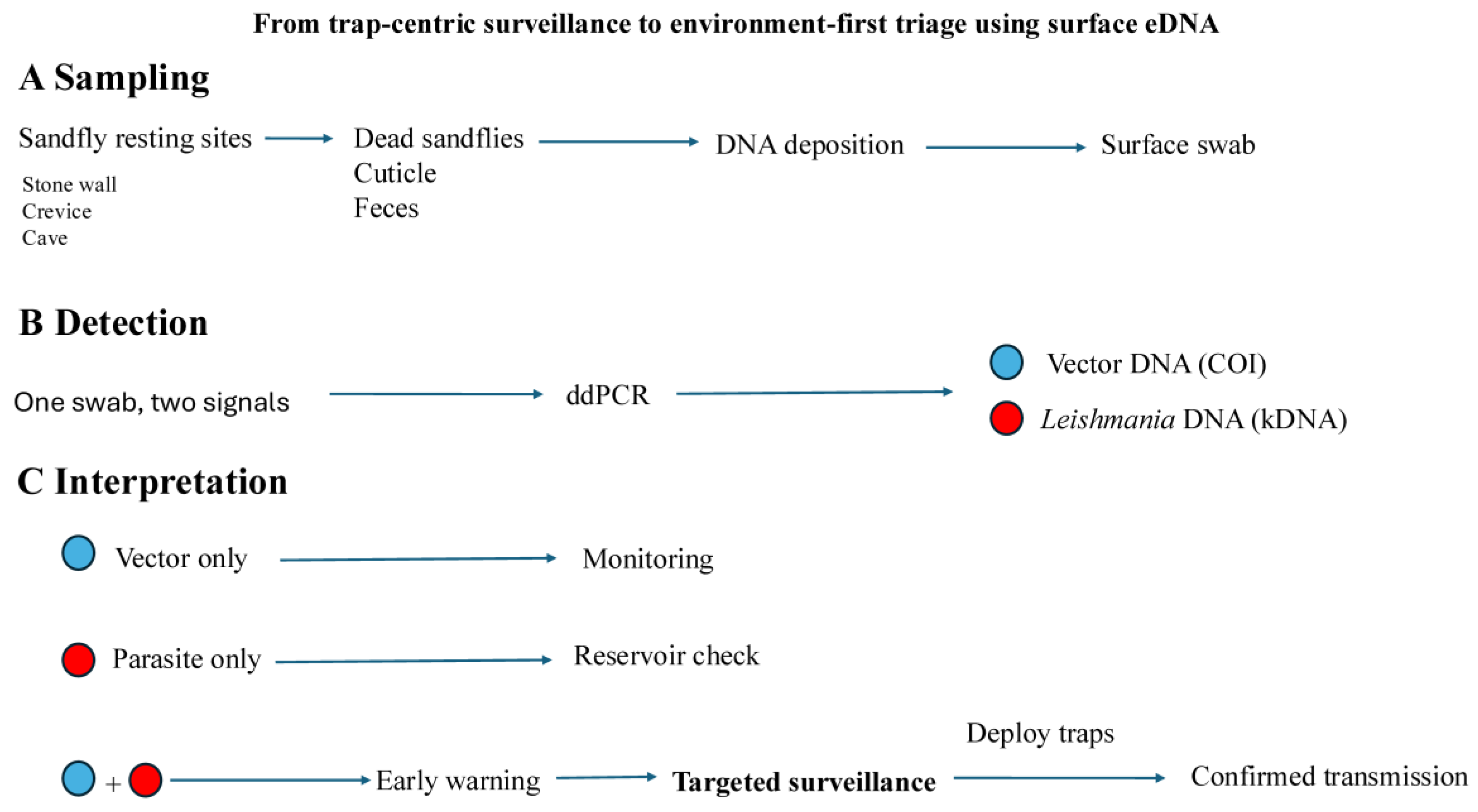

Table 1.
Tiered interpretation of eDNA swab results.
| eDNA result | Interpretation | Potential action if framework is validated |
| Vector DNA only | Possible vector presence or transient DNA deposition | Repeat eDNA monitoring; flag for next-season trapping |
| Parasite DNA only | Reservoir/environmental signal | Repeat sampling; assess nearby reservoir hosts if signal is replicated. Trigger canine serosurvey |
| Dual positive, low copy | Candidate spatial risk signal | Deploy CDC light traps at flagged site |
| Dual positive, replicated + species-specific | High-priority alert | Full entomological investigation + reservoir survey |
| Dual positive + trapped infected sandfly | Confirmed transmission evidence | Public health notification |
Disclaimer/Publisher’s Note: The statements, opinions and data contained in all publications are solely those of the individual author(s) and contributor(s) and not of MDPI and/or the editor(s). MDPI and/or the editor(s) disclaim responsibility for any injury to people or property resulting from any ideas, methods, instructions or products referred to in the content. |
© 2026 by the authors. Licensee MDPI, Basel, Switzerland. This article is an open access article distributed under the terms and conditions of the Creative Commons Attribution (CC BY) license (http://creativecommons.org/licenses/by/4.0/).
Copyright: This open access article is published under a Creative Commons CC BY 4.0 license, which permit the free download, distribution, and reuse, provided that the author and preprint are cited in any reuse.