
Submitted:
24 October 2026
Posted:
26 October 2026
You are already at the latest version
Abstract
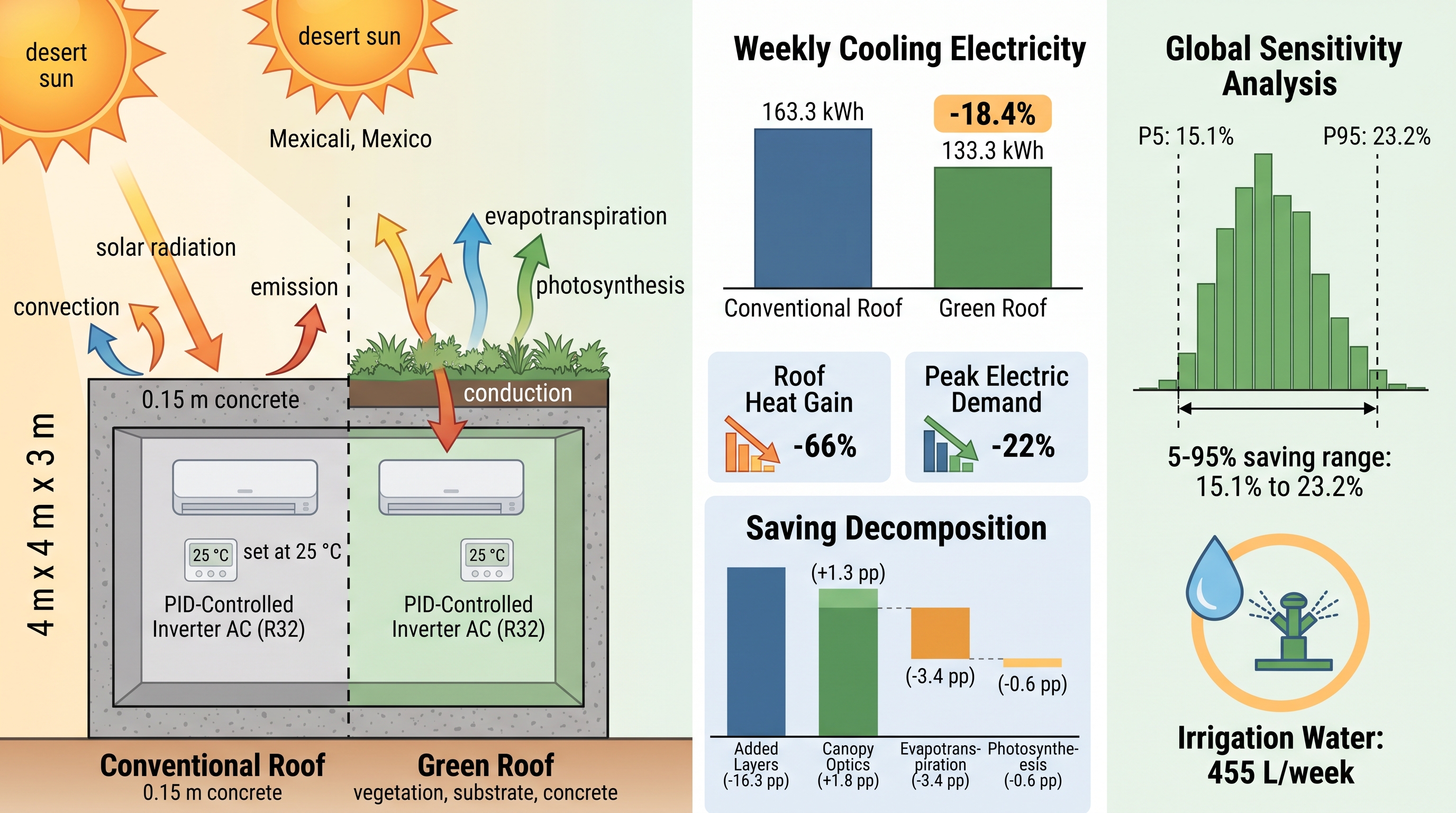
The cooling benefit of green roofs in the extreme heat of northern Mexico has rarely been quantified with dynamic models that couple the envelope with a controlled air-conditioning system. This study develops such a model for a 4 m × 4 m × 3 m concrete mini-building in Mexicali, Mexico (hot-desert climate), and compares a bare 0.15 m concrete roof with the same slab covered by a green roof. The model couples one-dimensional conduction through the roof and four walls, orientation-specific solar irradiance, evapotranspiration and photosynthesis sinks, a dynamic indoor-air balance and an inverter air conditioner with a proportional–integral–derivative controller tuned by the Ziegler–Nichols method, whose electricity use follows a vapour-compression cycle. The numerical solution was verified against analytical solutions, an independent implicit solver and energy-closure checks. Driven by measured weather for 10–16 June 2025, the green roof reduced the weekly cooling electricity from 163.3 to 133.3 kWh (18.4%), the peak electric demand by 22% and the roof heat gain by 66%, and avoided the capacity saturation of the conventional building. The added thermal resistance of the green-roof layers accounted for 16.3 percentage points of the saving, evapotranspiration for 3.4 points and photosynthesis for 0.6 points, whereas the canopy optical properties cost 1.8 points. A global sensitivity analysis gave a 5–95% range of 15.1–23.2% for the saving; the green-layer conductivity model, the sky temperature, the crop coefficient and the set point were the most influential inputs. The green roof required 455 L of irrigation water per week.
Keywords:
green roof
; evapotranspiration
; hot-arid climate
; cooling energy
; building energy simulation
; PID control
Copyright: This open access article is published under a Creative Commons CC BY 4.0 license, which permit the free download, distribution, and reuse, provided that the author and preprint are cited in any reuse.