

Submitted:
23 October 2026
Posted:
26 October 2026
You are already at the latest version
Abstract
Analyzing genetic progress from breeding efforts hitherto is essential not only for determining the effectiveness and efficiency of breeding programs but also to design more impactful strategies in the future. This study was conducted to determine genetic progresses from faba bean (Vicia faba L.) breeding for grain yield, seed size, stand survival and tolerance to black root rot (Fusarium solani) disease over the past forty-seven years in Ethiopia. Twenty-two improved faba bean varieties, along with a local check, were evaluated in a randomized complete block design (RCBD) with three replications during 2024 growing season at Ambo and Ginchi, Ethiopia. The results indicated significant differences among varieties for all traits. The linear regression of grain yield, seed size, and stand survival on year of variety release was positive and significant, whereas black root rot disease severity was also negatively significant. The average annual genetic progresses were 32.52 kg ha⁻¹ year⁻¹ for grain yield (R2 = 0.47), 1.32 g 100-seed⁻¹ year⁻¹ for seed size (R2 = 0.64) for seed size, 0.58% year⁻¹ for stand survival (R2 = 0.69) and that of black root rot disease severity was -0.36% year⁻¹ (R2 = 0.58). Overall, the findings demonstrate that substantial genetic progresses were realized for all the traits, confirming the effectiveness and efficiency of the faba bean breeding endeavors over the breeding period.
Keywords:
annual genetic progress
; disease severity
; economic traits
; regression coefficient
; stand survival
1. Introduction
Faba bean (Vicia faba L.) is considered as one of the most important pulse crops in the world. In Ethiopia, the crop is grown primarily for its edible seeds that are used for human consumption in different forms [1]. It is a valuable source of protein, carbohydrates, B group vitamins, and minerals [2] and also recognized as one of the most efficient in terms of biological nitrogen fixation, exhibiting one of the highest nitrogen-fixing capacities among legumes [3]. Consequently, it is widely incorporated into crop rotation systems to restore soil fertility and to reduce the incidence of soil-borne pathogens [4]. Ethiopia is among the major faba bean producing countries in the world, ranking second next to the People’s Republic China [1,5], and considered to be one of the centers of secondary diversity [5].
A major limiting factor in faba bean production is the impact of diseases. According to Abebe et al. [6], several diseases of faba bean are economically important in Ethiopia. These include chocolate spot (Botrytis fabae), rust (Uromyces viciae-fabae), black root rot (Fusarium solani), Ascochyta blight (Ascochyta fabae) and several viral diseases. Black root rot is a destructive soil-borne disease that affects the crop, particularly in heavy black clay vertisols [7]. Black root rot is reported to be caused not only by Fusarium solani but by a complex association of pathogens, including Fusarium spp., Rhizoctonia solani, and Pythium spp. [6,8,9].
Soil borne pathogens affect crops from their initial stages in nurseries until harvest and cause significant economic losses [10,11]. In severe conditions on farmers’ fields, annual yield loss due to wilt and root rots can reach up to 45-70% [9]. When favorable conditions prevail and severe infections occur, the disease can cause complete crop loss [9,12]. Therefore, developing cultivars, which are resistant to detrimental pathogens including black root rot is most cost-effective with reduced agrochemical inputs [13].
Improved crop varieties are a key output of agricultural research and have contributed to significant increases in agricultural production and productivity [14]. The inception of faba bean breeding in Ethiopia dates back to the 1950’s; focusing on improvement of economic traits like grain yield and seed size [15]. Breeding for resilience to black root rot disease and waterlogging stress also deserved top priorities as prime objectives of the breeding program [16,17].
Breeding efforts by the Ethiopian Institute of Agricultural Research (EIAR) have resulted in the release of several faba bean varieties characterized by high yield potential and tolerance to different stresses including waterlogging and root rot diseases specifically on vertisols [18,19,20].
The deployment of improved varieties remains the most effective strategy not only for enhancing productivity but also for the safest managing plant diseases. However, the development of improved cultivars needs periodic determination of genetic progresses as varieties could deteriorate because of pathogens evolution, the production system dynamics and changes in environmental conditions [21,22]. Likewise, such efforts reaffirm the reliability of hybridization and selection and the accuracy of conclusions about genetic improvement in economic traits and resilience to stresses [17].
Although significant efforts have been made to develop high-yielding and root rot–tolerant faba bean varieties for better performance under waterlogged vertisols in Ethiopia, during the last 47 years, there is limited evidence whether these long-term breeding efforts have effectively improved key economic traits. To date, only Tolessa et al. [23] have assessed breeding progress under non-waterlogged environments where root rot diseases are less important, focusing on economic traits including grain yield, seed size and chocolate spot disease. In this context, it is a high time for evaluation of the genetic progresses from breeding faba bean for higher grain yield and resilience to waterlogging and black root rot diseases as it is critically important. Such evaluation helps to validate the success of previous breeding efforts, assess the efficiency of applied strategies, identify existing gaps, and inform future breeding directions. The objectives of this study are, therefore, to assesses the genetic progress achieved from over the past four decades of faba bean breeding specifically for agronomic and host tolerance to black root rot under waterlogged vertisols in Ethiopia.
2. Results
2.1. Performance of the Genotypes
The analysis of variance (ANOVA) revealed significant (P < 0.01) differences among the genotypes for all traits, i.e., disease severity, seed size, stand survival and grain yield. Likewise, the effect of location revealed a significant difference for stand survival (P < 0.05), a highly significant (P < 0.01) difference for seed size and grain yield and a non-significant difference for black root rot disease severity, whereas genotype by location (G x L) interaction effects were significant (P < 0.01) for seed size and grain yield, but non-significant for disease severity and stand survival (Table 1).
In terms of response to black root rot disease, EH016021-4, Chalew, EH016021-5, Ashbeka and Gora exhibited the lowest disease severity, with values of 27.16%, 27.91%, 28.10%, 30.92%, and 31% in that order. These varieties showed corresponding reduction in black root rot disease severity of 40.30%, 38.64%, 38.25%, 32.04% and 31.87% respectively, compared to CS20DK as the oldest variety released for the first in Ethiopia. Whereas, the highest disease severities ranging from 44.90-55.19% were recorded for the local variety and two oldest varieties, namely CS20DK and Kuse. Other two varieties, namely Dosha and Obsie, released primarily for potential environments where there is no waterlogging stress also scored disease severity of 44.02% and 43.12%, respectively (Table 2).
Likewise, the best genotypes with the highest stand survival also include the two pipeline materials, namely EH016021-5 (92.37%) and EH016021-4 (92.36%), and better adapted varieties like Numan (91.48%), Gora (90.5%), and Shoa (90.47%). These varieties showed 35.72-38.57% higher stand survival than the oldest variety, CS20DK (Table 2). In contrast, the local check, the two oldest varieties (namely CS20DK and Kuse 2-27-33), and another variety released for potential eco-geographical areas (Gebelcho) showed the least stand survival scores of 66.35-68.78% (Table 2).
Similarly, hundred seed weight differed considerably among varieties. The mean of hundred seed weight ranged from 37.31g – 120.04g (Table 2). The two pipe lines entries, (EH016021-5 and EH016021-4), along with Gora, Chalew, and Numan recorded comparatively higher seed sizes (82.98- 120.04 g) (Table 2). As compared to the oldest variety, CS20DK, the pipeline materials (EH016021-5, EH016021-4) and recently released varieties like Gora, Chalew and Numan, showed magnificent improvements ranging from 69.6- 145.39% (Table 2). Likewise, Numan, Dida’a, Shoa, Gora and Ashebeka revealed the highest grain yields (2412.3-2861.4 kgha-1), with a comparative advantage of 133.46-176.93% over the oldest check, CS20DK. Conversely, the local check and oldest varieties such as CS20DK and Bulga-70, and varieties released for potential environments like Gebelcho showed the lowest performance for grain yield (Table 2).
2.2. Genetic Progress for Host Resistance to Black Root Rot Disease
Considering the CS20DK as baseline references, the linear regression analysis of genotypic performances for black root rot severity on the years of release showed significant (p < 0.01) negative trend for disease severity over the 47 years of varietal development period at Ambo (R2 = 0.50), Ginchi (R2 = 0.58) and for the average performances combined over the two locations (R2 = 0.61) (Figure 1 A-C).
The result showed that the past faba bean breeding efforts resulted with the negative annual genetic reduction of -0.36% at Ambo, Ginchi and on the average where CS20DK was considered as the base line, resulting with an overall reduction of -16.92% to -19.27% in 47 years. The relative genetic gain was estimated to be -0.81% year-1 at Ambo, -0.76% year-1 at Ginchi, and -0.79% year-1 on the average, compared to CS20DK (Table 3).
2.3. Genetic Progress for Stand Survival
Unlike black root rot disease severity which showed a negative genetic progress, the analysis for stand survival percentages using linear regression showed significant (P<0.01) positive trends at Ambo (R2 = 0.74), Ginchi (R2 = 0.60) and for average performances combined over the two locations (R2 = 0.69) (Figure 2 A-C). The annual stand survival improvements were 0.61% at Ambo, 0.54% at Ginchi and 0.58% on the average. In relation to CS20DK as the base line variety, the relative genetic gains of 0.92% at Ambo, 0.80% at Ginch and 0.87% on the average year-1 were recorded. Over the 47 years of faba bean breeding the cumulative stand survival improvements ranged from 16.92 to 27.73% (Table 3).
2.4. Genetic Progress for Seed Size
Linear regression analysis revealed highly significant (P<0.01) positive trends for seed size against the year of release at Ambo (R2= 0.57), Ginchi (R2= 0.68), and for the average performances at the two locations (R2=0.64) (Figure 3 A-C). The annual genetic progress from breeding faba bean for seed size was estimated to be 1.30, 1.33 and 1.32 g 100 seeds-1 with cumulative seed size improvements over the last 47 years of 59.69 g, 60.16 g and 60.16g, at Ambo, Ginchi and across locations, in that order (Table 3). The relative genetic progress was estimated to be 2.85% year-1 at Ambo, 2.56% year-1 at Ginchi, and 2.70% year-1 across locations considering CS20DK variety as a reference (Table 3).
2.5. Genetic Progress for Grain Yield
Regression analysis demonstrated highly significant (p < 0.01) positive linear trend for grain yield over years of release (R2 = 0. 46) at Ambo (R2 = 0.30), Ginchi, and on the average (R2 = 0.47) across locations, considering CS20DK variety as a reference (Figure 4 A-C).
The analysis further revealed that the annual genetic progress for faba bean grain yield was estimated to be 40.96 kg ha⁻¹ yr⁻¹ or 3.28% year-1 at Ambo but a slightly lower gain of 24.09 kg ha⁻¹ yr⁻¹ or 2.09% year-1 was recorded at Ginchi, considering CS20DK as a reference (Table 3). The combined linear regression analysis for grain yield revealed that the estimated annual yield increment was 32.52 kg ha⁻¹, with corresponding annual relative genetic gains of 3.15% (Table 3)
2.6. Relationship Between Characters
There were positive linear regression coefficients for seed size and (R2 = 0.35) and stand survival (R2 = 0.77) with grain yield, whereas a negative relationship was revealed between black root rot disease severity and grain yield (R2=0.58). Every 1g increment in 100 seed weight was associated with 17.00 kg ha-1 increment in grain yield.
Likewise, for every 1% increase in stand survival, there was a 59.83 kg ha-1 increase in grain yield. In the contrary, an increase of 1% increase in disease severity resulted in a decrease of 69.40 kg ha-1 in yield (Figure 5 A-C).
3. Discussion
This study evaluated progresses of faba bean breeding for the last forty-seven years in Ethiopia, considering the oldest variety released in 1977. A substantial genetic progress was demonstrated from the significant improvements not only in grain yield and seed size but also for resilience to faba bean black root rot and waterlogging stress on vertisols. In almost all the cases, the local variety stood the least performer, indicating the inherent low yielding and stress tolerance of the indigenous cultivars as one of the most important production constraints [16].
The significant location effects indicated that the two locations were distinctly different for stand survival, seed size and grain yield. Likewise, the significant G x L interaction effects for seed size and grain yield also showed that the genotypes differently responded to changes in locations. As shown in the Table 1, grain yield contributed the largest proportions of the mean squares due to location, varieties and variety × location interaction effects, probably due to the fact that yield is a highly complex character conditioned by more polygenic nature as compared to the other traits and strongly influenced by changes in environmental conditions [17].
EH016021-4 and EH016021-5, and the recently released varieties such as Chalew, Ashbeka, and Gora exhibited the lowest disease severity, as the best varieties for resilience to black root rot disease and the associated waterlogging on vertisols. The negative annual genetic progress (-0.36%) observed in the present study indicates the periodically decreasing faba bean black root rot disease severity over the breeding period. This advancement in black root rot disease resistance maybe resulted from the fact varieties tailer-made for resistance to this disease were initially rigorously screened from segregants of hybridization grown under sick-plots artificial inoculated with the causative agent of black root rot [16], which may, in turn, contributed to greater selection accuracy and consequently larger genetic progress per breeding cycle [18]. These results align with the finding of Tolessa et al. [23] who reported 0.27% annual reduction for chocolate spot severity in faba bean over 33 years. Similarly, annual reduction of 0.19-0.42% for anthracnose disease severity on common bean was reported from a prior study in Ethiopia [24].
Resistance to root rot in faba bean was reported to be controlled by multiple genes and exhibits a complex inheritance pattern, classifying it as a quantitative trait [25,26]. This genetic complexity contributes to slow and incremental genetic improvement, as demonstrated by the average negative genetic progress of only -0.36% in host tolerance to black root rot over the past four decades. Similarly, stand survival percentage showed significant differences among the genotypes, with 90.47-92.37% stand performance for recently released varieties such EH016021-4, EH016021-5, Numan, Gora, and Shoa, compared to the oldest variety, CS20DK (Table 2). Under stressed conditions where the majority of the farmers are resource-poor and production are very subsistent, resilience to stresses and risk aversion are equally important as yield maximization as the economic potentials of the farmers does not permit them to shoulder any level of failure.
Under severe infection, black root rot causes stand loss by completely collapsing the root function and stunting plant growth, ultimately leading to progressive plant death [27]. An earlier study in Ethiopia also reported stand losses ranging from 19%-89% for faba grown on the sick-plot for black root rot depending on the level of resistance of the genotypes [28]. Another source indicated that the disease may cause an average yield loss ranging from 45-100% with susceptible cultivars depending on the level of infestation [29].
A previous study by Agegnehu [30], also indicated existence of considerable variation of stand survival among faba bean on vertisoil under the Ethiopian condition where black root rot adversely affects stand establishment. Therefore, an increasing trend in stand survival as the result of genetic progress from the breeding efforts thus far is evidence of positive breeding progress, indicating that selection over time may have contributed to more tolerance/resistance of recently released faba bean genotypes to black root rot as compared to the oldest released variety.
Seed sizes also showed substantial genetic improvement for the two pipe lines and recently released varieties with relative genetic progresses of 2.56- 2.85% year-1, indicating considerable genetic progress (Table 3). The genetic progress recorded in the present study is comparable to or higher than the progress reported for chickpea and field pea in earlier studies [31,32,33], suggesting better improvement in seed size in faba bean breeding over time. At both locations, the results reveal substantial genetic progresses for seed size, again indicating effectiveness of the breeding efforts hitherto. According to Tolessa et al. [23], seed size is the second primary trait of interest and a prime objective of faba bean breeding in Ethiopia, receiving a special attention both for export and local markets as both demand large seed size. The current estimate of relative genetic progress for seed size is higher than the previously reported progress of 1.55% in faba bean breeding under potential environments for the period ranging from 1977-2007 [23] and 1.94% year-1 for Kabuli-type chickpea varieties [34]. However, it is considerably lower than the annual relative genetic progress of 7.26% for seed size reported for Kabuli chickpea by Megersa et al. [35]. The consistent performance for seed size of the advanced inbred lines, EH016021-4 and EH016021-5, at both locations highlights the potential of these varieties, making them promising for the trait under consideration.
Similar to other traits, grain yield exhibited positive linear trend over the years of variety release (Figure 4 A-C), demonstrating that continuous varietal improvement has contributed positively to faba bean productivity overtime. The highest grain yields ranging from 2401.8-2861.4 kg ha-1 were recorded for the top five best performing varieties including Numan, Dida’a, Shoa, Gora, Ashbeka, and Chalew (Table 2).
Although Ginchi location showed smaller regression coefficient (25.26) (Table 4), it exhibited higher RGP percentage because of its lower baseline mean yield, resulting in a larger proportional improvement over time (Table 3). The relatively lower annual genetic progress observed at Ginchi is likely attributable to higher silt and lower sand content as compared to Ambo (Table 5) which resulted in more waterlogging that promote higher root rot disease severity and consequently constrain nodulation, nutrient uptake, and overall plant productivity [36]. This finding agrees with the report of Daniel et al. [37] who also observed location-specific variation in genetic progresses for lentil, demonstrating that the magnitude of breeding-induced improvements is dependent on environmental context and is not uniform across production environments.
Despite their superior seed size, EH016021-4 and EH016021-5 produced relatively lower grain yield as compared to the best performing varieties (Table 2). It is generally accepted that such varieties with reasonable yields but fewer risks could be preferable as alternatives than those having high yield potential with high risks under marginal conditions where problems of pests and environmental stresses are prevalent [38].
The overall annual genetic progress achieved for grain yield in these faba bean genotypes was 32.52 kg ha⁻¹ yr⁻¹ (Table 3). These finding indicates that the genetic progress achieved in faba bean is relatively lower than the progresses previously reported for chickpea (80 kg ha⁻¹ yr⁻¹) and lentil (52 kg ha⁻¹ yr⁻¹) by Fikre et al. [39]. However, the present genetic progress in faba bean is by far greater than the past genetic progress of 8.74 kg ha⁻¹ yr⁻¹ reported by Tolesa et al. [23]. Comparable levels of annual relative genetic progress had been reported for haricot bean in Ethiopia, where a progress of 3.24% year-1 was documented by Bezaweletaw et al. [40]. Similarly, Barili et al. [41] reported an annual relative genetic progress of 2.42% for black common bean in Brazil.
The local check and oldest released varieties, particularly CS20DK and Kuse, including those that were released for potential environments like Dosha and Obsie, showed the highest disease severity, indicating comparatively poor resistance to black root rot. Similarly, the local check including the old varieties like CS20DK, Selale, Bulga-70 and Kuse had the smallest seed size; whereas CS20DK, Gebelcho, Kuse, and Bulga-70 exhibited the lowest grain yield and stand survival (because they were not specifically bred for waterlogging and root rot stress resistance/tolerance).
Generally, as the results of breeding efforts, resilience to waterlogging and black root rot disease stresses were improved in recently released varieties as clearly revealed by better disease resistance, stand survival, seed size and grain yields as compared to the oldest varieties (Table 2). Other authors also evaluated released and promising faba bean genotypes under potential faba bean growing environments with no waterlogging stress in Ethiopia, and observed more or less similar results where recently released varieties revealed better chocolate spot (Botrytis fabae) resistance, seed size and grain yield as compared to the older ones [23].
In addition, positive relationship between traits, namely seed weight and stand survival with grain yield, and negative relationship between black root rot disease severity and grain yield. The positive relationship between seed size and grain yield in this set of materials indicate that breeding for large seed size did not compromise for grain yield, as often reported by others [42,43,44].
4. Materials and Methods
4.1. Description of the Study Area
A field experiment was conducted at two locations of Ambo Agricultural Research Center (AARC), Ambo and Ginchi, during main cropping season of (June to November) 2024. Ambo is located about 116 km west of Addis Ababa in West Shewa Zone, Oromia Region, Ethiopia. The research farm is located at an altitude of 2165 meters above sea level, 80 58’ N latitude and 37 51’ E longitude. The other location, Ginchi, is located at an altitude of 2202 meter above sea level, 090 00 58′ N latitude and 380 10′ E longitude (Table 5).
4.2. Description of the Experimental Materials
A total of twenty-three faba bean varieties, including a local check, two pipeline materials at advanced yield trial stage (EH016021-5 and EH016021-4), and twenty released varieties, were evaluated for agronomic performance and black root rot disease reaction under naturally field conditions of waterlogged vertisols at Ambo and Ginchi, during the main cropping season of (June to November) in 2024. The seeds were sourced from National Highland Pulses Research Program, Holeta Agricultural Research Center (HARC), Ethiopia. The description of the test genotypes is summarized below (Table 6).
4.3. Experimental Design
The faba bean genotypes were arranged in randomized complete block design with three replications and randomly allocated to plots within blocks. The total plot size was 4.8m² (1.6m × 3m) and the spacing between plot and block were 0.5 m and 1.5 m, respectively. Seeds were sown at the rate of 10 cm plant to plant spacing and 40 cm row to row spacing. Fertilizer was applied at the rate of 100 kg ha-1 of DAP and 46 kg ha-1 urea at planting, just below the seeds with light covering of soil to avoid direct contact with the seed. All the other agronomic practices followed prior recommendations for the crop and kept constant.
4.4. Data Collection
- Disease severity: Randomly selected five plants were removed from the soil at the flowering stage and roots were washed with tap water. Disease severity was visually determined from individual plant root tissues based on a 1-9 scale proposed [45] where 1 = no visible symptoms, 3 = light discoloration either without necrotic lesions or with approximately 10% of the hypocotyl and root tissues covered with lesions, 5 = approximately 25% of the hypocotyls and root tissues covered with lesions but tissues remain firm, with some deterioration of the root system, 7 = approximately 50% of the hypocotyls and root tissues covered with lesions combined with considerable softening, rotting, and reduction of root system, 9 = approximately 75% or more of the hypocotyl and root tissues affected with advanced stages of rotting combined with severe reduction in the root system. With these data for each replicate, disease severity indices (DSI) were calculated as follows:
Disease severity index= ∑(score × number of plants with this score) × 100
Total number of plants × greater score
- Hundred seed weight(g): It was recorded as weight of 100 random seeds from each plot. The weight was adjusted to a moisture content of 10%.
- Stand survival (%): Stand survival was assessed by counting number of plants that remain alive at the harvesting stage and compared with the numbers of initial stand counted and converted to percentage using the following formula:
Stand survival (%) = Final stand count × 100
Initial stand count
- Grain yield (Kg ha-1): It was determined at physiological maturity by harvesting the two central rows of each plot. The harvested grain was weighted and the yield was adjusted to a standard moisture content of 10%.
4.5. Statistical Analysis
The collected data were subjected to analysis of variance (ANOVA) using the PROC GLM procedure of SAS version 9.0 [46] to determine the existence of significant differences among the faba bean genotypes.
The magnitude of genetic progress attributable to breeding was estimated by regressing the mean performance of genotypes at both location on the year of varietal release, following the approach of Cox et al. [46]. The first improved variety CS20DK which released in 1977 was used as the base year, since it has consistently demonstrated superior performance compared with the local check.
The regression model was expressed as: Y= a + bx; where Y represents the mean value of the dependent trait, X denotes the year of varietal release, a is the intercept, and b is the regression coefficient. Straight line was fitted using simple linear regression to describe the relationship between genotype mean performance and year of release. A similar procedure was applied to determine the relationship between characters. The annual rate of breeding progress b was estimated as:
b = Cov (x, y)/Var x where x is the year of varietal release, y is the mean trait value of each genotype, Cov represents the covariance between x and y, and Var represent the variance of x.
Relative genetic progress (RGP) was calculated from the regression coefficient of each trait and the baseline value of the oldest variety included in the trial (the local check).
The formula used is:
RGP (% year−1) = b × 100
Y0
Where:
b= regression coefficient (annual progress)
Y0= baseline value (usually the local variety/check mean)
5. Conclusions
The findings of this study demonstrate substantial genetic progress in Ethiopian faba bean breeding efforts for resilience to waterlogging and the associated black root rot disease, seed size and grain yield over the past 47 years in Ethiopia. It is obvious that past investments and the efforts made so far have resulted in the identification of a good number of desirable genotypes. This highlights the need for continued breeding efforts to simultaneously enhance yield potential while further improving tolerance to black root rot, in order to meet farmers’ productivity requirements and ensure sustainable adoption. It is strategically advisable that future efforts should not go far away from the areas of past successes but rather they should build on the past achievements as starting with new less adapted germplasm just from the scratch may take a longer time and ultimately show lesser probability of success. Also, the genetic bases of resilience to waterlogging and the associated black root rot disease under waterlogged vertisols while at the same time maintaing larger seed size with higher yields remain the subject of future investigation.
Author Contributions
Conceptualization, K.J., G.K., B.B., T.S. and T.H.; methodology, K.J.; formal analysis, K.J.; investigation, K.J.; writing—original draft preparation, K.J.; writing—review and editing, G.K., B.B., T.S., T.H., supervision, G.K., B.B., T.S., T.H. All authors have read and agreed to the published version of the manuscript.
Funding
This research was funded by Dilla University.
Data Availability Statement
The Data presented in this study are available on request from the corresponding author. The data is publicly unavailable due to privacy.
Acknowledgments
The authors sincerely express their gratitude to the Ambo Agricultural Research Center and all individuals who contributed to the successful completion of this research. Special thanks are extended to Mezgabu Debelo for his valuable contribution to the field activities.
Conflicts of Interest
The authors declare no conflicts of interest. The funders had no role in the design of the study; in the collection, analyses, or interpretation of data; in the writing of the manuscript; or in the decision to publish the results.
Abbreviations
The following abbreviations are used in this manuscript:
| ANOVA | Analysis of Variance |
| DSI | Disease Severity Indices |
| HARC | Holeta Agricultural Research Center |
| RGP | Relative genetic progress |
References
- Food and Agriculture Organization of the United Nations (FAO). FAOSTAT Statistical Database of the United Nation Food and Agriculture Organization of the United Nations Statistical Division; FAO: Rome, Italy, 2019. [Google Scholar]
- Crépon, K.; Marget, P.; Peyronnet, C.; Carrouée, B.; Arese, P.; Duc, G. Nutritional value of faba bean (Vicia faba L.) seeds for feed and food. Field Crops Res. 2010, 115, 329–339. [Google Scholar] [CrossRef]
- Mekkei, M. E. Effect of intra-row spacing and seed size on yield and seed quality of faba bean (Vicia faba L.). Int. J. Agric. Crop Sci. 2014, 7, 665–670. [Google Scholar]
- Landry, E. J.; Coyne, C. J.; McGee, R. J.; Hu, J. Adaptation of autumn-sown faba bean germplasm to southeastern Washington. Agron. J. 2016, 108, 301–308. [Google Scholar] [CrossRef]
- Torres, A. M.; Roman, B.; Avila, C. M.; Satovic, Z.; Rubiales, D.; Sillero, J. C.; Moreno, M. T. Faba bean breeding for resistance against biotic stresses: Towards application of marker technology. Euphytica 2006, 147, 67–80. [Google Scholar] [CrossRef]
- Abebe, T. A.; Birhane, T. B.; Nega, Y. N.; Workineh, A. Study on occurrence and importance of faba bean diseases with special consideration to the newly emerging-faba bean gall-in Tigray, Ethiopia. Afr. J. Agric. Res. 2014, 9, 3627–3631. [Google Scholar]
- Berhanu, B.; Getachew, M.; Teshome, G.; Temesgen, B. Faba bean and field pea diseases research in Ethiopia. In Food and forage legumes of Ethiopia: Progress and prospects; Kemal, A., Gemechu, K., Ahmed, S., Malhotra, R., Beniwal, Makkouk, K., Halila, M.H., Eds.; 2003; pp. 221–227. [Google Scholar]
- Aseffa, H.; Gorfu, D. A review of food legume disease research in Ethiopia. In a review of crop protection research in Ethiopia: Proceedings of the First Ethiopian Crop Protection Symposium, Addis Ababa, Ethiopia, 4–7 February 1985; Abate, T., Ed.; Institute of Agricultural Research (IAR): Addis Ababa, Ethiopia, 1986; pp. 345–402. [Google Scholar]
- Yilma, S.; Bekele, B.; Van Leur, J.; You, M.P.; Seid-Ahmed, K.; Giblot-Ducray, D.; Hill, K.; Selvaraj, T.; Lencho, A.; Driba, L.; Barbetti, M.J. Defining soilborne pathogen complexes provides a new foundation for the effective management of faba bean root diseases in Ethiopia. Pathogens 2025, 14, 695. [Google Scholar] [CrossRef] [PubMed]
- Lamichhane, J. R.; Venturi, V. Synergisms between microbial pathogens in plant disease complexes: a growing trend. Front. Plant sci. 2015, 6, 385. [Google Scholar] [CrossRef] [PubMed]
- Lamichhane, J. R.; Dürr, C.; Schwanck, A. A.; Robin, M. H.; Sarthou, J. P.; Cellier, V.; Aubertot, J. N. Integrated management of damping-off diseases. A review. Agron. Sustain. Dev. 2017, 37, 10. [Google Scholar] [CrossRef]
- Tadesse, N.; Ahmed, S.; Gorfu, D.; Beshir, T.; Fininsa, C.; Abraham, A.; Ayalew, M.; Tilahun, A.; Abebe, F.; Meles, K. Review of research on diseases food legumes. In Increasing crop production through improved plant protection – Volume I; Tadesse, A., Ed.; Plant Protection Society of Ethiopia (PPSE); Ethiopian Institute of Agricultural Research (EIAR): Addis Ababa, Ethiopia, 2008; pp. pp. 85–132. [Google Scholar]
- Brown, J.; Caligari, P. An Introduction to Plant Breeding; Wiley-Blackwell: Oxford, UK, 2011. [Google Scholar]
- Pingali, P. L. Green revolution: Impacts, limits, and the path ahead. Proc. Natl. Acad. Sci. USA 2012, 109, 12302–12308. [Google Scholar] [CrossRef] [PubMed]
- Keneni, G.; Jarso, M. Comparison of three secondary traits as determinants of grain yield in faba bean on waterlogged vertisols. J. Genet. Breed. 2002, 56, 317–326. [Google Scholar]
- Keneni, G.; Jarso, M.; Wolabu, T. Faba bean (Vicia faba L.) genetics and breeding research in Ethiopia: A review. In food and forage legumes of Ethiopia: Progress and prospects; Ali, K., Keneni, G., Ahmed, S., Malhotra, R., Beniwal, S., Makkouk, K., Halila, M.H., Eds.; International Center for Agricultural Research in the Dry Areas (ICARDA): Aleppo, Syria, 2006; pp. 42–52. [Google Scholar]
- Keneni, G.; Asmamaw, B.; Jarso, M. Efficiency of drained selection environments for improving grain yield in faba bean under undrained target environments on vertisol. Euphytica 2001, 122, 279–285. [Google Scholar] [CrossRef]
- Singh, A. K.; Bharati, R. C.; Manibhushan, N. C.; Pedpati, A. An assessment of faba bean (Vicia faba L.) current status and future prospect. Afr. J. Agric. Res. 2013, 8, 6634–6641. [Google Scholar]
- Yigezu, Y. A.; Yirga, C.; Aw-Hassan, A. Varietal output and adoption in barley, chickpea, faba bean, field pea and lentil in Ethiopia, Eritrea and Sudan. In crop improvement, adoption, and impact of improved varieties in food crops in Sub-Saharan Africa; Walker, T.S., Alwang, J., Eds.; CABI: Wallingford, UK, 2015; pp. 228–238. [Google Scholar]
- Tesfaye, D.; Yilma, G.; Achenif, G.; Abo, T.; Sefera, T.; Temesgen, T. Faba bean variety development for yield, quality, and disease resistance for waterlogged vertisol areas-Registration of a faba bean variety named ‘Ashebeka’. Agric. Food Sci. Res. 2020, 7, 46–50. [Google Scholar] [CrossRef]
- Fininsa, C.; Yuen, J. Association of bean rust and common bacterial blight epidemics with cropping systems in Hararghe Highlands, Eastern Ethiopia. Int. J. Pest Manag. 2001, 47, 211–219. [Google Scholar] [CrossRef]
- Woldeab, G.; Fininsa, C.; Singh, H.; Yuen, J.; Crossa, J. Variation in partial resistance to barley leaf rust (Puccinia hordei) and agronomic characters of Ethiopian landrace lines. Euphytica 2007, 158, 139–151. [Google Scholar] [CrossRef]
- Tolessa, T. T.; Keneni, G.; Mohammad, H. Genetic progresses from over three decades of faba bean (Vicia faba L.) breeding in Ethiopia. Aust. J. Crop Sci. 2015, 9, 41–48. [Google Scholar]
- Bekele, S.; Mekbib, F.; Keneni, G.; Amsalu, B. Genetic progress for yield and yield components of small seeded food and canning types of common bean (Phaseolus Vulgaris L.) in Ethiopia. J. Nat. Sci. Res. 2019, 8(20), 1–13. [Google Scholar]
- Ellis, M. L.; McHale, L. K.; Paul, P. A.; St. Martin, S. K.; Dorrance, A. E. Soybean germplasm resistant to Pythium irregulare and molecular mapping of resistance quantitative trait loci derived from the soybean accession PI 424354. Crop Sci. 2013, 53, 1008–1021. [Google Scholar] [CrossRef]
- Hamon, C.; Coyne, C. J.; McGee, R. J.; Lesne, A.; Esnault, R.; Mangin, P.; Herve, M.; Le Goff, I.; Deniot, G.; Roux-Duparque, M.; Morin, G.; McPhee, K. E.; Delourme, R.; Baranger, A.; Pilet-Nayel, M. L. QTL meta-analysis provides a comprehensive view of loci controlling partial resistance to Aphanomyces euteiches in four sources of resistance in pea. BMC Plant Biol. 2013, 13, 45. [Google Scholar] [CrossRef] [PubMed]
- Yu, H.; Yang, F.; Hu, C.; Yang, X.; Zheng, A.; Wang, Y.; Lv, M. Production status and research advancement on root rot disease of faba bean (Vicia faba L.) in China. Fron. Plant Sci. 2023, 14, 1165658. [Google Scholar] [CrossRef]
- Habtegebriel, B.; Boydom, A. Integrated management of faba bean black root rot (Fusarium Solani) through varietal resistance, drainage and adjustment of planting time. J. Plant Pathol. Microbiol. 2016, 7, 363. [Google Scholar]
- Yu, H.; Yang, F.; Hu, C.; Yang, X.; Zheng, A.; Wang, Y.; Lv, M. Production status and research advancement on root rot disease of faba bean (Vicia faba L.) in China. Fron. Plant Sci. 2023, 14, 1165658. [Google Scholar] [CrossRef]
- Agegnehu, G. Cool-season food legumes research on the highland vertisols of Ethiopia. In Advances in Vertisols Management in the Ethiopian Highlands: Proceedings of the International Symposium on Vertisol Management; Dubale, P., Dibabe, A., Zeleke, A., Ayele, G., Kirub, A., Eds.; Ethiopian Agricultural Research Organization (EARO): Debre Zeit, Ethiopia, 2001; pp. 171–183. [Google Scholar]
- Keneni, G.; Bekele, E.; Imtiaz, M.; Getu, E.; Dagne, K.; Assefa, F. Breeding chickpea (Cicer Arietinum [Fabaceae]) for better seed quality inadvertently increased susceptibility to Adzuki Bean Beetle (Callosobruchus chinensis [Coleoptera: Bruchidae]). Int. J. Trop. Insect Sci. 2011, 31, 249–261. [Google Scholar] [CrossRef]
- Legese, T. Genetic gain in grain yield and yield related traits of field pea (Pisum sativum L.) in Ethiopia. Master’s Thesis, Haramaya University, Haramaya, Ethiopia, 2011. [Google Scholar]
- Bekele, D.; Fikre, A.; Eshete, M.; Korbu, L.; Girma, N. Genetic progresses achieved in Ethiopian chickpea (Cicer arietinum L.) breeding program based on grain yield and seed size. In Harnessing chickpea value chain for nutrition security and commercialization of smallholder agriculture in Africa; Korbu, L., Damte, T., Fikre, A., Eds.; Debre Zeit, Ethiopia, 2016; pp. 119–134. [Google Scholar]
- Gebeyaw, M.; Fikre, A.; Abate, A.; Alemu, T. Comparative genetic gain study of Desi and Kabuli chickpea (Cicer arietinum L.) varieties for yield and related traits in Ethiopia. Res. Sq. 2024. [Google Scholar] [CrossRef] [PubMed]
- Megersa, T.; Assefa; Assefa, F.; Asnake, F.; Tulu; Tulu, D.; Million, E.; Lijalem, K.; Nigussie, G.; Dagnachew, B.; Ridwan, M.; Zewdie, B.; Pooran, G.; Ojiewo, C. O. Breeding progress for grain yield and yield related characters of Kabuli chickpea (Cicer arietinum L.) in Ethiopia using regression analysis. J. Agric. Sci. 2018, 10, 195–205. [Google Scholar] [CrossRef]
- Ploschuk, E.L.; Miralles, D.J.; Colmer, T.D.; Rivoira, A.A.; M. striker, G.G. Response of cool-season grain legumes to waterlogging at flowering. Plants 2018, 7, 1–15. [Google Scholar]
- Daniel, A.; Firew, M.; Asnake, F. Genetic Improvement of lentil (Lens culinaris Medik.) between 1980 and 2010 in Ethiopia. Malays. J. Med. Biol. Res. 2015, 2, 42–46. [Google Scholar]
- Keneni, G.; Bekele, E.; Imtiaz, M.; Dagne, K. Genetic Vulnerability of modern crop cultivars: Causes, mechanism and remedies. Int. J. Plant Breed. Genet. 2012, 6, 69–79. [Google Scholar] [CrossRef]
- Fikre, A.; Korbu, L.; Eshete, M.; Bekele, D.; Girma, N.; Mohamed, R.; Ahmed, S. A decade of research progress in chickpea and lentil breeding and genetics. Ethiop. J. Crop Sci. 2018, 6, 101–113. [Google Scholar]
- Bezaweletaw, K.; Belete, K.; Sripichitt, P. Genetic gain in grain yield potential and associated agronomic traits in haricot bean (Phaseolus Vulgaris L.). Agric. Nat. Resour. 2006, 40, 835–847. [Google Scholar]
- Barili, L. D.; Vale, N. M. D.; Carneiro, J. E. D. S.; Silva, F. F. E.; Silva, F. L. D. Five decades of black common bean genetic breeding in Brazil. Pesqui. Agropecu. Trop. 2016, 46, 259–266. [Google Scholar] [CrossRef]
- Das, R. R.; Bishnoi, S. K. Inter-correlation and path analysis in faba bean (Vicia faba L.). Electron. J. Plant Breed. 2017, 8, 395–397. [Google Scholar] [CrossRef]
- Tadesse, T.; Mulusew, F.; Legesse, T.; Parven, A. Correlation and path coefficient analysis of yield and its component in faba bean (Vicia faba L.) germplasm. Inter. J. Biodivers. Conserv. 2011, 3, 376–382. [Google Scholar]
- Torabian, S.; Zakeri, H.; Farhangi-Abriz, S. Optimizing faba bean cultivation: Assessing varietal performance in Spring and Fall. Front. Agron. 2024, 6, 1474528. [Google Scholar] [CrossRef]
- Abawi, G. S. Root rots of beans in Latin America and Africa: Diagnosis, research methodologies, and management strategies No. 35; CIAT: Cali, Colombia, 1990. [Google Scholar]
- Littell, R.; Stroup, W. W.; Freund, R. SAS for linear models; John Wiley & Sons: New York, NY, USA, 2002. [Google Scholar]
- Cox, T.S.; Shroyer, J.P.; Liu, B.-H.; Sears, R.G.; Martin, T.J. Genetic improvement in agronomic traits of hard red winter wheat cultivars from 1919 t01987. Crop. Sci. 1988, 28, 756–760. [Google Scholar] [CrossRef]
Figure 1.
A-C. Bi-plot regression of disease severity (%) of 22 faba bean genotypes against years of variety release starting from 1977-2024 using the CS20DK as baseline references, 2024 (A = Ambo, B = Ginchi and B = average of Ambo and Ginchi).
Figure 1.
A-C. Bi-plot regression of disease severity (%) of 22 faba bean genotypes against years of variety release starting from 1977-2024 using the CS20DK as baseline references, 2024 (A = Ambo, B = Ginchi and B = average of Ambo and Ginchi).
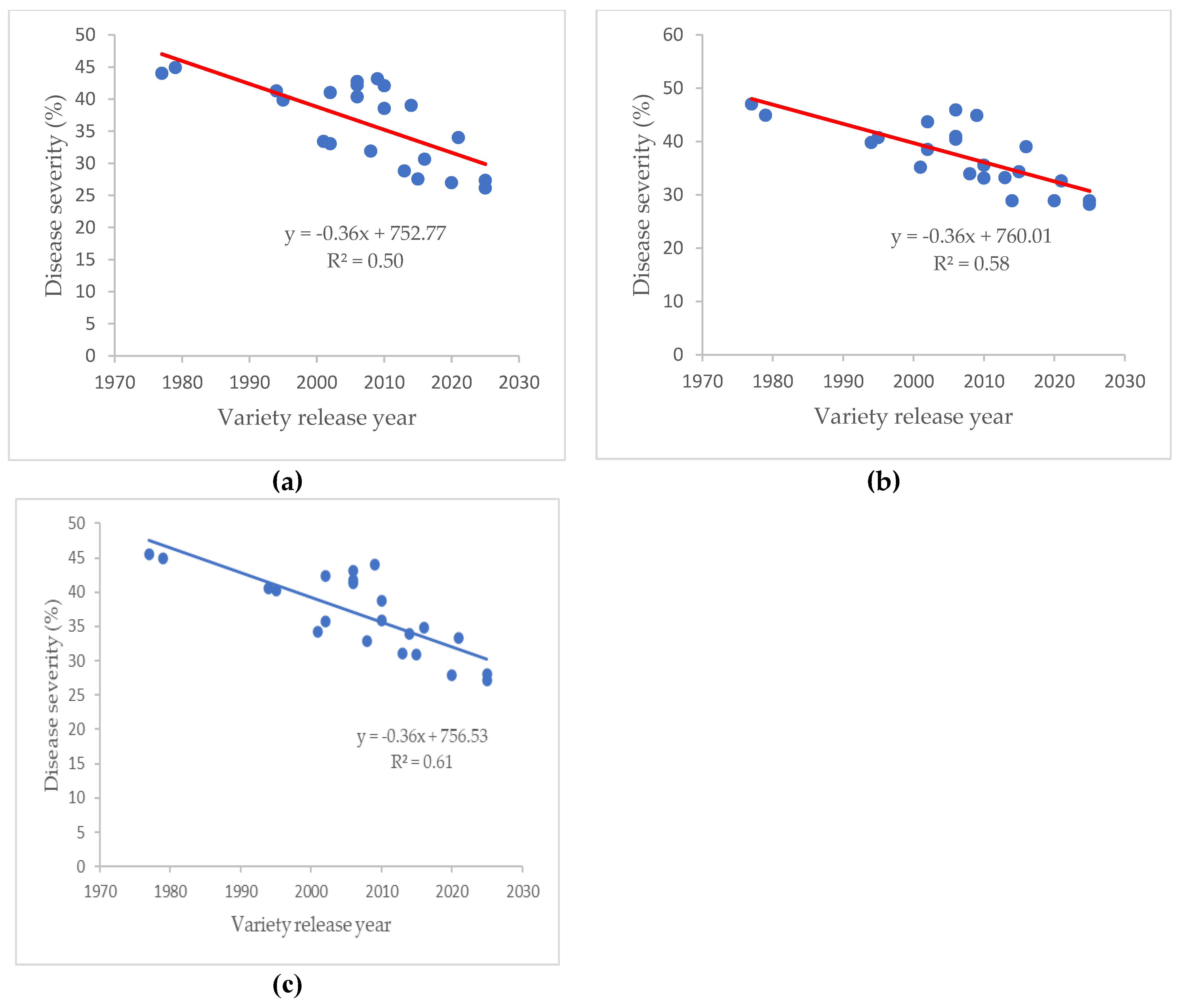
Figure 2.
A-C. Bi-plot regression of stand survival (%) of 22 faba bean genotypes against years of variety release starting from 1977-2024 using the CS20DK as baseline references, 2024 (A = Ambo, B = Ginchi and B = average of Ambo and Ginchi.
Figure 2.
A-C. Bi-plot regression of stand survival (%) of 22 faba bean genotypes against years of variety release starting from 1977-2024 using the CS20DK as baseline references, 2024 (A = Ambo, B = Ginchi and B = average of Ambo and Ginchi.
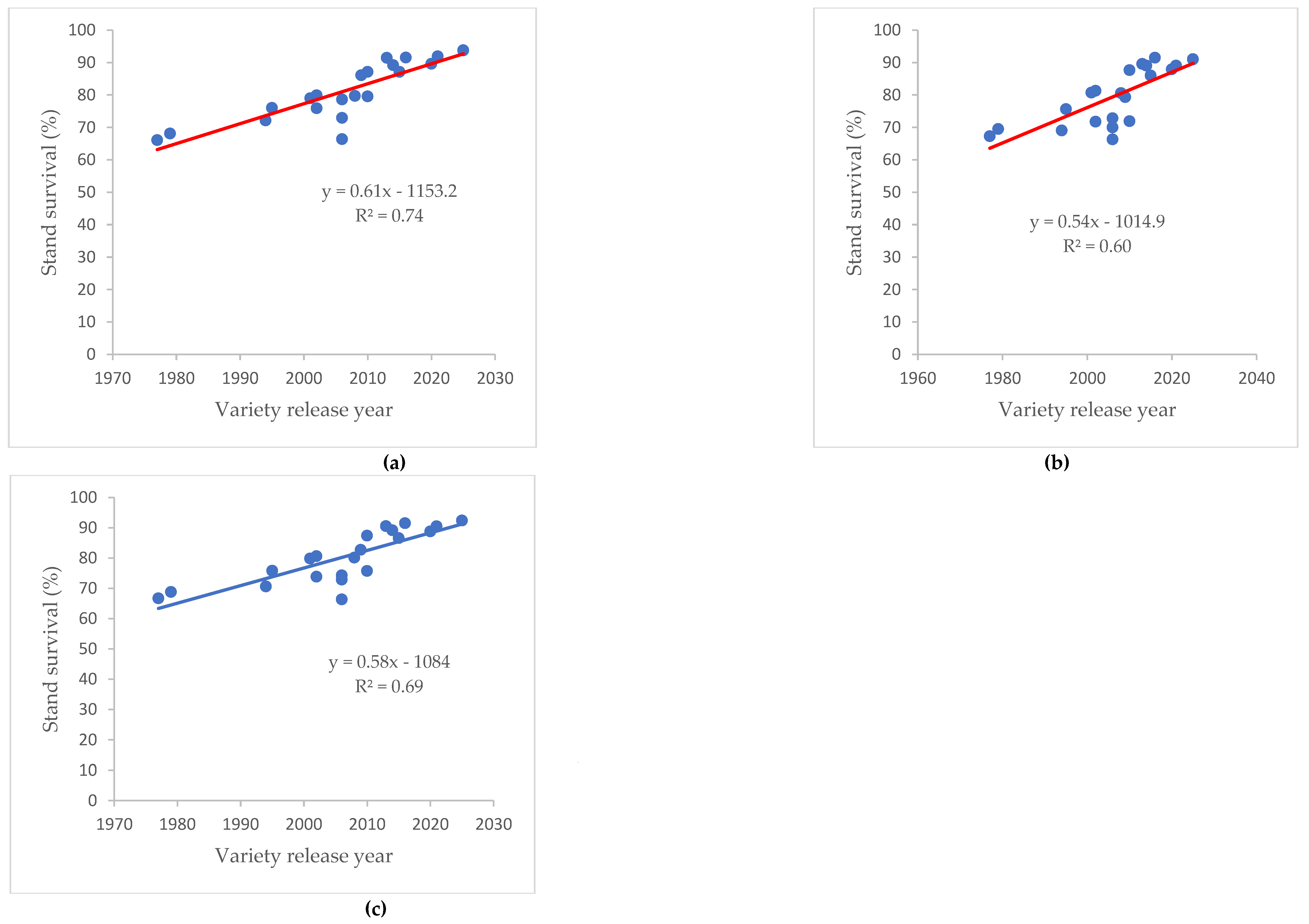
Figure 3.
A-C. Bi-plot regression of seed size (100 seed weight, g) of 22 faba bean genotypes against years of variety release starting from 1977-2024 using the CS20DK as baseline references, 2024 (A = Ambo, B = Ginchi and C = average of Ambo and Ginchi.
Figure 3.
A-C. Bi-plot regression of seed size (100 seed weight, g) of 22 faba bean genotypes against years of variety release starting from 1977-2024 using the CS20DK as baseline references, 2024 (A = Ambo, B = Ginchi and C = average of Ambo and Ginchi.
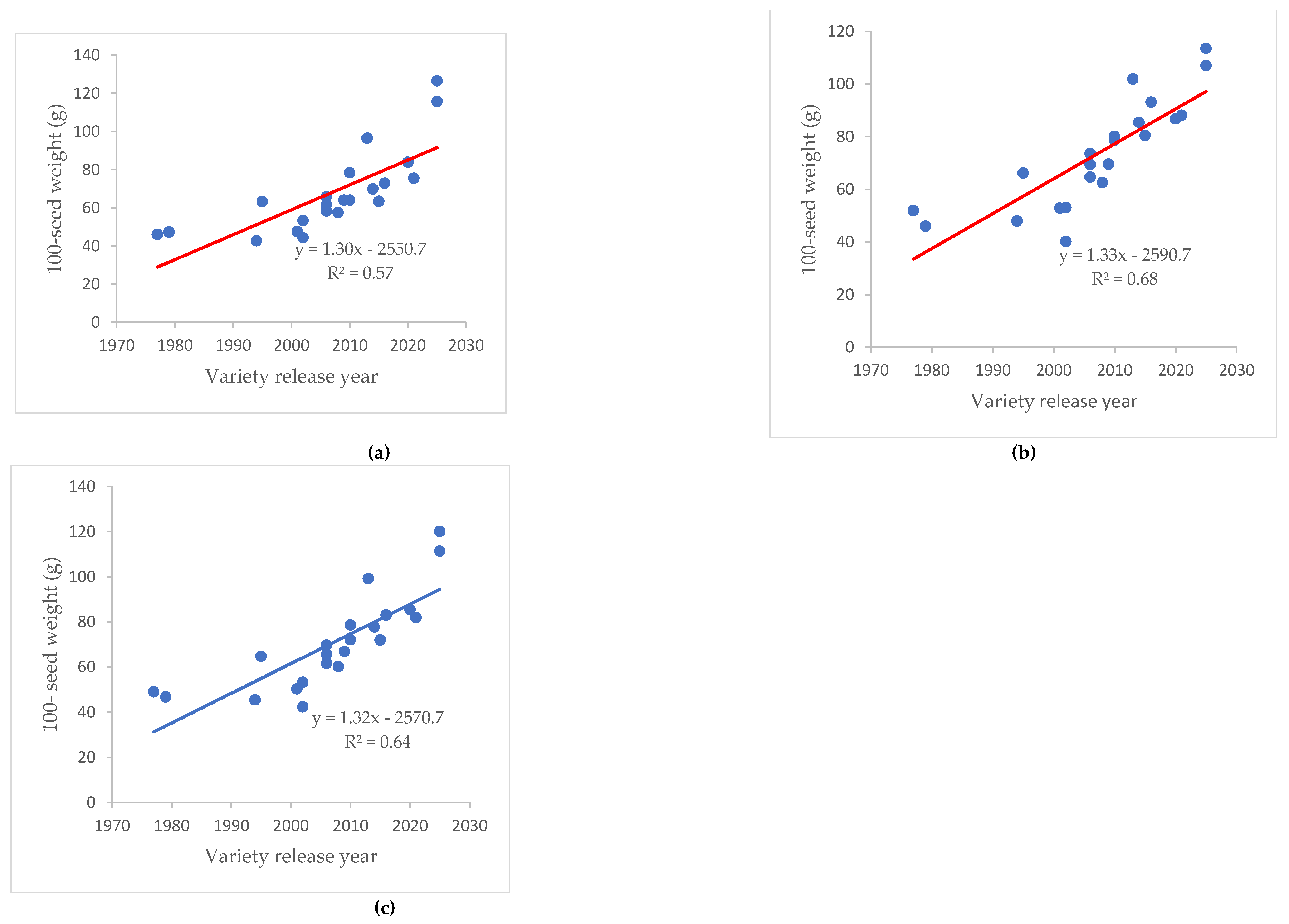
Figure 4.
A-C. Bi-plot regression of yield response of 23 faba bean genotypes against years of variety release starting from 1977-2024 using the CS20DK as baseline references, 2024 (A = Ambo, B = Ginchi and C = average of Ambo and Ginchi.
Figure 4.
A-C. Bi-plot regression of yield response of 23 faba bean genotypes against years of variety release starting from 1977-2024 using the CS20DK as baseline references, 2024 (A = Ambo, B = Ginchi and C = average of Ambo and Ginchi.
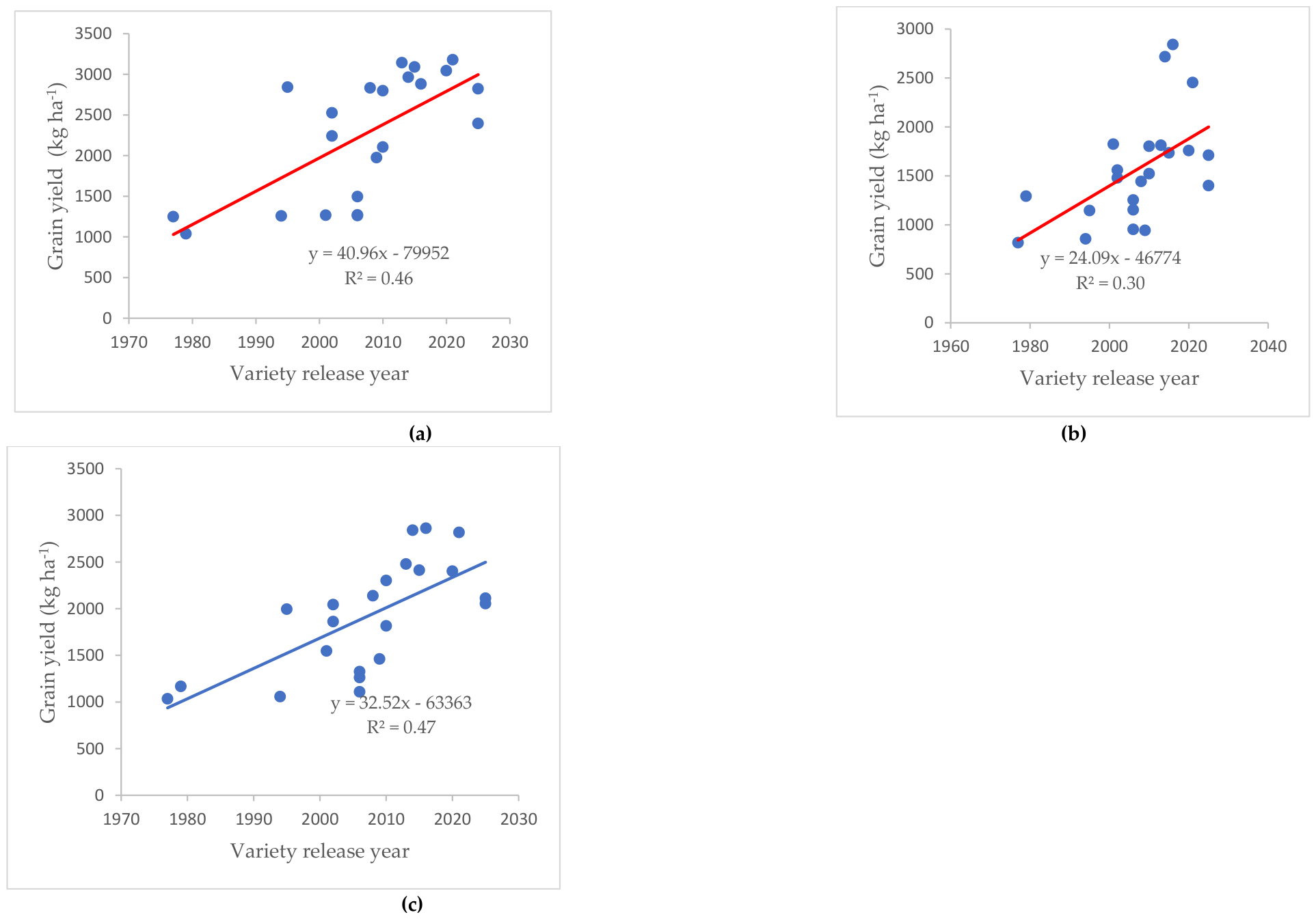
Figure 5.
A-C. Regression coefficients of root rot disease severity, seed size, stand survival with grain yield in 23 faba bean genotypes tested on vertisols at two locations in Ethiopia, 2024.
Figure 5.
A-C. Regression coefficients of root rot disease severity, seed size, stand survival with grain yield in 23 faba bean genotypes tested on vertisols at two locations in Ethiopia, 2024.
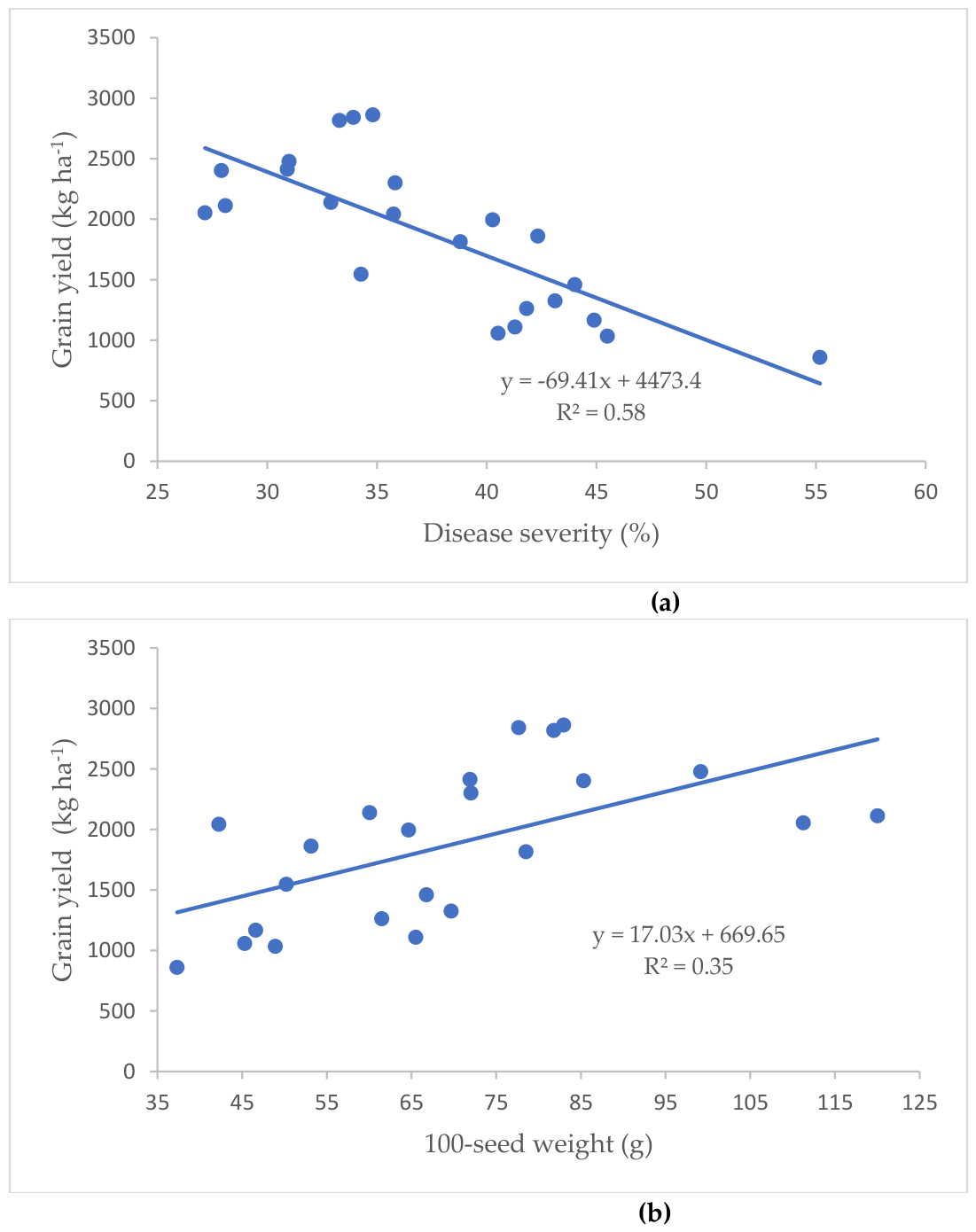
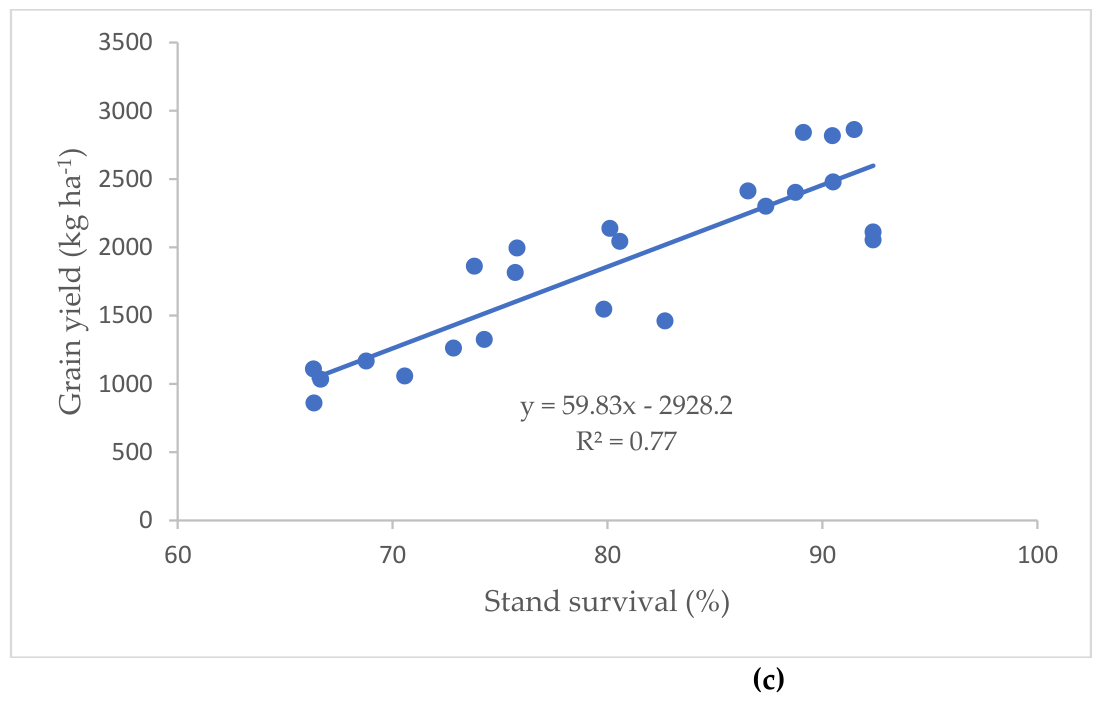

Table 1.
Mean square values for black root rot disease severity, seed size (100-seed weight, g), stand survival (%) and grain yield (kg ha-1) of 23 faba bean varieties tested at two locations under waterlogged vertisols in Ethiopia, 2024.
Table 1.
Mean square values for black root rot disease severity, seed size (100-seed weight, g), stand survival (%) and grain yield (kg ha-1) of 23 faba bean varieties tested at two locations under waterlogged vertisols in Ethiopia, 2024.
| Mean square | ||||
|---|---|---|---|---|
| Sources of variation |
Black root rot disease Severity (%) |
Hundred seed weight (g) | Stand survival (%) | Grain yield (kg ha-1) |
| Location | 34.27ns | 930.80** | 84.39* | 15930290.65 ** |
| Block | 107.18ns | 15.34ns | 33.82ns | 478400.72* |
| Varieties | 6169.67** | 2850.85** | 503.39** | 2335539.40 ** |
| Varieties × Location | 608.83ns | 93.94** | 12.93ns | 515492.73 ** |
| Error | 27.45 | 27.47 | 18.69 | 112418.42 |
* = significant at 0.05; ** = highly significant at 0.01; ns = non-significant.
Table 2.
Mean performance of the genotypes over the two locations and their percentage increments over the oldest check (CS20DK) for black root rot disease severity (%), seed size (g), stand survival (%) and grain yield (kg ha-1) in Ethiopia, 2024.
Table 2.
Mean performance of the genotypes over the two locations and their percentage increments over the oldest check (CS20DK) for black root rot disease severity (%), seed size (g), stand survival (%) and grain yield (kg ha-1) in Ethiopia, 2024.
| Black root rot disease severity (%) | 100-seed weight (g) | Stand survival (%) | Grain yield (kg ha-1) | |||||
|---|---|---|---|---|---|---|---|---|
| Variety | Mean | % over CS20DK |
Mean | % over CS20DK |
Mean | % over CS20DK |
Mean | % over CS20 |
| Local | 55.19 a | 21.30 | 37.31m | -23.73 | 66.35 i | -0.47 | 858.9 k | -16.87 |
| CS20DK | 45.50 b | - | 48.92 jk | - | 66.66 hi | - | 1033.2 jk | - |
| Kuse 2-27-33 | 44.90 b | -1.32 | 46.62 kl | -4.70 | 68.78 hi | 3.18 | 1166.1 hijk | 12.86 |
| Bulga-70 | 40.52 bcdef | -10.93 | 45.31 kl | -7.39 | 70.57 ghi | 5.87 | 1057.4 ijk | 2.33 |
| Messay | 40.28 bcdefg | -11.48 | 64.67 ghi | 32.20 | 75.80 ef | 13.71 | 1994.0 ef | 92.98 |
| Holetta-2 | 34.28 ghi | -24.66 | 50.22 jk | 2.66 | 79.84 de | 19.77 | 1545.7 gh | 49.60 |
| Degaga | 42.33 bc | -6.96 | 53.16 j | 8.66 | 73.81 fgh | 10.73 | 1860.7 fg | 80.08 |
| Selale | 35.76 efghi | -21.40 | 42.25 lm | -13.63 | 80.58 de | 20.88 | 2042.5 def | 97.68 |
| Moti | 41.83 bcd | -8.07 | 61.49 hi | 25.70 | 72.84 fgh | 9.27 | 1261.4 hijk | 22.08 |
| Gebelcho | 41.30 bcde | -9.24 | 65.50 ghi | 33.90 | 66.32 i | -0.51 | 1108.5 ijk | 7.28 |
| Obsie | 43.12 bc | -5.24 | 69.70 fg | 42.48 | 74.27 fg | 11.42 | 1324.4 hij | 28.18 |
| Walki | 32.90 hijkl | -27.68 | 60.07 i | 22.79 | 80.12 de | 20.19 | 2138.1 cdef | 106.93 |
| Dosha | 44.02 bc | -3.25 | 66.77 fgh | 36.48 | 82.67 dc | 24.02 | 1459.7 ghi | 41.27 |
| Hachalu | 35.83 defghi | -21.25 | 72.03 f | 47.23 | 87.37 abc | 31.07 | 2300.5 cde | 122.65 |
| Tumsa | 38.80 cdefgh | -14.73 | 78.53 e | 60.52 | 75.71 ef | 13.58 | 1814.6 fg | 75.62 |
| Gora | 31.00 ijkl | -31.87 | 99.18 c | 102.7 | 90.50 ab | 35.76 | 2477.5 abc | 139.77 |
| Dida’a | 33.93 hij | -25.42 | 77.66 e | 58.75 | 89.19 ab | 33.80 | 2840.5 a | 174.91 |
| Ashbeka | 30.92 ijkl | -32.04 | 71.93 f | 47.03 | 86.54 bc | 29.82 | 2412.3 bcd | 133.46 |
| Numan | 34.81 fghi | -23.48 | 82.98 de | 69.61 | 91.48 ab | 37.23 | 2861.4 a | 176.93 |
| Chalew | 27.91lk | -38.65 | 85.34 d | 74.44 | 88.75 ab | 33.14 | 2401.8 cde | 132.45 |
| Shoa | 33.29 hijk | -26.82 | 81.81 de | 67.23 | 90.47 ab | 35.72 | 2816.5 ab | 172.59 |
| EH016021-5 | 28.10 jkl | -38.25 | 120.04 a | 145.39 | 92.37 a | 38.57 | 2111.7 cdef | 104.38 |
| EH016021-4 | 27.16 l | -40.30 | 111.29 b | 127.49 | 92.36 a | 38.55 | 2053.2 def | 98.72 |
| Mean | 37.55 | 69.25 | 80.15 | 1866.98 | ||||
| LSD (0.05) | 6 | 5.44 | 5.04 | 410.77 | ||||
| CV (%) | 13.95 | 4.77 | 5.49 | 19.18 | ||||
Table 3.
Relative genetic progress (RGP) compared to CS20DK variety and trends in genetic progress obtained from breeding faba bean for black root rot disease severity, seed size, stand loss and grain yield during the last 47 years.
Table 3.
Relative genetic progress (RGP) compared to CS20DK variety and trends in genetic progress obtained from breeding faba bean for black root rot disease severity, seed size, stand loss and grain yield during the last 47 years.
| Traits | ||||||||||||
|---|---|---|---|---|---|---|---|---|---|---|---|---|
| BRR Disease severity (%) | 100-Seed weight (g) | Stand survival (%) | Grain yield (kg ha-1) | |||||||||
| Locations | Ambo | Ginchi | Combined | Ambo | Ginchi | Combined | Ambo | Ginchi | Combined | Ambo | Ginchi | Combined |
| Mean square of regression | 683.39 | 749.18 | 715.73 | 6886.55 | 6994.29 | 6940.3 | 604.27 | 471.94 | 537.49 | 6976860 | 2726558 | 4606609 |
| Regression coefficient | -0.36 | -0.36 | -0.36 | 1.30 | 1.33 | 1.32 | 0.61 | 0.54 | 0.58 | 40.96 | 24.09 | 32.52 |
| P-value | ** | ** | ** | ** | ** | ** | ** | ** | ** | ** | ** | ** |
| Gains in 47 years | -18.80 | -19.27 | -19.27 | 59.69 | 60.16 | 62.04 | 27.73 | 24.44 | 16.92 | 1899.27 | 1187.22 | 1543.48 |
| R2 | 0.50 | 0.58 |
0.58 | 0.57 | 0.68 | 0.64 | 0.74 |
0.60 |
0.69 |
0.46 | 0.30 | 0.47 |
| Mean of CS20DK | 44.00 | 47.00 | 45.5 | 45.98 | 51.86 | 48.92 | 66.07 | 67.25 | 66.66 | 1248.50 | 818.00 | 1033.25 |
| Relative genetic progress (%) year-1 | -0.81 | -0.76 | -0.79 | 2.85 | 2.56 | 2.70 | 0.92 | 0.80 | 0.87 | 3.28 | 2.09 | 3.15 |
Table 5.
Physico-chemical properties of the soils and geographical position of the experimental site.
Table 5.
Physico-chemical properties of the soils and geographical position of the experimental site.
| Parameter | Ambo | Ginchi |
|---|---|---|
| Latitude | 80 58’ N | 09° 00′ N |
| Longitude | 37 51’ E | 38° 10′ E |
| Altitude (meters above sea level) | 2165 | 2202 |
| Soil pH | 7.20 | 7.42 |
| Phosphorus (ppm) | 6.13 | 20.80 |
| Nitrogen (%) | 0.06 (low) | 0.08 |
| Organic C (%) | 1.13 | 0.80 |
| Clay (%) | 67.50 | 67.50 |
| Silt (%) | 17.50 | 20.00 |
| Sand (%) | 15.00 | 12.50 |
Table 6.
List of Faba bean genotypes /varieties.
| No. | Name of variety | Year of release | Special merits of the variety |
|---|---|---|---|
| 1 | CS20DK | 1977 | High yield, diseases resistance, wide adaptation |
| 2 | Kuse 2-27-33 | 1979 | High yield, diseases resistance, wide adaptation |
| 3 | Bulga-70 | 1994 | High yield, diseases resistance, adaptation to potential environments |
| 4 | Messay | 1995 | High yield, diseases resistance, adaptation to midaltitude |
| 5 | Holetta-2 | 2001 | High yield, diseases resistance, specific adaptation to West Shewa Zone |
| 6 | Degaga | 2002 | High yield, diseases resistance, wide adaptation |
| 7 | Selale | 2002 | Water logging and black root rot resistance |
| 8 | Moti | 2006 | High yield, wide adaptation, export type |
| 9 | Gebelcho | 2006 | High yield, wide adaptation, export type |
| 10 | Obsie | 2006 | High yield, wide adaptation, export type |
| 11 | Walki | 2008 | High yield, water logging and black root rot resistance, wide adaptation, export type |
| 12 | Dosha | 2009 | High yield, wide adaptation, export type |
| 13 | Hachalu | 2010 | High yield, water logging and black root rot resistance, wide adaptation, export type |
| 14 | Tumsa | 2010 | High yield, wide adaptation, export type |
| 15 | Gora | 2013 | High yield, wide adaptation, export type |
| 16 | Dida’a | 2014 | High yield, water logging and black root rot resistance, wide adaptation, export type |
| 17 | Ashbeka | 2015 | High yield, water logging and black root rot resistance, wide adaptation, export type |
| 18 | Numan | 2016 | High yield, wide adaptation, export type |
| 19 | Chalew | 2020 | High yield, water logging and black root rot resistance, wide adaptation, export type |
| 20 | Shoa | 2021 | High yield, water logging and black root rot resistance, wide adaptation, export type |
| 21 | EH016021-5 | 2024 | Pipeline materials at the advanced yield trial stages |
| 22 | EH016021-4 | 2024 | Pipeline materials at the advanced yield trial stages |
| 23 | Local variety | Local check |
Disclaimer/Publisher’s Note: The statements, opinions and data contained in all publications are solely those of the individual author(s) and contributor(s) and not of MDPI and/or the editor(s). MDPI and/or the editor(s) disclaim responsibility for any injury to people or property resulting from any ideas, methods, instructions or products referred to in the content. |
© 2026 by the authors. Licensee MDPI, Basel, Switzerland. This article is an open access article distributed under the terms and conditions of the Creative Commons Attribution (CC BY) license (http://creativecommons.org/licenses/by/4.0/).
Copyright: This open access article is published under a Creative Commons CC BY 4.0 license, which permit the free download, distribution, and reuse, provided that the author and preprint are cited in any reuse.