

Submitted:
25 October 2026
Posted:
26 October 2026
You are already at the latest version
Abstract
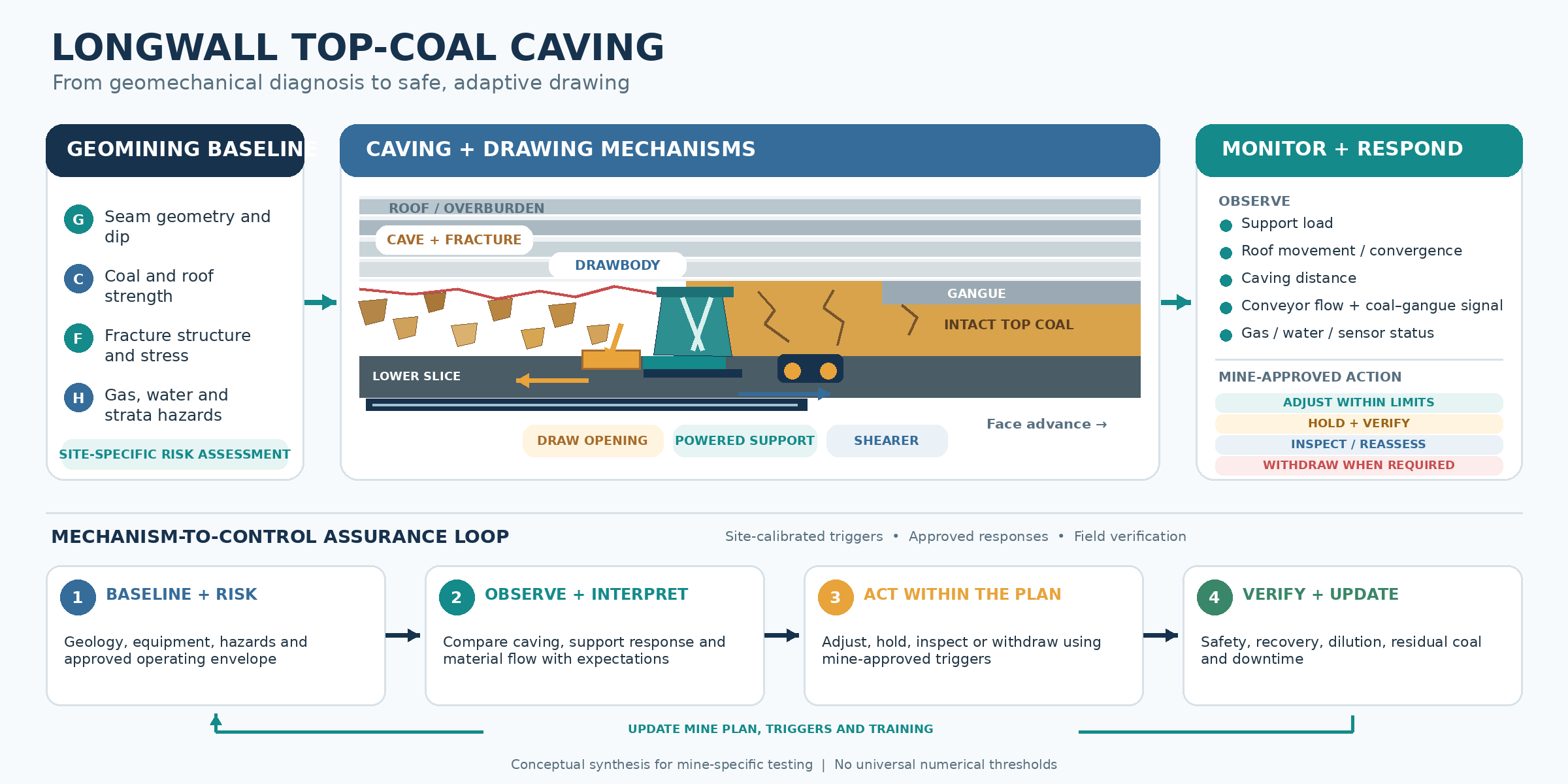
Longwall top-coal caving (LTCC) combines the mechanical extraction of the lower seam with caving and drawing of the coal above the cutting horizon. Its performance depends on linked geomechanical, strata-support, granular-flow, operational, and control processes: caving does not by itself ensure selective recovery. This global critical review synthesises research on stress redistribution, fracture-controlled cavability, roof rupture and weighting, drawbody and coal–gangue boundary evolution, drawing interval and sequence, support interaction, hazards, modelling, monitoring, and automation. It distinguishes recurring mechanisms from mine-specific numerical settings and appraises the evidence by study type, represented variables, and degree of field validation. The review's central contribution is a mechanism-to-control assurance framework that connects potential failure states to candidate indicators, mine-approved responses, and verification measures. It treats drawing initiation, sequence, adjustment, and termination as safety-critical decisions within a multi-objective goal of clean-coal recovery, dilution control, ground stability, and hazard management. The evidence remains dominated by simulations and mine-specific cases, with few end-to-end field-validated control demonstrations. The proposed framework is a synthesis for testing, not a validated universal controller; indicators and operating limits require site-specific calibration and field verification.
Keywords:
longwall top-coal caving
; thick coal seams
; cavability
; granular flow
; coal recovery
; dilution
; ground control
; numerical modelling
; monitoring
; automation
Copyright: This open access article is published under a Creative Commons CC BY 4.0 license, which permit the free download, distribution, and reuse, provided that the author and preprint are cited in any reuse.