

Submitted:
23 October 2026
Posted:
26 October 2026
You are already at the latest version
Abstract
Many plants used traditionally to aid memory have been put forward as neuroprotective candidates against dementia. This mini review weighs the preclinical and clinical evidence for six of them (Centella asiatica, Ginkgo biloba, Salvia species, Withania somnifera, Bacopa monnieri and Semecarpus anacardium), briefly describes five more, and considers their relevance to Bangladesh. Sources were PubMed, Google Scholar and Semantic Scholar, with a targeted update in 2026. In cells and rodents, the same mechanisms recur cholinergic modulation, antioxidant and anti-inflammatory activity, and protection against amyloid-beta toxicity. Human evidence is thin. Two large ginkgo trials did not prevent dementia, while small trials of sage, ashwagandha and Bacopa point to modest cognitive gains. Centella and Semecarpus have no controlled human data. Before any clinical recommendation, the field needs standardised extracts, safety assessment, and adequately powered trials in people at the earliest stages of Alzheimer's disease.
Keywords:
neuroprotection
; medicinal plants
; Alzheimer's disease
; Bangladesh
Introduction
In neurodegenerative disease, nerve cells deteriorate over time and are eventually lost. The group includes Huntington's disease (HD), amyotrophic lateral sclerosis (ALS), Parkinson's disease (PD) and, most common of all, Alzheimer's disease (AD). These conditions tend to appear late in life, may be sporadic or inherited, and are marked by misfolded proteins that build up in and around neurons (Przedborski et al., 2003; Taylor et al., 2002; Trojanowski and Lee, 2000). For 2021, the Global Burden of Disease study estimated that 3.40 billion people (43.1% of the world's population) had a nervous-system disorder, and that these disorders caused more disability-adjusted life-years (DALYs) than any other group of conditions, 443 million in all (GBD 2021 Nervous System Disorders Collaborators, 2024). For 2016, dementias including AD ranked third among neurological causes of DALYs, behind stroke and migraine (GBD 2016 Neurology Collaborators, 2019). About 57.4 million people were living with dementia in 2019, and projections put the figure at 152.8 million in 2050 (GBD 2019 Dementia Forecasting Collaborators, 2022). A 2019 survey in Bangladesh, covering 2,795 people aged 60 or above, found a dementia prevalence of 8.0% (95% confidence interval 7.0-8.9%) (Naheed et al., 2023). Even so, national epidemiological data are scarce, and awareness among the public and clinicians is low (Alam, 2017; Rahman et al., 2017).
Despite their differences, these diseases share a small set of cellular problems. Several are proteinopathies, in which amyloid-beta and tau (AD), alpha-synuclein (PD) or polyglutamine-expanded huntingtin (HD) aggregate while the cell's two main protein-clearance routes, the ubiquitin-proteasome system and autophagy through the lysosome, work poorly (Rubinsztein, 2006). Faulty mitochondria and oxidative damage have been linked to AD, PD, HD and ALS (Lin and Beal, 2006; Wang et al., 2017); amyloid-beta that accumulates inside mitochondria is one example (Chen and Yan, 2010). Other reported disturbances include defective axonal transport (De Vos et al., 2008), DNA damage (Jeppesen et al., 2011), activation of programmed cell death (Vila and Przedborski, 2003) and cross-linking of aggregation-prone proteins by transglutaminase (Caccamo et al., 2010). In AD, amyloid precursor protein is cut in two sequential steps to release amyloid-beta, which forms plaques; tau, partly through phosphorylation by glycogen synthase kinase-3β, becomes hyperphosphorylated and forms neurofibrillary tangles (Hardy and Selkoe, 2002; Hooper et al., 2008; Querfurth and LaFerla, 2010). The leading account is still the amyloid cascade model (Hardy and Higgins, 1992), although it is disputed. Alternatives include a mitochondria-centred model (Swerdlow and Khan, 2004) and the view that amyloid-beta has antimicrobial activity and takes part in innate defence (Soscia et al., 2010; Kumar et al., 2016). The amyloid evidence has also come under scrutiny. In 2022, Science reported apparent image manipulation in a much-cited 2006 paper (Lesné et al., 2006; Piller, 2022), and Nature retracted it in 2024 with the agreement of six of its eight authors (Lesné et al., 2024).
Treatment today rests mainly on two drug classes: inhibitors of acetylcholinesterase (AChE) and antagonists of the N-methyl-D-aspartate (NMDA) receptor. Both ease symptoms but do not change how the disease progresses. Attempts to modify the disease itself by targeting amyloid or tau, with β-secretase inhibitors or with active and passive immunotherapy (Brody and Holtzman, 2008; Schenk et al., 2012), have repeatedly failed in late-stage trials (Cummings et al., 2014). Latrepirdine (Dimebon) looked promising at first but showed no benefit in phase III testing of patients with mild or moderate AD (Bezprozvanny, 2010). Two anti-amyloid antibodies have since gained US regulatory approval: lecanemab in July 2023 and donanemab in July 2024. Both slowed decline a little in early AD, but both can cause amyloid-related imaging abnormalities, which are a real clinical risk (van Dyck et al., 2023; Sims et al., 2023). Their price and the monitoring they need are likely to put them out of reach in low-resource settings. Against this background and given that many botanicals are cheap and have a long history of human use, plant-derived candidates deserve a critical look. Earlier reviews mostly listed such plants as established nootropics (Howes et al., 2003; Perry and Howes, 2011). The questions here are different: which candidates have preclinical and, where they exist, clinical evidence behind them, how far that evidence can be trusted, and which are realistic for a setting with limited resources such as Bangladesh. The review focuses on six species (Centella asiatica, Ginkgo biloba, Salvia spp., Withania somnifera, Bacopa monnieri and Semecarpus anacardium, the last of which has received little attention in earlier reviews on this topic) and summarises five more (Table 1). Almost all of the retained studies concern AD-type memory impairment, so the conclusions apply to AD and cognitive decline only; work in PD, HD and ALS models is outside the scope.
Materials and Methods
This is a narrative review. PubMed (including records hosted by the National Center for Biotechnology Information), Google Scholar and Semantic Scholar were searched from September 2020 to January 2021 and again from January 2026 to September 2026. Search terms combined "neurodegeneration," "neurodegenerative disease," "neuroprotective," "Alzheimer's disease," "Parkinson's disease" and "potential treatment" with the Latin binomials of candidate plant species (Unexplored plants in Bangladesh). About 1,650 records were returned. Screening of titles and abstracts against pre-defined criteria (relevance to neurodegeneration, neurodegenerative disease, memory impairment or neuroprotective activity) left 480 records, to which papers found by hand-searching, expert recommendation and reference-list scanning were added. After full-text review, 84 papers were retained for descriptive (non-meta-analytic) synthesis (Figure 1).
The species with the largest bodies of preclinical or clinical evidence are covered in detail: Centella asiatica, Ginkgo biloba, Salvia lavandulaefolia and S. officinalis, Withania somnifera, Bacopa monnieri and Semecarpus anacardium. Five other species that turned up in the same search are covered briefly in Table 1. The clinical, safety and Bangladesh-specific sections were updated in October 2026 with targeted searches for randomised trials, systematic reviews, safety reports and Bangladeshi ethnomedicinal sources. Papers found this way appear in the reference list but are not included in the counts above. Study quality was judged qualitatively, looking at randomisation, blinding, sample size, duration, attrition and how relevant the outcome was; no formal risk-of-bias tool was used.
Results
Overview of Candidate Plants
Five further species, each supported by preclinical evidence that is sometimes a single study, are listed in Table 1 with their reported neuroprotective or cognition-related effects. The six species with more evidence are taken in turn below. Table 3 gives their clinical evidence, Table 4 their safety concerns and Table 5 their relevance to Bangladesh.
Centella asiatica (L.) Urb.
Centella asiatica (Apiaceae) is classed in Ayurveda as a rejuvenating herb, said to restore youthfulness and memory (Kapoor, 1990). Classical Ayurvedic preparations pair the leaf with milk to protect memory in old age and ward off dementia (Manyam, 1999). Chinese herbal practice uses the plant to counter fatigue of body and mind (Brinkhaus et al., 2000; Duke and Ayensu, 1985). In Bangladesh it is known as thankuni and grows on fallow land, and it is thought to support nerve function and memory (Uddin and Zidorn, 2020). Its principal constituents are triterpenoids (for example asiatic acid and asiaticoside), caffeoylquinic acids and flavonoids (Gray et al., 2018).
In mice, an alcoholic leaf extract had anti-amnesic, sedative and cholinomimetic effects, and atropine blocked them; the triterpene brahmoside was thought to account for at least part of this (Sakina and Dandiya, 1990). Rats given an aqueous leaf extract learned and remembered better, and their dopamine, serotonin and noradrenaline turnover changed (Nalini et al., 1992), which points to polar constituents, possibly triterpene saponins, acting on central neurotransmitter systems. Fractions of an extract lengthened neurites in cultured neurons, and oral dosing speeded nerve regeneration in rodents (Soumyanath et al., 2005). A review of the laboratory literature reports protection against amyloid-beta toxicity, possibly via mitochondria, antioxidant status and inflammation, plus neurotrophic effects on dendrite growth and synapse formation (Gray et al., 2018). There are essentially no controlled human data specific to neurodegeneration. A single trial in stroke survivors with vascular cognitive impairment compared a 750 mg dose and a 1,000 mg dose of extract with 3 mg of folic acid (Farhana et al., 2016). Because that condition is vascular rather than neurodegenerative, the trial is not included in Table 3.
Ginkgo biloba L.
Ginkgo biloba is a living fossil, the only survivor of an ancient tree lineage. Chinese herbal practice used it mainly for respiratory complaints, and Western pharmacology took it up in the 1960s for circulatory disorders (Kenner and Requena, 1996). Most current evidence concerns the standardised leaf extract EGb 761. The extract influences glucose metabolism in neurons (Löffler et al., 2001) and cholinergic function, for example high-affinity choline uptake in the hippocampus of aged rats (Krištofiková et al., 1992), and it is antioxidant in several model systems (Barth et al., 1991; Marcocci et al., 1994; Topic et al., 2002). In a pilot study of nine healthy men, four weeks of ginkgo extract at 60 mg twice daily increased cerebral blood flow on magnetic resonance perfusion imaging (Mashayekh et al., 2011). In vitro, EGb 761 shielded hippocampal neurons from amyloid-beta-induced cell death (Bastianetto et al., 2000). In rodents it improved memory retention in young and aged animals (Petkov et al., 1993), and in healthy middle-aged volunteers it had specific effects on memory (Kaschel, 2011). Another constituent, ginkgolide B, antagonises platelet-activating factor and is anti-inflammatory, possibly through an independent pathway (Koltai et al., 1991).
The first randomised, double-blind, placebo-controlled trials of EGb 761, in AD and in other dementias, found a small cognitive benefit (Hofferberth, 1994; Kanowski et al., 1996; Le Bars et al., 2000). The larger and longer prevention trials did not. The Ginkgo Evaluation of Memory (GEM) trial gave 3,069 adults aged 75 or older either 120 mg twice daily or placebo for a median of 6.1 years; dementia incidence was the same in both groups (hazard ratio 1.12; 95% confidence interval 0.94-1.33) (DeKosky et al., 2008). GuidAge followed more than 2,800 people with memory complaints for five years. AD developed in 61 of those taking ginkgo and 73 of those on placebo, a difference that was not significant (Vellas et al., 2012). A Cochrane review of 36 trials found the evidence for a predictable, clinically significant benefit in dementia or cognitive impairment to be inconsistent and unreliable (Birks and Grimley Evans, 2009). It is still unclear whether any effect comes from direct neuroprotection or from the vasodilatory flavonoids in the extract.
Salvia lavandulaefolia Vahl and Salvia officinalis L.
Salvia lavandulaefolia and S. officinalis (Lamiaceae) have long been used by herbalists for memory. English herbals of the sixteenth and eighteenth centuries credited sage with sharpening the senses and countering mental decline in old age (Perry et al., 1998; Perry et al., 2001). In vitro, the essential oil and the ethanolic extracts of S. lavandulaefolia both inhibit acetylcholinesterase from human erythrocytes (Table 2). The monoterpenes 1,8-cineole and α-pinene contribute, but each account for only a fraction of the whole oil's potency, which implies that constituents act together (Perry et al., 2000; Perry and Howes, 2011); monoterpenes in general inhibit AChE (Miyazawa et al., 1997; Ryan and Byrne, 1988). Aqueous extracts of S. officinalis, along with those of related Lamiaceae, are antioxidant, which is attributed partly to phenolic acids such as rosmarinic, carnosic and salvianolic acids (Hohmann et al., 1999; Wang et al., 1999, 2000). Sage also has anti-inflammatory actions. Ursolic acid is held responsible for the inhibition of croton-oil-induced ear oedema in mice (Baricevic et al., 2001), and α-pinene inhibits the synthesis of leukotriene B4, which matters because the pro-inflammatory 5-lipoxygenase pathway is upregulated in neurodegeneration (Perry et al., 2001; Sugaya et al., 2000). In rats, oral S. lavandulaefolia oil lowered striatal AChE activity compared with controls (Perry et al., 2001).
Three controlled human studies were found. One was a four-month randomised, double-blind trial in 42 patients aged 65-80 years with mild to moderate AD; 60 drops a day of an S. officinalis extract produced better scores on the Alzheimer's Disease Assessment Scale (cognitive subscale) than placebo (Akhondzadeh et al., 2003). In a placebo-controlled crossover study of healthy young volunteers, a low dose (50 μL) of standardised S. lavandulaefolia oil improved the speed and accuracy of word recall, although higher doses reduced self-rated calmness and contentment (Tildesley et al., 2005). In 20 healthy volunteers over 65, a 333 mg dose of a standardised S. officinalis extract improved secondary memory and the accuracy of attention (Scholey et al., 2008). The AD trial was small and needs replication in larger samples.
Withania somnifera (L.) Dunal
Ashwagandha, the root of the Solanaceae shrub Withania somnifera, is a rejuvenating Rasayana tonic in Ayurveda, valued as a nerve tonic and credited with restoring memory and vitality (Singh et al., 2011). In Bangladesh, where the plant is known as aswagandha, it is reported to grow wild in the North Bengal region and to be used as a tonic and for nervous tension and memory loss (Uddin and Zidorn, 2020). Sitoindoside IX and sitoindoside X, two steroidal glycosides from the root, improved acquisition and retention of learned tasks in young and old rats (Ghosal et al., 1989). In cultured human neuroblastoma cells, a methanolic root extract induced the outgrowth of dendrites (Tohda et al., 2000), and in stressed rats it lessened degeneration of hippocampal neurons (Jain et al., 2001); both findings point to a direct neurotrophic or neuroprotective action rather than only a symptomatic one. In mice the root extract reversed amnesia induced by scopolamine or electroconvulsive shock (Dhuley, 2001). Glycowithanolides also reduced anxiety- and depression-like behaviour in rodents (S.K. Bhattacharya et al., 2000b). They are antioxidant too, lowering lipid peroxidation and increasing the antioxidant enzymes catalase and glutathione peroxidase in rat striatum and frontal cortex (A. Bhattacharya et al., 2001; Ghosal et al., 1989), which could matter in neurodegeneration driven by oxidative stress. None of the studies reviewed tested anti-neuroinflammatory effects directly.
Two randomised, placebo-controlled trials have looked at cognition. One enrolled 50 people with mild cognitive impairment, who took 300 mg of root extract twice daily, or placebo, for eight weeks; the extract group did better on memory, executive-function and attention tasks and on how quickly they processed information (Choudhary et al., 2017). The other, in 60 euthymic adults with bipolar disorder, gave an adjunctive extract (500 mg a day) for eight weeks and found improvements in backward digit span, a response-time measure and social cognition, with no correction for multiple comparisons (Chengappa et al., 2013). Both trials were small and brief, and neither involved patients with AD.
Bacopa monnieri (L.) Wettst.
Bacopa monnieri (Plantaginaceae), called brahmi, is an Ayurvedic memory tonic. The saponins bacoside A and bacoside B are its principal active compounds. In Bangladesh it is known as brammishak, grows chiefly in coastal areas such as Chittagong and Cox's Bazar, and is also eaten as a leafy vegetable (Uddin and Zidorn, 2020). The extract was antioxidant in the hippocampus, striatum and frontal cortex of rats (S.K. Bhattacharya et al., 2000a), improved learning in several animal tests (Singh and Dhawan, 1982) and protected memory in mice given phenytoin (Vohora et al., 2000). In 46 healthy adults given 300 mg a day or placebo for 12 weeks, visual information was processed faster, and both the rate of learning and the consolidation of memory improved (Stough et al., 2001). In 54 older adults living in the community (aged 65 or above, free of dementia), the same 300 mg daily dose, taken for 12 weeks, produced better delayed word recall and lower depression and anxiety scores; stomach upset was the main adverse event (Calabrese et al., 2008). Pooling nine trials with 518 participants in total, a meta-analysis found better attention speed (Kongkeaw et al., 2014), although a later trial in healthy adults reported results that challenge the cognitive and anti-anxiety effects (Sathyanarayanan et al., 2013). No trial specific to AD was identified in the sources reviewed.
Semecarpus anacardium L.f.
The nut of Semecarpus anacardium (Anacardiaceae), known as Ballataka or Bhilwa, has long been used in Ayurvedic and Siddha medicine, traditionally for skin conditions and, once detoxified, as a general restorative. Phytochemical screening shows bioflavonoids, phenolic compounds, minerals, vitamins and amino acids as the main constituents, and several of the phenolics irritate the skin (Semalty et al., 2010). The sources consulted did not document local occurrence or use for memory disorders in Bangladesh. An ultrastructural study in rats found that extract treatment protected hippocampal neurons from stress-induced degeneration (Shukla et al., 2000). A methanolic nut extract also reversed scopolamine-induced deficits in Y-maze and radial-maze tests and inhibited AChE in vitro in a dose-dependent way, which suggests a cholinergic mechanism (Mishra et al., 2016). In the same study, traditional detoxification (shodhana) lowered the nootropic activity of the nuts (Mishra et al., 2016). Safety processing and potency therefore pull in opposite directions, and standardisation will have to resolve this. The evidence base is much smaller than for the other species, and no controlled human data were found.
Summary of Clinical Evidence and Study Quality
Table 3 collects the controlled human evidence cited above. Most trials were small (under 100 participants) and short (three to six months or less), they used different extracts and doses, and several enrolled healthy volunteers, so their outcomes cannot show disease modification. The two large, long prevention trials of ginkgo (GEM and GuidAge) found no effect on dementia incidence. Outside ginkgo, the only trial in people with dementia was a 42-patient study of Salvia officinalis for mild or moderate AD, while the Withania trial involved 50 people with mild cognitive impairment. Quality was judged qualitatively, and the main limitations are given in Table 3.
Safety and Herb-Drug Interactions
A plant origin does not make a product safe (Table 4). Ginkgo has been linked to bleeding in case reports, although trials found no more adverse events than with placebo (Bent et al., 2005; Birks and Grimley Evans, 2009). Hypericum perforatum, one of the species in Table 1, interacts with many co-medications (Henderson et al., 2002). Liver injury has been reported with ashwagandha (Björnsson et al., 2020) and with Centella (Jorge and Jorge, 2005). Thujone in sage and wormwood preparations is a concern at high exposures (Pelkonen et al., 2013), and Semecarpus nuts must be detoxified before use (Semalty et al., 2010). These points are important for older patients, who often take several drugs, and any trial or product development has to address them.
Discussion
The species reviewed here differ in their traditional origins and chemistry, yet they converge on a few mechanisms that are already established in neurodegenerative disease. Cholinergic modulation is the most common. It appears as AChE inhibition (Salvia, Semecarpus), cholinomimetic activity (Centella), altered choline uptake (Ginkgo), higher hippocampal acetylcholine release (Magnolia) and binding to nicotinic receptors (Artemisia). The main drug class licensed for symptomatic AD treatment, the cholinesterase inhibitors, acts through this mechanism and includes a plant alkaloid, galantamine, so the finding lends some pharmacological plausibility to traditional use as cognitive tonics. Antioxidant and anti-inflammatory activity (Ginkgo, Salvia, Withania, Bacopa) is a second recurring theme, in keeping with the roles of oxidative stress and neuroinflammation in AD, PD, HD and ALS. A few studies describe more specific neuroprotective actions that bear more directly on disease progression, namely protection of hippocampal neurons from amyloid-beta toxicity by EGb 761 and promotion of dendrite or neurite outgrowth by Withania and Centella. However, many of the animal studies relied on scopolamine-induced amnesia or passive-avoidance tests. These models measure the reversal of cholinergic symptoms, not neuroprotection, so they cannot support a disease-modifying claim by themselves.
Evidence weakens sharply on the way from cells and animals to people. Ginkgo biloba has by far the largest clinical base, yet its two large prevention trials were negative and the overall benefit in dementia is inconsistent (DeKosky et al., 2008; Vellas et al., 2012; Birks and Grimley Evans, 2009). Salvia officinalis has one small trial in AD and two small studies in healthy volunteers. Withania somnifera has two small cognition trials, one in people with mild cognitive impairment and one in bipolar disorder. Bacopa monnieri has several small trials and a meta-analysis, all in healthy or older adults without dementia. Centella asiatica and Semecarpus anacardium have no controlled human data specific to neuroprotection. Encouraging preclinical signals followed by thin clinical evidence is the same pattern that makes AD drug development so difficult, where mechanistically plausible candidates have repeatedly failed in late-stage trials (Cummings et al., 2014; Bezprozvanny, 2010). Plant extracts bring extra obstacles. Most are complex mixtures rather than defined molecules, which complicates standardisation, dose-finding and regulatory approval, and for several species the compounds behind the effects seen are only partly characterised. The Semecarpus finding that detoxification lowered activity shows that processing can alter potency (Mishra et al., 2016).
Relevance to Bangladesh depends on the species (Table 5). Three of the six species reviewed in depth, Centella asiatica (thankuni), Bacopa monnieri (brammishak) and Withania somnifera (aswagandha), occur in the country and appear in local ethnomedicine for memory or nervous-system complaints (Uddin and Zidorn, 2020). Ginkgo biloba, Salvia, Hypericum, Magnolia, Platycladus, Codonopsis and Artemisia absinthium are not native, so any use would rely on imported material. Local availability is an advantage that purely synthetic candidates lack, but exploiting it takes more than pharmacology. It needs better epidemiological data (the 2019 survey is a first step; Naheed et al., 2023), more awareness among the public and clinicians, and the research capacity to standardise extracts and run even modest local trials (Alam, 2017; Rahman et al., 2017). How standardised extracts would be classified and regulated in Bangladesh also has to be settled. The safety findings for Centella and Withania (Table 4) make liver monitoring a sensible part of any local trial.
As a narrative synthesis by a single reviewer of a large and varied literature, this review has limitations. Study quality was not formally graded, no meta-analysis was done, and some relevant studies may have been missed or may reflect publication bias towards positive results. Much of the preclinical literature dates from 1982 to 2005, and the 2026 update of clinical, safety and Bangladeshi sources was targeted rather than systematic. The review grew out of an undergraduate thesis. Its conclusions are meant to generate hypotheses, not to settle questions.
Conclusion
The traditional use of these plants as memory or nervous-system tonics is often backed by laboratory evidence of cholinergic modulation, antioxidant activity or direct neuroprotection in cells and animals, but seldom by adequately powered human trials. Ginkgo biloba, the best-tested species, did not prevent dementia in two large trials. Salvia officinalis, Withania somnifera and Bacopa monnieri gave small cognitive benefits in small trials, in AD only for Salvia (42 patients), and Centella asiatica and Semecarpus anacardium have no controlled human data. For Bangladesh, Centella, Bacopa and Withania are the locally relevant candidates. The priorities are chemically characterised and standardised extracts (including a way around the Semecarpus detoxification problem), systematic safety assessment with attention to the liver, and adequately powered trials of patients with early AD or mild cognitive impairment, using validated endpoints. Traditional use should not be taken as proof of efficacy.
Author Contributions
Abdullah Al Nayeem designed the review, searched and screened the literature, and wrote and edited the manuscript.
Funding
No funding was received for this work.
Ethical Issue
Not applicable. This literature review drew only on published sources and used no human or animal subjects, so ethical approval was not required.
Use of AI Tools
OpenAI tools helped polish the language of the original manuscript (grammar, readability and style). For this revision, Anthropic's Claude was used to help adapt the manuscript to the journal's format, find and identify more recent literature, and reword passages to reduce overlap with published sources. All AI-assisted text was checked and revised by the author, who is solely responsible for the content of the manuscript.
Acknowledgments
The author thanks Md. Tanvir Kabir (Senior Lecturer) for supervising the undergraduate thesis from which this review developed, and Eva Rahman Kabir (professor and department chair) for institutional support; both are at the Department of Pharmacy, Brac University.
Conflicts of Interest
The author has no conflict of interest to declare.
References
- Akhondzadeh, S.; Noroozian, M.; Mohammadi, M.; Ohadinia, S.; Jamshidi, A.H.; Khani, M. Salvia officinalis extract in the treatment of patients with mild to moderate Alzheimer's disease: a double blind, randomized and placebo-controlled trial. J. Clin. Pharm. Ther. 2003, 28, 53–9. [Google Scholar] [CrossRef] [PubMed]
- Alam, M.B. Neurological disease burden: Bangladesh perspective. J. Natl. Inst. Neurosci. Bangladesh 2017, 1, 31–2. [Google Scholar] [CrossRef]
- Baricevic, D.; Sosa, S.; Della Loggia, R.; Tubaro, A.; Simonovska, B.; Krasna, A.; Zupancic, A. Topical anti-inflammatory activity of Salvia officinalis L. leaves: the relevance of ursolic acid. J. Ethnopharmacol. 2001, 75, 125–32. [Google Scholar] [CrossRef] [PubMed]
- Barth, S.A.; Inselmann, G.; Engemann, R.; Heidemann, H.T. Influences of Ginkgo biloba on cyclosporin A induced lipid peroxidation in human liver microsomes in comparison to vitamin E, glutathione and N-acetylcysteine. Biochem Pharmacol. 1991, 41, 1521–6. [Google Scholar] [CrossRef] [PubMed]
- Bastianetto, S.; Ramassamy, C.; Doré, S.; Christen, Y.; Poirier, J.; Quirion, R. The Ginkgo biloba extract (EGb 761) protects hippocampal neurons against cell death induced by β-amyloid. Eur. J. Neurosci. 2000, 12, 1882–90. [Google Scholar] [CrossRef] [PubMed]
- Bent, S.; Goldberg, H.; Padula, A.; Avins, A.L. Spontaneous bleeding associated with Ginkgo biloba: a case report and systematic review of the literature. J. Gen. Intern Med. 2005, 20, 657–61. [Google Scholar] [CrossRef] [PubMed]
- Bezprozvanny, I. The rise and fall of Dimebon. Drug News Perspect. 2010, 23, 518–23. [Google Scholar] [CrossRef] [PubMed]
- Bhattacharya, A.; Ghosal, S.; Bhattacharya, S.K. Anti-oxidant effect of Withania somnifera glycowithanolides in chronic footshock stress-induced perturbations of oxidative free radical scavenging enzymes and lipid peroxidation in rat frontal cortex and striatum. J. Ethnopharmacol. 2001, 74, 1–6. [Google Scholar] [CrossRef] [PubMed]
- Bhattacharya, S.K.; Bhattacharya, A.; Kumar, A.; Ghosal, S. Antioxidant activity of Bacopa monniera in rat frontal cortex, striatum and hippocampus. Phytother Res. 2000a, 14, 174–9. [Google Scholar] [CrossRef]
- Bhattacharya, S.K.; Bhattacharya, A.; Sairam, K.; Ghosal, S. Anxiolytic-antidepressant activity of Withania somnifera glycowithanolides: an experimental study. Phytomedicine 2000b, 7, 463–9. [Google Scholar] [CrossRef] [PubMed]
- Birks, J.; Grimley Evans, J. Ginkgo biloba for cognitive impairment and dementia. Cochrane Database Syst. Rev. 2009, (1), CD003120. [Google Scholar] [CrossRef] [PubMed]
- Björnsson, H.K.; Björnsson, E.S.; Avula, B.; Khan, I.A.; Jonasson, J.G.; Ghabril, M.; Hayashi, P.H.; Navarro, V. Ashwagandha-induced liver injury: a case series from Iceland and the US Drug-Induced Liver Injury Network. Liver Int. 2020, 40, 825–9. [Google Scholar] [CrossRef] [PubMed]
- Brinkhaus, B.; Lindner, M.; Schuppan, D.; Hahn, E.G. Chemical, pharmacological and clinical profile of the East Asian medical plant Centella asiatica. Phytomedicine 2000, 7, 427–48. [Google Scholar] [CrossRef] [PubMed]
- Brody, D.L.; Holtzman, D.M. Active and passive immunotherapy for neurodegenerative disorders. Annu Rev. Neurosci. 2008, 31, 175–93. [Google Scholar] [CrossRef] [PubMed]
- Caccamo, D.; Currò, M.; Condello, S.; Ferlazzo, N.; Ientile, R. Critical role of transglutaminase and other stress proteins during neurodegenerative processes. Amino Acids 2010, 38, 653–8. [Google Scholar] [CrossRef] [PubMed]
- Calabrese, C.; Gregory, W.L.; Leo, M.; Kraemer, D.; Bone, K.; Oken, B. Effects of a standardized Bacopa monnieri extract on cognitive performance, anxiety, and depression in the elderly: a randomized, double-blind, placebo-controlled trial. J. Altern. Complement Med. 2008, 14, 707–13. [Google Scholar] [CrossRef] [PubMed]
- Chen, J.X.; Yan, S.S. Role of mitochondrial amyloid-β in Alzheimer's disease. J. Alzheimers Dis. 2010, 20 (Suppl 2), S569–78. [Google Scholar] [CrossRef] [PubMed]
- Chen, Y.L.; Lin, K.F.; Shiao, M.S.; Chen, Y.T.; Hong, C.Y.; Lin, S.J. Magnolol, a potent antioxidant from Magnolia officinalis, attenuates intimal thickening and MCP-1 expression after balloon injury of the aorta in cholesterol-fed rabbits. Basic Res. Cardiol. 2001, 96, 353–63. [Google Scholar] [CrossRef] [PubMed]
- Chengappa, K.N.R.; Bowie, C.R.; Schlicht, P.J.; Fleet, D.; Brar, J.S.; Jindal, R. Randomized placebo-controlled adjunctive study of an extract of Withania somnifera for cognitive dysfunction in bipolar disorder. J. Clin. Psychiatry 2013, 74, 1076–83. [Google Scholar] [CrossRef] [PubMed]
- Choudhary, D.; Bhattacharyya, S.; Bose, S. Efficacy and safety of ashwagandha (Withania somnifera (L.) Dunal) root extract in improving memory and cognitive functions. J. Diet. Suppl. 2017, 14, 599–612. [Google Scholar] [CrossRef] [PubMed]
- Cummings, J.L.; Morstorf, T.; Zhong, K. Alzheimer's disease drug-development pipeline: few candidates, frequent failures. Alzheimers Res. Ther. 2014, 6, 37. [Google Scholar] [CrossRef] [PubMed]
- DeKosky, S.T.; Williamson, J.D.; Fitzpatrick, A.L.; Kronmal, R.A.; Ives, D.G.; Saxton, J.A.; Lopez, O.L.; Burke, G.; Carlson, M.C.; Fried, L.P.; Kuller, L.H.; Robbins, J.A.; Tracy, R.P.; Woolard, N.F.; Dunn, L.; Snitz, B.E.; Nahin, R.L.; Furberg, C.D. Ginkgo Evaluation of Memory (GEM) Study Investigators. Ginkgo biloba for prevention of dementia: a randomized controlled trial. JAMA 2008, 300, 2253–62. [Google Scholar] [PubMed]
- De Vos, K.J.; Grierson, A.J.; Ackerley, S.; Miller, C.C.J. Role of axonal transport in neurodegenerative diseases. Annu Rev. Neurosci. 2008, 31, 151–73. [Google Scholar] [CrossRef] [PubMed]
- Dhuley, J.N. Nootropic-like effect of ashwagandha (Withania somnifera L.) in mice. Phytother Res. 2001, 15, 524–8. [Google Scholar] [CrossRef] [PubMed]
- Duke, J.A.; Ayensu, E.S. Medicinal Plants of China; Reference Publications: Algonac (MI), 1985. [Google Scholar]
- Farhana, K.M.; Malueka, R.G.; Wibowo, S.; Gofir, A. Effectiveness of Gotu Kola extract 750 mg and 1000 mg compared with folic acid 3 mg in improving vascular cognitive impairment after stroke. Evid. Based Complement Altern. Med. 2016, 2016, 9201656. [Google Scholar] [CrossRef] [PubMed]
- GBD 2016 Neurology Collaborators. Global, regional, and national burden of neurological disorders, 1990-2016: a systematic analysis for the Global Burden of Disease Study 2016. Lancet Neurol. 2019, 18, 459–80. [Google Scholar] [CrossRef] [PubMed]
- GBD 2019 Dementia Forecasting Collaborators. Estimation of the global prevalence of dementia in 2019 and forecasted prevalence in 2050: an analysis for the Global Burden of Disease Study 2019. Lancet Public Health 2022, 7, e105-25. [Google Scholar]
- GBD 2021 Nervous System Disorders Collaborators. Global, regional, and national burden of disorders affecting the nervous system, 1990-2021: a systematic analysis for the Global Burden of Disease Study 2021. Lancet Neurol. 2024, 23, 344–81. [Google Scholar] [CrossRef] [PubMed]
- Ghosal, S.; Lal, J.; Srivastava, R.; Bhattacharya, S.K.; Upadhyay, S.N.; Jaiswal, A.K.; Chattopadhyay, U. Immunomodulatory and CNS effects of sitoindosides IX and X, two new glycowithanolides from Withania somnifera. Phytother Res. 1989, 3, 201–6. [Google Scholar] [CrossRef]
- Gray, N.E.; Alcazar Magana, A.; Lak, P.; Wright, K.M.; Quinn, J.; Stevens, J.F.; Maier, C.S.; Soumyanath, A. Centella asiatica: phytochemistry and mechanisms of neuroprotection and cognitive enhancement. Phytochem Rev. 2018, 17, 161–94. [Google Scholar] [CrossRef] [PubMed]
- Hardy, J.; Selkoe, D.J. The amyloid hypothesis of Alzheimer's disease: progress and problems on the road to therapeutics. Science 2002, 297, 353–6. [Google Scholar] [CrossRef] [PubMed]
- Hardy, J.A.; Higgins, G.A. Alzheimer's disease: the amyloid cascade hypothesis. Science 1992, 256, 184–5. [Google Scholar] [CrossRef] [PubMed]
- He, J.Y.; Ma, N.; Zhu, S.; Komatsu, K.; Li, Z.Y.; Fu, W.M. The genus Codonopsis (Campanulaceae): a review of phytochemistry, bioactivity and quality control. J. Nat. Med. 2015, 69, 1–21. [Google Scholar] [CrossRef] [PubMed]
- Henderson, L.; Yue, Q.Y.; Bergquist, C.; Gerden, B.; Arlett, P. St John's wort (Hypericum perforatum): drug interactions and clinical outcomes. Br. J. Clin. Pharmacol. 2002, 54, 349–56. [Google Scholar] [CrossRef] [PubMed]
- Hiltunen, R.; Dastmalchi, K.; Vuorela, H.; Dorman, H. Plants as potential sources for drug development against Alzheimer's disease. Int. J. BioMed Pharm. Sci. 2007, 1, 83–104. [Google Scholar]
- Hofferberth, B. The efficacy of EGb 761 in patients with senile dementia of the Alzheimer type: a double-blind, placebo-controlled study on different levels of investigation. Hum. Psychopharmacol. 1994, 9, 215–22. [Google Scholar] [CrossRef]
- Hohmann, J.; Zupkó, I.; Rédei, D.; Csányi, M.; Falkay, G.; Máthé, I.; Janicsák, G. Protective effects of the aerial parts of Salvia officinalis, Melissa officinalis and Lavandula angustifolia and their constituents against enzyme-dependent and enzyme-independent lipid peroxidation. Planta Med. 1999, 65, 576–8. [Google Scholar] [CrossRef] [PubMed]
- Hooper, C.; Killick, R.; Lovestone, S. The GSK3 hypothesis of Alzheimer's disease. J. Neurochem. 2008, 104, 1433–9. [Google Scholar] [CrossRef]
- Hou, Y.C.; Lee Chao, P.D.; Chen, S.Y. Honokiol and magnolol increased hippocampal acetylcholine release in freely-moving rats. Am. J. Chin. Med. 2000, 28, 379–84. [Google Scholar] [CrossRef] [PubMed]
- Howes, M.J.R.; Perry, N.S.L.; Houghton, P.J. Plants with traditional uses and activities, relevant to the management of Alzheimer's disease and other cognitive disorders. Phytother Res. 2003, 17, 1–18. [Google Scholar] [CrossRef] [PubMed]
- Jain, S.; Shukla, S.D.; Sharma, K.; Bhatnagar, M. Neuroprotective effects of Withania somnifera Dunn. in hippocampal sub-regions of female albino rat. Phytother Res. 2001, 15, 544–8. [Google Scholar] [CrossRef] [PubMed]
- Jeppesen, D.K.; Bohr, V.A.; Stevnsner, T. DNA repair deficiency in neurodegeneration. Prog. Neurobiol. 2011, 94, 166–200. [Google Scholar] [CrossRef] [PubMed]
- Jorge, O.A.; Jorge, A.D. Hepatotoxicity associated with the ingestion of Centella asiatica. Rev. Esp. Enferm. Dig. 2005, 97, 115–24. [Google Scholar] [CrossRef] [PubMed]
- Kanowski, S.; Herrmann, W.M.; Stephan, K.; Wierich, W.; Hörr, R. Proof of efficacy of the Ginkgo biloba special extract EGb 761 in outpatients suffering from mild to moderate primary degenerative dementia of the Alzheimer type or multi-infarct dementia. Pharmacopsychiatry 1996, 29, 47–56. [Google Scholar] [CrossRef] [PubMed]
- Kapoor, L.D. Handbook of Ayurvedic Medicinal Plants; CRC Press: Boca Raton, 1990. [Google Scholar]
- Kaschel, R. Specific memory effects of Ginkgo biloba extract EGb 761 in middle-aged healthy volunteers. Phytomedicine 2011, 18, 1202–7. [Google Scholar] [CrossRef] [PubMed]
- Kenner, D.; Requena, Y. Botanical Medicine: A European Professional Perspective; Paradigm Publications: Brookline (MA), 1996. [Google Scholar]
- Koltai, M.; Hosford, D.; Guinot, P.; Esanu, A.; Braquet, P. Platelet activating factor (PAF): a review of its effects, antagonists and possible future clinical implications (Part I). Drugs 1991, 42, 9–29. [Google Scholar] [PubMed]
- Kongkeaw, C.; Dilokthornsakul, P.; Thanarangsarit, P.; Limpeanchob, N.; Scholfield, C.N. Meta-analysis of randomized controlled trials on cognitive effects of Bacopa monnieri extract. J. Ethnopharmacol. 2014, 151, 528–35. [Google Scholar] [CrossRef] [PubMed]
- Krištofiková, Z.; Benešová, O.; Tejkalová, H. Changes of high-affinity choline uptake in the hippocampus of old rats after long-term administration of two nootropic drugs (tacrine and Ginkgo biloba extract). Dement Geriatr. Cogn. Disord. 1992, 3, 304–7. [Google Scholar] [CrossRef]
- Kumar, D.K.V.; Choi, S.H.; Washicosky, K.J.; Eimer, W.A.; Tucker, S.; Ghofrani, J.; Lefkowitz, A.; McColl, G.; Goldstein, L.E.; Tanzi, R.E.; Moir, R.D. Amyloid-β peptide protects against microbial infection in mouse and worm models of Alzheimer's disease. Sci. Transl. Med. 2016, 8, 340ra72. [Google Scholar] [CrossRef] [PubMed]
- Kuribara, H.; Kishi, E.; Hattori, N.; Okada, M.; Maruyama, Y. The anxiolytic effect of two oriental herbal drugs in Japan attributed to honokiol from Magnolia bark. J. Pharm. Pharmacol. 2000, 52, 1425–9. [Google Scholar] [CrossRef] [PubMed]
- Le Bars, P.L.; Kieser, M.; Itil, K.Z. A 26-week analysis of a double-blind, placebo-controlled trial of the Ginkgo biloba extract EGb 761 in dementia. Dement Geriatr. Cogn. Disord. 2000, 11, 230–7. [Google Scholar] [CrossRef] [PubMed]
- Lee, M.M.; Hseih, M.T.; Kuo, J.S.; Yeh, F.T.; Huang, H.M. Magnolol protects cortical neuronal cells from chemical hypoxia in rats. Neuroreport 1998, 9, 3451–6. [Google Scholar] [CrossRef] [PubMed]
- Lesné, S.; Koh, M.T.; Kotilinek, L.; Kayed, R.; Glabe, C.G.; Yang, A.; Gallagher, M.; Ashe, K.H. A specific amyloid-β protein assembly in the brain impairs memory. Nature 2006, 440, 352–7. [Google Scholar] [CrossRef] [PubMed]
- Lesné, S.; Koh, M.T.; Kotilinek, L.; Kayed, R.; Glabe, C.G.; Yang, A.; Gallagher, M.; Ashe, K.H. Retraction Note: A specific amyloid-β protein assembly in the brain impairs memory. Nature 2024, 631, 240. [Google Scholar] [CrossRef] [PubMed]
- Lin, M.T.; Beal, M.F. Mitochondrial dysfunction and oxidative stress in neurodegenerative diseases. Nature 2006, 443, 787–95. [Google Scholar] [CrossRef] [PubMed]
- Löffler, T.; Lee, S.K.; Nöldner, M.; Chatterjee, S.S.; Hoyer, S.; Schliebs, R. Effect of Ginkgo biloba extract (EGb761) on glucose metabolism-related markers in streptozotocin-damaged rat brain. J. Neural Transm. 2001, 108, 1457–74. [Google Scholar] [CrossRef] [PubMed]
- Manyam, B.V. Dementia in Ayurveda. J. Altern. Complement Med. 1999, 5, 81–8. [Google Scholar] [CrossRef] [PubMed]
- Marcocci, L.; Packer, L.; Droy-Lefaix, M.T.; Sekaki, A.; Gardès-Albert, M. Antioxidant action of Ginkgo biloba extract EGb 761. Methods Enzymol. 1994, 234, 462–75. [Google Scholar] [CrossRef] [PubMed]
- Mashayekh, A.; Pham, D.L.; Yousem, D.M.; Dizon, M.; Barker, P.B.; Lin, D.D.M. Effects of Ginkgo biloba on cerebral blood flow assessed by quantitative MR perfusion imaging: a pilot study. Neuroradiology 2011, 53, 185–91. [Google Scholar] [CrossRef] [PubMed]
- Misane, I.; Ögren, S.O. Effects of Hypericum perforatum (St. John's wort) on passive avoidance in the rat: evaluation of potential neurochemical mechanisms underlying its antidepressant activity. Pharmacopsychiatry 2001, 34 (Suppl 1). [Google Scholar] [CrossRef] [PubMed]
- Mishra, S.K.; Rout, K.; Prusty, S.K.; Sahu, P.K. Shodhana decreases nootropic activity of Semecarpus anacardium. Asian J. Pharm. Clin. Res. 2016, 9 (Suppl 2), 294–7. [Google Scholar] [CrossRef]
- Miyazawa, M.; Watanabe, H.; Kameoka, H. Inhibition of acetylcholinesterase activity by monoterpenoids with a p-menthane skeleton. J. Agric. Food Chem. 1997, 45, 677–9. [Google Scholar] [CrossRef]
- Naheed, A.; Hakim, M.; Islam, M.S.; Islam, M.B.; Tang, E.Y.H.; Prodhan, A.A.; Amin, M.R.; Stephan, B.C.M.; Mohammad, Q.D. Prevalence of dementia among older age people and variation across different sociodemographic characteristics: a cross-sectional study in Bangladesh. Lancet Reg. Health Southeast Asia 2023, 17, 100257. [Google Scholar] [CrossRef] [PubMed]
- Nalini, K.; Aroor, A.R.; Karanth, K.S.; Rao, A. Effect of Centella asiatica fresh leaf aqueous extract on learning and memory and biogenic amine turnover in albino rats. Fitoterapia 1992, 63, 232–7. [Google Scholar]
- Öztürk, Y.; Aydin, S.; Beis, R.; Başer, K.H.C.; Berberoğlu, H. Effects of Hypericum perforatum L. and Hypericum calycinum L. extracts on the central nervous system in mice. Phytomedicine 1996, 3, 139–46. [Google Scholar] [CrossRef] [PubMed]
- Pelkonen, O.; Abass, K.; Wiesner, J. Thujone and thujone-containing herbal medicinal and botanical products: toxicological assessment. Regul. Toxicol. Pharmacol. 2013, 65, 100–7. [Google Scholar] [CrossRef] [PubMed]
- Perry, E.; Howes, M.J.R. Medicinal plants and dementia therapy: herbal hopes for brain aging? CNS Neurosci. Ther. 2011, 17, 683–98. [Google Scholar] [CrossRef] [PubMed]
- Perry, E.K.; Pickering, A.T.; Wang, W.W.; Houghton, P.; Perry, N.S.L. Medicinal plants and Alzheimer's disease: integrating ethnobotanical and contemporary scientific evidence. J. Altern. Complement Med. 1998, 4, 419–28. [Google Scholar] [CrossRef] [PubMed]
- Perry, N.S.L.; Houghton, P.J.; Sampson, J.; Theobald, A.E.; Hart, S.; Lis-Balchin, M.; Hoult, J.R.S.; Evans, P.; Jenner, P.; Milligan, S.; Perry, E.K. In-vitro activity of S. lavandulaefolia (Spanish sage) relevant to treatment of Alzheimer's disease. J. Pharm. Pharmacol. 2001, 53, 1347–56. [Google Scholar] [CrossRef] [PubMed]
- Perry, N.S.L.; Houghton, P.J.; Theobald, A.; Jenner, P.; Perry, E.K. In-vitro inhibition of human erythrocyte acetylcholinesterase by Salvia lavandulaefolia essential oil and constituent terpenes. J. Pharm. Pharmacol. 2000, 52, 895–902. [Google Scholar] [CrossRef] [PubMed]
- Petkov, V.D.; Kehayov, R.; Belcheva, S.; Konstantinova, E.; Petkov, V.V.; Getova, D.; Markovska, V. Memory effects of standardized extracts of Panax ginseng (G115), Ginkgo biloba (GK501) and their combination Gincosan (PHL-00701). Planta Med. 1993, 59, 106–14. [Google Scholar] [CrossRef] [PubMed]
- Piller, C. Blots on a field? Science 2022, 377, 358–63. [Google Scholar] [CrossRef] [PubMed]
- Przedborski, S.; Vila, M.; Jackson-Lewis, V. Neurodegeneration: what is it and where are we? J. Clin. Invest. 2003, 111, 3–10. [Google Scholar] [CrossRef]
- Querfurth, H.W.; LaFerla, F.M. Alzheimer's disease. N Engl. J. Med. 2010, 362, 329–44. [Google Scholar] [PubMed]
- Rahman, M.R.; Tajmim, A.; Ali, M.; Sharif, M. Overview and current status of Alzheimer's disease in Bangladesh. J. Alzheimers Dis. Rep. 2017, 1, 27–42. [Google Scholar] [CrossRef] [PubMed]
- Rubinsztein, D.C. The roles of intracellular protein-degradation pathways in neurodegeneration. Nature 2006, 443, 780–6. [Google Scholar] [CrossRef] [PubMed]
- Ryan, M.F.; Byrne, O. Plant-insect coevolution and inhibition of acetylcholinesterase. J. Chem. Ecol. 1988, 14, 1965–75. [Google Scholar] [CrossRef] [PubMed]
- Sakina, M.R.; Dandiya, P.C. A psycho-neuropharmacological profile of Centella asiatica extract. Fitoterapia 1990, 61, 291–6. [Google Scholar]
- Sathyanarayanan, V.; Thomas, T.; Einöther, S.J.L.; Dobriyal, R.; Joshi, M.K.; Krishnamachari, S. Brahmi for the better? New findings challenging cognition and anti-anxiety effects of Brahmi (Bacopa monniera) in healthy adults. Psychopharmacology (Berl) 2013, 227, 299–306. [Google Scholar] [CrossRef] [PubMed]
- Schenk, D.; Basi, G.S.; Pangalos, M.N. Treatment strategies targeting amyloid β-protein. Cold Spring Harb. Perspect. Med. 2012, 2, a006387. [Google Scholar] [CrossRef] [PubMed]
- Scholey, A.B.; Tildesley, N.T.J.; Ballard, C.G.; Wesnes, K.A.; Tasker, A.; Perry, E.K.; Kennedy, D.O. An extract of Salvia (sage) with anticholinesterase properties improves memory and attention in healthy older volunteers. Psychopharmacology (Berl) 2008, 198, 127–39. [Google Scholar] [CrossRef] [PubMed]
- Semalty, M.; Semalty, A.; Badola, A.; Joshi, G.P.; Rawat, M.S. Semecarpus anacardium Linn.: a review. Pharmacogn. Rev. 2010, 4, 88–94. [Google Scholar] [CrossRef] [PubMed]
- Shukla, S.D.; Jain, S.; Sharma, K.; Bhatnagar, M. Stress induced neuron degeneration protective effects of Semecarpus anacardium Linn. and Withania somnifera Dun. in hippocampus of albino rats - an ultrastructural study. Indian J. Exp. Biol. 2000, 38, 1007–13. [Google Scholar] [PubMed]
- Sims, J.R.; Zimmer, J.A.; Evans, C.D.; Lu, M.; Ardayfio, P.; Sparks, J.; Wessels, A.M.; Shcherbinin, S.; Wang, H.; Monkul Nery, E.S.; Collins, E.C.; Solomon, P.; Salloway, S.; Apostolova, L.G.; Hansson, O.; Ritchie, C.; Brooks, D.A.; Mintun, M.; Skovronsky, D.M. TRAILBLAZER-ALZ 2 Investigators. Donanemab in early symptomatic Alzheimer disease: the TRAILBLAZER-ALZ 2 randomized clinical trial. JAMA 2023, 330, 512–27. [Google Scholar] [PubMed]
- Singh, H.K.; Dhawan, B.N. Effect of Bacopa monniera Linn. (Brahmi) extract on avoidance responses in rat. J. Ethnopharmacol. 1982, 5, 205–14. [Google Scholar] [CrossRef] [PubMed]
- Singh, N.; Bhalla, M.; de Jager, P.; Gilca, M. An overview on ashwagandha: a Rasayana (rejuvenator) of Ayurveda. Afr. J. Tradit. Complement Altern. Med. 2011, 8((5) Suppl, 208–13. [Google Scholar] [CrossRef] [PubMed]
- Soscia, S.J.; Kirby, J.E.; Washicosky, K.J.; Tucker, S.M.; Ingelsson, M.; Hyman, B.; Burton, M.A.; Goldstein, L.E.; Duong, S.; Tanzi, R.E.; Moir, R.D. The Alzheimer's disease-associated amyloid β-protein is an antimicrobial peptide. PLoS ONE 2010, 5, e9505. [Google Scholar] [CrossRef] [PubMed]
- Soumyanath, A.; Zhong, Y.P.; Gold, S.A.; Yu, X.; Koop, D.R.; Bourdette, D.; Gold, B.G. Centella asiatica accelerates nerve regeneration upon oral administration and contains multiple active fractions increasing neurite elongation in-vitro. J. Pharm. Pharmacol. 2005, 57, 1221–9. [Google Scholar] [CrossRef] [PubMed]
- Squires, R.F.; Ai, J.; Witt, M.R.; Kahnberg, P.; Saederup, E.; Sterner, O.; Nielsen, M. Honokiol and magnolol increase the number of [3H] muscimol binding sites three-fold in rat forebrain membranes in vitro using a filtration assay, by allosterically increasing the affinities of low-affinity sites. Neurochem Res. 1999, 24, 1593–602. [Google Scholar] [CrossRef] [PubMed]
- Stough, C.; Lloyd, J.; Clarke, J.; Downey, L.A.; Hutchison, C.W.; Rodgers, T.; Nathan, P.J. The chronic effects of an extract of Bacopa monniera (Brahmi) on cognitive function in healthy human subjects. Psychopharmacology (Berl) 2001, 156, 481–4. [Google Scholar] [CrossRef] [PubMed]
- Sugaya, K.; Uz, T.; Kumar, V.; Manev, H. New anti-inflammatory treatment strategy in Alzheimer's disease. Jpn. J. Pharmacol. 2000, 82, 85–94. [Google Scholar] [CrossRef] [PubMed]
- Swerdlow, R.H.; Khan, S.M. A "mitochondrial cascade hypothesis" for sporadic Alzheimer's disease. Med. Hypotheses 2004, 63, 8–20. [Google Scholar] [CrossRef] [PubMed]
- Taylor, J.P.; Hardy, J.; Fischbeck, K.H. Toxic proteins in neurodegenerative disease. Science 2002, 296, 1991–5. [Google Scholar] [CrossRef] [PubMed]
- Tildesley, N.T.J.; Kennedy, D.O.; Perry, E.K.; Ballard, C.G.; Wesnes, K.A.; Scholey, A.B. Positive modulation of mood and cognitive performance following administration of acute doses of Salvia lavandulaefolia essential oil to healthy young volunteers. Physiol. Behav. 2005, 83, 699–709. [Google Scholar] [CrossRef] [PubMed]
- Tohda, C.; Kuboyama, T.; Komatsu, K. Dendrite extension by methanol extract of Ashwagandha (roots of Withania somnifera) in SK-N-SH cells. Neuroreport 2000, 11, 1981–5. [Google Scholar] [CrossRef] [PubMed]
- Topic, B.; Tani, E.; Tsiakitzis, K.; Kourounakis, P.N.; Dere, E.; Hasenöhrl, R.U.; Häcker, R.; Mattern, C.M.; Huston, J.P. Enhanced maze performance and reduced oxidative stress by combined extracts of Zingiber officinale and Ginkgo biloba in the aged rat. Neurobiol. Aging 2002, 23, 135–43. [Google Scholar] [CrossRef] [PubMed]
- Trojanowski, J.Q.; Lee, V.M.Y. Fatal attractions" of proteins underlying Alzheimer's disease and other neurodegenerative disorders. Ann. N Y Acad. Sci. 2000, 924, 62–7. [Google Scholar] [CrossRef] [PubMed]
- Uddin, M.J.; Zidorn, C. Traditional herbal medicines against CNS disorders from Bangladesh. Nat. Prod. Bioprospect 2020, 10, 377–410. [Google Scholar] [CrossRef] [PubMed]
- van Dyck, C.H.; Swanson, C.J.; Aisen, P.; Bateman, R.J.; Chen, C.; Gee, M.; Kanekiyo, M.; Li, D.; Reyderman, L.; Cohen, S.; Froelich, L.; Katayama, S.; Sabbagh, M.; Vellas, B.; Watson, D.; Dhadda, S.; Irizarry, M.; Kramer, L.D.; Iwatsubo, T. Lecanemab in early Alzheimer's disease. N Engl. J. Med. 2023, 388, 9–21. [Google Scholar] [CrossRef] [PubMed]
- Vellas, B.; Coley, N.; Ousset, P.J.; Berrut, G.; Dartigues, J.F.; Dubois, B.; Grandjean, H.; Pasquier, F.; Piette, F.; Robert, P.; Touchon, J.; Garnier, P.; Mathiex-Fortunet, H.; Andrieu, S.; GuidAge Study Group. Long-term use of standardised Ginkgo biloba extract for the prevention of Alzheimer's disease (GuidAge): a randomised placebo-controlled trial. Lancet Neurol. 2012, 11, 851–9. [Google Scholar] [CrossRef] [PubMed]
- Vila, M.; Przedborski, S. Targeting programmed cell death in neurodegenerative diseases. Nat. Rev. Neurosci. 2003, 4, 365–75. [Google Scholar] [CrossRef] [PubMed]
- Vohora, D.; Pal, S.N.; Pillai, K.K. Protection from phenytoin-induced cognitive deficit by Bacopa monniera, a reputed Indian nootropic plant. J. Ethnopharmacol. 2000, 71, 383–90. [Google Scholar] [CrossRef] [PubMed]
- Wake, G.; Court, J.; Pickering, A.; Lewis, R.; Wilkins, R.; Perry, E. CNS acetylcholine receptor activity in European medicinal plants traditionally used to improve failing memory. J. Ethnopharmacol. 2000, 69, 105–14. [Google Scholar] [CrossRef] [PubMed]
- Wang, H.; Dharmalingam, P.; Vasquez, V.; Mitra, J.; Boldogh, I.; Rao, K.S.; Kent, T.A.; Mitra, S.; Hegde, M.L. Chronic oxidative damage together with genome repair deficiency in the neurons is a double whammy for neurodegeneration: is damage response signaling a potential therapeutic target? Mech. Ageing Dev. 2017, 161 Pt A, 163–76. [Google Scholar] [CrossRef] [PubMed]
- Wang, J.P.; Ho, T.F.; Chang, L.C.; Chen, C.C. Anti-inflammatory effect of magnolol, isolated from Magnolia officinalis, on A23187-induced pleurisy in mice. J. Pharm. Pharmacol. 1995, 47, 857–60. [Google Scholar] [CrossRef] [PubMed]
- Wang, M.; Kikuzaki, H.; Zhu, N.; Sang, S.; Nakatani, N.; Ho, C.T. Isolation and structural elucidation of two new glycosides from sage (Salvia officinalis L.). J. Agric. Food Chem. 2000, 48, 235–8. [Google Scholar] [CrossRef] [PubMed]
- Wang, M.; Shao, Y.; Li, J.; Zhu, N.; Rangarajan, M.; LaVoie, E.J.; Ho, C.T. Antioxidative phenolic glycosides from sage (Salvia officinalis). J. Nat. Prod. 1999, 62, 454–6. [Google Scholar] [CrossRef] [PubMed]
- Whiskey, E.; Werneke, U.; Taylor, D. A systematic review and meta-analysis of Hypericum perforatum in depression: a comprehensive clinical review. Int. Clin. Psychopharmacol. 2001, 16, 239–52. [Google Scholar] [CrossRef] [PubMed]
- Zheng, W.; Wang, S.Y. Antioxidant activity and phenolic compounds in selected herbs. J. Agric. Food Chem. 2001, 49, 5165–70. [Google Scholar] [CrossRef] [PubMed]
Figure 1.
Flow of the literature search and selection for this review. Counts are from the author's original search; sources added during the October 2026 targeted update are shown separately. Figure files (labelled and unlabelled versions) are supplied separately.
Figure 1.
Flow of the literature search and selection for this review. Counts are from the author's original search; sources added during the October 2026 targeted update are shown separately. Figure files (labelled and unlabelled versions) are supplied separately.
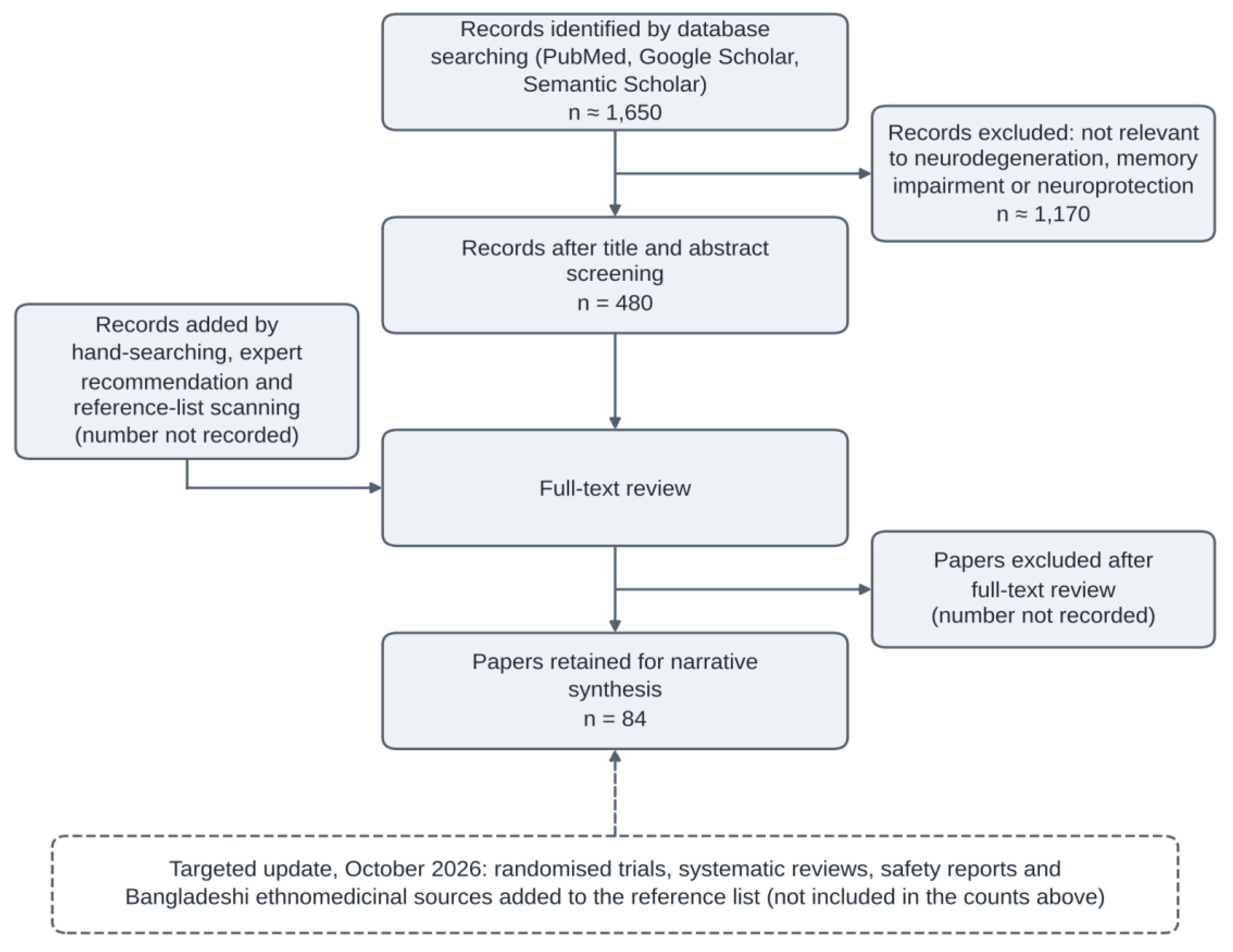

Table 1.
Additional plants identified in the literature search with preclinical evidence of neuroprotective or cognition-related activity.
Table 1.
Additional plants identified in the literature search with preclinical evidence of neuroprotective or cognition-related activity.
| Plant | Key compounds | Traditional use and reported findings |
| Platycladus orientalis (L.) Franco (syn. Biota orientalis (L.) Endl.) | Not fully characterised | Used for insomnia and amnesia in traditional Chinese medicine (TCM); a seed extract improved memory-acquisition deficits caused by amygdala and basal forebrain lesions in mice (as summarised by Hiltunen et al., 2007). |
| Codonopsis pilosula (Franch.) Nannf. | Not fully characterised | Root used in TCM for various conditions including amnesia (Duke and Ayensu, 1985); extract reduced memory-consolidation deficits and showed nootropic activity in animal models (as reviewed by He et al., 2015). |
| Hypericum perforatum L. and H. calycinum L. | Hypericin, hyperforin | Used in Portuguese and Turkish folk medicine for nervous complaints; extracts had central nervous system effects in mice (Öztürk et al., 1996); antioxidant activity in vitro (Zheng and Wang, 2001); modulates serotonergic and noradrenergic transmission relevant to mood regulation (Misane and Ögren, 2001); comparable to standard antidepressants for mild-to-moderate depression in a meta-analysis (Whiskey et al., 2001). |
| Magnolia officinalis Rehder & E.H.Wilson | Honokiol, magnolol (biphenolic lignans) | Bark used in TCM for nervous agitation; honokiol contributes to the anxiolytic effect of Magnolia bark (Kuribara et al., 2000); honokiol and magnolol enhance GABAA receptor ligand binding in vitro (Squires et al., 1999) and increase hippocampal acetylcholine release in rats (Hou et al., 2000); magnolol is a potent antioxidant (Chen et al., 2001) and protects cortical neurons from chemical hypoxia (Lee et al., 1998); magnolol is anti-inflammatory in mouse pleurisy induced by A23187 (Wang et al., 1995). |
| Artemisia absinthium L. | Constituents active at nicotinic receptors not fully characterised | Used in European folk medicine to restore lost or declining cognitive function; a crude alcohol extract displaced nicotine from nicotinic receptors in a concentration-dependent manner (Wake et al., 2000; Perry and Howes, 2011). |
Table 3.
Controlled human evidence for the plants reviewed in depth, with main limitations.
| Species / preparation | Study | Design (n; duration) | Population | Outcome | Main limitations |
| Ginkgo biloba (EGb 761) | Hofferberth, 1994 | RCT, double-blind, placebo-controlled (n = 40; 3 months) | Senile dementia, Alzheimer type | Modest cognitive benefit vs placebo | Small; short |
| Ginkgo biloba (EGb 761) | Kanowski et al., 1996 | RCT, double-blind, placebo-controlled, multicentre (n = 216; 24 weeks) | Mild-to-moderate Alzheimer-type or multi-infarct dementia | Modest cognitive benefit vs placebo | Short; mixed dementia types |
| Ginkgo biloba (EGb 761) | Le Bars et al., 2000 | RCT, double-blind, placebo-controlled (n = 309; 26-week analysis of a 52-week trial) | Alzheimer-type or multi-infarct dementia | Modest cognitive benefit vs placebo | Analysis of part of a longer trial; mixed dementia types |
| Ginkgo biloba (EGb 761), 120 mg twice daily | DeKosky et al., 2008 (GEM) | RCT, placebo-controlled (n = 3,069; median 6.1 years) | Age 75 years or older; cognitively normal (2,587) or mild cognitive impairment (482) | No reduction in all-cause dementia (HR 1.1; 95% CI 0.9-1.3) | Prevention trial, not treatment of established disease |
| Ginkgo biloba (EGb 761) | Vellas et al., 2012 (GuidAge) | RCT, placebo-controlled (n > 2,800; 5 years) | Memory complaints | AD cases 61 (ginkgo) vs 73 (placebo); not significant | Prevention trial; conversion to AD as endpoint |
| Ginkgo biloba | Birks and Grimley Evans, 2009 | Cochrane review (36 trials) | Cognitive impairment and dementia | Benefit inconsistent and unreliable | Heterogeneous trials and extracts |
| Salvia officinalis extract, 60 drops/day | Akhondzadeh et al., 2003 | RCT, double-blind, placebo-controlled (n = 42; 4 months) | Mild-to-moderate AD, age 65-80 years | Better cognitive scores than placebo | Small; single country (3 centres, Tehran); not replicated |
| Salvia officinalis extract (167-1,332 mg) | Scholey et al., 2008 | Double-blind, placebo-controlled, 5-period crossover (n = 20; single doses) | Healthy volunteers over 65 years | 333 mg improved secondary memory and attention accuracy | Acute dosing; healthy volunteers; small |
| Salvia lavandulaefolia oil | Tildesley et al., 2005 | Double-blind, placebo-controlled crossover (n = 24; single acute dose) | Healthy young volunteers | Improved word-recall speed and accuracy at low dose; higher doses reduced calmness | Acute dosing; healthy young adults |
| Withania somnifera root extract, 300 mg twice daily | Choudhary et al., 2017 | RCT, double-blind, placebo-controlled (n = 50; 8 weeks) | Mild cognitive impairment | Improved memory, executive function, attention and processing speed | Small; single centre; short |
| Withania somnifera extract, 500 mg/day | Chengappa et al., 2013 | RCT, double-blind, placebo-controlled, adjunctive (n = 60 enrolled, 53 completed; 8 weeks) | Euthymic bipolar disorder | Improved backward digit span, response time and social cognition | No multiplicity correction; not a neurodegenerative population |
| Bacopa monnieri extract, 300 mg/day | Stough et al., 2001 | RCT, double-blind, placebo-controlled (n = 46; 12 weeks) | Healthy adults aged 18-60 years | Improved speed of visual information processing, learning rate and memory consolidation | Healthy volunteers; small |
| Bacopa monnieri extract, 300 mg/day | Calabrese et al., 2008 | RCT, double-blind, placebo-controlled (n = 54, 48 completed; 12 weeks) | Age 65 years or older, no dementia | Improved delayed word recall; lower depression and anxiety scores | No effect on several other tasks; small |
| Bacopa monnieri extract | Kongkeaw et al., 2014 | Meta-analysis (9 RCTs; 518 participants) | Mostly healthy or older adults | Improved speed of attention | Short trials; modest effect sizes |
AD, Alzheimer's disease; CI, confidence interval; HR, hazard ratio; RCT, randomised controlled trial. Limitations were appraised qualitatively. No controlled human trials of Centella asiatica in neurodegenerative disease or of Semecarpus anacardium were found.
Table 4.
Safety concerns and herb-drug interactions for the plants discussed.
| Plant | Concern reported | Source |
| Ginkgo biloba | Case reports of bleeding; trials found no excess of adverse events over placebo | Bent et al., 2005; Birks and Grimley Evans, 2009 |
| Hypericum perforatum | Clinically important pharmacokinetic interactions with co-medications | Henderson et al., 2002 |
| Withania somnifera | Liver injury in a case series | Björnsson et al., 2020 |
| Centella asiatica | Hepatotoxicity case reports | Jorge and Jorge, 2005 |
| Salvia officinalis, Artemisia absinthium | Thujone content; concern at high exposures | Pelkonen et al., 2013 |
| Semecarpus anacardium | Skin-irritant phenolics; traditional detoxification needed, which reduced nootropic activity in rodents | Semalty et al., 2010; Mishra et al., 2016 |
| Bacopa monnieri | Mild adverse events in trials, mainly stomach upset | Calabrese et al., 2008 |
Table 5.
Relevance of the reviewed plants to Bangladesh.
| Plant | Occurrence in Bangladesh | Local name and documented use | Clinical evidence in this review |
| Centella asiatica | Native; grows in fallow land | Thankuni; regarded as strengthening nervous function and memory (Uddin and Zidorn, 2020) | None in neurodegenerative disease |
| Bacopa monnieri | Native; mainly coastal areas (Chittagong, Cox's Bazar); also eaten as a leafy vegetable | Brammishak (Uddin and Zidorn, 2020) | Several small RCTs in healthy and older adults; one meta-analysis |
| Withania somnifera | Reported to occur naturally in the North Bengal region | Aswagandha; tonic, senile debility, nervous tension, memory loss (Uddin and Zidorn, 2020) | Two small RCTs (mild cognitive impairment; bipolar disorder) |
| Semecarpus anacardium | Not documented in the sources consulted | Not documented in the sources consulted | None |
| Ginkgo biloba | Not native; use would depend on imported material | - | Most extensive; large prevention trials negative |
| Salvia spp., Hypericum, Magnolia, Platycladus, Codonopsis, Artemisia absinthium | Not native; use would depend on imported material | - | Salvia: one small AD trial; others none |
RCT, randomised controlled trial; AD, Alzheimer's disease.
Table 2.
Inhibition of human erythrocyte acetylcholinesterase by Salvia oils and extracts (data taken from Perry et al., 2001).
Table 2.
Inhibition of human erythrocyte acetylcholinesterase by Salvia oils and extracts (data taken from Perry et al., 2001).
| Sample | Assay concentration | Inhibition (%, mean ± SD) |
| Tacrine (positive control) | 2.0 × 10⁻² μM | 50 ± 0.1 |
| Physostigmine (positive control) | 4.5 × 10⁻² μM | 50 ± 0.1 |
| S. officinalis oil | 0.1 μg/mL | 52.4 ± 0.8 |
| S. officinalis ethanol extract (dried) | 2.5 mg/mL | 68.2 ± 15.6 |
| S. lavandulaefolia oil | 0.1 μg/mL | 63.0 ± 3.7 |
Single-concentration values; the controls gave 50% inhibition at the concentrations shown (approximately their IC50 values). IC50 values for the Salvia samples were not extracted.
Disclaimer/Publisher’s Note: The statements, opinions and data contained in all publications are solely those of the individual author(s) and contributor(s) and not of MDPI and/or the editor(s). MDPI and/or the editor(s) disclaim responsibility for any injury to people or property resulting from any ideas, methods, instructions or products referred to in the content. |
© 2026 by the authors. Licensee MDPI, Basel, Switzerland. This article is an open access article distributed under the terms and conditions of the Creative Commons Attribution (CC BY) license (http://creativecommons.org/licenses/by/4.0/).
Copyright: This open access article is published under a Creative Commons CC BY 4.0 license, which permit the free download, distribution, and reuse, provided that the author and preprint are cited in any reuse.