

Submitted:
20 October 2026
Posted:
23 October 2026
You are already at the latest version
Abstract
Cultivating the virtue of care is vital to university students’ whole-person development and benefits society as a whole. However, a culturally appropriate, particularly for Chinese university students, and psychometrically sound measure of care is lacking. To fill this gap, we developed and validated the Chinese Care Scale (CCS). Integrating Chinese philosophies and traditions with Western caring theories, we framed care as a two-dimensional construct, comprising intrapersonal caring orientation and interpersonal caring behavior. Accordingly, we created and evaluated CCS across two studies. In Study 1, we developed an initial item pool of 26 items and assessed its content validity through an expert panel (N = 10). In Study 2, we evaluated the psychometric properties of the final 21-item CCS using a longitudinal sample of Chinese university students in Hong Kong (N = 963; two waves a year apart). Results demonstrated CCS’s time-invariant factor structure, excellent convergent, criterion-related, and discriminant validity, and high reliability. CCS scores predicted participants’ social-asset outcomes a year later, above and beyond a set of covariates, including multilevel contextual influences, demographics, and baseline outcome. CCS provides an objective tool for effectively measuring care in research and applied contexts among Chinese university students.
Keywords:
care
; measurement
; psychometrics
; longitudinal study
; Chinese university students
1. Introduction
Higher education plays a crucial role in fostering care, a fundamental virtue that links individual moral commitment with public social obligation [1,2,3]. People who care for others, especially those who do so intrinsically, tend to accumulate social capital [4], which, in turn, leads to greater personal success and demonstrates stronger organizational citizenship [5,6]. Moreover, recipients receiving care also tend to pay kindness forward to others, so the benefits spread far beyond the first dyad [7]. Hence, universities should nurture students into socially caring citizens, not merely academically competent individuals. In fact, cultivating care is a key foundation of whole-person development initiatives for university students [8,9]. Although care is such an important developmental and educational outcome, measurement of care among Chinese university students has been either limited to targeting a narrow cohort or fragmented within a broad framework [10,11,12]. This measurement gap constrains care-related research and intervention evaluation concerning this population. Thus, the current study aims to fill this void by developing and validating the Chinese Care Scale (CCS).
1.1. Concept of Care in Western Literature
Western theories have construed care via ethical philosophy, clinical application, and psychological operationalization. Gilligan [13] proposed a classic conceptualization of care as an ethical stance. In this view, care is a moral vision in which all persons are treated with equal worth and responded to, ensuring that no individual is left alone or hurt. Tronto [14] extended this ethical vision to a larger social and ecological range, conceptualizing care as a human practice dedicated to sustaining and restoring our collective social and material environment. Similarly, Dillon [15] argued that care is directed not only toward intimates, but toward all persons with whom we stand in relation. These early theories advocated care as an intrapersonal ethical orientation.
Beyond ethical philosophy, care is central to nursing and clinical science, in which its ethical orientation has been translated into a practice framework. Drawing on four caring theories, McCance et al. [16] asserted that care is a human mode of being through nurturing and supporting acts. By the same token, Swanson [17] proposed a theory of caring, delineating care as five interpersonal processes: knowing (striving to understand the other’s lived experience), being with (offering sustained emotional presence for the other), doing for (acting on the other’s behalf), enabling (assisting the other’s navigation of life transitions), and maintaining belief (trusting the other’s capacity to grow and recover). This practice framework offers concrete interpersonal caring behavioral indicators used in nursing science and education [18].
Care has been further unpacked in Western psychological literature in both intrapersonal and interpersonal dimensions. Intrapersonally, care involves a moral disposition characterized by attitudes and commitments. Specifically, it entails kindness, genuine concern for others’ well-being, sensitivity to others’ emotional states, and the capacity to be attuned to and understand another’s experience [19,20,21]. Interpersonally, care is enacted through nurturing and supporting others. In practice, central to these acts are encouraging others, providing the conditions necessary for another’s well-being, and offering guidance, help, or assistance directed toward the other’s growth [2,22]. Overall, care in Western theories comprises intrapersonal orientation and interpersonal behavior. The intrapersonal dimension sensitizes individuals to others’ needs, while the interpersonal dimension expresses care through concrete actions. Both of these concepts are very important for the field of mental health and well-being.
1.2. Concept of Care in Chinese Culture
Like Western theories, Chinese philosophical and cultural traditions echo and enrich the two-dimensional structure of care. Chinese lexicographic sources are instructive. The Chinese term closest to care is guān huái (關懷). Guān huái carries both the meaning of inner affective caring concern, worried preoccupation, longing for others (guān xīn: 關心; qiān guà: 牽掛; guà niàn: 掛念), and outer active helping, protecting, and looking after others (bang zhù: 幫助; ài hù: 愛護; zhào gù: 照顧) [23]. Primarily, Confucianism provides a philosophical root for care in Chinese culture. Rén (仁, benevolence), the highest Confucian moral ideal, reflects an intrinsic love for humanity and a felt responsibility to act on its behalf, while such an inner virtue must be expressed through appropriate social conduct (lǐ, 禮) [24,25]. Without the spirit of rén, lǐ may be hollow; without the action of lǐ, rén may stay as an impulse. A similar idea is embedded in Mencius, who emphasized “cè yǐn zhī xīn” (惻隱之心, compassion). Also, care is emphasized in Buddhist and Taoist thoughts [26,27]. Buddhism views care as a mutual endeavor, where the inner feeling of universal caring translates into outer commitment. Care is an embedded concept of cí (慈, selfless caring) in Taoism, which is the first of the three treasures in the Dao De Jing, bridging internal ethic and external implementation. These Chinese philosophies underscore that inner orientation and outer practice are two distinct yet related dimensions of care.
Important in Chinese traditions of care is their alignment with relational and role-differentiated moral frameworks. As Fei [28] asserted, Chinese care spreads from the central self to concentric circles of relationship (e.g., family, friends, community), like ripples radiating from a stone cast in water. In this differential mode of association (chā xù gé jú: 差序格局), the proximity calibrates the depth of caring obligation—the closer, the deeper. Liang [29] extended this observation, arguing that Chinese society is ethics-centered (lún lǐ běn wèi: 倫理本位). In his framework, care is an expression of one’s relational obligations as the self is constituted through relational roles. Lin and Wang [25] also argued that Confucian moral capacity includes appropriate expression of care across relational spheres, from self-cultivation, to family harmony, to broader social contribution (xiū shēn, qí jiā, zhì guó, píng tiān xià: 修身,齊家,治國,平天下). Care in Chinese contexts carries the collective purposes of fulfilling role-based duties toward family and community (hù zhù: 互助), and maintaining social harmony (hé xié: 和谐) [9,25]. These insights suggest that it is necessary to design a care scale that captures the relational context for Chinese populations.
Empirical efforts to develop Chinese culturally situated measures of care have emerged. Kuo and colleagues [10] developed a multidimensional peer caring scale among Chinese university students, identifying behavioral, cognitive, and affective dimensions that reflect culturally specific relational practices. This instrument was designed for nursing students in fixed cohort classes. The Hong Kong Service Leadership Model addresses a more general population of Chinese university students with reference to leadership [8]. Care is fragmented into subcomponents and measured across separate subscales within this broad leadership framework. The Service Leadership Attitude Scale [11] and the Service Leadership Behavioral Scale [12] measure care from attitude and behavior aspects, respectively.
1.3. Conceptual and Methodological Gaps
Across Western caring theories and Chinese contexts, there is cross-cultural consensus that care comprises intrapersonal and interpersonal dimensions. In addition, measuring Chinese care should consider relational context. Accordingly, we conceptualize care as a moral virtue toward specific others, comprising the intrapersonal orientation of love and empathy, and the interpersonal behavior of nurturing and support sensitively and responsively. Existing Chinese measures of care have failed to reflect this integrated construct, leaving three specific gaps that motivate the present research.
The first gap is cultural in nature. Chinese traditions place more emphasis on the relational context of care than the West. A culturally sensitive measure of care for Chinese populations should therefore capture this relational texture. In the Chinese tradition, depth and form of care obligations vary with relational proximity [28]. Moreover, care is expressed and experienced through mutual trust and social harmony [9,25,29]. However, many existing instruments do not encode the relational gradation that characterizes care in the Chinese context [30,31]. Kuo and colleagues’ [10] peer caring measure considered Chinese cultural context, yet its applicability is limited to nursing students. A new measure of care developed for general Chinese university students, and honoring its cultural context, is required.
The second gap is fragmentation of measurement. Existing instruments have tended to operationalize care at either intrapersonal or interpersonal level. Some measures assess only one element of intrapersonal orientation, such as empathy, while leaving other intrapersonal elements and interpersonal behavior dimension unaddressed [32]. Conversely, some measures assess one element of interpersonal behavior, such as supportive behavior, without attention to other interpersonal elements and the intrapersonal orientation dimension [33]. Some measures assess different parts of care through separate subscales embedded within a broad leadership framework [11,12]. Fragmented care measures fail to assess care comprehensively. Thus, a standalone measure that assesses both orientational and behavioral dimensions within a coherent framework is needed, particularly in the mental health and well-being fields.
The third gap concerns the psychometric inadequacies of care measures. Primarily, most care measures were validated cross-sectionally [10,31,34], with few longitudinal studies examining their stability over time [35,36,37]. Longitudinal measurement invariance is a prerequisite for meaningful comparison in developmental or educational research and practice [38,39]. Furthermore, a valuable scale should demonstrate that what it measures matters. In other words, scores from a care measure should prospectively predict relevant outcomes within the whole-person development framework [9], above and beyond covariates. To facilitate care-related research and evaluation among Chinese university students, a new tool of care with rigorous longitudinal validation is needed.
1.4. Measurement Criteria for Assessing Care in Youth
University students are in a critical period for cultivating care. During the transition from late adolescence to early adulthood, they expand relational commitments, take more social and civic responsibilities, and consolidate moral identities [40,41]. These expansions, challenges, and growth simulate fluctuations in care. To objectively assess levels and changes in care among Chinese university students, a valid and reliable Chinese Care Scale (CCS) should satisfy several requirements.
The basic requirement for an assessment tool is that its factor structure should align with its theoretical conceptualization [42]. For this study, CCS data from a target sample should fit the hypothesized two-dimensional structure of care. This factor structure should also be longitudinally stable, which is a prerequisite for a measure intended to capture increases and decreases in care in developmental research and intervention evaluation [38,39].
Beyond a stable structure internal to the measure itself, CCS should meaningfully relate to external measures. On the one hand, it should positively correlate with or predict theoretically relevant variables. CCS should demonstrate convergent validity [43], showing positive associations with variables that share a common theoretical foundation or are conceptually related, such as other virtues and prosocial attitude. CCS should also demonstrate criterion-related validity retrospectively and prospectively [44]. Retrospectively, known-groups comparison can offer evidence for concurrent criterion-related validity. For example, students who scored higher on CCS should report higher frequencies of prosocial behavior, compared to those having lower CCS scores. Prospectively, longitudinal predictive power is evidence for predictive criterion-related validity. For example, CCS scores at one time point should predict social-asset outcomes at a later time point, even after controlling for baseline outcome and other relevant covariates. On the other hand, CCS should show discriminant validity by unrelated or negatively related to theoretically irrelevant or opposite variables, respectively [45]. For example, CCS scores should be negatively correlated with theoretically converse variables like egocentrism; nonsignificantly or only weakly correlated with theoretically irrelevant variables, such as preference for a specific sport.
Alongside validity, CCS should also be reliable [46,47]. Within a wave, CCS should demonstrate internal consistency at the item level, with coefficients like Cronbach’s α and correlations between items within acceptable ranges. Across waves, CCS should show test-retest reliability at the scale level. Put it differently, the correlation between CCS scores assessed at two time points shouldn’t be small in magnitude or nonsignificant.
1.5. The Present Research
To address the measurement gap and facilitate research and practice in care for Chinese university students, this study sought to develop and validate a culturally appropriate, psychometrically rigorous Chinese assessment tool for care. Grounded in a framework integrating Chinese contexts with Western theories, this study conceptualized care as a compound of two distinct yet related dimensions: intrapersonal caring orientation and interpersonal caring behavior. In Study 1, we created an initial item pool of 26 items, then assessed its content validity by structured expert review (N = 10), and identified the final items for the newly developed CCS. In Study 2, we comprehensively evaluated CCS’s psychometric properties by a longitudinal study of Chinese university students in Hong Kong (N = 963, two waves a year apart). We examined CCS’s factor structure and measurement invariance over time, and further validated its convergent, concurrent and predictive criterion-related, and discriminant validity. Additionally, Study 2 tested CCS’s internal consistency and test-retest reliability.
2. Study 1: Item Generation and Content Validity
Study 1 aimed to develop an initial item pool and establish CCS’s content validity. The integrated Western-Chinese framework derived from existing literature guided the process to ensure the scale accurately reflected the theoretical dimensions. Similar procedures were used to develop measures of responsibility [48] and acceptance [49].
2.1. Method
2.1.1. Item Generation
The literature on care from both Western theories [16,17,21] and Chinese philosophies and traditions [25,50,51] informed the framing and development of the initial item pool. We created it based on the theoretically identified two-dimensional structure, including corresponding items for each dimension. For the intrapersonal caring orientation dimension, the included items cover inner characteristics of caring dispositions (e.g., love, trust) and empathy (e.g., perspective-taking, emotional resonance). For the interpersonal caring behavior dimension, the included items cover outer acts of nurturance (e.g., enabling others’ growth) and supportiveness (e.g., practical assistance).
The Service Leadership Model [8] operationalizes care in a manner closely consistent with the two-dimensional framework. Thus, we drew items primarily from the Service Leadership Attitude Scale [11] and the Service Leadership Behavioral Scale [12]. To capture both dimensions fully, we also supplemented items from other relevant instruments and constructed new items.
To ensure these items align with cultural features of care in the Chinese context, we modified the wording. Echo Fei’s [28] relational gradation of caring obligations, we phrased several items to refer to close others rather than general others (e.g., “When my friend feels upset, I spend time accompanying them.”). All items were declarative sentences to be rated on a 6-point Likert scale from 1 (most dissimilar) to 6 (most similar). Finally, we produced the initial 26 items.
2.1.2. Expert Review
We invited 10 experts to evaluate the content validity of the initial item pool. The expert panel included scholars and practitioners in Social Work, Psychology, and Education. They assessed the initial 26 items targeting Chinese university students for clarity of each item’s phrasing, relevance of each item to the construct of care, and representativeness of each item group for its covered facet. Experts rated items on 4-point Likert scales. Experts also provided qualitative feedback on rewording, combining, or deleting items.
2.1.3. Analytic Plan
As recommended by Zamanzadeh et al. [52], we calculated both item-level content validity index (I-CVI) and scale-level content validity index (S-CVI) using experts’ quantitative ratings. I-CVI indicates whether each item or item group is highly relevant, clear, and representative, while S-CVI, the average of all I-CVIs, presents the scale’s overall content validity. I-CVI or S-CVI values below .78 may suggest the need for item revision. We also computed modified Kappa coefficients to test inter-rater reliability. We further used experts’ qualitative feedback to revise or remove items [44].
2.2. Results
The initial item pool demonstrated high relevance, clarity, and representativeness at both the item and scale levels, with I-CVIs ranging from .80 to 1.00, and S-CVIs ranging from .93 to .98. Meanwhile, the ratings among experts demonstrated high inter-rater reliability, with average modified Kappa coefficients ranging from .93 to .98. Incorporating experts’ qualitative feedback and the research team’s iterative discussion, seven items were rephrased to enhance theoretical alignment, and five items were removed to reduce redundancy.
2.3. Discussion
Study 1 resulted in a 21-item CCS. Expert review rated the new tool’s content validity highly. Its items were relevant, clear, and representative for measuring care in Chinese university students. The overall scale covers items on both intrapersonal orientation and interpersonal behavior dimensions of care.
3. Study 2: Longitudinal Validation
Following the content validation study (Study 1), we evaluated the psychometric properties of the newly developed 21-item CCS in Study 2. Based on a longitudinal sample of Chinese university students, we examined CCS’s factor structure, longitudinal measurement invariance, multifaceted validity, and reliability.
3.1. Research Questions and Hypotheses
Study 2 aimed to address eight key research questions following criteria for a rigorous assessment measure. For ease of reference, we compiled these questions in Table 1 (left column) with the corresponding hypotheses (right column).
3.2. Method
3.2.1. Participants and Procedures
Participants were from universities in Hong Kong SAR, China, through convenience sampling. Student helpers conducted recruitment. They approached potential participants and informed them about confidentiality and their right to withdraw at any time. Each participant who returned a survey with more than 50% of items completed received a supermarket voucher worth HKD 100 (roughly equivalent to USD 12.8) as compensation. Each participant was assigned a unique identifier for longitudinal matching. Ethics approval was obtained from the corresponding author’s affiliated institute. Similar procedures were used to develop measures of responsibility [48] and acceptance [49].
Figure 1 shows the data collection procedure. We collected data at two waves (T1 and T2), one year apart. T1 was conducted from July 1 to August 31, 2024, during which 3,406 participants were approached. We retained 1,973 responses after excluding cases due to refusal, failure to answer any questions, high missing-data rates, missing follow-up contact information, or duplicate entries. T2 was conducted from July 1 to October 20, 2025, during which we successfully re-contacted 1,219 participants. The analytic sample comprised 963 participants who completed both T1 and T2 with at least 70% completion.
Comparing participants retained in the analytic sample with those who dropped out, we did not find significant differences in CCS scores at T1 (t(1913) = –1.04, p = .30), or family background, as indicated by whether receiving low-income social welfare, parental highest education level, and parental marriage status (ps > .05). However, participants who were male (χ2(1) = 8.04, p < .01), younger (t(1866) = –2.33, p < .05), and local (χ2(1) = 7.61, p < .01) were less likely to participate in T2. Table 2 presents the demographic distribution of the analytic sample at T1.
3.2.2. Measures
In addition to CCS, participants completed a battery of self-report measures to examine multifaceted validity. We administered all measures at both waves. For demographic variables and contextual covariates for predictive criterion-related validity, this study used participants’ self-reported information at baseline.
3.2.2.1. Convergent Validity Measures
First, participants completed scales for the other four virtues within the same whole-person development framework with care: Respect (28 items), Acceptance (20 items), Responsibility (21 items), and Integrity (16 items) [48]. Like CCS, each virtue scale assessed the extent to which participants perceived their character as matching the respective prototype, using a 6-point scale from 1 (very dissimilar) to 6 (very similar).
Second, participants also completed a set of measures theoretically related to care. We assessed prosocial moral functioning using the 10-item Treating Others Well Subscale of the Student Moral Character Scale [53], rated on a 5-point scale from 1 (very poor) to 5 (very good). We also assessed endorsement of prosocial values using the 4-item Prosocial Attitude Scale [54], rated on a 6-point scale from 1 (strongly disagree) to 6 (strongly agree). Additionally, we assessed filial piety using the Contemporary Filial Piety Scale [55], comprising pragmatic obligations (6 items) and compassionate reverence (4 items), rated on a 5-point agreement scale. We averaged all items for each measure.
Third, participants completed an item to report their self-evaluated morality, rated on a 5-point scale from 1 (very low) to 5 (very high). These measures collectively form a theoretically coherent, multifaceted nomological network against which we can evaluate CCS’s convergent validity.
3.2.2.2. Criterion-Related Validity Measures
To evaluate concurrent criterion-related validity, we assessed participants’ prosocial behaviors in the past 12 months using the 4-item Prosocial Behavior Scale [56]. Participants reported their past-year frequency of giving up seats, helping people with disabilities cross the road, donating to charities, and doing voluntary work, on a 7-point scale from 1 (never) to 7 (more than 10 times). We first averaged all items and then divided participants into high- versus low-frequency groups based on a median split of the average score.
To evaluate predictive criterion-related validity, we assessed the social-asset outcome using the 4-item Positive Relation with Others Subscale of the Psychological Well-Being Scale [57], rated on a 5-point scale from 1 (strongly disagree) to 5 (strongly agree). Participants reported their psychological well-being in the social area across multiple dimensions, including perceived caring, willingness to invest time in others, mutual trust in friendships, and enjoyment of communication with family and friends.
We also assessed multilevel contextual influences and demographic variables that may confound the relation between care and the social-asset outcome as covariates to examine predictive validity rigorously. We assessed family influence using the 9-item Family Functioning Scale [58], covering mutuality, conflict, and communication within the family, rated on a 5-point agreement scale. We assessed the school and community influences using the 3-item School Influence Scale (e.g., “The school values students’ character development.”) and Community Influence Scale (e.g., “Most people in this community care about it.”), respectively. Both of them were developed as part of the same large project and rated on a 5-point agreement scale. We averaged all items for each measure. Participants self-reported their demographic information, including age, gender, study year, birthplace, parental education, parental marital status, and eligibility for low-income social welfare. Based on the information they provided, we further computed parental highest education level to reflect socioeconomic background and dummy-coded parental marital status (i.e., first marriage vs. not) to reflect family stability.
3.2.2.3. Discriminant Validity Measures
Participants completed a theoretically contrasting measure, the 5-item Chinese Adolescent Egocentrism Scale [59], which assessed their self-focused tendencies on a 5-point scale from 1 (very inconsistent) to 5 (very consistent). We averaged all items. Participants also completed four theoretically unrelated single-item indicators: liking Korean movies, liking playing basketball, agreement that Hong Kong has a good climate, and agreement that Hong Kong is suitable for living. Related items have been used in previous studies [60,61]. All of them used 4-point response scales.
All multi-item measures administered in this study demonstrated acceptable to excellent internal consistency, with Cronbach’s α coefficients ranging from .70 to .95, and mean inter-item correlations from .31 to .67. The only exception was the Prosocial Attitude Scale, which showed slightly lower but still marginally acceptable consistency (α = .65 at T1, .66 at T2).
3.3. Results
3.3.1. Factor Structure and Longitudinal Invariance
Table 3 presents the mean, standard deviation, skewness, and kurtosis for each CCS item. Descriptive statistics for these items showed no substantial departures from normality, with skewness ranging from -1.00 to -0.42 and kurtosis from -0.26 to 1.79. As the data were not skewed and, as is usual in social science, we treated the technically ordinal Likert-scale items as continuous variables in the analyses [77].
Regarding the preliminary EFA, the Kaiser–Meyer–Olkin (KMO = .96) and Bartlett’s test of sphericity (p < .001) indicated suitability for factor analysis. The eigenvalues and scree plots suggested CCS included two distinct factors (eigenvalues = 9.96 and 1.37). The two factors together explained 49.2% of the variance in CCS scores. Using factor loadings exceeding .30 as the criterion, 14 items loaded exclusively on their theoretically intended factor, five items (items 4, 9, 14, 16, 20) loaded on the other factor, and items 11 and 13 double-loaded. Rather than reassigning or deleting items based on the EFA results, we retained the theory-based, content-validated item assignment in the subsequent CFA to maintain item relevance and full construct coverage.
Next, we ran the primary longitudinal CFAs to compare the one-, two-, and four-factor models. As shown in Table 4, the one-factor model was the worst solution with the poorest fit. The four-factor model was not positive definite, indicating model instability. The two-factor model was the most robust representation of the data. After allowing three theoretically justifiable residual correlations based on modification indices, the revised two-factor model showed acceptable fit, which was therefore retained as the final model used in subsequent analyses. As shown in Figure 2, standardized factor loadings ranged from .56 to.79 in the final model. Correlations between the two latent factors were strong within a wave (rs = .96) and across two waves (rs = .56 to .62). Although the item-loading pattern in EFA and latent factor correlations warrant further discussion, the factor analysis results, in general, suggested a two-factor solution for CCS factor structure, supporting Hypothesis 1.
Based on the final two-factor model, we tested four levels of longitudinal invariance. As shown in Table 5, the results (ΔCFIs ≤ .003, ΔRMSEAs ≤ .001) supported strict measurement invariance across waves. This suggested that CCS operated equivalently across waves, allowing meaningful comparisons of the construct over time, supporting Hypothesis 2.
3.3.2. Convergent Validity
Table 6 presents the convergent validity correlations. Across both waves, total CCS and its subscale scores were all positively and significantly associated with convergent measures. The strongest correlations were observed with the other four virtues within the same theory framework (rs = .61 to .73 within-wave, .37 to .47 between-wave), followed by treating others well (rs = .58 to .67 within-wave, .42 to .48 between-wave), prosocial attitude (rs = .46 to .54 within-wave, .33 to .39 between-wave), filial piety (rs = .28 to .40 within-wave. .22 to .31 between-wave), and self-rated morality (rs = .30 to .34 within-wave, .24 to .29 between-wave). These medium-to-large correlations suggested excellent convergent validity, supporting Hypothesis 3.
3.3.3. Concurrent and Predictive Criterion-Related Validity
CCS showed concurrent criterion-related validity. As presented in Table 7, at both waves, participants who were more frequently engaged in prosocial behaviors in the past 12 months had significantly higher CCS scores than those who were less frequently engaged (ps < .001, Cohen’s ds = .32 to .42). Notably, the interpersonal caring behavior subscale, which is conceptually closer to prosocial behavior, showed the largest effect size, while the intrapersonal caring orientation subscale showed the smallest, and the total CCS fell in between. These patterns indicated that total CCS and its two subscales effectively distinguished students of varying levels of demonstrated prosocial engagement, supporting Hypothesis 4.
The CCS scores also showed predictive criterion-related validity. The exploratory bivariate correlations indicated that eligibility for low-income social welfare was unrelated to any dependent or independent variables (see Table 8). Thus, it was excluded from the subsequent regressions, while the remaining covariates were retained as controls. As shown in Table 9, multiple regressions found that the combination of CCS scores and covariates significantly predicted social-asset outcome, R2 = 0.36, F(10, 862) = 49.27, p < .001. After removing the effect of covariates, participants with higher total CCS scores at T1 reported higher social-asset outcome at T2 (β = .17, p < .001). Higher intrapersonal caring orientation (β = .14, p < .001) and interpersonal caring behavior (β = .17, p < .001) also predicted social-asset outcome a year later. These predictions demonstrated CCS’s predictive utility, supporting Hypothesis 5.
3.3.4. Discriminant Validity
Table 10 presents the discriminant validity correlations. Across both waves, total CCS and its subscale scores significantly and negatively correlated with egocentrism (rs = -.16 to -.06 within-wave, -.17 to -.08 between-wave). All p-values were below .05 except the correlation between egocentrism and interpersonal subscale scores at T2. The small but consistent negative associations suggested CCS was divergent from the self-centered measure, supporting Hypothesis 6a. Correlations between CCS scores and the four theoretically irrelevant single-item indicators (e.g., preferences for playing basketball) were negligible and mostly non-significant (rs = -.05 to .10), supporting Hypothesis 6b.
3.3.5. Internal Consistency and Test-Retest Reliability
Table 11 shows reliability estimates for total CCS and its two subscales across both waves. Composite reliability, Cronbach’s α, and McDonald’s ω were all above the .70 cutoff. Item-total correlations were all above the .30 cutoff. Mean item-total correlations (rs = .44 to .48) were within an acceptable range. These results suggested CCS’s high internal consistency and supported Hypothesis 7.
Test-retest reliability for total CCS and its subscales ranged from .54 to .58 (ps < .001). As T1 and T2 were a year apart, the medium-to-large between-wave correlations were acceptable, indicating CCS’s moderate stability over time and supporting Hypothesis 8.
3.4. Discussion
Overall, Study 2 demonstrated CCS’s good psychometric properties for measuring care in Chinese university students. CFA supported the two-factor structure, aligning with the theoretical hypothesis based on Western theories [16,17,21] and Chinese contexts [25,50,51]. These two dimensions reflect the nature of care, which involves both inner moral stance and outward action.
The high correlation between the two dimensions seemed to challenge the value of separating them, but it shouldn’t, given the concepts and data representation. Conceptually, the two dimensions are nonredundant, and reducing either may compromise care as a comprehensive construct. The intrapersonal caring orientation dimension sensitizes individuals to others’ needs, while the interpersonal caring behavior dimension expresses care through actions. Caring orientation may motivate caring behavior; conversely, caring behavior may reinforce caring orientation. Without inherent orientation, caring behavior may feel like a forced duty. Similarly, without the phenotypic behavior, caring orientation may not be actualized [2,21]. Statistically, both EFA and CFA indicated a two-factor solution as the best representation of the data. Thus, we argue the two-factor rather than the one-factor model is the optimal model for CCS.
Notably, we did not reassign or delete items as per the EFA, but retained the original theory-driven item allocation. We made this decision for three reasons. First, reassigning these items would compromise the relevance of the validated item content. For instance, it makes no sense to reassign the behavioral item “4. When my friends feel frustrated, I spend time with them.” to the orientation dimension, or reassign the orientational item “9. I am willing to spend time caring for others.” to the behavior dimension. Second, deleting these items would compromise content representativeness. For instance, items 4, 16, and 20 all focused on support behaviors (e.g., “When my friends feel anxious, I do my best to help them relieve their emotions.”). Deleting them would make the behavior dimension disproportionately represented by nurture behaviors (e.g., “I help others grow according to their needs.”), and degrade the construct coverage. Third, in CFAs, all items loaded highly on their intended factor. However, we acknowledge this limitation and recommend that future research refine these specific items and validate the refinement in more diverse samples.
Furthermore, the results support the hypothesis of longitudinal invariance of this two-dimensional structure across waves. The demonstrated longitudinal configural invariance suggested that the two-factor model of CCS applied appropriately and equivalently among Chinese university students over time. The demonstrated longitudinal metric invariance suggested that the associations between each item and its intended dimension were equally strong, so that varying item scores over time indicated real variation within the dimension. The demonstrated longitudinal scalar invariance suggested that the observed scores reflected the latent scores. The demonstrated longitudinal strict invariance suggested that each item was affected equally by random biases. In sum, these results suggest that changes in CCS scores over time can be interpreted as development of care. This is quite important before examining care-related longitudinal research questions and intervention effectiveness [38,39].
Collectively, convergent correlation results demonstrate that CCS captures care as a construct appropriately placed within its nomological network. The strongest associations were between CCS and the other virtue scales within the same virtue framework [48], followed by theoretically correlated variables [53,54,55] and, finally, the single-item moral self-evaluation. Among the two dimensions of filial piety [55], CCS scores correlated relatively more weakly with pragmatic obligations than with compassionate reverence. The former dimension is conceptually more compulsory, while the latter is more inherent. These differentiated correlations indicate CCS scores reflect a chosen virtue, rather than enforced duties, aligning with the nature of care [24]. Additionally, the moderate associations between CCS scores and self-rated morality suggest CCS assesses a specific moral indicator, rather than general morality. The gradient strength of associations supports CCS’s appropriate construct scope in measuring care within the Chinese moral network.
Retrospectively and prospectively, CCS demonstrates excellent criterion-related validity. Retrospectively, concurrent criterion-validity evidence showed CCS scores could differentiate participants’ high- or low-frequency prosocial behaviors during the past 12 months (Cheung et al., 1998). Notably, effect sizes were larger in the interpersonal behavioral dimension (Cohen’s d = 0.42 at T1, 0.39 at T2) than in the intrapersonal orientation dimension (Cohen’s d = 0.34 at T1, 0.32 at T2), which further consolidates the value of distinguishing the two dimensions. Prospectively, predictive criterion-related validity evidence showed that CCS scores predicted participants’ future social-asset outcomes above and beyond a set of covariates. To test this rigorously, we controlled for potential covariates identified through bivariate correlation analyses, including baseline outcome, relevant demographics, and multilevel influences from family, school, and community. Except for baseline outcome, CCS scores were the strongest predictor in the regressions. As care is a relational virtue in nature [3,78,79], and social asset accumulation is one of the key mechanisms that lead to long-term benefits of care [4], we used positive relations with others from the psychological well-being framework as the outcome indicator [57]. Accordingly, the findings suggest that students who scored higher on CCS tend to develop the relational fabric central to social thriving. The criterion-related evidence collectively supports CCS’s application as an index that contributes to long-term social flourishing in university students.
Regarding discriminant validity of the CCS, the near-zero or significantly negative correlations between CCS scores and divergent measures further demonstrate CCS’s construct validity. The near-zero associations between CCS and irrelevant items suggest that CCS is unlikely to only capture participants’ response tendencies or preferences. The association between CCS and egocentrism was significantly negative, which was consistent with prior Chinese moral research [80,81]. However, this (negative) association was small. One possible explanation for this is the partial overlap between self-cultivation and other-orientation within the Chinese moral framework. In its philosophy, building one’s own morality (xiū shēn: 修身) is an initial step before extending care beyond individuals (e.g., extending to family, country). Therefore, self-orientation does not absolutely conflict with other-orientation [25]. Another alternative explanation is that this weak (negative) association may reflect university students’ specific stages of moral development. During the transition from late adolescence to emerging adulthood, university students seek to balance growing personal needs with relational values [82]. Their focus on self or others may not be polarized and may fluctuate frequently. In light of this, university years may be a critical period for students to integrate self-cultivation with true care. Finally, regarding one is important does not necessarily mean a neglect of the needs of other people.
Last but not least, CCS demonstrates both good internal consistency and test-retest reliability. The moderate to large 1-year test-retest reliability was rational given the long-term timeframe, during which meaningful change is possible. As a whole, the above evidence establishes adequate psychometric properties for using CCS to assess the development of care in Chinese university students.
4. General Discussion
The present study developed and validated CCS, a new 21-item scale that measures the virtue of care in the Chinese context. We conceptualized care grounded in both Western theories and Chinese philosophies and traditions. CCS has two subscales, including intrapersonal caring orientation and interpersonal caring behavior. Its content validity was established via structured expert review regarding item relevance, clarity, and representativeness. Factor analyses indicated a two-factor solution, although the strong latent factor association and several items’ unintended loadings in exploratory factor analysis warrant caution. Further analyses showed CCS’s strict invariance across time. Findings revealed that CCS and its subscales have good convergent, criterion-related, and discriminant validity, as well as reliability. Collectively, pending validation in other samples and potential refinement in future studies, this investigation concludes that CCS is a culturally appropriate measure that meets psychometric standards for assessing care in research and applied settings in Chinese university students. For instance, it could assess the development of care in general university students, or evaluate changes in care for relevant intervention programs.
The current work was motivated by concerns about cultural inappropriateness, fragmented concepts, and psychometric inadequacies in measuring care among Chinese university students. Care is a well-established developmental and educational outcome for university students [5,6,8,9]. However, a limited amount of previous research developed Chinese care measures either for students in specific majors or covering only part of this concept [10,31,34]. These instruments are unlikely to fully capture care in general students. Thus, researchers and practitioners interested in care need a comprehensive measure with full concept coverage and validation in the target population. This study is a step toward this need. The final CCS covers both dimensions in the Western-Chinese combined conceptualization of care: intrapersonal caring orientation (e.g., “I am compassionate.”) and interpersonal caring behavior (e.g., “When people face difficulties, I actively listen to their thoughts.”). It also accounts for the role-differentiated moral framework within the Chinese context (e.g., “I often share useful information with friends in need.”). The scale development process also clarified the definition of care within the Chinese cultural context.
The multifaceted validation of CCS provided insights into relevant factors, consequential outcomes, and the changeability of care. The association was strongest between CCS scores and the other virtue measures across all convergent correlations. It suggests that care measured by CCS is coherent with other virtues in the same Chinese moral framework [48]. In light of this, these virtues, including care, may share a common moral character (e.g., the character of jūnzǐ: 君子, which refers to high moral character in Chinese classics). Future exploration should examine the relations among these virtues and the features of their nomological network. The negative but small significant correlations between CCS and egocentrism indicate that positive care does not stand in absolute opposition to self-concern. This pattern agrees with previous studies showing that compassion for self and others may not be significantly correlated but may interact to contribute to well-being [83,84]. Overly focusing on others while neglecting oneself may even lead to psychological distress [85]. Confucian philosophy also places self-cultivation as an initial step before contributing to family, country, and society [25]. Additionally, the cohesive relation between students’ past-year prosocial behavior frequency and CCS scores, especially the stronger effect size in the interpersonal caring behavior dimension, provided behavioral evidence that highly caring people are reflected not only in their inner morality but also in their outward actions. The prospective predictive utility of CCS for students’ future social-asset outcome reinforces the values of assessing and cultivating care in university students. Fortunately, the moderate 1-year test-retest reliability of CCS suggests that care is likely malleable and can probably be intervened in or improved.
Practically, the present study suggests that CCS can be used as an objective measure of care in different contexts. In particular, it can be used as an outcome measure in positive youth development programs such as the P.A.T.H.S. program [86,87]and mental health programs addressing youth well-being under adversity such as the COVID-19 pandemic [88,89]. Despite its contributions, several limitations of this study should be noted. First, the convenience sampling may limit the generalizability of the psychometric properties. Participants in this study were all recruited from universities in Hong Kong, where Western and Eastern cultures blend more than in some other Chinese communities. Future research should validate CCS in more diverse samples to ensure its applicability across Chinese populations, such as recruiting participants from universities in the Chinese mainland. Second, the reliance on self-reported data may raise concerns about social desirability bias. Informant-reported or behavioral recorded data are less susceptible to this bias and can enhance the evidence. Future research should collect informant-reported data (e.g., peer ratings, teacher ratings, recipient ratings) and behavioral recorded data (e.g., volunteer service hours, peer tutoring records, behavioral markers in prosocial tasks) when feasible. Third, as noted in Study 2, the existence of strong latent factor associations and loading issues in the EFA warrants caution. Although it’s more reasonable to retain the content-validated item assignment in the current investigation, considering item relevance and dimension coverage, future research should refine specific items to further improve the psychometric properties of CCS. Lastly, the test-retest interval in this study was a year, which is longer than is typical for such testing. Future research should provide evidence for short-term test-retest reliability. For example, 2-week or 1-month intervals. The correlation between CCS scores at short-term intervals should be large in magnitude.
In conclusion, the present investigation introduces CCS, a culturally grounded, conceptually comprehensive, and longitudinally validated measure of care in Chinese university students. This 21-item scale assesses two dimensions of care: intrapersonal caring orientation and interpersonal caring behavior. The factor and measurement invariance analyses confirm a two-factor structure with longitudinal strict invariance. Further evidence collectively demonstrates CCS’s multifaceted validity and reliability. The development and validation of CCS not only provides insights into correlates and outcomes of care during late adolescence and emerging adulthood in the Chinese context, but also will be helpful to facilitate research on care and practice targeting whole-person development.
Author Contributions
Conceptualization, D.T.L.S.; methodology, D.T.L.S., T.Z., and D.D.; investigation, D.D.; formal analysis, T.Z.; resources, D.T.L.S.; writing—original draft preparation, T.Z. and H.L.; writing—review and editing, D.T.L.S., T.Z., and H.L.; visualization, T.Z.; supervision, D.T.L.S.; project administration, D.T.L.S.; funding acquisition, D.T.L.S. All authors have read and agreed to the published version of the manuscript.
Funding
This research was funded by the Wofoo Foundation, the Li and Fung Endowed Professorship in Service Leadership Education, the Research Matching Fund of the Research Grants Council (ZH4Q), and The Hong Kong Polytechnic University (ZZUE and W02W).
Institutional Review Board Statement
The study was conducted in accordance with the Declaration of Helsinki, and approved by the Institutional Review Board (IRB) of The Hong Kong Polytechnic University (Approval No. HSEARS20240612005; approval date: June 13, 2024).
Informed Consent Statement
Informed consent was obtained from all subjects involved in the study.
Data Availability Statement
The data presented in this study are available on request from the corresponding author due to ethical and privacy restrictions related to the protection of participants' confidential information.
Acknowledgments
The authors thank the participants who gave their time to this study. The authors are also thankful to the student helpers and team members who helped carry this study out.
Conflicts of Interest
The authors declare no conflicts of interest.
Abbreviations
The following abbreviations are used in this manuscript:
| CCS | Chinese Care Scale |
| I-CVI | Item-level content validity |
| S-CVI | Scale-level content validity index |
| CFA | Confirmatory factor analysis |
| EFA | Exploratory factor analysis |
| CFI | Comparative fit index |
| TLI | Tucker-Lewis index |
| RMSEA | Root mean square error of approximation |
| SRMR | Standardized root mean square residual |
References
- Bozalek, V.; Mitchell, V.; Dison, A.; Alperstein, M. A Diffractive Reading of Dialogical Feedback through the Political Ethics of Care. Teach. High. Educ. 2016, 21(no. 7), 825–38. [Google Scholar] [CrossRef]
- Mayeroff, M. On Caring. In Harper & Row; 1971. [Google Scholar]
- Fraser, N. Contradictions of Capital and Care. New Left Rev. 2016, 100, 99–117. [Google Scholar] [CrossRef]
- Baker, W. E.; Bulkley, N. Paying It Forward Vs. Rewarding Reputation: Mechanisms of Generalized Reciprocity. Organ. Sci. 2014, 25(no. 5), 1493–510. [Google Scholar] [CrossRef]
- Bolino, M. C.; Grant, A. M. The Bright Side of Being Prosocial at Work, and the Dark Side, Too: A Review and Agenda for Research on Other-Oriented Motives, Behavior, and Impact in Organizations. Acad. Manag. Ann. 2016, 10(no. 1), 599–670. [Google Scholar] [CrossRef]
- Grant, A. M. Does Intrinsic Motivation Fuel the Prosocial Fire? Motivational Synergy in Predicting Persistence, Performance, and Productivity. J. Appl. Psychol. 2008, 93(no. 1), 48–58. [Google Scholar] [CrossRef] [PubMed]
- Pressman, S. D.; Kraft, T. L.; Cross, M. P. It’s Good to Do Good and Receive Good: The Impact of a ‘Pay It Forward’ Style Kindness Intervention on Giver and Receiver Well-Being. J. Posit. Psychol. 2015, 10(no. 4), 293–302. [Google Scholar] [CrossRef]
- Shek, D. T. L.; Li, X. Nurturing Students to Be Caring Service Leaders. Int. J. Disabil. Hum. Dev. 2015, 14(no. 4), 361–69. [Google Scholar] [CrossRef]
- Ng, P.; Su, X. S.; Lai, G.; Chan, D.; Ho, E.; Chan, V.; Leung, H.; Kwan, V.; Li, C. A Holistic Model of Student Development: The Validation of Whole Person Development Inventory for College Students in Hong Kong. Meas. Eval. Couns. Dev. Advance online publication. 2016. [Google Scholar]
- Kuo, C. -L.; Turton, M. A.; Lee-Hsieh, J.; Tseng, H. -F.; Hsu, C. -L. Measuring Peer Caring Behaviors of Nursing Students: Scale Development. Int. J. Nurs. Stud. 2007, 44(no. 1), 105–14. [Google Scholar] [CrossRef] [PubMed]
- Shek, D. T. L.; Chai, W. Y. Psychometric Properties of the Service Leadership Attitude Scale in Hong Kong. Front. Psychol. 2019, 10, Article 1070. [Google Scholar] [CrossRef] [PubMed]
- Shek, D. T. L.; Dou, D.; Ma, L. K. Development and Validation of a Pioneer Scale on Service Leadership Behavior in the Service Economies. Front. Psychol. 2019, 10, Article 1770. [Google Scholar] [CrossRef] [PubMed]
- Gilligan, C. In a Different Voice: Psychological Theory and Women's Development; Harvard University Press, 1982. [Google Scholar]
- Tronto, J. C. Moral Boundaries: A Political Argument for an Ethic of Care; Psychology Press, 1993. [Google Scholar]
- Dillon, R. S. Respect and Care: Toward Moral Integration. Can. J. Philos. 1992, 22(no. 1), 105–31. [Google Scholar] [CrossRef]
- McCance, T. V.; McKenna, H. P.; Boore, J. R. P. Caring: Theoretical Perspectives of Relevance to Nursing. J. Adv. Nurs. 1999, 30(no. 6), 1388–95. [Google Scholar] [CrossRef] [PubMed]
- Swanson, K. M. Empirical Development of a Middle Range Theory of Caring. Nurs. Res. 1991, 40(no. 3), 161–65. [Google Scholar] [CrossRef]
- Jarvis, K. Swanson's Theory of Caring: An Application to the Role of Nursing Education. Int. J. Hum. Caring 2019, 23(no. 3), 266–72. [Google Scholar] [CrossRef]
- Davis, M. H. Measuring Individual Differences in Empathy: Evidence for a Multidimensional Approach. J. Personal. Soc. Psychol. 1983, 44(no. 1), 113–26. [Google Scholar] [CrossRef]
- Eisenberg, N.; Carlo, G.; Murphy, B. Prosocial Development in Late Adolescence: A Longitudinal Study. In Cognitive and Moral Development, Academic Achievement in Adolescence; Routledge, 2016; pp. 75–93. [Google Scholar]
- Noddings, N. Caring: A Relational Approach to Ethics and Moral Education; University of California Press, 2013. [Google Scholar]
- Penner, L. A.; Dovidio, J. F.; Piliavin, J. A.; Schroeder, D. A. Prosocial Behavior: Multilevel Perspectives. Annu. Rev. Psychol. 2005, 56(no. 1), 365–92. [Google Scholar] [CrossRef] [PubMed]
- Handian. 關懷 [Guān Huái]. Available online: https://www.zdic.net/hans/%E5%85%B3%E6%80%80 (accessed on 7 May 2026).
- Li, C. The Confucian Concept of Jen and the Feminist Ethics of Care: A Comparative Study. Hypatia A J. Fem. Philos. 1994, 9(no. 1), 70–89. [Google Scholar] [CrossRef]
- Lin, J.; Wang, Y. Confucius’ Teachings of Virtues: Implications for World Peace and Peace Education. In Spirituality, Religion, and Peace Education; Brantmeier, Edward J., Lin, Jing, Miller, John P., Eds.; Information Age Publishing, 2010. [Google Scholar]
- Allison, E. Collective Responsibility and Environmental Caretaking: Toward an Ecological Care Ethic with Evidence from Bhutan. Ecol. Soc. 2023, 28(no. 1), Article 10. [Google Scholar] [CrossRef]
- Pang-White, A. A. Daoist Ci 慈, Feminist Ethics of Care, and the Dilemma of Nature. J. Chin. Philos. 2016, 43(no. 3–4), 275–94. [Google Scholar] [CrossRef]
- Fei, X. 鄉土中國; Hamilton, Gary G; Zheng, Wang, Translators; University of California Press, 1992. [Google Scholar]
- Liang, S. 中國文化要義; Shanghai Century Publishing: Shanghai, 2005. [Google Scholar]
- Tian, Q.; Robertson, J. L. How and When Does Perceived Csr Affect Employees’ Engagement in Voluntary Pro-Environmental Behavior? J. Bus. Ethics 2019, 155(no. 2), 399–412. [Google Scholar] [CrossRef]
- Trent, N. L.; Beauregard, M.; Schwartz, G. E. Preliminary Development and Validation of a Scale to Measure Universal Love. Spiritual. Clin. Pract. 2020, 7(no. 1), 51–64. [Google Scholar] [CrossRef]
- Mehrabian, A.; Epstein, N. A Measure of Emotional Empathy. J. Personal. 1972, 40(no. 4), 525–43. [Google Scholar] [CrossRef] [PubMed]
- Caruso, G. -A. L. The Development of Three Scales to Measure the Supportiveness of Relationships between Parents and Child Care Providers. Educ. Psychol. Meas. 1992, 52(no. 1), 149–60. [Google Scholar] [CrossRef]
- Shek, D. T. L.; Zhu, A. Y.; Ma, L. K.; Lin, L. Validation of the Service Leadership Attitude Scale in Hong Kong. Int. J. Child Adolesc. Health 2018, 11(no. 4), 467–77. [Google Scholar]
- Lai, L.; Ding, S.; Zhong, Z.; Mao, P.; Sun, N.; Zheng, F. Association between Positive Mental Character and Humanistic Care Ability in Chinese Nursing Students in Changsha, China. Front. Psychol. 2022, 13, Article 896415. [Google Scholar] [CrossRef] [PubMed]
- Pai, H. -C.; Eng, C. -J.; Ko, H. -L. Effect of Caring Behavior on Disposition toward Critical Thinking of Nursing Students. J. Prof. Nurs. 2013, 29(no. 6), 423–29. [Google Scholar] [CrossRef] [PubMed]
- Wang, Y.; Zhang, X.; Xie, Q.; Zhou, H.; Cheng, L. Humanistic Caring Ability of Midwifery Students in China and Its Associated Factors: A Multi-Centre Cross-Sectional Study. Nurse Educ. Today 2022, 111, Article 105276. [Google Scholar] [CrossRef] [PubMed]
- Chen, F. F. Sensitivity of Goodness of Fit Indexes to Lack of Measurement Invariance. Struct. Equ. Model. A Multidiscip. J. 2007, 14(no. 3), 464–504. [Google Scholar] [CrossRef]
- Vandenberg, R. J.; Lance, C. E. A Review and Synthesis of the Measurement Invariance Literature: Suggestions, Practices, and Recommendations for Organizational Research. Organ. Res. Methods 2000, 3(no. 1), 4–70. [Google Scholar] [CrossRef]
- Arnett, J. J. Emerging Adulthood: A Theory of Development from the Late Teens through the Twenties. Am. Psychol. 2000, 55(no. 5), 469–80. [Google Scholar] [CrossRef]
- Shek, D. T. L.; Dou, D.; Zhu, X.; Chai, W. Positive Youth Development: Current Perspectives. Adolesc. Health Med. Ther. 2019, 10, 131–41. [Google Scholar] [CrossRef] [PubMed]
- Lambert, L. S.; Newman, D. A. Construct Development and Validation in Three Practical Steps: Recommendations for Reviewers, Editors, and Authors. Organ. Res. Methods 2023, 26(no. 4), 574–607. [Google Scholar] [CrossRef]
- Messick, S. Validity of Psychological Assessment: Validation of Inferences from Persons' Responses and Performances as Scientific Inquiry into Score Meaning. Am. Psychol. 1995, 50(no. 9), 741–49. [Google Scholar] [CrossRef]
- Boateng, G. O.; Neilands, T. B.; Frongillo, E. A.; Melgar-Quiñonez, H. R.; Young, S. L. Best Practices for Developing and Validating Scales for Health, Social, and Behavioral Research: A Primer. Front. Public Health 2018, 6, Article 149. [Google Scholar] [CrossRef] [PubMed]
- Westen, D.; Rosenthal, R. Quantifying Construct Validity: Two Simple Measures. J. Personal. Soc. Psychol. 2003, 84(no. 3), 608–18. [Google Scholar] [CrossRef] [PubMed]
- Davenport, E. C.; Davison, M. L.; Liou, P. Y.; Love, Q. U. Reliability, Dimensionality, and Internal Consistency as Defined by Cronbach: Distinct Albeit Related Concepts. Educ. Meas. Issues Pract. 2015, 34(no. 4), 4–9. [Google Scholar] [CrossRef]
- Dunn, T. J.; Baguley, T.; Brunsden, V. From Alpha to Omega: A Practical Solution to the Pervasive Problem of Internal Consistency Estimation. Br. J. Psychol. 2014, 105(no. 3), 399–412. [Google Scholar] [CrossRef] [PubMed]
- Shek, D. T. L.; Sun, C.; Leung, J. T. Y.; Tan, L.; Guo, X. Psychometric Properties of the Chinese Responsibility Scale in University Students in Hong Kong, China. Front. Psychol. 2026, 17, 1843854. [Google Scholar] [CrossRef] [PubMed]
- Shek, D. T. L.; Luo, L.; Sun, C.; Li, X.; Tan, L.; Shek, E. Y. W. Development and Validation of the Chinese Acceptance Scale for University Students in Hong Kong, China. Front. Psychol. 2026, Article 1965526. [Google Scholar] [CrossRef] [PubMed]
- Wada, Y. Relational Care Ethics from a Comparative Perspective: The Ethics of Care and Confucian Ethics. Ethics Soc. Welf. 2014, 8(no. 4), 350–63. [Google Scholar] [CrossRef]
- Li, C. The Confucian Ren and Care Debate: Reassessment, Development, and Future Directions. Philos. Compass 2022, 17(no. 9), Article e12868. [Google Scholar] [CrossRef]
- Zamanzadeh, V.; Ghahramanian, A.; Rassouli, M.; Abbaszadeh, A.; Alavi-Majd, H.; Nikanfar, A. R. Design and Implementation Content Validity Study: Development of an Instrument for Measuring Patient-Centered Communication. J. Caring Sci. 2015, 4(no. 2), 165–78. [Google Scholar] [CrossRef] [PubMed]
- Zhou, Z.; Shek, D. T. L.; Zhu, X.; Lin, L. The Influence of Moral Character Attributes on Adolescent Life Satisfaction: The Mediating Role of Responsible Behavior. Child Indic. Res. 2021, 14(no. 3), 1293–313. [Google Scholar] [CrossRef]
- Ma, H. K.; Cheung, P. C.; Shek, D. T. L. The Relation of Prosocial Orientation to Peer Interactions, Family Social Environment and Personality of Chinese Adolescents. Int. J. Behav. Dev. 2007, 31(no. 1), 12–18. [Google Scholar] [CrossRef]
- Lum, T. Y. S.; Yan, E. C. W.; Ho, A. H. Y.; Shum, M. H. Y.; Wong, G. H. Y.; Lau, M. M. Y.; Wang, J. Measuring Filial Piety in the 21st Century: Development, Factor Structure, and Reliability of the 10-Item Contemporary Filial Piety Scale. J. Appl. Gerontol. 2016, 35(no. 11), 1235–47. [Google Scholar] [PubMed]
- Cheung, P. C.; Ma, H. K.; Shek, D. T. L. Conceptions of Success: Their Correlates with Prosocial Orientation and Behaviour in Chinese Adolescents. J. Adolesc. 1998, 21(no. 1), 31–42. [Google Scholar] [CrossRef] [PubMed]
- Ryff, C. D. Happiness Is Everything, or Is It? Explorations on the Meaning of Psychological Well-Being. J. Personal. Soc. Psychol. 1989, 57(no. 6), 1069–81. [Google Scholar] [CrossRef]
- Shek, D. T. L.; Leung, K. H.; Li, X.; Dou, D. Psychometric Properties of the Chinese Family Assessment Instrument: Evidence from Mainland China. Front. Psychol. 2023, 14, Article 1290224. [Google Scholar] [CrossRef] [PubMed]
- Shek, D. T. L. M.; Cecilia, M. S.; Lin, L. The Chinese Adolescent Materialism Scale: Psychometric Properties and Normative Profiles. Int. J. Disabil. Hum. Dev. 2014, 13(no. 2), 285–95. [Google Scholar] [CrossRef]
- Shek, D. T. L.; Lam, M. C.; Tsoi, K. W.; Lam, C. M. Psychometric Properties of the Chinese Version of the Kansas Marital Satisfaction Scale. Soc. Behav. Personal. An. Int. J. 1993, 21(no. 3), 241–49. [Google Scholar] [CrossRef]
- Schumm, W. R.; Paff-Bergen, L. A.; Hatch, R. C.; Obiorah, F. C.; Copeland, J. M.; Meens, L. D.; Bugaighis, M. A. Concurrent and Discriminant Validity of the Kansas Marital Satisfaction Scale. J. Marriage Fam. 1986, 48(no. 2), 381–87. [Google Scholar] [CrossRef] [PubMed]
- Curran, P. J.; West, S. G.; Finch, J. F. The Robustness of Test Statistics to Nonnormality and Specification Error in Confirmatory Factor Analysis. Psychol. Methods 1996, 1(no. 1), 16–29. [Google Scholar] [CrossRef]
- Kline, R. B. Principles and Practice of Structural Equation Modeling, 5th ed; Guilford Publications, 2023. [Google Scholar]
- Hoyle, R. H. Structural Equation Modeling: Concepts, Issues, and Applications; SAGE Publications, 1995. [Google Scholar]
- Browne, M. W.; Cudeck, R. Alternative Ways of Assessing Model Fit. Sociol. Methods Res. 1992, 21(no. 2), 230–58. [Google Scholar] [CrossRef]
- Ximénez, C.; Maydeu-Olivares, A.; Shi, D.; Revuelta, J. Assessing Cutoff Values of Sem Fit Indices: Advantages of the Unbiased Srmr Index and Its Cutoff Criterion Based on Communality. Struct. Equ. Model. A Multidiscip. J. 2022, 29(no. 3), 368–80. [Google Scholar] [CrossRef]
- Putnick, D. L.; Bornstein, M. H. Measurement Invariance Conventions and Reporting: The State of the Art and Future Directions for Psychological Research. Dev. Rev. 2016, 41, 71–90. [Google Scholar] [CrossRef] [PubMed]
- Cohen, J. Statistical Power Analysis for the Behavioral Sciences, 2nd Ed. ed; Lawrence Erlbaum Associates, 1988. [Google Scholar]
- Hair, J. F.; Hult, G. T. M.; Ringle, C. M.; Sarstedt, M.; Danks, N. P.; Ray, S. Partial Least Squares Structural Equation Modeling (Pls-Sem) Using R: A Workbook; Springer Nature, 2021. [Google Scholar]
- Hayes, A. F.; Coutts, J. J. Use Omega Rather Than Cronbach’s Alpha for Estimating Reliability. But…. Commun. Methods Meas. 2020, 14(no. 1), 1–24. [Google Scholar] [CrossRef]
- Clark, L. A.; Watson, D. Constructing Validity: Basic Issues in Objective Scale Development. Psychol. Assess. 1995, 7(no. 3), 309–19. [Google Scholar] [CrossRef]
- Jum, C.N.; Ira, H.B. Psychometric Theory, 3rd Ed. ed; McGraw-Hill, 1994. [Google Scholar]
- Hair, J. F.; Black, W. C.; Babin, B. J.; Anderson, R. E. Multivariate Data Analysis; Pearson, 2013. [Google Scholar]
- Muthén, L. K.; Muthén, B. O. Mplus User's Guide, 8th Ed. ed; Muthén & Muthén, 2017. [Google Scholar]
- IBM Corp. Ibm Spss Statistics for Windows, Version 30.0. IBM Corp., 2025.
- Peters, C. L. O.; Enders, C. A Primer for the Estimation of Structural Equation Models in the Presence of Missing Data: Maximum Likelihood Algorithms. J. Target. Meas. Anal. Mark. 2002, 11(no. 1), 81–95. [Google Scholar] [CrossRef]
- Rhemtulla, M.; Brosseau-Liard, P. É.; Savalei, V. When Can Categorical Variables Be Treated as Continuous? A Comparison of Robust Continuous and Categorical Sem Estimation Methods under Suboptimal Conditions. Psychol. Methods 2012, 17(no. 3), 354–73. [Google Scholar] [CrossRef] [PubMed]
- Luo, S. Relation, Virtue, and Relational Virtue: Three Concepts of Caring. Hypatia 2007, 22(no. 3), 92–110. [Google Scholar] [CrossRef]
- de la Bellacasa, M. P. ‘Nothing Comes without Its World’: Thinking with Care. Sociol. Rev. 2012, 60(no. 2), 197–216. [Google Scholar] [CrossRef]
- Shek, D. T. L.; Yu, L.; Siu, A. M. H. The Chinese Adolescent Egocentrism Scale: Psychometric Properties and Normative Profiles. Int. J. Disabil. Hum. Dev. 2014, 13(no. 2), 297–307. [Google Scholar] [CrossRef]
- Shek, D. T. L.; Ma, C.; Siu, A. M. H.; Lee, B. M. Materialism and Egocentrism in Chinese Adolescents in Hong Kong: Perceptions of Teachers. Int. J. Child Health Hum. Dev. 2019, 12(no. 3), 269–79. [Google Scholar]
- Kuang, J.; Zhong, J.; Arnett, J. J.; Hall, D. L.; Chen, E.; Markwart, M.; Yeung, A.; Zou, L. Conceptions of Adulthood among Chinese Emerging Adults. J. Adult Dev. 2024, 31(no. 1), 1–13. [Google Scholar] [CrossRef]
- Chio, F. H. N.; Mak, W. W. S.; Cheng, R. H. L. Dynamic Duo Is Inseparable: Self-Compassion and Compassion for Others Interact to Predict Well-Being. Appl. Psychol. Health Well-Being 2025, 17(no. 1), Article e12641. [Google Scholar] [CrossRef] [PubMed]
- López, A.; Sanderman, R.; Ranchor, A. V.; Schroevers, M. J. Compassion for Others and Self-Compassion: Levels, Correlates, and Relationship with Psychological Well-Being. Mindfulness 2018, 9(no. 1), 325–31. [Google Scholar] [CrossRef] [PubMed]
- Fritz, H. L.; Helgeson, V. S. Distinctions of Unmitigated Communion from Communion: Self-Neglect and Overinvolvement with Others. J. Personal. Soc. Psychol. 1998, 75(no. 1), 121–40. [Google Scholar] [CrossRef] [PubMed]
- Tan, L.; Shek, D. T. L.; Li, X. Evaluating the Impact of a Positive Youth Development Program Using Student Diaries: Tin Ka Ping P.A.T.H.S. Project in Mainland China. Appl. Res. Qual. Life 2026, 21(no. 3), 1205–32. [Google Scholar] [CrossRef]
- Zhu, X.; Shek, D. T. L.; Gong, Z.; Tang, Y. Subjective Outcome Evaluation of a Positive Youth Development Program in Mainland China during the Covid-19 Pandemic. Appl. Res. Qual. Life 2026, 21(no. 3), 1177–204. [Google Scholar] [CrossRef]
- Shek, D. T. L. Quality of Life in Young People in the Pandemic and Post-Pandemic Eras: Empirical, Theoretical, Methodological, and Intervention Considerations. Appl. Res. Qual. Life 2026, 21(no. 4), 1903–24. [Google Scholar] [CrossRef]
- Shek, D. T. L. Mental Health of Young People in the Post-Pandemic Era: Perspective Based on Positive Psychology and Resilience. Int. J. Environ. Res. Public Health 2025, 22(no. 10), 1574. [Google Scholar] [CrossRef] [PubMed]
Figure 1.
Details on the data collection procedures.
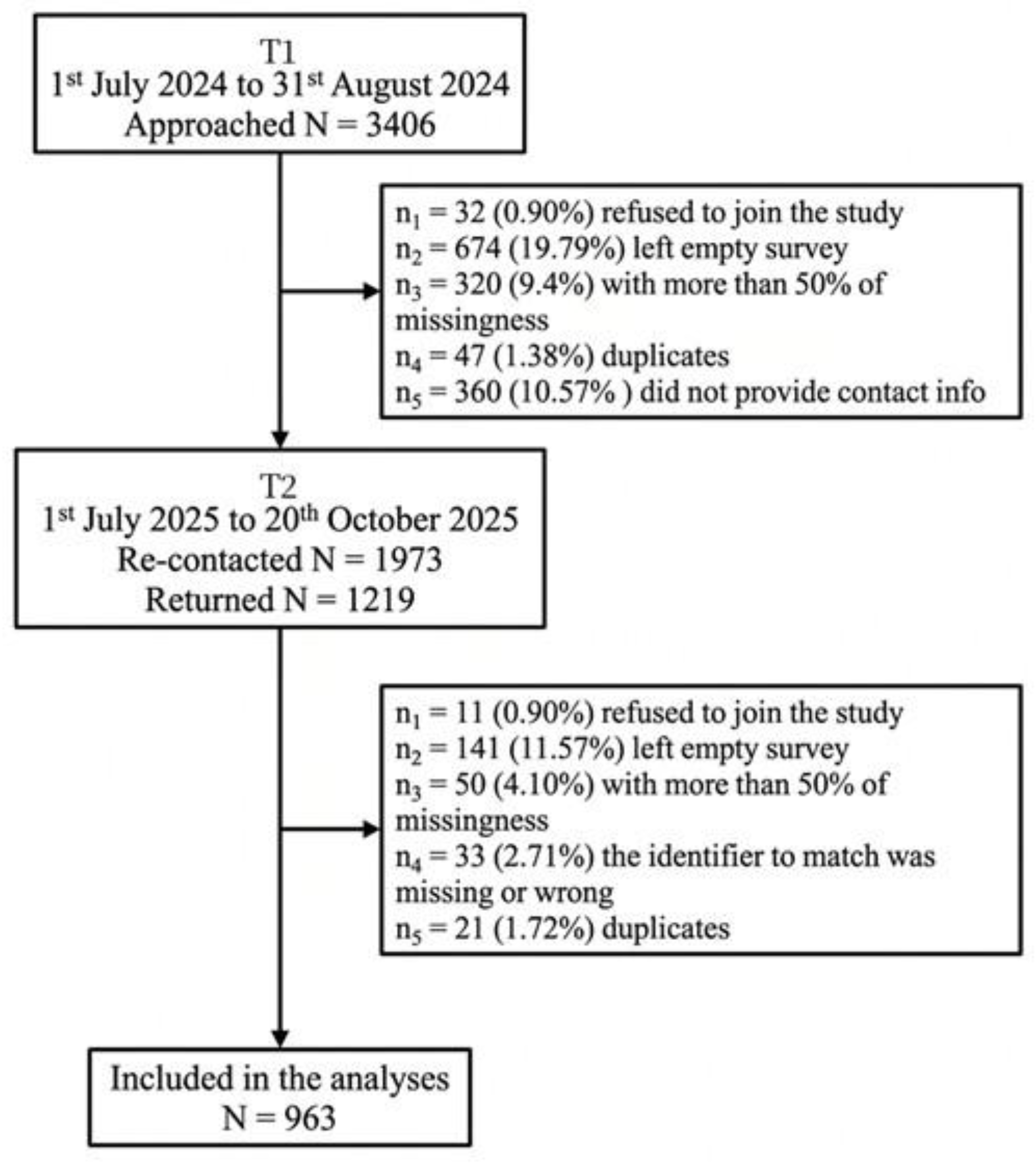
Figure 2.
Standardized loadings and factor correlation of the final model. Estimates to the left of the slash are for T1, and estimates to the right are for T2.
Figure 2.
Standardized loadings and factor correlation of the final model. Estimates to the left of the slash are for T1, and estimates to the right are for T2.
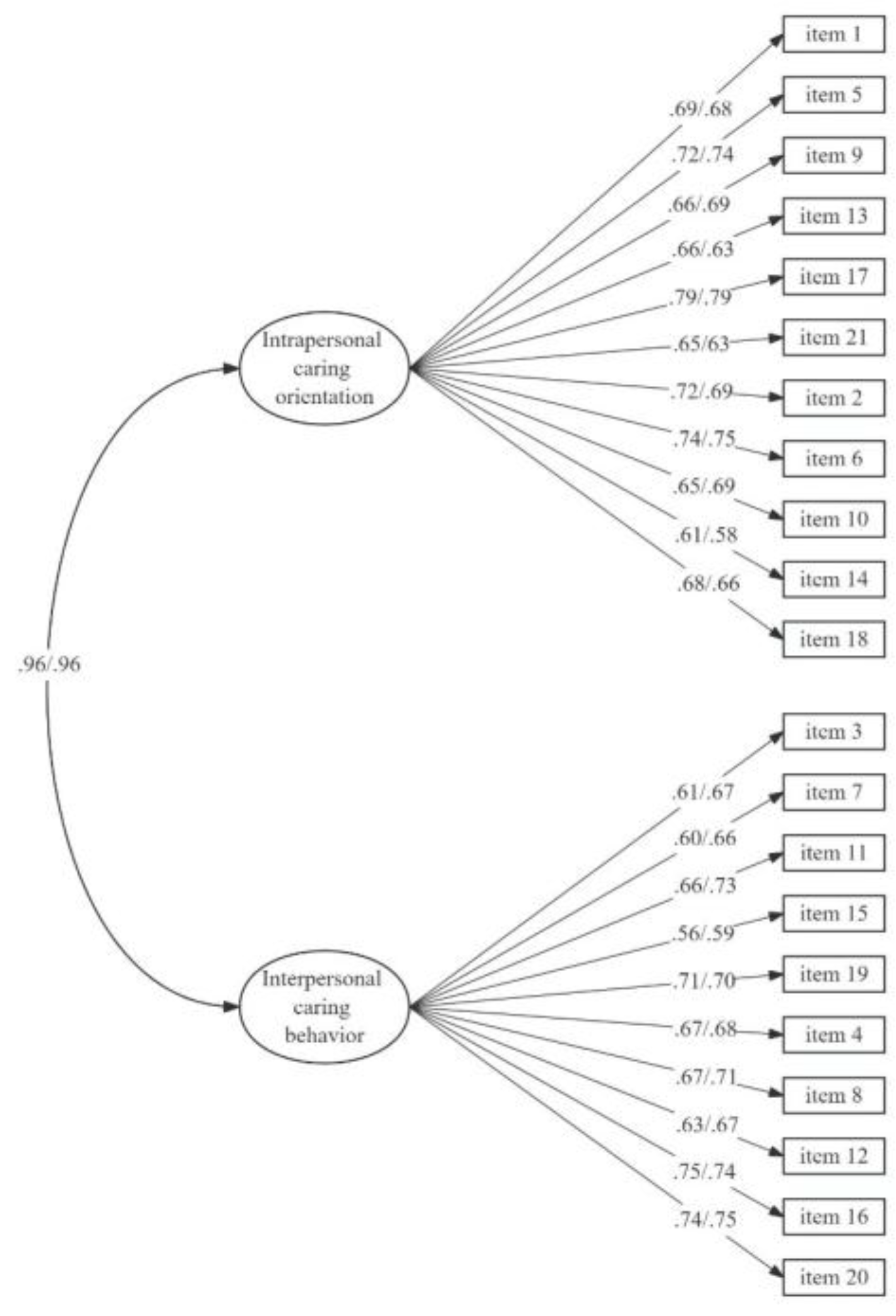

Table 1.
Research Questions in Study 2 and Corresponding Hypotheses.
| Question (Q) | Hypothesis (H) |
|---|---|
| Q1. Does CCS demonstrate a two-dimensional structure underlying care? | H1. We expected the confirmatory factor analysis to support the two-dimensional structure. |
| Q2. Does CCS demonstrate measurement invariance of the two-dimensional structure over time? | H2. We expected the measurement invariance analysis to support time invariance. |
| Q3. Does CCS demonstrate convergent validity? | H3. We expected CCS scores to be significantly and positively correlated with scores on theoretically related constructs. |
| Q4. Does CCS demonstrate concurrent criterion-related validity? | H4. We expected CCS scores to significantly differentiate between groups with high vs. low frequency of past-year prosocial behavior. |
| Q5. Does CCS demonstrate predictive criterion-related validity? | H5. We expected CCS scores to significantly and positively predict social-asset outcome a year later, even after controlling for baseline outcome and relevant covariates. |
| Q6. Does CCS demonstrate discriminant validity? | H6a. We expected CCS scores to be significantly and negatively correlated with scores on theoretically opposing constructs. H6b. We expected CCS scores to be nonsignificantly or weakly correlated with theoretically irrelevant constructs. |
| Q7. Does CCS demonstrate internal consistency? | H7. We expected CCS’s values of Cronbach’s α, McDonald’s ω, and composite reliability to exceed 70. |
| Q8. Does CCS demonstrate test-retest reliability? | H8. We expected CCS scores across the two waves to be not too varied. |
Table 2.
Demographic distribution at T1.
| Demographics | n (%) |
|---|---|
| Gender | |
| Female | 689 (71.8%) |
| Male | 271 (28.2%) |
| Age | |
| 18 or lower | 134 (14.0%) |
| 19 to 24 | 772 (80.8%) |
| 25 or above | 50 (5.2%) |
| Birthplace | |
| Local | 611 (63.5%) |
| Non-local | 351 (36.5%) |
| Parental highest education level | |
| Associate degree, bachelor’s, or above | 437 (48.61%) |
| High school | 151 (16.6%) |
| Middle school | 255 (28.1%) |
| Primary school or less | 57 (6.3%) |
| Parental marital status | |
| In first marriage | 741 (77.0%) |
| Not in first marriage | 221 (23.0%) |
| Low-income welfare eligibility | |
| No | 885 (96.5%) |
| Yes | 32 (3.5%) |
| Year group | |
| Freshman | 394 (40.9%) |
| Sophomore | 271 (28.1%) |
| Junior | 298 (30.9%) |
Note. N = 963. The total n for some variables is less than 963 due to missing data.
Table 3.
Mean, standard deviation, skewness, and kurtosis of the CCS items at T1 and T2.
| Items | T1 | T2 | |||||||
|---|---|---|---|---|---|---|---|---|---|
| Mean | SD | Skewness | Kurtosis | Mean | SD | Skewness | Kurtosis | ||
| 1.我富有同情心。 I am compassionate. |
4.78 | 0.99 | -0.83 | 1.12 | 4.74 | 0.96 | -0.74 | 0.88 | |
| 2.我會站在別人的角度了解他/她的想法。 I try to understand others’ thoughts from their perspective. |
4.85 | 0.94 | -0.90 | 1.63 | 4.81 | 0.86 | -0.64 | 0.96 | |
| 3.*我會向他人提供建議來幫助他們成長。 I offer advice to help others grow. |
4.63 | 0.99 | -0.63 | 0.57 | 4.60 | 1.00 | -0.57 | 0.54 | |
| 4.*當我的朋友感到沮喪時,我會花時間陪伴他們。 When my friends feel frustrated, I spend time with them. |
4.80 | 0.97 | -0.76 | 0.93 | 4.80 | 0.92 | -0.57 | 0.41 | |
| 5.我會體諒別人。 I am understanding towards others. |
4.80 | 0.94 | -0.88 | 1.49 | 4.77 | 0.86 | -0.65 | 1.27 | |
| 6.我會站在別人的角度體會他/她的感受。 I try to feel others’ feelings from their perspective. |
4.84 | 0.94 | -0.75 | 1.03 | 4.79 | 0.88 | -0.59 | 0.84 | |
| 7.*我幫助他人發揮他們的潛力。 I help others realize their potential. |
4.37 | 1.10 | -0.42 | -0.04 | 4.36 | 1.04 | -0.44 | 0.13 | |
| 8.*我會盡我所能來支持有需要幫助的人。 I do my best to support people in need. |
4.58 | 1.04 | -0.66 | 0.66 | 4.53 | 1.01 | -0.71 | 0.77 | |
| 9.我願意付出時間來照料別人。 I am willing to spend time caring for others. |
4.49 | 1.06 | -0.58 | 0.46 | 4.46 | 1.01 | -0.53 | 0.52 | |
| 10.我能感受別人的情緒。 I can sense others’ emotions. |
4.82 | 1.03 | -1.00 | 1.38 | 4.84 | 0.94 | -0.89 | 1.57 | |
| 11.*我會保護需要我照料的人。 I protect those who need my care. |
4.77 | 0.92 | -0.44 | -0.04 | 4.79 | 0.88 | -0.43 | 0.41 | |
| 12.*我經常向有需要幫助的朋友提供有用的資訊。 I often share useful information with friends in need. |
4.75 | 0.95 | -0.72 | 1.03 | 4.73 | 0.90 | -0.55 | 0.58 | |
| 13.我願意與別人建立互信。 I am willing to build mutual trust with others. |
4.80 | 0.98 | -0.85 | 0.94 | 4.80 | 0.94 | -0.81 | 0.97 | |
| 14.當我因為某人而生氣時,我會嘗試了解他的立場。 When I get angry at someone, I try to understand their position. |
4.37 | 1.10 | -0.53 | 0.21 | 4.38 | 1.03 | -0.49 | 0.35 | |
| 15.*我經常鼓勵他們挑戰自己。 I often encourage others to challenge themselves. |
4.35 | 1.17 | -0.42 | -0.26 | 4.40 | 1.12 | -0.60 | 0.25 | |
| 16.*當我的朋友感到不安時,我會盡力幫他們疏解情緒。 When my friends feel anxious, I do my best to help them relieve their emotions. |
4.76 | 0.95 | -0.91 | 1.79 | 4.75 | 0.88 | -0.68 | 1.32 | |
| 17.我關心他人。 I care about others. |
4.77 | 0.96 | -0.79 | 1.22 | 4.75 | 0.95 | -0.67 | 0.88 | |
| 18.當我的朋友受到不公平對待時,我感同身受並感到不開心。 When my friends are treated unfairly, I empathize and feel unhappy for them. |
4.76 | 1.03 | -0.90 | 1.09 | 4.80 | 0.92 | -0.63 | 0.51 | |
| 19.*我配合別人的需要來幫助他們成長。 I help others grow according to their needs. |
4.50 | 1.03 | -0.48 | 0.25 | 4.48 | 0.97 | -0.51 | 0.39 | |
| 20.*當人們遇到困難時,我會主動聆聽他們的想法。 When people face difficulties, I actively listen to their thoughts. |
4.75 | 0.95 | -0.68 | 0.82 | 4.77 | 0.87 | -0.56 | 0.71 | |
| 21.我以尊重的態度對待他人。 I treat others with respect. |
5.11 | 0.81 | -0.85 | 1.43 | 5.09 | 0.79 | -0.68 | 0.66 | |
Note. Items without an asterisk belong to intrapersonal caring orientation. Items marked with an asterisk (*) belong to interpersonal caring behavior.
Table 4.
Model fit comparison of longitudinal CFA.
| Model | χ2 | df | p | CFI | TLI | RMSEA | SRMR |
|---|---|---|---|---|---|---|---|
| One-factor model | 2861.61 | 148 | <.001 | .875 | .865 | .052 | .047 |
| Two-factor model | 2751.45 | 153 | <.001 | .882 | .871 | .051 | .047 |
| Four-factor model a | 2608.75. | 175 | <.001 | .889 | .876 | .050 | .046 |
| Revised two-factor model b | 2388.81 | 159 | <.001 | .903 | .894 | .046 | .045 |
Note.a The four-factor model yielded non-positive definite latent covariance matrices. b The revised model added three pairs of theoretically justified residual correlations, consistently across waves (items 1 and 2, 5 and 6, 8 and 9). Items 8 and 9 emphasize behavioral enactment and willingness, respectively, but both concern helping others in need. The final model is in bold.
Table 5.
Measurement invariance of CCS across waves.
| Model | χ² | df | c | CFI | RMSEA | ∆χ² | ∆df | p | ∆CFI | ∆RMSEA |
|---|---|---|---|---|---|---|---|---|---|---|
| Configural | 2388.81 | 786 | 1.39 | .903 | .046 | — | — | — | — | — |
| Metric | 2420.49 | 805 | 1.39 | .902 | .046 | 54.92 | 19 | .000 | .001 | .000 |
| Scalar | 2450.21 | 826 | 1.38 | .902 | .045 | 33.43 | 21 | .042 | .001 | .001 |
| Strict | 2521.97 | 847 | 1.38 | .899 | .045 | 229.92 | 21 | .000 | .003 | .000 |
Table 6.
Pearson correlations between CCS scores and convergent measures.
| Convergent measures | Total CCS (T1) |
Total CCS (T2) |
Intrapersonal (T1) |
Intrapersonal (T2) |
Interpersonal (T1) |
Interpersonal (T2) |
|---|---|---|---|---|---|---|
| Respect (T1) | .73 | .41 | .73 | .43 | .67 | .37 |
| Respect (T2) | .47 | .73 | .46 | .72 | .44 | .67 |
| Acceptance (T1) | .68 | .41 | .64 | .40 | .67 | .39 |
| Acceptance (T2) | .40 | .65 | .37 | .63 | .40 | .62 |
| Responsibility (T1) | .68 | .41 | .68 | .42 | .63 | .37 |
| Responsibility (T2) | .44 | .68 | .43 | .68 | .41 | .64 |
| Integrity (T1) | .67 | .42 | .66 | .42 | .63 | .38 |
| Integrity (T2) | .44 | .66 | .42 | .65 | .42 | .61 |
| Treating others well (T1) | .66 | .47 | .66 | .47 | .60 | .42 |
| Treating others well (T2) | .48 | .65 | .48 | .67 | .45 | .58 |
| Prosocial attitude (T1) | .49 | .37 | .49 | .38 | .46 | .33 |
| Prosocial attitude (T2) | .39 | .52 | .39 | .54 | .36 | .47 |
| Pragmatic obligations of filial piety (T1) | .32 | .30 | .33 | .30 | .28 | .27 |
| Pragmatic obligations of filial piety (T2) | .24 | .35 | .24 | .37 | .22 | .31 |
| Compassionate reverence of filial piety (T1) | .40 | .30 | .39 | .31 | .37 | .27 |
| Compassionate reverence of filial piety (T2) | .29 | .39 | .29 | .39 | .27 | .36 |
| How do you rate your morality? (T1) | .33 | .28 | .34 | .29 | .30 | .24 |
| How do you rate your morality? (T2) | .28 | .33 | .29 | .34 | .25 | .30 |
Note. All correlations are significant at the .001 level. Intrapersonal = intrapersonal caring orientation; Interpersonal = interpersonal caring behavior.
Table 7.
Comparison of CCS scores by past-year prosocial behavior frequency.
| Scale | High-frequency group | Low-frequency group | t | df | p | Cohen’s d | |||
|---|---|---|---|---|---|---|---|---|---|
| M | SD | M | SD | ||||||
| T1 | |||||||||
| Total CCS | 4.82 | 0.67 | 4.55 | 0.66 | 6.13 | 958 | <.001 | 0.40 | |
| Intrapersonal | 4.87 | 0.70 | 4.64 | 0.70 | 5.23 | 958 | <.001 | 0.34 | |
| Interpersonal | 4.76 | 0.70 | 4.47 | 0.69 | 6.53 | 958 | <.001 | 0.42 | |
| T2 | |||||||||
| Total CCS | 4.80 | 0.67 | 4.57 | 0.63 | 5.67 | 957 | <.001 | 0.37 | |
| Intrapersonal | 4.85 | 0.68 | 4.65 | 0.63 | 4.88 | 957 | <.001 | 0.32 | |
| Interpersonal | 4.76 | 0.70 | 4.49 | 0.67 | 6.00 | 957 | <.001 | 0.39 | |
Note. Intrapersonal = intrapersonal caring orientation; Interpersonal = interpersonal caring behavior.
Table 8.
Bivariate correlations among social-asset outcome, CCS scores, and potential covariates.
| Variables | 1 | 2 | 3 | 4 | 5 | 6 | 7 | 8 | 9 | 10 | 11 | 12 | 13 | |
|---|---|---|---|---|---|---|---|---|---|---|---|---|---|---|
| 1 | Social-asset (T2) | — | ||||||||||||
| 2 | Social-asset (T1) | .55*** | — | |||||||||||
| 3 | Total CCS (T1) | .46*** | .59*** | — | ||||||||||
| 4 | Intrapersonal CCS (T1) | .44*** | .57*** | .96*** | — | |||||||||
| 5 | Interpersonal CCS (T1) | .45*** | .56*** | .96*** | .85*** | — | ||||||||
| 6 | Family influence | .33*** | .37*** | .28*** | .28*** | .25*** | — | |||||||
| 7 | School influence | .28*** | .37*** | .28*** | .26*** | .29*** | .33*** | — | ||||||
| 8 | Community influence | .25*** | .37*** | .28*** | .26*** | .27*** | .26*** | .51*** | — | |||||
| 9 | Gender | .08* | .08* | .02 | .04 | .00 | -.02 | .06 | .07* | — | ||||
| 10 | Age | .04 | .05 | .07* | .06 | .07* | -.06 | -.04 | -.03 | -.02 | — | |||
| 11 | Birthplace | -.12*** | -.11*** | -.10** | -.10** | -.08* | -.05 | -.17*** | -.16*** | .00 | -.08* | — | ||
| 12 | Low-income welfare | -.01 | -.01 | -.04 | -.03 | -.05 | -.08* | .00 | -.05 | .01 | .02 | .01 | — | |
| 13 | Parental highest education | .13*** | .08* | .08* | .07* | .09** | .16*** | .04 | .07* | .01 | -.16*** | -.19*** | -.12*** | — |
| 14 | Parental marital status | .08* | .04 | .03 | .03 | .02 | .24*** | .11*** | .13*** | .00 | -.06 | .03 | -.11*** | .14*** |
Note.* p < .05; ** p < .01; *** p < .001. Gender is coded 1 = female, 0 = male. Birthplace is coded 1 = local, 0 = others. Parental marital status is coded 1 = in first marriage, 0 = others.
Table 9.
Prediction of T2 social-asset outcome from T1 CCS scores and covariates.
| Predictors | Model 1 (Total CCS) | Model 2 (Intrapersonal) | Model 3 (Interpersonal) | |||||
|---|---|---|---|---|---|---|---|---|
| β | t | β | t | β | t | |||
| CCS indicator (T1) | .17*** | 4.83 | .14*** | 4.20 | .17*** | 4.90 | ||
| Social-asset (T1) | .39*** | 10.64 | .41*** | 11.36 | .39*** | 10.75 | ||
| Family influence | .11*** | 3.49 | .11*** | 3.40 | .11*** | 3.64 | ||
| School influence | .06 | 1.67 | .06 | 1.80 | .05 | 1.58 | ||
| Community influence | -.02 | -0.46 | -.01 | -0.38 | -.02 | -0.50 | ||
| Gender | .05 | 1.86 | .05 | 1.66 | .06* | 2.02 | ||
| Age | .05 | 1.70 | .05 | 1.79 | .05 | 1.68 | ||
| Birthplace | -.04 | -1.33 | -.04 | -1.24 | -.04 | -1.46 | ||
| Parental highest education | .06* | 2.03 | .06* | 2.12 | .06 | 1.94 | ||
| Parental marital status | .02 | 0.65 | .02 | 0.61 | .02 | 0.68 | ||
| R2 | 0.36 | 0.36 | 0.36 | |||||
| F | 49.27*** | 48.39*** | 49.37*** | |||||
Note. * p < .05; ** p < .01; *** p < .001. Gender is coded 1 = female, 0 = male. Birthplace is coded 1 = local, 0 = others. Parental marital status is coded 1 = in first marriage, 0 = others.
Table 10.
Pearson correlations between CCS scores and discriminant measures.
| Discriminant measures | Total CCS (T1) |
Total CCS (T2) |
Intrapersonal (T1) |
Intrapersonal (T2) |
Interpersonal (T1) |
Interpersonal (T2) |
|---|---|---|---|---|---|---|
| Egocentrism (T1) | -.12*** | -.13*** | -.16*** | -.17*** | -.07* | -.08* |
| Egocentrism (T2) | -.14*** | -.11** | -.16*** | -.15*** | -.11*** | -.06 |
| Preference for Korean movies (T1) | .10** | .07* | .10** | .07* | .10** | .06 |
| Preference for Korean movies (T2) | .07* | .08** | .07* | .10** | .06 | .06 |
| Preference for playing basketball (T1) | -.01 | -.01 | -.03 | -.05 | .00 | .02 |
| Preference for playing basketball (T2) | .01 | .03 | -.02 | .01 | .04 | .05 |
| Perception of Hong Kong climate (T1) | .07* | .04 | .05 | .04 | .08** | .04 |
| Perception of Hong Kong climate (T2) | .01 | -.02 | .00 | -.02 | .02 | -.01 |
| Perception of Hong Kong livability (T1) | .08* | .01 | .06 | .01 | .09** | .01 |
| Perception of Hong Kong livability (T2) | .09** | .09** | .08* | .08* | .09** | .10** |
Note.* p < .05; ** p < .01; *** p < .001. Intrapersonal = intrapersonal caring orientation; Interpersonal = interpersonal caring behavior.
Table 11.
Reliability of CCS across two time points.
| Total CCS | Intrapersonal | Interpersonal | |
|---|---|---|---|
| T1 | |||
| Composite reliability | .94 | .91 | .88 |
| Cronbach’s α | .94 | .91 | .89 |
| McDonald’s ω | .94 | .91 | .88 |
| Mean inter-item correlations | .45 | .48 | .44 |
| Range of item-total correlations | .53–.75 | .56–.74 | .55–.68 |
| T2 | |||
| Composite reliability | .95 | .91 | .90 |
| Cronbach’s α | .95 | .90 | .90 |
| McDonald’s ω | .95 | .90 | .90 |
| Mean inter-item correlations | .46 | .47 | .48 |
| Range of item-total correlations | .55–.75 | .53–.75 | .59–.69 |
| T1 and T2 Correlations | .57 | .58 | .54 |
Note. Intrapersonal = intrapersonal caring orientation; Interpersonal = interpersonal caring behavior.
Disclaimer/Publisher’s Note: The statements, opinions and data contained in all publications are solely those of the individual author(s) and contributor(s) and not of MDPI and/or the editor(s). MDPI and/or the editor(s) disclaim responsibility for any injury to people or property resulting from any ideas, methods, instructions or products referred to in the content. |
© 2026 by the authors. Licensee MDPI, Basel, Switzerland. This article is an open access article distributed under the terms and conditions of the Creative Commons Attribution (CC BY) license (http://creativecommons.org/licenses/by/4.0/).
Copyright: This open access article is published under a Creative Commons CC BY 4.0 license, which permit the free download, distribution, and reuse, provided that the author and preprint are cited in any reuse.