

Submitted:
21 October 2026
Posted:
22 October 2026
You are already at the latest version
Abstract
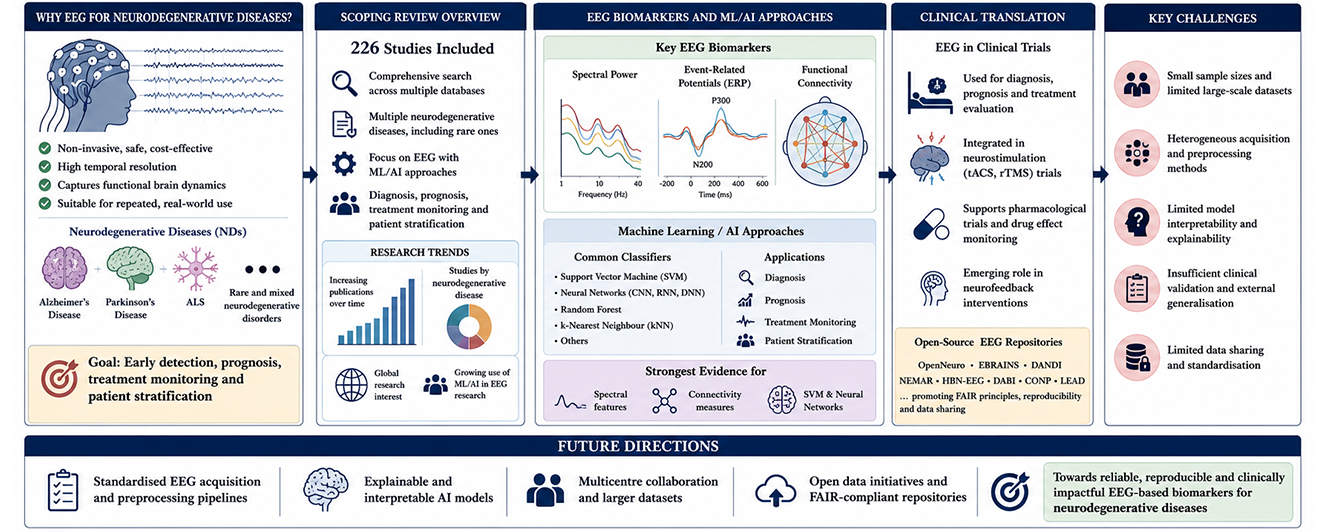
Neurodegenerative diseases (NDs) are diverse conditions characterised by selective dysfunction and progressive loss of neurons, glial cells, and neural networks in the brain and spinal cord. NDs pose a major global health challenge due to ageing populations and lack of cure, prompting interest in developing algorithms for early detection and biomarkers. Electroencephalography (EEG), a non-invasive and cost-effective tool, has emerged as a promising method for identifying neural signatures of NDs. Recent advances in machine learning (ML) and artificial intelligence (AI) have further enabled automated diagnosis, disease monitoring, and prognostic modelling using EEG data. This review synthesises evidence from 226 studies, mapping the current landscape of EEG-based diagnosis, prognosis, and patient stratification across various NDs. Unlike prior reviews, it provides a comprehensive overview across multiple disorders, including rare ones, and evaluates the role of ML and AI in clinical translation. We analyse research trends, EEG acquisition and preprocessing, and the development of biomarkers for disease diagnosis, prognosis, treatment monitoring, and patient stratification. Spectral power, event-related potentials, and connectivity are the main features, with support vector machines and neural networks as the primary classifiers. We review clinical trials involving EEG in NDs and highlight open-source EEG repositories to support reproducibility and data sharing. Despite promising results, challenges such as small sample sizes, methodological differences, limited model interpretability, and gaps in clinical validation remain. The review highlights the potential of EEG combined with ML/AI for early diagnosis and therapy, while outlining future directions through standardised pipelines, explainable models, and collaborative open data initiatives.
Keywords:
electroencephalography
; neurodegenerative disorders
; machine learning
; artificial intelligence
; clinical trials
Copyright: This open access article is published under a Creative Commons CC BY 4.0 license, which permit the free download, distribution, and reuse, provided that the author and preprint are cited in any reuse.