
Submitted:
21 October 2026
Posted:
22 October 2026
You are already at the latest version
Abstract
During the Japanese invasion of China (1894 - 1945), the Japanese carried out compre-hensive surveys of natural resources in China, including amphibians and reptiles that this article focuses on. The surveys of herpetofauna were conducted by dozens of Japanese scholars from about a dozen Japanese universities and academic institutions. The surveys’ results were presented in the books, monograph, reports, articles, and lectures at the time. Now, about 100 years later, with the gradual release of these historical documents, it is possible to conduct research on the history of colonial science during the Japanese invasion of China. A total of 93 species, comprising 25 amphibians (4 Caudata + 21 Anura) and 68 reptiles (2 Crocodylia + 7 Testudines + 15 Lacertilia + 44 Serpentes), were discovered and recorded in those original documents. These 93 species account for 17.2% of the 540 species (168 amphibians + 372 reptiles) recorded in China before 1945, and the proportions of amphibians and reptiles were 14.9% (25/168) and 18.3% (68/372) respectively. In the present study, those names of species from approximately 100 years ago and their rec-orded distribution locations in the historical documents were listed and compared with their current scientific names and distribution areas. We also discussed the changes in taxonomy and natural history information of some species. This article aims to provide a new perspective for understanding the colonial nature of Japanese scientific expeditions to China and some basic information of the science history studies of Chinese herpetology.
Keywords:
Japanese invasion of China
; colonial science
; amphibian
; reptile
; natural history
1. Introduction
In 1973, the renowned Japanese historian of science, Hiroshige Tetsu, argued in his book The Social History of Science that “colonial science” is “the science (scientific activities) engaged in for the purpose of managing colonies,” and pointed out that colonial science began with the study of natural history [1,2]. During the Japanese invasion of China (1894–1945), Japanese conducted the comprehensive surveys on China’s natural resources and subsequently wrote a series of investigation reports. Since the early 21st century, with the gradual release of these original documents, the study on colonial science during the Japanese invasion of China have become a hot topic [3].
Previous studies of colonial science in China have focused on the resources with direct economic and military strategic value, such as medicinal plants, forest resources, silkworms, livestock, crops, and freshwater organisms etc. [4,5,6,7,8,9,10]. These studies revealed the colonial plundering nature, intelligence-gathering functions, and the aggressive national policy of “using war to sustain war” etc. However, there are few systematic studies on colonial science regarding biological taxa with ecological and scientific value.
Therefore, this study examines Japanese herpetological surveys conducted in China during the Japanese invasion of China. We systematically review the survey organizations, participants, historical contexts, and academic achievements of these expeditions. By comparing these historical records with contemporary data on China’s herpetofauna, we highlight both the scientific value and the colonial characteristics of these datasets. This study aims to provide a new perspective on the colonial nature of Japanese scientific expeditions and contributes to the historiography of Chinese herpetology.
2. Materials and Methods
The research materials mainly come from the original historical documents written by Japanese scholars (see Table 1 and Table S1 [11,12,13,14,15,16,17,18,19,20,21,22,23,24,25]), as well as the literature published publicly (also written by Japanese scholars, e.g., Maki, 1931 [26]) during the Japanese invasion of China. Some historical documents that were not publicly available at the time have gradually been released in recent years. The survey areas were mainly in Northeastern China (Heilongjiang, Jilin, Liaoning and eastern Inner Mongolia), the northern North China Plain, Shanxi, Shaanxi, Guizhou, and the China’s islands (Taiwan and Hainan) with important strategic significance (Figure 1).
About 100 years ago, These Japanese scholars should have undergone formal scientific training. Most of them recorded and described species according to the modern knowledge system, used Latin binomial scientific names (with a few using Japanese names, see Table S1), and recorded their distribution locations. Some of them also presented morphological descriptions, comparisons with closely related species, animal photographs, and exquisite animal illustrations (Figure 2).
Table historical documents used in the present study were completed from 1920 to 1943, most of them non-public. Most species recorded in those historical documents have undergone changes in their taxonomic status. Fortunately, some world-renowned teams of herpetologists have built authoritative databases, e.g., Frost Amphibian Species of the World [27]; Che et al. AmphibiaChina [28]; Uetz et al. The Reptile Database [29], that comprehensively gathered abundant information on the natural history of all species of Chinese amphibians and reptiles. By retrieving these databases, and consulting classic academic works, e.g., Zhao et al. (1998) [30], (1999) [31]; Fei et al. (2006) [32], (2009) [33]; Zhao et al. (2008) [34]; Shi et al. (2011) [35]; Xiang et al. (2012) [36]; Huang (2021) [37], and recent classic papers e.g., Poyarkov et al. (2012) [38]; Takeuchi et al. (2012) [39]; Yan et al. (2018) [40]; Jiang et al. (2025) [41], the current scientific names of species and current distributions should be confirmed (Table S1).
3. Results
From 1758, when Linnaeus (1707-1778) recorded the earliest species and genera distributed in China, to the victory of the Chinese People’s War of Resistance Against Japanese Aggression in 1945, a total of 540 species had been recorded in China, comprising 168 amphibians (1 Gymnophiona + 24 Caudata + 143 Anura) and 372 reptiles (1 Crocodylia + 27 Testudines + 142 Lacertilia + 202 Serpentes). These species were mostly discovered and described by scholars, naturalists, and missionaries from Western countries.
During the Japanese invasion of China (1894–1945), a total of 93 species (see Table S1) were discovered and recorded by Japanese researchers, comprising 25 amphibians (4 Caudata + 21 Anura) and 68 reptiles (2 Crocodylia + 7 Testudines + 15 Lacertilia + 44 Serpentes). These 93 species account for 17.2% of the 540 species (168 amphibians + 372 reptiles) recorded in China before 1945, and the proportions of amphibians and reptiles are 14.9% (25/168) and 18.3% (68/372) respectively. In the present study, the species names and their distribution locations recorded approximately a century ago were listed and compared with their current scientific names and distribution areas (see Table S1). We also discussed the changes in taxonomy and natural history information for some species.
The records of distribution information at that time are valuable, as the historical location data can be used for comparative study with current distribution locations. For example, General Staff Headquarters 1940 [17] recorded that Yangtze Alligator (Alligator sinensis Fauvel 1879) was distributed in the Lower Yangtze River Basin, captured in Jiujiang, Wuhu, Dangtu, Zhenjiang, and Suzhou. However, now it is only distributed in a small area of Xuancheng (Anhui prov.) and Changxing (Zhejiang prov.). Another example, General Staff Headquarters 1940 [17] and Ikeda 1933 [14] stated that the Bay Crocodile (i.e., Saltwater Crocodile, Crocodylus porosus Schneider, 1801) was historically distributed along the southeast coast of China, but could no longer be found there by that time. This information tells us that the Bay Crocodile had no natural distribution in China as of about 100 years ago.
4. Discussion
Hiroshige Tetsu (1973) pointed out that colonial science began with the study of natural history [1]. Li Xuetao (2021) summarized that natural history is a concept from the 18th and 19th centuries, which is a holistic expression of different knowledge fields related to natural sciences. It includes research on what we call biology (including botany and zoology), mineralogy, paleontology, ecology, as well as some archaeology, geology and petrology, astronomy, physics, and meteorology today. Researchers in these fields of knowledge are called naturalists [42]. We think that natural history is a discipline in which humans describe the current state of themselves and all “things” around them, as well as review the history and predict the future of the “things”. Believing that the most primitive and simple “natural history” is synchronized with the origin of humanity, it is the most fundamental discipline that anyone can participate in and driven by curiosity. This innate curiosity is the driving force behind the origin and development of human civilization.
The correct and universally accepted name of the “things” is of paramount importance for the study of natural history. The correspondences between the old and new species names of some species in the present study need to be discussed.
The Latin name of the Giant Salamander listed by Murata (1943) [22,23] was “Megalobatrachus Japonicus, Temminck”. He also listed the distribution locations of this species in China: Guizhou, Shaanxi, Sichuan, Hubei, Hunan, Zhejiang, Jiangsu, Henan, Jiangxi. In fact, the Latin name “Megalobatrachus Japonicus, Temminck” corresponds to the Japanese Giant Salamander, and its current Latin scientific name is Andrias Japonicus (Temminck, 1836). The Chinese Giant Salamander was once thought to comprise only one species: Andrias davidianus (Blanchard, 1871). In recent years, Andrias sligoi (Boulenger, 1924) has been restored as a valid species, and three new species (Andrias jiangxiensis Lu, Wang, Chai, Yi, Peng, Murphy, Zhang, and Che, 2022; Andrias cheni Xu, Gong, Li, Jiang, Huang and Huang, 2023; Andrias yaoluopingensis Jiang, Huang, Zhao and Huang, 2026) have been described and published. Currently, the genus Andrias includes five species in China. We cannot determine the specific species identity of the Chinese Giant Salamander listed in Murata 1943 [22,23]. That record likely encompasses the species group of Andrias davidianus (sensu lato), which is distributed in the Qinling Mountains and southern Chinese provinces (excluding Hainan and Taiwan).
Previously, the Latin name for Clawed Salamander in China (only found in Jilin and Liaoning provinces) was recorded as Onychodactylus fischeri (Boulenger, 1886). In 2012, the Clawed Salamander distributed in Jilin was identified as a new species, Onychodactylus zhangyapingi Che, Poyarkov, and Yan, 2012 (Jilin Clawed Salamander); the Liaoning population was identified as another new species, Onychodactylus zhaoermii Che, Poyarkov, and Yan, 2012 (Liaoning Clawed Salamander) [38]. During the Japanese invasion of China, Mori 1927 [12], and Miyaji and Kiba 1940 [19] recorded the species names of the Clawed Salamander as “Geomolge fischeri BOULENGER” and “Onychodactylus fischeri (BOULENGER)” respectively. Mori 1927 [12] also recorded the discovery location as “a beach on the north bank of the Tumen River in Yanbian, Jilin Province”. Miyaji and Kiba 1940 [18] did not record the distribution location of the species, but they provided an illustration (Figure 2 C: Onychodactylus fischeri) and simple morphological descriptions of the species. From the illustration, we can find the uniform mesh patterns on the back of the body and tail. The morphological description states that “this species is similar in appearance to the Japanese Onychodactylus japonicus (Houttuyn), but there are no yellow longitudinal stripes in the center of the back of the body”, which indicates that the ridge groove of this species is not obvious. Based on these pieces of evidence, it is reasonable to conclude that both old names correspond to the new name Onychodactylus zhangyapingi Che, Poyarkov and Yan, 2012 (Jilin Clawed Salamander).
Hirasaka 1942 [21] recorded the Latin name for Asian Rice Frog as Rana limnocharis (the current genus name is Fejervarya), with the distribution in Hainan and Taiwan. At present, there are five species of the genus Fejervarya distributed in China: F. moodiei (Gravenhorst, 1829); F. multistriata (Hallowell, 1860); F. sakishimensis Matsui, Toda and Ota, 2008; F. kawamurai Djong, Matsui, Kuramoto, Nishioka and Sumida, 2011; F. zhoushanensis Tong, Wang, Xu, Guo, Guo, Shi and Jin, 2025. Due to the difficulty in distinguishing these five species in external morphology, and the fact that the first four species have distribution records in Hainan and/or Taiwan, we refer to this group as Fejervarya limnocharis (Gravenhorst, 1829) species complex. This species complex is widely distributed in southern China and other parts of East and Southeast Asia.
5. Conclusions
During the Japanese invasion of China (1894–1945), dozens of Japanese scholars from a dozen Japanese universities and academic institutions conducted comprehensive surveys on Chinese herpetofauna (Table 1). The survey areas were mainly in Northeastern China (Heilongjiang, Jilin, Liaoning and eastern Inner Mongolia), the northern North China Plain, Shanxi, Shaanxi, as well as Taiwan and Hainan which held significant strategic importance (Figure 1). The surveys’ results were subsequently presented in a series of historical documents (books, monographs, reports, articles, and lectures) as natural history records. A total of 93 species (Table S1) were discovered and recorded, comprising 25 amphibians (4 Caudata + 21Anura) and 68 reptiles (2 Crocodylia + 7 Testudines + 15 Lacertilia + 44 Serpentes). These surveys are considered typical examples of “colonial science” (Hiroshige, 1974 [1]).
The Japanese surveys of Chinese herpetofauna were, by design, in service of Japan’s aggression and colonization of China. Yet in practice, they constituted one of the earliest systematic surveys of China based on modern scientific knowledge. In recent years, the gradual release of these historical documents has made them valuable resources for the scientific study of amphibians and reptiles in China.
Supplementary Materials
The following supporting information can be downloaded at: https://www.mdpi.com/article/doi/s1, Table S1: Catalog of amphibians and reptiles surveyed by Japanese in China during the Japanese invasion of China.
Author Contributions
Conceptualization and methodology, Q.W. and S.H; investigation, resources, data curation, formal analysis, visualization and writing-original draft, Q.W.; writing—review and editing, Q.H. and S.H.; supervision, project administration and funding acquisition, S.H. All authors have read and agreed to the published version of the manuscript.
Funding
This research was supported by the Research Programs on the History of Biological Sciences of China: Modern Japanese Biological Surveys in China (HSNB2026-1, Huangshan Noah Biodiversity Institute), the National Natural Science Foundation of China (NSFC 31471968, 31071891, 30870290), the Key Research and Development Projects of Xizang Autonomous Region, China (XZ202301ZY0036G), and the Survey and Evaluation Project of Herpetofauna in Qimen, Anhui, China.
Informed Consent Statement
Not applicable.
Data Availability Statement
The data presented in this study are available on request from the corresponding author.
Acknowledgments
The authors appreciate the support and assistance of the historical documents provided by National Diet Library, Japan.
Conflicts of Interest
The authors declare no conflicts of interest. The funders had no role in the design of the study; in the collection, analyses, or interpretation of data; in the writing of the manuscript; or in the decision to publish the results.
References
- Hiroshige, T. The Social History of Science–The Scientific System of Modern Japan; Chuo Koron Sha: Tokyo, Japan, 1973; p. 144p. (In Japanese) [Google Scholar]
- Liang, B.; Chen, F. On “Colonial Science”. J. Dialect. Nat. 2000, 6, 34–40. (In Chinese) [Google Scholar] [CrossRef]
- Zhang, C.; Sun, J.L. Japan’s Plunder of Forest Resources in Northeast China. World Hist. 1996, 6, 75–81. (In Chinese) [Google Scholar]
- Cao, X.; Hu, Z. Colonial science: Japanese agricultural scientific research activities in China. In Proceedings of the 6th International Symposium on East Asian Agricultural History, Suwon-si, Gyeonggi-do, Korea, 20-22 Sept. 2006; pp. 17–25. (In Chinese) [Google Scholar]
- Yao, Y. Modern Japanese plunder policies on forest resources in Northeast China: From Sino-Japanese joint operation to monopolistic control. Agric. Archaeol. 2017, 3, 173–179. (In Chinese) [Google Scholar]
- Qi, J. Wool is gunpowder: A new horizon for the research of Japanese invasion of China. Res. War. Resist. Jpn. Aggress. 2018, 2, 146–147. (In Chinese) [Google Scholar]
- Shi, J. Investigation and research conducted by the Shanghai Institute of Natural Science in wartime China. J. Jpn. Aggress. Nanjing Mass. Stud. 2022, 1, 68–79. (In Chinese) [Google Scholar]
- Zhang, M. Constructing colonial medicine: The expansion of Japanese research on Chinese herbal medicine in modern China. World Hist. 2022, 3, 1–15. (In Chinese) [Google Scholar]
- Zhang, X.; Pan, D. The South Manchuria Railway’s plunder of tussah silkworm resources in Fengtian Province. Lantai World 2023, 6, 149–152. (In Chinese) [Google Scholar]
- Guo, A. Investigation as aggression: Japanese intelligence operations and resource plunder against Yongli Ammonia Plant (1936–1938). Guizhou Soc. Sci. 2025, 10, 76–86. (In Chinese) [Google Scholar]
- Oshima, M. Notes on the venomous snakes from the Islands of Formosa (Taiwan) and Riu Kiu—Annual Report of the Institute of Science, Vol. VIII, No.2; Government of Formosa (Taiwan): Taihoku (Taipei), China, 1920; pp. 1–160, (In Japanese and English). [Google Scholar]
- Mori, T. A hand-list of the Manchurian and Eastern Mongolian Vertebrata; Mori Tamezo: Tokyo, Japan, 1927; pp. 139–147, (In Japanese and English). [Google Scholar]
- Takahashi, S. A comprehensive view of Japanese snakes; Chunyangtang Educational Book Publishing Department: Tokyo, Japan, 1930; pp. 251–252. (In Japanese) [Google Scholar]
- Ikeda, K. Talks on animals of the south; Japan Publishing House: Osaka, Japan, 1933; pp. 137–174. (In Japanese) [Google Scholar]
- Okada, Y. Amphibia and Reptilia of Jehol. In Report of the First Scientific Expedition to Manchoukuo, Section V, Division II, Part II; Waseda University: Tokyo, Japan, 1935; pp. 1-47 (Amphibia), 1-76 (Reptilia). (In Japanese and English). [Google Scholar]
- Mori, T. Fauna and flora of the Mongolian-border region. In Reports of the Scientific Survey Group for Northern China-Mongolian Border Region; Chosen (Korean Peninsula) Natural Science Association, 1939; Volume 1, pp. 141–150. (In Japanese) [Google Scholar]
- Headquarters, General Staff (Ed.) Harmful and poisonous animals and plants in China; General Staff Headquarters: Japan, 1940; pp. 15–20. (In Japanese) [Google Scholar]
- Kiba, K. Soft-shelled turtles and Anura of Manchuria; Anura of Manchuria. In Survey Report on Terrestrial and Aquatic Organisms of Kwantung Leased Territory and Manchuria; Kawamura, T., Ed.; Kawamura Tamiji: Kyoto, Japan, 1940; pp. 15–19. (In Japanese) [Google Scholar]
- Miyaji, D.; Kiba, K. Urodela of Manchuria. In Survey Report on Terrestrial and Aquatic Organisms of Kwantung Leased Territory and Manchuria; Kawamura, T., Ed.; Kawamura Tamiji: Kyoto, Japan, 1940; pp. 20–21. (In Japanese) [Google Scholar]
- Kihara, H. (Ed.) Inner Mongolia biological survey; Yokendo: Tokyo, Japan, 1940; pp. 64–65. (In Japanese) [Google Scholar]
- Hirasaka, K. General overview of the animals of Hainan Island. In Report of the First Hainan Island Academic Research Group of Taipei Imperial University; Foreign Affairs Bureau of the Government-General of Taiwan, 1942; pp. 3–4. (In Japanese) [Google Scholar]
- Murata, M (a). Chapter 3: Fauna and flora, part 1: Natural environment. In Revised Complete Provincial Gazetteers of China; East Asia Common Culture Association: Tokyo, Japan, 1943; Volume 4, pp. 76–80. (In Japanese) [Google Scholar]
- Murata, M (b). Chapter 3: Fauna and flora, part 1: Natural environment. In Revised Complete Provincial Gazetteers of China; East Asia Common Culture Association: Tokyo, Japan, 1943; Volume 6, pp. 74–75. (In Japanese) [Google Scholar]
- Murayama, J. Animals of Changbai Mountain. In Preliminary Survey Report of Changbai Mountain; Natural Science Research Division, United Science-Technology Department, Manchurian Imperial Concordia Association: Changchun, China, 1943; pp. 103–104. (In Japanese) [Google Scholar]
- Yamashita, H. Preliminary Report on Academic Survey in Shanxi Province. In General Report on Resource Survey of Shanxi Province; Japanese Embassy in Peking: no Publisher Location, 1943; Volume 14, p. 169. (In Japanese) [Google Scholar]
- Maki, M. A Monograph of the Snakes of Japan; Dai-ichi Shobo Publisher: Tokyo, Japan, 1931; pp. 1–240. [Google Scholar]
- Frost, D.R. (Ed.) Amphibian Species of the World: An Online Reference, Version 6.2; American Museum of Natural History: New York, NY, USA; Available online: https://amphibiansoftheworld.amnh.org/index.php (accessed on 5 October 2026).
- AmphibiaChina. The database of Chinese amphibians, Kunming Institute of Zoology, Yunnan, China. Available online: http://www.amphibiachina.org/ (accessed on 5 October 2026).
- Uetz, P.; Freed, P.; Aguilar, R.; Reyes, F.; Kudera, J.; Hošek, J. (Eds.) The Reptile Database; Available online: http://www.reptile-database.org/ (accessed on 5 October 2026).
- Zhao, E.M.; Huang, M.H.; Zong, Y.; et al. Fauna Sinica, Reptilia Vol. 3: Squamata, Serpentes; Science Press: Beijing, China, 1998; pp. 1–523. (In Chinese) [Google Scholar]
- Zhao, E.M.; Zhao, K.T.; Zhou, K.Y.; et al. Fauna Sinica, Reptilia Vol. 2: Squamata, Lacertilia; Science Press: Beijing, China, 1999; pp. 1–395. (In Chinese) [Google Scholar]
- Fei, L.; Hu, S.Q.; Ye, C.Y.; Huang, Y.Z.; et al. Fauna Sinica, Amphibia Vol. 1: General accounts of Amphibia, Gymnophiona and Urodela; Science Press: Beijing, China, 2006; pp. 1–461. (In Chinese) [Google Scholar]
- Fei, L.; Hu, S.Q.; Ye, C.Y.; Huang, Y.Z.; et al. Fauna Sinica, Amphibia Vol. 2 and 3: Anura; Science Press: Beijing, China, 2009; pp. 1–1839. (In Chinese) [Google Scholar]
- Zhao, W.G.; et al. Herpetofauna of Heilongjiang Province; Science Press: Beijing, China, 2008; pp. 1–251. (In Chinese) [Google Scholar]
- Shi, H.T.; Zhao, E.M.; Wang, L.J.; et al. Herpetofauna of Hainan; Science Press: Beijing, China, 2011; pp. 1–316. (In Chinese) [Google Scholar]
- Xiang, G.S.; Li, P.X.; Yang, Y.R. Illustrated Guide of Amphibians and Reptiles of Taiwan; Owl Publishing House: Taibei, China, 2012; pp. 1–336. (In Chinese) [Google Scholar]
- Huang, S. Atlas of Chinese Snake–Sinoophis; Straits Publishing House: Fuzhou, China, 2021; pp. 1–645. (In Chinese) [Google Scholar]
- Poyarkov, N.A., Jr.; Che, J.; Min, M.S.; Kuro-o, M.; Yan, F.; Li, C.; Iizuka, K.; Vieites, D.R. Review of the systematics, morphology and distribution of Asian clawed salamanders, genus Onychodactylus (amphibia, caudata: hynobiidae), with the description of four new species. Zootaxa 2012, 3465, 1–106. [Google Scholar] [CrossRef]
- Takeuchi, H.; Ota, H.; Oh, H.S.; Hikida, T. Extensive genetic divergence in the East Asian natricine snake, Rhabdophis tigrinus (Serpentes: Colubridae), with special reference to prominent geographical differentiation of the mitochondrial cytochrome b gene in Japanese populations. Biol. J. Linn. Soc. 2012, 105, 395–408. [Google Scholar] [CrossRef]
- Yan, F.; Lü, J.C.; Zhang, B.L.; Yuan, Z.Y.; Zhao, H.P.; Huang, S.; Wei, G.; Mi, X.; Zou, D.H.; Xu, W.; Chen, S.; Wang, J.; Xie, F.; Wu, M.Y.; Xiao, H.B.; Liang, Z.Q.; Jin, J.Q.; Wu, S.F.; Xu, C.S.; Tapley, B.; Turvey, S.T.; Papenfuss, T.J.; Cunningham, A.A.; Murphy, R.W.; Zhang, Y.P.; Che, J. The Chinese giant salamander exemplifies the hidden extinction of cryptic species. Curr. BiolI. 2018, 28(10), R590–R592. [Google Scholar] [CrossRef] [PubMed]
- Jiang, K.; Lyu, Z.T.; Ren, J.L.; Li, J.T. Updated checklist of serpents (Reptilia, Squamata) in China. Asian Herpetol. Res. 2025, 16, 134–146. [Google Scholar] [CrossRef]
- Li, X.T. Why do we still need natural history today? Reading 2021, 11, 117–123. (In Chinese) [Google Scholar]
Figure 1.
The map of the areas (red parallel lines) concerning Japanese surveys of Chinese herpetofauna during the Japanese invasion of China [11,12,13,14,15,16,17,18,19,20,21,22,23,24,25]. Note: The base map had been approved under the review number GS (2019) 1683, issued by the Ministry of Natural Resources of the People’s Republic of China, downloaded from Standard Map Service Website: http://bzdt.ch.mnr.gov.cn.
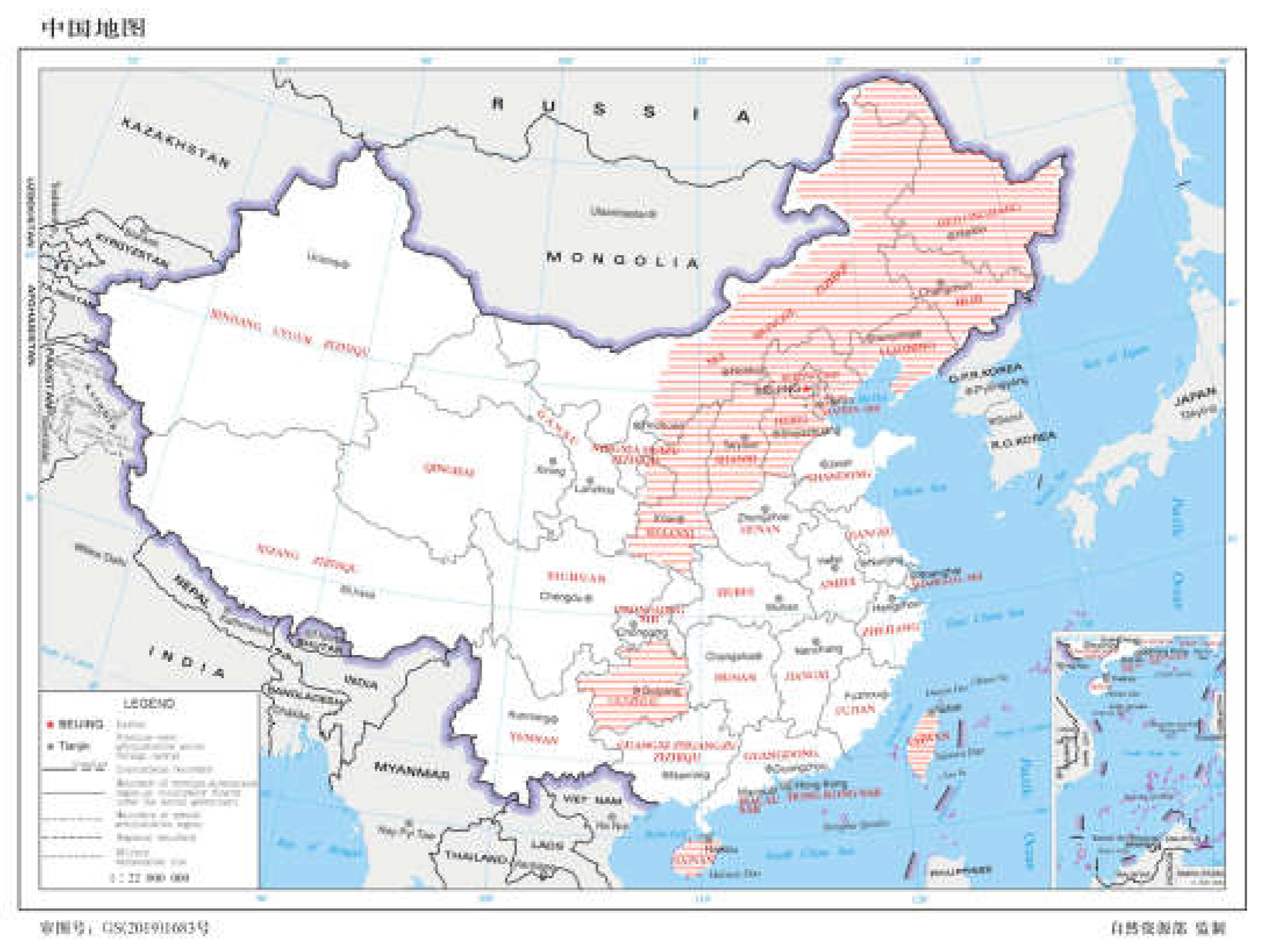
Figure 2.
The illustrations of Chinese amphibians and reptiles drawn by the Japanese scholars before about 100 years ago during the Japanese invasion of China. A: Bufo raddei STRAUCH (Strauchbufo raddei (Strauch, 1876)) from Okada 1935 [15], PL. II; B: Amyda sinesis (WIEGMANN) (Pelodiscus sinensis (Wiegmann, 1835)) from Okada 1935 [15], PL. IX; C: Salamandrella keyserlingii (Salamandrella keyserlingii Dybowski, 1870), Hynobius mantschuricus (Hynobius leechii Boulenger, 1887), Onycodactylus fischeri (Onychodactylus zhangyapingi Che, Poyarkov and Yan, 2012) from Miyaji and Kiba 1940 [18], p. 20; D: NATRIX MIYAJIMAE NEW SPECIES (Hebius miyajimae (Maki, 1931)) from Maki 1931 [26], p. 50.
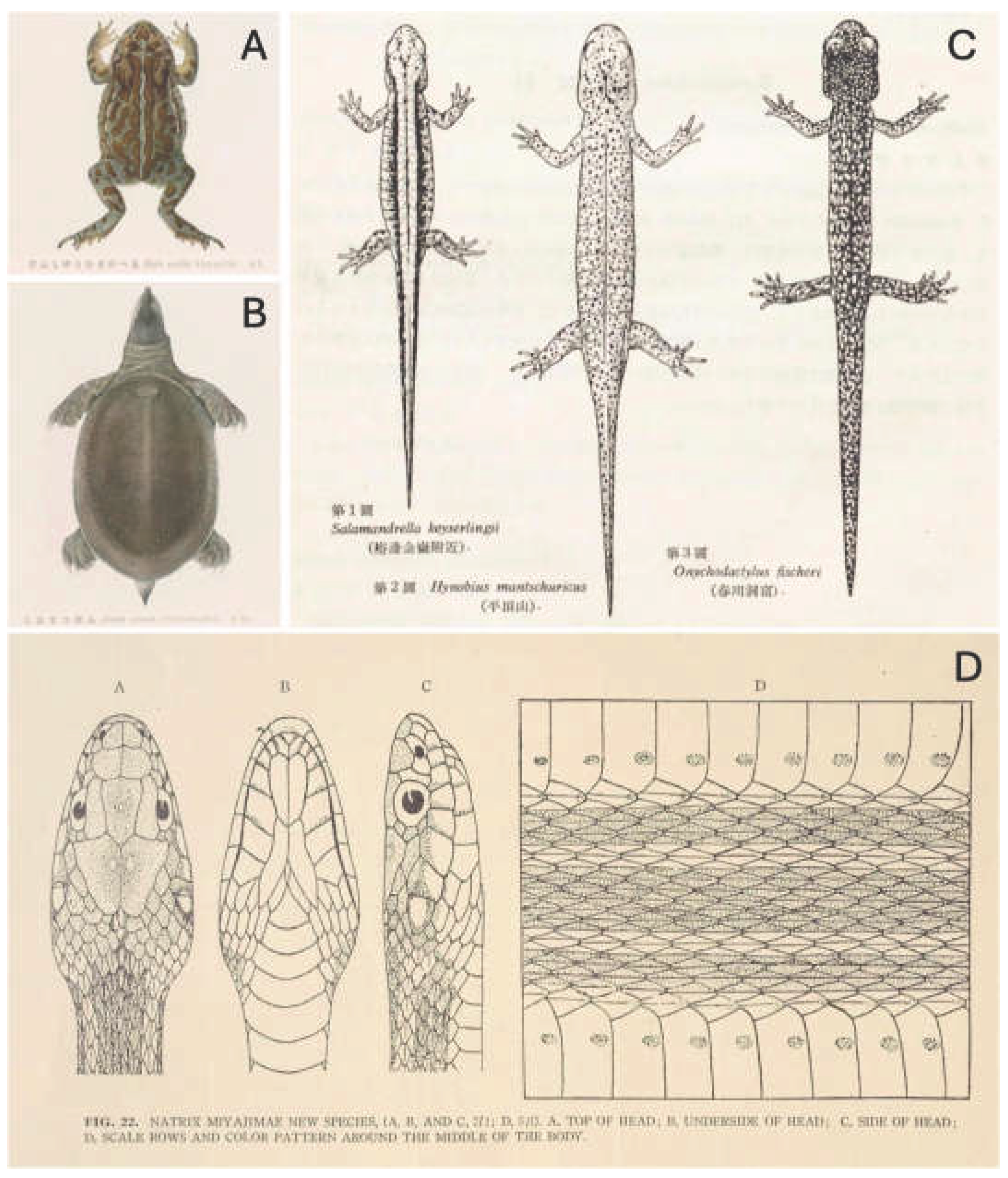

Table 1.
List of Japanese Survey Activities on Chinese herpetofauna during the Japanese Invasion of China.
Table 1.
List of Japanese Survey Activities on Chinese herpetofauna during the Japanese Invasion of China.
| Survey Period |
Dispatching/Host Institution | Author (grey) and Investigators | Survey Location | Survey Objectives | Survey Outcomes | Funding / Supporting Bodies |
|---|---|---|---|---|---|---|
| 1920 | Research Institute of the Government-General of Taiwan | Oshima Masamitsu | Taiwan and Ryukyu Islands | Compile a species catalog to provide foundational taxonomic support for the Department of Hygiene of the Government-General of Taiwan in its research on venoms and the development of treatments for snakebites. | Report on venomous snakes of Taiwan and Ryukyu Islands (1920) [11] | Research Institute of the Government-General of Taiwan. |
| 1925- 1926 |
Tokyo Imperial University, Keijō Imperial University | Mori Tamezo, Kudō Jōzō, Sasaki Zen, Odajima Kōzō, Arashima Kaikai, Kurai Toshiyuki, et al. | Manchuria and Eastern Inner Mongolia | Compile a regional vertebrate species catalogue. | Catalog of Vertebrates from Manchuria and Eastern Inner Mongolia (1927) [12] | Special-purpose survey grants from the Cultural Affairs Bureau of the Ministry of Foreign Affairs of Japan. Travel guarantees provided by the South Manchurian Railway Company and Japanese consulates across regions. |
| 1932- 1938 |
Fisheries Section of the Industry Department of Manchukuo, Kyoto Imperial University | Kiba Koba, Miyaji Denzaburo, Yamazaki Masatake, Komori Seiichi, Imaiwa Kanji, et al. | Liaodong Peninsula, Mukden, Fushun, Changchun, Harbin, Hailar, Manzhouli, etc. | Provide biological evidence for urban water-supply safety and water-quality assessment. Generate baseline data for aquaculture and fishery-resource development in Manchukuo. | Survey Report on Terrestrial and Aquatic Organisms of Kwantung Leased Territory and Manchuria (1940) [14] | Survey funds allocated by the Kwantung Governor-General’s Office. Logistical support furnished by the Industry Department of Manchukuo, the Kwantung Army, and Manchukuo military-police units. |
| 1933 | First Man-Mongolian Academic Research Expedition | Okada Yaichirō, Mori Tamezo, Kishida Kyukichi. | Border areas of Hebei, Liaoning and Inner Mongolia | Generate fundamental scientific data for industrial and mineral-resource development in Manchukuo | Amphibia and Reptilia of Jehol (1935) [15] | Project brokered by Viscount Toki Akira, Vice-Minister of the Army. Full-time army security personnel and interpreters assigned for field-work protection. |
| 1938 | Chinese-Mainland Culture Research Association of Keijō Imperial University, North-China Academic Survey Group of the Chosen Natural Science Association | Mori Tamezo. | Chahar, Suiyuan, Shanxi, Beijing, Chifeng and other regions | Conduct comprehensive surveys of animal- and plant-biological resources. | Fauna and flora of the Mongolian-Border Region (1939) [16] | Funding provided by the Chosen Natural Science Association. Assistance rendered by local Japanese-puppet authorities and Keijō Imperial University. |
| 1938 | Inner Mongolia Academic Survey Team of Kyoto Imperial University | Kihara Hitoshi, Imaiwa Kanji, Ōi Jisaburō, Hirakichi Isao, et al. | Central and eastern Inner Mongolia | Carry out biological, geographical, archaeological and economic surveys of Inner Mongolia; furnish scientific support for Japanese administrative control and resource exploitation in Inner Mongolia. | Inner Mongolia biological survey (1940) [20] | Collaboration from the Imperial Japanese Army General Staff Office, Manchurian Airline Company and the Ōsaka Asahi Shimbun. Material supplies provided by the Mengjiang United Committee, the Chanan Autonomous Government and other puppet regimes. |
| 1940 | First Hainan Island Scientific Expedition of Taihoku Imperial University | Hirasaka Kyōsuke. | Coastal zones of Hainan Island | Investigate the distribution patterns of coastal animals on Hainan Island. | General overview of the animals of Hainan Island (1942) [21] | Support offered by Taihoku Imperial University and the Fisheries Experiment Station of the Government-General of Taiwan. |
| 1942 | Natural Science Research Committee, Union Committee of Science and Technology, Manchukuo Imperial Concordia Association | Murayama Jōzō. Investigators more than a dozen. | Northern slope of the Changbai Mountain area | Lay groundwork for subsequent large-scale comprehensive surveys. Serve resource-exploitation and national-park-planning initiatives for Changbai Mountain. | Preliminary survey report of Changbai Mountain (1943) [24] | Personnel expenses covered by the Manchukuo Imperial Concordia Association and the Tōyō Takushoku Kabushiki Kaisha. Field-work safety guaranteed by security detachments. |
| 1942 | Unit 1400 (Kō-Dai 1400 Butai), North-China Liaison Bureau of the Kōa-in, Japanese Embassy in Peking | Yamashita Hiromi, Kiyosu Yukiyasu, Yasumatsu Kyōzō | Shanxi Province | Supply evidence for Japan to acquire Shanxi-region resources and formulate relevant economic-resource policies. |
General Report on Resource Survey of Shanxi Province (1943) [25] |
Survey costs borne by the Kōa-in (Asia Development Board). Full-range protection supplied by Japanese troops stationed in Shanxi. |
| 1942 | East Asia Common Culture Association | Murata Mamarō. Investigators more than a dozen. | Shaanxi Province | Compile comprehensive natural-human provincial records for Shaanxi; underpin Japanese understanding of Chinese resources and policymaking. | Revised complete provincial gazetteers of China. Volume 6, Shaanxi Province (1943) [23] | Committee for the Preservation of Cultural Relics of the Nanjing Wang-puppet Government, Shanghai Huazhong Development Corporation. |
| 1942 | East Asia Common Culture Association | Murata Mamarō. Investigators more than a dozen. | Guizhou Province | Fill gaps in resource documentation for remote Guizhou; support resource surveys and strategic assessments for Southwest China. | Revised complete provincial gazetteers of China. Volume 4, Guizhou Province (Part 1) (1943) [22] | Committee for the Preservation of Cultural Relics of the Nanjing Wang-puppet Government, Shanghai Huazhong Development Corporation. |
Disclaimer/Publisher’s Note: The statements, opinions and data contained in all publications are solely those of the individual author(s) and contributor(s) and not of MDPI and/or the editor(s). MDPI and/or the editor(s) disclaim responsibility for any injury to people or property resulting from any ideas, methods, instructions or products referred to in the content. |
© 2026 by the authors. Licensee MDPI, Basel, Switzerland. This article is an open access article distributed under the terms and conditions of the Creative Commons Attribution (CC BY) license (http://creativecommons.org/licenses/by/4.0/).
Copyright: This open access article is published under a Creative Commons CC BY 4.0 license, which permit the free download, distribution, and reuse, provided that the author and preprint are cited in any reuse.