

Submitted:
21 October 2026
Posted:
22 October 2026
You are already at the latest version
Abstract
Homo naledi is a hominin species represented at the site of Rising Star in South Africa. Dates were based on various techniques, including Uranium-Thorium (U-Th) and US-ESR analysis of teeth, leading to the estimation of ages between 236 ka and 335 ka. Here US-ESR dates are re-examined in relation to rates of uranium uptake in enamel and dentine, indicated graphically in a scenario on a logarithmic scale. A Thought Experiment Model (TEM 1) is presented, indicating a mean date of 840 kya for H. naledi teeth within a range of 780 and 900 kya. This Early-Mid Pleistocene episode is approximately three times older than dates published by the Rising Star team in 2017. As such it supports the ENH Early Naledi Hypothesis. Hominins went through a severe population bottleneck and a high probability of extinction between 930 and 813 kya during the Mid-Pleistocene Transition (MPT) when much of Africa was subjected to intense climatic change. It is questionable whether H. naledi became extinct at this time, having previously existed in southern Africa in the Early Pleistocene, perhaps as early as 2 million years ago.
Keywords:
Homo naledi
; South Africa
; dating
; Mid-Pleistocene Transition
; extinction
Introduction
Berger et al. (2015) announced an astonishing discovery of a new hominin species from the site of Rising Star in the Cradle of Humankind, South Africa. It was described as Homo naledi. No ages were presented by Dirks et al. (2015). Two years later Dirks et al. (2017) published dates based on various techniques, including Uranium-Thorium (U-Th) analysis of flowstones as well as primate teeth (one representing a baboon, and three H. naledi teeth). OSL was used as an attempt to obtain dates from sediments. US-ESR dates were determined using teeth. A palaeomagnetic signal was recorded. They concluded: “Considering all age results presented here the most parsimonious age estimate for the H. naledi fossils is sometime between 236 ka and 335 ka. More work will be needed in future to constrain these ages further.” They were specific about the following: “It is clear from these results that the H. naledi assemblage in Unit 3 is of mid- to late-Middle Pleistocene age”.
Stimulated by an article by Pettitt and Wood (2024, Figure 1), this article questions whether specimens of H. naledi from Rising Star might be considerably older than 300 ka, constituting the ENH “Early Naledi Hypothesis” (Thackeray, 2025). There have already been indications of this possibility. Dembo et al. (2016) used Bayesian analysis of cranial data to obtain 912 ka as the “most likely age for H. naledi.” Thackeray (2015, 2026) has considered Early Pleistocene dates. Here attention is given to teeth from Rising Star, recognising that as a species H. naledi may have spanned a considerable period of time within the Pleistocene.
Teeth
Dirks et al. (2017) undertook US-ESR analyses on three H. naledi teeth (U.W.101-1767, an upper premolar crown), U.W.101-1788 (a lower right second molar, RM2), and U.W.101-1810 (a lower left molar or premolar) part of which (sectioned) is shown in Figure 1. With regard to two of these specimens, they state: “The best age estimates for the H. naledi fossils come from the averaged US-ESR ages for [hominin tooth] samples 1788 and 1810: 229 +60/–46 ka (maximum) and 179 +49/–40 ka (minimum) for sample 1788, and 276 +59/–77 ka (maximum) and 220 +50/–60 ka (minimum) for [hominin] sample 1810, with an age range of 139 ka to 335 ka. The maximum age scenario provides an average age for both teeth of 253 +82/–70 ka”.
Dirks et al. (2017) provide an older age for a baboon tooth (U.W.101-1841) “in sub-unit 3a sediments devoid of hominin fossils, underlying the partly articulated remains of H. naledi, with US-ESR age estimates varying from 635 ± 148 ka (minimum) to 723 ± 181 ka (maximum) with an age range of 487 ka to 904 ka and a mid-point age of 679 ka. The older age estimate is considered to be more likely.” Dentine has not been preserved in the baboon tooth.
The possibility exists that Uranium-based dates estimated from three teeth of H. naledi and a baboon may be under-estimates of true ages. Indeed, Dirks et al. (2017) stated: “Considering the variable distribution of U within the tooth samples, it is possible that the same tooth records more than one U uptake event in different domains within the tooth (most notably when comparing enamel vs dentine domains (Grün et al., 2014). Since Th is immobile, each U uptake event that affects the tooth will shift pre-existing U-Th systematics to portray a younger age (Grün et al., 2014). The variable U-Th disequilibrium ages are a clear indication that U uptake events took place, and provide a minimum age estimate for the true age of the teeth” (emphasis added).
Figure 1 has been prepared as an example based on data published by Dirks et al. (2017, Table 5) for specimen U.W.101-1810 representing H. naledi. The Uranium concentration is low (< 1 ppm) for enamel which is high-density tooth apatite. By contrast the U concentration is relatively high (6-7 ppm) for (lower density) dentine, a fact which can be interpreted in terms of U uptake associated with episodic influx of water into and through the tooth. U-Th dates for the dentine are remarkably young (77-84 ka). Such dates do not reflect true age. No age estimate was attempted for enamel in which U content is low (Dirks et al., 2017).
Thought Experiment Model (TEM 1)
We now consider a theoretical model associated with a thought experiment and refer to it as Thought Experiment Model TEM 1, using data from Dirks et al. (2017).
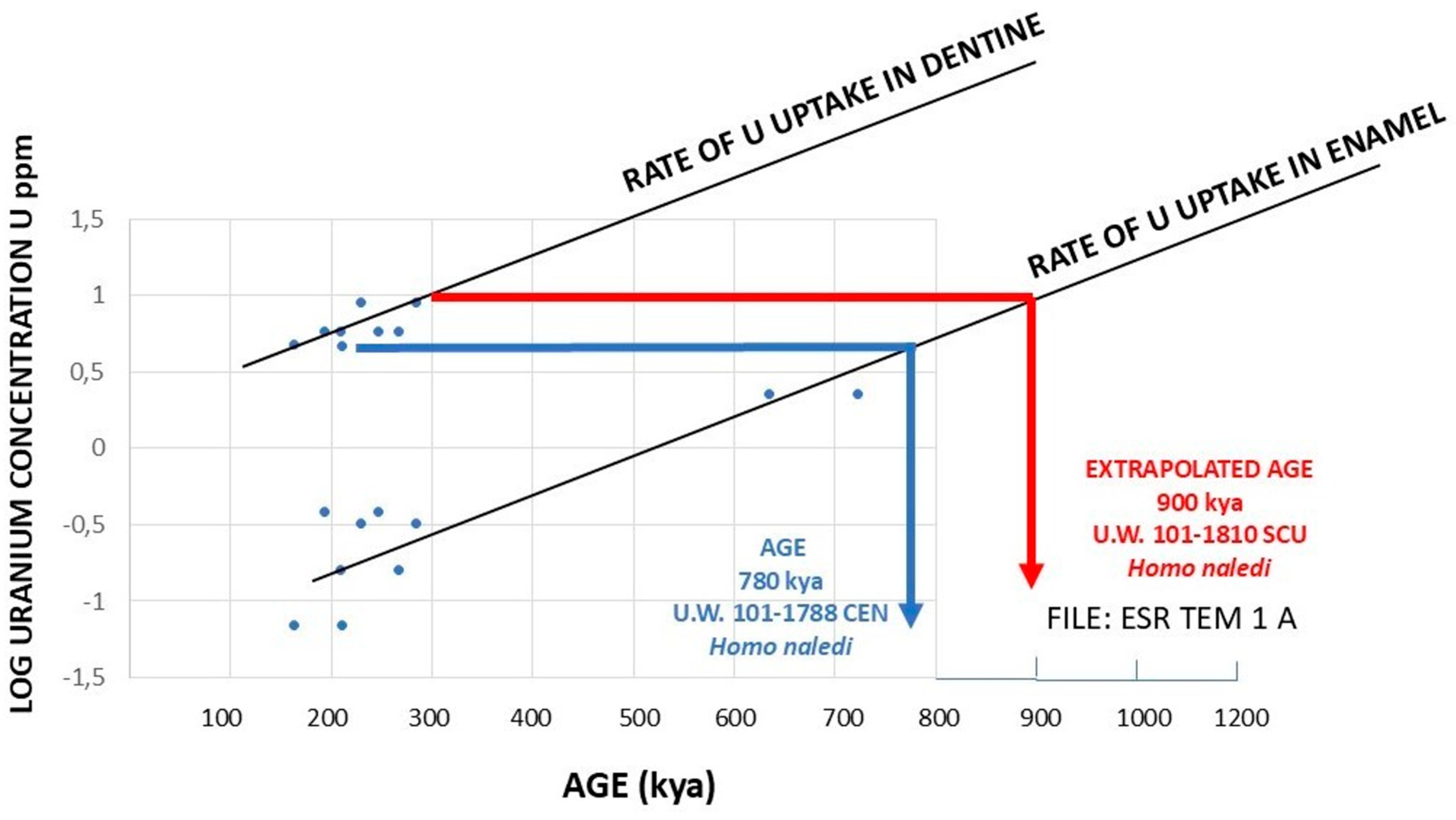
From Figure 2 one can see again that Uranium concentrations are relatively high in dentine but low in enamel. This observation can be viewed in relation to the following statement (AI overview, 2026):
“Uranium enters a fossil tooth via a Diffusion-Adsorption (D-A) process. Enamel is not completely solid; it is a semi-permeable crystalline structure with microscopic pathways, particularly along enamel prism boundaries and structural cracks. As uranyl ions diffuse through these pathways, they strongly adsorb (bind) to the surface of mineral crystals inside the tooth. This chemical binding maintains a concentration gradient, drawing more uranium into the tooth over time.”
The TEM 1 Model relates to the following:
- From empirical data based on Dirks et al. (2017), an approximate regression line in Figure 2 reflects (on a logarithmic scale) a scenario for a linear rate of Uranium increase in enamel, using US-ESR dates for teeth from sub-units 3a and 3b. It is recognised that US-ESR dates of circa 300 kya for 3b and circa 700 kya for 3a (50 cm deeper) may be underestimates. However for purposes of the TEM 1 model regarding enamel, it is assumed that the rate of uranium increase (on a log scale) reflected by the slope in Figure 2 (based on data published by Dirks et al., 2017) may be consistent with that for true ages.
- It is recognised that dates based on dentine are underestimated. Dirks et al. (2017) showed that U-Th dates of < 100 kya were obtained from dentine.
- Uranium concentrations may increase in dentine through time partly because U becomes bound to internal material as part of the Diffusion-Adsorption (D-A) process of the kind referred to above in the context of enamel.
- As shown in the scenario in Figure 2, the rate of increase in U (on a log scale) in dentine appears to be approximately the same as the rate of increase in U (on a log scale) in enamel.
- On the basis of data presented in Figure 2, it is assumed that the rate of increase in U can be used to estimate absolute dates for H. naledi teeth. In this scenario, ages between 780 kya and 900 kya are obtained for U.W. 100-1788 CEN and U.W. 1810 SCU respectively.
- Recognising that the TEM 1 Thought Experiment Model is based on uncertainties and assumptions for a small sample, one can nevertheless calculate a mean age which in this case is 840 kya.
Conclusions
In this exploratory article US-ESR dates have been examined in relation to a scenario regarding U uptake in dentine and enamel on a logarithmic scale. A Thought Experiment Model has been presented, indicating a mean date of 840 kya for H. naledi teeth from Rising Star. This is almost three times higher than the date of circa 300 kya published by Dirks et al. (2017) and as such supports the ENH Early Naledi Hypothesis (Thackeray 2025, 2026). The upper date of 900 kya (for U.W.101-1810) is consistent with an estimate of 912 kya based on Bayesian analyses of crania (Dembo, 2016).
Hu al (2023) claim that hominins went through a severe population bottleneck and a high probability of extinction between 930 and 813 kya during the Mid-Pleistocene Transition. The MPT was associated with a shift in glacial cycles from 41 kya periodicity (obliquity) to 100 kya (eccentricity). In much of Africa the transition triggered aridification. It is questionable whether H. naledi became extinct during the MPT, having previously existed in southern Africa in the Early Pleistocene, perhaps as early as 2 million years ago (Thackeray, 2015, 2025).
Acknowledgments
Clément Zanolli is thanked for discussion and enthusiastic encouragement. It is strongly recommended that new geochronological analyses should be undertaken on H. naledi specimens from Rising Star.
References
- Berger, L.R. et al. 2015. Homo naledi, a new species of the genus Homo from the Dinaledi Chamber, South Africa. elife. [CrossRef] [PubMed]
- Dembo, M., Radovčić, D., Garvin, H. M., Laird, M.F., Schroeder, L., Scott, J.E., Brophy, J., Ackermann, R.R., Musiba, C.M., de Ruiter, D.J., Mooers, A. Ø., Collard, M. 2016. The evolutionary relationships and age of Homo naledi: An assessment using dated Bayesian phylogenetic methods. Journal of Human Evolution 97, 17-26. [CrossRef] [PubMed]
- Dirks, P.et al. 2015. Geological and taphonomic context for the hominin species Homo naledi from the Dinaledi Chamber, South Africa. eLife. https://elifesciences.org/articles/09561.
- Dirks, P. et al. 2017. The age of Homo naledi and associated sediments in the Rising Star Cave, South Africa. eLife 6:e24231. [CrossRef] [PubMed]
- Hu, W. et al. 2023. Genomic inference of a severe human bottleneck during the Early to Middle Pleistocene transition.Science 381,979-984(2023). https://www.science.org/doi/10.1126/science.abq7487.
- Pettitt, P. and Wood, B.A. 2024. What we know and do not know after the first decade of Homo naledi. Nature Ecology and Evolution. [CrossRef] [PubMed]
- Thackeray, J.F. 2015. Estimating the age and affinities of Homo naledi. South African Journal of Science 111 (11-12):3-4. https://sajs.co.za/article/view/3837.
- Thackeray, F. 2025. The ENH hypothesis that Homo naledi from Rising Star is considerably older than 300,000 years. The Digging Stick 42 (1): 19-21.
- https://www.archaeology.org.za/sites/default/files/attachments/publications/2025/04/29/The Digging Stick 42(1) - April 2025.pdf.
- Thackeray, F. 2026. An Early Pleistocene biochronological date for Homo naledi, South Africa https://osf.io/preprints/paleorxiv/w4675_v3.
- Thackeray, J.F. & Dykes, S. 2016. Morphometric analyses of hominoid crania, probabilities of conspecificity and an approximation of a biological species constant. Homo - Journal of Comparative Human Biology 67(1): 1-10. [CrossRef] [PubMed]
Figure 1.
Uranium concentration in enamel and dentine in U.W.101-1810. The image of the sectioned tooth (inset, upper left) is flipped to correspond to the graph with enamel in red, and dentine in blue (Thackeray, 2025). U concentrations published by Dirks et al. (2017, Table 5).
Figure 1.
Uranium concentration in enamel and dentine in U.W.101-1810. The image of the sectioned tooth (inset, upper left) is flipped to correspond to the graph with enamel in red, and dentine in blue (Thackeray, 2025). U concentrations published by Dirks et al. (2017, Table 5).
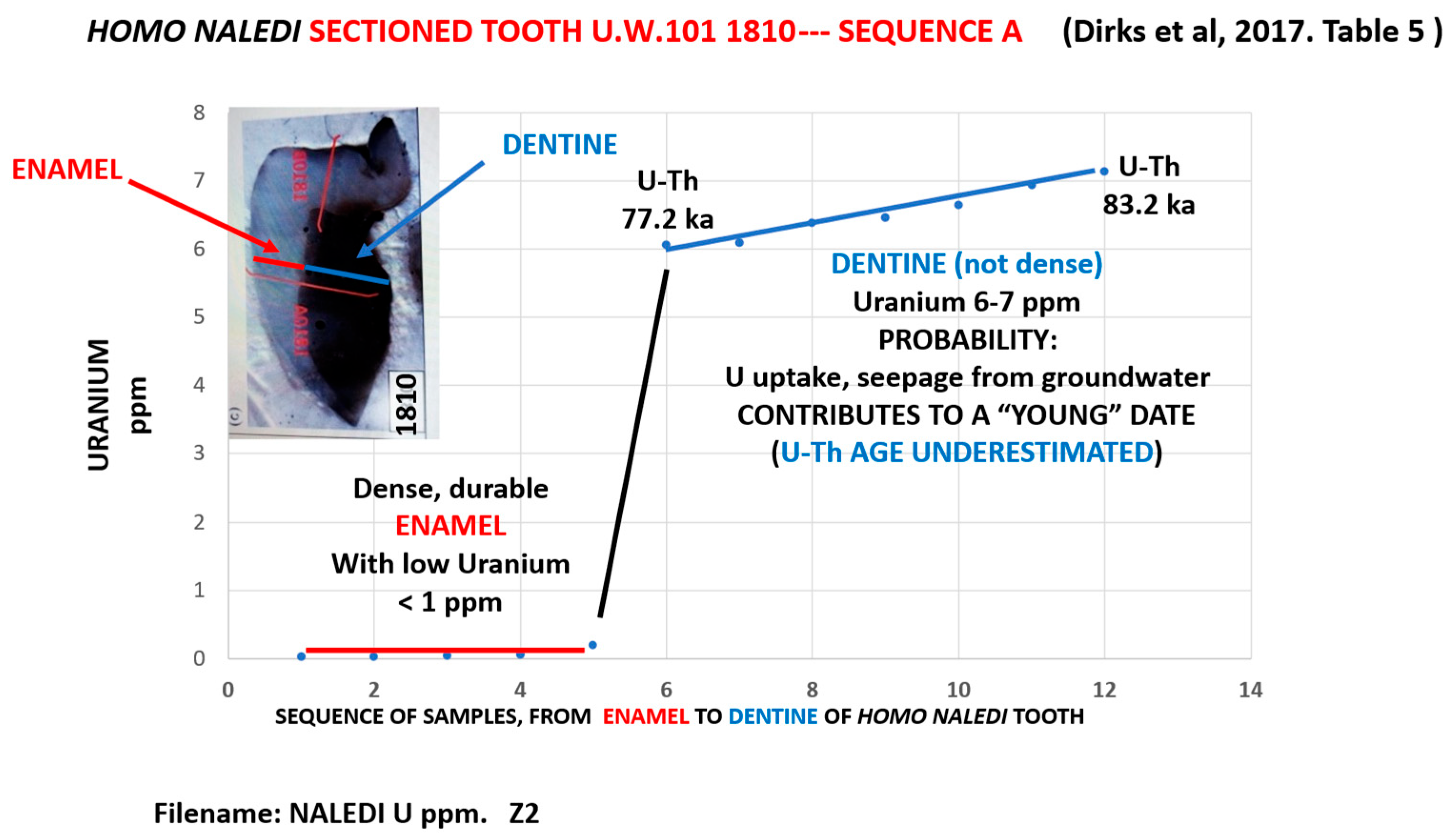
Figure 2.
Scenario for age estimation of samples of H. naledi teeth ranging between 780 kya (U.W. 101-1788) and 900 kya (U.W. 101-1810), with a mean of 840 kya, based on Thought Experiment Model TEM 1. U concentrations published by Dirks et al. (2017). File name ESR TEM 1AA.
Figure 2.
Scenario for age estimation of samples of H. naledi teeth ranging between 780 kya (U.W. 101-1788) and 900 kya (U.W. 101-1810), with a mean of 840 kya, based on Thought Experiment Model TEM 1. U concentrations published by Dirks et al. (2017). File name ESR TEM 1AA.
Disclaimer/Publisher’s Note: The statements, opinions and data contained in all publications are solely those of the individual author(s) and contributor(s) and not of MDPI and/or the editor(s). MDPI and/or the editor(s) disclaim responsibility for any injury to people or property resulting from any ideas, methods, instructions or products referred to in the content. |
© 2026 by the authors. Licensee MDPI, Basel, Switzerland. This article is an open access article distributed under the terms and conditions of the Creative Commons Attribution (CC BY) license (http://creativecommons.org/licenses/by/4.0/).
Copyright: This open access article is published under a Creative Commons CC BY 4.0 license, which permit the free download, distribution, and reuse, provided that the author and preprint are cited in any reuse.