
Submitted:
20 October 2026
Posted:
22 October 2026
You are already at the latest version
Abstract
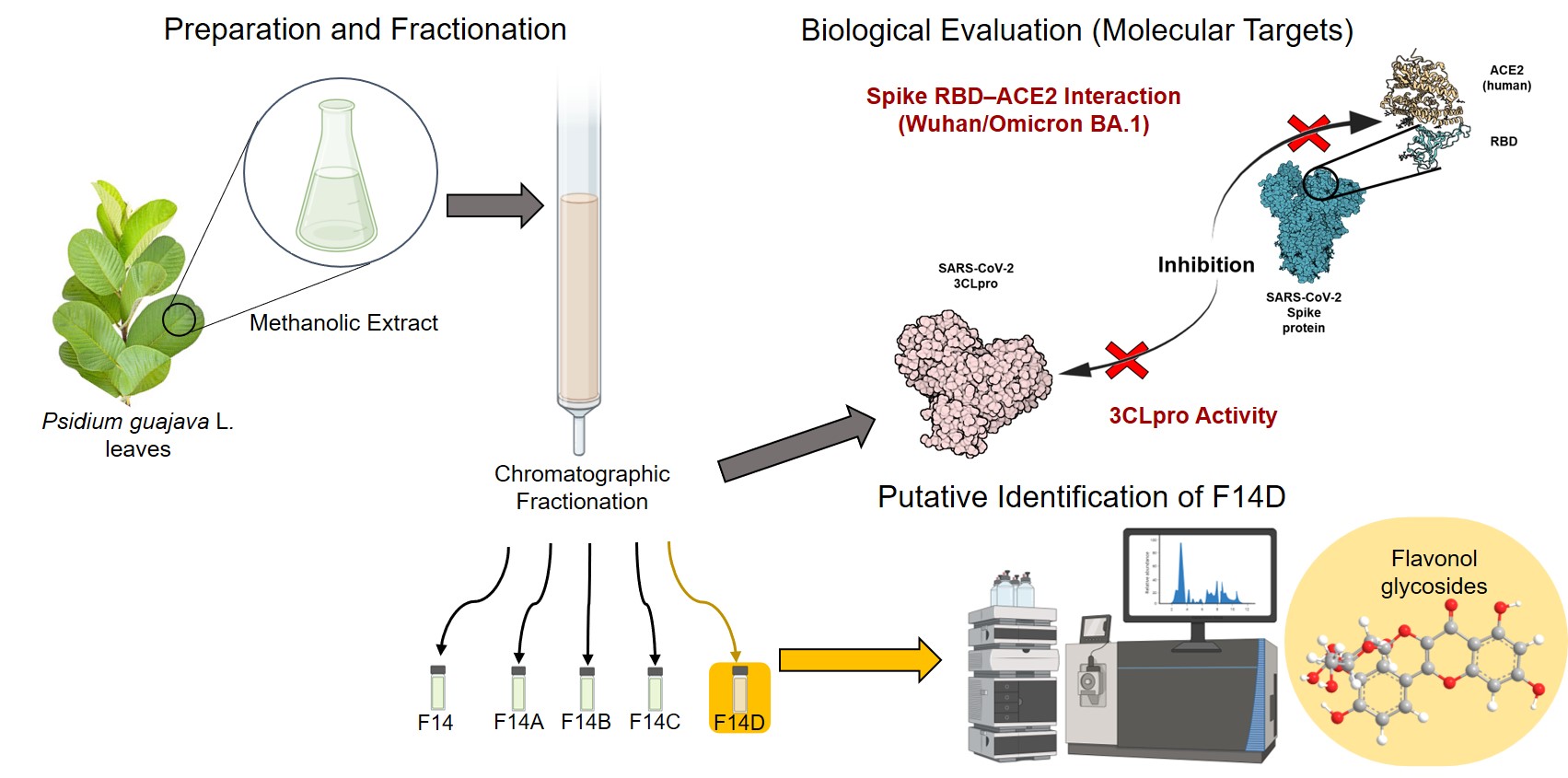
The leaves of Psidium guajava L. (guava) are an underutilized resource containing diverse bioactive metabolites. The present study evaluated the inhibitory potential of P. guajava leaf fractions against two SARS-CoV-2 molecular targets: the Spike RBD–ACE2 interaction of the Wuhan and Omicron BA.1 variants, and 3CLpro enzymatic activity. A methanolic extract was fractionated by vacuum liquid chromatography, and fraction F14 was then separated into subfractions F14A–F14D through the use of Sephadex LH-20. The activity was evaluated using colorimetric Spike RBD–ACE2 binding assays and a fluorometric 3CLpro assay. F14 and its subfractions inhibited the Spike RBD–ACE2 interaction of the Wuhan variant, whereas against Omicron BA.1, all fractions showed IC₅₀ values <1.25 mg mL−1. F14, F14C, and F14D also inhibited 3CLpro, with IC₅₀ values <1.25 mg mL−1. F14D demonstrated the most consistent inhibitory profile across all the three targets and was selected for further characterization by LC–HRMS. The three major constituents were tentatively assigned as a myricetin hexoside, a quercetin hexoside, and a quercetin pentoside. Overall, the results of this study suggest that F14D contains bioactive constituents with potential inhibitory activity against SARS-CoV-2 molecular targets, although further studies are required to determine their antiviral activity.
Keywords:
guava
; Mpro
; ACE2-spike complex
; coronavirus
; bioactive fractions
Copyright: This open access article is published under a Creative Commons CC BY 4.0 license, which permit the free download, distribution, and reuse, provided that the author and preprint are cited in any reuse.