

Submitted:
20 October 2026
Posted:
21 October 2026
Read the latest preprint version here
Abstract
Galaxies rotate faster than the gravity of their visible matter alone predicts. The two standard explanations are nonbaryonic dark matter or a change to gravity at low acceleration. This paper develops a third: space as one physical substrate with two effective mechanical roles—a stretched lattice and a permeating fluid—in which matter reorganizes the medium into a wake that contributes to gravity. On the established branch, the wake strength is locked to the baryonic source by one fixed formula shared across galaxies, with no object-by-object response parameters. Applied pointwise to SPARC, a public catalogue of 175 nearby disk galaxies, the formula gives an unweighted root-mean-square log residual of 0.1989 dex across 3,389 usable points. Under the same fixed disk-and-bulge mass-to-light assumptions, this differs from the RAR-exponential comparator by 0.000016 dex; the comparison establishes numerical similarity under the declared metric, not statistical equivalence or a test against fitted halo models. A complementary gas-dominated check, evaluated at the declared fixed stellar mass-to-light ratios, returns a median preferred scale from 61 galaxies of 1.07 (+0.11/−0.09) × 10⁻¹⁰ m s⁻² (bootstrap 16–84%), containing the fixed aW. The closure also enforces the slope-four BTFR scaling, but its fixed-slope normalization remains high by 0.1734 dex at the reference stellar mass scale, meaning that the law requires 1.491 times the inventoried baryonic mass at a given rotation speed; a linked global mass-to-light calibration reduces the offset to 0.1354 dex without closing it. A separate disk-geometry calculation removes a residual trend with the shape of the visible-matter field on a common 3,382-point sample. An isolated equal-mass binary calculation gives a circular orbital speed about 22.5% above Newtonian at 1.4 times its response-transition radius. The medium also has an acquisition gate and memory: a subsystem is eligible to establish a wake when its own Newtonian field exceeds the ambient field, and an established wake persists until reorganization. Two presently similar systems can therefore behave differently because of their histories. That history dependence is the framework’s sharpest prediction and its largest present weakness, because no independent observational branch selector yet exists. The wide-binary test is therefore reported as unscored. Transport, a global action joining systems with different histories, a positive microscopic realization in arbitrary geometry, and a relativistic account of gravitational lensing remain open.
Keywords:
galactic dynamics
; modified gravity
; QUMOND
; radial-acceleration relation
; wide binaries
; source scale
; transition systems
1. The Picture
This paper tests whether a fixed response of a physical medium can account for the extra gravitational pull in galaxies. It assumes a relation between visible matter and that response, derives the corresponding field equations, and compares their consequences with galaxy data and isolated star pairs. A separate rule describes when a system can acquire the response and how it retains it; that rule still needs an independent way to assign real systems to their histories.1
1.1. What the Medium Is
The framework is called Toroidal Scale Mechanics. Its starting claim is that what we call empty space is not empty and is not merely geometry: it is a physical material, called the substrate, with mechanical properties of its own — tension, stiffness, flow — in the way that steel has stiffness and water has currents.
The substrate supports two effective mechanical responses: a tension-bearing support, described as a lattice, and mobile flow, described as a fluid. Those are the two phases in this paper’s title. The terms organize the constitutive model; the microscopic number and identity of constituents remain open. The working architecture has four material support directions of the same kind. An internal observer describes three through position and the fourth through physical scale: changes in the size of the structures being resolved. Progression of that support is experienced internally as time [29].
Matter is not something sitting in this medium. Matter is the medium, locally circulating: a particle is a self-sustaining flow pattern in the substrate, the way a cyclone is a persistent shape of moving air rather than an object travelling through it. A concentration of such patterns reorganizes the substrate around it, and that reorganization is the wake. The wake is what pulls on other matter, and it is the central object of this paper — what the framework offers in place of dark matter. Nothing here is an object dragging a medium behind it. The matter, the wake, and the space between are one material in different states of motion.
In the revised corpus architecture, global rotation prestresses the substrate and matter deforms that prestressed state. The leading projected relation and its conditional Newtonian normalization target are
Here h is the outward displacement of the support, its slope along observed direction i, and the acceleration in that direction. A tilted support redirects part of the background centrifugal acceleration, whose normal component is , toward the raised region. The effective three-dimensional tension resists that deformation; is the gravitational coupling this construction aims to recover [6]. These relations are a constitutive recovery program, not an additional result of the SPARC calculation. The number of directions over which the response effectively spreads controls how it falls with distance; the local coupling strength controls its magnitude. The proposed common material state must supply both. Related calculations address a uniformly supported rotating background and reciprocal coupling between matter and that support [7,8]. The wake/RAR closure tested below is therefore downstream of that mechanics and retains its own empirical disposition.
The shared fluid–lattice response tensor is a table of coefficients describing how fluid motion deforms the support in different directions. It connects this galactic interpretation to the calculation at proton scales. Its selected sideways sliding responses are proportional to , where is the angle around the local cylindrical axis. The coefficient along that axis, , enters the rapid recovery of coupling outside a proton [30]. These coefficient values were selected with the intended applications in view. They specify directional proportions; converting them into physical stress also requires a material stiffness with pressure units. Their common use supplies a structural connection whose constitutive derivation remains open.
A common substrate action now supplies equations for the material variables and their description in observer coordinates, with local sound-wave and large-scale cosmological limits [31]. The specific open task here is to derive this galaxy’s fixed response, acquisition rule, and nested-source interfaces from that architecture. The existence of general equations does not yet supply that reduction.
1.2. The Problem the Wake Is Meant to Solve
Since the 1930s, galaxy dynamics have shown a mass discrepancy. Given the observed stars and gas, Newtonian gravity predicts less centripetal acceleration than measured rotation curves require, especially in outer disks. Something beyond the directly inventoried baryonic mass — or beyond the standard field law — is needed to account for the motion.
There are two standard responses.
The first is nonbaryonic dark matter. In conventional rotation-curve fits, each galaxy is assigned a halo whose parameters are inferred jointly with the baryonic mass model. Cosmological dark-matter theory makes a stronger claim: halo structure and its relation to baryons should emerge statistically from structure formation and galaxy evolution. Both levels can reproduce many rotation curves, but reproducing the observed regularities and the diversity of individual galaxies together remains a nontrivial constraint.
The second is to change gravity. Modified Newtonian Dynamics — MOND, proposed by Milgrom in 1983 — observes that the discrepancy always switches on below one particular, very small acceleration, and posits that Newton’s law simply departs from the familiar form below that threshold. This also works, for galaxies, using a single universal number.
The reason the choice is hard is a stubborn empirical fact. The additional gravitational response tracks the visible matter with high regularity: knowing the baryonic distribution in a galaxy strongly constrains the total pull. Two measured relations express this. The radial-acceleration relation (RAR) says the observed pull at any radius is a tight function of the pull the visible matter alone would produce there. The baryonic Tully–Fisher relation (BTFR) says a galaxy’s rotation speed tracks its total visible mass. Any account of galaxies has to reproduce both. Modified dynamics builds the coupling directly into the field law; dark-matter accounts must generate it through the joint statistics of halos and galaxy formation.
1.3. What This Paper Proposes
This paper tests a third option: the missing pull is the wake — a mechanical response of a physical medium — and, on the established branch, its strength is fixed rigidly to the visible matter by one relation shared across galaxies.
That rigidity is the whole point, and it is what makes the proposal worth testing rather than merely worth stating. There is no response curve fitted per galaxy, no halo shape chosen, no interpolating function selected to taste. One equation, one acceleration scale, applied everywhere. A theory with that little freedom is easy to kill: it either lands on the measured data or it does not.
1.4. Yield and Memory: The Least Familiar Idea Here
One further feature matters, and it is the part of this paper a reader is least likely to have met before.
The substrate does not respond autonomously to every concentration of matter. The proposed acquisition gate compares the subsystem’s own Newtonian pull with the surrounding pull: the subsystem is eligible to form a wake when its own field is stronger. A dominant environment closes this gate. The acceleration scale (“ay sub double-you”) separately sets where an established response changes from a small correction to a large one; it is not an upper limit on acquisition. Eligibility permits formation but does not make it instantaneous, because the model supplies no formation time.
And, like most things that yield, it does not simply spring back. Bend a paperclip and let go: it stays bent. Once a wake has been established around a system, it persists even after the conditions that created it have gone, until something reorganizes the system enough to erase it.
The consequence is unusual and is worth stating plainly, because everything in Section 5 and Section 7 depends on it. Two systems that look identical today — same masses, same separations, same surroundings — can behave differently, because one of them was worked into carrying a wake at some point in its past and the other never was. This paper calls the two conditions branches. A system on the established branch carries a wake and shows the extra pull. A system on the unestablished branch does not, and obeys ordinary Newtonian gravity exactly. A system can be unestablished either because it never established — the never-established case — or because it established and was later reorganized; the tests below turn on the first.
The gate is the condition deciding whether a system is currently eligible to acquire a wake at all. Closing the gate stops new acquisition; it does not remove a wake already there. Gate state and branch state are therefore different things, and confusing them is the error this paper’s structure is designed to prevent.
1.5. What Is Delivered Here, and What Is Not
Two things are separated throughout, and the separation is the paper’s main organizational claim.
The first is the field theory on the established branch: a complete, closed mathematical problem that takes any arrangement of visible matter and returns the total gravitational field, with the wake included. The equations follow from the stated functional, and Section 6 compares both the pointwise relation and the reconstructed disk field with 175 real galaxies.
The second is the constitutive rule governing which branch a system is on. That is not derived. It is stated as a physical postulate, inherited from the wider corpus, and it is the framework’s outstanding debt.
The honest position on the sharpest available test follows from that split. Wide binaries — pairs of stars orbiting each other at enormous separations, where the pull between them is feeble enough to sit in exactly the regime where these theories differ — should show no extra pull at all if they are on the never-established branch. That is a clean, falsifiable prediction. But to test it one must first sort real star pairs into branches using evidence independent of the very motions being tested, and this framework cannot presently do that. The test is therefore reported below as unscored: not passed, not failed, not yet eligible to count. Section 8 states what would have to be supplied before it could.
2. Introduction
The radial-acceleration relation (RAR) and the baryonic Tully–Fisher relation (BTFR) sharply constrain any account of galactic dynamics: the additional gravitational response is closely tied to the distribution of baryonic matter — ordinary matter, meaning the stars and gas that emit or absorb light — rather than being freely adjustable from galaxy to galaxy [1,2,3]. Modified-dynamics theories impose that regularity through a nonlinear field law, while particle dark matter seeks to obtain it statistically from halo formation. Here we test the third possibility set out in Section 1: a medium response — the wake — that gravitates like matter in the quasi-static description, while remaining locked to the visible matter by one fixed relation, called here the closure because it closes the system of equations without any further free function.
The current article consolidates two corpus components into one standalone public account. Hydrodynamic Mapping of the Skotonic Wake: Entrained Pneumon Flow in Galaxies and Cluster Mergers supplies the QUMOND-form functional and closed kernel, while Dimensional Exhaustion at the Galactic Edge The Substrate Mechanism of Constant-Velocity Rotation supplies the archived SPARC, gas-dominated acceleration-scale, and fixed-slope BTFR calculations [4,5]. The contribution here is to place those pieces under one source–response convention and to separate the closed quasi-static branch from the constitutive rule that selects whether a subsystem occupies it. For comparison, AQUAL and QUMOND are the standard action-based MOND field formulations for arbitrary matter distributions [9,10].
Throughout, g and denote total and Newtonian gravitational-field magnitudes, while denotes the host/environmental acceleration and the fixed acceleration scale; all four quantities have dimensions of acceleration.
The construction has two commitments:
- 1.
-
Fixed established-branch response. In spherical symmetry, where a response has been established,Here c is the speed of light and is the Hubble parameter in the conventional Planck cosmological fit. Its numerical value is imported solely to set ; no other output or ontology of that fit is imported by implication: [11]. The corresponding acceleration scale is . No system-dependent profile or interpolation function is fitted. The high-acceleration limit is a limit in ratio: as , while the absolute difference approaches , so a fixed offset survives the Newtonian regime. For arbitrary geometry, Section 4 defines the corresponding established branch by the QUMOND field map with the same fixed .
- 2.
-
Constitutive acquisition and memory. A subsystem may establish its own response only whileThe inequality governs acquisition. Closure of the gate does not by itself erase a previously established response; erasure or redistribution requires a reorganization event.
The distinction is essential. Equation (2) is promoted here to a complete effective field problem on the established branch. Equation (3) is stated as a constitutive yield rule owned by Satellite Galaxies [12]; no rate equation for formation, transport, or erasure is claimed. This division avoids treating a history-dependent material proposal as though it were a memoryless modification of the force law.
Table 1 records the epistemic status of the principal ingredients. It is also a guide to the scope of the conclusions below.
3. Baryonic Source and Fixed Established-Branch Closure
3.1. Source–Response Ledger
The independent source is the baryonic mass per unit volume . Here G is the gravitational constant and is the ordinary mass enclosed inside radius r. For a spherical system the baryonic Newtonian field is
The response generated by Eq. (2) is not inserted again into the source slot that defines the transition scale. For a point-like baryonic mass,
This baryonic source convention prevents a self-referential definition in which an inferred dynamical mass is used to generate the same inferred mass discrepancy. The Newtonian-equivalent response is instead read from the total field after the closure has been applied.
3.2. Spherical Effective Response
For a point source, Eq. (2) gives
The corresponding Newtonian-equivalent enclosed response is
with spherical effective density
Equation (8) is non-negative. Its density diverges toward the point source, but the enclosed mass remains finite. At large radius it approaches an profile, often called isothermal, so . The circular speed is
Here is the limiting outer rotation speed. Thus flat rotation and the slope-four BTFR scaling follow on the established branch without choosing a halo concentration, core radius, or galaxy-specific response function. The absolute normalization does not close automatically: the archived 123-galaxy fixed-slope calculation gives a normalization offset of dex at , meaning that the law requires times the inventoried baryonic mass at fixed velocity, and remains high by dex under the linked , calibration. The quoted offset is the theoretical intercept minus the empirical intercept in , using the same units in both. No correction term is introduced. Figure 1 displays the fixed closure, its asymptotic limits, and the associated spherical effective response.
4. Static Variational Functional and Field Equations on the Established Branch
4.1. Arbitrary Baryonic Sources
The calculation proceeds in two steps: find the field generated by ordinary matter, then calculate the total field after its prescribed response is included. A gravitational potential is potential energy per unit test mass; its downhill slope gives acceleration. The gradient ∇ takes that slope, the divergence measures a vector field’s local outward flux, and their combination is the Laplacian. The Poisson equations below relate that local flux to the source density. Let be the Newtonian potential of the baryons,
and define
On a domain whose response is everywhere established (not necessarily one with uniform matter density), the quasi-static field equations are
where
This is the QUMOND field map [10] for the fixed response (11). The identification is useful rather than cosmetic: it supplies a well-defined arbitrary-source calculation instead of extending a spherical force formula by analogy. Test bodies obey ordinary Newtonian kinematics in the resulting potential, ; no modified-inertia rule is introduced.
4.2. QUMOND-Form Variational Functional and Kernel
The field equations are the conditions that the following functional be stationary under small changes of its two potentials. With the Poisson-sign convention in Eq. (10), the static variational functional—equivalently, the action per unit time for a stationary configuration—is
The minus sign in the matter coupling is required for variation with respect to to yield Eq. (10). Variation with respect to yields Eq. (12), provided
For Eq. (11), a closed-form kernel is
The identity is exact. The shipped central-finite-difference check agrees to a maximum relative error over , limited by the differencing step.
The usual QUMOND variational and conservation structure applies on the established branch when the matter kinetic terms are included [10]. This statement does not provide a transport equation for the underlying medium response. It establishes conservation for the quasi-static effective field problem, not for an unprovided formation or stripping law.
4.3. Meaning and Limitation of the Effective Density
For the spherical point source considered above, Eq. (13) reduces to the positive profile (8). For sufficiently nonspherical sources, a QUMOND effective density can be locally negative even though the total field remains mathematically well defined. Accordingly, is called an effective gravitational response density in this paper. A literal positive material realization for arbitrary geometry would require additional constitutive degrees of freedom or a constrained projection not derived here. No pointwise truncation is imposed, because doing so would alter Eq. (12) without a corresponding variational functional.
5. Constitutive Gate and History Variable
5.1. Acquisition Eligibility
The environmental condition (3) is a reduced scalar proxy for a fuller stress/yield criterion in Satellite Galaxies [12]. Here is the candidate subsystem’s own Newtonian field, calculated from its baryonic source, while is the host’s total ambient acceleration at the subsystem’s location. The host field is not substituted for the baryonic source in Eq. (5).
For a two-body candidate with total baryonic mass and separation s, the Newtonian relative acceleration is
At a fixed positive ambient field, acquisition is eligible at physical separations
Here (“ess sub crit”) is the separation at which the pair’s own Newtonian pull equals the ambient pull. Solving gives this upper separation; no lower boundary at occurs. At zero ambient field, every finite separation is eligible. These equations determine where acquisition is permitted; the established-branch force is a separate calculation below.
5.2. Branch Bookkeeping and Hysteresis
Introduce a branch label :
For piecewise homogeneous domains, a compact bookkeeping form is
Equation (20) is not offered as a global mixed-domain action when . It records which of the two closed quasi-static field problems is being used. Nor does a single spatial label derive overlapping host and subsystem responses: applying Eq. (12) to the total baryonic distribution on a homogeneous established domain would give the ordinary QUMOND compound-system field. Equation (20) is therefore only aggregate-level bookkeeping. A global action with source-indexed branch variables, interface conditions, and conserved exchange terms is not supplied. The transition rules are constitutive:
No universal formation time or reorganization threshold is specified. The immediate consequence is that the instantaneous gate state and the branch state are not identical. A system can be gate-closed and remain established. Figure 2 separates the acquisition window from the retained branch history.
5.3. Compound Systems
The compound-system statements below adopt the additional source-separation prescription owned by Satellite Galaxies [12]: the host aggregate’s established response is solved at host resolution, while a candidate subsystem may or may not carry an additional autonomous response according to its own branch. This hierarchical decomposition is not derived from the single homogeneous-source variational functional of Section 4; it is a constitutive part of the bounded model. Under that prescription, a subsystem’s barycentre (centre of mass) moves in the smooth total field of its host, while its internal relative dynamics receives the host tide—the difference in the host’s pull across the subsystem—plus the autonomous response of the subsystem, if any. A subsystem that remains never-established then has Newtonian internal dynamics up to the host tide; an established immigrant need not share that result. The source-separated prescription also leaves an explicit momentum balance to complete: the subsystem feels the host wake, while a wake fixed by the host’s own source supplies no reciprocal response to the subsystem. The material transport law must carry the opposite momentum exchange [4]. These compound-system statements are therefore conditional rather than consequences of Eq. (12) alone.
6. Empirical Confrontation of the Established Branch
The algebraic closure can be tested as a radial-acceleration correspondence relation without invoking the history rule. This test evaluates Eq. (2) pointwise using the tabulated radial baryonic acceleration; it is not a numerical solution of Eq. (12) for each nonspherical disk, for which QUMOND geometry and curl-field effects can matter. We use SPARC [2], a public catalogue of mass models for 175 nearby disk galaxies. For each galaxy SPARC supplies a measured rotation curve — how fast material orbits at each radius — together with infrared photometry from the Spitzer Space Telescope, taken at a wavelength of microns because starlight at that wavelength tracks stellar mass more faithfully than visible light does. Converting that brightness into stellar mass requires a mass-to-light ratio, which says how many solar masses of stars a given amount of infrared light implies. We use the fixed two-component prescription and rather than fitting either value, and build the baryonic contribution pointwise from the signed gas, disk, and bulge velocity components. The declared physical mask is
Here R is radius, the measured rotation speed, its quoted uncertainty, and the signed sum of the baryonic contributions. Each tabulated component enters as , so a negative gas contribution represents an outward radial pull rather than an imaginary speed. The radial baryonic acceleration is the tabulated counterpart of . The public table contains 3,391 data rows; two fail this mask, leaving 3,389 usable points in all 175 galaxies.
Adopting [11], so that , Eq. (2) gives an unweighted pointwise root-mean-square residual of dex in . The corresponding multiplicative RMS scale is ; this summarizes squared log residuals rather than a coverage interval. The residuals are not centred on zero: their mean at these fixed photometric values is dex, so the prediction runs about low on average, and the mass-to-light scan below locates the unbiased point elsewhere. At the same fixed photometric assumptions, and with both comparators evaluated at , the RAR-exponential function used by McGaugh et al. [1], , gives dex, while the commonly used “simple” MOND interpolation, , gives dex. The fourth archived curve, a spherical TeVeS-style interpolation at the same , gives dex. The fixed closure therefore differs from the RAR-exponential comparator by dex under this shared setup. The pointwise curves are not identical; direct recomputation gives median per-galaxy RMS residuals of , , and dex, respectively. The scale is about below the empirical RAR acceleration scale reported by McGaugh et al. [1]. Table 2 records the frozen numerical comparison. The aggregate RMS values are numerically similar under the declared metric; this is not a statistical-equivalence test or a ranking against all existing descriptions. The fixed closure uses one universal acceleration scale and one fixed disk-and-bulge mass-to-light prescription for all 175 galaxies, with no per-galaxy response parameter. Conventional individual-galaxy halo fits generally infer halo parameters per object, whereas cosmological dark-matter models seek to generate baryon–halo regularities statistically. The present analysis fits neither class of halo model, so its parameter-cost comparison is qualitative. This is a correspondence test rather than a discriminator: matching the RAR shows that the closure remains viable under this projection, but does not decide between a wake in a medium, modified gravity, and nonbaryonic dark matter.
The executable SPARC scan evaluates 501 uniformly spaced values in steps of , with . It finds that the mean RAR residual crosses zero near , where the global RMS becomes dex. The mask is re-evaluated at every grid value, and returns the same usable points at both calibrations. This sensitivity is reported rather than absorbed into a fitted parameter: the primary result above retains the conventional fixed values. The separate fixed-slope BTFR comparison remains strained at both settings: dex at and dex at the linked calibration. The corresponding intercept problem is open rather than delivered.
A complementary gas-dominated check, evaluated at the declared fixed and , selects deep-regime points for which the gas contribution exceeds one half of the signed baryonic contribution, , and the inferred scale is positive. Requiring at least three qualifying points per galaxy leaves 61 galaxies. Their per-galaxy medians give (bootstrap 16–84%), placing the fixed inside the interval. This is a weak gas-dominated consistency preference with reduced, not absent, stellar-mass sensitivity and is not a discrimination among physical interpretations.
The shipped analysis also varies the shape of the transition across . The positive parameter p controls the bend between limits; recovers the fixed closure. All members share the same deep limit. At the conventional stellar calibration the best scanned shape is , with RMS dex versus dex for the fixed closure. At the near-unbiased calibration the best scanned shape is , with RMS dex versus dex for the fixed closure. The advantage therefore collapses from dex to dex after the mass-to-light offset is removed: the gentler bend was largely absorbing a systematically low prediction rather than identifying a materially different transition law. The complete scan is recorded in the machine-readable outputs.
A first-principles derivation of is also outside the present effective theory; here it is a committed externally calibrated constant.
6.1. Solving the Field on Reconstructed Disks
The pointwise comparison asks how well a formula maps one tabulated radial acceleration into another. A disk also pulls sideways and vertically. The current hydrodynamic owner therefore solves Eq. (12) on reconstructed three-dimensional baryonic distributions for the same 175 galaxies [4]. Stellar surface brightness supplies the stellar disk, the tabulated gas contribution supplies the gas disk, and the bulge is modeled as spherical. The ratio of the solved field to the algebraic field on that reconstructed model corrects the exact tabulated Newtonian baseline. Supplementary Material 1 includes the inputs, solver, correction tables, and executable reproduction.
This comparison has its own common sample. The same two nonpositive baryonic-speed-squared rows are excluded from the 3,391 input rows. A further seven rows fail , where this diagnostic uses the spherical-equivalent at the reference stellar calibration. That restriction was inherited from the archived comparison with an emergent-gravity formula that requires a positive derivative; it is retained for a common sample, not imposed by the present field law. The resulting sample contains 3,382 points in 175 galaxies. The standard quality cut excludes 12 quality-3 galaxies and 12 with inclination below , with two galaxies in both groups; it retains 153 galaxies and 3,159 points. Inclination is the angle between the disk’s axis and the line of sight, so nearly face-on disks make rotation speeds difficult to infer.
The disk calculation scans five shared stellar calibrations, , always linking the bulge value by a factor of . The reported case is a point in that scan, not the pointwise comparison’s mean-bias calibration or an independently selected fit. The full disk calculation moves the approximate mean-bias-zero calibration to . At the reported setting, the correlation between the within-galaxy residual and the local slope changes from for the spherical reduction to for the full disk solve. Here the slope measures how quickly the baryonic pull falls with radius; the within-galaxy correlation compares deviations after subtracting each galaxy’s mean. The full solve gives in the standard sample. Its global RMS on the full common sample is dex, against dex for the reduction at that same calibration. Thus the improvement concerns a systematic shape trend, not lower overall scatter. Varying the adopted gas scale height from to kpc keeps the full-solve correlation within in both samples. This is an executed consequence of the fixed field law, with its geometric reconstruction and stellar calibration stated explicitly.
6.2. The Same Field Law Above the Galactic Disk
A disk’s gravity acts vertically as well as radially. Integrating density from below to above the plane gives a column: mass per unit area, here measured in solar masses per square parsec. A parsec (pc) is about light-years; a kiloparsec (kpc) is parsecs. The vertical-budget calculation applies the same field law to an exponential baryonic disk with radial scale length kpc, vertical scale height kpc, and local total surface density , plus a central component. It evaluates the response at the adopted solar radius kpc [32]. These are declared source-model inputs; no response-law parameter is fitted to the vertical column.
Within kpc, the calculated wake column is . The adopted dynamical column is , and the inventoried baryons within that height contribute , giving a working required column of in the same units. The is a declared observational envelope, not a combined measurement; combines it in quadrature with the uncertainty on the larger total baryonic column, used as a proxy for the within-height inventory uncertainty. Ordinary matter plus the calculated response gives . The response density falls by a factor of from the midplane to kpc. Measurements of the vertical force , where z is height above the plane, can therefore test the shape as well as the integrated column. This supplements the pointwise SPARC projection with a conditional three-dimensional consequence of the same sourcing law.
7. Branch-Resolved Compound-System Tests
7.1. Wide Binaries
An astronomical unit (AU) is the mean Earth–Sun distance. For a candidate, Eq. (5) gives AU after propagating the stated uncertainty [13]. Using the Sun’s orbital speed around the Galaxy, , and its distance from the Galactic centre, kpc — the latter measured geometrically by the GRAVITY collaboration from the orbits of stars around the central black hole [14,15] — gives . For the stated pair, the acquisition gate closes at AU and above. It remains open below that physical separation: at AU the self-field is , above the ambient . A projected separation alone does not fix the physical separation, and present eligibility does not determine past acquisition. Within the hierarchical source-separation prescription, the resulting prediction is conditional but sharp:
A binary formed and remaining on the never-established disk branch has Newtonian internal dynamics, apart from the ordinary Galactic tide.
This conditional branch statement is not presently a scored wide-binary discriminator. Toroidal Scale Mechanics (TSM) has not supplied an operational branch selector or an observational history proxy independent of the internal dynamics being tested. Published analyses using data from Gaia — the European Space Agency satellite that measured the positions, distances, and motions of nearly two billion stars, and supplied the astrometry used in these wide-binary samples — remain divided: high-purity and forward-modelled studies report Newtonian consistency, while other analyses argue that a low-acceleration anomaly remains [16,17,18,19,20,21]. Those data compare Newtonian and MOND-like dynamics directly; they do not yet validate the TSM history assignment. The test remains open until the selector, independent proxy, detectable forbidden pair, and failure level are stated.
In an isolated established system, the finite-transition force is now calculated rather than inferred from a spherical substitution [13]. Numerical two-body QUMOND calculations already demonstrate the need to treat the pair together [22]. The calculation here uses the fixed response function of this paper. Both stars contribute to the Newtonian field inside the nonlinear source in Eq. (12). The calculation holds two smooth spherical density profiles fixed while translating their centers, and evaluates the net force on each body over all space. Two equivalent force integrals, with derivatives placed differently, check the numerical result.
For mass ratio and separation , define
Here q (“cue”) compares the smaller mass with the larger; (“zeta”) measures separation in units of the response radius; F is the calculated mutual force; and is the Newtonian force at the same masses and separation. (“script ee”) is their ratio. The two quantities are circular relative speeds, with the subscript N marking the Newtonian value. The square root follows because centripetal force is proportional to speed squared at fixed separation. This translates a computed force into a specific orbital observable.
The equal-mass speed at is about above Newtonian. The spherical test-body substitution gives , or about above Newtonian. A comparable pair therefore cannot be assigned the spherical amplitude by replacing the source mass with the sum of the two masses. Survey velocities additionally depend on eccentricity, orbital phase, orientation, the external field, and sample selection; Table 3 specifies isolated circular motion on an already established branch.
In the isolated deep limit, the adopted QUMOND-form law inherits Milgrom’s two-body virial result [23], with its acceleration scale set to :
Here (“eff one two”) is the mutual force when the separation is far beyond the response radius; the other quantities are the masses, separation, gravitational constant, and fixed acceleration scale already defined. The mass combination accounts for both bodies’ contributions to the field. For equal masses it gives a relative acceleration times the total-mass point-source deep benchmark; as one mass tends to zero, the test-body result is recovered. This theorem is a limiting check of the inherited effective field law. The finite-transition values in Table 3 come from the force integrals, not this asymptotic formula.
7.2. Satellite Galaxies
Within the same hierarchical prescription, present environment alone does not uniquely select a satellite’s branch. A satellite assembled under a dominant host field may never establish an autonomous response; a satellite that established before infall may retain it until tidal reorganization. Consequently NGC 1052–DF2 and DF4 — two diffuse galaxies whose stars move so slowly that they appear to contain little or no dark matter, a result widely reported as difficult for both dark-matter and MOND accounts — are compatible here with a never-established or reorganized branch, but are not a universal consequence of their current projected separation [12,24,25,26,27]. The discriminating prediction is population-level history dependence: at comparable present mass and host field, internal dynamics should correlate with infall and reorganization indicators if the hysteretic rule is correct.
7.3. Solar-System Regime
In the planetary regime the Solar System’s self-field exceeds both and the ambient Galactic field, so the revised gate permits acquisition. High acceleration alone therefore does not establish a Newtonian null. On an established spherical branch, the fractional correction becomes small but the absolute excess approaches . Exact Newtonian internal dynamics belongs to the separately assigned never-established branch. Solar-System compatibility requires a justified history assignment and comparison of the resulting perturbations with observations [4]; the acquisition rule by itself supplies neither.
7.4. Clusters and Lensing
Applying the established closure to relaxed clusters inherits the familiar residual mass problem of MOND-like galactic closures [28]. The current hydrodynamic owner treats merger wake displacement qualitatively [4], but does not supply a general transport law and is not used as evidence for the present field theory. Likewise, Eq. (14) is a nonrelativistic static variational functional and does not determine light deflection. Any claim that the effective response lenses exactly like material mass awaits a relativistic completion.
8. Falsification Logic and Completion Problems
The bounded formulation exposes several distinct tests.
-
Established-branch rigidity.Spherical established systems must follow Eq. (2), and arbitrary established systems must follow the fixed field map (12), without galaxy-specific response functions. A full disk calculation requiring systematically different response functions after baryonic uncertainties are controlled would falsify the static branch. The discriminator is the branch’s fixed response, as against per-galaxy halo fits or galaxy-specific response functions.
-
Acquisition geography.Within the stated source-separation prescription, a subsystem independently shown to have remained never-established cannot acquire an autonomous response while Eq. (3) is empty. The necessary independent history proxy is not yet supplied, so this conditional failure test is currently unscored.
-
History dependence.A confirmed pairing of an observed branch with a history that the stated transition rules forbid would falsify the branch prescription. Inferring the history only from the dynamics being explained is circular and does not count as a test.
-
Isolated two-body force.The established branch supplies the mass-ratio-dependent force in Table 3 and the inherited deep limit in Eq. (24). Applying that curve to halo binaries requires independent branch assignment, a bound on the external field, and an orbital and survey model. Those observational requirements remain open; the isolated finite-transition force does not.
-
Hierarchical coupling.A global nested-source completion must reproduce, replace, or falsify the adopted host/subsystem decomposition. If the only consistent completion reduces compound systems to the homogeneous QUMOND field of Eq. (12), the claimed exact internal-null branch would not follow.
The BTFR intercept residual is an empirical strain in the delivered static branch. Four completion problems remain explicit: a dynamical equation for w and the medium response; a global mixed-domain and hierarchical source action with interface and conservation conditions; a positive microscopic realization in arbitrary geometry; and a relativistic reduction connecting this galactic branch to lensing and the existing observer cosmology. The common equations identify a framework in which to attempt these calculations [31]; their specific galactic solutions remain open.
9. Discussion and Conclusion
The main result is a complete quasi-static field problem on the established branch, a reproducible RAR correspondence, and executed disk-geometry and isolated binary calculations. The disk calculation removes a residual shape trend, while the binary calculation fixes the isolated mass-ratio-dependent force. The BTFR normalization strain remains unresolved. The spherical closure fixes the point-source phenomenology; the same response defines a QUMOND-form static variational functional and arbitrary-source field equation. The environmental gate is not derived from that functional. It is a constitutive acquisition rule with memory, and compound-system predictions additionally require the stated host/subsystem source hierarchy.
This separation removes the contradiction in the earlier presentation between persistence and automatic re-screening. It also makes the theory easier to test. Established systems must follow one fixed baryon-locked response; a clean never-established disk-binary sample must remain Newtonian under the declared history rule; and isolated established binaries must follow the computed mass-ratio-dependent force. The response radius marks a crossover in amplitude; acquisition instead compares the self-field with the ambient field. A present closed gate does not erase an established wake.
The remaining debt is substantial and specific: a dynamical equation for the medium response, a global nested-source action with interface and conservation conditions, a positive material realization in arbitrary geometry, and a relativistic derivation of this galactic response and its lensing. The common material and observer equations provide the starting architecture for those calculations.
10. Glossary
Terms are defined as this paper uses them. Symbols are alphabetized by their spoken name.
- acceleration scale, (“ay sub double-you”). The scale separating small and large fractional corrections on the established branch. Acquisition separately requires ; supplies no upper acquisition boundary. Fixed here as , roughly a hundred billion times gentler than gravity at the Earth’s surface. It is imported from the Planck-inferred expansion rate rather than fitted to galaxies, and no derivation of the formula is claimed.
- AQUAL. Aquadratic Lagrangian theory: the first formulation of MOND as a proper field theory derivable from an action principle.
- baryonic matter. Ordinary matter — the stars, gas, and dust that emit or absorb light. Used in contrast to hypothetical dark matter. In this framework it is the only independent source of gravity.
- branch state, w (“double-you”). Whether a system currently carries a wake. The label is on the established branch, which carries the additional response, and on the unestablished branch, which obeys Newtonian gravity exactly. A system reaches the unestablished branch either by never having established — the never-established case, which is the one the disk-binary test requires — or by having established and then been reorganized. Which branch a system occupies depends on its history, not only on its present configuration.
- BTFR (baryonic Tully–Fisher relation). The measured regularity that a galaxy’s rotation speed tracks its total visible mass.
- closure. The fixed relation connecting the total gravitational field to the field the visible matter alone would produce. Called a closure because it closes the equations with no remaining free function.
- dex. One dex is a factor of ten. An RMS log residual of dex corresponds to a multiplicative RMS scale ; the value summarizes squared logarithmic residuals rather than a coverage interval.
- effective gravitational response density, (“roe sub eff”). The Newtonian-equivalent source density that reproduces the established branch’s additional field. It is non-negative for the spherical closure used here but can be locally negative for nonspherical sources, so it is not yet a literal positive material-density field in arbitrary geometry.
- established-branch functional, (“capital eff sub est”). The stationary QUMOND-form variational functional in Equation (14). Its variations supply the two quasi-static field equations on a homogeneous established domain; it does not derive branch acquisition, erasure, or mixed-domain transport.
- gate. The condition determining whether a system is presently eligible to acquire a wake. A closed gate prevents new acquisition; it does not erase a wake already established.
- Gaia. The European Space Agency satellite that measured positions, distances, and motions for nearly two billion stars, and the source of the wide-binary samples discussed here.
- hysteresis. The property of not returning to the original state when a stress is removed — as a bent paperclip stays bent. Here it is why a wake persists after the conditions that formed it have gone.
- kernel, (“cue of why squared”). The function in the established-branch variational functional whose derivative with respect to equals the fixed response function .
- Laplacian, (“del squared”). The spatial differential operator appearing in the Poisson equations for the Newtonian and total potentials.
- mass-to-light ratio, (“upsilon”). How much stellar mass a given amount of starlight implies. Fixed disk and bulge values are applied to all galaxies here rather than fitted per galaxy.
- MOND. Modified Newtonian Dynamics: Milgrom’s 1983 proposal that Newton’s law of gravity departs from its familiar form below a universal small acceleration, offered as an alternative to dark matter.
- Newtonian potential, (“fye sub en”). The gravitational potential calculated from the baryonic source alone through .
- Planck. The European Space Agency satellite that mapped the cosmic microwave background and supplied the expansion rate imported here.
- QUMOND. Quasi-linear MOND: a reformulation of MOND that is more tractable numerically, and whose mathematical form the established branch of this model shares.
- quasi-static. Treating the medium’s response as having settled into equilibrium, so that no equation for how it got there is required. This paper’s field theory is quasi-static, which is precisely why it says nothing about formation or erasure timescales.
- RAR (radial-acceleration relation). The measured regularity that the observed gravitational pull at any radius in a galaxy is a tight function of the pull its visible matter alone would produce there.
- RAR acceleration scale, (“gee-dagger”). The empirical scale reported for the RAR-exponential comparator. It is compared with, and is numerically distinct from, the fixed used here.
- reorganization event. Whatever disturbs a system enough to erase an established wake — a merger, a tidal disruption, a close passage. No rate or threshold for it is supplied here; that is an acknowledged gap.
- response function, (“new”). The fixed multiplier that maps the baryonic Newtonian field into the established-branch field equation.
- screening. Inhibited acquisition when the ambient field equals or exceeds the subsystem’s own Newtonian field. Screening closes the acquisition gate; it does not erase an already established response.
- solar mass, (“em sub sun”). The mass of the Sun, used here as the reference unit for baryonic source masses.
- SPARC. A public catalogue of mass models for 175 nearby disk galaxies, combining measured rotation curves with infrared photometry, and the standard testbed for this class of model.
- substrate. The physical medium this framework says space is: one medium with effective tension-bearing and mobile-flow responses. Those roles are the two phases named in the title; their microscopic constitution remains open.
- wake. The reorganization a concentration of matter produces in the surrounding substrate, which then pulls on nearby matter. This framework’s replacement for dark matter.
- wide binary. Two stars orbiting each other at a separation of thousands of astronomical units, where the mutual gravitational pull is weak enough to distinguish between competing theories of gravity.
- Woodward radius, (“arr sub double-you”). The characteristic radius for a given mass, , marking where the baryonic field falls to . The response there is of the baryonic mass; it equals it at and exceeds it beyond. For a two-solar-mass pair it is about astronomical units.
Supplementary Materials
The following supporting information can be downloaded at the website of this paper posted on Preprints.org.
Author Contributions
Conceptualization, methodology, software, validation, formal analysis, investigation, visualization, and writing—original draft preparation, review, and editing, V.A.W. The author has read and agreed to the published version of the manuscript.
Funding
This research received no external funding.
Institutional Review Board Statement
Not applicable.
Informed Consent Statement
Not applicable.
Data Availability Statement
The SPARC input table is publicly available at doi:10.5281/zenodo.16284118. Supplementary Material 1 contains the exact analysis mask, expected MD5 checksum, executable scripts, and machine-readable outputs used for the radial-acceleration, gas-dominated, and fixed-slope BTFR calculations. The supplement includes the checksum-pinned SPARC tables with their original attribution; the radial-acceleration script verifies input identity before analysis. The BTFR receipt carries its checksum-pinned public input tables in a separate subdirectory. The supplement also contains the disk-confrontation solver and outputs, the isolated-binary force code and verification receipts, and the vertical-column calculation. The figure assets and supplementary archive are included with this submission.
Conflicts of Interest
The author declares no conflicts of interest.
Use of Artificial Intelligence
The author used multiple general-purpose large language models during the preparation of this manuscript. Uses included research and source triage, manuscript organization, drafting and revision, LaTeX and code assistance, numerical cross-checking, and internal consistency review, as applicable. AI outputs were treated as provisional working material. The author reviewed and adjudicated the underlying sources, calculations, code, figures, and final text and accepts full responsibility for the manuscript.
Appendix A. Verification Summary
The analytic script in Supplementary Material 1 reports
The supplementary scripts use SI units internally and adopt , , , and . These numerical conventions are listed explicitly in the supplied scripts so that their use is reproducible. The dimensionless coefficient is independent of the numerical acceleration scale.
The analytic check records AU at the stated solar-circle field and confirms eligibility at AU. The separate isolated-binary script reproduces Table 3; the point-source speed excess () remains a spherical/test-body benchmark, distinct from the equal-mass result (). The disk-confrontation entrypoint verifies its raw-to-retained sample counts and regenerates the comparison statistics; its full mode reruns the three gas-height solves.
References
- McGaugh, S. S.; Lelli, F.; Schombert, J. M. The Radial Acceleration Relation in Rotationally Supported Galaxies. Phys. Rev. Lett. 2016, 117, 201101. [Google Scholar] [CrossRef]
- Lelli, F.; McGaugh, S. S.; Schombert, J. M. SPARC: Mass Models for 175 Disk Galaxies with Spitzer Photometry and Accurate Rotation Curves. Astron. J. 2016, 152, 157. [Google Scholar] [CrossRef]
- Lelli, F.; McGaugh, S. S.; Schombert, J. M.; Pawlowski, M. S. One Law to Rule Them All: The Radial Acceleration Relation of Galaxies. Astrophys. J. 2017, 836, 152. [Google Scholar] [CrossRef]
- Woodward, V. A. Hydrodynamic Mapping of the Skotonic Wake: Entrained Pneumon Flow in Galaxies and Cluster Mergers, in Foundations of Toroidal Scale Mechanics; Current working source checked 20 October 2026; identity and hash in the accompanying manifest; Zenodo, 2026. [Google Scholar] [CrossRef]
- Woodward, V. A. Dimensional Exhaustion at the Galactic Edge The Substrate Mechanism of Constant-Velocity Rotation, in Foundations of Toroidal Scale Mechanics; Current working source checked 20 October 2026; identity and hash in the accompanying manifest; Zenodo, 2026. [Google Scholar] [CrossRef]
- Woodward, V. A. The Tension Ladder: Centrifugal Prestress, Dimensional Focusing, and Gravitational Coupling, in Foundations of Toroidal Scale Mechanics; Current working source checked 20 October 2026; identity and hash in the accompanying manifest; Zenodo, 2026. [Google Scholar] [CrossRef]
- Woodward, V. A. Isotropic Centrifugal Support in Four Dimensions: Exact Equilibrium and Linear Stability on the Three-Sphere, in Foundations of Toroidal Scale Mechanics; Current working source checked 20 October 2026; identity and hash in the accompanying manifest; Zenodo, 2026. [Google Scholar] [CrossRef]
- Woodward, V. A. The Matter Handoff: Reciprocal Point Coupling and the Collective-Mass Gate, in Foundations of Toroidal Scale Mechanics Current working source checked 20 October 2026; identity and hash in the accompanying manifest; Zenodo, 2026. [Google Scholar] [CrossRef]
- Bekenstein, J.; Milgrom, M. Does the Missing Mass Problem Signal the Breakdown of Newtonian Gravity? Astrophys. J. 1984, 286, 7–14. [Google Scholar] [CrossRef]
- Milgrom, M. Quasi-linear Formulation of MOND. Mon. Not. R. Astron. Soc. 2010, 403, 886–895. [Google Scholar] [CrossRef]
- Planck Collaboration VI. Planck 2018 Results. VI. Cosmological Parameters. Astron. Astrophys. 2020, 641, A6. [CrossRef]
- Woodward, V. A. Satellite Galaxies, in Foundations of Toroidal Scale Mechanics. In identity and hash in the accompanying manifest; Current working source checked 20 October 2026; Zenodo, 2026. [Google Scholar] [CrossRef]
- Woodward, V. A. Wide Binaries, in Foundations of Toroidal Scale Mechanics Current working source checked 20 October 2026; identity and hash in the accompanying manifest; Zenodo, 2026. [Google Scholar] [CrossRef]
- Eilers, A.-C.; Hogg, D. W.; Rix, H.-W.; Ness, M. The Circular Velocity Curve of the Milky Way from 5 to 25 kpc. Astrophys. J. 2019, 871, 120. [Google Scholar] [CrossRef]
- GRAVITY Collaboration; Abuter, R.; Amorim, A.; et al. A Geometric Distance Measurement to the Galactic Center Black Hole with 0.3% Uncertainty. Astron. Astrophys. 2019, 625, L10. [Google Scholar] [CrossRef]
- Pittordis, C.; Sutherland, W. Wide Binaries from Gaia EDR3: Preference for GR over MOND? Open J. Astrophys. 2023, 6, 4. [Google Scholar] [CrossRef]
- Banik, I.; Pittordis, C.; Sutherland, W.; et al. Strong Constraints on the Gravitational Law from Gaia DR3 Wide Binaries. Mon. Not. R. Astron. Soc. 2024, 527, 4573–4615. [Google Scholar] [CrossRef]
- Cookson, S. A.; Banik, I.; El-Badry, K.; Sutherland, W.; Penoyre, Z.; Pittordis, C.; Clarke, C. J. A Quality Framework for Testing Gravity with Wide Binaries: No Evidence for MOND. Mon. Not. R. Astron. Soc. 2026, 547, stag342. [Google Scholar] [CrossRef]
- Chae, K.-H. Breakdown of the Newton–Einstein Standard Gravity at Low Acceleration in Internal Dynamics of Wide Binary Stars. Astrophys. J. Published correction: Astrophys. J. 2023, 956, 69. 2023, 952, 128. [Google Scholar] [CrossRef]
- Chae, K.-H. Measurements of the Low-Acceleration Gravitational Anomaly from the Normalized Velocity Profile of Gaia Wide Binary Stars and Statistical Testing of Newtonian and Milgromian Theories. Astrophys. J. 2024, 972, 186. [Google Scholar] [CrossRef]
- Hernandez, X.; Kroupa, P. A Recent Confirmation of the Wide Binary Gravitational Anomaly. Mon. Not. R. Astron. Soc. 2025, 537, 2925–2930. [Google Scholar] [CrossRef]
- Pflamm-Altenburg, J. Numerical Solutions of the Complete Two-Body System in QUMOND. Astron. Astrophys. 2025, 703, A68. [Google Scholar] [CrossRef]
- Milgrom, M. General Virial Theorem for Modified-Gravity MOND. Phys. Rev. D. 2014, 89, 024016. [Google Scholar] [CrossRef]
- Woodward, V. A. Galaxies with Scalar Benefits, in Foundations of Toroidal Scale Mechanics; Current working source checked 20 October 2026; identity and hash in the accompanying manifest; Zenodo, 2026. [Google Scholar] [CrossRef]
- van Dokkum, P.; Danieli, S.; Cohen, Y.; et al. A Galaxy Lacking Dark Matter. Nature 2018, 555, 629–632. [Google Scholar] [CrossRef]
- Danieli, S.; van Dokkum, P.; Conroy, C.; et al. Still Missing Dark Matter: KCWI High-Resolution Stellar Kinematics of NGC1052-DF2. Astrophys. J. Lett. 2019, 874, L12. [Google Scholar] [CrossRef]
- Famaey, B.; McGaugh, S.; Milgrom, M. MOND and the Dynamics of NGC 1052-DF2. Mon. Not. R. Astron. Soc. 2018, 480, 473–476. [Google Scholar] [CrossRef]
- Famaey, B.; McGaugh, S. S. Modified Newtonian Dynamics (MOND): Observational Phenomenology and Relativistic Extensions. Living Rev. Relativ. 2012, 15, 10. [Google Scholar] [CrossRef]
- Woodward, V.A. Postulates and Architecture of Toroidal Scale Mechanics. Found. Toroidal Scale Mech., Working version checked 20 October 2026; source hash in the accompanying manifest; 2026. [Google Scholar] [CrossRef]
- Woodward, V.A. The Fluid–Lattice Coupling Tensor: How Pneumon Flow Deforms the Duron Lattice in Toroidal Scale Mechanics. Found. Toroidal Scale Mech., Working version checked;source hash in the accompanying manifest; 2026. [Google Scholar] [CrossRef]
- Woodward, V.A. The Common Substrate Field Equations: A Selected Material Law and Its Observer-Chart Lift. Found. Toroidal Scale Mech., Working version checked 20 October 2026; source hash in the accompanying manifest; 2026. [Google Scholar] [CrossRef]
- Woodward, V.A. Disk Thickness and Wake Geometry: The Solar-Neighborhood Vertical Budget. Found. Toroidal Scale Mech., Working version checked 20 October 2026; source hash in the accompanying manifest; 2026. [Google Scholar] [CrossRef]
| 1 | This article is a public-facing derivative of Foundations of Toroidal Scale Mechanics, the versioned Zenodo corpus (doi:10.5281/zenodo.19301644). The specific scientific owners are cited where their results enter. Current working-source identities and hashes are recorded in the accompanying source manifest; a working revision is not thereby asserted to be present in an earlier public deposit. |
Figure 1.
The established branch. Left: the fixed relation (2) and its Newtonian and deep asymptotes. Right: the spherical Newtonian-equivalent response (7) and circular speed (9). The positivity statement applies to the spherical effective density (8); it is not asserted for the arbitrary-source effective density introduced below.
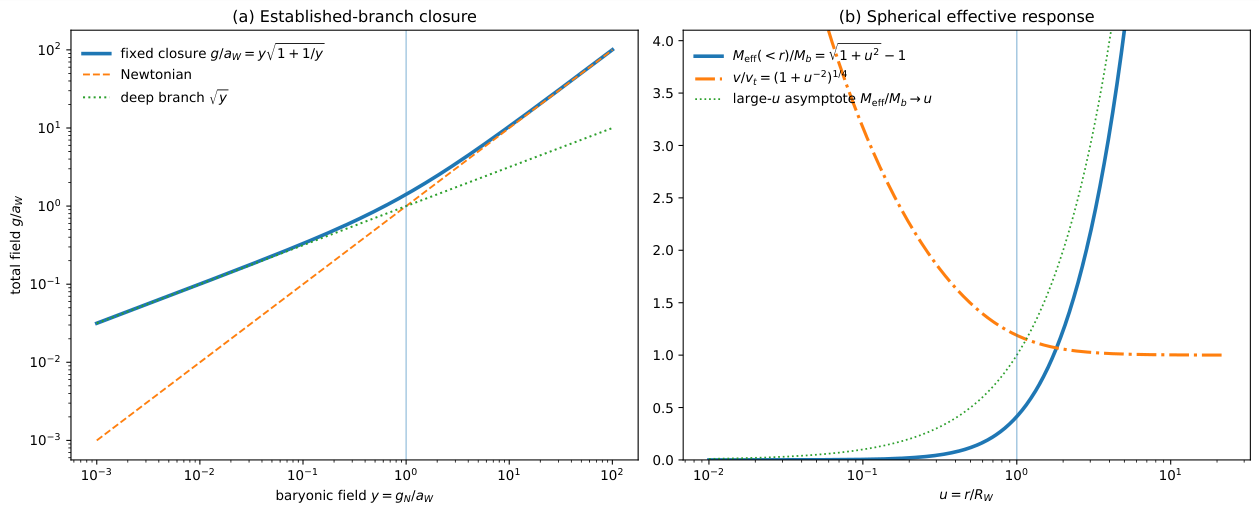
Figure 2.
Constitutive gating. Left: the region in which a binary-scale subsystem is eligible to acquire a response. Crossing the sloping boundary closes the acquisition gate; it does not automatically erase a response. Right: two schematic histories. Both schematic paths pass through an eligible interval. One acquires a response and retains it after the gate closes; the other remains unestablished. Eligibility alone specifies no formation time or mandatory transition. A separate reorganization event can erase an established response. The horizontal coordinate is schematic and does not encode a derived timescale.
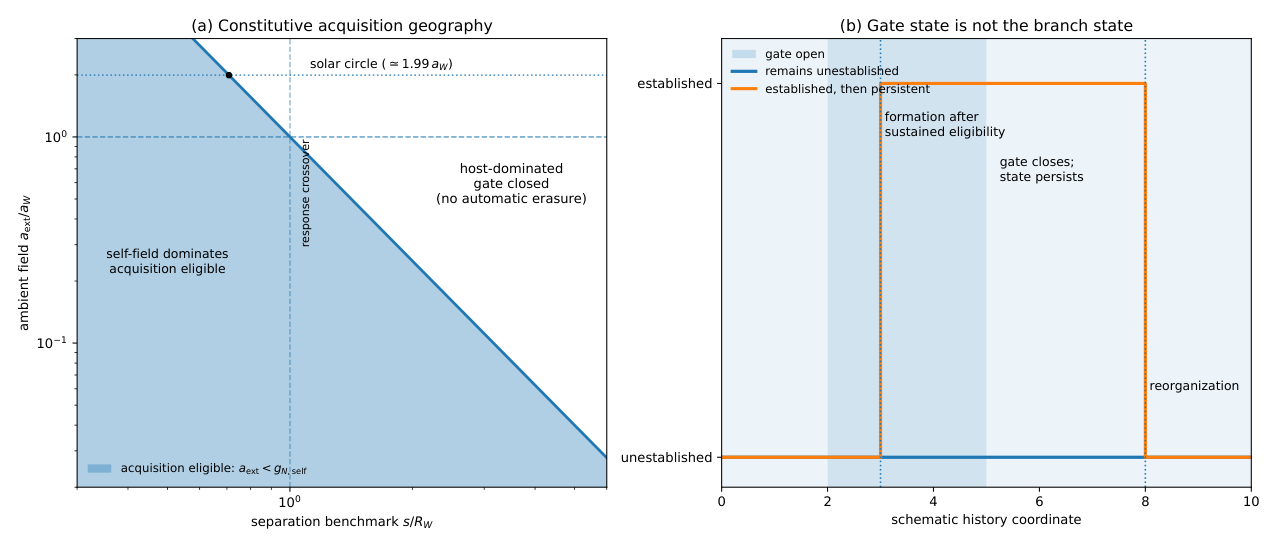

Table 1.
Status of the model ingredients. “Specified” denotes the chosen non-spherical completion of the spherical closure; “derived” denotes consequences of the stated functional or equations; “constitutive” denotes an explicit physical postulate rather than a result of the effective field model.
Table 1.
Status of the model ingredients. “Specified” denotes the chosen non-spherical completion of the spherical closure; “derived” denotes consequences of the stated functional or equations; “constitutive” denotes an explicit physical postulate rather than a result of the effective field model.
| Ingredient | Status in this paper | Consequence |
|---|---|---|
| Spherical closure and asymptotic BTFR slope | Derived from Eq. (2) | Fixed flat-curve limit and slope-four scaling |
| BTFR normalization | Archived fixed-slope confrontation | -dex residual at the reference stellar scale; dex under the linked global calibration; open strain with no correction term |
| QUMOND-form variational functional and field equations | Specified non-spherical extension; equations derived from the functional | Arbitrary-source quasi-static solve on a homogeneous established branch |
| SPARC pointwise and disk-geometry comparisons | Executed empirical calculations | Distinct samples and metrics; the disk solve tests the arbitrary-source field |
| Acquisition gate and persistence | Constitutive postulates | Branch-resolved rather than single-valued environmental predictions |
| Nested-source and mixed-domain coupling | Constitutive bookkeeping; no global hierarchical action | Compound-system statements are conditional on the source-separation prescription |
| Formation time, stripping, redistribution | Open dynamics | No universal instantaneous re-screening law |
| Comparable-mass finite-transition binary force | Executed isolated-branch calculation | Mass-ratio-dependent force; application to observed populations requires environment and history |
| Relativistic completion and lensing | Open theory | No lensing prediction is made here |
Table 2.
Frozen SPARC correspondence results at and . Supplementary Material 1 contains the exact mask, public-data checksum, executable analysis, and machine-readable outputs.
Table 2.
Frozen SPARC correspondence results at and . Supplementary Material 1 contains the exact mask, public-data checksum, executable analysis, and machine-readable outputs.
| Relation | Global RMS (dex) | Median per-galaxy RMS (dex) |
|---|---|---|
| Fixed closure | ||
| RAR exponential | ||
| Simple MOND | ||
| Spherical TeVeS-style curve | — |
Table 3.
Isolated established-branch calculation with each body’s radius equal to . Digits beyond the quoted physical scale serve numerical reproduction. The supplement supplies the density profiles, all-space force integrals, 36-separation curves, and compact-source, quadrature, force-balance, and limiting-law checks.
| q | at | ||
|---|---|---|---|
| 1.00 | 1.283412 | 1.499806 | 1.224666 |
| 0.30 | 1.297316 | 1.523506 | 1.234304 |
| 0.10 | 1.325160 | 1.570781 | 1.253308 |
| 0.03 | 1.355962 | 1.622805 | 1.273894 |
Disclaimer/Publisher’s Note: The statements, opinions and data contained in all publications are solely those of the individual author(s) and contributor(s) and not of MDPI and/or the editor(s). MDPI and/or the editor(s) disclaim responsibility for any injury to people or property resulting from any ideas, methods, instructions or products referred to in the content. |
© 2026 by the author. Licensee MDPI, Basel, Switzerland. This article is an open access article distributed under the terms and conditions of the Creative Commons Attribution (CC BY) license.
Copyright: This open access article is published under a Creative Commons CC BY 4.0 license, which permit the free download, distribution, and reuse, provided that the author and preprint are cited in any reuse.