

Submitted:
20 October 2026
Posted:
21 October 2026
You are already at the latest version
Abstract
Soil salinization is a widespread abiotic stress factor that significantly limits the growth, development, and productivity of plants. One of the effects of salt stress on plants is a disruption in mineral nutrient uptake, particularly due to the competition between nitrate and chloride anions for the root ion transport systems. In this study, we identified key genes in the salt-tolerant barley Hordeum marinum that regulate nitrate uptake from the soil solution and encode membrane proteins of the NPF, NRT2, and NAR2 families. When the expression profiles of nitrate transporter genes in H. marinum and H. vulgare were compared, differences were found in the response of NPF family genes to the addition of NaCl to the medium: in H. marinum, transcription of the HmNPF6.3B1 gene was significantly induced, whereas the expression level of orthologous genes in H. vulgare was almost independent of the NaCl concentration in the medium. Changes in the expression of nitrate transporter genes are consistent with data on the accumulation of nitrate and chloride anions in the organs of H. marinum and H. vulgare and indicate a greater ability of H. marinum, compared to H. vulgare, to maintain nitrate influx and limit chloride entry under salt stress conditions. Using the bimolecular fluorescence complementation (BiFC) method, the interaction of NRT2 family proteins of H. marinum with the HmNAR2.3 protein was detected, and using a heterologous expression system based on the yeast Ogataea parapolymorpha, the nitrate transport activity of the HmNPF6.3B1 protein was demonstrated.
Keywords:
nitrate transporters
; salt tolerance
; barley
; NPF family
; heterologous expression
; Hordeum marinum
Introduction
Nitrogen is an important biogenic element and is necessary for the proper growth and development of plants. In most soils, nitrate is the primary source of nitrogen for plants, and its availability has a significant impact on crop yield. Currently, two nitrate uptake systems with different affinities for NO3− anions are known in higher plants: the high-affinity transport system (HATS) and the low-affinity transport system (LATS). Typical values of Michaelis constants (Km) for HATS do not exceed 0.25-0.5 mM NO3−, whereas the Km value for LATS is usually greater than 0.5 mM [1]. There are constitutive and inducible parts to these transport systems, with the latter being expressed only when nitrate is present in the environment.
At the molecular level, two families of proteins responsible for nitrate uptake from the soil solution have been identified in plants: NPF (NRT1/PTR Family) and NRT2 [1,2]. Members of both groups belong to the Major Facilitator Superfamily (MFS) [3] and are localized on the plasma membrane, but they differ in their affinity for nitrate. The NPF family includes low- or dual-affinity NO3−/2H+ symporters [4], whereas members of the NRT2 family are high-affinity nitrate transporters. When investigating the nitrate transport activity of NRT2 family proteins, it turned out that for certain members of this family, maximum activity is observed only when forming a complex with relatively small (about 30 kDa) NAR2 family proteins [5,6].
Over the past few decades, the genes of the NPF, NRT2, and NAR2 families have been discovered in various species of higher plants and microalgae [7,8,9,10,11]. For example, the genome of Arabidopsis thaliana contains 53 NPF genes, 7 NRT2 genes, and 2 NAR2 genes. Along with their involvement in nitrate uptake, some proteins from these families have additional functions. Particularly, it has been shown that AtNPF6.3 in A. thaliana, in addition to dual-affinity nitrate transport, plays a central role in nitrate perception as a signaling molecule and initiates a signaling transduction pathway leading to changes in the transcription of nitrate-regulated genes [12]. Moreover, AtNPF6.3 can transport chloride ions and auxin, as well as inhibits lateral root formation under nitrate deficiency conditions [13,14]. Beyond root tissues, NPF and NRT2 family proteins are responsible for the redistribution of nitrate between plant roots and shoots, as well as for the accumulation of nitrate in seeds [15,16,17]. In mature seeds, the expression of the AtNRT2.7 gene, which encodes a tonoplast nitrate transporter, is observed [16]. Unlike other members of the NRT2 family, the AtNRT2.7 protein does not interact with NAR2 proteins.
In the genome of barley Hordeum vulgare, 10 NRT2 family genes and 3 NAR2 genes have been identified [6,18]. Out of the 10 NRT2 genes, only 4 genes (HvNRT2.1 – HvNRT2.4) have been cloned and thoroughly characterized [10,19]. In a heterologous system based on Xenopus oocytes, it has been shown that out of the three NAR2 family proteins in barley (HvNAR2.1-HvNAR2.3), only HvNAR2.3 is capable of interacting with HvNRT2.1, leading to an increase in the activity of the nitrate transporter HvNRT2.1 [6]. The HvNRT2.1-HvNAR2.3 complex has also been shown to mediate electrogenic nitrate transport, which is accompanied by membrane depolarization in Xenopus oocytes. This indicates the co-transport of nitrate with cations, the total charge of which exceeds the total charge of the transported nitrate anions in absolute value. However, the stoichiometry of the ions transported by the HvNRT2.1-HvNAR2.3 complex and the nature of the coupling cations remain unknown.
During the process of domesticating agricultural crops, traits related to plant tolerance to stress factors are often lost. Since one of the main abiotic factors limiting plant productivity is salt stress, the investigation of salt-tolerant wild plants related to agricultural crops is of great interest. For cultivated barley H. vulgare, such a closely related salt-tolerant species is Hordeum marinum Huds. The species H. marinum inhabits saline marshes and flooded areas of the Mediterranean region and is tolerant to flooding and high salt concentrations [20]. All of this makes H. marinum a promising genetic resource for the breeding of cultivated barley varieties H. vulgare to enhance their stress resistance.
In 2022, a team of researchers assembled the genome and transcriptome of the marine barley H. marinum [21]. This significantly simplifies the search for new genes and opens up opportunities for unraveling the molecular and biological processes underlying the high stress resistance of H. marinum.
In this study, we identified the transporter genes of the NPF, NRT2, and NAR2 families at the whole transcriptome level in the wild salt-tolerant barley species H. marinum, and functionally characterized some members of these families that are likely to contribute the most to nitrate uptake from media with high sodium chloride concentrations.
Materials and Methods
Plant Material and Growth Conditions
In this study, two species of barley were used: cultivated barley Hordeum vulgare L. (variety "Luch") and its wild relative H. marinum Huds (accession H559, obtained from NordGen, Nordic Genetic Resource Center, Sweden; doi https://glis.fao.org/glis/doi/10.18730/1JRE3J). Seeds of both species were stratified on wet filter paper for 4 days at 4 ℃ in the dark, after which they were germinated at 23 ℃ and illuminated with approximately 350 µmol photons/(m²∙s). Ten-day-old seedlings were transferred to a nutrient solution and grown hydroponically at a relative humidity of 70%, with the solution being changed weekly. The nutrient solution was a modified Hoagland medium containing 5 or 0.5 mM nitrate, with the addition of KOH to adjust the pH to 6.5 (Table S1). Seven days after transferring to hydroponic culture, the NaCl concentration in the nutrient solution was gradually increased by adding 50 mM of NaCl per day until reaching a final concentration of 150 or 300 mM. Plant material was collected 14 days after reaching 300 mM NaCl in the medium.
Determination of Ion Content in Plant Tissues
The collected plant material (roots and leaves) was dried at 80 ℃ for 3-4 days, after which it was ground using a mortar and pestle. Then, 10 ml of distilled water was added to 100 mg of the ground dry mass, and the solution was brought to a boil twice to extract the ions. The obtained extracts were filtered through paper filters and used to measure the concentrations of NO3−, Cl−, K+ and Na+ ions. Nitrate anions were determined spectrophotometrically by reducing nitrate with vanadium trichloride, followed by the detection of nitrite using the Griess reagent [22]. The concentration of chloride ions was determined by titrating the extracts with a standard Hg2+ solution. For this, 1 ml of the sample was mixed with 9 ml of distilled water, 2 drops of 0.2 N HNO3, 2 drops of the indicator solution (0.5% diphenylcarbazone and 0.05% bromophenol blue in ethanol), and titrated with 0.005 M Hg(NO3)2 until a purple color appeared. Potassium and sodium cations were determined using a flame photometer FPA-2-01 (ZOMZ, Sergiev Posad, Russia).
Isolation of Total RNA and RT-qPCR
Total RNA was isolated from the roots and leaves of H. marinum and H. vulgare using the hot phenol extraction method [23]. For the extraction, samples weighing 250 mg were used. Next, the obtained total RNA was used as a template for the synthesis of the first strand of cDNA in a reverse transcription reaction with an oligo-dT primer and MMLV reverse transcriptase (cat. No. SK022 Evrogen, Russia).
The relative quantity of transcripts of nitrate transporter genes from the NPF, NRT2, and NAR2 families was determined using the CFX Connect Real-Time PCR Detection System (Bio-Rad, Hercules, CA, USA) and the ready-to-use 5X qPCRmix-HS SYBR mixture (cat. No. PK147 Evrogen, Russia), using 50 ng of first-strand cDNA and primers listed in Table S2, according to the manufacturer's protocol. The genes actin [21] and elongation factor eEF1A (Table S2) were chosen as reference genes, and similar results were obtained when normalizing to their expression levels. Therefore, all graphs present the results normalized to the actin gene.
Cloning of the Coding Sequences HmNPF6.3B1, HmNRT2, and HmNAR2.3
First, using data from the transcriptome of H. marinum, primers were chosen for amplifying the CDS of the HmNRT2 and HmNAR2.3 transcripts on a cDNA template with the polymerase mix Encyclo (cat. No. PK002L, Evrogen, Russia) according to the manufacturer's recommendations. The obtained amplicons were cloned into the pAL2-T vector with sticky T-ends (Cat. No. TA002, Evrogen, Russia). The coding sequence of HmNPF6.3B1 was amplified using the ready-to-use CloneAmp HiFi PCR Premix (Cat. No. 639298, Clontech, USA) and cloned into the yeast vector pCHLX [24,25]. Then, the selected sequenced plasmids pAL2-T-HmNRT2, pAL2-T-HmNAR2.3, and pCHLX-HmNPF6.3B1 were used to subclone the coding sequences of nitrate transporter genes into yeast vectors pNX35-DEST (for HmNRT2 and HmNPF6.3B1) and pMetYC-DEST (for HmNAR2.3) [26] using the ClonExpress Ultra One Step kit (cat. No. C115-02, Vazyme, China) to study the possible interaction of HmNRT2 and HmNPF6.3B1 proteins with the HmNAR2.3 protein.
Yeast Mating-Based Split-Ubiquitin Assay
To investigate the possible interaction involving the proteins HmNRT2, HmNPF6.3B1, and HmNAR2.3, two haploid yeast strains were used: THY.AP4 (genotype: MATα; ade2−, his3−, leu2−, trp1−, ura3−; lexA::ADE2, lexA::HIS3, lexA::lacZ) and THY.AP5 (MATα; URA3; ade2−, his3−, leu2−, trp1−) [26]. The strain THY.AP5 was transformed with the prey vector constructs pNX35-DEST-HmNRT2 and pNX35-DEST-HmNPF6.3B1, while the bait construct pMetYC-DEST-HmNAR2.3 was used for the transformation of the strain THY.AP4. Transformants were selected on CSM-LM media (in the case of the THY.AP4 strain) and CSM-TUM media (for the strain THY.AP5). Next, we performed mating of yeast strains bearing vector constructs and selected the resulting diploids on CSM-LTUM medium (lacking leucine, tryptophan, uracil, and methionine). To identify specific protein-protein interactions, 4 µL of liquid cultures of diploid strains (with OD600 equal to 1 or 0.1) were plated on Petri dishes with selective CSM-LTUMAH medium (which lacked leucine, tryptophan, uracil, methionine, adenine, and histidine) with the addition of L-methionine in increasing concentrations (0.5; 5; 50; and 500 µM). Petri dishes were scanned after 2-3 days of incubation at 30 ℃.
Bimolecular Fluorescence Complementation (BiFC)
To study protein-protein interactions using the BiFC method, pSPYNE-35S and pSPYCE-35S vectors were used, which contain the N- and C-terminal fragments of the green fluorescent protein mVenus, respectively [27,28]. The previously amplified sequences HmNPF6.3B1, HmNRT2, and HmNAR2.3 were ligated with SmaI restriction site-linearized pSPYNE-35S and pSPYCE-35S vectors using the ClonExpress Ultra One Step kit (cat. no. C115-02, Vazyme, China). The obtained constructs pSPYNE-35S-HmNPF6.3B1, pSPYNE-35S-HmNRT2, and pSPYCE-35S-HmNAR2.3 were used for the transformation of Agrobacterium tumefaciens (strain GV3101) by the freeze-thaw method [29]. Then, overnight cultures of A. tumefaciens transformants, grown at 28°C in LB liquid medium with antibiotics (50 µg/ml kanamycin, 50 µg/ml gentamicin, and 25 µg/ml rifampicin), were centrifuged for 5 minutes at 6000g, washed with infiltration buffer (10 mM MES-KOH pH 5.7; 10 mM MgCl2; 150 µM acetosyringone), and resuspended in the same buffer to an OD600 of 0.7-1. The obtained suspensions were mixed with each other and with the helper strain suspension (expressing the protein p19) in a 1:1:1 volume ratio and used for leaf infiltration of 45-day-old Nicotiana benthamiana plants. Infiltrated N. benthamiana plants were incubated for 3-5 days at 21℃ for transgene expression, after which, leaf fragments were analyzed using a laser scanning confocal microscope LSM-710-NLO (Carl Zeiss, Germany) at λex 514 nm and λem 527 nm.
Complementation Analysis in the Cells of the Methylotrophic Yeast Ogataea parapolymorpha
To evaluate the nitrate transport activity of the HmNPF6.3B1 protein, heterologous expression of the HmNPF6.3B1 gene was carried out in the Δynt1 knockout mutant of Ogataea parapolymorpha yeast, which has a deletion in its own nitrate transporter gene Ynt1 (mutant genotype: Δynt1::BleoR, leu2, ura3; derived from the wild-type strain DL-1 with the genotype: leu2, ura3) [24]. For this purpose, the previously obtained construct pCHLX-HmNPF6.3B1 was linearized at the PspCI restriction site in the LEU2 auxotrophic marker region and used for transforming the Δynt1 strain by electroporation [30]. Transformants were selected on SD−leu medium (0.17% yeast nitrogen base without amino acids and ammonium sulfate; 2% glucose; 20 mg/l uracil; 2% agar) with the addition of 1 mM KNO3 or 0.5% (NH4)2SO4 as a nitrogen source. To ensure the prototrophy of the selected transformants, they were additionally transformed with the empty vector pCCUR2 [25], linearized at the PspCI restriction site in the URA3 auxotrophic marker region.
The resulting prototrophic strain with the HmNPF6.3B1 sequence integrated into the genome under the control of the nitrate-inducible promoter of nitrate reductase Ynr1 from O. parapolymorpha was grown in 5 ml of SD−leu−ura liquid medium supplemented with 0.5% (NH4)2SO4 at 37℃ overnight. Then, the overnight culture was centrifuged for 5 minutes at 6000g, the pellet was washed with sterile water, resuspended in water to an OD600 of 1 or 0.1, and 4 µL of the suspension was applied to Petri dishes with selective SD−leu−ura medium, containing KNO3 as the sole nitrogen source at increasing concentrations (ranging from 0.25 to 5 mM). As control variants, the wild-type strain DL-1 and the knockout mutant Δynt1 O. parapolymorpha, cotransformed with empty vectors pCHLX and pCCUR2, were used. The growth of yeast colonies was assessed 3 days after incubation at 37℃.
Bioinformatic Sequence Analysis
The search for nitrate transporter transcripts in the H. marinum transcriptome was conducted using the BLAST program, with amino acid sequences of homologs from A. thaliana and H. vulgare as queries. Transcriptomic data for H. marinum were downloaded from the CNCB database (accession number: GWHBJBH00000000). To search for NPF family transcripts in H. vulgare, an annotated transcriptome from the CNCB database (accession number: GCA_024137805.1) was used.
Multiple alignment was performed using the MAFFT program (https://www.ebi.ac.uk/jdispatcher/msa/mafft) and visualized in Jalview v. 2.11.5.1, indicating the percentage of identical amino acid residues at each alignment position. Phylogenetic trees were constructed using the MEGA11 software. To predict the three-dimensional structure of proteins and their transmembrane topology, we used the programs AlphaFold 3 (https://alphafoldserver.com/) and DeepTMHMM (https://services.healthtech.dtu.dk/services/DeepTMHMM-1.0/), respectively. The intracellular localization of proteins was predicted using the Plant-mPLoc program (http://www.csbio.sjtu.edu.cn/bioinf/plant-multi/).
Statistical Data Analysis
All quantitative data were obtained using 3-4 biological replicates and at least 2-3 analytical replicates. The normality of the data was assessed using the Shapiro-Wilk test. The statistical significance of the differences between the mean values of the treatments and the control variant was assessed using the Dunnett's test. In all graphs, statistically significant differences at p≤0.05 are marked with the symbol "*".
Results
Growth Traits and Ion Content in the Organs of H. marinum and H. vulgare
To study the effects of salinity on the uptake and transport of nitrate, we measured the accumulation of nitrate and chloride anions in the roots and leaves of two barley species, H. marinum and H. vulgare. When plants were grown in media containing both optimal (5 mM) and reduced (0.5 mM) nitrate concentrations, the addition of NaCl led to a significant increase in chloride ion content in the roots of both plant species H. marinum and H. vulgare (Figure 1a). However, unlike H. marinum, in the leaves of H. vulgare, a significant increase in chloride content was also observed, slightly exceeding its content in the roots (Figure 1b). This indicates the transport of chloride to the aboveground parts and the inability of H. vulgare plants to limit its entry into the photosynthetic tissues of the leaf. In the case of H. marinum, the chloride content in the leaves was weakly dependent on its concentration in the nutrient solution (Figure 1b). This can be explained by the existence of a mechanism in H. marinum that limits the transport of chloride to above-ground organs, presumably by altering the expression or post-translational regulation of chloride transporters.
Analysis of nitrate content in the roots and leaves of H. marinum and H. vulgare grown in a medium with 5 mM NO3− showed that as the chloride concentration in the nutrient solution increases, there is a significant decrease in nitrate content in the plant organs (Figure 2a, c). At the same time, the observed decrease in nitrate concentration in the tissues is somewhat more pronounced for H. vulgare than for H. marinum. These effects can be explained by the competition between nitrate and chloride anions during their absorption and transport within the plant. Interesting results regarding nitrate content in roots and leaves were obtained when growing H. marinum and H. vulgare under nitrate-deficient conditions (0.5 mM NO3−) (Figure 2b, d). In this case, as the chloride concentration in the medium increased, a significant increase in nitrate content in the roots of H. vulgare and a decrease in its content in the leaves were observed, whereas the nitrate content in the organs of H. marinum was weakly dependent on the chloride concentration in the medium and was maintained at comparable levels in the roots and leaves (Figure 2b, d). Apparently, under these conditions, in H. vulgare, unlike in H. marinum, the outflow of nitrate to the aerial parts is significantly disrupted, leading to its accumulation in the roots and a decrease in its content in the leaves. This may be related to the partial displacement of nitrate by chloride ions and the disruption of the activity of proteins involved in nitrate transport.
Since alkali metal cations often serve as counterions for nitrate and chloride, we also examined the potassium and sodium content in the organs of H. marinum and H. vulgare under the same conditions (Figure 3). At all applied nitrate concentrations (0.5 and 5 mM), the addition of NaCl led to a decrease in potassium content in the roots and leaves of both plant species (Figure 3a, b). However, in the case of H. marinum, this decrease was significantly less compared to H. vulgare, which confirms the ability of H. marinum to more effectively maintain ion homeostasis under salt stress conditions.
Along with the decrease in K+ content, there was an accumulation of Na+ ions in the tissues of the roots and leaves of H. marinum and H. vulgare (Figure 3c, d). However, at all NaCl concentrations in the medium, the Na+ content in the leaves of H. marinum was significantly lower than in the leaves of H. vulgare, with comparable sodium ion concentrations in the roots of both plant species. This indicates a more efficient control of sodium transport from the roots to the photosynthetic tissues of the leaves in H. marinum.
The obtained data on the ion content in the organs of cultivated and wild barley are well aligned with the greater salt tolerance of H. marinum compared to H. vulgare. This is supported by the changes in relative dry weights (i.e., weight normalized to weight under control conditions) of H. marinum and H. vulgare plants at two nitrate concentrations (0.5 and 5 mM) and three NaCl concentrations (0, 150, and 300 mM). In this case, the decrease in the dry weight of the plants was significantly more severe for H. vulgare than for H. marinum (Figure 4, Figure S1).
The NAR2 Family of H. marinum
Using the BLAST algorithm, we searched for transcripts in the H. marinum transcriptome that encode putative NAR2 family proteins. For this purpose, the amino acid sequences of previously identified proteins from H. vulgare (HvNAR2.1, HvNAR2.2, and HvNAR2.3) and A. thaliana (AtNAR2.1 and AtNAR2.2) were used as queries. As a result, two NAR2 family transcripts with the numbers GWHPBJBH052439 and GWHPBJBH058079 were identified in the transcriptome of H. marinum. These transcripts turned out to be most similar to the sequences HvNAR2.2 and HvNAR2.3 of H. vulgare and were therefore named HmNAR2.2 and HmNAR2.3, respectively (Figure 5a). The identified transcripts HmNAR2.2 and HmNAR2.3 encode protein sequences of 198 and 201 residues in length with calculated molecular weights of 21.1 and 21.2 kDa, respectively. According to the prediction by the Plant-mPLoc program, both proteins HmNAR2.2 and HmNAR2.3 are localized in the plasma membrane. Analysis of the transmembrane topology and three-dimensional structure of HmNAR2.2 and HmNAR2.3 using DeepTMHMM, AlphaFold 3, and Swiss-Model predicts the presence of a single transmembrane α-helix in the C-terminal region of the proteins (residues 173–194 and 182–191 for HmNAR2.2 and HmNAR2.3, respectively) (Figure 5b, Figure S2). Using the DeepTMHMM program, a signal peptide (residues 1–25) was identified at the N-terminus of the HmNAR2.2 and HmNAR2.3 proteins, followed by a large extracellular domain (residues 26–172 and 26–181 for HmNAR2.2 and HmNAR2.3, respectively) (Figure 5b). In a multiple alignment of amino acid sequences of the NAR2 family from various plant species, the conserved residues R93 and D102 in the proteins HmNAR2.2 and HmNAR2.3 were identified (Figure S3), which are homologous to the residues R100 and D109 in OsNAR2.1 of rice, important for interaction with NRT2 family proteins [31]. Moreover, both HmNAR2.2 and HmNAR2.3 proteins contain the conserved motif K(2)K(2)LCY(2)S(3)RxWR(3)D(4)DK, located between residues 140 and 180, characteristic of NAR2 family proteins in higher plants.
The NRT2 Family of H. marinum
As a result of the search for sequences encoding NRT2 family proteins in the transcriptome of H. marinum, 17 transcripts were found that reliably align with AtNRT2.1 of A. thaliana and HvNRT2.1–HvNRT2.4 of H. vulgare. Among the 17 identified transcripts, this study focuses on 9 transcripts that are most similar to AtNRT2.1, AtNRT2.5, and HvNRT2.1–HvNRT2.4 (Figure 6a), which make the main contribution to high-affinity nitrate transport in A. thaliana and H. vulgare. In silico analysis showed that all nine transcripts encode proteins sized 496-514 aa, which contain 12 transmembrane α-helices, characteristic of NRT2 family proteins. Also, two conserved motifs were identified in the sequences of these proteins: the GxxxDxxGxR motif, characteristic of MFS superfamily proteins, and the G(W/L)GN(M/L)GGG motif, specific to nitrate and nitrite transporters [32].
Orthologs of AtNPF6.3 in H. marinum and H. vulgare
As a result of the search for putative orthologs of the nitrate transporter AtNPF6.3 from A. thaliana, 5 sequences homologous to AtNPF6.3 were found in the transcriptome of H. marinum (GWHGBJBH006350/ 6353/ 41866/ 2217/ 50820) and 4 sequences in the transcriptome of H. vulgare. The transcripts GWHGBJBH006350 and GWHGBJBH006353, which we named HmNPF6.3B1 and HmNPF6.3B2, respectively, were the most similar to AtNPF6.3 in terms of amino acid sequence (Figure 6b). In the substrate-binding site of both proteins HmNPF6.3B1 and HmNPF6.3B2, there are histidine residues H362 and H363, respectively, whereas the other transcripts (GWHGBJBH041866/2217/50820) encode proteins that contain tyrosine residues (Y372, Y350, Y350, respectively) in the substrate-binding site. This suggests the involvement of the first group of proteins (HmNPF6.3B1 and HmNPF6.3B2) in nitrate transport, while the second group of proteins is responsible for chloride transport [33]. Moreover, in the amino acid sequence of all the proposed AtNPF6.3 orthologs from H. marinum, there are (1) the ExxER motif, involved in proton binding and the coupling of anion-proton transport, (2) conserved lysine and glutamate residues forming an ionic bond necessary for transport, and (3) a conserved threonine residue at the N-termini of the proteins, responsible for switching anion affinity [4]. Additionally, all the aforementioned orthologs have a transmembrane topology typical of NPF family members: 12 transmembrane α-helices and a long hydrophilic loop between the 6th and 7th α-helices, which likely serves as a binding site for regulatory proteins.
Analysis of the Expression of Nitrate Transporter Genes in H. marinum and H. vulgare
Almost all the studied nitrate transporter genes of the NAR2, NRT2, and NPF families were predominantly expressed in the roots of H. marinum and H. vulgare, except for the HmNPF6.3B2 and HvNPF6.3B2 genes, whose expression was also observed in the leaves. Analysis of expression profiles showed that in the case of H. marinum, the addition of NaCl to the cultivation medium induced the expression of all studied genes in the roots, except for the weakly expressed gene HmNAR2.2 (Figure 7). The highest induction of expression by sodium chloride was observed for the NRT2 family genes (Figure 7a), as well as for the HmNPF6.3B1 gene at 0.5 mM nitrate in the medium (Figure 7b). It is worth noting that the expression of most of the studied genes in the absence of NaCl was almost independent of the nitrate concentration in the nutrient solution (0.5 or 5 mM), except for the genes HmNPF6.3B1 and HmNRT2.2. In the case of HmNPF6.3B1, the optimal nitrate concentration (5 mM) led to the induction of this gene's expression compared to its expression level in nitrate-deficient medium. The opposite effect was observed for the gene HmNRT2.2: at the optimal nitrate concentration, its expression was suppressed, but it was induced under nitrate-deficient conditions. Among the nine studied NRT2 family genes of H. marinum, two genes, HmNRT2.8 and HmNRT2.9, most similar to AtNRT2.5, exhibited extremely low expression levels that were below the reliable detection threshold under all experimental conditions. In this regard, these two genes were excluded from further analysis.
In the case of H. vulgare, there was also an induction of expression of the NRT2 and NAR2 gene families in the presence of NaCl, except for the HvNAR2.2 gene, whose expression remained at a low level (Figure 8). However, unlike H. marinum, the expression of NPF6.3 genes in H. vulgare at 0.5 mM nitrate was weakly dependent on NaCl concentration, and at 5 mM nitrate, a decrease in their expression level was even observed (Figure 8b). Under these experimental conditions, the expression of almost all the studied genes did not depend on the nitrate concentration in the medium in the absence of NaCl, except for the HvNRT2.2 gene, for which an induction of expression was observed under nitrate deficiency conditions (0.5 mM).
Since the dependence of gene expression levels on nitrate concentration in the medium was identified only for HmNPF6.3B1, HmNRT2.2, and HvNRT2.2, it can be assumed that these genes encode components of inducible nitrate uptake systems. Despite the fact that no distinct changes in the expression levels of the other studied genes were observed in response to a fixed nitrate concentration in the medium, this does not exclude the possibility of more rapid changes in the expression levels of these genes (within a few hours) followed by a return to baseline levels in response to changes in nitrate concentration.
Evaluation of Protein-Protein Interactions Involving Members of the NRT2 and NAR2 Families in H. marinum
Since it has previously been shown for some plant species, including A. thaliana and H. vulgare, that NRT2 family transporters often form complexes with NAR2 proteins, it was necessary to determine whether similar two-component high-affinity nitrate uptake systems exist in H. marinum. For this purpose, three transporters of the NRT2 family (HmNRT2.1, HmNRT2.2, and HmNRT2.4) and one protein of the NAR2 family (HmNAR2.3) were chosen, as the genes of these proteins exhibited high expression levels or demonstrated a dependence of their expression on nitrate concentration in the medium. First, using the yeast split-ubiquitin system, we attempted to identify specific protein-protein interactions between the NRT2 transporters of H. marinum and the HmNAR2.3 protein. However, the application of this approach did not yield the expected results, and only weak growth of yeast colonies on selective media was observed, which was not suppressed in the presence of methionine (Figure S4). This can be explained by the disruption of protein sorting in the heterologous yeast system, resulting in most of the synthesized NRT2 family proteins and HmNAR2.3 being located in different compartments of the yeast cell or the heterologous proteins being rapidly subjected to proteasomal degradation. One possible way to solve this problem is to choose another heterologous system for studying membrane protein interactions. As such a system, epidermal cells of N. benthamiana tobacco leaves were chosen, and the interaction of target proteins was assessed by the restoration of mVenus fluorescence using the BiFC method. As a result, the appearance of mVenus fluorescence was observed for all pairs of NRT2 and HmNAR2.3 proteins (Figure 9a), while in the control variants, the fluorescent signal was almost absent (Figure 9b). This confirms the presence of protein complexes HmNRT2.1, HmNRT2.2, and HmNRT2.4 with the protein HmNAR2.3 and indicates the possible existence of a two-component high-affinity nitrate uptake system in H. marinum.
The Involvement of the HmNPF6.3B1 Protein in Nitrate Transport
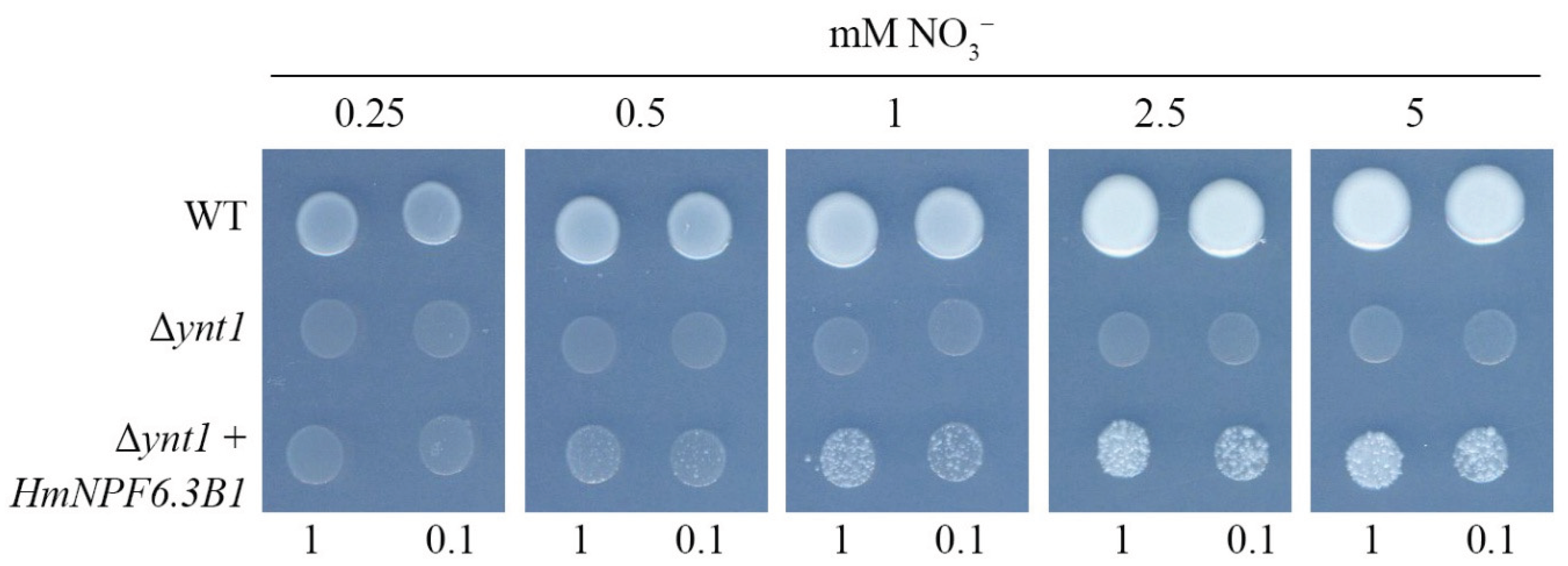
To identify the ion-transporting activity of the studied proteins in H. marinum, HmNPF6.3B1 was selected because, among nitrate-inducible transporters, it had the highest expression level and is likely the main transporter contributing the most to the overall nitrate uptake by H. marinum plants. The ability of the HmNPF6.3B1 protein to perform transmembrane transport of nitrate anions was assessed in a heterologous expression system based on the methylotrophic yeast O. parapolymorpha. This yeast species is capable of metabolizing nitrate and its genome contains a single gene that regulates nitrate uptake and encodes the transporter Ynt1. As a result of the heterologous expression of the HmNPF6.3B1 protein in the Δynt1 knockout mutant of O. parapolymorpha with a deletion in its own Ynt1 gene, partial restoration of growth was observed in the mutant strain with the HmNPF6.3B1 expression cassette integrated into its genome on media containing nitrate as the sole nitrogen source (Figure 10).
This confirms the presence of nitrate transport activity in HmNPF6.3B1. The partial nature of complementation may be related to the fact that only a small fraction of the HmNPF6.3B1 protein undergoes proper intracellular sorting in the heterologous system and reaches the plasma membrane of the yeast cell [34]. It is also possible that the yeast cells of O. parapolymorpha lack specific enzymatic systems that perform post-translational modifications of the HmNPF6.3B1 protein, which are necessary for its maximum activity [35,36]. These same reasons may explain the lack of complementation in the case of O. parapolymorpha strains expressing the transgenes HmNRT2.1 and HmNAR2.3 from H. marinum (Figure S5).
Discussion
In the current research, a comparative analysis of the functioning of nitrate-transporting systems in cultivated (H. vulgare) and wild (H. marinum) barley species was carried out under varying nitrate availability and salt stress conditions. As the analysis of ion distribution in plant organs showed, significant changes in ion composition occur in the tissues of H. vulgare upon the addition of NaCl to the cultivation medium, whereas H. marinum is relatively resistant to the effects of salt stress and is capable of maintaining ion homeostasis under these conditions. This is likely due to the functioning of transport systems in H. marinum cells, which are responsible for more efficient removal of excess toxic sodium and chloride ions compared to H. vulgare, or for limiting their entry into root cells, thereby preventing further transport of Na+ and Cl− ions to the shoots. The nitrate content we measured in the tissues of both barley species under control conditions (0 mM NaCl) correspond to previously published data on intracellular nitrate concentrations [37] and are more strictly regulated under salt stress conditions in H. marinum. It is possible that the nitrate transporters of H. marinum exhibit greater selectivity for nitrate in the presence of chloride compared to the orthologs of H. vulgare, or that different homologs of NPF6.3 in H. marinum transport either nitrate or chloride exclusively, and the expression of nitrate- and chloride-selective transporters is differently regulated. Indeed, it is characteristic of monocot plants, including barley, to have several genes orthologous to AtNPF6.3 of A. thaliana, and different orthologs may perform different functions in the transport of nitrate and chloride anions [38].
Analysis of the expression profiles of the NRT2 and NAR2 gene families showed a significant increase in their expression levels upon the addition of NaCl to the nutrient medium in both H. marinum and H. vulgare. This may be related to the necessity of maintaining nitrate influx under conditions of its competition with chloride, through compensatory upregulation of nitrate transporter gene expression. In the case of the salt-tolerant barley H. marinum, another possible explanation is the stimulation of nitrate transport by Na+ cations. Similarly, the possibility of nitrate symport with sodium, which is mediated by NRT2 family proteins, has been demonstrated using the marine higher plant Zostera marina [39,40]. However, despite the increase in the expression of NRT2 and NAR2 genes and the nitrate content in the roots at 0.5 mM NO3− in the medium, the transport of nitrate to the shoots of H. vulgare is disrupted in the presence of NaCl. This can be explained by the accumulation of chloride anions in the shoot tissues, which likely enter through low-selectivity transporters of the NPF family and displace nitrate ions from the substrate-binding sites of the NPF proteins. Since the NRT2 and NAR2 genes encode components of HATS, their expression is often induced under nitrate deficiency, when the NO3− concentration in the medium is less than 0.5 mM [34,41]. In the case of H. marinum and H. vulgare, the lack of induction of most NRT2 and NAR2 genes (except HmNRT2.2 and HvNRT2.2) at 0.5 mM NO3− may be related to the fact that they encode components of constitutive nitrate uptake systems or that these genes exhibit more rapid changes in expression levels, which are eliminated after several days of growth under stationary nitrate supply [18].
It is thought that two-component high-affinity nitrate uptake systems, consisting of NRT2 and NAR2 proteins, are widespread among various species of higher plants; however, it has been shown that not all possible combinations of NRT2 and NAR2 protein pairs are capable of forming complexes responsible for nitrate uptake. In this study, we demonstrated that at least three NRT2 proteins of H. marinum (HmNRT2.1, HmNRT2.2, and HmNRT2.4) are capable of interacting with the HmNAR2.3 protein, which likely indicates the functioning of a two-component HATS in H. marinum, involving these protein complexes.
Currently, several orthologs of AtNPF6.3 are known in monocot plants such as rice and corn, and it has been shown that these species possess several paralogous sequences similar to AtNPF6.3 [14,42,43]. All AtNPF6.3 homologs can be divided into three groups based on key amino acid residues: 1) A-haplotype (TYTF), characterized by the presence of a tyrosine residue in the substrate-binding site; 2) B-haplotype (THTF) with a histidine residue in the substrate-binding site; and 3) C-haplotype (NQMF), which is found in leguminous plants [33]. It has been shown that the proteins of haplotypes A and B differ in their substrate selectivity, with haplotype A including chloride-selective transporters, while haplotype B includes nitrate-selective proteins [33]. Moreover, the expression of genes encoding the transporters of haplotypes A and B is differentially regulated in response to changes in the concentration of nitrate and chloride in the surrounding environment [33]. Among the two HmNPF6.3 transporters belonging to the B-haplotype in H. marinum, HmNPF6.3B1 likely plays a leading role in nitrate uptake by the root from the environment. This is supported by data on the expression of nitrate transporter genes in the roots of H. marinum and the results of complementation analysis in O. parapolymorpha yeast cells expressing the HmNPF6.3B1 gene. In contrast, the second transporter HmNPF6.3B2 appears to be involved in the translocation of nitrate to the photosynthetic tissues of the leaves, while its role in nitrate uptake by the root is relatively minor.
Supplementary Materials
The following supporting information can be downloaded at the website of this paper posted on Preprints.org.
Author Contributions
Conceptualization, O.I.N. and D.E.K.; methodology, O.I.N. and D.E.K.; investigation, O.I.N. and D.E.K.; writing – original draft preparation, D.E.K.; writing – review & editing, V.S.V.; validation, O.I.N., D.E.K. and V.S.V.
Funding
This research was funded by the Ministry of Science and Higher Education of the Russian Federation (theme No. 126012615950-2).
Institutional Review Board Statement
This text of the manuscript was approved by the Institutional Review Board of K.A. Timiryazev Institute of Plant Physiology, Russian Academy of Sciences.
Informed Consent Statement
Not applicable.
Data Availability Statement
Accession numbers of sequences from the NCBI database (https://www.ncbi.nlm.nih.gov/) presented in this study are included in the supplementary material. Further inquiries can be directed to the corresponding authors. Yeast strains, vector constructs, and raw data obtained in this study can be provided by the authors upon request.
Acknowledgments
We are grateful to Mikhail O. Agafonov (A.N. Bach Institute of Biochemistry of Federal Research Center “Fundamentals of biotechnology”, Russian Academy of Sciences, Moscow, Russia) for kindly providing pCCUR2 and pCHLX plasmids; and to Sergey N. Lomin (K.A. Timiryazev Institute of Plant Physiology, Russian Academy of Sciences, Moscow, Russia) for kindly providing pSPYNE-35S and pSPYCE-35S plasmids. We also thank Evgeny Lysenko (K.A. Timiryazev Institute of Plant Physiology, Russian Academy of Sciences, Moscow, Russia) for the kindly provided H. vulgare seeds and Anastasia Ryabova (Prokhorov General Physics Institute, Russian Academy of Sciences, Moscow, Russia) for her assistance in the experiments carried out with a laser scanning confocal microscope.
Conflicts: of Interest: The authors declare no conflicts of interest.
References
- O'Brien, J. A.; Vega, A.; Bouguyon, E.; Krouk, G.; Gojon, A.; Coruzzi, G.; Gutiérrez, R. A. Nitrate Transport, Sensing, and Responses in Plants. Mol. Plant 2016, 9(6), 837–856. [Google Scholar] [CrossRef]
- Xu, N.; Cheng, L.; Kong, Y.; Chen, G.; Zhao, L.; Liu, F. Functional analyses of the NRT2 family of nitrate transporters in Arabidopsis. Front. Plant Sci. 2024, 15, 1351998. [Google Scholar] [CrossRef]
- Pao, S. S.; Paulsen, I. T.; Saier, M. H., Jr. Major facilitator superfamily. Microbiol. Mol. Biol. Rev. MMBR 1998, 62(1), 1–34. [Google Scholar] [CrossRef]
- Parker, J. L.; Newstead, S. Molecular basis of nitrate uptake by the plant nitrate transporter NRT1.1. Nature 2014, 507(7490), 68–72. [Google Scholar] [CrossRef]
- Okamoto, M.; Kumar, A.; Li, W.; Wang, Y.; Siddiqi, M. Y.; Crawford, N. M.; Glass, A. D. High-affinity nitrate transport in roots of Arabidopsis depends on expression of the NAR2-like gene AtNRT3.1. Plant Physiol. 2006, 140(3), 1036–1046. [Google Scholar] [CrossRef]
- Tong, Y.; Zhou, J. J.; Li, Z.; Miller, A. J. A two-component high-affinity nitrate uptake system in barley. Plant J. Cell Mol. Biol. 2005, 41(3), 442–450. [Google Scholar] [CrossRef]
- Filleur, S.; Daniel-Vedele, F. Expression analysis of a high-affinity nitrate transporter isolated from Arabidopsis thaliana by differential display. Planta 1999, 207(3), 461–469. [Google Scholar] [CrossRef]
- Quesada, A.; Galván, A.; Fernández, E. Identification of nitrate transporter genes in Chlamydomonas reinhardtii. Plant J. Cell Mol. Biol. 1994, 5(3), 407–419. [Google Scholar] [CrossRef]
- Tsay, Y. F.; Schroeder, J. I.; Feldmann, K. A.; Crawford, N. M. The herbicide sensitivity gene CHL1 of Arabidopsis encodes a nitrate-inducible nitrate transporter. Cell 1993, 72(5), 705–713. [Google Scholar] [CrossRef]
- Vidmar, J. J.; Zhuo, D.; Siddiqi, M. Y.; Glass, A. D. Isolation and characterization of HvNRT2.3 and HvNRT2.4, cDNAs encoding high-affinity nitrate transporters from roots of barley. Plant Physiol. 2000, 122(3), 783–792. [Google Scholar] [CrossRef]
- Zhuo, D.; Okamoto, M.; Vidmar, J. J.; Glass, A. D. Regulation of a putative high-affinity nitrate transporter (Nrt2;1At) in roots of Arabidopsis thaliana. Plant J. Cell Mol. Biol. 1999, 17(5), 563–568. [Google Scholar] [CrossRef]
- Maghiaoui, A.; Gojon, A.; Bach, L. NRT1.1-centered nitrate signaling in plants. J. Exp. Bot. 2020, 71(20), 6226–6237. [Google Scholar] [CrossRef]
- Krouk, G.; Lacombe, B.; Bielach, A.; Perrine-Walker, F.; Malinska, K.; Mounier, E.; Hoyerova, K.; Tillard, P.; Leon, S.; Ljung, K.; Zazimalova, E.; Benkova, E.; Nacry, P.; Gojon, A. Nitrate-regulated auxin transport by NRT1.1 defines a mechanism for nutrient sensing in plants. Dev. Cell 2010, 18(6), 927–937. [Google Scholar] [CrossRef]
- Wen, Z.; Tyerman, S. D.; Dechorgnat, J.; Ovchinnikova, E.; Dhugga, K. S.; Kaiser, B. N. Maize NPF6 Proteins Are Homologs of Arabidopsis CHL1 That Are Selective for Both Nitrate and Chloride. Plant Cell 2017, 29(10), 2581–2596. [Google Scholar] [CrossRef]
- Almagro, A.; Lin, S. H.; Tsay, Y. F. Characterization of the Arabidopsis nitrate transporter NRT1.6 reveals a role of nitrate in early embryo development. Plant Cell 2008, 20(12), 3289–3299. [Google Scholar] [CrossRef]
- Chopin, F.; Orsel, M.; Dorbe, M. F.; Chardon, F.; Truong, H. N.; Miller, A. J.; Krapp, A.; Daniel-Vedele, F. The Arabidopsis ATNRT2.7 nitrate transporter controls nitrate content in seeds. Plant Cell 2007, 19(5), 1590–1602. [Google Scholar] [CrossRef]
- Léran, S.; Muños, S.; Brachet, C.; Tillard, P.; Gojon, A.; Lacombe, B. Arabidopsis NRT1.1 is a bidirectional transporter involved in root-to-shoot nitrate translocation. Mol. Plant 2013, 6(6), 1984–1987. [Google Scholar] [CrossRef]
- Guo, B.; Li, Y.; Wang, S.; Li, D.; Lv, C.; Xu, R. Characterization of the nitrate transporter gene family and functional identification of HvNRT2.1 in barley (Hordeum vulgare L.). PLoS ONE 2020, 15(4), e0232056. [Google Scholar] [CrossRef]
- Trueman, L. J.; Richardson, A.; Forde, B. G. Molecular cloning of higher plant homologues of the high-affinity nitrate transporters of Chlamydomonas reinhardtii and Aspergillus nidulans. Gene 1996, 175(1-2), 223–231. [Google Scholar] [CrossRef]
- Jakob, S. S.; Ihlow, A.; Blattner, F. R. Combined ecological niche modelling and molecular phylogeography revealed the evolutionary history of Hordeum marinum (Poaceae)--niche differentiation, loss of genetic diversity, and speciation in Mediterranean Quaternary refugia. Mol. Ecol. 2007, 16(8), 1713–1727. [Google Scholar] [CrossRef]
- Kuang, L.; Shen, Q.; Chen, L.; Ye, L.; Yan, T.; Chen, Z. H.; Waugh, R.; Li, Q.; Huang, L.; Cai, S.; Fu, L.; Xing, P.; Wang, K.; Shao, J.; Wu, F.; Jiang, L.; Wu, D.; Zhang, G. The genome and gene editing system of sea barleygrass provide a novel platform for cereal domestication and stress tolerance studies. Plant Commun. 2022, 3(5), 100333. [Google Scholar] [CrossRef]
- García-Robledo, E.; Corzo, A.; Papaspyrou, S. A fast and direct spectrophotometric method for the sequential determination of nitrate and nitrite at low concentrations in small volumes. Mar. Chem. 2014, 162. [Google Scholar] [CrossRef]
- Nedelyaeva, O. I.; Popova, L. G.; Khramov, D. E.; Volkov, V. S.; Balnokin, Y. V. Chloride channel family in the euhalophyte Suaeda altissima (L.) Pall: cloning of novel members SaCLCa2 and SaCLCc2, general characterization of the family. Int. J. Mol. Sci. 2023, 24(2), 941. [Google Scholar] [CrossRef]
- Nedelyaeva, O. I.; Khramov, D. E.; Khalilova, L. A.; Konoshenkova, A. O.; Ryabova, A. V.; Popova, L. G.; Volkov, V. S.; Balnokin, Y. V. Molecular cloning, expression and transport activity of SaNPF6.3/SaNRT1.1, a novel protein of the low-affinity nitrate transporter family from the euhalophyte Suaeda altissima (L.) Pall. Membranes 2023, 13(10), 845. [Google Scholar] [CrossRef]
- Sohn, J. H.; Choi, E. S.; Kim, C. H.; Agaphonov, M. O.; Ter-Avanesyan, M. D.; Rhee, J. S.; Rhee, S. K. A novel autonomously replicating sequence (ARS) for multiple integration in the yeast Hansenula polymorpha DL-1. J. Bacteriol. 1996, 178(15), 4420–4428. [Google Scholar] [CrossRef]
- Horaruang, W.; Zhang, B. Mating Based Split-ubiquitin Assay for Detection of Protein Interactions. Bio-protocol 2017, 7(9), e2258. [Google Scholar] [CrossRef]
- Walter, M.; Chaban, C.; Schütze, K.; Batistic, O.; Weckermann, K.; Näke, C.; Blazevic, D.; Grefen, C.; Schumacher, K.; Oecking, C.; Harter, K.; Kudla, J. Visualization of protein interactions in living plant cells using bimolecular fluorescence complementation. Plant J. Cell Mol. Biol. 2004, 40(3), 428–438. [Google Scholar] [CrossRef]
- Sparkes, I. A.; Runions, J.; Kearns, A.; Hawes, C. Rapid, transient expression of fluorescent fusion proteins in tobacco plants and generation of stably transformed plants. Nat. Protoc. 2006, 1(4), 2019–2025. [Google Scholar] [CrossRef]
- An, G.; Ebert, P.R.; Mitra, A.; Ha, S.B. Binary vectors. In Plant Molecular Biology Manual; Gelvin, S.B., Schilperoort, R.A., Verma, D.P.S., Eds.; Springer: Dordrecht, 1989. [Google Scholar] [CrossRef]
- Wu, S.; Letchworth, G. J. High efficiency transformation by electroporation of Pichia pastoris pretreated with lithium acetate and dithiothreitol. BioTechniques 2004, 36(1), 152–154. [Google Scholar] [CrossRef]
- Liu, X.; Huang, D.; Tao, J.; Miller, A. J.; Fan, X.; Xu, G. Identification and functional assay of the interaction motifs in the partner protein OsNAR2.1 of the two-component system for high-affinity nitrate transport. New Phytol. 2014, 204(1), 74–80. [Google Scholar] [CrossRef]
- Forde, B. G. Nitrate transporters in plants: structure, function and regulation. Biochim. Et. Biophys. Acta 2000, 1465(1-2), 219–235. [Google Scholar] [CrossRef]
- Xiao, Q.; Chen, Y.; Liu, C. W.; Robson, F.; Roy, S.; Cheng, X.; Wen, J.; Mysore, K.; Miller, A. J.; Murray, J. D. MtNPF6.5 mediates chloride uptake and nitrate preference in Medicago roots. EMBO J. 2021, 40(21), e106847. [Google Scholar] [CrossRef]
- Khramov, D. E.; Nedelyaeva, O. I.; Ryabova, A.; Volkov, V.; Popova, L. G. SaNAR2.2, a novel member of the NAR2 family from the euhalophyte Suaeda altissima: molecular cloning and characterization. Membranes 2026, 16(8), 267. [Google Scholar] [CrossRef]
- Li, Z.; Na Wu, X.; Jacquot, A.; Chaput, V.; Adamo, M.; Neuhäuser, B.; Straub, T.; Lejay, L.; Schulze, W. X. Phosphoregulation in the N-terminus of NRT2.1 affects nitrate uptake by controlling the interaction of NRT2.1 with NAR2.1 and kinase HPCAL1 in Arabidopsis. J. Exp. Bot. 2024, 75(7), 2127–2142. [Google Scholar] [CrossRef]
- Yue, L.; Liu, M.; Liao, J.; Zhang, K.; Wu, W. H.; Wang, Y. CPK28-mediated phosphorylation enhances nitrate transport activity of NRT2.1 during nitrogen deprivation. New Phytol. 2025, 245(1), 249–262. [Google Scholar] [CrossRef]
- Zhen, R. G.; Koyro, H. W.; Leigh, R. A.; Tomos, A. D.; Miller, A. J. Compartmental nitrate concentrations in barley root cells measured with nitrate-selective microelectrodes and by single-cell sap sampling. Planta 1991, 185(3), 356–361. [Google Scholar] [CrossRef]
- Plett, D.; Toubia, J.; Garnett, T.; Tester, M.; Kaiser, B. N.; Baumann, U. Dichotomy in the NRT gene families of dicots and grass species. PLoS ONE 2010, 5(12), e15289. [Google Scholar] [CrossRef]
- Rubio, L.; Díaz-García, J.; Amorim-Silva, V.; Macho, A. P.; Botella, M. A.; Fernández, J. A. Molecular Characterization of ZosmaNRT2, the Putative Sodium Dependent High-Affinity Nitrate Transporter of Zostera marina L. Int. J. Mol. Sci. 2019, 20(15), 3650. [Google Scholar] [CrossRef]
- Rubio, L.; Díaz-García, J.; Martín-Pizarro, C.; Siverio, J. M.; Raven, J. A.; Fernández, J. A. Identity and functional characterisation of the transporter supporting the Na+ -dependent high-affinity NO3- uptake in Zostera marina L. Plant Cell Environ. 2023, 46(9), 2851–2866. [Google Scholar] [CrossRef]
- Khramov, D. E.; Rostovtseva, E. I.; Matalin, D. A.; Konoshenkova, A. O.; Nedelyaeva, O. I.; Volkov, V. S.; Balnokin, Y. V.; Popova, L. G. novel proteins of the high-affinity nitrate transporter family NRT2, SaNRT2.1 and SaNRT2.5, from the euhalophyte Suaeda altissima: molecular cloning and expression analysis. Int. J. Mol. Sci. 2024, 25(11), 5648. [Google Scholar] [CrossRef]
- Wang, W.; Hu, B.; Yuan, D.; Liu, Y.; Che, R.; Hu, Y.; Ou, S.; Liu, Y.; Zhang, Z.; Wang, H.; Li, H.; Jiang, Z.; Zhang, Z.; Gao, X.; Qiu, Y.; Meng, X.; Liu, Y.; Bai, Y.; Liang, Y.; Wang, Y.; …; Chu, C. Expression of the Nitrate Transporter Gene OsNRT1.1A/OsNPF6.3 Confers High Yield and Early Maturation in Rice. Plant Cell 2018, 30(3), 638–651. [Google Scholar] [CrossRef]
- Hu, B.; Wang, W.; Ou, S.; Tang, J.; Li, H.; Che, R.; Zhang, Z.; Chai, X.; Wang, H.; Wang, Y.; Liang, C.; Liu, L.; Piao, Z.; Deng, Q.; Deng, K.; Xu, C.; Liang, Y.; Zhang, L.; Li, L.; Chu, C. Variation in NRT1.1B contributes to nitrate-use divergence between rice subspecies. Nat. Genet. 2015, 47(7), 834–838. [Google Scholar] [CrossRef]
Figure 1.
The content of chloride ions in the roots (a) and leaves (b) of 35-day-old H. marinum and H. vulgare plants grown at 0.5 or 5 mM nitrate in the presence of various concentrations of NaCl in the medium (0, 150, and 300 mM).
Figure 1.
The content of chloride ions in the roots (a) and leaves (b) of 35-day-old H. marinum and H. vulgare plants grown at 0.5 or 5 mM nitrate in the presence of various concentrations of NaCl in the medium (0, 150, and 300 mM).
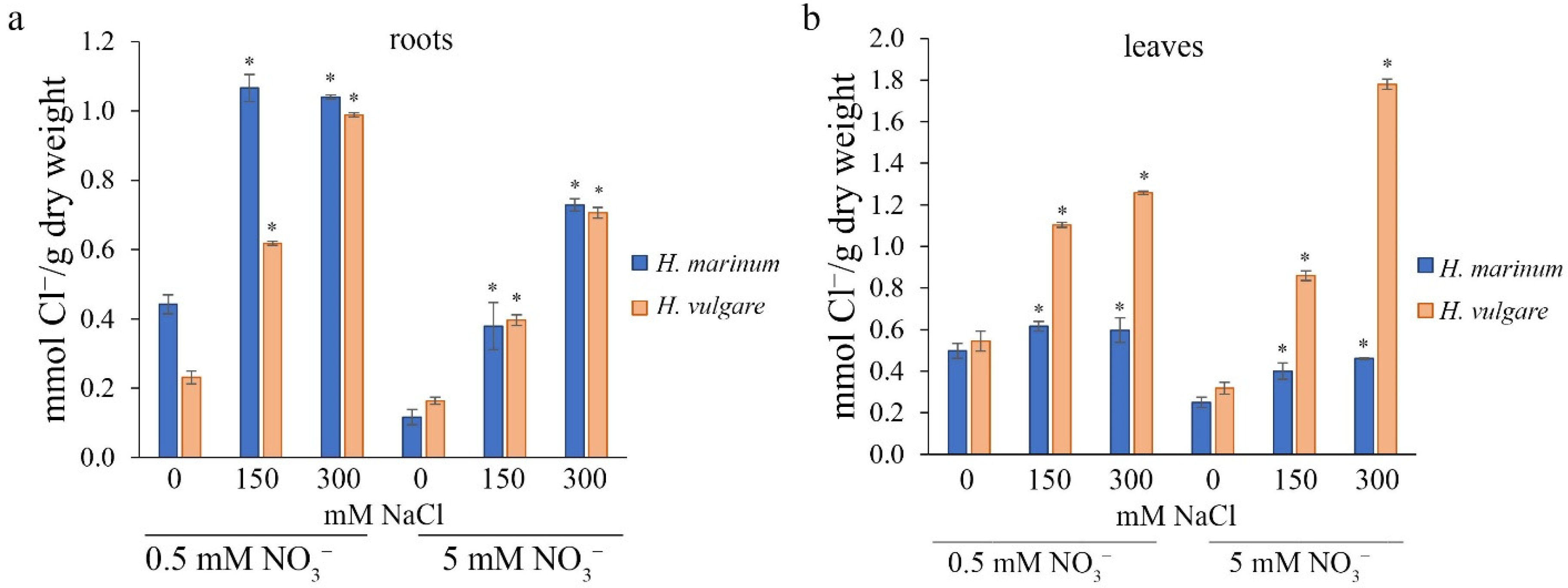
Figure 2.
The content of nitrate ions in the leaves (a, b) and roots (c, d) of 35-day-old H. marinum and H. vulgare plants grown at 0.5 (b, d) or 5 (a, c) mM nitrate in the presence of various concentrations of NaCl in the medium (0, 150, and 300 mM).
Figure 2.
The content of nitrate ions in the leaves (a, b) and roots (c, d) of 35-day-old H. marinum and H. vulgare plants grown at 0.5 (b, d) or 5 (a, c) mM nitrate in the presence of various concentrations of NaCl in the medium (0, 150, and 300 mM).
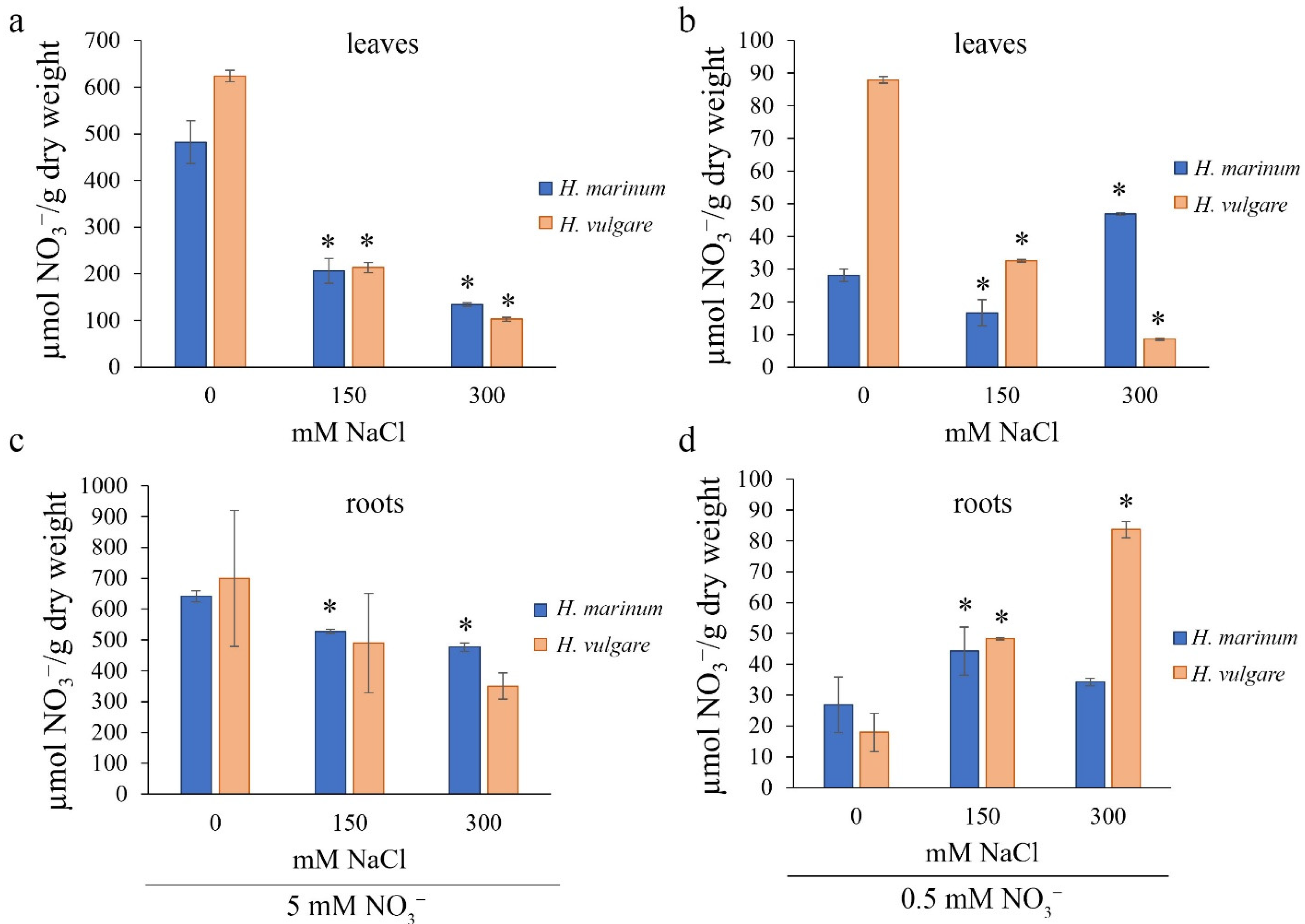
Figure 3.
The content of potassium ions (a, b) and sodium ions (c, d) in the leaves (a, c) and roots (b, d) of 35-day-old H. marinum and H. vulgare plants grown at 0.5 or 5 mM nitrate in the presence of various concentrations of NaCl in the medium (0, 150, and 300 mM).
Figure 3.
The content of potassium ions (a, b) and sodium ions (c, d) in the leaves (a, c) and roots (b, d) of 35-day-old H. marinum and H. vulgare plants grown at 0.5 or 5 mM nitrate in the presence of various concentrations of NaCl in the medium (0, 150, and 300 mM).
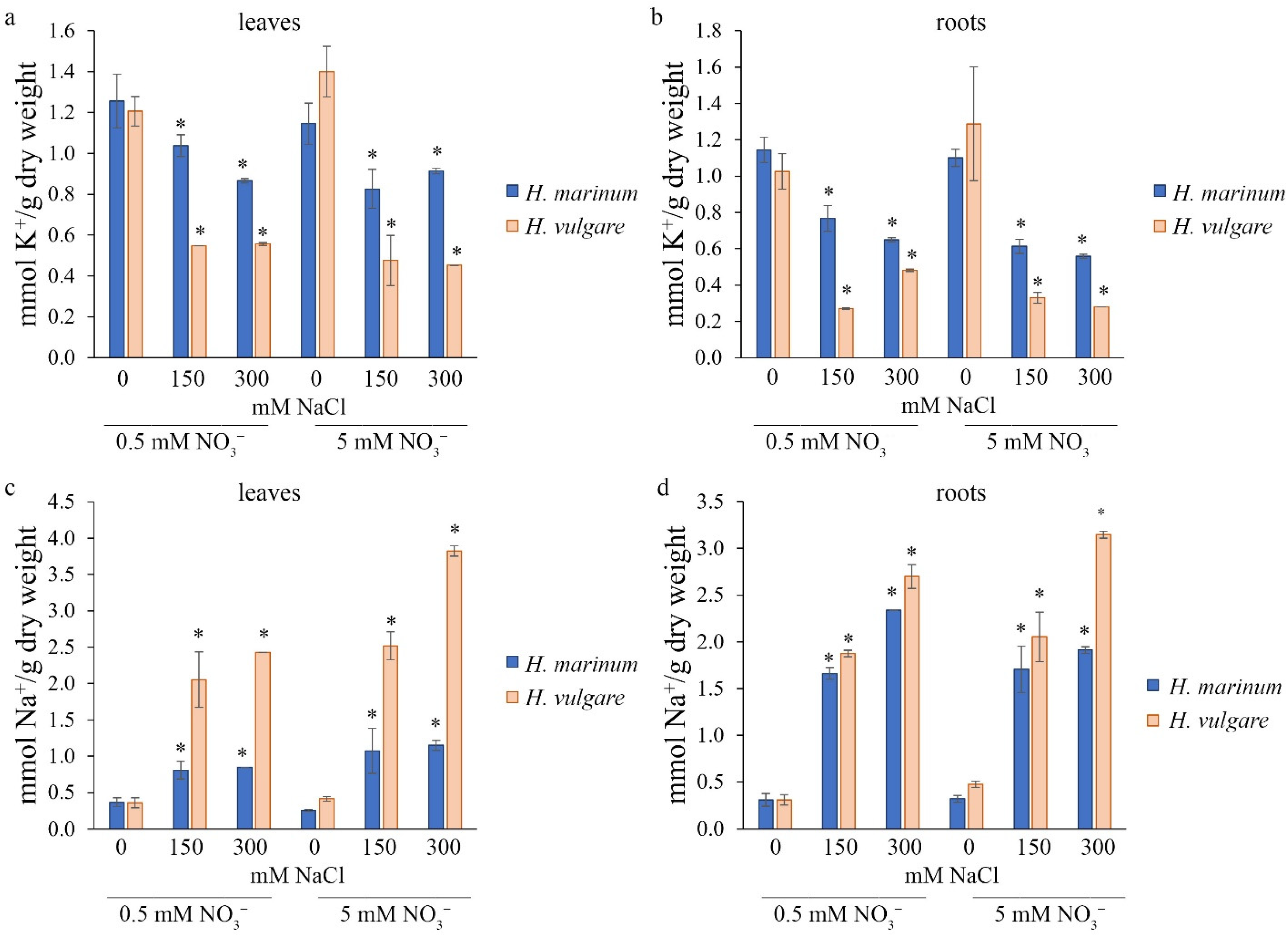
Figure 4.
Growth traits of 35-day-old H. marinum and H. vulgare plants, grown at 0.5 (a, c) or 5 (b, d) mM nitrate in the presence of various NaCl concentrations in the medium (0, 150, and 300 mM). On the ordinate axis, the values of leaf or root dry weight are presented, normalized to the corresponding weight under control conditions (0 mM NaCl), calculated per plant. For the measurements, 10-30 plants were used in 2-3 replicates for each condition.
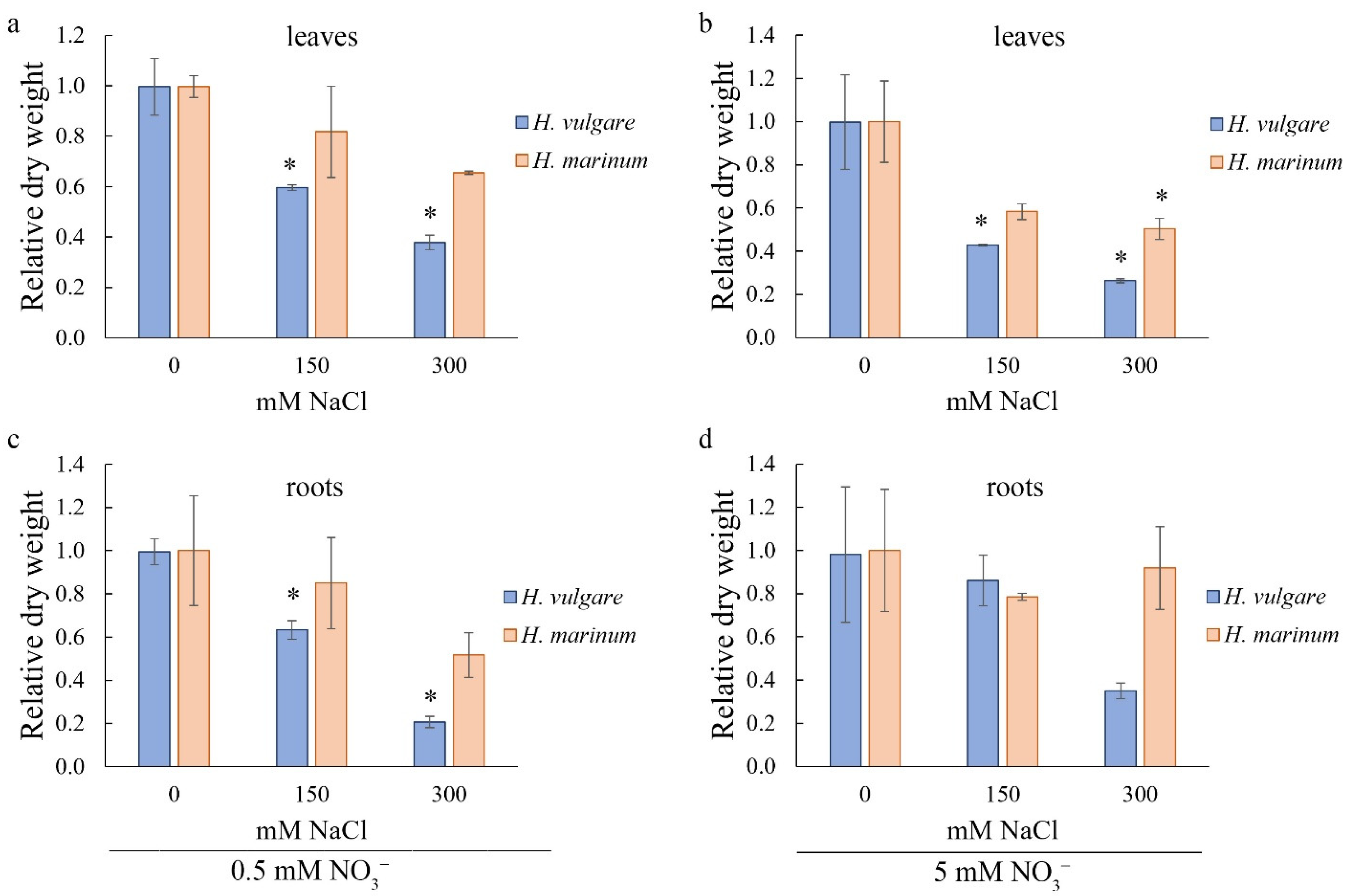
Figure 5.
Phylogenetic analysis of NAR2 family proteins from H. marinum, H. vulgare, and A. thaliana (a), as well as prediction of the transmembrane topology of the HmNAR2 protein (b). Additional information about the sequences is provided in the supplementary materials (Table S3).
Figure 5.
Phylogenetic analysis of NAR2 family proteins from H. marinum, H. vulgare, and A. thaliana (a), as well as prediction of the transmembrane topology of the HmNAR2 protein (b). Additional information about the sequences is provided in the supplementary materials (Table S3).
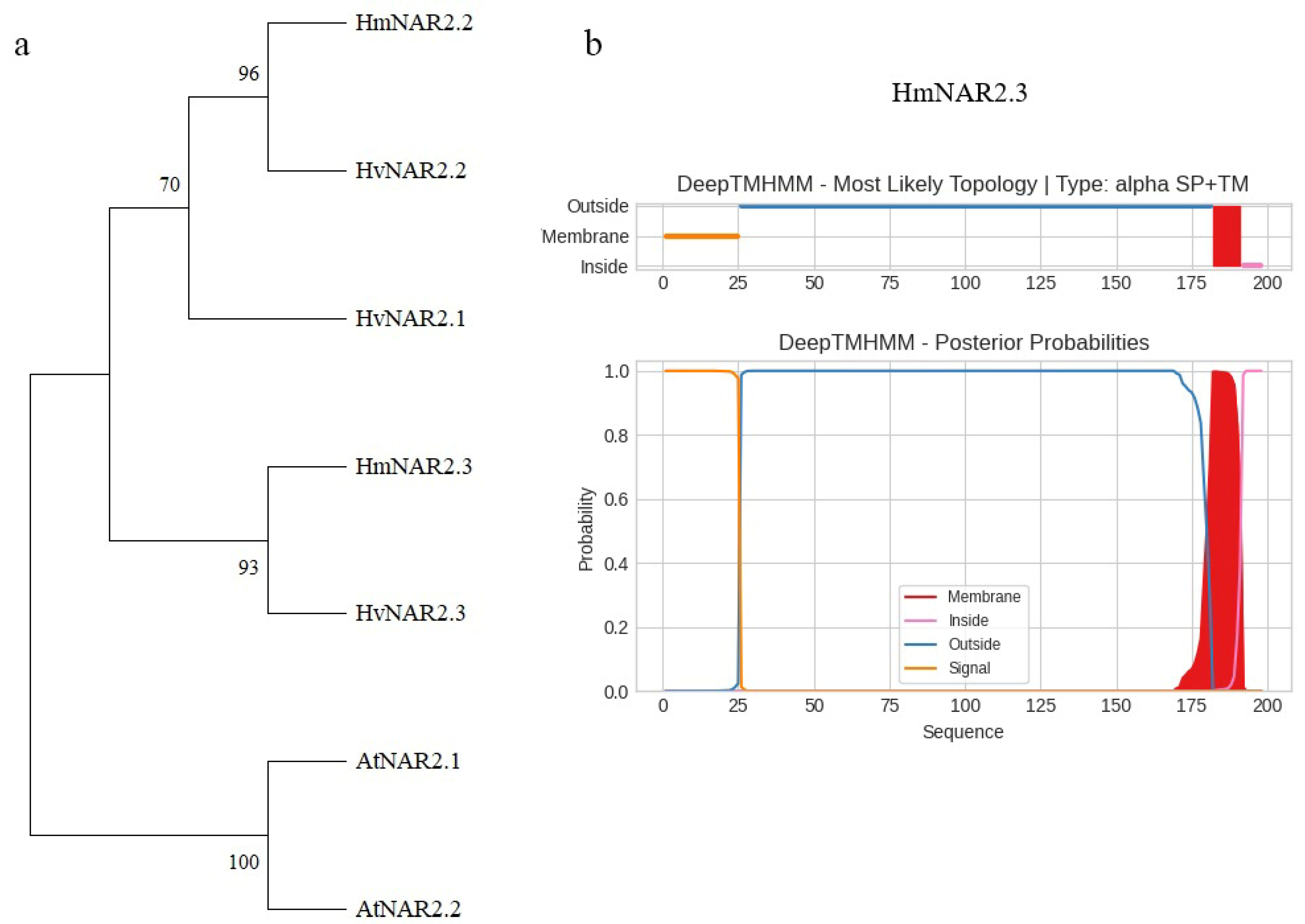
Figure 6.
Phylogenetic analysis of NRT2 family proteins from H. marinum, H. vulgare, and A. thaliana (a) and the entire NPF family of A. thaliana along with NPF6.3 orthologs from H. marinum and H. vulgare (b). Additional information on the sequences is provided in the supplementary materials (Table S3).
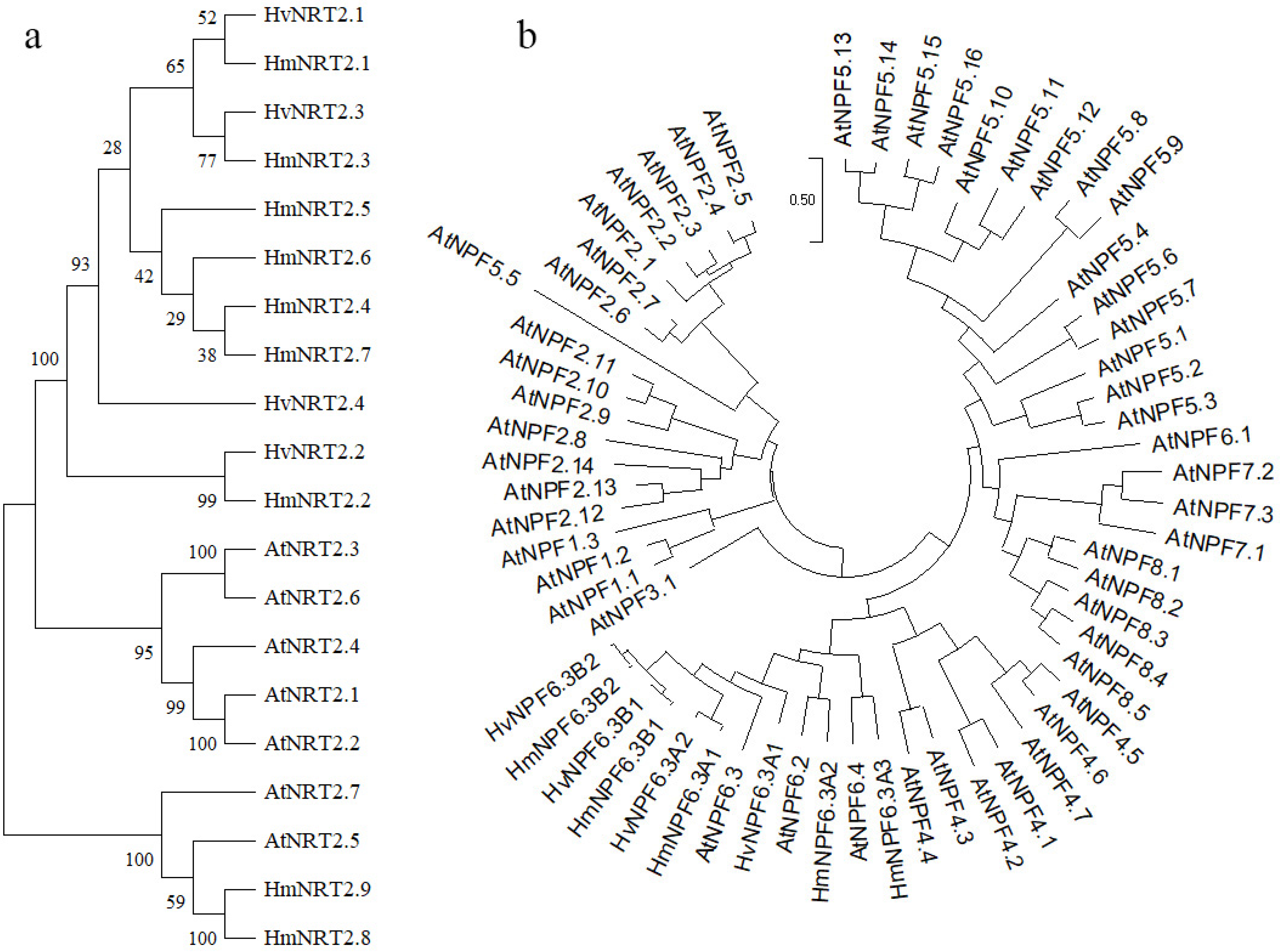
Figure 7.
Expression profiles of NRT2 family genes (a), NPF6.3 homologs (b), and NAR2 family genes (c, d) in the roots of H. marinum plants grown with 0.5 mM or 5 mM nitrate in the presence of various NaCl concentrations in the medium (0, 150, and 300 mM). The actin gene was used as a reference gene.
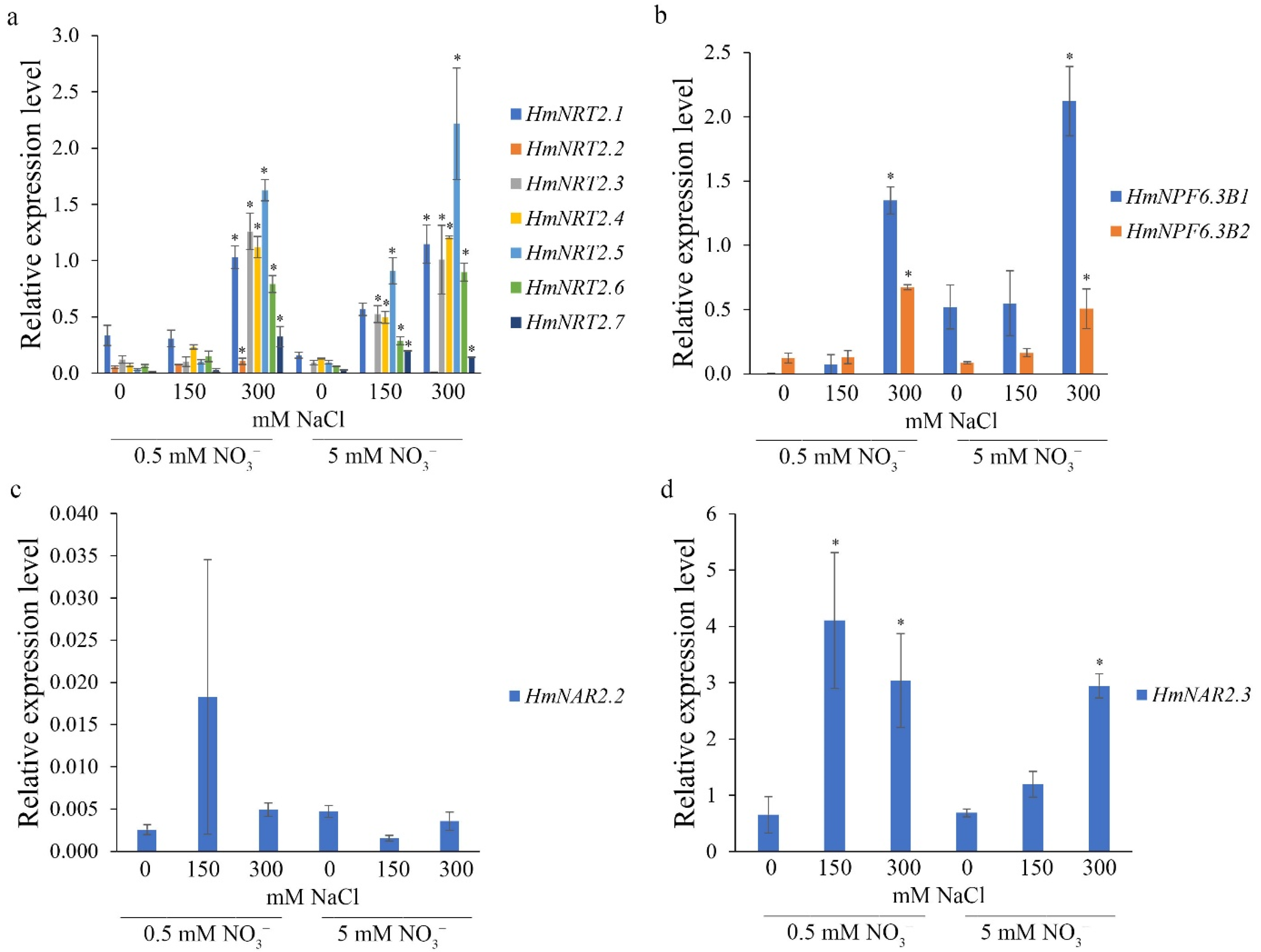
Figure 8.
Expression profiles of NRT2 family genes (a), NPF6.3 homologs (b), and NAR2 family genes (c, d) in the roots of H. vulgare plants grown with 0.5 or 5 mM nitrate in the presence of various NaCl concentrations in the medium (0, 150, and 300 mM). The actin gene was used as a reference gene.
Figure 8.
Expression profiles of NRT2 family genes (a), NPF6.3 homologs (b), and NAR2 family genes (c, d) in the roots of H. vulgare plants grown with 0.5 or 5 mM nitrate in the presence of various NaCl concentrations in the medium (0, 150, and 300 mM). The actin gene was used as a reference gene.
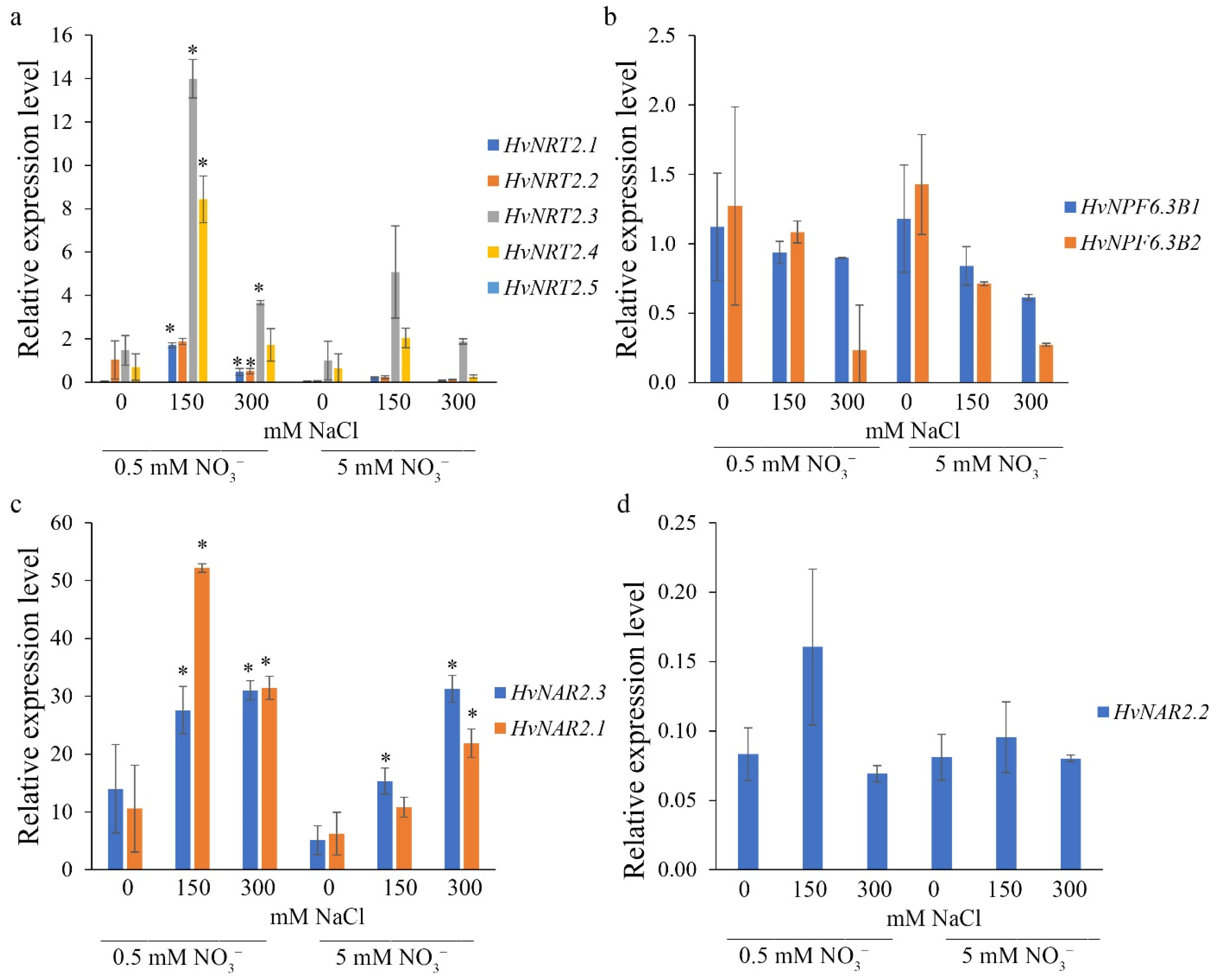
Figure 9.
Analysis of protein-protein interactions using the BiFC method. (a) – Epidermal cells of tobacco leaves, co-expressing the HmNAR2.3 protein fused with the C-terminal fragment (VC) of the fluorescent protein mVenus, and NRT2 family proteins fused with the N-terminal fragment (VN) of mVenus. (b) – Control variants including co-expression of HmNAR2.3-VC with the NPF family protein H. marinum fused with VN, or with free VN, as well as co-expression of free VC and VN.
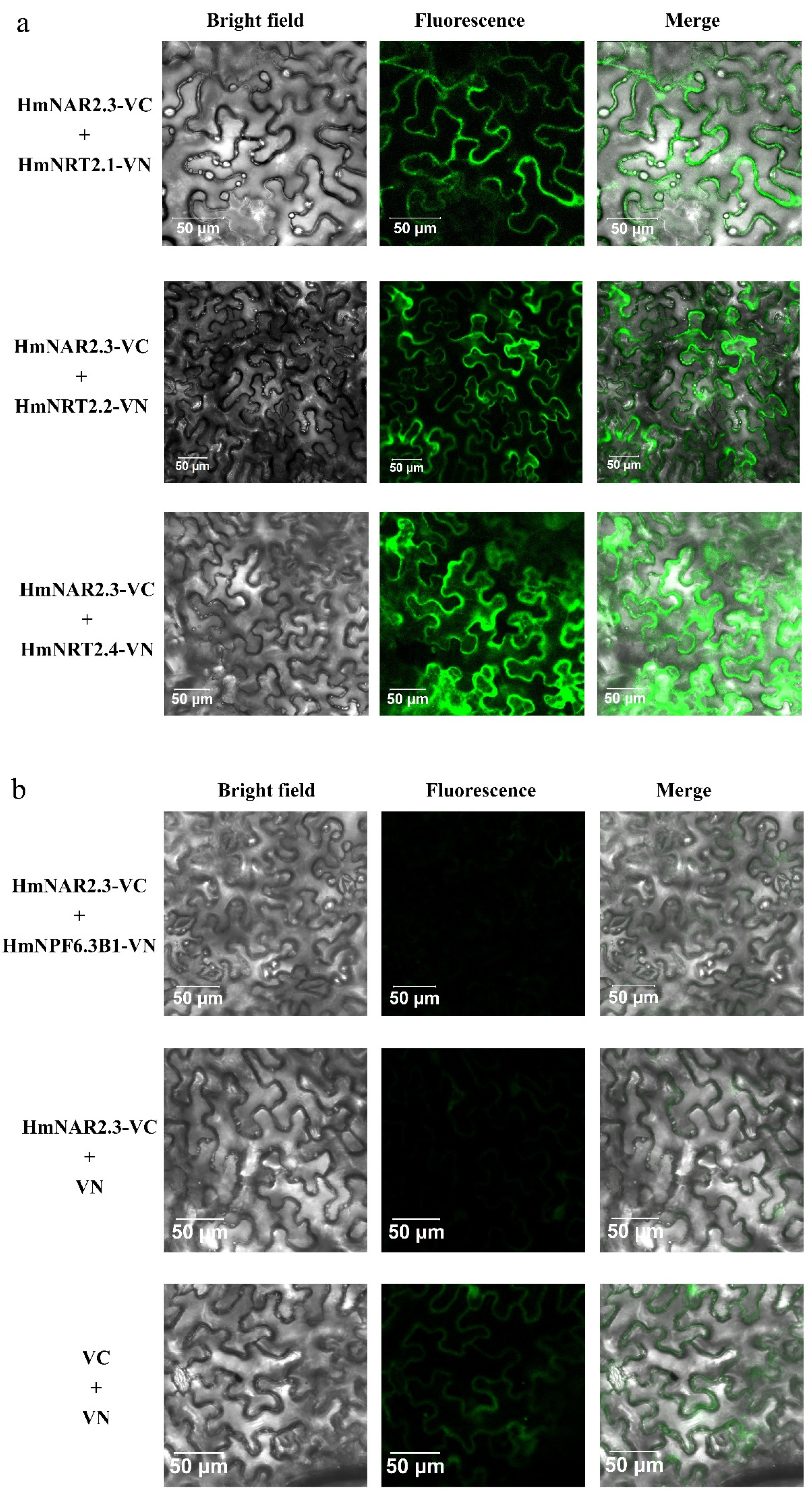
Figure 10.
Complementation assay of the nitrate-transporting activity of the HmNPF6.3B1 protein in Δynt1 knockout mutant cells of O. parapolymorpha yeast with a deletion in the gene of the endogenous nitrate transporter Ynt1.
Figure 10.
Complementation assay of the nitrate-transporting activity of the HmNPF6.3B1 protein in Δynt1 knockout mutant cells of O. parapolymorpha yeast with a deletion in the gene of the endogenous nitrate transporter Ynt1.
Disclaimer/Publisher’s Note: The statements, opinions and data contained in all publications are solely those of the individual author(s) and contributor(s) and not of MDPI and/or the editor(s). MDPI and/or the editor(s) disclaim responsibility for any injury to people or property resulting from any ideas, methods, instructions or products referred to in the content. |
© 2026 by the authors. Licensee MDPI, Basel, Switzerland. This article is an open access article distributed under the terms and conditions of the Creative Commons Attribution (CC BY) license (http://creativecommons.org/licenses/by/4.0/).
Copyright: This open access article is published under a Creative Commons CC BY 4.0 license, which permit the free download, distribution, and reuse, provided that the author and preprint are cited in any reuse.