

Submitted:
20 October 2026
Posted:
21 October 2026
You are already at the latest version
Abstract
Renewable energy sources are central to decarbonization, and social support for their expansion is linked to how citizens understand and evaluate the energy transition. This study examines attitudes towards Renewable Energy Sources (RES) among 408 Generation Z respondents in Italy, Lithuania, Morocco and Poland, providing the possibility to compare different energy contexts, while using a common questionnaire on the same attitudinal dimensions across samples. Country-specific OLS regressions with forward variable selection were used to analyse associations between attitudes towards RES and a set of cognitive, evaluative and behavioural measures. Climate-change importance is the only correlate appearing in all four final models, while the other selected correlates differ across countries. The results therefore point to a common climate-related association within otherwise country-specific patterns in Generation Z attitudes towards renewable energy. By applying a common questionnaire and the same modelling strategy to four Generation Z samples, the study provides a structured comparison of RES attitudes across contrasting national energy contexts. This design makes it possible to examine which associations recur across the four samples and which appear only in particular specifications.
Keywords:
renewable energy sources
; Generation Z
; energy transition
; OLS regression
; cross-country analysis
; energy security
1. Introduction
Energy policy is again at the centre of debates on decarbonisation, security of supply, competitiveness and resilience. Energy systems remain closely connected to greenhouse-gas emissions and to the capacity of economies to reduce their dependence on fossil fuels, while electricity demand is increasing in a context marked by electrification, digitalisation and new infrastructure needs. At the same time, energy-security concerns increasingly extend beyond fuel supply to the resilience of power systems and strategic supply chains. This does not weaken the case for decarbonisation, but it shows that the energy transition should advance while preserving affordability and reliable energy supply [1].
Energy transition debates also sit within the broader framework of sustainable development. The 2030 Agenda for Sustainable Development (SDG7 and SDG13), the Paris Agreement and the European Green Deal frame decarbonisation as a transformation with environmental, economic and social implications [2,3,4]. Energy makes this connection particularly concrete because its affordability, reliability and environmental consequences directly affect living conditions and economic activity.
The energy transition is not only a technological process. A transition that is technically effective but inaccessible, unaffordable or perceived as unfair may struggle to secure durable public support. For this reason, a people-centred transition must therefore consider access to energy, affordability, distributional effects, decent work and opportunities for participation [5]. This is why energy transitions are usually understood as socio-technical processes in which technologies, infrastructures, markets, institutions, policies and everyday practices evolve together, often at different speeds [6,7]. Renewable energy sources (RES) are a central component of this transformation. This study adopts the definition established under European Union law, according to which renewable energy is energy from renewable non-fossil sources, including wind, solar, geothermal, hydropower, biomass and biogas [8]. RES can reduce emissions when they replace fossil-fuel generation, diversify energy supply and contribute to energy security [1]. Their expansion also has technical, territorial and distributive implications. Public evaluation of RES therefore concerns both climate mitigation and the way the transition is planned, financed and governed [5,9].
This social dimension is essential because a technically possible transition does not automatically produce acceptance, adoption or supportive behaviour since public evaluations of renewable energy depend on perceptions of the technology and on the social and institutional conditions surrounding its implementation [9,10]. More recent evidence confirms that acceptance is multidimensional and that beliefs about technology, context and social process may matter more than purely sociodemographic characteristics [11]. In this sense, the human dimension of the transition concerns not only opposition to specific plants, but also the way people understand RES, evaluate their effects and connect them with climate, economic and everyday concerns. The intergenerational principle at the core of sustainable development is especially relevant in this context. Meeting present needs without compromising the ability of future generations to meet their own means that today’s energy choices will shape the conditions experienced by younger cohorts for decades [12]. Generation Z therefore occupies a distinctive position in the transition and its members are increasingly active as consumers and citizens while also being among those who will experience the long-term consequences of current investment and policy choices.
The empirical part of the paper uses primary survey data collected by project partners in Italy, Lithuania, Morocco and Poland. The analysis is based on 408 Generation Z respondents and uses OLS to examine variables associated with attitudes towards RES. The study treats knowledge, impact evaluation, personal environmental action and climate-change importance as theoretically relevant candidate dimensions. This is important because the literature suggests that RES acceptance is multidimensional and context-sensitive, while the four samples are situated in different energy systems.
Two research questions were formulated in the article, along with one hypothesis:
RQ1: Which factors are independently associated with Generation Z's attitudes towards renewable energy sources within each country?
RQ2: Which associations are common across Italy, Lithuania, Morocco and Poland, and which are country-specific?
and:
H1: The importance attributed to climate change is positively associated with attitudes towards renewable energy sources among Generation Z across the four countries.
The comparison among Italy, Lithuania, Morocco and Poland originates from the structure of the international project and the availability of partner organisations for data collection, but the resulting country set also provides a useful comparison. The four energy systems differ markedly in the way renewable deployment is embedded in their broader energy structures. Poland remains strongly coal-intensive despite rapid renewable expansion, while Italy combines a substantial renewable contribution to electricity generation with continued reliance on natural gas. Lithuania records a very high renewable share in domestic electricity generation while remaining dependent on imported fossil energy in its overall supply. Morocco, in turn, has expanded renewable generation within an energy system that continues to rely heavily on fossil-fuel imports [13,14]. For the three EU countries, these national trajectories unfold within the broader framework of the internal electricity market, although national energy structures, infrastructure and regulatory conditions remain differentiated [15,16]. Morocco also provides a non-EU comparison shaped by a different policy and market setting. These contrasts make it possible to examine the same attitudinal dimensions across energy contexts that differ both in their transition pathways and in their institutional setting.
The literature reviewed below provides the theoretical basis for these candidate dimensions, while the cross-country design leaves open which associations will emerge within each national sample. With this background, the paper is structured as follows. Section 2 reviews the national energy contexts, the literature on Generation Z and RES acceptance and the dimensions associated with attitudes towards RES. Section 3 presents the survey, sample, variables and OLS modelling strategy. Section 4 reports the country-specific OLS results. Section 5 discusses the findings in relation to the national energy contexts and their implications, while Section 6 presents the conclusions, study limitations and directions for future research.
2. Literature Review
2.1. National Energy Contexts
The diffusion of RES has followed different trajectories across the four countries considered in this study. At the global level, installed renewable power capacity increased from approximately 2.02 TW in 2016 to 5.15 TW in 2025, while capacity in the European Union rose from about 387 GW to 779 GW [17]. In 2025, installed renewable capacity reached approximately 78.3 GW in Italy, 6.1 GW in Lithuania, 4.9 GW in Morocco and 38.2 GW in Poland, with particularly strong proportional growth in Lithuania and Poland [17]. As shown in Figure 1, in 2023, renewables accounted for 81.60% of electricity generation in Lithuania, 44.30% in Italy, 27.60% in Poland and 20.70% in Morocco. Since 2010, the increase in this indicator has been especially marked in Lithuania, followed by Poland, Italy and Morocco [18].
Figure 2 reports the source-specific electricity generation data clarifying the differences among the four cases. In 2024, Italy had a mixed electricity system in which natural gas accounted for 43.70% of recorded electricity generation, renewables accounted for 51.00% and coal accounted for 1.80%. Lithuania’s 2024 electricity generation table reported no coal category and showed renewables accounting for 86.70% of domestic generation, with natural gas at 10.40%. Morocco’s most recent available data refer to 2023 and describe a coal-centred electricity mix, with coal at 62.10%, natural gas at 9.70% and renewables at 21.00%. Poland remained coal-intensive in 2024, with coal at 55.90%, natural gas at 12.40% and renewables at 30.30% [13].
The comparison becomes more complex when total energy supply and final energy consumption are considered. In 2024, fossil fuels still accounted for 67.90% of Lithuania’s total energy supply, despite the high renewable share in domestic electricity generation. The same calculation gives fossil-fuel shares of 77.20% in Italy, 89.40% in Morocco and 83.20% in Poland for the latest available year [14]. The IEA SDG 7.2 indicator also shows a different picture, as in 2022, modern renewables accounted for 35.80% of final energy consumption in Lithuania, 16.35% in Poland, 16.32% in Italy and 8.16% in Morocco [18].
These differences provide the current context for the renewable-energy targets set by the four countries. Italy’s updated National Energy and Climate Plan sets a 2030 target of 39.40% renewables in gross final energy consumption and approximately 63.40% in gross final electricity consumption [19]. Lithuania’s updated targets are 55.00% of gross final energy consumption and 100.00% of gross electricity consumption by 2030 [20]. Morocco’s 52.00% target concerns the share of renewables in installed electricity capacity, not electricity generation or final energy consumption [21]. Poland’s 2026 plan indicates a 30.00-32.00% renewable share of gross final energy consumption and a 51.60-53.20% renewable share in the electricity generation by 2030 under its WEM and WAM scenarios [22].
2.2. Generation Z, Social Acceptance and Renewable Energy
Social acceptance has been conceptualised as a multidimensional construct that includes socio-political acceptance, community acceptance and market acceptance [23]. It has also been shown that acceptance depends on place, institutional credibility, distributive fairness and beliefs about the technology and its context [10,11,24]. Public support for energy sources may also change when climate mitigation is weighed against energy security and affordability [25].
This perspective is particularly relevant when studying Generation Z, as the literature challenges the idea of considering this cohort as a homogeneous sustainable-oriented generation. Existing evidence suggests that the relationship between Generation Z and sustainability is heterogeneous, with cross-cultural research showing that pro-environmental beliefs and behaviours can differ across national groups [26,27]. This variation is echoed in comparative evidence from Poland and Germany, where attitudes and pro-environmental behaviour among Generation Z differ across contexts [28]. Italian evidence also points to a distinction between environmental orientation and factual knowledge. One study documents misperceptions of the national energy mix among younger respondents [29], while another identifies environmental concern and awareness alongside gaps in objective marine-environment knowledge among Italian Generation Z [30].
Research connecting younger generations and renewable energy addresses several related questions. A critical review of youth in energy-transition scholarship identifies energy literacy, perceptions of energy technologies, energy-conservation behaviour and climate advocacy as recurring strands of research [31]. Empirical studies have examined knowledge, perceptions and attitudes towards renewable energy among adolescents and students [32,33,34], while cross-national research has compared young people’s knowledge and evaluations of specific renewable technologies across different countries [35]. Research on student populations has similarly approached energy literacy as a combination of cognitive, attitudinal and behavioural dimensions [36,37]. Other work has considered how information and knowledge relate to acceptance, attitudes towards renewable electricity and willingness to pay for green energy among Generation Z, and broader pro-environmental consumption and energy behaviour [26,28,39]. More recent studies further extend this perspective to the institutional and behavioural dimensions of the transition, including trust and procedural fairness in youth acceptance of energy-transition policies [40] and the factors shaping Generation Z’s residential energy behaviour [41]. Together, this literature shows that young people’s relationship with the energy transition involves cognitive, attitudinal, behavioural and institutional dimensions whose relevance may vary across settings. The present study builds on these strands by applying a common questionnaire and analytical strategy to Generation Z samples in four different national energy settings. This provides a consistent basis for examining which correlates of RES attitudes recur across the four samples and which appear only in particular country-specific specifications.
2.3. Dimensions Related to Attitudes Towards RES
The empirical analysis focuses on several dimensions theoretically connected to attitudes towards RES. Knowledge plays a role in energy-technology acceptance because people evaluate technologies partly through what they know, understand and consider credible [9,10,42]. We distinguish for knowledge of what RES are from knowledge of how RES work, allowing the analysis to separate general familiarity with renewable energy from an understanding of its functioning. Knowledge may support more favourable evaluations, yet favourable attitudes may equally encourage information seeking and confidence, and research on environmental learning shows that environmental attitudes can support the acquisition of new knowledge, pointing to a possible two-way relationship between knowledge and attitudes [10,43]. Evidence on consumer awareness of RES further confirms that knowledge and awareness are relevant dimensions in the relationship between individuals and renewable energy [44]. A second dimension is about the importance attributed to climate change. RES are frequently framed as part of climate-mitigation strategies, so respondents who attach greater importance to climate change may also evaluate RES more favourably. From this perspective, climate importance captures the salience of the issue for respondents, linking it to several psychological and contextual evaluations [10,11]. Recent evidence also connects climate-change perceptions and environmental self-identity with willingness to support environmentally friendly energy sources, reinforcing the relevance of distinguishing climate salience from more general environmental attitudes [45]. Cross-European evidence further shows that climate concern and perceived personal responsibility are associated with energy-related behavioural orientations, while some of these relationships vary across regional contexts [46]. The third dimension interests impacts, since RES may be evaluated through their expected environmental, climate and economic effects. Environmental and climate benefits may include lower greenhouse-gas emissions, reduced pollution, lower fossil-fuel dependence or broader ecological gains, while economic effects may include employment, local development, competitiveness, energy independence or concerns about affordability and public support. These dimensions matter because climate-policy support is shaped by perceived costs, fairness, trust, revenue use and participation [47], and because household energy use and expenditure vary considerably across countries while remaining connected to living standards [48]. These perceptions are also relevant to everyday consumption, where environmental preferences are translated into choices made under practical and economic constraints. This is particularly relevant for Generation Z as consumers, since a pro-environmental orientation does not necessarily translate into consistent behaviour in daily life [27,49]. A fourth dimension deals with personal action to reduce carbon footprint. Environmental psychology has long shown that knowledge, concern and attitudes do not automatically translate into behaviour. The gap between attitudes and action may depend on habits, costs, perceived control, social norms and situational constraints [49,50].
3. Materials and Methods
This study draws on primary survey data collected between November 2025 and February 2026 in Italy, Lithuania, Morocco and Poland, gathered as part of an international project through partner organisations in each country. The survey combined online forms and paper-based questionnaires and targeted Generation Z respondents, which number accounted for 408 complete observations: 178 from Italy, 36 from Lithuania, 109 from Morocco and 85 from Poland. Participation was voluntary and the survey responses were collected and analysed in anonymised form.
The full questionnaire assessed attitudes towards RES, environmental awareness, climate-related threats, environmental behaviour, knowledge of renewable energy sources and willingness to support or finance renewable energy. It included yes/no questions, multiple-response items and 0–7 rating scales. Multiple-response items were coded as binary indicators, equal to 1 when the option was selected and 0 otherwise. Scale items were treated as numeric variables ranging from 0 to 7, with higher values indicating a greater degree of the construct described by the item. Table 1 reports descriptive statistics on the respondents constituting the analysis sample.
As shown in Table 2, variables included were attitude towards renewable energy sources (RESAT), RES knowledge (RESIS and RESAR), environmental and economic impacts (RESEN and RESEC), personal action to reduce carbon footprint (RESCF) and importance of climate change (RESCC). These variables were selected to cover cognitive, evaluative, behavioural and climate-salience dimensions of attitudes towards renewable energy sources. RESIS and RESAR distinguish knowledge of what RES are from knowledge of how they work, RESEN measures the environmental and climate impact of RES, while RESEC measures the economic impact of RES, RESCF captures behavioural orientation towards carbon-footprint reduction and, finally, RESCC is about the salience attributed to climate change. The correlation matrices for the candidate variables are reported in Appendix A.
Using these variables, country-specific OLS regressions were estimated with RESAT as the dependent variable. Model selection used a forward stepwise procedure with post-entry removal. Each procedure started from the intercept-only model. At each step, candidate predictors not yet included in the model were evaluated through partial F-tests and the predictor with the lowest eligible p-value was added when p < 0.05. After each entry, the model was re-checked and any retained predictor with p ≥ 0.05 was removed, starting from the least significant one. The procedure stopped when no additional predictor met the entry rule and all retained predictors met the retention rule. The intercept was always included and the strict selection rule concerned the slopes of the explanatory variables. The final specification was selected to preserve parsimony, retain statistically significant covariates and maintain acceptable diagnostic results (Table 3). The general OLS specification is shown in Equation (1):
Yi = β0 + β1X1i + β2X2i + … + βkXki + εi
in Equation (1), the index i identifies the respondent and k the number of explanatory variables. Yᵢ is the attitude score, Xⱼᵢ is the value of variable j for respondent i, β₀ is the intercept, βⱼ is the coefficient of variable j and εᵢ is the error term. Each coefficient indicates the change in the mean value of attitude associated with a one-point increase in the corresponding variable, holding the other variables in the model constant. Four models were estimated separately, one for each national sample, with RESAT as the response variable.
Model diagnostics were used to assess whether the OLS models provided an adequate exploratory specification. The F-test evaluates whether the model, taken as a whole, explains more variation than an intercept-only model. Adjusted R² reports the share of variance explained, after accounting for the number of predictors. The Shapiro-Wilk test was used to inspect residual normality, which is relevant for small-sample inference. The Breusch-Pagan test was used to assess heteroskedasticity, because non-constant error variance can affect the reliability of conventional standard errors. The Ramsey Regression Equation Specification Error Test (RESET) was used as a functional-form check, assessing whether omitted nonlinear patterns may remain in the fitted values. Maximum VIF inspected multicollinearity among taken predictors and values below 5 were treated as acceptable. These diagnostics were interpreted jointly with coefficient significance and substantive plausibility.
Table 4 reports descriptive statistics for the variables used in the regression analysis where a generally favourable attitude towards RES is shown, with mean RESAT = 5.14. Among the candidate predictors, RESCC records the highest mean value (5.24), followed by RESEN (5.06) and RESEC (4.93). The two knowledge variables are lower, especially RESAR (3.89), suggesting that respondents report greater familiarity with what RES are than with how they work. RESCF is intermediate (mean = 4.21) and has the largest dispersion among the predictors (SD = 1.61). All variables cover the full 0–7 range, indicating substantial heterogeneity within the sample analysed.
4. Results
4.1. Country-Specific Econometric Models
Table 5 reports the country-specific OLS models estimated with RESAT as the dependent variable. All four models are statistically significant according to the F-test, indicating that the retained predictors jointly explain a significant share of variation in attitudes towards renewable energy sources within each country sample. Model fit varies across countries: R² ranges from 0.29 in Morocco to 0.46 in Lithuania, while adjusted R² ranges from 0.27 to 0.42.
Model for Italy:
Y = 2.658 + 0.257RESIS + 0.308RESCC
(0.335) (0.057) (0.055)
In Italy, the final OLS model includes RESIS and RESCC. Both coefficients are positive and statistically significant. A one-point increase in RESIS is associated with a 0.26-point increase in RESAT, holding RESCC constant. A one-point increase in RESCC is associated with a 0.31-point increase in RESAT, holding RESIS constant. The standardized coefficients indicate that RESCC (β = 0.38) has a slightly stronger association with RESAT than RESIS (β = 0.30). The model explains 32.00% of the variance in RESAT, with an adjusted R² of 0.31.
Model for Lithuania:
Y = 2.454 + 0.431RESIS + 0.314RESCC
(0.634) (0.124) (0.097)
In Lithuania, the final model also retains RESIS and RESCC. A one-point increase in RESIS is associated with a 0.43-point increase in RESAT, holding RESCC constant. A one-point increase in RESCC is associated with a 0.31-point increase in RESAT, holding RESIS constant. The standardized coefficients are high for both predictors, with β = 0.46 for RESIS and β = 0.42 for RESCC. This suggests that, within the Lithuanian sample, both knowledge of what renewable energy sources are and the importance attached to climate change are strongly associated with attitudes towards RES. The model has the highest explanatory power among the four country-specific models, with R² = 0.46 and adjusted R² = 0.42.
Model for Morocco:
Y = 1.708 + 0.2RESAR + 0.235RESCF + 0.233RESCC
(0.529) (0.087) (0.089) (0.087)
In Morocco, the final model retains RESAR, RESCF and RESCC. A one-point increase in RESAR is associated with a 0.20-point increase in RESAT, holding RESCF and RESCC constant. A one-point increase in RESCF is associated with a 0.24-point increase in RESAT, holding RESAR and RESCC constant. A one-point increase in RESCC is associated with a 0.23-point increase in RESAT, holding RESAR and RESCF constant. The standardized coefficients are similar in size, with β = 0.21 for RESAR, β = 0.26 for RESCF and β = 0.24 for RESCC. This indicates that the Moroccan model is not dominated by a single predictor, but combines knowledge of how RES work, personal action to reduce carbon footprint and climate-change importance. The model explains 29.00% of the variance in RESAT, with an adjusted R² of 0.27.
Model for Poland:
Y = 1.319 + 0.213RESIS + 0.354RESEN + 0.203RESCC
(0.393) (0.084) (0.102) (0.083)
In Poland, the final model retains RESIS, RESEN and RESCC. A one-point increase in RESIS is associated with a 0.21-point increase in RESAT, holding RESEN and RESCC constant. A one-point increase in RESEN is associated with a 0.35-point increase in RESAT, holding RESIS and RESCC constant. A one-point increase in RESCC is associated with a 0.20-point increase in RESAT, holding RESIS and RESEN constant. RESEN has the largest standardized coefficient in the Polish model (β = 0.38), followed by RESCC (β = 0.25) and RESIS (β = 0.23). Thus, Poland is the only country in which the environmental and climate impact of RES remains an independent predictor of RESAT after controlling for knowledge and climate-change importance. The model explains 43.00% of the variance in RESAT, with an adjusted R² of 0.41.
Across the four models, RESCC is the only predictor that appears in every final specification. This makes climate-change importance the most stable OLS correlate of attitudes towards RES. Knowledge also matters, but it enters the models differently. In particular, RESIS is retained in Italy, Lithuania and Poland, while RESAR is retained only in Morocco. RESCF is retained only in Morocco, whereas RESEN is retained only in Poland. RESEC is not retained in any final model, meaning that the economic impact of RES does not add independent explanatory power once the selected predictors are included. This should be interpreted as a result of the OLS model selection procedure, not as evidence that economic considerations are irrelevant.
The diagnostic tests support the adequacy of the selected exploratory specifications. Shapiro-Wilk tests are non-significant in all four models, suggesting no major departure from residual normality. Breusch-Pagan tests are also non-significant, although the Lithuanian model is closest to the conventional threshold (p = 0.07). Ramsey RESET tests are non-significant, suggesting no major functional-form misspecification. Maximum VIF values remain low, ranging from 1.04 to 1.68, indicating no relevant multicollinearity among retained predictors.
4.2. Results in Relation to the Research Questions and Hypothesis
The results provide answers to both research questions formulated in the study. Regarding RQ1, the country-specific OLS models show that different combinations of factors are independently associated with Generation Z’s attitudes towards renewable energy sources. In Italy, attitudes towards RES are significantly associated with knowledge of what renewable energy sources are (RESIS) and the importance attributed to climate change (RESCC). In Lithuania, the same two variables are retained in the final model. In Morocco, attitudes towards RES are associated with knowledge of how renewable energy sources work (RESAR), personal action to reduce carbon footprint (RESCF) and the importance attributed to climate change (RESCC). In Poland, attitudes towards RES are associated with knowledge of what renewable energy sources are (RESIS), environmental and climate impact of RES (RESEN) and the importance attributed to climate change (RESCC). Thus, the results indicate that the determinants of attitudes towards RES are not identical across the four national samples.
Regarding RQ2, the comparison of the final country-specific models shows that the importance attributed to climate change (RESCC) is the only association that is consistently present in all four countries. The knowledge dimension is also relevant across the study, but its specific form differs across countries. In particular, knowledge of what RES are (RESIS) is retained in Italy, Lithuania and Poland, whereas knowledge of how RES work (RESAR) is maintained in Morocco. Personal action to reduce carbon footprint is kept just in the Moroccan model, while environmental and climate impact of RES is retained only in the Polish model. The economic impact of RES (RESEC) is not present in any of the final models. These findings indicate that the common element across the four national contexts is the association between climate-change importance and attitudes towards RES, whereas the remaining associations are more context-specific.
The results also provide support for H1, which stated that the importance attributed to climate change is positively associated with attitudes towards renewable energy sources among Generation Z across the four countries. RESCC has a positive and statistically significant coefficient in all four country-specific models: Italy (B = 0.308, p < 0.01), Lithuania (B = 0.314, p < 0.01), Morocco (B = 0.233, p < 0.01) and Poland (B = 0.203, p < 0.05). Therefore, the hypothesis is supported within the four country-specific samples. The consistency of the positive association across the four models identifies the importance attributed to climate change as the most stable correlate of attitudes towards renewable energy sources in the analysed Generation Z samples.
5. Discussion
Across the selected country-specific specifications, climate-change importance is the only correlate that appears in all four samples. Its recurrence across Italy, Lithuania, Morocco and Poland is notable given the differences in their energy systems and policy trajectories. The relevance of this result lies precisely in the diversity of the four cases. Italy, Lithuania, Morocco and Poland differ in electricity mix, fossil-fuel dependence, renewable deployment and policy trajectory. The recurrence of RESCC is consistent with climate-change importance remaining associated with RES attitudes across samples drawn from contrasting energy systems.
This finding provides support for H1, which proposed that the importance attributed to climate change is positively associated with attitudes towards renewable energy sources among Generation Z across the four countries. The positive and statistically significant association between RESCC and RESAT in Italy, Lithuania, Morocco and Poland indicates that the relevance attributed to climate change is a consistent correlate of favourable attitudes towards RES across the four national samples but this cross-sectional design does not allow this association to be interpreted causally: the results indicate that climate-change salience represents a common dimension accompanying attitudes towards RES despite differences in national energy contexts.
The present models do not test whether national energy-system characteristics themselves explain individual attitudes. This interpretation is consistent with research showing that energy-technology acceptance is shaped by environmental consequences, benefits, risks, trust and social context [9,10,11]. It also fits evidence that public support for energy sources may shift when climate mitigation is weighed against energy-security concerns [25]. The results should therefore not be read as evidence that climate concern alone explains RES attitudes. The results therefore identify climate-change importance as a recurring correlate, while the additional variables selected by the procedure differ across the four samples. Knowledge forms the second relevant layer, although its role differs across countries. Knowledge of what RES are is upheld in Italy, Lithuania and Poland, while knowledge of how RES work is retained in Morocco. This distinction has conceptual value, since environmental knowledge can concern system functioning, possible actions and the effectiveness of alternative actions [51]. At the same time, the two knowledge ratings are closely related. The finding does not demonstrate that only one form of knowledge matters in each country, suggesting that knowledge of what RES are and knowledge of how RES work belong to the same broader cognitive area, but may become salient in different ways depending on the national context. This point is important for policy. Education and communication should not be reduced to generic information campaigns. Acceptance research repeatedly shows that knowledge interacts with perceptions of cost, fairness, trust, local effects and institutional credibility [10,11,24]. Recent evidence also suggests that knowledge about renewables can support general approval while increasing attention to concrete trade-offs, especially when implementation details, costs or local effects become visible [52].
The Italian case can be read through this connection between knowledge and climate salience. Italy combines a significant renewable presence in electricity generation with continuing dependence on natural gas and fossil fuels in total energy supply. In such a setting, RES are not a distant or merely theoretical policy objective, but they are part of an ongoing transition that is visible, institutionally promoted and still incomplete. In the Italian model, favourable attitudes towards RES are associated with both knowledge of what RES are and the importance attributed to climate change. This is compatible with Italian evidence showing that awareness, knowledge, perception and attitudes matter in energy-transition behaviour, while household choices may still be shaped by price, location and other conventional criteria before sustainability and energy efficiency [53]. The policy implication is that education should connect RES knowledge with the material trade-offs of the Italian transition.
Lithuania offers a different interpretation. Its domestic electricity generation has a strong renewable component, but total energy supply and energy security remain linked to imports, infrastructure and system flexibility. The Lithuanian model takes knowledge of what RES are and climate-change importance. This result is particularly relevant in a country where domestic electricity generation has a strong renewable component, while the broader energy system remains linked to imports, infrastructure and system flexibility. Recent work on Lithuanian regional energy transformation stresses the importance of municipal capacity, local competences and infrastructure conditions [54].
One possible contextual reading is that this pattern emerges in a policy setting where renewable expansion has been linked to national development and large-scale renewable projects [21,55]. As seen above, Morocco’s electricity mix remains strongly linked to coal, while renewable strategy is framed through capacity expansion and flagship projects. In this context, technological intelligibility may matter because RES are not evaluated only as an environmental preference, but also as part of a development pathway. The role of reported personal action can be interpreted as a link between everyday environmental orientation and support for system-level change, in line with broader models of pro-environmental behaviour [50,56]. This does not imply that individual actions cause support for RES, but it suggests that attitudes towards RES may be embedded in a wider orientation toward environmental responsibility and modernization. In addition, previous research on the Ouarzazate solar complex found high local acceptance together with limited perceived project knowledge and noted that social desirability and unmet expectations about employment could affect responses over time [55]. This is not directly comparable with the present youth sample, but it helps frame the results without overstating acceptance. In particular, strong support for RES within a policy environment centered on large renewable projects should not be read as unconditional consent, as it may instead depend on whether projects are perceived as understandable, beneficial, fair and connected to local opportunities.
In the Polish sample, RESEN also enters the final specification. Because higher RESEN scores indicate a more positive evaluation of the environmental and climate impact of RES, its positive association with RESAT shows that respondents who evaluate these effects more positively also tend to express more favourable attitudes towards renewable energy. Poland remains the most coal-dependent country in the comparison and the energy transition is closely tied to household affordability, industrial restructuring, regional employment and security of supply. In such a setting, young respondents may evaluate RES against a fossil baseline that is politically and socially visible. Poland's coal-intensive energy system provides a relevant context for this association, although the model does not establish that the national energy structure itself explains respondents' evaluations. Research on Poland's coal transition identifies employment, energy-security concerns and institutional interests as important elements of the national transition [57], while studies on photovoltaic development and decarbonisation point to the relevance of economic conditions, regional differences, funding and local communication [58,59,60].
Taken together, the selected models identify one recurring correlate (climate-change importance) and different combinations of additional variables across the four samples. Knowledge appears in each final specification, although the selected knowledge item differs in Morocco, while personal action appears only in the Moroccan model and environmental and climate impact only in the Polish model. The results therefore provide a basis for further comparative research using designs that allow such differences to be tested directly. Overall, the findings provide support for H1 and answer the two research questions by showing that climate-change importance is the only common correlate of RES attitudes across the four countries, whereas the remaining associations form country-specific configurations.
6. Conclusions
This study provides an initial comparative assessment of Generation Z attitudes towards renewable energy sources in Italy, Lithuania, Morocco and Poland. Using the same questionnaire and analytical strategy across the four samples, the study examined whether the same dimensions recur in the country-specific models and where different patterns emerge.
Climate-change importance is the only correlate selected in all four final models, with a positive coefficient in Italy, Lithuania, Morocco and Poland. This finding provides support for H1 within the four samples analysed. Knowledge also appears in every final specification, although the selected knowledge item differs in Morocco. Personal action to reduce carbon footprint appears only in the Moroccan model, while environmental and climate impact appears only in the Polish model. The comparison therefore identifies one recurring association together with additional variables that appear only in some national samples. The two research questions are answered at the level of the country-specific models. The results also suggest that Generation Z attitudes towards renewable energy cannot be reduced to a single scheme: climate-change importance recurs across the four samples, whereas knowledge, personal environmental action and impacts enter the models differently. This leaves room for energy communication and engagement strategies that take account not only of climate-related concerns, but also of the way renewable energy is situated within specific national energy systems.
Given the exploratory character of the analysis, these indications require further investigation before being translated into country-level policy recommendations. Indeed, the study has several limitations. The analysis is based on 408 complete observations distributed unevenly across the four countries. This limits the precision and comparability of some country-specific estimates, but the data still allow a first examination of the same set of dimensions across four different national settings and provide an empirical starting point for more extensive comparative research. Participation was voluntary and respondents were reached through project partners, so the samples cannot be considered representative of the national Generation Z populations. A further limitation concerns the modelling strategy since country-specific forward selection was used to obtain exploratory specifications, so the variables included in the final models depend on the samples analysed and on the stated selection criteria. The four models can therefore be compared in terms of the patterns that emerge from the same analytical procedure, while stronger conclusions about differences between countries would require models designed to test those differences directly. The national energy contexts discussed in the paper serve to situate and interpret the country results and their characteristics are not included as explanatory variables in the individual-level regressions.
Future research could extend the analysis in several directions. Larger and more balanced samples would improve the precision of country-specific estimates and allow the inclusion of a broader range of national contexts. In addition, extending the study beyond the four countries considered here would also make it possible to examine whether the recurring role of climate-change importance persists across a wider variety of energy systems. A further step would be to compare Generation Z with older and younger generations, separating patterns linked specifically to this cohort from those shared more broadly across age groups. Also, research conducted at different points in time could examine whether the associations identified here remain stable as energy systems, climate policies and public debate evolve. More detailed measures of factual energy knowledge, trust, procedural and distributive fairness and other institutional dimensions would further strengthen the analysis.
The study therefore offers a first comparative picture of Generation Z attitudes towards renewable energy using the same empirical framework in four different national settings. Its contribution lies in identifying climate-change importance as the only correlate recurring across all four final models and in showing that the other selected dimensions do not appear in the same way in every sample. These results provide a starting point for broader comparative work on how young people relate to renewable energy across countries, generations and stages of the energy transition.
Author Contributions
Conceptualization, F.C., L.M., K.C.-L. and T.P.; Investigation, F.C., L.M., K.C.-L., T.P., N.E.A.E.I. and M.T.; Writing—original draft preparation, F.C., L.M., K.C.-L. and T.P.; Writing—review and editing, F.C., L.M., K.C.-L., T.P., N.E.A.E.I. and M.T. All authors have read and agreed to the published version of the manuscript.
Funding
The research leading to these results has received funding from the project titled "Cluster for innovative energy" in the frame of the program "HORIZON-MSCA-2022-SE-01" under the Grant agreement number 101129820.
Data Availability Statement
The data supporting the findings of this study are available from the corresponding author upon reasonable request.
Acknowledgments
The authors would like to sincerely thank the project partners for their invaluable assistance in distributing the survey and collecting the questionnaire responses. We are also deeply grateful to all the Generation Z youth who generously contributed their time and insights by participating in this study. During the preparation of this manuscript, the authors used Gemini for the purposes of improving language and readability and translating parts of the text. The authors have reviewed and edited the output and take full responsibility for the content of this publication.
Conflicts of Interest
The authors declare no conflicts of interest.
Abbreviations
The following abbreviations are used in this manuscript:
| Abbreviation | Meaning |
| EU | European Union |
| GW | Gigawatt |
| IEA | International Energy Agency |
| OLS | Ordinary Least Squares |
| RES | Renewable Energy Sources |
| RESAR | Knowledge of how renewable energy sources work |
| RESAT | Attitude towards renewable energy sources |
| RESCC | Importance of climate change |
| RESCF | Action to reduce carbon footprint |
| RESEN | Environmental and climate impact of renewable energy sources |
| RESET | Regression Equation Specification Error Test |
| RESEC | Economic impact of renewable energy sources |
| RESIS | Knowledge of what renewable energy sources are |
| SD | Standard deviation |
| SDG | Sustainable Development Goal |
| TW | Terawatt |
| VIF | Variance Inflation Factor |
| WAM | With Additional Measures |
| WEM | With Existing Measures |
Appendix A
Appendix A.1. Correlation Matrix

Table A1.
Pearson correlation matrix for Italy.
| Pearson Italy |
RESAT | RESIS | RESAR | RESEN | RESEC | RESCF | RESCC |
|---|---|---|---|---|---|---|---|
| RESAT | 1.000 | — | — | — | — | — | — |
| RESIS | 0.444 | 1.000 | — | — | — | — | — |
| RESAR | 0.355 | 0.727 | 1.000 | — | — | — | — |
| RESEN | 0.215 | 0.253 | 0.196 | 1.000 | — | — | — |
| RESEC | 0.256 | 0.285 | 0.155 | 0.487 | 1.000 | — | — |
| RESCF | 0.375 | 0.442 | 0.416 | 0.266 | 0.186 | 1.000 | — |
| RESCC | 0.489 | 0.376 | 0.297 | 0.398 | 0.254 | 0.536 | 1.000 |
Table A2.
Pearson correlation matrix for Lithuania.
| Pearson Lithuania |
RESAT | RESIS | RESAR | RESEN | RESEC | RESCF | RESCC |
|---|---|---|---|---|---|---|---|
| RESAT | 1.000 | — | — | — | — | — | — |
| RESIS | 0.533 | 1.000 | — | — | — | — | — |
| RESAR | 0.418 | 0.833 | 1.000 | — | — | — | — |
| RESEN | 0.414 | 0.324 | 0.304 | 1.000 | — | — | — |
| RESEC | 0.313 | 0.153 | 0.194 | 0.542 | 1.000 | — | — |
| RESCF | 0.335 | 0.112 | 0.228 | 0.253 | 0.228 | 1.000 | — |
| RESCC | 0.505 | 0.185 | 0.187 | 0.468 | 0.209 | 0.377 | 1.000 |
Table A3.
Pearson correlation matrix for Morocco.
| Pearson Morocco |
RESAT | RESIS | RESAR | RESEN | RESEC | RESCF | RESCC |
|---|---|---|---|---|---|---|---|
| RESAT | 1.000 | — | — | — | — | — | — |
| RESIS | 0.420 | 1.000 | — | — | — | — | — |
| RESAR | 0.390 | 0.849 | 1.000 | — | — | — | — |
| RESEN | 0.363 | 0.315 | 0.272 | 1.000 | — | — | — |
| RESEC | 0.287 | 0.214 | 0.199 | 0.665 | 1.000 | — | — |
| RESCF | 0.438 | 0.529 | 0.453 | 0.293 | 0.287 | 1.000 | — |
| RESCC | 0.385 | 0.289 | 0.257 | 0.397 | 0.344 | 0.361 | 1.000 |
Table A4.
Pearson correlation matrix for Poland.
| Pearson Poland |
RESAT | RESIS | RESAR | RESEN | RESEC | RESCF | RESCC |
|---|---|---|---|---|---|---|---|
| RESAT | 1.000 | — | — | — | — | — | — |
| RESIS | 0.387 | 1.000 | — | — | — | — | — |
| RESAR | 0.342 | 0.836 | 1.000 | — | — | — | — |
| RESEN | 0.595 | 0.373 | 0.318 | 1.000 | — | — | — |
| RESEC | 0.324 | 0.388 | 0.353 | 0.630 | 1.000 | — | — |
| RESCF | 0.409 | 0.111 | 0.136 | 0.510 | 0.361 | 1.000 | — |
| RESCC | 0.460 | 0.055 | 0.091 | 0.533 | 0.360 | 0.536 | 1.000 |
References
- International Energy Agency. World Energy Outlook 2025; IEA: Paris, France, 2025. [Google Scholar]
- United Nations. Transforming Our World: The 2030 Agenda for Sustainable Development; A/RES/70/1; United Nations: New York, NY, USA, 2015. [Google Scholar]
- United Nations Framework Convention on Climate Change. Paris Agreement; UNFCCC: Bonn, Germany, 2015. [Google Scholar]
- European Commission. The European Green Deal; COM(2019) 640 final; European Commission: Brussels, Belgium, 2019. [Google Scholar]
- International Energy Agency. Recommendations of the Global Commission on People-Centred Clean Energy Transitions; IEA: Paris, France, 2021. [Google Scholar]
- Markard, J.; Raven, R.; Truffer, B. Sustainability transitions: An emerging field of research and its prospects. Res. Policy 2012, 41, 955–967. [Google Scholar] [CrossRef]
- Geels, F.W.; Sovacool, B.K.; Schwanen, T.; Sorrell, S. Sociotechnical transitions for deep decarbonization. Science 2017, 357, 1242–1244. [Google Scholar] [CrossRef] [PubMed]
- European Parliament; Council of the European Union. Off. J. Eur. Union 2023, L 2023/2413; Directive (EU) 2023/2413 of 18 October 2023 as regards the promotion of energy from renewable sources.
- Perlaviciute, G.; Steg, L. Contextual and psychological factors shaping evaluations and acceptability of energy alternatives: Integrated review and research agenda. Renew. Sustain. Energy Rev. 2014, 35, 361–381. [Google Scholar] [CrossRef]
- Huijts, N.M.A.; Molin, E.J.E.; Steg, L. Psychological factors influencing sustainable energy technology acceptance: A review-based comprehensive framework. Renew. Sustain. Energy Rev. 2012, 16, 525–531. [Google Scholar] [CrossRef]
- Milani, A.; Dessi, F.; Bonaiuto, M. A meta-analysis on the drivers and barriers to the social acceptance of renewable and sustainable energy technologies. Energy Res. Soc. Sci. 2024, 114, 103624. [Google Scholar] [CrossRef]
- World Commission on Environment and Development. Our Common Future; Oxford University Press: Oxford, UK, 1987. [Google Scholar]
- International Energy Agency. Electricity Information. July 2026 ed. [Dataset. Available online: https://www.iea.org/data-and-statistics/data-product/electricity-information (accessed on 10 August 2026).
- International Energy Agency. World Energy Balances. July 2026 ed. [Dataset. Available online: https://www.iea.org/data-and-statistics/data-product/world-energy-balances (accessed on 10 August 2026).
- European Commission. Electricity Market Design. Available online: https://energy.ec.europa.eu/topics/markets-and-consumers/electricity-market-design_en (accessed on 8 September 2026).
- European Court of Auditors. Internal Electricity Market Integration: Complex Legal Architecture, Delays, Weaknesses in Governance and Incomplete Market Surveillance Hamper Full Achievement of the Ambitious Objective; Special Report 03/2023; European Court of Auditors: Luxembourg, Luxembourg, 2023. [Google Scholar]
- International Renewable Energy Agency. Renewable Capacity Statistics 2026; IRENA: Abu Dhabi, United Arab Emirates, 2026. [Google Scholar]
- International Energy Agency. Energy Statistics Data Browser [Dataset]. Available online: https://www.iea.org/data-and-statistics/data-tools/energy-statistics-data-browser (accessed on 11 August 2026).
- Italian Ministry of the Environment and Energy Security. Italy: Final Updated National Energy and Climate Plan 2021–2030; Ministry of the Environment and Energy Security: Rome, Italy, 2024. [Google Scholar]
- European Environment Agency. Share of Renewable Energy in Final Energy Consumption: Lithuania. Europe’s Environment 2025. Available online: https://www.eea.europa.eu/en/europe-environment-2025/countries/lithuania/renewable-energy-sources (accessed on 10 September 2026).
- Ministry of Energy Transition and Sustainable Development of Morocco. Stratégie Bas Carbone à Long Terme Maroc 2050; Ministry of Energy Transition and Sustainable Development: Rabat, Morocco, 2021. [Google Scholar]
- Ministry of Energy of the Republic of Poland. Krajowy Plan w dziedzinie Energii i Klimatu do 2030 r. z perspektywą do 2040 r. [National Energy and Climate Plan to 2030 with an Outlook to 2040; Ministry of Energy: Warsaw, Poland, 2026. [Google Scholar]
- Wüstenhagen, R.; Wolsink, M.; Bürer, M.J. Social acceptance of renewable energy innovation: An introduction to the concept. Energy Policy 2007, 35, 2683–2691. [Google Scholar] [CrossRef]
- Batel, S. Research on the social acceptance of renewable energy technologies: Past, present and future. Energy Res. Soc. Sci. 2020, 68, 101544. [Google Scholar] [CrossRef]
- Arndt, C. Climate change vs energy security? The conditional support for energy sources among Western Europeans. Energy Policy 2023, 174, 113471. [Google Scholar] [CrossRef]
- Kurek, B.; Górowski, I. Willingness to pay for green energy: Exploring Generation Z perspectives. Sustainability 2025, 17, 7953. [Google Scholar] [CrossRef]
- Juma-Michilena, I.-J.; Ruiz-Molina, M.-E.; Gil-Saura, I.; Belda-Miquel, S. Pro-environmental behaviours of Generation Z: A cross-cultural approach. Int. Rev. Public Nonprofit Mark. 2024, 21, 1–29. [Google Scholar] [CrossRef]
- Andruszkiewicz, K.; Grzybowska-Brzezińska, M.; Grzywińska-Rąpca, M.; Wiśniewski, P.D. Attitudes and pro-environmental behavior of representatives of Generation Z from the example of Poland and Germany. Sustainability 2023, 15, 15068. [Google Scholar] [CrossRef]
- Casamassima, A.; Morone, A.; Perdiguero García, J. Next Generation’s energy misperception. Energy Syst. 2024. [Google Scholar] [CrossRef]
- Forleo, M.B.; Bredice, M. What is the consciousness, literacy and behaviour of Italian Gen-Z towards the protection of the marine environment? Mediterr. Mar. Sci. 2024, 25, 768–782. [Google Scholar] [CrossRef]
- Jaradat, A.; Noble, B.; Poelzer, G. Youth as energy citizens or passive actors? A critical review of energy transition scholarship. Energy Res. Soc. Sci. 2024, 108, 103405. [Google Scholar] [CrossRef]
- Zyadin, A.; Puhakka, A.; Ahponen, P.; Cronberg, T.; Pelkonen, P. School students’ knowledge, perceptions, and attitudes toward renewable energy in Jordan. Renew. Energy 2012, 45, 78–85. [Google Scholar] [CrossRef]
- Keramitsoglou, K.M. Exploring adolescents’ knowledge, perceptions and attitudes towards renewable energy sources: A colour choice approach. Renew. Sustain. Energy Rev. 2016, 59, 1159–1169. [Google Scholar] [CrossRef]
- Karasmanaki, E.; Tsantopoulos, G. Exploring future scientists’ awareness about and attitudes towards renewable energy sources. Energy Policy 2019, 131, 111–119. [Google Scholar] [CrossRef]
- Halder, P.; Prokop, P.; Chang, C.-Y.; Usak, M.; Pietarinen, J.; Havu-Nuutinen, S.; Pelkonen, P.; Cakir, M. International survey on bioenergy knowledge, perceptions, and attitudes among young citizens. BioEnergy Res. 2012, 5, 247–261. [Google Scholar] [CrossRef]
- Białynicki-Birula, P.; Makieła, K.; Mamica, Ł. Energy literacy and its determinants among students within the context of public intervention in Poland. Energies 2022, 15, 5368. [Google Scholar] [CrossRef]
- Cerović, L.; Malnar, A.; Sinčić, D. Energy literacy of economics students in Rijeka: Knowledge, attitudes, and behavioral approach. Energies 2024, 17, 1840. [Google Scholar] [CrossRef]
- Van Dael, M.; Lizin, S.; Swinnen, G.; Van Passel, S. Young people’s acceptance of bioenergy and the influence of attitude strength on information provision. Renew. Energy 2017, 107, 417–430. [Google Scholar] [CrossRef]
- Kędzior-Laskowska, M.; Szczubełek, G.; Lulińska, A. Generation Z’s attitudes towards environmental changes and renewable electricity: Evidence based on the New Ecological Paradigm. Equilib. Q. J. Econ. Econ. Policy 2025, 20, 713–743. [Google Scholar] [CrossRef]
- Sancho-Esper, F.; Rodriguez-Sanchez, C.; Miquel-Romero, M.J.; Sarabia-Sánchez, F.J. Two roads to understanding youth acceptance of energy transition policies: A symmetrical and asymmetrical perspective. Energy Policy 2026, 211, 115102. [Google Scholar] [CrossRef]
- Peng, Y.; Marchi, L.; Gaspari, J. Key influencing factors of Generation Z’s residential energy behaviour: Insights from a gamified investigation for the energy transition. Energy Build. 2026, 361, 117498. [Google Scholar] [CrossRef]
- Gârdan, I.P.; Micu, A.; Paștiu, C.A.; Micu, A.E.; Gârdan, D.A. Consumers’ attitude towards renewable energy in the context of the energy crisis. Energies 2023, 16, 676. [Google Scholar] [CrossRef]
- Baierl, T.-M.; Johnson, B.; Bogner, F.X. Informal Earth Education: Significant shifts for environmental attitude and knowledge. Front. Psychol. 2022, 13, 819899. [Google Scholar] [CrossRef] [PubMed]
- Maciaszczyk, M.; Czechowska-Kosacka, A.; Rzepka, A.; Lipecki, T.; Łazuka, E.; Wlaź, P. Consumer awareness of renewable energy sources: The case of Poland. Energies 2022, 15, 8395. [Google Scholar] [CrossRef]
- Kovách, I.; Megyesi, B.G. The interconnections among environmental attitudes, sustainable energy use, and climate change perception with socio-demographic characteristics. Energies 2025, 18, 6024. [Google Scholar] [CrossRef]
- Campagnola, G.; Sergi, B.S.; Sironi, E. Attitudes towards climate change and energy demand: Evidence from the European Social Survey. Sustainability 2025, 17, 4661. [Google Scholar] [CrossRef]
- Drews, S.; van den Bergh, J.C.J.M. What explains public support for climate policies? A review of empirical and experimental studies. Clim. Policy 2016, 16, 855–876. [Google Scholar] [CrossRef]
- Chudy-Laskowska, K.; Pisula, T. Forecasting household energy consumption in European Union countries: An econometric modelling approach. Energies 2023, 16, 5561. [Google Scholar] [CrossRef]
- Kollmuss, A.; Agyeman, J. Mind the gap: Why do people act environmentally and what are the barriers to pro-environmental behavior? Environ. Educ. Res. 2002, 8, 239–260. [Google Scholar] [CrossRef]
- Bamberg, S.; Möser, G. Twenty years after Hines, Hungerford, and Tomera: A new meta-analysis of psycho-social determinants of pro-environmental behaviour. J. Environ. Psychol. 2007, 27, 14–25. [Google Scholar] [CrossRef]
- Frick, J.; Kaiser, F.G.; Wilson, M. Environmental knowledge and conservation behavior: Exploring prevalence and structure in a representative sample. Pers. Individ. Differ. 2004, 37, 1597–1613. [Google Scholar] [CrossRef]
- Sardianou, E.; Kougias, K. Empowering future energy citizens: How knowledge, environmental attitudes, and student characteristics shape perceptions of renewables? Eur. J. Interdiscip. Stud. 2025, 17, 129–144. [Google Scholar] [CrossRef]
- Ali, A.; Esposito, L.; Gatto, A. Energy transition and public behavior in Italy: A structural equation modeling. Resour. Policy 2023, 85, 103945. [Google Scholar] [CrossRef]
- Śvažas, M.; Bilan, Y.; Chudy-Laskowska, K.; Navickas, V. Methodological solutions for assessing energy transformation assumptions in regions. Energy Strategy Rev. 2026, 65, 102223. [Google Scholar] [CrossRef]
- Hanger, S.; Komendantova, N.; Schinke, B.; Zejli, D.; Ihlal, A.; Patt, A. Community acceptance of large-scale solar energy installations in developing countries: Evidence from Morocco. Energy Res. Soc. Sci. 2016, 14, 80–89. [Google Scholar] [CrossRef]
- Steg, L.; Perlaviciute, G.; van der Werff, E. Understanding the human dimensions of a sustainable energy transition. Front. Psychol. 2015, 6, 805. [Google Scholar] [CrossRef] [PubMed]
- Brauers, H.; Oei, P.-Y. The political economy of coal in Poland: Drivers and barriers for a shift away from fossil fuels. Energy Policy 2020, 144, 111621. [Google Scholar] [CrossRef]
- Lew, G.; Sadowska, B.; Chudy-Laskowska, K.; Zimon, G.; Wójcik-Jurkiewicz, M. Influence of photovoltaic development on decarbonization of power generation—Example of Poland. Energies 2021, 14, 7819. [Google Scholar] [CrossRef]
- Czarnecka, M.; Chudy-Laskowska, K.; Kinelski, G.; Lew, G.; Sadowska, B.; Wójcik-Jurkiewicz, M.; Budka, B. Grants and funding for the processes of decarbonization in the scope of sustainability development—The case from Poland. Energies 2022, 15, 7481. [Google Scholar] [CrossRef]
- Kowalska, M.; Chomać-Pierzecka, E.; Kuboń, M.; Bogusz, M. The social aspects of energy system transformation in light of climate change: A case study of south-eastern Poland in the context of current challenges and findings to date. Energies 2026, 19, 286. [Google Scholar] [CrossRef]
Figure 1.
Renewable electricity generation shares in Italy, Lithuania, Morocco and Poland, 2010–2023. Source: Authors’ elaboration based on [18].
Figure 1.
Renewable electricity generation shares in Italy, Lithuania, Morocco and Poland, 2010–2023. Source: Authors’ elaboration based on [18].
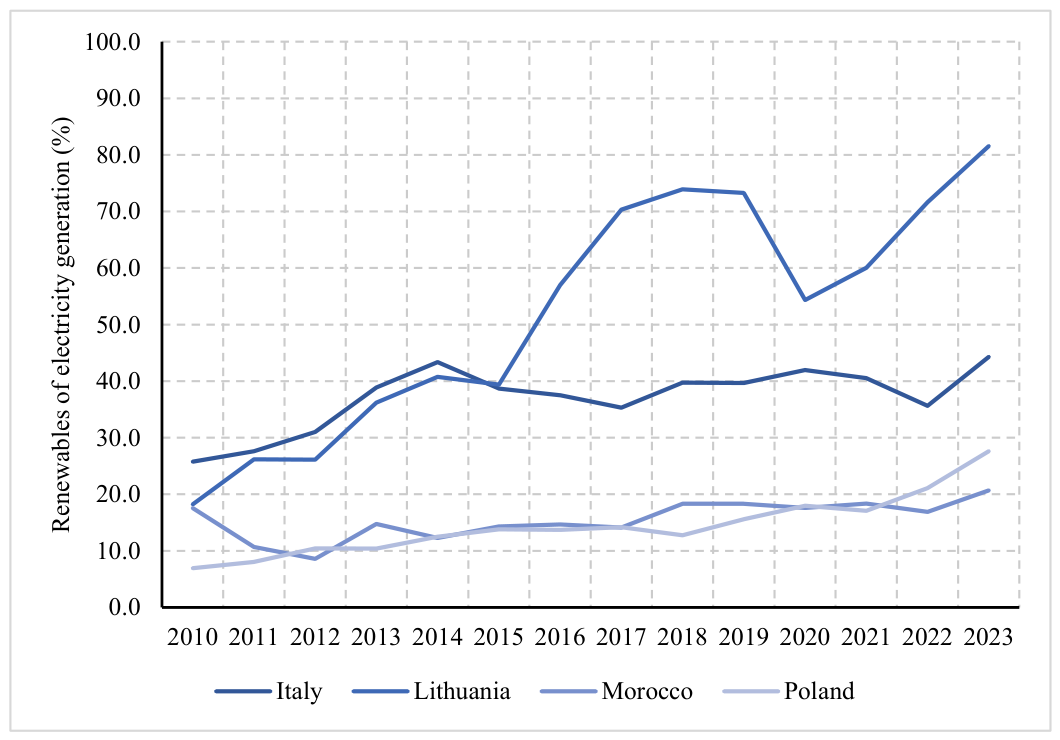
Figure 2.
Electricity generation mix by source in Italy, Lithuania, Morocco and Poland. Source: Authors’ elaboration based on [13]. Note: Italy, Lithuania and Poland use 2024 data, while Morocco uses 2023 data (latest available year).
Figure 2.
Electricity generation mix by source in Italy, Lithuania, Morocco and Poland. Source: Authors’ elaboration based on [13]. Note: Italy, Lithuania and Poland use 2024 data, while Morocco uses 2023 data (latest available year).
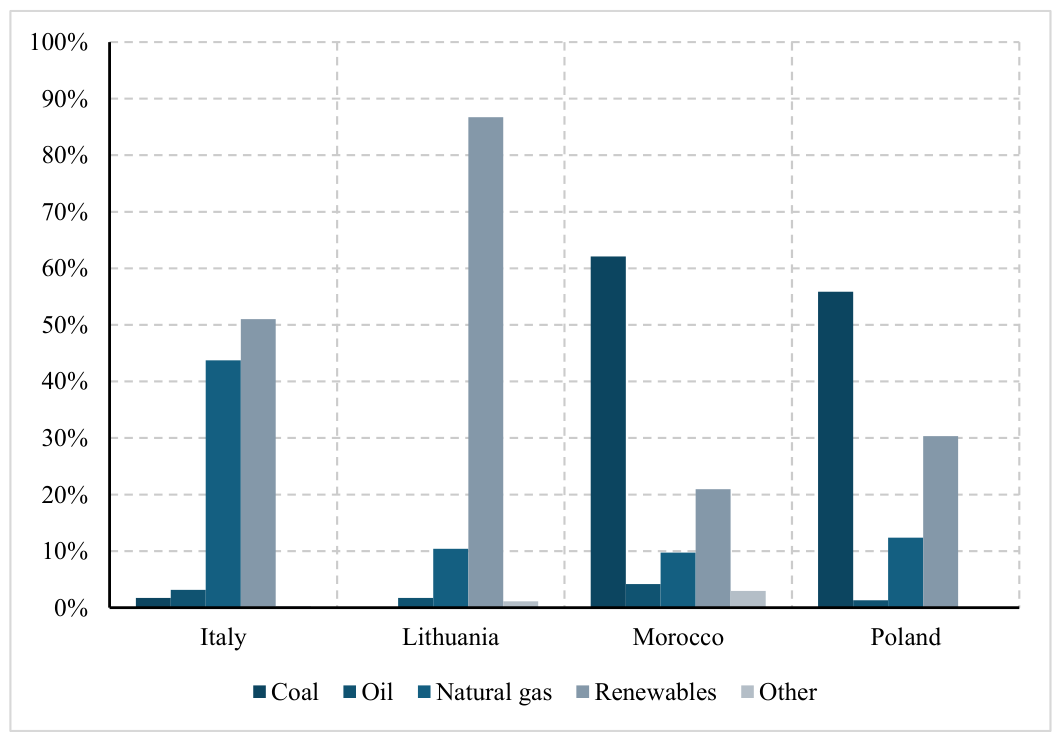
Table 1.
Sample profile by country.
| Country | N | Average age | SD age | Men (%) | Women (%) |
|---|---|---|---|---|---|
| Italy | 178 | 23.22 | 2.86 | 37.64 | 61.80 |
| Lithuania | 36 | 21.47 | 3.70 | 77.78 | 22.22 |
| Morocco | 109 | 23.40 | 2.57 | 46.79 | 53.21 |
| Poland | 85 | 20.95 | 1.31 | 45.88 | 52.94 |
| Total | 408 | 22.64 | 2.80 | 45.34 | 54.17 |
Source. Authors’ elaboration based on the survey sample. Note: For Italy and Poland, 1 respondent each (respectively, 0.6% and 1.2%) answered “prefer not to say”.
Table 2.
Variables used in the regression analysis.
| Code | Description | Dimension |
|---|---|---|
| RESAT | Attitude towards renewable energy sources | Attitude |
| RESIS | Knowledge of what renewable energy sources are | Knowledge |
| RESAR | Knowledge of how renewable energy sources work | Knowledge |
| RESEN | Evaluation of environment and climate | Environmental impact |
| RESEC | Impact on the economy | Economic impact |
| RESCF | Action to reduce carbon footprint | Behaviour |
| RESCC | Importance of climate change | Climate importance |
Source. Authors’ elaboration based on the survey questionnaire and variable coding. Note: All scale variables range from 0 to 7. Higher values indicate higher levels of the construct described in the variable label.
Table 3.
Forward stepwise selection paths and final country-specific OLS specifications.
| Country | Path and final specification |
|---|---|
| Italy | Intercept + RESCC + RESIS RESATᵢ = β₀ + β₁RESISᵢ + β₇RESCCᵢ + εᵢ |
| Lithuania | Intercept + RESIS + RESCC RESATᵢ = β₀ + β₁RESISᵢ + β₇RESCCᵢ + εᵢ |
| Morocco | Intercept + RESCF + RESEN + RESAR + RESCC − RESEN RESATᵢ = β₀ + β₂RESARᵢ + β₆RESCFᵢ + β₇RESCCᵢ + εᵢ |
| Poland | Intercept + RESEN + RESIS + RESCC RESATᵢ = β₀ + β₁RESISᵢ + β₃RESENᵢ + β₇RESCCᵢ + εᵢ |
Source. Authors’ elaboration based on country-specific models estimated from the survey sample.
Table 4.
Descriptive statistics of the regression variables included in the models.
| Variable | M | SD | CV | Me | Q1 | Q3 | Min | Max |
|---|---|---|---|---|---|---|---|---|
| RESAT | 5.14 | 1.38 | 27% | 5.00 | 4.00 | 6.00 | 0.00 | 7.00 |
| RESIS | 4.23 | 1.48 | 35% | 4.00 | 3.00 | 5.00 | 0.00 | 7.00 |
| RESAR | 3.89 | 1.48 | 38% | 4.00 | 3.00 | 5.00 | 0.00 | 7.00 |
| RESEN | 5.06 | 1.43 | 28% | 5.00 | 4.00 | 6.00 | 0.00 | 7.00 |
| RESEC | 4.93 | 1.44 | 29% | 5.00 | 4.00 | 6.00 | 0.00 | 7.00 |
| RESCF | 4.21 | 1.61 | 38% | 4.00 | 3.00 | 5.00 | 0.00 | 7.00 |
| RESCC | 5.24 | 1.64 | 31% | 6.00 | 4.00 | 7.00 | 0.00 | 7.00 |
Source. Authors’ elaboration based on the survey sample. Note: M = mean; SD = standard deviation; CV = coefficient of variation; Me = median; Q1 = first quartile; Q3 = third quartile.
Table 5.
Country-specific OLS regression results and diagnostic tests.
| Italy | Lithuania | Morocco | Poland | |
|---|---|---|---|---|
| Intercept | 2.658*** | 2.454*** | 1.708*** | 1.319*** |
| (0.335) | (0.634) | (0.529) | (0.393) | |
| RESIS | 0.257*** [0.303] | 0.431*** [0.455] | — | 0.213** [0.233] |
| (0.057) | (0.124) | — | (0.084) | |
| RESAR | — | — | 0.200** [0.213] | — |
| — | — | (0.087) | — | |
| RESEN | — | — | — | 0.354*** [0.377] |
| — | — | — | (0.102) | |
| RESCF | — | — | 0.235*** [0.255] | — |
| — | — | (0.089) | — | |
| RESCC | 0.308*** [0.375] | 0.314*** [0.421] | 0.233*** [0.239] | 0.203** [0.247] |
| (0.055) | (0.097) | (0.087) | (0.083) | |
| R² | 0.317 | 0.456 | 0.287 | 0.428 |
| Adjusted R² | 0.310 | 0.423 | 0.266 | 0.407 |
| F-test | 40.68*** | 13.81*** | 14.06*** | 20.21*** |
| Shapiro-Wilk p | 0.258 | 0.693 | 0.496 | 0.490 |
| Breusch-Pagan p | 0.132 | 0.067 | 0.967 | 0.201 |
| Ramsey RESET p | 0.575 | 0.205 | 0.972 | 0.297 |
| Max VIF | 1.165 | 1.036 | 1.368 | 1.675 |
Source. Authors’ elaboration based on country-specific OLS models estimated from the survey sample. Note: Standard errors are in parentheses and standardized beta coefficients are in square brackets. Significance: *** p < 0.01, ** p < 0.05, * p < 0.10.
Disclaimer/Publisher’s Note: The statements, opinions and data contained in all publications are solely those of the individual author(s) and contributor(s) and not of MDPI and/or the editor(s). MDPI and/or the editor(s) disclaim responsibility for any injury to people or property resulting from any ideas, methods, instructions or products referred to in the content. |
© 2026 by the authors. Licensee MDPI, Basel, Switzerland. This article is an open access article distributed under the terms and conditions of the Creative Commons Attribution (CC BY) license (http://creativecommons.org/licenses/by/4.0/).
Copyright: This open access article is published under a Creative Commons CC BY 4.0 license, which permit the free download, distribution, and reuse, provided that the author and preprint are cited in any reuse.