

Submitted:
20 October 2026
Posted:
21 October 2026
You are already at the latest version
Abstract
Quantum image encryption (QIE) loads a digital image into qubits and ciphers it with unitary circuits, usually keyed by chaotic maps, quantum walks or quantum random numbers. This review follows the field from an early geometric-transformation scheme (2013) to designs executed on 127-qubit IBM processors (2025). We organise the literature by image representation (FRQI, NEQR, amplitude encoding), confusion and diffusion mechanism, key source and validation level, and we compare recent schemes on entropy, NPCR, UACI, correlation and key space. Reported statistics sit close to their ideals almost everywhere; recent quantum-walk and chaos-based designs report NPCR of 99.6 to 99.97% and UACI of 33.5 to 33.9%, so these metrics no longer separate strong schemes from weak ones. Three gaps stand out. Most evidence comes from classical simulation. The secret usually sits in a classical key generator rather than in the quantum circuit. And loading an image into qubits, then reading it back, remains the main hardware bottleneck. Hybrid designs that distribute keys with BB84 and cipher the image classically offer the most deployable route today. We close with a research agenda: attack-based benchmarks, error-aware hardware validation, cheaper state preparation and explicit security definitions.
Keywords:
quantum image encryption
; quantum image representation
; NEQR
; FRQI
1. Introduction
Images carry diagnoses, surveillance footage and identity documents across networks that were not built to protect them. Classical image security faces two separate pressures. Public-key schemes used to exchange keys are exposed to Shor's algorithm, and published resource estimates keep falling: a 2025 analysis put RSA-2048 within reach of fewer than one million noisy qubits running for under a week [1], and a 2026 preprint described an architecture needing fewer than 100,000 physical qubits under idealised assumptions [2]. No machine of that size exists today, so these figures are projections, not capabilities. NIST nonetheless finalised its first three post-quantum standards, FIPS 203, 204 and 205, on 13 August 2024 [3].
Symmetric image ciphers have an older problem of their own. Chaos-based designs dominate the literature, yet cryptanalysis has repeatedly shown that statistically perfect output does not imply security. One widely studied scheme fell to a known- or chosen-plaintext attack needing only one or two plain-images [4], and a bit-plane-extraction cryptosystem was broken by a chosen-plaintext attack [5]. Any new family of image ciphers, quantum or otherwise, has to be judged against that record.
Quantum image processing offers a different substrate. An image is first mapped into a quantum state through a representation such as FRQI [6], which stores intensity in a rotation angle, or NEQR [7], which stores each pixel value in basis states; Yan et al. survey the wider family [8]. Once the image is a quantum state, encryption becomes a sequence of unitary operations and decryption is the inverse circuit. An early scheme built from quantum geometric transformations appeared in 2013 [9], and many variants have followed, combining scrambling operators, chaotic maps, quantum walks and DNA-style coding.
Existing reviews cover parts of this ground. Ali et al. examine key generation, confusion and diffusion, and the use of optimisation and other AI methods in QIE [10]. Zemate and Sedra compare representations by qubit efficiency, complexity and security, and discuss hybrid, chaos-based, transform-based and DNA-based families [11]. Broader surveys of image encryption treat quantum schemes as one branch [5,12]. Judging from their stated scope, none places schemes side by side by how far each was validated, from analysis alone to execution on a quantum processor, or asks whether the standard statistical metrics can still tell schemes apart.
This review makes four contributions. First, a taxonomy of QIE by representation, confusion mechanism, diffusion mechanism and key source. Second, a comparison of recent schemes (2022 to 2026) that records the validation platform next to the reported statistics. Third, a critical reading of entropy, NPCR, UACI and key-space claims in light of the cryptanalytic record. Fourth, a research agenda. Section 2 describes the review method and background, Section 3 presents the comparison and discussion, and Section 4 concludes.
2. Methods
2.1. Review Method
We searched the open web in October 2026 for review and research articles on quantum image encryption, combining the terms quantum image encryption, NEQR, FRQI, quantum walk, chaos, QKD, IBM quantum hardware, cryptanalysis, NPCR and UACI. Results came from SpringerLink, ScienceDirect, MDPI, EDP Sciences, PubMed Central and arXiv. We kept papers that either define a QIE or hybrid quantum-classical image cipher and report at least one security statistic, or assess representations, hardware execution or cryptanalytic practice relevant to QIE. We also kept the post-quantum threat estimates and standards needed to motivate the topic.
This is a narrative review, not a systematic one, and three limits apply. We read the full text of some papers and only the abstract, metadata or reference list of others; values taken from abstracts are marked in the tables. All statistics are as reported by the original authors: we did not re-implement the schemes, and test images, image sizes and attack protocols differ between papers. The search covered open web sources, so paywalled journals may be under-represented.
2.2. Quantum Image Representations
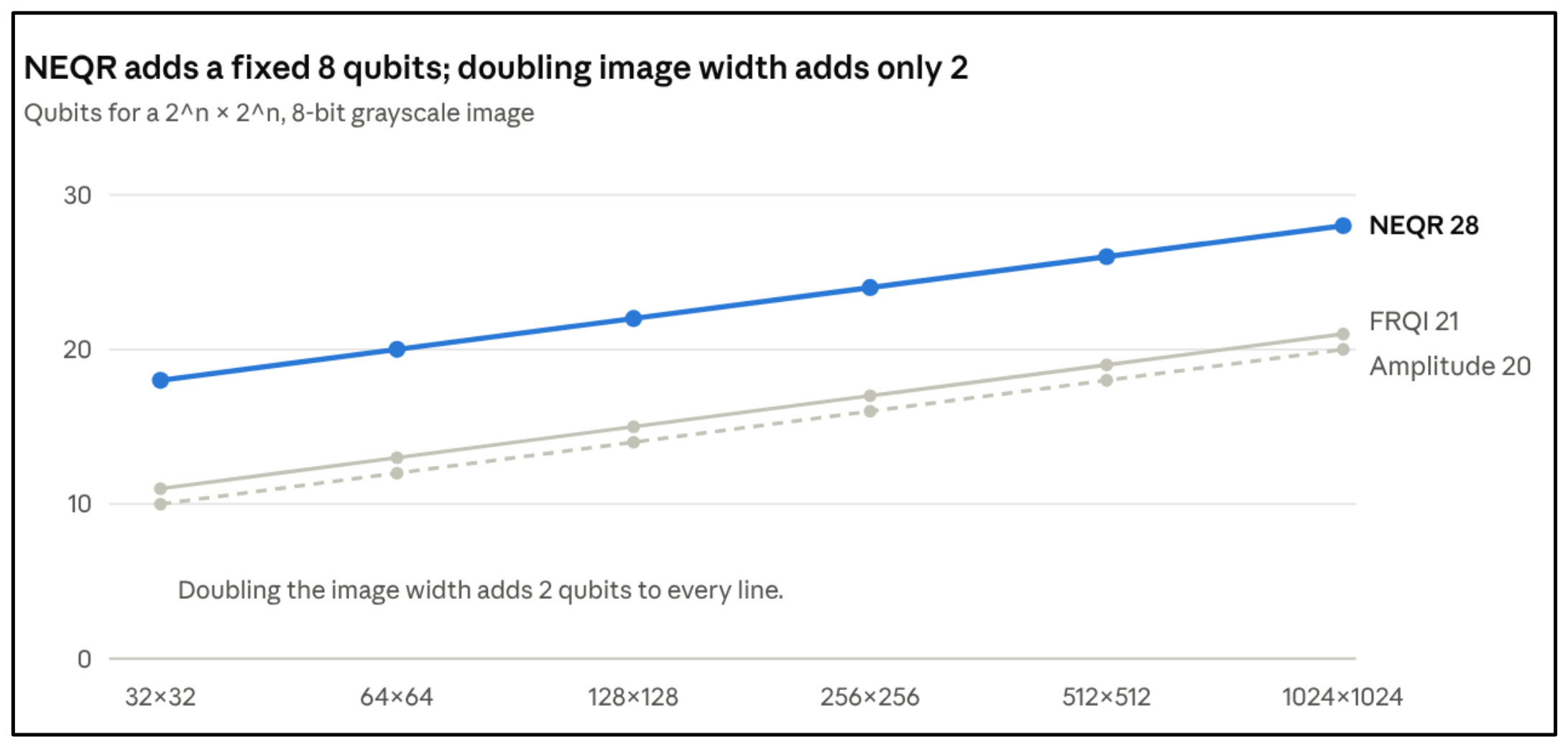
Every QIE scheme starts from a representation. Table 1 compares three families by the resources they need for a 2n × 2n, 8-bit grayscale image.
In the original NEQR paper, the authors report a quadratic speedup in image preparation and about 1.5 times better compression than FRQI [7]. NEQR also keeps pixel values intact on measurement, whereas an FRQI measurement collapses the intensity superposition [14]. For colour images, NEQR-based schemes treat each channel as a separate 8-qubit register, so a 256 × 256 RGB image needs 16 position qubits and 24 colour qubits, 40 in all [14]. Representation therefore drives cost: NEQR lets CNOT gates act directly on intensity bits, which is why the diffusion layer in [14] uses it, while amplitude encoding is cheap in qubits but is a lossy picture of the image [13].
Figure 1.
Qubits needed by each representation as image width grows. NEQR sits a constant 8 qubits above amplitude encoding, so a 1024 × 1024 image needs 28 qubits under NEQR and 20 under amplitude encoding; FRQI sits one qubit above amplitude encoding.
Figure 1.
Qubits needed by each representation as image width grows. NEQR sits a constant 8 qubits above amplitude encoding, so a 1024 × 1024 image needs 28 qubits under NEQR and 20 under amplitude encoding; FRQI sits one qubit above amplitude encoding.
2.3. Taxonomy of Schemes
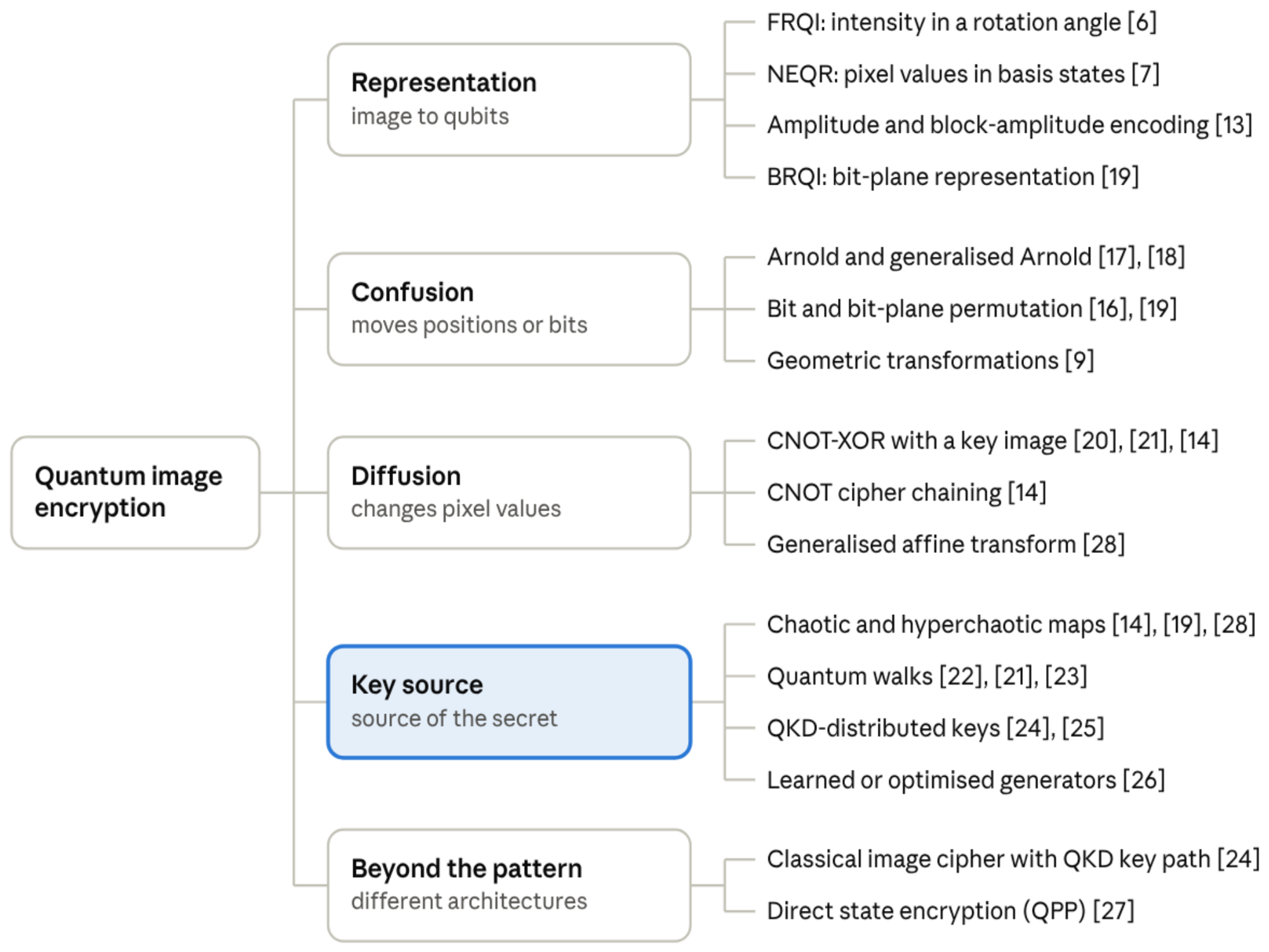
Most QIE designs combine four building blocks. The representation is the first (Section 2.2). Confusion rearranges positions or bit planes: intra- and inter-bit permutation driven by a logistic map [16], quantum Arnold transforms with S-box scrambling [17], iterative generalised Arnold transforms with cyclic shifts [18], and bit-plane scrambling in the BRQI representation [19]. Diffusion changes values, most often with CNOT gates that XOR a key image into the intensity register [14,20,21]. Key sources fall into three groups: classical chaotic or hyperchaotic maps, often seeded by a hash of the plaintext [14]; quantum walks whose probability distributions yield a key image [21,22,23]; and keys distributed by QKD [24,25]. A smaller group tunes key generation with learning or optimisation, for instance a neural-network pseudo-random generator optimised by quantum-behaved particle swarm optimisation [26].
Figure 2.
A generic quantum image encryption pipeline. The circuit stages (top) scramble positions and mix values; the key stream (bottom) is produced outside the circuit and, in hybrid designs, distributed by QKD or a post-quantum key exchange.
Figure 2.
A generic quantum image encryption pipeline. The circuit stages (top) scramble positions and mix values; the key stream (bottom) is produced outside the circuit and, in hybrid designs, distributed by QKD or a post-quantum key exchange.
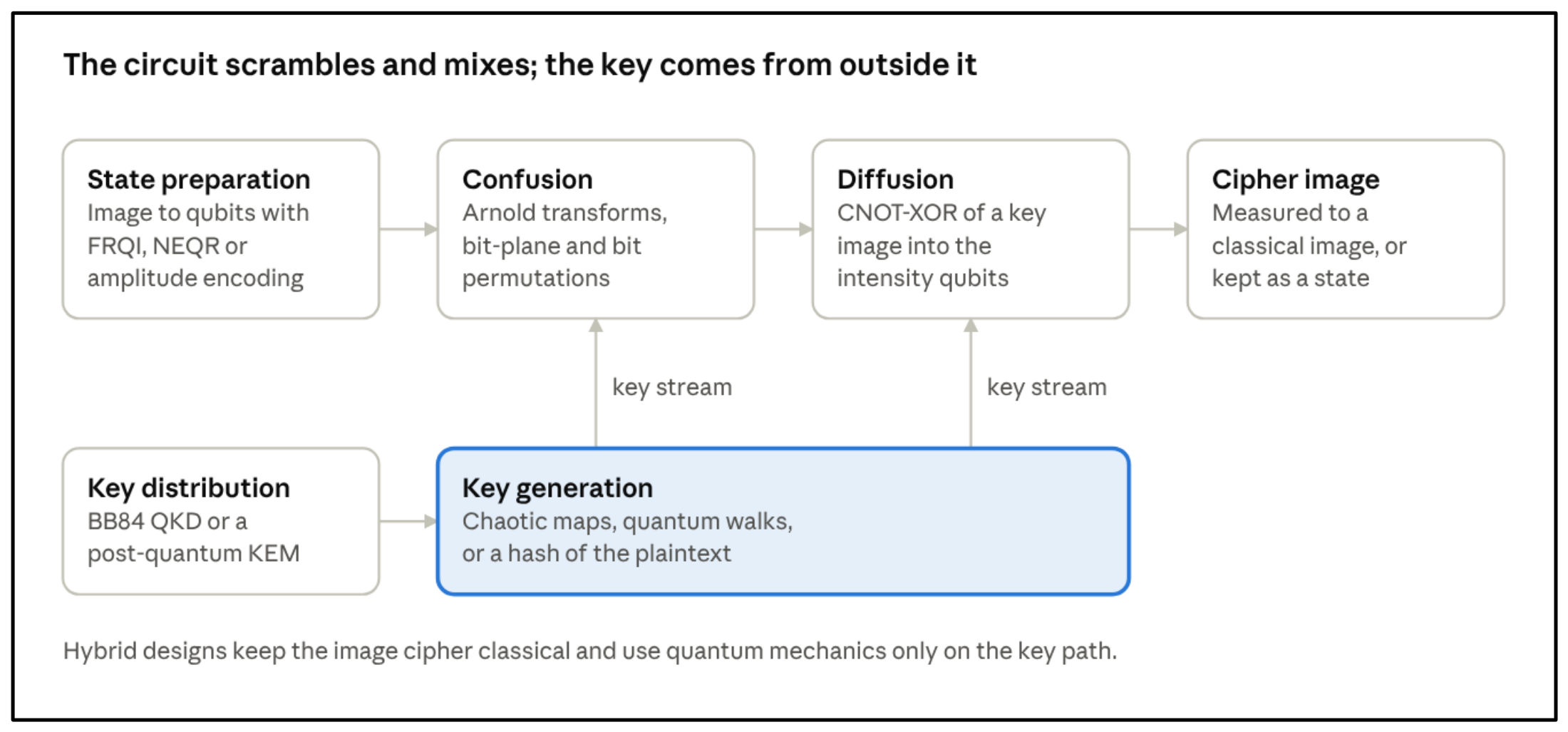
Two further families sit outside this pattern. Hybrid designs keep the image cipher classical and use quantum mechanics for keys: BB84 [25] establishes a shared secret that wraps the symmetric keys with a one-time pad, and 6D hyperchaotic and Ikeda-map sequences then drive bit-plane scrambling and diffusion in classical code [24]. The Quantum Permutation Pad encrypts quantum states directly, applying keyed permutation operators to 2-qubit states; its authors ran it on IBM processors with an image as plaintext and suggest drawing the pre-shared key from a quantum random number generator and establishing it with a quantum-safe algorithm [27]. Circuit-cost reduction is a third concern: the NEQRX work combines a generalised affine transform with a logistic map and reports a cost cut of about 50% from the Espresso algorithm and one extra qubit [28].
Figure 3.
Taxonomy of quantum image encryption schemes by building block, with example schemes and their references.
Figure 3.
Taxonomy of quantum image encryption schemes by building block, with example schemes and their references.
2.4. Evaluation Metrics
Papers in this field report a common set of statistics. Entropy of the cipher image should approach 8 bits for 8-bit images, and adjacent-pixel correlation should approach zero. NPCR (number of pixels change rate) and UACI (unified average changing intensity) measure how a one-pixel change in the plain image spreads through the cipher image; for two independent random 8-bit images their expected values are 99.6094% and 33.4635% [29]. Key-space size is usually compared with a floor of 2100 attributed to Alvarez and Li [31]. Some papers add the NIST SP 800-22 test suite on the key stream [30], histogram variance, or PSNR and MSE between plain and cipher images [14]. Robustness tests add noise or cropping to the cipher image [24]. Section 3.3 returns to what these statistics can and cannot show.
3. Results and Discussion
3.1. Recent Schemes Compared
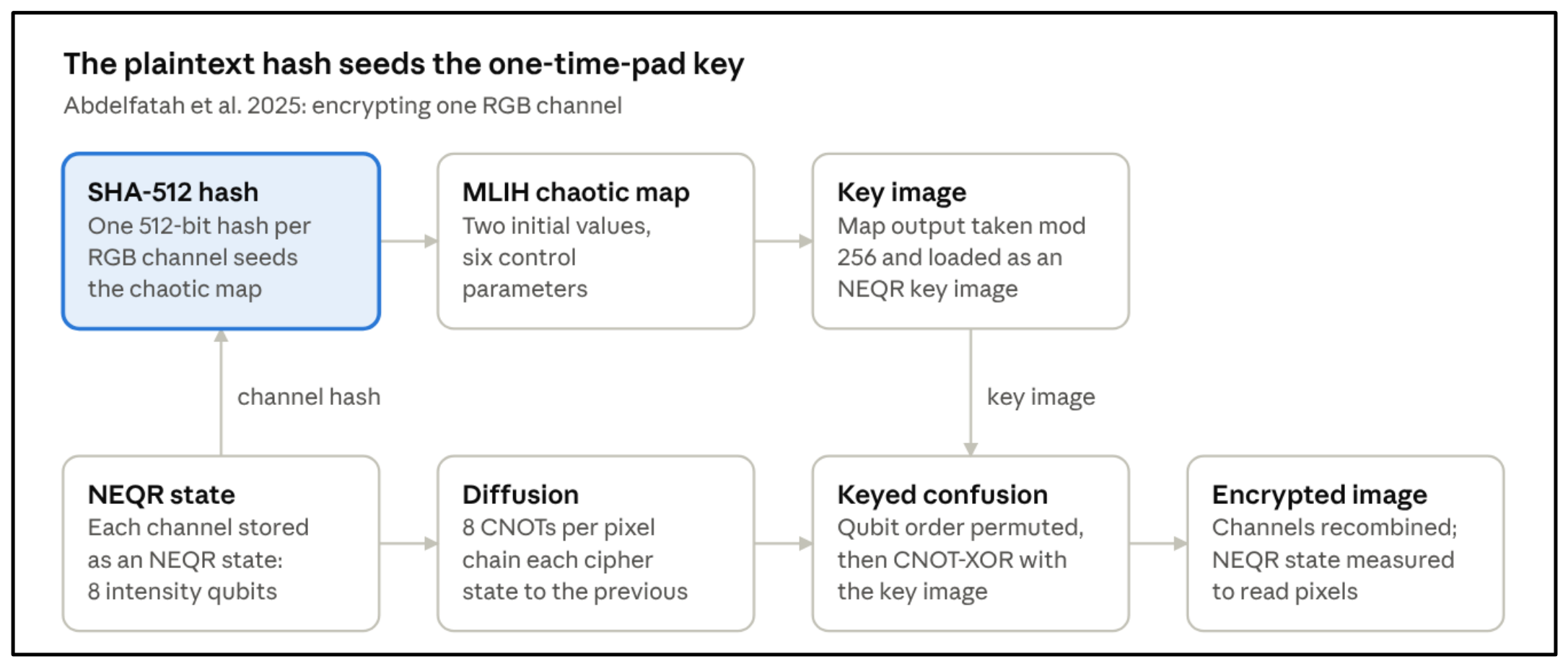
Six recent schemes show how designs differ in what secures the image and how far each was validated (Table 2). Three of them, rows 3 to 5, were executed on quantum devices. No two schemes share a recipe. Representation, key source and platform all vary, which is one reason their statistics cannot be ranked against each other (Section 3.3).
Figure 4.
Encryption of one RGB channel in the scheme of Abdelfatah et al. [14]. The SHA-512 hash of the plain channel seeds the chaotic key, so a one-bit change in the image produces a different key image. The same circuits were run on a 127-qubit IBM processor.
Figure 4.
Encryption of one RGB channel in the scheme of Abdelfatah et al. [14]. The SHA-512 hash of the plain channel seeds the chaotic key, so a one-bit change in the image produces a different key image. The same circuits were run on a 127-qubit IBM processor.
3.2. Hardware Evidence
Three of the six schemes ran on quantum devices, and the evidence is thin but real. Abdelfatah et al. executed their NEQR cipher on the 127-qubit ibm_sherbrooke processor, reporting a median echoed cross-resonance gate error of 1.1 × 10⁻² and a throughput of 4,500 circuit layer operations per second [14]. Perepechaenko and Kuang encrypted and decrypted a PNG image with 2-qubit permutations on IBM systems; with no quantum channel they decrypted on the same device, and noise limited each circuit to two qubits [27]. Saini et al. evaluated their circuits with Qiskit and quantum devices and reported the 50% cost reduction noted in Section 2.3 [28].
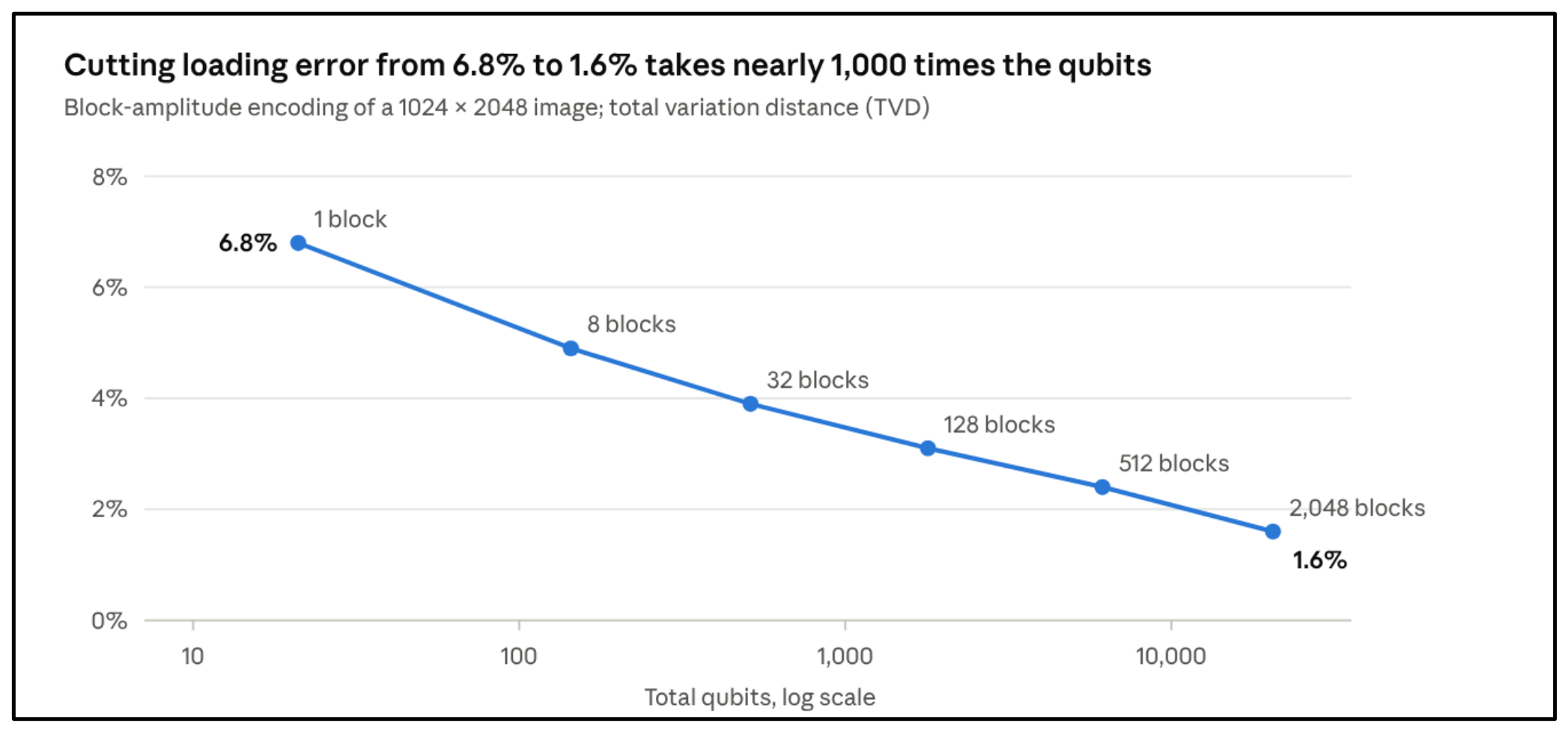
Two results show the limits that remain. The first is image loading: Gharibyan et al. fitted a 1024 × 2048 image into 21 qubits with 80 two-qubit gates and ran it on IBM-Algiers, but the loaded image kept only broad features such as sky and road, with a total variation distance of 6.8% [13]. The second is noise: with block-amplitude encoding on 72 qubits of IBM-Brisbane, single-qubit statistics drifted toward the maximally mixed state as CNOT counts rose toward 3,114, although signal remained extractable near 2,000 CNOTs [13].
Figure 5.
Loading error against qubit count for block-amplitude encoding [13]. Error falls steadily, but each step costs several times more qubits, and these error values come from simulation rather than hardware runs.
Figure 5.
Loading error against qubit count for block-amplitude encoding [13]. Error falls steadily, but each step costs several times more qubits, and these error values come from simulation rather than hardware runs.
A sceptical reading of the NEQR line is also on record. Mastriani, in a single-author preprint, argues that FRQI and NEQR are impractical on physical processors and favours quantum Boolean image processing, which he reports running on cloud simulators and two quantum processors [15]. We treat this as a minority view that the NEQR hardware runs in [14] partly answers. It still underlines that most NEQR-based schemes have been validated mostly in simulation, a limitation the 2026 survey by Jadoon et al. also notes [5].
3.3. What the Statistics Can and Cannot Show
Table 3 shows the pattern: whichever scheme is read, entropy, NPCR and UACI land within a few hundredths of their ideals, and the survey by Jadoon et al. reports the same for quantum schemes [5]. The one visible departure, a UACI of about 30% in [21], sits below the 33.46% expected for random images [29]; the abstract does not say whether it passes the significance test of that work. When nearly every scheme scores near the ceiling, these numbers screen out only badly broken designs.
They also have a record of passing schemes that later failed. The RCES/RSES cipher and a bit-plane scheme met the usual statistical expectations and were still broken by known- or chosen-plaintext attacks [4,5]. In the quantum literature, Abdelfatah et al. report that an earlier scheme combining iterative Arnold transforms with cyclic shifts reached only low entropy and weak attack resistance [18].
Key-space figures need the same care. The formula printed in Section 3.3 of [14], (2512 ×(252)6 ×(252)2 )3, evaluates to 22784, not the stated 21952. Both lie far above the 2100 floor, but the mismatch shows why headline key-space numbers should be recomputed. Grover's algorithm would cut a search over 21952 keys to about 2976 steps [14], still out of reach, so in our reading the practical risk lies in structural attacks rather than brute force.
We therefore suggest that QIE papers report, beyond the standard statistics: chosen-plaintext tests with structured inputs such as all-black and all-white images, as [14] does; key sensitivity and the plaintext dependence of the key stream; a stated adversary model, classical, quantum or both; and the validation platform, from analysis to hardware.
3.4. Where the Secret Lives
In most schemes in Table 2, the secret is a classical key stream: chaotic parameters seeded by a hash [14], a logistic map [19,28], or a walk-generated mask [21]. The quantum circuit then applies reversible operations, mainly CNOT-XOR and permutations, to that key. When an image is stored in basis states, as in NEQR, such gates act as classical reversible logic, so the same cipher could be run on a classical machine; the authors of the Quantum Permutation Pad state outright that their scheme runs on both classical and quantum devices [27]. This does not make such schemes insecure. It means their security rests on the key generator and the cipher structure, and that claims of quantum advantage need separate justification.
Abdelfatah et al. credit part of their efficiency to parallel CNOT operations [14]. That is a claim about speed on a large machine, not a security property, and it meets a practical obstacle: a measurement of an NEQR state returns one pixel per shot, so reading a full cipher image takes many repeated runs [13].
3.5. Hybrid Quantum-Classical Routes
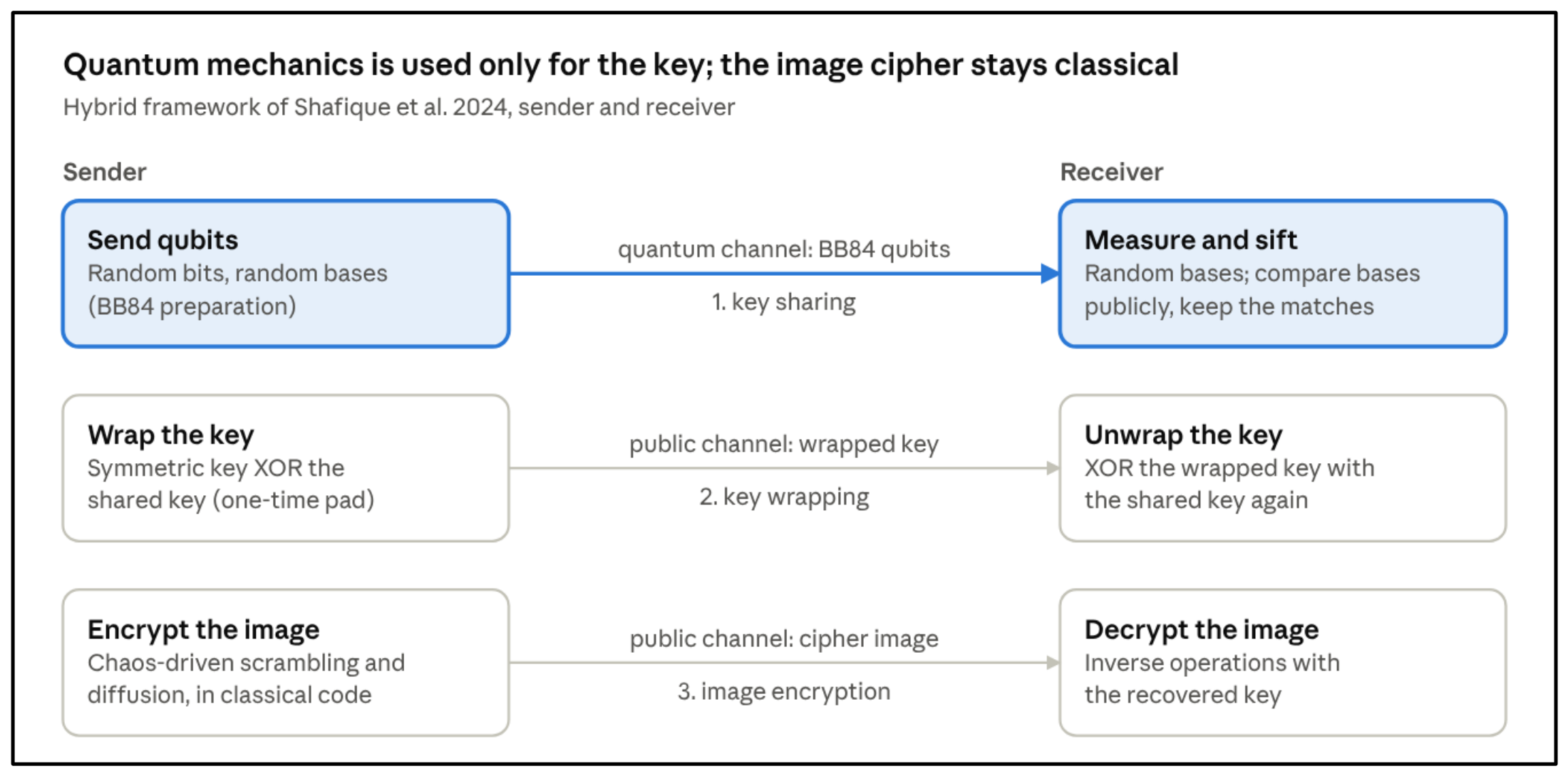
A more conservative design uses quantum mechanics only where it has a clear security role, which is key establishment. Shafique et al. run BB84 [25] to share a key, use it as a one-time pad to wrap the symmetric keys, and cipher the image classically. They report cipher-image entropy of 7.9991 to 7.9994 on four medical test images and encryption times of a few milliseconds on a laptop CPU [24].
Figure 6.
Message flow of the hybrid framework in [24]. BB84 is the only quantum step; wrapping the symmetric key and ciphering the image are classical.
Figure 6.
Message flow of the hybrid framework in [24]. BB84 is the only quantum step; wrapping the symmetric key and ciphering the image are classical.
Post-quantum key encapsulation is the classical counterpart: ML-KEM (FIPS 203) covers key establishment [3], and Perepechaenko and Kuang point to NIST post-quantum algorithms and quantum-random keys for their pre-shared secret [27]. QKD needs dedicated quantum links, while post-quantum schemes run in software but rest on conjectured hardness. Neither is specific to images, which suggests that the image-specific contribution of QIE lies in the cipher layer, not the key channel.
3.6. Open Challenges and Future Directions
- Attack-based benchmarks. A shared suite of known-plaintext, chosen-plaintext and differential attacks, run on fixed images and sizes, would make results comparable across papers. Zemate and Sedra also call for uniform evaluation policies [11].
- A quantum channel. Without one, quantum ciphertext states cannot be sent; current demonstrations measure first or decrypt on the same device [27].
- Formal security definitions. Indistinguishability-based notions such as IND-CPA exist for quantum encryption, but the authors of [27] did not examine their implementation against them, and QIE papers rarely state any.
- Adaptive composition. No single primitive wins on security, cost and deployability: BB84 needs quantum links, NEQR circuits need deep hardware, and post-quantum key encapsulation needs only software. A policy layer that chooses classical, post-quantum, chaotic or quantum-assisted components per device and threat level is a natural next step, and it would need the benchmarks above to compare options.
4. Conclusion
Quantum image encryption has moved from circuit designs on paper to a few schemes executed on 127-qubit processors, yet its security evidence still comes mostly from the statistics that classical chaotic ciphers relied on before many of them were broken. In the recent schemes compared here, entropy, NPCR and UACI sit within hundredths of their ideals, so they no longer rank designs. In most schemes the secret is a classical key stream, the quantum circuit applies reversible operations to it, and hardware runs are held back by image loading, noise and the lack of a quantum channel. Hybrid designs that use quantum mechanics for key distribution and classical ciphers for the image are the most deployable today, and post-quantum key establishment now has finalised standards. Progress needs shared attack-based benchmarks, hardware-validated circuits with reported error budgets, cheaper state preparation and explicit security definitions. Meeting these goals would show where quantum image encryption offers real advantages over classical designs.
Acknowledgments
The author would like to acknowledge the scientific contributions of researchers whose work has shaped the development of quantum image encryption and related quantum information technologies. Their published research and publicly available resources were valuable in preparing this review. No external financial support was received for the preparation of this manuscript.
References
- The Quantum Insider. Google researcher lowers quantum bar to crack RSA encryption (report on C. Gidney, Google Quantum AI). 24 May 2025.
- The Quantum Insider. New architecture could cut quantum hardware needed to break RSA-2048 by tenfold, study finds (Iceberg Quantum "Pinnacle Architecture" preprint). 13 February 2026.
- Encryption Consulting. NIST PQC standards: FIPS 203, 204 and 205.
- Li S, Li C, Chen G, Lo K-T. Cryptanalysis of the RCES/RSES image encryption scheme. J Syst Softw. 2008;81(7):1130-1143. [CrossRef]
- Jadoon S, Pan L, Huda S, Khan KH. A survey of image encryption schemes: Arnold transformation, chaos, bit-plane extraction and permutation based algorithms. Multimed Tools Appl. 2026;85:210. [CrossRef]
- Le PQ, Dong F, Hirota K. A flexible representation of quantum images for polynomial preparation, image compression, and processing operations. Quantum Inf Process. 2011;10:63-84. [CrossRef]
- Zhang Y, Lu K, Gao Y, Wang M. NEQR: a novel enhanced quantum representation of digital images. Quantum Inf Process. 2013;12(8):2833-2860. [CrossRef]
- Yan F, Iliyasu AM, Venegas-Andraca SE. A survey of quantum image representations. Quantum Inf Process. 2016;15:1-35. [CrossRef]
- Zhou RG, Wu Q, Zhang MQ, Shen CY. Quantum image encryption and decryption algorithms based on quantum image geometric transformations. Int J Theor Phys. 2013;52:1802-1817. [CrossRef]
- Ali ZA, Atia TS, Yousuf AY, Khahdim AJ. A comprehensive review of quantum image encryption methods: design characteristics, cryptographic properties, and AI integration. Quantum Inf Process. 2024;23:335. [CrossRef]
- Zemate AA, Sedra MB. Quantum image encryption using quantum image representations. EPJ Web Conf. 2026;350:01001. [CrossRef]
- SaberiKamarposhti M, Ghorbani A, Yadollahi M. A comprehensive survey on image encryption: taxonomy, challenges, and future directions. Chaos Solitons Fractals. 2024;178:114361. [CrossRef]
- Gharibyan H, Karapetyan H, Sedrakyan T, Subasic P, Su VP, Tanin RH, Tepanyan H. Quantum image loading: hierarchical learning and block-amplitude encoding. arXiv:2504.10592. 2025.
- Abdelfatah RI, Elsobky RM, Khamis SA. Ultra-secure quantum protection for e-healthcare images: hybrid chaotic one-time pad with cipher chaining encryption framework. J King Saud Univ Comput Inf Sci. 2025;37(6):158. [CrossRef]
- Mastriani M. Quantum image processing: the truth, the whole truth, and nothing but the truth about its problems on internal image representation and outcomes recovering. arXiv:2002.04394. 2020.
- Liu X, Xiao D, Xiang Y. Quantum image encryption using intra and inter bit permutation based on logistic map. IEEE Access. 2019;7:6937-6946. [CrossRef]
- Liu H, Zhao B, Huang L. Quantum image encryption scheme using Arnold transform and S-box scrambling. Entropy. 2019;21(4):343. [CrossRef]
- Zhou N, Hu Y, Gong L, Li G. Quantum image encryption scheme with iterative generalized Arnold transforms and quantum image cycle shift operations. Quantum Inf Process. 2017;16:164. [CrossRef]
- Basiri S, FarhangMatin L, Naseri M. Innovative quantum encryption method for RGB images based on bit-planes and logistic maps. Computation. 2025;13(2):56. [CrossRef]
- Gong LH, He XT, Cheng S, Hua TX, Zhou NR. Quantum image encryption algorithm based on quantum image XOR operations. Int J Theor Phys. 2016;55(7):3234-3250. [CrossRef]
- Pawela Ł. Parrondo paradox in quantum image encryption. arXiv:2508.16382. 2025.
- Yang Y-G, Pan Q-X, Sun S-J, Xu P. Novel image encryption based on quantum walks. Sci Rep. 2015;5:7784. [CrossRef]
- Kamran MI, Khan MA, Alsuhibany SA, Ghadi YY, Arshad A, Arif J, Ahmad J. A highly secured image encryption scheme using quantum walk and chaos. Comput Mater Contin. 2022;73(1):657-672. [CrossRef]
- Shafique A, Naqvi SAA, Raza A, Ghalaii M, Papanastasiou P, McCann J, Abbasi QH, Imran MA. A hybrid encryption framework leveraging quantum and classical cryptography for secure transmission of medical images in IoT-based telemedicine networks. Sci Rep. 2024;14:31054. [CrossRef]
- Bennett CH, Brassard G. Quantum cryptography: public key distribution and coin tossing. In: Proc IEEE Int Conf Computers, Systems and Signal Processing, Bangalore. 1984:175-179.
- Dai JY, Zhou NR. Optimal quantum image encryption algorithm with the QPSO-BP neural network-based pseudo random number generator. Quantum Inf Process. 2023;22(8). [CrossRef]
- Perepechaenko M, Kuang R. Quantum encryption of superposition states with quantum permutation pad in IBM quantum computers. arXiv:2301.10832. 2023.
- Saini R, Behera BK, Al-Kuwari S, Farouk A. NEQRX: efficient quantum image encryption with reduced circuit complexity. arXiv:2204.07996. 2022 (v3, 2024).
- Wu Y, Noonan JP, Agaian S. NPCR and UACI randomness tests for image encryption. J Selected Areas in Telecommunications. April 2011.
- Rukhin A, Soto J, Nechvatal J, et al. A statistical test suite for random and pseudorandom number generators for cryptographic applications. NIST Special Publication 800-22 Rev. 1a.
- Alvarez G, Li S. Some basic cryptographic requirements for chaos-based cryptosystems. Int J Bifurcation Chaos. 2006;16(8):2129-2151. [CrossRef]

Table 1.
Quantum image representations compared.
| Representation | How intensity is stored | Qubits for a 2n × 2n gray image | Retrieval | Practical note |
|---|---|---|---|---|
| FRQI [6] | One qubit, intensity as a rotation angle | 2n + 1 | Statistical, from measurement counts | A single intensity qubit limits precision for 8-bit values [14] |
| NEQR [7] | Eight qubits in basis states, one per bit | 2n + 8 | Deterministic, bit-exact | Base of the hardware run in [14]; practicality on physical processors is contested [15] |
| Amplitude and block-amplitude encoding [13] | Normalised pixel values as amplitudes | ⌈log2N⌉ for N pixels, 21 for a 1024 × 2048 image |
Approximate, rebuilt from a histogram of many shots | Shallow circuits, but fine detail is lost [13] |
Table 2.
Design and validation of recent quantum and hybrid image ciphers.
| Scheme | Representation | Confusion and diffusion | Key source | Validation platform |
|---|---|---|---|---|
| Pawela 2025 [21] | NEQR | Walk-generated mask turned into a quantum key image and applied by CNOT | Discrete-time quantum walk on a cycle | Benchmark analysis on 64 × 64 images; hardware implications discussed |
| Basiri et al. 2025 [19] | BRQI | Bit-plane scrambling, then mixing with a key image | Logistic map | Not stated in the abstract |
| Abdelfatah et al. 2025 [14] | NEQR, per RGB channel | CNOT cipher chaining, then a CNOT one-time pad after a qubit-order permutation | MLIH chaotic map seeded by a SHA-512 hash of each channel | Mathematica simulation; 127-qubit ibm_sherbrooke |
| Saini et al. 2022 [28] | Not stated in the abstract | Generalised affine transform | Logistic map | Qiskit and quantum devices; about 50% lower circuit cost |
| Perepechaenko and Kuang 2023 [27] | None: bits loaded as 2-qubit basis states | Keyed 2-qubit permutations after classical XOR randomisation | Pre-shared secret; 56 permutations give 256 bits of entropy | IBM simulator and IBM Manila; no quantum channel |
| Shafique et al. 2024 [24] | None (classical image) | Bit-plane scrambling, then DCT, wavelet and affine diffusion | 6D hyperchaotic Chen and Ikeda sequences; BB84 and a one-time pad protect the symmetric keys | MATLAB simulation |
Table 3.
Author-reported security statistics. Values are not comparable across rows: images, sizes and protocols differ.
Table 3.
Author-reported security statistics. Values are not comparable across rows: images, sizes and protocols differ.
| Scheme | Entropy | NPCR (%) | UACI (%) | Adjacent-pixel correlation |
|---|---|---|---|---|
| Expected for random 8-bit images [29] | 8 | 99.6094 | 33.4635 | 0 |
| Kamran et al. 2022 [23] (abstract) | 7.9970 | 99.60 | 33.47 | 0.0069 |
| Pawela 2025 [21] (abstract) | Near the 8-bit ideal | Above 99 | About 30 | About 10^-2 (H, V, D) |
| Abdelfatah et al. 2025 [14] | 7.9977 | 99.97 | 33.89 | Near zero |
| Prajapat et al. 2025, as summarised in [5] | 7.99 | 99.6 | 33.54 | Negative coefficients |
Disclaimer/Publisher’s Note: The statements, opinions and data contained in all publications are solely those of the individual author(s) and contributor(s) and not of MDPI and/or the editor(s). MDPI and/or the editor(s) disclaim responsibility for any injury to people or property resulting from any ideas, methods, instructions or products referred to in the content. |
© 2026 by the authors. Licensee MDPI, Basel, Switzerland. This article is an open access article distributed under the terms and conditions of the Creative Commons Attribution (CC BY) license (http://creativecommons.org/licenses/by/4.0/).
Copyright: This open access article is published under a Creative Commons CC BY 4.0 license, which permit the free download, distribution, and reuse, provided that the author and preprint are cited in any reuse.