

Submitted:
18 October 2026
Posted:
20 October 2026
You are already at the latest version
Abstract
Bioenergetic accounts of bipolar disorder (BD) have been shaped by a persistent observation: resting brain ATP and phosphocreatine often appear near-normal, even in symptomatic patients. Challenge-based work has moved the field beyond static measures, showing that patients fail to sustain ATP under high demand, and has framed the core abnormality as a deficit of capacity. This review re-examines that literature from a control perspective and argues that the capacity to terminate demand-driven energetic upregulation has been largely untested, chiefly because resting and single-challenge designs cannot resolve return kinetics. The argument is developed in three steps. First, we review how neuronal energy supply is matched to demand, giving comparable weight to adenine-nucleotide feedback, mitochondrial calcium signalling, and phosphotransfer buffering, and we note evidence that cytosolic ATP and ATP:ADP are strikingly stable during physiological activity. Second, we set out three candidate implementations of the termination step — mitochondrial Ca² efflux via NCLX, adenine ⁺ nucleotide feedback, and the creatine kinase–phosphocreatine system — and grade the evidence for each, distinguishing findings obtained in BD from those extrapolated from other systems. None has been assayed directly in BD tissue. Third, using a minimal control-loop model, we show that reduced termination capacity alone does not generate cycling; depending on parameters it produces slowed return, latching, persistent elevation, or sustained oscillation. Cycling therefore requires additional conditions, which we state explicitly. We close with pharmacological strategies that would discriminate among the candidates.
Keywords:
bipolar disorder
; bioenergetics
; mitochondria
; calcium
; phosphocreatine
; lithium
1. Introduction
Bipolar disorder (BD) affects roughly 1–2% of the population and remains mechanistically unresolved despite decades of work centred on monoamines and circuit phenotyping (Grande et al., 2016; Merikangas et al., 2011; Phillips and Kupfer, 2013). Among the biological accounts that have been pursued, the bioenergetic one has a long history and renewed momentum, with recent argument that brain energy metabolism in BD may be approaching a translational inflection point (Berk et al., 2025).
That account has always had to contend with an awkward observation. In many studies, resting ATP and phosphocreatine (PCr) appear near-normal in symptomatic patients (Kato et al., 1992, 1993). This has sometimes been read as evidence that bioenergetic abnormalities are secondary. We think that reading rests on a conflation. Stable ATP is not evidence of an inactive control system; it is what a well-regulated control system produces. The point is made forcefully outside psychiatry: in neurons, cytosolic ATP and ADP remain unperturbed across a wide range of physiological workloads, not because demand is small but because consumption and production are tightly coupled (Baeza-Lehnert et al., 2019). Constancy of a regulated variable tells us about the regulator, not about the absence of load.
Challenge-based work has already drawn the practical conclusion and moved to dynamic measures. Patients with BD maintain normal resting high-energy phosphates yet fail to sustain ATP during periods of high demand, and reduced creatine kinase forward-rate has been proposed as a candidate trait marker (Du et al., 2018; Yuksel et al., 2015; Stork and Renshaw, 2005). This body of work frames the abnormality as a deficit: an inability to meet demand.
This review asks a question that the existing literature has not been designed to answer. Energetic control is bidirectional: a system must both engage output when demand rises and terminate that output when demand falls. Resting measurements cannot see termination at all, and single-challenge designs that quantify the rise rarely quantify the return. If the capacity to terminate were selectively impaired, current measures would largely miss it.
Our aims are deliberately bounded. Section 2 reviews how neuronal energy supply is coupled to demand. Section 3 states the termination framework and its limits. Section 4 sets out three candidate mechanisms and grades the evidence for each. Section 5 reports a minimal model that tests whether impaired termination can generate cycling — and finds that, by itself, it cannot. Section 6 derives pharmacological and kinetic tests, and Section 7 states what would falsify the framework. We do not claim that termination failure has been demonstrated in BD. We argue that it is a specific, testable gap, and we try to be explicit throughout about which statements are supported by data in BD, which are extrapolated from other systems, and which are inference.
2. How Neuronal Energy Supply Is Matched to Demand
Neurons have little stored energy but face abrupt, unpredictable increases in demand, most of it attributable to ATP-powered ion pumping (Meyer et al., 2022). Several mechanisms contribute to matching supply to that demand, and the relative weight of each is not settled.
2.1. Adenine-Nucleotide Feedback
The classical account assigns demand–supply coupling to ADP: consumption raises ADP, which stimulates oxidative phosphorylation (Chance and Williams, 1956). This remains the textbook control scheme and any dynamic account must accommodate it. It is also the mechanism most directly challenged by recent measurements: in neurons responding to physiological stimulation, cytosolic ATP and ADP were unperturbed, and the authors concluded that neuronal energy homeostasis under these conditions is mediated neither by adenine nucleotides nor by Ca²⁺ but by a mechanism commanded by the Na⁺ pump (Baeza-Lehnert et al., 2019). The same work identified the Na⁺/K⁺ pump as exerting permissive control over mitochondrial ATP production and glycolysis (Baeza-Lehnert et al., 2019), and independent work in hippocampal granule cells found that glycolytic activation is driven predominantly by Na⁺/K⁺ pump activity rather than by Ca²⁺ (Meyer et al., 2022).
2.2. Mitochondrial Calcium Signalling
A second mechanism couples demand to oxidative output through matrix Ca²⁺. Influx via the mitochondrial calcium uniporter activates the tricarboxylic-acid-cycle dehydrogenases, raising oxidative phosphorylation during activity (Denton, 2009; Rizzuto et al., 2012; Glancy and Balaban, 2012). Return to baseline requires active extrusion of matrix Ca²⁺, mediated in excitable cells principally by the mitochondrial Na⁺/Ca²⁺ exchanger NCLX, encoded by SLC8B1 (Palty et al., 2010; Kostic and Sekler, 2019). NCLX is itself regulated by mitochondrial membrane potential, functioning as a feedback element that links metabolic state to Ca²⁺ signalling (Kostic et al., 2018).
The scope of this mechanism should not be overstated. The neuronal measurements described above concluded that Ca²⁺ was not the mediator of energy homeostasis under physiological workloads (Baeza-Lehnert et al., 2019), and glycolytic activation in hippocampal neurons is driven chiefly by the Na⁺/K⁺ pump (Meyer et al., 2022). Mitochondrial Ca²⁺ signalling is therefore better described as one regulatory route among several, prominent under conditions of substantial or pathological Ca²⁺ loading, rather than as the principal signal coupling demand to output under all physiological conditions.
2.3. Phosphotransfer Buffering
The creatine kinase–PCr system links sites of ATP production and use and buffers demand transients, smoothing mismatches that would otherwise perturb ATP (Wallimann et al., 1992; Andres et al., 2008). Because this system sets how rapidly the network re-equilibrates after a transient, its kinetics bear directly on return to baseline — the property at issue here.
2.4. Why Static Measures Underperform
These control loops share a consequence. A system can hold a regulated variable near constant while differing substantially in how it achieves that constancy and in how it behaves when perturbed. Consistent with this, studies relying on static resting measures have produced inconsistent findings in BD, whereas approaches sensitive to dynamic change have revealed abnormalities not apparent at rest (Du et al., 2018; Yuksel et al., 2015), and ultra-high-field spectroscopic imaging has reported lactate flux dysfunction during both task and rest (Bertocci and Diler, 2025). Resting abnormalities in phospholipid metabolites, PCr:ATP ratios, and intracellular pH have also been reported in subsets of cohorts (Kato et al., 1998; Dager et al., 2004).
3. The Termination Framework
3.1. Two Separable Arms
We use engagement for the capacity to raise energetic output when demand rises, and termination for the capacity to return output to baseline when demand falls. These are distinct operations: engagement depends on the signal that raises flux and on available capacity, termination on the processes that remove or oppose that signal. Section 4 identifies the specific molecular steps involved. The prediction that distinguishes the two is kinetic: impaired engagement reduces the amplitude of the response, whereas impaired termination prolongs its return.
Three qualifications matter. First, the two arms need not be independent: some mechanisms contribute to both, and a lesion affecting a shared element would impair both. Second, we use re-engagement failure for reduced response amplitude on a chronically perturbed background — a description, not a separate mechanism. Third, and most importantly, the claim here is about cellular energetic control. It is not a claim about subjective energy or activity level. Increased goal-directed behaviour and reduced sleep in mania do not demonstrate increased neuronal oxidative flux, and psychomotor retardation in depression does not demonstrate reduced flux. Clinical presentation and cellular bioenergetics are different levels of description, and an activated behavioural state could coexist with regional energetic inefficiency, altered substrate use, or heterogeneous circuit-specific changes. We therefore avoid characterising mood states as high-flux or low-flux, and confine the predictions in Section 6 to measured recovery kinetics.
3.2. What Existing Designs can and Cannot See
Resting measurements are blind to termination by construction. Challenge designs that quantify the rise to demand but not the return quantify engagement only. The deficit findings in BD derive from such designs (Du et al., 2018; Yuksel et al., 2015), so they constrain engagement and are largely uninformative about termination. This is the gap the framework identifies. It is a claim about measurement coverage, and it is verifiable independently of whether impaired termination turns out to occur in BD.
4. Candidate Implementations of the Termination Step
A recurring weakness of bioenergetic frameworks for BD is that “mitochondrial dysfunction” is invoked without commitment to a specific step. We therefore name three candidate implementations (Figure 2), state what each predicts, and grade the evidence (Table 1). We treat them as alternatives to be discriminated, not as a single favoured mechanism. The first is developed at greater length because it is the least familiar in this context, not because it is the best supported.
Figure 1.
Static concentration versus dynamic regulation. Resting ATP and phosphocreatine can appear near-normal (A) while the response to perturbation and the return to baseline differ (B). Abnormalities of this kind are visible only under challenge-and-recovery designs. The impaired-termination trace is hypothetical. This schematic was produced with the assistance of an AI tool (Claude, Anthropic) and verified by the author.
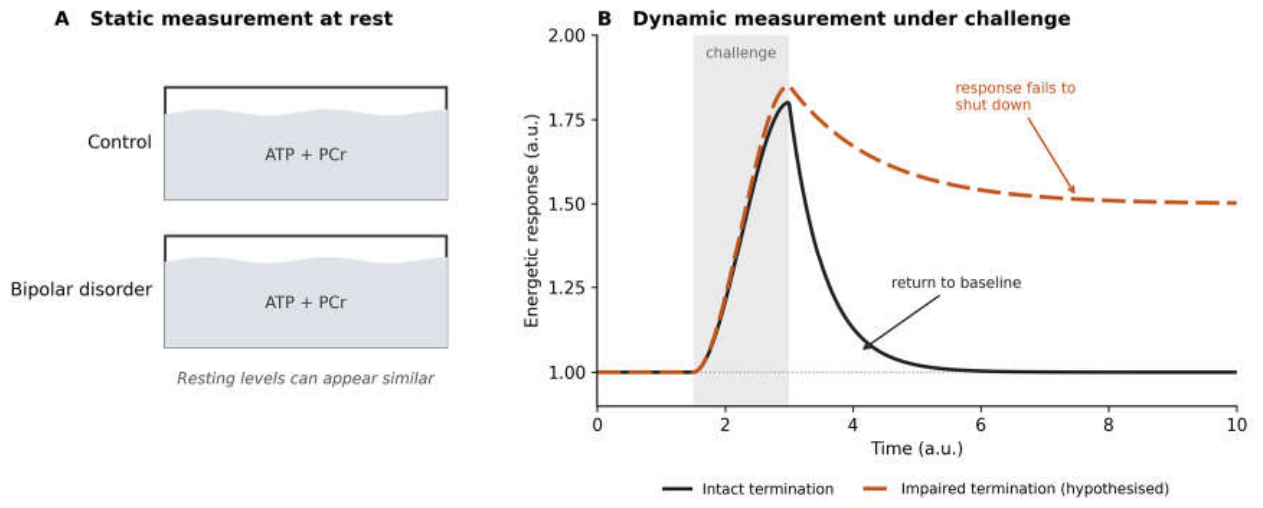
Figure 2.
The control loop and three candidate implementations of the termination step. (A) Demand engages energetic output; returning to baseline requires a termination step with capacity k. When k is reduced, the response fails to shut down, producing a persistent after-response. (B) Three candidate implementations of that step, compared in Table 1: mitochondrial Ca²⁺ efflux via NCLX, adenine-nucleotide feedback, and creatine kinase–phosphocreatine phosphotransfer. None has been assayed directly in bipolar disorder. This schematic was produced with the assistance of an AI tool (Claude, Anthropic) and verified by the author.
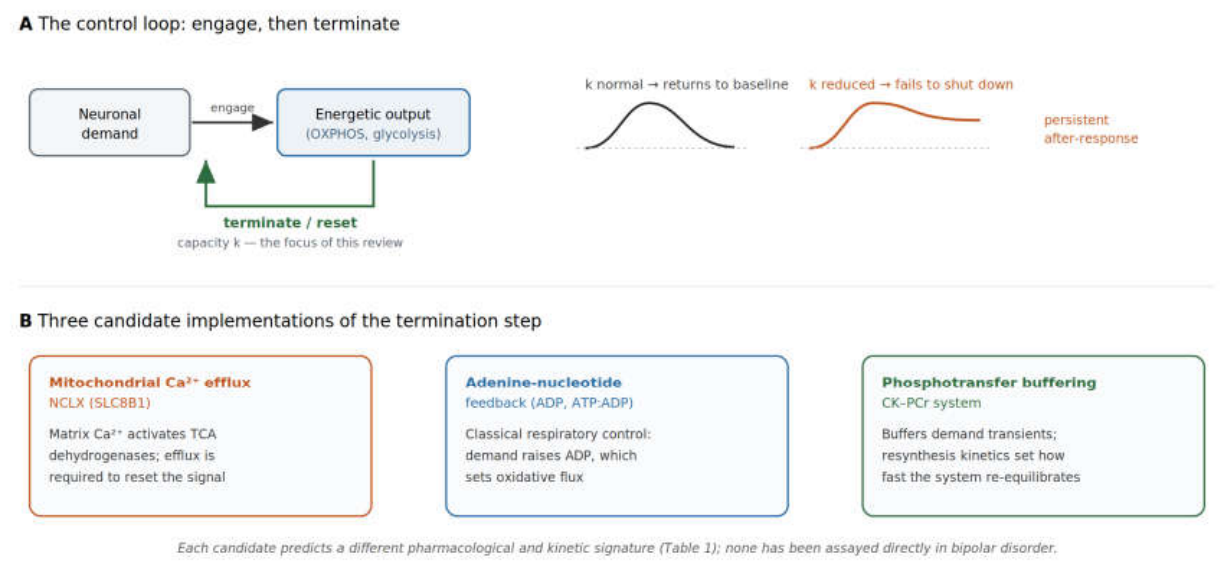
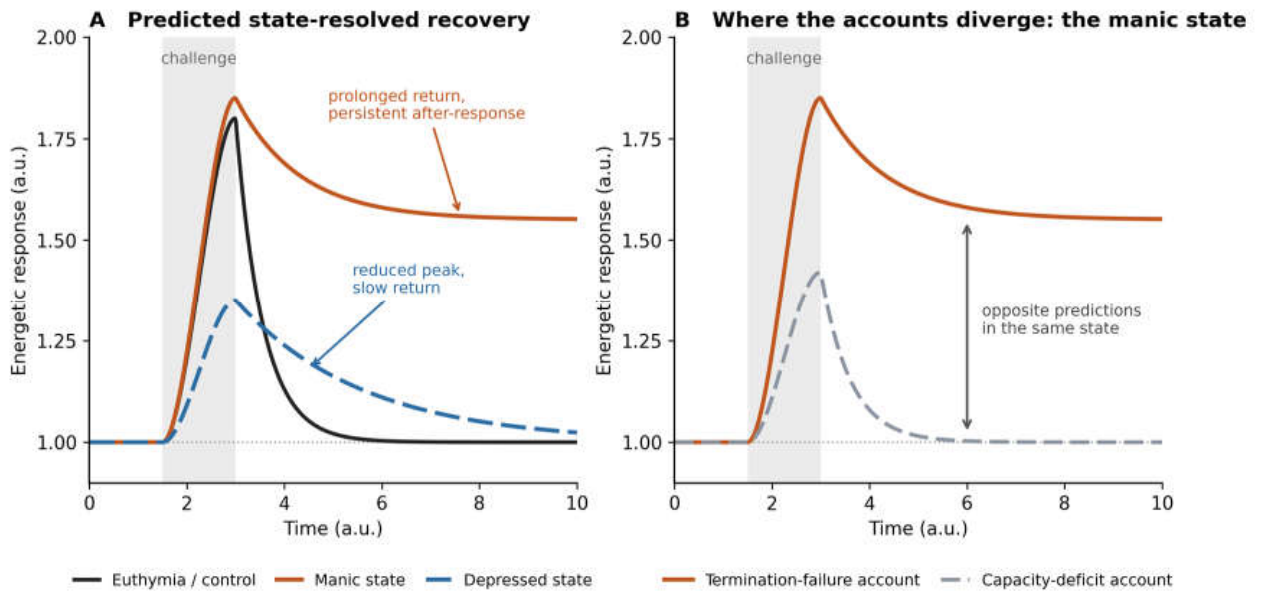
Figure 3.
Predicted recovery kinetics under a matched challenge-and-recovery paradigm. All traces are predictions, not observations. (A) In euthymia the response peaks and returns rapidly to baseline; the termination-failure account predicts prolonged return with a persistent after-response in the manic state, and reduced peak with slow return in the depressed state. (B) The point of divergence. In the manic state a capacity-deficit account predicts a reduced response, whereas the termination-failure account predicts a preserved peak followed by prolonged elevation — opposite predictions in the same state. Directions, not magnitudes, are specified (Section 6.2). This figure was produced with the assistance of an AI tool (Claude, Anthropic) and verified by the author.
4.1. Mitochondrial Ca²⁺ Efflux (NCLX)
If matrix Ca²⁺ clearance is slowed, dehydrogenase-driven flux would persist after demand has ceased. NCLX is the principal efflux route in excitable cells (Palty et al., 2010; Kostic and Sekler, 2019), making it a concrete candidate for the termination step.
Several observations establish that impaired NCLX function has consequences in the human central nervous system. A recessive missense SLC8B1 variant that slows NCLX-mediated efflux is associated with severe intellectual disability, and NCLX-deficient neurons show basal matrix Ca²⁺ overload, membrane depolarisation, and reduced amplitude and rate of both Ca²⁺ influx and efflux (Stavsky et al., 2021). Restoring NCLX activity is corrective: PKA-mediated phosphorylation reverses mitochondrial Ca²⁺ overload and depolarisation in stressed dopaminergic neurons (Kostic et al., 2015). Impaired efflux also shifts cells toward glycolysis and lactate release (Cabral-Costa et al., 2023), which is of interest given the lactate flux abnormality reported in BD (Bertocci and Diler, 2025) and the proposal that manic drive recruits glycolytic and glutaminolytic pathways (Campbell and Campbell, 2024).
Two points limit what can be concluded. First, the SLC8B1 phenotype is a developmental disorder, not BD; it establishes that the lesion is consequential, not that it occurs in BD. Second, NCLX function and mitochondrial Ca²⁺ efflux kinetics have not been measured in BD tissue, and we are not aware of SLC8B1 emerging from large-scale BD genetic or post-mortem transcriptomic studies, which to our knowledge have not implicated this gene. Both the absence of direct assays and the absence of genetic signal are informative, and the candidate should be weighed accordingly.
What makes it worth testing is adjacency to existing BD findings. NCLX and store-operated Ca²⁺ entry are reciprocally coupled, and store-operated entry is dysregulated in BD-derived neural progenitor cells (Hewitt et al., 2023); intracellular calcium abnormalities are among the more replicated findings in BD (Warsh et al., 2004); and calcium-related pathways recur in BD genetics (Psychiatric GWAS Consortium Bipolar Disorder Working Group, 2011). Independently, mice with brain-accumulated mtDNA deletions show spontaneous recurrent depression-like episodes, with the deletions concentrated in the paraventricular thalamic nucleus (Kasahara et al., 2016).
4.2. Adenine-Nucleotide Feedback
If ADP-mediated respiratory control were impaired, both engagement and termination would be affected, since the same signal governs the rise and fall of oxidative flux (Chance and Williams, 1956). This candidate therefore predicts a different pattern from the first: coupled rather than selective impairment. It also sits uneasily with the finding that adenine nucleotides are not the proximate error signal under physiological stimulation in neurons (Baeza-Lehnert et al., 2019). Including it is nonetheless necessary: it is the classical mechanism, it was not addressed in earlier formulations of this framework, and the Na⁺ pump–centred control it implicates has independent standing in BD. Reduced Na⁺/K⁺-ATPase activity has been reported in BD, inhibition of the pump by ouabain produces behavioural changes used as a model of mania that are reversed by lithium, and the same manipulation also produces hypoactivity (El-Mallakh and Wyatt, 1995; Valvassori et al., 2019).
4.3. Creatine Kinase–Phosphocreatine Phosphotransfer
If phosphotransfer were impaired, recovery would be slowed without necessarily altering peak output, since the system governs re-equilibration rather than the setting of flux. This candidate has the most direct existing support in BD: reduced creatine kinase forward-rate has been reported and proposed as a trait marker (Du et al., 2018), and PCr recovery kinetics are measurable with established methods. Its limitation is that it does not by itself explain why impairment should be state-dependent.
4.4. Evidence Grading
5. Does Impaired Termination Generate Cycling?
It is tempting to argue that a controller which fails to terminate will oscillate, and therefore that impaired termination explains the cyclic course of BD. We thought this worth testing rather than asserting, because weakened negative feedback does not by itself imply oscillation: it can equally produce a shifted steady state, a slower return, or bistability.
5.1. A Minimal Model
We used a deliberately minimal, phenomenological model. Let a denote activation of the energetic response and r a slower, activation-driven opposing process:
- (1)
- da/dt = u(t) + g·S(a) − (k + c·r)·a
- (2)
- dr/dt = ε·(a − r)
where u(t) is demand, S(a) a saturating function representing activation-dependent recruitment of further demand (positive feedback) with gain g, k the termination capacity, and c and ε the strength and rate of the slow opposing process. Impaired termination corresponds to reduced k. The model is not a model of any specific molecule; it represents the control architecture that all three candidates in Section 4 share. Code and parameters are provided in Appendix A.
5.2. Results
Three findings follow (Figure 4).
First, in the absence of positive feedback, reducing k slows the return to baseline without changing its form: the recovery time constant scales as 1/k, so a 50% reduction in termination capacity doubles recovery time (Figure 4A). This is the straightforward case and it is unambiguous.
Second, adding positive feedback produces latching rather than oscillation. Below a threshold value of k, a transient challenge moves the system to a persistently elevated state that outlasts the challenge indefinitely (Figure 4B). The system does not cycle; it fails to come back.
Third, sustained cycling requires both reduced k and a slow opposing process of sufficient strength. Mapping the model across k and c (Figure 4C) yields four regimes: normal return, latching, persistent elevation, and sustained cycling. Cycling occupies a restricted region of the parameter space — in our scan, roughly 6% of sampled parameter combinations — and requires the slow feedback to be strong relative to the termination deficit. Critically, the same value of k produces either cycling or persistent elevation depending on c (Figure 4D).
5.3. What this Means for the Framework
The honest conclusion is that impaired termination does not, by itself, explain cycling. It predicts slowed return, and under some conditions persistent elevation; cycling additionally requires a slow opposing process in a specific range. This is a weaker claim than the one the framework originally invited, and we state it as such.
It is also more useful, because it converts a rhetorical argument into conditions. If the framework is right about BD, then a slow opposing process with the required properties should be identifiable, and the model predicts that manipulating it should shift the system between cycling and persistent elevation without changing the termination deficit. Candidate slow processes — allostatic load, sleep–wake and circadian regulation, inflammatory signalling — are not addressed here and would need to be specified before this prediction could be tested. We note in passing that the regimes the model produces correspond loosely to clinical descriptions (recurrent episodes, chronic activation, treatment-resistant persistence), but we attach no weight to that correspondence: the model has no clinical calibration and the resemblance could be coincidental.
6. Pharmacological and Kinetic Tests
The value of naming candidates is that they can be separated experimentally. The tests below are ordered by tractability.
6.1. Pharmacological Discrimination in Neuronal Preparations
The candidates predict distinct signatures under targeted manipulation, which can be assessed in patient-derived neurons — platforms already used in BD, where iPSC-derived neurons and cerebral organoids show disease-relevant electrophysiological and mitochondrial phenotypes (Mertens et al., 2015; El Soufi El Sabbagh et al., 2025).
The mitochondrial Ca²⁺ efflux candidate is the most directly addressable, because selective tools exist. CGP-37157 inhibits NCLX-mediated mitochondrial Na⁺/Ca²⁺ exchange (Palty et al., 2010), and NCLX activity can be restored pharmacologically through PKA-mediated phosphorylation (Kostic et al., 2015). The prediction is specific: if impaired efflux underlies termination failure in BD-derived neurons, then NCLX inhibition in control neurons should reproduce the prolonged-return phenotype, and restoring NCLX activity in patient neurons should shorten return toward control values, with both effects appearing in return kinetics rather than in peak response. The specificity of CGP-37157 is imperfect (Palty et al., 2010), so genetic manipulation of SLC8B1 should accompany pharmacological work.
For adenine-nucleotide feedback, Na⁺/K⁺-ATPase inhibition with ouabain provides an established manipulation with behavioural validation in rodents (Valvassori et al., 2019). The prediction differs: impairment should affect peak and return together rather than selectively prolonging return.
For phosphotransfer, creatine loading and manipulation of creatine kinase activity alter the buffering capacity directly, predicting slowed return with preserved peak and without state dependence.
The essential design feature is that all three be assessed with the same challenge-and-recovery protocol, so that the measured quantity — the kinetics of return — is directly comparable across manipulations.
6.2. Dynamic Measurement in Patients
In human studies, the framework predicts that resting ATP/PCr will discriminate state poorly while challenge-based measures reveal abnormal return. Suitable paradigms include standardised cognitive load, sensory stimulation, or mild hypercapnia during ³¹P-MRS to quantify PCr depletion and resynthesis kinetics, with magnetisation transfer used to estimate phosphotransfer flux (Wallimann et al., 1992; Andres et al., 2008). The informative metrics are recovery time constants, after-response persistence, and within-person variability under matched perturbation.
We deliberately specify direction rather than magnitude. An earlier version of this framework proposed numerical thresholds for prolonged recovery and reduced peak; we withdraw them. The reliability estimates available for PCr recovery derive largely from skeletal muscle, cerebral protocols are less standardised, and quantitative thresholds that are not derived from brain-specific pilot data convey more precision than the evidence supports. The direction of effect — prolonged return in the manic state versus reduced peak in the depressed state (Figure 3A) — is the model-differentiating prediction, and thresholds should be set from pilot test–retest data for the specific protocol.
The practical obstacles are real: challenge paradigms for ³¹P-MRS in BD are not validated, and scanner time, state ascertainment, and medication status all constrain feasibility. Intensive within-person designs with single-subject replication should precede multi-site work, with each participant serving as their own euthymic control.
6.3. Specificity
Mitochondrial dysfunction, oxidative stress, and altered energy metabolism are highly transdiagnostic (Andreazza et al., 2010; Clay et al., 2011; Scaini et al., 2021; Zou et al., 2025), and we do not claim that dynamic measures escape this problem. Showing that return kinetics are abnormal in BD would not establish specificity; slowed recovery could equally reflect sleep loss, medication, activation, or illness severity. A convincing test requires comparison not only across BD mood states but against major depressive disorder, schizophrenia, attention-deficit/hyperactivity disorder, and experimentally sleep-deprived healthy participants. Until such comparisons exist, the specificity question is open, and our model results in Section 5 make the situation plainer: if cycling depends on a slow process rather than on the termination deficit alone, then specificity may reside in that slow process rather than in termination at all.
6.4. Lithium: A Hypothesis-Generating Observation
NCLX transports Ca²⁺ using Li⁺ as well as Na⁺, a property that distinguishes it among exchangers (Palty et al., 2004, 2010). This places lithium in biochemical contact with one of the candidate mechanisms, and it is a legitimate reason to include lithium in the experimental programme above.
It is not evidence that lithium acts therapeutically through this route, and we previously framed it more strongly than the data allow. Demonstrating that an exchanger can use Li⁺ in vitro is distant from demonstrating that therapeutic lithium exposure alters NCLX-mediated efflux in human neurons, still less that this contributes to prophylaxis. Lithium has multiple established actions, including neurotrophic and GSK-3-mediated effects and circadian stabilisation (Machado-Vieira et al., 2009), and reliable response biomarkers have proven difficult to establish (Fornaro et al., 2018). The claim we retain is narrow: if the efflux candidate is correct, then lithium responders should show shortened return kinetics under challenge, and this is worth measuring because it is cheap to add to studies already being done.
7. Limitations and Falsification
No direct evidence for termination failure in BD. The central proposition has not been tested. Return kinetics under matched challenge have not been measured across mood states, and none of the three candidate mechanisms has been assayed in BD tissue. This is the framework’s principal weakness.
The evidence base is thin. The dynamic ³¹P-MRS findings motivating the measurement programme come from a small number of studies with modest samples that have not been independently replicated in large pre-registered cohorts (Du et al., 2018; Yuksel et al., 2015). Oxidative-stress findings vary in effect size and carry transdiagnostic and medication confounds (Andreazza et al., 2008; Brown et al., 2014; Giménez-Palomo et al., 2024).
Confounding. Metabolic findings in BD could reflect consequences of episodes rather than primary control abnormalities. Sleep deprivation, altered activity and diet, and medication all affect mitochondrial function and calcium handling, and drug-free studies typically involve washout rather than medication-naïve status.
Risk of over-flexibility. Bioenergetic frameworks for BD have been criticised as able to accommodate almost any finding. We have tried to constrain this framework by committing to named candidates with divergent predictions (Table 1), by withdrawing quantitative claims that the evidence did not support (Section 6.2), and by reporting a model result that weakens rather than strengthens our original argument (Section 5).
What would falsify it. The framework predicts that return kinetics under matched challenge differ between mood states within individuals, with prolonged return in mania. If adequately powered within-person studies find that return kinetics do not differ across states, or that the manic state shows reduced peak with normal return — the pattern predicted by a pure capacity-deficit account — the central proposition is wrong. If pharmacological manipulation of all three candidate steps fails to alter return kinetics in patient-derived neurons, the candidates are wrong even if the framework is not. And if effective prophylaxis does not normalise return kinetics, the claim that termination is mechanistically central is substantially weakened.
Scope. Claims here concern neuronal, and possibly astrocytic, bioenergetic control. We have not addressed whether any abnormality would be uniform across brain regions. The existing in vivo BD literature is largely cortical, whereas the animal work most suggestive of regional specificity implicates the paraventricular thalamus (Kasahara et al., 2016) — a mismatch that regionally resolved designs would need to address.
8. Conclusion
We have argued that the bioenergetic literature on BD has characterised one arm of a two-arm control system. Engagement has been measured; termination has not. This is a gap in measurement coverage, and it can be closed with existing methods.
We have named three candidate implementations of the termination step, set out what each predicts, and graded the evidence for each — which, for the termination step itself, is in every case indirect. We have also tested the framework’s most appealing claim and found it wanting: impaired termination alone does not generate cycling, and the conditions under which it does are specific enough to be stated and tested.
What remains is a bounded proposal. Return kinetics are measurable, the candidate mechanisms are pharmacologically separable, and the predictions diverge from those of a capacity-deficit account in the manic state specifically. We offer it not as an account of bipolar disorder but as a set of experiments worth doing.
CRediT authorship contribution statement: Yehu Eom: Conceptualization, Writing – original draft, Writing – review and editing.
Data availability: No new data were generated. Code for the model in Section 5 is provided in Appendix A.
Declaration of competing interest: The author declares no competing interests.
Declaration of generative AI and AI-assisted technologies in the writing process: During the preparation of this work the author used Claude (Anthropic) to support literature searching, to identify and compare candidate molecular mechanisms for the control step proposed by the author, to implement and run the computational model reported in Section 5, to generate Figure 1, Figure 2, Figure 3 and Figure 4, and to draft and edit the manuscript. The conceptual framework — that bipolar disorder may involve a failure to terminate demand-driven energetic upregulation — is the author’s own. After using this tool the author reviewed and edited all content, verified all scientific claims and references, and takes full responsibility for the content of the publication.
Appendix A. Model Code
Python code implementing the model in Section 5 (Eqs. 1–2) and the parameter scan underlying Figure 4C. Requires NumPy and SciPy.
“””Positivity-preserving minimal control-loop model (used in manuscript).da/dt = u(t) + g*S(a) - (k + c*r)*a fast activation/flux (a >= 0 guaranteed if u >= 0)dr/dt = eps*(a - r) slow activation-driven negative processk : termination capacity; g: activation-dependent recruitment (positive feedback)c : strength of slow negative feedback; eps: its rate (eps << 1)“””import numpy as npfrom scipy.integrate import solve_ivpdef S(a, theta=1.0, n=4): a = np.maximum(a, 0.0) return a**n/(a**n + theta**n)def rhs(t, y, k, g, c, eps, u0, pulse): a, r = y u = u0 + (pulse[2] if pulse and pulse[0] <= t < pulse[1] else 0.0) return [u + g*S(a) - (k + c*r)*a, eps*(a - r)]def simulate(k, g=0.0, c=0.0, eps=0.0, u0=0.2, pulse=None, T=200, y0=None, dt=0.05): if y0 is None: y0 = [u0/k, u0/k] t_eval = np.arange(0, T, dt) sol = solve_ivp(rhs, (0, T), y0, t_eval=t_eval, args=(k, g, c, eps, u0, pulse), rtol=1e-8, atol=1e-10, max_step=0.1) return sol.t, sol.yimport numpy as np, time, jsonfrom scipy.integrate import solve_ivpg, u0, eps = 2.0, 0.5, 0.02ks = np.round(np.linspace(0.1, 2.5, 25), 3)cs = np.round(np.linspace(0.0, 2.0, 21), 3)def run(k, c, pulse): sol = solve_ivp(rhs, (0, 1500), [0.05, 0.05], t_eval=np.arange(0,1500,0.25), args=(k, g, c, eps, u0, pulse), rtol=1e-7, atol=1e-9, max_step=0.5) return sol.t, sol.y[0]t0=time.time()codes = np.zeros((len(cs), len(ks)), dtype=int)for i,c in enumerate(cs): for j,k in enumerate(ks): t,a1 = run(k,c,None) late1 = a1[t>900] if late1.max()-late1.min() > 0.05: codes[i,j] = 2; continue # oscillation t,a2 = run(k,c,(300,303,2.0)) late2 = a2[t>900] if late2.max()-late2.min() > 0.05: codes[i,j] = 2; continue lo, hi = late1.mean(), late2.mean() if hi - lo > 0.3: codes[i,j] = 1 # latching / bistable elif lo > 1.0: codes[i,j] = 3 # persistent elevation (monostable high) else: codes[i,j] = 0 # normal returnprint(f”elapsed {time.time()-t0:.1f}s”)lab = {0:‘.’,1:‘B’,2:‘O’,3:‘H’}print(“c\\k “ + “”.join(f”{k:5.1f}” for k in ks[::2]))for i,c in enumerate(cs): print(f”{c:3.1f} “ + “”.join(f”{lab[codes[i,j]]:>5}” for j in range(0,len(ks),2)))np.save(“codes.npy”, codes); json.dump({“ks”:ks.tolist(),”cs”:cs.tolist()}, open(“grid.json”,”w”))unique, counts = np.unique(codes, return_counts=True)print({lab[u]:int(n) for u,n in zip(unique,counts)}, “of”, codes.size)
References
- Andreazza, A.C.; Kauer-Sant’Anna, M.; Frey, B.N.; Bond, D.J.; Kapczinski, F.; Young, L.T. Oxidative stress markers in bipolar disorder: a meta-analysis. J. Affect. Disord. 2008, 111, 135–144. [Google Scholar] [CrossRef]
- Andreazza, A.C.; Shao, L.; Wang, J.F.; Young, L.T. Mitochondrial complex I activity and oxidative damage to mitochondrial proteins in the prefrontal cortex of patients with bipolar disorder. Arch. Gen. Psychiatry 2010, 67, 360–368. [Google Scholar] [CrossRef]
- Andres, R.H.; Ducray, A.D.; Schlattner, U.; Wallimann, T.; Widmer, H.R. Functions and effects of creatine in the central nervous system. Brain Res. Bull. 2008, 76, 329–343. [Google Scholar] [CrossRef]
- Baeza-Lehnert, F.; Saab, A.S.; Gutiérrez, R.; Larenas, V.; Díaz, E.; Horn, M. Non-canonical control of neuronal energy status by the Na⁺ pump. Cell Metab. 2019, 29, 668–680.e4. [Google Scholar] [CrossRef]
- Berk, M.; Walder, K.; Kim, J.H. Past, present and future of research on brain energy metabolism in bipolar disorder. World Psychiatry 2025, 24, 47–49. [Google Scholar] [CrossRef]
- Bertocci, M.A.; Diler, R.S. Lactate flux dysfunction in patients with bipolar disorder: preliminary insights from ultra-high field 7T MRSI during task and rest. Front. Neurosci. 2025, 19, 1587011. [Google Scholar] [CrossRef]
- Brown, N.C.; Andreazza, A.C.; Young, L.T. An updated meta-analysis of oxidative stress markers in bipolar disorder. Psychiatry Res. 2014, 218, 61–68. [Google Scholar] [CrossRef]
- Cabral-Costa, J.V. Mitochondrial sodium/calcium exchanger NCLX regulates glycolysis in astrocytes, impacting on cognitive performance. J. Neurochem. 2023, 165, 521–535. [Google Scholar] [CrossRef]
- Campbell, I.H.; Campbell, H. The metabolic overdrive hypothesis: hyperglycolysis and glutaminolysis in bipolar mania. Mol. Psychiatry 2024, 29, 1521–1527. [Google Scholar] [CrossRef]
- Chance, B.; Williams, G.R. The respiratory chain and oxidative phosphorylation. Adv. Enzymol. Relat. Subj. Biochem. 1956, 17, 65–134. [Google Scholar] [CrossRef]
- Clay, H.B.; Sillivan, S.; Konradi, C. Mitochondrial dysfunction and pathology in bipolar disorder and schizophrenia. Int. J. Dev. Neurosci. 2011, 29, 311–324. [Google Scholar] [CrossRef]
- Dager, S.R.; Friedman, S.D.; Parow, A.; Demopulos, C.; Stoll, A.L.; Lyoo, I.K. Brain metabolic alterations in medication-free patients with bipolar disorder. Arch. Gen. Psychiatry 2004, 61, 450–458. [Google Scholar] [CrossRef]
- Denton, R.M. Regulation of mitochondrial dehydrogenases by calcium ions. Biochim. Biophys. Acta 2009, 1787, 1309–1316. [Google Scholar] [CrossRef]
- Du, F.; Yuksel, C.; Chouinard, V.A.; Huynh, P.; Ryan, K.; Cohen, B.M. Abnormalities in high-energy phosphate metabolism in first-episode bipolar disorder measured using ³¹P-magnetic resonance spectroscopy. Biol. Psychiatry 2018, 84, 797–802. [Google Scholar] [CrossRef]
- El-Mallakh, R.S.; Wyatt, R.J. The Na,K-ATPase hypothesis for bipolar illness. Biol. Psychiatry 1995, 37, 235–244. [Google Scholar] [CrossRef]
- El Soufi El Sabbagh, D.; Machado, A.K.; Pappis, L.; Beroncal, E.L.; Ji, D.; Nader, G. iPSC-derived cerebral organoids reveal mitochondrial, inflammatory and neuronal vulnerabilities in bipolar disorder. Transl. Psychiatry 2025, 15, 315. [Google Scholar] [CrossRef]
- Fornaro, M.; De Berardis, D.; Anastasia, A.; Novello, S.; Fusco, A.; Cattaneo, C.I. The identification of biomarkers predicting acute and maintenance lithium treatment response in bipolar disorder: a plea for further research attention. Psychiatry Res. 2018, 269, 658–672. [Google Scholar] [CrossRef]
- Giménez-Palomo, A.; Andreu, H.; de Juan, O.; Olivier, L.; Ochandiano, I.; Ilzarbe, L. Mitochondrial dysfunction as a biomarker of illness state in bipolar disorder: a critical review. Brain Sci. 2024, 14, 1199. [Google Scholar] [CrossRef]
- Glancy, B.; Balaban, R.S. Role of mitochondrial Ca²⁺ in the regulation of cellular energetics. Biochemistry 2012, 51, 2959–2973. [Google Scholar] [CrossRef]
- Grande, I.; Berk, M.; Birmaher, B.; Vieta, E. Bipolar disorder. Lancet 2016, 387, 1561–1572. [Google Scholar] [CrossRef]
- Hewitt, T.; Alural, B.; Tilak, M.; Wang, J.; Becke, N.; Chartley, E. Bipolar disorder-iPSC derived neural progenitor cells exhibit dysregulation of store-operated Ca²⁺ entry and accelerated differentiation. Mol. Psychiatry 2023, 28, 5237–5250. [Google Scholar] [CrossRef]
- Kasahara, T.; Takata, A.; Kato, T.M.; Kubota-Sakashita, M.; Sawada, T.; Kakita, A. Depression-like episodes in mice harboring mtDNA deletions in paraventricular thalamus. Mol. Psychiatry 2016, 21, 39–48. [Google Scholar] [CrossRef]
- Kato, T.; Takahashi, S.; Shioiri, T.; Inubushi, T. Brain phosphorous metabolism in depressive disorders detected by phosphorus-31 magnetic resonance spectroscopy. J. Affect. Disord. 1992, 26, 223–230. [Google Scholar] [CrossRef]
- Kato, T.; Takahashi, S.; Shioiri, T.; Inubushi, T. Alterations in brain phosphorous metabolism in bipolar disorder detected by in vivo ³¹P and ⁷Li magnetic resonance spectroscopy. J. Affect. Disord. 1993, 27, 53–59. [Google Scholar] [CrossRef]
- Kato, T.; Murashita, J.; Kamiya, A.; Shioiri, T.; Kato, N.; Inubushi, T. Decreased brain intracellular pH measured by ³¹P-MRS in bipolar disorder: a confirmation in drug-free patients and correlation with white matter hyperintensity. Eur. Arch. Psychiatry Clin. Neurosci. 1998, 248, 301–306. [Google Scholar] [CrossRef]
- Kostic, M.; Sekler, I. Functional properties and mode of regulation of the mitochondrial Na⁺/Ca²⁺ exchanger, NCLX. Semin. Cell Dev. Biol. 2019, 94, 59–65. [Google Scholar] [CrossRef]
- Kostic, M.; Katoshevski, T.; Sekler, I. Allosteric regulation of NCLX by mitochondrial membrane potential links the metabolic state and Ca²⁺ signaling in mitochondria. Cell Rep. 2018, 25, 3465–3475.e4. [Google Scholar] [CrossRef]
- Kostic, M.; Ludtmann, M.H.R.; Bading, H.; Hershfinkel, M.; Steer, E.; Chu, C.T. PKA phosphorylation of NCLX reverses mitochondrial calcium overload and depolarization, promoting survival of PINK1-deficient dopaminergic neurons. Cell Rep. 2015, 13, 376–386. [Google Scholar] [CrossRef]
- Machado-Vieira, R.; Manji, H.K.; Zarate, C.A. The role of lithium in the treatment of bipolar disorder: convergent evidence for neurotrophic effects as a unifying hypothesis. Bipolar Disord. 2009, 11 (Suppl. 2), 92–109. [Google Scholar] [CrossRef]
- Merikangas, K.R.; Jin, R.; He, J.P.; Kessler, R.C.; Lee, S.; Sampson, N.A. Prevalence and correlates of bipolar spectrum disorder in the world mental health survey initiative. Arch. Gen. Psychiatry 2011, 68, 241–251. [Google Scholar] [CrossRef]
- Meyer, D.J.; Díaz-García, C.M.; Nathwani, N.; Rahman, M.; Yellen, G. The Na⁺/K⁺ pump dominates control of glycolysis in hippocampal dentate granule cells. eLife 2022, 11, e81645. [Google Scholar] [CrossRef]
- Mertens, J.; Wang, Q.W.; Kim, Y.; Yu, D.X.; Pham, S.; Yang, B. Differential responses to lithium in hyperexcitable neurons from patients with bipolar disorder. Nature 2015, 527, 95–99. [Google Scholar] [CrossRef]
- Palty, R.; Ohana, E.; Hershfinkel, M.; Volokita, M.; Elgazar, V.; Beharier, O. Lithium-calcium exchange is mediated by a distinct potassium-independent sodium-calcium exchanger. J. Biol. Chem. 2004, 279, 25234–25240. [Google Scholar] [CrossRef]
- Palty, R.; Silverman, W.F.; Hershfinkel, M.; Caporale, T.; Sensi, S.L.; Parnis, J. NCLX is an essential component of mitochondrial Na⁺/Ca²⁺ exchange. Proc. Natl. Acad. Sci. U. S. A. 2010, 107, 436–441. [Google Scholar] [CrossRef]
- Phillips, M.L.; Kupfer, D.J. Bipolar disorder diagnosis: challenges and future directions. Lancet 2013, 381, 1663–1671. [Google Scholar] [CrossRef]
- Psychiatric GWAS Consortium Bipolar Disorder Working Group. Large-scale genome-wide association analysis of bipolar disorder identifies a new susceptibility locus near ODZ4. Nat. Genet. 2011, 43, 977–983. [Google Scholar] [CrossRef]
- Rizzuto, R.; De Stefani, D.; Raffaello, A.; Mammucari, C. Mitochondria as sensors and regulators of calcium signalling. Nat. Rev. Mol. Cell Biol. 2012, 13, 566–578. [Google Scholar] [CrossRef]
- Scaini, G.; Andrews, T.; Lima, C.N.C.; Benevenuto, D.; Streck, E.L.; Quevedo, J. Mitochondrial dysfunction as a critical event in the pathophysiology of bipolar disorder. Mitochondrion 2021, 57, 23–36. [Google Scholar] [CrossRef]
- Stavsky, A.; Stoler, O.; Kostic, M.; Katoshevsky, T.; Assali, E.A.; Savic, I. Aberrant activity of mitochondrial NCLX is linked to impaired synaptic transmission and is associated with mental retardation. Commun. Biol. 2021, 4, 666. [Google Scholar] [CrossRef]
- Stork, C.; Renshaw, P.F. Mitochondrial dysfunction in bipolar disorder: evidence from magnetic resonance spectroscopy research. Mol. Psychiatry 2005, 10, 900–919. [Google Scholar] [CrossRef]
- Valvassori, S.S.; Dal-Pont, G.C.; Resende, W.R.; Varela, R.B.; Lopes-Borges, J.; Cararo, J.H. Validation of the animal model of bipolar disorder induced by ouabain: face, construct and predictive perspectives. Transl. Psychiatry 2019, 9, 158. [Google Scholar] [CrossRef]
- Wallimann, T.; Wyss, M.; Brdiczka, D.; Nicolay, K.; Eppenberger, H.M. Intracellular compartmentation, structure and function of creatine kinase isoenzymes in tissues with high and fluctuating energy demands: the ‘phosphocreatine circuit’ for cellular energy homeostasis. Biochem. J. 1992, 281, 21–40. [Google Scholar] [CrossRef]
- Warsh, J.J.; Andreopoulos, S.; Li, P.P. Role of intracellular calcium signaling in the pathophysiology and pharmacotherapy of bipolar disorder: current status. Clin. Neurosci. Res. 2004, 4, 201–213. [Google Scholar] [CrossRef]
- Yuksel, C.; Du, F.; Ravichandran, C.; Goldbach, J.R.; Thida, T.; Lin, P. Abnormal high-energy phosphate molecule metabolism during regional brain activation in patients with bipolar disorder. Mol. Psychiatry 2015, 20, 1079–1084. [Google Scholar] [CrossRef]
- Zou, S.; Mendes-Silva, A.P.; Dos Santos, F.C.; Ebrahimi, M.; Kennedy, J.L.; Goncalves, V.F. Multi-omics analysis of energy metabolism pathways across major psychiatric disorders. Mol. Neurobiol. 2025, 62, 13272–13285. [Google Scholar] [CrossRef]
Figure 4.
Behaviour of the minimal control-loop model (Eqs. 1–2). (A) Without positive feedback, reducing termination capacity k slows the return to baseline, with the recovery time constant scaling as 1/k; traces are normalised to the end of the challenge. (B) With positive feedback, reducing k below a threshold causes latching: a transient challenge moves the system to a persistently elevated state. (C) Regimes across termination capacity k and slow-feedback strength c: normal return, latching, persistent elevation, and sustained cycling. Cycling occupies a restricted region and requires both reduced k and sufficiently strong slow feedback. Markers indicate the parameter values used in (D). (D) The same termination deficit (k = 0.3) produces either sustained cycling or persistent elevation depending on c. This figure was generated from the model code provided in Appendix A, with the assistance of an AI tool (Claude, Anthropic), and verified by the author.
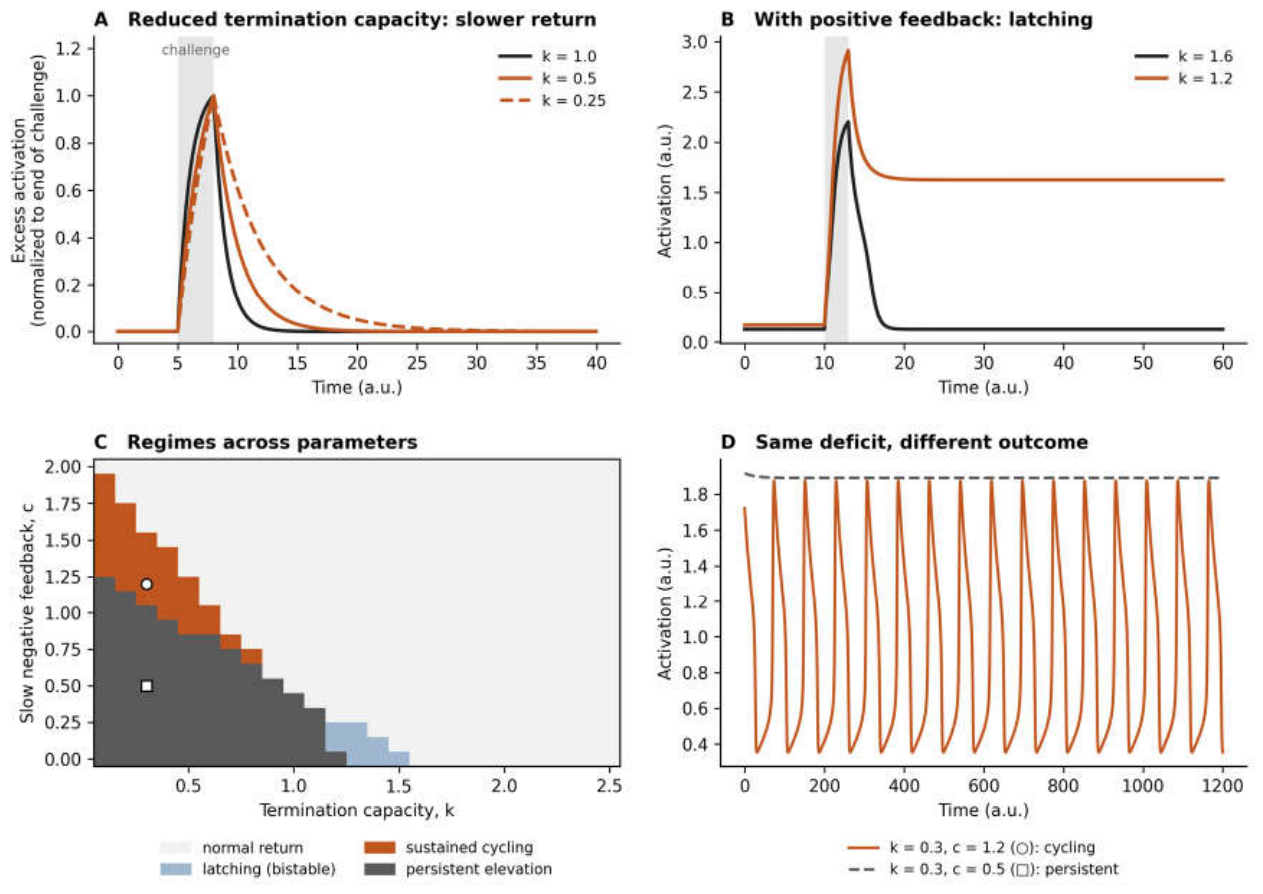

Table 1.
Candidate implementations of the termination step. Evidence is graded as: direct in BD (measured in BD tissue or patients); indirect (established in other systems); inferred (our reasoning, not measured).
Table 1.
Candidate implementations of the termination step. Evidence is graded as: direct in BD (measured in BD tissue or patients); indirect (established in other systems); inferred (our reasoning, not measured).
| Mitochondrial Ca²⁺ efflux (NCLX) | Adenine-nucleotide feedback | CK–PCr phosphotransfer | |
|---|---|---|---|
| Proposed role in termination | Matrix Ca²⁺ extrusion removes the signal that raised oxidative flux | ADP falls as demand ceases, withdrawing respiratory drive | Sets the rate at which the phosphate network re-equilibrates |
| Evidence that the step operates as described | Indirect: established in neurons and other excitable cells (Palty et al., 2010; Kostic and Sekler, 2019) | Indirect, and contested in neurons under physiological load (Chance and Williams, 1956; Baeza-Lehnert et al., 2019) | Indirect: well established biochemistry (Wallimann et al., 1992) |
| Evidence that impairment is consequential | Indirect: human SLC8B1 variant causes neurological disease (Stavsky et al., 2021) | Indirect: pump inhibition produces behavioural change in rodents (Valvassori et al., 2019) | Indirect: established buffering role in brain (Andres et al., 2008) |
| Evidence in bipolar disorder | None direct; adjacent calcium findings only (Hewitt et al., 2023; Warsh et al., 2004) | Indirect: reduced Na⁺/K⁺-ATPase activity reported (El-Mallakh and Wyatt, 1995) | Direct: reduced CK forward-rate reported (Du et al., 2018) |
| Distinguishing kinetic prediction | Selective prolongation of return with preserved peak | Coupled impairment of peak and return | Slowed return with preserved peak, without state dependence |
| Pharmacological probe | NCLX inhibition (CGP-37157) or activity restoration (Section 6.1) | Na⁺/K⁺-ATPase inhibition (ouabain) | Creatine loading; CK manipulation |
The table makes the overall evidentiary position explicit. No candidate has direct support in BD for the termination step itself; one has direct BD support for a related measure; and the chain from any candidate to BD phenomenology is, at present, inference.
Disclaimer/Publisher’s Note: The statements, opinions and data contained in all publications are solely those of the individual author(s) and contributor(s) and not of MDPI and/or the editor(s). MDPI and/or the editor(s) disclaim responsibility for any injury to people or property resulting from any ideas, methods, instructions or products referred to in the content. |
© 2026 by the author. Licensee MDPI, Basel, Switzerland. This article is an open access article distributed under the terms and conditions of the Creative Commons Attribution (CC BY) license.
Copyright: This open access article is published under a Creative Commons CC BY 4.0 license, which permit the free download, distribution, and reuse, provided that the author and preprint are cited in any reuse.