Preprint
Article

This version is not peer-reviewed.

Anatomical Variations in the Near-Endemic Ebenus armitagei Across the Past 80 Years of Climate Change

Submitted:

17 October 2026

Posted:

19 October 2026

You are already at the latest version

Abstract

Ebenus armitagei Schweinf. et Taub is a near-endemic species in Egypt and Libya. The IUCN has listed E. armitagei as endangered since 1997. Global warming may harm the plant’s environment, increasing its extinction risk. This study examines the leaf anatomical adaptations to different climatic parameters over the past 80 years. At Ras El-Hekma, Egypt, we collected leaves from herbarium specimens in 1954, 1964, and 2006 and filed samples in 2024 to study descriptive and quantitative traits. Leaf shapes, mesophyll tissue, and central vascular bundles were described. Quantitative traits included leaf blade thickness, cross-sectional areas of adaxial and abaxial idioblasts, vascular xylem, phloem, sclerenchyma, xylem diameters, and their hydraulic conductance. All descriptive traits remained constant over time, indicating their fundamental role in plant adaptation to arid deserts. In contrast, all quantitative traits increased from 1954 to 2006 and decreased towards 2024, illustrating significant retardation in plant survival mechanisms recently. The quantitative traits exhibited strong negative responses to rainfall change patterns. In addition, the adaxial idioblast area showed two more negative relationships with air and soil temperatures. Rainfall was a primary climate driver for quantitative traits over the studied years, along with air and soil temperatures for the adaxial idioblast area.

Keywords: 
;  ;  ;  ;  

1. Introduction

Global climate change is a significant shift in Earth’s climatic elements over decades or centuries. These significant climatic changes have attracted global attention owing to their obvious effects on many aspects, such as human and environmental health, socio-economic activities, and natural resource availability [1,2]. The Egyptian Northwestern Coastal Zone (ENWCZ) is an obvious example of considerable climate change and its dramatic impact on humans and natural resource availability. The ENWCZ has been described as a Mediterranean food basket because of its massive food supply for the entire Mediterranean basin, two or three millennia ago. Currently, the ENWCZ is described as desert land inhabited by pastoral societies, depending on livestock breeding and limited agricultural activities [3,4]. Relative to these societies, major shifts towards urbanization in the ENWCZ were due to a drought wave hitting this zone from 1995 to 2010. As evidence, the Bedouin inhabitants of this zone described that drought wave as “never seen drought” or “never heard drought in the 20th century” [3,4]. Such catastrophic impacts of climate change on the ENWCZ threaten the survival of wild plants in this region, especially endemic and near-endemic plants. Both endemic and near-endemic plants are most vulnerable to climate change due to their limited geographical distributions [5,6]. Therefore, severe disturbances to their limited habitats increase the susceptibility as endemic and rare wild species to extinction.
Ebenus armitagei Schweinf. et Taub. (Family: Fabaceae) is a near-endemic plant species recorded in Egypt and Libya [7]. In Egypt, E. armitagei has been found in three populations inhabiting the Egyptian northwestern coastal zone (ENWCZ) [8,9]. One population is found in the El Omayed biosphere reserve, and the other two populations in Ras El Hekma, and Salloum costal areas [8]. Conversely, E. armitagei is also distributed in the northeastern part of Libya [10] in three habitats namely; Badia near Al Jabal Al Akhdar, Marmarica region [11], and El-Bardia, a Mediterranean port in the Butnan District of eastern Libya near the Egyptian borders [7]. Since 1997, The International Union for Conservation of Nature (IUCN) listed E. armitagei as an endangered species [12]. There are many reasons for the plant rarity, both natural and anthropogenic causes. The natural rarity causes are due to plant species endemism, the plant’s seeds’ predation by Callosobruchus maculatus (Fabricius, 1775) (Coleoptera: Chrysomelidae) [8,13], and seed dispersions by winds into other locations with non-favorable germination conditions. Anthropogenic rarity is caused by the plant’s habitat change through tourist resorts’ constructions, and overgrazing of the species due to its values as a forage [8]. In addition to these known rarity reasons, climate change may worsen the in-situ status of E. armitagei, accelerating the extinction of the plant species.
The survival of E. armitagei under such environmental stresses indicates its ability to develop adaptive mechanisms that enable it to resist the stress conditions. Therefore, it is important to explore these adaptive mechanisms to enhance the in-situ plant’s adaptive characteristics.
Herbarium specimens play a significant role in explaining plant biological responses to climate change. Herbarium specimens are considered a massive historical repository of morphological, anatomical, biochemical, and molecular functional traits at the temporal and spatial levels [14,15,16,17,18]. Therefore, analysis of the herbarium functional traits of E. armitagei in response to temporal changes is a critical step for understanding plant adaptations over decades or centuries, hence informing the possible conservation of the species.
This study aimed to examine the anatomical adaptive characters of E. armitagei leaves in response to changes in different climate parameters over the past 80 years to explore possible conservation mechanisms.

2. Results

2.1. Descriptive Traits

Over the past 80 years, E. armitagei develops some conserved characters related to the leaf shape, leaf tissue structure of the ground and vascular tissues. The plant leaves are compound leaves with obovate leaflets characterized by acute apex, entire margin, cuneate base, and glandular trichomes on the adaxial and abaxial surfaces (Figure 1). Similarly, in Figure 1.A and B of herbarium and fresh leaves respectively, the leaf tissues are bordered by single-cell layer of epidermis with barrel-shaped cells at the adaxial and abaxial leaf surfaces. The leaf ground tissues consist of fairly compact adaxial and abaxial palisades with tiny airspaces. There are enlarged, densely colored cells known as idioblasts located in the abaxial and adaxial palisades. The abaxial idioblasts distribute as a disrupted strip of rounded and oblong-shaped cells, whereas the adaxial idioblasts are distributed as separate large oblong cells. The leaf vascular tissues, the sclerenchyma, phloem, and xylem, are organized into a collateral central vascular bundle located in the leaf midrib (Figure 1.A and B). As the xylem vessels and the phloem tissue are arranged in the bundle side by side, xylem vessels pointed towards the leaf adaxial palisade and phloem faced leaf abaxial epidermis.

2.2. Measurable Traits

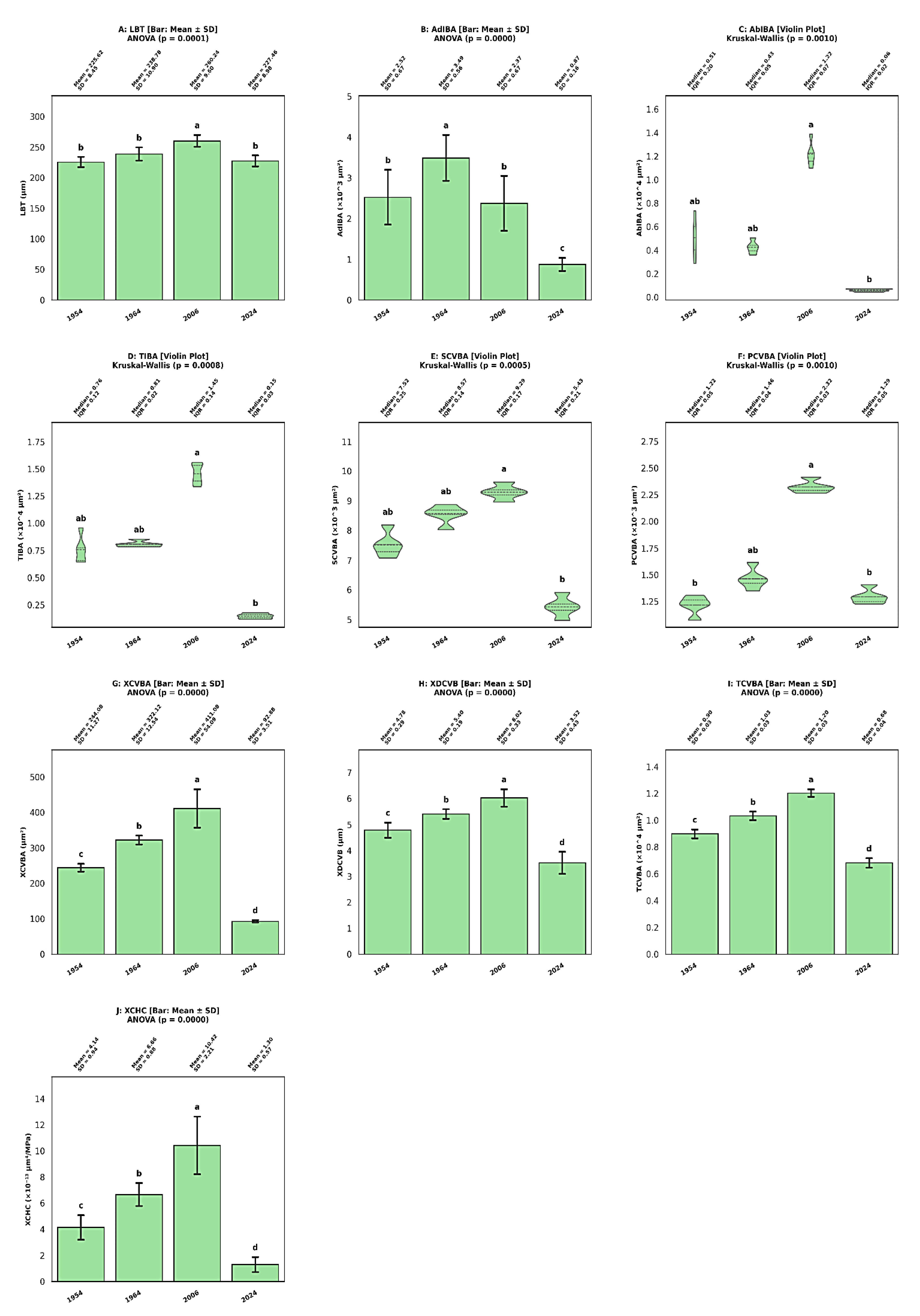
The anatomical adaptations exhibited by E. armitagei leaves across decades are examined focusing on ten traits which are (1) leaf blade thickness (LBT), (2) adaxial idioblast area (AdIBA), (3) abaxial idioblast area (AbIBA), (4) total idioblast area (TIBA), central vascular bundle parameters: (5) sclerenchyma area (SCVBA), (6) phloem area (PCVBA), (7) xylem area (XCVBA), (8) total bundle area (TVBA), (9) xylem vessels diameter (XDCVB), and (10) hydraulic conductivity of xylem vessels (XCHC) (Figure 2).
There is a slight increase of LBT from 225.62 ± 8.45 µm in 1954 to 238.78 ± 10.9 µm in 1964 followed by a significant increase to 260.24 ± 9.6 µm in 2006, then a significant decrease to 227.46 ± 8.98 µm in 2024 (Figure 2. A).
AdIBA increases significantly from 2.52 ± 0.67 x 103 µm2 in 1954 to 3.49 ± 0.56 x 103 µm2 in 1964, then decreases significantly to 2.37 ± 0.67 x 103 µm2 in 2006 to 0.87 ± 0.16 x 103 µm2 in 2024 (Figure 2. B). AbIBA decreases slightly from 0.51 (0.2) × 10^4 µm^2 in 1954 to 0.43 (0.05) x 104 µm2 in 1964 to 1.22 (0.07) x 104 µm2 in 2006, then decreases significantly to 0.06 (0.02) x 104 µm2 in 2024 (Figure 2. C). TIBA increases slightly from 0.76 (0.12) x 104 µm2 in 1954 to 0.81 (0.02) x 104 µm2 in 1964, then increases significantly to 1.45 (0.14) x 104 µm2 in 2006, then decreases significantly to 0.15 (0.03) x 104 µm2 in 2024 (Figure 2. D).
There is a slight increase of SCVBA from 7.52 (0.25) x 103 µm2 in 1954 to 8.57 (0.14) x 103 µm2 in 1964 to a significant increase to 9.29 (0.17) x 103 µm2 in 2006, followed by a significant decrease to 5.43 (0.21) x 103 µm2 in 2024 (Figure 2. E). Similar to SCVBA, there is a slight increase of PCVBA from 1.22 (0.05) x 103 µm2 in 1954 to 1.46 (0.04) x 103 µm2 in 1964 to a significant increase to 2.32 (0.03) x 103 µm2 in 2006, followed by a significant decrease to 1.29 (0.05) x 103 µm2 in 2024 (Figure 2. F). XCVBA increases significantly from 244.08 ± 11.27 µm2 in 1954 to 322.12 ± 12.54 µm2 in 1964, to 411.08 ± 54.09 µm2 in 2006, then decreases significantly to 92.88 ± 3.51 µm2 in 2024 (Figure 2. G). Similar to XCVBA, XDCVB increases significantly from 4.78 ± 0.29 µm in 1954 to 5.40 ± 0.19 µm in 1964, to 6.02 ± 0.33 µm in 2006, then decreases significantly to 3.52 ± 0.43 µm in 2024 (Figure 2. H). Similar to XCVBA and XDCVB, TCVBA increases significantly from 0.9 ± 0.03 x 104 µm2 in 1954 to 1.03 ± 0.03 x 104 µm2 in 1964, to 1.2 ± 0.03 x 104 µm2 in 2006, then decreases significantly to 0.68 ± 0.04 x 104 µm2 in 2024 (Figure 2. I).
Similar to XCVBA, XDCVB and TCVBA, XCHC increases significantly from 4.14 ± 0.94 x 10⁻¹³ µm4/MPa in 1954 to 6.66 ± 0.88 x 10⁻¹³ µm4/MPa in 1964, to 10.42 ± 2.21 x 10⁻¹³ µm4/MPa in 2006, then decreases significantly to 1.3 ± 0.57 x 10⁻¹³ µm4/MPa in 2024 (Figure 2. J).

3. Discussion

3.1. Decadal Climate Data

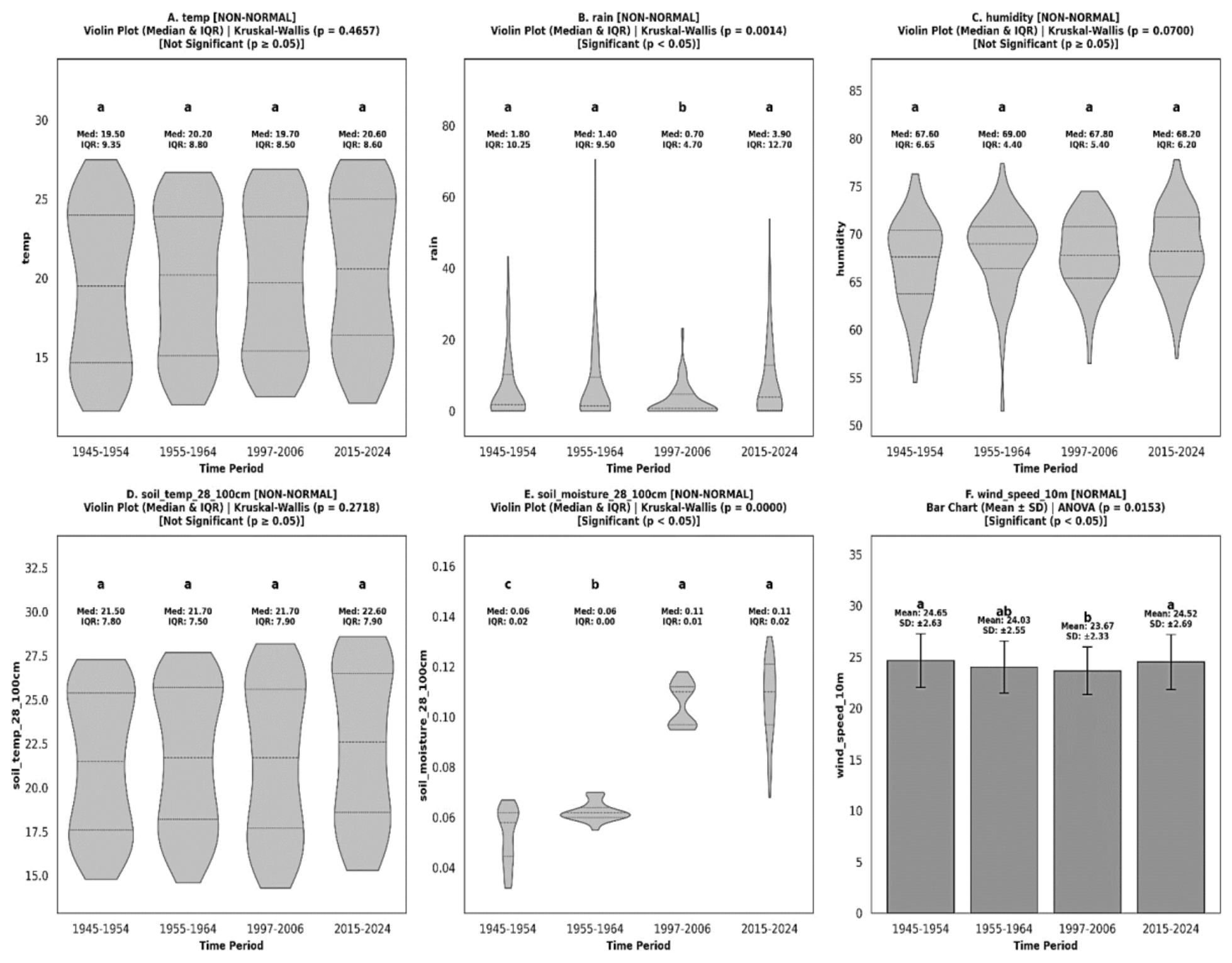
The studied climatic parameters are (1) air temperatures, (2) rainfall amounts, (3) relative humidity, (4) temperature and (5) moisture of soil at a depth range of 28-100 cm below the soil surface, and (6) wind speed at 10 m altitude (Figure 3).
Air temperatures shows non-significant trade-offs across decades starting with non-significant increase from 19.5 (9.35) °C in first decade (1945-1954) to 20.2 (8.8) °C in the second decade (1955-1964), followed by non-significant reduction to 19.7 (8.5) °C in the third decade (1997-2006) then non-significant increase to 20.6 (8.6) °C in the fourth decade (2015-2024) (Figure 3.A).
Rainfall amounts show significant changes. There is a slight decrease from 1.8 (10.25) mm in 1945-1954 to 1.4 (9.5) mm in 1955-1964, then a significant decrease to 0.7 (4.7) mm in 1997-2006, then a significant increase to 3.9 (12.7) mm in 2015-2024 (Figure 3.B).
Similar to air temperatures, relative humidity exhibits non-significant fluctuations starting with a non-significant elevation from 67.6 (6.65) % in 1945-1954 to 69 (4.4) % in 1955-1964, followed by non-significant decrease to 67.8 (5.4) %, then non-significant increase up to 68.2 (6.2) % in 2015-2024 (Figure 3.C).
Similar to air temperatures and relative humidity, soil temperatures exhibit non-significant changes across time. There is a slight increase from 21.5 (7.8) °C in 1945-1954 to 21.7 (7.5) °C in 1955-1964 and 1997-2006 to 22.6 (7.9) °C in 2015-2024 (Figure 3.D).
Soil moisture exhibits significant changes across the four decades. Although the median values of 1945-1954 and 1955-1964 are constant of 0.06 (0.02) and (0.00) m3/ m3, respectively, the data distribution of the second decade is obviously shifted upper than of the first decade. After that soil moisture elevates significantly up to 0.11 (0.01) and (0.02) m3/ m3 in 1997-2006 and 2015-2024, respectively (Figure 3.E).
Wind speeds reduce non-significantly from 24.65 ± 2.63 km/h in 1945-1954 to 24.03 ± 2.55 km/h in 1955-1964 to 23.67 ± 2.33 km/h in 1997-2006, then increase significantly to 24.52 ± 2.69 km/h in 2015-2024 (Figure 3.F).

3.2. PLS Regressions

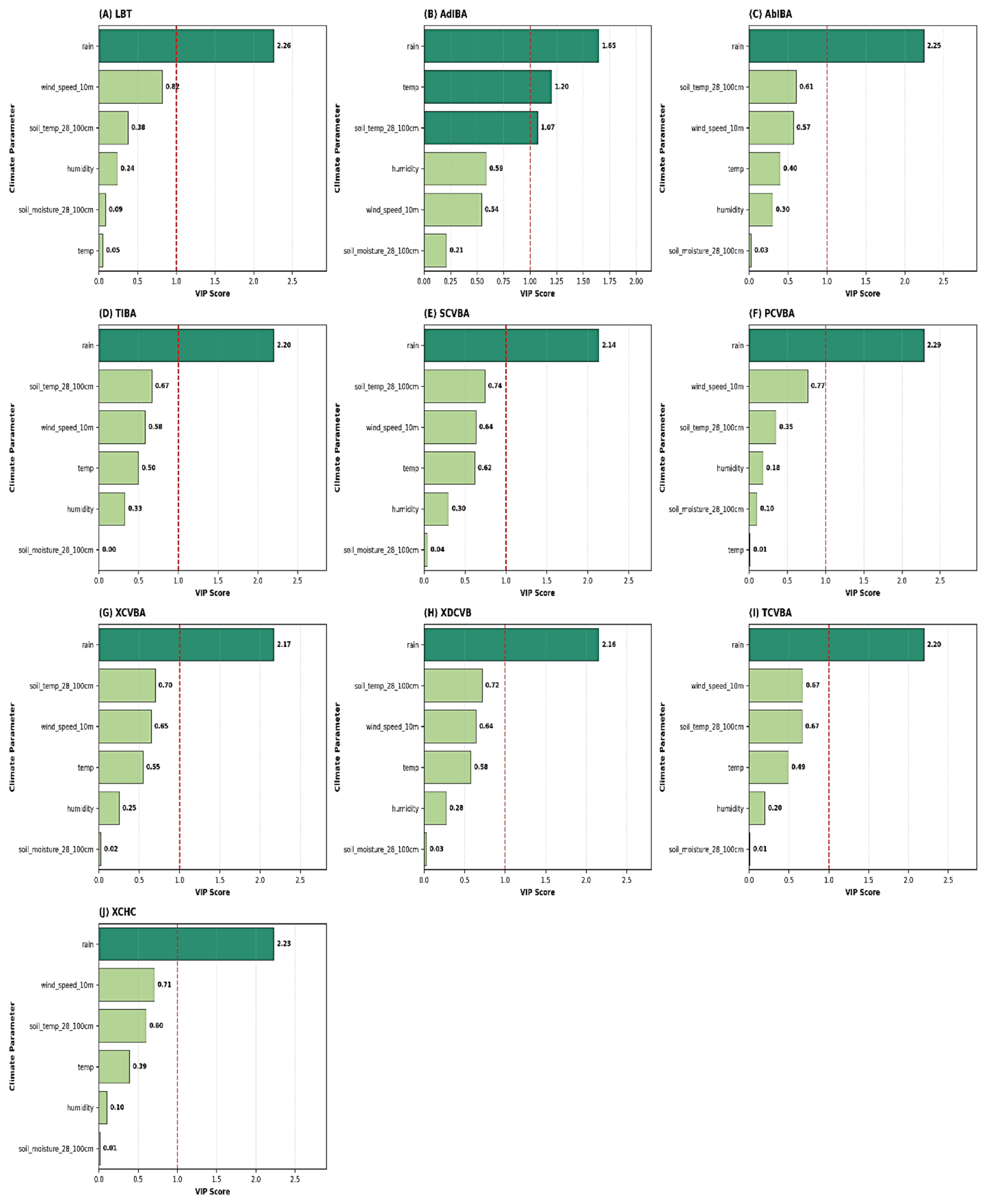
Partial Least Square (PLS) regression is widely used to explain the change of each anatomical trait as response to each climate parameter via calculation of Variable Importance in Projection (VIP) scores (Figure 4).
VIP scores between LBT and climate parameters are 2.2 with rainfall, 0.82 with wind speed, 0.38 with soil temperature, 0.24 with relative humidity, 0.09 with soil moisture, and 0.05 with air temperatures (Figure 4.A).
AdIBA has VIP scores of 1.65 with rainfall, 1.2 with air temperatures, 1.07 with soil temperatures, 0.59 with relative humidity, 0.54 with wind speed, and 0.21 with soil moisture (Figure 4.B). VIP scores of AbIBA are 2.25 with rainfall, 0.61 with soil temperatures, 0.57 with wind speed, 0.4 with air temperatures, 0.3 with relative humidity, and 0.03 with soil moisture (Figure 4.C). Similar to arrangement of climate parameters with AbIBA, TIBA has highest VIP score of 2.2 with rainfall, followed by 0.67 with soil temperatures, 0.58 with wind speed, 0.5 with air temperatures, 0.33 with relative humidity, and 0.00 with soil moisture (Figure 4.D).
For SCVBA, the highest VIP score is 2.14 with rainfall, followed by 0.74 with soil temperatures, 0.64 with wind speed, 0.62 with air temperatures, 0.3 with relative humidity, and 0.04 with soil moisture (Figure 4.E). For PCVBA, the highest VIP score is 2.29 with rainfall, followed by 0.77 with wind speed, 0.35 with soil temperatures, 0.18 with relative humidity, 0.1 with soil moisture, and 0.01 with air temperatures (Figure 4.F). Similar to arrangement of climate factors with SCVBA, The VIP scores of XCVBA with climate parameters range from the highest value of 2.17 with rainfall, then 0.7 with soil temperatures, 0.65 with wind speed, 0.55 with air temperatures, 0.25 with relative humidity, and 0.02 with soil moisture (Figure 4.G). Similar to the arrangement of climate parameters with SCVBA and XCVBA, VIP scores of XDCVB are 2.16 with rainfall, 0.76 with soil temperatures, 0.64 with wind speed, 0.58 with air temperatures, 0.28 with relative humidity, and 0.03 with soil moisture (Figure 4.H). TCVBA exhibits VIP scores of 2.2 with rainfall, 0.67 with wind speed and soil temperatures, 0.49 with air temperatures, 0.2 with relative humidity, and 0.01 with soil moisture (Figure 4.I).
XCHC exhibits VIP scores of 2.23 with rainfall, 0.71 with wind speed, 0.6 with soil temperatures, 0.39 with air temperatures, 0.1 with relative humidity, and 0.01 with soil moisture (Figure 4.J).

3.3. Standardized ß Regression Coefficients

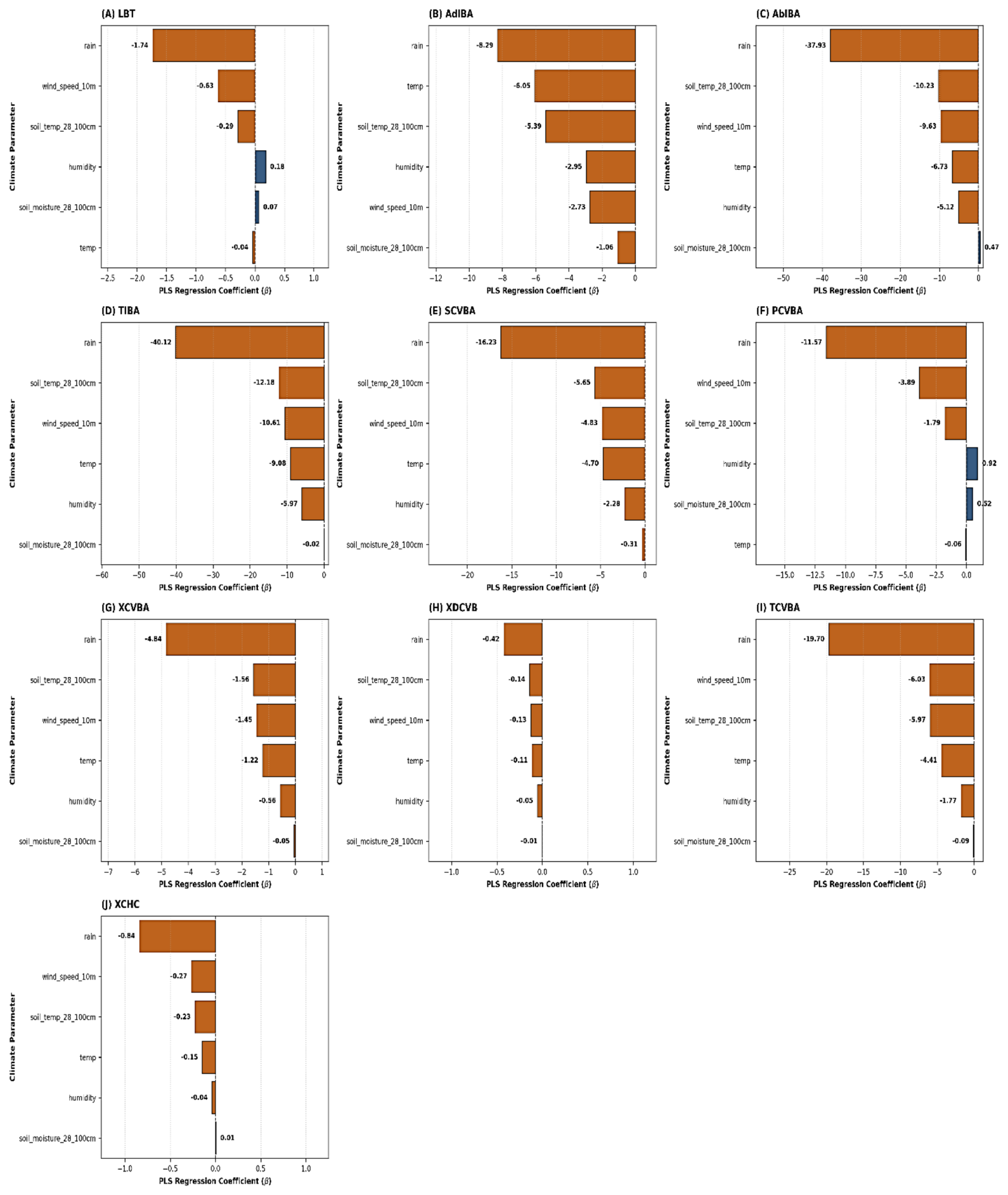
The standardized Beta (ß) regression coefficient from PLS regression measures the magnitude and direction of the response of each plant trait to each climate parameter (Figure 5). ß coefficients vary from -1.74 with rainfall to 0.18 with relative humidity for LBT (Figure 5.A), from -8.29 with rainfall to -1.06 with soil moisture for AdIBA (Figure 5.B), from -37.93 with rainfall to 0.47 with soil moisture for AbIBA (Figure 5.C), and from -40.12 with rainfall to -0.02 with soil moisture for TIBA (Figure 5.D). For anatomical traits of the central vascular bundles, the regression coefficients range from -16.23 with rainfall to -0.31 with soil moisture for SCVBA (Figure 5.E), from -11.57 with rainfall to 0.92 with relative humidity for PCVBA (Figure 5.F), from -4.84 with rainfall to -0.05 with soil moisture for XCVBA (Figure 5.G), from -0.42 with rainfall to -0.01 with soil moisture for XDCVB (Figure 5.H), from -19.7 with rainfall to -0.09 with soil moisture for TCVBA (Figure 5.I), and from -0.84 with rainfall to 0.01 with soil moisture for XCHC (Figure 5.J).

4. Discussion

E. armitagei Schweinf. et Taub. (Family: Fabaceae) is exploited as forage for livestock in the Bedouin societies of the Egyptian Mediterranean coastal area [8]. The plant has been listed in the Red List since 1997 as an endangered species by the International Union for Conservation of Nature (IUCN) [12]. However, E. armitagei has survived till recent years, indicating that it has developed adaptive mechanisms. This is the first work studying the effects of climatic parameters on leaf anatomical adaptations of E. armitagei in Ras El-Hekma across 80 years, helping us understand adaptation mechanisms and hence, improve the plant conservation under the future unfavorable environmental conditions and the plant’s socio-economic values.
Regarding to the leaf morphology and anatomy, the plant leaves have conserved traits throughout the past 80 years of the leaf shape, the structure of the leaf ground tissues, and the type of central vascular bundles. E. armitagei leaves have similar morphological and anatomical characteristics across past 80 years and to leaves of E. cretica [19,20], reflecting the essentiality of these traits for plant survival.
Regarding to the conserved traits, the compound leaves are considered a strong morphological adaptation to stressful environments via reducing mechanical drag in high winds [19], dissipating heat at high temperatures [20], and limiting water loss in dry conditions [21]. Knowing that the climate of Ras El-Hekma habitat is characterized with stressful conditions of high wind speeds [22], high temperatures [23] and drought [24] especially in summers. The fairly compact leaf palisades with tiny intercellular spaces are important xeromorphic leaf adaptation mechanism response to drought in arid and semi-arid environments as reported previously in many plant species including Gossypium hirsutum L. [25], Elytrigia repens L. [26], and Liriodendron tulipifera [27]. According to the previous knowledge, this is the first study explains the central vascular bundles of genus Ebenus, especially E. armitagei. However, these vascular bundles are similar to those examined in closely related genera to genus Ebenus such as Hedysarum sp. [28], and other plant species belong to Fabaceae family [29].The arrangement of the phloem and xylem vessels in the central vascular bundles is conserved across the studied samples having collateral bundles. In this bundle type, xylem vessels point towards the adaxial leaf palisade (inner side of the leaf), while phloem face leaf abaxial epidermis (outer side of the leaf). Such vessels orientation likely enhances transport efficiency of water and nutrients and photoassimilates especially in plants in arid and semi-arid habitats such as in Echeveria sp. [30], and Salsola incanescens [31].
Besides these conserved traits, there are anatomical features exhibiting significantly different plasticity responses across the past 80 years under different climate conditions, which are LBT, AdIBA, AbIBA, TIBA, SCVBA, PCVBA, XCVBA, XDCVB, TCVBA, and XCHC. Based on PLS regression VIP scores and standardized regression coefficients, rainfall is considered the most important climate driver responsible mainly for the changes in all studied anatomical traits across 80 years. Moreover, air temperatures, followed by soil temperatures at depths of 28-100 cm, are also important environmental drivers of the changes in AdIBA.
Leaf blade thickness (LBT) is the distance between the upper and lower surfaces, illustrating the optical path of light through the leaf that can either absorb, reflect, or transmit [32]. LBT is a good indicator of plant fitness, yield, and net productivity because it correlates positively with photosynthesis [33] and leaf-water use efficiency [34]. That means the plants in 2024 may be suffering from productivity retardation due to a reduction in leaf thickness compared with previous decadal periods, especially in 2006. The change pattern of LBT is strongly inversely matched with the change pattern of rainfall across decadal periods, which is a consistent result with responses of many plant species such as Quercus ilex [35], Calotropis procera [34], and many woody species that have small, fleshy, and succulent leaves in the driest climates in China [36]. Since thicker leaves or tissues are common responses to reduced water availability [37]. Under higher rainfall amounts, the leaf thickness tends to reduce to shorten gas diffusion distance and enhance transpiration, similar to Quercus variabilis [38].
The leaf idioblasts recorded in E. armitagei are highly similar to those found in E. cretica [39] and other closely related genera to genus Ebenus sp. [40], such as Hedysarum sp. [28], and Onobrychis sp. [41]. These previous studies describe the idioblasts as phenolic- or tannin-containing cells in palisade tissue. The negative relations between idioblast areas and rainfall are consistent with findings of earlier works [42,43]. The negative relation between AdIBA, AbIBA, and TIBA and rainfall may be attributed to the hygroscopic properties of tannins and phenolic compounds, as previously proved [44,45] to trap water inside leaves, improving leaf internal hydration under drought conditions. The negative relations between adaxial idioblast areas and air and soil temperatures are consistent with findings of earlier works [46,47,48]. Air temperature changes may be able to control the expression levels of critical enzymes in phenolic biosynthesis, as found in leaves of Camellia sinensis [46,49] and Populus x canescens [50] exposed to high and low temperatures. Also, soil temperature may control nutrient uptake by plants, including nitrogen and phosphorus, as proved with Cunninghamia lanceolata and other plant species [51,52], affecting photosynthesis [53] and hence changing the production of non-structural carbohydrates, primary products of photosynthesis [54], which are important for phenolics production [55]. As noticed, AdIBA, AbIBA, and TIBA values in samples from 2024 are the least values compared to other times, especially in 2006. These findings suggest higher possibilities of abiotic stressors including atmospheric radiation of UV, drought, and heat [56,57,58], and biotic stressors including the herbivory attacks to plants in 2024 due to reduced compounds of anti-herbivore and anti-pathogen, tannins and phenolics [59], especially at the abaxial leaf layer due to the strip-like shape of abaxial idioblasts compared to the adaxial ones indicates a chemical barrier against stressful abaxial micro-environment. As evidence, beneath abaxial leaf surface may be more humid, and shade domatia that house beneficial and herbivorous mites and other small arthropods [60,61,62].
According to the previous knowledge, this is the first study explains the central vascular bundles of genus Ebenus, especially E. armitagei. However, these vascular bundles are similar to those examined in closely related genera to genus Ebenus such as Hedysarum sp. [28], and other plant species belong to Fabaceae family [29].The arrangement of the phloem and xylem vessels in the central vascular bundles is conserved across the studied samples having collateral bundles. In this bundle type, xylem vessels point towards the adaxial leaf palisade (inner side of the leaf), while phloem face leaf abaxial epidermis (outer side of the leaf).
The negative relation between the change pattern of SCVBA and rainfall across decades is similar to previously proved negative correlation between the sclerified tissues of the vasculature and rainfall using leaves of perennial plants in New South Wales, Australia [63], and Cenchrus ciliaris [64]. The negative relation between vascular sclerenchyma area and rainfall may be to act as a mechanical support for leaves reducing cellular collapse during dry conditions [65]. As shown in this study, SCVBA in plants in 2024 is significantly lower than in 2006, which may make leaves more prone to physical tearing and collapse, especially under higher wind speeds in 2024.
The strongly negative relation between the decadal change patterns PCVBA and rainfall is similar to findings of two drought-tolerant sugarcane cultivars, KKU-1999-02 and KKU-1999-03 [66] and results of Pinus edulis [67]. This adaptation mechanism can lead to a substantial increase in conductivity of photoassimilates under drought conditions when sap viscosity increases due to osmoregulation [67]. This indicates that the plants in 2024 may suffer from reduction of phloem transport capacity and hence reducing carbon allocation and growth of heterotroph plant parts [68].
The standard response of xylem vessels traits to drought is reduction of xylem diameters, and hydraulic conductivities in many plant species [69,70,71]. However, the xylem-related traits: XCVBA, XDCVB, and XCHC have negative relations with rainfall which are similar to earlier findings such as the negative relation between vessel area percentage of Fagus crenata and yearly, winter, spring and autumn precipitations [72], xylem vessels diameters of leaves of Sahra, Jonob, and Zarjo cultivars of barley plant under drought stress compared to irrigated normally plants [73], larger stem xylem vessels developed in the Moroccan ecotype drought-stressed Arundo donax accompanied with an increase of theoretical hydraulic conductivity [74], and significant increase of hydraulic conductivities of root and shoot of Populus euphratica in response to drought stress for 21 days [75]. That means, E. armitagei may have experienced mild drought stress in 2006, which can improve xylem vessel traits and associated hydraulic conductance, enhancing water transportation efficiency and consequently photosynthesis. Also, these relations may reflect active repair mechanisms for embolism related to larger xylem vessels, especially under drought [76].

4. Materials and Methods

4.1. Study Area

The study location is RAS El-Hekma, which is located northwest of Egypt [77,78]. The Egyptian government is paying attention to these coastal areas because they are the most promising for tourism investment in Egypt over the next 20 years, with predicted capital flows and foreign direct investment of tens of millions of dollars. This coastline region is located around 212 km west of Alexandria and approximately 350 km northwest of Cairo. It is bordered to the north by the Mediterranean Sea and to the south by Egypt’s west desert.

4.2. Study Species

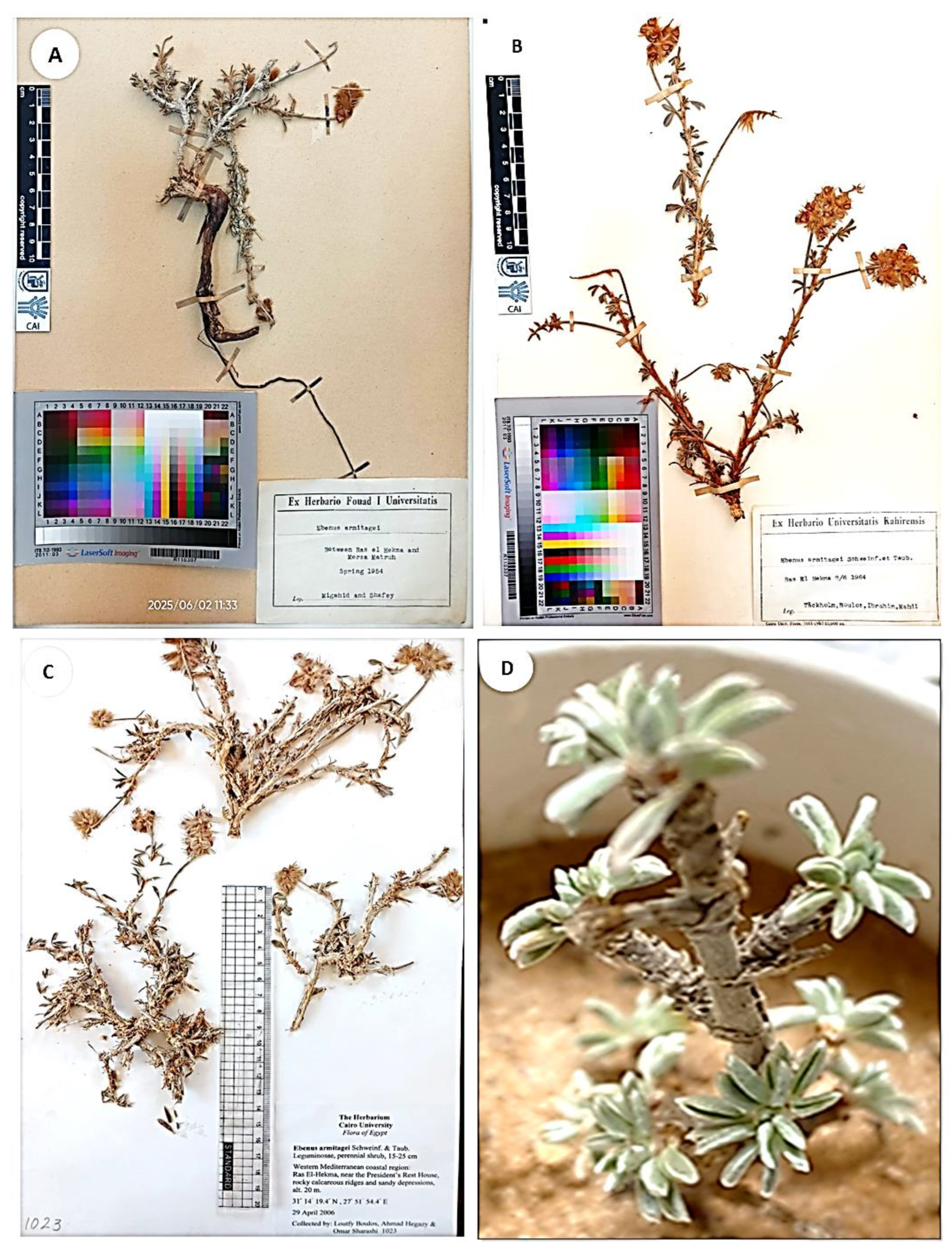
This study deals with the leaves taken from the herbarium specimens of the endangered species E. armitagei Schweinf. et Taub. (Family: Fabaceae). The plant herbarium sheets are deposited in the Cairo University Herbarium (CAI), Department of Botany and Microbiology, Faculty of Science, Cairo University, Giza, Egypt. Knowing that the herbarium specimens are collected from Ras El-Hekma in the years 1954, 1964, and 2006 (Figure 6.A; B; and C, orderly). In addition, fresh leaves are collected in 2024 from Al-Amirat coast in Ras El-Hekma at 31° 14ˋ 13.9՝՝ N, 27° 51՝ 55.3՝՝ E (Figure 6.D). The plant is collected after permission from the Department of Botany and Microbiology at the Faculty of Science, Cairo University, Egypt. The plant is collected for scientific purposes according to the national guidelines and the international regulations of the Convention on the Trade in Endangered Species of Wild Fauna and Flora (CITES) and the International Union for Conservation of Nature (IUCN). The freshly collected leaves were identified and compared with the authenticated specimens deposited in CAI using keys of local flora [79,80]. The freshly collected plant material is deposited in CAI, Department of Botany and Microbiology, Faculty of Science, Cairo University, Giza, Egypt.

4.3. Samples Preparation

The leaves are carefully picked from plants with approximate same age (10 years old), such that the plants are from the herbarium sheets and from fresh plants for the anatomical investigations according to Waly et al., 2021 [81]. The herbarium leaves are first softened by soaking in warm distilled water at 45 °C for 24h. This step is critical to re-hydrate the herbarium samples decreasing the shrinking effects happened during the herbarium sample preparation. The soaked leaves are imbedded in a fixative solution for overnight (i.e., 12h) and stored at refrigerator (4 °C). The fixative solution consists of 0.1 M Na-cacodylate buffer (pH 7.2) containing 2% (v/v) ice-cold glutaraldehyde. To avoid tissue sever drying up, then add phosphate buffered saline (PBS) (pH 7.4) in equal volume to the fixative solution. The fixed leaves are restored in refrigerator till anatomical analysis conducted. Similarly, the freshly collected leaves are processed and preserved but without being softened prior to fixation. The leaves are embedded in wax and shaped and sized into a woodblock of 2(length)×2(width)×3(height) cm. The transverse sections are taken using a rotary microtome giving sections of 15 μm in thickness. The leaf sections are stained with safranin and light green. Permanent slides of leaves sections are obtained by mounting of the stained sections using Canada balsam followed by slide dehydration. The slides are examined by Nikon eclipse LV 100 POL light microscopy in the Central Laboratory of Geology Department, Faculty of Science, Cairo University. The photomicrographs are captured by Nikon DS-Fi1 camera and processed by NIS-Elements F-[Live-Fast] software.

4.4. Measurement of Anatomical Traits

The descriptive anatomical characters and measurable anatomical traits of the plant leaves are explored in this study. The descriptive characters covered the leaf shape, presence or absence of trichomes knowing their type(s), and the shapes of the leaf tissues precisely epidermal layer, ground tissue, and vascular tissues. The quantitative anatomical characteristics were leaf blade thickness (µm), total cross-sectional area of idioblasts (µm2), parameters of the central vascular bundle including cross-sectional area of the central vascular bundle (µm2) and its tissues of sclerenchyma, phloem and xylem, diameter of xylem vessels (µm), and xylem vessels’ hydraulic conductivity (Kh, m4/MPa) which was calculated according to Hagen–Poiseuille law outlined in the equation below [82,83]. The measurements were conducted from the transverse sections images using Image J software 1.45 released in 2011 [84].
Kh = πƩd4i/128Ƞ
where Kh is the theoretical hydraulic conductivity (m4/MPa), d is the diameter in meter (m) of the ith xylem vessel in the vascular bundle, and Ƞ is the viscosity of water (MPa) supposed to be 1 at 20 °C.

4.5. Collection of Meteorological Data

There are 6 climatic parameters: air temperatures, rainfalls, relative humidity, soil temperatures at depth of 28-100 cm, soil moistures at depth of 28-100 cm, and wind speeds at altitude of 10 m. The climatic data are retrieved using python code from Open-Meteo Historical Weather API similar to recent studies used this website to retrieve the climatic data [85](https://open-meteo.com/en/docs/historical-weather-api) which discover how weather has shaped the world from 1940 until now. The exact location coordinates of samples collected in 2006 and 2024 can be used to retrieve the climatic data in these locations. Oppositely, the exact location coordinates of the herbarium specimens collected in 1954 and 1964 are missed and recorded as textual descriptions on the herbarium sheet labels. So, a python script (Supporting information file generated by Google Gemini) is used to convert the geographical boundary limits into a 2D metric shape, calculating its geometric center, measuring the spatial error radius, and formatting the output into Darwin Core standard fields which are decimal latitude (31.202819), decimal longitude (27.83665), coordinate uncertainty in meters (22309), geodetic datum (EPSG:4326) according to Point-Radius georeferencing protocol [86]. The daily climatic data are retrieved across four decades: in the plausible area of Ras El-Hekma from January 1945 to May 1954, and from January 1955 to 8/6/1964, and in the exact locations from January 1996 to 28/4/2006, and from January 2015 to 21/5/2024. After that, these daily retrieved data are manipulated to be annual data using the supplemented python script (script final-supporting information file) which are used to study the effects of these climate data on E. armitagei.

4.6. Statistical Analyses

The quantitative anatomical functional traits are measured from anatomical sections from 5 plants (n = 5). The normal distribution assumption of the experimental data was tested using the Shapiro–Wilk test (p < 0.05). Normally distributed data are presented as mean ± standard deviation (SD), while non-normally distributed data are presented as median and inter quartile range (IQR). Statistical significance of normally distributed data was assessed using one-way analysis of variance (ANOVA) followed by Duncan’s multiple range test (p < 0.05) as a post-hoc test, while Kruskal-Wallis and Dunn’s post-hoc test (p < 0.05) were used for non-normally distributed data. Partial Least Square (PLS) regression is widely used to explain the change of each anatomical trait as response to each climate parameter via calculation of Variable Importance in Projection (VIP) scores. The standardized Beta (ß) regression coefficients from PLS regression measures the magnitude and direction of the response of each plant trait to each climate parameters.

5. Conclusions

E. armitagei is one of the forage and endangered plant species 1997 listed in IUCN red lists. However, this plant species is able to live to this day. This is the first work aiming to study the effects of climatic parameters across the 80 years: 1945-1954, 1955-1964, 1997-2006, and 2015-2024 on leaf anatomical traits of plants in Ras El-Hekma, Egypt. Some of studied plant traits are conserved across decades, meaning their essentialities to the aridity of Ras El-Hekma. These conserved traits are compound leaf structure, compact palisade, and collateral vascular bundles are considered critical features for xerophytic plants. While there are other plant traits that show plasticity, indicating their possible roles in plant adaptations under variable climatic conditions. Rainfall is considered the primary climatic parameter for all traits, leading to significant deterioration of traits from 2006 to 2024. As evidence, E. armitagei suffers from significant reductions of leaf blade thickness, xylem traits of cross-section area, diameters and hydraulic conductance, phloem cross-section area, and idioblasts cross-section area, especially at abaxial leaf surface leading to retardations of photosynthesis, nutrients uptake, and photoassimilates translocations to other plant parts, and higher susceptibility to abiotic stressors including atmospheric radiation of UV, drought, and heat, and biotic stressors including herbivory attacks. It is recommended to (1) provide the plant with a stable water resource besides fluctuated rainfalls to stop significant physiological deterioration in the future, and (2) do more field studies to explore more about biotic stressors, including insect attacks and their relations with idioblast components.

Supplementary Materials

The following supporting information can be downloaded at the website of this paper posted on Preprints.org, The Python script to retrieve the archived climate data from Open-Meteo Historical Weather API web server is supplied as a supporting information file named as “script final-supporting information file”. Also, this script analyzes statistically the retrieved climate data and plant anatomy data and drawing the results.

Author Contributions

Conceptualization: AKH, and MF. Methodology: all authors. Data analysis: all authors. Manuscript drafting: AAM, and AKH. Review and editing: all authors. Overall guidance: AKH. Plant identification and collection according to the national and international guidelines: RH. All authors have read and agreed to the published version of the manuscript.

Funding

This work was supported by the Man and Biosphere Programme (MAB) from the United Nations Educational, Scientific and Cultural Organization (UNESCO) under young researchers support prize number: 4500498707, in 2023.

Data Availability Statement

All the data analyzed during this study are included in this article. The climate data are retrieved from Open-Meteo Historical Weather API, similar to recent studies that used this website to retrieve the climatic data (https://open-meteo.com/en/docs/historical-weather-api) accessed in August 2026.

Acknowledgments

Google Gemini (https://gemini.google.com/app?hl=en-IN) helped significantly in generating a Python script to retrieve the archived climate data from Open-Meteo Historical Weather API web server.

Conflicts of Interest

Not applicable.

Abbreviations

The following abbreviations are used in this manuscript:
ENWCZ Egyptian Northwestern Coastal Zone
IUCN The International Union for Conservation of Nature
LBT Leaf blade thickness
AdIBA Adaxial idioblast area
AbIBA Abaxial idioblast area
TIBA Total idioblast area
SCVBA Sclerenchyma vascular bundle area
PCVBA Phloem vascular bundle area
XCVBA Xylem vascular bundle area
TVBA Total vascular bundle area
XDCVB Xylem vessels diameter of central vascular bundle
XCHC Hydraulic conductivity of xylem vessels of central vascular bundle
PLS Partial Least Square regression
VIP Variable Importance in Projection scores
CAI the Cairo University Herbarium
CITES the Convention on the Trade in Endangered Species of Wild Fauna and Flora
PBS Phosphate buffered saline

References

  1. Shukla, K.K.; Nongthombom, R.; Sen, A.; Khatoon, A.; Bhagawati, K. Climate Change: In the Context of Socio-Economic Development of Arunachal Pradesh (India)-A Review. Trends Biosci. 2014, 7(10), 827–35. [Google Scholar]
  2. Rocque, R.J.; Beaudoin, C.; Ndjaboue, R.; Cameron, L.; Poirier-Bergeron, L.; Poulin-Rheault, R.-A.; et al. Health effects of climate change: an overview of systematic reviews. BMJ Open 2021, 11(6), e046333. [Google Scholar] [CrossRef]
  3. Daoud, I.; Osman, M.-A.; Alary, V.; Tourrand, J.-F. Overview on livestock policies in the Bedouin area Northwestern coast zone of Egypt. 2020. [Google Scholar]
  4. Alary, V.; Hassan, F.; Daoud, I.; Naga, A.A.; Osman, M.A.; Bastianelli, D.; et al. Bedouin adaptation to the last 15-years of drought (1995–2010) in the North Coastal Zone of Egypt: Continuity or rupture? World Dev. 2014, 62, 125–37. [Google Scholar] [CrossRef]
  5. Ghareb, H.E. IN VITRO PRESERVATION OF THE EGYPTIAN ENDEMIC SILENE SCHIMPERIANA BOISS. PLANT VIA ENCAPSULATION. Egypt J. Desert Res. 2021, 69(2), 19–35. [Google Scholar] [CrossRef]
  6. El-Barougy, R.F.; Elgamal, I.; Rohr, R.P.; Probert, A.F.; Khedr, A.A.; Bacher, S. Functional similarity and dissimilarity facilitate alien plant invasiveness along biotic and abiotic gradients in an arid protected area. Biol. Invasions [Internet] 2020, 22(6), 1997–2016. Available online: http://link.springer.com/10.1007/s10530-020-02235-3. [CrossRef]
  7. SAAED, M.W.B.; EL-BARASI, Y.M.; RAHIL, R.O. An updated checklist and quantitative analysis of the Marmarica Plateau flora, in the north-eastern part of Libya. Phytotaxa [Internet] 2021, 509(1), 1–55. Available online: https://phytotaxa.mapress.com/pt/article/view/phytotaxa.509.1.1. [CrossRef]
  8. Hegazy, A.K.; Kabiel, H.F.; Boulos, L.; Sharashy, O.S. Conservation approach to the demography and dynamics of protected and unprotected populations of the endemic Ebenus armitagei in the Western Mediterranean Coast of Egypt. J. Nat. Conserv [Internet] 2010, 18(3), 151–8. Available online: https://linkinghub.elsevier.com/retrieve/pii/S161713810900065X. [CrossRef]
  9. Hegazy, A.; Doust, J.L. Plant ecology in the Middle East; Oxford University Press, 2016. [Google Scholar]
  10. Jafri, S.M.H.; El-Gadi, A. Flora of Libya: Fabaceae [Internet]. Department of Botany, Al Faateh University, 1980. Available online: https://books.google.com.eg/books?id=4BL2uQEACAAJ.
  11. Pampanini, R. Prodromo della Flora Cirenaica. p. Forli, 577 pp. 1930. Available online: https://bibdigital.rjb.csic.es/idurl/1/14218.
  12. Walter, K.S.; Gillett, H.J. 1997 IUCN red list of threatened plants; IUCN, 1998. [Google Scholar]
  13. HEGAZY, A.K.; EESA, N.M. On the Ecology, Insect Seed-Predation, and Conservation of a Rare and Endemic Plant Species: Ebenus amnitagei (Leguminosae). Conserv Biol. 1991, 5(3), 317–24. [Google Scholar] [CrossRef]
  14. Meineke, E.K.; Davis, C.C.; Davies, T.J. The unrealized potential of herbaria for global change biology. Ecol. Monogr. 2018, 88(4), 505–25. [Google Scholar] [CrossRef]
  15. Heberling, J.M.; Miller, J.T.; Noesgaard, D.; Weingart, S.B.; Schigel, D. Data integration enables global biodiversity synthesis. Proc. Natl. Acad. Sci. 2021, 118(6), e2018093118. [Google Scholar] [CrossRef]
  16. Mishler, B.D.; Guralnick, R.; Soltis, P.S.; Smith, S.A.; Soltis, D.E.; Barve, N.; et al. Spatial phylogenetics of the North American flora. J. Syst. Evol. 2020, 58(4), 393–405. [Google Scholar] [CrossRef]
  17. Miller, M.J.; Albarracin-Jordan, J.; Moore, C.; Capriles, J.M. Chemical evidence for the use of multiple psychotropic plants in a 1,000-year-old ritual bundle from South America. Proc. Natl. Acad. Sci. 2019, 116(23), 11207–12. [Google Scholar] [CrossRef]
  18. Foutami, I.J.; Mariager, T.; Rinnan, R.; Barnes, C.J.; Rønsted, N. Hundred fifty years of herbarium collections provide a reliable resource of volatile terpenoid profiles showing strong species effect in four medicinal species of Salvia across the Mediterranean. Front Plant Sci. 2018, 9, 1877. [Google Scholar] [CrossRef]
  19. Vogel, S. Leaves in the lowest and highest winds: temperature, force and shape. New Phytol. 2009, 183(1), 13–26. [Google Scholar] [CrossRef]
  20. Stowe, L.G.; Brown, J.L. A geographic perspective on the ecology of compound leaves. In Evolution (N Y); 1981; pp. 818–21. [Google Scholar]
  21. Poorter, L.; Markesteijn, L. Seedling traits determine drought tolerance of tropical tree species. Biotropica 2008, 40(3), 321–31. [Google Scholar] [CrossRef]
  22. Alham, M.H.; Gad, M.F.; Ibrahim, D.K. Potential of wind energy and economic assessment in Egypt considering optimal hub height by equilibrium optimizer. Ain Shams Eng. J. 2023, 14(1), 101816. [Google Scholar] [CrossRef]
  23. Sobhy, A.; Mohamed, M.; Kalas, A.; Elfar, M.H. Techno-economic and environmental feasibility of large-scale hybrid renewable energy system for coastal megaprojects: a case study of Ras El-Hekma, Egypt. Sci. Rep. [Internet] Available from. 2026, 16(1), 19376. [Google Scholar] [CrossRef]
  24. Alary, V.; Messad, S.; Aboul-Naga, A.; Osman, M.A.; Daoud, I.; Bonnet, P.; et al. Livelihood strategies and the role of livestock in the processes of adaptation to drought in the Coastal Zone of Western Desert (Egypt). Agric. Syst. [Internet] 2014, 128, 44–54. Available online: https://www.sciencedirect.com/science/article/pii/S0308521X14000389. [CrossRef]
  25. Sun, D.; Lei, Z.; Carriquí, M.; Zhang, Y.; Liu, T.; Wang, S.; et al. Reductions in mesophyll conductance under drought stress are influenced by increases in cell wall chelator-soluble pectin content and denser microfibril alignment in cotton. J. Exp. Bot. 2025, 76(4), 1116–30. [Google Scholar] [CrossRef]
  26. Pyurko, O.E.; Khrystova, T.E.; Pyurko, V.E.; Arabadzhi-Tipenko, L.I. Structural and functional content of xerophytic plants of Elytrigia repens L. genus. IOP Conf. Ser. Earth Environ. Sci. [Internet] 2024, 1415(1), 012052. Available online: https://iopscience.iop.org/article/10.1088/1755-1315/1415/1/012052. [CrossRef]
  27. Akinshina, N.G.; Duschanova, G.M.; Azizov, A.A.; Khalmurzaeva, A.I.; Toderich, K.N. Xeromorphic Features of the Leaves of Liriodendron Tulipifera L. (Magnoliaceae) in the Arid Climate of Central Asia. Mosc. Univ. Biol. Sci. Bull. [Internet] 2020, 75(4), 212–7. Available online: https://link.springer.com/10.3103/S0096392520040021. [CrossRef]
  28. Dural, H.; Yilmaz Çitak, B. Morphology and anatomy of Hedysarum pannosum (Boiss.) Boiss. (Fabaceae). Acta Bot. Croat. 2015, 74(1), 19–29. [Google Scholar] [CrossRef]
  29. Leal, A.S.; Cozin, B.B.; Leite, M.C.M.; Martins, A.R. How do legumes cope with environmental filters in savanna ecosystems? Analysis of morphoanatomical and ultrastructural traits of legumes aerial organs and ecological implications. Braz. J. Bot. [Internet] 2026, 49(1), 9. Available online: https://link.springer.com/10.1007/s40415-026-01133-7. [CrossRef]
  30. Ha Tran, M.K.T.; Cabahug-Braza, R.A.M.; Hwang, Y.-J. Echeveria Leaf Morpho-Anatomical Analysis and Its Implications for Environmental Stress Conditions. Horticulturae [Internet] 2024, 10(4), 308. Available online: https://www.mdpi.com/2311-7524/10/4/308. [CrossRef]
  31. Ibrokhimova, G.A.; Duschanova, G.M. Structural-Adaptation Features of Assimilation Organs of the Species Salsola incanescens Cam. in Conditions of Kyzylkum. Am. J. Plant Sci. [Internet] 2024, 15(07), 589–602. Available online: https://www.scirp.org/journal/paperinformation?paperid=134986.
  32. Khan, R.; Ma, X.; Hussain, Q.; Chen, K.; Farooq, S.; Asim, M.; et al. Transcriptome and anatomical studies reveal alterations in leaf thickness under long-term drought stress in tobacco. J. Plant Physiol. [Internet] 2023, 281, 153920. Available online: https://www.sciencedirect.com/science/article/pii/S0176161723000147. [CrossRef]
  33. Aneja, P.; Sanyal, R.; Ranjan, A. Leaf growth in third dimension: a perspective of leaf thickness from genetic regulation to ecophysiology. New Phytol. 2025, 245(3), 989–99. [Google Scholar] [CrossRef]
  34. Pompelli, M.F.; Mendes, K.R.; Ramos, M. V.; Santos, J.N.B.; Youssef, D.T.A.; Pereira, J.D.; et al. Mesophyll thickness and sclerophylly among Calotropis procera morphotypes reveal water-saved adaptation to environments. J. Arid Land [Internet] 2019, 11(6), 795–810. Available online: http://link.springer.com/10.1007/s40333-019-0016-7. [CrossRef]
  35. Castro-Diez, P.; Villar-Salvador, P.; Pérez-Rontomé, C.; Maestro-Martínez, M.; Montserrat-Martí, G. Leaf morphology and leaf chemical composition in three Quercus (Fagaceae) species along a rainfall gradient in NE Spain. Trees 1997, 11(3), 127–34. [Google Scholar] [CrossRef]
  36. Wang, H.; Wang, R.; Harrison, S.P.; Prentice, I.C. Leaf morphological traits as adaptations to multiple climate gradients. J. Ecol. [Internet] 2022, 110(6), 1344–55. Available online: https://besjournals.onlinelibrary.wiley.com/doi/10.1111/1365-2745.13873. [CrossRef]
  37. Abrams, M.D.; Kubiske, M.E.; Mostoller, S.A. Relating Wet and Dry Year Ecophysiology to Leaf Structure in Contrasting Temperate Tree Species. Ecology [Internet] 1994, 75(1), 123–33. Available online: https://esajournals.onlinelibrary.wiley.com/doi/10.2307/1939389. [CrossRef]
  38. Ren, F.; Wang, T.; Chen, C.; Zong, W.; Hui, D.; Feng, Z.; et al. Coordinated variation in leaf economics, hydraulics and anatomy of Quercus variabilis along an environmental gradient. In J Plant Ecol [Internet]; Yan, Z., Ed.; 7 Jan 2026; Volume 19, 1, p. rtaf127. Available online: https://academic.oup.com/jpe/article/doi/10.1093/jpe/rtaf127/8222711.
  39. Syros, T.; Kofidis, G.; Economou, A.S.; Bosabalidis, A.M. Leaf structural dynamics associated with adaptation of two Ebenus cretica ecotypes. Biol. Plant 2006, 50, 245–50. [Google Scholar] [CrossRef]
  40. Nafisi, H.; Kaveh, A.; Kazempour-Osaloo, S. Characterizing nrDNA ITS1, 5.8S and ITS2 secondary structures and their phylogenetic utility in the legume tribe Hedysareae with special reference to Hedysarum. In PLoS One [Internet]; Available from; Chen, S., Ed.; 12 Apr 2023; Volume 18, 4. [Google Scholar] [CrossRef]
  41. AL-OTRAQCHE, F.D.Y. Anatomical Comparison of the Stem and Leaf in Some of Onobrychis Mill. (Fabaceae) Species in Kurdistan region-Iraq. ZANCO J. PURE Appl. Sci. [Internet] 2022, 34(1), 97–109. Available online: https://zancojournal.su.edu.krd/index.php/JPAS/article/view/110. [CrossRef]
  42. Souza, RT de A; Silva, DK de A; dos Santos, M.V.F.; Naumann, H.D.; Magalhães, A.L.R.; de Andrade, A.P. Association of edaphoclimatic characteristics and variability of condensed tannin content in species from Caatinga. Rev. CIÊNCIA AGRONÔMICA [Internet] 2020, 51(3), e20196611. Available online: http://periodicos.ufc.br/revistacienciaagronomica/article/view/88820. [CrossRef]
  43. Mohagheghian, B.; Saeidi, G.; Arzani, A. Phenolic compounds, antioxidant enzymes, and oxidative stress in barley (Hordeum vulgare L.) genotypes under field drought-stress conditions. BMC Plant Biol. [Internet] 2025, 25(1), 709. Available online: https://bmcplantbiol.biomedcentral.com/articles/10.1186/s12870-025-06750-0. [CrossRef]
  44. Huss, J.C.; Schoeppler, V.; Merritt, D.J.; Best, C.; Maire, E.; Adrien, J.; et al. Climate-Dependent Heat-Triggered Opening Mechanism of Banksia Seed Pods. Adv. Sci. [Internet] 2018, 5(1), 1700572. Available online: https://advanced.onlinelibrary.wiley.com/doi/10.1002/advs.201700572. [CrossRef]
  45. Karabourniotis, G.; Liakopoulos, G.; Nikolopoulos, D.; Bresta, P.; Stavroulaki, V.; Sumbele, S. “Carbon gain vs. water saving, growth vs. defence”: Two dilemmas with soluble phenolics as a joker. Plant Sci. [Internet] 2014, 227, 21–7. Available online: https://linkinghub.elsevier.com/retrieve/pii/S0168945214001484. [CrossRef]
  46. Yu, J.; Wang, Q.; Wang, W.; Ma, R.; Ding, C.; Wei, K.; et al. Transcriptomic and metabolomic insights into temperature-dependent changes in catechin and anthocyanin accumulation in tea plants with different leaf colors. Plant Stress [Internet] 2024, 14, 100705. Available online: https://linkinghub.elsevier.com/retrieve/pii/S2667064X24003580. [CrossRef]
  47. Komariah; Pitaloka, D.D.A.; Batubara, I.; Nurcholis, W.; Sandrawati, A.; Setyawati, A.; et al. The effects of soil temperature from soil mulching and harvest age on phenol, flavonoid and antioxidant contents of Java tea (Orthosiphon aristatus B.). Chem. Biol. Technol. Agric. [Internet] 2021, 8(1), 56. Available online: https://chembioagro.springeropen.com/articles/10.1186/s40538-021-00256-1. [CrossRef]
  48. Nakamura, M.; Minoshima, M.; Terada, C.; Takagi, K.; Makoto, K.; Shibata, H.; et al. Response of Background Herbivory in Mature Birch Trees to Global Warming. Front Glob. Chang [Internet] 2021, 4, 675401. Available online: https://www.frontiersin.org/articles/10.3389/ffgc.2021.675401/full. [CrossRef]
  49. Shen, J.; Zhang, D.; Zhou, L.; Zhang, X.; Liao, J.; Duan, Y.; et al. Transcriptomic and metabolomic profiling of Camellia sinensis L. cv. ‘Suchazao’ exposed to temperature stresses reveals modification in protein synthesis and photosynthetic and anthocyanin biosynthetic pathways. Tree Physiol. [Internet] 2019, 39(9), 1583–99. Available online: https://academic.oup.com/treephys/article/39/9/1583/5499164. [CrossRef]
  50. Behnke, K.; Kaiser, A.; Zimmer, I.; Brüggemann, N.; Janz, D.; Polle, A.; et al. RNAi-mediated suppression of isoprene emission in poplar transiently impacts phenolic metabolism under high temperature and high light intensities: a transcriptomic and metabolomic analysis. Plant Mol. Biol. [Internet] 2010, 74(1–2), 61–75. Available online: https://link.springer.com/10.1007/s11103-010-9654-z. [CrossRef]
  51. Zhang, Q.; Yang, Z.; Chen, T.; Gong, X.; Xiong, D.; Ye, W.; et al. Warming Alters Plant Chemical and Nutrient Compositions by Affecting Metabolites in Cunninghamia lanceolata (Lamb.) Hook. Forests [Internet]. 2019, 10(7), 553. Available online: https://www.mdpi.com/1999-4907/10/7/553. [CrossRef]
  52. Mishra, S.; Spaccarotella, K.; Gido, J.; Samanta, I.; Chowdhary, G. Effects of Heat Stress on Plant-Nutrient Relations: An Update on Nutrient Uptake, Transport, and Assimilation. Int. J. Mol. Sci. [Internet] 2023, 24(21), 15670. Available online: https://www.mdpi.com/1422-0067/24/21/15670. [CrossRef]
  53. Lu, Z.; Ren, T.; Li, Y.; Cakmak, I.; Lu, J. Nutrient limitations on photosynthesis: from individual to combinational stresses. Trends Plant Sci. [Internet] 2025, 30(8), 872–85. Available online: https://linkinghub.elsevier.com/retrieve/pii/S1360138525000664. [CrossRef]
  54. Tu, Z.; Ping, J.; Bian, C.; Cui, E.; Xia, J. Non-Structural Carbohydrates Drive Vegetation Productivity: Global Insights From a Land Surface Model. Glob. Ecol. Biogeogr. [Internet] 2025, 34(12), e70185. Available online: https://onlinelibrary.wiley.com/doi/10.1111/geb.70185. [CrossRef]
  55. AbdElgawad, H.; Peshev, D.; Zinta, G.; Van den Ende, W.; Janssens, I.A.; Asard, H. Climate Extreme Effects on the Chemical Composition of Temperate Grassland Species under Ambient and Elevated CO2: A Comparison of Fructan and Non-Fructan Accumulators. In PLoS One [Internet]; Available from; Passi, A.G., Ed.; 26 Mar 2014; Volume 9, 3. [Google Scholar] [CrossRef]
  56. Beckman, C.H. Phenolic-storing cells: keys to programmed cell death and periderm formation in wilt disease resistance and in general defence responses in plants? Physiol Mol Plant Pathol [Internet]. 2000, 57(3), 101–10. Available online: https://www.sciencedirect.com/science/article/pii/S088557650090287X.
  57. Forkner, R.E.; Marquis, R.J.; Lill, J.T. Feeny revisited: condensed tannins as anti-herbivore defences in leaf-chewing herbivore communities of Quercus. Ecol. Entomol. [Internet] 2004, 29(2), 174–87. Available online: https://resjournals.onlinelibrary.wiley.com/doi/10.1111/j.1365-2311.2004.0590.x. [CrossRef]
  58. Dehghanian, Z.; Habibi, K.; Dehghanian, M.; Aliyar, S.; Asgari Lajayer, B.; Astatkie, T.; et al. Reinforcing the bulwark: unravelling the efficient applications of plant phenolics and tannins against environmental stresses. Heliyon [Internet] 2022, 8(3), e09094. Available online: https://linkinghub.elsevier.com/retrieve/pii/S2405844022003826. [CrossRef]
  59. Lehmanski, L.M.A.; Kösters, L.M.; Huang, J.; Göbel, M.; Gershenzon, J.; Hartmann, H. Windthrow causes declines in carbohydrate and phenolic concentrations and increased monoterpene emission in Norway spruce. In PLoS One [Internet]; Available from; Gomory, D., Ed.; 28 May 2024; Volume 19, 5. [Google Scholar] [CrossRef]
  60. Romero, G.Q.; Benson, W.W. Biotic interactions of mites, plants and leaf domatia. Curr. Opin. Plant Biol. [Internet] 2005, 8(4), 436–40. Available online: https://linkinghub.elsevier.com/retrieve/pii/S1369526605000671. [CrossRef]
  61. Pemberton, R.W.; Turner, C.E. OCCURRENCE OF PREDATORY AND FUNGIVOROUS MITES IN LEAF DOMATIA. Am. J. Bot. [Internet] 1989, 76(1), 105–12. Available online: https://bsapubs.onlinelibrary.wiley.com/doi/10.1002/j.1537-2197.1989.tb11290.x. [CrossRef]
  62. Maccracken, S.A.; Miller, I.M.; Labandeira, C.C. Late Cretaceous domatia reveal the antiquity of plant–mite mutualisms in flowering plants. Biol. Lett. [Internet] 2019, 15(11), 20190657. Available online: https://royalsocietypublishing.org/doi/10.1098/rsbl.2019.0657. [CrossRef]
  63. Cunningham, S.A.; Summerhayes, B.; Westoby, M. Evolutionary divergences in leaf structure and chemistry, comparing rainfall and soil nutrient gradients. Ecol. Monogr. 1999, 69(4), 569–88. [Google Scholar] [CrossRef]
  64. Bibi, S.; Ahmad, M.S.A.; Bahadur, A.; Naeem, Z.; Hameed, M.; Li, Y. Integrated structural and physiological adaptations of Buffel grass (Cenchrus ciliaris) to aridity gradients. Sci. Rep. [Internet] 2026, 16(1), 22424. Available online: https://www.nature.com/articles/s41598-026-38751-w. [CrossRef]
  65. Silva, K.R.; Boanares, D.; Rossi, M.L.; Filgueira, J.P.P.S.; Martinelli, A.P.; Carvalho, C.; et al. Structural adaptations of aboveground vegetative organs to cangas: A case study with the Amazonian species Carajasia cangae R.M.Salas, E.L.Cabral & Dessein (Rubiaceae), which grows on ferruginous outcrops. In PLoS One [Internet]; Available from; Pereira, F.J., Ed.; 21 Aug 2026; Volume 21, 8. [Google Scholar] [CrossRef]
  66. Taratima, W.; Ritmaha, T.; Jongrungklang, N.; Maneerattanarungroj, P. Leaf Anatomical Adaptation Under Early Drought Stress of Sugarcane Cultivars—KKU-1999-02 and KKU-1999-03. In Acta Agrobot [Internet]; Łotocka, B., Ed.; 16 Dec 2021; 1, p. 74. Available online: https://pbsociety.org.pl/journals/index.php/aa/article/view/aa.7419.
  67. Sevanto, S.; Ryan, M.; Dickman, L.T.; Derome, D.; Patera, A.; Defraeye, T.; et al. Is desiccation tolerance and avoidance reflected in xylem and phloem anatomy of two coexisting arid-zone coniferous trees? Plant Cell Environ. [Internet] 2018, 41(7), 1551–64. Available online: https://onlinelibrary.wiley.com/doi/10.1111/pce.13198. [CrossRef]
  68. Gómez-Gallego, M.; Sellier, D.; Dickson, A.; Bader, M.K.; Leuzinger, S.; Williams, N. Light Limitation and Foliar Pathogenic Infection Impact Phloem Anatomy and Function in Pinus radiata D. Don. Plant Cell Environ. [Internet] 2025, 48(8), 6356–72. Available online: https://onlinelibrary.wiley.com/doi/10.1111/pce.15610. [CrossRef]
  69. Li, S.; Huang, X.; Zheng, R.; Zhang, M.; Zou, Z.; Heal, K. V.; et al. Xylem plasticity of root, stem, and branch in Cunninghamia lanceolata under drought stress: implications for whole-plant hydraulic integrity. Front Plant Sci. [Internet] 2024, 15, 1308360. Available online: https://www.frontiersin.org/articles/10.3389/fpls.2024.1308360/full. [CrossRef]
  70. Li, X.; Wang, S.; Zhu, L.; Zhang, P.; Qi, H.; Zhang, K.; et al. Leaf hydraulic decline coordinates stomatal and photosynthetic limitations through anatomical adjustments under drought stress in cotton. Front Plant Sci. [Internet] 2025, 16, 1622308. Available online: https://www.frontiersin.org/articles/10.3389/fpls.2025.1622308/full. [CrossRef]
  71. Kalita, J.; Mehta, S.K.; Panja, S.; Mondal, P.K. Phytoscale transport physics: Insights into xylem flow homeostasis and drought stress. Appl. Phys. Rev. [Internet] 2026, 13(3). Available online: https://pubs.aip.org/apr/article/13/3/031409/3400551/Phytoscale-transport-physics-Insights-into-xylem. [CrossRef]
  72. Bayramzadeh, V.; Attarod, P.; Ahmadi, M.T.; Amruabadi, S.H.R.; Kubo, T. Does the climate of the origin control anatomical characteristics of the vessel elements as well as different foliar traits in Fagus crenata? J. Sci. 2011, 57(9), 377–83. [Google Scholar] [CrossRef]
  73. Sorkhi, F. Effects of drought stress on some anatomical characteristics of barley leaves. J. Plant Physiol. Breed. 2017, 7(2), 11–21. [Google Scholar]
  74. Haworth, M.; Centritto, M.; Giovannelli, A.; Marino, G.; Proietti, N.; Capitani, D.; et al. Xylem morphology determines the drought response of two Arundo donax ecotypes from contrasting habitats. GCB Bioenergy [Internet] 2017, 9(1), 119–31. Available online: https://onlinelibrary.wiley.com/doi/10.1111/gcbb.12322. [CrossRef]
  75. Li, D.; Si, J.; Zhang, X.; Gao, Y.; Luo, H.; Qin, J.; et al. The Mechanism of Changes in Hydraulic Properties of Populus euphratica in Response to Drought Stress. Forests [Internet] 2019, 10(10), 904. Available online: https://www.mdpi.com/1999-4907/10/10/904. [CrossRef]
  76. Brodersen, C.R.; McElrone, A.J. Maintenance of xylem Network Transport Capacity: A Review of Embolism Repair in Vascular Plants. Front Plant Sci. [Internet] 2013, 4, 108. Available online: http://journal.frontiersin.org/article/10.3389/fpls.2013.00108/abstract. [CrossRef]
  77. Basiouny, M.; Kafrawy, S.; Ghanem, E.; Taha, A. Shoreline Change Rate Detеction and Futurе Prediction Using Rеmote Sensing and GIS Tеchniques: A Case Study of Ras EL-Hekma, North Western Coast, Egypt. J. Geogr. Environ. Earth Sci. Int. [Internet] 2017, 9(3), 1–14. Available online: https://journaljgeesi.com/index.php/JGEESI/article/view/177. [CrossRef]
  78. Oraby, M.A.; Marmoush, R.Y.; El-Badry, H.M.; Abdelsalheen, M.H. The shoreline and morphological responses to storm event at Ras Al-Hekma sandy beaches. Ain Shams Eng. J. [Internet] 2024, 15(12), 103132. Available online: https://linkinghub.elsevier.com/retrieve/pii/S2090447924005136. [CrossRef]
  79. Täckholm, V. Student’s Flora of Egypt, 2nd edn; Cairo University, 1974; pp. 474–476. [Google Scholar]
  80. Boulos, L. Flora of Egypt: Verbenaceae-Compositae; Al Hadara Publishing, 2002; pp. 41–43. [Google Scholar]
  81. Waly, N.; Moustafa, H.; Hamdy, R.; Soliman, A. Multivariate analysis of the stem anatomical characters of Terminalia L. (Combretaceae) in Egypt. Bull. Iraq Nat. Hist. Mus. (P-ISSN 1017-8678, E-ISSN 2311-9799) 2021, 16(3), 359–87. [Google Scholar] [CrossRef]
  82. Gibson, A.C.; Calkin, H.W.; Nobel, P.S. Xylem Anatomy, Water Flow, and Hydraulic Conductance in the Fern Cyrtomium falcatum. Am. J. Bot. 1984, 71(4), 564. [Google Scholar] [CrossRef]
  83. Hegazy, A.K.; Barakat, H.N.; Kabiel, H.F. Anatomical significance of the hygrochastic movement in Anastatica hierochuntica. Ann. Bot. 2006, 97(1), 47–55. [Google Scholar] [CrossRef]
  84. Schneider, C.A.; Rasband, W.S.; Eliceiri, K.W. NIH Image to ImageJ: 25 years of image analysis. Nat. Methods 2012, 9(7), 671–5. [Google Scholar] [CrossRef]
  85. Zippenfenig, P. Open-meteo. com weather api. Zenodo 2024. [Google Scholar]
  86. Wieczorek, J.; Guo, Q.; Hijmans, R. The point-radius method for georeferencing locality descriptions and calculating associated uncertainty. Int. J. Geogr. Inf. Sci. [Internet] 2004, 18(8), 745–67. Available online: https://www.tandfonline.com/doi/full/10.1080/13658810412331280211. [CrossRef]
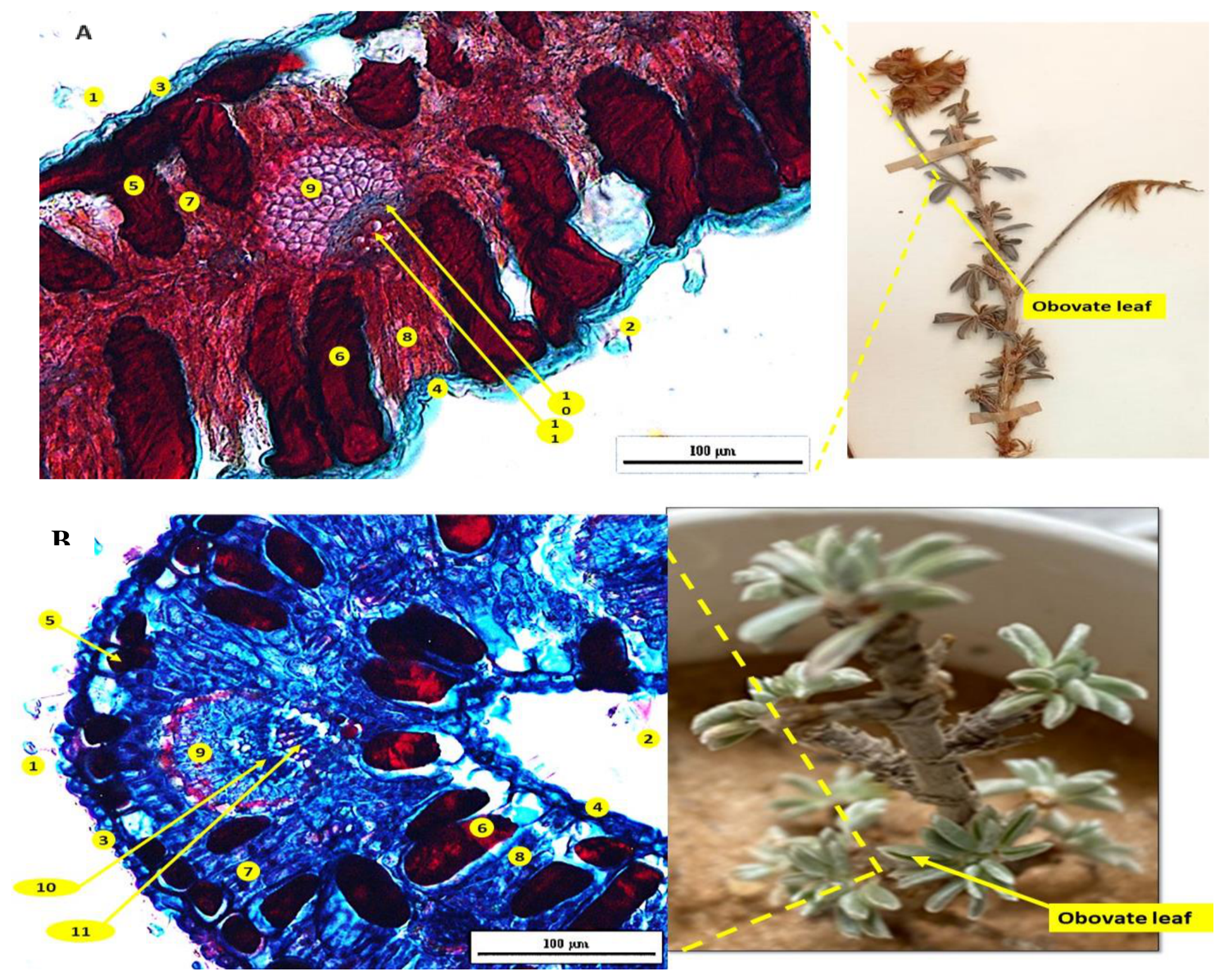
Figure 1. Conserved descriptive characters of the plant leaves throughout the past 80 years. (A and B) representative plates of the obovate leaf shape of the herbarium and fresh specimens, respectively, illustrating the structure of the leaf tissues of the epidermis, palisades and the vascular tissues. (1) abaxial glandular trichomes, (2) adaxial glandular trichomes, (3) abaxial epidermis, (4) adaxial epidermis, (5) abaxial idioblast of rounded and oblong-shaped cells, (6) adaxial idioblasts with oblong-shaped cells, (7) abaxial palisade, (8) adaxial palisade, (9) sclerenchyma, (10) phloem faced the abaxial epidermis, and (11) xylem vessels pointed towards adaxial palisade. In the fresh leaf section, (12) adaxial hypoderm. The light micrographs are at scale 100 µm.
Preprints 238868 g001
Figure 2. Anatomical traits of E. armitagei in Ras El-Hekma habitat in 1954, 1964, 2006, and 2024. The plant traits are (A) LBT: Leaf blade thickness (µm), (B) AdIBA: Adaxial idioblast area (µm2), (C) AbIBA: Abaxial idioblast area (µm2), (D) TIBA: Total idioblast area (µm2), (E) SCVBA: Sclerenchyma area of central vascular bundle (µm2), (F) PCVBA: Phloem area of central vascular bundle (µm2), (G) XCVBA: Xylem area of central vascular bundle (µm2), (H) XDCVB: Xylem diameter of central vascular bundle (µm), (I) TCVBA: Area of total central vascular bundle (µm2), (J) XCHC: Hydraulic conductance of xylem vessels in central vascular bundle (µm4/MPa). Bar and violin plots represent the normally and non-normally distributed data, respectively according to Shapiro-Wilk normality test (p≤ 0.05). The data are represented as mean ± standard deviation (SD) indicated as vertical bar above each column for normally distributed data and median with inter quartile range (IOR) for non-normally distributed data. The small letters (a-d) indicate the significant differences between decades according to One-Way ANOVA and Duncan post-hoc test (p≤ 0.05) for normally distributed data and Kruskal-Wallis and Dunn's post-hoc test (p≤ 0.05) for non-normally distributed data.
Preprints 238868 g002
Figure 3. Climate parameters in Ras El-Hekma of four decades: 1945-1954, 1955-1964, 1997-2006, and 2015-2024. The climate parameters are (A) air temperature (°C), (B) rainfall (mm), (C) relative humidity (%), (D) soil temperature at depth of 28-100 cm (°C), (E) soil moisture (m³/m³), and (F) wind speed (km/h). Bar and violin plots represent the normally and non-normally distributed data, respectively according to Shapiro-Wilk normality test (p≤ 0.05). The data are represented as mean ± standard deviation (SD) indicated as vertical bar above each column for normally distributed data and median with inter quartile range (IOR) for non-normally distributed data. The small letters (a-d) indicate the significant differences between decades according to One-Way ANOVA and Duncan post-hoc test (p≤ 0.05) for normally distributed data and Kruskal-Wallis and Dunn's post-hoc test (p≤ 0.05) for non-normally distributed data. The data are retrieved monthly form March 1945 to May 1954, From June 1955 to June 1964, from April 1997 to April 2006, and from May 2015 to May 2024, from Historical Weather API database https://open-meteo.com/en/docs/historical-weather-api accessed in August 2026. The location in 1945-1954 and 1955-1964 according to Point-radius georeferencing using core elements of Darwin core georeferencing is represented as decimal latitude: 31.202819, decimal longitude: 27.83665, coordinate uncertainty in meters: 22309, geodetic datum: EPSG:4326. The location in 1997-2006 is 31° 14` 19.4`` N and 27° 51` 54.4`` E and in 2015-2024 is 31° 14ˋ 13.9՝՝ N, 27° 51՝ 55.3՝՝ E.
Preprints 238868 g003
Figure 4. Variable importance plot of Variable Importance in Projection (VIP) scores. VIP scores of Partial Least Square (PLS) regression between each of climate parameters and each of anatomical plant traits. (A) LBT, (B) AdIBA, (C) AbIBA, (D) TIBA, (E) SCVBA, (F) PCVBA, (G) XCVBA, (H) XDCVB, (I) TCVBA, and (J) XCHC. Both climate parameters and plant traits are centered and scaled according to robust Pareto scale according to Varmuza K and Filzmoser P. 2024 before performing PLS regression to get VIP scores. The dashed red line marks the VIP = 1 threshold, a cut-off above which the climate parameter is considered a strong or primary driver or effector of the plant trait.
Preprints 238868 g004
Figure 5. Standardized PLS regression coefficient (ß: beta coefficient) using the standardized climate parameters and anatomical traits. (A) LBT, (B) AdIBA, (C) AbIBA, (D) TIBA, (E) SCVBA, (F) PCVBA, (G) XCVBA, (H) XDCVB, (I) TCVBA, and (J) XCHC. Both climate parameters and plant traits are centered and scaled according to robust Pareto scale according to Varmuza K and Filzmoser P. 2024 before performing PLS regression to get VIP scores. The brown and blue bars represent the negative and positive regressions, respectively.
Preprints 238868 g005
Figure 6. E. armitagei Schweinf. et Taub (Family: Fabaceae) collected from Ras El-Hekma. (A-C) Herbarium sheets deposited in the Cairo University Herbarium (CAI), Department of Botany and Microbiology, Faculty of Science, Cairo University, Giza, Egypt in the years 1954, 1964, and 2006, respectively. (D) Freshly collected leaves in 2024 from Al-Amirat coast in Ras El-Hekma at 31° 14ˋ 13.9՝՝ N, 27° 51՝ 55.3՝՝ E.
Preprints 238868 g006
Disclaimer/Publisher’s Note: The statements, opinions and data contained in all publications are solely those of the individual author(s) and contributor(s) and not of MDPI and/or the editor(s). MDPI and/or the editor(s) disclaim responsibility for any injury to people or property resulting from any ideas, methods, instructions or products referred to in the content.
Copyright: This open access article is published under a Creative Commons CC BY 4.0 license, which permit the free download, distribution, and reuse, provided that the author and preprint are cited in any reuse.