

Submitted:
15 October 2026
Posted:
16 October 2026
You are already at the latest version
Abstract
Digital mental health interventions increasingly use narrative, game design, personalisation and behavioural data to support engagement, but it remains unclear how these features can be integrated without weakening fidelity to the original evidence-based intervention approach. This study examined interdisciplinary perspectives on a narrative based serious game and meaningful engagement framework for preventative digital mental health grounded in Self Help Plus (SH+) and Acceptance and Commitment Therapy (ACT) informed principles. A two-round electronic Delphi (eDelphi) study was conducted involving participants from Human-Computer Interaction (HCI), mental health experts, and representatives of the target user groups. Fifteen participants completed Round 1 and following attrition, twelve completed Round 2. Consensus required at least 70% agreement or disagreement and an interquartile range of no more than 1. Round 1 assessed agreement with core framework assumptions and established consensus on 6/12 items. Round 2 re-rated the six unresolved items with controlled feedback, introduced five clarification items and elicited refinement priorities. Round 1 showed broad support for narrative, game design, behavioural observation, transferability and flexible pacing, but identified tensions around translation of SH+/ACT principles, oversimplification, narrative complexity, behavioural data sufficiency, context specificity and autonomy. Round 2 produced consensus that SH+/ACT principles can be translated into interactive mechanics when the core SH+/ACT content and processes remain stable and adaptation occurs mainly through delivery style, examples, pacing, narrative framing and interaction format. Participants also supported adjustable narrative depth, multidimensional engagement assessment, principle level transferability and guided autonomy. The framework received partial conceptual support, but findings indicate that further development should proceed through a modular minimum viable product (MVP) and empirical testing rather than immediate deployment.
Keywords:
digital mental health
; meaningful engagement
; serious games
; eDelphi
1. Introduction
Digital mental health interventions (DMHIs) have emerged as a viable solution in response to a persistent mismatch between the demand for psychological support and the capacity of traditional face-to-face services to provide timely, accessible and scalable care. Their promise lies in not only delivering treatment remotely, but also in extending support across prevention, early intervention, self-management and adjunctive care pathways [1,2]. However, this promise remains unevenly realised. Digital mental health (DMH) is no longer limited to static psychoeducational websites or telehealth substitutes. It increasingly includes smartphone applications, adaptive systems, virtual environments, sensor based monitoring and generative artificial intelligence [2]. These developments create opportunities for more personalised and context-aware care while also intensifying longstanding questions about evidence, implementation, intervention quality, safety and user engagement [1,2].
Engagement is one of the most persistent and theoretically under-specified problems in DMH. Although many DMHIs are designed to be scalable, scalability alone does not guarantee that users will find the intervention relevant, usable, trustworthy or worth returning to. Low adherence, attrition and limited sustained use remain common across digital interventions [3,4,5,6,7]. More importantly, the field continues to struggle with the assumption that observable use is equivalent to meaningful engagement. Metrics such as log-ins, clicks, time spent, session completion and return frequency can show whether a user interacted with a system but they do not necessarily indicate whether the user attended to, understood, valued or applied the psychological content [3,4,8].
This distinction is particularly important in preventative DMH. In a treatment context, symptom change may eventually indicate whether an intervention has had an effect, although even then the mechanism may remain unclear. In a preventative context, the intended contribution is often subtler, for instance helping users recognise stress responses, rehearse coping skills, reflect on values and apply psychological strategies before distress becomes severe or clinically entrenched. For such interventions, the relevant question is not simply whether users complete modules, but also whether they engage with the intervention in ways that are psychologically meaningful and sufficient for the intended outcome [3,4]. Yardley et al. describe this as “effective engagement”, emphasising that more use is not automatically better use [3]. Perski et al. similarly conceptualise engagement as both behavioural and experiential, involving not only interaction with the technology but also attention, interest, affect and cognitive investment [4]. Recent reviews of DMH engagement reinforce the same concern that engagement is influenced by patient, intervention and system level factors, yet remains inconsistently defined and measured [5,6,8].
These limitations suggest that DMH design should move beyond retention oriented thinking. Design strategies that make systems more attractive may increase use, but they may also produce superficial interaction if they are not aligned with intended psychological mechanisms. Serious games and gamification illustrate this tension. Serious games can provide experiential learning environments, feedback, challenge, progression and rehearsal opportunities, while gamification can introduce selected motivational features into otherwise non-game interventions [9,10,11,12]. Their application across mental health and wellbeing has produced a heterogeneous evidence base and the presence of game elements does not by itself establish psychological benefit [9,10,11,12,13]. A reward system may increase task completion without deepening reflection; a points system may shift attention from psychological practice to accumulation; and a game mechanic may obscure rather than clarify the intervention’s theoretical logic. Therefore, the relevant design question is not whether DMHIs can be gamified, but whether game mechanics can be mapped transparently and responsibly onto psychological processes.
Narrative design may provide a complementary route to meaningful engagement, but also requires critical scrutiny. Narrative communication has been used in health behaviour change because stories can organise experience, provide context, support identification and make abstract health information more personally meaningful [14,15,16,17]. Narrative transportation theory suggests that immersion in a story can influence beliefs and attitudes by integrating attention, imagery and emotion [15]. In DMH, narrative may help users approach psychological material indirectly through metaphor, character, environment, progression and reflective distance. This is potentially valuable for stress management content, where abstract concepts such as cognitive defusion, grounding, values and committed action may be difficult to understand through instruction alone.
However, narrative does not inherently produce psychological benefit. A poorly integrated story can increase cognitive load, distract from the psychological task, create confusion about what the user is supposed to learn or make the intervention feel childish or artificial. Narrative may also be experienced differently across users. It may increase emotional salience and motivation for some, while becoming an unnecessary barrier to the intervention content for others. Narrative should therefore be conceptualised not as decorative wrapping, but as a delivery layer whose value depends on whether it supports, rather than displaces, psychological skill acquisition.
The present study focuses on a narrative based serious game concept grounded in the World Health Organisation’s (WHO) Self-Help Plus (SH+) and Acceptance and Commitment Therapy (ACT). SH+ is a scalable, low intensity stress management intervention developed by WHO. It is delivered as a group based, guided self help course using pre-recorded audio, an illustrated guide and trained non-specialist facilitators [18,19]. SH+ has been evaluated in humanitarian and refugee contexts, including cluster randomised trial evidence and secondary analyses examining distress reduction, prevention and promotion outcomes [20,21]. ACT provides the broader psychological flexibility model underpinning many SH+ processes including acceptance, cognitive defusion, present moment awareness, values clarification and committed action [22,23]. Web based and internet based ACT interventions have also been evaluated in systematic reviews suggesting that ACT processes can be delivered digitally, while also raising questions about adherence, process fidelity and intervention quality [24,25].
Translating SH+/ACT-informed content into a narrative serious game is therefore not simply a matter of increasing engagement. It is a problem of preserving psychological purpose during translation into a new delivery format. If the game layer becomes too dominant, the intervention may lose fidelity to the psychological processes it is meant to support. If the SH+/ACT content is delivered too didactically, the game may become superficial or unnecessary. The design challenge is to preserve the core SH+/ACT content and processes while adapting the delivery layer through narrative interaction, pacing, feedback, examples and user choice. The distinction between intervention core and adaptive delivery was a design assumption of the proposed framework to be examined in this study.
Personalisation and behavioural telemetry add further complexity. Adaptive intervention frameworks, including just-in-time adaptive interventions (JITAIs), emphasise the possibility of providing the right type and amount of support at the right time by adapting to changing internal and contextual states [26]. Ecological momentary assessment and intervention approaches similarly illustrate how repeated self-report and context sensitive delivery may support behaviour change and self-management [27]. However, in mental health, adaptive systems and digital phenotyping also raise ethical and epistemic concerns. Passive or behavioural data may reveal patterns of use, movement, communication or interaction but such data are not neutral proxies for psychological meaning [28,29,30]. Digital phenotyping and telemetry raise questions about privacy, informed consent, accountability, bias, explainability and the risk of reducing care to what can be sensed or logged [28,29,30]. For a narrative serious game, this means that behavioural traces may indicate how users move through the system, but not necessarily whether they understand, value or apply the skills in daily life.
These considerations point to the need for a multidimensional model of meaningful engagement. The proposed framework uses a working definition of meaningful engagement that extends beyond repeated use. It includes behavioural interaction with the system, subjective involvement, reflective processing, perceived personal relevance, autonomy and the potential transfer of SH+/ACT skills into real world contexts. This framing aligns with digital intervention development models that emphasise the mapping of behavioural aims to technological components, the importance of user perspectives and the need to develop complex interventions iteratively before large scale evaluation [31,32,33,34]. It also aligns with the view that DMHIs should be evaluated not only for access and acceptability, but also for their mechanisms, implementation requirements and potential harms [1,2].
Given the conceptual complexity of combining SH+/ACT, narrative, serious games, personalisation and engagement telemetry, early-stage conceptual appraisal is useful before feasibility or effectiveness testing. An electronic Delphi approach is well suited to this stage because it allows structured interdisciplinary judgement on questions where empirical evidence is limited, design assumptions require scrutiny and multiple forms of expertise are relevant [35,36,37,38,39]. Rather than testing whether the system works clinically, the present study asks whether the framework is conceptually coherent, perceived as consistent with the original intervention approach, acceptable in principle across stakeholder perspectives and sufficiently refined to guide prototype development and subsequent empirical evaluation.
The aim of this study was therefore to obtain interdisciplinary feedback on a narrative-based serious game and meaningful engagement framework for preventative DMH. Specifically, the study examined panel perspectives on (1) fidelity to SH+/ACT informed principles; (2) narrative as a medium for psychological engagement; (3) gamification and personalisation; (4) behavioural telemetry and meaningful engagement measurement; (5) transferability beyond the current intervention context; and (6) human-system interaction, including autonomy, guidance and pacing. The study sought to identify areas of consensus, disagreement and design refinement to inform the next stage of intervention development.
2. Materials and Methods
2.1. Study Design
This study used an electronic Delphi (eDelphi) design to obtain structured interdisciplinary feedback on a narrative-based serious game and meaningful engagement framework for preventative DMH. The Delphi method is an iterative approach for eliciting and refining expert or stakeholder judgement through sequential rounds, controlled feedback and reassessment of responses [35]. It is commonly used in health research where evidence is incomplete, concepts require clarification or practice recommendations depend on multidisciplinary judgement [36,37,38,39]. An electronic format was selected to support asynchronous participation and to allow geographically distributed participants to review the intervention concept independently.
The study was designed as an early stage conceptual validation and refinement exercise with the aim to examine whether the conceptual framework was coherent, acceptable and sufficiently specified to justify further prototype development. This positioning is consistent with complex intervention and digital health development which emphasises iterative development, stakeholder input, theoretical specification and refinement before definitive evaluation [31,32,33,34].
The eDelphi process comprised two planned rounds. Round 1 collected quantitative ratings and qualitative comments across six framework domains. Round 2 presented controlled group feedback from round 1 and invited participants to confirm, revise or clarify selected responses. Reporting of the Delphi procedure was informed by guidance recommending transparent description of the rationale for the Delphi use, panel composition, number of rounds, feedback procedures, consensus criteria and treatment of non-consensus items [36,37,38]. Items that remained unresolved after the two planned rounds were retained as findings and additional rounds were not introduced to force agreement.
2.2. Intervention Concept and Framework
The evaluated concept was a narrative-based serious game for preventative DMH support. The system was informed by SH+ and ACT and was designed to translate psychological flexibility and stress management processes into an interactive, reflective experience [18,19,22,23]. The proposed intervention was structured around psychological skill areas corresponding to grounding, unhooking from difficult thoughts and feelings, values, kindness and committed action. The concept also included multiple components such as a narrative world organised around psychological skill areas; a guide or avatar character to orient the user; interactive exercises linked to SH+/ACT informed processes; reflective prompts intended to support meaning making and transfer; game elements such as progression, feedback, achievement and delivery format; and behavioural telemetry intended to observe interaction patterns and inform engagement assessment.
A central assumption of the framework was that the intervention core, comprising the psychological principles and skill processes that should remain faithful to SH+ goals, should be distinguished from the adaptive delivery layer: how these processes are presented, sequenced, paced, narrated, personalised and interacted with. This distinction was examined explicitly to assess whether the serious game’s narrative elements would reinforce rather than undermine or distort the core logic.
2.3. Participants and Recruitment
Participants were purposively recruited to provide interdisciplinary feedback relevant to the design, evaluation, implementation and potential use of the proposed system. The panel included perspectives from three main groups: Group 1, clinical and SH+/ACT specialists and digital ethics, implementation and mental health service experts; Group 2, human-computer interaction (HCI), serious games, gamification and personalisation researchers; and Group 3, potential users. There were 5 participants from each group with 15 participants in total. This heterogeneous panel composition was intentional given that the proposed system spans SH+ informed self help content, interaction design, engagement measurement, adaptive technology and user acceptability. No single disciplinary group could adequately evaluate all relevant dimensions.
Eligible participants were individuals able to provide informed feedback on at least one of the areas in the main groups. They were initially approached by word of mouth based on personal and professional working relationships. After agreeing to participate, they were then officially invited by email and provided with information about the study purpose, intervention concept and voluntary nature of participation before completing the questionnaire. Round 1 included 15 responses from which the aggregate feedback was calculated before personalised Round 2 forms were prepared. Both questionnaires included an electronic consent item before the substantive questions. Participant identifiers and group membership are reported in Table 1.
2.4. Round 1 Materials and Procedure
Before completing Round 1, participants were provided with a description of the proposed system and its conceptual basis, which included a short visual overview of the prototype concept. The purpose of this material was to establish a shared understanding of the proposed intervention before participants evaluated its assumptions.
The Round 1 questionnaire was administered electronically and it consisted of six thematic sections corresponding to the main domains of the framework:
- A. SH+ fidelity and transformation;
- B. Narrative as intervention medium;
- C. Gamification and personalisation;
- D. Measurement and telemetry;
- E. Generalisability and transferability;
- F. Human-system interaction.
Each section contained two Likert scale items, giving 12 items in total, rated from 1 to 5, where 1 indicated strong disagreement, 3 a neutral response and 5 strong agreement. Participants were also invited to provide free-text comments explaining their ratings, identifying risks or suggesting refinements. This mixed structure allowed the study to examine both the direction of the panel judgement and the reasoning underlying agreement, disagreement or uncertainty.
The questionnaire also included both supportive and cautionary items. This was necessary since the study was not designed to confirm the desirability of the framework but to test its conceptual vulnerabilities and reduce the risk of treating engagement oriented design features as inherently beneficial. Consequently, a high score on a cautionary item expressed concern about the stated risk. The statements were interpreted individually rather than combined into an overall support score. Round 1 item wording is reproduced in Appendix B.
2.5. Round 1 Questionnaire Domains
The SH+ fidelity and transformation section (A) examined whether translating SH+/ACT informed principles into interactive mechanics was considered appropriate and whether this translation risked oversimplifying or distorting SH+/ACT content. The narrative section (B) examined whether narrative could support psychological understanding and engagement, while also assessing whether it might introduce unnecessary complexity. The gamification and personalisation section (C) considered the perceived value of game design elements and the possible risks of personalisation for coherence, predictability or comprehensibility.
The measurement and telemetry section (D) explored whether behavioural observation could provide useful insight into user experience and whether behavioural data alone would be sufficient to assess meaningful engagement. The generalisability section (E) analysed whether the framework could be useful beyond the specific proposed system or whether some elements might be too specific to SH+, mental health or the proposed narrative world. The human-system interaction section (F) evaluated guidance, autonomy, pacing and the possibility that support could become overly directive.
Together, these domains reflected the main conceptual tensions within the framework, namely, fidelity versus adaptation; engagement versus distraction; personalisation versus coherence; telemetry versus meaning; transferability versus specificity; and guidance versus autonomy.
2.6. Consensus Criteria
Consensus criteria were specified a priori during the study design phase, before Round 1 findings were examined, and applied consistently across both rounds. Responses were grouped into three directional bands: i) disagreement, scores of 1 or 2; ii) neutral/uncertain, score of 3; and iii) agreement, scores of 4 or 5. An item was considered to have reached consensus when at least 70% of the participants scored in either the agreement or disagreement band and the interquartile range (IQR) was less than or equal to 1.
This combined criterion was selected to account for both directional agreement and dispersion. Percentage agreement alone can obscure spread with ordinal data, while dispersion alone does not indicate whether the group has converged towards agreement or disagreement. The use of a predefined threshold is also consistent with Delphi reporting recommendations, given that consensus definitions vary widely across Delphi studies and should be specified a priori [37,38]. A 70% directional threshold was selected as a pragmatic criterion for exploratory framework validation while the IQR criterion provided an additional check on response concentration.
Since the data were ordinal, medians and IQRs were used as the primary descriptive statistics. Means were not used as the main basis for determining consensus since the study’s aim was to identify conceptual convergence or divergence and not to estimate continuous latent scores. Quartiles were calculated by linear interpolation. Tables report the first and third quartiles (Q1-Q3) and the IQR width used for the consensus rule is Q3 minus Q1.
2.7. Round 2 Controlled Feedback and Personalised Routing
Round 2 was designed to support reflection and refinement without forcing conformity. For each re-rated item included in Round 2, participants were shown anonymised group feedback from Round 1. The feedback cards displayed the distribution of responses across the five response options. Median, mode, IQR and agreement percentages were not displayed, and no explicit comparison between an individual score and the group summary was provided.
All participants received the same common Round 2 items for domains where consensus had not been reached in Round 1. These common non-consensus items asked participants to review the group feedback, view their own previous score, and either confirm or revise their rating. Participants were also asked to briefly explain their reasoning, particularly where their view changed after seeing the group feedback. Additional common clarification items were included to refine unresolved conceptual distinctions that emerged from Round 1, including preserving the intervention core while adapting delivery, adjustable narrative depth, multidimensional meaningful engagement, transferability and guided autonomy. These items specified new, more bounded propositions and their endorsement was analysed separately from change on the original statements.
Personalised follow-up prompts on original items were used only for consensus items where a participant’s Round 1 response differed from the main panel tendency. The common re-rating items already invited all participants to explain their position. For consensus items omitted from that section, personalised prompts were included when an individual response was neutral or opposed the consensus. The purpose of these prompts was not to pressure participants to align with the panel, but to clarify whether their position remained the same after the group feedback and to understand the reasoning behind divergent judgements. Some individual forms also included the additional personalisation clarification item C3, which was analysed separately from the common items (Appendix D).
2.8. Quantitative Analysis
Round 1 Likert responses were summarised using frequencies, percentages, medians, modes and IQRs. For each item, the proportion of participants in the agreement, neutral and disagreement bands was calculated and items were then classified as consensus or non-consensus according to the predefined criteria.
Aggregate feedback for Round 2 used all 15 Round 1 responses. Round 2 item summaries and refinement priorities used the 12 Round 2 responses. Common re-rating and clarification items were summarised using the same directional bands, medians, IQRs and consensus criteria. Personalised clarification items were analysed separately since they were not administered to the full panel and therefore could not be interpreted as panel-level consensus items. Full item distributions are provided in Appendix A, Table A1.
2.9. Group Type Analysis, Priority Ranking and Exploratory Response Profiles
Descriptive group-type analyses were conducted to examine whether response tendencies differed across the three analytic groups. For each group, directional response frequencies were summarised using the predefined agreement, neutral and disagreement bands. These analyses were exploratory and descriptive only and no inferential subgroup testing was conducted due to the small group sizes. For the six items included in both rounds, paired changes in scores and directional bands were examined using the same 12 identifiers in each round. Group mean changes were calculated from these paired records so that differences in group composition did not enter the change estimate. Means summarised patterns descriptively and were not used to determine consensus. Appendix A, Table A2 reports increases, unchanged scores and decreases.
Round 2 refinement priorities were analysed using a Borda-style scoring approach where participants ranked their top five priorities before deployment. Priorities were scored on a decreasing scale, where the first ranked item was assigned five points and the fifth-ranked item was assigned one. Unselected options received zero. Priority rankings were summarised overall and by participant group. Equal point totals were assigned the same rank, and all options tied at the reporting cut-off were retained. Rankings reflected selection and ordering within each participant’s top five choices, rather than absolute judgements of importance. Exploratory response profile analysis was used to examine whether participant rating patterns appeared to cluster beyond the predefined group categories. The analysis was conducted in Python 3.12.14, using pandas 2.2.3 and NumPy 2.3.5. Exploratory clustering, standardisation and principal component analysis were implemented using scikit-learn 1.8.0.
This analysis used agglomerative hierarchical clustering with Euclidean distance and Ward linkage on item scores standardised separately within each round. Round 1 used the 12 original items and Round 2 used the 11 common re-rating and clarification items. A three cluster partition was used in each round for exploratory description and consistency of presentation across rounds. The number of clusters was specified for this summary, while participant membership was determined algorithmically from the complete standardised item ratings. PCA provided two dimensional visualisations of these memberships. Principal component analysis (PCA) provided separate two-dimensional projections for each round. The axes and cluster labels were specific to each fit. Clusters were labelled A-C in decreasing order of membership within each round. The term ‘largest broad profile’ denotes Cluster A. Their substantive interpretation was based on item-level ratings and associated comments, with supportive and cautionary statements interpreted in their original direction.
2.10. Qualitative Analysis
Free-text responses from Round 1 were analysed using a pragmatic, framework-informed approach to identify recurring themes, conceptual ambiguities and design risks, and to inform Round 2 refinement. Comments were grouped by questionnaire section and item and examined alongside the corresponding quantitative ratings to understand participants’ reasons for agreement, disagreement, neutrality or caution. Particular attention was given to conditions under which the framework would be acceptable, suggested refinements and explanations for items not reaching consensus. The analysis was informed by thematic analysis principles and Delphi reporting guidance emphasising transparent synthesis of qualitative panel feedback across rounds [40,41].
The first and second authors (MM, SAP) conducted the analysis collaboratively, with subsequent review by the supervisory authors (OG, SG). Differences in interpretation were resolved through discussion and re-examination of the original comments, relevant questionnaire items and associated ratings. This process established the interpretations used to prepare Round 2 feedback and refine clarification items.
Comments from both rounds were integrated with the final quantitative findings to explain unresolved conceptual tensions and inform future prototype development. In line with person-based and participatory eHealth development approaches, written comments were treated as exploratory design evidence [32,33]. Selected examples were attributed by participant identifier. Minority and ambiguous positions were retained to represent the range of reasoning, and examples were not used to estimate theme prevalence.
2.11. Ethical Considerations
Participants were informed about the purpose of the study, the voluntary nature of participation and the use of their responses for research and intervention refinement. Electronic consent was recorded before questionnaire completion. No clinical intervention was delivered as part of the eDelphi process and no clinical outcomes were collected. The study involved only expert and stakeholder judgement on a proposed intervention concept.
2.12. Data Management
All personal data were processed in accordance with the European Union General Data Protection Regulation (GDPR) (EU 2016/679). Survey responses were stored securely and analysed using pseudonymised identifiers, with identifying information separated from response data where possible. Aggregate feedback presented in Round 2 did not identify individual participants and the personalised forms used individual scores only to support reflection and clarification. Aggregate data supporting the numerical results are included in Appendix A; participant-level access arrangements are specified in the Data Availability Statement.
3. Results
3.1. Response Flow and Analytical Dataset
Round 1 included 15 participants from the groups described in Section 2.3. The Round 2 analytical dataset included 12 participants, with five from each of Groups 1 and 2 and two from Group 3. S5, S6 and S13 were absent from the Round 2 data set. Table 1 reports the identifiers used in each round.
Substantive interpretation is based on group level patterns, item level consensus, qualitative comments and exploratory voting profiles.
3.2. Round 1 Consensus and Unresolved Items
Round 1 established the initial pattern of support and uncertainty across the framework. Table 2 summarises the Round 1 item level results using the predefined directional bands and consensus criteria. Consensus was reached on 6 of the 12 original Likert scale items. The panel reached consensus agreement that narrative elements can support understanding and engagement (B1), game design elements can support engagement and personal relevance (C1), behavioural observation can provide useful insight into user experience (D1), the broader approach may be useful beyond the proposed system (E1), and users should be able to proceed flexibly at their own pace (F1). Consensus disagreement was reached for the statement that personalisation may make the system inconsistent or harder to understand (C2).
The six non-consensus items were A1, A2, B2, D2, E2 and F2. These items corresponded to the central design tensions in the framework, namely translation of SH+/ACT principles, oversimplification, narrative complexity, behavioural data sufficiency, transferability and guidance/autonomy. In this regard, Round 1 showed broad receptiveness to the framework’s direction, but it also identified concerns about design failure, loss of intervention fidelity or misinterpretation that required further clarification. The directional distribution of responses during Round 1 is illustrated in Figure 1. Neutral responses were common on B2, D2, E2 and F2, so the absence of consensus did not consistently indicate two opposing camps. The five-category distributions in Appendix A distinguish neutrality from agreement and disagreement.
3.3. Group Type Patterns in Round 1 Unresolved Areas
The Round 1 group-type analysis helped identify where the initial tensions were concentrated. Figure 2 shows the overall group-level response tendencies across all Round 1 items.
Comparison of the three participant groups showed that differences were concentrated in specific unresolved areas rather than being consistent across all items. For this reason, group patterns were interpreted mainly through the non-consensus items rather than treating group-type as a global predictor of agreement or disagreement. Figure 3 focuses on the agreement, neutral and disagreement distributions for the six non-consensus items.
Figure 3 shows the clearest group-level differences in the Round 1 conflict areas. For A1, both Group 1 and 2 were broadly supportive of translating SH+/ACT principles into interactive mechanics. In each group, 4 of 5 participants agreed and 1 was neutral. Group 3 was more cautious. Two participants agreed, two were neutral and one disagreed. Interactive translation therefore attracted initial agreement in the two professional groups, while the potential user ratings were more varied.
The clearest group difference appeared in A2. All 5 participants in Group 3 agreed that turning SH+ skills into game mechanics could oversimplify or distort the SH+/ACT content. Group 2 also recognised this risk, although less uniformly, with 3 agreeing and 2 neutral. Group 1 was more divided, with 2 agreeing, 1 neutral and 2 disagreeing. Concern about oversimplification was therefore strongest among potential users and was not confined to clinical expertise.
Narrative complexity showed a different pattern as Group 1 participants were least likely to view narrative as inherently problematic, with 4 of 5 participants disagreeing that it would add unnecessary complexity. Group 2 was more uncertain, with most responses falling in the neutral band. These differences concern responses to this particular statement. Possible explanations are considered alongside the qualitative comments in the Discussion.
For behavioural data, uncertainty cut across groups. Group 3 leaned most strongly toward the view that behavioural data may be insufficient alone, while Group 2 was mixed and Group 1 was mostly neutral. Reservations about telemetry were distributed across stakeholder categories, although the balance of agreement and neutrality differed. The items on transferability and guidance/autonomy showed no clear group-level convergence in Round 1, which suggests that these were not simply group specific disagreements but instead unresolved conceptual issues across the panel.
Taken together, the Round 1 group analysis shows that concerns varied across participant groups without forming a uniform division between them. Potential users were most concerned about oversimplification, Group 1 participants were least concerned about narrative complexity and HCI design participants were generally supportive of interactive translation while still recognising implementation risks.
3.4. Round 2 Convergence, Clarification and Remaining Uncertainty
Round 2 re-presented the six Round 1 non-consensus items with controlled feedback and invited participants to confirm or revise their ratings. It also included clarification items designed to convert Round 1 uncertainties into more specific design principles. Table 3 summarises the Round 2 results for both common re-rating and clarification items.
Table 3 shows that the strongest Round 2 convergence occurred in the clarification items rather than in all of the original re-rating items. The re-rating items show which Round 1 concerns persisted while the clarification items show how the panel refined those concerns into more specific design principles. The clearest shift occurred for A1, which did not reach consensus in Round 1 despite 10 of 15 participants agreeing, but in Round 2 agreement increased to 11 of 12 responses with a median of 5 and quartile limits of 4-5. Among the same 12 identifiers in Round 1, nine agreed, two were neutral and one disagreed. S4 and S14 moved from neutral to agreement, while S3 retained disagreement. Consensus therefore emerged in favour of the idea that SH+/ACT principles can be translated into interactive mechanics. However, the paired cautionary item A2 did not reach consensus. Eight of 12 responses agreed that turning SH+ skills into game mechanics could still oversimplify or distort SH+/ACT content. Although the panel moved toward agreement that interactive translation is possible, it did not dismiss the risk of distortion. Seven of the 12 responses endorsed both A1 and A2, showing that support for interactive translation and concern about oversimplification coexisted within the same response profiles.
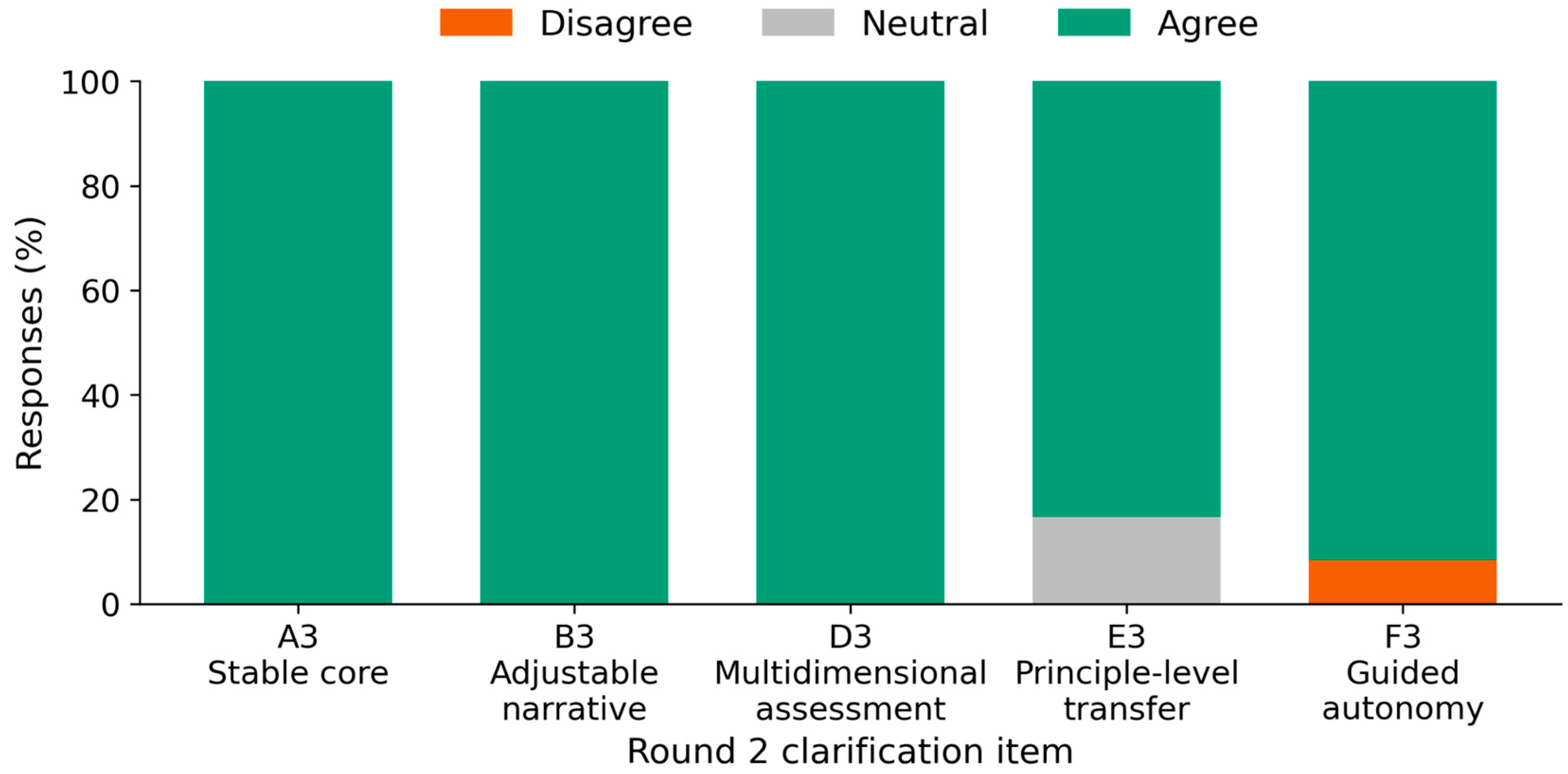
The clarification item A3 identified a shared condition for translation, as all 12 responses agreed that the “therapeutic core” of SH+/ACT should remain standardised, while personalisation and game mechanics should mainly adapt the delivery style, examples, pacing, narrative framing and interaction format. This indicates that participants supported interactive delivery when the core SH+/ACT content and processes remain protected. The narrative item B2 also remained below the formal consensus threshold with 7 of 12 responses disagreeing that narrative adds unnecessary complexity, 4 neutral and 1 agreeing. This indicates movement away from viewing narrative as inherently problematic, but not enough to establish formal consensus disagreement. The clarification item B3 provided a more decisive finding and all 12 responses agreed that narrative should function as a supportive scaffold for reflection and skill practice, while allowing users to reduce narrative depth, sensory intensity, visual effects, audio or motion if these become distracting or overwhelming.
D2 remained unresolved and 5 of 12 responses agreed that behavioural data may not be enough to determine meaningful engagement, 6 were neutral and 1 disagreed. However, D3 reached complete agreement with all 12 responses agreeing that meaningful engagement should be assessed through a combination of behavioural data, brief self report, reflective responses, emotional relevance and evidence of real world application of SH+ skills. This indicates that the panel accepted behavioural telemetry as useful, but converged more strongly around a multidimensional measurement model. E2 also remained unresolved as 5 of 12 responses disagreed that some parts of the approach may be too context specific to transfer easily, 5 were neutral and 2 agreed. The clarification item E3 gave a more precise interpretation with 10 of 12 responses agreeing that the framework is most transferable at the level of design principles, engagement measurement, adaptive delivery and reflective interaction rather than as a fixed SH+ game structure or fixed set of mechanics. Two responses were neutral on E3.
F2 remained unresolved as well and 5 of 12 responses disagreed that guidance may reduce autonomy, 6 were neutral and 1 agreed. The clarification item F3 reached consensus with 11 of 12 responses agreeing that the system should provide a recommended structured pathway while allowing users to pause, repeat, slow down, request guidance and personalise examples without being forced through the experience. The emerging Round 2 principle was therefore guided autonomy, although S10 retained disagreement with F3.
The clarification items attracted stronger agreement than the corresponding broad concerns. Endorsing adjustable narrative, complementary engagement measures or guided autonomy did not require respondents to dismiss narrative complexity, data sufficiency or autonomy risks. The pattern indicates convergence on more specific design conditions while leaving implementation questions open.
Figure 4.
Paired mean score changes from Round 1 to Round 2 for the six re-rated items. Each group’s comparison uses the same identifiers in both rounds. Positive values indicate stronger endorsement of the stated item, including cautionary statements.
Figure 4.
Paired mean score changes from Round 1 to Round 2 for the six re-rated items. Each group’s comparison uses the same identifiers in both rounds. Positive values indicate stronger endorsement of the stated item, including cautionary statements.
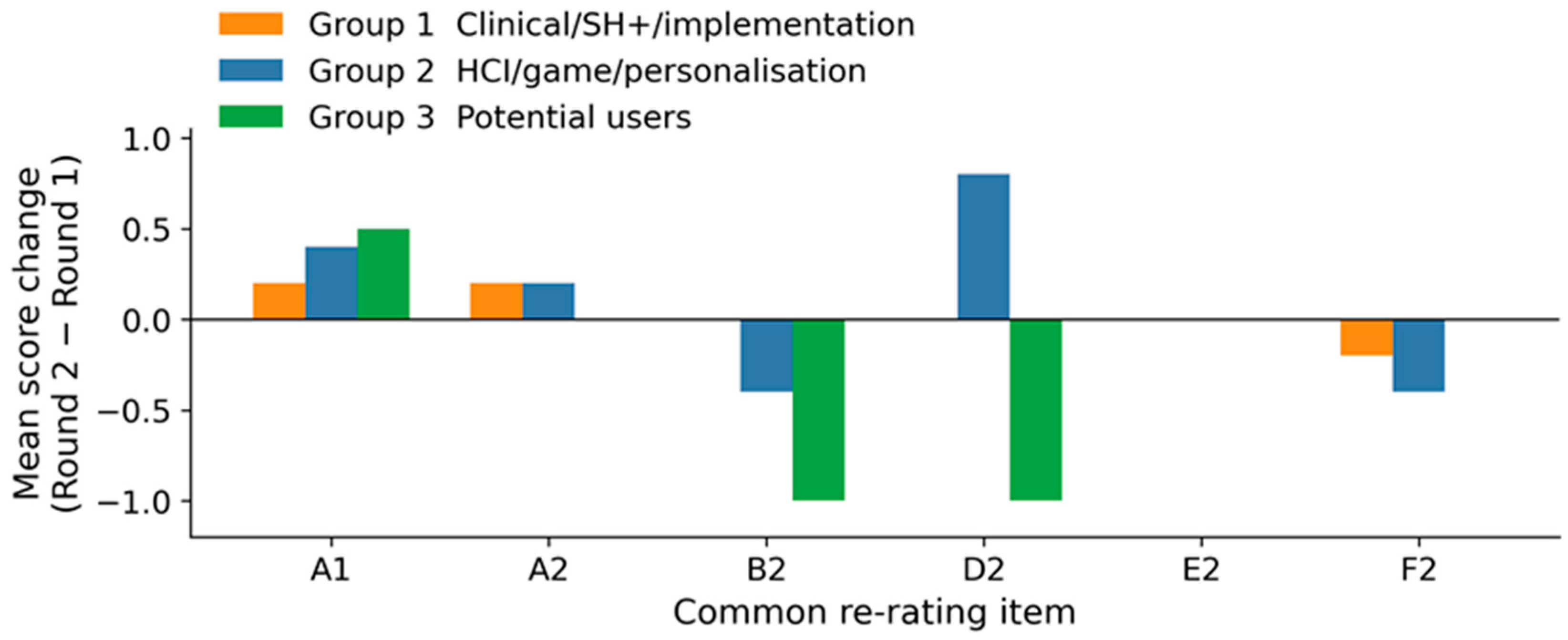
Figure 5.
Round 2 clarification item distributions. All five items met the consensus rule; E3 and F3 did not receive unanimous agreement.
Figure 5.
Round 2 clarification item distributions. All five items met the consensus rule; E3 and F3 did not receive unanimous agreement.
Paired changes further qualify the aggregate findings (Appendix A, Table A2). For D2, ten scores were unchanged, one increased and one decreased. The increase from 1 to 5 was accompanied by continued emphasis on the richness of behavioural data in S7’s comment, so its meaning cannot be inferred from the score alone. E2 had two increases and three decreases, with five changes of directional band despite an unchanged paired median of 3. Aggregate stability therefore concealed movement in opposite directions. The Round 2 group-type analysis should be interpreted cautiously since the potential user group (Group 3) was represented by only two Round 2 records. Nevertheless, several patterns were visible in the two fully retained groups. Both Group 1 and 2 fully converged on A1, with all five participants in each group agreeing that interactive translation was appropriate. For A2, however, Group 2 showed stronger concern about oversimplification with 4 of 5 agreeing and 1 neutral. Group 1 was more divided with 2 agreeing, 2 neutral and 1 disagreeing. Support for interactive translation coexisted with concern about how game design might affect psychological meaning.
For B2, Group 1 again showed the strongest disagreement with the idea that narrative necessarily adds complexity while Group 2 was more neutral. For D2, Group 2 leaned more strongly toward behavioural data insufficiency while Group 1 was mostly neutral. For F2, Group 2 participants were more likely to reject the view that guidance necessarily reduces autonomy while Group 1 participants were more mixed. The comments provide context for these patterns. S2 favoured optional guidance, whereas S10 emphasised designed pacing and progression. Neither position can be assumed to characterise every member of a group.
3.5. Refinement Priorities and Exploratory Response Profiles
The Round 2 priority ranking asked participants to identify the five most important aspects arising from Round 1 comments to refine before deployment, including development of a modular minimum viable product (MVP). Table 4 summarises the Borda ranking while Figure 6 illustrates the relative weight of the highest ranked priorities, including all options tied at tenth rank. The complete ranking is provided in Appendix A, Table A3.
Table 4 shows that the highest ranked priority was preserving SH+/ACT fidelity and therapeutic depth. It received 43 Borda points, appeared in 11 of 12 top 5 lists and was ranked first by 6 participants. The next highest priority was testing with real target users before deployment, followed by developing a modular MVP before adding more features. Testing with vulnerable or stressed users, allowing users to reduce or disable game elements and clarifying the psychological purpose of each game mechanic also ranked highly.
Figure 6 shows that fidelity to SH+/ACT principles was not only the top ranked priority but also separated from the remaining priorities by a substantial margin. This suggests that the panel’s main concern was not adding further functionality, but protecting the psychological depth of SH+/ACT during further development. Lower scores reflect relative selection within five ranked choices and do not establish that a requirement is unnecessary.
The group priority analysis showed how the shared priority of fidelity was accompanied by different secondary emphases. Figure 7 displays the eight leading priorities by group. Group 2 participants gave relatively high priority to target user testing, modular MVP development, personalisation logic, ethics/privacy, user control and the option to reduce or disable game elements. Group 1 participants placed more emphasis on narrative clarity, vulnerable user testing, showing how SH+/ACT processes interact, real world transfer and clarifying the psychological purpose of each mechanic. The available Group 3 responses were consistent with the Round 1 concern that the system must avoid superficial or reductive implementation.
Exploratory clustering examined whether response profiles extended across the predefined groups. The procedure is explained in Section 2.9. Figure 8 displays the profiles, and Appendix A, Table A4 lists membership.
The cluster analysis showed that response patterns did not map neatly onto participant group. In Round 1, the largest broad profile (Cluster A) contained ten participants from all three groups. A second shared profile (Cluster B) contained S1, S7, S9 and S11, while S10 formed a singleton (Cluster C). The broad profile included varied positions on interactive translation (A1), with five members agreeing, four neutral and one disagreeing. All four members of Cluster B strongly agreed with A1 and disagreed that parts of the approach were too context-specific to transfer easily (E2). S10 combined support for interactive translation with concerns about personalisation and unrestricted pacing. This illustrates a distinctive combination of item judgements, without establishing a separate participant type.
In Round 2, the largest broad profile contained eight records across all three groups, the second contained S1, S2 and S11, and S10 again formed a singleton. All eight members of the largest profile endorsed core preservation (A3), adjustable narrative (B3), multidimensional assessment (D3) and guided autonomy (F3). Seven endorsed principle-level transferability (E3). Membership of the largest cluster did not necessarily imply support for interactive translation. S3 belonged to it while maintaining disagreement with A1 and strong agreement with A2, despite endorsing all five clarification items. The three members of Cluster B strongly endorsed A1, disagreed with unnecessary narrative complexity (B2) and context specificity (E2), and gave agreement or neutral responses to behavioural-data insufficiency (D2). The profiles therefore illustrate variation across group boundaries. Their interpretation depends on the underlying items and comments rather than cluster size or position alone. S10’s Round 2 responses further specified the implementation boundary. Strong endorsement of interactive translation (A1) coexisted with concern about relying on behavioural data alone (D2) and disagreement with the guided-autonomy proposition (F3). Across rounds, S10’s comments emphasised designed pacing and repeated practice for habit formation, alongside concern about personalisation. These observations support interpreting S10’s position as an individual implementation-boundary profile. By comparison, S3’s caution concerned the appropriateness of the proposed translation itself. Cautionary reasoning therefore occurred both within and outside the largest broad profile.
3.6. Integrated Qualitative Findings
The qualitative comments from both rounds helped explain the quantitative patterns. The integrated synthesis explains why participants supported, questioned or qualified the framework. Participant-attributed examples connect the themes to their supporting observations.
Participants repeatedly emphasised fidelity to SH+/ACT principles. Support for interactive or game-based delivery was accompanied by concerns that poorly mapped mechanics could reduce SH+/ACT processes to superficial tasks. S3 requested brief explanations of how mechanics represented SH+ principles, while S6 and S11 questioned whether separate narrative worlds adequately represented the interaction among psychological processes. This theme was consistent with the item level tension between A1 and A2 and with the priority ranking where preserving SH+/ACT fidelity was the dominant deployment priority. Narrative and game quality also emerged as implementation conditions rather than optional refinements. S1 favoured adjustable narrative depth and sensory intensity, and S9 emphasised enjoyment as a condition for continued participation. Participants described narrative as potentially useful when it makes psychological processes more concrete, memorable and emotionally meaningful. At the same time, they warned that narrative could become distracting or burdensome if it is too complex, sensory intense or disconnected from intended psychological purpose. Comments on game mechanics followed the same logic where game elements were acceptable when they supported reflection and skill practice, but problematic if they resembled reward loops or progression systems that encourage task completion without psychological internalisation.
The panel treated behavioural data as useful but interpretively limited. They recognised that interaction traces could show where users pause, repeat, disengage, or move through the system. However, they also noted that these behaviours can have different meanings. Longer time in a section could indicate engagement, confusion, distress or distraction. Repetition could indicate practice or misunderstanding. Completion could reflect meaningful learning or superficial compliance. These comments help explain the coexistence of D1 consensus, unresolved D2 ratings and complete agreement with D3. S1 explicitly noted that time spent could indicate engagement or confusion. S12 favoured brief assessments to limit burden. S9’s continued uncertainty on D2 also shows why neutral ratings should not automatically be read as conditional acceptance. Participants favoured guided autonomy and they wanted users to receive enough structure to understand what to do, but not so much direction that the system feels controlling. Several comments emphasised the importance of pausing, repeating, slowing down, requesting guidance and adjusting narrative or sensory intensity. S12 raised a minority concern about when serious distress should trigger suspension of gamified interaction and a shift to minimal support or signposting. This identifies a scope question for development rather than a panel-endorsed crisis-management function.
Panellists also consistently pointed toward staged empirical development. Rather than recommending immediate deployment or further feature expansion, they emphasised a modular MVP, target user testing, vulnerable user testing and clearer mapping between SH+/ACT processes and interaction mechanics. S2 proposed modular development, S10 requested a concrete demonstrator to make evaluation more specific, and S8 emphasised practice and reflection in daily life. This qualitative pattern aligned closely with the priority ranking and helped define the next development stage.
4. Discussion
4.1. Principal Findings
This eDelphi study provides partial conceptual support for a narrative based serious game and meaningful engagement framework for preventative digital mental health. The findings do not support immediate deployment of the proposed system, nor do they show that the system is clinically effective, feasible or acceptable in real world use. Instead, they show that an interdisciplinary panel considered the framework plausible under specific design conditions.
Round 1 established the initial assessment where participants supported the general use of narrative, game design elements, behavioural observation, transferability and flexible pacing, but identified six unresolved areas including translation of SH+/ACT principles, oversimplification, narrative complexity, behavioural data sufficiency, context specificity and autonomy. Round 2 clarified the conditions under which several of these tensions could be addressed. Consensus emerged that SH+/ACT principles can be translated into interactive mechanics but the risk of oversimplification remained credible. Stronger consensus emerged around the conditions needed to make such translation defensible including that the core SH+/ACT content and processes should remain stable, narrative should be adjustable, meaningful engagement should be assessed multidimensionally, transferability should be claimed at principle level rather than fixed mechanics and guidance should preserve autonomy.
The central finding is conditional support for engagement oriented features when they preserve psychological meaning. The framework’s promise lies in whether narrative, interaction, personalisation and telemetry can support meaningful engagement without weakening the SH+/ACT processes they are intended to deliver. The coexistence of A1 and A2 agreement within seven records strengthens this interpretation. Willingness to explore interactive delivery can accompany concern about distortion. Similarly, the clarification items narrowed broad concerns into propositions about how a system should be designed. Their stronger agreement represents conceptual refinement, while the unresolved original items identify questions that the prototype must still address.
4.2. Translation of SH+/ACT Principles Rather than Gamification Alone
The most important conceptual contribution of the study is the distinction between translating SH+/ACT principles into interactive design and gamification alone. The ratings and comments supported interactive translation alongside explicit conditions for preserving the intervention core informed by SH+/ACT. The distinction matters since serious games and gamification can increase motivation, progression and interaction but those features do not automatically produce meaningful psychological engagement [9,10,11,12,13]. A system can be engaging in a behavioural sense while still failing to support reflection, skill acquisition or real world application. This is consistent with the engagement literature which cautions against equating use with effective engagement [3,4].
For this framework, the relevant question is whether grounding, unhooking, values, kindness and committed action can be represented through interaction without being reduced to superficial tasks. The Round 2 consensus on A3 supports a proposed design principle in which SH+/ACT processes form the stable intervention core while narrative, pacing, examples, feedback and interaction style should operate as the adaptive delivery layer. This has direct implications for prototype development because each game mechanic should be justified through an SH+/ACT process map. Such a map should specify the SH+/ACT process, the narrative representation, the user action, the intended reflection, the engagement indicator and potential risk. The map should distinguish preservation of a process’s psychological purpose from retention of its name or position in a sequence. A grounding activity, for example, needs to make the purpose of attending to the present intelligible, rather than merely reward completion. Brief user-facing explanations and opportunities to practise the skill outside the game would make this mapping assessable. These are proposed development tools arising from the findings.
4.3. Narrative, Personalisation and Guidance as Adjustable Support Layers
The results suggest that narrative, personalisation and guidance should be treated as support layers rather than fixed or universal features. Narrative was valued because it can make abstract psychological concepts concrete, emotionally meaningful and memorable, which aligns with narrative health communication research where narrative can support identification, transportation and meaning making [14,15,16,17]. However, the panel also recognised that narrative can become burdensome if it adds cognitive load, sensory intensity or conceptual confusion.
The Round 2 consensus on adjustable narrative is important and suggests that it should not be imposed at the same intensity for all users. A richer story mode may support immersion for some users, while a more direct and low stimulation mode may be more appropriate for others. This is particularly relevant for stress management support, where excessive visual, auditory or narrative stimulation could undermine the regulatory aim of the intervention. The same logic applies to personalisation and consensus disagreement with C2 indicated that personalisation was not generally seen as creating inconsistency. Read alongside the comments and A3, the findings favour bounded personalisation features such as pacing, examples, feedback, accessibility, narrative intensity, explanation depth and interaction style. They were more cautious about personalisation that changes the core SH+/ACT sequence, uses excessive data or makes the intervention opaque.
Guidance also needs this balance and the results support guided autonomy rather than either rigid direction or unsupported exploration. Users should receive a recommended pathway and enough structure to understand the purpose of activities, but they should also be able to pause, repeat, slow down, request guidance and adjust the experience. This is also important in a mental health context, where guidance may be experienced not only as interface support but also as psychological direction.
Autonomy can be specified at several levels: control over pace, presentation and access to help need not imply that essential practice is omitted. S13’s preference for a mostly linear pathway with choices within activities and S10’s concern about unrestricted pacing illustrate different boundaries. A recommended pathway with local choices is one candidate to investigate. Changes to ostensibly peripheral features, such as pacing or feedback, should also be checked for their effects on opportunities to practise the core skills.
4.4. Meaningful Engagement Requires Triangulation
The measurement findings are central to the paper’s contribution. Behavioural observation was unanimously endorsed in Round 1, but the sufficiency of behavioural data alone remained unresolved. Round 2 then produced complete consensus that meaningful engagement should be assessed through behavioural data, brief self-report, reflective responses, emotional relevance and evidence of real world application. This result supports a multidimensional model of meaningful engagement. Behavioural telemetry describes interaction, while its psychological meaning requires interpretation. D2 did not establish consensus that telemetry was insufficient; D3 more clearly supported combining complementary sources. Time spent, completion, repetition, pausing and navigation patterns are useful but ambiguous. They need to be interpreted alongside subjective and reflective indicators.
This finding is consistent with the distinction between behavioural and experiential engagement [3,4], and with ethical and epistemic concerns in digital phenotyping and behavioural sensing [28,29,30]. For the proposed framework, meaningful engagement should not be reduced to retention or session completion but it should also include whether users find the content relevant, understand the skill, reflect on its meaning, feel supported rather than pushed and apply SH+/ACT strategies outside the system. This has clear implications for later empirical work wherein future studies should include proximal engagement outcomes that go beyond usage metrics. These may include perceived relevance, cognitive load, emotional clarity, reflective depth, perceived autonomy, intention to use a skill and brief follow up indicators of real world application.
The measurement plan should state what each source can establish. Logs can describe exposure and interaction, while brief self-report can assess perceived relevance or support. Reflective responses can illuminate understanding, and follow-up questions can examine skill use in everyday situations. High completion alongside low perceived usefulness, for example, would warrant investigating why the measures differ. Additional questions or sensing should have a defined purpose and proportionate burden, and neither self-report nor physiology should be treated as an unqualified measure of internal experience.
4.5. Participant Group Dynamics and Interpretation
The group analysis adds an important layer to the interpretation. Since Round 1 had balanced group representation, it provides the clearest view of how different stakeholder perspectives were reflected in the initial conflict areas.
The potential user group (Group 3) showed the strongest concern about oversimplification which is important as it challenges the assumption that only clinical experts would be concerned with preserving psychological depth. Group 3 participants may be particularly sensitive to whether a mental health game feels credible, respectful and useful because if game elements appear childish, manipulative or disconnected from real stress experiences, users may reject the intervention even if the underlying SH+/ACT model is sound. The HCI group (Group 2) was supportive of interactive translation, but also recognised implementation risks. By Round 2, this group showed strong concern about oversimplification and behavioural data insufficiency, suggesting that from a design informed position, game mechanics and telemetry can be powerful but their effects depend on implementation quality and interpretative caution. In this panel, support for interactive design coexisted with attention to its implementation risks.
The clinical/SH+/implementation group (Group 1) was supportive of interactive translation and was least likely to see narrative as inherently complex. This may reflect familiarity with psychological metaphors, guided exercises and structured psychological processes. However this group was more cautious or neutral on behavioural data sufficiency, transferability and autonomy. These are plausible interpretations of the observed patterns, informed by the comments. Professional background was not tested as a cause of the responses.
The exploratory profiles show that response combinations extended across the predefined groups. Broad agreement with the proposed safeguards coexisted with caution about the concept and disagreement about implementation boundaries. These positions were not confined to the smaller clusters. Endorsement of safeguards also extended beyond the largest profile, while S3’s caution occurred within it. The profiles do not establish supportive and cautionary participant classes. S3’s scepticism about interactive translation differed from S10’s support for translation coupled with constraints on personalisation and pacing. Read alongside the comments, these positions distinguish concern about whether game-based representation preserves psychological meaning from concern about how an otherwise acceptable intervention should be delivered. These examples suggest that unresolved design concerns should not be attributed solely to disciplinary membership.
The value of these profiles for prototype development lies in making the remaining questions more specific. S3’s concerns direct attention to understanding and real-world application of SH+/ACT processes. S10’s concerns direct attention to how flexibility affects opportunities for repeated practice and habit formation. These questions connect the minority positions to the fidelity, guidance and engagement-measurement implications discussed above, and to the staged user evaluation outlined in Section 4.6.
4.6. Implications for MVP Development and Future Evaluation
The results point toward a staged development pathway. The next step should not be a full featured serious game or immediate deployment. The panel’s priorities indicate that the framework should first be translated into a modular MVP that preserves SH+/ACT fidelity, clarifies the psychological purpose of each mechanic, supports adjustable narrative and sensory intensity and measures engagement multidimensionally. An initial evaluation could use observation, brief interviews and linked engagement measures to examine comprehension, perceived support, burden and skill application [31,32,33,34]. Once specific components and outcomes are sufficiently defined, the unresolved questions also suggest candidates for experimental evaluation, including micro-randomised trials [26,42]. These include narrative depth, guidance intensity, feedback framing, engagement check in design and transparent personalisation.
Regarding narrative support, since narrative was supported but should remain adjustable, different levels of narrative intensity could be tested at relevant decision points while holding the core skill content constant. Outcomes could include perceived clarity, cognitive load, emotional relevance and willingness to continue. For guidance intensity, because guided autonomy emerged as the preferred model, future studies could examine self directed progression, light guidance and more structured guidance, including whether the level chosen by users fits their needs. Proximal outcomes could include perceived autonomy, perceived support, task completion, reflection quality and confidence in applying the skill.
For feedback framing, since the panel remained concerned about superficial gamification, reward-based feedback could be compared with mastery oriented, reflection oriented or real world skill use feedback. This would directly test whether feedback supports psychological internalisation rather than mere task completion. Concerning engagement check in design, given the consensus on complementary engagement measures, future work should test the timing and format of brief self report or reflective prompts. These prompts must be informative without becoming burdensome.
Regarding transparent personalisation, the system could test whether explaining why an adaptation is suggested improves trust, perceived relevance and autonomy compared with unexplained adaptation. These are author-proposed research contrasts motivated by the eDelphi findings. Selecting a micro-randomised design would additionally require defined decision points, availability conditions, proximal outcome windows and an appropriate sample size [42]. Observational prototype work can first identify which mechanisms merit such testing.
4.7. Strengths and Limitations
This study has a number of strengths. It examined the framework before feasibility or effectiveness testing, thus allowing design assumptions to be refined. This is appropriate for a complex DMHI that combines SH+/ACT content, narrative, game mechanics, personalisation, telemetry and user experience. The balanced group composition using the 5-5-5 structure, particularly in Round 1, allowed meaningful descriptive comparisons across different groups and perspectives from HCI experts to clinical/SH+/implementation experts as well as potential users. This helped show that different groups identified different risks, while also demonstrating that the main concerns cut across group boundaries. Furthermore the inclusion of both supportive and cautionary items moved beyond simply asking whether participants liked the framework but also tested whether the framework could fail through oversimplification, complexity, poor measurement, context specificity or reduced autonomy.
However, there were also some limitations. The Round 2 analysis included 12 responses, with only two in the potential user group (Group 3), limiting group-level interpretation for that perspective. Attrition was confined to Group 3, so potential-user perspectives also contributed less to the overall Round 2 consensus and priority rankings. Additionally, the purposively recruited panel was small and drawn from existing networks, limiting representation of wider stakeholder populations and precluding inferential subgroup testing. Participants evaluated a concept and a prototype direction rather than a fully functional intervention, so the findings reflect perceived plausibility and conceptual refinement rather than actual use, feasibility or effectiveness. Feedback, repeated exposure and more specific wording may each have influenced Round 2 ratings, and the design cannot isolate their effects. Clarification items combined several features, so their endorsement does not identify which component drove agreement. The exploratory clusters are sensitive to the item set, scaling and chosen number of clusters. Separate round-specific fits do not establish stable types or individual trajectories. Finally, the qualitative data came from survey comments rather than interviews, limiting the depth of exploration. Some rating-comment ambiguities remain unresolved.
5. Conclusions
This eDelphi study examined whether a narrative based serious game and meaningful engagement framework for preventative DMH was conceptually coherent and sufficiently well specified to guide further prototype development. The findings provide partial conceptual support for the framework, while also identifying the conditions under which it should be developed. Across two rounds, the panel supported the use of narrative, game based interaction, personalisation, behavioural observation and flexible guidance, but only when these features preserve fidelity to the core SH+/ACT principles. The central outcome of the study was the design principle that the core SH+/ACT content and processes should remain stable while narrative, pacing, examples, feedback and interaction style may be adapted as part of the delivery layer.
The consensus on complementary measurement supports future evaluation combining usage data with brief self-report, reflective response, emotional relevance, autonomy and evidence of real world SH+/ACT skill application. The framework is not ready for deployment as a full intervention. The next step is a modular MVP that tests whether fidelity to core SH+/ACT principles, adjustable narrative, guided autonomy and multidimensional engagement measurement can be implemented coherently with target users. Subsequent empirical work could investigate the design components most relevant to meaningful engagement including narrative depth, guidance intensity, feedback framing, engagement check-ins and transparent personalisation.
Overall the study reframes the proposed system as a challenge of preserving psychological purpose during interactive translation rather than a generic gamified mental health product. Its contribution lies in identifying design conditions under which narrative, interaction and adaptive delivery may support meaningful engagement while preserving the psychological depth of SH+/ACT.
Supplementary Materials
The following supporting information can be downloaded at the website of this paper posted on Preprints.org. Appendix A provides the full item distributions, paired changes, complete refinement-priority ranking and exploratory cluster membership. Appendix B reproduces the Round 1 questionnaire items and free-response questions. Appendix C presents the combined Round 2 questionnaire content, including the common re-rating items, clarification items, refinement-priority options and closing question. Appendix D provides examples of the personalised Round 2 follow-up questions and illustrates how participants received only the items relevant to them.
Author Contributions
Conceptualisation, [MM, SAP, SG]; Methodology, [MM, SAP, SG]; Investigation, [MM, SAP, SG]; Data curation, [MM]; Formal analysis, [MM, SAP, SG]; Validation, [MM; SAP, SG, OG]; Visualisation, [MM]; Writing - original draft, [MM]; Writing - review and editing, [SAP, SG, OG]; Supervision, [SG, OG]; Project administration, [MM, SG].
Funding
This research received no external funding.
Institutional Review Board Statement
Ethical review and approval were not sought for this study because it was conducted as a minimal risk, non-clinical eDelphi consultation with adult participants concerning the conceptual design of a proposed digital mental health framework. The study did not involve delivery of an intervention, clinical procedures, diagnosis, treatment, deception, collection of medical records or assessment of participants’ health status or health outcomes. Names and contact details were collected only for recruitment, consent, questionnaire personalisation and linkage across rounds. These identifiers were not used in the analysis. Responses were coded using participant identifiers and findings were reported in aggregate or by non-identifying participant code.
Informed Consent Statement
Electronic informed consent was obtained before questionnaire completion.
Data Availability Statement
The aggregate quantitative data supporting the reported analyses are included in the Supplementary Materials. Complete individual response forms and verbatim participant-level qualitative data are not publicly available because the small purposively recruited panel and contextual responses could permit participant identification. Additional de-identified analysis materials may be obtained from the corresponding author on reasonable request, subject to applicable data-protection requirements.
Conflicts of Interest
The authors declare no conflicts of interest.
Abbreviations
The following abbreviations are used in this manuscript:
| ACT | Acceptance and Commitment Therapy |
| DMH | Digital Mental Health |
| DMHI | Digital Mental Health Intervention |
| DTx | Digital Therapeutics |
| eDelphi | Electronic Delphi |
| HCI | Human-Computer Interaction |
| IQR | Interquartile range |
| JITAI | Just-in-time Adaptive Intervention |
| MVP | Minimum Viable Product |
| PCA | Principal Component Analysis |
| SH+ | Self-Help Plus |
| WHO | World Health Organisation |
Appendix A. Supporting Numerical Results
Appendix A.1 Item Distributions
Table A1 reports the five response categories used to calculate medians, quartiles, directional percentages and consensus. Scores retain the direction of the original statements; higher scores on cautionary items indicate greater concern.

Table A1.
Frequencies for each Likert response category.
| Round | Item | 1 | 2 | 3 | 4 | 5 |
|---|---|---|---|---|---|---|
| 1 | A1 | 0 | 1 | 4 | 5 | 5 |
| 1 | A2 | 0 | 2 | 3 | 9 | 1 |
| 1 | B1 | 0 | 1 | 1 | 7 | 6 |
| 1 | B2 | 1 | 6 | 5 | 3 | 0 |
| 1 | C1 | 0 | 1 | 1 | 3 | 10 |
| 1 | C2 | 4 | 9 | 1 | 0 | 1 |
| 1 | D1 | 0 | 0 | 0 | 8 | 7 |
| 1 | D2 | 1 | 2 | 6 | 3 | 3 |
| 1 | E1 | 0 | 0 | 2 | 7 | 6 |
| 1 | E2 | 1 | 5 | 7 | 2 | 0 |
| 1 | F1 | 0 | 1 | 0 | 4 | 10 |
| 1 | F2 | 0 | 5 | 7 | 3 | 0 |
| 2 | A1 | 0 | 1 | 0 | 4 | 7 |
| 2 | A2 | 0 | 1 | 3 | 7 | 1 |
| 2 | B2 | 1 | 6 | 4 | 1 | 0 |
| 2 | D2 | 0 | 1 | 6 | 2 | 3 |
| 2 | E2 | 1 | 4 | 5 | 1 | 1 |
| 2 | F2 | 0 | 5 | 6 | 1 | 0 |
| 2 | A3 | 0 | 0 | 0 | 7 | 5 |
| 2 | B3 | 0 | 0 | 0 | 7 | 5 |
| 2 | D3 | 0 | 0 | 0 | 8 | 4 |
| 2 | E3 | 0 | 0 | 2 | 8 | 2 |
| 2 | F3 | 0 | 1 | 0 | 5 | 6 |
Appendix A.2. Paired Changes
Table A2.
Changes on the six common re-rating items. Higher scores indicate stronger endorsement of the original statement.
Table A2.
Changes on the six common re-rating items. Higher scores indicate stronger endorsement of the original statement.
| Item | Increase | Unchanged | Decrease | Changed directional band |
|---|---|---|---|---|
| A1 | 4 | 8 | 0 | 2 |
| A2 | 3 | 8 | 1 | 4 |
| B2 | 0 | 9 | 3 | 3 |
| D2 | 1 | 10 | 1 | 2 |
| E2 | 2 | 7 | 3 | 5 |
| F2 | 0 | 9 | 3 | 3 |
Appendix A.3. Complete Priority Ranking
Table A3.
Complete Round 2 Borda ranking. First place receives five points and fifth place one; unselected options receive zero. Equal scores share a rank.
Table A3.
Complete Round 2 Borda ranking. First place receives five points and fifth place one; unselected options receive zero. Equal scores share a rank.
| Rank | Code | Priority | Points | Top-five mentions | First-place selections |
|---|---|---|---|---|---|
| 1 | A | Preserve SH+/ACT fidelity and therapeutic depth | 43 | 11 | 6 |
| 2 | P | Test with target users | 27 | 7 | 1 |
| 3 | R | Develop a modular MVP | 18 | 6 | 2 |
| 4 | Q | Test with stressed or vulnerable users | 13 | 4 | 0 |
| 5 | H | Allow users to reduce or disable game elements | 11 | 4 | 1 |
| 6 | B | Clarify the psychological purpose of each mechanic | 10 | 4 | 1 |
| 7 | C | Improve narrative clarity and storytelling | 8 | 2 | 1 |
| 7 | M | Combine telemetry with self-report and reflection | 8 | 2 | 0 |
| 9 | J | Improve personalisation logic and avoid over-personalisation | 7 | 3 | 0 |
| 10 | K | Transparent adaptation | 6 | 2 | 0 |
| 10 | L | Ethics, privacy and consent | 6 | 2 | 0 |
| 12 | D | Show how SH+/ACT processes interact | 5 | 2 | 0 |
| 12 | I | Control sensory intensity | 5 | 3 | 0 |
| 12 | N | Real-world transfer exercises | 5 | 3 | 0 |
| 12 | O | Adapt difficulty | 5 | 3 | 0 |
| 16 | E | Refine guide or avatar tone | 2 | 1 | 0 |
| 17 | G | Character customisation | 1 | 1 | 0 |
| 18 | F | Improve or replace the AI voice | 0 | 0 | 0 |
| 18 | S | Other | 0 | 0 | 0 |
Appendix A.4. Exploratory Cluster Membership
Table A4.
Membership of the descriptive three-cluster solutions. Letters are specific to each round. The item sets and PCA projections differ between rounds.
Table A4.
Membership of the descriptive three-cluster solutions. Letters are specific to each round. The item sets and PCA projections differ between rounds.
| Round | Cluster | Participant identifiers |
|---|---|---|
| Round 1 | A | S2, S3, S4, S5, S6, S8, S12, S13, S14, S15 |
| Round 1 | B | S1, S7, S9, S11 |
| Round 1 | C | S10 |
| Round 2 | A | S3, S4, S7, S8, S9, S12, S14, S15 |
| Round 2 | B | S1, S2, S11 |
| Round 2 | C | S10 |
Appendix B. Round 1 Questionnaire Items
The following statements reproduce the Round 1 rating statements, retaining the original wording. Responses ranged from 1 (strongly disagree) to 5 (strongly agree), with 3 representing a neutral response. Each domain also invited explanatory free-text comments.
A1. Translating SH+ principles (grounding, unhooking,etc) into interactive mechanics (e.g. balancing against wind to represent grounding) is an appropriate way to help users experience the core ideas.
A2. There is a risk that turning SH+ skills into game mechanics can oversimplify or distort them (e.g. complex emotions reduced to win/lose mechanics) .
B1. Narrative elements (e.g. destabilised world, guide, portals and land transitions) can help users understand and engage with psychological processes more effectively than instruction alone.
B2. Narrative elements may add unnecessary complexity, making the system harder to understand, evaluate or use compared with a simpler intervention design.
C1. Using game design elements (goals, progression, feedback, regards, exploration) could make the system more engaging and personally relevant.
C2. Personalising the system (e.g. changing goals, feedback or experience for different users) may make the system feel inconsistent or harder to understand.
D1. Observing user behaviour (e.g. actions taken, retries, decisions made, time spent, skips, reflections) can provide useful insight into how users are experiencing the system.
D2. Behavioural data may not be enough to tell whether users are meaningfully engaged with the system.
E1. The broader approach of combining narrative, interaction mechanics and engagement measurement could be useful beyond this system, e.g. in education, wellbeing, behaviour change or other digital systems.
E2. Some parts of this approach may be too specific to this system, SH+ or mental health to transfer easily to other systems.
F1. The system should be flexible enough to support users, allowing them to proceed at their own pace.
F2. The support and guidance offered by the system might reduce user autonomy or make users feel pushed rather than supported.
Appendix B.1. Round 1 Free Response Questions
The six domains included the following free response prompts alongside the rating statements in Appendix B. Round 1 ended with four broader questions.
A. SH+ Fidelity and Transformation. Critical aspects: What elements of the SH+ digitalisation do you think are most important to preserve? Improvements: What changes, if any, would you suggest to improve engagement or implementation?
B. Narrative as Intervention Medium. In this system, which narrative elements help the experience, which hinder it, and what would you change?
C. Gamification and Personalisation. To what extent do you think the gamified intervention should be personalised?
D. Measurement and Telemetry. What types of data (behavioral, physiological..) do you think would help most in understanding the user experience?
E. Generalisability and Transferability. Which parts of the approach are most transferable, and which parts are context or system-specific?
F. Human-System Interaction. How should the system balance flexibility and guidance, to ensure appropriate engagement and user experience?
Closing Questions
1. What is the most compelling aspect of the system?
2. What is the most critical weakness or risk of the system?
3. What aspects of the system should be refined before deployment?
4. Any other suggestions you would like to provide?
Appendix C. Round 2 Common Questionnaire
This appendix presents the common Round 2 re-rating items, clarification items, refinement priorities and closing question. Ratings used a five-point scale from 1 (strongly disagree) to 5 (strongly agree), with 3 indicating neutrality. Wording is reproduced as administered, including the original use of “therapeutic”. Personalised follow-up examples are provided in Appendix D.
Appendix C.1. Common Re-Rating Items
A1. Translating SH+ principles (grounding, unhooking,etc) into interactive mechanics (e.g. balancing against wind to represent grounding) is an appropriate way to help users experience the core ideas.
After reviewing the Round 1 group feedback, please confirm or revise your rating for A1.
Please briefly explain your A1 rating, especially if your view has changed after seeing the group feedback.
A2. There is a risk that turning SH+ skills into game mechanics can oversimplify or distort them (e.g. complex emotions reduced to win/lose mechanics) .
After reviewing the Round 1 group feedback, please confirm or revise your rating for A2.
Please briefly explain your A2 rating, especially if your view has changed after seeing the group feedback.
B2. Narrative elements may add unnecessary complexity, making the system harder to understand, evaluate or use compared with a simpler intervention design.
After reviewing the Round 1 group feedback, please confirm or revise your rating for B2.
Please briefly explain your B2 rating, especially if your view has changed after seeing the group feedback.
D2. Behavioural data may not be enough to tell whether users are meaningfully engaged with the system.
After reviewing the Round 1 group feedback, please confirm or revise your rating for D2.
Please briefly explain your D2 rating, especially if your view has changed after seeing the group feedback.
E2. Some parts of this approach may be too specific to this system, SH+ or mental health to transfer easily to other systems.
After reviewing the Round 1 group feedback, please confirm or revise your rating for E2.
Please briefly explain your E2 rating, especially if your view has changed after seeing the group feedback.
F2. The support and guidance offered by the system might reduce user autonomy or make users feel pushed rather than supported.
After reviewing the Round 1 group feedback, please confirm or revise your rating for F2.
Please briefly explain your F2 rating, especially if your view has changed after seeing the group feedback.
Appendix C.2. New Clarification Items
Participants rated each new statement on the same five point scale.
A3. Therapeutic core versus adaptive delivery. Round 1 comments repeatedly distinguished between preserving the SH+/ACT core and adapting the surrounding digital experience.
Please rate the following statement: The therapeutic core of SH+/ACT should remain standardised, while personalisation and game mechanics should mainly adapt the delivery style, examples, pacing, narrative framing, and interaction format.
B3. Adjustable narrative depth. Round 1 comments suggested that narrative may be useful, but not all users will want the same level of fantasy, sensory stimulation or storytelling.
Please rate the following statement: Narrative should function as a supportive scaffold for reflection and skill practice, but users should be able to reduce narrative depth, sensory intensity, visual effects, audio or motion if these become distracting or overwhelming.
D3. Multidimensional meaningful engagement. Round 1 comments suggested that meaningful engagement cannot be reduced to time spent or completion alone.
Please rate the following statement: Meaningful engagement should be assessed through a combination of behavioural data, brief self-report, reflective responses, emotional relevance, and evidence of real-world application of SH+ skills.
E3. Level of transferability. Round 1 comments suggest that the framework may be transferable, but the therapeutic content and implementation details may need domain-specific redesign.
Please rate the following statement: The framework is most transferable at the level of design principles, engagement measurement, adaptive delivery and reflective interaction, rather than as a fixed SH+ game structure or fixed set of mechanics.
F3. Guided autonomy. Round 1 comments suggest that the system should neither leave users unsupported nor over-direct their experience.
Please rate the following statement: The system should provide a recommended structured pathway, while allowing users to pause, repeat, slow down, request guidance and personalise examples without being forced through the experience.
Appendix C.3. Refinement Priorities and Closing Question
G1. Please rank the five most important aspects to refine before deployment. 1 = highest priority (e.g., 1 = A, 2 = H).
A. Preserve SH+/ACT fidelity and therapeutic depth
B. Clarify the psychological purpose of each game mechanic
C. Improve narrative clarity and storytelling quality
D. Show how ACT/SH+ processes interact rather than presenting them as fully separate worlds
E. Refine the guide/avatar character and its tone
F. Improve or replace the AI voice
G. Allow character customisation or user identity customisation
H. Allow users to reduce or disable game elements
I. Allow users to control sensory intensity, including visuals, audio, colour, animation and motion
J. Improve personalisation logic and avoid over-personalisation
K. Make adaptation transparent and predictable
L. Strengthen privacy, consent and ethical data-use explanations
M. Combine behavioural telemetry with self-report and reflection
N. Include real-world exercises and transfer prompts
O. Adapt difficulty to avoid boredom or frustration
P. Test with real target users before deployment
Q. Test with vulnerable or stressed users before deployment
R. Develop a modular MVP before adding more features
S. Other: _______
G2. After reviewing the Round 1 group feedback, what is the most important unresolved concern that should be addressed before this system is developed further?
Appendix D. Personalised Round 2 Question Examples
The combined Round 2 template lists all possible questions, while each administered form contained only the items relevant to its participant. The selected examples below reproduce follow-up items recorded in individual response forms. Each included Round 1 group feedback, a reminder of the participant’s own previous score, a five point rating and the corresponding explanation prompt.
Example B1
Round 1 statement. B1. Narrative elements (e.g. destabilised world, guide, portals and land transitions) can help users understand and engage with psychological processes more effectively than instruction alone.
Your Round 1 score: [individual previous score]
After reviewing the Round 1 group feedback, please confirm or revise your rating for B1.
Please briefly explain your B1 rating, especially if your view has changed after seeing the group feedback.
Example C1
Round 1 statement. C1. Using game design elements (goals, progression, feedback, regards, exploration) could make the system more engaging and personally relevant.
Your Round 1 score: [individual previous score]
After reviewing the Round 1 group feedback, please confirm or revise your rating for C1.
Please briefly explain your C1 rating, especially if your view has changed after seeing the group feedback.
Example C2
Round 1 statement. C2. Personalising the system (e.g. changing goals, feedback or experience for different users) may make the system feel inconsistent or harder to understand.
Your Round 1 score: [individual previous score]
After reviewing the Round 1 group feedback, please confirm or revise your rating for C2.
Please briefly explain your C2 rating, especially if your view has changed after seeing the group feedback.
Example F1
Round 1 statement. F1. The system should be flexible enough to support users, allowing them to proceed at their own pace.
Your Round 1 score: [individual previous score]
After reviewing the Round 1 group feedback, please confirm or revise your rating for F1.
Please briefly explain your F1 rating, especially if your view has changed after seeing the group feedback.
Additional Personalised Clarification Item
C3 appeared in selected individual forms. It was not a common clarification item for the full Round 2 panel.
C3. Transparent and bounded personalisation. Round 1 comments strongly supported personalisation but raised concerns about over-complexity, opacity, excessive data collection and loss of user control.
Please rate the following statement: Personalisation should be transparent, bounded, and user-controllable, so that users understand what is being adapted, why it is being adapted and how they can modify or disable personalisation features.
References
- Smith, K.A.; Blease, C.; Faurholt-Jepsen, M.; Firth, J.; Van Daele, T.; Moreno, C.; Carlbring, P.; Ebner-Priemer, U.W.; Koutsouleris, N.; Riper, H.; et al. Digital mental health: Challenges and next steps. BMJ Ment. Health 2023, 26, e300670. [Google Scholar] [CrossRef] [PubMed]
- Torous, J.; Linardon, J.; Goldberg, S.B.; Bell, I.; Nicholas, J.; Hassan, L.; Hua, Y.; Milton, A.; Firth, J. The evolving field of digital mental health: Current evidence and implementation issues for smartphone apps, generative artificial intelligence, and virtual reality. World Psychiatry 2025, 24, 156–174. [Google Scholar] [CrossRef] [PubMed]
- Yardley, L.; Spring, B.J.; Riper, H.; Morrison, L.G.; Crane, D.H.; Curtis, K.; Merchant, G.C.; Naughton, F.; Blandford, A. Understanding and promoting effective engagement with digital behavior change interventions. Am. J. Prev. Med. 2016, 51, 833–842. [Google Scholar] [CrossRef] [PubMed]
- Perski, O.; Blandford, A.; West, R.; Michie, S. Conceptualising engagement with digital behaviour change interventions: A systematic review using principles from critical interpretive synthesis. Transl. Behav. Med. 2017, 7, 254–267. [Google Scholar] [CrossRef] [PubMed]
- Lipschitz, J.M.; Pike, C.K.; Hogan, T.P.; Murphy, S.A.; Burdick, K.E. The engagement problem: A review of engagement with digital mental health interventions and recommendations for a path forward. Curr. Treat. Options Psychiatry 2023, 10, 119–135. [Google Scholar] [CrossRef] [PubMed]
- Gan, D.Z.Q.; McGillivray, L.; Han, J.; Christensen, H.; Torok, M. Effect of engagement with digital interventions on mental health outcomes: A systematic review and meta-analysis. Front. Digit. Health 2021, 3, 764079. [Google Scholar] [CrossRef] [PubMed]
- Elkes, J.; Cro, S.; Batchelor, R.; O’Connor, S.; Yu, L.-M.; Bell, L.; Harris, V.; Sin, J.; Cornelius, V. User engagement in clinical trials of digital mental health interventions: A systematic review. BMC Med. Res. Methodol. 2024, 24, 184. [Google Scholar] [CrossRef] [PubMed]
- Kelders, S.M.; Kok, R.N.; Ossebaard, H.C.; Van Gemert-Pijnen, J.E.W.C. Persuasive system design does matter: A systematic review of adherence to web-based interventions. J. Med. Internet Res. 2012, 14, e152. [Google Scholar] [CrossRef] [PubMed]
- Fleming, T.M.; Bavin, L.; Stasiak, K.; Hermansson-Webb, E.; Merry, S.N.; Cheek, C.; Lucassen, M.; Lau, H.M.; Pollmuller, B.; Hetrick, S. Serious games and gamification for mental health: Current status and promising directions. Front. Psychiatry 2017, 7, 215. [Google Scholar] [CrossRef] [PubMed]
- Lau, H.M.; Smit, J.H.; Fleming, T.M.; Riper, H. Serious games for mental health: Are they accessible, feasible, and effective? A systematic review and meta-analysis. Front. Psychiatry 2017, 7, 209. [Google Scholar] [CrossRef] [PubMed]
- Cheng, V.W.S.; Davenport, T.; Johnson, D.; Vella, K.; Hickie, I.B. Gamification in apps and technologies for improving mental health and well-being: Systematic review. JMIR Ment. Health 2019, 6, e13717. [Google Scholar] [CrossRef] [PubMed]
- Sardi, L.; Idri, A.; Fernández-Alemán, J.L. A systematic review of gamification in e-Health. J. Biomed. Inform. 2017, 71, 31–48. [Google Scholar] [CrossRef] [PubMed]
- Lukka, L.; Palva, J.M. The development of game-based digital mental health interventions: Bridging the paradigms of health care and entertainment. JMIR Serious Games 2023, 11, e42173. [Google Scholar] [CrossRef] [PubMed]
- Hinyard, L.J.; Kreuter, M.W. Using narrative communication as a tool for health behavior change: A conceptual, theoretical, and empirical overview. Health Educ. Behav. 2007, 34, 777–792. [Google Scholar] [CrossRef] [PubMed]
- Green, M.C.; Brock, T.C. The role of transportation in the persuasiveness of public narratives. J. Pers. Soc. Psychol. 2000, 79, 701–721. [Google Scholar] [CrossRef] [PubMed]
- Kim, H.S.; Bigman, C.A.; Leader, A.E.; Lerman, C.; Cappella, J.N. Narrative health communication and behavior change: The influence of exemplars in the news on intention to quit smoking. J. Commun. 2012, 62, 473–492. [Google Scholar] [CrossRef] [PubMed]
- de Graaf, A.; Sanders, J.; Hoeken, H. Characteristics of narrative interventions and health effects: A review of the content, form, and context of narratives in health-related narrative persuasion research. Rev. Commun. Res. 2016, 4, 88–131. [Google Scholar] [CrossRef]
- Epping-Jordan, J.E.; Harris, R.; Brown, F.L.; Carswell, K.; Foley, C.; García-Moreno, C.; Kogan, C.; van Ommeren, M. Self-Help Plus (SH+): A new WHO stress management package. World Psychiatry 2016, 15, 295–296. [Google Scholar] [CrossRef] [PubMed]
- World Health Organization. Self Help Plus (SH+): A Group-Based Stress Management Course for Adults, Generic field-trial version 1.0; World Health Organization: Geneva, Switzerland, 2021; Available online: https://www.who.int/publications/i/item/9789240035119 (accessed on 5 July 2026).
- Tol, W.A.; Leku, M.R.; Lakin, D.P.; Carswell, K.; Augustinavicius, J.; Adaku, A.; Au, T.M.; Brown, F.L.; Bryant, R.A.; García-Moreno, C.; et al. Guided self-help to reduce psychological distress in South Sudanese female refugees in Uganda: A cluster randomised trial. Lancet Glob. Health 2020, 8, e254–e263. [Google Scholar] [CrossRef] [PubMed]
- Augustinavicius, J.; Purgato, M.; Tedeschi, F.; Musci, R.; Leku, M.R.; Carswell, K.; Lakin, D.; van Ommeren, M.; Cuijpers, P.; Sijbrandij, M.; et al. Prevention and promotion effects of Self Help Plus: Secondary analysis of cluster randomised controlled trial data among South Sudanese refugee women in Uganda. BMJ Open 2023, 13, e048043. [Google Scholar] [CrossRef] [PubMed]
- Hayes, S.C.; Luoma, J.B.; Bond, F.W.; Masuda, A.; Lillis, J. Acceptance and commitment therapy: Model, processes and outcomes. Behav. Res. Ther. 2006, 44, 1–25. [Google Scholar] [CrossRef] [PubMed]
- Hayes, S.C.; Levin, M.E.; Plumb-Vilardaga, J.; Villatte, J.L.; Pistorello, J. Acceptance and commitment therapy and contextual behavioral science: Examining the progress of a distinctive model of behavioral and cognitive therapy. Behav. Ther. 2013, 44, 180–198. [Google Scholar] [CrossRef] [PubMed]
- Brown, M.; Glendenning, A.C.; Hoon, A.E.; John, A. Effectiveness of web-delivered acceptance and commitment therapy in relation to mental health and well-being: A systematic review and meta-analysis. J. Med. Internet Res. 2016, 18, e221. [Google Scholar] [CrossRef] [PubMed]
- Han, A.; Kim, T.H. The effects of internet-based acceptance and commitment therapy on process measures: Systematic review and meta-analysis. J. Med. Internet Res. 2022, 24, e39182. [Google Scholar] [CrossRef] [PubMed]
- Nahum-Shani, I.; Smith, S.N.; Spring, B.J.; Collins, L.M.; Witkiewitz, K.; Tewari, A.; Murphy, S.A. Just-in-time adaptive interventions (JITAIs) in mobile health: Key components and design principles for ongoing health behavior support. Ann. Behav. Med. 2018, 52, 446–462. [Google Scholar] [CrossRef] [PubMed]
- Dao, K.P.; De Cocker, K.; Tong, H.L.; Kocaballi, A.B.; Chow, C.; Laranjo, L. Smartphone-delivered ecological momentary interventions based on ecological momentary assessments to promote health behaviors: Systematic review and adapted checklist for reporting ecological momentary assessment and intervention studies. JMIR Mhealth Uhealth 2021, 9, e22890. [Google Scholar] [CrossRef] [PubMed]
- Martinez-Martin, N.; Insel, T.R.; Dagum, P.; Greely, H.T.; Cho, M.K. Data mining for health: Staking out the ethical territory of digital phenotyping. npj Digit. Med. 2018, 1, 68. [Google Scholar] [CrossRef] [PubMed]
- Martinez-Martin, N.; Greely, H.T.; Cho, M.K. Ethical development of digital phenotyping tools for mental health applications: Delphi study. JMIR Mhealth Uhealth 2021, 9, e27343. [Google Scholar] [CrossRef] [PubMed]
- Oudin, A.; Maatoug, R.; Bourla, A.; Ferreri, F.; Bonnot, O.; Millet, B.; Schoeller, F.; Mouchabac, S.; Adrien, V. Digital phenotyping: Data-driven psychiatry to redefine mental health. J. Med. Internet Res. 2023, 25, e44502. [Google Scholar] [CrossRef] [PubMed]
- Mohr, D.C.; Schueller, S.M.; Montague, E.; Burns, M.N.; Rashidi, P. The behavioral intervention technology model: An integrated conceptual and technological framework for eHealth and mHealth interventions. J. Med. Internet Res. 2014, 16, e146. [Google Scholar] [CrossRef] [PubMed]
- Yardley, L.; Morrison, L.; Bradbury, K.; Muller, I. The person-based approach to intervention development: Application to digital health-related behavior change interventions. J. Med. Internet Res. 2015, 17, e30. [Google Scholar] [CrossRef] [PubMed]
- van Gemert-Pijnen, J.E.W.C.; Nijland, N.; van Limburg, M.; Ossebaard, H.C.; Kelders, S.M.; Eysenbach, G.; Seydel, E.R. A holistic framework to improve the uptake and impact of eHealth technologies. J. Med. Internet Res. 2011, 13, e111. [Google Scholar] [CrossRef] [PubMed]
- Skivington, K.; Matthews, L.; Simpson, S.A.; Craig, P.; Baird, J.; Blazeby, J.M.; Boyd, K.A.; Craig, N.; French, D.P.; McIntosh, E.; et al. A new framework for developing and evaluating complex interventions: Update of Medical Research Council guidance. BMJ 2021, 374, n2061. [Google Scholar] [CrossRef] [PubMed]
- Hasson, F.; Keeney, S.; McKenna, H. Research guidelines for the Delphi survey technique. J. Adv. Nurs. 2000, 32, 1008–1015. [Google Scholar] [CrossRef]
- Boulkedid, R.; Abdoul, H.; Loustau, M.; Sibony, O.; Alberti, C. Using and reporting the Delphi method for selecting healthcare quality indicators: A systematic review. PLoS ONE 2011, 6, e20476. [Google Scholar] [CrossRef] [PubMed]
- Diamond, I.R.; Grant, R.C.; Feldman, B.M.; Pencharz, P.B.; Ling, S.C.; Moore, A.M.; Wales, P.W. Defining consensus: A systematic review recommends methodologic criteria for reporting of Delphi studies. J. Clin. Epidemiol. 2014, 67, 401–409. [Google Scholar] [CrossRef] [PubMed]
- Jünger, S.; Payne, S.A.; Brine, J.; Radbruch, L.; Brearley, S.G. Guidance on Conducting and REporting DElphi Studies (CREDES) in palliative care: Recommendations based on a methodological systematic review. Palliat. Med. 2017, 31, 684–706. [Google Scholar] [CrossRef] [PubMed]
- Schifano, J.; Niederberger, M. How Delphi studies in the health sciences find consensus: A scoping review. Syst. Rev. 2025, 14, 14. [Google Scholar] [CrossRef] [PubMed]
- Braun, V.; Clarke, V. Using thematic analysis in psychology. Qual. Res. Psychol. 2006, 3, 77–101. [Google Scholar] [CrossRef]
- Brady, S.R. Utilizing and adapting the Delphi method for use in qualitative research. Int. J. Qual. Methods 2015, 14, 1–6. [Google Scholar] [CrossRef]
- Qian, T.; Walton, A.E.; Collins, L.M.; Klasnja, P.; Lanza, S.T.; Nahum-Shani, I.; Rabbi, M.; Russell, M.A.; Walton, M.A.; Yoo, H.; et al. The microrandomized trial for developing digital interventions: Experimental design and data analysis considerations. Psychol. Methods 2022, 27, 874–894. [Google Scholar] [CrossRef] [PubMed]
Figure 1.
Round 1 directional distribution across original items. Disagreement combines scores 1-2, neutrality is 3 and agreement combines 4-5. C indicates consensus and NC no consensus under the specified directional-percentage and IQR rule.
Figure 1.
Round 1 directional distribution across original items. Disagreement combines scores 1-2, neutrality is 3 and agreement combines 4-5. C indicates consensus and NC no consensus under the specified directional-percentage and IQR rule.
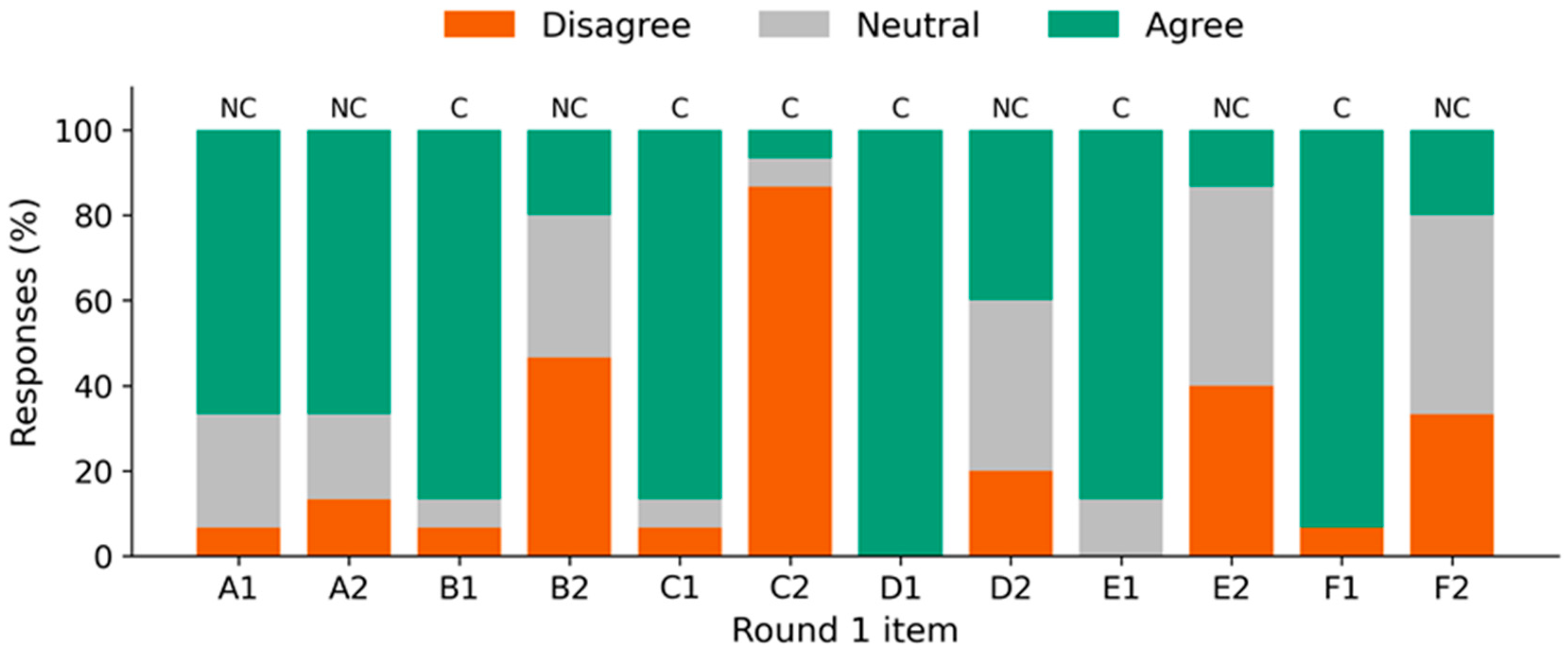
Figure 2.
Round 1 group mean tendencies across all original items. Group numbers and names follow Table 1. Means describe ordinal response patterns. Item consensus was determined separately using directional percentages and IQR width.
Figure 2.
Round 1 group mean tendencies across all original items. Group numbers and names follow Table 1. Means describe ordinal response patterns. Item consensus was determined separately using directional percentages and IQR width.
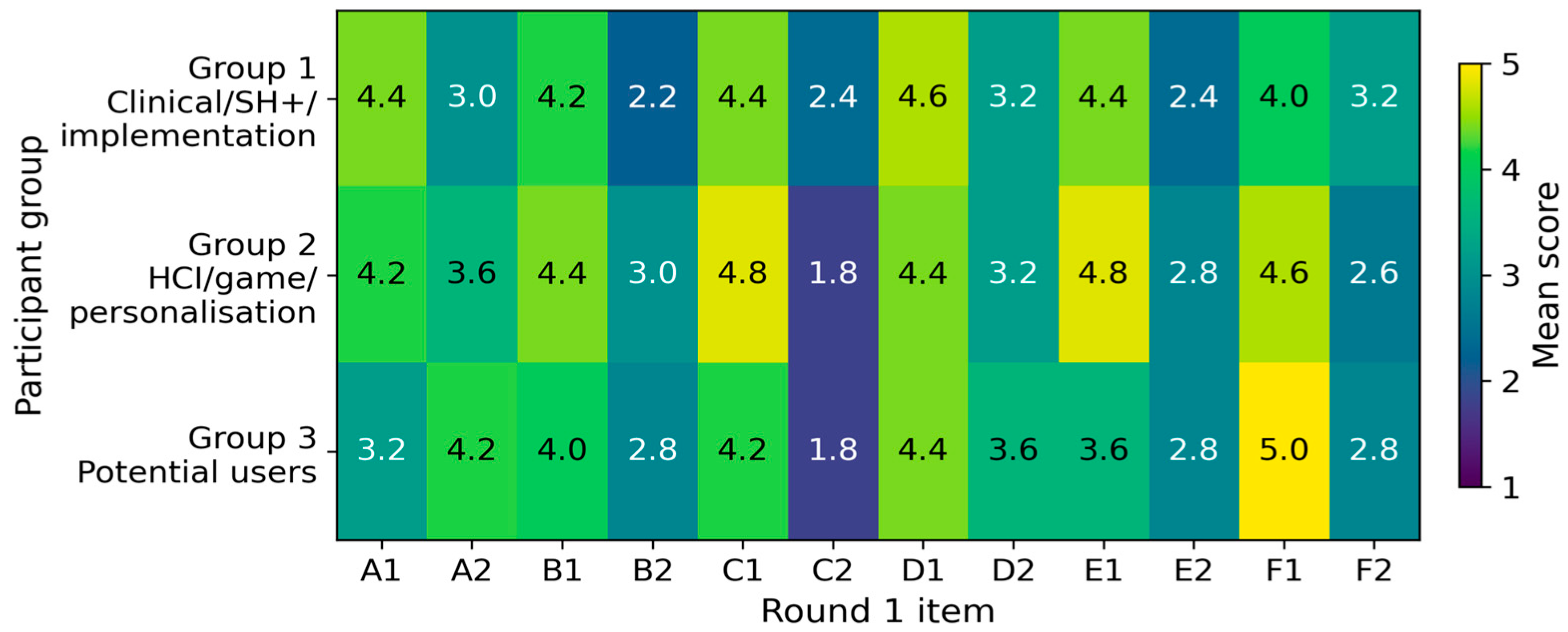
Figure 3.
Round 1 directional response distributions for unresolved items by group. Separate response categories distinguish neutral judgements from opposing ratings that could cancel in a mean direction score.
Figure 3.
Round 1 directional response distributions for unresolved items by group. Separate response categories distinguish neutral judgements from opposing ratings that could cancel in a mean direction score.
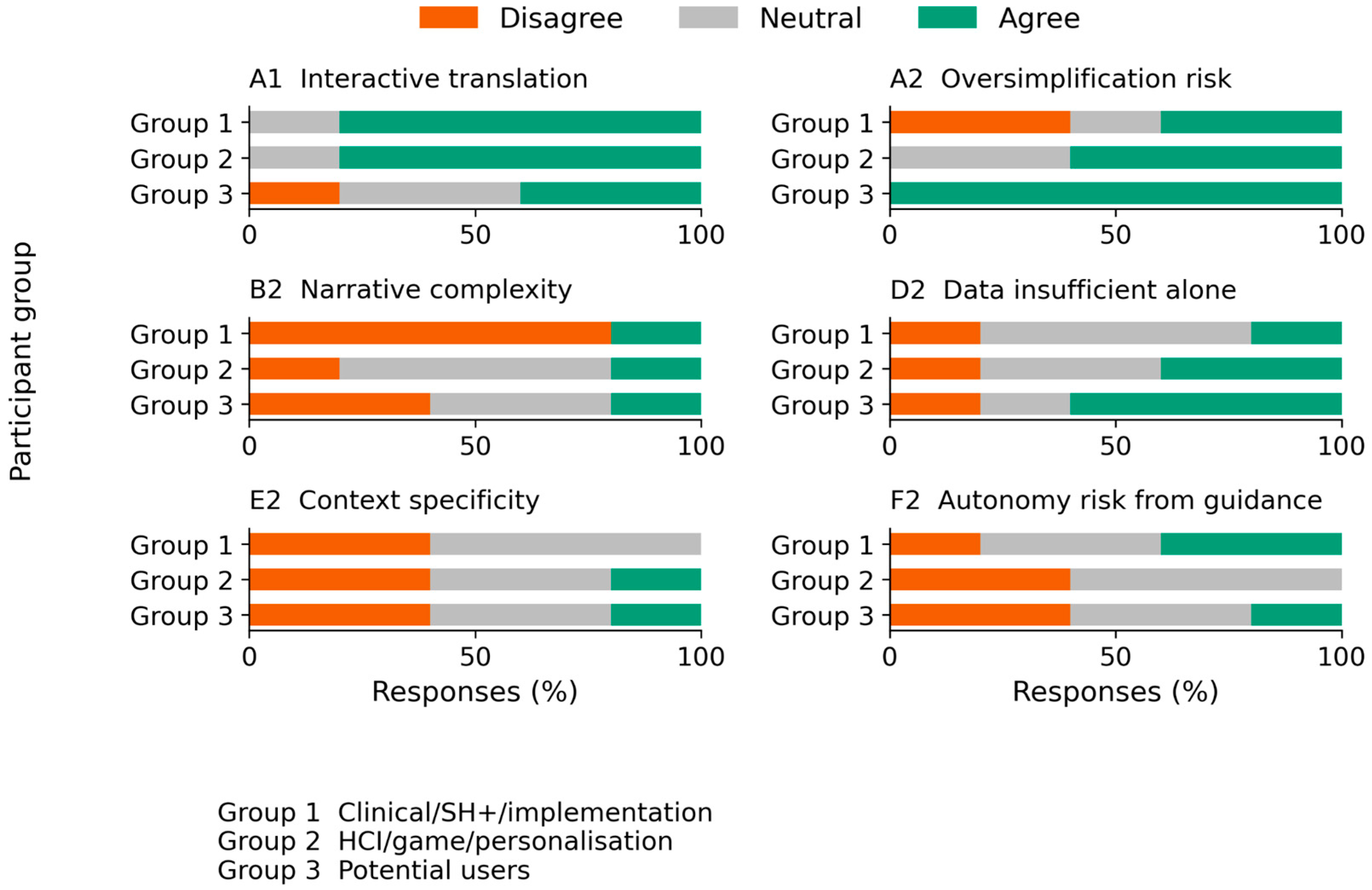
Figure 6.
Leading Round 2 refinement priorities before deployment using Borda scores. Equal point totals share a rank.
Figure 6.
Leading Round 2 refinement priorities before deployment using Borda scores. Equal point totals share a rank.
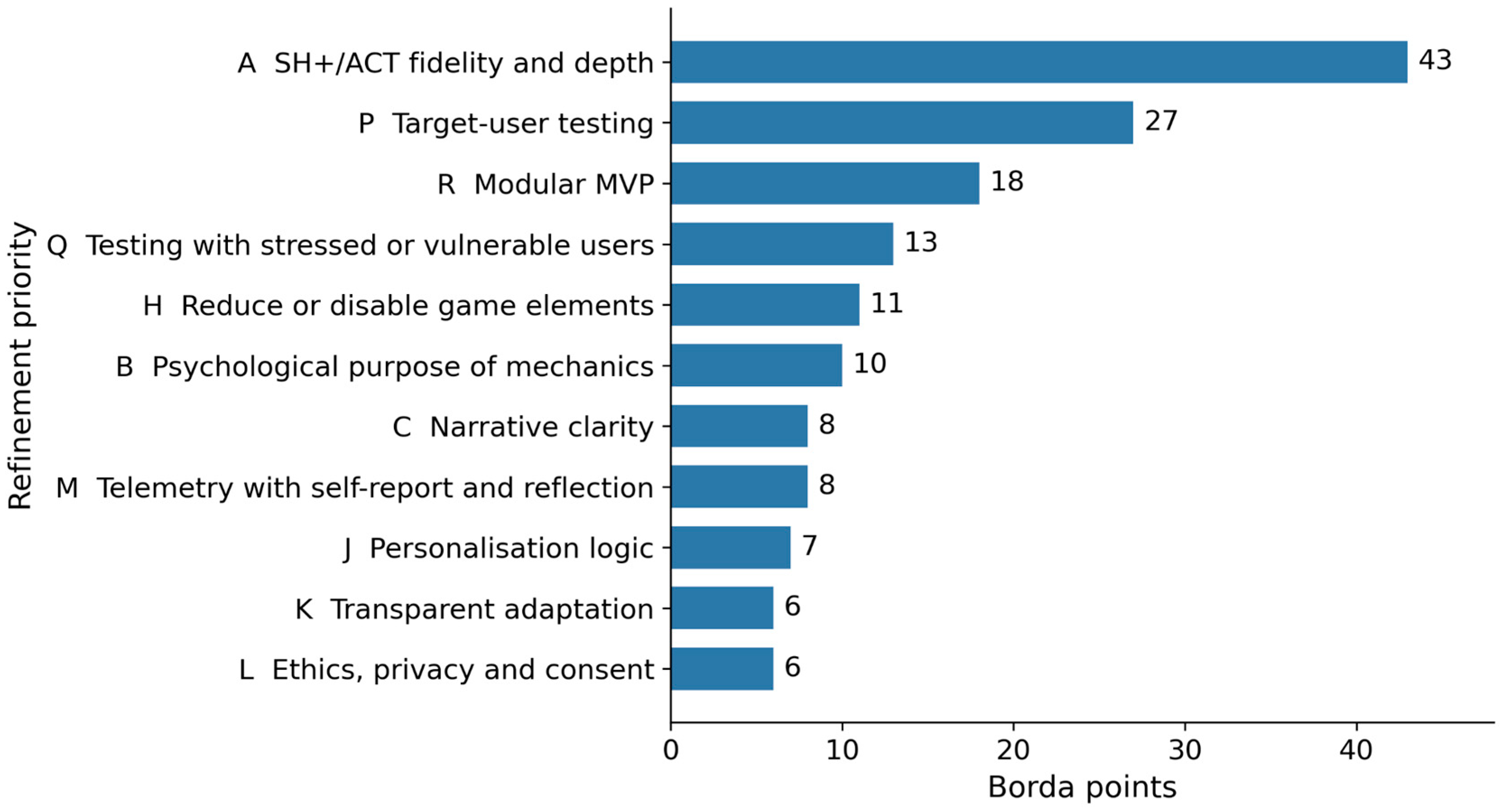
Figure 7.
Borda scores by participant group for the eight highest-scoring priorities. Group numbers and names follow Table 1. Totals reflect the number of contributing records as well as their selections. The smaller Group 3 totals are not directly equivalent to those of Groups 1 and 2.
Figure 7.
Borda scores by participant group for the eight highest-scoring priorities. Group numbers and names follow Table 1. Totals reflect the number of contributing records as well as their selections. The smaller Group 3 totals are not directly equivalent to those of Groups 1 and 2.
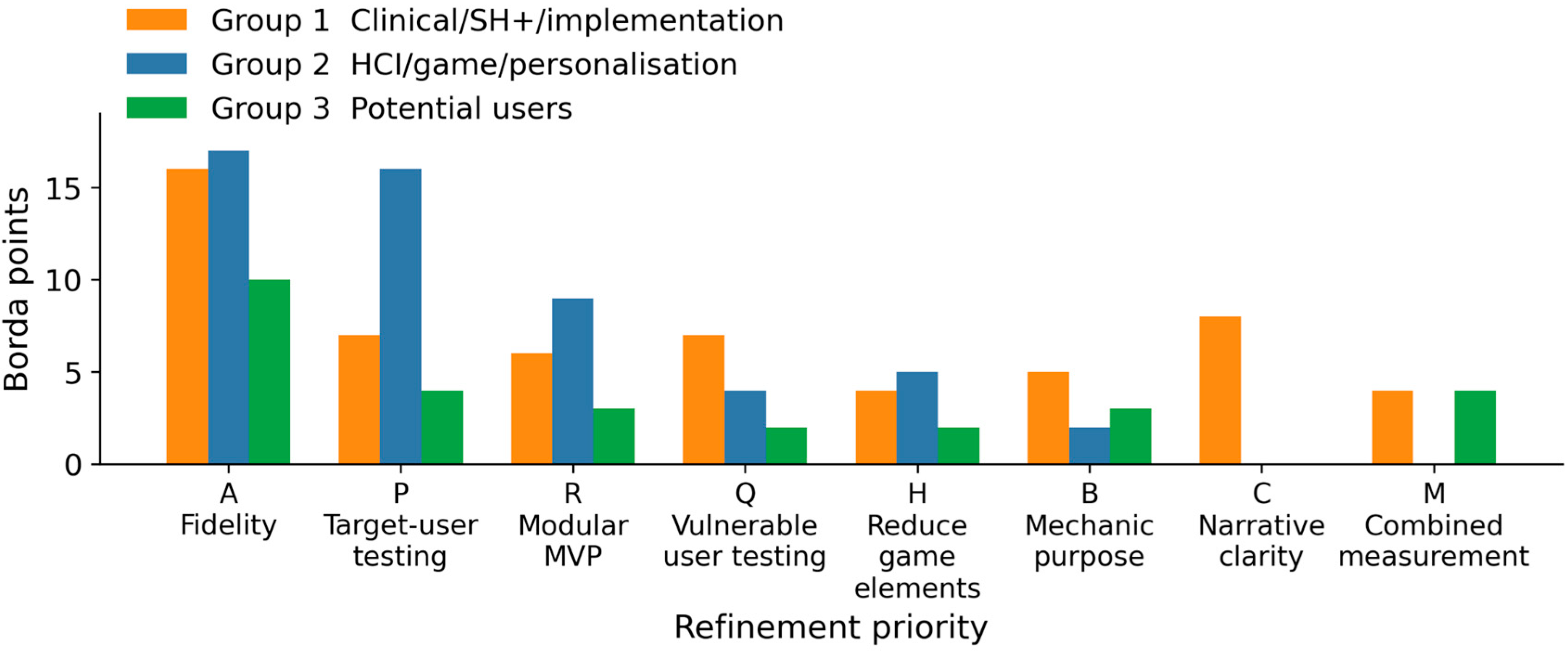
Figure 8.
Exploratory response profiles in Round 1 and Round 2, displayed through separate PCA projections. Colour and shape identify the participant groups. Labels identify participants and their within-round cluster (A, B or C). Light grey solid and darker grey dashed envelopes show the plotted members of Clusters A and B. Membership was determined from the full item ratings, so proximity in the two-dimensional plots does not determine cluster assignment. S10’s double outline marks individual Cluster C. S3 illustrates caution about translation within Cluster A.
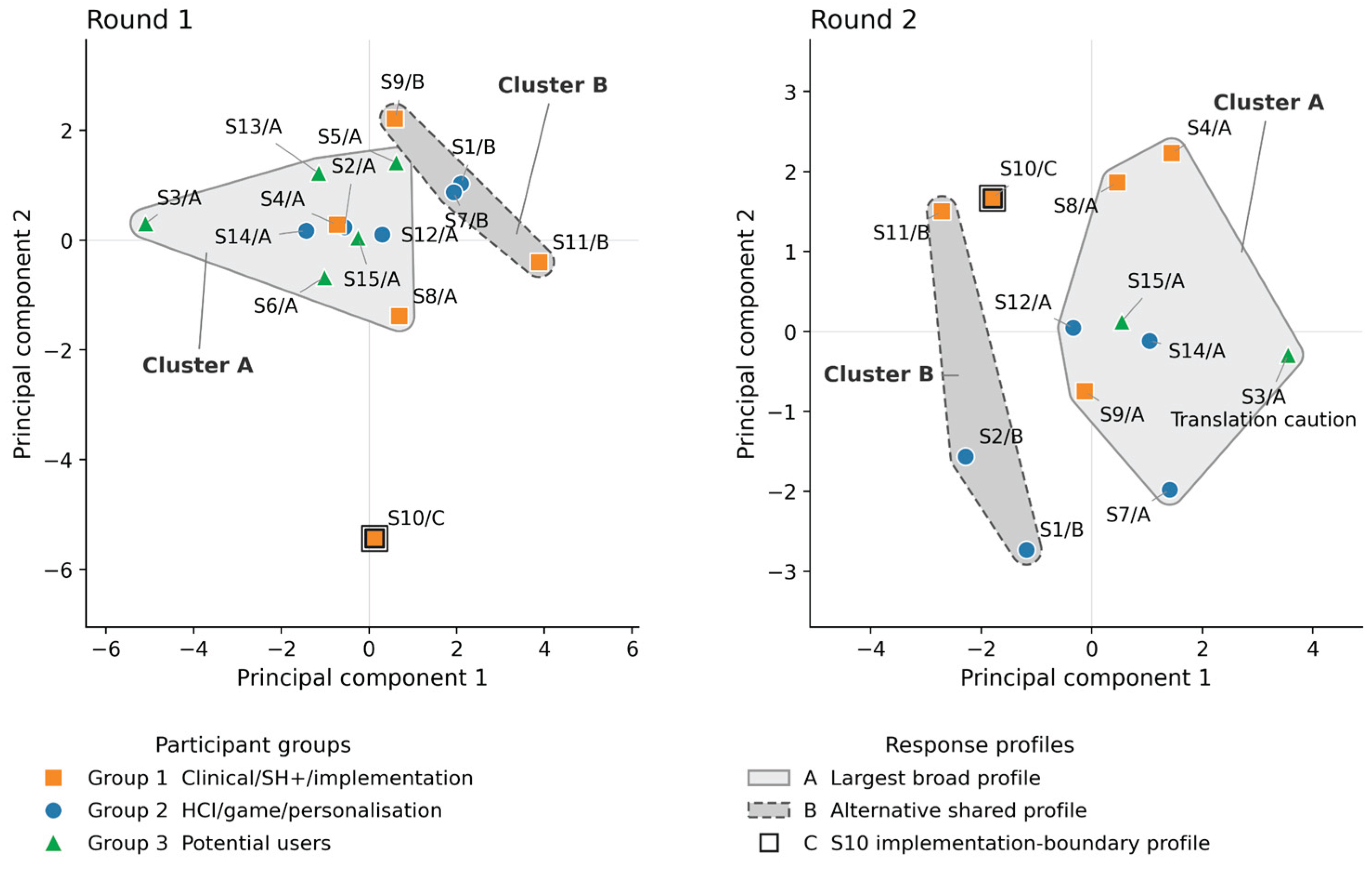
Table 1.
Analytical records by participant group and round.
| Group No. | Participant Group | Round 1 PID1 | Round 2 PID | Absent in Round 2 |
|---|---|---|---|---|
| 1 | Clinical and SH+/ACT specialists, Digital ethics, implementation and mental health service. | S4, S8, S9, S10, S11 | S4, S8, S9, S10, S11 | None |
| 2 | Human-computer interaction, serious games, gamification, researchers and personalisation experts. | S1, S2, S7, S12, S14 | S1, S2, S7, S12, S14 | None |
| 3 | Potential users. | S3, S5, S6, S13, S15 | S3, S15 | S5, S6, S13 |
| Total | 15 | 12 | 3 |
1 Participant ID—pseudonymised analytic labels used to describe inclusion across rounds, group membership and exploratory individual response profiles.
Table 2.
Round 1 item level results.
| Item | Construct | Median | Q1–Q3 | Agreement n/N (%) |
Neutral n/N (%) |
Disagreement n/N (%) |
|---|---|---|---|---|---|---|
| A1 | SH+/ACT principles translated into interactive mechanics | 4 | 3 - 5 | 10/15 (66.7) |
4/15 (26.7) |
1/15 (6.7) |
| A2 | Risk of oversimplification or distortion | 4 | 3 - 4 | 10/15 (66.7) |
3/15 (20.0) |
2/15 (13.3) |
| B1 | Narrative supports understanding and engagement | 4 | 4 - 5 | 13/15 (86.7) |
1/15 (6.7) |
1/15 (6.7) |
| B2 | Narrative may add unnecessary complexity | 3 | 2 - 3 | 3/15 (20) |
5/15 (33.3) |
7/15 (46.7) |
| C1 | Game design supports engagement and relevance | 5 | 4 - 5 | 13/15 (86.7) |
1/15 (6.7) |
1/15 (6.7) |
| C2 | Personalisation creates inconsistency or confusion | 2 | 1.5 - 2 | 1/15 (6.7) |
1/15 (6.7) |
13/15 (86.7) |
| D1 | Behavioural observation provides useful insight | 4 | 4 - 5 | 15/15 (100.0) |
0/15 (0.0) |
0/15 (0.0) |
| D2 | Behavioural data may be insufficient alone | 3 | 3 - 4 | 6/15 (40.0) |
6/15 (40.0) |
3/15 (20.0) |
| E1 | Approach may be useful beyond this system | 4 | 4 - 5 | 13/15 (86.7) |
2/15 (13.3) |
0/15 (0.0) |
| E2 | Some parts may be context specific | 3 | 2 - 3 | 2/15 (13.3) |
7/15 (46.7) |
6/15 (40.0) |
| F1 | Flexible pacing is needed | 5 | 4 - 5 | 14/15 (93.3) |
0/15 (0.0) |
1/15 (6.7) |
| F2 | Guidance may reduce autonomy | 3 | 2 - 3 | 3/15 (20.0) |
7/15 (46.7) |
5/15 (33.3) |
Table 3.
Round 2 results for common re-rating and clarification items.
| Item | Type | Median | Q1-Q3 | Agreement n/N (%) |
Neutral n/N (%) |
Disagreement n/N (%) |
Consensus Status |
|---|---|---|---|---|---|---|---|
| A1 | Common re-rating | 5 | 4 - 5 | 11/12 (91.7) |
0/12 (0.0) |
1/12 (8.3) |
Consensus Agreement |
| A2 | Common re-rating | 4 | 3 - 4 | 8/12 (66.7) |
3/12 (25.0) |
1/12 (8.3) |
No Consensus |
| B2 | Common re-rating | 2 | 2 - 3 | 1/12 (8.3) |
4/12 (33.3) |
7/12 (58.3) |
No Consensus |
| D2 | No Consensus | ||||||
| Common re-rating | 3 | 3 - 4.25 | 5/12 (41.7) |
6/12 (50.0) |
1/12 (8.3) |
||
| E2 | Common re-rating | 3 | 2 - 3 | 2/12 (16.7) |
5/12 (41.7) |
5/12 (41.7) |
No Consensus |
| F2 | No Consensus | ||||||
| Common re-rating | 3 | 2 - 3 | 1/12 (8.3) |
6/12 (50.0) |
5/12 (41.7) |
||
| A3 | Clarification item | 4 | 4 - 5 | 12/12 (100.0) |
0/12 (0.0) |
0/12 (0.0) |
Consensus Agreement |
|
B3 |
Consensus Agreement | ||||||
| Clarification item | 4 | 4 - 5 | 12/12 (100.0) |
0/12 (0.0) |
0/12 (0.0) |
||
| D3 | Clarification item | 4 | 4 - 5 | 12/12 (100.0) |
0/12 (0.0) |
0/12 (0.0) |
Consensus Agreement |
| E3 | Consensus Agreement | ||||||
| Clarification item | 4 | 4 - 4 | 10/12 (83.3) |
2/12 (16.7) |
0/12 (0.0) |
||
| F3 | Clarification item | 4.5 | 4 - 5 | 11/12 (91.7) |
0/12 (0.0) |
1/12 (8.3) |
Consensus Agreement |
Table 4.
Leading Round 2 refinement priorities using Borda scoring.
| Rank | Code | Priority | Borda Score | Top 5 mentions | 1st rank count |
|---|---|---|---|---|---|
| 1 | A | Preserve SH+/ACT fidelity and therapeutic depth | 43 | 11 | 6 |
| 2 | P | Test with real target users before deployment | 27 | 7 | 1 |
| 3 | R | Develop a modular MVP before adding more features | 18 | 6 | 2 |
| 4 | |||||
| Q | Test with vulnerable or stressed users before deployment | 13 | 4 | 0 | |
| 5 | H | Allow users to reduce or disable game elements | 11 | 4 | 1 |
| 6 | |||||
| B | Clarify the psychological purpose of each game mechanic | 10 | 4 | 1 | |
| 7 | M | Combine behavioural telemetry with self report and reflection | 8 | 2 | 0 |
|
7 |
|||||
| C | Improve narrative clarity and storytelling quality | 8 | 2 | 1 | |
| 9 | J | Improve personalisation logic and avoid overpersonalising | 7 | 3 | 0 |
| 10 | |||||
| K | Transparent adaptation | 6 | 2 | 0 | |
| 10 | L | Ethics, privacy and consent | 6 | 2 | 0 |
Disclaimer/Publisher’s Note: The statements, opinions and data contained in all publications are solely those of the individual author(s) and contributor(s) and not of MDPI and/or the editor(s). MDPI and/or the editor(s) disclaim responsibility for any injury to people or property resulting from any ideas, methods, instructions or products referred to in the content. |
© 2026 by the authors. Licensee MDPI, Basel, Switzerland. This article is an open access article distributed under the terms and conditions of the Creative Commons Attribution (CC BY) license (http://creativecommons.org/licenses/by/4.0/).
Copyright: This open access article is published under a Creative Commons CC BY 4.0 license, which permit the free download, distribution, and reuse, provided that the author and preprint are cited in any reuse.