

Submitted:
15 October 2026
Posted:
16 October 2026
You are already at the latest version
Abstract
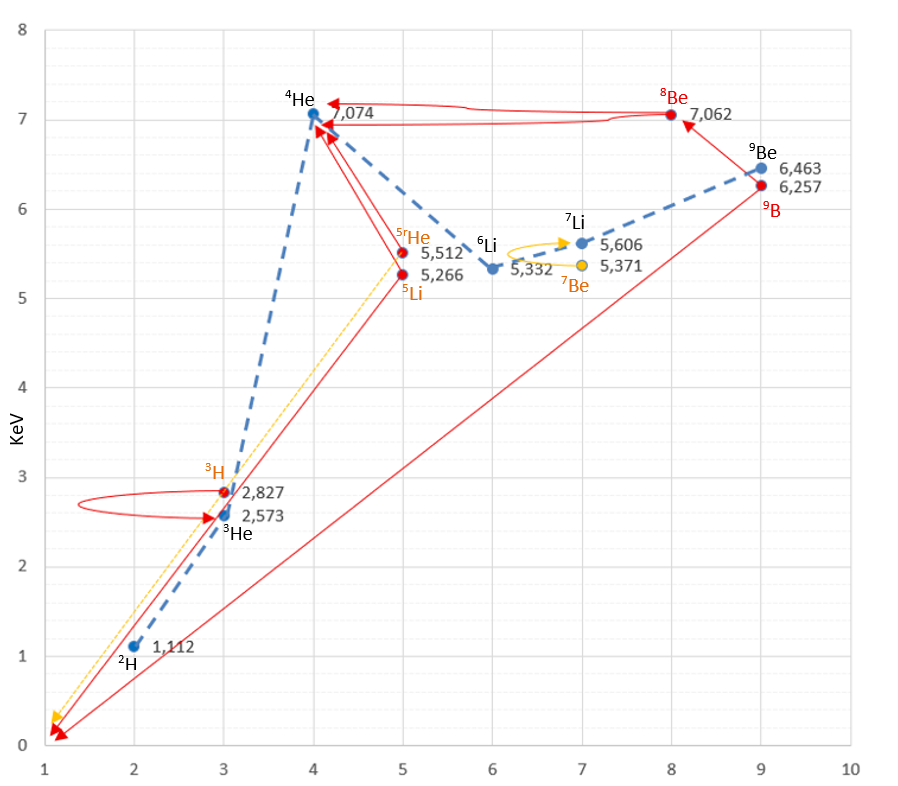
The Multi-Bubble Universe (MBU) model, developed within the framework of Electromagnetic Bridge Theory (BT), provides a phenomenological description of the emergence of spacetime, energy and matter in which quantum and relativistic properties coexist within the same physical process. In this work, the model is extended to investigate the cosmological origin, primordial abundances and nuclear structure of light elements. Following charge fractionation and neutronization, collisions and mixing between spacetime bubbles produced in Small Cold Bangs (SCBs), the conditions for the formation of primordial neutron aggregates are generated. Their evolution results from the competition between binding, aggregation and fragmentation, with spontaneous aggregation structurally allowed up to N = 9. The subsequent fragmentation and beta decay of these primordial aggregates generate the light nuclear species and, through charge rearrangement, drive their quark maps toward alternating ud/du configurations. In this topology, the same elementary DEMS structure describes both baryonic organization and nuclear binding, while the binding-energy analysis indicates a fluid rearrangement of the quark configuration as the nuclear system evolves. The primordial neutronization mechanism simultaneously provides a possible origin for the matter-antimatter asymmetry. The resulting scenario therefore extends the MBU framework from the emergence of spacetime and primordial matter to light-element nucleosynthesis and nuclear structure.
Keywords:
Bridge Theory
; multi-bubble universe
; Small Cold Bangs
; primordial nucleosynthesis
; neutron aggregates
; nuclear structure
; dipolar electromagnetic sources (DEMS)
Copyright: This open access article is published under a Creative Commons CC BY 4.0 license, which permit the free download, distribution, and reuse, provided that the author and preprint are cited in any reuse.