

Submitted:
15 October 2026
Posted:
16 October 2026
You are already at the latest version
Abstract
This study examined the effects of a visuo‑motoric, dynamic‑assessment‑based intervention on children’s three‑dimensional mental rotation (MR3D) and spatial‑orientation SOMR‑reading (SOMR) performance. Researchers randomly assigned 160 Grade 2 students to an experimental group that received mediated visuo‑motor training or a control group that practiced the same tasks without mediation. Both groups completed MR3D and SOMR assessments before and after the intervention. Results showed a significant Treatment × Time interaction for both MR3D and SOMR, indicating greater improvement in the experimental group than in the control group. Boys outperformed girls at baseline on MR3D, but no sex differences emerged in responsiveness to training, supporting the view that cognitive modifiability operates similarly across sexes. Correlational analyses revealed strengthened associations between MR3D and SOMR following intervention in the experimental group, suggesting enhanced integration of spatial‑cognitive processes. Hierarchical regression demonstrated that MR3D modifiability significantly predicted SOMR modifiability beyond demographic factors and baseline performance (ΔR² = .09) . Findings highlight the effectiveness of mediated visuo‑motor training for improving spatial reasoning, the transfer of MR3D gains to SOMR‑reading skills, and the value of dynamic assessment for identifying and fostering learning potential in early spatial cognition.
Keywords:
mental rotation
; spatial orientation
; dynamic assessment
; cognitive modifiability
; spatial cognition
; visuo-motor intervention
; mediated learning experience
; young children
1. Introduction
Mental rotation (MR) refers to the ability to imagine how an object seen from one perspective would appear when rotated in space and viewed from a different perspective. Spatial abilities are essential for many everyday activities, such as giving directions, assembling furniture, packing objects in a vehicle, and solving academic tasks involving reading, mathematics, and geometry (e.g., Frick, 2019; Gilligan et al., 2017; Lauer & Lourenco, 2016; Newcombe et al., 2010, 2019; van Tetering et al., 2019; Verdine et al., 2017; Young et al., 2018). MR skills are also highly relevant to STEM disciplines, making them important for a wide range of professional careers, including chemistry, biology, navigation, aviation, geography, engineering, and medicine (Kerkman et al., 2000; Uttal & Cohen, 2012).
Mental rotation in three dimensions (MR3D), a central component of spatial cognition, plays a critical role in children’s cognitive development, academic achievement, and later participation in STEM fields. Despite its educational significance, MR3D remains underrepresented in early assessment and instruction, particularly in preschool and elementary school, when spatial abilities respond most to intervention (Bruce & Haws, 2015). In typical MR3D tasks, participants compare two three-dimensional objects (or letters) and determine whether they are identical or mirror images. Children are presented with pairs of images rotated to varying degrees, some depicting the same object in a different orientation and others representing mirror reflections. Performance is typically evaluated in terms of accuracy and response time in discriminating against mirrored and non-mirrored pairs.
Research suggests that early childhood and the first years of schooling constitute a sensitive developmental period for the emergence of spatial cognition, including MR3D (Frick & Möhring, 2016; Mix et al., 2018). Spatial abilities begin to develop well before formal schooling and show substantial cognitive plasticity and responsiveness to environmental experiences. Children who engage in structured spatial activities during early education demonstrate long-term advantages in mathematics, problem solving, and STEM learning. However, early curricula still largely omit MR3D despite growing evidence that targeted spatial training can improve performance and reduce later disparities in spatial reasoning (Hawes et al., 2022). Consequently, many children progress through school with underdeveloped spatial skills that may limit achievement in domains that depend on spatial thinking.
Early assessment of MR3D is therefore particularly important. Individual differences in MR3D have been linked to later achievements in mathematics, geometry, and STEM-related domains, highlighting the value of identifying children with weak spatial skills before such difficulties become entrenched. Because MR3D abilities are highly malleable and responsive to training, assessment can serve not only a diagnostic function but also inform the design of interventions that promote spatial reasoning and STEM readiness. Given the strong predictive value of early spatial abilities for later educational and occupational success, developing reliable, age-appropriate MR3D measures has become a major research and educational priority (Cheng & Mix, 2021).
Most current MR3D assessments are limited by their static nature, as they capture children’s current performance without evaluating their capacity to learn and improve. Dynamic assessment (DA) offers a theoretically grounded, empirically supported alternative for examining cognitive modifiability in early childhood (Feuerstein et al., 1979; Tzuriel, 2020, 2021). DA is especially relevant for MR3D because young children often lack effective mental rotation strategies and benefit from mediated learning experiences that support internalizing spatial transformations (Tzuriel & Egozi, 2010; Jansen & Pietsch, 2022). Unlike conventional MR tasks that focus solely on accuracy and speed, DA reveals how children respond to mediation, acquire new problem-solving strategies, and improve their performance with guidance. Such information is particularly valuable during the early school years, when spatial reasoning remains highly malleable and responsive to intervention (Frick & Möhring, 2016; Verdine et al., 2017). Incorporating DA into MR3D assessment may therefore help identify children’s spatial learning potential and provide opportunities for targeted support before achievement gaps widen.
Decades of cognitive research further support MR3D’s importance. Shepard and Metzler (1971) demonstrated that response times for judging whether rotated objects were identical increased linearly with the angle of rotation, suggesting that individuals mentally simulate the rotation process. Subsequent work led Shepard and Cooper (1982) to propose the concept of mental imagery as a fundamental mechanism underlying mental rotation. Later studies showed that greater task complexity increases MR response times (Bethell-Fox & Shepard, 1988), whereas training can substantially improve performance and reduce reaction times in both children and adults (Kail & Park, 1990). More recently, neuroimaging research has identified specific brain regions associated with mental imagery and mental rotation processes (Cohen et al., 1996). Together, these findings underscore MR3D’s importance, trainability, and educational relevance, reinforcing the need for systematic assessment and development during the early years of schooling. Following Shepard and Metzler’s (1971) findings, Vandenberg and Kuse (1978) developed the Mental Rotations Test (MRT), in which participants are given a limited amount of time to complete a series of MR tasks. Participants are given four response choices for each item, two of which must match the target form after rotation; the other two do not. Voyer et al. (1995) found that male accuracy under the MRT-timed condition is the most significant sex difference observed in visuospatial situations. These findings have been persistent in Western civilizations for over 20 years (Masters & Sanders, 1993) and cross-culturally among African and Asian groups (e.g., Mann et al., 1990).
1.1. The Malleability of Mental Rotation Skills
Evidence for Trainability. Research has provided persuasive evidence that MR skills are malleable and can improve with MR training (Uttal et al., 2013), including MR speed and accuracy (Heil & Jansen-Osmann, 2008; Kail & Park, 1990). Meta-analytic evidence indicates medium-to-large effects (d = 0.40–0.80) that vary with training duration and specificity (Baenninger & Newcombe, 1989; Uttal et al., 2013). Spatial training also yields a “double benefit” for both spatial and mathematical development.
Cognitive Mechanisms Underlying Training Effects. A growing body of evidence indicates that improvements in MR performance are closely tied to changes in the cognitive mechanisms that support spatial transformation. One central mechanism involves the shift from visual to motor imagery strategies. Motor imagery refers to mentally simulating the movement of one’s own body or effectors. Motor imagery has been shown to outperform purely visual strategies in MR tasks, likely because motor simulation provides a more efficient, embodied route for representing rotation (Berneiser et al., 2018; Bernier et al., 2018). Developmental and expertise research further suggests that with increased experience, individuals gradually transition from effortful visual comparison processes to more automatic motor routines (Vingerhoets et al., 2002; Moreau, 2013). This shift reflects a broader reorganization of cognitive resources, in which motor-based strategies reduce the computational load associated with maintaining and manipulating complex visual representations. Bernier et al. (2018) found that motor imagery outperforms more visual techniques for mental hand rotation, regardless of training. Routine development further reinforces the superiority of motor strategies (Vingerhoets et al., 2002). More experience shifts mental rotation from visual to motor techniques (e.g., Frick et al., 2020; Moreau, 2013). Extensive research suggests that spatial education has a “double benefit” in both mathematics and spatial domains, given the link between spatial and mathematical capabilities. As a result, expanding access to preschool spatial education promotes school preparedness, particularly in STEM subjects (Verdine et al., 2017). Another mechanism involves visuospatial working memory (VSWM), which plays a critical role in maintaining intermediate spatial states during rotation (Tzuriel & Hozez-Sagi, 2026). MR training often enhances VSWM efficiency, enabling individuals to hold spatial configurations more stably and manipulate them more flexibly (Miyake et al., 2001). VSWM improvements may therefore mediate training gains by reducing interference, increasing representational precision, and supporting a shift to more holistic or motor-based strategies. Together, these findings suggest that MR training does not merely increase familiarity with spatial tasks but induces deeper cognitive restructuring. In other words, MR motor training strengthens embodied rotation routines, reduces reliance on piecemeal visual analysis, and enhances the working memory systems that support spatial transformation.
1.2. Sex Differences and Responsiveness to Mental Rotation Training
Mental rotation (MR) is one of the few cognitive abilities that consistently demonstrates sex differences, with males often outperforming females across a wide range of ages and task formats (Bartlett & Camba, 2023; Buckley et al., 2026; Hervin & Gibson, 2026; Linn & Petersen, 1985; Voyer et al., 1995; Lauer et al., 2019). Researchers have attributed these differences to multiple factors, including differences in spatial experience, strategy use, and other cognitive processes involved in spatial reasoning (Baenninger & Newcombe, 1989; Newcomb & Frick, 2010; Reilly et al., 2017). Importantly, however, evidence suggests that spatial abilities are highly malleable and responsive to educational intervention. Meta-analytic reviews have reported moderate-to-large gains following MR and spatial skills training, while generally finding that sex does not significantly moderate training outcomes (Baenninger & Newcombe, 1989; Uttal et al., 2013). Thus, although males often start with higher performance levels, boys and girls tend to benefit similarly from conventional training programs. Recent findings, however, suggest that the nature of the intervention may be critical. Whereas traditional practice-based training often produces parallel gains for both sexes, strategy-oriented interventions that explicitly teach transformational and holistic processing appear more effective in reducing sex disparities. For example, Tzuriel and Egozi (2010) found that mediated strategy instruction resulted in disproportionately larger gains among girls, virtually eliminating the initial sex difference in MR performance. Similarly, Taragin et al. (2019) reported that strategy-focused computerized training enhanced MR performance and attenuated sex differences, particularly among participants who adopted global processing strategies. These findings suggest that sex differences in MR may reflect differences in cognitive processing efficiency rather than immutable constraints and raise the possibility that interventions based on cognitive modifiability and mediated learning principles may differentially benefit learners with initially lower spatial performance. Accordingly, the present study examined not only the intervention’s effects on MR and SOMR but also whether boys and girls differed in their responsiveness to the DA-based visuo-motor training program.
1.3. Rationale of the Study
MR is a fundamental component of spatial cognition that supports the ability to manipulate, transform, and interpret spatial representations. Research has consistently linked MR to spatial competencies such as navigation, perspective taking, SOMR reading, and mathematical learning (Frick, 2019; Mix et al., 2023). Although MR is often treated as a relatively stable cognitive ability, contemporary evidence indicates that it is amenable to training and mediation, particularly when instruction incorporates visuo-motoric experiences that externalize spatial transformations (Jansen & Kaltner, 2021; Uttal et al., 2013). From a DA perspective, cognitive performance is not a fixed trait but an indicator of learning potential and cognitive modifiability (Tzuriel, 2021). Integrating visuo-motoric mediation within DA gives children opportunities to internalize spatial transformation strategies, improving their ability to mentally manipulate three-dimensional objects. Recent findings suggest that mediated intervention can enhance MR performance and promote transferable spatial reasoning strategies (Jansen & Pietsch, 2022; Tzuriel & Hozez-Sagi, 2026). Despite growing evidence for MR trainability, less is known about the extent to which gains achieved through DA transfer to related spatial abilities. Spatial orientation in map reading requires coordinating perspective taking, directional judgments, and mental transformations, processes that conceptually overlap with those underlying MR (Hawes & Ansari, 2020; Newcombe & Shipley, 2015). Examining the relationship between mediated improvements in MR and performance in SOMR-reading tasks therefore provides an opportunity to evaluate the generalization of training effects and the convergent validity of the DA approach.
1.4. Objectives of the Study
The study had three primary objectives: (a) To examine the effects of visuo-motoric mediation embedded within a DA framework on children’s performance in three-dimensional mental rotation tasks. (b) To investigate whether gains in MR following mediation generalize to performance on a spatial orientation in map-reading task (SOMR). (c) To evaluate the convergent and predictive validity of DA by examining the relationships between pre-, post-, and gain scores in MR3D and SOMR.
Drawing on research on cognitive modifiability, MR training, and the transfer of spatial skills, we randomly assigned a sample of Grade 2 children (n = 160) to an experimental and a control group, with about equal numbers of boys and girls in each group. Children in the experimental group received a visuo- motoric intervention for MR3D within a DA framework, whereas children in the control group practiced the same problems without mediation. Both groups underwent MR3D and spatial orientation tests in SOMR reading before and after the intervention. The following hypotheses were advanced regarding expected differences between the experimental and control groups before and after the intervention.
1.5. Hypotheses
H1. Students in the experimental group will show greater pre- to post-intervention improvement in MR3D than students in the control group.
H2. Students in the experimental group will show greater pre- to post-intervention improvement in spatial orientation in map reading (SOMR) than students in the control group.
H3a. Boys will obtain higher MR3D scores than girls at the pre-intervention phase.
H3b. Despite the expected baseline sex differences, boys and girls in the experimental group will benefit similarly from the intervention, as reflected by comparable gains in MR3D and SOMR from pre- to post-intervention. This hypothesis is based on literature showing stable sex differences in MR performance but generally comparable responsiveness to spatial training.
H4. Within the experimental group, the correlation between MR3D and SOMR will be stronger post-intervention than pre-intervention. In the control group, the correlation pattern will remain relatively stable.
H5. The correlation between MR3D and SOMR in the experimental group will be stronger at post-intervention than at pre-intervention, reflecting increased integration of spatial-cognitive processes following mediation.
H6: Children who exhibit greater cognitive modifiability in MR3D during the visuo-motoric DA intervention will also show greater modifiability in spatial orientation in SOMR. This prediction reflects the shared cognitive mechanisms underlying both tasks and the expectation that improvements in spatial transformation strategies will generalize across related spatial domains.
2. Materials and Methods
2.1. Participants
Before the study began, the College Ethics Committee and the Ministry of Education Ethics Committee approved the study, and parents consented to their children’s participation. Participants (n = 160) were Grade 2 children randomly selected from 10 classes across 10 schools in central Israel. We randomly assigned children to an experimental group (n = 87; 38 boys and 49 girls) and a control group (n = 73; 38 boys and 35 girls). Because we determined the sample size based on the number of students available in the participating schools rather than an a priori power analysis, we conducted a sensitivity analysis using G*Power 3.1 (Faul et al., 2009). The analysis was based on the study’s 2 (Treatment: Experimental vs. Control) × 2 (Sex: Boys vs. Girls) × 2 (Time: Pretest vs. Posttest) mixed factorial design, with Time specified as a repeated-measures factor. Assuming α = .05, a desired power level of .80, a total sample size of 160 participants, and a moderate correlation between repeated measurements (r = .50), the analysis indicated that the study had adequate sensitivity to detect small-to-medium effects. Thus, the available sample size was sufficient to identify practically meaningful intervention effects and Treatment × Time interactions. Because administrative constraints fixed the sample size, we interpret the analysis as a sensitivity analysis rather than a prospective power analysis. No significant sex × treatment interaction was found, χ2 = 1.18, p = 0.291. Frequency analysis of participants’ occupation level (low = 1 to high = 5) revealed no significant differences for fathers, χ2 = 6.15, df = 4, p = .188, or mothers, χ2 = 7.04, df = 4, p = .133. Similarly, no significant differences were found for years of education of fathers, t(155) = .12, p = .908, or mothers, t(155) = .13, p = .306.
2.2. Measures
The Mental Rotation 3-Dimensions (MR3D) Test. The MR3D test is a DA instrument designed to evaluate the cognitive modifiability of young children (ages 5-8) and older children with learning disabilities. The MR3D is based on Tzuriel’s principles of DA in young children and mediated learning experience theory (Feuerstein et al., 1979; Tzuriel, 2020, 2021). The test consists of four phases: preliminary, pre-intervention, teaching, and post-intervention. Each phase consists of 16 problems, divided into Level I (8 items) and Level II (8 items) of increasing difficulty. In each problem, the child sees a 3D pattern of a target 3D object made of rectangular blocks, along with four 3D objects at the bottom of the page. Three of these objects are distractors, and one matches the target object but is rotated. The child points to the correct object. Figure 1 shows examples of Levels I and II.
Preliminary Phase. The preliminary phase familiarizes the child with the MR3D instrument’s physical components and operational features. The examiner presents the five MR3D blocks (see Figure 2) together with the small rectangular black connectors used to join the blocks through the circular holes embedded in each block.
The examiner emphasizes that the child can connect any two blocks in multiple configurations and orientations. When necessary, the examiner provides limited assistance to help the child insert and remove the connectors, ensuring the child understands the instrument’s construction and manipulation procedures.
Pre-Intervention Phase. The pre-intervention phase uses the MR3D problem booklet to assess the child’s initial performance on three-dimensional construction tasks. At Level I of difficulty (Figure 1), the child is presented with a 3D pattern that contains a single-colored block (red). This colored block serves as a salient visual cue, helping the child identify the correct configuration. At Level II of difficulty (Figure 1), the child is presented with comparable 3D patterns without any colored cues, thereby increasing task complexity and reducing reliance on visual guidance.
Teaching Phase. The teaching phase uses a visuo-motor mediation approach to strengthen MR by integrating perceptual, spatial, and manipulative experiences. Research on spatial cognition suggests that MR is facilitated when learners actively manipulate three-dimensional objects and coordinate visual representations with motor actions, thereby promoting the development of robust spatial representations and rotation strategies (Jost & Jansen, 2022; Moen et al., 2020; Kaltner et al., 2014). Visuo-motor mediation bridges external, hands-on manipulation and internalized spatial reasoning, consistent with Feuerstein et al.’s (1979) concept of mediated learning and Vygotsky’s (1978) internalization process.
During instruction, children are provided with five MR3D blocks and rectangular connectors to join them. Through guided construction activities, they learn that blocks can be connected in multiple configurations and orientations, with limited assistance provided when necessary to facilitate connector manipulation. The child is then encouraged to build tangible 3D models that match pictorial representations and to compare the model with identical patterns shown from different spatial perspectives. This process promotes recognition of structural relationships, rotational transformations, and part-whole spatial organization among component blocks. The teaching activities are based on the 16 patterns administered during the pre-intervention phase, with mediation focused on helping children develop systematic strategies for analyzing, constructing, and mentally transforming three-dimensional configurations. Figure 3 illustrates a step-by-step example of the construction.
Post-Intervention. The post-intervention phase consists of 16 problems that are parallel to the pre-intervention phase for both Levels I and II. This allows comparison of MR modifiability following the teaching phase.
We administer the pre- and post-intervention phases without a time limit. However, we record performance time to assess efficiency. We administer the pre- and post-intervention phases without a time limit. However, we record performance time to assess efficiency. Each correct answer is worth 1 point. The Cronbach’s alpha reliability coefficients for the current sample were .75 and .83 for the pre- and post-intervention tests, respectively.
2.3. Spatial Orientation in Map Reading Test
The Spatial Orientation in Map Reading (SOMR; Tzuriel, 2023) is a standardized paper-and-pencil instrument that assesses children’s spatial orientation, directional judgment, and spatial perspective-taking during route navigation. The measure presents a schematic map of a small village comprising an interconnected road network and familiar environmental landmarks, including a school, post office, residential buildings, a park with a monument, and natural geographic features. This ecologically relevant setting provides a meaningful spatial context in which participants must navigate a predetermined route (see Figure 4).
The SOMR consists of a red route containing 14 directional decision points. At each turn, participants must determine the direction of movement from the perspective of a traveler moving along the route and indicate whether the corresponding turn is to the left (L) or right (R). Successful performance requires continuously adopting and maintaining a traveler-centered frame of reference, rather than relying on the map’s fixed orientation. To increase task complexity and reduce the effectiveness of simple visual heuristics, the route incorporates both upward and downward movements on the map, thereby necessitating repeated mental transformations of spatial perspective throughout navigation.
We developed two parallel forms of the SOMR, matched for route structure, complexity, and difficulty. In Version A, participants traverse the route from right to left, whereas in Version B, they complete the route from left to right. Using equivalent forms allows repeated assessment while minimizing practice effects and enables evaluation of how stable spatial orientation performance is across travel directions. The parallel forms also allow assessment of changes in performance following the MR intervention.
The SOMR assesses multiple components of spatial cognition, including spatial orientation, mental perspective transformation, directional decision-making, and the executive control processes involved in maintaining a task-relevant spatial representation while inhibiting competing egocentric responses. Because participants must continuously update their orientation relative to the route, the task additionally places substantial demands on visuospatial cognitive flexibility and spatial working memory. Consequently, the SOMR provides a comprehensive measure of navigationally relevant spatial reasoning and may be particularly useful for examining individual differences in spatial cognitive functioning and their associations with learning and academic achievement.
Participants receive one point for each correctly identified turn, for a maximum score of 14 points per form. In the current sample, internal consistency was satisfactory, with Cronbach’s alpha coefficients of .70 and .77 for the pretest and posttest administrations, respectively.
2.4. Procedure
Before the intervention, participants in both the experimental and control groups completed the MR3D and SOMR assessments in a fixed sequence during a single 60-minute session. The intervention phase was administered exclusively to the experimental group and comprised 16 mediated pre-intervention activities involving motoric assembly tasks with the MR3D blocks (see Measures section). We conducted these sessions individually in a quiet room at the school, and they lasted approximately one hour. Children assigned to the control group constructed the same 16 patterns for an equivalent duration but without the mediated instructional component. The intervention was completed in a single session, and post-intervention testing occurred 1 to 2 days later using the same assessment battery and administration procedures used during the pre-intervention phase. Twenty graduate students enrolled in a Learning Disabilities program carried out the intervention and assessment procedures. All trainers completed six hours of instruction in standardized test administration and intervention procedures and practiced these procedures with two children who were not part of the study sample. To ensure procedural consistency, the same trainer worked with participants in both experimental and control conditions.
3. Results
3.1. Descriptive Analyses
Descriptive analyses examined changes in students’ distribution across MR3D performance categories from pre- to post-intervention in the experimental and control groups. The distributions were comparable across groups at pre-intervention, with most students concentrated in the middle score ranges and relatively few participants in the lowest or highest categories (see Figure 4).
These observations are consistent with the nonsignificant Treatment × MR Group association obtained at pre-intervention, χ(5)² = 3.70, p = .594. Following the intervention, the distributions of the two groups diverged. In the experimental group, the distribution shifted toward the upper end of the performance continuum, with a substantial increase in the proportion of students scoring in the highest MR category (14-16 points) and a corresponding reduction in the proportion of students in the middle performance ranges. In contrast, the control group showed only modest changes across categories, with the overall distribution remaining similar to pre-intervention and no comparable increase in representation in the highest-performing category. More specifically, only 14.9% of experimental participants were classified in the highest MR category before the intervention, and this proportion increased to 37.9% at post-intervention. In contrast, the corresponding proportion in the control group remained largely unchanged (21.9% vs. 20.5%). At the same time, the experimental group showed a decrease in the proportion of students in the intermediate score categories, suggesting movement from moderate to high-performance levels. The control group, however, showed comparatively minor redistribution across categories, indicating limited developmental change over the same period.
These distributional changes align with the borderline significant Treatment × MR Group difference at posttest, χ(5)² = 10.51, p < .062, and provide descriptive support for the effectiveness of the DA-based mental rotation intervention. Taken together, the findings suggest that the intervention not only improved overall MR performance but also increased the likelihood that students would attain the highest levels of MR achievement, thereby shifting the experimental group’s performance profile toward more advanced spatial reasoning.
3.2. The Effects of Visuo-Motoric Intervention for MR3D on Mental Rotation and Spatial Orientation in SOMR Reading
Table 1 presents the means and SDs for the MR3D and SOMR tests at pre- and post-intervention, by Treatment and Sex.
To examine the effects of DA-based MR training on MR and SOMR, we conducted two repeated-measures analyses of variance. Each analysis employed a 2 (Treatment: Experimental vs. Control) × 2 (Sex: Boys vs. Girls) × 2 (Time: Pre- vs. Post-intervention) design, with MR3D and SOMR scores serving as the dependent variables. The results of these analyses are presented in Table 2.
MR3D Scores. The repeated-measures analyses revealed differential intervention effects across outcome measures. The significant Treatment × Time interaction indicated that changes across the intervention period differed between the experimental and control groups, supporting the effectiveness of DA-based MR training in enhancing mental rotation performance. The Treatment × Time interaction was moderate (ηp² = .07), suggesting that participation in the DA-based MR intervention accounted for a practically meaningful proportion of the variance in MR performance gains. Figure 5 shows the interaction.
Post hoc (between-group) analyses showed that in the pre-intervention phase, both groups scored similarly, t(158) = .89, p = .378. However, in the post-intervention phase, the experimental group scored higher than the control group (t(158) = 1.94, p = .054). Post hoc (within-group) comparisons showed that the experimental group improved significantly from pre- to post-intervention (t(86) = 2.73, p < .008), but the control group did not (t(72) = 1.88, p = .065). A significant main effect of Sex was also observed, with boys scoring higher on MR3D than girls; however, the absence of sex interactions suggests both sexes benefited similarly from the intervention.
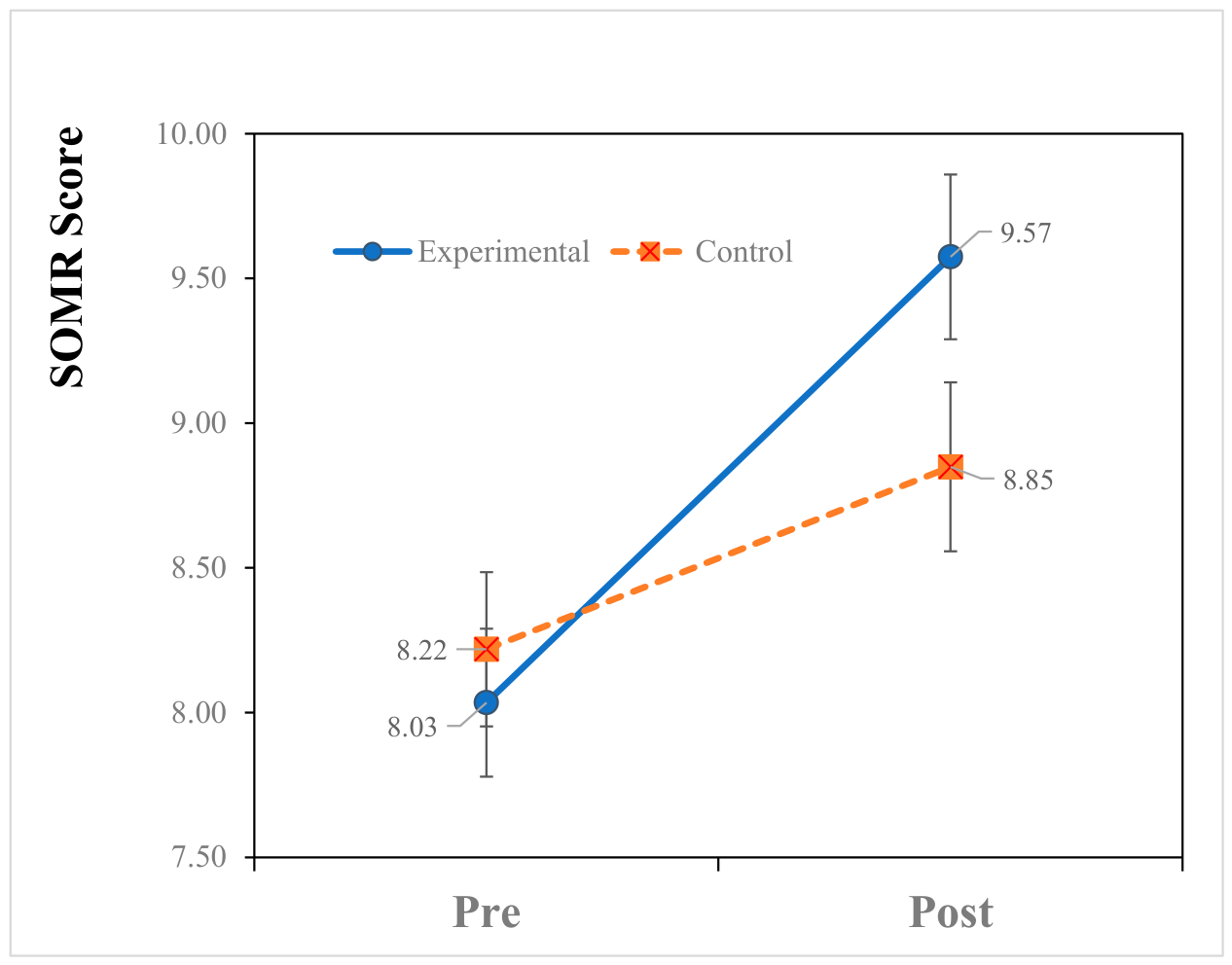
SOMR Scores. For SOMR performance, a significant main effect of Time indicated improvement from pre- to post-intervention, whereas a significant Treatment × Time interaction (Figure 6) showed greater gains for the experimental than for the control group.
No significant sex-related effects emerged. Simple effects analysis showed that the experimental group scored about the same as the control group pre-intervention, t(158) = -.47, p = .638, but was borderline higher post-intervention, t(158) = 1.84, p = .098. Within-group analyses show significant pre- to post-intervention improvement in both the experimental group (t(86) = -4.97, p < .001) and the control group t(72) = -2.77, p = .007).
3.3. Correlation Analyses of MR3D and SOMR in the Pre- and Post-Intervention Phases
To examine Hypotheses 4 and 5, we conducted Pearson correlation analyses between MR3D and SOMR scores in the pre- and post-intervention phases for the experimental and control groups. As shown in Table 3, pre- and post-intervention MR3D scores were significantly correlated in both the experimental (r = .60, p < .001) and control (r = .61, p < .001) groups, indicating moderate stability of mental rotation performance over time. Significant associations also emerged between pre- and post-intervention SOMR scores in both groups, though the relationship was stronger in the control group (r = .69) than in the experimental group (r = .33). Consistent with Hypotheses 4 and 5, MR3D and SOMR were significantly associated at both measurement occasions in the experimental and control groups, indicating a stable relationship between mental rotation and spatial orientation in map reading abilities. Notably, in the experimental group, the correlation between post-intervention MR3D and SOMR scores was relatively strong (r = .52, p < .001), suggesting a closer association between these spatial abilities following the intervention. In contrast, the control group showed similar associations across measurement occasions, with no apparent strengthening of the relationship between the two constructs over time. Thus, the findings provide preliminary support for Hypotheses 4 and 5, suggesting that participation in the intervention was associated with a stronger linkage between MR and spatial orientation processes. To further evaluate Hypotheses 4 and 5, we conducted dependent-samples correlations using Steiger’s procedure. In the experimental group, the correlation between MR3D and SOMR increased from r = .41 at pre-intervention to r = .52 at post-intervention. The increase was not statistically significant, z = 0.98, p = .33. In the control group, the correlation decreased slightly from r = .52 to r = .46. This difference was likewise non-significant, z = -0.46, p = .65. Thus, Hypotheses 4 and 5 received directional but not statistical support, indicating that while the intervention group showed a stronger post-intervention association between MR3D and SOMR, the magnitude of the increase did not differ significantly from the pre-intervention association.
Figure 7.
Pre- and Post-Intervention SOMR Scores in the Experimental and Control Groups.
3.4. Hierarchical Regression Analysis: Predicting Modifiability of Spatial Orientation in SOMR Reading from Modifiability of Mental Rotation
One aim of the study was to determine whether MR3D modifiability predicts SOMR modifiability beyond the effects of treatment condition, sex, age, parental education, and parental occupational status. We hypothesized that greater MR3D modifiability would be associated with greater post-intervention gains in spatial orientation of map reading. We operationalized MR3D modifiability as the post-intervention MR3D score after controlling for the corresponding pre-intervention score. Similarly, we indexed SOMR modifiability as the post-intervention SOMR score after controlling for the pre-intervention SOMR score. Thus, residual post-test scores represented change, with residual values reflecting variance in post-intervention performance not accounted for by pre-intervention performance. Compared with simple gain scores, residualized scores provide a more robust measure of change, although they may still be influenced by ceiling effects and regression toward the mean (Embretson, 1992). To examine MR3D modifiability’s unique contribution to SOMR modifiability, we conducted a three-step hierarchical regression analysis with post-intervention SOMR score as the dependent variable. In Step 1, we entered treatment condition, age, sex, parents’ occupational level, and parents’ years of education (a composite score derived from both parents). In Step 2, we added pre-intervention MR3D and SOMR scores to control for baseline performance. Finally, in Step 3, we entered the post-intervention MR3D score to assess the additional variance explained by MR3D modifiability. Table 4 presents the hierarchical regression results. The hierarchical regression analysis supported the hypothesis that MR3D modifiability predicts SOMR modifiability. After controlling for treatment condition, demographic variables, parental background, and baseline MR3D and SOMR performance, adding the MR3D post-intervention score significantly increased explained variance in SOMR post-intervention performance by 9% (ΔR² = .09, p < .001).
In the final model, MR3D-Post emerged as a strong positive predictor (β = .41, p < .001), whereas MR3D-Pre was no longer significant. The final model explained 43% of the variance in SOMR post-test scores (R² = .43), indicating that gains in MR3D performance following mediation are uniquely associated with improvements in SOMR performance.
4. Discussion
4.1. Effects of Intervention on MR3D in Young Children
This study provides strong evidence that DA-based visuo-motoric intervention can substantially enhance three-dimensional mental rotation (MR3D) performance, even among very young learners. The participants—second-grade children approximately 7–8 years old—are at an age when spatial-cognitive abilities are rapidly developing but not yet fully consolidated. Prior research has consistently shown that early childhood and the first years of schooling represent a sensitive developmental window for the emergence of spatial reasoning skills, including mental rotation (Frick & Möhring, 2016; Mix et al., 2018; Newcombe et al., 2019). Young children often rely on unsystematic or perceptually bound strategies when solving spatial tasks, and their performance is highly influenced by opportunities for guided exploration, scaffolding, and embodied interaction (Hawes et al., 2022; Verdine et al., 2017). Against this developmental backdrop, these findings highlight the importance of early intervention and show that even early primary-grade children can benefit substantially from structured mediation.
Consistent with Hypothesis 1, the significant Treatment × Time interaction indicated that MR3D performance improved more in the experimental group than in the control group. The moderate effect size (ηp² = .07) suggests that the DA-based intervention contributed meaningfully to mental rotation development beyond improvements attributable to repeated exposure or normative maturation. This is particularly noteworthy given the participants’ young age, as they are still acquiring foundational visuospatial competencies. The results align with DA theory, which emphasizes cognitive modifiability and responsiveness to mediated learning experiences rather than static performance levels alone (Feuerstein et al., 1979; Tzuriel, 2021). The pattern of post hoc analyses further strengthens this interpretation. Before the intervention, the experimental and control groups showed comparable MR3D performance, indicating successful baseline equivalence. After the intervention, however, the experimental group achieved higher MR3D scores than the control group, with the between-group comparison approaching conventional statistical significance. More importantly, within-group analyses showed significant improvement only among participants exposed to the DA-based intervention, whereas gains in the control group did not reach significance. These findings suggest that the observed improvements were not simply due to practice effects or repeated testing but reflected the specific contribution of the motor-mediated learning procedures incorporated into the intervention. These results align with previous research showing that spatial abilities, especially MR, respond well to training (Uttal et al., 2013). This study extends this literature by showing that even young children can acquire more effective problem-solving strategies with structured mediation, scaffolding, and feedback. During the intervention, participants were encouraged to analyze object features systematically, identify rotational axes, and use strategic visualization processes. Such mediation may have facilitated the development of more efficient cognitive representations, thereby enhancing performance on MR3D tasks. The findings therefore support the view that mental rotation is a modifiable cognitive function rather than a fixed ability, even at early developmental stages.
4.2. Effects of Intervention on Spatial Orientation in Map Reading
The present study also examined whether gains in MR3D following visuo-motoric mediation would generalize to a conceptually related but distinct spatial domain: spatial orientation in map reading (SOMR). Consistent with Hypothesis 2, the findings revealed significant far-transfer effects, with children in the experimental group improving SOMR performance more than those in the control group. This pattern indicates that the DA-based MR3D intervention not only enhanced performance on the trained task but also facilitated broader spatial-cognitive processes underlying navigation and directional judgment. Although MR3D and SOMR share underlying cognitive mechanisms, such as perspective-taking, spatial transformation, and visuospatial working memory, the empirical literature directly linking MR training to improvements in map-reading performance remains limited. Research on spatial orientation in children has shown that successful map reading requires adopting the traveler’s perspective, continuously updating orientation, and inhibiting misleading egocentric cues (Hawes & Ansari, 2020; Newcombe & Shipley, 2015). These processes overlap with those strengthened through MR3D mediation, suggesting a plausible theoretical basis for transfer. However, few studies have demonstrated actual transfer from MR training to SOMR-reading skills, making the present findings both novel and theoretically significant.
The far-transfer observed here suggests that MR3D mediation may promote deeper cognitive restructuring rather than task-specific skill acquisition. During the intervention, children learned to analyze spatial configurations, coordinate visual and motor information, and mentally transform three-dimensional structures. These strategies appear to have generalized to the SOMR task, which requires children to mentally adopt the traveler’s viewpoint and determine left-right turns along a route. The improvement in SOMR performance therefore reflects not only enhanced spatial orientation but also the internalization of flexible spatial-transformation routines that extend beyond the original training context.
This finding is particularly noteworthy given the participants’ young age. Spatial orientation in SOMR reading is a complex skill that typically develops gradually across childhood and is influenced by environmental experience, navigation practice, and cognitive maturation (Uttal et al., 2013; Ishikawa, 2019). Measurable gains in SOMR performance after a single MR3D mediation session underscore early spatial cognition’s sensitivity to guided intervention and highlight the potential of DA-based approaches to foster foundational navigation skills.
At the same time, these results should be interpreted within the DA framework. DA aims not to produce permanent changes through brief intervention but to reveal children’s learning potential and responsiveness to mediation (Feuerstein et al., 1979; Tzuriel, 2020, 2021). Thus, the observed far-transfer effects should be understood as indicators of possible structural cognitive change rather than as evidence of long-term mastery. A longer, more intensive intervention would likely be required to achieve durable improvements in real-world navigation and SOMR-reading proficiency. Nevertheless, the present findings demonstrate that even short-term mediation can activate latent spatial-cognitive processes and produce meaningful transfer to complex spatial-orientation tasks. Taken together, the results strongly support Hypothesis 2 and highlight the study’s unique contribution. Whereas most spatial-training research focuses on near-transfer within similar task formats, the present study shows that DA-based MR3D mediation can influence performance in a conceptually related yet operationally distinct spatial domain. This far-transfer effect underscores the integrative nature of spatial cognition and suggests that interventions targeting core spatial-transformation processes may have broad educational relevance for navigation, geography, mathematics, and STEM learning.
The results also contribute to the growing literature linking embodied and motoric experiences to spatial cognition (e.g., Tzuriel & Hozez-Sagi, 2026). MR tasks require individuals to mentally transform objects across space, a process that shares characteristics with motor imagery and action planning. The intervention’s effectiveness suggests that motoric mediation may have strengthened internal spatial representations and supported the coordination of visual and kinesthetic information. This interpretation aligns with embodied cognition perspectives, which propose that spatial reasoning develops through interactions among perceptual, motor, and cognitive systems. Consequently, actively mediated experiences may provide a particularly effective pathway for enhancing spatial thinking in young children, who benefit greatly from hands-on, concrete, and visually rich learning environments.
4.3. Sex Differences
We found a significant main effect of sex, indicating overall differences in MR3D performance between boys and girls. This finding is consistent with a substantial body of research reporting, on average, male advantages in MR tasks, particularly those involving three-dimensional stimuli and timed performance conditions (e.g., Voyer et al., 1995; Lauer et al., 2019). However, the absence of significant interactions involving sex is especially noteworthy. Both boys and girls benefited similarly from the intervention, suggesting that the mechanisms underlying cognitive modifiability operate similarly across sexes. The intervention therefore enhanced performance without widening existing differences, suggesting that DA-based mediation may be an equitable approach to developing spatial abilities.
From a theoretical perspective, the lack of sex-related differences in responsiveness to intervention supports distinguishing baseline performance from learning potential. Although boys and girls may differ in initial performance levels due to biological, experiential, or sociocultural factors, their capacity to benefit from mediated learning experiences appears comparable. This finding aligns with DA approaches that emphasize learning potential and cognitive plasticity rather than static ability estimates (Tzuriel, 2021). It also suggests that educational interventions targeting spatial reasoning may be effective for diverse populations regardless of initial performance differences.
4.4. Correlation Findings
The correlation findings provide further evidence that MR and spatial orientation in SOMR reading are closely related, yet distinguishable, components of spatial cognition. Significant associations between MR3D and SOMR across measurement occasions align with research showing that spatial abilities share common representational and transformation processes while retaining task-specific characteristics (Uttal et al., 2013; Mix & Cheng, 2012). Notably, the relatively strong association between post-intervention MR3D and SOMR in the experimental group suggests the intervention may have enhanced the coordination of cognitive processes underlying these spatial skills. This interpretation aligns with theories of cognitive modifiability, which propose that mediated learning experiences can enhance the efficiency and integration of cognitive functions rather than merely improve isolated skills (Feuerstein et al., 1979; Tzuriel, 2021). The findings also align with evidence that training can promote transfer across related spatial abilities when tasks engage overlapping cognitive processes, such as generating, maintaining, and transforming mental representations (Uttal et al., 2013; Newcombe & Shipley, 2015). In contrast, the control group’s relatively stable correlation pattern suggests that repeated exposure and normal maturation were insufficient to alter the functional relationships among these spatial abilities. Taken together, the results support the view that intervention-based gains may extend beyond improvements in specific task performance to greater coherence among interconnected spatial processes.
In conclusion, the findings show that DA-mediated intervention can significantly enhance MR performance. The significant Treatment × Time interaction, together with the within-group improvements observed only in the experimental group, provides evidence that spatial cognition is modifiable. Although we observed sex differences in overall performance, boys and girls responded similarly to the intervention, underscoring the value of dynamic assessment as a framework for identifying and fostering learning potential in spatial reasoning.
4.5. Prediction of SOMR Modifiability from MR3D Modifiability
One of the central aims of the present study was to examine whether improvements in mental rotation (MR3D) following mediated visuomotor intervention would predict corresponding improvements in spatial-orientation map-reading performance (SOMR). We formalized this question in Hypothesis 6, which proposed that MR3D modifiability would positively predict SOMR modifiability. The hierarchical regression analysis supported this hypothesis and contributed to the spatial-cognition literature.
Conventional research on spatial abilities typically investigates whether performance on one spatial measure predicts performance on another, such as mental rotation predicting navigation, perspective taking, or broader spatial-reasoning outcomes. These studies generally rely on static performance scores and conceptualize spatial abilities as relatively stable individual characteristics. In contrast, the present study examined modifiability scores, which reflect learning potential and responsiveness to mediated intervention rather than baseline performance. This distinction is theoretically important because modifiability indexes the extent to which learners can reorganize cognitive processes, internalize new strategies, and benefit from guided mediation. Such a focus is consistent with the fundamental assumptions of DA, which seek to reveal not only what children currently know but also how readily they can learn when provided with appropriate support and mediation.
The finding that MR3D modifiability significantly predicted SOMR modifiability suggests that changes occurring during mediated learning are not confined to a single task but may reflect broader development of underlying spatial processes. Mental rotation and spatial orientation share several cognitive foundations, including generating and manipulating internal spatial representations, coordinating multiple reference frames, and transforming spatial information across perspectives. Thus, children who responded more strongly to MR3D also showed greater modifiability in spatial orientation, suggesting that the cognitive processes enhanced during mental-rotation mediation may support learning in related spatial domains. This interpretation is consistent with contemporary views of spatial cognition that regard mental rotation as a central component of a broader spatial-processing system rather than an isolated ability (e.g., Hegarty & Waller, 2005; Newcombe & Frick, 2010; Uttal et al., 2013).
From a DA perspective, these findings provide evidence that modifiability may generalize across related spatial tasks. Feuerstein’s theory of Structural Cognitive Modifiability proposes that mediated learning can change the cognitive processes underlying performance, thereby increasing learners’ capacity to approach novel tasks more effectively. According to this view, assessment should focus not only on observable achievement but also on learners’ responsiveness to mediation and their potential for future development. The predictive relationship between MR3D and SOMR modifiability aligns with this framework, suggesting that children who benefit more from mediation in one spatial domain may also benefit more from learning opportunities in another.
Importantly, the present findings should not be interpreted as evidence of permanent cognitive change. DA provides an estimate of learning potential and cognitive responsiveness to mediation, rather than a measure of stable long-term transformation. Modifiability scores from a brief test-mediation-retest procedure indicate that children can improve with appropriate support; however, they do not guarantee that these gains will be maintained over time. Rather, DA identifies developmental possibilities and directions for future growth. Lasting changes in cognitive functioning typically require more intensive, systematic, and prolonged intervention than a short assessment procedure can provide. Therefore, the observed MR3D and SOMR modifiability gains should be viewed as indicators of potential future development rather than as evidence of fully consolidated competence. The DA procedure shows that children can acquire and apply more effective spatial strategies with mediation and that some of these emerging competencies can transfer to related spatial tasks. However, for these changes to become stable, generalized, and educationally meaningful, they would likely need reinforcement through extended instruction, repeated practice, and ongoing mediated learning experiences. This interpretation aligns fully with DA theory, which views assessment as a means of identifying latent developmental potential and informing subsequent intervention rather than as an endpoint.
The results extend previous spatial-cognition research by demonstrating that responsiveness to mediation in mental rotation predicts responsiveness to mediation in spatial orientation. More broadly, they support the view that dynamic measures of learning potential may reveal relationships among spatial abilities that traditional static assessments do not readily detect and highlight the value of DA in identifying children most likely to benefit from future spatial-cognitive interventions.
4.6. Educational Implications
These findings suggest several important educational implications. Spatial abilities are increasingly recognized as significant predictors of achievement in mathematics, science, technology, engineering, and other STEM-related domains. The present results indicate that DA-based interventions can effectively enhance MR skills and may therefore contribute indirectly to broader academic outcomes. Educational programs that incorporate mediation, strategic feedback, guided questioning, and visuo-motor experiences may be particularly beneficial for children who experience difficulties in spatial reasoning. Moreover, because boys and girls benefited similarly from the intervention, such approaches may help promote equitable access to spatial-learning opportunities and reduce gender disparities often reported in some spatial domains.
An additional implication concerns the educational value of assessing MR in young children. MR appears to function as a foundational spatial ability that supports a wide range of higher-order spatial competencies, including spatial orientation, navigation, map reading, perspective taking, geometry learning, and problem solving (Hegarty & Waller, 2005; Newcombe & Frick, 2010). Consequently, early assessment of MR3D may help educators identify children at risk for later difficulties in spatially demanding academic tasks before these difficulties become evident in classroom performance. Unlike conventional static assessments, the DA approach provides information not only about children’s current level of functioning but also about their capacity to benefit from mediation, acquire effective spatial strategies, and respond to instruction.
The assessment of MR3D modifiability may therefore serve as an early screening and planning tool. Children who initially perform poorly but respond strongly to mediation may have substantial latent learning potential and benefit considerably from targeted spatial interventions. Conversely, children who show limited responsiveness may require more intensive, individualized, and sustained support. DA-based MR3D assessment can thus help educators distinguish between limited prior experience and more persistent learning difficulties, enabling more precise educational planning and intervention. Furthermore, the strong predictive relationship between MR3D modifiability and SOMR modifiability suggests that gains observed during MR mediation may extend beyond the trained task. Educators may therefore use MR3D assessment as an indicator of a child’s readiness to acquire other spatial competencies that are important for mathematics, geometry, geography, navigation, and STEM learning. From this perspective, mental-rotation assessment may provide a valuable window into children’s broader spatial-learning potential and cognitive readiness for future instruction.
Finally, it is important to emphasize that the modifiability demonstrated during DA should be interpreted as evidence of learning potential rather than as proof of stable or permanent cognitive change. The improvements observed during the test-mediation-retest procedure indicate that children can benefit from appropriate mediation and can begin to develop more effective spatial strategies. However, consolidating and maintaining these gains will likely require longer-term, systematic educational interventions, repeated practice opportunities, and continued mediated learning experiences. Thus, DA primarily identifies developmental possibilities and informs future educational programming rather than documenting fully established cognitive change.
4.6. Limitations of the Study and Suggested Future Research
Several limitations of the present study warrant acknowledgment. First, although the intervention group showed greater gains than the control group, the post-intervention difference approached, but did not reach conventional statistical significance. This finding suggests the study may have been underpowered to detect smaller intervention effects and that larger samples are needed to more rigorously evaluate the efficacy of the visuo-motor mediation program. Larger samples would also allow examination of potential moderators, such as initial spatial ability, cognitive functioning, socioeconomic background, and prior spatial experience. Second, the study focused on two spatial constructs: mental rotation (MR3D) and spatial orientation map reading (SOMR). Although these abilities represent important components of spatial cognition, they do not capture the full range of spatial processes. Future research should examine whether the effects observed in the present study generalize to other spatial domains, such as spatial visualization, perspective taking, navigation, spatial working memory, geometry learning, and spatial problem solving. Such investigations would help clarify the extent to which modifiability demonstrated in one spatial domain transfers to broader spatial functioning. Third, although the findings suggest that MR3D modifiability predicts SOMR modifiability, the study did not examine transfer to educational outcomes. Given the well-documented associations between spatial abilities and achievement in mathematics and STEM-related disciplines, future studies should investigate whether improvements in spatial modifiability are associated with subsequent gains in mathematics performance, geometry, science learning, and other academic outcomes. Establishing these links would strengthen the educational significance of dynamically assessing spatial abilities. Fourth, the study used a relatively brief DA intervention primarily to assess learning potential rather than produce enduring cognitive change. Consequently, interpret the observed modifiability scores as indicators of responsiveness to mediation and developmental potential rather than evidence of stable, long-term cognitive transformation. According to DA theory, changes observed during a test-mediation-retest procedure indicate what learners may achieve under appropriate instructional conditions, but more intensive, sustained intervention is typically required to consolidate and maintain cognitive gains over time. Finally, the absence of longitudinal follow-up data limits conclusions regarding the durability and developmental significance of the observed improvements. It remains unclear whether the gains observed during the DA procedure would persist, expand, or diminish over extended periods without continued intervention.
4.7. Suggested Future Research
Several directions for future research emerge from the present findings. First, future studies should use larger, more diverse samples to increase statistical power and improve generalizability across populations, age groups, and educational contexts. Second, longitudinal investigations are needed to determine the stability of MR3D and SOMR modifiability over time and to examine whether early indicators of learning potential predict later spatial and academic achievement. Such studies provide important evidence regarding the developmental validity of DA measures. Third, future research should examine transfer effects beyond mental rotation and spatial orientation by incorporating a broader battery of spatial, mathematical, and STEM-related measures. This would clarify whether mediated improvements in spatial processing contribute to wider cognitive and academic development. Most importantly, future studies should investigate whether DA indicators of learning potential can predict responsiveness to long-term intensive interventions. The present study demonstrated that children differed in their degree of modifiability during a brief mediated-learning procedure. However, because DA is designed to estimate learning potential rather than to produce lasting change, an important unanswered question is whether children who demonstrate higher levels of MR3D modifiability subsequently benefit more from extended intervention programs than children who exhibit lower levels of modifiability. To address this issue, future research should use intensive longitudinal intervention designs with repeated, sustained mediated-learning experiences over several months. Such studies could examine whether DA-based learning indicators validly predict intervention responsiveness and long-term developmental outcomes. If supported, the findings would provide strong empirical evidence for a central assumption of DA: that responsiveness during mediated assessment reflects an individual’s capacity to benefit from future educational intervention. Finally, future investigations should explore the mechanisms underlying the relationship between MR3D and SOMR modifiability. The present findings suggest that both abilities may share common spatial-processing components, such as perspective transformation, reference-frame coordination, and spatial representation. Examining these mechanisms through cognitive-process analyses and repeated assessments may refine our theoretical understanding of how modifiability develops and transfers across related spatial domains.
Author Contributions
Conceptualization, D.T, L.A. and B.O.; methodology, D.T, L.A. and B.O.; software, D.T and L.A.; validation, D.T, L.A. and B.O.; formal analysis, D.T and L.A.; investigation, D.T. and L.A.; resources, D.T. and L.A.; data curation, D.T. and L.A.; writing—original draft preparation, X.X.; writing—review and editing, X.X.; visualization, X.X.; supervision, D.T, L.A. and B.O.; project administration, D.T. and L.A.; funding acquisition, D.T. and L.A.; All authors have read and agreed to the published version of the manuscript.
Funding
This research received no funding.
Institutional Review Board Statement
The study was conducted in accordance with the Declaration of Helsinki and approved by the Ministry of Education (Israel), Department of Chief Scientist. The Ministry of Education protocol code is 12099 (January 2, 2022). .
Informed Consent Statement
Informed consent was obtained from all parents of children participating in the study.
Data Availability Statement
Data is available at Repository Name: Google Drive ORL: https://docs.google.com/spreadsheets/d/1uXl96hKP70KIp3LwmzXkydXVOgH3957t/edit?gid=675888191#gid=675888191.
Acknowledgments
During the preparation of this manuscript/study, the author(s) used Grammarly for spelling mistakes and sentence formatting. The authors have reviewed and edited the output and take full responsibility for the content of this publication.
Conflicts of Interest
The authors declare no conflicts of interest.”.
References
- Bartlett, K.; Camba, J.D. Gender differences in spatial ability: A critical review. Educ. Psychol. Rev. 2023, 35, 8. [Google Scholar] [CrossRef]
- Baenninger, M.; Newcombe, N. The role of experience in spatial test performance: A metanalysis. Sex. Roles 20 1989, 327–344. [Google Scholar] [CrossRef]
- Berneiser, J.; Jahn, G.; Grothe, M.; Lotze, M. From visual to motor strategies: Training in mental rotation of hands. Neuroimage 167 2018, 247–255. [Google Scholar] [CrossRef] [PubMed]
- Bersier, N. M.; Arbula, S.; Ionta, S.; Rumiati, R. I. Mental rotation-related neural interactions between gender and cognitive strategy. Imaging Neurosci. 2 2024, imag-2-00310. [Google Scholar] [CrossRef] [PubMed]
- Bethell-Fox, C. E.; Shepard, R. N. Mental rotation: Effects of stimulus complexity and familiarity. J. Exp. Psychol. Hum. Percept. Perform. 14 1988, 12–23. [Google Scholar] [CrossRef]
- Bruce, C.D.; Hawes, Z. The role of 2D and 3D mental rotation in mathematics for young children: what is it? Why does it matter? And what can we do about it? ZDM Math. Educ. 47 2015, 331–343. [Google Scholar] [CrossRef]
- Buckley, J.; Sorby, S.; Duffy, G.; Maresch, G.; Power, J. Gender differences in mental rotation and visualisation across adolescence: Large-scale evidence from the United States, Ireland, and Austria with single-paper meta-analyses. Educ. Psychol. Rev. 2026, 38, 57. [Google Scholar] [CrossRef]
- Cheng, Y.-L.; Mix, K. S. Spatial training improves children’s mathematics performance. J. Cogn. Dev. 2021, 22(4), 526–546. [Google Scholar] [CrossRef]
- Cohen, M.; et al. Changes in cortical activity during mental rotation: A SOMRping study using functional MRI. Brain 119 1996, 89–100. [Google Scholar] [CrossRef] [PubMed]
- Faul, F.; Erdfelder, E.; Buchner, A.; Lang, A. G. Statistical power analyses using G*Power 3.1: Tests for correlation and regression analyses. Behav. Res. Methods 2009, 41(4), 1149–1160. [Google Scholar] [CrossRef] [PubMed]
- Feuerstein, R.; Rand, Y.; Hoffman, M. B. The dynamic assessment of retarded performers: The learning potential assessment device: Theory, instruments, and techniques; University Park Press, 1979. [Google Scholar]
- Frick, A. Spatial transformation abilities and their relation to later mathematics performance. Psychol. Res. 2019, 83(7), 1465–1484. [Google Scholar] [CrossRef] [PubMed]
- Frick, A.; Daum, M. M.; Wilson, M.; Wilkening, F. Motor experience facilitates mental rotation ability. Dev. Sci. 2020, 23(1), e12832. [Google Scholar] [CrossRef] [PubMed]
- Frick, A.; Möhring, W. Development of mental rotation in 3- to 5-year-old children. Cogn. Dev. 39 2016, 63–74. [Google Scholar] [CrossRef]
- Gilligan, K. A.; Flouri, E.; Farran, E. K. The contribution of spatial ability to mathematics achievement in middle childhood. J. Exp. Child Psychol. 163 2017, 107–125. [Google Scholar] [CrossRef] [PubMed]
- Hegarty, M.; Waller, D. A. Individual differences in spatial abilities. In The Cambridge handbook of visuospatial thinking; Shah, P., Miyake, A., Eds.; Cambridge University Press, 2005; pp. 121–169. [Google Scholar] [CrossRef]
- Hawes, Z.; Ansari, D. What explains the relationship between spatial and mathematical skills? A review of evidence from brain and behavior. Psychon. Bull. Rev. 27 2020, 465–482. [Google Scholar] [CrossRef] [PubMed]
- Hawes, Z.; Sokolowski, H. M.; Lyons, I. M. The development of spatial skills and their relation to mathematics learning: A meta-analysis. Dev. Psychol. 2022, 58(4), 1–18. [Google Scholar] [CrossRef] [PubMed]
- Heil, M.; Jansen-Osmann, P. Gender differences in math and mental rotation accuracy but not in mental rotation speed in 8-year-old children. Eur. J. Dev. Sci. 2 2008, 190–196. [Google Scholar] [CrossRef]
- Hervin, J.; Gibson, C. L. A systematic review and meta-analysis examining sex differences in mental rotation ability. Q. J. Exp. Psychol. 2026, 79(7), 1719–1731. [Google Scholar] [CrossRef] [PubMed]
- Ishikawa, T. Spatial thinking in the context of geographic information science. Geogr. Compass 2019, 13(1), e12424. [Google Scholar] [CrossRef]
- Jansen, P.; Kaltner, S. Embodied training improves mental rotation performance. Cogn. Process. 2021, 22(1), 1–12. [Google Scholar] [CrossRef]
- Jansen, P.; Pietsch, S. Mental rotation training in primary school children: A randomized controlled trial. Learn. Instr. 80 2022, 101600. [Google Scholar] [CrossRef]
- Jost, L.; Jansen, P. Manual training of mental rotation performance: Visual representation of rotating figures is the main driver for improvements. Q. J. Exp. Psychol. 2022, 75(4), 695–711. [Google Scholar] [CrossRef] [PubMed]
- Kail, R.; Park, Y.S. Impact of practice on speed of mental rotation. J. Exp. Child Psychol. 49 1990, 227–244. [Google Scholar] [CrossRef] [PubMed]
- Kaltner, S.; Riecke, B. E.; Jansen, P. Embodied mental rotation: A special link between egocentric transformation and the bodily self. Front. Psychol. 5 2014, 505. [Google Scholar] [CrossRef] [PubMed]
- Kerkman, D. D.; Wise, J. C.; Hardwood, E. A. Impossible “mental rotation” problems. A mismeasure of women’s spatial abilities? Learn. Individ. Differ. 12 2000, 253–269. [Google Scholar]
- Lauer, J. E.; Lourenco, S. F. Spatial processing in infancy predicts both spatial and mathematical aptitude in childhood. Psychol. Sci. 2016, 27, 1291–1298. [Google Scholar] [CrossRef] [PubMed]
- Lauer, J.E.; Yhang, E.; Lourenco, S.F. The development of gender differences in spatial reasoning: A meta-analytic review. Psychol. Bull. 145 2019, 537–565. [Google Scholar] [CrossRef]
- Linn, M. C.; Petersen, A. C. Emergence and characterization of sex differences in spatial ability: A meta-analysis. Child Dev. 56 1985, 1479–1498. [Google Scholar] [CrossRef]
- Mann, V.A.; Sasanuma, S.; Sakuma, N.; Masaki, S. Sex differences in cognitive abilities: A cross-cultural perspective. Neuropsychol. 28 1990, 1063–1077. [Google Scholar] [CrossRef] [PubMed]
- Masters, M. S.; Sanders, B. Is the gender difference in mental rotation disappearing? Behav. Genet. 23 1993, 337–341. [Google Scholar] [CrossRef] [PubMed]
- Mix, K. S.; Cheng, Y. L. The relation between space and math: Developmental and educational implications. Adv. Child Dev. Behav. 42 2012, 197–243. [Google Scholar] [CrossRef] [PubMed]
- Mix, K. S.; Levine, S. C.; Cheng, Y.-L.; Young, C.; Hambrick, D. Z.; Ping, R.; Konstantopoulos, S. Early spatial reasoning predicts later STEM success. Psychol. Sci. 2018, 29(5), 1–12. [Google Scholar] [CrossRef]
- Mix, K. S.; Levine, S. C.; Newcombe, N. S. The development of spatial skills and their role in STEM learning. Child Dev. Perspect. 2023, 17(1), 12–19. [Google Scholar] [CrossRef] [PubMed]
- Miyake, A.; Friedman, N. P.; Rettinger, D. A.; Shah, P.; Hegarty, M. How are visuospatial working memory, executive functioning, and spatial abilities related? A latent-variable analysis. J. Exp. Psychol. General. 2001, 130(4), 621–640. [Google Scholar] [CrossRef] [PubMed]
- Moen, K. C.; Beck, M.R.; Saltzman, S.M.; Cowan, T.M.; Burleigh, L.M.; Butler, L.G.; et al. Strengthening spatial reasoning: Elucidating the attentional and neural mechanisms associated with mental rotation skill development. Cogn. Res. Princ. Implic. 2020, 5, 20. [Google Scholar] [CrossRef] [PubMed]
- Moreau, D. Differentiating two- from three-dimensional mental rotation training effects. Q. J. Exp. Psychol. 66 2013, 1399–1413. [Google Scholar] [CrossRef] [PubMed]
- Newcombe, N. S.; Booth, J. L.; Gunderson, E. Spatial skills, reasoning, and mathematics. In Cambridge Handbook of Cognition and Education; Dunlosky, J., Rawson, K. A., Eds.; Cambridge University Press, 2019; pp. 100–123. [Google Scholar]
- Newcombe, N. S.; Frick, A. Early education for spatial intelligence: Why, what, and how. Mind Brain Educ. 2010, 4(3), 102–111. [Google Scholar] [CrossRef]
- Newcombe, N. S.; Shipley, T. F. Thinking about spatial thinking: New typology, new assessments. In Studying visual and spatial reasoning for design creativity; Gero, J. S., Ed.; Springer, 2015; pp. 179–192. [Google Scholar] [CrossRef]
- Reilly, D.; Neumann, D. L.; Andrews, G. Sex differences in spatial ability: Implications for STEM education and approaches to reducing the gap for parents and educators. Aust. J. Educ. 2017, 61(2), 245–258. [Google Scholar] [CrossRef]
- Shepard, R.; Cooper, L. Mental images and their transformations; MIT Press, 1982. [Google Scholar]
- Shepard, R.; Metzler, J. Mental rotation of three-dimensional objects. Science 1971, 171(972), 701–3. [Google Scholar] [CrossRef] [PubMed]
- Taragin, D.; Tzuriel, D.; Vakil, E. Mental rotation: The effects of processing strategy, gender and task characteristics on children’s accuracy, reaction time and eye movements’ pattern. J. Eye Mov. Res. 2019, 12(8), 2. [Google Scholar] [CrossRef]
- Tzuriel, D. Dynamic cognitive assessment for preschool-age children. In Oxford Encyclopedia of Educational Psychology; Oxford University Press, 2020. [Google Scholar] [CrossRef]
- Tzuriel, D. Mediated learning and Cognitive modifiability; Springer Nature, 2021. [Google Scholar] [CrossRef]
- Tzuriel, D. Spatial Orientation in Map Reading (SOMR) Test; Unpublished test; Talpiot Academic College, 2023. [Google Scholar]
- Tzuriel, D.; Egozi, G. Gender differences in spatial ability of young children: The effects of training and processing strategies. Child Dev. 81 2010, 1417–1430. [Google Scholar] [CrossRef] [PubMed]
- Tzuriel, D.; Hozez-Sagi, R. Cognitive modifiability of mental rotation: Effects of mediation, sex, and working memory among third-grade students. J. Intell. 2026, 14, 162. [Google Scholar] [CrossRef] [PubMed]
- Uttal, D. H.; Cohen, C. A. Spatial thinking and STEM education: When, why, and how. Psychol. Learn. Motiv. 2012, 57, 147–181. [Google Scholar] [CrossRef]
- Uttal, D. H.; Meadow, N. G.; Tipton, E.; Hand, L. L.; Alden, A. R.; Warren, C.; Newcombe, N. S. The malleability of spatial skills: A meta-analysis of training studies. Psychol. Bull. 139 2013, 352–402. [Google Scholar] [CrossRef]
- Vandenberg, S. G.; Kuse, A. R. Mental rotations, a group test of three-dimensional spatial visualization. Percept. Mot. Ski. 4 1978, 599–604. [Google Scholar] [CrossRef] [PubMed]
- van Tetering, M.; van der Donk, M.; de Groot, R. H. M.; Jolles, J. Sex differences in the performance of 7–12-year-olds on a mental rotation task and the relation with arithmetic performance. Front. Psychol. 10 2019, 107. [Google Scholar] [CrossRef] [PubMed]
- Verdine, B. N.; Golinkoff, R. M.; Hirsh-Pasek, K.; Newcombe, N. S. Links between spatial and mathematical skills across the preschool years. Monogr. Soc. Res. Child Dev. 2017, 82(1), 1–150. [Google Scholar] [CrossRef] [PubMed]
- Vingerhoets, G.; de Lange, F.P.; Vandemaele, P.; Deblaere, K.; Achten, E. Motor imagery in mental rotation: An fMRI study. Neuroimage 2002, 17, 1623–1633. [Google Scholar] [CrossRef] [PubMed]
- Voyer, D.; Voyer, S.; Bryden, M. P. Magnitude of sex differences in spatial abilities: A meta-analysis and consideration of critical variables. Psychol. Bull. 1995, 117, 250–270. [Google Scholar] [CrossRef] [PubMed]
- Young, C. J.; Levine, S. C.; Mix, K. S. The connection between spatial and mathematical ability across development. Front. Psychol. 9 2018, 755. [Google Scholar] [CrossRef] [PubMed]
Figure 1.
Examples of Items from the MR3D Test Level I and Level II.
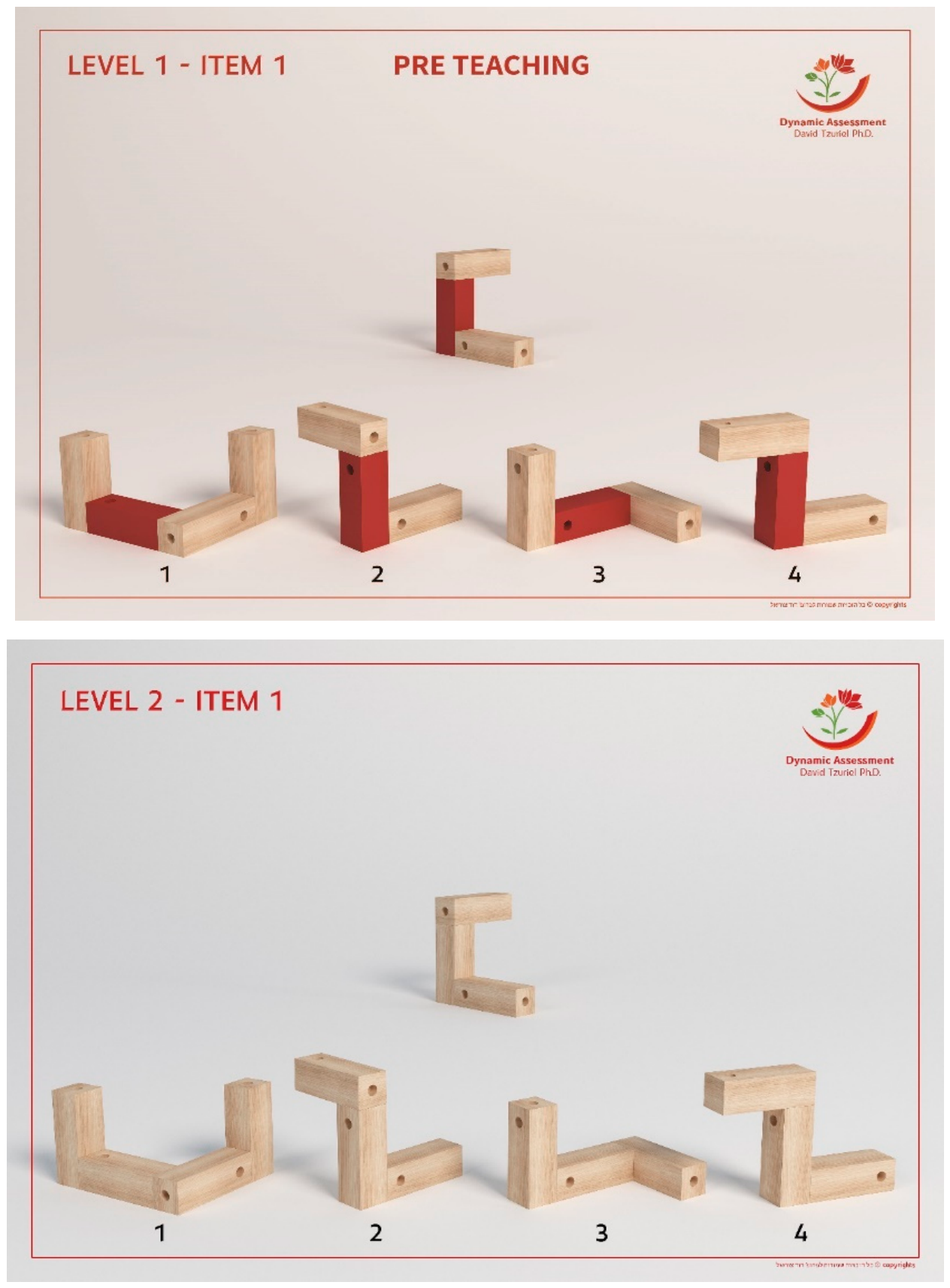
Figure 2.
Example of the MR3D Blocks and Chips.
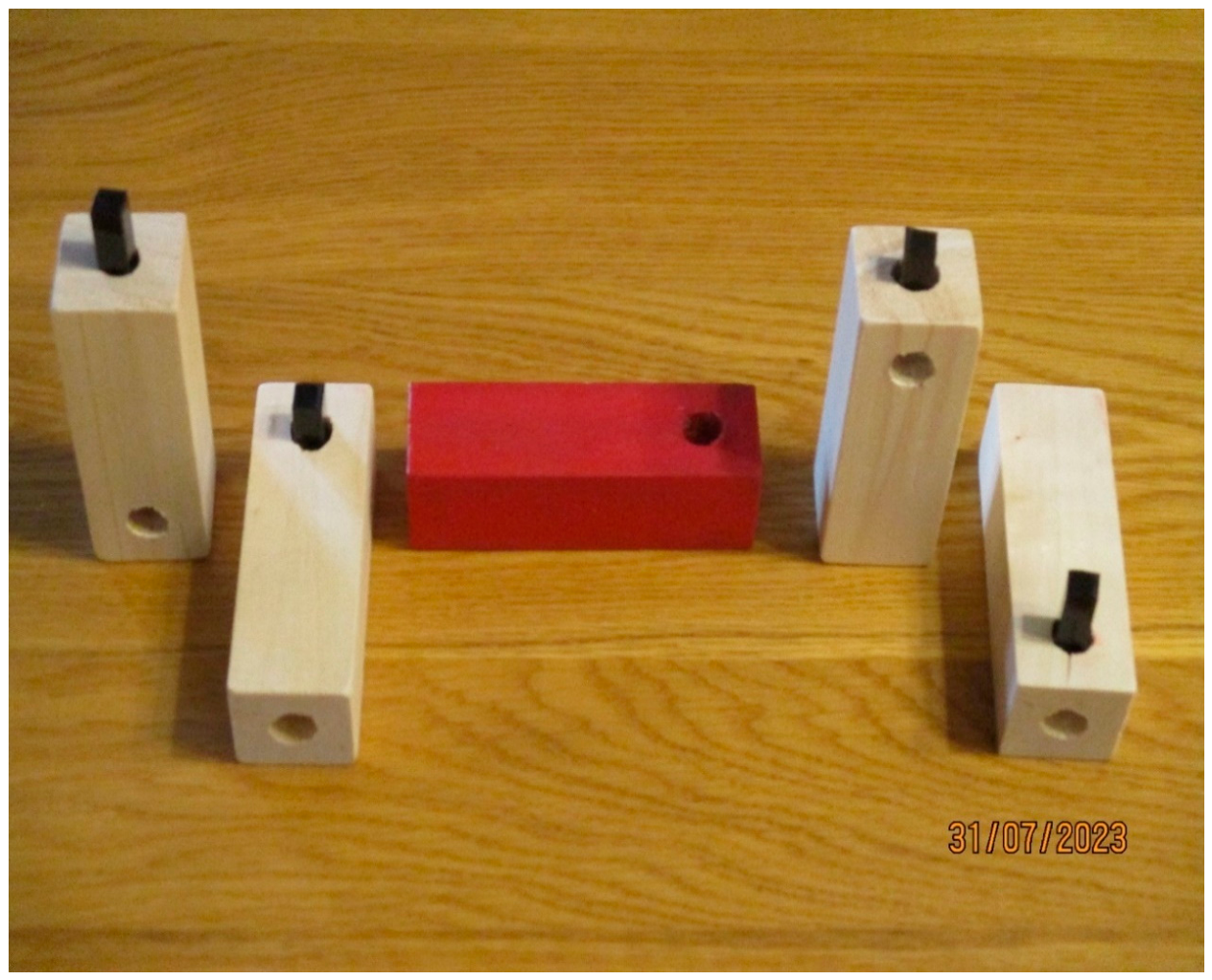
Figure 3.
Step-by-step construction of Item 8 from Pre-Intervention Level I.
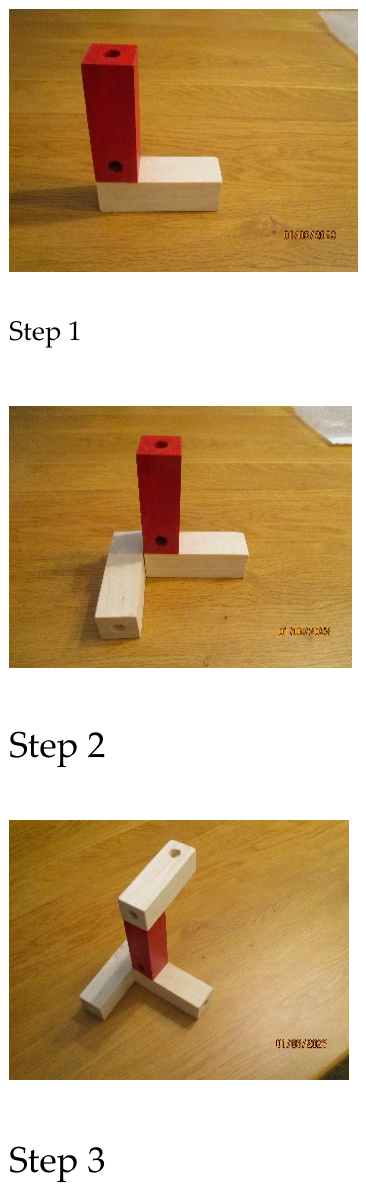
Figure 4.
Pre- and Post-Intervention Tests of Spatial Orientation in Reading Maps.
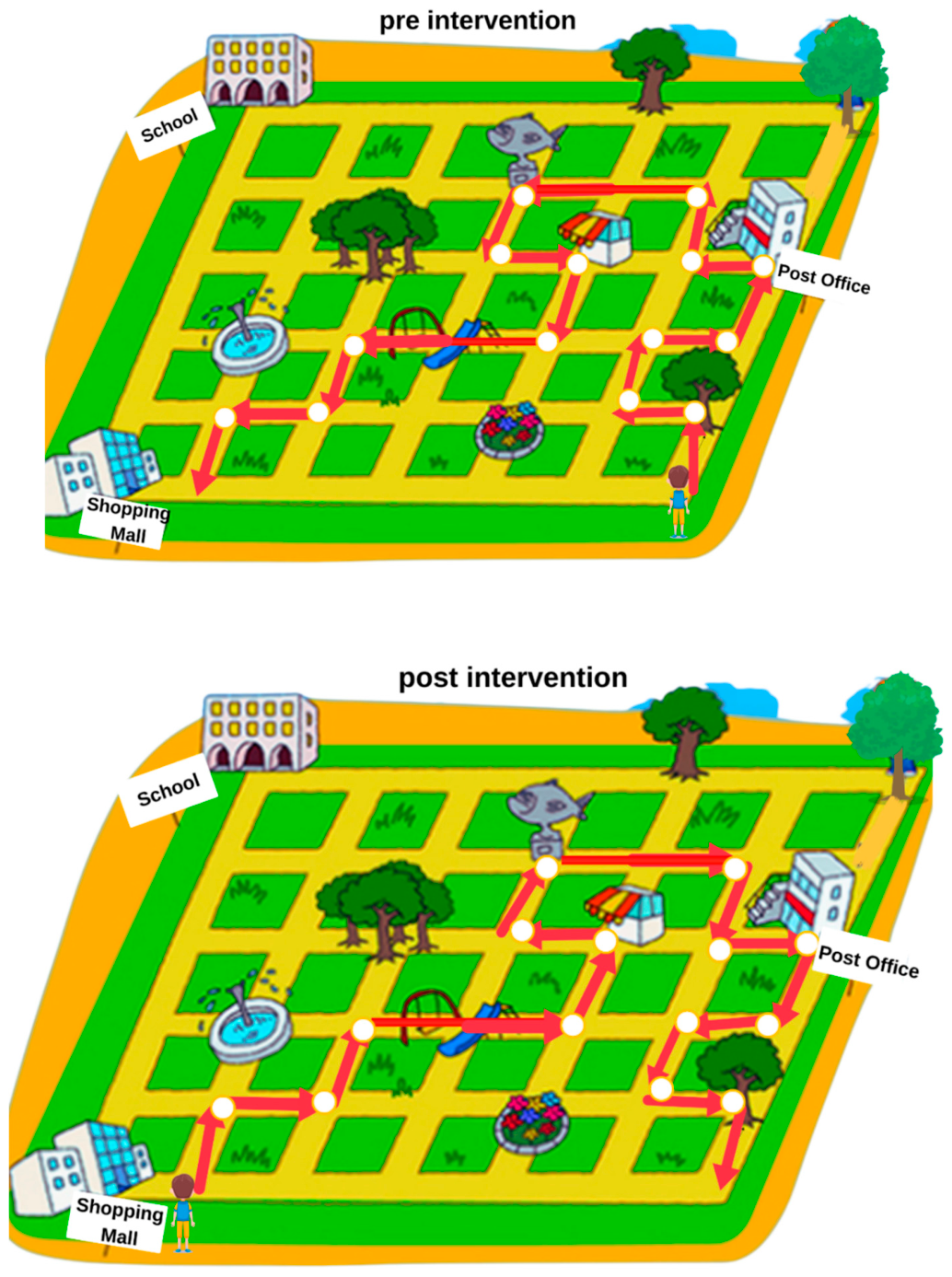
Figure 4.
Percentage of Children Within Each MR3D Score Category Before and After the Intervention in the Experimental (Top Panel) and Control (Bottom Panel) Groups. Note. MR3D score categories: 1 = 0-2, 2 = 3-5, 3 = 6-8, 4 = 9-11, 5 = 12-13, and 6 = 14-16.
Figure 4.
Percentage of Children Within Each MR3D Score Category Before and After the Intervention in the Experimental (Top Panel) and Control (Bottom Panel) Groups. Note. MR3D score categories: 1 = 0-2, 2 = 3-5, 3 = 6-8, 4 = 9-11, 5 = 12-13, and 6 = 14-16.
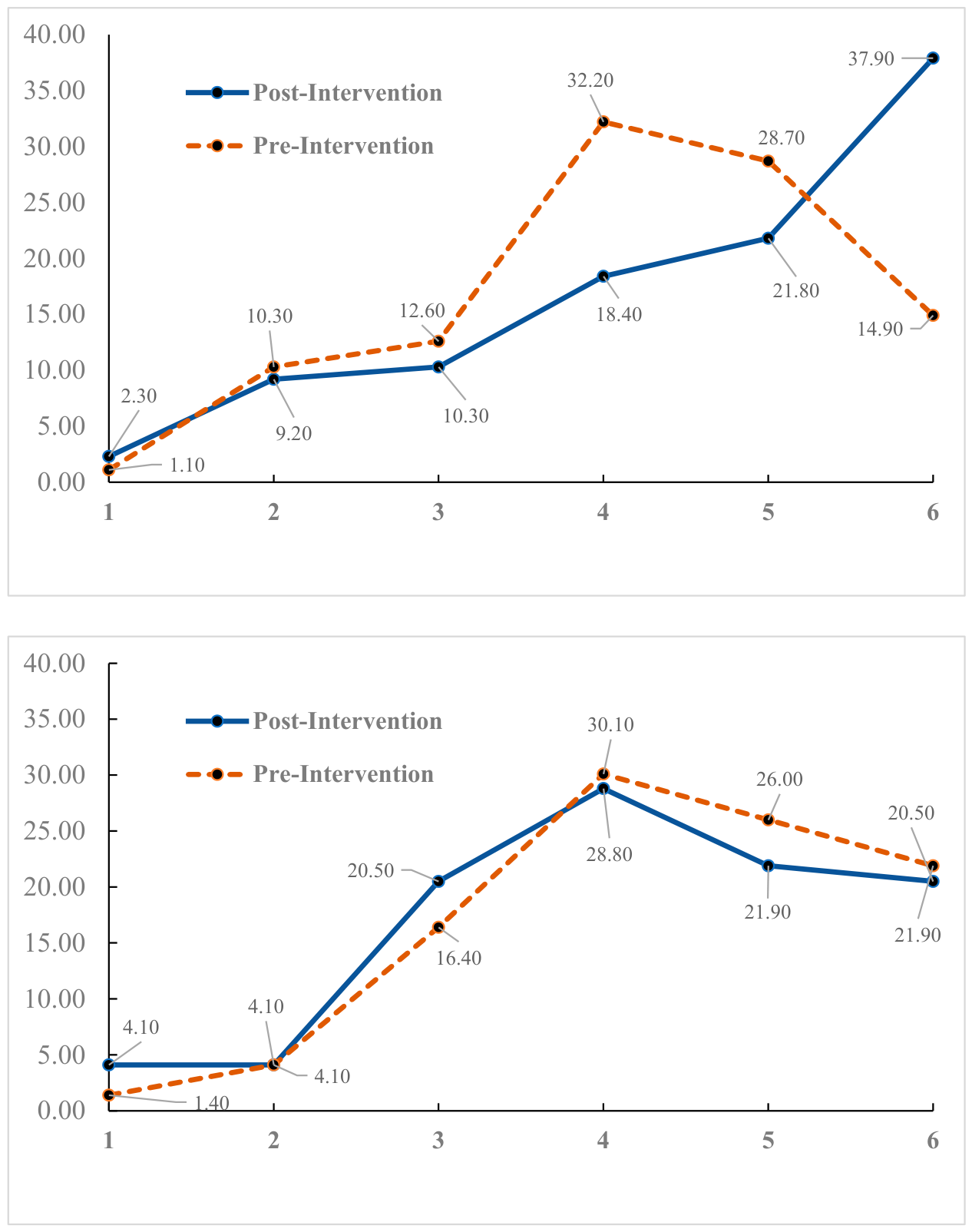
Figure 6.
Pre- and Post-Intervention MR3D Scores in the Experimental and Control Groups.
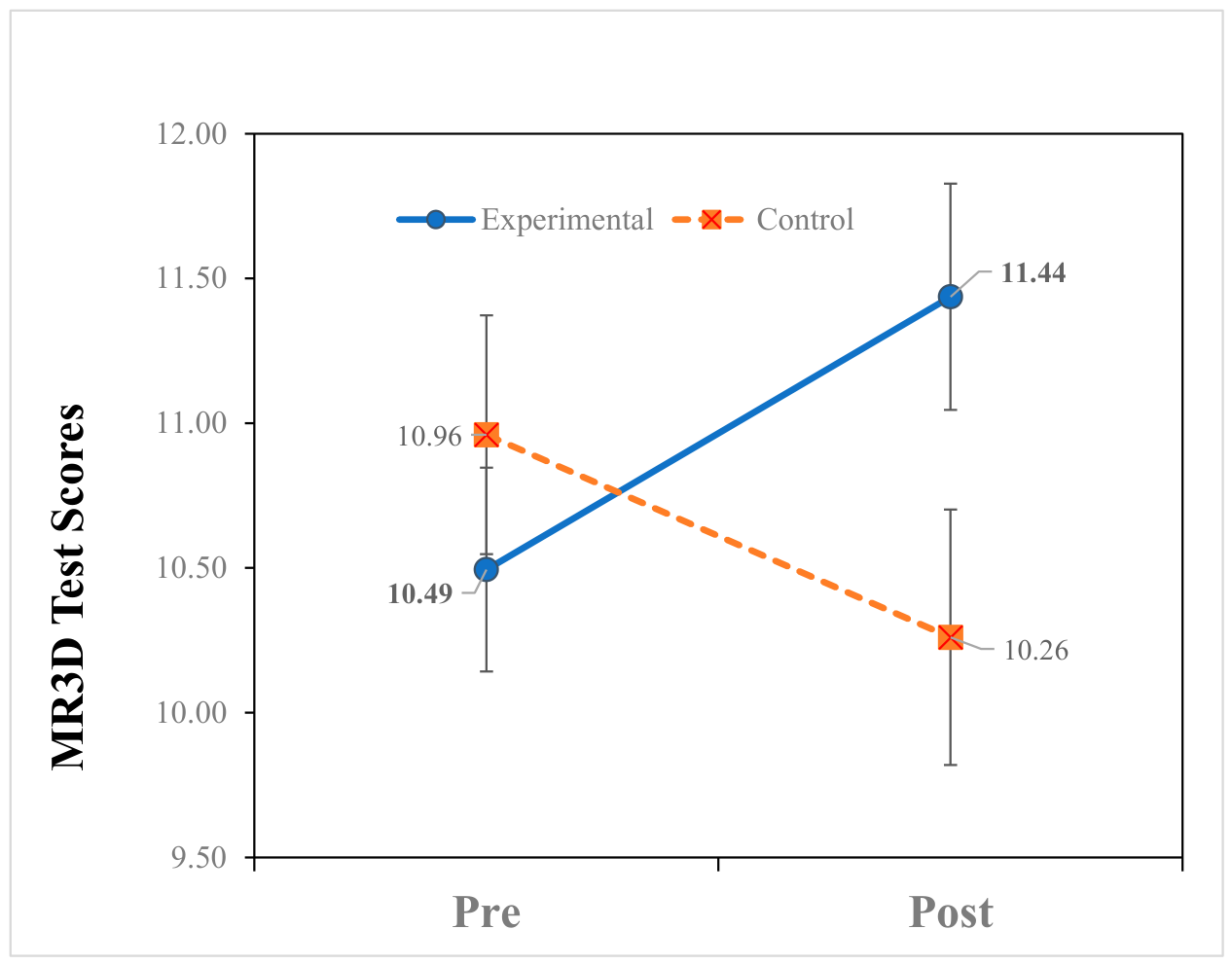

Table 1.
Means and SDs of pre- and post-intervention MR3D and SOMR Tests among Boys and Girls in the Experimental and Control Groups.
Table 1.
Means and SDs of pre- and post-intervention MR3D and SOMR Tests among Boys and Girls in the Experimental and Control Groups.
| Treatment | Sex | MR3D | SOMR | |||
| Pre | Post | Pre | Post | |||
| Experimental | Boys | M | 11.50 | 12.61 | 7.89 | 9.89 |
| SD | 2.68 | 3.31 | 2.47 | 2.63 | ||
| Girls | M | 9.71 | 10.53 | 8.14 | 9.33 | |
| SD | 3.52 | 4.02 | 2.54 | 2.37 | ||
| Control | Boys | M | 11.24 | 11.03 | 8.39 | 9.00 |
| SD | 3.02 | 3.31 | 2.41 | 2.48 | ||
| Girls | M | 9.43 | 11.77 | 8.06 | 8.69 | |
| SD | 4.10 | 4.20 | 2.48 | 2.53 | ||
Table 2.
Repeated Measures Analysis of Variance of MR3D and SOMR Tests by Treatment x Sex x Time.
| MR3D | SOMR | ||||||||
| Source of Variation | df | MS | F | p | ηp2 | MS | F | p | ηp2 |
| Treatment (A) | 1 | 19.71 | 1.02 | .314 | .01 | 6.48 | .70 | .491 | .00 |
| Sex (B) | 2 | 179.39 | 9.28 | .003 | .06 | 4.40 | .48 | .404 | .00 |
| A x B | 2 | 13.94 | 0.72 | .397 | .01 | .46 | .05 | .824 | .00 |
| Error | 156 | 19.33 | 9.24 | ||||||
| Time (C) | 1 | 1.15 | .22 | .637 | .00 | 97.17 | 31.05 | .001 | .17 |
| A x C | 1 | 55.58 | 10.83 | .001 | .07 | 18.21 | 5.82 | .017 | .04 |
| B x C | 1 | 8.41 | 1.64 | .202 | .01 | 3.30 | 1.06 | .306 | .04 |
| A x B x C | 1 | .2.62 | .51 | .476 | .00 | 3.26 | 1.04 | .309 | .01 |
| Error | 156 | 5.12 | 3.13 | ||||||
Table 3.
Pearson Correlation Pattern between MR3D and SOMR in Pre- and Post-Intervention in the Experimental and Control Groups.
Table 3.
Pearson Correlation Pattern between MR3D and SOMR in Pre- and Post-Intervention in the Experimental and Control Groups.
| MR3D Pre | MR3D Post | SOMR Pre | SOMR Post | |
| MR3D Pre | 1 | .61*** | .52*** | .45*** |
| MR3D Post | .60*** | 1 | .55*** | .46*** |
| SOMR Pre | .41*** | .18 | 1 | .69*** |
| SOMR Post | .29** | .52*** | .33** | 1 |
Note. MR3D = Mental Rotation in Three Dimensions; SOMR = Spatial Orientation in Map Reading. Pearson correlation coefficients are reported for the pre- and post-intervention assessments in experimental and control groups. Correlations below the diagonal represent the experimental group, and correlations above the diagonal represent the control group. *p < .05, **p < .01, ***p < .001.
Table 4.
Hierarchical Regression Analysis: Prediction of Modifiability of Spatial Orientation in SOMR Reading by Modifiability of MR3D.
Table 4.
Hierarchical Regression Analysis: Prediction of Modifiability of Spatial Orientation in SOMR Reading by Modifiability of MR3D.
| Step | Predicting Variables | β | t tttt | p |
| 1 | Treatment | -.14 | -.80 | .426 |
| Sex | -.10 | -1.24 | .218 | |
| Age | .12 | 1.60 | .111 | |
| Father’s Occupation | .05 | .39 | .697 | |
| Mother’s Occupation | .372 | 3.41 | .001 | |
| Parents’ Education | -.09 | -.72 | .471 | |
| R2 = .09; F(6, 156) = 2.45, p < .027 | ||||
| 2 | Treatment | -.06 | -1.00 | .316 |
| Sex | -.05 | -.74 | .461 | |
| Age | .05 | .83 | .406 | |
| Father’s Occupation | .03 | .28 | .028 | |
| Mother’s Occupation | .26 | 2.60 | .010 | |
| Parents’ Education | -.11 | -1.01 | .315 | |
| SOMR-Pre | .56 | 8.40 | .001 | |
| MR3D-Pre |
.05 | .82 | .416 | |
| R2 = .34, ΔR2 = .25, p < .001; F(8, 156) = 9.65, p < .001 | ||||
| 3 | Treatment | -.10 | -1.50 | .136 |
| Sex | -.04 | -.59 | .555 | |
| Age (in months) | .01 | .15 | .885 | |
| Father’s Occupation | -.28 | -2.81 | .006 | |
| Mother’s Occupation | .17 | 1.86 | .065 | |
| Parents’ Education | -.09 | -.89 | .373 | |
| SOMR-Pre | .34 | 4.45 | .001 | |
| MR3D-Pre | -.02 | -.19 | .848 | |
| MR3D-Post |
.41 | 4.87 | .001 | |
| R2 = .43, ΔR2 = .09, p < .001; F(9, 156) = 12.53, p = .001 | ||||
Note: SOMR = Spatial Orientation in SOMR Reading; MR3D = Mental Rotation 3 Dimensions.
Disclaimer/Publisher’s Note: The statements, opinions and data contained in all publications are solely those of the individual author(s) and contributor(s) and not of MDPI and/or the editor(s). MDPI and/or the editor(s) disclaim responsibility for any injury to people or property resulting from any ideas, methods, instructions or products referred to in the content. |
© 2026 by the author. Licensee MDPI, Basel, Switzerland. This article is an open access article distributed under the terms and conditions of the Creative Commons Attribution (CC BY) license.
Copyright: This open access article is published under a Creative Commons CC BY 4.0 license, which permit the free download, distribution, and reuse, provided that the author and preprint are cited in any reuse.