
Submitted:
13 October 2026
Posted:
14 October 2026
You are already at the latest version
Abstract
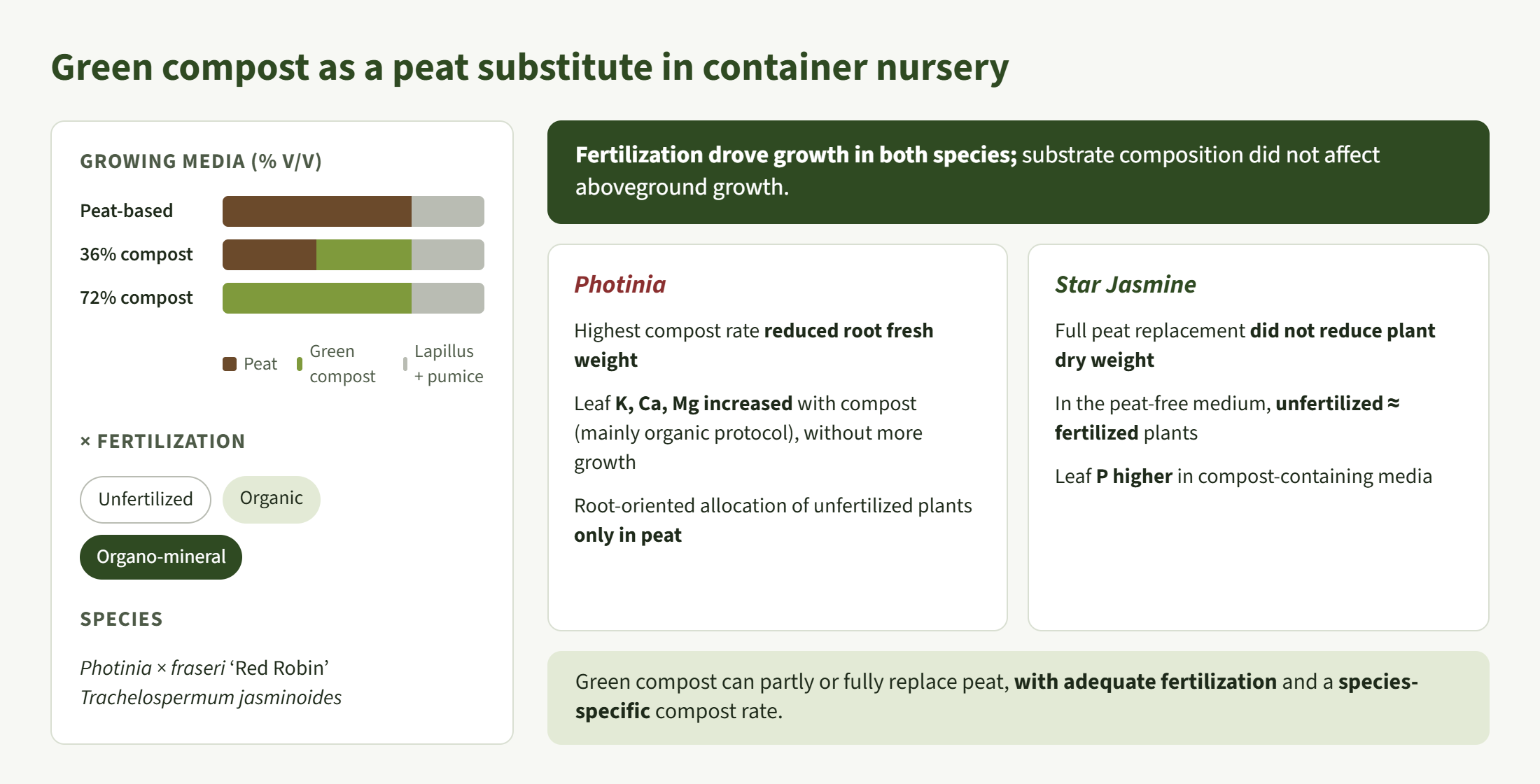
Green compost is a promising peat substitute in container nursery production, but plant responses are often species-specific. This study evaluated three growing media containing 0, 36, and 72% (v/v) green compost, replacing none, half, or all of the peat fraction, combined with three fertilization protocols (unfertilized, organic, and organo-mineral), on growth, biomass, biomass allocation, and leaf macronutrients of Photinia × fraseri ‘Red Robin’ and Trachelospermum jasminoides. Fertilization was the main factor affecting growth in both species, with the organo-mineral protocol giving the highest values, whereas substrate composition did not affect aboveground growth. In Photinia, the highest compost proportion reduced root fresh weight and increased leaf K, Ca, and Mg concentrations, mainly under organic fertilization, without improving growth; unfertilized plants allocated more biomass to roots only in the peat-based substrate. In Star Jasmine, complete peat replacement did not reduce plant dry weight. However, root fresh weight decreased, and unfertilized plants in the peat-free substrate did not differ from fertilized ones. Green compost can therefore partly or fully replace peat for these species, provided that adequate fertilization is supplied. The compost pro-portion is adapted to the species.
Keywords:
biomass allocation
; container nursery production
; green compost
; growing media
; macronutrient leaf content
; utilization index
; organic amendment
; sustainable horticulture
Copyright: This open access article is published under a Creative Commons CC BY 4.0 license, which permit the free download, distribution, and reuse, provided that the author and preprint are cited in any reuse.