
Submitted:
13 October 2026
Posted:
14 October 2026
You are already at the latest version
Abstract
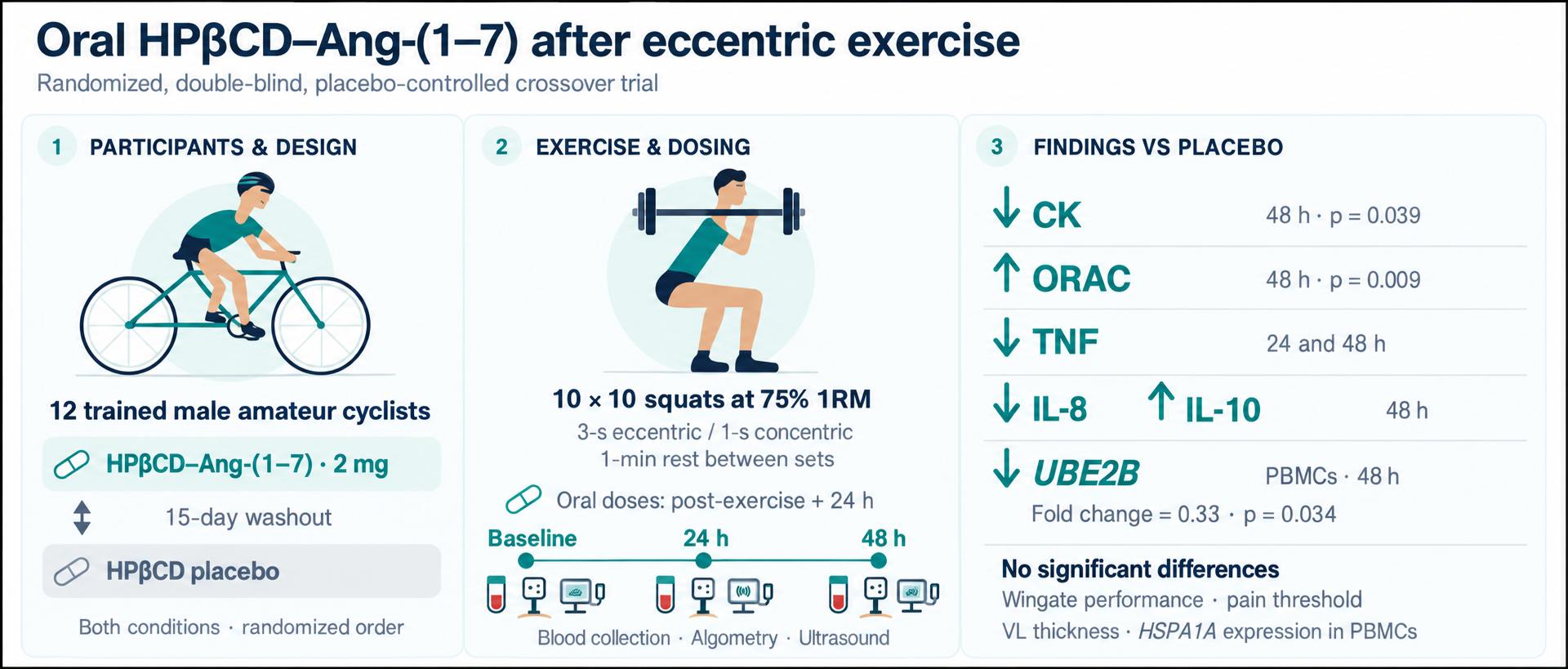
Background/Objectives: Exercise can induce muscle damage, and human evidence on angiotensin-(1–7) supplementation for recovery remains limited. This study evaluated the effects of oral hydroxypropyl-β-cyclodextrin-complexed angiotensin-(1–7) (HPβCD–Ang-(1–7)) on muscle damage and recovery in trained amateur cyclists. Methods: Twelve male cyclists completed a randomized, double-blind, placebo-controlled crossover trial with a 15-day washout. Participants received HPβCD–Ang-(1–7) (2 mg) or placebo immediately after 10 sets of 10 squats at 75% of one-repetition maximum and again 24 h later. Outcomes included creatine kinase (CK), ferric reducing antioxidant power (FRAP), oxygen radical absorbance capacity (ORAC), cytokines, pressure pain threshold, and vastus lateralis thickness. Wingate performance and UBE2B and HSPA1A expression in peripheral blood mononuclear cells were assessed at 48 h. Results: Compared with placebo, HPβCD–Ang-(1–7) supplementation resulted in lower CK (p = 0.039) and higher ORAC (p = 0.009) at 48 h. FRAP was higher overall, but between-condition differences at individual time points were not significant after adjustment. TNF was lower at 24 h and 48 h, while IL-8 was lower and IL-10 higher at 48 h. UBE2B expression was lower (fold change = 0.33; p = 0.034), whereas HSPA1A expression did not differ significantly. No significant differences between conditions were detected in Wingate performance, pressure pain threshold, or muscle thickness. Conclusions: HPβCD–Ang-(1–7) supplementation reduced circulating CK, modified antioxidant and inflammatory responses, and lowered UBE2B expression in peripheral blood mononuclear cells, without detectable differences in Wingate performance, pressure pain threshold, or muscle thickness. Trial registration: RBR-5ftj2fy.
Keywords:
angiotensin-(1–7)
; exercise-induced muscle damage
; antioxidant capacity
; inflammation
; cycling
Copyright: This open access article is published under a Creative Commons CC BY 4.0 license, which permit the free download, distribution, and reuse, provided that the author and preprint are cited in any reuse.