

Submitted:
13 October 2026
Posted:
14 October 2026
You are already at the latest version
Abstract
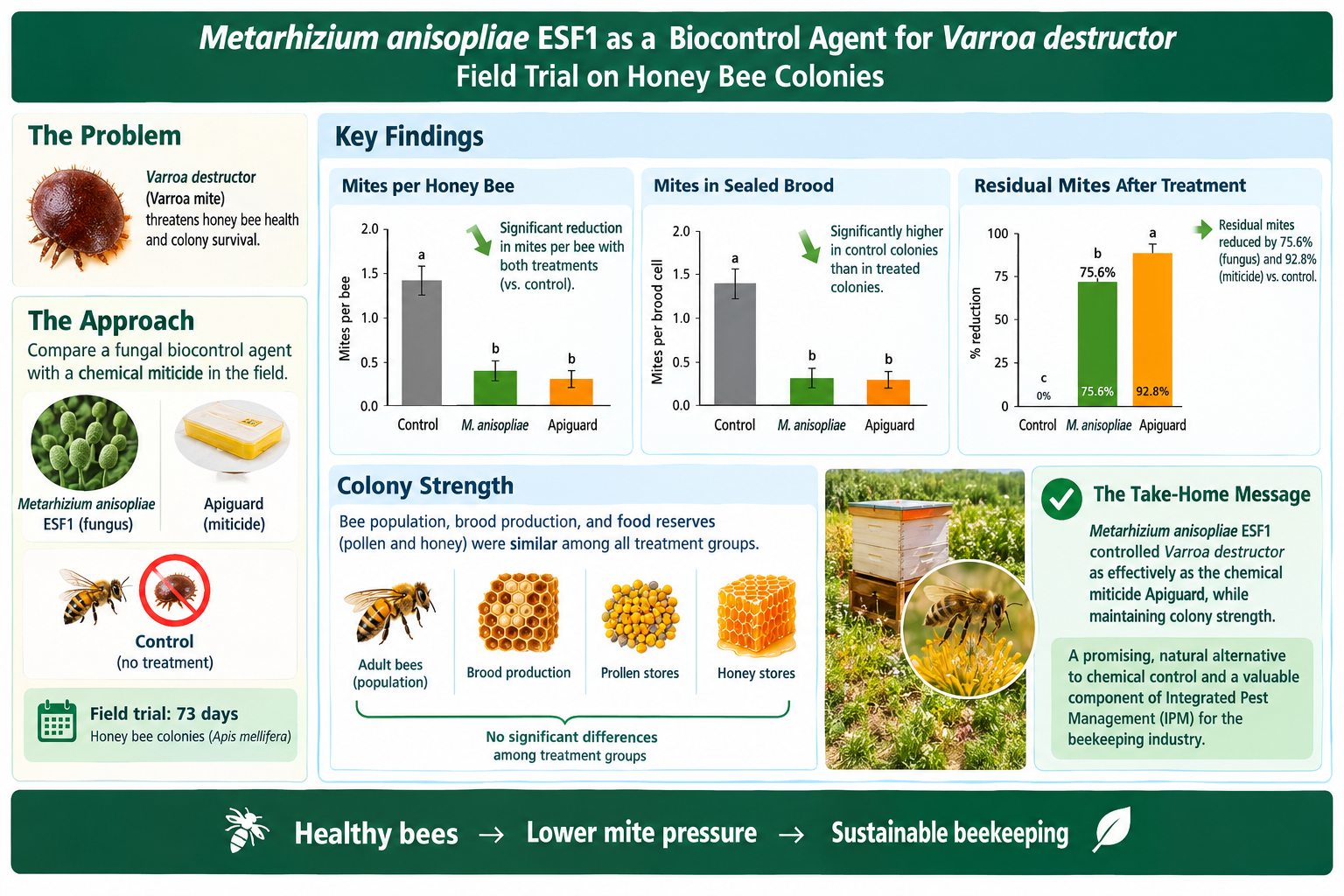
The potential of the fungal strain Metarhizium anisopliae ESF1 to control Varroa destructor was evaluated in a field trial conducted on honey bee colonies, with comparisons made to the miticide Apiguard. At the end of the 73-day experimental period, M. anisopliae demonstrated efficacy comparable to the chemical treatment in suppressing V. destructor populations. The number of mites per honey bee (Apis mellifera) was significantly reduced in colonies treated with the miticide Apiguard and the fungus M. anisopliae; however, mite infestations increased in the control colonies. Similarly, the number of mites in sealed brood was significantly higher in the control colonies than in those treated with the miticide and the fungus. Mites remaining in the colonies post-treatments (residual mites) were higher in the control colonies but reduced by 75.6% and 92.8% in colony treated with the fungus and miticide, respectively. Colony strength in terms of bee populations, brood production, and food reserves (pollen and honey) were similar between treatment groups. Overall, microbial control of V. destructor with M. anisopliae could be a promising alternative to the use of chemicals and a useful component of an Integrated Pest Management program for the beekeeping industry.
Keywords:
Metarhizium anisopliae
; Varroa destructor
; fungus
; honey bee
; beekeeping
Copyright: This open access article is published under a Creative Commons CC BY 4.0 license, which permit the free download, distribution, and reuse, provided that the author and preprint are cited in any reuse.