

Submitted:
12 October 2026
Posted:
13 October 2026
You are already at the latest version
Abstract
This study examined the role of emotional intelligence and self-esteem in the context of the athletic development of young soccer players aged 10 to 12 years, using standardized and validated psychological instruments. Emotional intelligence was assessed using the Bar-On Emotional Quotient Inventory: Youth Version (EQ-i:YV), and self-esteem was measured with the Coopersmith Self-Esteem Inventory – School Form (CSEI-S). Motor performance was used as a functional indicator of the level of sports preparation and was assessed using the 10-m sprint, Zig-Zag dribbling test, and T-test for agility. Between-group analyses indicated more favourable emotional-intelligence and self-esteem profiles and greater improvements in selected motor-performance measures among players in the Montessori-informed training environment. Given the quasi-experimental design and small sample, these findings should be interpreted as associations rather than evidence of causal effects and highlight the potential relevance of psychological assessment in youth sport and support the consideration of psychological dimensions alongside physical and technical components of training.
Keywords:
emotional intelligence
; self-esteem
; psychological assessment
; youth soccer
; EQ-i:YV
; CSEI-S
1. Introduction
Sport performance in children and adolescents is a multidimensional construct influenced by motor, cognitive, emotional, and social factors. In youth soccer, physical abilities such as speed, agility, and coordination are essential for performance development. However, recent research emphasizes that psychological variables also play an important role in athletes’ adaptation to training and competition (Côté et al., 2007; Lloyd et al., 2015). Among these psychological dimensions, emotional intelligence and self-esteem have been associated with emotional regulation, stress management, motivation, and behavioural adaptation in sport contexts. Athletes with higher emotional intelligence demonstrate better coping strategies and greater emotional stability during competitive situations, while self-esteem influences confidence, persistence, and engagement in training (Laborde et al., 2016; Orth & Robins, 2014). Moreover, emotional intelligence can be improved through targeted interventions and educational experiences, supporting athletes’ adaptive capacities and psychological functioning (Kotsou et al., 2019).
Furthermore, regular physical activity has been positively associated with life satisfaction and psychosocial well-being among children and adolescents (Ubago-Jiménez et al., 2023). Despite increasing interest in psycho-emotional factors in sport, limited research has examined the relationship between emotional intelligence, self-esteem, and motor performance in preadolescent soccer players. Furthermore, the role of educational environments that promote autonomy, active learning, responsibility, cooperation, and emotional self-regulation (Ericsson et al., 2018), such as Montessori-inspired systems remains comparatively underexplored in youth sport (Gentaz & Richard, 2022; Demangeon et al., 2023). The empirical evidence supporting Montessori education generally remains relatively limited, with the existing body of research being constrained by several methodological limitations, including small sample sizes, inadequate control conditions, and variability in the fidelity with which Montessori principles and practices are implemented across studies (Gentaz & Richard, 2022).
In physical activity, the findings suggest that the educational setting and instructional practices may play an important role in shaping children’s physical activity behaviour, with children attending Montessori centres reported to be more physically active than their counterparts attending traditional childcare centres (Pate et al, 2022). These findings highlight the potential relevance of child-centred educational environments for promoting physical activity, while also indicating the need for further research to determine whether Montessori-based principles can be systematically translated into structured physical activity and sport interventions.
Other evidence highlights the importance of providing children with structured, developmentally appropriate opportunities to practise fundamental movement skills, supported by well-informed educators and an environment that facilitates meaningful engagement in physical activity. Dobell et al. (2023) emphasize that effective interventions should address not only the child’s individual capabilities but also the interpersonal and organisational contexts in which movement learning occurs. This perspective supports the development of pedagogical approaches that integrate structured practice with child-centred learning environments and may provide a relevant foundation for extending fundamental movement skill development into more specialised physical activity and sport contexts. Taken together, these findings provide a rationale for investigating whether the principles underlying Montessori education, particularly its emphasis on child-centred learning and the learning environment, can be adapted to structured sport settings and may be associated with developmental outcomes in young athletes. Within the context of youth soccer training, these principles may contribute not only to psychological development but also to improved adaptation to sport-specific motor demands.
The Role of Emotional Intelligence and Self-Esteem in Youth Sports
Such educational approaches are consistent with contemporary perspectives on youth sport that emphasize the interpersonal and developmental dimensions of coaching. Emotional intelligence and transformational leadership have been associated with the quality of coach–athlete relationships and with positive developmental experiences in youth sport. Research involving adolescent soccer players has shown that transformational leadership behaviours and the quality of the coach–athlete relationship are positively associated with developmental experiences, highlighting the importance of individualized consideration, intellectual stimulation, and positive role modelling in youth coaching (Vella et al., 2013).
More recent evidence similarly indicates that transformational leadership behaviours are related to the quality of coach–athlete relationships, particularly through individualized consideration, role modelling, and the promotion of group goals (López de Subijana et al., 2021; Zhao & Jowett, 2023). Emotional intelligence may further contribute to the quality of these relationships, with evidence suggesting that emotional intelligence and relationship quality are interconnected with athletes’ and coaches’ satisfaction (Zhao & Jowett, 2023). Within this developmental framework, self-esteem should not be conceptualised solely as a consequence of sporting success. Rather, it represents an important component of young athletes’ self-perceptions and may interact with perceived competence, motivation, and engagement in sport (Ryan & Deci, 2000). Longitudinal research in children has demonstrated associations among global self-esteem, perceived athletic competence, and physical activity (individual or team practice), although these relationships may vary according to developmental and individual characteristics (Noordstar et al., 2016; Šagát et al., 2021).
In youth soccer, therefore, psychological development should be considered alongside the acquisition of sport-specific skills. Organized sport provides opportunities not only for the development of physical and technical competencies but also for the development of confidence, social connection, responsibility, and adaptive behaviours. Evidence from youth sport research indicates that positive coaching environments and supportive coach–athlete relationships can contribute to these broader developmental outcomes.
Accordingly, contemporary youth soccer training may be conceptualized as a multidimensional educational process in which motor learning, psychological development, interpersonal relationships, and opportunities for autonomy and competence are closely interconnected. Yu et al. (2024) demonstrated that self-esteem and collective self-esteem may represent important psychological mechanisms linking football participation with sport trait confidence among adolescents. Zhao et al. (2025) found that athlete engagement and collective self-esteem jointly mediated the relationship between soccer participation and team cohesion in adolescent soccer players.
Research on youth soccer has also emphasized the importance of autonomy-supportive coaching and increasingly emphasized athlete-centred leadership and the alignment between coaches’ behaviours and athletes’ perceptions. Sevil-Serrano et al. (2021) showed that athletes’ perceptions of coaching behaviours are closely related to the satisfaction and frustration of basic psychological needs and to sport commitment. The study by Buda et al. (2026) highlights the relevance of individualized consideration, emotional support, interpersonal adaptability, and athlete-centred communication within effective coaching environments.
Therefore, the present study examines the relationship between emotional intelligence, self-esteem, and motor performance in soccer players aged 10–12 years and compares psychological and motor performance profiles between athletes participating in Montessori-informed and traditional training environments.
2. Materials and Methods
2.1. Aim of the Study
The present study aimed to examine the relationships between emotional intelligence, self-esteem, and motor performance among U10–U12 soccer players while investigating whether participation in a Montessori-informed educational environment contributes to differences in psycho-emotional functioning and sport-related motor development. Specifically, the study sought to compare psychological and motor performance profiles between athletes trained within a traditional football setting and those enrolled in a Montessori-based educational program, as well as to explore the extent to which emotional intelligence and self-esteem may contribute to variability in youth athletic performance.
To achieve this aim, the study focused on assessing emotional intelligence and self-esteem levels among young soccer players, analysing motor performance through soccer-specific standardized tests, and identifying potential differences between athletes trained within a traditional coaching system and those integrated into a Montessori-based training environment.
The present research was designed within a multidimensional framework of youth sports development, according to which athletic performance at early ages is not determined exclusively by motor abilities but emerges from the complex interaction between physical, emotional, and psychosocial characteristics of young athletes, as proposed by long-term athlete development models (Lloyd et al., 2015; Fernandes et al., 2024).
2.2. Research Objectives
To address the study aim, the research was structured around the following objectives:
- To characterize the motor performance through standardized soccer-specific assessments, including agility, dribbling efficiency, and sprint speed, using the T-test, Zig-Zag dribbling test, and 10-meter sprint test (Montenegro Bonilla et al., 2024).
- To identify the levels of emotional intelligence among U10–U12 soccer players using the Bar-On Emotional Quotient Inventory – Youth Version (EQ-i:YV) (Bar-On, 1997), with particular attention to adaptability, stress management, interpersonal functioning, and general well-being.
- To assess the self-esteem profiles among young athletes using the Coopersmith Self-Esteem Inventory – Students (CSEI-S) (Coopersmith, 1967), examining both global and domain-specific dimensions of self-perception relevant to youth sport participation
- To compare psycho-emotional and motor performance profiles between athletes trained within a traditional football setting and those participating in a Montessori-informed educational environment, in order to identify potential developmental differences.
2.3. Research Hypotheses
The research was based on the following hypotheses:
- Athletes exposed to a Montessori-inspired, autonomy-supportive training environment will demonstrate greater improvements in agility and adaptation to game-specific motor tasks than athletes trained in a traditional coach-centered environment.
The rationale for H1 is that guided choice, variable task constraints, and op-portunities for self-correction require players to participate actively in solving mo-vement problems. For example, spatial restrictions and changes in possession create repeated opportunities to adjust movement direction, pace, and ball control. Such activities connect practice with the coordination demands represented by the T-test and Zig-Zag dribbling assessment, while repeated accelerations also relate to 10-m sprint performance. Within the skill-acquisition framework discussed above, the coach prepares appropriately challenging tasks and offers concise guidance, allo-wing the player to explore effective solutions rather than relying continuously on an externally prescribed response. The expected advantage therefore concerns the qu-ality of engagement with motor practice and the opportunity to adapt learned skills to changing task conditions. The three motor tests provide complementary indica-tors through which this expectation can be examined.
- Athletes participating in a Montessori training environment will demonstrate higher scores on selected dimensions of emotional intelligence than athletes participating in a traditional training environment.
H2 follows from the emotional and interpersonal demands embedded in the intervention. Choosing among possible actions, coping with errors, and responding to changing task conditions provide opportunities to practise adaptability and stress management. Cooperative activities also require players to communicate, recognize teammates’ needs, and coordinate their responses, making interpersonal function-ing particularly relevant. When the coach treats errors as information for learning and combines clear rules with meaningful choice, players may experience a greater sense of competence, inclusion, and enjoyment. These features offer a conceptual explanation for expecting favourable General Mood scores, consistent with the autonomy, competence, and relatedness framework introduced earlier. The hypothesis thus concerns a differentiated emotional-intelligence profile: the strongest expectations relate to capacities repeatedly engaged in training, rather than assuming an identical response across every psychological dimension.
- Athletes trained according to Montessori pedagogical principles will report higher levels of self-esteem and more favorable self-perception profiles than athletes trained in a traditional environment.
The rationale for H3 centers on how children interpret their participation and progress. Opportunities to make decisions, recognize personal improvement, and contribute to shared activities may help players experience themselves as capable and valued participants. Individualized feedback can direct attention towards achievable progress and constructive responses to mistakes, providing a basis for more favorable self-perception. Cooperative tasks also give children opportunities to experience recognition and belonging within the group, making the social domain of self-esteem relevant to the training context. This reasoning is consistent with the relationships among perceived competence, self-esteem, and sport participation discussed in the Introduction. The hypothesis concerns substantive self-esteem dimensions; the inventory’s social-desirability scale is considered separately as an indicator of response tendencies, rather than as evidence of improved self-esteem.
2.4. Participants
A non-probability convenience sampling strategy was used. Participants were recruited from two pre-existing training environments: School Sports Club No. 1 Bucharest, a conventional football club, and the Keep Going – Montessori School educational programme. All athletes enrolled at the two participating institutions were invited to participate in the study. Their parents were informed at meetings held at each institution, during which the study procedures were explained and written informed consent forms were distributed. Recruitment took place between 1 and 15 March 2024.
A total of 51 children expressed interest in participating in the study. The inclusion criteria were: (1) being aged 10–12 years at the time of the study; (2) having 2–4 years of formal soccer training experience; (3) having participated in local-level soccer competitions; and (4) being enrolled in one of the two designated training environments. Of these, 11 were not included because they did not confirm their availability to attend all scheduled training sessions. The final study sample comprised 40 soccer players, with 20 participants from each training environment. Participation was voluntary, and written informed consent was obtained from the parents or legal guardians of all participants in accordance with ethical principles governing research involving minors.
The traditional training group comprised athletes enrolled at School Sports Club No. 1 Bucharest. This group followed the club’s conventional football training model, characterised by coach-directed instruction, structured drills, direct corrective feedback, and comparatively greater coach control over task execution and decision-making. The Montessori-based group comprised athletes participating in the Keep Going – Montessori School educational programme. These athletes trained with the same coach as the traditional group but followed a Montessori-informed approach (Table 1).
Group membership therefore reflected participants’ pre-existing training environments rather than random allocation by the researchers. Accordingly, the study employed a quasi-experimental rather than a randomised design.
2.5. Research Methods
From a methodological perspective, the study employed a pedagogical experiment and systematic pedagogical observation. The primary between-group factor was training environment (traditional vs. Montessori-informed), while the outcome variables comprised emotional intelligence, self-esteem, and motor performance. This multidimensional research design allowed the investigation of the interaction between psycho-emotional factors and athletic performance within the context of youth football training.
Motor performance was assessed using standardized tests commonly applied in youth soccer evaluation, namely the T-Test for agility, the Zig-Zag dribbling test (Figure 1) and the 10-meter sprint test. These assessments represent relevant indicators of functional performance in modern soccer, where reaction speed and rapid directional changes constitute key determinants of competitive success (Montenegro Bonilla et al., 2024).
These instruments were selected due to their ecological validity and their relevance for the functional demands of modern football, where rapid accelerations, multidirectional movements, agility, and technical execution under time pressure represent essential components of competitive performance. Existing literature (Montenegro Bonilla et al., 2024) emphasizes that speed and change-of-direction ability constitute reliable indicators of motor efficiency and game adaptability in youth football players.
Psychological dimensions were evaluated using internationally validated instruments. Emotional intelligence was measured using the Bar-On Emotional Quotient Inventory – Youth Version (EQ-i:YV) (BarOn & Parker, 2022) is a 60-item self-report for children and adolescents aged 6–18 years. The measure takes approximately 30 minutes to complete and is grounded in the Bar-On model of emotional and social intelligence, which encompasses competencies related to self-awareness, interpersonal relationships, adaptability, and emotion regulation. It yields scores on five scales—Intrapersonal, Interpersonal, Stress Management, Adaptability, and General Mood. The inventory also includes a Positive Impression scale and an Inconsistency Index to assess response validity. The four core scales—Intrapersonal, Interpersonal, Stress Management, and Adaptability—contribute to the Total EQ score, while General Mood provides additional information on emotional functioning. Each of the 60 items is rated on a four-point Likert-type scale ranging from 1 (Very seldom true of me) to 4 (Very often true of me). The responses are used to calculate scores for the instrument's emotional and social intelligence dimensions, according to the standardized scoring procedures. The Romanian version used in this study has been validated for the Romanian population and was approved by the Romanian College of Psychologists, in 2023, for use in clinical psychology, educational psychology, school counseling, and vocational counseling.
Self-esteem was evaluated through the Coopersmith Self-Esteem Inventory – for Students (CSEI-S) (Coopersmith, 2017), in its Romanian standardized version for children and adolescents aged 9–18 years. It measures evaluative self-attitudes across various domains of an individual's life, including social, academic, family, and personal contexts. Within the CSEI framework, self-esteem is defined as a subjective judgment of personal worth, expressed through an individual's attitudes toward themselves. Self-perception is considered an indicator of perceived competence, success, significance, and personal worth. The CSEI-S comprises 58 items scored using a dichotomous response format (Yes/No), with an estimated completion time of approximately 25–30 minutes. Fifty items assess self-esteem, while the remaining eight constitute the Distortion Scale, which evaluates the defensive response patterns that may influence a child's answers to the inventory. The self-esteem items yield a total score and can also be used to calculate four separate subscale scores: General Self-Esteem, Peer-Related Self-Esteem, Home-Related Self-Esteem (reflecting relationships with parents), and School-Related Self-Esteem (reflecting academic performance). The interpretation of its scores followed the standardized scoring procedures specified for the instrument.
The intervention was delivered in Romanian, which was the participants' native language and the language used for all instructional activities and communication throughout the study. Evidence supporting the validity of the Romanian version of both instruments was reported in the specific references authorized by the Romanian College of Psychologist (Bar-On & Parker, 2022; Coopersmith, 2017). In the present study, internal consistency reliability was assessed using Cronbach’s alpha; no additional instrument-validation analyses were conducted.
The combined use of these instruments enabled an integrated analysis of psychological mechanisms underlying youth sports participation, consistent with recent findings emphasizing the role of emotional intelligence in behavioral self-regulation and sustained sport motivation (Huang et al., 2025). Both instruments have demonstrated evidence of validity and reliability in previous research, and their use in the present study provided standardized measures of the assessed psycho-emotional dimensions. Their inclusion in the present research ensured an objective evaluation of psycho-emotional variables relevant to sport participation and athlete development.
Internal consistency
Internal consistency was assessed using item-level responses for both the Bar-On Emotional Quotient Inventory – Youth Version (EQ-i:YV) and the Coopersmith Self-Esteem Inventory – Students (CSEI). Cronbach’s alpha coefficients were calculated for the total sample and separately for each training group. Reverse-keyed items were recoded before analysis in accordance with the respective scoring instructions.
For the EQ-i:YV, internal consistency was assessed separately for the four core dimensions: Intrapersonal, Interpersonal, Stress Management, and Adaptability. Items from the General Mood and Positive Impression scales were excluded from the analysis of the combined 40-item core scale. In the total sample, Cronbach’s alpha was .762 for Intrapersonal, .731 for Interpersonal, .610 for Stress Management, and .875 for Adaptability. The coefficient for the combined core scale was .862. For this combined scale, group-specific coefficients were .895 in the traditional football group and .731 in the Montessori-informed Keep Going group.
For the CSEI items, excluding the eight Lie Scale items. The coefficient for the total self-esteem scale was .842 in the total sample, .722 in the traditional football group, and .829 in the Montessori-informed Keep Going group.
Collected data were analyzed using both descriptive and inferential statistical methods. Statistical analyses were conducted using IBM SPSS Statistics (Version 29/30). Distribution normality was assessed using the Shapiro–Wilk test, while homogeneity of variances was verified through Levene’s test. Within-group changes from baseline (T1) to follow-up (T2) were assessed with the Wilcoxon signed-rank test, and between-group differences at T2 with the Mann–Whitney U test. Where appropriate, T2-to-T1 change scores were calculated and compared between groups to assess differences in the magnitude of change. Effect sizes were reported as rank-biserial correlations. Exploratory associations between psychological and motor-performance variables were examined using regression analyses. The significance threshold was set at α = 0.05.
2.6. Research Methodology
The research protocol was implemented over a period of nine months, during the 2024–2025 competitive season. Two assessment sessions were organized: an initial evaluation (T1, September 2024) at the beginning of the championship period and a final evaluation (T2, May 2025) at the end of the season. Training sessions were conducted in Bucharest, three times per week, complemented by weekly official matches organized within local and regional youth football competitions. This longitudinal structure enabled the assessment of changes in motor and psycho-emotional variables over one competitive season.
The intervention program was developed according to the principles of Montessori pedagogy and adapted to the specific demands of football training. (Table 1) The originality of the intervention consisted in integrating football-specific motor objectives with socio-affective and self-regulatory learning components. The training environment was intentionally designed to encourage autonomy, active participation, cooperation, decision-making, and self-regulation during game-related situations.
A central principle of the intervention involved the use of constraint-based learning situations, in which the environment itself generated corrective feedback through task conditions, limited time, spatial restrictions, or loss of ball possession. This approach was intended to encourage players to identify solutions independently and adapt their behaviour to contextual demands. Within this framework, autonomy was operationalized through the players’ capacity to make effective tactical and technical decisions without continuous external intervention from the coach. Furthermore, the coach adopted a facilitative role, providing guidance while minimizing direct control over players’ decision-making. Training activities were organized around game-based tasks and small-sided situations that promoted exploration, responsibility, and experiential learning.
These learning conditions are consistent with contemporary theories of expertise development, emphasizing deliberate practice, experiential learning, and the progressive acquisition of performance-related skills (Ericsson et al., 2018).
Consequently, the Montessori-informed approach aimed not only to improve motor performance but also to stimulate emotional adaptability, communication skills, intrinsic motivation, and psychological resilience, dimensions considered essential for long-term athlete development in contemporary youth football.
3. Results
The analysis of the results was conducted both separately for each assessment instrument and through the examination of the relationships between motor and psycho-emotional variables. This approach allowed a multidimensional interpretation of the effects generated by the Montessori-informed intervention program on the athletic and psychological development of young football players. The term “Montessori-informed” is used to indicate that selected principles of Montessori pedagogy were adapted to football training rather than that the intervention constituted a full Montessori educational program.
3.1. Analysis of Motor Performance
Regarding motor performance, the initial assessment (T1) did not reveal statistically significant differences between the two groups in any of the selected motor tests, suggesting no statistically significant baseline differences between the groups on the assessed motor-performance measures. This aspect is methodologically important, as it supports the assumption that subsequent differences identified at the final assessment may be associated with the characteristics of the implemented intervention rather than with pre-existing disparities between participants.
Table 2 presents the results of the intragroup analysis of motor performance, highlighting significant improvements in agility, dribbling ability, and sprint speed between the initial and final assessments. Within-group changes were examined using Wilcoxon signed-rank tests. In the traditional group, statistically significant differences were observed between the initial and final assessments for T_L1–T_L2, W = 78, p = .002, the Zig-Zag test, W = 3, p = .009, and the Sprint test, W = 42, p = .024. However, the corresponding rank-biserial correlations indicated very small effects (rrb = .10, .12, and .06, respectively).
In the Montessori group, statistically significant improvements were observed across all three measures. The T_L1–T_L2 comparison yielded W = 105, p = .001, with a moderate effect (rrb = .35). The Zig-Zag assessment showed a highly significant difference, W = 171, p < .001, accompanied by a very large effect (rrb = .85). Similarly, the Sprint assessment demonstrated a highly significant difference, W = 210, p < .001, with a large effect (rrb = .55). Overall, both groups demonstrated statistically significant changes from the initial to the final assessment; however, the magnitude of the observed changes was substantially greater in the Montessori group. The strongest within-group effect was observed for the Zig-Zag performance (rrb = .85), followed by Sprint performance (rrb = .55). In contrast, the traditional group demonstrated only very small effects across all assessed motor-performance measures. The analysis demonstrated significant improvements in both groups across the evaluated motor parameters.
At the second evaluation session (T2/follow-up assessment), intergroup differences became more pronounced. Table 3 summarizes the intergroup significant differences (p<0.05) in motor performance observed at the final assessment, highlighting the superior performance achieved by athletes from the Montessori-based program.
The Mann–Whitney U test revealed statistically significant differences between the two groups across all three motor performance measures assessed at T2. For the T-test, a statistically significant between-group difference was observed, U = 98.5, p = .006, with a mean difference of 0.3 points (95% CI [0.1, 0.5]). The rank-biserial correlation indicated a medium effect size (rrb = .50).
A particularly pronounced between-group difference was observed for the Zig-Zag test, U = 2.0, p < .001. The mean difference was 1.4 points (95% CI [1.2, 1.6]), with a rank-biserial correlation of rrb = .99, indicating an extremely large effect and a near-complete separation between the two groups in terms of ranked performance.
Similarly, the Sprint test showed a statistically significant difference between groups, U = 42.5, p < .001. The mean difference was 0.6 points (95% CI [0.6, 0.8]), and the rank-biserial correlation indicated a large effect (rrb = .78).
Overall, the findings indicate statistically significant and substantial between-group differences in all three motor performance measures at T2, with the medium to large effect observed for the T-test, the Sprint and the Zig-Zag test measures.
3.2. Analysis of the Psycho-Emotional Variables
The analysis of psycho-emotional variables assessed using the Bar-On Emotional Quotient Inventory revealed consistent differences favouring the Montessori group across most assessed dimensions. Figure 2 illustrates the mean values obtained by the two groups across the emotional intelligence dimensions assessed by the Bar-On Emotional Quotient Inventory at the final evaluation (T2).
As shown in Figure 2, athletes from the Montessori group obtained higher scores in Adaptability, Stress Management, Interpersonal Skills, and Intrapersonal functioning compared to the traditional group, with the largest difference being observed for the Interpersonal dimension.
The Mann–Whitney U test indicated statistically significant differences between the two groups for four of the five assessed dimensions. A significant difference was observed for Adaptability, U = 111, p = .02, with a mean difference of −7 and a moderate effect size (rrb = .45). Similarly, Stress differed significantly between groups, U = 125, p = .04, with a mean difference of −3 and a moderate effect size (rrb = .38). A statistically significant difference was also identified for the Interpersonal dimension, U = 120, p = .03, with a mean difference of −5 and a moderate effect size (rrb = .40). For General Mood, the analysis revealed a significant between-group difference, U = 114, p = .02, with a mean difference of −18 and a moderate effect size (rrb = .43). In contrast, no statistically significant difference was found for the Intrapersonal dimension, U = 166, p = .35. The mean difference was small (−1), and the reported effect size was negligible (rrb = 0). (Table 4)
From a self-esteem perspective, higher self-perception scores and more stable self-evaluative patterns, along with lower social desirability scores observed in Group 2, suggest enhanced self-awareness and a favourable self-perception profile and lower socially desirable response tendencies. (Table 5) Mann–Whitney U tests revealed statistically significant between-group differences in three of the four assessed dimensions. A significant difference was observed for Self-perception, U = 89.5, p = .003, with a mean difference of −2 points (95% CI [−3, −1]) and a moderate-to-large rank-biserial correlation (rrb = .55). Social-self also differed significantly between groups, U = 127, p = .041, with a mean difference of 1 point (95% CI [1, 5.57]) and a moderate effect (rrb = .37). No statistically significant difference was found for the educational contexts dimension (School), U = 153.5, p = .184, with a mean difference of 3.67 points (95% CI [−5.94, 1]) and a small effect (rrb = .23). Finally, Social desirability showed a highly significant between-group difference, U = 78.5, p < .001, with a mean difference of 1 point (95% CI [1, 1]) and a large effect (rrb = .61). Overall, the findings indicate that the groups differed significantly in self-perception, social-self, and social desirability, whereas no significant difference was observed for the educational dimension. (Table 5)
An exploratory linear regression analysis was conducted in the Montessori group (n = 20) to examine the association between T2 motor performance and General Mood. The final model included Zig-Zag performance as the predictor and was statistically significant, F(1,18) = 5.64, p = .029, R² = .24. Thus, Zig-Zag performance accounted for approximately 24% of the variance in General Mood in the analysed sample. Given the exploratory nature and limited sample size of this analysis, the finding should be interpreted as an association rather than evidence of a predictive or causal effect, suggesting that motor performance may represent a meaningful correlate and potential predictor of General Mood in young football players, although these findings should be interpreted cautiously and verified in larger samples. (Table 6).
Discussions
These findings suggest that participation in structured football training programs contributed positively to the development of speed, agility, and change-of-direction abilities over the course of the competitive season. However, the magnitude and pattern of improvement differed between groups. While both training approaches were effective in promoting motor development, athletes exposed to the Montessori-inspired training environment generally exhibited greater gains in variables requiring adaptive motor responses and autonomous decision-making. The present findings are consistent with previous research showing that both game-based and drill-based football training can improve motor performance, while the pattern of gains depends on the training approach and the outcome assessed (Chaouachi et al, 2014). Small-sided games may particularly benefit ball-related agility, whereas nonlinear pedagogy and differential learning have shown benefits for decision-making and creative game behavior (Santos et al., 2018; Roberts et.al, 2019). These parallels provide indirect support for the proposed value of the Montessori-inspired environment.
The improvements observed in both groups indicate that motor performance increased over the study period in the context of structured football training. The additional advantages observed in the Montessori group should therefore be interpreted as potential added value of the pedagogical approach rather than evidence that conventional football training was ineffective.
The findings also may indicate that the increased opportunities for exploration, problem-solving, and self-directed engagement provided within the Montessori framework may have supported the application of motor skills in game-related contexts.
Considering the developmental characteristics of children aged 10–12 years, the observed improvements may reflect a combination of training-related changes and natural growth and maturation. Related research on discovery learning and nonlinear pedagogy has reported benefits for performance under transfer conditions and for decision-making in game-based tasks (Gredin & Williams, 2016; Dugdale et al., 2024).
The results analysis supports the notion that athlete-centred learning environments may enhance not only the acquisition of motor skills but also the flexibility with which these skills are applied under changing task constraints. The greater gains observed in agility and dribbling performance may be consistent with the development of more effective movement solutions, potentially supported by opportunities for self-directed exploration and problem-solving. From an ecological dynamic perspective, variable practice that preserves relevant game information may encourage adaptable movement responses and support the integration of perception and action. This interpretation is consistent with conceptual accounts of representative learning design and nonlinear pedagogy (Machade et al., 2019)
These findings confirm the first research hypothesis and suggest that autonomy-supportive and exploratory learning environments may contribute to more effective motor adaptation in youth football players. More specifically, athletes exposed to the Montessori-based intervention demonstrated more pronounced progress in speed-related performance indicators and greater variability in motor responses.
Such an interpretation is consistent with contemporary ecological and nonlinear approaches to skill acquisition, which emphasize the role of autonomy, exploration, and adaptive problem-solving in the development of functional movement solutions within sport-specific contexts (Davids et al., 2008; Renshaw et al., 2019).
From a developmental perspective, this variability may reflect increased behavioral flexibility, adaptive motor exploration, and a more individualized learning process. In contrast, the traditional training environment produced more stable but less substantial performance gains, potentially reflecting the characteristics of a more standardized and coach-centred instructional framework. From an ecological perspective, functional variability can provide athletes with opportunities to discover multiple movement solutions rather than repeatedly reproducing a single externally prescribed response (Davids et al., 2008; Renshaw et al., 2019).
The greater variability observed in the Montessori group may therefore not necessarily indicate less stable performance. Rather, it may reflect a broader exploration of movement solutions and increased adaptability to task constraints (Davids et al., 2008; Renshaw et al., 2019).
Taken together, these results provide preliminary evidence that pedagogical approaches emphasizing autonomy, active participation, and experiential learning may offer additional benefits beyond those achieved through conventional coach-centred training, particularly in motor tasks requiring rapid adaptation and coordinated decision-making.
The findings are consistent with research suggesting that emotional competencies are associated with athletes’ ability to regulate competitive stress and engage effectively in learning and performance contexts (Şekerci et al., 2025). Educational environments promoting autonomy and emotional self-regulation may be associated with motor progress and psychological stability, contributing to athlete profiles consistent with the demands of soccer. One possible explanation for the better post-intervention performance and selected psychological outcomes observed in the Montessori group lies in the pedagogical emphasis on active participation, self-directed learning, and collaborative problem-solving, discussed by Demangeon et al. (2023). Such learning experiences may encourage athletes to become more engaged in the training process, fostering deeper cognitive processing and more effective integration of motor skills. In youth football, where performance depends on the rapid coordination of perceptual, cognitive, and motor processes, environments that promote autonomy may facilitate more efficient adaptation to complex and dynamic game situations.
Furthermore, the observed advantages in emotional intelligence suggest that the benefits of the Montessori-oriented approach extend beyond physical performance. This interpretation is consistent with the findings reported by Gledhill et al. (2017), who suggested that emotional regulation, adaptability, and interpersonal competencies may support athletes’ ability to cope with competitive pressure, maintain concentration during performance, and interact effectively with teammates and coaches. These psychosocial resources may provide a complementary explanation for the broader developmental pattern observed in the Montessori group.
The largest intergroup difference was identified in the General Mood dimension, indicating more favorable reported mood states among athletes in the Montessori-informed group and a more positive psycho-emotional climate able to contribute to the holistic development of young athletes (Demangeon et al., 2023; Gentaz & Richard, 2022). Such results are consistent with contemporary theoretical perspectives emphasizing the role of supportive educational environments in promoting emotional well-being, intrinsic motivation, and long-term engagement in sport (Ryan & Deci, 2000; Sevil-Serrano et al., 2021). Furthermore, the emphasis placed on autonomy, cooperation, and meaningful participation within the Montessori framework may foster a greater sense of competence and personal satisfaction, factors that are closely associated with positive affective experiences in youth sport (Ryan & Deci, 2000; Gentaz & Richard, 2022). These findings may be relevant to motivation and engagement in youth sport, although such outcomes were not directly assessed in the present study, and maintain a constructive attitude toward both success and failure (Sevil-Serrano et al., 2021; Praisan et al., 2026).
From a developmental perspective, positive mood states are particularly important during late childhood, as they contribute to the formation of healthy self-perceptions, social adjustment, and adaptive coping strategies (Vella et al., 2013; Orth & Robins, 2014; Fernandes et al., 2024). In the sporting context, athletes who experience higher levels of positive affect are more likely to demonstrate sustained motivation, stronger interpersonal relationships with peers and coaches, and lower susceptibility to emotional exhaustion and sport dropout (Vella et al., 2013; Sevil-Serrano et al., 2021; Huang et al., 2025). Therefore, the higher General Mood scores observed in the Montessori group may indicate differences in reported affective functioning; however, their implications for long-term sport participation cannot be established from the present data, but the findings suggest that the pedagogical structure of the intervention may positively influence not only athletic performance but also emotional functioning relevant to competitive sport participation.
The larger improvement observed in the Interpersonal dimension may be consistent with the opportunities for communication, cooperation, and shared responsibility provided within the Montessori-inspired intervention. This interpretation aligns with evidence that cooperative learning in physical exercises practice can support social outcomes (Schulze & von Huth, 2022). These findings may also be relevant to team functioning, given the reported associations between intrateam communication and perceived cohesion in youth soccer (McLaren & Spink, 2018).
The higher scores observed in Adaptability and Stress Management further suggest that athletes exposed to autonomy-supportive learning conditions may be better equipped to cope with the uncertainty, pressure, and rapidly changing demands characteristic of competitive sport (Laborde et al., 2016; Sevil-Serrano et al., 2021; Šekerci et al., 2025). These competencies may be particularly relevant during the transition from late childhood to adolescence, a developmental stage marked by substantial cognitive, emotional, and social changes (Orth & Robins, 2014; Hill et al., 2024). Consequently, the observed psychological advantages may represent important developmental resources that support both athletic performance and broader psychosocial adjustment, as Vella et al. (2013) and Fernandes et al. (2024) concluded.
Although differences in the Intrapersonal dimension did not reach statistical significance, the tendency toward higher scores in the Montessori group may indicate that intrapersonal competencies require longer periods of exposure before meaningful between-group differences emerge. Self-related psychological constructs may evolve gradually across childhood and adolescence, potentially making some dimensions less sensitive to short- or medium-term educational interventions (Orth & Robins, 2014).
The findings provided partial support for Hypothesis 2 and are consistent with the principles of Montessori education, which emphasize autonomy, intrinsic motivation, and self-regulated learning (Ryan & Deci, 2000; Gentaz & Richard, 2022).
For Hypothesis 3, the significant difference in self-perception supports the expectation of a more favourable personal self-evaluation in the Montessori-informed group. The social-self dimension also differed between groups, whereas the school dimension did not show a significant difference. Accordingly, support for H3 is domain-specific rather than evidence of a uniform advantage across all self-esteem dimensions. The social-desirability result describes response tendencies and is interpreted separately from substantive self-esteem outcomes.
More specifically, the results suggest that successful engagement in motor tasks requiring coordination, adaptation, and skill acquisition may contribute positively to athletes’ emotional experiences. As children perceive improvements in their performance and competence, they may experience greater satisfaction, enjoyment, and confidence, which are reflected in more positive mood states. Such an interpretation is consistent with contemporary models of youth development emphasizing interrelationships among perceived competence and emotional well-being (Ryan & Deci, 2000; Fernandes et al., 2024).
From a theoretical perspective, the present findings are compatible with principles derived from Self-Determination Theory, which posit that environments supporting autonomy, competence, and relatedness foster more adaptive motivational and emotional outcomes (Ryan & Deci, 2000). The characteristics of the Montessori-inspired training context may be compatible with the satisfaction of these basic psychological needs, thereby enhancing both engagement in training activities and the quality of learning experiences. Consequently, the observed differences in motor and emotional outcomes may be compatible with a learning environment that combines physical practice with opportunities for autonomy, competence development, and social interaction (Côté et al., 2007; Sevil-Serrano et al., 2021), emphasizing the importance of mental health and well-being in youth football development (Hill et al., 2024; Praisan et al., 2026).
From an applied perspective, these findings highlight the value of training environments that simultaneously challenge physical, cognitive, and emotional capacities (Côté et al., 2007; Davids et al., 2008; Gentaz & Richard, 2022). Coaches and practitioners may therefore benefit from implementing learning-oriented activities that promote not only technical and motor improvement but also positive emotional experiences, thereby supporting the holistic development of young athletes (Fernandes et al., 2024; Vella et al., 2013).
Collectively, these findings are consistent with the growing body of evidence suggesting that youth football development should be approached through a holistic framework that integrates technical, physical, cognitive, and socio-emotional dimensions. (Tabel 7) Such an approach may not only enhance short-term performance outcomes but also promote psychological well-being, resilience, and sustained participation in sport over time.

Table 7.
Summary of main study outcomes and proposals for a Montessori-informed training approach.
| Domain | Main findings | Proposals for a Montessori-informed training approach |
| Motor performance | ||
| Speed, agility | Motor performance improved over the study period in both groups, but with a greater gains in speed and agility in the Montessori-informed group. Greater variability was described in the Montessori-informed group. | Consider combining structured technical practice with exploratory, game-related tasks that allow players to choose movement solutions; monitor individual progress rather than assuming one approach is superior. Allow variation in task execution and assess whether individual movement solutions meet the task goals; avoid treating greater score variability alone as evidence of better adaptability. |
| Emotional Intelligence | ||
| General Mood | Higher general mood scores were reported in the Montessori-informed group. | Consider monitoring players’ reported mood and providing opportunities for meaningful participation and choice; do not infer improved long-term retention from mood scores alone. |
| Interpersonal competencies | An advantage in the interpersonal dimension in the Montessori-informed group. | Consider cooperative tasks involving communication, shared responsibility, and peer interaction; assess teamwork directly if it is a training objective. |
| Adaptability and stress management | Higher adaptability and stress management scores were reported in the Montessori-informed group. | Consider progressively varied tasks and manageable challenges, with opportunities for player-led problem-solving; evaluate coping and adaptation directly rather than assuming transfer from questionnaire scores. |
| Intrapersonal competencies | The between-group difference did not reach statistical significance. | Do not assume that the approach improves intrapersonal competencies. If self-awareness is a training objective, consider reflective activities and repeated assessment to evaluate change. |
| Self-esteem | ||
| Self-esteem domains | Self-perception differed significantly in favour of the Montessori-informed group; social-self scores also differed, whereas school-related scores did not differ significantly | Consider competence-focused feedback and achievable individual goals, while monitoring self-esteem domains separately; avoid inferring a general self-esteem benefit. |
| Social desirability | The Discussion treats social desirability separately from substantive self-esteem outcomes. | Treat social-desirability scores as information about questionnaire responding, not as a developmental outcome. Base self-esteem conclusions on substantive self-perception measures rather than response-style scores. |
Conclusions
This study brings together motor-performance assessment, emotional intelligence, and self-esteem within a comparison of two youth football training environments. Both groups improved over the competitive season, while the Montessori-informed group displayed a more favourable follow-up motor-performance profile and higher scores on selected psycho-emotional dimensions. The central contribution is the convergence of these findings: the pedagogical organization of training is relevant to understanding how physical preparation and psychological development can be considered together in U10–U12 football.
The motor results are consistent with H1. Significant within-group improvements were reported for all three tests, and the Montessori-informed group achieved better performance at T2 in the T-test, Zig-Zag dribbling test, and 10-m sprint. The most pronounced between-group separation occurred in Zig-Zag performance, followed by sprint performance and T-test performance. This pattern gives particular relevance to practice that combines movement control with changing task demands. Guided exploration, task-generated feedback, and opportunities to select movement solutions offer a coherent pedagogical interpretation of the observed performance profile. The findings support including these features within structured football practice.
H2 received partial support through significant differences favouring the Montessori-informed group in adaptability, stress management, interpersonal functioning, and General Mood. These dimensions have a clear connection with the intervention’s emphasis on responding to challenges, working with teammates, and taking responsibility for decisions. Their joint pattern suggests that emotional intelligence should be considered through its specific components when planning youth training. The absence of a significant intrapersonal difference further clarifies the profile: the observed advantage was concentrated in selected emotional and social capacities rather than distributed uniformly across all dimensions.
H3 received domain-specific support, most clearly through the more favourable self-perception reported in the Montessori-informed group. A significant social-self difference and a nonsignificant school-domain difference indicate that self-esteem outcomes should also be interpreted by domain. In practical terms, giving children opportunities to recognize their own progress and participate meaningfully in shared activities offers a plausible basis for strengthening personal self-evaluation. Social-desirability scores describe a separate aspect of questionnaire responding and are not treated as a developmental outcome. This distinction makes the substantive self-perception finding the clearest basis for the study’s self-esteem conclusion.
The exploratory regression adds a complementary link between motor and emotional functioning. Within the Montessori-informed group, Zig-Zag performance was associated with General Mood, with the fitted model accounting for approximately 24% of its variance. This association supports considering technical-motor performance and affective experience together when evaluating training. Successful engagement with challenging movement tasks may provide experiences of progress and satisfaction, while positive emotional functioning may help children engage constructively with practice. These reciprocal processes offer a theoretical interpretation of the association, rather than mechanisms established by the regression.
For coaches, the findings favour a practical approach that retains clear objectives and training structure while creating space for guided choice, cooperative problem-solving, and self-correction. Small-sided games, appropriately designed spatial or temporal constraints, and brief individualized feedback can translate these principles into everyday practice.
Motor tests and psychological questionnaires can then provide complementary information about players’ development, helping coaches consider how children perform, how they experience training, and how they perceive themselves. The study therefore supports a developmentally informed approach to youth football in which technical and physical progress are pursued alongside emotional competence and constructive self-perception. These outcomes provide a foundation for programmes that value both sporting development and the quality of children’s participation.
Limitations of the Study
Despite the encouraging findings, several limitations should be acknowledged. First, the relatively small sample size (N = 40) limits the generalizability of the findings beyond the study population. Second, the participants were recruited from a restricted geographical area and represented only two training environments, which may reduce the external validity of the findings. Furthermore, the duration of the intervention covered a single competitive season, limiting the assessment of long-term developmental effects associated with Montessori-oriented training principles.
Another limitation concerns the reliance on self-report psychological instruments, which may be influenced by social desirability and response bias despite their established validity and reliability. In addition, the present study focused primarily on selected motor and psycho-emotional variables, without considering other potentially relevant factors such as biological maturation, coaching style, parental involvement, training history, or socioeconomic characteristics. Because the intervention incorporated several interconnected pedagogical principles, the present design does not allow the independent contribution of autonomy, exploratory practice, collaborative learning, or emotional self-regulation to be determined. Future studies using component-based or factorial designs could clarify which elements are most strongly associated with specific motor and psycho-emotional outcomes.
Given the age of the participants, maturational differences may have contributed to individual variability in motor performance and psychological functioning, representing a potential confounding factor that was not directly controlled.
Moreover, the quasi-experimental nature of the study limits the extent to which causal inferences can be drawn regarding the effects of the Montessori-oriented educational environment. Although significant differences were observed between groups, it cannot be excluded that unmeasured contextual factors, including coach–athlete relationships, peer interactions, or organizational culture, may have influenced the outcomes. Future studies should consider randomized or matched-group designs whenever feasible to strengthen causal interpretations.
Additionally, the study did not include objective behavioural measures of emotional competence, coach ratings, or observational assessments, relying exclusively on questionnaire-based indicators. The inclusion of multiple assessment methods could provide a more comprehensive evaluation of psychosocial development and reduce the risk of common-method bias.
Future research should include larger and more diverse samples, longitudinal designs extending across multiple developmental stages, and a broader range of performance indicators, including tactical decision-making, perceptual-cognitive skills, and competitive performance outcomes. Such investigations would contribute to a more comprehensive understanding of the complex interactions among educational context, psychological functioning, and athletic development in youth football players.
Author Contributions
Conceptualization, RC and MS.; methodology, RC, MS, ZV; validation, MS, KV and TP; formal analysis, RC, MS, KV and TP; data curation, RC and TP; writing—original draft preparation, RC, MS, ZV and KV; writing—review and editing, MS, ZV, KV and TP; supervision, MS. All authors have read and agreed to the published version of the manuscript.
Funding
This research received no external funding.
Institutional Review Board Statement
The study was conducted in accordance with the Declaration of Helsinki, and approved by the Ethics Committee of the National University of Physical Education and Sports Bucharest (Romania) (approval no. 127/01.03.2024) for studies involving humans.
Informed Consent Statement
Informed consents were obtained from all the children’s caregivers/parents in a club setting. Participants were encouraged to ask questions during the process of consent to ensure all research procedures were well understood. All methods were carried out in accordance with relevant guidelines and regulations.
Data Availability Statement
The anonymized data supporting the findings of this study are available from the corresponding author upon reasonable request. The data is not publicly available due to privacy and ethical restrictions concerning the protection of participants' personal information.
Acknowledgments
During the preparation of this manuscript/study, the author(s) used ChatGPT (OpenAI, GPT-5.5 Thinking) for the purposes of language refinement, grammar correction, and assistance in improving clarity and organization of the manuscript text. The authors reviewed and edited all AI-assisted outputs and took full responsibility for the content of this publication.
Conflicts of Interest
The authors declare no conflicts of interest.
References
- Bar-On, R., & Parker, J. D. A. (2022). Emotional Quotient Inventory: Youth Version Inventarul de inteligență emoțională BarOn – versiunea pentru copii și adolescenți (EQ-i:YV)/: manual tehnic. Adapted in Romanian language: Butucescu A, Iliescu, D. Cluj-Napoca, Sinapsis Publishing Projects.
- Buda, I.-A.; Stănilă, A.M.; Popescu, S.; Erdelyi, R.-A.; Almajan, B. Coach–Athlete Perceptual Alignment in Youth Soccer: A Descriptive Multi-Case Study of Leadership Perceptions and Match-Observed Behaviors. Behav. Sci. 16 2026, 1586. [Google Scholar] [CrossRef]
- Chaouachi, A.; Chtara, M.; Hammami, R.; Chtara, H.; Turki, O.; Castagna, C. Multidirectional sprints and small-sided games training effect on agility and change of direction abilities in youth soccer. J. Strength Cond. Res. 2014, 28(11), 3126–3132. [Google Scholar] [CrossRef]
- Coopersmith, S. CSEI Coopersmith Self-Esteem Inventories/ISS: inventarele stimei de sine Coopersmith: manual tehnic; Adapted in Romanian language; Țănculescu, L., Ed.; Synapsis Publishing Projects: Iliescu D. Cluj-Napoca, 2017. [Google Scholar]
- Côté, J.; Baker, J.; Abernethy, B. Practice and play in the development of sport expertise. Handb. Sport Psychol. 2007, 3(1), 184–202. [Google Scholar] [CrossRef]
- Davids, K.; Button, C.; Bennett, S. J. Dynamics of skill acquisition: A constraints-led approach; Human Kinetics, 2008. [Google Scholar]
- Demangeon, A.; Claudel-Valentin, S.; Aubry, A.; Tazouti, Y. A meta-analysis of the effects of Montessori education on five fields of development and learning in preschool and school-age children. Contemp. Educ. Psychol. 2023, 73. [Google Scholar] [CrossRef]
- Dobell, A.P.; Faghy, M.A.; Pringle, A.; Roscoe, C.M.P. Improving Fundamental Movement Skills during Early Childhood: An Intervention Mapping Approach. Children 2023, 10, 1004. [Google Scholar] [CrossRef]
- Dugdale, J. H.; Myers, T.; Sanders, D.; Andrew, M.; Clarke, R.; Hunter, A. M. Evaluation of multi-directional speed qualities throughout adolescence in youth soccer: The non-linear nature of transfer. J. Sports Sci. 2024, 42(4), 301–312. [Google Scholar] [CrossRef]
- Ericsson, K. A.; Hoffman, R. R.; Kozbelt, A. (Eds.) The Cambridge handbook of expertise and expert performance; Cambridge University Press, 2018. [Google Scholar]
- Fernandes, H. M.; Costa, H.; Esteves, P.; Machado-Rodrigues, A. M.; Fonseca, T. Direct and indirect effects of youth sports participation on emotional intelligence, self-esteem, and life satisfaction. Sports 2024, 12(6), 155. [Google Scholar] [CrossRef]
- Gentaz, E.; Richard, S. The Behavioral Effects of Montessori Pedagogy on Children’s Psychological Development and School Learning. Child. 9 2022, 133. [Google Scholar] [CrossRef]
- Gledhill, A.; Harwood, C.; Forsdyke, D. Psychosocial factors associated with talent development in football: A systematic review. Psychol. Sport Exerc. 31 2017, 93–112. [Google Scholar] [CrossRef]
- Gredin, V.; Williams, A. M. The Relative Effectiveness of Various Instructional Approaches During the Performance and Learning of Motor Skills. J. Mot. Behav. 2016, 48(1), 86–97. [Google Scholar] [CrossRef]
- Hill, P. J.; McNarry, M. A.; Mackintosh, K. A.; Murray, M. A. The influence of motor competence on broader aspects of health: A systematic review of the longitudinal associations between motor competence and cognitive and social-emotional outcomes. Sports Med. 54 2024, 375–427. [Google Scholar] [CrossRef]
- Huang, Y.; Liu, H.; Zhu, G. Emotional intelligence and burnout in youth athletes: the mediating roles of sleep quality, fatigue, and delayed onset muscle soreness. Front. Psychol. 2025, 16. [Google Scholar] [CrossRef]
- Kotsou, I.; Mikolajczak, M.; Heeren, A.; Grégoire, J.; Leys, C. Improving emotional intelligence: A systematic review of existing work and future challenges. Emot. Rev. 2019, 11(2), 151–165. [Google Scholar] [CrossRef]
- Laborde, S.; Dosseville, F.; Allen, M. S. Emotional intelligence in sport and exercise: A systematic review. Scand. J. Med. Sci. Sports 2016, 26(8), 862–874. [Google Scholar] [CrossRef]
- Lloyd, R. S.; Oliver, J. L.; Faigenbaum, A. D.; Howard, R.; Croix, M. B. D. S.; Williams, C. A.; Myer, G. D. Long-term athletic development-part 1: a pathway for all youth. J. Strength Cond. Res. 2015, 29(5), 1439–1450. [Google Scholar] [CrossRef]
- López de Subijana, C.; Martin, L. J.; Ramos, J.; Côté, J. How coach leadership is related to the coach-athlete relationship in elite sport. Int. J. Sports Sci. Coach. 2021, 16(6), 1239–1246. [Google Scholar] [CrossRef]
- Machado, J. C.; Barreira, D.; Galatti, L.; Chow, J. Y.; Garganta, J.; Scaglia, A. J. Enhancing learning in the context of Street football: a case for Nonlinear Pedagogy. Phys. Educ. Sport Pedagog. 2019, 24(2), 176–189. [Google Scholar] [CrossRef]
- McLaren, C. D.; Spink, K. S. Team Member Communication and Perceived Cohesion in Youth Soccer. Commun. Sport 2018, 6(1), 111–125. [Google Scholar] [CrossRef]
- Montenegro Bonilla, A. D.; Rodríguez Pachón, S. D.; Hernández-Beltrán, V.; Gamonales, J. M.; Rico-González, M.; Pino-Ortega, J.; Olivares-Arancibia, J.; Yanez-Sepulveda, R.; Lopez-Gil, J. F.; Becerra Patiño, B. A. Comparative analysis of the physical, tactical, emotional, and mood characteristics of under-13 soccer players by performance level. J. Funct. Morphol. Kinesiol. 2024, 9(4), 237. [Google Scholar] [CrossRef]
- Noordstar, J.J.; van der Net, J.; Jak, S.; Helders, P.J.M.; Jongmans, M.J. Global self-esteem, perceived athletic competence, and physical activity in children: A longitudinal cohort study. Psychol. Sport Exerc. Volume 22(2016), 83–90. [CrossRef]
- Orth, U.; Robins, R. W. The development of self-esteem. Curr. Dir. Psychol. Sci. 2014, 23(5), 381–387. [Google Scholar] [CrossRef]
- Pate, R.R.; Dishman, R.K.; Dowda, M.; McIver, K.L.; Pfeiffer, K.A.; Porter, D.E.; Saunders, R.P.; Ward, D.S. A Summary of One Research Team’s Contributions to Understanding Physical Activity Behaviour in Children and Youth. Int. J. Environ. Res. Public Health 19 2022, 14136. [Google Scholar] [CrossRef]
- Praisan, G.; Scaramuzza, C.; Raimo, M.; Yiapanas, G.; Hamdi, F.; Berchicci, M.; Bertollo, M. Mental health and well-being in youth football players: a systematic review. Sport Sci. Health 2026, 22(1), 90. [Google Scholar] [CrossRef]
- Renshaw, I.; Davids, K.; Newcombe, D.; Roberts, W. The constraints-led approach: Principles for sports coaching and practice design; Routledge, 2019. [Google Scholar]
- Roberts, S. J.; Rudd, J. R.; Reeves, M. J. Efficacy of using non-linear pedagogy to support attacking players’ individual learning objectives in elite-youth football: A randomised cross-over trial. J. Sports Sci. 2020, 38(11–12), 1454–1464. [Google Scholar] [CrossRef]
- Ryan, R. M.; Deci, E. L. Self-determination theory and the facilitation of intrinsic motivation, social development, and well-being. Am. Psychol. 2000, 55(1), 68–78. [Google Scholar] [CrossRef]
- Šagát, P.; Bartik, P.; Lazić, A.; Tohănean, D. I.; Koronas, V.; Turcu, I.; Knjaz, D.; Alexe, C. I.; Curițianu, I. M. Self-esteem, individual versus team sports. Int. J. Environ. Res. Public Health 2021, 18(24), 12915. [Google Scholar] [CrossRef]
- Santos, S.; Coutinho, D.; Gonçalves, B.; Schöllhorn, W.; Sampaio, J.; Leite, N. Differential Learning as a Key Training Approach to Improve Creative and Tactical Behavior in Soccer. Res. Q. Exerc. Sport 2018, 89(1), 11–24. [Google Scholar] [CrossRef]
- Schultze, C.; von Huth, M. Effects of Cooperative Learning Structures in Physical Education: A Systematic Review. Int. J. Phys. Educ. Fit. Sports 2022, vo.11(4). [Google Scholar] [CrossRef]
- Sevil-Serrano, J.; Abós, Á.; Diloy-Peña, S.; Egea, P.L.; García-González, L. The Influence of the Coach’s Autonomy Support and Controlling Behaviours on Motivation and Sport Commitment of Youth Soccer Players. Int. J. Environ. Res. Public Health 18 2021, 8699. [Google Scholar] [CrossRef]
- Şekerci, K.; Şahbudak, M.; Işıkgöz, M. E. The interplay of emotional intelligence and mental toughness in amateur soccer: the role of goal commitment. Front. Psychol. 2025, 16. [Google Scholar] [CrossRef]
- Ubago-Jiménez, J. L.; Zurita, F.; Cachón Zagalaz, J.; Melguizo-Ibáñez, E. Analysis of academic performance according to levels of physical activity and life satisfaction. A systematic review. 2023. [Google Scholar] [CrossRef]
- Vella, S. A.; Oades, L. G.; Crowe, T. P. The relationship between coach leadership, the coach–athlete relationship, team success, and the positive developmental experiences of adolescent soccer players. Phys. Educ. Sport Pedagog. 2013, 18(5), 549–561. [Google Scholar] [CrossRef]
- Yu, D.; Che, X.; Wang, H.; Ma, N.; Wan, Z.; Wan, B.; You, X.; Zhang, K.; Li, N.; Shui, Y. The Relationship between Football Participation and Sport Trait Confidence for Adolescents: A Chain-Mediated Effect of Collective Self-Esteem and Self-Esteem. Behav. Sci. 2024, 14, 656. [Google Scholar] [CrossRef]
- Zhao, C.; Jowett, S. Before supporting athletes, evaluate your coach–athlete relationship: Exploring the link between coach leadership and coach–athlete relationship. Int. J. Sports Sci. Coach. 2023, 18(3), 633–641. [Google Scholar] [CrossRef]
- Zhao, Z.; Che, X.; Wang, H.; Zheng, Y.; Ma, N.; Gao, L.; Shui, Y. The Relationship Between Soccer Participation and Team Cohesion for Adolescents: A Chain-Mediated Effect of Athlete Engagement and Collective Self-Esteem. Behav. Sci. 2025, 15, 155. [Google Scholar] [CrossRef]
Figure 1.
Motor tests.
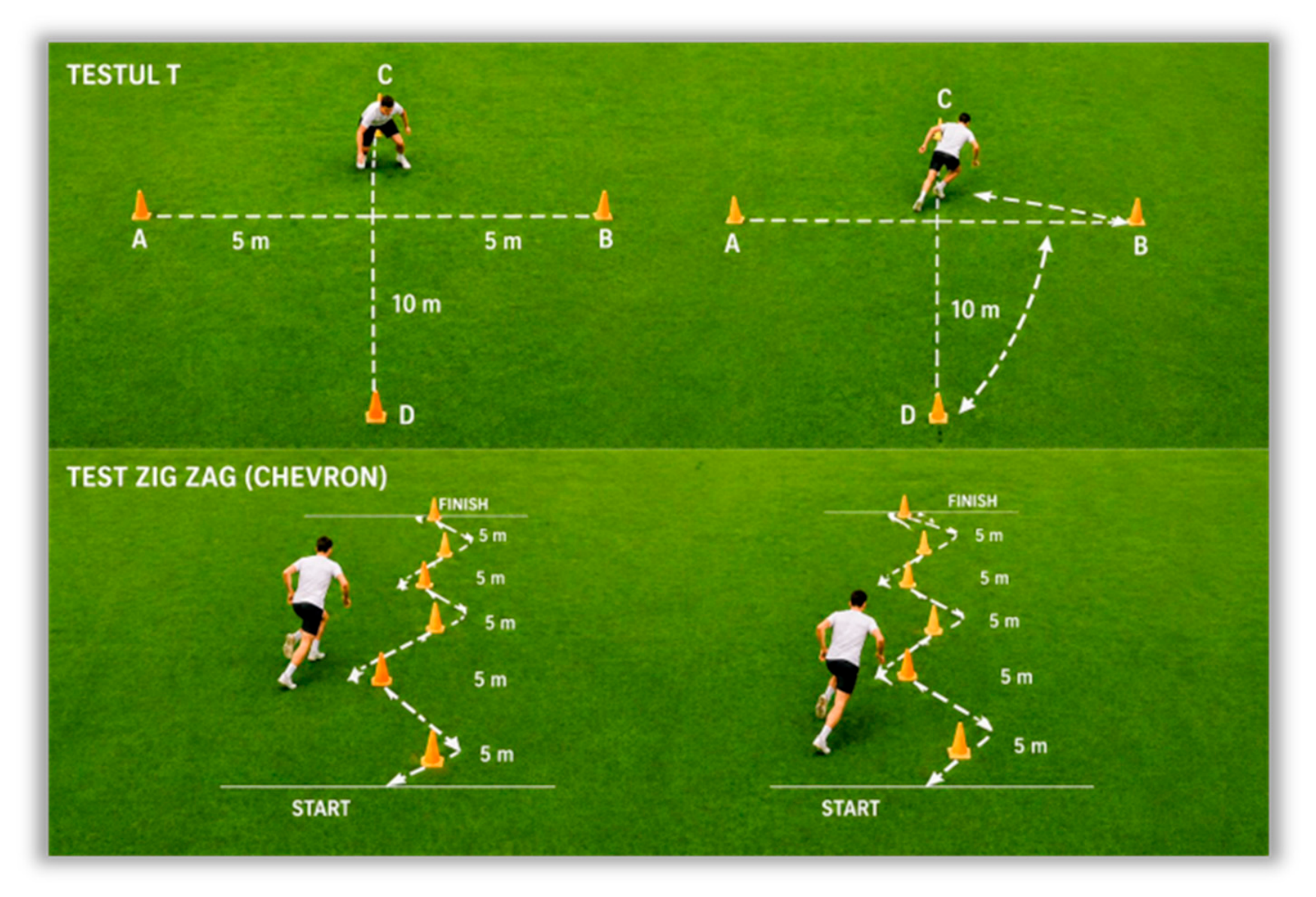
Figure 2.
Bar-On test mean scores of emotional intelligence dimensions in the traditional and Montessori groups, at T2.
Figure 2.
Bar-On test mean scores of emotional intelligence dimensions in the traditional and Montessori groups, at T2.
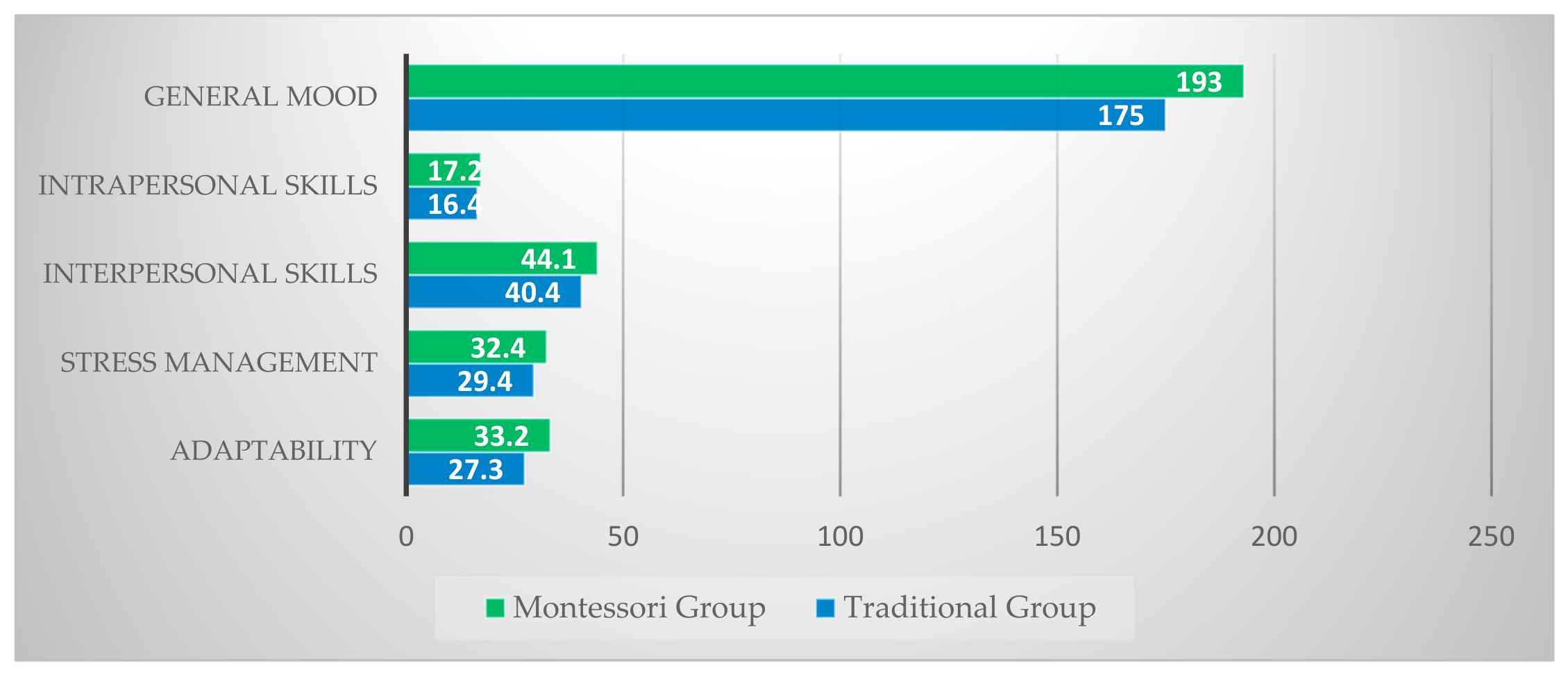
Table 1.
Applying Montessori principle for football training.
| Montessori principles | Application for football training |
|---|---|
| The environment is the “second educator.” |
The training space: adapted dimensions, small-sided games, workstations, and simple, clear rules. The player is continuously engaged in solving situations relevant to the real game. |
| The guided freedom through clear rules. | Games and tasks that provide decision-making freedom while being constrained by rules that channel desired behaviours (e.g., touch limits, goal validation conditions, tactical bonuses). |
| The error as an essential part of learning, with instructional materials designed to provide immediate feedback. | Design of constraints, where the environment itself “corrects” the player (loss of possession, inability to progress, limited time). |
| The development of an individual capable of regulating their own learning process. | Autonomy is reflected in the player’s ability to make effective decisions without constant coach intervention. |
| The coach observes, prepares the environment, and intervenes minimally. | Brief, individualized, and contextualized interventions, rather than lengthy explanations addressed to the entire group. The coach gives to the children the main orientation and encourages them to act autonomous. |
Table 2.
Intragroup Analysis of Motor Tests: Wilcoxon Test Results.
| Groups |
Wilcoxon W |
Statistic | P | Mean diffe-rence | SE df |
95% Conf. Interval |
Rank biserial correlation |
||
| Lower | Upper | Effect Size | |||||||
| T_L1 | T_L2 | 78 | 0.002 | 0.75 | 0.10 | 0.10 | 1 | 0.10 | |
| Traditional group | Zig-Zag 1 | Zig- Zag 2 |
3 | 0.009 | -0.8 | 0.12 | 0.11 | -0.91 | 0.12 |
| Sprint 1 | Sprint 2 | 42 | 0.024 | 0.3 | 0.06 | 0.056 | 0.87 | 0.06 | |
| Montessori group | T_L1 | T_L2 | 105 | 0.001 | 0.6 | 0.09 | 0.35 | 0.75 | 0.35 |
| Zig- Zag 1 |
Zig- Zag 2 |
171 | <.001 | 1 | 0.11 | 0.85 | 1.3 | 0.85 | |
| Sprint 1 | Sprint 2 | 210 | <.001 | 0.65 | 0.056 | 0.55 | 0.75 | 0.55 | |
Table 3.
Intergroup Evaluation of Motor Tests: Mann–Whitney U Test Results.
| Evaluation | Mann- Whitney U |
Mean Dif |
95% CONF INTERVAL |
Rank biserial correlation | |||
| T 2 | Tests | Statistic | P | Min | Max | Effect size | |
| Group 2 - Group 1 | T_test2 | 98.5 | 0.006 | 0.3 | 0.1 | 0.5 | 0.50 |
| Zig-Zag2 | 2 | <.001 | 1.4 | 1.2 | 1.6 | 0.99 | |
| Sprint 2 | 42.5 | <.001 | 0.6 | 0.6 | 0.8 | 0.78 | |
Table 4.
Independent Samples Mann-Whitney U for the two groups (Group 1 vs Group 2).
| Variables | Statistic | p | Mean difference |
Effect Size |
|---|---|---|---|---|
| Adaptability | 111 | 0.02 | -7 | 0.45 |
| Stress | 125 | 0.04 | -3 | 0.38 |
| Interpersonal | 120 | 0.03 | -5 | 0.40 |
| Intrapersonal | 166 | 0.35 | -1 | 0 |
| General mood | 114 | 0.02 | -21.76 | 0.43 |
Table 5.
Intergroup Analysis of Psychological Variables Assessed by the Coopersmith Self-Esteem Test.
Table 5.
Intergroup Analysis of Psychological Variables Assessed by the Coopersmith Self-Esteem Test.
| Mann-Whitney U | Rank biserial correlation | ||
|---|---|---|---|
| Variables | Statistic | p | Effect size |
| Self-perception | 89.5 | 0.003 | 0.55 |
| Social-self | 127 | 0.041 | 0.37 |
| Educational contexts (school) | 153.5 | 0.184 | 0.23 |
| Social desirability scale | 78.5 | <.001 | 0.61 |
Table 6.
Regression analysis predicting General Mood from Zig-Zag test performance.
| Model | R | R Square | Adjusted R Square | Std Error of the Estimate | Change Statistics | ||||
|---|---|---|---|---|---|---|---|---|---|
| R Square Change | F Change |
Df 1 | Df 2 | Sig. F Change | |||||
| 1 | .49a | .24 | .196 | 19.40 | .239 | 5.64 | 1 | 18 | .029 |
| a.Predictor:(Constant),Zig-Zag2 test b.Dependent Variable:General Mood | |||||||||
Disclaimer/Publisher’s Note: The statements, opinions and data contained in all publications are solely those of the individual author(s) and contributor(s) and not of MDPI and/or the editor(s). MDPI and/or the editor(s) disclaim responsibility for any injury to people or property resulting from any ideas, methods, instructions or products referred to in the content. |
© 2026 by the authors. Licensee MDPI, Basel, Switzerland. This article is an open access article distributed under the terms and conditions of the Creative Commons Attribution (CC BY) license.
Copyright: This open access article is published under a Creative Commons CC BY 4.0 license, which permit the free download, distribution, and reuse, provided that the author and preprint are cited in any reuse.