

Submitted:
13 October 2026
Posted:
13 October 2026
You are already at the latest version
Abstract
Facultative endosymbionts living within arthropod cells are known to affect several aspects their hosts’ behavior. Here we synthesize studies that measure effects of endosymbionts on arthropod behavioral traits, ranging from effects on host activity and feeding to mating and multitrophic interactions with predators and parasitoids. Our systematic review of the literature identified 70 laboratory studies that compared behavioral traits between arthropod populations where the endosymbiont was either present or absent. In a meta-analysis of 799 comparisons (639 Hedges’ g effect sizes and 160 log of odds ratios for binomial data) across different endosymbiont species and behavioral categories, we found that the presence of facultative endosymbionts tended to provide benefits to mating but costs to feeding, while for many other traits endosymbionts had no overall effect or patterns depended on the endosymbiont or host species. Measured effects of endosymbionts tended to be larger when the genetic background of the strains was not controlled. We discuss challenges with assessing effects of endosymbionts on arthropod behavior, identify avenues for future studies and highlight implications for field releases of arthropod lines carrying endosymbionts for pest and pathogen control.
Keywords:
endosymbiont
; behavior
; arthropod
; Wolbachia
; Hamiltonella
1. Introduction
Many arthropods host intracellular endosymbiotic bacteria, which are strictly dependent on their host for their survival, and these interactions can range from parasitic to mutualistic [1,2]. Facultative endosymbionts are not essential for the survival or reproduction of their host but can nevertheless influence their fitness. The most widely studied of these is Wolbachia pipientis, an endosymbiont present in many insects that can influence the reproduction of its host through different mechanisms including cytoplasmic incompatibility (CI): this is often considered a form of parasitism by the bacterium that may increase the chance of its own transmission [3,4], although interpretations are complicated by interactions with endosymbiont transmission as well as non-CI host effects [2]. At the other end of the spectrum are obligate endosymbionts that are required by their hosts to function. One notable example is the aphid obligate endosymbiont, Buchnera aphidicola, which provides essential amino acids to its host [5,6].
The applied importance of endosymbionts is becoming increasingly recognized. Endosymbionts frequently affect the susceptibility of hosts to pathogens and parasitoids [7] and in some cases may influence tolerance to chemical insecticides and biopesticides [8] which can affect control efforts. Obligate endosymbionts can also serve as potential targets in insect pest and disease management. For instance, antibiotics can be used to treat obligate Wolbachia strains within filarial nematodes that cause onchocerciasis and lymphatic filariasis [9]. Recently, virus-blocking Wolbachia strains from Drosophila and mosquitoes have been used to control Aedes mosquito populations and dengue virus transmission by relying on cytoplasmic incompatibility to spread Wolbachia through populations or reduce the fertility of the native population [10,11,12,13]. In agricultural pests, endosymbionts are also being explored as a tool to suppress the transmission of plant viruses [14,15] or reduce aphid populations by inducing fitness costs [16].
Endosymbionts can generate changes in their hosts’ life history traits, including reproductive output and lifespan [17,18]. The presence of endosymbionts can also directly or indirectly modify their host’s behavior [19,20,21,22,23]. Impacts on behavior could in part be explained by their presence in somatic tissues, leading to changes in cognitive [24,25,26,27] or sensory [28] functions. Endosymbionts may also alter the behavior of non-infected trophic-adjacent organisms, as well as non-infected potential mating partners. Effects of endosymbionts on intra- or interspecific interactions including mate choice, kin recognition, and group living [29] might be influenced by the production of bacterial organic compounds that act as semiochemicals [30].
Despite increasing interest in endosymbiont-host interactions, knowledge gaps remain, partly due to specific effects of each host-endosymbiont combination and because of the complexity of how host behavior can be affected by the endosymbiont and how these in turn interact with fitness. Modifications may provide no benefit to the host, they may be counteracted by the host, or there may be a process of evolutionary and coevolutionary changes in the host and endosymbiont that are of benefit to the host. A life history example is the wRi Wolbachia infection in Drosophila simulans where initial deleterious effects of the infection on host fecundity evolved to a fecundity advantage over 20 years [31]. Endosymbiont effects on host behavior may depend on the novelty of the infection for a host; while many arthropod species have had long-term associations with endosymbionts, others have been acquired relatively recently either through natural horizontal transmission [32] or deliberate endosymbiont transinfections, where endosymbionts are transferred into hosts that do not naturally have them [e. g. 15,33,34]. This could lead to unexpected effects on behavioral traits that are not necessarily observed in their native host as in mosquito transinfections [35].
Behavioral effects of endosymbionts might help to explain changes in the incidence of endosymbionts in natural populations generally, and the different applied contexts where endosymbionts might be used [17] may need to consider the impact of target endosymbionts on host behavior. For example, in the case of applications involving the introduction of endosymbionts into agricultural pests, endosymbiont-mediated behavioral changes may affect pest exposure to insecticides and natural enemies and/or influence patterns of host plant feeding. Similarly for approaches relying on the incompatible insect technique [e. g. 13], endosymbiont-mediated effects on mating preferences or activity could directly affect intervention success.
To understand whether there are general impacts of endosymbionts on behavior, we performed a systematic literature review of studies that test whether arthropod endosymbionts change (1) host behavior, (2) the behavior of their host’s predators or parasitoids, and (3) the behavior of the host’s potential mates. We explore patterns and effect sizes across different behavioral traits, endosymbionts and host groups. Attention was given to the methods by which endosymbiont-infected and endosymbiont free lines were generated, and whether endosymbionts were naturally occurring or generated through transinfection.
2. Materials and Methods
2.1. Systematic Literature Review
To identify studies measuring the impact of endosymbionts on arthropod behavior, we searched for papers on Web of Science on the 4th of April 2025 with the following query: "endosymbiont" OR "symbiont" OR "Wolbachia" OR "Regiella" OR "Rickettsiella" OR "Serratia" OR "Cardinium" OR "Spiroplasma" OR "Hamiltonella" OR "Rickettsia" OR "Arsenophonus" AND "behavior" OR "behaviour". We then proceeded to screen titles and abstracts using the following inclusion criteria: (1) studies involving terrestrial arthropods, (2) studies involving facultative endosymbionts, (3) studies that tested host or trophic-adjacent organisms’ behavior and (4) original research papers. We included studies in which the authors explored clearly identifiable behaviors, including choice experiments, host activity, feeding, mating, memory, oviposition preference, temperature preference and predation responses. We excluded studies that focused on (1) bacterial cell behavior, (2) non-endosymbiotic bacteria including the gut microbiome, (3) the impact of hosts on symbiont behavior, and (4) review articles. Studies were only included if they performed a direct comparison between arthropod lines with and without endosymbionts and obtained a trait value for each.
To identify studies measuring endosymbiont effects on the host’s predators or parasitoids, we searched on Web of Science on the 11th of November 2025 with the following query: "endosymbiont" OR "symbiont" OR "Wolbachia" OR "Regiella" OR "Rickettsiella" OR "Serratia" OR "Cardinium" OR "Spiroplasma" OR "Hamiltonella" OR "Rickettsia" OR "Arsenophonus" AND "behavior" OR "behaviour/behavior" AND "predation" OR "predator" OR "parasitoid" OR "natural enemy". We then screened papers that measured the behavior of trophic-adjacent organisms in the presence of an endosymbiont in their prey or host. In the case of parasitoid wasps, studies that used mummification as a measure of parasitoid preference were excluded due to the documented effect of resistance to parasitism conferred by some endosymbionts [36,37,38]. We therefore only included studies where the choice was recorded directly, or parasitized arthropods were dissected to count laid eggs.
2.2. Data Extraction
Eligible studies were screened to identify behavioral traits where an endosymbiont-infected and endosymbiont-free population were directly compared. Mean trait values, errors and sample sizes were extracted for each comparison. This process was repeated for each treatment and trait included in the study. If raw data were unavailable, we extracted summary statistics from relevant plots using ImageJ, version 1.54r [39], assuming a Gaussian distribution (with means equal to medians and one standard deviation equal to 34.1% of the values) [40]. For boxplots, standard deviation (SD) was calculated according to equation 1, while the standard error of the mean (SEM) was calculated with equation 2 [40,41,42]. With line graphs and bar charts where SEM was represented by error bars, we deduced SD from equation 2. Variance (VAR) was then calculated from SD as shown in equation 3 [43].
Equation 1. Formula used to link the measured value of boxplot height to standard deviation (SD). The interquartile range is the percentage of data captured in the box extent which was assumed to be 50 unless stated otherwise.
Equation 2. Correlation of stand deviation (SD) and standard error (SEM), where n represents the sample size.
Equation 3. Variance as a function of the standard deviation.
When graphs presented individual data points but not summary statistics, we recreated the dataset by extracting y values of each point in ImageJ and then calculated the above summary statistics with a pivot table in Microsoft Excel. The same procedure was used when the dataset was already available.
To calculate effect sizes in comparisons between endosymbiont-infected and endosymbiont-free populations, we calculated the pooled standard deviation (SDp, equation 4) and Cohen’s d (equation 5) with the formulas for two-group designs [44]. For traits with a clear fitness direction (e.g. mating preference, where higher values are expected to be associated with higher fitness), we also computed the direction of the effect, though for many of the behavioral traits this was not possible to determine.
Equation 4. Equation for pooled standard deviation, where SD1 and SD2 are the standard deviations of the endosymbiont-infected and endosymbiont-free populations, and n1 and n2 are the respective sample sizes.
Equation 5. Formula for Cohen’s d, where mean1 and mean2 are the means of the endosymbiont-infected and endosymbiont-free populations.
Cohen’s d overestimates effect sizes when replication is low [44,45]. We therefore calculated Hedges’ correction factor (J, equation 6), which generates Hedges’ g, an unbiased measure of Cohen’s d as shown in equation 7 [44].
Equation 6. Formula for the Hedges’ correction factor, n1 and n2 are the sample sizes of the compared groups.
Equation 7. Formula for Hedges’ g, where J is Hedges’ correction factor and d is Cohen’s d.
In the case of binomial data (proportions or percentages of successes), we calculated log of odds ratios instead of Cohen’s d.
Equation 8. Formula for the log of odds ratio, with probability 1 and 2 being the probability of success of the endosymbiont-infected and endosymbiont-free populations.
For each comparison, we also extracted the following information: (1) the host arthropod genus and species, (2) the endosymbiont’s genus and species (where relevant), (3) the trait being measured and its broader category (e.g. activity, mating), (4) the novelty of the endosymbiont-host association (natural infection or transinfection), and (5) information on how the infected and uninfected lines were generated (e. g. curing of a natural infection).
3. Results
Our systematic review identified 70 studies from 1998 to 2025 that fit the inclusion criteria, with the studies increasing in frequency over the last decade (Figure 1A). Despite most studies focusing on Wolbachia, we identified a total of eighteen endosymbiont combinations that were explored in these studies (Figure 1B). We calculated Hedge’s g for a total of 639 comparisons between endosymbiont-infected and endosymbiont-free hosts across 64 of the studies (Figure 2). We also calculated log of odds ratios of 160 comparisons in 14 of the studies (Figure 3).
We then assessed patterns of effect sizes across 7 main behavioral trait categories: activity, feeding, mating, memory, oviposition, predation and temperature preference (Figure 4). Host behavior was affected the most by their endosymbionts in the categories of feeding, memory, oviposition, and predation, with Hedges’ g values above 0.5 (or a medium-high effect size) (Figure 4A). Effects of endosymbionts on mating behavior were also substantial, while the behavior of hosts’ predators was affected less strongly by endosymbionts, with a low average effect size. For traits where a fitness direction could be determined (Figure 4B), endosymbionts had a negative impact on feeding and predation and a positive impact on mating, while other categories showed a neutral effect.
We then calculated overall effect sizes (Figure 5A) and fitness directions (Figure 5B) for each endosymbiont across the trait categories. The effect sizes of endosymbionts on behavioral traits varied substantially across the different endosymbiont species (Figure 5A). For combinations where there were substantial data available, overall effects tended to be neutral. One exception was Cardinium, which had overall costs to host behavioral traits but with benefits to mating behavior (Figure 5B). When considering the binary data (Figure 6), effects of endosymbionts tended to be neutral across both the different behavioral categories and endosymbiont species.
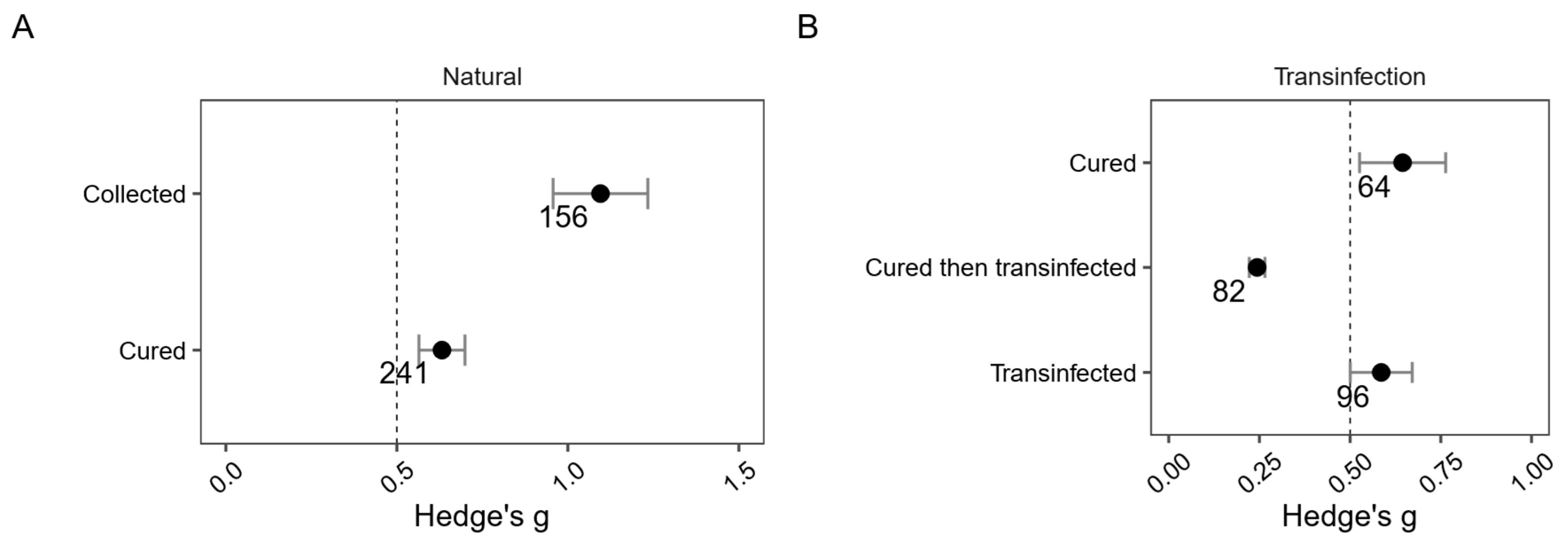
The studies identified included both naturally occurring endosymbionts as well as transinfections. For natural endosymbionts, studies used two main approaches to generate infected and uninfected populations: either curing the endosymbiont with antibiotic treatments or exploiting polymorphisms in endosymbiont frequencies to collect both naturally infected and uninfected lines. Comparisons between collected populations tended to have larger effects than comparisons involving endosymbiont curing (Figure 7A). For transinfections, studies used three different approaches: comparisons between naturally uninfected and transinfected populations, comparisons between transinfected and cured populations (where the transinfection was removed), and comparisons where populations were cured of their natural endosymbiont(s) prior to transinfection. Comparisons where the natural infection was cured prior to transinfection tended to have lower effect sizes than the other two experimental designs (Figure 7B). Overall, the effect sizes of natural endosymbionts and transinfections were similar for studies that used a comparable experimental design (Figure 7).
4. Discussion
Our meta-analysis of arthropod behavioral traits showed that effects of endosymbionts were diverse and depended on both the trait category compared and the endosymbiont species. Below we discuss these patterns and highlight some key studies.
4.1. Activity
Behaviors in this category are all to some degree linked to locomotion, which is measured by counting the number of movements, tracking movement speed and duration or distance travelled. The effect of endosymbionts on activity was inconsistent across endosymbiont and host species, with an overall neutral effect across all studies. Effects on activity have been hypothesized as driven by an endosymbiont to increase its own transmission. For instance, increased mobility as part of the exploratory behavior in Dermatocentor reticulatus (caused by Rickettsia spp.) is suggested to represent a mechanism to increase bacterial transmission [46]. On the other hand, Adamo [47] described behavioral fever as a mechanism used by the cricket Acheta domesticus to raise its body temperature by actively moving to warmer surfaces, to kill the pathogen (Rickettsiella grilly) infecting it. Effects of endosymbionts on activity may also arise because of impacts on other traits. For instance, Hamidović et al. [48] discussed increased locomotor activity in Aphis fabae caused by Serratia symbiotica as being linked to a lack of receptivity towards plant stimuli.
Reduced locomotion is generally interpreted by authors as neutral or beneficial to host fitness. A reduction in defensive behaviors displayed by the pea aphid, Acyrthosiphon pisum, infected with Hamiltonella defensa, may not reduce fitness in the presence of a parasitoid; instead infected aphids may conserve their energy by avoiding dropping, while benefitting from mummification resistance conferred by the endosymbiont [49]. The effect of Rickettsiella in reducing the variance in microhabitat selection in Myzus persicae may also link to possible muscle tropism reducing mobility, although in this case there was no direct effect on host fitness [50].
In the case of Wolbachia in Drosophila, studies point to a reduction in host activity, resulting in higher recapture rates in the field due to lower escape rates from traps [51]. Male aggression of D. melanogaster was also lowered in Wolbachia infected individuals, due to measured lower concentrations of octopamine [52]. Activity effects may not be consistent between hosts though; infected D. melanogaster had lower responsiveness towards olfactory cues [53], suggesting either tissue tropism or the interference of Wolbachia with the host’s olfaction. Drosophila simulans on the other hand showed an increase in activity, and Wolbachia increased locomotion in newly transinfected Drosophila nigrosparsa [54].
4.2. Feeding
Effects of endosymbionts on feeding in aphids varied substantially across systems but tended to be negative. Sitobion miscanthi infected with the endosymbiont SMLS spent more time probing but with fewer individual probes; the time before the first phloem ingestions was also shorter and the phloem ingestion phase was longer [55]. Similar patterns were observed in Circulifer tenellum, where Wolbachia-infected leafhoppers had a significantly longer phloem intake phase, but this was not linked to increased performance [56]. Leybourne et al. [57] showed that Rhopalosiphum padi, infected with Hamiltonella defensa, had more frequent and shorter exploratory intracellular punctures. Additionally, they spend less time salivating into the phloem but had increased phloem ingestion. These patterns did change however to some extent on a poor-quality plant.
Finally, three studies on a transinfected Wolbachia strain in Aedes aegypti report a negative effect of Wolbachia, and describe a condition called “bendy proboscis”, contributing to reduced blood-feeding success of the infected mosquitoes [58,59,60]. The strain involved (wMelPop) which is derived from D. melanogaster has other persistent negative fitness effects on this mosquito species [61].
4.3. Mating
This category is dominated by Wolbachia, which may alter the host’s chemical signature [62]. There is also evidence for mating effects in Pezothrips kellyanus infected by Cardinium, with females of this species recognizing and avoiding mating with males carrying the infection, and therefore avoiding cytoplasmic incompatibility [63,64]. On the other hand, Bagheri et al. [65] showed that female Habrobracon hebetor, infected with Wolbachia tend to choose an infected male while uninfected females had no preference, and there are also age preference effects in this species mediated by endosymbionts [66]. De Crespigny et al. [67] described an increase of male promiscuity in the presence of a Wolbachia infection in Drosophila which could also influence Wolbachia transmission, but there are questions about the consistency of this effect [68,69]. Wiwatanaratanabutr et al. [70] showed that infected Aedes albopictus males did not differentiate between infected or uninfected females, even if they were faster to mate with uninfected females. Effects of Wolbachia on mating behavior in mosquitoes are particularly important from an applied perspective because suppression programs rely on successful mating of Wolbachia-infected males to induce cytoplasmic incompatibility, and so far there is little evidence for wild females avoiding Wolbachia-infected males despite strong selection [71].
4.4. Other Traits
Selecting an ideal oviposition site can increase the chances of offspring survival. In the case of endosymbiont infections, the host may either shift its oviposition site preference to (1) increase transmission or (2) reduce it in the case of costly endosymbionts. For instance, laying eggs in warmer environments could cure an infection [47]. The studies considered here suggest (at least for parasitic wasps) that Wolbachia and also other endosymbionts affect oviposition, reducing the ability of the wasps to discriminate between different hosts or hosts of different quality [72,73,74,75]. This may increase the likelihood of symbiont transmission even if it is at the cost of host fitness.
Wolbachia has been associated with learning and memory, but the results are rather inconsistent. Three studies on Trichogramma wasps showed reduced memory retention, and lower positive response to conditioning odors when wasps carry endosymbionts [26,27,76]. This may be linked to downregulation of genes involved in memory formation after conditioning [27]. On the other hand, there is evidence of Wolbachia upregulating memory-related genes in D. melanogaster, resulting in improved memory and learning capacity [24,25]. The Trichogramma findings may reflect a general tendency of Wolbachia to interfere with discrimination of chemical cues but more direct evidence is required.
Aphid endosymbionts may protect their hosts against mummification by parasitoids [38,77] and there may be behavioral aspects to this effect although at this stage the research focus has been on identifying toxins involved [78]. Endosymbionts may also influence predation behavior, but the results are inconsistent. Depending on the endosymbiont, infected aphids can display more [79] or less [80] aggressive behaviors towards a predator; and in terms or predation rate as well, the endosymbiont changes the outcome from higher [81], neutral [82], or lower [83] rates. Additionally environmental variables such as temperature [84], and aphid position on the plant [50] may also influence the effects of endosymbionts on susceptibility to predation. For parasitoid wasps, there is both evidence of a lack of preference of an infected host, hence no direct defensive mechanism from protective endosymbionts [85], as well as parasitoid preference towards uninfected, and therefore unprotected, aphids [86].
4.5. Challenges
Experiments that measure effects of endosymbionts on behavior can be potentially influenced by other factors. For naturally occurring endosymbionts, studies often treat populations carrying the endosymbiont with antibiotics to generate an uninfected line. While this design can help to control the genetic background, removal of the endosymbiont could also have off-target effects on the host or broader microbiome affecting fitness [92]. Curing may also lead to bottlenecks or genetic drift in the compared populations, leading to genetic divergence in sexual species though not in clonal species [93]. For endosymbionts with an intermediate frequency in natural populations, studies often compare populations where the endosymbiont is naturally present or absent, but there may be underlying genetic differences between lines that can confound endosymbiont effects. This may help to explain the overall larger effect sizes in studies that compare populations derived from polymorphic situations. While studies of this type can be informative since they involve comparisons of natural populations without experimental manipulation, attributing effects to endosymbionts alone should be done with caution.
For transinfections, naturally uninfected populations can be compared to newly transinfected lines, or an uninfected line can be generated by removing the transinfection. Many studies also involved removing the native endosymbiont to introduce a novel transinfection to replace it. These designs can have similar issues to natural infections in terms of genetic bottlenecks or drift between lines, while there may also be off-target effects of the microinjection procedure itself. Backcrossing is one route to mitigate these confounding effects and is often employed in studies that compare life history traits [93], however few of the studies identified here involved backcrossing to control the genetic background of endosymbiont-infected and endosymbiont-free populations. Transinfections are also expected to have stronger effects than natural infections on life history traits [94] but we found no clear difference between natural and transinfections regarding behavioral traits.
5. Conclusions
The study of endosymbiont-driven changes in arthropod behavior is still at an early stage, with under 100 papers on the subject, which often focus on different host and endosymbiont systems. Results are often variable and, within some behavioral categories, don’t follow a clear identifiable direction. The mechanisms driving the observed changes in behavior are for the most part still unexplored. Regarding endosymbiont virulence, a recurring argument, present in many studies, is that of muscle trophism. It seems that the colonization of either nervous or muscular tissues in the host’s body can impede movement. Evidence supporting this scenario was first suggested by Min and Benzer [95] for a laboratory strain of Wolbachia, and it is something that should be explored for more endosymbionts and strains. The issue of locomotion as a confounding variable was also raised by Markov et al. [96]. Further mechanistic analyses could help differentiate between directed changes in behavior versus incidental changes with a lack of adaptive value to the host or endosymbiont.
Given that some endosymbionts have potential applications in biocontrol, biological realism relevant to field contexts is important when evaluating endosymbiont effects on behavior. and assessing the transferability of the observed changes into real world conditions. Endosymbiont effects on behavioral traits linked to dispersal ability, feeding, host preferences, and interactions with predators (defensive/evasive behaviors) or parasitoids have the potential to either enhance or counter the impact of endosymbionts as biocontrol agents. Work to date provides a solid list of behavioral effects worth exploring.
Supplementary Materials
The following supporting information can be downloaded at the website of this paper posted on Preprints.org, Table S1: Data included in the meta-analysis.
Author Contributions
Conceptualization, E.A., A.A.H. and P.A.R.; methodology, E.A., A.A.H and P.A.R.; investigation, E.A.; data curation, E.A.; writing—original draft preparation, E.A.; writing—review and editing, E.A., A.A.H. and P.A.R.; visualization, E.A.; supervision, A.A.H and P.A.R.; funding acquisition, A.A.H. All authors have read and agreed to the published version of the manuscript.
Funding
This work was undertaken as part of the Australian Grains Pest Innovation Program (AGPIP), supported through funding provided by the Grains Research and Development Corporation (UOM1905-002RTX) and the Australian Grains and Horticulture Pest Innovation Program (AGHPIP), supported through funding provided by the Grains Research and Development Corporation (UOM1906-002RTX, UOM2404-006RT), and by Hort Innovation Australia (ST23002) with additional support from the University of Melbourne and Cesar Australia. This work was made possible by the Melbourne Research Scholarship (University of Melbourne).
Institutional Review Board Statement
Not applicable.
Informed Consent Statement
Not applicable.
Data Availability Statement
All data are available in the supplementary materials.
Conflicts of Interest
The authors declare no conflicts of interest. The funders had no role in the design of the study; in the collection, analyses, or interpretation of data; in the writing of the manuscript; or in the decision to publish the results.
References
- Leung, T.L.; Poulin, R. Parasitism, commensalism, and mutualism: exploring the many shades of symbioses. Vie Milieu 2008, 107–115. [Google Scholar]
- Hoffmann, A.A.; Cooper, B.S. Describing endosymbiont-host interactions within the parasitism-mutualism continuum. Ecol. Evol. 2024, 14, e11705. [Google Scholar] [CrossRef]
- Sinkins, S.P. Wolbachia and cytoplasmic incompatibility in mosquitoes. Insect Biochem. Mol. Biol. 2004, 34, 723–729. [Google Scholar] [CrossRef]
- Werren, J.H. Biology of Wolbachia. Annu Rev. Entomol. 1997, 42, 587–609. [Google Scholar] [CrossRef]
- Brinza, L.; Vinuelas, J.; Cottret, L.; Calevro, F.; Rahbe, Y.; Febvay, G.; Duport, G.; Colella, S.; Rabatel, A.; Gautier, C.; et al. Systemic analysis of the symbiotic function of Buchnera aphidicola, the primary endosymbiont of the pea aphid Acyrthosiphon pisum. C R Biol. 2009, 332, 1034–1049. [Google Scholar] [CrossRef]
- Douglas, A.E. Nutritional interactions in insect-microbial symbioses: aphids and their symbiotic bacteria Buchnera. Annu Rev. Entomol. 1998, 43, 17–37. [Google Scholar] [CrossRef]
- Brownlie, J.C.; Johnson, K.N. Symbiont-mediated protection in insect hosts. Trends Microbiol. 2009, 17, 348–354. [Google Scholar] [CrossRef]
- Thia, J.A.; Dorai, A.P.S.; Hoffmann, A.A. Symbiotic bacteria and pest control: plant toxins, chemical pesticides, and fungal entomopathogens. Trends Microbiol. 2025, 33, 976–988. [Google Scholar] [CrossRef]
- Johnston, K.L.; Hong, W.D.; Turner, J.D.; O'Neill, P.M.; Ward, S.A.; Taylor, M.J. Anti-Wolbachia drugs for filariasis. Trends Parasitol. 2021, 37, 1068–1081. [Google Scholar] [CrossRef]
- Hoffmann, A.A.; Montgomery, B.; Popovici, J.; Iturbe-Ormaetxe, I.; Johnson, P.; Muzzi, F.; Greenfield, M.; Durkan, M.; Leong, Y.; Dong, Y. Successful establishment of Wolbachia in Aedes populations to suppress dengue transmission. Nature 2011, 476, 454–457. [Google Scholar] [CrossRef]
- Ant, T.H.; Mancini, M.V.; McNamara, C.J.; Rainey, S.M.; Sinkins, S.P. Wolbachia-Virus interactions and arbovirus control through population replacement in mosquitoes. Pathog. Glob. Health 2023, 117, 245–258. [Google Scholar] [CrossRef]
- Moretti, R.; Lim, J.T.; Ferreira, A.G.A.; Ponti, L.; Giovanetti, M.; Yi, C.J.; Tewari, P.; Cholvi, M.; Crawford, J.; Gutierrez, A.P.; et al. Exploiting Wolbachia as a tool for mosquito-borne disease control: pursuing efficacy, safety, and sustainability. Pathogens 2025, 14, 285. [Google Scholar] [CrossRef]
- Zheng, X.; Zhang, D.; Li, Y.; Yang, C.; Wu, Y.; Liang, X.; Liang, Y.; Pan, X.; Hu, L.; Sun, Q. Incompatible and sterile insect techniques combined eliminate mosquitoes. Nature 2019, 572, 56–61. [Google Scholar] [CrossRef]
- Yu, W.; Yang, Q.; Gill, A.; Chirgwin, E.; Gu, X.; Joglekar, C.; Umina, P.A.; Hoffmann, A.A. A persistent bacterial Regiella transinfection in the bird cherry-oat aphid Rhopalosiphum padi increasing host fitness and decreasing plant virus transmission. Pest Manag Sci. 2025, 81, 2791–2799. [Google Scholar] [CrossRef]
- Gong, J.-T.; Li, Y.; Li, T.-P.; Liang, Y.; Hu, L.; Zhang, D.; Zhou, C.-Y.; Yang, C.; Zhang, X.; Zha, S.-S.; et al. Stable introduction of plant-virus-inhibiting Wolbachia into planthoppers for rice protection. Curr. Biol. 2020, 30, 4837–4845.e4835. [Google Scholar] [CrossRef]
- Gu, X.; Ross, P.A.; Gill, A.; Yang, Q.; Ansermin, E.; Sharma, S.; Soleimannejad, S.; Sharma, K.; Callahan, A.; Brown, C.; et al. A rapidly spreading deleterious aphid endosymbiont that uses horizontal as well as vertical transmission. Proc. Natl. Acad. Sci. U S A 2023, 120, e2217278120. [Google Scholar] [CrossRef]
- Hoffmann, A.A.; Cooper, B.S. Changes in the frequency of facultative endosymbionts in insect populations: overview and applications. Entomol. Gen. 2025, 45, 351. [Google Scholar] [CrossRef]
- Zytynska, S.E.; Tighiouart, K.; Frago, E. Benefits and costs of hosting facultative symbionts in plant-sucking insects: A meta-analysis. Mol. Ecol. 2021, 30, 2483–2494. [Google Scholar] [CrossRef]
- Feldhaar, H. Bacterial symbionts as mediators of ecologically important traits of insect hosts. Ecol. Entomol. 2011, 36, 533–543. [Google Scholar] [CrossRef]
- Hosokawa, T.; Fukatsu, T. Relevance of microbial symbiosis to insect behavior. Curr. Opin. Insect Sci. 2020, 39, 91–100. [Google Scholar] [CrossRef]
- Lewis, Z.; Lize, A. Insect behaviour and the microbiome. Curr. Opin. Insect Sci. 2015, 9, 86–90. [Google Scholar] [CrossRef]
- Rohrscheib, C.E.; Brownlie, J.C. Microorganisms that manipulate complex animal behaviours by affecting the host’s nervous system. Springer Sci. Rev. 2013, 1, 133–140. [Google Scholar] [CrossRef]
- Weinert, L.A.; Araujo-Jnr, E.V.; Ahmed, M.Z.; Welch, J.J. The incidence of bacterial endosymbionts in terrestrial arthropods. Proceedings. Biol. Sci. R. Soc. 2015, 282, 20150249. [Google Scholar] [CrossRef]
- Bi, J.; Zheng, Y.; Wang, R.F.; Ai, H.; Haynes, P.R.; Brownlie, J.C.; Yu, X.Q.; Wang, Y.F. Wolbachia infection may improve learning and memory capacity of Drosophila by altering host gene expression through microRNA. Insect Biochem Mol. Biol. 2019, 106, 47–54. [Google Scholar] [CrossRef]
- Chen, M.Y.; Li, D.; Wang, Z.N.; Xu, F.Z.; Feng, Y.W.; Yu, Q.L.; Wang, Y.Y.; Zhang, S.; Wang, Y.F. Infection by virulent wMelPop Wolbachia improves learning and memory capacity in Drosophila melanogaster. Anim. Behav. 2024, 212, 101–112. [Google Scholar] [CrossRef]
- Kishani Farahani, H.; Ashouri, A.; Goldansaz, S.H.; Shapiro, M.S.; Pierre, J.S.; van Baaren, J. Decrease of memory retention in a parasitic wasp: an effect of host manipulation by Wolbachia? Insect Sci. 2017, 24, 569–583. [Google Scholar] [CrossRef]
- Zhou, J.C.; Zhao, X.; Huo, L.X.; Shang, D.; Dong, H.; Zhang, L.S. Wolbachia-driven memory loss in a parasitic wasp increases superparasitism to enhance horizontal transmission. mBio 2022, 13, e0236222. [Google Scholar] [CrossRef]
- Wang, Z.; Chang, Z.; Liu, Z.; Zhang, S. Influences of microbial symbionts on chemoreception of their insect hosts. Insects 2023, 14, 638. [Google Scholar] [CrossRef]
- Archie, E.A.; Theis, K.R. Animal behaviour meets microbial ecology. Anim. Behav. 2011, 82, 425–436. [Google Scholar] [CrossRef]
- Eleftherianos, I.; Zhang, W.; Mohamed, A.; Al-Akeel, R.K.; Alkhaibari, A.M.; Keyhani, N.; Smagghe, G. Microbiome-mediated chemical communication in insects: Implications for pest management. Pest Manag Sci. 2026, 82, 8132–8151. [Google Scholar] [CrossRef]
- Weeks, A.R.; Turelli, M.; Harcombe, W.R.; Reynolds, K.T.; Hoffmann, A.A. From parasite to mutualist: rapid evolution of Wolbachia in natural populations of Drosophila. PLoS Biol. 2007, 5, e114. [Google Scholar] [CrossRef]
- Turelli, M.; Cooper, B.S.; Richardson, K.M.; Ginsberg, P.S.; Peckenpaugh, B.; Antelope, C.X.; Kim, K.J.; May, M.R.; Abrieux, A.; Wilson, D.A.; et al. Rapid global spread of wRi-like Wolbachia across multiple Drosophila. Curr. Biol. 2018, 28, 963–971 e968. [Google Scholar] [CrossRef]
- Gu, X.; Ross, P.A.; Yang, Q.; Gill, A.; Umina, P.A.; Hoffmann, A.A. Influence of genetic and environmental factors on the success of endosymbiont transfers in pest aphids. Environ. Microbiol. 2024, 26, e16704. [Google Scholar] [CrossRef]
- Braig, H.R.; Guzman, H.; Tesh, R.B.; O'Neill, S.L. Replacement of the natural Wolbachia symbiont of Drosophila simulans with a mosquito counterpart. Nature 1994, 367, 453–455. [Google Scholar] [CrossRef]
- Osorio, J.; Villa-Arias, S.; Camargo, C.; Ramírez-Sánchez, L.F.; Barrientos, L.M.; Bedoya, C.; Rúa-Uribe, G.; Dorus, S.; Alfonso-Parra, C.; Avila, F.W. wMel Wolbachia alters female post-mating behaviors and physiology in the dengue vector mosquito Aedes aegypti. Commun. Biol. 2023, 6, 865. [Google Scholar] [CrossRef]
- Oliver, K.M.; Higashi, C.H. Variations on a protective theme: Hamiltonella defensa infections in aphids variably impact parasitoid success. Curr. Opin. Insect Sci. 2019, 32, 1–7. [Google Scholar] [CrossRef]
- Vorburger, C. The evolutionary ecology of symbiont-conferred resistance to parasitoids in aphids. Insect Sci. 2014, 21, 251–264. [Google Scholar] [CrossRef]
- Vorburger, C.; Gehrer, L.; Rodriguez, P. A strain of the bacterial symbiont Regiella insecticola protects aphids against parasitoids. Biol. Lett. 2010, 6, 109–111. [Google Scholar] [CrossRef]
- Schneider, C.A.; Rasband, W.S.; Eliceiri, K.W. NIH Image to ImageJ: 25 years of image analysis. Nat. Methods 2012, 9, 671–675. [Google Scholar] [CrossRef]
- Lee, D.K.; In, J.; Lee, S. Standard deviation and standard error of the mean. Korean J. Anesthesiol. 2015, 68, 220–223. [Google Scholar] [CrossRef]
- Curran-Everett, D.; Taylor, S.; Kafadar, K. Fundamental concepts in statistics: elucidation and illustration. J. Appl. Physiol. 1998, 85, 775–786. [Google Scholar] [CrossRef]
- Livingston, E.H. The mean and standard deviation: what does it all mean? J. Surg. Res. 2004, 119, 117–123. [Google Scholar] [CrossRef]
- Pfeiffer, P.E. Variance and standard deviation. In Probability for Applications; Springer, 1990; pp. 355–370. [Google Scholar]
- Goulet-Pelletier, J.C.; Cousineau, D. A review of effect sizes and their confidence intervals, Part I: The Cohen’s d family. Quant. Meth Psych. 2018, 14, 242–265. [Google Scholar] [CrossRef]
- Hedges, L.V. Distribution theory for Glass's estimator of effect size and related estimators. J. Educ. Stat. 1981, 6, 107–128. [Google Scholar] [CrossRef]
- Pipova, N.; Penazziova, K.; Banas, M.; Majlath, I.; Majlathova, V. The behavior of Rickettsia-positive Dermacentor reticulatus ticks under laboratory conditions. Life 2023, 13, 612. [Google Scholar] [CrossRef]
- Adamo, S.A. The specificity of behavioral fever in the cricket Acheta domesticus. J. Parasitol. 1998, 84, 529–533. [Google Scholar] [CrossRef]
- Hamidović, A.; Ameline, A.; Dhondt, L.; Renoz, F.; Denoirjean, T.; Hance, T. Gut symbiont Serratia symbiotica influences feeding and locomotor behavior of aphid host Aphis fabae. Arthropod-Plant Interact. 2025, 19, 87. [Google Scholar] [CrossRef]
- Dion, E.; Polin, S.E.; Simon, J.C.; Outreman, Y. Symbiont infection affects aphid defensive behaviours. Biol. Lett. 2011, 7, 743–746. [Google Scholar] [CrossRef]
- Ansermin, E.; Hoffmann, A.A.; Ross, P.A. Changes in the behavior of Myzus persicae (Hemiptera: Aphididae) in response to predators after transinfection with Rickettsiella (Legionellales: Coxiellaceae) endosymbionts. Ann. Entomol. Soc. Am. 2025, 118, 502–512. [Google Scholar] [CrossRef]
- Caragata, E.P.; Real, K.M.; Zalucki, M.P.; McGraw, E.A. Wolbachia infection increases recapture rate of field-released Drosophila melanogaster. Symbiosis 2011, 54, 55–60. [Google Scholar] [CrossRef]
- Rohrscheib, C.E.; Bondy, E.; Josh, P.; Riegler, M.; Eyles, D.; van Swinderen, B.; Weible, M.W., 2nd; Brownlie, J.C. Wolbachia Influences the production of octopamine and affects Drosophila male aggression. Appl. Environ. Microbiol. 2015, 81, 4573–4580. [Google Scholar] [CrossRef]
- Peng, Y.; Nielsen, J.E.; Cunningham, J.P.; McGraw, E.A. Wolbachia infection alters olfactory-cued locomotion in Drosophila spp. Appl. Environ. Microbiol. 2008, 74, 3943–3948. [Google Scholar] [CrossRef]
- Detcharoen, M.; Arthofer, W.; Jiggins, F.M.; Steiner, F.M.; Schlick-Steiner, B.C. Wolbachia affect behavior and possibly reproductive compatibility but not thermoresistance, fecundity, and morphology in a novel transinfected host, Drosophila nigrosparsa. Ecol. Evol. 2020, 10, 4457–4470. [Google Scholar] [CrossRef]
- Li, X.; Sun, Y.; Tian, X.; Wang, C.; Li, Q.; Li, Q.; Zhu, S.; Lan, C.; Zhang, Y.; Li, X.; et al. Sitobion miscanthi L type symbiont enhances the fitness and feeding behavior of the host grain aphid. Pest Manag Sci. 2023, 79, 1362–1371. [Google Scholar] [CrossRef]
- Angelella, G.M.; Foutz, J.J.; Galindo-Schuller, J. Wolbachia infection modifies phloem feeding behavior but not plant virus transmission by a hemipteran host. J. Insect Physiol. 2025, 160, 104746. [Google Scholar] [CrossRef]
- Leybourne, D.J.; Valentine, T.A.; Bos, J.I.B.; Karley, A.J. A fitness cost resulting from Hamiltonella defensa infection is associated with altered probing and feeding behaviour in Rhopalosiphum padi. J. Exp. Biol. 2020, 223. [Google Scholar] [CrossRef]
- Moreira, L.A.; Saig, E.; Turley, A.P.; Ribeiro, J.M.; O'Neill, S.L.; McGraw, E.A. Human probing behavior of Aedes aegypti when infected with a life-shortening strain of Wolbachia. PLoS Neglected Trop. Dis. 2009, 3, e568. [Google Scholar] [CrossRef]
- Turley, A.P.; Moreira, L.A.; O'Neill, S.L.; McGraw, E.A. Wolbachia infection reduces blood-feeding success in the dengue fever mosquito, Aedes aegypti. PLoS Neglected Trop. Dis. 2009, 3, e516. [Google Scholar] [CrossRef]
- Turley, A.P.; Smallegange, R.C.; Takken, W.; Zalucki, M.P.; O'Neill, S.L.; McGraw, E.A. Wolbachia infection does not alter attraction of the mosquito Aedes (Stegomyia) aegypti to human odours. Med. Vet. Entomol. 2014, 28, 457–460. [Google Scholar] [CrossRef]
- Ross, P.A.; Axford, J.K.; Callahan, A.G.; Richardson, K.M.; Hoffmann, A.A. Persistent deleterious effects of a deleterious Wolbachia infection. PLoS Negl. Trop. Dis. 2020, 14, e0008204. [Google Scholar] [CrossRef]
- Moreau, J.; Bertin, A.; Caubet, Y.; Rigaud, T. Sexual selection in an isopod with Wolbachia-induced sex reversal: males prefer real females. J. Evol. Biol. 2001, 14, 388–394. [Google Scholar] [CrossRef]
- Tourani, A.H.; Katlav, A.; Cook, J.M.; Hunt, J.; Karan, S.; Riegler, M. Common endosymbionts influence host sexual selection by shaping mating preferences via altered chemical communication. Evol. Lett. 2026, 10, 77–90. [Google Scholar] [CrossRef]
- Tourani, A.H.; Katlav, A.; Cook, J.M.; Riegler, M. Mating receptivity mediated by endosymbiont interactions in a haplodiploid thrips species. Proc. Biol. Sci. 2024, 291, 20241564. [Google Scholar] [CrossRef]
- Bagheri, Z.; Talebi, A.A.; Asgari, S.; Mehrabadi, M. Wolbachia induce cytoplasmic incompatibility and affect mate preference in Habrobracon hebetor to increase the chance of its transmission to the next generation. J. Invertebr. Pathol. 2019, 163, 1–7. [Google Scholar] [CrossRef]
- Amini, S.; Fathipour, Y.; Hoffmann, A.; Mehrabadi, M. Wolbachia affect female mate preference and offspring fitness in a parasitoid wasp. Pest Manag Sci. 2024, 80, 5432–5439. [Google Scholar] [CrossRef]
- de Crespigny, F.E.; Pitt, T.D.; Wedell, N. Increased male mating rate in Drosophila is associated with Wolbachia infection. J. Evol. Biol. 2006, 19, 1964–1972. [Google Scholar] [CrossRef]
- Arbuthnott, D.; Levin, T.C.; Promislow, D.E. The impacts of Wolbachia and the microbiome on mate choice in Drosophila melanogaster. J. Evol. Biol. 2016, 29, 461–468. [Google Scholar] [CrossRef]
- Champion de Crespigny, F.E.; Wedell, N. Mate preferences in Drosophila infected with Wolbachia? Behav. Ecol. Sociobiol. 2007, 61, 1229–1235. [Google Scholar] [CrossRef]
- Wiwatanaratanabutr, I.; Allan, S.; Linthicum, K.; Kittayapong, P. Strain-specific differences in mating, oviposition, and host-seeking behavior between Wolbachia-infected and uninfected Aedes albopictus. J. Am. Mosq. Control Assoc. 2010, 26, 265–273. [Google Scholar] [CrossRef]
- Li, Y.; Gong, J.T.; Liang, Y.; Hu, L.; Wei, Y.; Gan, R.; Wang, X.; Yu, J.; Tang, M.; Hoffmann, A.A.; et al. Ecological dynamics of field Aedes albopictus populations under Wolbachia-mediated suppression. Infect. Dis. Poverty 2025, 14, 96. [Google Scholar] [CrossRef]
- Abrun, P.; Ashouri, A.; Duplouy, A.; Farahani, H.K. Wolbachia impairs post-eclosion host preference in a parasitoid wasp. Naturwissenschaften 2021, 108, 13. [Google Scholar] [CrossRef]
- Kenyon, S.G.; Hunter, M.S. Manipulation of oviposition choice of the parasitoid wasp, Encarsia pergandiella, by the endosymbiotic bacterium Cardinium. J. Evol. Biol. 2007, 20, 707–716. [Google Scholar] [CrossRef]
- Kishani Farahani, H.; Ashouri, A.; Goldansaz, S.H.; Farrokhi, S.; Ainouche, A.; Baaren, J. Does Wolbachia infection affect decision-making in a parasitic wasp? Entomol. Exp. Appl. 2015, 155, 102–116. [Google Scholar] [CrossRef]
- Zchori-Fein, E.; Gottlieb, Y.; Kelly, S.E.; Brown, J.K.; Wilson, J.M.; Karr, T.L.; Hunter, M.S. A newly discovered bacterium associated with parthenogenesis and a change in host selection behavior in parasitoid wasps. Proc. Natl. Acad. Sci. U S A 2001, 98, 12555–12560. [Google Scholar] [CrossRef]
- Farahani, H.K.; Ashouri, A.; Abroon, P.; Pierre, J.S.; van Baaren, J. Wolbachia manipulate fitness benefits of olfactory associative learning in a parasitoid wasp. J. Exp. Biol. 2021, 224, 240549. [Google Scholar] [CrossRef]
- Oliver, K.M.; Russell, J.A.; Moran, N.A.; Hunter, M.S. Facultative bacterial symbionts in aphids confer resistance to parasitic wasps. Proc. Natl. Acad. Sci. U S A 2003, 100, 1803–1807. [Google Scholar] [CrossRef]
- Ayoubi, A.; Talebi, A.A.; Fathipour, Y.; Hoffmann, A.A.; Mehrabadi, M. Symbiont-mediated insect host defense against parasitism: insights from the endosymbiont, Hamiltonella defensa and the insect host, Myzus persicae. Pest Manag Sci. 2025, 81, 4886–4893. [Google Scholar] [CrossRef]
- Humphreys, R.K.; Ruxton, G.D.; Karley, A.J. Influence of Hamiltonella defensa infection and predator type on anti-predator behaviours in pea (Acyrthosiphon pisum) and potato aphids (Macrosiphum euphorbiae). Entomol. Exp. Appl. 2022, 170, 982–992. [Google Scholar] [CrossRef]
- Polin, S.; Simon, J.C.; Outreman, Y. An ecological cost associated with protective symbionts of aphids. Ecol. Evol. 2014, 4, 826–830. [Google Scholar] [CrossRef]
- Ramírez-Cáceres, G.E.; Moya-Hernández, M.G.; Quilodrán, M.; Nespolo, R.F.; Ceballos, R.; Villagra, C.A.; Ramírez, C.C. Harbouring the secondary endosymbiont Regiella insecticola increases predation risk and reproduction in the cereal aphid Sitobion avenae. J. Pest Sci. 2019, 92, 1039–1047. [Google Scholar] [CrossRef]
- Wang, Z.W.; Zhao, J.; Li, G.Y.; Hu, D.; Wang, Z.G.; Ye, C.; Wang, J.J. The endosymbiont Serratia symbiotica improves aphid fitness by disrupting the predation strategy of ladybeetle larvae. Insect Sci. 2024, 31, 1555–1568. [Google Scholar] [CrossRef]
- Polin, S.; Le Gallic, J.F.; Simon, J.C.; Tsuchida, T.; Outreman, Y. Conditional reduction of predation risk associated with a facultative symbiont in an insect. PLoS ONE 2015, 10, e0143728. [Google Scholar] [CrossRef]
- Bitsch, K.; Ross, P.A.; Gill, A.; Yang, Q.; Stelmach, M.; Callahan, A.G.; Ørsted, M.; Hoffmann, A.A.; Kristensen, T.N. Endosymbionts impact ladybird predation rates of aphids in a temperature-dependent manner. BioControl 2025, 70, 613–626. [Google Scholar] [CrossRef]
- Donald, K.J.; Clarke, H.V.; Mitchell, C.; Cornwell, R.M.; Hubbard, S.F.; Karley, A.J. Protection of pea aphids associated with coinfecting bacterial symbionts persists during superparasitism by a braconid wasp. Microb. Ecol. 2016, 71, 1–4. [Google Scholar] [CrossRef]
- Cheng, R.X.; Meng, L.; Mills, N.J.; Li, B. Host preference between symbiotic and aposymbiotic Aphis fabae, by the aphid parasitoid, Lysiphlebus ambiguus. J. Insect Sci. 2011, 11, 81. [Google Scholar] [CrossRef]
- Arnold, P.A.; Levin, S.C.; Stevanovic, A.L.; Johnson, K.N. Drosophila melanogaster infected with Wolbachia strain wMelCS prefer cooler temperatures. Ecol. Entomol. 2018. [Google Scholar] [CrossRef]
- Hague, M.T.J.; Caldwell, C.N.; Cooper, B.S. Pervasive effects of Wolbachia on host temperature preference. mBio 2020, 11. [Google Scholar] [CrossRef]
- Strunov, A.; Schoenherr, C.; Kapun, M. Wolbachia has subtle effects on thermal preference in highly inbred Drosophila melanogaster which vary with life stage and environmental conditions. Sci. Rep. 2023, 13, 13792. [Google Scholar] [CrossRef]
- Strunov, A.; Schonherr, C.; Kapun, M. Wolbachia effects on thermal preference of natural Drosophila melanogaster are influenced by host genetic background, Wolbachia type, and bacterial titer. Environ. Microbiol. 2024, 26, e16579. [Google Scholar] [CrossRef]
- Truitt, A.M.; Kapun, M.; Kaur, R.; Miller, W.J. Wolbachia modifies thermal preference in Drosophila melanogaster. Environ. Microbiol. 2018, 21, 3259–3268. [Google Scholar] [CrossRef]
- Fry, A.J.; Palmer, M.R.; Rand, D.M. Variable fitness effects of Wolbachia infection in Drosophila melanogaster. Heredity 2004, 93, 379–389. [Google Scholar] [CrossRef]
- Weeks, A.R.; Reynolds, K.T.; Hoffmann, A.A. Wolbachia dynamics and host effects: what has (and has not) been demonstrated? Trends Ecol. Evol. 2002, 17, 257–262. [Google Scholar] [CrossRef]
- Ross, P.A.; Turelli, M.; Hoffmann, A.A. Evolutionary ecology of Wolbachia releases for disease control. Annu Rev. Genet 2019, 53, 93–116. [Google Scholar] [CrossRef]
- Min, K.T.; Benzer, S. Wolbachia, normally a symbiont of Drosophila, can be virulent, causing degeneration and early death. Proc. Natl. Acad. Sci. U S A 1997, 94, 10792–10796. [Google Scholar] [CrossRef]
- Markov, A.; Lazebny, O.; Goryacheva, I.; Antipin, M.; Kulikov, A. Symbiotic bacteria affect mating choice in Drosophila melanogaster. Anim. Behav. 2009, 77, 1011–1017. [Google Scholar] [CrossRef]
Figure 1.
Number of studies published per year (A) and number of studies per endosymbiont (B) that test effects of endosymbionts on arthropod behavioral traits. Blue bars represent the count of studies per year or endosymbiont combination.
Figure 1.
Number of studies published per year (A) and number of studies per endosymbiont (B) that test effects of endosymbionts on arthropod behavioral traits. Blue bars represent the count of studies per year or endosymbiont combination.
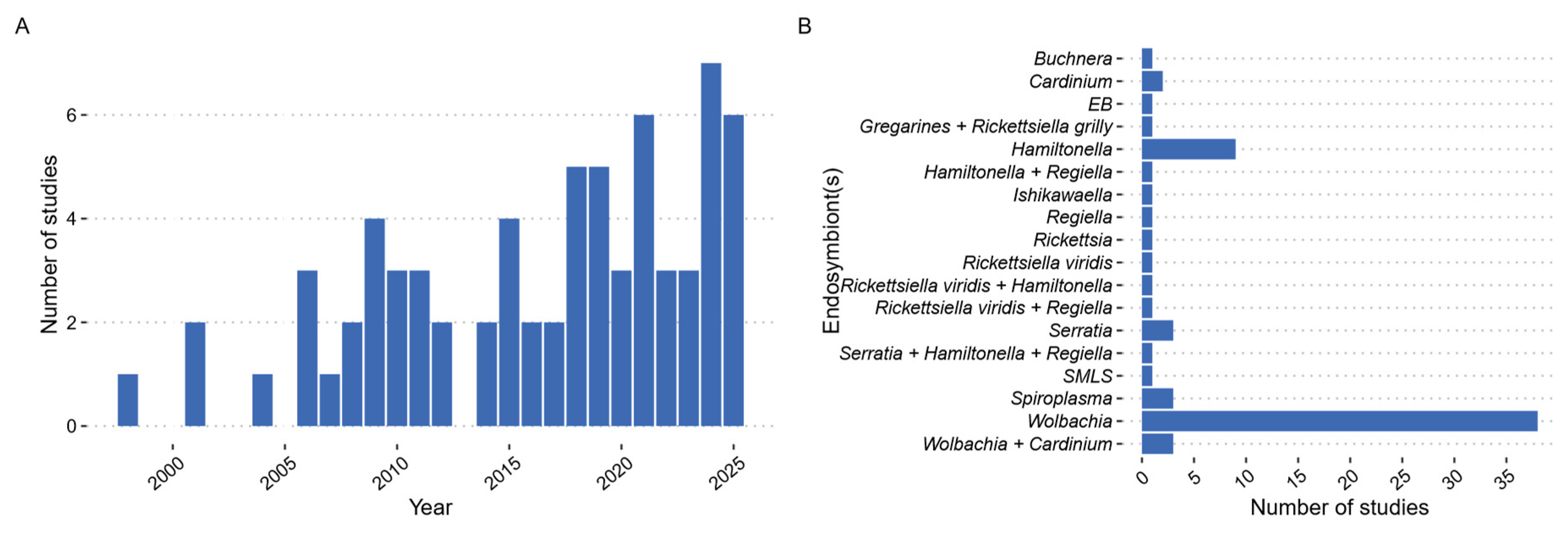
Figure 2.
Mean effect sizes (Hedges’ g) of comparisons between endosymbiont-infected and endosymbiont-free populations in each study. Each box separates the studied traits into comparisons involving (1) the behavior of a host carrying an endosymbiont, (2) mating behavior between individuals with and without endosymbionts and (3) the behavior of a predator or parasitoid interacting with a host that carries an endosymbiont. Effect sizes are shown as absolute values. The dotted vertical line at 0.5 separates medium-low effect sizes from medium-high effect sizes. Dots represent means across all comparisons in each study, and horizontal grey lines represent the standard error of the mean.
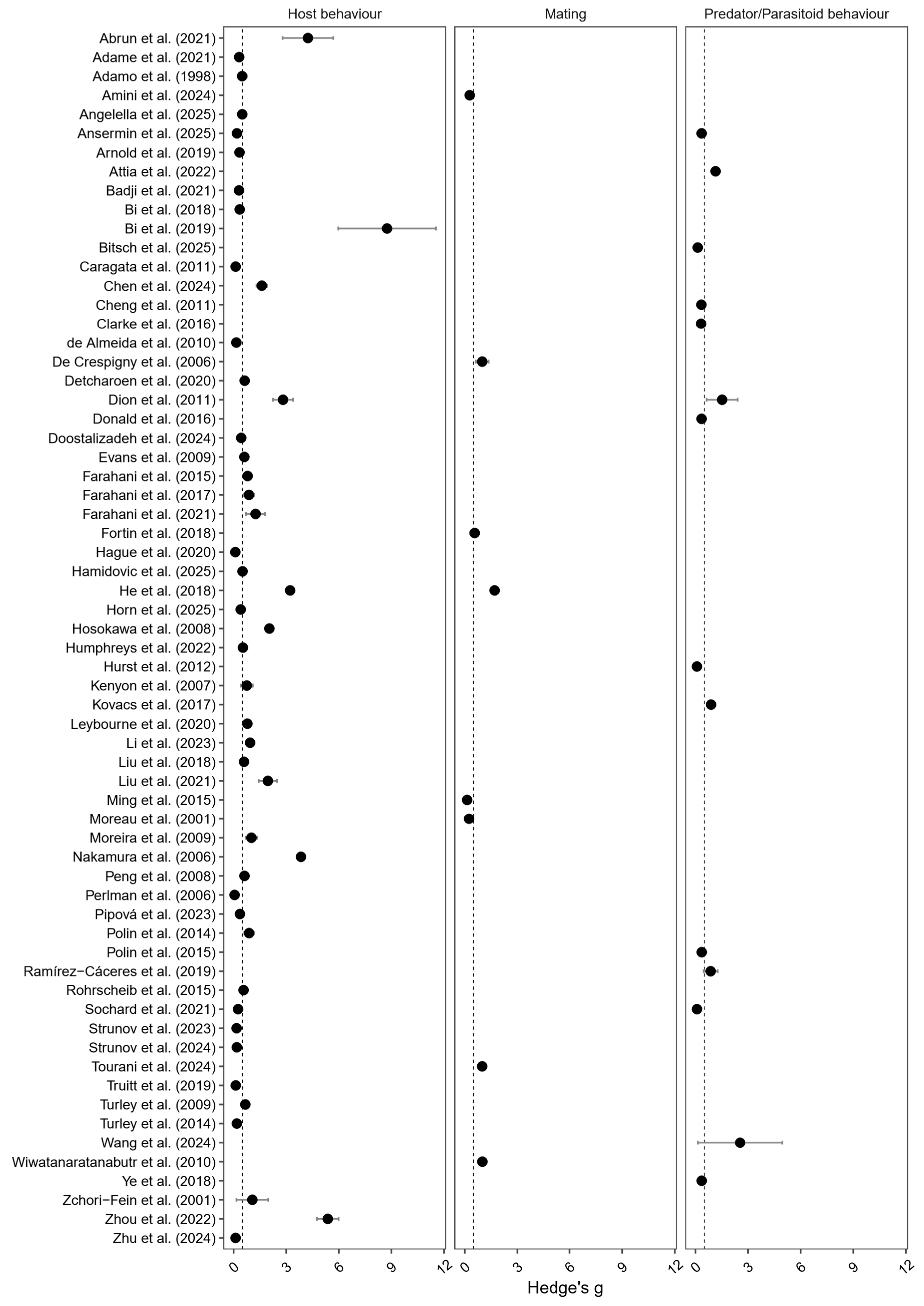
Figure 3.
Mean effect sizes (log of odds ratio) of comparisons between endosymbiont-infected and endosymbiont-free populations in each study with binary data. Each box separates the studied traits into comparisons involving (1) the behavior of a host carrying an endosymbiont, (2) mating behavior between individuals with and without endosymbionts and (3) the behavior of a predator or parasitoid interacting with a host that carries an endosymbiont. The dotted line represents a neutral effect of the endosymbiont, a value above zero indicates a benefit of the endosymbiont and a value below zero indicates a cost of the endosymbiont. Dots represent means across all comparisons in each study, and horizontal grey lines represent the standard error of the mean.
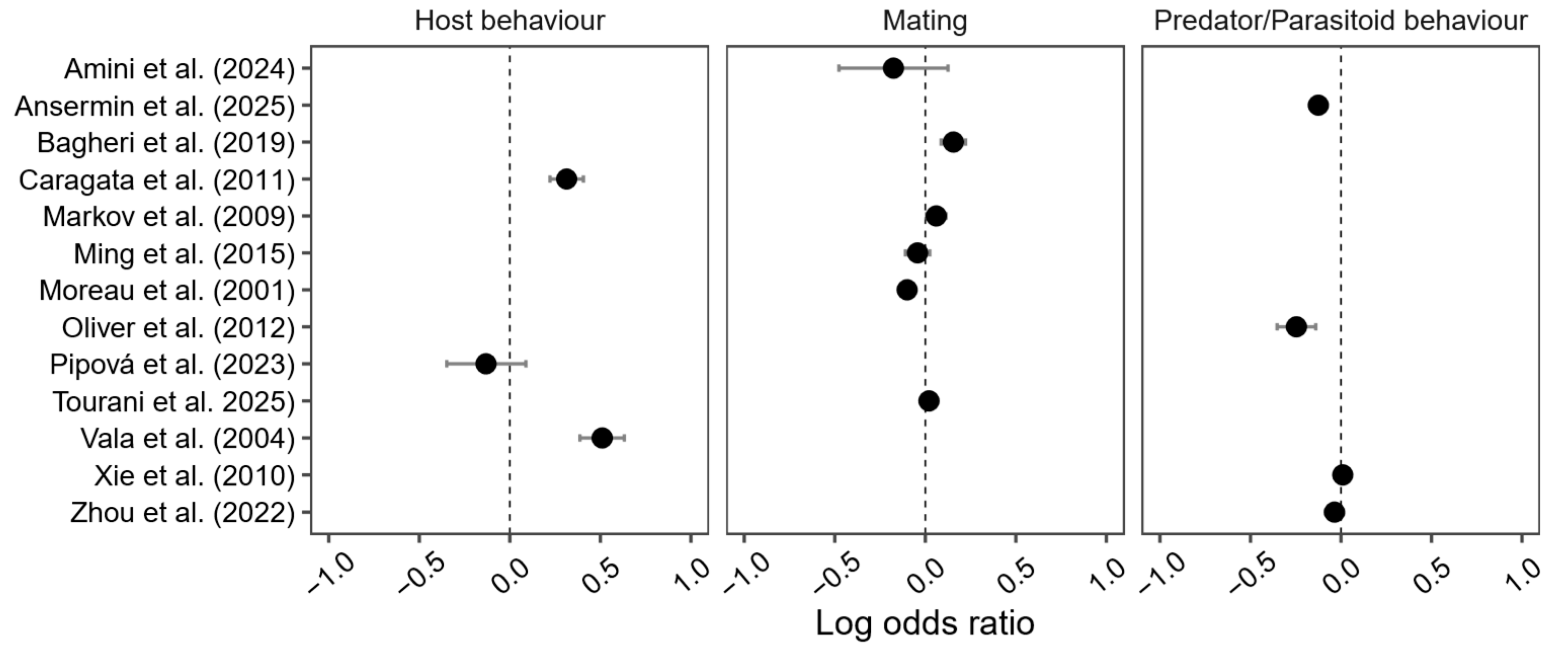
Figure 4.
Mean effect sizes (Hedges’ g) of comparisons between endosymbiont-infected and endosymbiont-free populations across behavioral categories. Each box separates the studied traits into comparisons involving (1) the behavior of a host carrying an endosymbiont, (2) mating behavior between individuals with and without endosymbionts and (3) the behavior of a predator or parasitoid interacting with a host that carries an endosymbiont. (A) Hedge’s g shown as absolute values. The dotted vertical line at 0.5 separates medium-low effect sizes from medium-high effect sizes. (B) Hedge’s g corrected for fitness direction in each behavioral category, with positive values indicating benefits of endosymbionts to fitness, negative values for costs, and the dotted vertical line at 0 indicating a neutral effect. Dots represent means across all comparisons in each category, numbers indicate the number of comparisons per category, and horizontal grey lines represent the standard error of the mean.
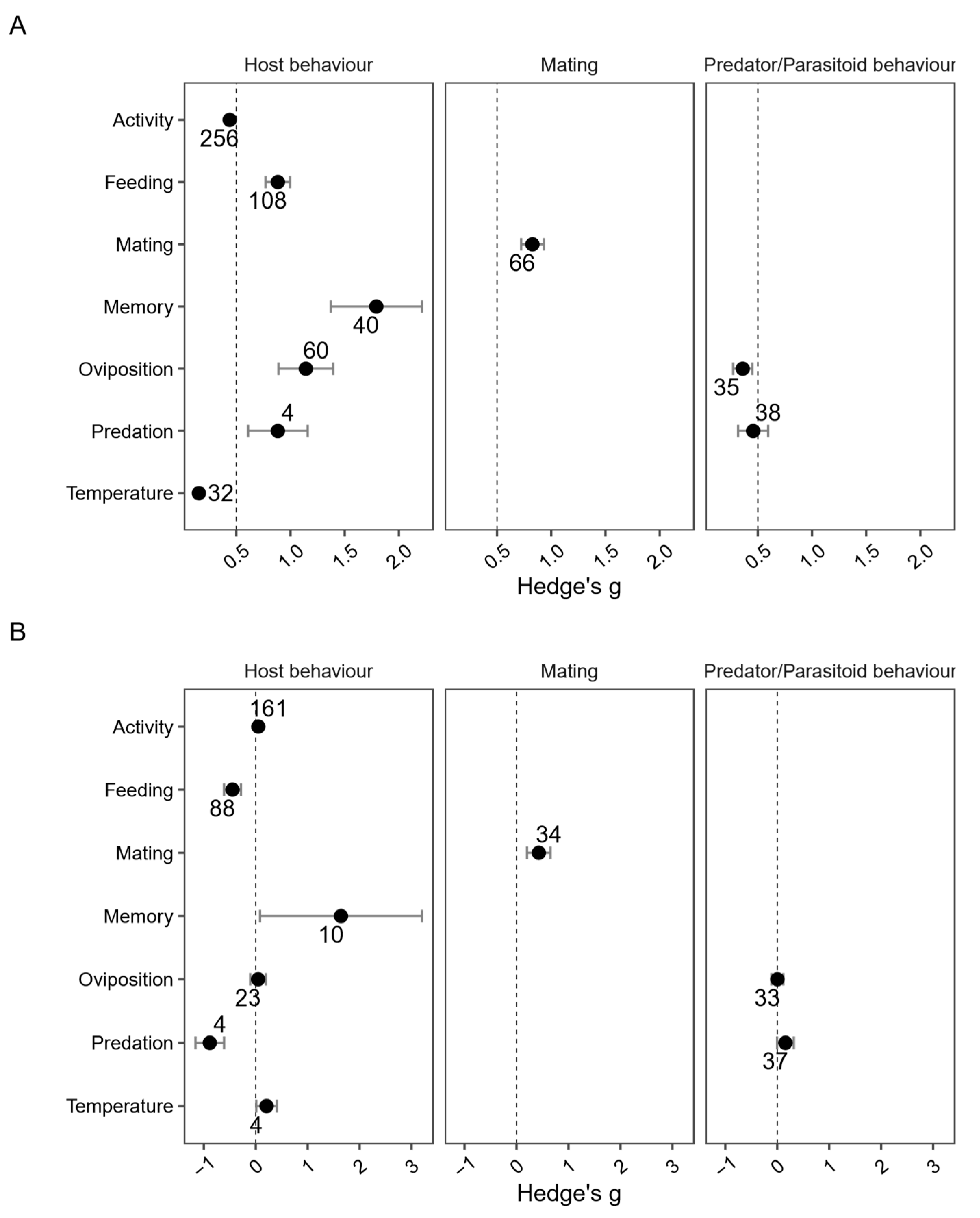
Figure 5.
Mean effect sizes (Hedges’ g) of comparisons between endosymbiont-infected and endosymbiont-free populations across different endosymbionts. Each box separates the studied traits into comparisons involving (1) the behavior of a host carrying an endosymbiont, (2) mating behavior between individuals with and without endosymbionts and (3) the behavior of a predator or parasitoid interacting with a host that carries an endosymbiont. (A) Hedges’ g shown as absolute values. The dotted vertical line at 0.5 separates medium-low effect sizes from medium-high effect sizes. (B) Hedges’ g corrected for fitness direction for each endosymbiont, with positive values indicating positive consequences of endosymbionts on fitness, negative values for negative consequences, and the dotted vertical line at 0 indicating a neutral effect. Dots represent means across all comparisons for each endosymbiont, numbers indicate the number of comparisons per endosymbiont, and horizontal grey lines represent the standard error of the mean.
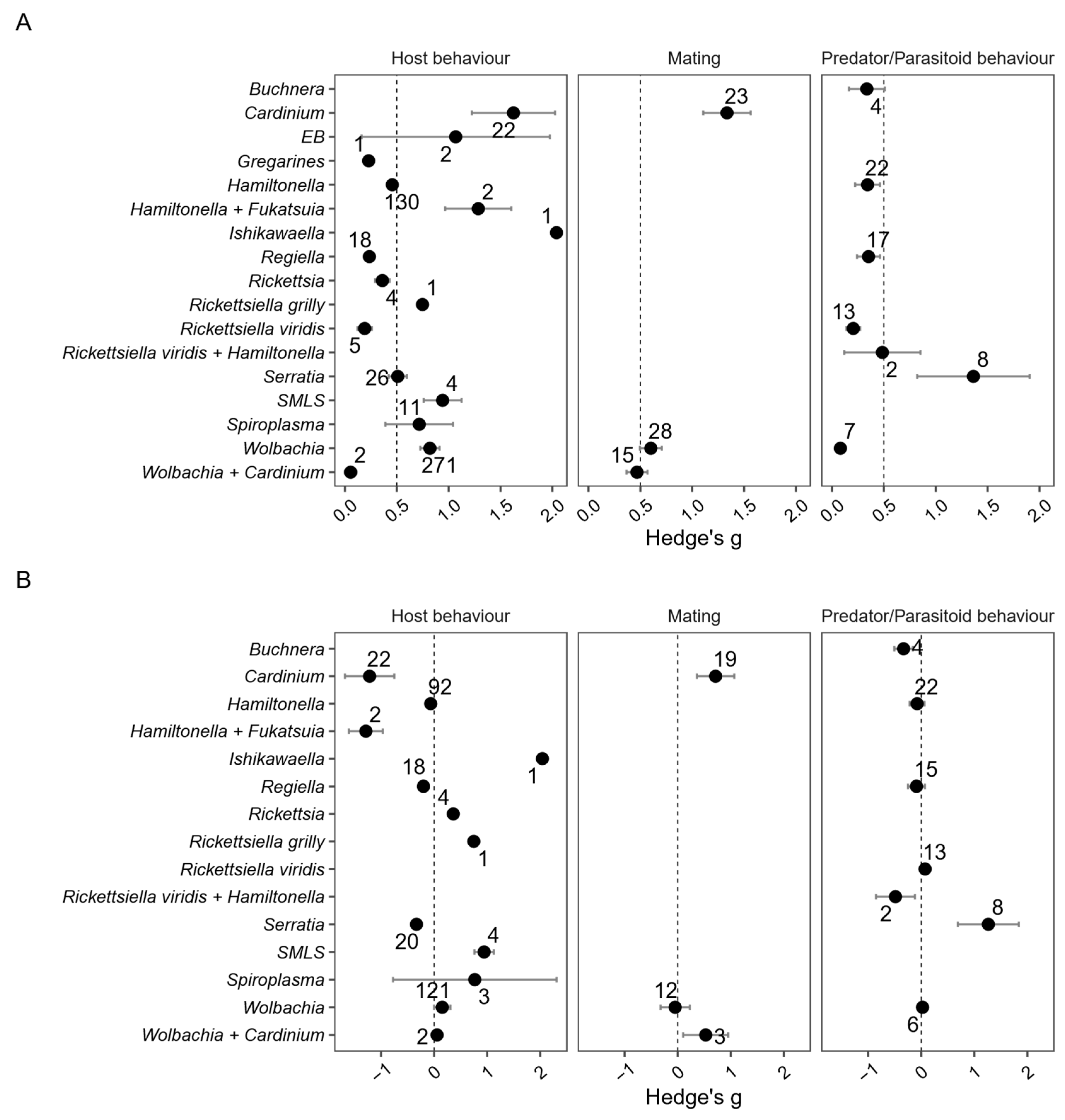
Figure 6.
Mean effect sizes (log of odds ratios) of comparisons between endosymbiont-infected and endosymbiont-free populations across different (A) behavioral categories and (B) endosymbionts. Each box separates the studied traits into comparisons involving (1) the behavior of a host carrying an endosymbiont, (2) mating behavior between individuals with and without endosymbionts and (3) the behavior of a predator or parasitoid interacting with a host that carries an endosymbiont. The dotted line represents a neutral effect of the endosymbiont, a value above zero indicates a benefit of the endosymbiont and a value below zero indicates a cost of the endosymbiont. Dots represent means across all comparisons for each trait or endosymbiont, numbers indicate the number of comparisons, and horizontal grey lines represent the standard error of the mean.
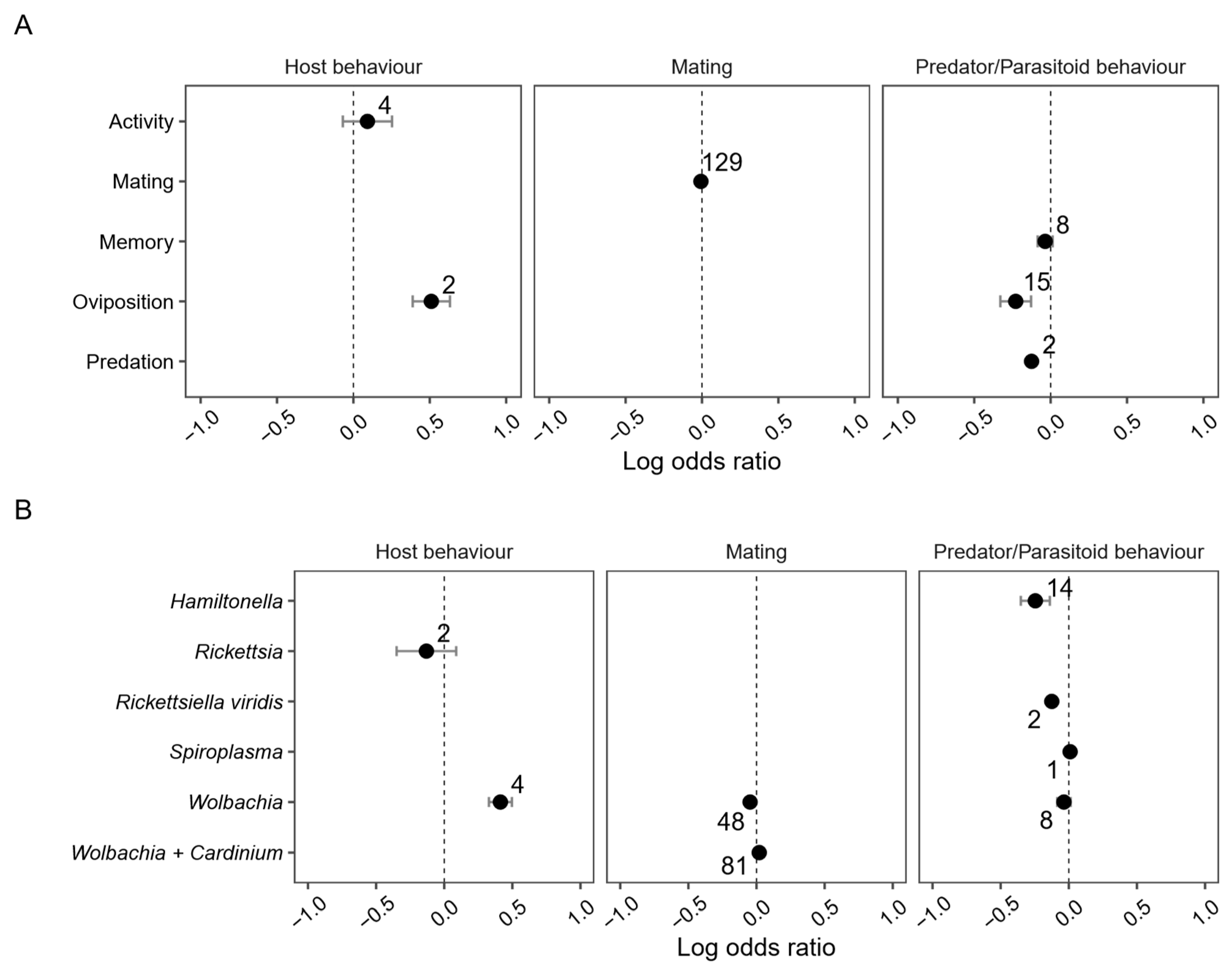
Figure 7.
Comparison of effect sizes (Hedge’s g) of endosymbionts on behavioral traits for different experimental designs involving naturally infected hosts (A) and artificially transinfected hosts (B). The dotted vertical line at 0.5 separates medium-low effect sizes from medium-high effect sizes. Dots represent means across all comparisons for each experimental design, numbers indicate the number of comparisons, and horizontal grey lines represent the standard error of the mean.
Disclaimer/Publisher’s Note: The statements, opinions and data contained in all publications are solely those of the individual author(s) and contributor(s) and not of MDPI and/or the editor(s). MDPI and/or the editor(s) disclaim responsibility for any injury to people or property resulting from any ideas, methods, instructions or products referred to in the content. |
© 2026 by the authors. Licensee MDPI, Basel, Switzerland. This article is an open access article distributed under the terms and conditions of the Creative Commons Attribution (CC BY) license (http://creativecommons.org/licenses/by/4.0/).
Copyright: This open access article is published under a Creative Commons CC BY 4.0 license, which permit the free download, distribution, and reuse, provided that the author and preprint are cited in any reuse.