

Submitted:
10 October 2026
Posted:
12 October 2026
You are already at the latest version
Abstract
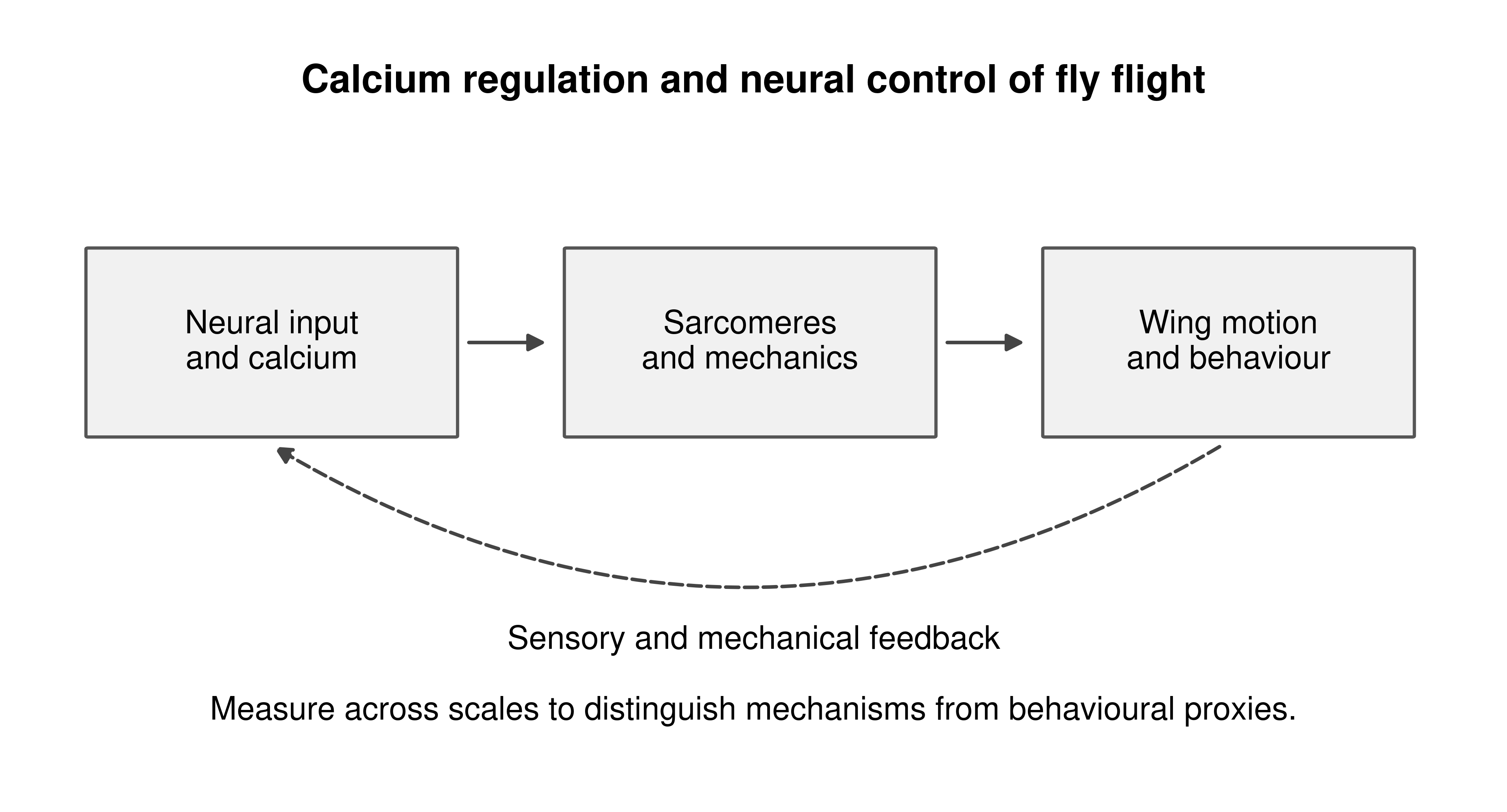
Flight in Drosophila melanogaster depends on a division of labour between asynchronous indirect flight muscles that supply power and synchronous steering muscles that modify wing motion. The indirect muscles operate through interactions between calcium-dependent activation, delayed stretch activation, sarcomere kinetics and thoracic mechanics. Their motor neurons do not command each wing stroke, but neural input can regulate the operating state of the flight motor. Understanding this system requires connecting measurements across scales: calcium signals, muscle force, wing kinematics, aerodynamic loading and behaviour. This narrative review examines the evidence for calcium-dependent power regulation and places it within the neural and mechanical organisation of flight. Published optogenetic studies illustrate how perturbing visual pathways, descending neurons or motor circuits can identify causal contributions to wing control, while also exposing the limits of interpreting a behavioural response as a direct measure of muscle function. Particular attention is given to tethered-flight arenas, open-loop and closed-loop visual stimulation, free-flight measurements and wingbeat recordings. Changes in wingbeat frequency, stroke amplitude or flight persistence can arise through several mechanisms and do not, on their own, establish changes in indirect-muscle force or power. A conceptual multiscale framework is proposed to organise these relationships and distinguish measured quantities from inferred states. An accompanying computational supplement illustrates energy-accounting and numerical checks in an imposed-strain simulated system; it is not a calibrated model of flight or evidence for calcium-dependent power generation. The central argument is that causal interpretation improves when perturbations and measurements span more than one level of the flight system.
Keywords:
Drosophila melanogaster
; indirect flight muscle
; calcium regulation
; stretch activation
; channelrhodopsin
; optogenetics
; flight arena
; wingbeat frequency
; sensorimotor control
; biomechanics
1. Introduction
Drosophila flight provides a tractable example of how molecular machinery, elastic structures and neural feedback work together to produce rapid movement. Its indirect flight muscles (IFMs) generate mechanical work at wingbeat frequencies around 200 Hz under commonly studied conditions. These frequencies are not fixed species constants: operating conditions, morphology and motor state matter. A much slower neural activation rate supports a faster mechanical cycle, making the system especially useful for separating activation from contraction timing [1,2,3,4].
The central scientific challenge is to connect measurements that describe different parts of this system. A calcium signal reports an aspect of intracellular regulation. An isolated-fibre work loop measures mechanical energy exchange under imposed conditions. A wingbeat recording describes motion or a signal correlated with motion. A flight arena measures a sensorimotor response in a specified feedback environment. These measurements are related, but they are not interchangeable.
This review focuses on that connection. It asks how calcium and stretch activation jointly regulate IFM function, how neural circuits influence the flight motor, what optogenetic perturbations can establish, and how flight measurements should be interpreted. Sarcomere structure and development are considered where they help explain adult mechanics. The purpose is a critical synthesis of published evidence that can support future studies linking physiological perturbations to flight behaviour.
2. Scope and Approach of the Review
This is a focused narrative review rather than a systematic review or meta-analysis. Its starting point was the literature cited in an existing IFM review draft. During revision, targeted searches of PubMed-indexed records, publisher pages and institutional publication repositories were used to examine calcium-dependent IFM regulation, muscle mechanics, optogenetic flight control and flight measurement. Searches combined Drosophila with terms including indirect flight muscle, calcium, stretch activation, channelrhodopsin, optogenetics, wingbeat, tethered flight, flight arena and wing hinge. References were checked against DOI registration records and publisher or indexed publication records where available. The revision incorporated literature located through 10 October 2026; this date does not imply exhaustive coverage of all publications up to that point.
Primary studies were prioritised for specific experimental claims. Reviews were used for broader physiological context. Drosophila-specific findings are distinguished from general principles established across dipterans or other asynchronous insects. A recent eLife Reviewed Preprint is identified as such rather than treated as an unqualified final journal article [21]. The synthesis is selective and may underrepresent work outside the selected topics. No pooled effect estimates or formal risk-of-bias scores were calculated.
3. The Flight Motor Separates Power Production from Steering
3.1. Indirect Muscles and Thoracic Mechanics
The dorsal longitudinal muscles (DLMs) and dorsoventral muscles (DVMs) form antagonistic power-producing groups. They drive the wings indirectly by deforming the thoracic exoskeleton. Their relative geometry couples shortening in one group to length changes in the other. The wing hinge transmits thoracic deformation to the wings, so muscle performance depends on the mechanical load and transmission as well as on intrinsic contractile properties [1,2].
The thorax is therefore an active part of the flight apparatus. Its elasticity and the inertia of the moving wings contribute to oscillation and energy exchange. Mechanical coupling can also coordinate wings and halteres, as demonstrated in fly preparations, but such comparative evidence should not be mistaken for a complete quantitative description of every Drosophila thoracic component [15]. A phenotype caused by altered muscle stiffness may reflect a changed operating point of the coupled system rather than a simple reduction in contractile force.
3.2. Synchronous Control Muscles
Smaller synchronous steering muscles act around the wing hinge. Their effects depend on which muscles are recruited and when they are activated within the wingbeat. Electrophysiological work in Drosophila linked distinct steering-muscle activities to optomotor changes in course and altitude [13]. This timing-sensitive control differs from the slower modulation of the asynchronous power muscles.
The hinge is a mechanical transmission whose output cannot be inferred from IFM activity alone. Recent work combining muscle calcium measurements, high-speed wing imaging and modelling has examined how steering-muscle activity maps onto wing-hinge mechanics [28]. This provides a direct reason to consider transmission alongside the power source: a change in wing trajectory may arise through hinge control even when the fundamental IFM mechanism remains intact.
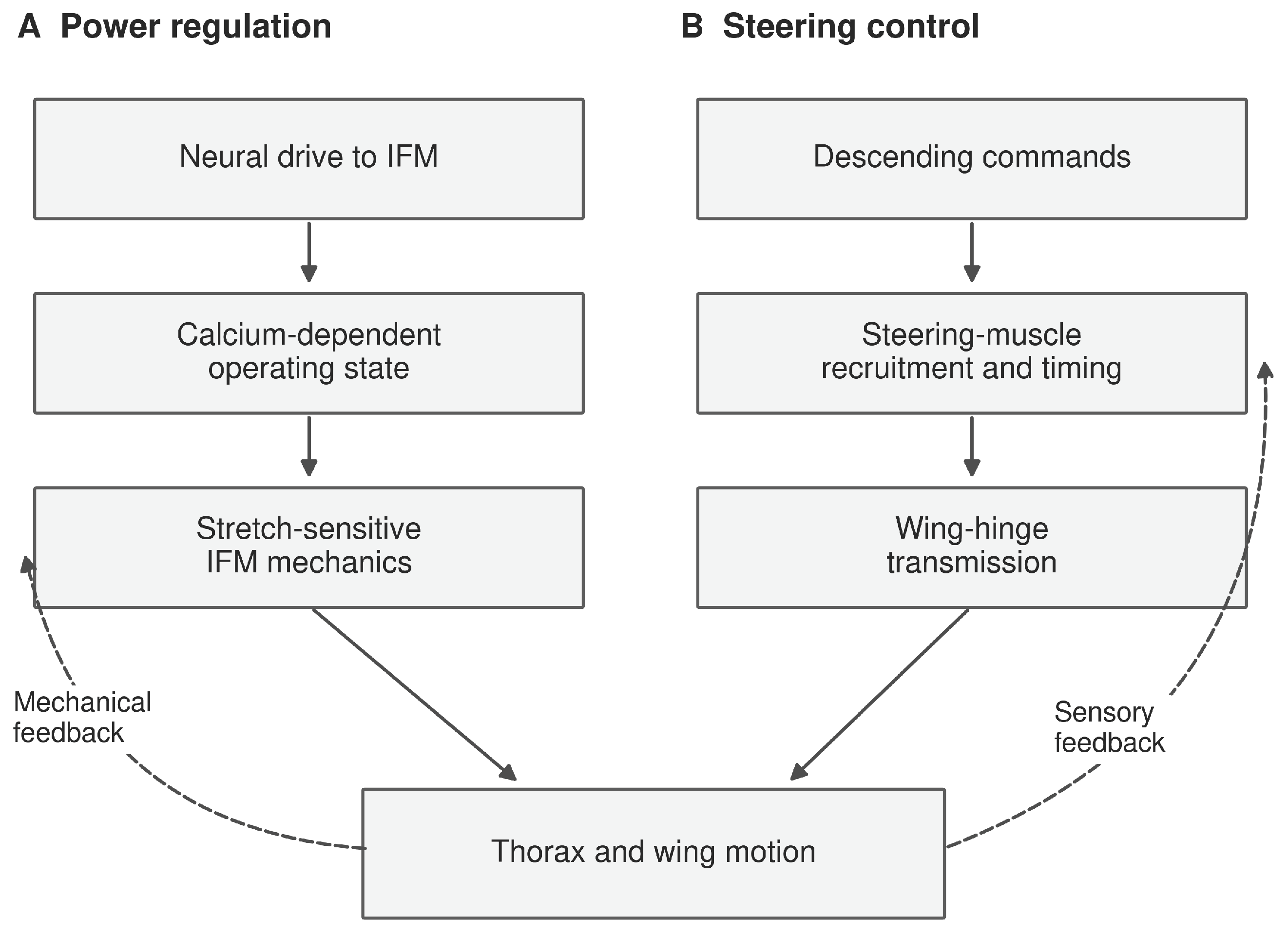
Figure 1.
Power regulation and steering act through distinct but coupled pathways. A: neural drive regulates the calcium-dependent IFM operating state, while stretch-sensitive mechanics interact with thoracic motion. B: descending commands influence steering-muscle recruitment and timing, which modify wing-hinge transmission. Dashed arrows indicate mechanical and sensory feedback. This conceptual diagram is not an anatomical reconstruction or quantitative circuit map. Sources: [1,2,3,4,5,12,13,14,15,16,28].
4. Calcium and Stretch Activation Jointly Regulate Indirect Flight Muscle
4.1. Neural Activation Does Not Specify Every Contraction
In synchronous muscle, individual excitation events are closely associated with contraction cycles. Asynchronous IFM instead maintains an activating intracellular calcium state while mechanical length changes help organise rapid force cycling. Stretch activation is the delayed force enhancement following stretch of an already activated muscle; shortening deactivation contributes to the complementary response during shortening [1,2,4]. The temporal relationship between force and length determines whether the muscle delivers or absorbs mechanical work.
Calcium should consequently not be described as a merely binary switch. Gordon and Dickinson combined recordings of IFM electrical activity and calcium-related measurements with flight observations, showing that neural activation and calcium vary with the demands placed on the flight motor [3]. Their results support modulation of power, while the estimated aerodynamic quantities remain dependent on the measurement and modelling approach used in that study.
4.2. Evidence from Isolated Fibres and Behaving Flies
Wang and colleagues directly examined calcium-dependent mechanical performance in isolated Drosophila IFM fibres. Their experiments showed that calcium changes affect oscillatory power and the stretch-activated contribution to force [4]. This evidence is particularly informative because calcium and mechanical conditions can be controlled independently in the preparation. Its interpretation nevertheless depends on fibre condition, imposed strain, temperature and the operating range examined.
Lehmann and colleagues measured bilateral calcium signals during manoeuvring in tethered flight and related these signals to changes in wing motion and estimated power balance [5]. This extends the question from mean motor activity to left–right regulation. The result should be interpreted as evidence for bilateral modulation under the tested conditions, rather than as a universal conversion from fluorescence to instantaneous force.
Together, these studies support an operating-state model: calcium changes how much force or power the muscle can produce under appropriate mechanical conditions, while stretch-sensitive dynamics help organise force relative to the oscillation. They do not establish a single invariant calcium-to-power relationship that can be applied across preparations. Calcium, strain, frequency and load must be considered together.
4.3. Molecular Specialisation and Its Interpretive Limits
The rapid kinetics of flight-muscle myosin provide part of the molecular basis for high-frequency mechanical performance [6]. Alternative myosin converter domains alter muscle power, stretch activation and kinetics, linking protein variation to operating conditions [7]. Troponin C isoform perturbations provide another entry point: the dominant IFM isoform is important for normal structure and mechanical function, but a severe structural phenotype does not by itself identify a unique molecular stretch sensor [8].
Structural proteins also shape performance. Flightin contributes to thick-filament length, integrity and bending stiffness [9]. Cryo-electron microscopy has resolved non-myosin components of the Drosophila thick-filament backbone at 4.7 Å resolution [10]. Such structural evidence constrains mechanistic hypotheses; a static reconstruction does not directly measure force, calcium sensitivity or the timing of an active work loop.
Development can change the adult operating state before a behavioural test begins. Bruno1/CELF-dependent regulation of splicing and cytoskeletal dynamics is needed for normal sarcomere assembly and maturation [11]. A flight deficit after a chronic genetic manipulation can therefore reflect developmental organisation as well as an acute physiological effect. Comparing these explanations requires evidence beyond flight ability alone.
5. Neural and Sensory Control of Wing Motion
5.1. Descending Commands and Local Timing
Flight control combines descending signals with motor circuits and mechanical feedback. The neural system can regulate overall wing output while coordinating asymmetric changes during steering. Reviews of activation precision emphasise the distinction between IFM operating-state regulation and wingbeat-phase-dependent steering-muscle activity [12].
Namiki and colleagues used optogenetic activation and functional imaging to examine the DNg02 descending-neuron population. Increasing recruitment produced changes in wingbeat amplitude over a broad range, while visual responsiveness supported a role in flight control [16]. This is evidence for a descending contribution to wing-output regulation. It does not establish that wingbeat amplitude is a direct measurement of IFM force or that the behavioural effect travels through only one motor pathway.
Flight state also feeds back to the nervous system. Cheong and colleagues identified an ascending circuit conveying flight motor state, showing that flight-related information can influence several brain networks [20]. Thus, a perturbation can change sensory processing and subsequent motor commands as well as the immediate mechanical output. A strictly one-way chain from brain to muscle is insufficient to explain the full behaviour.
5.2. Halteres and Feedback
Halteres provide rotation-sensitive and timing-related mechanosensory information. Their role is not limited to passive detection of body motion. Dickerson and colleagues showed that visual input can modulate haltere control muscles and influence the feedback that structures wing steering [14]. The haltere can therefore participate in an adjustable timing pathway.
This organisation has consequences for tethered experiments. The animal may receive visual motion without the body rotation that would normally accompany the movement. A response measured in that condition characterises the tested sensorimotor loop. Its magnitude or time course need not match the same perturbation in free flight.
6. What Optogenetic Perturbations Can Reveal
6.1. Causal Access at Different Levels
Channelrhodopsins provide a way to influence selected cells with light. Tool development has enabled spectrally distinct excitation, including red-shifted approaches widely used in Drosophila [18]. The useful causal question depends on the targeted level: visual neurons, descending neurons, premotor circuits, motor neurons and muscle fibres intervene at different points and therefore support different interpretations.
Haikala and colleagues activated horizontal-system visual neurons using a bistable channelrhodopsin variant and demonstrated optomotor responses [17]. This established a causal contribution of the targeted visual pathway to behaviour; it did not directly identify calcium-dependent IFM mechanics as the mediator. Likewise, the DNg02 experiments link a descending population to changes in wingbeat amplitude [16], whereas Ros and colleagues examined descending components that generate and regulate spontaneous flight turns [19]. These studies address related but distinct control functions.
A recent library of genetic driver lines provides access to wing-related motor and premotor cell types and includes optogenetic tests of wing kinematics [21]. It illustrates the growing ability to resolve contributions at the single-cell-type level. Its eLife Reviewed Preprint status is retained in the reference list. Anatomical specificity and behavioural effects remain separate forms of evidence: both are valuable, and neither replaces direct verification of the proposed physiological pathway.
6.2. Sufficiency Is Not the Complete Endogenous Mechanism
Artificial activation can show that a targeted population is sufficient to influence an outcome under the tested conditions. Necessity requires an appropriate loss-of-function or suppression test, and the endogenous operating pattern requires recordings or comparable evidence. Recruitment stronger or more synchronous than natural activity may expose circuit capacity without reproducing normal control.
The route from light to behaviour should therefore be explicit. Light affects the opsin, the targeted cells change activity, downstream circuits or muscles respond, and the mechanical system produces an observable outcome. If only the last stage is recorded, the intervening steps remain inferred. A wingbeat-frequency change after neural stimulation should be reported first as a change in wingbeat frequency, with any attribution to force, power or calcium identified as a hypothesis unless those quantities were measured or independently constrained.
6.3. Optical and Measurement Confounds
Light is also a sensory stimulus for the fly. Haikala and colleagues specifically considered photoreceptor activation when designing their optical intervention [17]. The general lesson is that a light-evoked response must be distinguished from an opsin-mediated response. Genetic controls and matched illumination help separate these explanations, while expression-pattern validation constrains which cells can plausibly mediate the effect.
Combining stimulation with calcium imaging creates an additional interpretive problem. Fluorescence changes can reflect calcium-dependent activity, movement, optical contamination or changes in the sampled tissue. Reporter kinetics also filter the biological signal. These are measurement-model considerations, not evidence that a particular dataset is artefactual. They should be addressed at the level of the actual instrument and reporter rather than assumed to be solved by a generic analysis step.
7. Flight Arenas and the Quantities They Measure
7.1. Tethered Flight
Tethering makes electrophysiology, imaging, optical perturbation and repeated visual stimulation accessible. It can support within-animal comparisons while reducing variation in position. However, it also constrains movement and changes feedback. Fry and colleagues compared free and tethered wing motion and documented substantial tether-associated differences in stroke pattern and the resulting aerodynamics [22]. The preparation is therefore an experimental system with its own boundary conditions.
Rigid tethering, rotationally permissive tethering and free flight should not be treated as equivalent. Their allowed body movements differ, changing the relation between motor output and sensory consequences. A report should state the relevant degrees of freedom and the actual outcome recorded, whether wing amplitude, force, torque, heading or a signal used as a proxy.
7.2. Open-Loop and Closed-Loop Visual Stimulation
In an open-loop arena, the stimulus follows a prescribed trajectory independent of the fly's response. This can make stimulus–response relationships easier to compare but does not reproduce the normal contingency between action and visual feedback. In closed loop, a measured output updates the scene. The selected output, gain, delay and mapping become part of the system under study.
A left–right wing-amplitude difference used to rotate a visual scene is a control signal within that implementation. It should not be labelled actual body yaw or calibrated aerodynamic torque unless that mapping has been established. Classical work linking wing motion to measured flight forces illustrates why independent calibration is valuable [23]. A behavioural effect can also change with feedback gain even if intrinsic muscle capacity does not, because the closed-loop operating condition has changed.
7.3. Free Flight
Free-flight recordings permit the body to respond to aerodynamic forces and allow natural combinations of translation and rotation. They are especially useful for testing whether an effect observed in a tethered preparation affects actual trajectories. Their physiological interpretation can be less direct when cell activity or muscle state cannot be recorded simultaneously.
Wing geometry and motion both matter for force generation. Robotic and kinematic studies established the importance of wing rotation and aerodynamic mechanisms beyond a single summary variable [24]. Work on unilateral wing damage further shows that flies can compensate through coordinated adjustments of wing and body kinematics [25]. An apparently normal trajectory can therefore coexist with altered internal mechanics, while an abnormal trajectory may reflect a control problem rather than an isolated power deficit.
8. Wingbeat Measurements Require an Explicit Inference Model
8.1. Frequency and Amplitude Describe Motion
Wingbeat frequency is useful for characterising flight state and its changes over time. Stroke amplitude adds information about the excursion of the wings. Together, they help constrain wing velocity, but they do not specify the full trajectory, angle of attack, stroke-plane orientation, wing geometry or aerodynamic environment [22,23,24]. A frequency shift alone cannot determine the sign or magnitude of a power change.
For a tensile muscle force F and length L, with lengthening defined as positive, external mechanical power delivered by the muscle is P_out = −F(dL/dt). The work delivered over a cycle is W_out = −∮F dL. Positive tensile force during shortening contributes positive output work; positive force during lengthening contributes negative output work. A force–length loop is therefore meaningful only when its axes, traversal direction and sign convention are defined. These statements concern mechanical work and do not measure metabolic efficiency or ATP consumption [27].
Ageing provides an empirical warning against a simple behavioural proxy. Miller and colleagues found that older Drosophila could show enhanced isolated-fibre performance despite reduced flight ability [26]. Fibre mechanics, transmission, energetics and control can diverge. The correct interpretation of a behavioural measure depends on the specific biological question and the additional evidence available.
8.2. Piezoelectric and Other Indirect Recordings
A piezoelectric recording is a signal from a sensor and its mechanical coupling to the preparation. A periodic spectral peak can support a frequency estimate when the relationship to wing motion has been validated. Signal amplitude is additionally influenced by attachment, orientation, mounting compliance, electronics and the forces transmitted to the sensor. It should not be labelled wing stroke amplitude, muscle force or power without calibration.
The same reasoning applies to optical wingbeat detectors and acoustic signals: the measured variable should be named before its biological interpretation. Independent high-speed imaging can help identify the fundamental frequency and distinguish it from harmonics or unrelated vibrations. A stronger spectral peak does not automatically mean a stronger contraction. These are general consequences of measurement coupling, rather than claims about unpublished recordings.
8.3. Persistence and Flight Failure
Flight initiation, bout duration and failure are valuable behavioural outcomes. They integrate several requirements, including circuit state, sensory feedback, motor capacity and energetic support. A perturbation that reduces persistence may affect any combination of these components. Reporting the outcome precisely preserves its value while avoiding a mechanistic conclusion that exceeds the measurement.
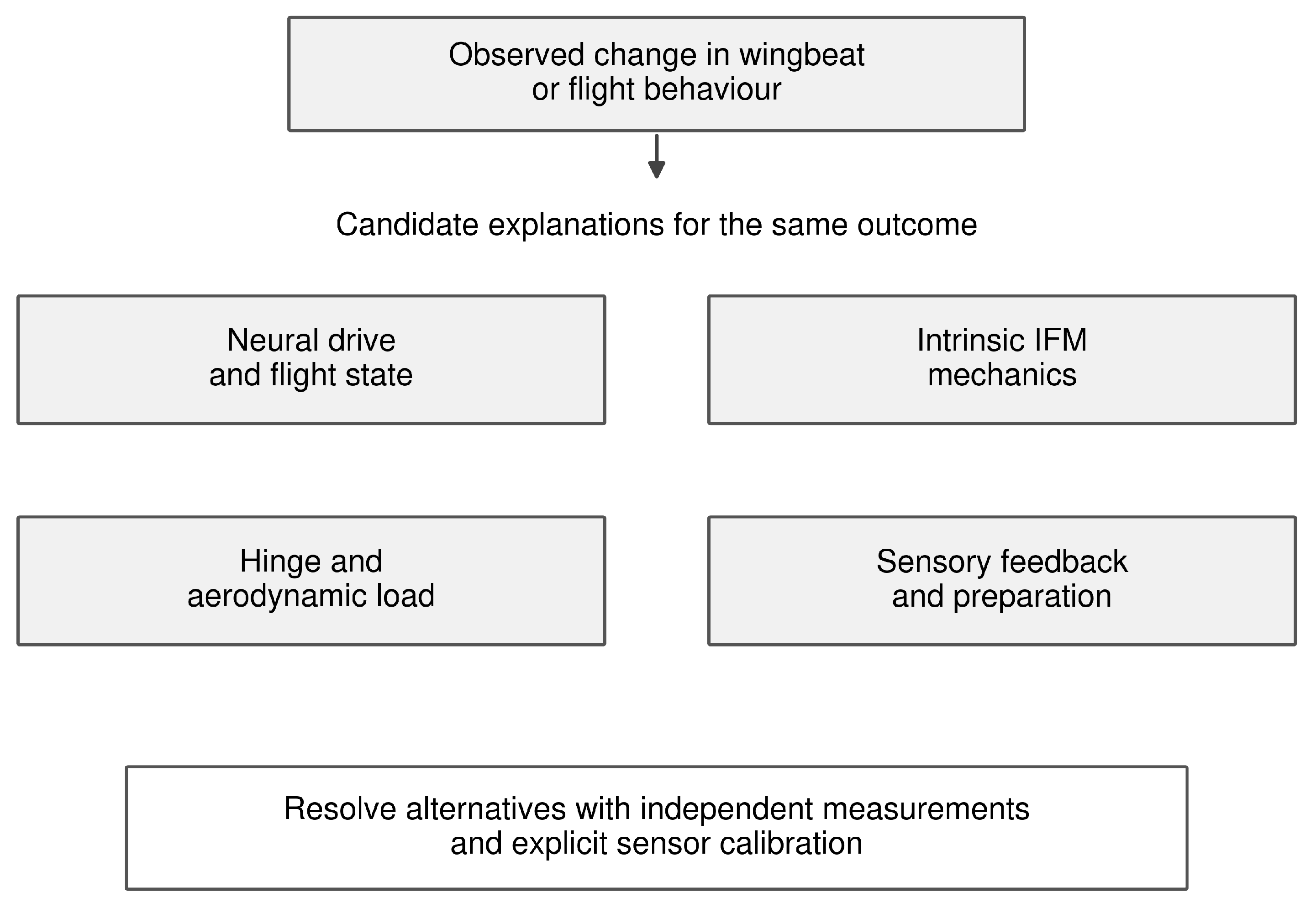
Figure 2.
Alternative explanations for changes in wingbeat or flight behaviour. Neural state, intrinsic muscle mechanics, hinge and aerodynamic load, and feedback conditions can contribute to the same observable outcome. Boxes identify candidate explanations, not a fitted causal hierarchy. Independent measurements and sensor calibration help resolve these alternatives. No experimental data are depicted. Sources: [3,4,5,16,22,23,24,25,26,27].
9. Connecting Perturbations to Mechanisms Across Scales
A stronger inference follows when a perturbation is accompanied by measurements at adjacent levels. For example, a change in muscle calcium alongside altered wing motion narrows the interpretation compared with wing motion alone, but still does not directly measure force. Isolated-fibre mechanics can establish altered intrinsic performance, while flight measurements test how that alteration is expressed within the intact system [3,4,5,27].
Evidence should also be separated by preparation. Calcium sensitivity measured in a skinned fibre is not automatically the sensitivity of fluorescence in an intact animal. Nor is aerodynamic power estimated from a model identical to measured muscle power. Each link requires an explicit transfer assumption and an uncertainty statement. Table 1 summarises useful distinctions.
The observational unit matters when comparing responses. Repeated wingbeats, frames or stimulation trials within a fly provide information about that fly; they do not create independent biological replicates. Between-fly variation and within-fly dynamics answer different questions. Reporting both prevents a technically dense recording from appearing to provide more independent biological evidence than it contains.
10. A Conceptual Framework from Sarcomere to Flight
10.1. States and Observables
A multiscale framework can organise the causal chain without claiming that a complete predictive model already exists. Its components are neural drive, intracellular calcium regulation, stretch-sensitive contractile dynamics, thoracic and hinge mechanics, wing aerodynamics and sensory feedback. Observable signals attach to specific components; latent variables such as instantaneous muscle force should remain labelled as inferred until validated (Figure 3).
For a reduced model, let x be thoracic displacement in metres. A schematic balance is m_eff ẍ + c_eff ẋ + k_eff x = Q_muscle − Q_load, where the effective parameters have consistent mechanical units and Q represents generalised forces referred to the chosen coordinate. Converting DLM and DVM tension to Q_muscle requires geometry-dependent transmission factors. Those factors cannot be replaced by a simple difference of unsigned muscle forces unless the coordinate and mechanical transformation justify that expression.
An additional state could represent calcium-dependent activation, and a separate state could represent delayed stretch-sensitive regulation. Their functional forms require empirical justification. In particular, a relaxation time is not identical to a pure time delay, and a muscle driven by imposed sinusoidal strain is not an autonomous flight oscillator. These distinctions prevent a minimal mathematical demonstration from acquiring a stronger physiological interpretation than its construction supports.
10.2. Parameter Constraints and Validation
Mechanical parameters should be associated with their source, preparation, temperature, units and uncertainty. The model should be tested against more than a single wingbeat frequency. Candidate targets include force responses to stretch, frequency-dependent fibre work, wing kinematics and responses to controlled perturbations. Multiple parameter sets may produce similar behavioural outputs, so identifiability must be assessed before attributing a fitted parameter to a molecular mechanism.
The computational supplement accompanying this review is deliberately narrower. It implements a dimensionless response to externally imposed strain, with explicit input and output work definitions and numerical checks. It contains no calcium-dependent force law, motor circuit, fitted Drosophila parameters or autonomous wing motion. Its purpose is to illustrate why a loop and a frequency-dependent response are insufficient, by themselves, to establish power generation or a biological mechanism. It is not used to support the experimental claims in this review.
11. Unresolved Questions and Research Priorities
An important unresolved question is how calcium-dependent IFM operating state and phase-dependent steering are coordinated during changing flight demands. Measurements that combine intracellular signals, wing motion and motor activity can help distinguish common neural drive from separate mechanical pathways. The published bilateral-calcium and descending-neuron studies provide complementary evidence, but they do not yet supply a universal quantitative mapping across these levels [5,16].
A second question concerns compensation. A molecular or developmental perturbation may alter intrinsic mechanics while the animal preserves a behavioural output by changing recruitment, amplitude or operating frequency. Conversely, a circuit perturbation may impair flight despite adequate fibre capacity. The ageing and wing-damage studies demonstrate why these alternatives deserve explicit consideration [25,26].
A third priority is to connect cell-type-specific perturbations to the mechanical variables they actually control. Genetic access to premotor and motor circuits is expanding [21], while wing-hinge work provides a route from muscle activity to transmission [28]. Integrating these approaches could separate changes in power supply, hinge state and feedback. Such integration should be evaluated with independent measurements rather than assumed from circuit anatomy alone.
Finally, measurement validity deserves the same attention as perturbation specificity. Fluorescence, piezoelectric signals, wing-amplitude traces and arena outputs each have a transfer function and a timescale. Shared timing, calibration and transparent reporting can make their relationships testable. The objective is not simply to collect more signals, but to identify which additional signal resolves the main alternative explanation.
12. Conclusion
Drosophila flight depends on coordinated regulation across sarcomeres, muscles, mechanical transmission and neural feedback. Calcium changes the operating state of asynchronous IFM, while stretch-sensitive dynamics organise rapid force cycling. Steering muscles and sensory pathways shape wing motion within that mechanically active system.
Published optogenetic studies provide causal access to visual, descending and motor-related pathways, but a behavioural effect does not automatically identify its muscular mediator. Flight arenas and wingbeat recordings become more informative when their measured quantities, feedback conditions and calibration limits are explicit. A multiscale framework can connect these observations while keeping measured evidence separate from proposed mechanisms. This provides a foundation for future work linking physiological perturbations to flight behaviour without relying on unpublished experimental findings.
Supplementary Materials
The following supporting information can be downloaded at the website of this paper posted on Preprints.org. Supplementary Methods S1 describes the illustrative imposed-strain calculation, its equations, parameters, numerical checks and energy convention. The accompanying archive contains executable code, regenerated CSVs, Figure S1–S2, editable main-figure files, a graphical abstract, reference-verification records and file checksums. The supplied illustrative model is an explanatory example and is not a physiological validation dataset.
Author Contributions
Taufia Hussain: conceptualisation, literature synthesis, writing of the original draft, revision, preparation of the manuscript, computational simulation and figure preparation.
Funding
This review received no specific funding.
Data and Code Availability
No new experimental data were collected for this review. The literature is identified in the reference list. The illustrative computational code, regenerated outputs and figure-generation code are supplied in the supplementary archive. These outputs are synthetic and are not measurements from flies or laboratory preparations.
Ethics Statement
This article reviews published literature and includes an illustrative computation. It reports no new experiments involving humans or animals.
Conflicts of interest
The author declares no conflicts of interest.
References
- Iwamoto, H. Structure, function and evolution of insect flight muscle. BIOPHYSICS 2011, 7, 21–28. [Google Scholar] [CrossRef] [PubMed]
- Dickinson, M.H.; Tu, M.S. The Function of Dipteran Flight Muscle. Comp. Biochem. Physiol. Part A Physiol. 1997, 116, 223–238. [Google Scholar] [CrossRef]
- Gordon, S.; Dickinson, M.H. Role of calcium in the regulation of mechanical power in insect flight. Proc. Natl. Acad. Sci. U.S.A. 2006, 103, 4311–4315. [Google Scholar] [CrossRef] [PubMed]
- Wang, Q.; Zhao, C.; Swank, D.M. Calcium and Stretch Activation Modulate Power Generation in Drosophila Flight Muscle. Biophys. Journal. 2011, 101, 2207–2213. [Google Scholar] [CrossRef] [PubMed]
- Lehmann, F.O.; Skandalis, D.A.; Berthé, R. Calcium signalling indicates bilateral power balancing in the Drosophila flight muscle during manoeuvring flight. J. R. Soc. Interface. 2013, 10, 20121050. [Google Scholar] [CrossRef] [PubMed]
- Swank, D.M.; Vishnudas, V.K.; Maughan, D.W. An exceptionally fast actomyosin reaction powers insect flight muscle. Proc. Natl. Acad. Sci. U.S.A. 2006, 103, 17543–17547. [Google Scholar] [CrossRef] [PubMed]
- Glasheen, B.M.; Ramanath, S.; Patel, M.; et al. Five Alternative Myosin Converter Domains Influence Muscle Power, Stretch Activation, and Kinetics. Biophys. Journal. 2018, 114, 1142–1152. [Google Scholar] [CrossRef] [PubMed]
- Eldred, C.C.; Katzemich, A.; Patel, M.; Bullard, B.; Swank, D.M. The roles of troponin C isoforms in the mechanical function of Drosophila indirect flight muscle. J. Muscle Res. Cell Motil. 2014, 35, 211–223. [Google Scholar] [CrossRef] [PubMed]
- Contompasis, J.L.; Nyland, L.R.; Maughan, D.W.; Vigoreaux, J.O. Flightin Is Necessary for Length Determination, Structural Integrity, and Large Bending Stiffness of Insect Flight Muscle Thick Filaments. J. Mol. Biol. 2010, 395, 340–348. [Google Scholar] [CrossRef] [PubMed]
- Abbasi Yeganeh, F.; Rastegarpouyani, H.; Li, J.; Taylor, K.A. Structure of the Drosophila melanogaster Flight Muscle Myosin Filament at 4.7 Å Resolution Reveals New Details of Non-Myosin Proteins. IJMS 2023, 24, 14936. [Google Scholar] [CrossRef] [PubMed]
- Nikonova, E.; DeCata, J.; Canela, M.; et al. Bruno 1/CELF regulates splicing and cytoskeleton dynamics to ensure correct sarcomere assembly in Drosophila flight muscles. PLoS Biol. 2024, 22, e3002575. [Google Scholar] [CrossRef] [PubMed]
- Lehmann, F.O.; Bartussek, J. Neural control and precision of flight muscle activation in Drosophila. J. Comp. Physiol. A 2017, 203, 1–14. [Google Scholar] [CrossRef] [PubMed]
- Heide, G.; Götz, K.G. Optomotor Control of Course and Altitude in Drosophila Melanogaster is Correlated With Distinct Activities of at Least Three Pairs of Flight Steering Muscles. J. Exp. Biol. 1996, 199, 1711–1726. [Google Scholar] [CrossRef] [PubMed]
- Dickerson, B.H.; de Souza, A.M.; Huda, A.; Dickinson, M.H. Flies Regulate Wing Motion via Active Control of a Dual-Function Gyroscope. Curr. Biol. 2019, 29, 3517–3524.e3. [Google Scholar] [CrossRef] [PubMed]
- Deora, T.; Singh, A.K.; Sane, S.P. Biomechanical basis of wing and haltere coordination in flies. Proc. Natl. Acad. Sci. U.S.A. 2015, 112, 1481–1486. [Google Scholar] [CrossRef] [PubMed]
- Namiki, S.; Ros, I.G.; Morrow, C.; et al. A population of descending neurons that regulates the flight motor of Drosophila. Curr. Biol. 2022, 32, 1189–1196.e6. [Google Scholar] [CrossRef] [PubMed]
- Haikala, V.; Joesch, M.; Borst, A.; Mauss, A.S. Optogenetic Control of Fly Optomotor Responses. J. Neurosci. 2013, 33, 13927–13934. [Google Scholar] [CrossRef] [PubMed]
- Klapoetke, N.C.; Murata, Y.; Kim, S.S.; et al. Independent optical excitation of distinct neural populations. Nat. Methods 2014, 11, 338–346. [Google Scholar] [CrossRef] [PubMed]
- Ros, I.G.; Omoto, J.J.; Dickinson, M.H. Descending control and regulation of spontaneous flight turns in Drosophila. Curr. Biol. 2024, 34, 531–540.e5. [Google Scholar] [CrossRef] [PubMed]
- Cheong, H.S.J.; Boone, K.N.; Bennett, M.M.; et al. Organization of an ascending circuit that conveys flight motor state in Drosophila. Curr. Biol. 2024, 34, 1059–1075.e5. [Google Scholar] [CrossRef] [PubMed]
- Ehrhardt, E.; Whitehead, S.C.; Namiki, S.; et al. Single-cell type analysis of wing premotor circuits in the ventral nerve cord of Drosophila melanogaster. eLife Rev. Prepr. 2025. Version 1 2025. [Google Scholar] [CrossRef]
- Fry, S.N.; Sayaman, R.; Dickinson, M.H. The aerodynamics of hovering flight in Drosophila. J. Exp. Biol. 2005, 208, 2303–2318. [Google Scholar] [CrossRef] [PubMed]
- Lehmann, F.O.; Dickinson, M.H. The Control of Wing Kinematics And Flight Forces In Fruit Flies (Drosophila Spp.). J. Exp. Biol. 1998, 201, 385–401. [Google Scholar] [CrossRef] [PubMed]
- Dickinson, M.H.; Lehmann, F.O.; Sane, S.P. Wing Rotation and the Aerodynamic Basis of Insect Flight. Science 1999, 284, 1954–1960. [Google Scholar] [CrossRef] [PubMed]
- Muijres, F.T.; Iwasaki, N.A.; Elzinga, M.J.; Melis, J.M.; Dickinson, M.H. Flies compensate for unilateral wing damage through modular adjustments of wing and body kinematics. Interface Focus 2017, 7, 20160103. [Google Scholar] [CrossRef] [PubMed]
- Miller, M.S.; Lekkas, P.; Braddock, J.M.; et al. Aging Enhances Indirect Flight Muscle Fiber Performance yet Decreases Flight Ability in Drosophila. Biophys. J. 2008, 95, 2391–2401. [Google Scholar] [CrossRef] [PubMed]
- Swank, D.M. Mechanical analysis of Drosophila indirect flight and jump muscles. Methods 2012, 56, 69–77. [Google Scholar] [CrossRef] [PubMed]
- Melis, J.M.; Siwanowicz, I.; Dickinson, M.H. Machine learning reveals the control mechanics of an insect wing hinge. Nature 2024, 628, 795–803. [Google Scholar] [CrossRef] [PubMed]
Figure 3.
Proposed multiscale framework and corresponding measurements. Solid arrows organise the proposed mechanical and regulatory chain; the dashed return path represents feedback. Dashed horizontal links associate states with measurements that constrain them, rather than implying a one-to-one conversion. The framework is conceptual and has not been fitted or validated as a complete flight model. Sources: [3,4,5,12,14,16,20,22,27,28].
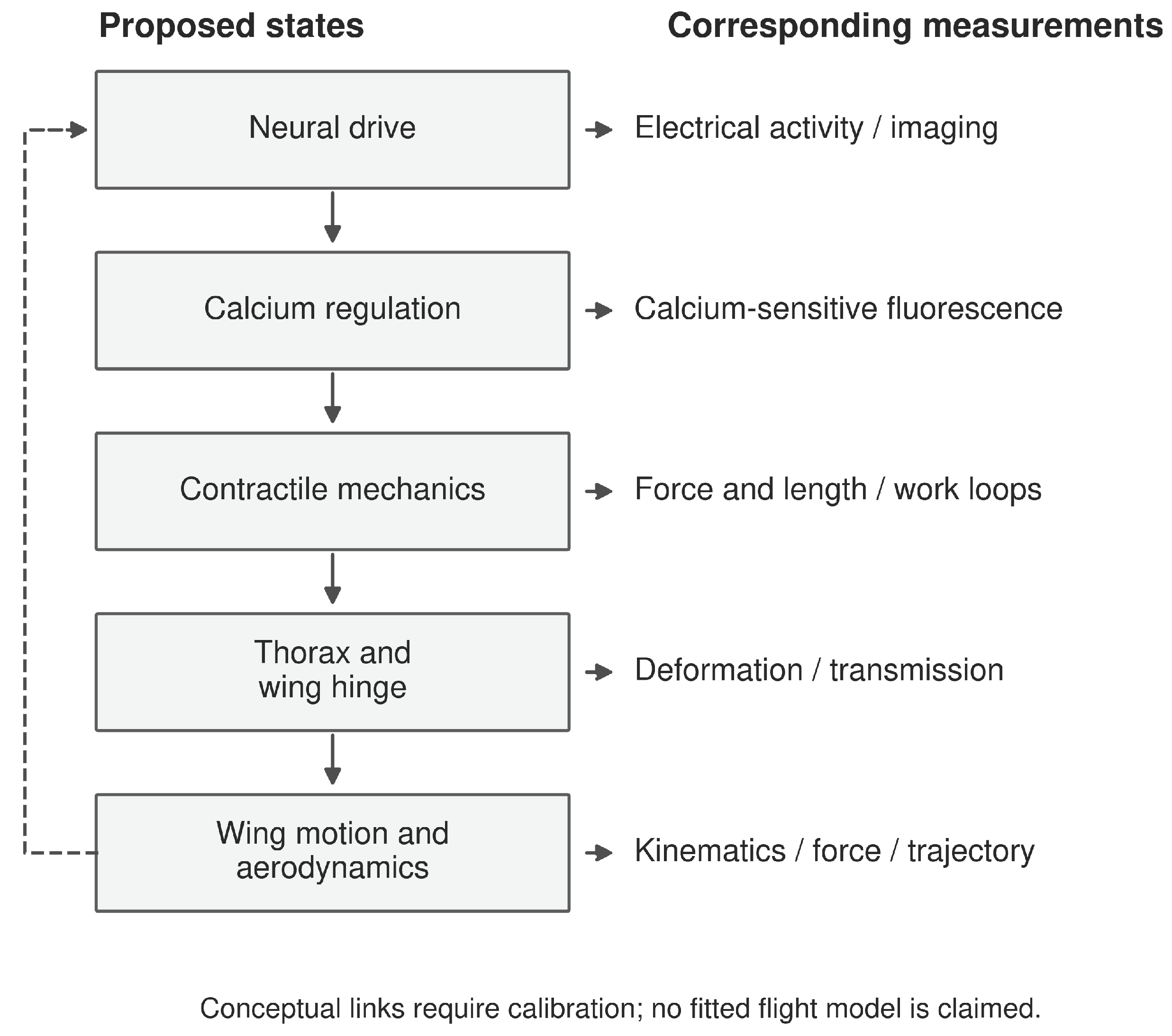

Table 1.
Measurements constrain different levels of the flight system. The limits listed are interpretive distinctions, not criticisms of the cited studies.
Table 1.
Measurements constrain different levels of the flight system. The limits listed are interpretive distinctions, not criticisms of the cited studies.
| Measurement | What it directly describes | What remains to be established |
| Calcium fluorescence | Reporter signal in the sampled cells or tissue | Calibrated calcium; force or power [3,4,5] |
| Fibre force–length loop | Mechanical energy exchange at imposed conditions | Intact-system transmission and control [4,27] |
| Wingbeat frequency and amplitude | Selected features of wing motion | Full aerodynamics; IFM force [22,23,24] |
| Arena steering response | Output within a specified feedback mapping | Actual body motion and torque calibration [13,23] |
| Free-flight trajectory | Movement of the body under flight conditions | Internal muscle and neural states [25] |
Disclaimer/Publisher’s Note: The statements, opinions and data contained in all publications are solely those of the individual author(s) and contributor(s) and not of MDPI and/or the editor(s). MDPI and/or the editor(s) disclaim responsibility for any injury to people or property resulting from any ideas, methods, instructions or products referred to in the content. |
© 2026 by the author. Licensee MDPI, Basel, Switzerland. This article is an open access article distributed under the terms and conditions of the Creative Commons Attribution (CC BY) license.
Copyright: This open access article is published under a Creative Commons CC BY 4.0 license, which permit the free download, distribution, and reuse, provided that the author and preprint are cited in any reuse.