

Submitted:
10 October 2026
Posted:
12 October 2026
You are already at the latest version
Abstract
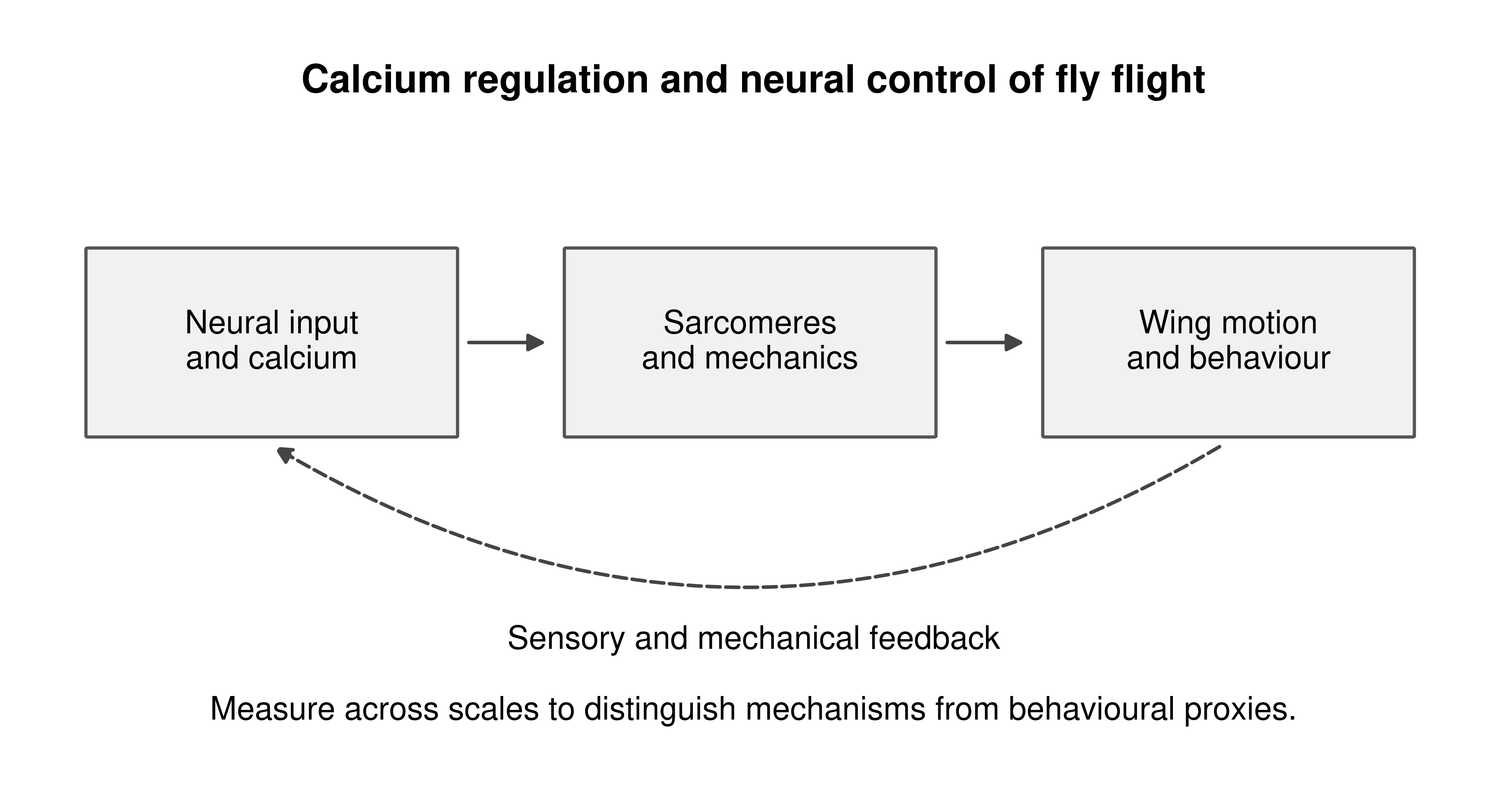
Flight in Drosophila melanogaster depends on a division of labour between asynchronous indirect flight muscles that supply power and synchronous steering muscles that modify wing motion. The indirect muscles operate through interactions between calcium-dependent activation, delayed stretch activation, sarcomere kinetics and thoracic mechanics. Their motor neurons do not command each wing stroke, but neural input can regulate the operating state of the flight motor. Understanding this system requires connecting measurements across scales: calcium signals, muscle force, wing kinematics, aerodynamic loading and behaviour. This narrative review examines the evidence for calcium-dependent power regulation and places it within the neural and mechanical organisation of flight. Published optogenetic studies illustrate how perturbing visual pathways, descending neurons or motor circuits can identify causal contributions to wing control, while also exposing the limits of interpreting a behavioural response as a direct measure of muscle function. Particular attention is given to tethered-flight arenas, open-loop and closed-loop visual stimulation, free-flight measurements and wingbeat recordings. Changes in wingbeat frequency, stroke amplitude or flight persistence can arise through several mechanisms and do not, on their own, establish changes in indirect-muscle force or power. A conceptual multiscale framework is proposed to organise these relationships and distinguish measured quantities from inferred states. An accompanying computational supplement illustrates energy-accounting and numerical checks in an imposed-strain simulated system; it is not a calibrated model of flight or evidence for calcium-dependent power generation. The central argument is that causal interpretation improves when perturbations and measurements span more than one level of the flight system.
Keywords:
Drosophila melanogaster
; indirect flight muscle
; calcium regulation
; stretch activation
; channelrhodopsin
; optogenetics
; flight arena
; wingbeat frequency
; sensorimotor control
; biomechanics
Copyright: This open access article is published under a Creative Commons CC BY 4.0 license, which permit the free download, distribution, and reuse, provided that the author and preprint are cited in any reuse.