

Submitted:
08 October 2026
Posted:
10 October 2026
You are already at the latest version
Abstract
A reduced density matrix conditioned on an internal quantum reference frame (QRF) carries, through its mixed-state quantum geometric tensor, a Fisher–Bures metric and an Uhlmann gauge field. We determine which parts of this structure are frame independent, separating passive frame changes (reparametrizations and observer-local unitaries) from active ones (a change of the internal frame itself) within the perspective-neutral framework. Under passive changes the spectrum and the eigenbundle Chern numbers are invariant for every smooth single-valued transformation, the metric and the Uhlmann holonomy only for reparametrizations and constant unitaries. Under an active change between ideal frames the observer’s marginal obeys an exact shifted-overlap law for every relational state; its charge distribution is frame invariant, which gives the entanglement plus-coherence invariant of Cepollaro et al. in closed form. For a product relative state the law reduces to a partial twirl (relativization), under which the metric can only contract. For a two level observer the geometry is then graded by one inter-frame coherence |κ|: the Bures area is π|κ|, the Chern numbers survive for every |κ| > 0, and the equatorial Uhlmann Z2 holonomy only for |κ| > √3/2, the known thermal critical point reached here by coherence instead of temperature. For bounded generators the observer’s definability is itself frame relative.
Keywords:
quantum reference frames
; Uhlmann holonomy
; mixed-state quantum geometric tensor
; Chern numbers
; reference-frame decoherence
; emergent geometry
1. Introduction
Reference frames are physical quantum systems [1], and treating them as such has become an operational calculus [2,3,4,5,6] with a perspective-neutral formulation in which the change between two internal frames is a unitary on the reduced physical Hilbert space [7,8,9]. A structural lesson of this programme is that the decomposition of a constrained universe into subsystems is itself frame dependent, and that quantities as basic as correlations, entropy, and thermodynamics are frame relative [9,10,11]; entanglement and coherence, in particular, are traded against each other under a frame change with an invariant sum [12].
Independently, the geometry of mixed states has become a working tool of quantum information: the Bures metric and the quantum Fisher information [13,14,15,16], the Uhlmann connection and its holonomy [17,18,19], the Uhlmann phase as a topological measure for density matrices with its finite-temperature transitions [20,21,22], and interferometric protocols to measure it [23]. The two subjects meet whenever geometric or gauge structure is read off a reduced density matrix. This is done whenever a mixed-state geometric phase is assigned to a subsystem whose description is conditioned on a frame and, more ambitiously, by proposals in which spacetime geometry is reconstructed from the entanglement of reduced states [24,25,26,27,28,29]. Whatever is read off a conditioned reduced density matrix carries an implicit frame label, and the question of what survives a frame change—what is objective—is sharp and, as we show, quantitative.
The object studied here is the mixed-state quantum geometric tensor (msQGT) of a QRF-conditioned reduced state : its real part is the Fisher–Bures metric and its imaginary sector the Uhlmann curvature, whose holonomy plays the role of a gauge field. The QRF literature attaches no such information-geometric structure to the reduced state. Once it is attached, one can ask how each layer of it—spectrum, metric, connection, holonomy, topological charge—transforms when the internal frame is changed, and the answer turns out to be layered and quantitative rather than a single yes or no.
The central observation is that “frame change” covers two operations that behave very differently. A passive change alters the description of the observer without altering the partition of the universe: a reparametrization of the relational coordinates, or an observer-local unitary such as a change of clock gauge or of relational picture. Under these the observer’s state is conjugated and the transformation laws are the familiar ones. An active change replaces the internal frame by another physical system. It is a unitary on the reduced physical Hilbert space, but that unitary is generically entangling, so the observer’s marginal is not conjugated at all: entanglement and coherence are redistributed [2,12], the spectrum changes, and the geometric content read from the marginal changes with it. We show that for ideal frames the observer’s marginal in the new frame is an exact shifted-overlap transform of the relational state, with a frame-invariant charge distribution. For a product relative state this reduces to a partial twirl weighted by the distribution of the relative orientation of the two frames—the relativization of Refs. [1,5]—and we use that channel to grade every layer of the msQGT by the inter-frame coherence: a single number for a two-level observer, the characteristic function of the relative-orientation distribution in general.
Contributions.
- 1.
- Passive covariance (Proposition 1). Under reparametrizations and constant observer-local unitaries every layer of the msQGT is invariant or tensorial. Under x-dependent observer-local unitaries (clock gauge, relational picture) only the spectrum and the eigenbundle Chern numbers survive; the metric and the Uhlmann holonomy do not, which is verified numerically. A multivalued (Dirac-string) clock gauge of relative winding k shifts the spin- monopole charge by k.
- 2.
- An exact law for active frame changes (Theorem 1, Corollary 1, Proposition 2). In the exactly solvable -charge model with ideal frames, the observer’s marginal after a change of frame is a shifted-overlap transform of the relational state, valid for non-product states, and its charge distribution is frame invariant; the entanglement-plus-coherence invariant of Ref. [12] follows in closed form as the Shannon entropy of that distribution. For a product relative state the law reduces to the Schur product with the characteristic function of the phase distribution of the new frame relative to the old, equivalently a partial twirl; for a compact group the same derivation gives a partial twirl by the relative-orientation distribution, with the depolarizing channel as the instance.
- 3.
- Coherence thresholds (Theorem 2, Propositions 3 and 4). Under the twirl the metric can only contract. For the canonical monopole family the second frame sees Bures area instead of , the same Chern numbers for every , and, on the equator, the Uhlmann phase only for , which is the thermal critical point of Refs. [20,30] with the inter-frame coherence in the role of the thermal Bloch radius ; off the equator the Uhlmann phase is a continuous function of given in closed form. At the degeneracy locus becomes a circle and the eigenbundle over the sphere is undefined. A Weyl-type bound gives a general sufficient condition for Chern-number invariance under any frame-induced channel. A three-level (spin-1) observer is checked as well.
- 4.
- Signature (Remark 6). The msQGT metric is positive semidefinite, and along Page–Wootters relational time it equals a quarter of the quantum Fisher information for time estimation. No Lorentzian signature arises from the msQGT alone.
- 5.
Framing.
The thesis is descriptive and quantitative: it sorts the geometric structure carried by a conditioned state into layers and attaches to each the class of frame changes, and the amount of inter-frame coherence, under which it is preserved. We deliberately avoid deterministic language: the claim is not that information geometry “forces” any gauge structure, but that whatever gauge and geometric content is read from has a well-defined, graded covariance under change of internal observer. All numerical work is verification of derived statements, with grids, step counts, and residuals documented in Appendix A.
2. Setting and Methods
2.1. Perspective-Neutral Quantum Reference Frames
We work throughout with the perspective-neutral formulation [7,8,9]: a kinematical Hilbert space , a constraint with self-adjoint on , and physical states satisfying (for a compact or finite symmetry group, invariance under the group action). Choosing subsystem k as internal frame and conditioning on its orientation defines the reduction map (the Page–Wootters relational Schrödinger map [31] or its Heisenberg trivialization). The change between two frames is the quantum coordinate transformation [7,32]
For an ideal frame (generator spectrum all of , or the regular representation of a compact group) is an invertible isometry on physical states, so is unitary [7,8]. The structural result we rely on in the physical regime is the factorization criterion of Ref. [9]: the reduced physical space factorizes into the kinematical subsystems iff
where and . When (2) fails, single-subsystem observables fail to commute after constraint imposition and the kinematical subsystem dissolves.
2.2. The Mixed-State Quantum Geometric Tensor
For parametrized by coordinates on a parameter manifold M (relational coordinates in the application of Section 2.3), the msQGT is
the real part being a quarter of the quantum Fisher information matrix (QFIM), i.e., the Bures metric [14,15,16], and the imaginary sector the Uhlmann curvature [17,18]. Throughout, is the conditioned state in the relational Schrödinger trivialization of the reduction map of Section 2 A. This choice is a definitional input: the metric and the Uhlmann holonomy depend on it, the spectrum and the eigenbundle Chern numbers do not (Remark 3). The holonomy-generating Uhlmann connection carries, in the instantaneous eigenbasis, the parallel-transport weight
which vanishes quadratically at a degeneracy ; this is Hübner’s explicit weight [19], also recorded in the appendix of Ref. [33], and it is distinct from the mean-Uhlmann-curvature weight of Refs. [34,35], which serves a different purpose and is not the object whose topology is tracked here. The Uhlmann holonomy is also distinct from the interferometric mixed-state phase of Sjöqvist et al. [36,37], which arises from a different transport condition and carries no fibre-bundle connection over M.
Two invariants of a family are used throughout. The eigenbundle Chern numbers of the spectral line bundles of over a closed oriented surface enclosing a degeneracy locus, computed by the gauge-invariant plaquette method of Fukui, Hatsugai, and Suzuki [38]; and the Uhlmann phase of a loop ,
with the holonomy of the Uhlmann parallel transport [17,20]. For the equatorial loop of the depolarized spin- monopole with Bloch radius r one has the closed form
so that for and 0 for , with the transition exactly at , purity . This is the equatorial case of the known Uhlmann phase of a spin- thermal state [20,30]: with the transition is the critical point of Ref. [30], i.e., the critical temperature of Ref. [20], observed with superconducting qubits in Ref. [39]. Appendix B gives a short self-contained derivation, for the equator and for a general loop of latitude, in the transport-weight variables used here; the result is checked end to end, independently of any connection formula, by path-ordered polar-decomposition transport in Section 5.
Remark 1
(Location of the quantized content). The two invariants live in different layers, and only this division of labour is used below: integer invariants in the spectral eigenbundles, and a -valued, mixedness-sensitive phase (6) in the Uhlmann layer. Near a pairwise degeneracy locus of ρ, which has codimension three by the von Neumann–Wigner theorem, the division can be made precise through a local decomposition of the curvature that governs Uhlmann holonomy [40]; none of that local structure is needed here.
2.3. The Relational Observer
Geometric and gauge data are read off a frame-conditioned reduced state in two kinds of construction. The first is operational: whenever a mixed-state geometric phase or an Uhlmann holonomy, such as the measured Uhlmann phases of Ref. [39], is assigned to a subsystem whose description is conditioned on a reference frame. The second is the class of emergent-geometry proposals in which the real and imaginary sectors of the msQGT of an observer’s conditioned reduced state in a constrained (Wheeler–DeWitt) universe are read as a metric and a gauge field; an example is Ref. [41], which in addition reads a gauge group from the spectral degeneracy pattern of (nondegenerate , twofold , ...). Throughout, “observer” is only a label for the frame-conditioned subsystem. We ask only how the resulting structure transforms between internal observers; nothing below depends on the dynamical content of any such proposal, and every theorem is a statement about finite-dimensional density-matrix families and the QRF maps that act on them.
Remark 2
( is not the orientation-averaged marginal). If one defines by averaging the conditioned state over all frame orientations, the result equals the kinematical marginal , which is frame independent by construction, and every relational (perspectival) content disappears. The emergent structure must be built from the conditioned state at a fixed frame orientation—equivalently from the frame-relative observable subalgebra—which places inside the frame-relative subsystem structure of Ref. [9] and makes the analysis below nontrivial.
2.4. Two Classes of Frame Change
Definition 1
(Passive frame change). Let be a smooth family. A passive frame change is a pair with a diffeomorphism of the parameter manifold and a smooth, single-valued observer-local unitary, acting by
It isconstantif V does not depend on x, andsingularif V is smooth away from a set of codimension but multivalued there (Dirac string).
In the relational setting, reparametrizations of the relational coordinates, changes of clock gauge, and the change between the relational Schrödinger and Heisenberg trivializations (which differ by the relational evolution , an x-dependent unitary) are passive in this sense. They change how the observer is described, not what the observer is.
Definition 2
(Active frame change). An active frame change is the perspective-neutral map (1) from the perspective of frame k to that of frame , both internal physical systems. It acts on the reduced physical state of everything-but-the-frame; the observer’s marginal in the new frame is obtained by tracing out the new rest, which now contains the old frame.
The distinction is not cosmetic. is unitary on the reduced physical space, so the global relational state transforms by conjugation; but is generically entangling across the observer/rest cut (this is the content of the frame dependence of entanglement [2] and of the resource trade-off of Ref. [12]), so the observer’s marginal does not. Section 3 treats the passive class, Section 4Section 5 the active one.
2.5. Methods, Software, and Use of Generative AI
All statements below are proved for finite-dimensional density-matrix families and the QRF maps that act on them. The statements of Propositions 1 and 4, Theorems 1 and 2, Corollaries 1 and 3, and Remark 6 are then tested numerically on explicit instances by computations that do not use the formula being tested: literal relabelling and partial trace for the frame change, plaquette sums for the Chern numbers, path-ordered polar-decomposition transport for the holonomy, and finite differences of the Bures distance for the metric. Appendix A documents the grids, step counts, and residuals. The computations use Python with NumPy, SciPy, and Matplotlib; the scripts and their outputs are openly deposited [42].
Use of generative AI. This study was carried out with the assistance of the large language model Claude (Anthropic), accessed through the claude.ai application during 2026; the revision submitted here was prepared with Claude Fable 5.1. Under the author’s direction the tool was used to carry out and check the analytic derivations and proofs, to write and run the numerical verification scripts and produce the figures, and to draft and typeset the text. The author conceived the question, directed the work, decided the scope and the claims, and reviewed the results. Because AI-assisted derivations can contain errors, the numerical tests above were designed to be independent of the derived formulas, and the deposited scripts allow every number, table, and figure to be reproduced independently of the tool.
3. Passive Frame Changes
Proposition 1
(Passive covariance). Let be a smooth family with all eigenvalues distinct on a closed oriented surface , and let be given by (7).
- (i)
- (Reparametrization, .) The spectrum is invariant; is the -tensor law ; the Uhlmann connection pulls back as a one-form; Uhlmann holonomies of loops and the Chern numbers of eigenbundles over Σ are invariant (the latter up to the orientation character of f).
- (ii)
- (Constant unitary, , V constant.) Spectrum, metric, Uhlmann holonomies, and Chern numbers are invariant; the moving-frame Uhlmann connection is conjugated.
- (iii)
- (x-dependent smooth single-valued V.) The spectrum and the Chern numbers over Σ are invariant. The metric and the Uhlmann holonomy are not invariant in general.
- (iv)
- (Singular V.) Chern numbers need not be preserved. For the spin- monopole and with integer relative winding k, the Chern numbers change from to .
Proof. (i) The QFIM (3) depends on x only through , so the chain rule gives the tensor law; the connection and curvature are differential forms on M built from and and pull back accordingly; a holonomy is the path-ordered exponential of a one-form and is reparametrization invariant; changes sign iff f reverses orientation. (ii) Every quantity in (3)–(5) is built from , , and traces, and is invariant under simultaneous conjugation of all of them. (iii) Spectrum: conjugation. Chern numbers: the eigenvectors of are , so the map is a smooth isomorphism between the nth eigen line bundle of and that of ; isomorphic bundles have the same first Chern class. Equivalently, the Berry connections differ by , a globally defined one-form on when V is single-valued, so the curvatures differ by an exact form. Non-invariance of the metric: , and the commutator term changes the QFIM unless . Non-invariance of the holonomy: if W is a parallel amplitude for , then , whose second term is anti-Hermitian and nonzero for non-constant V, so is not parallel for . (iv) Conjugation by rotates the Bloch vector about by , so the Bloch map of is , continuous at the poles and of degree ; the Chern numbers of the two eigenbundles are ∓ the degree. □
Remark 3
(Trivialization dependence). Item (iii) has a consequence for any construction that reads a metric off . The relational Schrödinger and Heisenberg trivializations differ by an x-dependent unitary; in the Heisenberg trivialization the conditioned state carries no relational time dependence at all, so its msQGT has where the Schrödinger trivialization has (Remark 6). The msQGT is therefore a picture-dependent object, and an emergent-geometry proposal must fix the relational Schrödinger trivialization before its metric is even defined. Only the spectrum and the Chern numbers are trivialization independent.
Numerical verification.
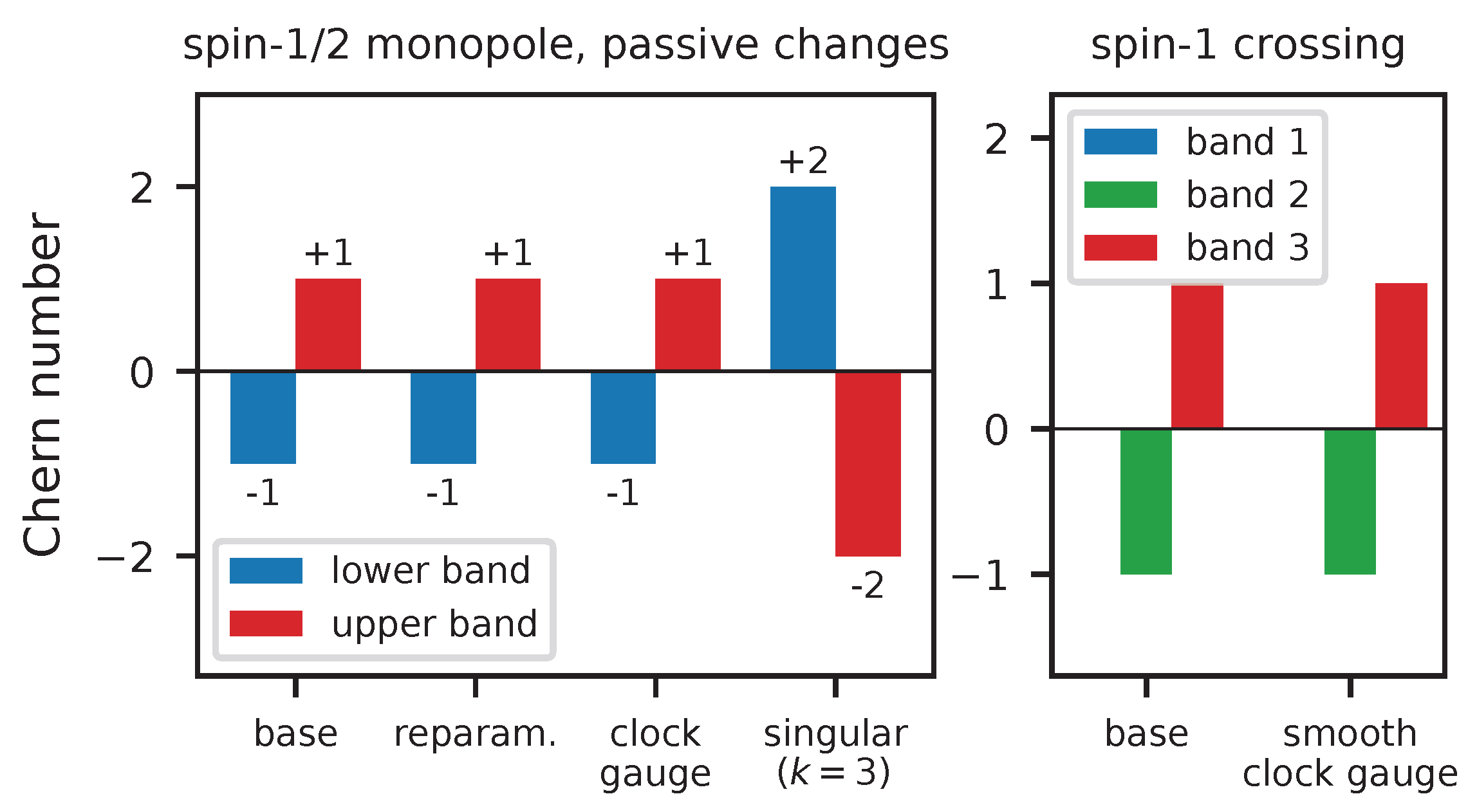
Table 1 (and Figure A1 in Appendix A) reports eigenbundle Chern numbers computed by the plaquette method on a pole-inclusive grid (Appendix A). For the thermal spin- family on the unit sphere, the charges are unchanged by (a) the smooth reparametrization and (b) the smooth single-valued x-dependent unitary , ; the singular gauge shifts them to as predicted by (iv). The maximal deviation of any computed charge from an integer is at the finest grid (round-off accumulated over plaquettes). For the same x-dependent unitary (b) the equatorial Uhlmann phase changes from 0 to and the Bures area of the sphere from to : these are the non-invariances of (iii), and they show that “clock gauge” is a symmetry of the topological layer only. The thermal spin-1 family () on a sphere of radius about the crossing gives for the three bands, invariant under the analogous smooth unitary; the charge-2 crossing of the pair at the origin is not resolved by the Abelian plaquette method and is left open.
4. Active Frame Changes: A Shifted-Overlap Law for the Observer’S Marginal
4.1. An Exactly Solvable Model with Ideal Frames
Let , . Each of the three subsystems carries a charge basis with , and the orientation (phase) states
The frames A and C are ideal: they carry the regular representation, i.e., all of . The observer B may have any support. Physical states are invariant under the diagonal action, , of dimension when B is a full register. Everything is finite dimensional and exact; no truncation is involved.
Lemma 1
(Reduction maps and frame change). Conditioning on frame A at orientation 0, , acts as and is unitary; likewise , . Conditioning on A at orientation g gives , a constant local unitary. The frame change is
Proof.
for every a, so maps the orthonormal basis of onto the orthonormal basis ; on gives the second statement; (9) is the composition, using . □
The map (9) is a permutation of basis states and therefore unitary on the reduced physical space, as it must be for ideal frames. It is manifestly not of the product form : the new label of the rest, , depends on the observer’s charge. This is the whole mechanism.
Theorem 1
(Observer marginal under an active frame change). Let with , and write and of the reduced physical states in the two frames.
- (i)
-
(Shifted-overlap law.) For every relational state,In particular the charge distribution of the observer is the same in both frames.
- (ii)
- (Product relative state.) If , thenwith ∘ the Schur (entrywise) product and the distribution of the orientation of C relative to A. Equivalently
- (iii)
- (Nature of the channel.) is a unital, trace-preserving, completely positive map that commutes with the group action (a partial twirl). It is unitary iff P is a point mass, in which case the active change reduces to the passive constant unitary of Proposition 1(ii); it is the complete dephasing in the charge basis iff P is uniform, i.e., iff the new frame carries no orientation information relative to the old one; a charge eigenstate is the simplest such state.
Proof. (i) By (9), , so that ; substituting gives . Setting gives the invariance of the diagonal. (ii) Insert the product form into (10); the sum over c is . For the second expression, and . For (12), , and averaging over P multiplies the entry by . (iii) is the Fourier transform of a probability distribution, hence positive definite on (Bochner), so the Toeplitz matrix K is positive semidefinite and the Schur product is completely positive (Schur product theorem); gives trace preservation and unitality; covariance is manifest in (12). Unitarity iff for all m iff P is a point mass; complete dephasing iff iff P is uniform, which holds in particular for a charge eigenstate. □
Proposition 2
(Compact groups: the frame change as a partial twirl). Let G be a compact group with Haar measure , let the frames be ideal ( with orientation basis ), and let the observer carry a unitary representation . For the physical state with , frame A sees the product , and frame C sees
For the Haar measure this is the full G-twirl; for , and a spin- observer it is the depolarizing channel .
Proof.
Conditioning on C at the identity selects, in the integrand, , i.e., , so . The vectors are orthonormal, so tracing out A gives (13). The last two statements are the standard twirl identities. □
Proposition 2 identifies the depolarizing channel as the instance of the frame-induced channel, and Theorem 1 identifies the instance as a Schur-product dephasing. Both are the “decoherence from lack of a shared reference frame” of Bartlett, Rudolph, and Spekkens [1,43]. What the present derivation adds is the origin of that decoherence within the perspective-neutral framework: the reference-frame uncertainty is the relational state of the new frame, and the channel is nothing but the action of the frame-change map (1) on the observer’s marginal. For a product relative state the twirl (12) is the relativization of the observer’s state to frame C in the sense of Refs. [1,5]; the content of Theorem 1 is therefore not the twirl itself but its origin in the perspective-neutral map (1), the identification of the twirling distribution with the relational state of the new frame, and the exact shifted-overlap law (10) for non-product states. In this sense the third particle of Ref. [4] has a perfectly well-defined marginal in each frame; what fails is not definability (the frames are ideal) but conjugation. Note also that an active change is not a gauge transformation of the observer’s state: treating it as one would overstate the invariance of every layer except the Chern numbers (Section 5).
Corollary 1
(The entanglement-plus-coherence invariant in closed form). Let denote dephasing in the charge basis and the relative entropy of coherence with respect to the charge (group) basis. For the model and any relational state, by Theorem 1(i), so with the entanglement of the observer with the rest (the reduced physical state being pure in both frames),
the Shannon entropy of the observer’s charge distribution.
This is an explicit, model-level instance of the invariant of Cepollaro et al. [12]: entanglement and coherence are traded against each other by the dephasing channel, and their sum is fixed by the frame-independent charge distribution. In frame A a product relative state has and all of the invariant is coherence; in a frame carrying no orientation information all of it is entanglement.
Numerical verification.
With and random states (seed 7), the shifted-overlap law (10) holds to in Frobenius norm, the Schur-product form (11) to , and the partial-twirl form (12) to , where in each case the left-hand side is computed by the explicit relabelling (9) on the -dimensional physical space and the partial trace, with no use of the theorem.
5. Coherence Thresholds for the Geometric Structure
Theorem 1 turns the question “what survives an active frame change” into the question “what survives the channel ”, and is controlled by the characteristic function : for a two-level observer by the single number , the inter-frame coherence. For the canonical monopole family every layer can be followed in closed form.
Theorem 2
(Coherence grading of the monopole family). Let the observer be a two-level system on the charge states , let A be a frame relative to which the relational state is a product [Theorem 1(ii)], with the pure family , , (a monopole of charge at the centre of the Bloch sphere), and let the active frame change have coherence . In frame C:
- (a)
-
(Spectrum.) has Bloch vector and eigenvaluesFor the two bands are nondegenerate on all of ; for they are degenerate on the whole equator.
- (b)
- (Metric.) , , ; the Bures area of the parameter sphere is
- (c)
- (Topology.) For every the eigenbundle Chern numbers of the bands are , as in frame A; at the eigenbundles over are undefined.
- (d)
- (Holonomy.) For the loop of latitude at polar angle , traversed in the direction of increasing φ, on which frame C sees the transverse Bloch radius and the axial component ,so that is a continuous function of off the equator. On the equator () the imaginary part vanishes, with , and (17) reduces to : iff , equivalently iff the purity on the equator exceeds , and for .
- (e)
- (Resources.) in both frames; in frame A all of it is coherence.
Proof. (a) By (11), while the diagonal is unchanged, which is the stated Bloch vector; with . (b) The Bures metric of a qubit is [19,44]. With one has , , and , so ; is orthogonal to and to with . Then and the area follows. (c) The eigenbundles are the ± eigenbundles of with , and is homotopic to the identity map of through with throughout; the Chern numbers of the ± eigenbundles of are . At the gap closes on the equator by (a). (d) On the loop of latitude , is a rigid rotation of the Bloch vector about with a shifted origin of (a reparametrization, Proposition 1(i)); for such loops Appendix B derives (17), in agreement with the spin- case of Ref. [30] under . On the equator and . The purity is . (e) Corollary 1 with the charge distribution . □
The grading is thus stated relative to the frame in which the relational state is a product. The change is then the twirl (12); the inverse change starts from an entangled relational state and is governed by the general law (10), not by a channel on the observer’s marginal.
Proposition 3
(The metric can only contract). Let the relational state be a product relative to frame A for every x, , with a frame state ϕ that does not depend on x. Then as quadratic forms on the tangent space of M. Equality holds along every direction v for which the classical Fisher information of the observer’s charge distribution already equals the quantum Fisher information in frame A.
Proof.
By Theorem 1(ii)–(iii), with one completely positive trace-preserving map for all x, and the Bures metric is monotone under such maps [44,45]. For the equality statement let be the quantum Fisher information along v and the classical Fisher information of the charge distribution along v. The charge distribution is frame invariant [Theorem 1(i)], so is the same in both frames, and in each [14]. Hence whenever . □
For the monopole family the charge distribution is , whose classical Fisher information along is . This is why is the same in both frames in Theorem 2(b), while contracts by . The three layers are thus graded differently: the metric contracts continuously, the holonomy has a threshold, and the topology is lost only at . For a correlated relational state the change of frame is not a channel on the observer’s marginal [Equation (10)], and no such monotonicity is implied.
Remark 4
(Mixed initial family). Nothing in (a)–(d) requires the family seen by frame A to be pure: by linearity of the frame change, (11) holds for every relational state of the form . If frame A sees the depolarized family with Bloch radius , i.e., , the Schur product (11) multiplies the off-diagonal element by and leaves the diagonal unchanged, so frame C sees the Bloch vector : the Chern numbers survive for every by the same homotopy argument, (17) holds with and , and the equatorial threshold becomes . The inter-frame coherence and the intrinsic mixedness enter the holonomic layer only through their product: a thermal state of Bloch radius seen from a frame of coherence has the Uhlmann phase of a thermal state of Bloch radius .
Corollary 2
(The degeneracy pattern is perspectival). In the ideal regime there are pairs of frames in each of which the observer is a subsystem, but between which the spectral degeneracy pattern of differs: nondegenerate with an isolated monopole in frame A, degenerate along a codimension-one circle in frame C when the orientation distribution P is uniform (for instance, when the new frame is in a charge eigenstate). Consequently the degeneracy pattern of —and with it any gauge group read from that pattern by the degeneracy-based dictionary of Section 2.3, as well as the codimension-three hypothesis of Remark 1—is not an invariant of active frame changes.
The Chern statement (c) has a model-independent version.
Proposition 4
(Weyl robustness bound). Let and be continuous families of density matrices on a closed surface Σ, let ρ have a minimal spectral gap around band n, and let . If , the nth eigenbundle of over Σ is well defined and has the same Chern number as that of ρ.
Proof.
Along , , Weyl’s inequality [46] moves every eigenvalue by at most , so the gaps around band n stay ; the family is continuous in , and an integer-valued continuous function of s is constant. □
The proposition applies to for any frame-induced channel , covariant or not, including the compact-group twirls of Proposition 2, and to the marginal (10) of a non-product relational state. For the dephasing channel of Theorem 2, . The phase of is removed by the constant unitary , which leaves the Chern numbers unchanged [Proposition 1(ii)]; after it and , so the bound gives invariance for every and is sharp. Numerically, for real , equals to at and .
Numerical verification (two-level observer).
Figure 1 follows the four layers as functions of , with the frame change implemented by the exact relabelling (9) for Gaussian charge states (, ) and, for the fine scans, by the Schur form on the two-dimensional support, the two agreeing to . The equatorial eigenvalues agree with (a) to ; the Bures area integrated by the midpoint rule on a grid agrees with to a relative ; the Chern numbers are from down to (minimal gap ) and undefined at , where the gap closes; the equatorial Uhlmann phase computed by path-ordered polar-decomposition transport with 2000 steps reproduces pointwise to , and bisection on locates the transition at , against (, the step-discretization error); for loops of latitude the same transport reproduces the complex value (17) to over a grid of and ; the diagonal of is invariant to , so is invariant identically.
Three-level observer.
The same channel applied in the basis to the thermal spin-1 crossing family of Section 3 (a frame for the azimuth, with from the same Gaussian frame states) leaves the Chern numbers unchanged for every from 1 down to , while the minimal gap on the sphere decreases from to (Table 2). The gap is attained on the polar axis, where the azimuthal dephasing acts trivially, for , and moves off-axis below that; the Chern numbers are thereby verified beyond the two-level case, where a spectator band is present.
Remark 5
(Reading of the thresholds). Theorem 2 orders the msQGT layers by fragility. The metric is lost immediately: any shrinks the emergent area, and the observer’s parameter sphere has no frame-independent size. The equatorial Uhlmann holonomy survives down to , the thermal critical point of Refs. [20,30], reached here by a frame change rather than by temperature; off the equator the Uhlmann phase has no sharp threshold and degrades continuously with , exactly as the thermal Uhlmann phase of a latitude loop degrades with temperature. The Chern numbers survive as long as the new frame carries any orientation information. And the degeneracy pattern, which fixes the gauge group in a degeneracy-based dictionary, changes qualitatively at , where the monopole point spreads into a degeneracy circle. The picture of “parameter smearing” makes this transparent: by (12), frame C sees the family , , the observer’s relational azimuth smeared by the orientation distribution of the old frame relative to the new one.
6. Signature of the Perspectival Metric
The metric layer of the msQGT is frame independent only under reparametrizations (as a tensor) and constant unitaries; under x-dependent passive changes and under every active change of coherence below one it is perspectival. It is also, independently of frames, of fixed signature.
Remark 6
(No Lorentzian signature from the msQGT alone). The real part of (3) is positive semidefinite: with the symmetric logarithmic derivative, for every tangent vector v, and where nondegenerate it is a Riemannian metric. If is Page–Wootters relational time, so that for the constraint [8,31], then
a quarter of the quantum Fisher information for the estimation of τ, with equality iff . Relational time is spacelike or null, never timelike, in the msQGT metric. (A state is invariant under its own modular flow [47], so modular time is a null direction by definition.) Consequently no identification of with a physical spacetime metric can produce a Lorentzian signature without an input beyond the msQGT.
Numerically, for a two-level observer coupled to a three-level environment by a random Hamiltonian (seed 11) and a random initial state, ranges between and on and agrees with the central finite difference of the Bures distance, , , to . The remark is elementary, but it fixes what an emergent-spacetime reading of the msQGT can and cannot claim: the metric is Euclidean, and the Lorentzian problem is not a problem about frames.
7. Physical Regime: Frame-Relative Definability
Sections 4–5 assume ideal frames, for which the observer is a subsystem in every frame and its marginal transforms by the law (10). With physical (bounded-below) generators even this fails.
Corollary 3
(Frame-relative definability, from Ref. [9]). Let the observer’s relevant constraint generator have spectrum bounded below, as any physical Hamiltonian does. Then the factorization condition (2) generically fails in some frames. Whenever it fails, the observer is not a tensor factor of the reduced physical Hilbert space: single-subsystem observables fail to commute after constraint imposition [9]. Consequently —and with it its spectrum, its degeneracy pattern, and the emergent content of (3)—is not defined frame independently; its definability is frame relative.
Proof
(Proof and numerical witness). The statement is Refs. [9] applied to . Witness: tripartite charges with constraint and spectra (bounded) and (wide, ideal-like). In frame C, and (2) holds; in frame A, and it fails. For the nearest-neighbour hopping observables (X the charge shift) of the two non-frame subsystems, projected onto the reduced space , the commutator norm is 0 in frame C (reduced space , dimension 9 of 9) and in frame A (reduced space of dimension 9 inside the 27-dimensional ). □
Remark 7
(Scope). Corollary 3 follows from the subsystem-relativity literature [9,10,48]; its only model-specific content is the application to the msQGT layer. Note the division of labour with Section 5: with ideal frames the observer exists in every frame and its emergent structure is perspectival (Corollary 2); with physical frames the observer may not exist in some frames and its emergent structure is then undefined. The two statements are independent, and the first is not implied by the second.
Physical reading.
Every physical Hamiltonian is bounded below. The factorization condition (2) is a Minkowski-sum identity between spectra, and a one-sided spectrum generically violates it in frames where the conditioned subsystem inherits the bound, as in the witness. For physical frames the definability of the content read from an observer’s state is therefore itself frame relative.
8. Discussion
8.1. An Objectivity Hierarchy
The QRF programme establishes the frame relativity of subsystems, correlations, entropy, and thermodynamics [9,10,11,12] but attaches no information-geometric structure to the reduced state. The present construction supplies that structure and determines, layer by layer, what survives. Table 3 collects the results.
Three features of the table deserve emphasis. First, the hierarchy is graded, not binary: “objective” means invariant under a stated class of frame changes and above a stated inter-frame coherence, and the Chern numbers are the only msQGT data that survive every frame change considered here for which the eigenbundles remain defined. Second, the same characteristic function (a single number for a two-level observer) that controls the Cepollaro trade-off [12] controls the fate of every geometric layer; the entanglement–coherence invariant and the Uhlmann/Chern invariants are thus not competing but complementary diagnostics of the same channel, one continuous and resource theoretic, the others integer or valued and gauge theoretic. Third, the sharp thresholds— for topology, (purity ) for holonomy—are closed form and, in principle, measurable: they are statements about mixed-state geometric phases of an observer whose phase reference is shared only imperfectly with a second party, a setting within reach of the Uhlmann-phase protocols of Ref. [23]. In the purification-based scheme with which the thermal Uhlmann phase of a qubit was observed [39], the mixedness enters as a parameter of the prepared state; preparing instead the family of Remark 4, with Bloch radius , the measured phase should flip at at fixed temperature.
8.2. Consequences for Emergent-Geometry Programmes
Read through either construction of Section 2.3, the geometric structure of an observer’s state has the following covariance. The topological content (monopole charges at degeneracy loci and any discrete data built from them) is objective across all passive changes and across active changes of any nonzero inter-frame coherence. The holonomic content (the Uhlmann phases) is objective across passive reparametrizations and constant unitaries and across active changes of coherence above , and is otherwise perspectival. A gauge group read from the degeneracy pattern is passive invariant but active perspectival, and the codimension-three hypothesis of Remark 1 can fail in a frame that carries no orientation information. The metric survives only reparametrizations (as a tensor) and x-independent unitary frame changes and is perspectival under every other one; it is trivialization dependent (Remark 3), and is Euclidean (Remark 6); a Lorentzian spacetime cannot be read from it without further input. And in the physical regime the observer itself is frame relative in existence. None of this is a defect of one proposal relative to another: it is the covariance structure that any emergent-geometry proposal built on a conditioned reduced state has, and the value of making it explicit is that it identifies which outputs of such a construction are candidates for frame-independent statements.
8.3. Relation to Prior Work
The technical scaffolding is borrowed and not claimed as new. The reduction maps, the frame-change unitary, and the factorization criterion are the perspective-neutral constructions of Refs. [7,8,9]; the reading of frame changes as gauge transformations and the absence of a global relational perspective are due to Ref. [32]; the operational calculus and its group-theoretic generalizations to Refs. [2,3,4,5,6], with the quantum-information prehistory reviewed in Ref. [1]; the subsystem, correlation, and thermodynamic relativity invoked in the physical regime to Refs. [9,10,11,48]. Corollary 3 follows from Ref. [9]. The geometric machinery is likewise standard: Uhlmann transport [17,18], Hübner’s explicit connection and the Bures geometry [15,19,44], the Uhlmann transition of Refs. [20,21,22], and the plaquette method [38]. In the pure-state limit the spin- results reduce to the Berry–Simon monopole [49,50] and the non-Abelian structure at degeneracy to Ref. [51].
What is new is the placement of this geometric layer on a QRF-conditioned state and the classification of its transformation behaviour, and three points distinguish the classification from what was available. First, the passive/active distinction (Section 2.4): the transformation laws of the msQGT under reparametrization and gauge are textbook, but an active frame change is not a gauge transformation of the observer’s state, and treating it as one overstates the invariance of every layer except the Chern numbers. Second, the exact law for the active change (Theorem 1, Corollary 1): the shifted-overlap form (10) holds for every relational state, product or not, and with the frame invariance of the charge distribution it yields the invariant of Ref. [12] in closed form. That an imperfect shared reference frame dephases is the classic observation of Refs. [1,43], that QRF transformations redistribute entanglement and coherence is the content of Refs. [2,12], and the twirl of a product relative state is the known relativization [1,5]; what the present derivation adds there is the identification of the twirling distribution with the relational state of the new frame, and the contraction of the metric that follows (Proposition 3). Third, the grading (Theorem 2): the thresholds at which the metric, the holonomy, and the topology of the geometric structure cease to be frame independent are closed-form functions of the inter-frame coherence. The closed forms themselves are those of the thermal spin- Uhlmann phase [20,30], and no claim of novelty is made for them; what is new is that the inter-frame coherence enters exactly where the thermal Bloch radius enters, so that the finite-temperature topological Uhlmann transition, observed in Ref. [39], can be driven by the relational state of a reference frame at fixed temperature. Table 4 summarizes the positioning.
8.4. Limitations and Open Problems
- L1.
- Corollary 3 follows from Ref. [9]; the novelty is confined to the msQGT application.
- L2.
- The grading of Theorem 2 is proved for a product relative state, i.e., relative to the frame in which the relational state is a product; for a correlated relational state only the shifted-overlap law (10) and the Weyl bound are available.
- L3.
- Proposition 2 treats ideal frames and the invariant state built from a product; the general non-Abelian perspective-neutral frame change with arbitrary states is not treated.
- L4.
- The charge-2 crossing of the spin-1 model is not resolved by the Abelian plaquette method.
- O1.
- For non-ideal frames (bounded or periodic clocks [52]) the frame change is no longer a channel on a fixed observer space; quantify the additional, non-unital information loss relative to the ideal partial twirl.
- O2.
- The Weyl bound is sufficient but not necessary; determine the sharp Chern-number threshold for general channels, and extend the closed form (17) to loops that are not rigid rotations of the Bloch vector, where the transport generator is not constant in any rotating frame.
- O3.
- O4.
- Turn the experimental signature of Section 8 A into a full interferometric protocol in which the mixedness is generated by an imperfectly shared phase reference of coherence rather than prepared directly.
9. Conclusions
We have separated passive from active changes of quantum reference frame and determined, for each, the fate of every layer of the mixed-state quantum geometric tensor of a conditioned observer state. Passive changes conjugate the observer and preserve the spectrum and the Chern numbers whenever they are smooth and single valued, the metric and holonomy only when they are reparametrizations or constant unitaries. Active changes between ideal frames obey an exact shifted-overlap law with a frame-invariant charge distribution, which yields the entanglement-plus-coherence invariant in closed form; for a product relative state the law is a partial twirl by the relative-orientation distribution of the two frames—a Schur-product dephasing for abelian frames, the depolarizing channel for an isotropic component—under which the metric can only contract. For a two-level observer the geometric structure is then graded by a single inter-frame coherence: its metric is perspectival at any coherence below one and Euclidean in any case; its Uhlmann holonomy is objective above the closed-form coherence ; its eigenbundle Chern numbers are objective at any nonzero coherence and are lost, together with the codimension of the degeneracy locus, only when the new frame carries no orientation information; and in the physical regime of bounded generators the observer itself is frame relative in existence. For programmes that read emergent geometry or gauge structure off a conditioned reduced state, this identifies the topological layer as the one that is frame independent under the widest class of frame changes, gives the holonomic layer a sharp domain of objectivity, and locates the Lorentzian problem outside the frame question.
Author Contributions
J.W.L. is the sole author. He conceived the study, directed the work, decided its scope and claims, and reviewed and approved the manuscript. The derivations, the software, and the drafting were carried out with a generative-AI tool under his direction, as disclosed in Section 2.5 and in the Acknowledgments.
Funding
This research received no external funding.
Institutional Review Board Statement
Not applicable.
Informed Consent Statement
Not applicable.
Data Availability Statement
The original data presented in the study—the scripts geom.py, run_passive.py, run_active.py, run_active2.py, run_definability.py, run_signature.py, make_figs.py and their outputs, which generate every number, table, and figure in this paper—are openly available in Zenodo at https://doi.org/10.5281/zenodo.22842517 [42].
Acknowledgments
During the preparation of this study and manuscript, the author used Claude (Anthropic; accessed through the claude.ai application in 2026, the present revision with Claude Fable 5.1) for the purposes of carrying out and checking the analytic derivations, writing and running the numerical verification scripts, producing the figures, and drafting and typesetting the text, as described in Section 2.5. The author has reviewed and edited the output and takes full responsibility for the content of this publication.
Conflicts of Interest
The author declares no conflicts of interest.
Appendix A. Numerical Methods and Error Control
All numerical work is verification of previously derived statements.
Chern numbers.
Eigenbundle Chern numbers are computed by the plaquette method [38] on a grid (), (periodic). The poles are included as single points carrying one eigenvector each, replicated in , so that the plaquettes tile the closed sphere and the lattice flux is an integer up to round-off whenever the band is gapped on the grid. Bands are sorted by increasing eigenvalue of ; the minimal gap on the grid is reported with every result, and a band is declared undefined if it falls below . Grids , , and give identical integers for all passive cases (maximal deviation from an integer ); the active scans use (spin-1) and – (two-level), with deviations .
Figure A1.
Eigenbundle Chern numbers under passive frame changes (grid ). Left: spin- monopole under a smooth reparametrization, a smooth single-valued x-dependent clock unitary, and a singular clock gauge of relative winding ; only the singular gauge shifts the charges, by exactly k. Right: thermal spin-1 crossing at ; band 1 has charge 0.
Uhlmann holonomy.
For a closed loop discretized into N states, the transport step is the unitary polar factor of , the holonomy is , and the phase is (5). This is the discretization of the parallel-transport condition on amplitudes, independent of any connection formula, and therefore an end-to-end check of the closed form (6). The pointwise deviation of from is at and at , consistent with second-order convergence in ; the bisection for the threshold (50 iterations, ) is limited by this discretization to .
Metric and area.
The QFIM is evaluated from the eigenbasis expression (3) with analytic derivatives of the family; the Bures area is integrated by the midpoint rule on a grid (relative error against ). For the passive non-invariance check the derivatives are central differences with on an grid, which reproduces the exact thermal area as .
Frame change.
The relabelling (9) is implemented literally on the -dimensional physical space () and the observer marginals are obtained by partial trace; the theorem is then tested against this implementation (residuals , , for the shifted-overlap, Schur, and twirl forms, random states with seed 7). Gaussian frame states are exact on (wrapped), so no truncation error enters.
Definability and signature.
The spectra and Minkowski sums of Corollary 3 are computed exactly on integers; the commutator norm is the operator norm. The signature check uses a random Hermitian Hamiltonian and random initial state (seed 11), the QFIM of the observer’s marginal, and the central finite difference of the Bures distance with (agreement ).
Appendix B. Closed Form of the Uhlmann Phase for Loops of Latitude
Let with , , a rigid rotation of the Bloch vector about (the equator is , ). The eigenvalues are , and with the single-valued eigenframe is , . Uhlmann transport of the amplitude along the loop is with the anti-Hermitian generator whose eigenframe matrix elements are for and 0 for , with the weight (4) [19,33]; here , so that . A direct computation gives , and at , where the frame is real, . Since with , , the generator is a rotated constant,
Writing turns the transport equation into with a constant generator, and since the holonomy is . With ,
and . Hence
With , , and ,
References
- Bartlett, S. D.; Rudolph, T.; Spekkens, R. W. Reference frames, superselection rules, and quantum information. Rev. Mod. Phys. 2007, 79, 555. [Google Scholar] [CrossRef]
- Giacomini, F.; Castro-Ruiz, E.; Brukner, Č. Quantum mechanics and the covariance of physical laws in quantum reference frames. Nat. Commun. 2019, 10, 494. [Google Scholar] [CrossRef]
- de la Hamette, A.-C.; Galley, T. D. Quantum reference frames for general symmetry groups. Quantum 2020, 4, 367. [Google Scholar] [CrossRef]
- Krumm, M.; Höhn, P. A.; Müller, M. P. Quantum reference frame transformations as symmetries and the paradox of the third particle. Quantum 2021, 5, 530. [Google Scholar] [CrossRef]
- Loveridge, L.; Miyadera, T.; Busch, P. Symmetry, reference frames, and relational quantities in quantum mechanics. Found. Phys. 2018, 48, 135. [Google Scholar] [CrossRef]
- Castro-Ruiz, E.; Giacomini, F.; Belenchia, A.; Brukner, Č. Quantum clocks and the temporal localisability of events in the presence of gravitating quantum systems. Nat. Commun. 2020, 11, 2672. [Google Scholar] [CrossRef]
- Vanrietvelde, A.; Höhn, P. A.; Giacomini, F.; Castro-Ruiz, E. A change of perspective: Switching quantum reference frames via a perspective-neutral framework. Quantum 2020, 4, 225. [Google Scholar] [CrossRef]
- Höhn, P. A.; Smith, A. R. H.; Lock, M. P. E. Trinity of relational quantum dynamics. Phys. Rev. D. 2021, 104, 066001. [Google Scholar] [CrossRef]
- Ahmad, S. Ali; Galley, T. D.; Höhn, P. A.; Lock, M. P. E.; Smith, A. R. H. Quantum relativity of subsystems. Phys. Rev. Lett. 2022, 128, 170401. [Google Scholar] [CrossRef]
- Höhn, P. A.; Kotecha, I.; Mele, F. M. Quantum frame relativity of subsystems, correlations and thermodynamics. arXiv arXiv:2308.09131.
- De Vuyst, J.; Eccles, S.; Höhn, P. A.; Kirklin, J. Gravitational entropy is observer-dependent. J. High Energy Phys. 2025, 07, 146. [Google Scholar] [CrossRef]
- Cepollaro, C.; Akil, A.; Cieśliński, P.; de la Hamette, A.-C.; Brukner, Č. Sum of entanglement and subsystem coherence is invariant under quantum reference frame transformations. Phys. Rev. Lett. 2025, 135, 010201. [Google Scholar] [CrossRef]
- Provost, J. P.; Vallee, G. Riemannian structure on manifolds of quantum states. Commun. Math. Phys. 1980, 76, 289. [Google Scholar] [CrossRef]
- Braunstein, S. L.; Caves, C. M. Statistical distance and the geometry of quantum states. Phys. Rev. Lett. 1994, 72, 3439. [Google Scholar] [CrossRef]
- Dittmann, J. Explicit formulae for the Bures metric. J. Phys. A Math. Gen. 1999, 32, 2663. [Google Scholar] [CrossRef]
- Liu, J.; Yuan, H.; Lu, X.-M.; Wang, X. Quantum Fisher information matrix and multiparameter estimation. J. Phys. A Math. Theor. 2020, 53, 023001. [Google Scholar] [CrossRef]
- Uhlmann, A. Parallel transport and “quantum holonomy” along density operators. Rep. Math. Phys. 1986, 24, 229. [Google Scholar] [CrossRef]
- Uhlmann, A. A gauge field governing parallel transport along mixed states. Lett. Math. Phys. 1991, 21, 229. [Google Scholar] [CrossRef]
- Hübner, M. Computation of Uhlmann’s parallel transport for density matrices and the Bures metric on three-dimensional Hilbert space. Phys. Lett. A 1993, 179, 226. [Google Scholar] [CrossRef]
- Viyuela, O.; Rivas, A.; Martin-Delgado, M. A. Uhlmann phase as a topological measure for one-dimensional fermion systems. Phys. Rev. Lett. 2014, 112, 130401. [Google Scholar] [CrossRef]
- Viyuela, O.; Rivas, A.; Martin-Delgado, M. A. Two-dimensional density-matrix topological fermionic phases: Topological Uhlmann numbers. Phys. Rev. Lett. 2014, 113, 076408. [Google Scholar] [CrossRef]
- Budich, J. C.; Diehl, S. Topology of density matrices. Phys. Rev. B 2015, 91, 165140. [Google Scholar] [CrossRef]
- Hou, X.-Y.; Guo, H.; Chien, C.-C. Finite-temperature topological phase transitions of spin-j systems in Uhlmann processes: General formalism and experimental protocols. Phys. Rev. A 2021, 104, 023303. [Google Scholar] [CrossRef]
- Jacobson, T. Thermodynamics of spacetime: The Einstein equation of state. Phys. Rev. Lett. 1995, 75, 1260. [Google Scholar] [CrossRef]
- Ryu, S.; Takayanagi, T. Holographic derivation of entanglement entropy from the anti–de Sitter space/conformal field theory correspondence. Phys. Rev. Lett. 2006, 96, 181602. [Google Scholar] [CrossRef]
- Van Raamsdonk, M. Building up spacetime with quantum entanglement. Gen. Relativ. Gravit. 2010, 42, 2323. [Google Scholar] [CrossRef]
- B. Swingle, Entanglement renormalization and holography. Phys. Rev. D. 2012, 86, 065007.
- T. Jacobson, Entanglement equilibrium and the Einstein equation. Phys. Rev. Lett. 2016, 116, 201101. [CrossRef]
- Cao, C.; Carroll, S. M.; Michalakis, S. Space from Hilbert space: Recovering geometry from bulk entanglement. Phys. Rev. D. 2017, 95, 024031. [Google Scholar] [CrossRef]
- Morachis Galindo, D.; Rojas, F.; Maytorena, J. A. Topological Uhlmann phase transitions for a spin-j particle in a magnetic field. Phys. Rev. A 2021, 103, 042221. [Google Scholar] [CrossRef]
- Page, D. N.; Wootters, W. K. Evolution without evolution: Dynamics described by stationary observables. Phys. Rev. D. 1983, 27, 2885. [Google Scholar] [CrossRef]
- Vanrietvelde, A.; Höhn, P. A.; Giacomini, F. Switching quantum reference frames in the N-body problem and the absence of global relational perspectives. Quantum 2023, 7, 1088. [Google Scholar] [CrossRef]
- He, Y.; Guo, H.; Chien, C.-C. Thermal Uhlmann Chern number from the Uhlmann connection for extracting topological properties of mixed states. Phys. Rev. B 2018, 97, 235141. [Google Scholar] [CrossRef]
- Carollo, A.; Spagnolo, B.; Valenti, D. Uhlmann curvature in dissipative phase transitions. Sci. Rep. 2018, 8, 9852. [Google Scholar] [CrossRef]
- Carollo, A.; Valenti, D.; Spagnolo, B. Geometry of quantum phase transitions. Phys. Rep. 2020, 838, 1. [Google Scholar] [CrossRef]
- Sjöqvist, E.; Pati, A. K.; Ekert, A.; Anandan, J. S.; Ericsson, M.; Oi, D. K. L.; Vedral, V. Geometric phases for mixed states in interferometry. Phys. Rev. Lett. 2000, 85, 2845. [Google Scholar] [CrossRef]
- Tong, D. M.; Sjöqvist, E.; Kwek, L. C.; Oh, C. H. Kinematic approach to the mixed state geometric phase in nonunitary evolution. Phys. Rev. Lett. 2004, 93, 080405. [Google Scholar] [CrossRef]
- Fukui, T.; Hatsugai, Y.; Suzuki, H. Chern numbers in discretized Brillouin zone: Efficient method of computing (spin) Hall conductances. J. Phys. Soc. Jpn. 2005, 74, 1674. [Google Scholar] [CrossRef]
- Viyuela, O.; Rivas, A.; Gasparinetti, S.; Wallraff, A.; Filipp, S.; Martin-Delgado, M. A. Observation of topological Uhlmann phases with superconducting qubits. npj Quantum Inf. 4 2018, 10. [Google Scholar]
- Lee, J. W. Regularity and local Yang–Mills structure of the Uhlmann curvature at density-matrix degeneracy loci. J. Math. Phys. (under review) 2026. [Google Scholar] [CrossRef]
- Lee, J. W. Emergent gravity and gauge fields from the mixed-state quantum geometric tensor: The Relational–Informational Model; Zenodo, 2026. [Google Scholar] [CrossRef]
- Lee, J. W. Numerical scripts and outputs for “What survives a change of quantum reference frame?”. Zenodo 2026. [Google Scholar] [CrossRef]
- Bartlett, S. D.; Rudolph, T.; Spekkens, R. W.; Turner, P. S. Degradation of a quantum reference frame. New J. Phys. 2006, 8, 58. [Google Scholar] [CrossRef]
- Bengtsson, I.; Życzkowski, K. Geometry of Quantum States, 2nd ed.; Cambridge University Press: Cambridge, 2017. [Google Scholar]
- Petz, D. Monotone metrics on matrix spaces. Linear Algebra Appl. 1996, 244, 81. [Google Scholar] [CrossRef]
- Bhatia, R. Matrix Analysis; Springer: New York, 1997. [Google Scholar]
- Connes, A.; Rovelli, C. Von Neumann algebra automorphisms and time-thermodynamics relation in generally covariant quantum theories. Class. Quantum Grav. 1994, 11, 2899. [Google Scholar] [CrossRef]
- Castro-Ruiz, E.; Oreshkov, O. Relative subsystems and quantum reference frame transformations. arXiv arXiv:2110.13199.
- Berry, M. V. Quantal phase factors accompanying adiabatic changes. Proc. R. Soc. Lond. A 392 1984, 45. [Google Scholar]
- B. Simon, Holonomy, the quantum adiabatic theorem, and Berry’s phase. Phys. Rev. Lett. 1983, 51, 2167. [CrossRef]
- Wilczek, F.; Zee, A. Appearance of gauge structure in simple dynamical systems. Phys. Rev. Lett. 1984, 52, 2111. [Google Scholar] [CrossRef]
- Chataignier, L.; Höhn, P. A.; Lock, M. P. E.; Mele, F. M. Relational dynamics with periodic clocks. arXiv arXiv:2409.06479.
Figure 1.
Two-level observer under an active frame change, as a function of the inter-frame coherence . (a) Equatorial eigenvalues, Bures area , and equatorial purity (all perspectival); the vertical line is , the dotted line purity . (b) from path-ordered polar-decomposition transport (circles) against the closed form (line), and the Uhlmann phase (crosses), which flips at . (c) Eigenbundle Chern numbers, invariant for all down to on this scan; the dashed line is the minimal gap . (d) Entanglement and charge-basis coherence at a generic point trade against each other with invariant sum.
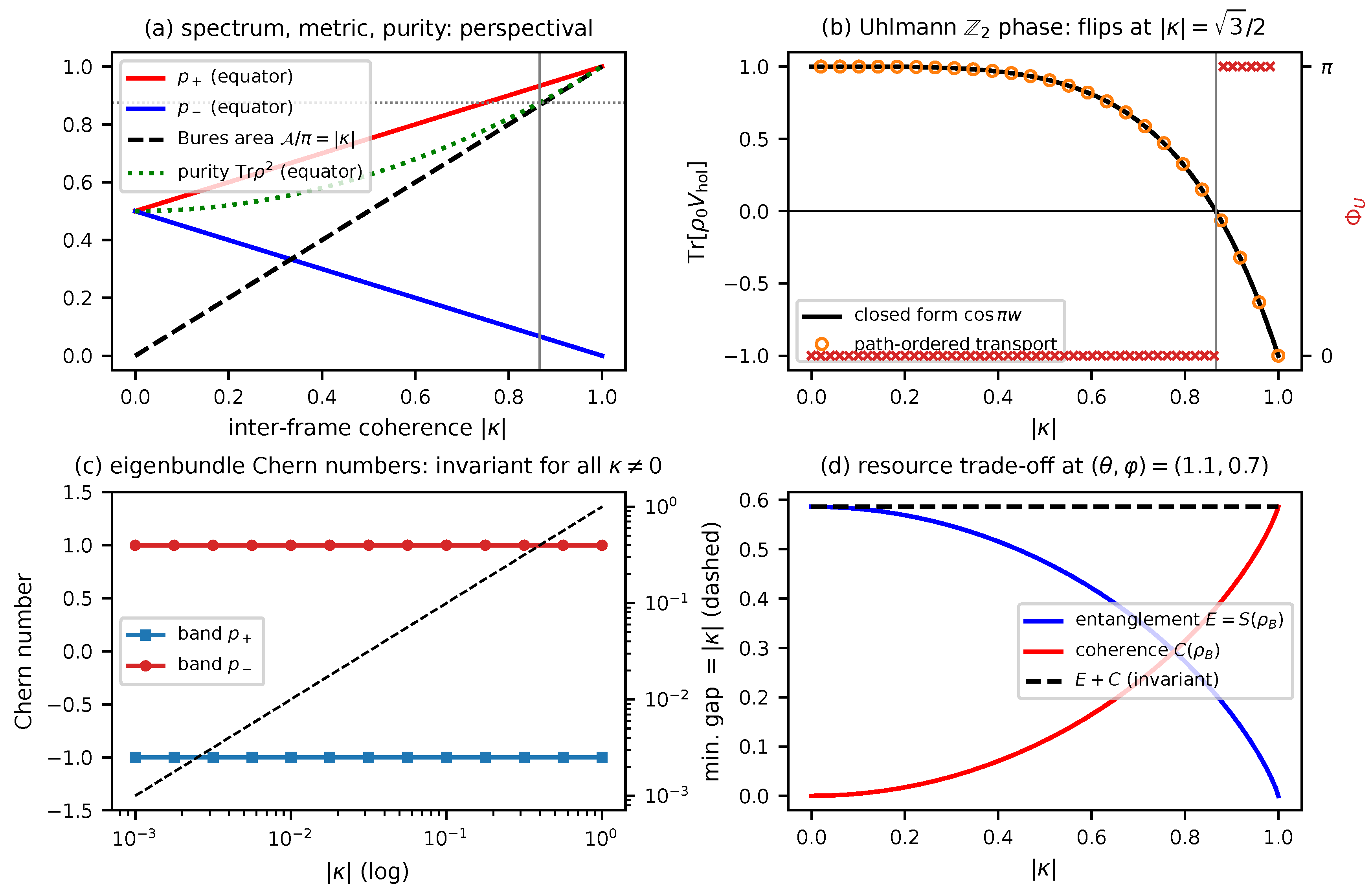

Table 1.
Plaquette Chern numbers at grid ; the values are identical at and (Appendix A). Bands are ordered by increasing eigenvalue of ; “dev.” is the maximal deviation of a computed charge from an integer.
Table 1.
Plaquette Chern numbers at grid ; the values are identical at and (Appendix A). Bands are ordered by increasing eigenvalue of ; “dev.” is the maximal deviation of a computed charge from an integer.
| family | frame change | Chern | dev. | min. gap |
|---|---|---|---|---|
| spin- | none | 0.762 | ||
| reparam. | 0.762 | |||
| smooth | 0.762 | |||
| singular, | 0.762 | |||
| spin-1 | none | |||
| smooth |
Table 2.
Thermal spin-1 crossing family (, , sphere radius about ) under the frame-induced azimuthal dephasing with Gaussian frame states of charge width s; grid .
Table 2.
Thermal spin-1 crossing family (, , sphere radius about ) under the frame-induced azimuthal dephasing with Gaussian frame states of charge width s; grid .
| s | Chern | dev. | min. gap | ||
|---|---|---|---|---|---|
| ∞ | 1 | 1 | |||
| 1.0 | 0.8825 | 0.6065 | |||
| 0.6 | 0.7043 | 0.2494 | |||
| 0.42 | 0.4353 | 0.0587 | |||
| 0.3 | 0.1234 | 0.0039 | |||
| 0.25 | 0.0366 | 0.0003 | |||
| 0.15 |
Table 3.
What survives which frame change (the “const. V” column also covers reparametrizations). “inv.”: invariant; “persp.”: perspectival, i.e., changes by an explicit, frame-dependent law; is the inter-frame coherence of Theorem 1. The passive columns are Proposition 1, the active columns Theorems 1–2, the last column Corollary 3.
| passive | active, ideal frames | physical | ||||
|---|---|---|---|---|---|---|
| layer of the msQGT | const. V | regime | ||||
| charge distribution; | inv. | inv. | inv. | inv. | inv. | undefined |
| spectrum, degeneracy pattern (gauge group) | inv. | inv. | persp. | persp. | codim. changes | undefined |
| metric (area ) | tensorial | not inv. | persp. | persp. | persp. | undefined |
| Uhlmann holonomy | inv. | not inv. | inv. | lost | lost | undefined |
| eigenbundle Chern numbers | inv. | inv. | inv. | inv. | undefined | undefined |
Table 4.
Positioning of the present results.
| Established in the literature | Added here |
|---|---|
| Reduction map , frame change , factorization criterion [7,9] | Passive/active distinction for the msQGT layer; active change as an explicit channel on the observer’s marginal (Theorem 1, Proposition 2) |
| Decoherence from an imperfect shared frame [1,43] | Obtained as the perspective-neutral frame change; frame quality = relational state of the new frame |
| Entanglement + coherence invariant [12] | Closed form for abelian frames (Corollary 1); same governs the geometric layers |
| Uhlmann transition at finite temperature [20,39]; closed-form spin-j Uhlmann phase [30] | Same transition driven by an active frame change, with (times the intrinsic Bloch radius) in the role of (Theorem 2(d), Remark 4) |
| Chern numbers as topological invariants of [22,38] | Invariance under all smooth passive changes, under active changes with , and a Weyl bound for general channels (Proposition 4) |
| Subsystem relativity in the physical regime [9,10] | Consequence for the definability of the geometric content (Corollary 3) |
| Fisher/Bures metric positivity | Signature obstruction along relational time (Remark 6) |
Disclaimer/Publisher’s Note: The statements, opinions and data contained in all publications are solely those of the individual author(s) and contributor(s) and not of MDPI and/or the editor(s). MDPI and/or the editor(s) disclaim responsibility for any injury to people or property resulting from any ideas, methods, instructions or products referred to in the content. |
© 2026 by the authors. Licensee MDPI, Basel, Switzerland. This article is an open access article distributed under the terms and conditions of the Creative Commons Attribution (CC BY) license (http://creativecommons.org/licenses/by/4.0/).
Copyright: This open access article is published under a Creative Commons CC BY 4.0 license, which permit the free download, distribution, and reuse, provided that the author and preprint are cited in any reuse.