

Submitted:
08 October 2026
Posted:
09 October 2026
You are already at the latest version
Abstract
Soil salinity is a major abiotic constraint that severely limits crop production, whereas beneficial legume-rhizobia symbioses can alleviate stress effects and enhance crop yield performance. In this study, pre isolated Rhizobium phaseoli R9 and Mesorhizobium ciceri R6 strains were evaluated individually and in co inoculation on common bean (Phaseolus vulgaris L.) grown in saline soils (5.6 dS m⁻¹). The experiment was established using a randomized complete block design (RCBD) with three replications at the Experimental Station of the Institute of Agriculture and Agrotechnologies of Karakalpakstan during the 2024–2025 growing seasons. Bacterial inoculations showed potential to increase plant height, root and shoot biomass, grain yield, number of nodules per plant, nodule dry weight, and root length of common bean. Co-inoculation was particularly effective, increasing the dry weights of shoot, root, leaf, grain, and husk by 47.6%, 28.0%, 32.1%, 39.6%, and 22.2%, respectively, compared with the control. Likewise, the highest grain yield (1.85 Mg ha⁻¹) was produced under co inoculation, exhibiting a 44.5% increase compared with the uninoculated control. Chemical analysis showed that co inoculation (R6+R9) increased oil and protein content by 18.2% and 27.4%, respectively, over the control. The results show a strong correlation (R2=0.89) between increased nodule weight and common bean grain yield. The application of biological interventions markedly improved multiple indicators of soil fertility and biological activity, with the R6 + R9 co-inoculation treatment producing the highest concentrations of humus (0.85 g kg⁻¹), total N (1.05 g kg⁻¹), total P (1.15 g kg⁻¹), nitrate-N (6.72 mg kg⁻¹), available P₂O₅ (46.0 mg kg⁻¹), and exchangeable K₂O (180 mg kg⁻¹) compared with the control. It might be concluded that co-inoculation of Rhizobium strains could be the most effective nature-based solutions strategy for enhancing agricultural productivity and ecosystem restoration under saline conditions.
Keywords:
co-inoculation
; rhizobium
; salinity
; common bean
; yield
; seed quality
; soil health
Introduction
Common bean (Phaseolus vulgaris L.) is a globally significant legume, primarily cultivated for its rich nutritional profile and as a major source of protein, particularly in developing countries. It serves as a staple food for millions, contributing to food security and economic stability and accounting for nearly half of all grain legumes consumed [1]. When the global cultivation area of this crop reached 18 million hectares, in Uzbekistan, it is cultivated on approximately 7000 hectares as a follow-up crop, with an average yield of 1.6 t ha-1 [2]. The rapid expansion of the cultivation area is largely attributed to its benefits for food security, soil health, and climate resilience, especially among smallholder farmers. However, productivity remains constrained by the crop’s sensitivity to salinity with a reported tolerance threshold of approximately 1.5 dS m⁻¹ electrical conductivity [3]. Nevertheless, the crop exhibits adaptive mechanisms that can partially alleviate salinity-induced physiological stress, thereby supporting plant growth and sustaining yield under moderately saline environments.
Soil salinity represents one of the most severe abiotic constraints to agricultural production, reducing crop productivity by an estimated 40-60% and posing substantial challenges to food security, environmental sustainability, and economic development [4]. Salinity impairs root growth, nutrient uptake, respiration, carbohydrate transport, and photosynthesis, thereby reducing crop productivity. It also diminishes microbial activity and enzyme function, further exacerbating soil health challenges [5]. In addition to salinity stress, abiotic factors such as high temperatures, drought, and nutrient deficiencies often limit legume productivity in dry regions [6]. In addition, ongoing climate change is a major driver of accelerated droughts, heat waves, and land degradation, particularly across drylands of Central Asia [7].
Legumes depend on biological nitrogen fixation through their partnership with root nodule-forming rhizobia, which boosts soil fertility and plant nutrient status. However, salinity reduces the supply of photosynthates to nodules and limits energy for the bacteria, disrupting hormone balance and lowering nitrogen fixation [8]. Salt-tolerant rhizobial strains can help by improving nodulation, nutrient uptake, and nodule development in host plants. The growth and symbiotic success of common bean in saline soils depend on the salt tolerance of existing rhizobial strains. In addition, the effectiveness of nitrogen fixation in legumes is highly influenced by specific Rhizobium strains involved [9]. The selection of appropriate Rhizobium strains is therefore crucial in developing effective symbiosis that can thrive under environmental stresses, including salinity. Beyond nitrogen fixation, rhizobia can produce phytohormones, such as auxin and cytokinins, which stimulate plant growth and development. These hormones can improve plant resilience to salt stress, allowing for better survival and productivity [10].
As a nitrogen-fixing legume, enhanced growth responses have been reported in common bean inoculated with salt-tolerant rhizobial strains [11]. Therefore, the performance of common bean in saline soils depends on the salt tolerance of rhizobial strains [12]. However, only certain Rhizobium strains may trigger stress-resilient mechanisms in common beans, allowing for better adaptation to saline environments [13]. The concept of symbiotic efficiency between Rhizobia and legumes, especially in the context of salt stress, encapsulates the interplay of nodule development, nitrogen fixation and stress tolerance. The effective functioning of this mechanism reflects in improved soil health by increasing nutrients, reducing reliance on synthetic fertilisers and supporting sustainable agriculture. However, abiotic and biotic factors can limit the potential of this mechanism [10]. Rhizobial strains in combination with other beneficial microbes often form effective interactions, leading to better nodulation, greater biomass, and higher yields than using a single strain [14]. Studies show that co-inoculation with Rhizobium strains is more effective than single inoculation in improving the growth and yield of common bean in saline fields [15,16].
While controlled studies are promising, few field studies have examined co-inoculation of common bean in saline soils. This study hypothesized that field evaluation of native rhizobial strains can enhance yield parameters and salt-stress tolerance of common bean and contribute to the development of sustainable biofertilization strategies. Therefore, this study focused to investigated the effect of inoculating common bean seeds with rhizobial strains on nodulation, grain yield and soil fertility parameters in saline soils.
Materials and Methods
Climate and Soil Properties
The experiment was conducted at the Experimental Station of the Institute of Agriculture and Agrotechnologies of Karakalpakstan during the 2024–2025 growing seasons in Nukus, Karakalpakstan, Uzbekistan (42°48′N 59°59′E). The region is characterized by an arid continental climate, with pronounced temperature fluctuations between winter and summer. January is the coldest month, with an average temperature of 0 °C, while July is the hottest at 37 °C. Summers are consistently hot and dry. The annual rainfall averages 100±40 mm (Figure 1).
The low soil nutrient content in the study area is attributed to prolonged cotton monoculture and frequent tillage. The soil’s electrical conductivity (EC) was approximately 5.6 dS per meter, with a pH of 8.0. Average soil nutrient characteristics are provided in Table 1.
On average, the soil contained 46±9 g kg−1 sand, 668±12 g kg−1 silt, and 213±13 g kg−1 clay. Key chemical properties included organic matter at 0.77%, Ct at 2.43%, Nt at 0.08%, CO32-C at 1.43%, Ca2+ at 44.7 g/kg, Mg2+ at 18.1 g/kg, K+ at 2.3 g/kg, P at 1.5 g/kg, Cl− at 0.1 g/kg, and Na+ at 0.8 g/kg. Elevated concentrations of Ca2+, K+, and Na+ are associated with CO32− and Cl−, indicating the predominance of carbonate and chloride in the saline soil.
Bacterial Strains
Rhizobial strains Rhizobium phaseoli R9 and Mesorhizobium ciceri R6 were previously isolated from the rhizosphere of groundnut cultivated in saline soils of Uzbekistan [17]. These strains were preserved in 50% glycerol (v/v) at −80 °C until use in the experiment at the Biotechnology Department of Tashkent State Agrarian University, Tashkent, Uzbekistan.
For inoculation, bacterial strains were cultured in yeast extract mannitol broth (YEM) medium. Growth rates were measured by spectrophotometry at 24, 48, and 72 hours. The inoculum suspension was standardized to approximately 10⁷ CFU mL−1. Common bean seeds were coated with rhizobial inoculants at a rate of 10 mL per 200 g of seeds prior to sowing in the experimental plots.
Experimental Procedures
The experiment utilized the common bean cultivar Zvezda Vostoka. Seeds were obtained from the Seed Production Laboratory of the Plant Science Department, Tashkent State Agrarian University, and manually planted in mid-April during the 2024 and 2025 growing seasons. This cultivar is recognized for high N2 fixation, adaptation to saline and drought conditions, and efficient N and P uptake. Seeds were sorted to remove broken or undersized specimens, surface-sterilized with a solution of 75 mL chlorine in 25 mL water for 2–3 minutes, and subsequently washed with sterile distilled water.
Four treatments were used in this study: no inoculation (control), inoculation with Mesorhizobium ciceri R6, inoculation with Rhizobium phaseoli R9, and dual inoculation with both strains. Common bean seeds were soaked for 15 minutes in inocula of the selected rhizobial strains (10⁷ CFU mL−1) cultured in YMB medium. Control seeds were soaked in sterilized water for 15 minutes. For co-inoculation, inocula of both strains were combined in equal proportions and shaken for 5 minutes to achieve uniform cell density prior to seed soaking.
Both inoculated and control common bean seeds were planted in field plots using a randomized complete block design (RCBD) with three replicates. The nodule numbers per plant was recorded two months after sowing. At the end of the growing season, plants were harvested to evaluate seed yield and seed quality parameters.
Each plot received 40 kg ha-1 of granular nitrogen as ammonium nitrate (34% N), 40 kg ha-1 of phosphorus as triple superphosphate (17.2% P), and 30 kg ha-1 of potassium as muriate of potash (21.5% K), in accordance with the agronomic practices recommended for this area. Half of the urea was applied before planting, with the remainder added 40 days after planting. Seventy percent of the phosphorus and potassium were applied before sowing, and the remaining 30 percent before flowering.
Common bean plots were irrigated three times, with approximately 1000–1050 m³ ha−1 per irrigation, to prevent drought stress and ensure uniform water distribution across all plots.
Soil and Plant Analysis
In accordance with existing land management practices, soil samples were collected at the beginning of each experimental year in mid-March. At least four samples were taken from two diagonals of each plot at depths of 0–30 cm and 30–50 cm. These samples were air-dried, ground, and sieved through 2-mm mesh for subsequent chemical and physical analyses.
Air-dried samples were analyzed for pH (H₂O and KCl), organic matter, humus content, and available nutrients. Agrochemical analyses followed the NIAST protocols [18]. Soil particle distribution was determined using sodium phosphate. Total nitrogen (Ntot) was measured by the Kjeldahl method, total phosphorus (Ptot) by the molybdenum blue method, and potassium (K) by the flame photometric method [19]. Calcium chloride (CaCl₂) concentrations were quantified using an atomic absorption spectrophotometer (AAS). Soil pH and electrical conductivity (EC) were assessed using standard meters.
Nitrogen fixation was estimated using the total nitrogen difference (TND) method to calculate nitrogen derived from the atmosphere (Ndfa). In this approach, Ndfa was determined by subtracting the total nitrogen content of non-fixing (non-inoculated) commonbean from that of nitrogen-fixing (inoculated) commonbean [20].
Ndfa TND (kg ha⁻¹) = N accumulated by fixing commonbean (kg ha⁻¹) − N accumulated by non-fixing commonbean (kg ha⁻¹).
Nitrogen balance was calculated for the whole plant, including shoots and sampled roots, to quantify N fixation.
Plants were randomly harvested from experimental plots and replicates, with equal numbers of samples totalling 30 plants per treatment. Fresh weights of shoots, roots, and pods were measured immediately after removal and root cleaning. During root cleaning, nodules were counted on inoculated plants, and control plants were examined for nodulation to account for potential indigenous rhizobial infection. Nodules were separated and dried for 48 hours at 65 °C to determine dry weight.
Plants were harvested when fully dry, approximately 105 days after planting. Prior to harvest, the number of plants per plot was recorded. Grain yield was calculated by dividing the seed weight per plot by the number of harvested plants and multiplying by the plant count per hectare. Plant samples were used to determine the number of pods and grains per plant, as well as the dry weights of roots and shoots. Dry weights were measured after 72 hours of oven drying at 65 °C. Seed protein and oil content were determined using a near-infrared reflectance spectroscopy instrument (Bruker Matrix-I).
Statistical Procedures
Data collected over the two experimental seasons were subjected to analysis of variance (ANOVA) using CropStat version 7.2 [21] (International Rice Research Institute, Los Baños, Philippines). The experiment was conducted as a randomized complete block design (RCBD) with three replications. Biotreatment was considered a fixed effect, whereas year, replication (block), and their interactions with year were treated as random effects. Treatment effects were evaluated across both experimental years, and the significance of year and treatment × year interactions was assessed prior to data pooling. Because the year effect was not statistically significant, data were pooled across years for subsequent analyses. Differences among treatment means were evaluated using the least significant difference (LSD) test at the 5% probability level (P ≤ 0.05).
Results
Effect of Inoculation on Growth Parameters of Common Bean
The applied biotreatments significantly enhanced the development of both vegetative and reproductive organs of common bean under saline soil conditions (Table 2). Individual rhizobial inoculation improved growth and biomass production of common bean; however, the effects of co-inoculation were more pronounced than those of single-strain application. Inoculation with Mesorhizobium ciceri R6 increased the dry weights of shoots, roots, leaves, grains, and husks by 14.3%, 7.4%, 14.3%, 18.8%, and 7.4%, respectively, compared with the control. Similarly, inoculation with Rhizobium phaseoli R9 enhanced these parameters by 19.0%, 18.9%, 25.0%, 26.4%, and 14.8%, respectively. Across all field trials, co-inoculation with M. ciceri R6 and R. phaseoli R9 produced the greatest improvements in plant growth. Under co-inoculation, shoot, root, leaf, grain, and husk dry weights increased by 47.6%, 28.0%, 32.1%, 39.6%, and 22.2%, respectively, relative to the control. The enhanced root biomass observed under co-inoculation likely improved nutrient acquisition and translocation to aboveground tissues, thereby promoting vegetative growth and increasing grain yield.
Inoculation with rhizobial strains significantly enhanced dry matter accumulation in both vegetative and reproductive organs of common bean compared with the uninoculated control. The greatest response was observed under co-inoculation with R6 + R9, which consistently outperformed single-strain inoculation treatments. Shoot dry matter increased from 4.2 g plant⁻¹ in the control to 6.2 g plant⁻¹ under co-inoculation, representing a 47.6% increase. Similarly, root dry matter increased from 2.43 to 3.11 g plant⁻¹, indicating improved belowground growth and resource acquisition capacity. Leaf dry matter also increased from 2.8 to 3.7 g plant⁻¹, suggesting enhanced photosynthetic potential and biomass production.
Among yield-related traits, grain dry matter exhibited the largest improvement, increasing from 14.4 g plant⁻¹ in the control to 20.1 g plant⁻¹ under co-inoculation, corresponding to a 39.6% increase. Husk dry matter likewise increased from 2.7 to 3.3 g plant⁻¹. These results indicate that the synergistic interaction between the two rhizobial strains promoted plant growth and biomass partitioning, ultimately leading to greater reproductive output. Enhanced root development under co-inoculation likely improved nutrient and water uptake, which supported aboveground growth and grain formation.
The observed differences among treatments were statistically significant (p < 0.05), as evidenced by distinct letter groupings. Furthermore, the relatively low LSD₀.₀₅ values (0.32 for shoot dry matter and 0.21 for root dry matter) and coefficients of variation ranging from 2.8% to 8.0% confirm the robustness and precision of the experimental results.
These findings highlight that inoculation with Rhizobium strains enhances both vegetative and reproductive growth in common bean. Single inoculations with R6 or R9 improved biomass allocation, but co-inoculation produced the strongest effects, suggesting synergistic interactions between the strains. Increased shoot and leaf biomass indicate improved photosynthetic potential, while higher root biomass reflects enhanced nutrient and water uptake. Most importantly, the significant increase in grain dry matter under co-inoculation underscores the agronomic value of dual strain application for yield improvement.
Inoculation with Rhizobium strains significantly enhanced dry matter accumulation in common bean plant parts. Especially, co-inoculation with R6 and R9 produced the greatest improvements, particularly in shoot, root, and grain biomass, demonstrating synergistic effects that strengthen vegetative growth and reproductive yield under saline field conditions.
Effect of the Biointerventions on Yield Parameters of Common Bean
Bacterial inoculation significantly increased common bean yield and seed quality parameters (Table 3). Single inoculation with Mesorhizobium ciceri R6 yielded 1.41 Mg ha-1 (10.2% increase) grain yield, whereas Rhizobium phaseoli R9 inoculation exhibited the value of 1.56 Mg ha-1 (21.9% increase). The highest grain yield (1.85 Mg ha⁻¹) was produced under co-inoculation, exhibiting a 44.5% increase compared with the uninoculated control. Likewise, the highest biomass production in common bean was found under co-inoculation with Rhizobium strains under saline soil conditions. As expected, the control treatment recorded the lowest biomass at 2.81 Mg ha⁻¹. Single inoculation with strain R6 increased biomass modestly to 3.07 Mg ha⁻¹, while R9 inoculation further improved it to 3.19 Mg ha⁻¹. The most pronounced effect was observed under co-inoculation (R6+R9), which achieved 3.83 Mg ha⁻¹, representing a 36.3% increase compared with the control group.
The 1000-seed weight was significantly enhanced by rhizobial inoculation, demonstrating the positive effects of microbial symbiosis on seed development and grain filling. Compared with the control (215.6 g), inoculation with R6 and R9 increased 1000-seed weight to 4.2% and 7.2%, respectively. The highest value (244.8 g) was recorded under co-inoculation with R6 + R9, representing a 13.5% increase over the control. This superior performance under co-inoculation suggests a synergistic interaction between the two rhizobial strains, which likely improved nutrient acquisition and assimilate allocation to developing seeds, thereby enhancing seed filling and overall grain quality.
Protein content in the seeds was significantly influenced by the application of individual rhizobial strains and in combinations. Interestingly, protein content was markedly higher in seeds induced by Mesorhizobium ciceri R6 (20.4%) than in those induced by Rhizobium phaseoli R9 (13.7%), but the highest increase (27.4%) was observed after dual inoculation. This result shows that protein content, although it decreases with the severity of salt stress, is higher in plants inoculated with Mesorhizobium ciceri R6 than in those inoculated with Rhizobium phaseoli R9.
Seed oil content in common bean showed relatively modest variation across treatments under saline soil conditions. The uninoculated control recorded 2.2%, while single inoculations with R6 and R9 resulted in slight increases to 2.5% and 2.3%, respectively. The highest oil content (2.6%) was observed under co-inoculation (R6+R9), representing an 18.2% increase over the control.
Furthermore, Rhizobium strains, or their interactions, influence the symbiotic outcome through single and combined inoculations with two different strains. The result of the experiment shows there is a strong correlation (r2=0.89) between the increased nodule weight and grain yield of common bean and it is hypothesized that increasing nodule weight has a positive effect on plant productivity (Figure 2).
The high positive correlation between nodule dry weight and root dry matter (r = 0.84) indicates a strong association between root development and symbiotic nodulation. Beneficial rhizobial inoculation likely stimulated root growth through improved nitrogen nutrition and the production of plant growth-promoting substances, resulting in greater root biomass. In turn, a more extensive root system provides a larger surface area and additional infection sites for bacterial colonization, facilitating nodule formation and development. This mutually reinforcing relationship suggests that enhanced root growth supports the establishment of effective symbiosis, while increased nodulation contributes to improved nutrient acquisition and plant vigor. Therefore, the observed correlation highlights the critical role of beneficial bacteria in promoting root development and creating favorable conditions for successful nodule establishment and function.
Together, the two microorganisms had additive effects on both root nodulation and plant yield while proving N2 fixation by rhizobia increases the N content of host plant tissue. Co-inoculation additionally increased bean pod weight, thereby enhancing reproductive tissue growth, reflecting the strong dependence of plant growth on N availability. Thus, reproductive development was positively affected by single and exceeded in co-inoculations of the strains.
Effects of Biointerventions on Soil Fertility
The applied biological interventions positively influenced soil physical, chemical, and biological properties (Table 5). At the beginning of the experiment, the soil exhibited relatively poor structural and fertility conditions, with an initial bulk density of 1.16 g cm⁻³ in the 0–30 cm layer and a humus content of only 0.62%. Soil salinity was moderate, with an electrical conductivity of 5.8 dS m⁻¹, while the soil reaction was approximately neutral (pH 6.8–6.9). The 0–30 cm soil layer contained 0.58 g kg⁻¹ total N, 0.80 g kg⁻¹ total P, 4.06 mg kg⁻¹ nitrate-N, 30.0 mg kg⁻¹ P₂O₅, and 160 mg kg⁻¹ K₂O.
The applied biological intervention practices resulted in a clear improvement in several indicators of soil fertility. The most pronounced response was observed under the integrated treatment (R6+R9), where humus, total N, and total P increased by 37%, 81%, and 43.8%, respectively, relative to the control treatment values. These improvements indicate that biological compounds can enhance the accumulation and stabilisation of organic matter and associated nutrients in the soil layer.
The results presented in Table 5 revealed significant treatment effects on soil chemical properties at the end of the experiment. Compared with the control, the R6 + R9 co-inoculation treatment resulted in the highest concentrations of humus (0.85 g kg⁻¹), total N (1.05 g kg⁻¹), total P (1.15 g kg⁻¹), nitrate-N (6.72 mg kg⁻¹), available P₂O₅ (46.0 mg kg⁻¹), and exchangeable K₂O (180 mg kg⁻¹). For most measured parameters, these values were significantly greater than those observed in the control treatment (p < 0.05).
The increase in soil nutrient status indicates that microbial inoculation enhanced nutrient cycling and retention within the soil-plant system. Rhizobial inoculation alone increased soil N, P, and K concentrations by 21.4%, 11.2%, and 6.2%, respectively, relative to the control, whereas the combined R6 + R9 treatment produced even greater increases of 34.5%, 26.6%, and 26.4%, respectively. These improvements were accompanied by enhanced nutrient return through crop residues and biological nitrogen fixation. As shown in Table 6, nutrient inputs from crop residues varied considerably among treatments, with the R6 + R9 co-inoculation consistently returning the greatest amounts of N, P, and K to the soil, thereby contributing to improved soil fertility and nutrient availability.
Under the R6 + R9 co-inoculation treatment, crop residues returned 27.2 kg N ha⁻¹, 12.3 kg P ha⁻¹, and 24.2 kg K ha⁻¹ to the soil, exceeding the values recorded in both the control and single-inoculation treatments. Co-inoculation also enhanced nodulation, with a greater proportion of nodules developing on the main root. Inoculation with Mesorhizobium ciceri R6 and Rhizobium phaseoli R9 individually increased nodule numbers to 31.2 and 40.8 nodules plant⁻¹, respectively, whereas co-inoculation resulted in the highest nodulation rate, reaching 58.1 nodules plant⁻¹.
Biological N fixation was particularly responsive to the integrated treatment. Ndfa reached 62.9 kg ha⁻¹ under R6+R9, compared with 41.9 kg ha⁻¹ under R9 and 40.6 kg ha⁻¹ under R6. Thus, combined crop-specific microbial inoculation enhanced biological N inputs beyond those achieved by either practice alone. The greater N fixation was reflected in the overall nutrient contribution to the soil, with the integrated treatment producing the highest total nutrient return.
The results demonstrate that integrating microbial inoculation can generate complementary benefits for soil fertility in salt-affected agricultural lands. The two-year experimental results indicate that the combined approach increased organic matter and nutrient availability while strengthening nutrient recycling through crop residues and biological N fixation.
Enhancement of Soil Biological Activity Through Applied Biointerventions
The applied biological interventions exerted a pronounced influence on the composition and abundance of rhizosphere microorganisms (Table 7). At the beginning of the experiment, baseline populations of ammonifiers (5.2×10⁷), oligonitrophils (3.1×10⁶), micromycetes (5.5×10⁴), and actinomycetes (4.2×10⁵) reflected the natural microbial background of saline soils. However, during the vegetation period, sharp contrasts emerged between treatments.
In the control plots, microbial counts declined markedly, with ammonifiers reduced to 7.5×10⁶ and actinomycetes to 7.5×10⁴, indicating that salinity stress suppressed microbial activity. In contrast, inoculation with Rhizobium phaseoli R9 moderately enhanced microbial abundance, particularly ammonifiers (6.0×10⁷) and actinomycetes (2.5×10⁵). Application of Mesorhizobium ciceri R6 further improved microbial populations, with oligonitrophils (2.7×10⁶) and actinomycetes (5.5×10⁵) showing significant increases, highlighting the strain’s adaptability to saline conditions.
The most pronounced effects were observed under co-inoculation with R9 and R6, where ammonifiers reached 4.5×10⁸, oligonitrophils 4.5×10⁶, micromycetes 4.3×10⁵, and actinomycetes 4.5×10⁶. These values were statistically superior (p≤0.05), confirming synergistic interactions between the two strains. The low coefficients of variation (4.5–5.3%) and LSD₀.₀₅ values further validate the reliability and precision of the observed differences.
The findings demonstrate that salinity stress alone suppresses microbial diversity and abundance, undermining soil biological functioning. Inoculation with rhizobial strains counteracts this suppression, restoring microbial populations and enhancing soil resilience. The synergistic effect of co-inoculation suggests functional complementarity between Rhizobium phaseoli R9 and Mesorhizobium ciceri R6, which collectively support microbial consortia and strengthen soil biological processes.
Enhanced abundance of ammonifiers and actinomycetes implies improved nitrogen cycling and organic matter turnover, both of which are critical for sustaining crop productivity under saline conditions. These results highlight the potential of targeted microbial interventions to rehabilitate degraded soils and promote sustainable agricultural practices in arid and semi-arid regions.
Discussion
This research systematically evaluated the effect of rhizobial inoculation with Mesorhizobium ciceri R6 and Rhizobium phaseoli R9 on common bean morphological traits and soil fertility parameters. The dual inoculation treatment demonstrated superior performance, as evidenced by higher soil N, P, and K concentrations, greater nutrient return through crop residues, and enhanced biological N fixation. Also, many positive signs of the dual inoculation of common bean were found in terms of increased nodule numbers, plant weight, and seed yields under saline soil conditions. To date, many studies with microbial symbioses have failed to perform into measurable crop yield and quality benefits in extreme field conditions [22].
The effect of bacterial stimulation on common bean growth was greater exhibiting root and shoot dry matter values increased by 7.4–18.9% and 14.3–19.0%, respectively, under individual inoculation with Mesorhizobium ciceri R6 and Rhizobium phaseoli R9 compared with the control. However, the combined effect of the bacterial strains was more pronounced in increasing root and shoot biomass, grain yield, and seed content of common bean. A similar result has been observed in previous studies: a mixture containing arbuscular mycorrhizal fungi, Rhizobium sp., Azospirillum sp., and Bacillus increased plant growth, nodulation, and yield of common beans compared with sole inoculation and control plants [23]. According to de Oliveira et al, (2025) Rhizobium inoculation of common bean increased nodule weight by 33%, root weight by 32%, and shoot weight by 26%, respectively. These results could be explained by symbiotic efficiency between common bean and Rhizobium strains, which increased nutrient uptake under low levels of available soil N [25]. Similar observations were reported in which a salt-tolerant cultivar and a rhizobial strain stimulated root and shoot growth and improved the salt tolerance of crops through various mechanisms [26].
The application of biological interventions markedly improved soil nutrient status, with rhizobial inoculation significantly increasing soil N, P, and K availability while reducing soil salinity. These findings indicate that integrating crop-specific microbial management may contribute to the restoration of soil fertility and enhance the long-term sustainability of crop production in arid irrigated environments. Large populations of indigenous rhizobial strains exhibit high nitrogenase activity and survive in harsh soil conditions for 2-3 weeks to effectively form nodules on the roots of legume seedlings [27]. The effect of bacterial inoculation was higher than that of without inoculation, increasing by 20, 15 and 60-80% in the yield of paddy, wheat and legumes, respectively ([28,29]. Some researchers observed that soil microorganisms, such as rhizobacteria, influence soil quality in many ways and enhance nutrient uptake by plants [30]. Beneficial soil bacteria can contribute to plant growth by increasing nutrient uptake, synthesis of phytohormones (auxin, cytokinin), and solubilisation of minerals in the soil [31]. Moreover, the Rhizobium microbes can tolerate abiotic stresses such as salinity extremes, drought, temperature, pH, heavy metal and pesticide pollution [32].
In this study, common bean also responded positively to dual inoculation with the selected Rhizobium strains, with significant improvements in key yield-related traits. The tested rhizobial inoculation enhanced the growth and yield parameters of common bean under salt stress, likely by improving the availability of nitrogen and other essential elements. This, in turn, conceivably increased the production and accumulation of protein and oil in the seeds, both of which are critical determinants of seed quality. Moreover, co-inoculation of rhizobial strains could be more beneficial than their sole application. Stajković et al. [33] conducted an experiment using a mixture of Rhizobium and Pseudomonas sp. or Bacillus sp. that promoted plant growth, N and P contents in common bean plants. They also reported solubilization of phosphate, production of indoleacetic acid and ammonia, and siderophore production by bacterial strains in vitro, which together could explain common bean growth promotion. Co-inoculation with Rhizobium and P. fluorescens increased growth and yield components such as the number of pods per plant, the number of seeds per pod, the weight of 100 seeds, the mass of seeds per plant, plant biomass, as well as grain yield and protein content in common beans [33].
This study also showed the advantages of bio-inoculants in common bean production and demonstrated their success on yield, quality, and mineral nutrient levels, especially important for creating environment-friendly and licensed bio-inoculants for organic cultivation. While improvements in physical and chemical characteristics are essential for sustaining crop productivity, the biological component is particularly critical for maintaining soil processes and regulating organic matter dynamics [25,34]. Regarding the synergistic effects of the microorganisms, this experiment showed that the rhizobial strains on saline land can increase root nodulation and stimulate plant growth. The current results corroborate the recommendation to inoculate common bean at sowing with Mesorhizobium ciceri R6 strains, with additional gains from co-inoculating with Rhizobium phaseoli R9. Furthermore, this study supports the view that co-inoculation of different rhizobia is a better option than single-strain inoculation for enhancing plant growth and yield under soil salinity conditions.
The application of beneficial microorganisms as biointerventions for common bean production under soil salinity conditions represents a promising strategy to enhance yield through sustainable crop management practices. This study further confirmed that native Rhizobium strains exerted a stimulatory effect, enhanced climate resilience, and improved common bean productivity under saline soil conditions.
These findings underscore the importance of Rhizobium strains as biofertilisers, offering a novel technological approach to reduce chemical inputs and promote the production of healthier foods. Developing farm management systems that integrate salinity-tolerant bacterial inoculants is essential to turning complex problems into practical solutions. Moreover, these findings advance nature-based solutions under harsh environmental conditions, thereby strengthening sustainable agricultural production in the context of climate change.
Conclusion
This study confirms that the applied rhizobial strains improved common bean productivity under saline soil conditions. The superior performance of the co-inoculation contributed to higher common bean yields and improved soil quality indicators, thereby reducing soil salinity and enhancing the availability of most mineral elements. A strong correlation between increased nodule weight and common bean yield indicates that nodule formation is the primary driver of effective Rhizobium inoculation, soil health and crop productivity.
The findings highlight the potential of integrated biological approaches to enhance agricultural production and foster climate-resilient farming systems in arid and saline environments. These biological interventions have considerable potential to support sustainable crop production while contributing to the restoration of key ecosystem services under environmentally stressful conditions. Further efforts are needed to widespread use of soil-beneficial bacteria as bio-inoculants for practical ecosystem restoration and nature-based solutions in salt-affected soils.
References
- Alfaro-Diaz, A.; Escobedo, A.; Luna-Vital, D.A.; Castillo-Herrera, G.; Mojica, L. Common beans as a source of food ingredients: techno-functional and biological potential. Compr. Rev. Food Sci. Food Saf. 2023, 22(4), 2910–2944. [CrossRef]
- FAO. FAOSTAT Database. Available online: https://www.fao.org/faostat/en/ (accessed on 3 October 2026).
- Ansari, S.; Kazemeini, S.A.; Alinia, M.; Mahjenabadi, V.A.J. Co-inoculation of Stenotrophomonas maltophilia and Rhizobium leguminosarum phaseoli improves salinity tolerance in common bean cultivars. Sci. Rep. 2026, 16, 6120. [CrossRef]
- Sindarov, O.; Isayev, S.; Khayitov, K.; Bulanbayeva, P.; Rizaev, S.; Sanayev, S.; Zakirova, S.; Khojasov, A.; Abdulkhaqov, F.; Isashov, S.; Nematov, U. Application of the AquaCrop model for cotton production under water scarce arid conditions. Front. Sustain. Food Syst. 2025, 9, 1714464. [CrossRef]
- Umarov, S.; Nurbekov, A.; Nishanov, N.; Kosimov, M.; Bobomurotov, S.; Umarov, M.; Khaitov, B.; Namozov, N. Land degradation in Uzbekistan: key challenges and sustainable solutions. Front. Sustain. Food Syst. 2025, 9, 1676403. [CrossRef]
- Khaitov, B.; Abdumuxtorov, S.; Amanturdiev, S.; Kholliyev, A.; Norboyeva, U.; Adizova, K.; Bobokulov, S.; Makhkamov, D.; Allanazarov, S.; Zakirova, S.; Ataxajiyeva, F. Integrating conservation practices and microbial inoculation in wheat–mungbean sequential cropping systems under dryland conditions. Front. Sustain. Food Syst. 2026, 10, 1784923. [CrossRef]
- Nurbekov, A.; Umarov, S.; Azizov, S.; Umarov, M.; Khaitov, B.; Khalilova, L.; Namozov, F.; Teshaboyev; S. Arid irrigated winter wheat and soybean cropping under conservation tillage systems. Front. Sust. Food Syst. 2025, 9, 1512277.
- Namozov, F.; Islamov, S.; Atabaev, M.; Allanov, K.; Karimov, A.; Khaitov, B.; Park, K.W. Agronomic performance of soybean with Bradyrhizobium inoculation in double-cropped farming. Agriculture 2022, 12(6), 855. [CrossRef]
- Israilov, I.; Sheraliev, K.; Abdalova, G.; Iminov, A.; Allanov, K.; Karimov, A.; Khaitov, B. Interactive effects of N fertilization and Bradyrhizobium japonicum on agronomical traits of soybean in salt-affected soils. Turk. J. Field Crops 2023, 28(1), 15–25. [CrossRef]
- Shahid, M.; Altaf, M.; Danish, M. The halotolerant exopolysaccharide-producing Rhizobium azibense increases salt tolerance in Phaseolus vulgaris L. by improving growth, ion homeostasis, and antioxidant defensive enzymes. Chemosphere 2024, 360, 142431. [CrossRef]
- Ahmad, I.; Zhu, G.; Zhou, G.; Younas, M.U.; Suliman, M.S.E.; Liu, J.; Zhu, Y.M.; Salih, E.G.I. Integrated approaches for increasing plant yield under salt stress. Front. Plant Sci. 2023, 14, 1215343. [CrossRef]
- Souza, A.E.S.D.; Filla, V.A.; Silva, J.P.M.D.; Barbosa Júnior, M.R.; Oliveira-Paiva, C.A.D.; Coelho, A.P.; Lemos, L.B. Application of Bacillus spp. phosphate-solubilizing bacteria improves common bean production compared to conventional fertilization. Plants 2023, 12(22), 3827. [CrossRef]
- Abdelrhim, A.S.; Hemeda, N.F.; Mwaheb, M.A.; Omar, M.O.; Dawood, M.F. The role of Trichoderma koningii and Trichoderma harzianum in mitigating the combined stresses motivated by Sclerotinia sclerotiorum and salinity in common bean (Phaseolus vulgaris). Plant Stress 2024, 11, 100370. [CrossRef]
- Yerkuatov, R.; Sydyk, D.; Kenenbayev, S.; Turebayeva, S.; Kazybaeva, A.; Nurbekov, A.; Raximov, M.; Khaitov, B. Innovative nutrient management practices for soybean production in southern Kazakhstan. Front. Sustain. Food Syst. 2026, 10, 1704644. [CrossRef]
- Hui, Q.; Li, S.; Chen, Z.; Zhang, R.; Hou, R.; Efrose, R.; Flemetakis, E.; Hu, B.; Rennenberg, H. Inoculation with salt-tolerant rhizobia and AMF regulates K+/Na+ homeostasis in Robinia pseudoacacia L. alleviating salinity. Plant Cell Environ. 2026, 49(7), 4116–4133. [CrossRef]
- Nematov, U.; Shahmaliyeva, S.; Matyakubov, B.; Tursunov, K.; Yormatova, D.; Karabayev, A.; Tajiyev, Z.; Khayitova, M.; Mirfozilov, N.; Karimova, D.; Turdiyeva, M. Effects of biofertilizers under varying irrigation regimes on soybean productivity and soil fertility in arid agroecosystems. Front. Soil Sci. 2026, 6, 1895897. [CrossRef]
- Khaitov, B.; Kurbonov, A.; Abdiev, A.; Adilov, M. Effect of chickpea in association with Rhizobium on crop productivity and soil fertility. Eurasian J. Soil Sci. 2016, 5(2), 105. [CrossRef]
- NIAST. Methods of Analysis of Soil and Plant; National Institute of Agricultural Science and Technology: Suwon, Korea, 2000.
- Riehm, H. Arbeitsvorschrift zur Bestimmung der Phosphorsäure und des Kaliums nach der Laktatmethode. Z. Pflanzenernähr. Bodenkd. 1985, 40, 152–156.
- Danso, S.K.A. Assessment of biological nitrogen fixation. Fertil. Res. 1995, 42, 33–41. [CrossRef]
- CropStat 2.7. Statistical software program; International Rice Research Institute: Los Baños, Philippines, 2015.
- Jaiswal, S.K.; Dakora, F.D. Maximizing photosynthesis and plant growth in African legumes through rhizobial partnerships: the road behind and ahead. Microorganisms 2025, 13(3), 581. [CrossRef]
- da Costa Neto, V.P.; de Melo, A.R.P.; Alencar, C.E.S.; de Lima, V.B.C.; Zilli, J.E.; Rodrigues, A.C.; Bonifacio, A. Bacterial consortia among Bradyrhizobium species, Azospirillum baldaniorum and Bacillus pumilus promote plant growth and efficient symbiotic nitrogen fixation in mung bean. Symbiosis 2024, 93(3), 255–267. [CrossRef]
- de Oliveira, K.S.; Volsi, B.; Telles, T.S.; Mendes, A.D.R.; Yunes, J.S.; Andrade, D.S. Co-inoculation with Rhizobium, Azospirillum, and microalgae increases common bean yield and profitability. Agron. J. 2025, 117(1), e21719. [CrossRef]
- Goettsch, L.H.; Lenssen, A.W.; Yost, R.S.; Luvaga, E.S.; Semalulu, O.; Tenywa, M.; Miiro, R.; Mazur, R.E. Improved production systems for common bean on Ferralsol soil in south-central Uganda. Afr. J. Agric. Res. 2017, 12(23), 1959–1969. [CrossRef]
- Anzuma, A.; Hossain, M.M.; Mohammed, M.U.D.; Nazran, A.; Khan, H.I.; Islam, S.M.N.; Ghosh, T.K. Enhancing drought tolerance in common bean by plant growth-promoting rhizobacterium Bacillus amyloliquefaciens. Acta Agric. Slov. 2024, 120(3), 1–10. [CrossRef]
- Etesami, H.; Santoyo, G. Boosting Rhizobium–legume symbiosis: The role of nodule non-rhizobial bacteria in hormonal and nutritional regulation under stress. Microbiol. Res. 2025, 297, 128192. [CrossRef]
- Khaitov, B. Effects of Rhizobium inoculation and magnesium application on growth and nodulation of soybean (Glycine max L.). J. Plant Nutr. 2018, 41(16), 2057–2068. [CrossRef]
- Patra, D.; Mandal, S. Non-rhizobia as alternative sustainable solutions for growth and development of non-legume plants. Biotechnol. Genet. Eng. Rev. 2023, 39(2), 435–464. [CrossRef]
- Alinia, M.; Kazemeini, S.A.; Sepehri, M.; Dadkhodaie, A. Simultaneous application of rhizobium strain and melatonin improves the photosynthetic capacity and induces antioxidant defense system in common bean (Phaseolus vulgaris L.) under salinity stress. J. Plant Growth Regul. 2022, 41(3), 1367–1381. [CrossRef]
- Orozco-Mosqueda, M.D.C.; Flores, A.; Rojas-Sánchez, B.; Urtis-Flores, C.A.; Morales-Cedeño, L.R.; Valencia-Marin, M.F.; Chávez-Avila, S.; Rojas-Solis, D.; Santoyo, G. Plant growth-promoting bacteria as bioinoculants: attributes and challenges for sustainable crop improvement. Agronomy 2021, 11(6), 1167. [CrossRef]
- Shumilina, J.; Soboleva, A.; Abakumov, E.; Shtark, O.Y.; Zhukov, V.A.; Frolov, A. Signaling in legume–rhizobia symbiosis. Int. J. Mol. Sci. 2023, 24(24), 17397. [CrossRef]
- Stajković, O.; Delić, D.; Jošić, D.; Kuzmanović, Đ.; Rasulić, N.; Knežević-Vukčević, J. Improvement of common bean growth by co-inoculation with Rhizobium and plant growth-promoting bacteria. Rom. Biotechnol. Lett. 2011, 16, 5919–5926. Available online: https://e-repository.org/rbl/vol.16/iss.1/11.pdf.
- Abd El, A.E.M.M.; Azeem, S. Effects of co-inoculation of rhizobium and plant growth-promoting rhizobacteria on common bean (Phaseolus vulgaris) yield, nodulation, nutrient uptake, and microbial activity under field conditions. J. Soil Water Sci. 2022, 7(1), 13–26.
- Raghupathy, S.; Arunachalam, S. Trends in legume–rhizobia symbiosis in remediation of mercury-contaminated agricultural soils. Commun. Soil Sci. Plant Anal. 2024, 55(6), 916–930. [CrossRef]
Figure 1.
Air temperature and rainfall parameters in the study area, Nukus district, Karakalpakstan, during the experiment years (2024–2025). Air temperature is presented as curves, while precipitation data are shown as columns.
Figure 1.
Air temperature and rainfall parameters in the study area, Nukus district, Karakalpakstan, during the experiment years (2024–2025). Air temperature is presented as curves, while precipitation data are shown as columns.
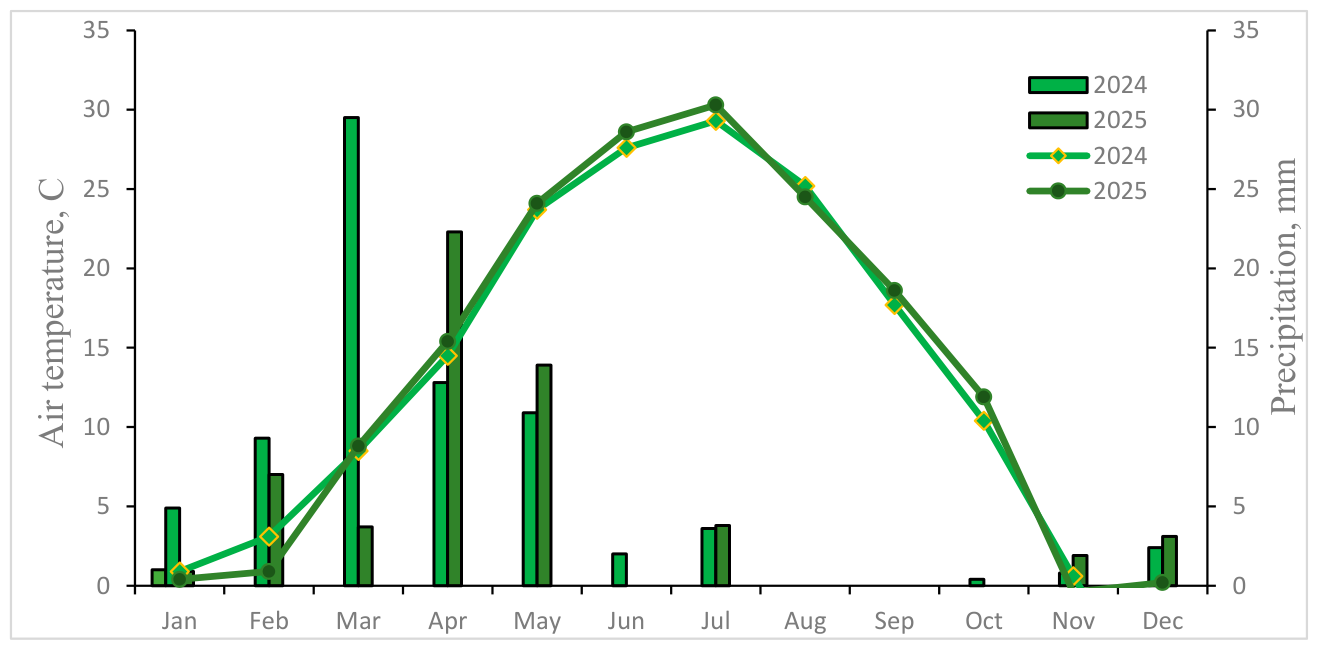
Figure 2.
Effect of co-inoculation with rhizobium strains on the correlation between nodule weight vs. grain yield and nodule weight vs. root dry weight of common bean in saline soil under continental climate (averaged across 2024 and 2025 growth seasons).
Figure 2.
Effect of co-inoculation with rhizobium strains on the correlation between nodule weight vs. grain yield and nodule weight vs. root dry weight of common bean in saline soil under continental climate (averaged across 2024 and 2025 growth seasons).
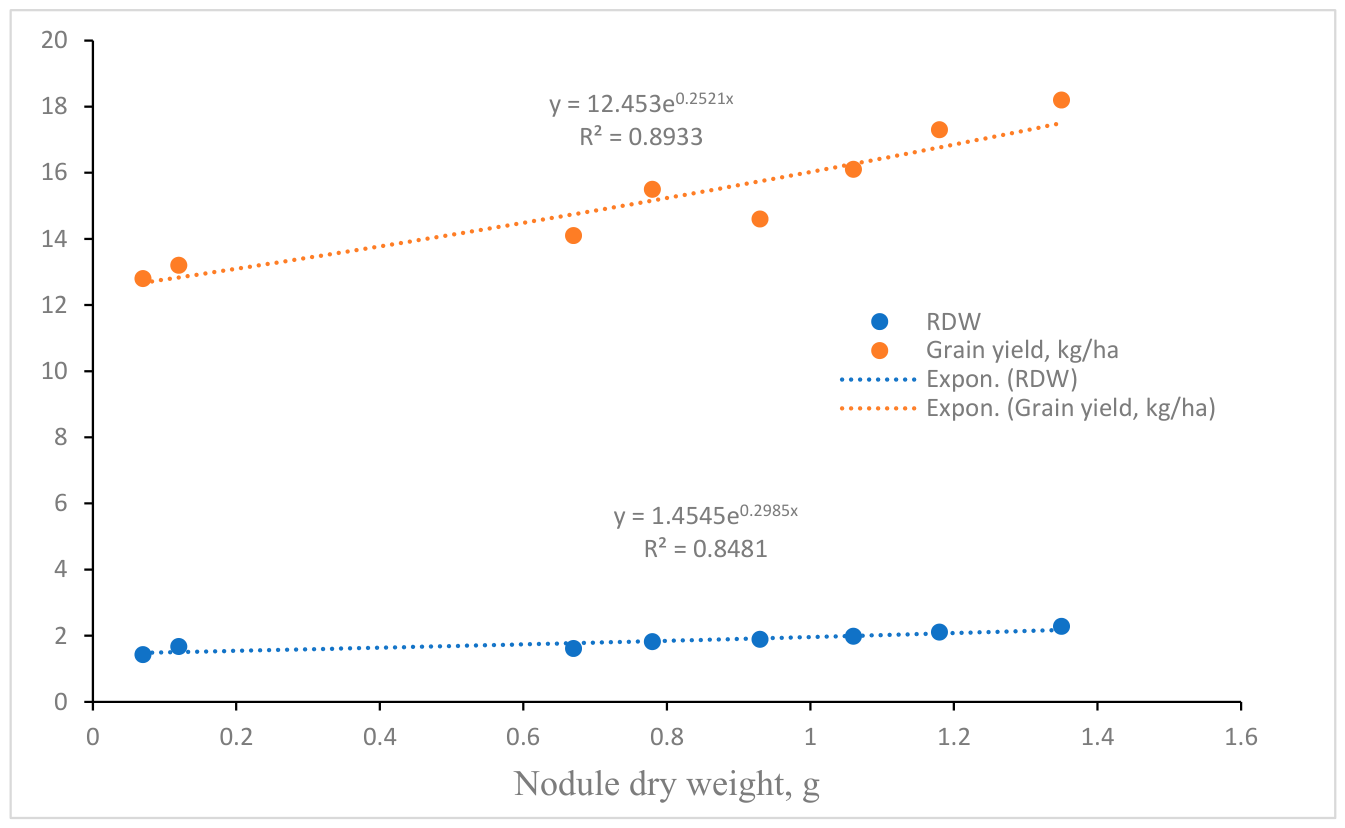

Table 1.
Soil chemical analysis of the experimental field.
| Soil horizons, cm | Total content, % | Mobile forms, mg/kg | |||||
| Humus | N | P | K | N-NO3 | P2O5 | K2O | |
| 0-30 30-50 |
0.62 0.51 |
0.58 0.46 |
0.80 0.73 |
2.30 1.80 |
4.06 3.27 |
30.0 15.0 |
160.5 141.0 |
Table 2.
Effect of inoculation with Rhizobium strains on the dry matter accumulation of common bean plant parts.
Table 2.
Effect of inoculation with Rhizobium strains on the dry matter accumulation of common bean plant parts.
| Treatments |
Shoot (g plant-1) |
Root (g plant-1) |
Leaf (g plant-1) |
Grain (g plant-1) |
Husk (g plant-1) |
| Control | 4.2d | 2.43d | 2.8d | 14.4d | 2.7d |
| R6 | 4.8c | 2.61c | 3.2c | 17.1c | 2.9c |
| R9 | 5.0b | 2.89b | 3.5b | 18.2b | 3.1b |
| R6+R9 | 6.2a | 3.11a | 3.7a | 20.1a | 3.3a |
| LSD 0.05 | 0.32 | 0.21 | 0.13 | 1.14 | 5.1 |
| CV(%) | 3.4 | 6.6 | 2.8 | 3.8 | 8.0 |
Means marked with different letters represent significant differences (p<0.05).
Table 3.
Effect of inoculation with Rhizobium strains on yield, protein and oil content of seeds of common bean in saline soil.
Table 3.
Effect of inoculation with Rhizobium strains on yield, protein and oil content of seeds of common bean in saline soil.
| Treatments |
Grain yield (Mg ha-1) |
Biomass (Mg ha-1) |
Weight of 1000 seeds (g) |
Protein content (%) |
Oil content (%) |
| Control | 1.28d | 2.81e | 215.6d | 22.6d | 2.2c |
| R6 | 1.41bc | 3.07de | 224.7c | 27.2b | 2.5b |
| R9 | 1.56b | 3.19d | 231.3b | 25.7c | 2.3b |
| R6+R9 | 1.85a | 3.83c | 244.8a | 28.8a | 2.6a |
| LSD 0.05 | 0.16 | 0.25 | 6.8 | 0.22 | 0.86 |
| CV(%) | 2.4 | 3.4 | 4.2 | 2.6 | 3.7 |
Means marked with different letters represent significant differences (p<0.05).
Table 5.
Impact of the applied biological interventions to soil physical and chemical structure.
| Treatments | Soil layer (cм) |
Soil bulk density (g сm-3) |
Soil salinity (dS m-1) |
Total forms (g kg-1) | Available forms (mg kg-1) | ||||
| Humus | N | P | N-NO3 | P2O5 | К2O | ||||
| Beginning of the experiment (2024 spring) | |||||||||
| Before the experiment | 0-30 | 1.16c | 5.58e | 0.62d | 0.58e | 0.80e | 4.06d | 30.0cd | 160c |
| The end of the experiment (2024 autumn) | |||||||||
| Control | 0-30 | 1.18c | 5.41d | 0.64c | 0.68d | 0.89d | 4.55c | 28.2d | 160c |
| R6 | 0-30 | 1.26b | 5.11c | 0.82b | 0.74c | 0.95c | 5.25b | 31.4c | 160c |
| R9 | 0-30 | 1.27ab | 4.94b | 0.87b | 0.81b | 0.90b | 6.55ab | 37.0b | 170b |
| R6+R9 | 0-30 | 1.29a | 4.45a | 0.85a | 1.05a | 1.15a | 6.72a | 46.0a | 180a |
Means marked with different letters represent significant differences (p<0.05).
Table 6.
Nutrients returned to the soil by crop residues and Ndfa (averaged across 2024-2025 growth seasons).
Table 6.
Nutrients returned to the soil by crop residues and Ndfa (averaged across 2024-2025 growth seasons).
| Treatments | Nutrients returned with residues (kg ha-1) |
Nodulation (plant-1) |
Ndfa (kg ha-1) |
Total returned nutrients (kg ha-1) |
||||
| N | P | K | N | P | K | |||
| Control | 12.1d | 5.8c | 16.9d | 3.8d | - | 12.1d | 5.8c | 16.9d |
| R6 | 17.9c | 6.1c | 20.4c | 31.2c | 30.6c | 48.5c | 6.1c | 20.4c |
| R9 | 20.4b | 8.2b | 22.8b | 40.8b | 41.9b | 62.3b | 8.2b | 22.8b |
| R6+R9 | 27.5a | 12.3a | 24.2a | 58.1a | 62.9a | 80.4a | 12.3a | 24.2a |
| LSD 0.05 | 2.3 | 1.4 | 1.1 | 5.7 | 5.6 | 8.6 | 1.6 | 1.2 |
| CV(%) | 4.5 | 3.5 | 3.6 | 5.4 | 4.7 | 4.3 | 3.2 | 3.5 |
Means marked with different letters represent significant differences (p<0.05).
Table 7.
Quantity of microorganisms in the rhizosphere as affected by the applied biological interventions (averaged across 2024 and 2025 growth seasons).
Table 7.
Quantity of microorganisms in the rhizosphere as affected by the applied biological interventions (averaged across 2024 and 2025 growth seasons).
| Treatment | Ammonifiers | Oligonitrophils | Micromycetes | Actinomycete |
| At the beginning of the experiment | ||||
| 5.2х107d | 3.1х106c | 5.5х104c | 4.2х105b | |
| At the vegetation period | ||||
| Control | 7.5х106d | 4.5х105d | 3.5х104d | 7.5х104e |
| R6 | 6.0х107c | 9.7х105d | 5.7х104c | 2.5х105c |
| R9 | 9.0х107b | 2.7х106b | 7.5х104b | 5.5х105b |
| R9+R6 | 4.5х108a | 4.5х106a | 4.3х105a | 4.5х106a |
| LSD0.05 | 1.4х107 | 1.1х106 | 2.1х104 | 0.9х105 |
| CV(%) | 4.5 | 5.0 | 4.5 | 5.3 |
Means marked with different letters represent significant differences (p<0.05).
Disclaimer/Publisher’s Note: The statements, opinions and data contained in all publications are solely those of the individual author(s) and contributor(s) and not of MDPI and/or the editor(s). MDPI and/or the editor(s) disclaim responsibility for any injury to people or property resulting from any ideas, methods, instructions or products referred to in the content. |
© 2026 by the authors. Licensee MDPI, Basel, Switzerland. This article is an open access article distributed under the terms and conditions of the Creative Commons Attribution (CC BY) license (http://creativecommons.org/licenses/by/4.0/).
Copyright: This open access article is published under a Creative Commons CC BY 4.0 license, which permit the free download, distribution, and reuse, provided that the author and preprint are cited in any reuse.