
Submitted:
08 October 2026
Posted:
09 October 2026
You are already at the latest version
Abstract
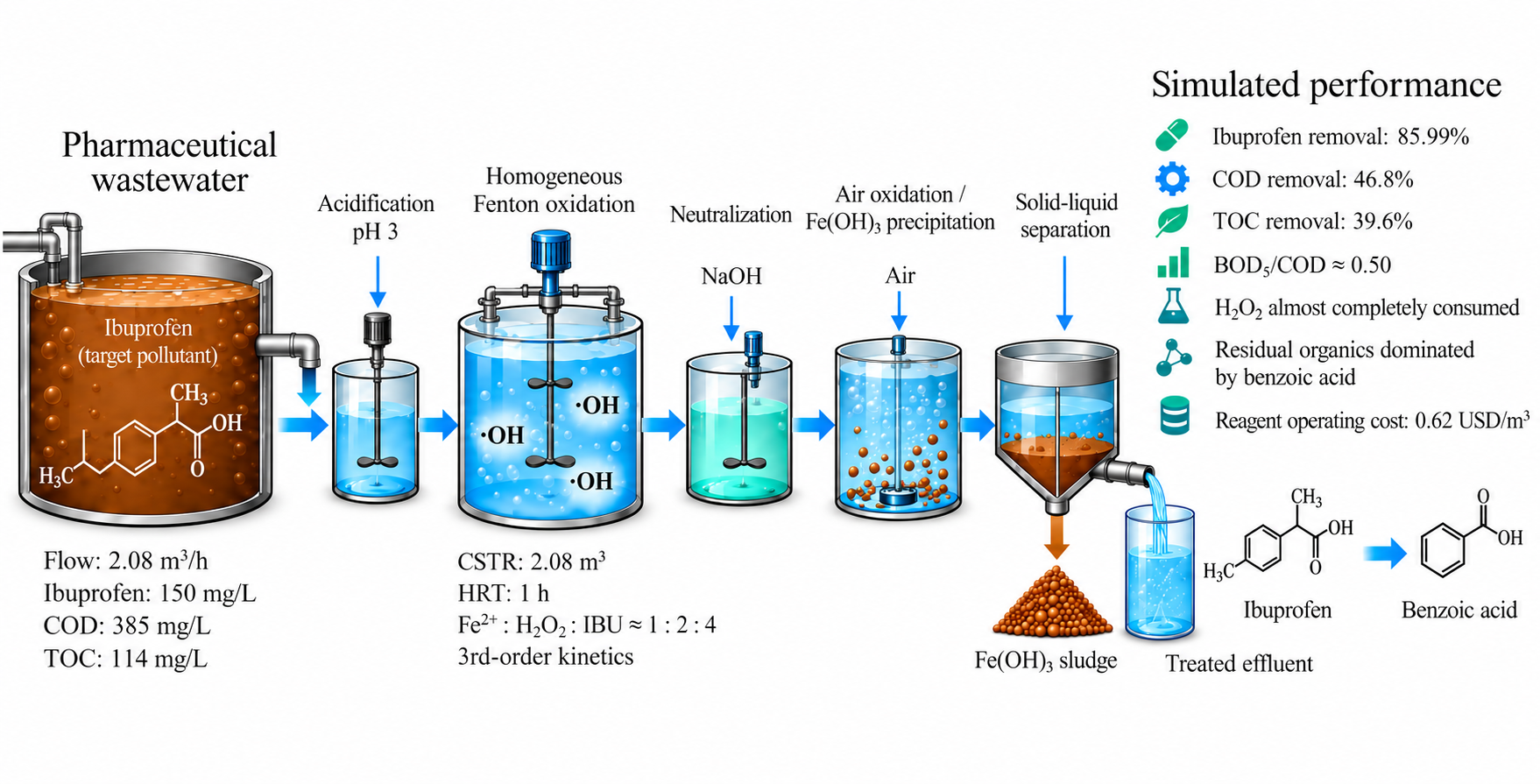
Ibuprofen is among the most widely consumed non-steroidal anti-inflammatory drugs and is frequently detected in wastewater treatment effluents, is not efficiently removed by conventional biological processes. In this study, a physicochemical treatment train−acidification, homogeneous Fenton oxidation, neutralization, iron oxidation/precipitation, and solid-liquid separation−was simulated in Aspen Plus for ibuprofen degradation (150 mg/L; COD 385 mg/L; TOC 114 mg/L) at a design flow of 2.08 m3/h. The Fenton reactor (CSTR, ≈2.08 m3, 1 h residence time) operated at pH 3, following third-order power law kinetics with a rate constant of 1.1×10⁶ m6/(kmol2-s) and an activation energy of 56.5 kJ/mol. At the design point (Fe2+:H2O2≈1:2.4). The model predicted 85.99% ibuprofen removal alongside 46.8% COD and 39.6% TOC removal (mass-load basis), with H2O2 consumed almost completely; a higher-dose scenario (≈1:10) was evaluated for comparison. The effluent’s BOD5/COD ratio (≈0.50) reflects a residual dominated by benzoic acid, a partial-oxidation by-product indicating incomplete mineralization. Residual dissolved iron was oxidized with air and precipitated as ferric hydroxide before separation, and the simulated reagent operating cost was 0.62 USD/m3 of treated effluent. These findings demonstrate that Aspen Plus provides a reliable framework for simulating Fenton-based ibuprofen degradation together with downstream iron management and preliminary process economics.
Keywords:
advanced oxidation processes
; hydroxyl radical
; pharmaceutical micropollutants
; wastewater treatment
Copyright: This open access article is published under a Creative Commons CC BY 4.0 license, which permit the free download, distribution, and reuse, provided that the author and preprint are cited in any reuse.