
Submitted:
01 November 2026
Posted:
03 November 2026
You are already at the latest version
Abstract
A transient force was observed with high-voltage capacitors switch-on/off by several teams with dozens of experiments. It is well-known that, in the maxwell equations, as an electric field is switched on/off, an instantaneous superstrong magnetic field can be produced. For the hypothesis of gravitational-magnetic field interaction, the superstrong magnetic field should make a transient variation of the gravitational acceleration. And, in another line, weight loss experiments with rotating superconductor in magnetic fields was observed by several teams. These experiments could be solid evidence for gravitational-magnetic field interaction. And, we presented that a large variation of gravity could be arrived at with superconductor.
Keywords:
gravitational-magnetic field interaction
; high-voltage capacitor
; switch-on/off
; Maxwell equation
; rotating superconductor
It is an old dream of human to control gravity. In 1843, Michael Faraday [1] tested the relation of gravity to electricity. Till nowadays, many ways have been tried to utilize gravity with electromagnetism.
In 2018, we presented that gravitational acceleration can be varied by strong magnetic/ electric field [2,3]
where is the gravitational acceleration, B is the magnetic flux density, E is the electric field intensity, is the gravitational redshift parameter, G, and are the gravitational, magnetic and electric constant.
In Eqs.(1) and (2), and are needed to make . [2] And, the measurable gravitational acceleration is . Therefore, it is difficult to test Eqs. (1) and (2). And, till now, such large a magnetic field has rarely been used in the experiments to test the relationship between gravity and magnetic field and the electric field with has not been used for this subject.
In recent we know, a transient force was observed from the experiments [4,5,6,7,8,9,10,11,12,13,14,15,16,17,18,19,20,21,22] with High-voltage Capacitors Switch-on/off by several teams. It is very important that the force was observed by every team while it is argued what is the reason for the force. Here, we presented that the force could be well explained with Eq.(1) and maxwell equations. And, a way to finally judge the reason for the transient force is presented.
1. Instantaneous Induced Superstrong Magnetic Field and Measurable
We presented in [3]: “A very large initial magnetic field can be produced from that an initial current is produced by that a switch is on/off”. Here, we continue to discuss the subject in detail.
In the maxwell equation, . Here, the current density need not be considered. As only the field strength of the magnetic field is considered, let , there is, . As an induced magnetic field is completely formed in the time , this magnetic field shall have reached its max volume. Thus, relative to , there is . Thus, can be treated as a constant. Let , , we have
where k=.
It is emphasized that, the time for an electric field or a current produced from that a key is switched on is shorter than from any other way. As an electrostatic field is formed/disappeared from switch-on/off, there is: , and . Thus, there is
It is noted that, as an electric field is producing from 0 to E or is fading away from E to 0, a time can be or . For example, the time for a capacitor charges/discharges can be on the level of or hours.
Eq.(3) shows that an instantaneous super strong magnetic field can be induced from that an electric field is switched on/off. However, it need be noted that a magnetic field with infinite field strength cannot really be arrived at.
It is emphasized here, it is well-known that a super strong magnetic field can be produced as an electric current is switched on/off. Therefore, the electric field can be replaced by a current. It also means that Eq. (3) are well-confirmed experimentally.
Usually, the electric field strength E, voltage, current and frequency are noted by the researchers in [4,5,6,7,8,9,10,11,12,13,14,15,16,17,18,19,20,21,22] While, from Eqs. (1) and (3) we know, k is a constant, although E is important for that it determines with the largest value , the value of B is mainly determined with for that as , . Switching-on/off a key is the best way to make . Therefore, Eqs. (1) and (3) could show that a very large could be produced by switching on/off an electric field.
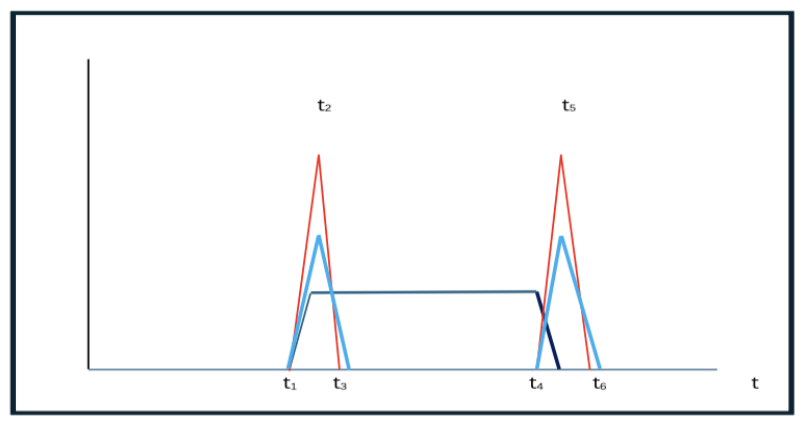
In a period of an electric field switch-on/off, the variation of gravity can be described with Figure 1.
Figure 1 shows that in a period of an electric field switch-on/off, the variation of gravity by the induced magnetic is with three features: 1) is impulse. The force can reach the largest value in a very short time of switch-on/off. 2) in a period of switch-on/off, there are two force impulses. relative to switch-on is symmetrical to that to switch-off. 3) as the electric field is steady, there are with , because of .
It is important, in many experiments, such as [4,6,7,8,11,12,22], the transient force produced from high-voltage capacitors is usually with two force impulses relative to the switch-on/off. In [4,6,7,8,11,12,22], if the observed force in the time that the electric field is steady (we call it steady force) is excluded, the observed two force impulses shall be highly accordant with that described in Figure 1. And, we think, the steady force should be noise produced from accelerometers. The Figure 3 and Figure 4 in [12] and the FIGs. 5,6,8 and 9 in [22] showed: 1) the difference between the steady force and noise is little; 2) the two force impulses are clear.
2. Discussion
The experiments and researchers that observed transient force produced with high-voltage capacitors switch-on/off are more than that cited in [4,5,6,7,8,9,10,11,12,13,14,15,16,17,18,19,20,21,22]. The researchers cited here are that they repeated their experiments several times. In all of the experiments, a transient force is measured under the condition that the capacitor is switched on/off. While different theoretical models with different equations were presented to predict the result. Generally, it is thought that the result is related with the electrostatic field E; while some think it is not a direct result of the electric field. For example, Porcelli and Filho [18] think it is an effect of quantum entanglement and Tajmar and co-workers [21] think it is a thermal effect.
But, in [4,5,6,7,8,9,10,11,12,13,14,15,16,17,18,19,20,21,22], it is omitted that, in maxwell equations, a magnetic field is certainly produced as an electrostatic field is switched on/off or a capacitor is charged/discharged. The time for a switch-on/off is very short, the induced magnetic field can be very strong. From Eqs.(1) and (2) we know, no electric field in the experiments [4,5,6,7,8,9,10,11,12,13,14,15,16,17,18,19,20,21,22] is strong enough to make a measurable variation of gravity while the induced magnetic field could be strong enough to make a very large variation of gravity. Therefore, we think, all of the theoretical models with equations in [4,5,6,7,8,9,10,11,12,13,14,15,16,17,18,19,20,21,22] should be questioned.
And, the two force impulses which was observed in many experiments [4,6,7,8,11,12,22] could not be explained with other reasons. From Eqs.(1) and (3) we know, the two force impulses reach the largest value only in the time of switch-on/off. And, in the time , an electric field from 0 to E is formed/disappeared. The variation of the electric field is with the largest value . Thus, in the time , a magnetic field, , is certainly produced for . Therefore, the two force impulses cannot be related to the steady electric field while it can be well related to the induced magnetic field. So, we prefer to believe, gravitational acceleration varied by strong magnetic field should have been well proven in [4,5,6,7,8,9,10,11,12,13,14,15,16,17,18,19,20,21,22].
In fact, it is easy to test Eqs.(1)-(3). From Eq.(3) we know, an induced magnetic field is determined with and . And, the electric field strength E is certain while is possible. Therefore, although E is important, the largest induced magnetic field B is mainly determined with . Thus, by regulating the time , the measured variation of gravity should be correspondently determined with . From Eqs.(1) and (3) we know,
Eq.(4) is a conclusive argument to judge whether the force in [4,5,6,7,8,9,10,11,12,13,14,15,16,17,18,19,20,21,22] is produced from the induced magnetic field.
According to Eqs.(1)-(4), as , a very large variation of gravity could be arrived at. Buhler’s team reported that they should have observed a force of 421 [9] and 10 mN [10] produced form capacitor switch-on/off. Such large a force from capacitor switch-on/off cannot be explained with anyone of the theoretical models in [4,5,6,7,8,9,10,11,12,13,14,15,16,17,18,19,20,21,22]. It should be the strongest evidence for that the variation of gravity by strong magnetic field should have been observed.
It is noted that, now, the observed largest magnetic field is . From Eq.(1) we know, the variation of gravity by such large a magnetic field is on the level of . [2] Maybe, the largest induced magnetic field could reach the level of . So, in general material, the largest variation of gravity by the magnetic field could not be larger than . But, in [3], it is presented
where is the relative permeability. For superconductor, there is . Therefore, it should be possible that a very large could be arrived at with superconductor or other materials under the condition that the magnetic field is on the level of . And, in Eq.(3), for a current, is strongly related with the resistor. For an electric field in a capacitor, is related with the materials of the capacitor. Therefore, it is an important subject that what is the best material for the capacitor to have the largest variation of gravity.
From Eqs.(4) and (5), it could be understood that why the force in [4,5,6,7,8,9,10,11,12,13,14,15,16,17,18,19,20,21,22] is varying in the range of . For different materials, the and are different which determine different value of the variation of gravity. As the experiment is repeated, the material for the experimental setup need be considered to arrive at right result.
Podkletnov [23] obtained weight loss of up to 2% under two main conditions: 1) rotating superconductor; 2) in magnetic fields up to 2T. Podletnov effect was not observed in some experiments [24] while observed in some other experiments. [25,26,27,28]. And, importantly, for Eqs.(1) and (5), his condition “in magnetic fields up to 2T” is important to arrive at a large variation of gravity; while is not used in [24,25,26,27,28].
It is noted that, there were different theoretical explanations for the experiments in [23,24,25,26,27,28]. But, it is certain that the foundation of these experiments is the rotating superconductor from which the effect is produced. And, as it is considered that a magnetic field is produced from the current of a rotating superconductor, we think, the experiments [25,26,27,28] could be another solid evidence for Eqs.(1) and (5). And, further and extensive testing Podkletnov effect is needed. It is emphasized that the superconductor in a strong magnetic field should be determined to arrive at a large variation of gravity. [23,28] And, as the magnetic field is steady, a steady force in a long time should be possible.
3. Conclusion
In the past 100 years, in many experiments with different ways by many researchers, it was observed that an anomalous force is related with electromagnetic field. Usually, so many experimental results are sufficient evidence to have a certain scientific conclusion. But, till now, it is being argued whether the anomalous force is a gravitational effect by electromagnetism. It is the reason that we have not had a commonly accepted theory for the relationship between gravity and electromagnetism. It results in that the experiment cannot be improved and repeated in right way to have predictable result. Therefore, it is the time to have a theory for the anomalous force related with electromagnetism. There are these requirements for the theory:
- 1)
- The experiments [4,5,6,7,8,9,10,11,12,13,14,15,16,17,18,19,20,21,22,23,25,26,27,28] can be well understood with the theory. If there should be the relationship between gravity and electromagnetism, it should be clear that the relationship is unique. The experimental results observed from high-voltage capacitors switch-on/off [4,5,6,7,8,9,10,11,12,13,14,15,16,17,18,19,20,21,22] and from rotating superconductor [23,25,26,27,28] could be explained with one single theory.
- 2)
- New experimental result can be predicted with the theory. And, larger experimental effect can be obtained by improving the experiment with the theory.
- 2)
- It is important that, for different materials,
and are different. Thus, as the materials of the device are different, the experiments [4,5,6,7,8,9,10,11,12,13,14,15,16,17,18,19,20,21,22,23,25,26,27,28] could not be repeated in the analogous experimental configuration. Therefore, it is required that the experiment can be rightly repeated according to the theory.
From these requirements, we have the conclusions:
- 1)
- 1)
- Gravitational-magnetic field interaction could be put into application. According to Eqs.(1), (3) and (5), a very large variation of gravity by magnetic field could be arrived at by applying superconductor and by making the time
under the condition that the variation of an electric field is large enough. And, a large (such as weight loss of up to 2% [23]) steady variation of gravity could be arrived at with steady magnetic field.
- The material is determined to arrive at a very large variation of gravity. First, the relative permeability
of the material is the most important. Second, it is better as the time is less to form an electric field in the capacitor. Third, it is better as the magnetism persisting in the materials is longer.
References
- Faraday, M. Experimental researches in electricity. Twenty-fourth series. On the possible relation of gravity to electricity. Commun. To R. Soc. Lond. 1843, 5, 994. [Google Scholar]
- Zhu, Y. Gravitational-magnetic-electric field interaction. Results Phys. 2018, 10, 794. [Google Scholar] [CrossRef]
- Zhu, Y. Gravitational-magnetic-electric interaction in controlling relative permittivity and permeability. 2021. [Google Scholar] [CrossRef]
- Woodward, J. F. Measurements of a Machean Transient Mass Fluctuation. Found. Phys. Lett. 1991, 4, 407. [Google Scholar] [CrossRef]
- Woodward, J. F. A Stationary Apparent Weight Shift From a Transient Machian Mass Fluctuation. Found. Phys. Lett. 1992, 5, 425. [Google Scholar] [CrossRef]
- Woodward, J. F. A Laboratory Test of Mach’s Principle and Strong-Field Relativistic Gravity. Found. Phys. Lett. 1996, 9, 247. [Google Scholar] [CrossRef]
- Woodward, J.; Mahood, T.; March, P. “Rapid spacetime transport and Machian mass fluctuations - Theory and experiment,” AIAA2001-3907. 37thJoint Propulsion Conference and Exhibit, 2001. [Google Scholar]
- Ventura, T. Charles Buhler and Exodus Technologies on Propellantless Propulsion. 2025. [Google Scholar]
- Aurigema, A. N.; et al. US 2024/0011469 A1; System and method for generating forces using asymmetrical electrostatic pressure. 2024.
- Plain, C. NASA Vateran’s Propellantless Propulsion Drive that Physics Says Shouldn’t Work Just Produced Enough Thrust to Overcome Earth’s Gravity; Debrief, 2024. [Google Scholar]
- Fearn, H. Experimental tests of the Mach Effect Thruster. Proc. Int. Astronaut. Congr. IAC 2014. [Google Scholar] [CrossRef]
- Fearn, H.; Zachar, A.; Wanser, K.; Woodward, J. Theory of a Mach Effect Thruster I. J. Mod. Phys. 2015, 6, 1510. [Google Scholar]
- Fearn, H.; Woodward, J.F. Recent Results of an Investigation of Mach Effect Thrusters. AIAA J. 2012. [Google Scholar] [CrossRef]
- Fearn, H.; van Rossum, N.; Wanser, K.; Woodward, J.F. Theory of a Mach Effect Thruster II. J. Mod. Phys. 2015, 6, 1868. [Google Scholar]
- Fearn, H.; Woodward, J.F. New Experimental Results for Mach Effect Gravitation Assist (MEGA) drives, in: AIAA Propuls. Energy Forum NNF, Indianapolis, 2019. [Google Scholar]
- Porcelli, E. B.; Filho, V. S. On the Anomalous Weight Losses in High-Voltage Symmetrical Capacitors. arXiv 2015, arXiv:1502.06915. [Google Scholar]
- Porcelli, E. B.; Filho, V. S. Characterisation of Anomalous Asymmetric High-Voltage Capacitors. IET Sci. Meas. Tech. 2016, 10(4), 383. [Google Scholar] [CrossRef]
- Porcelli, E. B.; Filho, V. S. Thrust from electric devices as source for anomalous effects on space probes. Metascience Aerosp. 2026, 3(1), 1. [Google Scholar] [CrossRef]
- Tajmar, M. Mach-Effect thruster model. Acta Astronaut 2017, 141, 8. [Google Scholar] [CrossRef]
- Tajmar, M.; Kößling, M.; Weikert, M.; Monette, M. The SpaceDrive Project-First Results on EMDrive and Mach-Effect Thrusters. 2018. [Google Scholar]
- Monette, M.; Kößling, M.; Tajmar, M. Experimental Investigation of Mach-Effect Thrusters on Torsion Balances. Acta Astronaut. 2021, 182, 531. [Google Scholar] [CrossRef]
- Buldrini, N. Verification of the thrust signature of a Mach effect device. In Wiener Neustadt; 2014. [Google Scholar]
- Podkletnov, E. Weak Gravitational Shilding Properties of Composite Bulk YBa-CuO, Superconductor Below 70 K under an EM Field. 1997. [Google Scholar]
- Hathaway, G.; Cleveland, B.; Bao, Y. Gravity modification experiment using a rotating superconducting disk and radio frequency fields. Physica C 2003, 385(4), 488. [Google Scholar] [CrossRef]
- Tajmar, M.; Plesescu, F.; Seifert, B.; Marhold, K. Measurement of Gravitomagnetic and Acceleration Fields Around Rotating Superconductors. arXiv 2006, arXiv:gr. [Google Scholar]
- Tajmar, M.; Plesescu, F.; Marhold, K.; de Matos, C.J. Experimental Detection of the Gravitomagnetic London Moment. gr-qc/0603033. 2006. [Google Scholar] [CrossRef]
- Tajmar, M.; de Matos, c. Gravitomagnetic Fields in Rotating Superconductors to Solve Tate’s Cooper Pair Mass Anomaly. arXiv 2006, arXiv:gr. [Google Scholar]
- Fetisov, A.V. New experimental evidence for Podkletnov effect. arXiv 2025, arXiv:2209.03332v3. [Google Scholar]
Figure 1.
Variation of gravity produced by an electric field switch-on/off. Black line is electric field E, red line is the induced magnetic field B, green line is the variation of gravity . 1) As switch-on, an electric field is produced from E=0, t=t1 to E=E, t=t2; a magnetic field is induced from B=0, t=t1 to B=B, t=t’2, and B is fading away to B=0, t=t3 as E is steady; correspondent to the magnetic field, a variation of gravity should be produced from =0, t=t1 to , t=t’2 and is fading away to =0, t=t’3. 2) As E is steady, in the time Dt=t4-t2, there are and B=0, =0. 3) As switch-off, the electric field is fading away from E=E, t=t4 to E=0, t=t5; a magnetic field is induced from B=0, t=t4 to B=B, t=t’5, and B is fading away to B=0, t=t’6 as E is disappeared; correspondently a variation of gravity should be produced from =0, t=t4 to , t=t’5, and is fading away to =0, t=t’6 as the electric field is disappeared. It is noted that .
Disclaimer/Publisher’s Note: The statements, opinions and data contained in all publications are solely those of the individual author(s) and contributor(s) and not of MDPI and/or the editor(s). MDPI and/or the editor(s) disclaim responsibility for any injury to people or property resulting from any ideas, methods, instructions or products referred to in the content. |
© 2026 by the authors. Licensee MDPI, Basel, Switzerland. This article is an open access article distributed under the terms and conditions of the Creative Commons Attribution (CC BY) license (http://creativecommons.org/licenses/by/4.0/).
Copyright: This open access article is published under a Creative Commons CC BY 4.0 license, which permit the free download, distribution, and reuse, provided that the author and preprint are cited in any reuse.