

Submitted:
07 October 2026
Posted:
09 October 2026
You are already at the latest version
Abstract
This study examines how truth claims are constructed, contested, and negotiated within the liquid digital environment, extending Zygmunt Bauman's (2000, 2007) theory of liquid modernity into digital epistemology. Using a triangulated qualitative design combining phenomenological inquiry, digital ethnography, and critical discourse analysis, the research investigated how individuals navigate competing truth claims within an increasingly fluid and algorithmically mediated information ecosystem. Data comprised 45 in-depth interviews with social media users in the United States, the United Kingdom, and Canada; 12 months of digital ethnographic observation across six platforms; and critical discourse analysis of 500 digital interactions concerning contested truth claims posted between 2016 and 2025. The findings show that the digital environment has reorganized the epistemic frameworks through which participants assess reality, producing adaptive credibility strategies alongside heightened ontological insecurity. Three mechanisms emerged through which digital liquidity shapes truth perception: algorithmic mediation of visibility, performative authenticity across multiple identities, and epistemic communities that sustain parallel truth ecosystems. Seventy-eight percent of participants reported diminished confidence in discerning truth online, even as they described sophisticated heuristics for managing uncertainty, including lateral reading, epistemic patience, and the cultivation of algorithmic personas. Awareness of generative artificial intelligence produced a condition of synthetic doubt, in which the mere possibility of machine authorship became grounds for doubting any content. Integrating these findings with recent experimental, meta-analytic, and philosophical scholarship on algorithmic amplification, testimonial trust, and synthetic media, the study proposes liquid epistemology as a framework capturing the fluid, contextual, and perpetually renegotiated character of truth in digital spaces, considers its transferability to high-connectivity, high-trust societies such as Saudi Arabia, and identifies priorities for comparative, longitudinal, and intervention research.
Keywords:
liquid modernity
; digital epistemology
; truth construction
; social media
; ontological security
; epistemic communities
; digital ethnography
; information disorder
; algorithmic mediation
; generative artificial intelligence
1. Introduction
The transformation of human communication and knowledge production in the digital age is among the most consequential sociological phenomena of the twenty-first century. The proliferation of networked technologies since the mid-2000s has altered how individuals construct, share, and validate truth claims (Tufekci, 2017; Van Dijck et al., 2018). This study investigates the relationships among truth, doubt, and persuasion within what can be characterized as a liquid digital environment, a conceptual extension of Bauman’s (2000) theory of liquid modernity into digital communication ecosystems Al-Jumiah, A. 2025, October 22).
The digital revolution has not merely changed the speed and scale of information transmission; it has restructured the epistemological foundations on which societies build consensus about reality (Couldry & Hepp, 2017). Between January 2015 and January 2025, global internet penetration rose from 42% to 68% of the world’s population, and social media user identities grew from 2.08 billion to 5.24 billion (Kemp, 2015, 2025b). Trust in news did not keep pace: average cross-market trust stood at 44% in 2018 and had settled at 40% by 2025, where it has remained for three consecutive years (Newman et al., 2018, 2025). The 2025 Reuters Institute survey also records that 58% of respondents across 48 markets worry about distinguishing what is real from what is false online, that 40% sometimes or often avoid the news, and that 7% already use generative AI chatbots to access news weekly, rising to 15% among those under 25 (Newman et al., 2025). Table 1 consolidates these connectivity, trust, and epistemic-concern indicators.
As Table 1 shows, the defining pattern of the past decade is not growth alone but divergence: connectivity has expanded relentlessly while trust in the institutions that once certified public knowledge has stagnated and self-reported uncertainty about what is real has risen. This widening gap forms the empirical backdrop for the present study. Unprecedented connectivity has consolidated what Castells (2010) describes as the network society, in which the vertical hierarchies that once governed knowledge validation have been supplemented, and in many domains supplanted, by horizontal, peer-to-peer information flows.
Bauman’s (2000, 2007) concept of liquid modernity offers a powerful lens for these transformations. Bauman argued that society has shifted from a solid phase, characterized by stable institutions, fixed roles, and enduring values, to a liquid phase marked by constant change, flexibility, and the dissolution of traditional boundaries. This liquidity manifests acutely in digital spaces, where information flows continuously, identities are perpetually reconstructed, and the boundary between truth and falsehood becomes increasingly permeable (Baym, 2015; boyd, 2014). Lee (2022) adds an important qualification: the platforms that dissolve epistemic boundaries also enable new forms of algorithmic control, producing a partial resolidification of power through data accumulation, a tension that recurs throughout the analysis. Figure 1 visualizes the divergence summarized in Table 1 alongside the 2025 indicators of epistemic concern.
Scholarship has explored how digital liquidity affects social life: social media produce context collapse, in which multiple audiences converge within a single space and demand complex performances of authenticity (Marwick & boyd, 2011), and computational propaganda blurs the distinction between authentic and inauthentic communication (Woolley & Howard, 2018). Yet field experiments during the 2020 U.S. election found that altering Facebook and Instagram feed algorithms changed what users saw without measurably affecting polarization or attitudes (Guess et al., 2023; Nyhan et al., 2023), and Metzler and Garcia (2024) caution that recommendation systems typically amplify pre-existing social drivers rather than generating them independently.
The COVID-19 pandemic accelerated these dynamics, producing what the World Health Organization termed an infodemic, an overabundance of information, including misinformation, that makes trustworthy guidance hard to locate (Zarocostas, 2020); exposure to COVID-19 misinformation was associated with reduced vaccination intent and compliance (Loomba et al., 2021; Roozenbeek et al., 2020). Accessible generative artificial intelligence has added further complexity since 2022. Readers cannot reliably distinguish GPT-3-generated tweets from human-written ones and find synthetic disinformation at least as credible (Spitale et al., 2023), while a scoping review documents generative AI’s dual role in producing and detecting misinformation (Park & Nan, 2026). These developments raise fundamental questions about authorship, authenticity, and truth that this study takes up in examining participants’ strategies for evaluating AI-generated content.
1.1. Research Problem
The central problem this research addresses is the epistemological crisis emerging from the intersection of liquid modernity and digital communication technologies. In an environment characterized by information abundance, algorithmic curation, and the erosion of traditional gatekeeping, individuals face unprecedented challenges in determining what constitutes reliable knowledge (Zuboff, 2019). This problem manifests across several interconnected dimensions.
First, the velocity and volume of information circulation create perpetual uncertainty. Vosoughi et al. (2018) demonstrated that falsehoods on Twitter diffused farther, faster, and deeper than the truth, with true stories taking about six times as long as false ones to reach 1,500 people. This asymmetry creates a structural bias toward novel, emotionally charged content, compounded by the algorithmic amplification of engagement-optimized material regardless of veracity (Gillespie, 2018). Budak et al. (2024) nonetheless show that exposure to false content is on average low and concentrated among a small, motivated minority, a reminder that the problem is as much one of perceived epistemic instability as of measured exposure.
Second, the multiplication of sources has eroded traditional epistemic authorities. Whereas earlier generations relied on universities, professional journalism, and scientific bodies to validate claims, contemporary users encounter a cacophony of competing voices, each claiming legitimacy (Ekström et al., 2020). Influencer culture exemplifies what Barzilai-Nahon (2008) theorizes as network gatekeeping, in which authority is distributed and continuously renegotiated; online influencers and politicians are now tied, at 47% each, as the sources people worldwide regard as the greatest misinformation threat (Newman et al., 2025).
Third, the personalization of information flows creates what Pariser (2011) termed filter bubbles, although subsequent research distinguishes more precisely between echo chambers and the structurally closed condition of epistemic bubbles (Nguyen, 2020; Turner, 2025). These mediations shape not only what individuals encounter but how they evaluate truth claims; Bail et al. (2018) show that exposure to opposing viewpoints can increase rather than reduce polarization, so the problem extends beyond exposure to diverse information.
Fourth, the performative nature of digital identity creates tension between authentic self-expression and strategic self-presentation. Goffman’s (1959) dramaturgical framework, updated for digital contexts by Hogan (2010) and Duffy (2017), shows how individuals manage multiple, sometimes contradictory, performances of self, often prioritizing belonging over epistemic accuracy (Osmundsen et al., 2021).
The problem is further complicated by what Harsin (2015) terms regimes of post-truth, in which objective truth is itself called into question. Popescu-Sarry (2024) argues that post-truth is better understood as misplaced distrust in testimony than as indifference to facts, so that interventions must rebuild testimonial trust rather than merely supply more facts, and Hoggan-Kloubert and Hoggan (2023) characterize it as rooted in eroded deliberation, autonomy, and pluralism, conditions that resonate with Bauman’s account of dissolved authority. The proliferation of terms such as “alternative facts” since 2016 signals a broader crisis in how societies establish consensus about reality (Block, 2019; McIntyre, 2018).
1.2. Research Objectives
This study pursues five objectives: to examine how individuals develop strategies for assessing credibility under epistemic uncertainty and how these strategies evolve with changing affordances; to analyze how algorithmic mediation, through recommendation, moderation, and platform architecture, shapes what becomes visible and credible, and the extent of user awareness of and resistance to curation; to investigate how the performative demands of digital self-presentation shape which truths individuals acknowledge, share, or challenge; to identify how epistemic communities form, maintain boundaries, and shape individual approaches to validation; and to develop a theoretical framework that captures the epistemological conditions distinctive of liquid digital environments by synthesizing the findings with sociological theory.
1.3. Research Questions
The primary research question guiding this investigation is: How do individuals navigate, construct, and validate truth claims within the liquid digital environment of contemporary social media platforms? Six secondary questions specify this inquiry.
RQ1: What strategies and heuristics do individuals employ to assess the credibility of information encountered in digital spaces, and how do these strategies differ across demographic groups and levels of digital literacy?
RQ2: How do algorithmic recommendation systems and platform affordances shape users’ exposure to and evaluation of truth claims, and to what extent are users aware of these mediating influences?
RQ3: In what ways does the management of multiple digital identities across platforms affect individuals’ willingness to engage with, share, or challenge specific truth claims?
RQ4: How do epistemic communities form and maintain boundaries in digital spaces, and what role do these communities play in shaping individual approaches to truth validation?
RQ5: What forms of doubt, uncertainty, and epistemic anxiety emerge from navigating liquid digital environments, and how do individuals manage these psychological and social challenges?
RQ6: How has the introduction of generative AI and synthetic media since 2022 affected users’ trust in digital information and their strategies for truth verification?
1.4. Significance of the Study
Theoretically, the study extends sociological understanding of how liquid modernity manifests within digital communication ecosystems. By developing the concept of liquid epistemology, it offers digital sociology, media studies, and science and technology studies new analytical tools and answers calls for interpretive, experience-near research on credibility evaluation that quantitative measures alone cannot supply (Malhotra et al., 2025).
Practically, the findings can inform digital literacy education and platform design. Meta-analytic and experimental evidence shows that well-designed, skill-based literacy interventions measurably improve resilience to misinformation (Huang et al., 2026; Huang & Hu, 2025; Qian et al., 2023), and a growing toolbox of individual-level interventions, from accuracy prompts to psychological inoculation, has been catalogued and evaluated (Kozyreva et al., 2024; Roozenbeek et al., 2022). This study’s qualitative findings help translate that literature into curricular direction grounded in lived epistemic practice.
Societally, the significance is acute: health misinformation during the pandemic showed how epistemic confusion translates into public health crises (van der Linden et al., 2020), and the erosion of shared truth frameworks challenges democratic deliberation and cohesion (Bennett & Livingston, 2018). Finally, as generative AI grows more sophisticated and as governments and platforms invoke AI governance narratives to manufacture public confidence (Schmid et al., 2026), understanding how ordinary users adapt their epistemic practices becomes crucial. The research offers baseline qualitative evidence against which future change can be measured.
1.5. Thesis Statement
This study argues that the liquid digital environment has transformed epistemic practice, creating conditions in which truth is no longer discovered or verified through traditional means alone but is continuously performed, negotiated, and reconstructed through interactions among human agents, algorithmic systems, and platform affordances. Rather than a simple degradation of truth or a descent into relativism, these liquid practices constitute adaptive responses to structural uncertainty, generating collective sense-making that operates through provisional consensus, contextual validation, and recursive doubt. Individuals develop sophisticated, often tacit, strategies for navigating uncertainty while experiencing profound anxiety about their capacity to distinguish truth from falsehood, a paradoxical condition in which skepticism and credulity coexist and reinforce one another.
2. Literature Review
This section reviews the scholarship that informs the study, drawing on work published between 2006 and 2026: digital epistemology and credibility research (2.1), platforms and algorithmic mediation (2.2), identity and epistemic positioning (2.3), post-truth and information disorder (2.4), generative AI (2.5), literacy interventions (2.6), and digital epistemology beyond the Anglophone contexts in which most of this research has been conducted (2.7).
2.1. The Evolution of Digital Epistemology and Credibility Research
Early work on digital epistemology, exemplified by Lynch’s (2016) analysis of epistemic dependence in networked environments, focused on how connectivity created new forms of testimonial knowledge and reliance on technological systems. Credibility research developed in parallel. Tandoc et al. (2018) proposed a framework of audiences’ “acts of authentication,” distinguishing internal authentication, which draws on intuition and prior knowledge, from external authentication, which consults other sources or people. Wineburg and McGrew (2019) showed that professional fact-checkers reach more warranted credibility judgments in less time than historians or students because they read laterally, leaving a page to check what other sources say about it, rather than vertically. Fletcher and Nielsen (2019) found across four countries a “generalised scepticism” toward both algorithmic and editorial news selection, suggesting that distrust is diffused across the news environment rather than targeted at algorithms.
Nguyen’s (2020) distinction between echo chambers and epistemic bubbles advanced the field by separating mere exposure limitation, where contrary information is simply absent, from the more entrenched condition in which outside testimony is actively discredited within a closed evidential system. Turner (2025) argues that participation in online epistemic bubbles corrodes open-mindedness independent of the specific beliefs reinforced, so that the harm lies as much in epistemic character as in false belief.
The pandemic catalyzed rapid growth in this research. Vraga and Bode (2021) documented strategies for addressing health misinformation preemptively and responsively; Pennycook et al. (2021) showed that accuracy prompts improve sharing discernment; Ecker et al. (2022) synthesized the drivers of misinformation belief, emphasizing intuitive processing, repetition, and identity-protective motivation; and Roozenbeek et al. (2022) showed in a YouTube field experiment that short inoculation videos improve recognition of manipulation techniques, a logic extended to health communication by Roozenbeek and van der Linden (2022). These studies highlight both the vulnerability and the latent resilience of digital epistemic practices, a duality central to the findings below.
2.2. Platform Studies and Algorithmic Mediation
Platform studies have shown how technical architectures and business models shape epistemic possibilities. Gillespie’s (2018) analysis of content moderation reveals how decisions about visibility and ranking create de facto epistemic hierarchies. Bucher’s (2017) concept of the algorithmic imaginary illuminates how users develop folk theories about platform operations that shape their information-seeking and validation practices, and her later work shows how algorithmic power operates through the conditional logics that structure visibility (Bucher, 2018); Toff and Nielsen (2018) document related folk theories of “distributed discovery,” in which people assume that important news will find them. Van Dijck et al. (2018) show how platforms have become infrastructural to social life, mediating knowledge production through datafication, commodification, and algorithmic selection, and Zuboff (2019) identifies an epistemic inequality in which platforms’ asymmetric knowledge about users enables unprecedented influence.
More recent quantitative work complicates any purely deterministic account. In the largest field experiments to date, replacing the engagement-ranked feed with a reverse-chronological feed on Facebook and Instagram during the 2020 U.S. election substantially altered exposure but did not measurably change polarization, knowledge, or attitudes (Guess et al., 2023), and reducing exposure to like-minded sources by about one third likewise had no measurable attitudinal effects (Nyhan et al., 2023). Synthesizing experimental and observational studies, Metzler and Garcia (2024) argue that algorithms amplify pre-existing social drivers, such as partisan identity and motivated reasoning, rather than independently causing belief change, so that psychology and architecture co-produce outcomes. Research on algorithm literacy complements this view: Swart (2021) shows that young people engage with algorithmic news selection in tacit and affective rather than technical ways, and Dogruel et al. (2022) have validated a scale that distinguishes awareness of algorithms from knowledge about them, confirming that awareness is only loosely coupled to understanding and control.
2.3. Identity, Performance, and Epistemic Positioning
Papacharissi’s (2015) work on affective publics shows how emotional and identity-based logics drive information sharing and validation, so that epistemic positions become as much about belonging as about accuracy, and Osmundsen et al. (2021) provide behavioral evidence that partisan polarization, rather than ignorance, is the primary motivation behind sharing political fake news. Duffy’s (2017) examination of aspirational labor reveals how the pressure to maintain engaging personas affects which truths individuals acknowledge, so that epistemic integrity may conflict with social and economic imperatives. Marwick and boyd’s (2011) theory of context collapse shows how the convergence of audiences forces individuals to address epistemic communities with incompatible evaluative frameworks, often producing strategic ambiguity, and Hogan (2010) adds that much of what is encountered online is curated exhibition mediated by platform algorithms acting as third-party curators, a distinction that anticipates this study’s findings on algorithmic personas.
2.4. Post-Truth, Misinformation, and Information Disorder
McIntyre’s (2018) philosophical analysis traces how the denial of scientific facts evolved from tobacco-industry strategies through climate denial to contemporary information warfare, revealing post-truth not as mere lying but as a systematic attack on the institutions that establish truth. Wardle and Derakhshan’s (2017) framework distinguishes misinformation, disinformation, and malinformation, a taxonomy that remains essential for targeted interventions. Two recent contributions refine this literature. Hoggan-Kloubert and Hoggan (2023) characterize post-truth as an epistemic crisis grounded in the erosion of rational deliberation, autonomy, and pluralistic exchange, arguing for renewed investment in deliberative educational spaces. Popescu-Sarry (2024) contends that what is labeled indifference to facts is more accurately a crisis of misplaced distrust in testimony, shifting the practical focus from correcting beliefs to rebuilding trustworthy relationships between citizens and epistemic institutions. Together, this work suggests that post-truth conditions are less a collapse of concern for truth than a redistribution of trust away from institutional testimony and toward interpersonal and community sources, a pattern strongly corroborated by the findings reported below.
Lazer et al. (2018) argue that fake news requires a coordinated scientific response, and Vosoughi et al. (2018) supply empirical grounding for this urgency. Yet the field has also turned a critical eye on itself. Altay et al. (2023) identify “misinformation on misinformation,” cautioning that prevalence is often overestimated, that fake news is a small share of most media diets, and that alarmist narratives can themselves erode trust in reliable sources. Budak et al. (2024) reach a complementary conclusion, arguing that exposure is concentrated among a small, motivated minority and that algorithms play a smaller role in diffusion than commonly assumed. Pennycook and Rand (2021) locate much of the vulnerability not in ideology but in inattention. These correctives matter here because they suggest that the subjective sense of epistemic instability documented below may exceed objective exposure to falsehood, a possibility addressed in the Discussion.
2.5. Generative AI, Synthetic Media, and Emerging Epistemic Challenges
Chesney and Citron (2019) anticipated the challenges of synthetic media, coining the term “liar’s dividend” to describe how the mere existence of convincing fakes allows genuine evidence to be dismissed as fabricated. Fallis (2021) argues that deepfakes undermine the evidential reliability that historically made photographic and video evidence a trusted foundation for testimony and legal proof, and Rini and Cohen (2022) extend this analysis to the corrosive effect of deepfakes on the reliability of audiovisual evidence as a category. Vaccari and Chadwick (2020) supplied early experimental evidence, finding that political deepfakes did not primarily deceive viewers but generated uncertainty, which in turn reduced trust in news on social media. Lundberg and Mozelius (2025), drawing on forum analyses and expert interviews, conclude that deepfakes threaten to erode overall trust in news media, including trust in authentic journalistic content.
Experimental studies of AI-generated text reach parallel conclusions. Kreps et al. (2022) found that readers judged GPT-2-generated news stories about as credible as human-written ones, and Spitale et al. (2023) found that participants could not reliably distinguish GPT-3-authored tweets from human-authored ones. Altay and Gilardi (2024) add a further twist: people are skeptical of headlines labeled as AI-generated even when true or human-made, because they assume full automation, so provenance labels can reduce trust in accurate information. Park and Nan (2026) conclude from a scoping review that generative AI lowers the cost of producing convincing falsehoods while enabling new detection tools, so that its net epistemic effect depends on governance rather than on the technology itself.
How, then, might users build resistance to synthetic media? Qian et al. (2023) show that training in reverse image search improves detection of out-of-context visual content, or “cheapfakes,” and Huang and Hu (2025) find that generic warning labels are insufficient for AI-generated video and that only skill-based interventions produce durable gains in deepfake detection. The challenge posed by generative AI is therefore pedagogical as much as technological, a theme that this study’s findings on participants’ self-taught heuristics corroborate.
2.6. Digital Literacy Interventions: Evidence and Limits
Because this study’s recommendations depend on the efficacy of literacy-based interventions, the state of evidence matters. Huang et al.’s (2026) meta-analysis of 49 experimental studies and 81,155 participants finds that media literacy interventions reliably improve resilience to misinformation, with larger effects for multi-session delivery and active skill-building, and with stronger effects in cultural contexts characterized by higher uncertainty avoidance. Kozyreva et al. (2024) catalogue the broader toolbox of individual-level interventions, including accuracy prompts, inoculation, lateral reading training, and credibility labels, and both syntheses caution that effects decay without reinforcement. If interventions are effective when well designed, then experience-near findings about what users actually do and struggle with offer essential material for designing interventions responsive to lived practice. Consistent with this orientation, Malhotra et al. (2025) argue that credibility judgments are culturally situated practices that quantitative measures cannot adequately capture, a position that directly informs the present design.
2.7. Digital Epistemology Beyond the Anglophone Core
Most of the research reviewed above was conducted in North America and Western Europe, where high connectivity coincides with low institutional trust. Saudi Arabia is an instructive contrasting case: internet penetration reached 99.0% of the population in January 2025, with social media user identities equivalent to 99.6% (Kemp, 2025c), while the 2025 Edelman Trust Barometer ranked the Kingdom first among 28 surveyed countries in trust in government (Edelman, 2025). Alasmari et al. (2021), analyzing 3.8 million Arabic-language tweets and a community survey during the first months of the pandemic, found that rumors reached people more often through private messaging (WhatsApp, approximately 46%) than through Twitter (approximately 41%) and suggest that prompt institutional communication, including daily Ministry of Health briefings and verified-information applications, helped limit misinformation. Fayez et al. (2026), surveying 800 young adults in Saudi Arabia, Egypt, and Yemen, report strong associations between digital media literacy competencies and fake-news handling skills, with more intensive social media users reporting stronger skills, and Alfalah et al. (2025), studying 631 participants in Saudi Arabia’s Hail Region, find that digital inclusion, rather than access or literacy alone, mediates the contribution of digitalization to human development. These studies suggest that connectivity, trust, and epistemic practice are configured differently where institutional testimony retains public confidence, a possibility examined in the Discussion. Table 2 consolidates the most recent studies drawn upon in this review.
As Table 2 indicates, the recent literature converges on three propositions that frame the empirical analysis: algorithms amplify rather than create the social drivers of epistemic fragmentation; post-truth is best understood as a redistribution of trust rather than indifference to facts; and resilience to misinformation, including synthetic media, is learnable through skill-based rather than warning-based interventions. The present study tests the experiential plausibility of each proposition against the accounts of digital users themselves.
3. Theoretical Framework
The theoretical framework integrates sociological and communication theories to understand truth navigation in liquid digital environments. At its foundation lies Bauman’s (2000, 2007) concept of liquid modernity, the overarching metaphor for social conditions characterized by constant change, the dissolution of stable structures, and the individualization of life projects. The framework is particularly relevant to digital environments, where the solid structures of media gatekeeping, institutional authority, and stable identity categories have given way to fluid, network-based, continuously reconfigured arrangements. Information takes the shape of its containers (platforms) while retaining its fluidity: trends rise and dissipate quickly, consensus forms and dissolves rapidly, and individuals must adapt their epistemic strategies accordingly. At the same time, the study follows Lee’s (2022) qualification that liquidity and solidity are co-constitutive within digital modernity: the platforms that dissolve epistemic hierarchies accumulate durable control over data, visibility, and attention, so that databases become “the new localities of power.” Participants experienced this tension directly, describing platforms as spaces of constant flux governed by opaque and comparatively fixed algorithmic logics.
The framework next incorporates Giddens’s (1991) theory of ontological security. Giddens argues that modern individuals must trust abstract systems they cannot fully understand or verify, creating a tension between security and anxiety. In digital environments, this manifests as reliance on algorithmic systems and distributed networks of validation that operate beyond individual comprehension, which helps explain why epistemic uncertainty produces existential anxiety rather than merely intellectual confusion. Schmid et al. (2026) extend this insight to governance, showing that governmental narratives about artificial intelligence manufacture public confidence discursively rather than through demonstrated reliability, a dynamic directly relevant to participants’ relationship with generative AI (Theme 5).
Actor-network theory (Latour, 2005) adds an understanding of truth as constructed through assemblages of human and non-human actors, including algorithms, interfaces, databases, and automated agents, so that agency is distributed across socio-technical networks and truth emerges from interaction rather than being discovered or imposed. Media ecology (Postman, 1985/2005; Strate, 2017) contributes the insight that communication technologies shape not merely what people communicate but how they think and what they consider knowable; the digital affordances of searchability, persistence, replicability, and scalability create epistemic conditions that differ fundamentally from those of print or broadcast media.
Two further bodies of work supply middle-range concepts. The distinction between echo chambers and epistemic bubbles (Nguyen, 2020; Turner, 2025) specifies the boundary-maintenance dynamics through which communities insulate themselves from correction, and the amplification model of algorithmic influence (Metzler & Garcia, 2024), supported by field experiments (Guess et al., 2023; Nyhan et al., 2023), specifies the relationship between user agency and platform architecture that the study’s account of algorithmic negotiation develops. Table 3 consolidates these perspectives and the analytic contribution each makes.
The perspectives in Table 3 are nested: liquid modernity and its resolidification describe the macro-structural condition; ontological security and actor-network theory describe how individuals and assemblages respond to it; and media ecology, epistemic bubbles, and algorithmic amplification supply the meso-level mechanisms through which responses are channeled. This nesting scaffolds both the methodology described next and the interpretation of the five empirical themes.
4. Methodology
This section describes how the study was designed and conducted. Over 18 months (January 2024 to June 2025), the research combined semi-structured interviews with 45 participants in the United States, the United Kingdom, and Canada, digital ethnography across six platforms, and critical discourse analysis of 500 online interactions. The section first sets out the study’s interpretive philosophical foundation (4.1) and its research design and sampling strategy (4.2), then details the three data collection methods (4.3) and the analytic procedures (4.4). It closes by addressing validity and trustworthiness (4.5), ethical considerations (4.6), and the researcher’s reflexivity and positionality (4.7).
4.1. Philosophical Foundation and Approach
This research employs a qualitative methodology grounded in interpretive sociology and phenomenological inquiry, reflecting the premise that understanding truth construction requires deep engagement with the lived experiences and meaning-making practices of social actors. The philosophical foundation draws on Berger and Luckmann’s (1966) social construction of reality, updated for digital contexts by Hine (2015) and Pink et al. (2016), and treats truth in liquid digital environments not as a simple property of statements but as an outcome of negotiation, validation, and contestation. Consistent with Malhotra et al.’s (2025) argument that credibility judgments are situated practices best captured through interpretive methods, the study privileges depth and contextual nuance over standardized measurement, integrating phenomenological inquiry, to understand the lived experience of epistemic uncertainty; digital ethnography, to observe truth-construction practices in naturalistic settings; and critical discourse analysis, to examine how truth claims are linguistically constructed and contested.
4.2. Research Design and Sampling Strategy
The research design follows a sequential, exploratory qualitative approach, combining methods in sequence to build increasingly nuanced understanding. The study was conducted in three phases over 18 months, from January 2024 to June 2025, allowing iterative refinement of research questions and sampling as findings emerged. Figure 2 summarizes the design, showing how the three data streams were sequenced and how each fed the integrated analysis.
Maximum-variation purposive sampling ensured diversity across age, education, digital literacy, and primary platform. Initial criterion sampling identified individuals who spent at least two hours daily on social media and had questioned the veracity of online information; subsequent theoretical sampling targeted individuals occupying boundary positions between epistemic communities. The final sample comprised 45 participants across five age cohorts, with attention to gender balance and ethnic diversity, educational backgrounds from high school completion to doctoral study across STEM, humanities, and vocational fields, and urban, suburban, and rural residence in the United States, the United Kingdom, and Canada, which allowed differing media ecosystems to be captured while maintaining linguistic consistency. Table 4 summarizes the sample.
As Table 4 indicates, the sample achieved broad distribution across age, education, and platform use, supporting the maximum-variation logic and the identification of patterns that cut across demographic subgroups. The near-even split between participants under 36 and those 36 and older proved particularly valuable, since several of the most consequential differences in epistemic strategy tracked generational position more closely than any other variable. The three countries share a configuration of very high connectivity and comparatively low trust in news: internet penetration in January 2025 stood at 93.1% in the United States, 97.8% in the United Kingdom, and 95.2% in Canada (Kemp, 2025e, 2025d, 2025a), while trust in news stood at 30%, 35%, and 39%, respectively (Newman et al., 2025). The implications of this configuration for transferability are taken up in Section 6.6.
4.3. Data Collection Methods
Data were generated through three complementary methods, each addressing a different dimension of truth construction: in-depth semi-structured interviews captured how participants experience and evaluate information uncertainty (4.3.1); digital ethnography observed how truth claims are verified and contested in naturalistic platform settings (4.3.2); and critical discourse analysis examined how those claims are linguistically constructed and challenged (4.3.3). Used together, the three methods allowed participants’ accounts to be checked against observed practice and against the discourse of online interactions.
4.3.1. In-Depth Semi-Structured Interviews
In-depth, semi-structured interviews lasting 90 to 150 minutes were conducted via secure video conferencing; the protocol was piloted with five participants and refined on the basis of their feedback. The guide explored six areas: (a) experiences with information uncertainty and doubt; (b) strategies for evaluating credibility; (c) the role of social networks and communities in shaping truth perceptions; (d) experiences with algorithmic curation and platform features; (e) identity management across platforms and its relationship to truth claims; and (f) responses to AI-generated content and synthetic media. Interviews employed photo-elicitation, asking participants to discuss screenshots of posts they found challenging to evaluate; this grounding in specific artifacts helped participants articulate tacit practices, consistent with Tandoc et al.’s (2018) observation that acts of authentication are often intuitive and hard to verbalize in the abstract. Follow-up interviews with 15 participants six months later explored how practices evolved over time and in response to major news events.
4.3.2. Digital Ethnography
The ethnographic component involved 12 months of systematic observation across Facebook, Twitter/X, Instagram, TikTok, Reddit, and LinkedIn, following Pink et al.’s (2016) framework. Observation focused on spaces where truth claims were actively contested, including fact-checking communities, science communication forums, political discussion groups, and health information spaces. Field notes documented practices of truth construction, verification, and contestation, with attention to how affordances shaped them; the quote-repost function on Twitter/X, for instance, created dynamics of contestation distinct from Facebook’s threaded comments or TikTok’s video responses. The work included participation in 20 communities focused on verification and digital literacy, allowing observation of how groups develop and maintain epistemic norms; participation was disclosed to moderators and conducted in accordance with platform terms and the guidelines described in Section 4.6.
4.3.3. Critical Discourse Analysis
The third component involved critical discourse analysis of 500 digital interactions concerning contested truth claims, posted between 2016 and 2025, sampled from the platforms under observation to represent scientific disputes, political fact-checking, health debates, and discussions of AI-generated content. The analysis employed Fairclough’s (2010) three-dimensional framework: the textual level focused on linguistic strategies used to assert or challenge claims, including evidential markers, hedging, and certainty expressions; the discursive-practice dimension examined how texts were produced, distributed, and consumed within platform ecosystems; and the social-practice dimension connected these patterns to broader structures and power relations. Because online truth claims are multimodal, the framework was adapted to account for hashtags, emoji reactions, and amplification metrics.
4.4. Data Analysis Procedures
Data analysis combined thematic analysis, phenomenological reduction, and discourse-analytic techniques. Interviews were professionally transcribed and participants invited to review their transcripts. Analysis began with immersion in transcripts and field notes while listening to recordings to retain participants’ vocal expressions of uncertainty, conviction, or doubt. Coding was both deductive, with codes derived from the theoretical framework (liquid modernity, epistemic communities, algorithmic mediation), and inductive, with particular attention to negative cases that challenged developing insights; ATLAS.ti supported the organization of codes, memos, and theoretical notes.
First-cycle coding identified 247 initial codes, refined through constant comparison and theoretical memoing into 45 focused codes, which were organized into 12 theoretical categories through axial coding. The phenomenological analysis identified essential structures of the experience of epistemic uncertainty, employing Moustakas’s (1994) modification of van Kaam’s method. For the discourse component, a specialized coding framework focused on epistemic modality, evidential strategies, and intertextual reference was applied across the 500 interactions, attending to how claims were warranted, challenged, and negotiated and how participants positioned themselves through stance-taking and alignment. Table 5 maps each research question to its data sources, analytic techniques, and the theme in which the corresponding findings are reported.
As Table 5 makes clear, no research question relied on a single data stream: interview accounts supplied the experiential core of each theme, ethnographic observation established whether described practices were enacted in situ, and discourse analysis tested whether the linguistic strategies of warranting and challenging claims corresponded to those participants reported.
4.5. Validity and Trustworthiness
This research employed Lincoln and Guba’s (1985) framework of credibility, transferability, dependability, and confirmability. Credibility was strengthened through 18 months of prolonged engagement and triangulation across methods, data sources, and theoretical perspectives, together with member checking and peer debriefing with colleagues in digital sociology and media studies. Transferability was addressed through thick description and maximum-variation sampling. Dependability rested on a documented audit trail of coding and theoretical decisions within ATLAS.ti. Confirmability was addressed through a reflexive research journal and external auditing by a colleague not involved in the research.
4.6. Ethical Considerations
The study received institutional review board approval prior to data collection. Interview participants provided written informed consent after receiving detailed information about the study’s purposes and data handling. For digital ethnography, a contextual consent approach followed the Association of Internet Researchers’ guidelines (franzke et al., 2020): public-forum observation followed platform terms and community norms, while private or semi-private spaces required explicit permission from moderators and members. All names were replaced with pseudonyms, identifying details were altered while preserving analytical relevance, quoted posts were paraphrased where necessary to prevent reverse searching, and data were stored on encrypted, access-restricted devices. Because discussions of truth could surface sensitive topics or challenge worldviews, the protocol included provisions for emotional support, and the design avoided deception, recognizing that studying truth and deception requires especially high ethical standards.
4.7. Reflexivity and Researcher Positionality
As a researcher investigating truth in digital environments, I acknowledge my own positioning within these environments and epistemic communities. My sociological training frames truth as socially constructed, which influences how I interpret participants’ more realist or absolutist positions, and my participation in academic digital communities shapes my understanding of how epistemic communities function online. Throughout the research, I used my own epistemic anxieties as sensitizing experiences while avoiding the imposition of my frameworks on participant data; the research journal documented moments at which my assumptions were challenged, particularly by the sophisticated strategies of individuals without formal training in epistemology or media criticism. My position as at once a digital native and a digital immigrant, straddling generational divides, allowed connection with diverse age cohorts while requiring conscious effort to understand both younger participants’ intuitive navigation of affordances and older participants’ translation of pre-digital frameworks into digital contexts.
5. Results
Analysis of the interview, ethnographic, and discourse-analytic data yielded five interrelated themes: adaptive epistemic strategies, algorithmic awareness and negotiation, the paradox of epistemic confidence and doubt, epistemic communities and truth franchises, and the impact of generative AI. Table 6 summarizes the themes, their prevalence in the interview sample, and their analytic significance; each is then developed with illustrative accounts and explicit connections to the literature.
As Table 6 indicates, algorithmic awareness was the most nearly universal finding (96%), whereas epistemic code-switching, though still a majority pattern, was less widespread (62%). This asymmetry suggests that participants found it easier to recognize algorithmic mediation than to articulate how community membership shaped their own truth judgments: participants were far more able to narrate their relationship to platform infrastructure than to interrogate the epistemic loyalties embedded in their social ties. Figure 3 disaggregates the themes into the twelve coded practices from which they were constructed.
Two features of Figure 3 deserve comment. The most widely reported practices (gut checks, algorithmic awareness, awareness of AI-generated content) are forms of recognition rather than action, whereas the more effortful practices (lateral reading, epistemic patience, reverse engineering) were reported by smaller majorities; and awareness of AI content (84%) outstripped concern about it (60%), a gap examined under Theme 5.
5.1. Theme 1: Adaptive Epistemic Strategies in Liquid Digital Environments
Participants had developed multi-layered strategies for navigating truth claims that reflect adaptation to liquid conditions. Rather than a single method of validation, they demonstrated “epistemic flexibility,” continuously adjusting verification practices to context, stakes, and resources, consistent with Malhotra et al.’s (2025) argument that credibility judgment is a situated practice rather than a fixed competency. The pattern maps onto Tandoc et al.’s (2018) distinction between internal and external acts of authentication: participants moved from intuitive assessment to consultation of other sources and people as the stakes of a claim rose.
Among the 45 participants, 41 (91%) described intuitive “gut checks” as an initial credibility filter. Though often dismissed within media literacy education, these proved to be complex heuristics developed through extensive experience. Sarah, a 28-year-old marketing professional, articulated the process: “It’s not that I just believe what feels right, but after years online, you develop a sense for what seems off. The tone, the formatting, the way something spreads, it all tells you something before you even check the facts.” Sarah’s account corresponds to the fluency-based intuitive processing that Ecker et al. (2022) describe, with one difference: her heuristics target the manner of a claim’s circulation rather than its content, suggesting that experienced users partially compensate for the weaknesses of intuition by attending to metadata-like cues.
Participants also understood platform-specific credibility signals: LinkedIn was perceived as having higher baseline credibility for professional information, while TikTok was approached with greater skepticism but valued for experiential knowledge. James, a 45-year-old engineer, explained: “On LinkedIn, people use their real names and jobs, so there’s accountability. On TikTok, anyone can claim expertise, but sometimes that nobody sharing their experience knows more than the expert with an agenda.” This platform-differentiated trust parallels Bucher’s (2017) algorithmic imaginary, in which folk theories of platform operation guide information-seeking, and it illustrates the generalized skepticism that Fletcher and Nielsen (2019) document: James does not trust one platform and distrust another; he calibrates the kind of truth he expects each to deliver.
Lateral reading, checking information across multiple sources and platforms, emerged among 34 participants (76%) and differed from the linear fact-checking promoted in literacy curricula, reflecting a fluid, network-based approach. Maria, a 52-year-old teacher, described her process: “I don’t go to specific fact-checking sites usually. I see how different communities are talking about something. If my teacher groups, news feeds, and even my conspiracy-theorist uncle all agree something happened, it probably did, even if they disagree about what it means.” Maria’s strategy is a vernacular version of the lateral reading that Wineburg and McGrew (2019) found among professional fact-checkers, with one modification: whereas fact-checkers read laterally across sources, Maria reads laterally across communities, treating convergence among epistemically divergent groups as evidence of a claim’s factual core. The strategy works precisely because Maria’s networks are not a closed epistemic bubble (Nguyen, 2020), and it becomes considerably less effective for participants embedded in homogeneous networks, a pattern discussed under Theme 4.
Temporal strategies also emerged. Twenty-nine participants (64%) reported deliberately waiting before accepting or sharing information, recognizing that initial reports often prove incorrect, an “epistemic patience” that represented conscious resistance to the acceleration of information cycles. David, a 22-year-old college student, noted: “The first twenty-four hours after something big happens, everything is chaos. I’ve learned to wait. The real picture usually emerges after a few days when people have time to verify things.” This corroborates Vosoughi et al.’s (2018) documentation of the early velocity of false claims and suggests that some users have independently developed folk countermeasures to a structural feature of diffusion. Epistemic patience also resembles the accuracy-prompt effect of Pennycook et al. (2021): both interrupt the inattentive processing in which misinformation thrives, but participants had arrived at the practice unprompted, as a learned response to premature belief.
5.2. Theme 2: Algorithmic Awareness and Negotiation
A striking finding was near-universal algorithmic awareness: 43 of 45 participants (96%) demonstrated some understanding of how algorithms shape their exposure. This awareness translated not into simple resistance or acceptance but into complex negotiation with algorithmic systems, confirming and extending the tacit, affective understanding that Swart (2021) documents among young people and that Dogruel et al. (2022) distinguish from knowledge about how algorithms work.
Participants described cultivating “algorithmic personas,” deliberately engaging with content to train recommendation systems toward desired information flows. Lisa, a 35-year-old graphic designer, explained: “I maintain different accounts for different purposes. My main Instagram is curated for inspiration and positivity. I have a separate account for news and politics. It’s like I’m training different AIs to show me different realities.” Lisa’s practice inverts Hogan’s (2010) observation that platforms act as third-party curators of self-presentation: here, the user curates the curator. Algorithmic “reverse engineering” emerged among 31 participants (69%), who described attempting to understand and manipulate recommendations through experimentation and elaborate folk theories. Tom, a 19-year-old student, shared: “I noticed that if I watch political videos to the end, even ones I disagree with, the algorithm shows me more extreme stuff. So now I scroll past quickly if I don’t want to go down that rabbit hole.” Thirty-seven participants (82%) also recognized that viral content was not necessarily true or important but optimized for engagement. Emma, a 30-year-old nurse, reflected: “The algorithm doesn’t care if something is true, it cares if people will click, comment, and share. So the most outrageous takes, true or false, get pushed to everyone.”
These accounts align with Metzler and Garcia’s (2024) argument that algorithms amplify pre-existing social and psychological drivers rather than acting as autonomous causes. Participants described a co-productive relationship in which their own engagement choices trained systems that then narrowed and intensified those preferences, a dynamic more consistent with an amplification model than with deterministic filter-bubble accounts (Pariser, 2011). The field experiments of Guess et al. (2023) and Nyhan et al. (2023) suggest why Tom’s and Lisa’s careful feed management may matter less for their beliefs than they assume: when feed algorithms were altered for millions of users, exposure changed but attitudes did not, so the epistemic work participants attribute to the algorithm is largely work they are doing themselves. This nuance matters for governance, because interventions that assume algorithms alone manufacture polarized belief are unlikely to succeed while the social drivers of motivated reasoning remain unaddressed.
5.3. Theme 3: The Paradox of Epistemic Confidence and Doubt
A central finding was the coexistence of heightened skepticism and persistent credulity. While 35 participants (78%) reported feeling less confident in distinguishing truth from falsehood than five years earlier, they also showed moments of high certainty about claims aligned with their identity or community. This paradox manifested as “selective skepticism,” coded among 26 participants (58%): while maintaining critical distance from mainstream media and official sources, many engaged less critically with information from trusted individuals or communities. Rachel, a 41-year-old small-business owner, exemplified the pattern: “I don’t trust mainstream media at all anymore, they all have agendas. But when someone in my entrepreneur group shares something, I usually believe it because we look out for each other.” This offers direct support for Popescu-Sarry’s (2024) reframing of post-truth as misplaced distrust in testimony rather than indifference to facts. Rachel does not disbelieve in truth; she has relocated her trust from institutional to interpersonal testimony, exactly the redistribution Popescu-Sarry predicts, and her account mirrors the finding that trust in news in her country stands at 30% (Newman et al., 2025), which marks selective skepticism as the experiential face of a population-level trend.
The emotional toll of constant vigilance was significant. Thirty-four participants (76%) described “verification fatigue,” exhaustion from the constant need to fact-check, often producing cycles of hypervigilance followed by disengagement. Michael, a 38-year-old accountant, described: “Sometimes I spend hours going down rabbit holes, checking every claim, reading opposite perspectives. Then I get so tired of it all that I just tune out completely for weeks.” Michael’s oscillation gives experiential texture to the rise in selective news avoidance to 40% across markets (Newman et al., 2025) and to Skovsgaard and Andersen’s (2020) distinction between avoidance driven by low interest and avoidance driven by overload, of which his account is a clear instance. It also resonates with Hoggan-Kloubert and Hoggan’s (2023) characterization of post-truth conditions as corrosive of sustained deliberation: verification fatigue is not merely a private cost but a structural threat to public reasoning.
One further observation is warranted. Altay et al. (2023) and Budak et al. (2024) indicate that most people’s measured exposure to outright falsehood is modest and that alarm about misinformation can itself damage trust in reliable sources. Participants’ diminished confidence may therefore partly reflect the circulation of narratives about misinformation rather than direct experience of deception, a possibility the present data cannot adjudicate but which suggests that liquid epistemology is sustained by a culturally diffused expectation of hazard as well as by actual hazards, a point developed in the Discussion.
5.4. Theme 4: Epistemic Communities and Truth Franchises
Epistemic communities emerged as a crucial mechanism for managing truth claims. Participants described membership in multiple, sometimes overlapping and sometimes conflicting, communities, each with distinct norms for validation. These communities functioned as “truth franchises,” offering ready-made frameworks for interpreting information and events; membership provided epistemic security and social belonging but required ongoing performance of alignment with community norms. Jessica, a 26-year-old graduate student, explained: “In my social justice spaces, certain truths are just accepted. If you question them, you’re not being critical, you’re being harmful. But in my academic seminars, everything must be questioned. I switch between these modes depending on where I am.”
“Epistemic code-switching” emerged among 28 participants (62%), who described adapting their truth claims to different community contexts. This flexibility, while pragmatic, created internal tension. Robert, a 48-year-old sales manager, reflected: “At work, I have to accept corporate messaging as truth. With my family, I need to respect their religious truths. Online with my gaming friends, it’s all irony and nothing is serious. Sometimes I don’t know what I actually believe anymore.” Read alongside Turner’s (2025) finding that closed communities erode open-mindedness, Robert’s account suggests a further cost: the strain of maintaining mutually inconsistent commitments may itself be a distinct harm. Participant observation in the verification communities (Section 4.3.2) was consistent with these accounts: the norms communities collectively developed governed not only which claims were accepted but also the terms on which challenges could legitimately be raised, the boundary-maintenance dynamic that distinguishes an epistemic bubble from a merely under-exposed echo chamber (Nguyen, 2020). Osmundsen et al.’s (2021) finding that partisan identity rather than ignorance drives the sharing of political falsehoods receives an experiential gloss here: sharing is a performance of alignment whose epistemic content is secondary to its social function. Table 7 consolidates the illustrative accounts across the five themes, indicating the practice each exemplifies and the scholarship with which it most directly connects.
The accounts in Table 7 reveal a pattern that cuts across the themes: in every case, the practice responds to a structural feature of the liquid digital environment rather than expressing individual deficiency. Sarah’s gut checks respond to volume, David’s patience to velocity, Lisa’s personas to algorithmic opacity, Rachel’s selective trust to institutional distrust, and Robert’s code-switching to context collapse. This is the sense in which the study treats liquid epistemic practices as adaptive rather than pathological, even where, as with Robert, adaptation carries real costs.
5.5. Theme 5: The Impact of Generative AI on Epistemic Practices
Widely accessible generative AI has introduced new complexity to epistemic practice since 2022. Among participants, 38 (84%) reported awareness of AI-generated content, and 27 (60%) expressed significant concern about distinguishing AI-generated from human-created content, a concern aligned with Park and Nan’s (2026) finding that generative AI has lowered the cost of producing convincing falsehoods faster than detection tools have matured, and with Spitale et al.’s (2023) demonstration that lay readers cannot reliably identify machine-authored text.
Participants described new, often unreliable heuristics for identifying AI content, including looking for writing that seemed “too perfect,” checking for logical inconsistencies, and examining metadata or sourcing. Alex, a 33-year-old journalist, noted: “I used to think I could spot AI writing easily, it was too clean, too generic. But now, with newer models, it can mimic any style. I’ve probably shared AI-generated content without knowing it.” This self-reported unreliability matches Huang and Hu’s (2025) finding that generic vigilance, absent structured training, yields only marginal improvement in deepfake discernment; the durable gains they document require skill-based instruction of precisely the kind Alex, a professional journalist, had not received. The finding gains resonance from the 2025 Reuters Institute data: 7% of respondents already use AI chatbots to access news weekly, and 15% of those under 25 do so (Newman et al., 2025), so these heuristics are being applied to an information diet in which machine authorship is no longer exceptional.
“Synthetic doubt” emerged as awareness of AI capabilities led participants to question the authenticity of all digital content, so that the mere possibility of AI generation became grounds for doubting any claim, regardless of provenance. Sophie, a 24-year-old artist, expressed this anxiety: “Now when I see any image or read any text, my first thought is ‘could this be AI?’ It’s exhausting because you can never be completely sure anymore.” This generalization of doubt beyond content that is actually synthetic tracks the liar’s dividend that Chesney and Citron (2019) anticipated and Rini and Cohen (2022) theorize: convincing synthetic media degrade trust in authentic media as well. Vaccari and Chadwick’s (2020) finding that deepfakes produce uncertainty rather than belief, and that uncertainty reduces trust in news, describes the same mechanism at the level of a single exposure; Sophie describes its cumulative, dispositional form. Altay and Gilardi’s (2024) finding that audiences discount even true headlines once labeled as AI-generated shows that the dividend accrues against honest communicators who disclose their use of AI, and Lundberg and Mozelius’s (2025) conclusion, drawn from expert interviews, that deepfakes threaten overall trust in news media suggests that synthetic doubt is a generalizable consequence of living where synthetic media is common knowledge. Figure 4 depicts the pathway through which awareness of generative AI becomes synthetic doubt and, ultimately, a generalized liar’s dividend.
Figure 4 makes visible the disproportion that characterizes Theme 5: awareness (84%) and concern (60%) are the input to the pathway, and synthetic doubt is an output that exceeds its input, since doubt extends to content that is not synthetic at all. What begins as a reasonable response to a real technological development ends as a blanket discount on the evidential value of digital media. The pathway also identifies two points of intervention: skill-based detection training, which addresses the unreliability of self-taught heuristics (Huang & Hu, 2025; Qian et al., 2023), and credible provenance infrastructure, which addresses the generalization of doubt to authentic content (Park & Nan, 2026).
6. Discussion
This section interprets the findings considering the research questions and the literature reviewed in Section 2. It first develops liquid epistemology as a framework for understanding digital truth (6.1) and then examines three of its central dynamics: the productive but costly role of doubt (6.2), the hybrid agency that emerges under algorithmic mediation (6.3), and the shift from individual to communal validation of truth (6.4). It then situates the findings within contemporary scholarship (6.5), considers their transferability beyond the Anglophone sample through a comparison with Saudi Arabia (6.6), and closes with the study’s limitations (6.7).
6.1. Liquid Epistemology: A Framework for Digital Truth
The findings reveal the emergence of what can be theorized as liquid epistemology, an epistemic mode characterized by fluidity, contextuality, and continuous renegotiation. Unlike frameworks that assume stable methods for establishing truth, liquid epistemology reflects adaptation to environments in which the ground for truth claims constantly shifts. Figure 5 presents the framework as a layered model, tracing the path from structural conditions through the three mechanisms identified in this study to the practices participants developed and the experiential outcomes those practices produced.
Liquid epistemology operates through the interlocking mechanisms in the second layer of Figure 5. First, truth claims are evaluated not through fixed criteria but through dynamic assemblages of verification practice that shift with context, platform, and community (Theme 1), consistent with Malhotra et al.’s (2025) characterization of credibility judgment as situated. Second, the temporal dimension of truth has accelerated and fragmented, with distinct truth cycles operating simultaneously, from viral spread (Vosoughi et al., 2018) through slower institutional fact-checking to long-term revision, a fragmentation participants navigated through epistemic patience. Third, the infrastructures supporting truth claims are themselves in flux, as platforms update algorithms, communities form and dissolve, and new technologies, most recently generative AI, disrupt established verification practices.
When truth becomes liquid, the basis for shared reality and coordinated action becomes problematic, which helps explain the divergent responses of communities operating with incompatible truth frameworks to the same pandemic (Loomba et al., 2021; Roozenbeek et al., 2020). Read against Lee’s (2022) argument that digital modernity combines fluidity with algorithmic resolidification, the findings suggest a refinement of the liquid metaphor itself. Liquidity best describes the experiential, felt quality of navigating digital truth claims, while the algorithmic and platform infrastructure that shapes this experience is comparatively fixed and increasingly consolidated. Liquid epistemology names not the absence of structure but a structure that renders itself invisible to those navigating it, consistent with participants’ descriptions of algorithmic systems as simultaneously omnipresent and opaque. The top layer of Figure 5 captures this duality by distinguishing experiential liquidity from the infrastructural solidity that produces it.
6.2. The Productivity of Doubt in Digital Environments
While epistemic uncertainty is often framed as simply problematic, this study reveals how doubt functions productively. The pervasive skepticism participants expressed, rather than cynicism or nihilism, constitutes an adaptive response to information abundance and the erosion of traditional authorities, matching Hoggan-Kloubert and Hoggan’s (2023) account of post-truth as a crisis demanding renewed capacities for autonomous, pluralistic reasoning rather than a return to deference. This productive doubt operates as “epistemic suspension,” a deliberate withholding of firm commitment that preserves flexibility. Rather than seeking certainty, participants developed comfort with provisional truths and probabilistic thinking, a departure from modernist epistemology’s emphasis on secure foundations. Epistemic suspension is, moreover, functionally equivalent to the interventions experimental research has found most effective: epistemic patience resembles the accuracy prompt (Pennycook et al., 2021), and asking what else is being said about a claim resembles lateral reading (Wineburg & McGrew, 2019). The study thus identifies a vernacular repertoire that interventions could formalize rather than introduce from outside.
This suspension, however, carries costs: the emotional labor of maintaining openness, the anxiety of never achieving certainty, and the difficulty of coordinating action without shared truths. The verification fatigue reported by 76% of participants suggests real limits to sustained vigilance, with direct implications for any intervention that assumes indefinite vigilance is reasonable, and the rise of news avoidance to 40% across markets (Newman et al., 2025) indicates that this limit is already being reached at scale. The correctives of Altay et al. (2023) and Budak et al. (2024) sharpen the point: if measured exposure to falsehood is modest for most people, then the vigilance participants described is calibrated less to actual risk than to a pervasive sense of risk, and part of the cost of liquid epistemology is the cost of defending against hazards rarer than they feel. This does not diminish the harms of misinformation where it is concentrated, but it suggests that restoring warranted trust may be as important an objective as increasing skepticism.
6.3. Algorithmic Mediation and Epistemic Agency
The high levels of algorithmic awareness (96%) challenge simplistic narratives of either manipulation or naivety. Participants developed sophisticated, if not always accurate, understandings of how algorithms shape their environments, yet awareness did not translate into resistance or escape. Rather, participants demonstrated “complicit agency,” knowingly participating in algorithmic systems while attempting to maintain control through strategic engagement, a pattern that lends experience-near support to Metzler and Garcia’s (2024) argument that algorithms amplify pre-existing human tendencies rather than acting as autonomous forces. The null attitudinal effects of the 2020 feed experiments (Guess et al., 2023; Nyhan et al., 2023) can be read the same way: the algorithm changes what people see, but what people believe is the product of a hybrid, distributed form of socio-technical agency spread across human–algorithm assemblages (Latour, 2005), in which neither pure algorithmic determination nor complete human autonomy obtains.
The implications for platform governance are significant. Approaches that focus narrowly on transparency or user control may miss the more fundamental issue: algorithmic mediation has become infrastructural to contemporary epistemology in the sense articulated by Van Dijck et al. (2018), and governance may need to treat algorithmic systems as infrastructure whose legitimacy rests on demonstrated reliability rather than the rhetorical reassurance that Schmid et al. (2026) document in governmental discourse. The algorithm-literacy literature (Dogruel et al., 2022; Swart, 2021) suggests where to begin: because awareness and knowledge are distinct dimensions, interventions that raise awareness alone, which participants already possess in abundance, are unlikely to change practice.
6.4. The Communalization of Truth
The centrality of epistemic communities reveals a shift from individual to communal epistemology: truth validation increasingly occurs not through individual reasoning or institutional authority but through collective sense-making that provides members with entire frameworks for interpreting claims. This communalization democratizes epistemic authority, breaking the monopoly once held by traditional institutions, yet it enables parallel truth universes that may be immune to correction, a risk amplified when communities approximate the closed structure of Nguyen’s (2020) epistemic bubbles rather than the merely under-exposed structure of echo chambers. The challenge is therefore not simply correcting false information but bridging incompatible frameworks, which requires rebuilding relationships of interpersonal and institutional trust rather than supplying additional facts to audiences who, per Popescu-Sarry (2024), are not indifferent to facts but selectively distrustful of their source. Maria’s community-level lateral reading (Theme 1) shows that communalization is not uniformly corrosive: where a person belongs to several epistemically divergent communities, convergence among them becomes a usable signal of reliability, and multi-membership functions as an informal safeguard against bubble closure.
6.5. Integrating the Findings with Contemporary Scholarship
Taken together, the five themes substantiate and extend recent scholarship while complicating certain assumptions. Table 8 maps each research question to its principal finding and to the work that finding corroborates, extends, or complicates.
Three lines of integration deserve emphasis. Against deterministic accounts of algorithmic manipulation, the findings support the amplification model (Metzler & Garcia, 2024) and the field-experimental evidence behind it (Guess et al., 2023; Nyhan et al., 2023), since participants described themselves as active, if imperfect, co-producers of their information environments. Against the assumption that post-truth reflects indifference to facts, the findings substantiate its reframing as a crisis of testimonial trust (Hoggan-Kloubert & Hoggan, 2023; Popescu-Sarry, 2024), most vividly in selective skepticism toward institutional versus community sources, and add that this selectivity tracks national trust levels (Newman et al., 2025). Against the assumption that awareness alone inoculates users against synthetic media, the findings corroborate the evidence of Huang and Hu (2025), Qian et al. (2023), and Spitale et al. (2023) that only skill-based interventions produce durable gains. Finally, synthetic doubt offers qualitative confirmation of the liar’s dividend that Chesney and Citron (2019) anticipated and that Rini and Cohen (2022), Vaccari and Chadwick (2020), Altay and Gilardi (2024), and Lundberg and Mozelius (2025) describe: convincing synthetic media degrade trust in authentic content, a dynamic this study shows operating as a lived, exhausting daily experience within an information ecosystem whose authenticity has become, in the most literal sense, liquid.
6.6. Transferability Beyond the Anglophone Sample: Saudi Arabia as a Contrasting Configuration
The sample was drawn from three societies that combine very high connectivity with comparatively low trust in news. Because liquid epistemology was theorized from that configuration, its transferability to differently configured societies is an open question, and Saudi Arabia offers an especially instructive comparison. Table 9 juxtaposes the connectivity and trust indicators of the sampled countries with those of the Kingdom.
As Table 9 shows, Saudi Arabia matches or exceeds the sampled countries in connectivity, with internet penetration at 99.0% and social media user identities equivalent to 99.6% of the population (Kemp, 2025c), yet it occupies the opposite end of the trust distribution, ranking first among 28 countries in trust in government at 87%, against 47% in the United States and 43% in the United Kingdom (Edelman, 2025). The framework yields a clear prediction for such a configuration: where institutional testimony retains public confidence, the redistribution of trust from institutional to interpersonal sources that underlies selective skepticism (Theme 3) should be attenuated, and community-based validation (Theme 4) should operate alongside rather than in place of institutional validation. The available Saudi evidence is consistent with this prediction. Alasmari et al. (2021) found that during the early infodemic, rumors circulated more through private messaging than through Twitter and that prompt institutional communication, including daily Ministry of Health briefings and verified-information applications, appears to have helped contain misinformation, a pattern that contrasts with the institutional distrust Rachel and Michael described. Fayez et al. (2026) report that among young adults in Saudi Arabia, Egypt, and Yemen, digital media literacy competencies are strongly associated with fake-news handling skills, and that more intensive social media use is associated with stronger skills, which suggests that the vernacular heuristics documented in Theme 1 develop in similar ways across cultural contexts.
Saudi Arabia has also institutionalized the kind of epistemic infrastructure this Discussion identifies as necessary. The National Strategy for Data and AI, implemented by the Saudi Data and Artificial Intelligence Authority (SDAIA, 2020), places data governance and AI reliability at the center of national policy, the demonstrated-reliability approach that Schmid et al. (2026) advocate over rhetorical reassurance. Alfalah et al.’s (2025) finding that digital inclusion, rather than access or literacy alone, mediates the developmental benefits of digitalization aligns with this study’s conclusion that awareness and access are insufficient without practiced skill and institutional support, and Huang et al.’s (2026) finding that literacy interventions produce larger effects in cultures characterized by higher uncertainty avoidance identifies a cultural moderator that future Saudi research is well placed to test. These considerations position Saudi Arabia as a theoretically strategic case: a society that has achieved near-universal connectivity while preserving institutional trust, in which the costs of liquid epistemology documented here, from verification fatigue to synthetic doubt, may be mitigated by precisely the configuration the sampled countries lack. Whether this is so is an empirical question, and it is the first priority in the recommendations.
6.7. Limitations
Several limitations qualify these conclusions. The sample, though diverse within its three countries, is confined to Anglophone, high-connectivity, low-trust contexts, and the prevalence figures describe this purposive sample rather than any population. The 18-month window captured an early phase of generative AI adoption, so the heuristics documented in Theme 5 may already be evolving. Self-reported practices may overstate what participants actually do, a divergence the triangulated design partly addresses but cannot eliminate. Finally, the discourse corpus was drawn from spaces of active contestation and therefore over-represents conflict relative to the uncontested flows that make up most digital experience.
7. Conclusion
This study has examined how individuals navigate truth claims within the liquid digital environment, revealing transformations in epistemic practice that extend well beyond familiar concerns about misinformation or digital literacy narrowly conceived. Combining phenomenological inquiry, digital ethnography, and discourse analysis, the research documents the emergence of liquid epistemology as an adaptive response to the structural conditions of digital communication ecosystems. Rather than experiencing simple epistemic degradation, individuals are developing sophisticated strategies for managing truth claims under radical uncertainty: contextual verification, algorithmic negotiation, community-based validation, and the productive deployment of doubt. These adaptations exhibit creativity and resilience while exacting significant costs in anxiety, verification fatigue, and challenges to collective action.
The theoretical contribution lies in articulating liquid epistemology as a mode of knowing suited to liquid modern conditions. Unlike epistemologies that seek stable foundations, it operates through provisional truths, contextual validation, and continuous renegotiation, providing conceptual tools for understanding phenomena from political polarization to vaccine hesitancy in a manner consistent with, while extending, recent scholarship on algorithmic amplification (Guess et al., 2023; Metzler & Garcia, 2024), testimonial trust (Popescu-Sarry, 2024), the measured harms of misinformation (Budak et al., 2024), and generative AI (Park & Nan, 2026). The study also documents a shift from individual to communal epistemology, in which validation occurs through collective processes that provide security and belonging while risking parallel truth universes, and the emergence of synthetic doubt, a pervasive uncertainty about the authenticity of digital content that moves the central question from the accuracy of information toward the more fundamental question of its reality.
The comparison with Saudi Arabia suggests, finally, that these costs are not inevitable consequences of connectivity. Societies that combine near-universal digital participation with sustained institutional trust and deliberate investment in data and AI governance may follow a different trajectory, in which the adaptive strengths of liquid epistemic practice are retained while its most corrosive effects are contained.
8. Recommendations
The findings and limitations point to a focused agenda for future research and to a small number of implications for practice that the evidence already supports.
The first research priority is comparative. The framework was developed in high-connectivity, low-trust societies, and its mechanisms predict a different configuration of epistemic practice where institutional trust is high. Saudi Arabia, with internet penetration of 99.0% (Kemp, 2025c) and the highest trust in government recorded in the 2025 Edelman Trust Barometer (Edelman, 2025), is a theoretically strategic site. Replicating the triangulated design with Arabic-speaking participants, and extending the survey work of Fayez et al. (2026), would test whether selective skepticism, verification fatigue, and synthetic doubt are attenuated where institutional testimony retains public confidence, thereby establishing the framework’s boundary conditions.
The second priority is longitudinal. The themes documented here were captured during an early phase of generative AI adoption. Panel designs that follow users as AI-generated content and AI-mediated news access expand, building on the baselines that Newman et al. (2025) and this study provide, would show whether synthetic doubt stabilizes, intensifies, or yields to new provenance heuristics, and whether epistemic patience and lateral reading persist or erode under verification fatigue.
The third priority is quantitative and interventional. The vernacular practices identified here, including community-level lateral reading, epistemic patience, and algorithmic personas, should be operationalized and measured in representative samples and related to the validated dimensions of algorithm literacy (Dogruel et al., 2022) and to misinformation discernment. Intervention studies should test whether formalizing these practices in skill-based curricula produces the durable gains that Huang et al. (2026), Huang and Hu (2025), and Qian et al. (2023) report, with attention to the cultural moderators Huang et al. identify and to the risk, documented by Altay and Gilardi (2024), that provenance labeling may suppress trust in accurate content.
Three implications for practice follow. Digital literacy education should teach specific, practiced diagnostic skills rather than generic warnings and should address the emotional dimension of epistemic labor, since interventions that assume indefinite vigilance will fail at the point of verification fatigue. Platform designers should treat algorithmic systems as epistemic infrastructure, investing in features that make recommendation logics legible and support epistemic patience, because users already possess algorithmic awareness but lack the knowledge and critical evaluation that convert awareness into control. Policymakers should require that claims of algorithmic and AI reliability be substantiated through independent evaluation rather than accepted as assurance, following the demonstrated-reliability model that national strategies such as Saudi Arabia’s (SDAIA, 2020) have begun to institutionalize. The goal of all three is the same: not perfect knowledge, which liquid digital environments do not permit, but sufficient, workable, and sustainable understanding for meaningful action.
- Note: The idea for this paper is based on Dr. Ahmed Al-Jumiah’s article, titled “Convincing Others of the Truth”, published in Okaz on Wednesday, October 22, 2025, (https://www.okaz.com.sa/articles/authors/2218742.
Funding
This work was supported and funded by the Deanship of Scientific Research at Imam Mohammad ibn Saud Islamic University (IMSIU) (grant number IMSIU-DDRSP2602).
Conflicts of interest
The author declares no conflicts of interest.
Transparency
The author confirms that the manuscript is an honest, accurate, and transparent account of the study; that no vital features of the study have been omitted; and that any discrepancies from the study as planned have been explained. This study followed all applicable ethical practices in its conduct and reporting.
Data availability
All data analyzed in this study derive from publicly available treaty texts, official policy documents, institutional statistical databases, and published scholarship, each cited in the reference list.
Ethics approval
Not applicable.
References
- Alasmari, A.; Addawood, A.; Nouh, M.; Rayes, W.; Al-Wabil, A. A retrospective analysis of the COVID-19 infodemic in Saudi Arabia. Future Internet 2021, 13(10), 254. [Google Scholar] [CrossRef]
- Alfalah, A. A.; Abubakar, A. A.; Al-Mamary, Y. H.; Goaill, M. M.; Al-Samhi, N. M.; Salisu, I.; Alhaidan, H. Bridging the digital divide: Empowering Saudi Arabia’s future through psychological resilience and digital literacy. Humanities and Social Sciences Communications 12 2025, 1627. [Google Scholar] [CrossRef]
- Al-Jumiah, A. Convincing others of the truth. Okaz. 22 October 2025. Available online: https://www.okaz.com.sa/articles/authors/2218742.
- Altay, S.; Berriche, M.; Acerbi, A. Misinformation on misinformation: Conceptual and methodological challenges. Social Media + Society 2023, 9(1). [Google Scholar] [CrossRef]
- Altay, S.; Gilardi, F. People are skeptical of headlines labeled as AI-generated, even if true or human-made, because they assume full AI automation. PNAS Nexus 2024, 3(10), pgae403. [Google Scholar] [CrossRef] [PubMed]
- Bail, C. A.; Argyle, L. P.; Brown, T. W.; Bumpus, J. P.; Chen, H.; Hunzaker, M. B. F.; Lee, J.; Mann, M.; Merhout, F.; Volfovsky, A. Exposure to opposing views on social media can increase political polarization. Proceedings of the National Academy of Sciences 2018, 115(37), 9216–9221. [Google Scholar] [CrossRef] [PubMed]
- Barzilai-Nahon, K. Toward a theory of network gatekeeping: A framework for exploring information control. Journal of the American Society for Information Science and Technology 2008, 59(9), 1493–1512. [Google Scholar] [CrossRef]
- Bauman, Z. Liquid modernity; Polity Press, 2000; ISBN 978-0-7456-2409-9. [Google Scholar]
- Bauman, Z. Liquid times: Living in an age of uncertainty; Polity Press, 2007; ISBN 978-0-7456-3987-1. [Google Scholar]
- Baym, N. K. Personal connections in the digital age, 2nd ed.; Polity Press, 2015; ISBN 978-0-7456-7034-8. [Google Scholar]
- Bennett, W. L.; Livingston, S. The disinformation order: Disruptive communication and the decline of democratic institutions. European Journal of Communication 2018, 33(2), 122–139. [Google Scholar] [CrossRef]
- Berger, P. L.; Luckmann, T. The social construction of reality: A treatise in the sociology of knowledge; Anchor Books, 1966; ISBN 978-0-385-05898-8. [Google Scholar]
- Block, D. Post-truth and political discourse; Palgrave Macmillan, 2019; ISBN 978-3-030-00496-5. [Google Scholar]
- boyd, d. It’s complicated: The social lives of networked teens; Yale University Press, 2014; ISBN 978-0-300-16631-6. [Google Scholar]
- Bucher, T. The algorithmic imaginary: Exploring the ordinary affects of Facebook algorithms. Information, Communication & Society 2017, 20(1), 30–44. [Google Scholar] [CrossRef]
- Bucher, T. If... then: Algorithmic power and politics; Oxford University Press, 2018; ISBN 978-0-19-049302-8. [Google Scholar]
- Budak, C.; Nyhan, B.; Rothschild, D. M.; Thorson, E.; Watts, D. J. Misunderstanding the harms of online misinformation. Nature 2024, 630(8015), 45–53. [Google Scholar] [CrossRef] [PubMed]
- Castells, M. The rise of the network society, 2nd ed.; Wiley-Blackwell, 2010; ISBN 978-1-4051-9686-4. [Google Scholar]
- Chesney, B.; Citron, D. Deep fakes: A looming challenge for privacy, democracy, and national security. California Law Review 2019, 107(6), 1753–1820. [Google Scholar] [CrossRef]
- Couldry, N.; Hepp, A. The mediated construction of reality; Polity Press, 2017; ISBN 978-0-7456-8130-6. [Google Scholar]
- Dogruel, L.; Masur, P.; Joeckel, S. Development and validation of an algorithm literacy scale for Internet users. Communication Methods and Measures 2022, 16(2), 115–133. [Google Scholar] [CrossRef]
- Duffy, B. E. (Not) getting paid to do what you love: Gender, social media, and aspirational work; Yale University Press, 2017; ISBN 978-0-300-21817-6. [Google Scholar]
- Ecker, U. K. H.; Lewandowsky, S.; Cook, J.; Schmid, P.; Fazio, L. K.; Brashier, N.; Kendeou, P.; Vraga, E. K.; Amazeen, M. A. The psychological drivers of misinformation belief and its resistance to correction. Nature Reviews Psychology 2022, 1(1), 13–29. [Google Scholar] [CrossRef]
- Edelman. 2025 Edelman Trust Barometer: Trust and the crisis of grievance. 2025. Available online: https://www.edelman.com/trust/2025/trust-barometer.
- Ekström, M.; Lewis, S. C.; Westlund, O. Epistemologies of digital journalism and the study of misinformation. New Media & Society 2020, 22(2), 205–212. [Google Scholar] [CrossRef]
- Fairclough, N. Critical discourse analysis: The critical study of language, 2nd ed.; Routledge, 2010; ISBN 978-1-4058-5822-9. [Google Scholar]
- Fallis, D. The epistemic threat of deepfakes. Philosophy & Technology 2021, 34(4), 623–643. [Google Scholar] [CrossRef] [PubMed]
- Fayez, H.; Alquaary, M. A.; Al-Hazwarh, N. A.; Alhattami, A. M.; Saleh, M. M. H. Digital media literacy and perceived fake news handling skills among Arab social media users: Evidence from a cross-national survey. Frontiers in Communication 11 2026, 1931528. [Google Scholar] [CrossRef]
- Fletcher, R.; Nielsen, R. K. Generalised scepticism: How people navigate news on social media. Information, Communication & Society 2019, 22(12), 1751–1769. [Google Scholar] [CrossRef]
- franzke, a. s.; Bechmann, A.; Zimmer, M.; Ess, C.; the Association of Internet Researchers. Internet research: Ethical guidelines 3.0; Association of Internet Researchers, 2020; Available online: https://aoir.org/reports/ethics3.pdf.
- Giddens, A. Modernity and self-identity: Self and society in the late modern age; Stanford University Press, 1991; ISBN 978-0-8047-1944-5. [Google Scholar]
- Gillespie, T. Custodians of the internet: Platforms, content moderation, and the hidden decisions that shape social media; Yale University Press, 2018; ISBN 978-0-300-17313-0. [Google Scholar]
- Goffman, E. The presentation of self in everyday life; Doubleday, 1959; ISBN 978-0-385-09402-3. [Google Scholar]
- Guess, A. M.; Malhotra, N.; Pan, J.; Barberá, P.; Allcott, H.; Brown, T.; Crespo-Tenorio, A.; Dimmery, D.; Freelon, D.; Gentzkow, M.; González-Bailón, S.; Kennedy, E.; Kim, Y. M.; Lazer, D.; Moehler, D.; Nyhan, B.; Rivera, C. V.; Settle, J.; Thomas, D. R.; Tucker, J. A. How do social media feed algorithms affect attitudes and behavior in an election campaign? Science 2023, 381(6656), 398–404. [Google Scholar] [CrossRef] [PubMed]
- Harsin, J. Regimes of posttruth, postpolitics, and attention economies. Communication, Culture & Critique 2015, 8(2), 327–333. [Google Scholar] [CrossRef]
- Hine, C. Ethnography for the internet: Embedded, embodied and everyday; Bloomsbury Academic, 2015; ISBN 978-0-85785-570-1. [Google Scholar]
- Hogan, B. The presentation of self in the age of social media: Distinguishing performances and exhibitions online. Bulletin of Science, Technology & Society 2010, 30(6), 377–386. [Google Scholar] [CrossRef]
- Hoggan-Kloubert, T.; Hoggan, C. Post-truth as an epistemic crisis: The need for rationality, autonomy, and pluralism. Adult Education Quarterly 2023, 73(1), 3–20. [Google Scholar] [CrossRef]
- Huang, G.; Hu, B. A warning is not enough. Teach me how to spot deepfakes”: Testing media literacy interventions for combating deepfakes. Science Communication Advance online publication. 2025. [Google Scholar] [CrossRef]
- Huang, G.; Jia, W.; Yu, W. Media literacy interventions improve resilience to misinformation: A meta-analytic investigation of overall effect and moderating factors. Communication Research 2026, 53(7), 899–926. [Google Scholar] [CrossRef]
- Kemp, S. Digital 2015: Global digital overview; DataReportal, 2015; Available online: https://datareportal.com/reports/digital-2015-global-digital-overview.
- Kemp, S. Digital 2020: Global digital overview; DataReportal, 2020; Available online: https://datareportal.com/reports/digital-2020-global-digital-overview.
- Kemp, S. Digital 2025: Canada; DataReportal, 2025a; Available online: https://datareportal.com/reports/digital-2025-canada.
- Kemp, S. Digital 2025: Global overview report.; DataReportal, 2025b; Available online: https://datareportal.com/reports/digital-2025-global-overview-report.
- Kemp, S. Digital 2025: Saudi Arabia; DataReportal, 2025c; Available online: https://datareportal.com/reports/digital-2025-saudi-arabia.
- Kemp, S. Digital 2025: United Kingdom; DataReportal, 2025d; Available online: https://datareportal.com/reports/digital-2025-united-kingdom.
- Kemp, S. Digital 2025: United States of America; DataReportal, 2025e; Available online: https://datareportal.com/reports/digital-2025-united-states-of-america.
- Kozyreva, A.; Lorenz-Spreen, P.; Herzog, S. M.; Ecker, U. K. H.; Lewandowsky, S.; Hertwig, R.; Ali, A.; Bak-Coleman, J.; Barzilai, S.; Basol, M.; Berinsky, A. J.; Betsch, C.; Cook, J.; Fazio, L. K.; Geers, M.; Guess, A. M.; Huang, H.; Larreguy, H.; Maertens, R.; Wineburg, S. Toolbox of individual-level interventions against online misinformation. Nature Human Behaviour 2024, 8(6), 1044–1052. [Google Scholar] [CrossRef] [PubMed]
- Kreps, S.; McCain, R. M.; Brundage, M. All the news that’s fit to fabricate: AI-generated text as a tool of media misinformation. Journal of Experimental Political Science 2022, 9(1), 104–117. [Google Scholar] [CrossRef]
- Latour, B. Reassembling the social: An introduction to actor-network-theory; Oxford University Press, 2005; ISBN 978-0-19-925604-4. [Google Scholar]
- Lazer, D. M. J.; Baum, M. A.; Benkler, Y.; Berinsky, A. J.; Greenhill, K. M.; Menczer, F.; Metzger, M. J.; Nyhan, B.; Pennycook, G.; Rothschild, D.; Schudson, M.; Sloman, S. A.; Sunstein, C. R.; Thorson, E. A.; Watts, D. J.; Zittrain, J. L. The science of fake news. Science 2018, 359(6380), 1094–1096. [Google Scholar] [CrossRef] [PubMed]
- Lee, R. L. M. Time, space, and power in digital modernity: From liquid to solid control. Time & Society 2022, 31(1), 69–87. [Google Scholar] [CrossRef]
- Lincoln, Y. S.; Guba, E. G. Naturalistic inquiry; SAGE Publications, 1985; ISBN 978-0-8039-2431-4. [Google Scholar]
- Loomba, S.; de Figueiredo, A.; Piatek, S. J.; de Graaf, K.; Larson, H. J. Measuring the impact of COVID-19 vaccine misinformation on vaccination intent in the UK and USA. Nature Human Behaviour 2021, 5(3), 337–348. [Google Scholar] [CrossRef] [PubMed]
- Lundberg, E.; Mozelius, P. The potential effects of deepfakes on news media and entertainment. AI & Society 2025, 40(4), 2159–2170. [Google Scholar] [CrossRef]
- Lynch, M. P. The internet of us: Knowing more and understanding less in the age of big data; Liveright, 2016; ISBN 978-1-63149-277-8. [Google Scholar]
- Malhotra, P.; Hall, N.-A.; Xia, Y.; Stahl, L.; Chadwick, A.; Vaccari, C.; Lawson, B. Unpacking credibility evaluation on digital media: A case for interpretive qualitative approaches. Annals of the International Communication Association 2025, 49(3), 177–191. [Google Scholar] [CrossRef]
- Marwick, A. E.; boyd, d. I tweet honestly, I tweet passionately: Twitter users, context collapse, and the imagined audience. New Media & Society 2011, 13(1), 114–133. [Google Scholar] [CrossRef]
- McIntyre, L. Post-truth; MIT Press, 2018; ISBN 978-0-262-53504-5. [Google Scholar]
- Metzler, H.; Garcia, D. Social drivers and algorithmic mechanisms on digital media. Perspectives on Psychological Science 2024, 19(5), 735–748. [Google Scholar] [CrossRef] [PubMed]
- Moustakas, C. Phenomenological research methods; SAGE Publications, 1994; ISBN 978-0-8039-5799-2. [Google Scholar]
- Newman, N.; Fletcher, R.; Kalogeropoulos, A.; Levy, D. A. L.; Nielsen, R. K. Reuters Institute digital news report 2018; Reuters Institute for the Study of Journalism, University of Oxford, 2018; Available online: https://reutersinstitute.politics.ox.ac.uk/our-research/digital-news-report-2018.
- Newman, N.; Fletcher, R.; Ross Arguedas, A.; Robertson, C. T.; Nielsen, R. K. Reuters Institute digital news report 2025; Reuters Institute for the Study of Journalism, University of Oxford, 2025; Available online: https://reutersinstitute.politics.ox.ac.uk/digital-news-report/2025.
- Nguyen, C. T. Echo chambers and epistemic bubbles. Episteme 2020, 17(2), 141–161. [Google Scholar] [CrossRef]
- Nyhan, B.; Settle, J.; Thorson, E.; Wojcieszak, M.; Barberá, P.; Chen, A. Y.; Allcott, H.; Brown, T.; Crespo-Tenorio, A.; Dimmery, D.; Freelon, D.; Gentzkow, M.; González-Bailón, S.; Guess, A. M.; Kennedy, E.; Kim, Y. M.; Lazer, D.; Malhotra, N.; Moehler, D.; Tucker, J. A. Like-minded sources on Facebook are prevalent but not polarizing. Nature 2023, 620(7972), 137–144. [Google Scholar] [CrossRef] [PubMed]
- Osmundsen, M.; Bor, A.; Vahlstrup, P. B.; Bechmann, A.; Petersen, M. B. Partisan polarization is the primary psychological motivation behind political fake news sharing on Twitter. American Political Science Review 2021, 115(3), 999–1015. [Google Scholar] [CrossRef]
- Papacharissi, Z. Affective publics: Sentiment, technology, and politics; Oxford University Press, 2015; ISBN 978-0-19-999973-6. [Google Scholar]
- Pariser, E. The filter bubble: What the internet is hiding from you; Penguin Press, 2011; ISBN 978-1-59420-300-8. [Google Scholar]
- Park, S.; Nan, X. Generative AI and misinformation: A scoping review of the role of generative AI in the generation, detection, mitigation, and impact of misinformation. AI & Society 2026, 41(2), 1501–1515. [Google Scholar] [CrossRef]
- Pennycook, G.; Epstein, Z.; Mosleh, M.; Arechar, A. A.; Eckles, D.; Rand, D. G. Shifting attention to accuracy can reduce misinformation online. Nature 2021, 592(7855), 590–595. [Google Scholar] [CrossRef] [PubMed]
- Pennycook, G.; Rand, D. G. The psychology of fake news. Trends in Cognitive Sciences 2021, 25(5), 388–402. [Google Scholar] [CrossRef] [PubMed]
- Pink, S.; Horst, H.; Postill, J.; Hjorth, L.; Lewis, T.; Tacchi, J. Digital ethnography: Principles and practice; SAGE Publications, 2016; ISBN 978-1-4739-0237-4. [Google Scholar]
- Popescu-Sarry, D. Post-truth is misplaced distrust in testimony, not indifference to facts: Implications for deliberative remedies. Political Studies 2024, 72(4), 1453–1470. [Google Scholar] [CrossRef]
- Postman, N. Amusing ourselves to death: Public discourse in the age of show business. (Original work published 1985), 20th anniversary ed.; Penguin Books, 2005; ISBN 978-0-14-303653-1. [Google Scholar]
- Qian, S.; Shen, C.; Zhang, J. Fighting cheapfakes: Using a digital media literacy intervention to motivate reverse search of out-of-context visual misinformation. Journal of Computer-Mediated Communication 2023, 28(1), zmac024. [Google Scholar] [CrossRef]
- Rini, R.; Cohen, L. Deepfakes, deep harms. Journal of Ethics and Social Philosophy 2022, 22(2), 143–161. [Google Scholar] [CrossRef]
- Roozenbeek, J.; Schneider, C. R.; Dryhurst, S.; Kerr, J.; Freeman, A. L. J.; Recchia, G.; van der Bles, A. M.; van der Linden, S. Susceptibility to misinformation about COVID-19 around the world. Royal Society Open Science 2020, 7(10), 201199. [Google Scholar] [CrossRef] [PubMed]
- Roozenbeek, J.; van der Linden, S. How to combat health misinformation: A psychological approach. American Journal of Health Promotion 2022, 36(3), 569–575. [Google Scholar] [CrossRef] [PubMed]
- Roozenbeek, J.; van der Linden, S.; Goldberg, B.; Rathje, S.; Lewandowsky, S. Psychological inoculation improves resilience against misinformation on social media. Science Advances 2022, 8(34), eabo6254. [Google Scholar] [CrossRef] [PubMed]
- Saudi Data and Artificial Intelligence Authority. National strategy for data & AI. 2020. Available online: https://wp.oecd.ai/app/uploads/2021/12/Saudi_Arabia_National_Strategy_for_Data_and_AI_2020.pdf.
- Schmid, S.; Pham, B.-C.; Ferl, A.-K. Trust in artificial intelligence: Producing ontological security through governmental visions. Cooperation and Conflict 2026, 61(2), 473–502. [Google Scholar] [CrossRef]
- Skovsgaard, M.; Andersen, K. Conceptualizing news avoidance: Towards a shared understanding of different causes and potential solutions. Journalism Studies 2020, 21(4), 459–476. [Google Scholar] [CrossRef]
- Spitale, G.; Biller-Andorno, N.; Germani, F. AI model GPT-3 (dis)informs us better than humans. Science Advances 2023, 9(26), eadh1850. [Google Scholar] [CrossRef] [PubMed]
- Strate, L. Media ecology: An approach to understanding the human condition; Peter Lang, 2017; ISBN 978-1-4331-3184-4. [Google Scholar]
- Swart, J. Experiencing algorithms: How young people understand, feel about, and engage with algorithmic news selection on social media. Social Media + Society 2021, 7(2). [Google Scholar] [CrossRef]
- Tandoc, E. C., Jr.; Ling, R.; Westlund, O.; Duffy, A.; Goh, D.; Lim, Z. W. Audiences’ acts of authentication in the age of fake news: A conceptual framework. New Media & Society 2018, 20(8), 2745–2763. [Google Scholar] [CrossRef]
- Toff, B.; Nielsen, R. K. “I just Google it”: Folk theories of distributed discovery. Journal of Communication 2018, 68(3), 636–657. [Google Scholar] [CrossRef]
- Tufekci, Z. Twitter and tear gas: The power and fragility of networked protest; Yale University Press, 2017; ISBN 978-0-300-21512-0. [Google Scholar]
- Turner, C. Online echo chambers, online epistemic bubbles, and open-mindedness. Episteme 2025, 22(1), 232–257. [Google Scholar] [CrossRef]
- Vaccari, C.; Chadwick, A. Deepfakes and disinformation: Exploring the impact of synthetic political video on deception, uncertainty, and trust in news. Social Media + Society 2020, 6(1). [Google Scholar] [CrossRef]
- van der Linden, S.; Roozenbeek, J.; Compton, J. Inoculating against fake news about COVID-19. Frontiers in Psychology 11 2020, 566790. [Google Scholar] [CrossRef] [PubMed]
- Van Dijck, J.; Poell, T.; de Waal, M. The platform society: Public values in a connective world; Oxford University Press, 2018; ISBN 978-0-19-088976-0. [Google Scholar]
- Vosoughi, S.; Roy, D.; Aral, S. The spread of true and false news online. Science 2018, 359(6380), 1146–1151. [Google Scholar] [CrossRef] [PubMed]
- Vraga, E. K.; Bode, L. Addressing COVID-19 misinformation on social media preemptively and responsively. Emerging Infectious Diseases 2021, 27(2), 396–403. [Google Scholar] [CrossRef] [PubMed]
- Wardle, C.; Derakhshan, H. Information disorder: Toward an interdisciplinary framework for research and policy making (Council of Europe Report DGI(2017)09); Council of Europe., 2017; Available online: https://rm.coe.int/information-disorder-report/1680937398.
- Wineburg, S.; McGrew, S. Lateral reading and the nature of expertise: Reading less and learning more when evaluating digital information. Teachers College Record 2019, 121(11), 1–40. [Google Scholar] [CrossRef]
- Woolley, S. C.; Howard, P. N. (Eds.) Computational propaganda: Political parties, politicians, and political manipulation on social media; Oxford University Press, 2018; ISBN 978-0-19-093140-7. [Google Scholar]
- Zarocostas, J. How to fight an infodemic. The Lancet 2020, 395(10225), 676. [Google Scholar] [CrossRef] [PubMed]
- Zuboff, S. The age of surveillance capitalism: The fight for a human future at the new frontier of power; PublicAffairs, 2019; ISBN 978-1-61039-569-4. [Google Scholar]
Author Biography
Dr. Safran Safar Almakaty is Professor in the Journalism and New Media Department, College of Media and Communication, Imam Mohammad Ibn Saud Islamic University (IMSIU), Riyadh. He holds a Master of Arts from Michigan State University and a PhD from the University of Kentucky, and his research addresses media transformation, international communication, and higher education policy in Saudi Arabia and the wider Middle East. His scholarly work examines how emerging technologies, global trends, and sociopolitical change reshape public discourse and information exchange. He also advises government agencies, corporate entities, and non-profit organizations on communication strategy, corporate communication, and international relations, with particular attention to the intersection of media literacy, digital transformation, and educational reform.
Figure 1.
Diverging Trends in Connectivity and Trust, and Indicators of Epistemic Concern, 2015–2025. Note. Panel (a) plots global internet penetration (Kemp, 2015, 2020, 2025b) against the cross-market average share who trust most news most of the time (Newman et al., 2018, 2025); the 2021, 2023, and 2024 trust values are as reported in the 2025 Reuters Institute trend summary. Panel (b) reports 2025 survey indicators across 48 markets (Newman et al., 2025). Source. Compiled by the author from Kemp (2015, 2020, 2025b) and Newman et al. (2018, 2025).
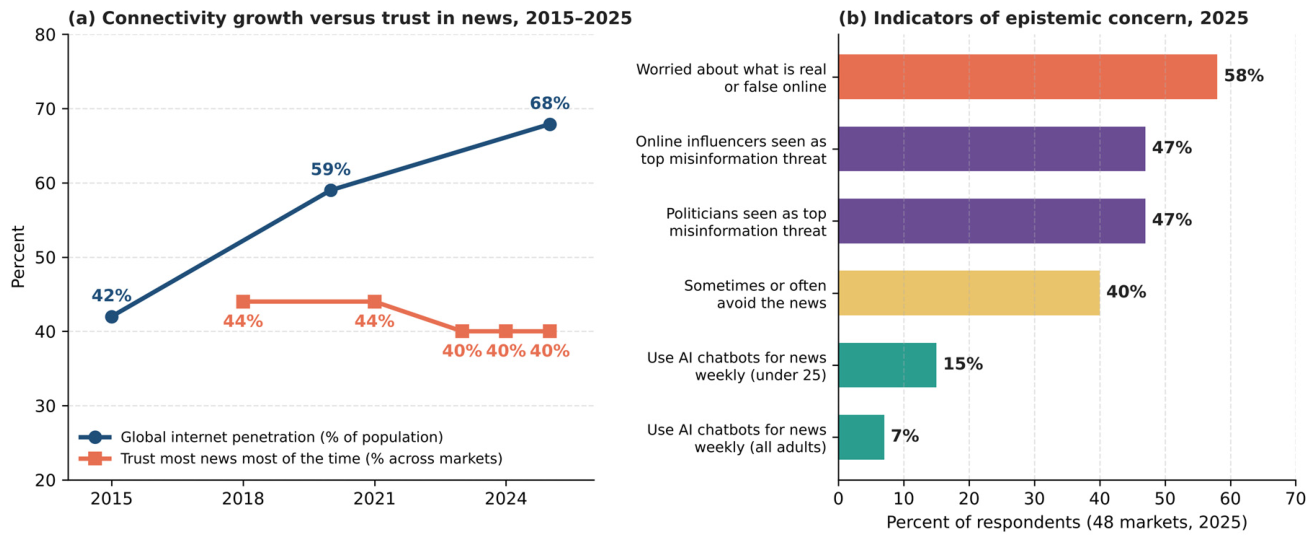
Figure 2.
Sequential, Triangulated Research Design and Analytic Workflow (January 2024–June 2025). Note. Arrows indicate the flow of data into the integrated analysis; phases overlapped in practice, and ethnographic observation continued for 12 months across Phases 1–3. Source. Author’s research design.
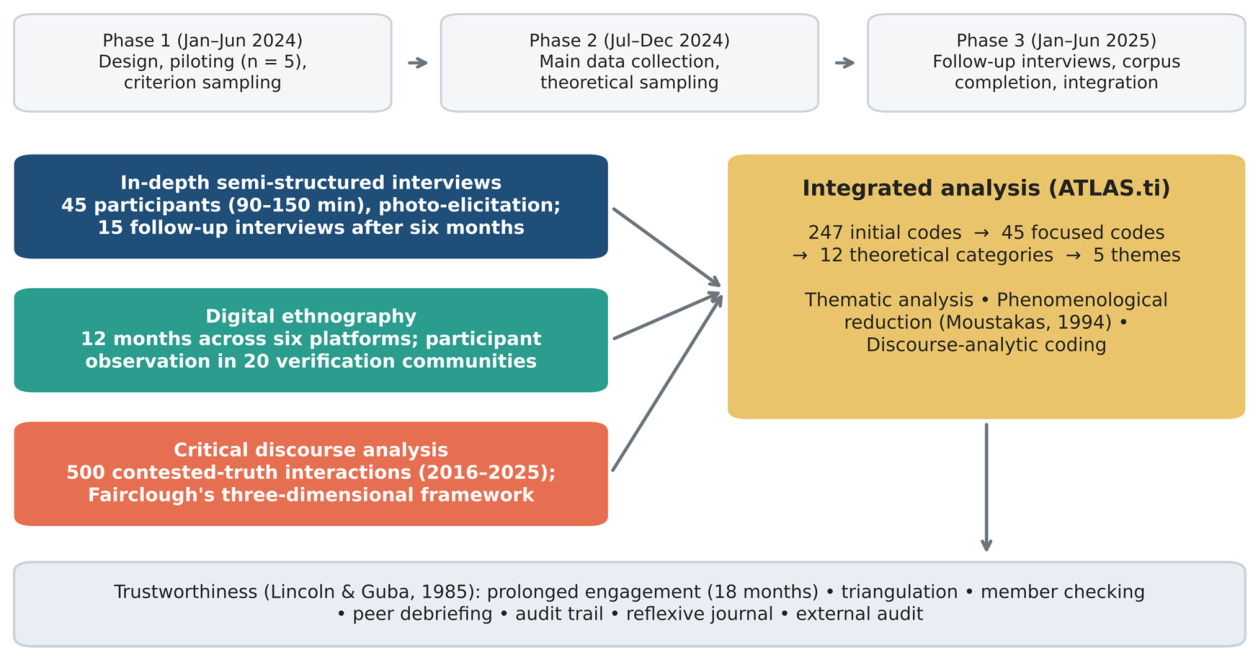
Figure 3.
Prevalence of Coded Epistemic Practices Among Interview Participants, by Theme (N = 45). Note. Bars represent the percentage of the 45 interview participants whose accounts were coded for each practice; practices are not mutually exclusive, and participants could be coded into more than one theme. Source. Primary interview data collected by the author, January 2024–June 2025.
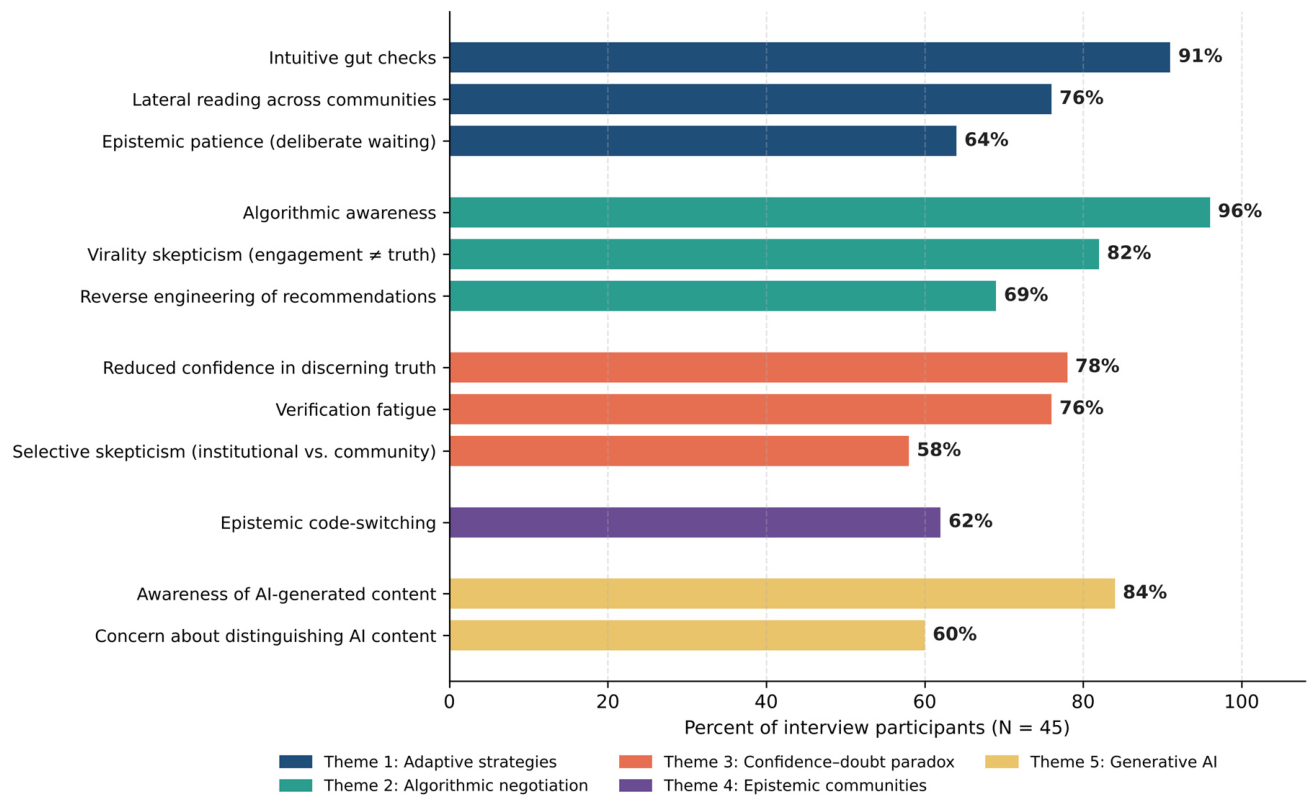
Figure 4.
The Synthetic Doubt Pathway: From Awareness of Generative AI to a Generalized Liar’s Dividend. Note. Percentages refer to the 45 interview participants. Dashed boxes mark the two points at which the literature identifies effective intervention: skill-based detection training (Huang & Hu, 2025; Qian et al., 2023) and credible provenance infrastructure (Park & Nan, 2026). Source. Author’s analysis of primary interview data (Theme 5), integrated with Chesney and Citron (2019) and Vaccari and Chadwick (2020).
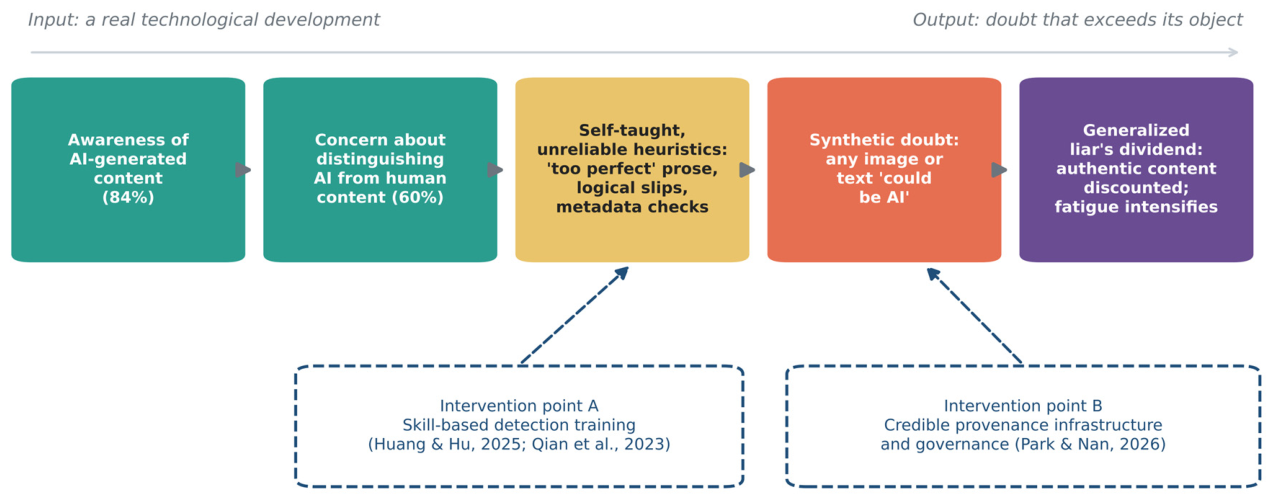
Figure 5.
Layered Conceptual Model of Liquid Epistemology in Digital Environments. Note. The model reads from structural conditions (Layer 1) through mechanisms (Layer 2) and adaptive practices (Layer 3) to experiential outcomes (Layer 4); the dashed arrow indicates that recursive doubt feeds back into practice. Percentages refer to the 45 interview participants. Source. Author’s original analysis based on primary data collected January 2024–June 2025, integrating Bauman (2000) and Lee (2022).
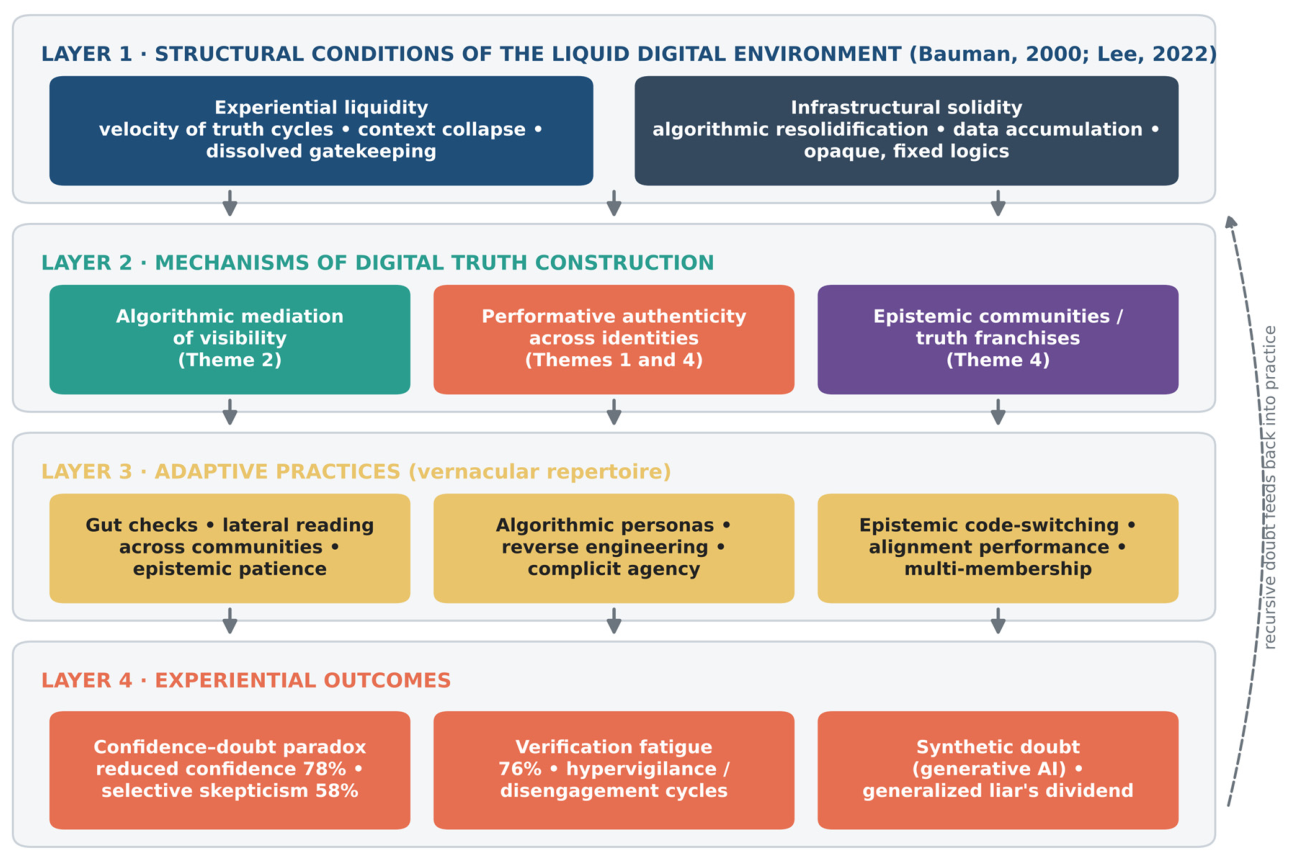

Table 1.
Global Digital Connectivity, Trust in News, and Epistemic-Concern Indicators, 2015–2025.
| Indicator | Earliest available value | Most recent value | Primary source |
|---|---|---|---|
| Global internet penetration (% of population) | 42% (January 2015) | 68% (January 2025) | Kemp (2015, 2025b) |
| Global social media user identities | 2.08 billion (January 2015) | 5.24 billion (January 2025) | Kemp (2015, 2025b) |
| Average cross-market trust in news | 44% (2018) | 40% (2025) | Newman et al. (2018, 2025) |
| Worried about distinguishing real from false online | 54% (2022) | 58% (2025) | Newman et al. (2025) |
| Sometimes or often avoid the news | 29% (2017) | 40% (2025) | Newman et al. (2025) |
| Use AI chatbots to access news weekly | — | 7% of all respondents; 15% of those under 25 (2025) | Newman et al. (2025) |
Note. Trust-in-news values are the average share across surveyed markets who trust most news most of the time; no cross-market average was published before 2018. Internet penetration is rounded from 67.9% (2025). A dash indicates that no earlier value was reported. Source. Compiled by the author from Kemp (2015, 2025b) and Newman et al. (2018, 2025).
Table 2.
Selected Recent Studies Informing the Review, 2020–2026.
| Study | Focus area | Key finding relevant to this study |
|---|---|---|
| Nguyen (2020) | Epistemic bubbles | Echo chambers (under-exposure) differ from epistemic bubbles (active discrediting of outside testimony) |
| Alasmari et al. (2021) | Saudi infodemic | Rumors spread mainly via private messaging; prompt institutional communication helped limit misinformation |
| Lee (2022) | Liquid modernity | Digital platforms combine experiential fluidity with algorithmic resolidification of power |
| Spitale et al. (2023) | AI-generated text | Readers cannot distinguish GPT-3 tweets from human ones and believe synthetic disinformation |
| Guess et al. (2023); Nyhan et al. (2023) | Feed algorithms | Changing feed algorithms altered exposure but not polarization or attitudes |
| Hoggan-Kloubert & Hoggan (2023) | Post-truth | Post-truth reflects eroded rational deliberation, autonomy, and pluralism |
| Metzler & Garcia (2024) | Algorithmic amplification | Algorithms amplify pre-existing social drivers rather than independently causing polarization |
| Popescu-Sarry (2024) | Testimonial trust | Post-truth is misplaced distrust in testimony, not indifference to facts |
| Budak et al. (2024) | Harms of misinformation | Exposure is low and concentrated; algorithms play a smaller role than commonly assumed |
| Altay & Gilardi (2024) | AI provenance labels | Headlines labeled as AI-generated are distrusted even when true or human-made |
| Turner (2025) | Open-mindedness | Bubble participation erodes open-mindedness regardless of belief content |
| Huang & Hu (2025) | Deepfake literacy | Skill-based training outperforms generic warning labels for detection |
| Malhotra et al. (2025) | Credibility research | Credibility judgment is culturally situated; interpretive methods are required |
| Huang et al. (2026) | Literacy meta-analysis | Multi-session, skill-based interventions reliably improve resilience to misinformation |
| Park & Nan (2026) | Generative AI review | Generative AI both produces and helps detect misinformation; net effect depends on governance |
| Schmid et al. (2026) | AI governance | Governmental AI narratives manufacture ontological security through discourse |
| Fayez et al. (2026) | Arab youth literacy | Digital media literacy correlates with fake-news handling skills in Saudi Arabia, Egypt, and Yemen |
Note. Studies are ordered chronologically by year of final publication; foundational earlier work is cited in the text. Source. Compiled by the author from Section 2.1, Section 2.2, Section 2.3, Section 2.4, Section 2.5, Section 2.6 and Section 2.7.
Table 3.
Theoretical Perspectives Informing the Liquid Epistemology Framework.
| Perspective | Key theorists | Core claim | Application in this study |
|---|---|---|---|
| Liquid modernity | Bauman (2000, 2007); Lee (2022) | Constant flux and dissolved structures coexist with algorithmic resolidification of power | Overarching metaphor; experiential liquidity versus infrastructural solidity (Section 6.1) |
| Ontological security | Giddens (1991); Schmid et al. (2026) | Trust in abstract systems produces security amid complexity; AI narratives can manufacture it discursively | Explains anxiety toward algorithmic and AI systems (Themes 3 and 5) |
| Actor-network theory | Latour (2005) | Truth is constructed through assemblages of human and non-human actors | Distributed agency between users and algorithms (Theme 2; Section 6.3) |
| Media ecology | Postman (1985/2005); Strate (2017) | Technologies shape cognition and epistemic possibility, not merely message content | Analysis of platform affordances (Themes 1 and 2) |
| Epistemic bubbles | Nguyen (2020); Turner (2025) | Closed evidential networks discredit outside testimony and erode open-mindedness | Boundary maintenance in epistemic communities (Theme 4) |
| Algorithmic amplification | Metzler & Garcia (2024); Guess et al. (2023); Nyhan et al. (2023) | Algorithms amplify pre-existing social drivers rather than independently causing belief change | Complicit-agency model of algorithmic negotiation (Theme 2; Section 6.3) |
Note. Perspectives are listed in the order introduced in Section 3, from macro-structural condition to meso-level mechanism. Source. Compiled by the author.
Table 4.
Demographic Characteristics of the Interview Sample (N = 45).
| Characteristic | Category | n | % |
|---|---|---|---|
| Age cohort | 18–25 | 9 | 20.0 |
| 26–35 | 11 | 24.4 | |
| 36–45 | 10 | 22.2 | |
| 46–55 | 8 | 17.8 | |
| 56–65 | 7 | 15.6 | |
| Gender | Woman | 23 | 51.1 |
| Man | 20 | 44.4 | |
| Non-binary | 2 | 4.4 | |
| Educational background | High school / vocational | 11 | 24.4 |
| Undergraduate | 18 | 40.0 | |
| Graduate / doctoral | 16 | 35.6 | |
| Country of residence | United States | 21 | 46.7 |
| United Kingdom | 14 | 31.1 | |
| Canada | 10 | 22.2 | |
| Primary platform reported | Facebook / Instagram | 15 | 33.3 |
| TikTok | 12 | 26.7 | |
| Twitter/X | 10 | 22.2 | |
| Reddit / LinkedIn | 8 | 17.8 |
Note. Percentages are calculated within each characteristic and may not sum to exactly 100.0 because of rounding. Source. Primary data from participant intake surveys administered by the author before the first interview (January 2024–June 2025).
Table 5.
Chain of Evidence: Research Questions, Data Sources, Analytic Techniques, and Reporting.
| Research question | Primary data sources | Analytic technique | Reported in |
|---|---|---|---|
| RQ1 Credibility strategies | Interviews (photo-elicitation); ethnography of verification communities | Thematic; phenomenological | Theme 1 |
| RQ2 Algorithmic mediation | Interviews; ethnography of platform affordances | Thematic; discourse coding of amplification metrics | Theme 2 |
| RQ3 Identity management | Interviews; discourse corpus (stance-taking, alignment) | Thematic; critical discourse analysis | Themes 2 and 4 |
| RQ4 Epistemic communities | Participant observation in 20 communities; discourse corpus | Axial coding; critical discourse analysis | Theme 4 |
| RQ5 Doubt and epistemic anxiety | Interviews; follow-up interviews (n = 15) | Phenomenological reduction (Moustakas, 1994) | Theme 3 |
| RQ6 Generative AI | Interviews; discourse corpus on AI-generated content | Thematic; critical discourse analysis | Theme 5 |
Note. Every question drew on at least two of the three data streams. Source. Author’s research design (Section 4.2, Section 4.3 and Section 4.4).
Table 6.
Summary of Major Themes, Prevalence, and Analytic Significance.
| Theme | Representative practice | Participants (n = 45) | Primary analytic significance |
|---|---|---|---|
| 1. Adaptive epistemic strategies | Lateral reading across communities | 76% | Fluid, context-dependent verification replaces linear fact-checking |
| 2. Algorithmic awareness and negotiation | Cultivating algorithmic personas | 96% | Complicit agency rather than resistance or naivety |
| 3. Paradox of confidence and doubt | Reduced confidence in discerning truth | 78% | Skepticism and credulity coexist and reinforce each other |
| 4. Epistemic communities and truth franchises | Epistemic code-switching across contexts | 62% | Truth validated communally rather than individually |
| 5. Impact of generative AI | Awareness of AI-generated content | 84% | Synthetic doubt generalizes beyond AI content itself |
Note. Percentages are shares of the 45 interview participants coded for the representative practice; participants could be coded into more than one theme. Source. Primary interview and discourse-analysis data collected by the author, January 2024–June 2025.
Table 7.
Illustrative Participant Accounts, the Practice Each Exemplifies, and Connections to Literature.
Table 7.
Illustrative Participant Accounts, the Practice Each Exemplifies, and Connections to Literature.
| Participant (pseudonym, age, occupation) | Practice exemplified | Theme | Most direct connection to the literature |
|---|---|---|---|
| Sarah, 28, marketing professional | Gut checks keyed to circulation cues | 1 | Ecker et al. (2022); Tandoc et al. (2018) |
| James, 45, engineer | Platform-differentiated trust | 1 | Bucher (2017); Fletcher & Nielsen (2019) |
| Maria, 52, teacher | Lateral reading across communities | 1 | Wineburg & McGrew (2019); Nguyen (2020) |
| David, 22, college student | Epistemic patience | 1 | Vosoughi et al. (2018); Pennycook et al. (2021) |
| Lisa, 35, graphic designer | Algorithmic personas | 2 | Hogan (2010) |
| Tom, 19, student | Reverse engineering of recommendations | 2 | Metzler & Garcia (2024) |
| Emma, 30, nurse | Virality skepticism | 2 | Gillespie (2018) |
| Rachel, 41, small-business owner | Selective skepticism | 3 | Popescu-Sarry (2024); Newman et al. (2025) |
| Michael, 38, accountant | Verification fatigue | 3 | Skovsgaard & Andersen (2020); Hoggan-Kloubert & Hoggan (2023) |
| Jessica, 26, graduate student | Truth franchises | 4 | Turner (2025) |
| Robert, 48, sales manager | Epistemic code-switching | 4 | Marwick & boyd (2011); Osmundsen et al. (2021) |
| Alex, 33, journalist | Unreliable AI-detection heuristics | 5 | Huang & Hu (2025); Spitale et al. (2023) |
| Sophie, 24, artist | Synthetic doubt | 5 | Chesney & Citron (2019); Vaccari & Chadwick (2020) |
Note. All names are pseudonyms (Section 4.6). Source. Primary interview data collected by the author, January 2024–June 2025.
Table 8.
Principal Findings Mapped to Research Questions and to the Literature They Corroborate, Extend, or Complicate.
Table 8.
Principal Findings Mapped to Research Questions and to the Literature They Corroborate, Extend, or Complicate.
| RQ | Principal finding | Corroborates | Extends or complicates |
|---|---|---|---|
| RQ1 | Situated strategies: gut checks (91%), lateral reading (76%), epistemic patience (64%) | Tandoc et al. (2018); Wineburg & McGrew (2019); Malhotra et al. (2025) | Lateral reading operates across communities, not only sources |
| RQ2 | Near-universal awareness (96%); complicit agency through algorithmic personas | Metzler & Garcia (2024); Guess et al. (2023); Nyhan et al. (2023) | Complicates deterministic filter-bubble accounts (Pariser, 2011) |
| RQ3 | Epistemic code-switching (62%) ties truth claims to identity performance | Marwick & boyd (2011); Osmundsen et al. (2021) | Identifies the strain of inconsistent commitments as a distinct harm |
| RQ4 | Truth franchises with active boundary maintenance | Nguyen (2020); Turner (2025) | Multi-membership as an informal safeguard against bubble closure |
| RQ5 | Reduced confidence (78%), verification fatigue (76%), selective skepticism (58%) | Popescu-Sarry (2024); Hoggan-Kloubert & Hoggan (2023); Newman et al. (2025) | Vigilance may exceed measured exposure (Altay et al., 2023; Budak et al., 2024) |
| RQ6 | Synthetic doubt; unreliable self-taught heuristics (84% aware, 60% concerned) | Chesney & Citron (2019); Vaccari & Chadwick (2020); Huang & Hu (2025) | Doubt generalizes to authentic content; provenance labels can backfire (Altay & Gilardi, 2024) |
Table 9.
Connectivity and Trust Indicators: Sampled Countries Compared With Saudi Arabia, 2025.
| Indicator | United States | United Kingdom | Canada | Saudi Arabia |
|---|---|---|---|---|
| Internet penetration (% of population, January 2025) | 93.1% | 97.8% | 95.2% | 99.0% |
| Social media user identities (% of population, January 2025) | 73.0% | 79.0% | 79.4% | 99.6% |
| Trust most news most of the time (2025) | 30% | 35% | 39% | Not surveyed |
| Trust in government, Edelman Trust Barometer (2025) | 47% | 43% | Not reported | 87% (ranked 1st of 28) |
Note. Trust in news and trust in government derive from different survey instruments and are comparable across countries within a row only. Saudi Arabia is not included in the Reuters Institute survey. Source. Compiled by the author from Kemp (2025a, 2025c, 2025d, 2025e), Newman et al. (2025), and Edelman (2025).
Disclaimer/Publisher’s Note: The statements, opinions and data contained in all publications are solely those of the individual author(s) and contributor(s) and not of MDPI and/or the editor(s). MDPI and/or the editor(s) disclaim responsibility for any injury to people or property resulting from any ideas, methods, instructions or products referred to in the content. |
© 2026 by the authors. Licensee MDPI, Basel, Switzerland. This article is an open access article distributed under the terms and conditions of the Creative Commons Attribution (CC BY) license (http://creativecommons.org/licenses/by/4.0/).
Copyright: This open access article is published under a Creative Commons CC BY 4.0 license, which permit the free download, distribution, and reuse, provided that the author and preprint are cited in any reuse.