

Submitted:
06 October 2026
Posted:
09 October 2026
You are already at the latest version
Preprints on COVID-19 and SARS-CoV-2
Abstract
This paper examines whether the survival value of different financing sources is contingent on exposure to an exogenous shock. We assemble hand-collected survey data on 301 startups founded during 2021–2022 across five provinces of Vietnam's Mekong Delta—a peripheral entrepreneurial ecosystem within a bank-based emerging economy—and track them for up to 56 months, observing 114 market exits. Cox proportional hazards models show that external finance is protective: debt, angel investment, and family-and-friends funding significantly reduce the exit hazard, whereas re-liance on founder equity increases it; government financial support has no detectable effect. Criti-cally, these effects are concentrated almost entirely among Covid-exposed ventures. Within the exposed cohort, a one-log-unit increase in founder-equity funding is associated with a more than four-fold exit hazard (HR = 4.51; p = 0.001), while debt reduces the hazard by roughly a quarter per log-unit (HR = 0.77; p < 0.001); among non-exposed ventures, financing composition is essentially unrelated to survival. Discrete-time, matching, and logistic estimates corroborate these patterns. The findings challenge the view of debt as a source of fragility for young firms and indicate that financing structure operates as a crisis-contingent resource, with implications for founders, lenders, and the design of startup support policy in emerging economies.
Keywords:
startup survival
; entrepreneurial finance
; financing structure
; Covid-19
; Cox proportional hazards
; emerging economy
1. Introduction
Most startups die young. A large share of new ventures exits the market within the first three to five years of operation, a period commonly described as the "valley of death" (Stinchcombe, 1965; Audretsch & Mahmood, 1995; Coad, Frankish, Roberts, & Storey, 2013). The Covid-19 pandemic added a distinctive twist to this familiar pattern: it produced an entire cohort of "shock-born" ventures—firms founded while the crisis was still unfolding—whose founders raised and deployed capital under conditions of extreme uncertainty, disrupted demand, and constrained financial intermediation (Brown & Rocha, 2020; Kuckertz et al., 2020). Whether, and through which financing channels, such ventures can traverse the valley of death is a first-order question for entrepreneurial finance, yet systematic evidence remains scarce, particularly for emerging economies where formal venture capital is thin and bank credit dominates external finance (Beck & Demirgüç-Kunt, 2006).
A substantial literature links financial capital to new venture survival (see Soto-Simeone, Sirén, & Antretter, 2020, for a review). Initial financial resources lengthen the runway over which entrepreneurs can experiment, absorb early losses, and reach viable scale (Evans & Jovanovic, 1989; Holtz-Eakin, Joulfaian, & Rosen, 1994; Cassar, 2004), and the composition of early financing—owner equity, bank debt, venture capital, angel investment, and informal funding from family and friends—shapes both the resources and the governance a venture receives (Berger & Udell, 1998; Robb & Robinson, 2014; Cole & Sokolyk, 2018). Three gaps nonetheless remain. First, most studies estimate average effects of financing sources and rarely test whether those effects are contingent on macro-level shocks; yet resource-based reasoning implies that buffers matter most precisely when adversity strikes. Second, the emerging crisis literature focuses overwhelmingly on incumbent firms that entered the pandemic with established operations, examining cash holdings, credit lines, bootstrap financing, and government guarantees as survival devices (Bartik et al., 2020; Cowling, Brown, & Rocha, 2020; Didier, Huneeus, Larrain, & Schmukler, 2021; Belghitar, Moro, & Radić, 2022; Belitski, Guenther, Kritikos, & Thurik, 2022; Block, Fisch, & Hirschmann, 2022; Gourinchas, Kalemli-Özcan, Penciakova, & Sander, 2021). Much less is known about ventures founded during the shock itself, for which founding conditions are known to leave lasting imprints on survival prospects (Geroski, Mata, & Portugal, 2010). Third, the evidence base is dominated by developed, market-based financial systems; bank-based emerging economies—where the relevant financing menu, institutional support, and crisis policy responses differ materially—remain underexplored (Beck & Demirgüç-Kunt, 2006).
We address these gaps using hand-collected survey data on 301 startups founded in 2021–2022 across five provinces of Vietnam’s Mekong Delta, a peripheral entrepreneurial ecosystem within an emerging, bank-based economy. The ventures are tracked from founding until market exit or until the survey date in 2025, yielding durations of up to 56 months and 114 observed exits. We estimate Cox proportional hazards models relating six financing sources—founder equity, debt, venture capital, angel capital, government financial support, and family-and-friends (FFF) funding—to the hazard of market exit, and we test whether these relationships are moderated by self-reported exposure to the Covid-19 shock. Identification of the moderation exploits both interaction terms and within-cohort estimation on the exposed subsample, and we probe robustness with discrete-time complementary log-log models, propensity-score matching on debt receipt, binary logistic marginal effects, and stratified specifications. Three findings stand out. First, external finance is protective on average: debt, angel capital, and FFF funding are associated with significantly lower exit hazards, venture capital with a weakly lower hazard, and government financial support with no detectable effect—whereas reliance on founder equity is associated with a significantly higher hazard. Second, exposure to the Covid-19 shock is a powerful correlate of exit: 67.1% of exposed ventures exited during the observation window against only 4.3% of non-exposed ventures (log-rank χ² = 130.7; p < 0.001). Third, and most importantly, the financing–survival nexus is crisis-contingent. Within the exposed cohort, a one-log-unit increase in founder-equity funding is associated with a hazard ratio of 4.51 (p = 0.001), whereas debt carries a hazard ratio of 0.77 per log-unit (p < 0.001); among non-exposed ventures—of which only six exited—financing composition is essentially unrelated to survival. Money matters when it rains, and different money matters very differently: debt behaves as a liquidity buffer while founder-equity dependence behaves as a burden.
2. Materials and Methods
2.1. Financial Capital and the Survival of Young Ventures
New ventures suffer from the liability of newness: they lack established routines, reputations, and exchange relationships, and they fail at higher rates than older organizations (Stinchcombe, 1965). From a resource-based perspective, financial capital is the most fungible of resources—an all-purpose buffer that allows young firms to absorb early-stage shocks, finance experimentation, and acquire the complementary assets they do not yet possess (Barney, 1991; Cassar, 2004). Larger initial financial endowments relax liquidity constraints on the entrepreneur’s optimal scale of operation (Evans & Jovanovic, 1989; Holtz-Eakin et al., 1994) and are robustly associated with longer survival in hazard-model studies across countries and cohorts (Audretsch & Mahmood, 1995; Mata & Portugal, 1994; Honjo, 2000; Coad et al., 2013).
The composition of that capital matters as much as its quantity. Because startups are informationally opaque, they face a financing pecking order in which internal funds come first and external funds are rationed by asymmetric information (Myers & Majluf, 1984; Berger & Udell, 1998). Each rung of the external ladder bundles money with distinct screening, monitoring, and value-adding services: banks screen on repayment capacity and impose cash-flow discipline (Diamond, 1984), venture capitalists and angels select, certify, and coach (Gompers & Lerner, 2001; Hsu, 2004; Kerr, Lerner, & Schoar, 2014), and family-and-friends funding provides flexible, patient capital embedded in social ties (Robb & Robinson, 2014; Lee & Persson, 2016). Receiving external finance is therefore simultaneously a resource inflow and a quality signal (Spence, 1973): survival differences across financing sources reflect both treatment and selection, a duality we return to in interpreting our estimates.
2.2. Heterogeneous Financing Sources and the Hazard of Exit
Debt is the dominant external source for young firms outside a narrow venture-capital segment (Berger & Udell, 1998; Robb & Robinson, 2014). Cole and Sokolyk (2018) show that U.S. startups using debt at founding—especially business bank debt—are significantly more likely to survive and achieve higher revenues, attributing the pattern to bank screening and to the discipline that servicing debt imposes. In bank-based emerging economies, a credit relationship additionally embeds the venture in the formal financial system, improving subsequent access to working capital. We therefore expect debt financing to be associated with a lower exit hazard (H1a). Venture capital and angel investment combine funds with certification, monitoring, and coaching; portfolio ventures backed by such investors exhibit superior growth and survival outcomes (Gompers & Lerner, 2001; Kerr et al., 2014; Croce, Martí, & Murtinu, 2013), motivating H1b. Informal funding from family and friends is the most widespread source of early external finance worldwide; although it comes without professional governance, it is patient, flexible, and renegotiable in ways formal contracts are not, and its social embeddedness creates strong incentives to persist and repay (Lee & Persson, 2016), motivating H1c.
Founder equity occupies a different position. While personal investment signals commitment, heavy reliance on founder equity concentrates household wealth in a single risky asset, provides no external screening of project quality, and creates thin buffers that are exhausted precisely when conditions deteriorate. Ventures financed predominantly out of the founder’s own pocket are those that either chose not to seek, or failed to obtain, external validation (Åstebro & Bernhardt, 2003; Frid, Wyman, Gartner, & Hechavarria, 2016). We therefore expect founder-equity reliance to be associated with a higher exit hazard (H1d). Government financial support programs, finally, are typically small in scale, slow to disburse, and allocated by administrative rather than market criteria in emerging economies; prior evidence on their survival effects is mixed at best (Santarelli & Vivarelli, 2007), and we treat their effect as an empirical question.
H1a. Debt financing is negatively associated with the hazard of market exit.
H1b. Venture capital and angel investment are negatively associated with the hazard of market exit.
H1c. Family-and-friends funding is negatively associated with the hazard of market exit.
H1d. Reliance on founder equity is positively associated with the hazard of market exit.
2.3. The Covid-19 Shock as a Moderating Condition
Buffers reveal their value under stress. If financial capital protects ventures by absorbing adverse shocks, its protective effect should be largest—indeed, may only be detectable—among ventures actually exposed to adversity. The Covid-19 pandemic provides a rare, plausibly exogenous source of such variation: it disrupted demand, supply chains, and mobility in ways unrelated to any individual venture’s quality, and it did so heterogeneously across sectors and localities (Bartik et al., 2020; Fairlie, 2020; Gourinchas et al., 2021). Ventures founded during 2021–2022 in Vietnam experienced this heterogeneity directly: some operated through prolonged lockdowns and demand collapses, while others—by sector or location—were largely spared. We expect exposed ventures to face a higher exit hazard (H2).
More distinctively, the shock should reshape the relative value of financing sources. Founder-equity dependence should become more dangerous under exposure: personal buffers are thin and non-replenishable in a crisis, no outside party shares the downside, and sunk personal wealth fosters escalation of commitment that delays value-preserving exit or restructuring. Informal FFF funding may also lose potency as the same shock simultaneously hits the household networks that supply it. By contrast, two mechanisms predict that debt’s protective role survives—or even strengthens—under crisis exposure. First, debt shares risk with a deep-pocketed counterparty: a lender’s claim can be rescheduled, and during 2020–2023 the State Bank of Vietnam explicitly mandated such forbearance, permitting banks to restructure repayment terms and maintain loan classifications for pandemic-affected borrowers (Circulars No. 01/2020/TT-NHNN, 03/2021/TT-NHNN, and 14/2021/TT-NHNN). Debt-financed ventures thus held an embedded option to convert fixed obligations into state-sanctioned breathing room—an option unavailable to ventures living off the founder’s savings. Second, bank screening concentrates debt among ventures with verifiable repayment capacity, a selection margin whose survival value is amplified when conditions deteriorate. This prediction runs against the classic debt-fragility view, in which leverage amplifies distress risk in downturns (Zingales, 1998); which force dominates for shock-born startups in a bank-based emerging economy is the central empirical question of this paper.
H2. Exposure to the Covid-19 shock is positively associated with the hazard of market exit.
H3a. Covid-19 exposure amplifies the positive association between founder-equity reliance and the exit hazard.
H3b. Covid-19 exposure does not weaken—and may strengthen—the negative association between debt financing and the exit hazard.
Figure 1 summarizes the conceptual model.
3. Data and Methodology
3.1. Research Context and Sample
The Mekong Delta is a thirteen-province region of roughly 17 million inhabitants in southern Vietnam whose economy is anchored in agriculture, aquaculture, and processing. As an entrepreneurial ecosystem it is peripheral: venture-capital penetration is thin, formal bank credit dominates external finance, and startup support is channelled largely through universities and a regional startup support network rather than through professional investor communities. Vietnam itself is a bank-based emerging economy in which small-business lending, directed-credit programs, and—during the pandemic—regulatory forbearance on loan classification constituted the principal financial policy levers. This context is analytically useful precisely because it differs from the market-based settings that dominate the entrepreneurial finance literature.
Our sampling frame is the population of startups founded during 2021–2022 recorded by the Mekong Delta startup support network across five provinces (Tra Vinh, Can Tho, Vinh Long, Ben Tre, and Soc Trang). We surveyed this frame in 2025 by structured questionnaire administered to founders, obtaining 301 usable responses; the data thus approximate a near-census of the observable population of network-registered startups rather than a convenience sample, although ventures outside the network are not covered—a limitation we return to in Section 6. For each venture we record the founding date, current operating status, and—for exited ventures—the month of exit, yielding a duration measured in months from founding to exit or to the survey date (right-censoring). Durations range from 8 to 56 months (mean 36.9); 114 ventures (37.9%) exited during the window, with a median time-to-exit of 24.5 months among exiting ventures—squarely inside the valley of death documented in prior cohort studies (Coad et al., 2013).
3.2. Variables
The dependent variable is the duration from founding to market exit, with an event indicator equal to one if the venture had ceased operations by the survey date. Financing variables capture the amount of funding the venture obtained from each of six sources—founder equity (FE), debt capital (DC), venture capital (VC), angel capital (AC), government financial support (GS), and family-and-friends funding (FFF)—each entered as the natural logarithm of the amount (in million VND), with zero for non-users. All ventures report positive founder-equity and FFF amounts; 73.4% report debt, 72.8% angel capital, 24.3% venture capital, and 16.6% government financial support. Covid-19 exposure is a founder-reported indicator equal to one if the venture’s operations were directly affected by the pandemic and its associated restrictions during the founding period (161 ventures, 53.5%), and zero otherwise. Because exposure is self-reported ex post, we interpret it as a treatment-intensity marker rather than a randomized instrument, and we show below that our conclusions rest on within-cohort comparisons as well as interactions.
Controls cover founder human capital—university education, years of industry experience, count of prior founding experiences, opportunity (versus necessity) motivation, and full-time engagement in the venture—together with founder age and gender; organizational characteristics—team size, firm size, return on assets, presence of an R&D unit, and self-assessed competitive advantage; innovation assets—counts of trademarks, copyrights, and patents; collaboration ties with universities and firms; receipt of non-financial government support; and an urban-location indicator. Table 1 reports descriptive statistics. Multicollinearity is unproblematic: the maximum variance inflation factor across regressors is 2.98 (mean 1.79), and the largest absolute pairwise correlation among the financing variables and the exposure indicator is 0.54.
3.3. Empirical Strategy
Our baseline is the Cox (1972) proportional hazards model, h(t | X) = h₀(t)·exp(β′X), which leaves the baseline hazard unrestricted and accommodates right-censoring. We estimate four nested specifications on the full sample: Model 1 enters the six financing variables; Model 2 adds the full control set; Model 3 adds the Covid-19 exposure indicator; and Model 4 adds interactions between exposure and the two theoretically focal financing sources—founder equity and debt—with the financing variables mean-centered before interacting to reduce collinearity (Aiken & West, 1991). We restrict the interaction set to the two focal sources for a transparent reason: only six exits occur among non-exposed ventures, so a full set of six interactions is weakly identified and produces unstable estimates; the focal-interaction design concentrates the available information on the hypotheses at stake (H3a, H3b). Because nonlinear-model interactions are not read directly from coefficients (Ai & Norton, 2003), we complement the interaction terms with linear-combination tests of the financing effects within the exposed group and, as our sharpest evidence, re-estimate the full financing model on the exposed subsample alone (Model 5; 161 ventures, 108 events), which is well powered and imposes no cross-cohort proportionality.
We report robust (sandwich) standard errors throughout, verify the proportional-hazards assumption with Schoenfeld residual tests (Grambsch & Therneau, 1994), and gauge discriminatory power with Harrell’s concordance index. Robustness checks comprise (i) discrete-time complementary log-log models on a person-period panel (six-month intervals; 1990 venture-periods) with standard errors clustered by venture, which relax the continuous-time proportionality restriction; (ii) binary logistic models of exit status with average marginal effects; (iii) nearest-neighbour propensity-score matching on debt receipt (caliper 0.05), with the propensity estimated from the full control set and the exposure indicator; and (iv) a specification stratifying the baseline hazard by exposure. Given the observational design and the signalling content of external finance, we interpret all estimates as robust associations arising from both treatment and selection, and we are explicit about this duality in Section 5.
4. Results
4.1. Survival Patterns
Figure 2 plots Kaplan–Meier survival functions. Panel (a) splits the sample by Covid-19 exposure: the two curves separate dramatically, with 67.1% of exposed ventures exiting during the window against 4.3% of non-exposed ventures (log-rank χ² = 130.7; p < 0.001). Panel (b) splits by debt financing: debt-financed ventures (73.4% of the sample) survive at markedly higher rates than ventures without debt (log-rank χ² = 73.1; p < 0.001). These unconditional contrasts motivate the multivariate analysis, which asks whether they persist once founder, firm, and financing characteristics are held constant—and whether they are, in fact, two faces of the same crisis-contingency.
4.2. Baseline Estimates: Financing Structure and the Hazard of Exit
Table 2 supports H1a–H1d. In the full specification (Model 2), a one-log-unit increase in debt is associated with a 21.6% lower exit hazard (HR = 0.784; p < 0.01), angel capital with a 19.7% lower hazard, and family-and-friends funding with a large protective association (HR = 0.152; p < 0.01); venture capital is protective at the ten-percent level (HR = 0.629). By contrast, founder-equity reliance is associated with a sharply higher hazard (HR = 4.252; p < 0.01), and government financial support is statistically indistinguishable from zero in every specification—a null that is itself informative for policy. Control variables behave sensibly: university education, opportunity motivation, full-time engagement, prior founding and industry experience, an R&D unit, competitive advantage, profitability, and patent and copyright holdings all predict lower hazards, consistent with the human-capital and innovation-assets literatures (Unger, Rauch, Frese, & Rosenbusch, 2011; Colombo & Grilli, 2005). Model 3 adds exposure: Covid-exposed ventures face roughly a 2.80-fold hazard (p = 0.088), while the financing estimates barely move. Discriminatory power is high throughout (Harrell’s C up to 0.95).
4.3. Crisis-Contingency: Does the Shock Reshape the Value of Money?
Table 3 contains the paper’s central result. In Model 4, the main effects of founder equity (HR = 0.671) and debt (HR = 0.839) now refer to non-exposed ventures—and neither differs from unity. Among ventures spared by the shock, of which only six exited, financing composition simply does not predict survival. The interaction point estimates run strongly in the hypothesized directions—founder equity × Covid at 6.72 and debt × Covid at 0.92—although, with six events in the comparison cohort, the interaction contrasts themselves are individually imprecise (p = 0.15 and p = 0.69), and we flag this transparently. The decisive evidence lies in the linear combinations and the within-cohort model. For exposed ventures, the implied founder-equity effect is HR = 4.51 (p = 0.001) and the implied debt effect is HR = 0.77 (p < 0.001). Model 5, estimated on the exposed subsample alone with 108 events, tells the same story with full force: founder-equity reliance more than quadruples the hazard per log-unit (HR = 4.40; p < 0.01), debt reduces it by 22% per log-unit (HR = 0.783; p < 0.01), and angel and FFF funding remain protective, while government support remains null. Figure 3 visualizes the implied survival functions: debt-financed exposed ventures track close to the (nearly flat) non-exposed benchmark, whereas high-founder-equity exposed ventures collapse. Taken together, the pattern supports H2 and H3a directly and supports H3b in its strong form: rather than merely surviving the crisis, debt’s protective association is only visible within it.
4.4. Robustness
The robustness battery in Table 4 corroborates the core pattern. The discrete-time model reproduces the crisis-contingency sharply: within the exposed group, the implied founder-equity effect is 5.19 (p < 0.001) and the debt effect 0.81 (p = 0.003), and the FE × Covid contrast itself reaches the ten-percent level despite the thin comparison cohort. The logistic model confirms that founder-equity reliance raises, and angel capital lowers, the probability of exit, and that exposure raises it by 13.6 percentage points (p < 0.01); debt’s marginal effect on the binary end-state is small and insignificant, indicating that debt’s protection operates chiefly on the timing margin captured by the hazard models. Matching on debt receipt compresses the sample to 82 ventures yet leaves the debt hazard ratio essentially unchanged in magnitude (0.806; p = 0.11), suggesting the baseline association is not an artifact of observable selection into borrowing, though precision falls in the small matched sample. Schoenfeld tests flag time-variation in 6 of 28 coefficients—notably exposure (p = 0.043), unsurprising for a shock whose bite varied over the pandemic’s phases—while the focal financing and interaction coefficients show no violation (all p > 0.15); re-estimating Model 4 with the baseline hazard stratified by exposure leaves the financing point estimates similar in magnitude. Finally, within-cohort estimation (Model 5) is itself the strongest robustness device, as it imposes no proportionality across cohorts at all.
5. Discussion
5.1. Money Matters When It Rains: Revisiting the Hypotheses
The evidence maps onto the hypotheses as follows. H1a (debt), H1c (family-and-friends funding), and H1d (founder equity) are supported in every full-sample specification; H1b is supported for angel capital and only weakly for venture capital, whose thin penetration in the region (24.3% of ventures, typically small tickets) limits statistical power; government financial support shows no association. H2 is supported both nonparametrically—the Kaplan–Meier gap between cohorts is dramatic—and in the multivariate hazard. H3a and H3b receive their sharpest support not from the interaction coefficients in isolation, which are honestly imprecise given only six exits among unexposed ventures, but from the convergent triangulation of linear-combination tests, the within-cohort model, and the discrete-time replication: founder-equity reliance is dangerous, and debt protective, essentially only where the shock actually struck.
This crisis-contingency reframes how the financing–survival literature’s average effects should be read. Our full-sample estimates replicate the canonical pattern—external finance protects, self-finance reliance endangers (Cassar, 2004; Cole & Sokolyk, 2018; Soto-Simeone et al., 2020)—but the decomposition shows that such averages are mixtures: a near-zero effect where conditions were benign and a large effect where they were not. The point echoes the heterogeneity emphasized in the pandemic literature on established SMEs, where crisis damage and policy reach varied sharply across firms and sectors (Belitski et al., 2022; Fairlie, 2020), and it extends that insight backward to the founding moment: for shock-born ventures, the financing mix chosen at birth operated as a contingent claim whose value was realized only in the bad state of the world. Methodologically, this cautions survival researchers against pooling tranquil and turbulent cohorts without interaction or stratification—doing so understates what financing structure is worth to the ventures actually at risk, a compositional bias that may help explain the instability of financing-effect estimates across published cohort studies (Soto-Simeone et al., 2020).
5.2. Debt as a Buffer: Mechanisms and Comparison with Prior Evidence
The protective association of debt among crisis-exposed ventures speaks to an unresolved tension in the literature. On one side, Cole and Sokolyk (2018) show for U.S. startups in normal times that debt use at founding—especially business bank debt—predicts survival and growth, attributing the result to bank screening and repayment discipline; Robb and Robinson (2014) likewise document that new firms lean heavily and productively on formal credit. On the other side, the debt-fragility tradition, from Zingales’s (1998) trucking-industry evidence onward, holds that leverage amplifies exit risk precisely in downturns, when fixed obligations meet collapsing cash flow. Our estimates side with the first view even under crisis conditions—debt-financed exposed ventures survive at rates approaching the unexposed benchmark (Figure 3, panel a)—and the institutional record suggests why the fragility channel was muted in this setting. During 2020–2023 the State Bank of Vietnam’s Circulars 01/2020, 03/2021, and 14/2021 mandated that banks reschedule principal and interest, waive or reduce fees, and preserve loan classification for pandemic-affected borrowers. A bank loan in this regime embedded a state-sanctioned option to convert fixed obligations into breathing room; founder savings embedded no such option. The comparison with Belghitar, Moro, and Radić (2022), who find that UK government support schemes could not fully offset pandemic damage to SMEs, is instructive: the Vietnamese instrument that mattered was not a transfer to firms but a rewriting of creditor forbearance rules—policy transmitted through the credit relationship itself, which reaches exactly the firms with the strongest formal-finance ties. Didier, Huneeus, Larrain, and Schmukler (2021) argue on theoretical grounds that crisis policy should keep viable firms in “hibernation” by sharing the burden across stakeholders, lenders foremost; our within-cohort estimates are, to our knowledge, among the first survival-level evidence from an emerging economy consistent with that prescription operating on newly founded ventures.
Selection surely contributes alongside treatment, and we resist a purely causal reading. Banks in the Mekong Delta lend against verifiable repayment capacity, household collateral, and often a pre-existing relationship through agricultural value chains; debt receipt therefore marks ventures that passed an external quality test—a signalling margin in the spirit of Spence (1973) whose survival content a crisis amplifies. Two features of the evidence nonetheless suggest the association is not solely selection on observables: propensity-score matching on the full control set and exposure leaves the debt hazard ratio essentially unchanged in magnitude, and the protective association is absent among unexposed ventures, which pure quality-marking would not predict—a marker of quality should predict survival in all states, whereas an option to restructure pays off only in the bad state. The pattern is thus more consistent with the buffer mechanism doing real work at the margin. The boundary conditions deserve emphasis: absent the forbearance regime, or in market-based systems where startup debt is scarce, covenant-driven, and classified strictly through a downturn, the fragility ranking could well reverse toward Zingales’s (1998) prediction—a directly testable proposition for comparative work across institutional settings.
5.3. Founder Equity as a Burden: Escalation in a Household Economy
The mirror-image result—founder-equity reliance more than quadrupling the exit hazard among exposed ventures—extends earlier findings that heavy self-finance marks vulnerable ventures (Åstebro & Bernhardt, 2003; Frid, Wyman, Gartner, & Hechavarria, 2016) by showing when that vulnerability bites. Three features of the Mekong Delta’s household economy sharpen the mechanisms. First, buffers were thin and correlated: founder equity in our sample is typically drawn from family savings and land-based wealth, and the same pandemic that hit the venture hit the household’s other income sources—agriculture, aquaculture, trading, and remittances from relatives working in Ho Chi Minh City’s industrial belt, many of whom returned home during the 2021 lockdowns. Second, no counterparty shared the downside: unlike a borrower, a self-financed founder had no one with whom losses could be renegotiated and no standing under the forbearance circulars. Third, sunk personal wealth invites escalation of commitment: founders who had staked household savings plausibly persisted past the point where an outside financier would have forced restructuring or orderly exit, exhausting resources before exiting—consistent with the shorter observed median time-to-exit among heavily self-financed exposed ventures. Block, Fisch, and Hirschmann (2022) document that entrepreneurs bootstrapped intensively during the pandemic; our estimates add the sobering complement that, for ventures actually in the storm’s path, reliance on internal funds was associated with precisely the exits bootstrapping was meant to avoid. The two findings are reconcilable—bootstrapping conserves cash at the margin, while wholesale dependence on founder equity removes the risk-sharing and screening that external finance provides—but together they caution against romanticizing self-reliance in crisis entrepreneurship.
5.4. The Null on Government Financial Support in a Peripheral Ecosystem
Government financial support is the only external source with no detectable survival association in any specification—despite reaching 16.6% of ventures—echoing long-standing skepticism about direct public subsidies to new firms (Santarelli & Vivarelli, 2007). The regional practice makes the null interpretable rather than surprising. Support to Mekong Delta startups in this period flowed mainly through provincial startup competitions, innovation vouchers, and small grants administered under national startup-ecosystem programs; amounts were modest (median roughly 100 million VND, an order of magnitude below median founder equity in our sample), disbursement was procedure-heavy and slow relative to the tempo of a liquidity crisis, and allocation followed administrative selection rather than a repayment test. The contrast with the strong association of bank debt—whose crisis value was created by a general regulatory instrument, forbearance, rather than firm-by-firm grants—suggests a design lesson for emerging economies: in bank-based systems, policy transmitted through the credit channel (guarantees, rescheduling frameworks, refinancing windows) can reach further, faster, and more selectively toward viable firms than policy transmitted through direct transfers. We offer this as an interpretation consistent with our estimates rather than a causal program evaluation, which our data cannot support; credible evaluation of the Delta’s startup support programs, ideally with administrative data and eligibility discontinuities, is a priority for future work.
5.5. Contributions
The paper makes three contributions. To the entrepreneurial finance literature, it provides direct evidence that the survival value of financing sources is activated by adversity, integrating the resource-buffer, pecking-order, and signalling perspectives into a single contingency claim and quantifying it with within-cohort survival estimates—answering calls in the survival literature for research on when, not just whether, resources matter (Soto-Simeone et al., 2020). To the crisis-entrepreneurship literature (Doern, Williams, & Vorley, 2019; Kuckertz et al., 2020; Zahra, 2021), it shifts attention from incumbent SMEs to shock-born ventures, showing that founding-condition imprinting (Geroski et al., 2010) operates through the financing mix chosen at birth. To the emerging-economy literature, it documents that in a bank-based system with active forbearance policy, debt was the resilient rung of the financing ladder—an inversion of developed-market intuition (Zingales, 1998) with concrete implications for how startup finance policy should be designed where venture capital is thin and household self-finance is the default.
6. Conclusions, Implications, and Limitations
Tracking 301 startups founded in Vietnam’s Mekong Delta through the turbulence of 2021–2025, we find that financing structure is a crisis-contingent determinant of survival: external finance—debt above all—protected ventures exposed to the Covid-19 shock, reliance on founder equity endangered them, and among unexposed ventures the financing mix was immaterial. For founders, the practical lesson is to diversify the financing base early and to treat external validation—by a bank as much as by an investor—as survival insurance, not merely as money. For lenders, the crisis demonstrated that restructuring flexibility preserved viable young borrowers; counter-cyclical startup credit products and pre-committed rescheduling options are the peacetime analogue. For policymakers in bank-based emerging economies, our estimates favour instruments that work through the credit system—guarantees, forbearance frameworks, refinancing windows—over small direct subsidies, whose survival footprint we cannot detect.
7. Limitations
First, although our data approximate a near-census of network-registered startups in five provinces, ventures outside the support network are unobserved, and single-region evidence limits external validity. Second, financing amounts are measured as totals reported at the survey date rather than as time-varying flows, so we cannot trace within-venture financing dynamics; registry-linked panels would allow time-varying covariates and formal competing-risks analysis distinguishing distress-driven from voluntary exits. Third, Covid-19 exposure is founder-reported and, with only six exits among unexposed ventures, the interaction contrasts—though consistently signed and supported by within-cohort estimation and discrete-time replication—are less precisely identified than the within-cohort effects themselves. Fourth, as with all observational financing studies, our estimates blend treatment with selection; instruments for credit access, or quasi-experimental variation in forbearance eligibility, would sharpen the causal reading. Within these bounds, the central message stands: for startups born into a storm, the composition of money—not merely its amount—decided who was still standing when the skies cleared.
Funding
This research received no specific grant from any funding agency in the public, commercial, or not-for-profit sectors.
Acknowledgments
We acknowledge the support of time and facilities from Tra Vinh University (TVU) for this study.
Conflict of interest
The authors declare that they have no conflict of interest.
References
- Ai, C.; Norton, E. C. Interaction terms in logit and probit models. Economics Letters 2003, 80(1), 123–129. [Google Scholar] [CrossRef]
- Aiken, L. S.; West, S. G. Multiple regression: Testing and interpreting interactions; Sage, 1991. [Google Scholar]
- Åstebro, T.; Bernhardt, I. Start-up financing, owner characteristics, and survival. Journal of Economics and Business 2003, 55(4), 303–319. [Google Scholar] [CrossRef]
- Audretsch, D. B.; Mahmood, T. New firm survival: new results using a hazard function. Review of Economics and Statistics 1995, 77(1), 97–103. [Google Scholar] [CrossRef] [PubMed]
- Barney, J. Firm resources and sustained competitive advantage. Journal of Management 1991, 17(1), 99–120. [Google Scholar] [CrossRef]
- Bartik, A. W.; Bertrand, M.; Cullen, Z.; Glaeser, E. L.; Luca, M.; Stanton, C. The impact of COVID-19 on small business outcomes and expectations. Proceedings of the National Academy of Sciences 2020, 117(30), 17656–17666. [Google Scholar] [CrossRef] [PubMed]
- Beck, T.; Demirgüç-Kunt, A. Small and medium-size enterprises: Access to finance as a growth constraint. Journal of Banking & Finance 2006, 30(11), 2931–2943. [Google Scholar] [CrossRef]
- Belghitar, Y.; Moro, A.; Radić, N. When the rainy day is the worst hurricane ever: The effects of governmental policies on SMEs during COVID-19. Small Business Economics 2022, 58, 943–961. [Google Scholar] [CrossRef] [PubMed]
- Belitski, M.; Guenther, C.; Kritikos, A. S.; Thurik, R. Economic effects of the COVID-19 pandemic on entrepreneurship and small businesses. Small Business Economics 2022, 58, 593–609. [Google Scholar] [CrossRef] [PubMed]
- Berger, A. N.; Udell, G. F. The economics of small business finance: The roles of private equity and debt markets in the financial growth cycle. Journal of Banking & Finance 1998, 22(6–8), 613–673. [Google Scholar] [CrossRef]
- Block, J. H.; Fisch, C.; Hirschmann, M. The determinants of bootstrap financing in crises: Evidence from entrepreneurial ventures in the COVID-19 pandemic. Small Business Economics 2022, 58, 867–885. [Google Scholar] [CrossRef] [PubMed]
- Brown, R.; Rocha, A. Entrepreneurial uncertainty during the Covid-19 crisis: Mapping the temporal dynamics of entrepreneurial finance. Journal of Business Venturing Insights 2020, 14, e00174. [Google Scholar] [CrossRef]
- Cassar, G. The financing of business start-ups. Journal of Business Venturing 2004, 19(2), 261–283. [Google Scholar] [CrossRef]
- Coad, A.; Frankish, J.; Roberts, R. G.; Storey, D. J. Growth paths and survival chances: An application of Gambler’s Ruin theory. Journal of Business Venturing 2013, 28(5), 615–632. [Google Scholar] [CrossRef]
- Cole, R. A.; Sokolyk, T. Debt financing, survival, and growth of start-up firms. Journal of Corporate Finance 2018, 50, 609–625. [Google Scholar] [CrossRef]
- Colombo, M. G.; Grilli, L. Founders’ human capital and the growth of new technology-based firms: A competence-based view. Research Policy 2005, 34(6), 795–816. [Google Scholar] [CrossRef]
- Cowling, M.; Brown, R.; Rocha, A. Did you save some cash for a rainy COVID-19 day? The crisis and SMEs. International Small Business Journal 2020, 38(7), 593–604. [Google Scholar] [CrossRef] [PubMed]
- Cox, D. R. Regression Models and Life-Tables. Journal of the Royal Statistical Society. Series B (Methodological) 1972, 34(2), 187–220. Available online: http://www.jstor.org/stable/2985181. [CrossRef]
- Croce, A.; Martí, J.; Murtinu, S. The impact of venture capital on the productivity growth of European entrepreneurial firms: ’Screening’ or ’value added’ effect? Journal of Business Venturing 2013, 28(4), 489–510. [Google Scholar] [CrossRef]
- Diamond, D. W. Financial intermediation and delegated monitoring. Review of Economic Studies 1984, 51(3), 393–414. [Google Scholar] [CrossRef]
- Didier, T.; Huneeus, F.; Larrain, M.; Schmukler, S. L. Financing firms in hibernation during the COVID-19 pandemic. Journal of Financial Stability 2021, 53, 100837. [Google Scholar] [CrossRef] [PubMed]
- Doern, R.; Williams, N.; Vorley, T. Special issue on entrepreneurship and crises: Business as usual? An introduction and review of the literature. Entrepreneurship & Regional Development 2019, 31(5–6), 400–412. [Google Scholar] [CrossRef]
- Evans, D. S.; Jovanovic, B. An estimated model of entrepreneurial choice under liquidity constraints. Journal of Political Economy 1989, 97(4), 808–827. [Google Scholar] [CrossRef] [PubMed]
- Fairlie, R. The Impact of COVID-19 on Small Business Owners: The First Three Months after Social-Distancing Restrictions; National Bureau of Economic Research Working Paper Series, No. 27462; 2020. [Google Scholar] [CrossRef]
- Frid, C. J.; Wyman, D. M.; Gartner, W. B.; Hechavarria, D. H. Low-wealth entrepreneurs and access to external financing. International Journal of Entrepreneurial Behavior & Research 2016, 22(4), 531–555. [Google Scholar] [CrossRef]
- Geroski, P. A.; Mata, J.; Portugal, P. Founding conditions and the survival of new firms. Strategic Management Journal 2010, 31(5), 510–529. Available online: http://www.jstor.org/stable/40587596. [CrossRef]
- Gompers, P.; Lerner, J. The venture capital revolution. Journal of Economic Perspectives 2001, 15(2), 145–168. [Google Scholar] [CrossRef]
- Gourinchas, P.-O.; Kalemli-Özcan, Ṣ.; Penciakova, V.; Sander, N. SME Failures Under Large Liquidity Shocks: An Application to the COVID-19 Crisis (Sander NBER Working Paper No. 27877); National Bureau of Economic Research, 2021. [Google Scholar] [CrossRef]
- Grambsch, P. M.; Therneau, T. M. Proportional hazards tests and diagnostics based on weighted residuals. Biometrika 1994, 81(3), 515–526. [Google Scholar] [CrossRef]
- Holtz-Eakin, D.; Joulfaian, D.; Rosen, H. S. Sticking it out: Entrepreneurial survival and liquidity constraints. Journal of Political Economy 1994, 102(1), 53–75. [Google Scholar] [CrossRef]
- Honjo, Y. Business failure of new firms: An empirical analysis using a multiplicative hazards model. International Journal of Industrial Organization 2000, 18(4), 557–574. [Google Scholar] [CrossRef]
- Hsu, D. H. What do entrepreneurs pay for venture capital affiliation? Journal of Finance 2004, 59(4), 1805–1844. [Google Scholar] [CrossRef]
- Kaplan, E. L.; Meier, P. Nonparametric estimation from incomplete observations. Journal of the American Statistical Association 1958, 53(282), 457–481. [Google Scholar] [CrossRef]
- Kerr, W. R.; Lerner, J.; Schoar, A. The consequences of entrepreneurial finance: Evidence from angel financings. Review of Financial Studies 2014, 27(1), 20–55. [Google Scholar] [CrossRef]
- Kuckertz, A.; Brändle, L.; Gaudig, A.; Hinderer, S.; Morales Reyes, C. A.; Prochotta, A.; Steinbrink, K. M.; Berger, E. S. C. Startups in times of crisis – A rapid response to the COVID-19 pandemic. Journal of Business Venturing Insights 2020, 13, e00169. [Google Scholar] [CrossRef]
- Lee, S.; Persson, P. Financing from family and friends. Review of Financial Studies 2016, 29(9), 2341–2386. [Google Scholar] [CrossRef]
- Mata, J.; Portugal, P. Life duration of new firms. Journal of Industrial Economics 1994, 42(3), 227–245. [Google Scholar] [CrossRef]
- Myers, S. C.; Majluf, N. S. Corporate financing and investment decisions when firms have information that investors do not have. Journal of Financial Economics 1984, 13(2), 187–221. [Google Scholar] [CrossRef]
- Robb, A. M.; Robinson, D. T. The capital structure decisions of new firms. Review of Financial Studies 2014, 27(1), 153–179. [Google Scholar] [CrossRef]
- Rosenbaum, P. R.; Rubin, D. B. The central role of the propensity score in observational studies for causal effects. Biometrika 1983, 70(1), 41–55. [Google Scholar] [CrossRef]
- Santarelli, E.; Vivarelli, M. Entrepreneurship and the process of firms’ entry, survival and growth. Industrial and Corporate Change 2007, 16(3), 455–488. [Google Scholar] [CrossRef]
- Soto-Simeone, A.; Sirén, C.; Antretter, T. New Venture Survival: A Review and Extension [Article]. International Journal of Management Reviews 2020, 22(4), 378–407. [Google Scholar] [CrossRef]
- Spence, M. Job Market Signaling. The Quarterly Journal of Economics 1973, 87(3), 355–374. [Google Scholar] [CrossRef]
- State Bank of Vietnam. Circular No. 01/2020/TT-NHNN on debt rescheduling, exemption and reduction of interest and fees, and maintenance of debt classification to support customers affected by Covid-19; SBV: Hanoi, 2020. [Google Scholar]
- State Bank of Vietnam. Circular No. 03/2021/TT-NHNN amending Circular No. 01/2020/TT-NHNN; SBV: Hanoi, 2021a. [Google Scholar]
- State Bank of Vietnam. Circular No. 14/2021/TT-NHNN amending Circular No. 01/2020/TT-NHNN; SBV: Hanoi, 2021b. [Google Scholar]
- Stinchcombe, A. L. Social structure and organizations. In Handbook of organizations; March, J. G., Ed.; Rand McNally, 1965; pp. 142–193. [Google Scholar]
- Unger, J. M.; Rauch, A.; Frese, M.; Rosenbusch, N. Human capital and entrepreneurial success: A meta-analytical review. Journal of Business Venturing 2011, 26(3), 341–358. [Google Scholar] [CrossRef]
- Zahra, S. A. International entrepreneurship in the post Covid world. Journal of World Business 2021, 56(1), 101143. [Google Scholar] [CrossRef]
- Zingales, L. Survival of the fittest or the fattest? Exit and financing in the trucking industry. Journal of Finance 1998, 53(3), 905–938. [Google Scholar] [CrossRef]
Figure 1.
Conceptual model. Source: Authors’ compilation based on the theoretical framework in Section 2.
Figure 1.
Conceptual model. Source: Authors’ compilation based on the theoretical framework in Section 2.
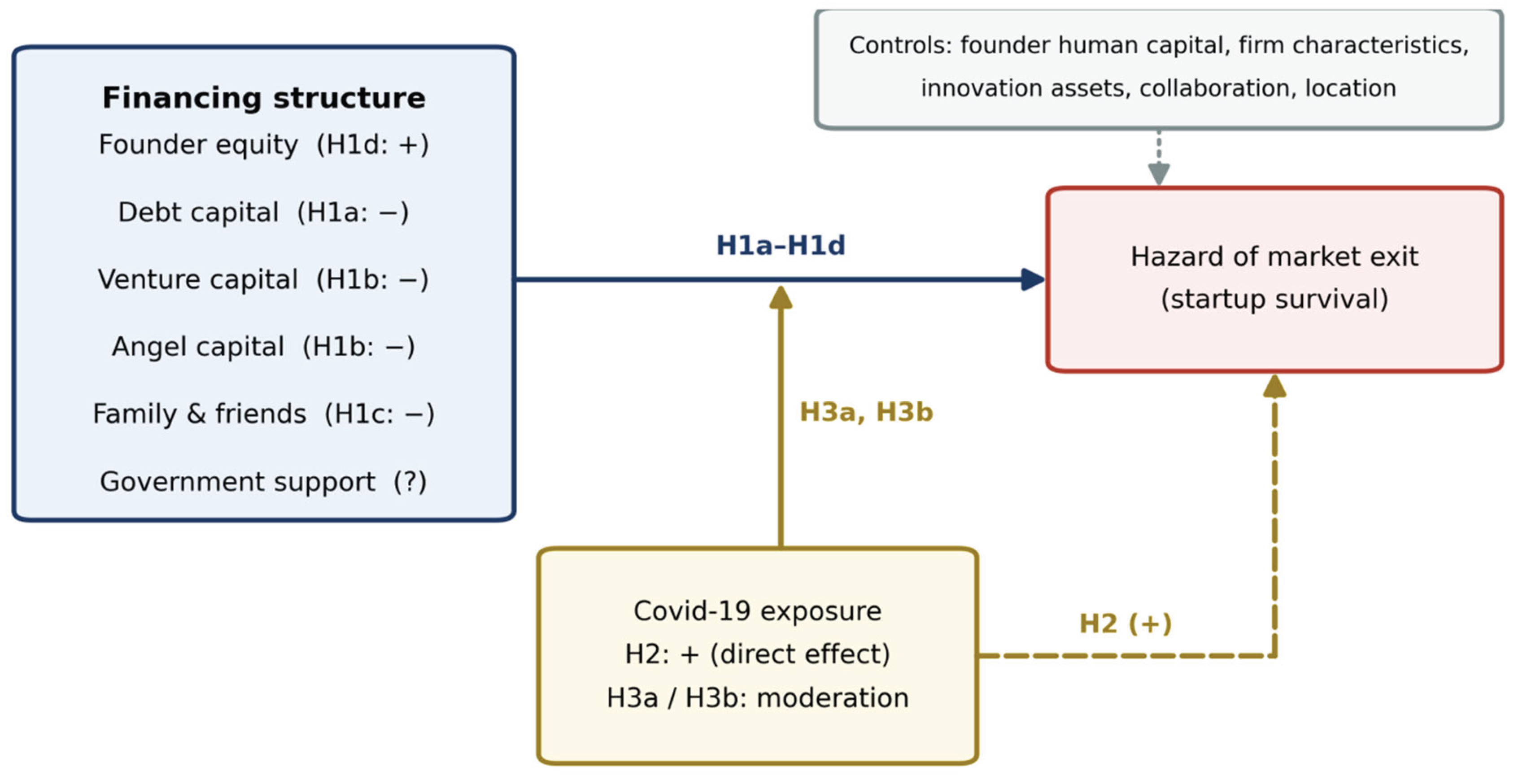
Figure 2.
Kaplan–Meier survival functions. Notes: Shaded bands are 95% confidence intervals. Log-rank tests reject equality of survival functions in both panels at p < 0.001. Source: Authors’ estimation from the survey data.
Figure 2.
Kaplan–Meier survival functions. Notes: Shaded bands are 95% confidence intervals. Log-rank tests reject equality of survival functions in both panels at p < 0.001. Source: Authors’ estimation from the survey data.
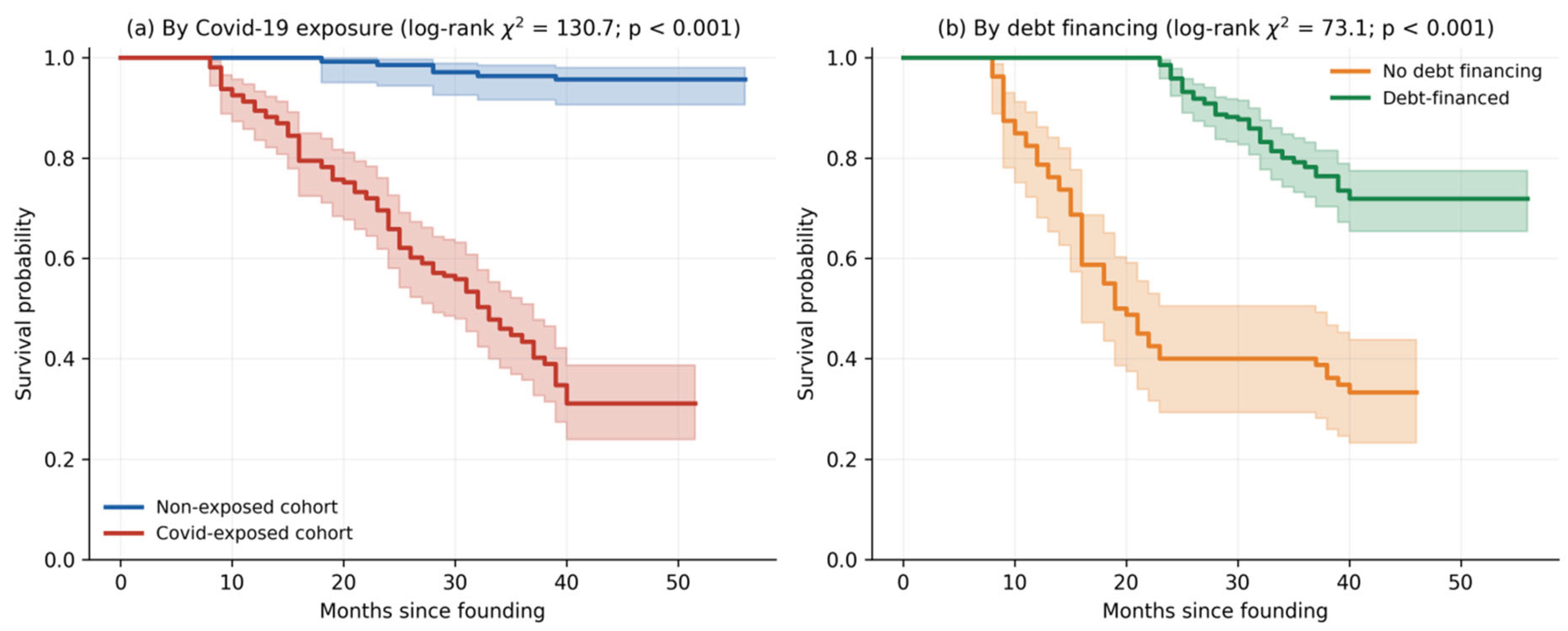
Figure 3.
Predicted survival functions from Model 4. Notes: Predictions hold all covariates at sample means. “Debt-financed” sets ln debt at the median among debt users; “high/low founder equity” at the 75th/25th percentiles. Source: Authors’ estimation from the survey data.
Figure 3.
Predicted survival functions from Model 4. Notes: Predictions hold all covariates at sample means. “Debt-financed” sets ln debt at the median among debt users; “high/low founder equity” at the 75th/25th percentiles. Source: Authors’ estimation from the survey data.
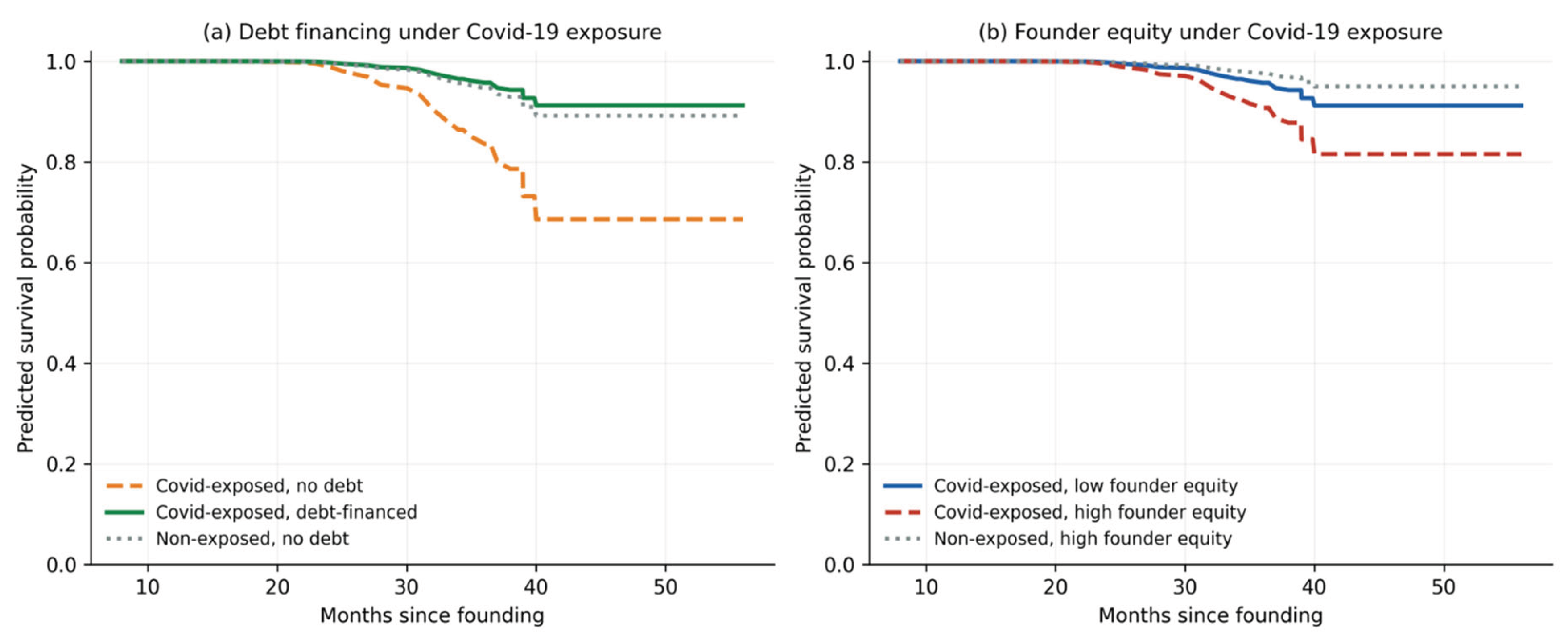

Table 1.
Descriptive statistics (n = 301).
| Variable | Mean | SD | Min | Max |
|---|---|---|---|---|
| Exit (=1 if exited) | 0.38 | 0.49 | 0 | 1 |
| Survival time (months) | 36.93 | 11.87 | 8 | 55.97 |
| Founder equity (ln) | 6.72 | 0.41 | 5.52 | 7.31 |
| Debt capital (ln) | 3.98 | 2.41 | 0 | 5.86 |
| Venture capital (ln) | 1.15 | 2.07 | 0 | 6.21 |
| Angel capital (ln) | 3.75 | 2.47 | 0 | 7.60 |
| Government support (ln) | 0.75 | 1.68 | 0 | 5.30 |
| Family & friends funding (ln) | 4.97 | 0.32 | 3.91 | 5.70 |
| Covid-19 exposure (=1) | 0.53 | 0.50 | 0 | 1 |
| Education (=1 university+) | 0.50 | 0.50 | 0 | 1 |
| Industry experience (years) | 5.11 | 4.12 | 0 | 22 |
| Entrepreneurial experience (count) | 1.72 | 1.40 | 0 | 4 |
| Opportunity motivation (=1) | 0.50 | 0.50 | 0 | 1 |
| Full-time founding (=1) | 0.60 | 0.49 | 0 | 1 |
| Founder age (years) | 38.62 | 10.70 | 23 | 56 |
| Founder gender (=1 male) | 0.55 | 0.50 | 0 | 1 |
| R&D unit (=1) | 0.54 | 0.50 | 0 | 1 |
| Team size | 6.91 | 4.05 | 1 | 12 |
| Firm size (employees) | 9.29 | 11.71 | 1 | 118 |
| ROA (%) | 24.22 | 25.66 | -11 | 66 |
| Competitive advantage (1-5) | 2.66 | 1.54 | 1 | 5 |
| Trademarks (count) | 2.36 | 1.80 | 0 | 5 |
| Copyrights (count) | 1.37 | 1.13 | 0 | 3 |
| Patents (count) | 4.57 | 2.77 | 0 | 8 |
| University collaboration (=1) | 0.43 | 0.50 | 0 | 1 |
| Firm collaboration (=1) | 0.53 | 0.50 | 0 | 1 |
| Non-financial gov. support (=1) | 0.51 | 0.50 | 0 | 1 |
| Urban location (=1) | 0.46 | 0.50 | 0 | 1 |
Notes: Financing variables are natural logarithms of amounts in million VND (zero for non-users). Survival time is measured in months from founding to exit or to the 2025 survey date (right-censored). Counts of trademarks, copyrights, and patents are founder-reported registrations. Source: Authors’ computation from the survey data.
Table 2.
Cox proportional hazards estimates: hazard ratios.
| Model 1 | Model 2 | Model 3 | |
|---|---|---|---|
| Founder equity (ln) | 2.852*** (0.359) |
4.252*** (0.327) |
3.919*** (0.332) |
| Debt capital (ln) | 0.689*** (0.052) |
0.784*** (0.063) |
0.781*** (0.063) |
| Venture capital (ln) | 0.540*** (0.234) |
0.629* (0.276) |
0.642 (0.279) |
| Angel capital (ln) | 0.831*** (0.058) |
0.803*** (0.047) |
0.816*** (0.047) |
| Government support (ln) | 0.889 (0.234) |
0.863 (0.200) |
0.935 (0.160) |
| Family & friends funding (ln) | 0.018*** (0.558) |
0.152*** (0.639) |
0.169*** (0.635) |
| Covid-19 exposure | — | — | 2.795* (0.602) |
| Controls (human capital, firm, innovation, collaboration, location) | No | Yes | Yes |
| LR χ² (vs. null) | 305.4*** | 492.7*** | 497.8*** |
| Harrell’s C | 0.895 | 0.947 | 0.95 |
| AIC (partial) | 955.7 | 806.4 | 803.3 |
| Observations (events) | 301 (114) | 301 (114) | 301 (114) |
Notes: Hazard ratios with robust standard errors of the underlying coefficients in parentheses. A hazard ratio below one indicates a lower hazard of exit (longer survival). *** p < 0.01, ** p < 0.05, * p < 0.10. Source: Authors’ estimation from the survey data.
Table 3.
Crisis-contingent financing effects.
| Model 4: Full sample with focal interactions | Model 5: Covid-exposed subsample | |
|---|---|---|
| Founder equity (ln) | 0.671 (1.283) |
4.399*** (0.369) |
| Debt capital (ln) | 0.839 (0.195) |
0.783*** (0.073) |
| Venture capital (ln) | 0.640 (0.279) |
0.670 (0.303) |
| Angel capital (ln) | 0.820*** (0.047) |
0.830*** (0.046) |
| Government support (ln) | 0.927 (0.160) |
1.056 (0.106) |
| Family & friends funding (ln) | 0.177*** (0.634) |
0.189** (0.700) |
| Covid-19 exposure | 2.330 (0.549) |
— |
| Founder equity × Covid-19 | 6.721 (1.327) |
— |
| Debt capital × Covid-19 | 0.917 (0.214) |
— |
| Linear combination: FE effect | exposed | 4.513*** (z = 3.24) | — |
| Linear combination: DC effect | exposed | 0.769*** (z = -3.67) | — |
| Controls | Yes | Yes |
| LR χ² (vs. null) | 499.5*** | 317.5*** |
| Harrell’s C | 0.951 | 0.914 |
| Observations (events) | 301 (114) | 161 (108) |
Notes: Hazard ratios with robust standard errors of the underlying coefficients in parentheses. Financing variables are mean-centered before interacting, so main financing effects in Model 4 refer to non-exposed ventures at mean funding levels. Linear-combination rows report the implied hazard ratio of the financing variable for exposed ventures with its z-statistic. *** p < 0.01, ** p < 0.05, * p < 0.10. Source: Authors’ estimation from the survey data.
Table 4.
Robustness checks.
| (i) Discrete-time hazard (exp(b)) | (ii) Logistic marginal effects (dy/dx on exit) | (iii) PSM Cox (HR) | |
|---|---|---|---|
| Founder equity (ln) | 0.421 | 0.175*** | 1.189 |
| Debt capital (ln) | 0.864 | -0.007 | 0.806 |
| Covid-19 exposure | 2.184 | 0.136*** | 2.738 |
| FE × Covid-19 | 12.32* | — | — |
| DC × Covid-19 | 0.937 | — | — |
| FE effect | exposed (lin. comb.) | 5.19*** | — | — |
| DC effect | exposed (lin. comb.) | 0.81*** | — | — |
| Estimator detail | cloglog, person-period, cluster-by-venture | Logit AME, robust SE | 1:1 NN match on debt receipt, caliper 0.05 |
| Observations | 1990 venture-periods | 301 | 82 (matched) |
Notes: Column (i) re-estimates Model 4 as a complementary log-log discrete-time hazard on six-month venture-periods with period dummies; entries are exponentiated coefficients. Column (ii) reports average marginal effects on the probability of exit from a logistic version of Model 3. Column (iii) re-estimates the Cox model on the propensity-score-matched sample (propensity from all controls plus exposure). *** p < 0.01, ** p < 0.05, * p < 0.10. Source: Authors’ estimation from the survey data.
Disclaimer/Publisher’s Note: The statements, opinions and data contained in all publications are solely those of the individual author(s) and contributor(s) and not of MDPI and/or the editor(s). MDPI and/or the editor(s) disclaim responsibility for any injury to people or property resulting from any ideas, methods, instructions or products referred to in the content. |
© 2026 by the authors. Licensee MDPI, Basel, Switzerland. This article is an open access article distributed under the terms and conditions of the Creative Commons Attribution (CC BY) license.
Copyright: This open access article is published under a Creative Commons CC BY 4.0 license, which permit the free download, distribution, and reuse, provided that the author and preprint are cited in any reuse.