

Submitted:
07 October 2026
Posted:
09 October 2026
You are already at the latest version
Abstract
This paper examines the conceptual boundary and governing principles connecting classical Newtonian mechanics, Einsteinian mass-energy equivalence, and Planckian quantum electrodynamics. In low-velocity macroscopic dynamics, mechanical energy transformations proceed under strict mass invariance, rendering relativistic corrections unnecessary. However, in complete radioactive decay or particle-antiparticle annihilation of a resting mass, intrinsic rest-frame energy converts directly into quantum electromagnetic energy. By linking rest-frame energy directly with Planck’s quantum formulation relating photon energy to radiation frequency and wavelength, the study demonstrates that the cumulative radiant energy strictly conserves the system's initial rest energy, establishing the fundamental equivalence between initial rest energy and total emitted photonic field energy. This paper details the structural transition from classical Newtonian mechanics to quantum field energy conservation without relying on intermediate relativistic momentum formulations.
Keywords:
energy conservation
; mass invariance
; mass-energy equivalence
; radiative transition
1. Introduction
The relationship between mass and energy lies at the core of physical principles spanning classical mechanics, special relativity [1,2,3,4,5], and quantum electrodynamics. In classical Newtonian physics, mass () is treated as an immutable, invariant scalar quantity that serves as a measure of inertia and gravitational attraction. Within this macroscopic regime, interactions occurring at velocities far below the speed of light () govern physical phenomena through mechanical work, kinetic energy, and potential energy transformations without altering system mass.
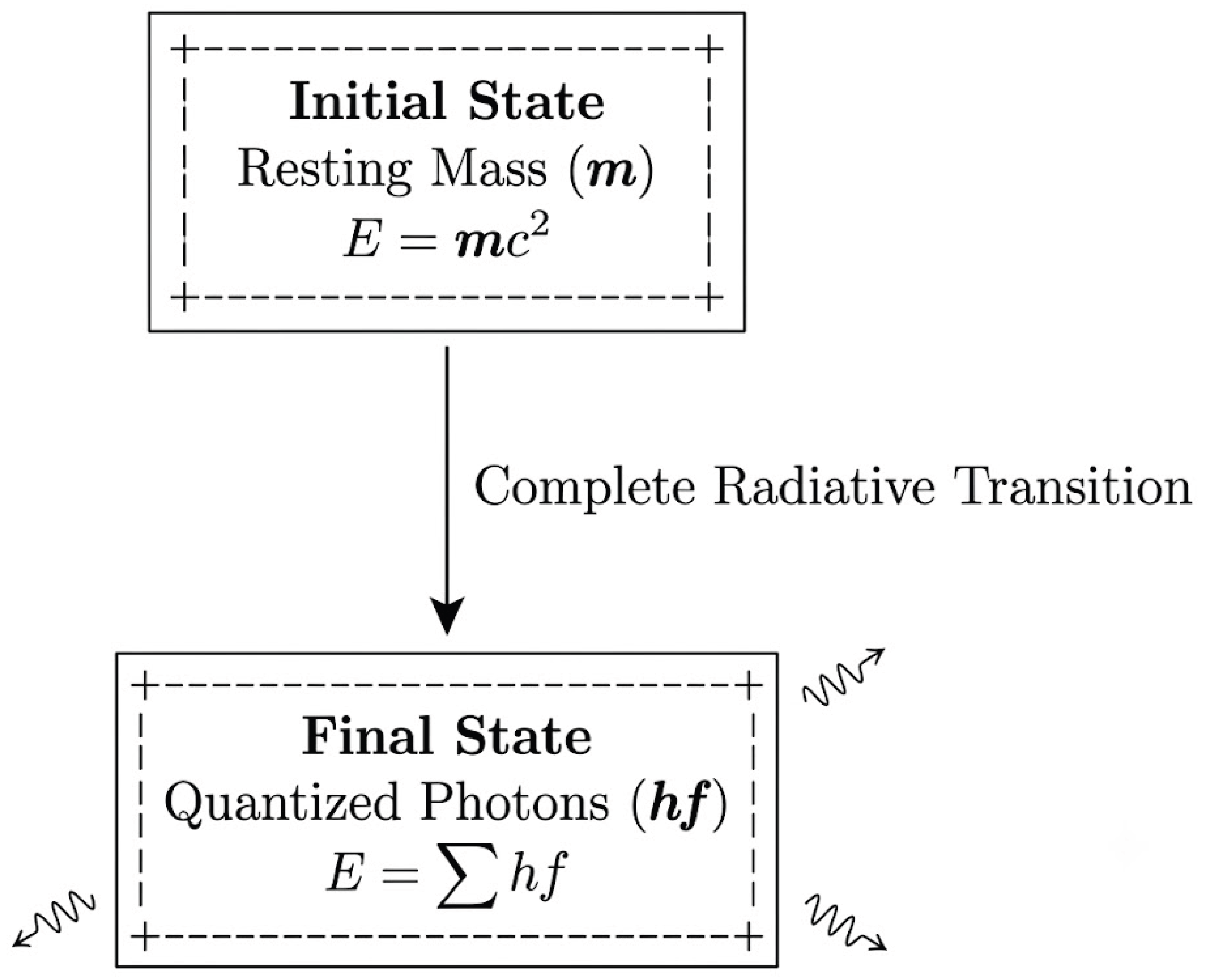
However, the advent of special relativity fundamentally redefined mass not as an absolute constant, but as a dense, bound form of intrinsic energy. Through Einstein’s formulation (), mass and energy were unified into a singular physical entity. In nuclear reactions, radioactive decay, and matter-antimatter annihilation, rest-frame mass can diminish or disappear entirely, re-emerging as radiant field energy. This transition is visualized in Figure 1, illustrating the complete conversion of a resting mass into quantized radiation.
2. Classical Mechanics and Mass Invariance
In classical Newtonian mechanics, macroscopic objects operating at non-relativistic velocities () undergo mechanical work, energy storage, and energy transfer without measurable variations in rest mass ().
When an object of mass is launched into motion:
- ○
- Kinetic Energy (): Work performed by applied external forces converts into motion:
- ○
- Potential Energy (): Work performed against a conservative field (e.g., gravity) is stored as positional energy:
Under these conditions, mass remains an invariant scalar quantity (). Energy transforms between mechanical forms (kinetic to potential and vice versa) without mass deficit or mass creation. Consequently, invoking Einstein’s mass-energy equivalence equation () in classical mechanics is unnecessary and physically inappropriate.
3. Special Relativity and Rest-Frame Energy
When particles undergo high-energy interactions, radioactive decay, or complete annihilation, mass can no longer be treated as an invariant constant separated from energy. Instead, mass itself represents a concentrated form of rest-frame energy.
For a stationary particle or system of mass , its intrinsic rest energy is given by Einstein’s mass-energy equivalence formula:
where is the rest mass (invariant mass) of the system and is the speed of light in vacuum ().
In processes where rest mass decreases by a deficit (such as nuclear fission or fusion), energy is liberated according to .
4. Quantum Electrodynamics: Planck-Einstein Formulation
When a resting mass $m$ transitions into radiation, the liberated energy manifests as quantized electromagnetic energy packets (photons). According to Planck’s quantum postulate, the energy of a photon is directly proportional to its frequency ($f$) or inversely proportional to its wavelength ():
where:
- ○
- is Planck’s constant (),
- ○
- is the radiation frequency,
- ○
- is the radiation wavelength ().
This formulation reflects the fundamental wave-particle duality of light, expressing energy directly through quantum frequency parameters without requiring particle mass terms. The final state, consisting of quantized photons carrying this energy, is a direct result of the Complete Radiative Transition process described in Figure 1.
5. Total Energy Conservation and Field Synthesis
When a resting mass $m$ undergoes complete transformation into radiation emitting multiple photons of varying or equal frequencies (), the total energy of the emitted photonic field is the summation of individual photon energies [2]:
Enforcing the Law of Conservation of Energy:
This conservation is illustrated in the transition diagram below.
Special Case: Electron-Positron Annihilation
In electron-positron pair annihilation at rest, the total initial rest mass of the electron-positron system () converts completely into gamma-ray photon energy ():
5. Conclusions
This paper establishes a unified theoretical framework linking classical mechanics, special relativity, and quantum electrodynamics through the governing principles of mass invariance and mass-energy transformation. In classical Newtonian mechanics, low-velocity interactions conserve system mass strictly, operating via potential and kinetic energy exchanges where relativistic corrections remain unnecessary. However, when a resting mass $m$ undergoes total transformation or decay, its rest-frame energyfully converts into radiant field energy. By directly synthesizing Einstein’s rest energy with Planck’s quantum formulation, as summarized in Figure 1, we demonstrate that the total radiant energy generated across all emitted frequencies satisfies the strict conservation law . This perspective bridges classical particle dynamics and quantum field transitions, providing a clear mathematical and physical framework for mass-energy conversion across distinct mechanical regimes.
Conflicts of Interest
The author declares that there is no conflict of interest.
References
- Einstein, A. Ist die Trägheit eines Körpers von seinem Energieinhalt abhängig? Ann. Der Phys. 1905, 18, 639–641. [Google Scholar] [CrossRef]
- Planck, M. Über eine Verbesserung der Wien’schen Spectralgleichung. Verhandlungen Der Dtsch. Phys. Ges. 1900, 2, 202–204. [Google Scholar]
- Annamalai, C. Derivation of Relativistic Momentum Corresponding to Classical Momentum. SSRN Electron. J. 2025. [Google Scholar] [CrossRef]
- Annamalai, C. A Systematic Approach to Deriving Relativistic Momentum and Energy Relations, COE; Cambridge University Press, 2026. [Google Scholar] [CrossRef]
- Annamalai, C. On Relativistic Energy Equivalence, Mass Defect, and the Lifetime Radiative Energy Balance of Solar-Mass Stars; ResearchGate, 2026. [Google Scholar] [CrossRef]
Figure 1.
Mass to photon radiative transition (The diagram shows the complete theoretical conversion of resting mass energy into quantized photonic energy.).
Figure 1.
Mass to photon radiative transition (The diagram shows the complete theoretical conversion of resting mass energy into quantized photonic energy.).
Disclaimer/Publisher’s Note: The statements, opinions and data contained in all publications are solely those of the individual author(s) and contributor(s) and not of MDPI and/or the editor(s). MDPI and/or the editor(s) disclaim responsibility for any injury to people or property resulting from any ideas, methods, instructions or products referred to in the content. |
© 2026 by the authors. Licensee MDPI, Basel, Switzerland. This article is an open access article distributed under the terms and conditions of the Creative Commons Attribution (CC BY) license (http://creativecommons.org/licenses/by/4.0/).
Copyright: This open access article is published under a Creative Commons CC BY 4.0 license, which permit the free download, distribution, and reuse, provided that the author and preprint are cited in any reuse.