
Submitted:
14 October 2026
Posted:
14 October 2026
You are already at the latest version
Abstract
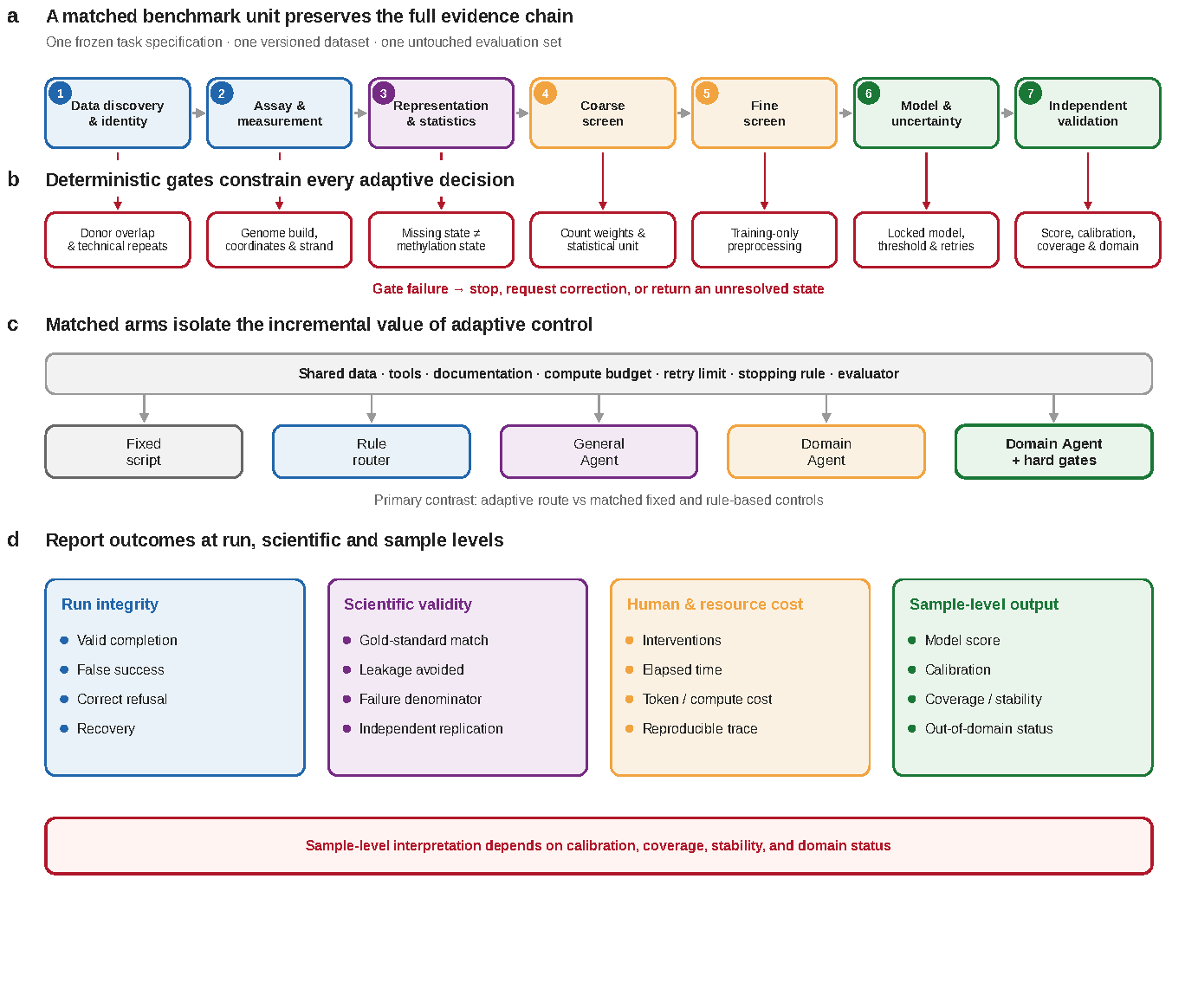
DNA methylation biomarker development spans data discovery, assay-specific processing, marker selection, model development, and independent validation. Agentic systems could help coordinate these stages, but current studies use the term agent for systems with markedly different levels of autonomy and domain-specific evidence. We conducted a structured evidence synthesis, screening 2,801 unique records and organizing relevant systems along three dimensions: workflow autonomy (M0–M4), direct methylation-task evidence, and evidence maturity (E0–E5).Current systems cover complementary parts of the workflow. MethylCurate supports public methylation-data curation; AutoBA and BioMaster execute methylation-analysis pipelines; CpG Atlas provides a self-correcting query interface; and EpiBench, BixBench, and BixBench3 provide direct benchmark evidence for bounded methylation tasks. Across these studies, evidence is strongest for data access, workflow execution, and task-level evaluation. Among systems with task-level evidence reviewed here, we did not identify one that spans dataset discovery, marker selection, classifier development, independent validation, and sample-level uncertainty reporting within a single validated workflow.We therefore propose a matched evaluation framework comparing fixed workflows, rule-based routers, and general or domain-specific agents under shared data, tools, compute, and retry budgets. The framework separates execution reliability, scientific validity, replication, uncertainty, and resource use. Current evidence supports agentic components for methylation analysis, while end-to-end autonomous biomarker discovery remains an open evaluation problem.
Keywords:
DNA methylation
; artificial intelligence agent
; biomarker discovery
; bioinformatics workflow
; large language model
Copyright: This open access article is published under a Creative Commons CC BY 4.0 license, which permit the free download, distribution, and reuse, provided that the author and preprint are cited in any reuse.