

Submitted:
05 October 2026
Posted:
08 October 2026
You are already at the latest version
Abstract
Quantum computing relies on the controlled preparation, coherent transformation, coupling, and measurement of quantum states implemented in physical hardware. This article develops a proposed Photony interpretation of electronic qubits based on electron structure, c-spin, x-spin, electron transduction, elemental charge photons, and organized electromagnetic chain states. The analysis focuses on two complementary implementations: semiconductor electron-spin qubits, in which an individual electron participates directly in the encoded quantum degree of freedom, and superconducting qubits, in which the relevant state is collective and must be associated with coordinated many-electron electromagnetic organization. The proposed interpretation does not identify $|0\rangle$ and $|1\rangle$ with two fixed classical electron orientations. Instead, a qubit is hypothesized to correspond to an admissible structural condition involving electron or collective electronic organization, x-spin response, transduction geometry, and the surrounding electromagnetic chain state. Applied control fields may modify this structural condition, while multi-qubit interactions may establish shared or jointly constrained transduced organization. The quantum state remains the established predictive description, and the Photony framework is treated as a structural hypothesis rather than a replacement for quantum mechanics. Its viability requires quantitative recovery of superposition, relative phase, coherent evolution, Rabi oscillations, basis-dependent measurement probabilities, entanglement, decoherence behavior, superconducting-qubit dynamics, and quantum no-signaling, together with at least one experimentally distinguishable prediction.
Keywords:
quantum computing
; qubits
; photony theory
; electron transduction
; electron-spin qubits
; semiconductor spin qubits
; superconducting qubits
; c-spin
; x-spin
; elemental charge photons
; electromagnetic chain organization
; quantum entanglement
; multi-qubit coupling
; quantum measurement
; decoherence
; Rabi oscillations
; coherent quantum control
1. Introduction
Quantum computing uses controlled quantum states as physical information resources. Qubits must be prepared, coherently transformed, coupled, protected from unwanted environmental interaction, and ultimately measured. Although quantum information theory provides the established mathematical description of these processes, every qubit is also implemented through a physical system and a physical control environment [1,2].
The present article asks whether electron transduction in Photony Theory can provide an underlying structural interpretation of some of those physical processes. The investigation focuses primarily on two classes of hardware: electron-spin qubits and superconducting qubits. These systems provide the most direct connection between controlled quantum states, electrons, and engineered electromagnetic environments.
Electron-spin qubits encode quantum information directly in electronic spin degrees of freedom. Semiconductor implementations use electrostatic confinement, microwave or magnetic excitation, exchange interaction, and charge-sensitive readout to initialize, manipulate, couple, and measure confined electron states [3,4]. These systems therefore provide a direct test case for any proposed relationship among electron structure, externally applied control fields, and quantum-state evolution.
Superconducting qubits provide a complementary test case. Their computational states are collective rather than attributable to one identifiable electron. In the established description, the qubit is associated with quantized collective circuit degrees of freedom supported by the superconducting condensate, Josephson junctions, charge, phase, magnetic flux, capacitance, inductance, microwave fields, and resonant electromagnetic structures [5,6]. They therefore provide a useful test of whether the proposed Photony electron-transduction mechanism can extend from an individual electron to a coordinated many-electron electromagnetic organization.
Photony Theory proposes that electrons function as transducers and regulators of electromagnetic organization. Elemental charge photons interacting with electron structures are proposed to become organized into larger electric and magnetic chains, while electron orientation and internal structure influence the geometry and rotational organization of those chains [7].
The distinction between the conventional field description and this proposed underlying organization is illustrated in Figure 1.
The present proposal does not identify the computational states and with two fixed classical electron orientations. Such a model would be unable to reproduce coherent superposition, relative phase, basis-dependent measurement, interference, or reversible quantum gates. Instead, the working hypothesis is that a physically implemented electronic qubit may involve an admissible structural relationship among persistent electron c-spin, locally responsive x-spin, electron transduction geometry, and the surrounding electromagnetic chain organization.
For an electron-spin qubit, the proposed relationship is summarized conceptually as:
applied electromagnetic control
↓
local x-spin response
↓
change in electron transduction geometry
↓
change in organized electromagnetic structure
↓
controlled qubit-state response
This sequence is not intended to replace the quantum-mechanical description. The quantum state remains the established predictive formalism. The proposed Photony structure must instead reproduce the measured behavior of that state, including amplitudes, relative phase, coherent rotations, measurement probabilities, and entanglement.
The distinction becomes especially important for superconducting qubits. There the relevant structural organization cannot reasonably be assigned to a single electron. A Photony interpretation must instead determine whether coordinated electron transduction can participate in the distributed electromagnetic organization associated with collective circuit states.
The primary scope of this article is therefore electronic quantum hardware. Other qubit platforms, including photonic, atomic, ionic, mechanical, and hybrid systems, remain important because they show that a qubit need not itself be an electron. They are treated here primarily as boundary cases for the hypothesis. In such systems, electrons may participate indirectly through the surrounding materials, resonators, interfaces, detectors, or control structures rather than through the encoded quantum degree of freedom itself.
The central hypothesis is that electron transduction may provide an underlying structural connection among the physical control environment, the electron or collective electronic configuration, organized electromagnetic chain states, and the qubit being manipulated. For a directly electronic qubit the relationship may be local and immediate. For a superconducting qubit it may require coordinated transduction by a larger electron population.
Any such interpretation faces strict quantitative requirements. It must recover coherent state evolution, relative phase, Rabi oscillations, basis-dependent measurement, reversible gate operations, multi-qubit entanglement, and experimentally observed coherence behavior. A structural model that provides only an intuitive picture without reproducing those quantitative results would be insufficient.
The following section establishes only the mainstream qubit concepts needed for that comparison. The article then focuses on the physical implementation of electron-spin and superconducting qubits, develops the relevant Photony electron structure and transduction processes, and examines whether those elements can provide a consistent structural interpretation of controlled qubit states. The final section identifies the quantitative and experimental requirements needed to test the proposed interpretation.
2. Mainstream Qubit and Quantum-Computing Framework
The purpose of this section is to establish only the quantum concepts needed to evaluate the proposed Photony interpretation. The relevant requirements are coherent superposition, relative phase, controlled state evolution, basis-dependent measurement, entanglement, and experimentally measurable coherence. These provide the reference standard that any proposed underlying electron-transduction mechanism must reproduce [1,2].
For a two-level quantum system, a pure qubit state is written as:
where and are complex probability amplitudes satisfying:
If the qubit is measured in the computational basis, the corresponding probabilities are:
The amplitudes contain more information than ordinary classical probabilities. Their relative phase affects interference and the outcomes of subsequent coherent operations. Two states can therefore produce the same immediate computational-basis probabilities while responding differently to later control operations [1].
After removal of an overall physically irrelevant global phase, a pure qubit state can be represented on the Bloch sphere as:
The parameters and describe a continuous quantum-state space. This is an important constraint on any physical interpretation. A qubit cannot be represented adequately as an unknown classical choice between two fixed microscopic configurations. The underlying model must contain enough structure to reproduce both basis-state populations and relative phase.
Quantum gates transform the qubit state through controlled unitary evolution. For an operator U, the state transformation is:
At the hardware level, this transformation is produced by a physical interaction. In electron-spin systems the control may involve microwave, magnetic, or electrically mediated spin manipulation. In superconducting circuits the control commonly involves shaped microwave pulses and tunable circuit parameters [4,5].
Rabi oscillations provide a particularly useful experimental example because they demonstrate coherent, continuously controlled evolution of a two-level system. For an idealized resonantly driven qubit initially in its lower state, the excited-state probability can be represented as:
where is the Rabi angular frequency.
For the present article, this behavior is more important than the detailed matrix representation of individual quantum gates. Any Photony structural model must explain how the proposed electron and chain configuration can change continuously and coherently in a manner that reproduces the measured Rabi response.
Measurement introduces a different requirement. For a projective measurement described by projector , the probability of outcome m is:
The measurement outcome therefore depends on both the prepared state and the measurement basis. This basis dependence is especially important for electron-spin qubits. A state that is definite relative to one axis is generally a superposition relative to another axis [1,8].
A proposed physical structure beneath the quantum formalism must therefore distinguish carefully between an underlying electron configuration and the measured spin result. A fixed classical electron orientation cannot by itself reproduce the complete basis-dependent behavior of a spin- qubit.
The same principle applies to superconducting qubits. The measured logical state is not simply a classical circuit state revealed without disturbance. The physical measurement apparatus couples to the qubit through an engineered electromagnetic environment and produces state-dependent readout [5,6].
Multi-qubit operation introduces the additional requirement of nonseparability. A separable two-qubit state can be written as:
An entangled state cannot, in general, be written in this form. A standard example is:
In such a state, physically relevant information resides partly in the relationship between the two qubits rather than entirely within either qubit considered independently [1,9].
This feature places an important constraint on the Photony interpretation. A single-qubit structural model may associate a qubit with a local electron and electromagnetic organization, but an entangled multi-qubit state requires an additional shared or jointly constrained relationship. The later Photony discussion must therefore allow structural information to be distributed across more than one physical qubit.
Coherence provides the final mainstream requirement needed here. A qubit must retain phase information long enough for the intended control operations to occur. Environmental interaction can distribute quantum information into uncontrolled degrees of freedom and thereby reduce the coherence accessible within the intended computational system [10,11].
In experimental hardware, relaxation and dephasing are commonly characterized by the time scales and . The first describes energy relaxation, while the second describes loss of phase coherence. The details vary by platform, but both provide direct constraints on any proposed underlying structural mechanism [4,5].
The mainstream framework can therefore be reduced to a small set of nonnegotiable requirements for the present investigation:
coherent superposition and relative phase
↓
controlled and reversible state evolution
↓
basis-dependent measurement probabilities
↓
multi-qubit nonseparability
↓
finite experimentally measured coherence
Photony electron transduction, c-spin, x-spin, and electromagnetic chain organization cannot replace these established quantum results. Any proposed underlying structure must instead reproduce them.
The following section therefore turns from the abstract quantum requirements to the physical hardware most relevant to the present hypothesis. Particular attention is given to electron-spin and superconducting qubits, where the relationship between electrons, electromagnetic control, and quantum-state manipulation is most direct.
3. Physical Implementations of Qubits
The mathematical definition of a qubit does not determine its physical implementation. The states and may correspond to electron-spin states, collective superconducting circuit states, atomic levels, photon states, or other controllable quantum degrees of freedom [1,2].
For the present Photony investigation, two implementations are especially important. Semiconductor electron-spin qubits provide the most direct case in which an individual electron participates in the encoded quantum state. Superconducting qubits provide a complementary case in which the relevant quantum degree of freedom belongs to a collective electronic and electromagnetic circuit state.
These two platforms therefore test the proposed transduction hypothesis at two different structural scales:
individual electronic qubit
↓
single-electron response and transduction
collective electronic qubit
↓
coordinated many-electron electromagnetic organization
Other qubit platforms remain important as boundary cases, but they are not developed independently here because the present article focuses on electronic quantum hardware.
3.1. Semiconductor Electron-Spin Qubits
Semiconductor spin qubits provide a direct physical connection between quantum information and individual electrons. Electrons can be confined electrostatically within semiconductor quantum dots, while the electron spin degree of freedom provides the qubit [3,4].
Relative to a selected quantization axis, the computational basis can be represented as:
This representation must not be interpreted as a classical electron simply pointing permanently in one of two directions. Spin qubits support coherent superposition, arbitrary basis measurement, phase evolution, and entangling operations [4].
Control can involve microwave or magnetic excitation, electric-dipole spin resonance, spin-orbit interaction, magnetic-field gradients, and electrostatically controlled exchange coupling. For two confined electron spins, an idealized exchange interaction can be written as:
where is the controllable exchange coupling.
These systems are particularly important for the Photony hypothesis because the electron is simultaneously the proposed structural transducer and a direct participant in the quantum degree of freedom. Gate voltages, microwave fields, magnetic conditions, interfaces, and charge reservoirs alter the electromagnetic environment experienced by the confined electron.
A Photony interpretation can therefore ask a physically specific question: whether controlled changes in the local electromagnetic environment produce corresponding changes in x-spin, transduction geometry, and electromagnetic chain organization that remain quantitatively consistent with the measured quantum-state evolution.
Semiconductor spin qubits consequently provide the clearest single-electron test case developed in this article.
3.2. Superconducting Qubits
Superconducting qubits test the same hypothesis at a collective scale. Instead of encoding the state in one identifiable electron spin, these devices use quantized collective circuit degrees of freedom supported by the superconducting condensate and engineered through Josephson junctions, capacitance, inductance, charge, phase, magnetic flux, and microwave electromagnetic modes [5,6].
The Josephson junction supplies the nonlinear element that permits a controllable quantum circuit to support distinguishable energy levels. Its idealized current relation is:
where is the critical current and is the superconducting phase difference across the junction.
Modern superconducting qubits are controlled primarily through engineered microwave interactions and circuit parameters. Two-qubit coupling can involve capacitive or inductive interaction, tunable couplers, or shared resonator modes, while readout commonly uses state-dependent changes in a coupled microwave resonator [5,6].
The Photony question is therefore different from the single-electron case. The established superconducting qubit state is a collective circuit state, not the state of one identifiable electron. The proposed Photony structural mechanism must therefore determine whether coordinated transduction involving many participating electrons can underlie part of the electromagnetic organization associated with that measured collective circuit state.
Within the proposed Photony interpretation, a preliminary structural hierarchy is:
participating superconducting electron population
↓
coordinated electron transduction
↓
distributed electric and magnetic chain organization
↓
collective electromagnetic circuit state
↓
superconducting qubit response
This possibility remains hypothetical. Conventional superconducting quantum circuits are already described quantitatively by established condensed-matter physics and circuit quantum electrodynamics. A Photony interpretation must recover those measured dynamics rather than replace them with an unquantified structural analogy.
Superconducting qubits are nevertheless valuable for the present hypothesis because they combine large electron populations, extremely low dissipation, coherent microwave control, resonant electromagnetic organization, and reversible quantum operations within one engineered device.
3.3. Other Qubit Platforms as Boundary Cases
The focus on electronic hardware does not imply that all qubits are electronic. Atomic, ionic, photonic, mechanical, and hybrid systems provide important counterexamples. In such systems, the encoded quantum degree of freedom may not itself be an electron state.
This distinction prevents an overly broad interpretation of electron transduction. The presence of electrons in a device does not imply that the qubit itself should be identified with an electron.
Instead, three levels of possible Photony involvement can be distinguished:
direct electronic participation
the electron itself participates in the encoded qubit
collective electronic participation
the qubit belongs to a coordinated many-electron system
electron-mediated environment
electrons participate in preparation, control, coupling, conversion, or measurement of another quantum degree of freedom
The first category applies most directly to semiconductor spin qubits. The second applies naturally to superconducting circuits. The third may become relevant to photonic, atomic, mechanical, or hybrid platforms, but it is not developed further in the present article.
This narrowing is deliberate. Demonstrating a consistent structural interpretation for electron-spin and superconducting qubits is a necessary step before attempting to extend the same mechanism to every quantum information platform.
The two selected hardware classes therefore provide complementary tests of the Photony hypothesis. Electron-spin qubits ask whether c-spin, x-spin, and electron transduction can be related to the controlled evolution of an individual electronic qubit. Superconducting qubits ask whether the same framework can scale to collective electronic organization.
The next section develops the proposed Photony electron structure and transduction processes needed for those two applications.
4. Electron Structure and Transduction in Photony Theory
The preceding sections identified two electronic qubit platforms of primary interest to the present study. Semiconductor spin qubits involve individual electrons directly, while superconducting qubits involve collective electronic and electromagnetic states. Photony Theory proposes several structural electron properties that may provide an underlying interpretation of these physical implementations.
The proposed model does not replace the established spin- formalism. Quantum mechanics remains the experimentally validated description of electron spin, state evolution, and measurement. Photony instead proposes additional underlying structure whose behavior must reproduce those observed quantum results [7,8].
4.1. Electron Structure, c-Spin, and x-Spin
Within Photony Theory, electron formation is associated with pair-production processes involving sufficiently energetic gamma-ray classical photons. The resulting electron is proposed to possess a toroidal structure surrounding a central transduction region and to retain a persistent internal rotational organization identified as c-spin [7].
Photony distinguishes this persistent internal organization from an externally responsive behavior identified as x-spin. The two proposed roles are:
c-spin
persistent internal rotational organization
x-spin
externally responsive electron orientation
The distinction is important for qubit control. An applied electromagnetic condition may alter the x-spin orientation through which the electron interacts with its surroundings without requiring the persistent c-spin organization to disappear.
The proposed c-spin is not identified directly with the quantum spin operator. In standard quantum mechanics, electron spin is an intrinsic angular momentum described by the spin- formalism and is not treated as classical rotation of an extended body [8]. Photony c-spin and x-spin must therefore be regarded as hypothesized structural processes whose validity depends on whether they can reproduce measured spin behavior.
Likewise, an x-spin response must not be reduced to a universal mechanical flip. A qubit can be prepared, controlled, and measured relative to continuously varying axes. The proposed x-spin response must therefore permit reorientation or other allowed structural change according to the local interaction rather than impose only two classical electron orientations.
4.2. Electron Transduction and Chain Organization
Photony proposes that electromagnetic organization is supported by elemental charge photons, or ECPs. These are proposed underlying constituents and are distinct from the classical propagating photon used in conventional descriptions of radiation [7].
Electron transduction occurs when ECPs interacting with the electron are redirected and organized into larger electromagnetic chain structures. The electron is therefore treated as a transducer and regulator rather than as the source of all energy contained in the resulting structure.
The proposed relationship is:
available elemental charge photons
↓
interaction with electron structure
↓
c-spin and x-spin dependent transduction geometry
↓
organized electromagnetic chain state
The persistent rotational sense associated with c-spin is proposed to influence the directional or rotational organization of a transduced chain, while x-spin influences the orientation through which the local interaction occurs.
Photony distinguishes electric and magnetic chain organization. Static electric-chain organization is associated primarily with surface and electrostatic conditions, while dynamic magnetic-chain organization is associated more directly with current and conductive systems [7].
These proposed structures are not substitutes for conventional electric and magnetic fields. Maxwellian field quantities remain the experimentally established macroscopic description. The Photony chain model is proposed as an underlying structural interpretation whose observable behavior must remain consistent with those fields.
4.3. Transduction and Reduction
Photony also distinguishes chain formation from a complementary process called reduction. During transduction, an electron contributes to the formation or extension of organized electromagnetic structure. During reduction, an electron interacting with an insufficiently supported chain can contribute to shortening or reorganizing that structure [7].
The distinction can be summarized as:
available ECP support → transduction → chain formation or extension
insufficient chain support → reduction → chain shortening or reorganization
Figure 2 summarizes the proposed electron structure and these complementary processes.
For the present article, reduction is relevant mainly because it establishes that the electromagnetic organization associated with a qubit need not be permanent. Changes in the local environment may build, modify, or reduce the proposed chain state. The quantitative relationship between such changes and measured qubit relaxation or decoherence remains undeveloped.
4.4. Application to an Individual Electron-Spin Qubit
The most direct application of the model is an electron-spin qubit. The electron participates directly in the encoded quantum degree of freedom and is also the proposed transducing structure.
A preliminary Photony hierarchy is:
persistent electron c-spin
↓
locally responsive x-spin condition
↓
electron transduction geometry
↓
associated electromagnetic chain organization
↓
physically implemented qubit condition
The local control environment can include gate potentials, microwave fields, magnetic conditions, interfaces, and nearby electron populations. Within the Photony hypothesis, these conditions may alter x-spin and the geometry through which transduction occurs.
This proposed hierarchy must not be interpreted as a hidden deterministic assignment of the future measurement result. The resulting structural state must still reproduce coherent superposition, relative phase, arbitrary basis measurement, Rabi oscillations, and the probabilistic outcomes predicted by quantum mechanics.
The useful Photony question is therefore not whether and correspond to two fixed mechanical electron orientations. It is whether a controlled relationship among c-spin, x-spin, transduction geometry, and electromagnetic organization can underlie the continuously evolving quantum state.
4.5. Application to Collective Superconducting Qubits
The superconducting case requires a broader interpretation. A superconducting qubit cannot reasonably be assigned to the x-spin or transduction state of one electron. Its measured quantum state belongs to a collective electronic and electromagnetic circuit system [5,6].
Photony must therefore permit coordinated transduction involving many electrons.
A preliminary hierarchy is:
collective electron population
↓
coordinated electron transduction
↓
distributed electric and magnetic chain organization
↓
collective electromagnetic circuit condition
↓
superconducting qubit response
In conductive systems, Photony proposes that participating electrons can become organized relative to current and surrounding electromagnetic conditions, allowing repeated transduction sites to contribute to extended magnetic-chain organization [7].
This provides a possible structural bridge to superconducting circuits, but the correspondence remains hypothetical. A successful Photony model must recover the measured Josephson dynamics, energy levels, microwave control, resonator coupling, gate behavior, and coherence of the superconducting device.
The distinction between individual and collective electronic qubits can therefore be summarized as:
electron-spin qubit
local electron structure and transduction are directly relevant
superconducting qubit
coordinated many-electron transduction and distributed chain organization are required
This two-scale distinction is sufficient for the scope of the present paper. The broader application of electron transduction to photonic, atomic, mechanical, or hybrid qubits is left for separate treatment.
4.6. Dynamic Control and the Qubit State
Quantum hardware is controlled by time-dependent electromagnetic excitation. Microwave, electric, and magnetic control signals modify the local physical environment and drive coherent quantum evolution.
Within the Photony hypothesis, the proposed structural response is:
time-dependent control signal
↓
changing local electromagnetic condition
↓
x-spin response or collective electron response
↓
change in transduction geometry
↓
change in organized electromagnetic state
The corresponding established description is the Hamiltonian evolution of the qubit. Photony must eventually derive a quantitative mapping between these two levels.
For example, when a resonant control pulse produces a measured Rabi oscillation, the structural model must determine what continuous evolution of x-spin, collective electron organization, or transduced chain state corresponds to the measured quantum evolution. A statement that the electron merely responds to an applied field is not sufficient.
The central proposal of this section is therefore limited but specific. Electron transduction may contribute to the physical organization through which an electronic qubit is controlled, but transduction is not identified with the quantum state itself.
For an individual spin qubit, the relevant structure may involve one electron and its local chain environment. For a superconducting qubit, it must involve a distributed many-electron electromagnetic organization.
In both cases, the proposed structure must reproduce the experimentally established amplitudes, relative phase, basis dependence, coherent evolution, and measurement probabilities of the qubit.
The next section applies this framework directly to the single-qubit state and examines whether a controlled structural configuration can represent more than two fixed classical electron alternatives.
5. Qubit States as Controlled Structural Configurations
The preceding section identified the Photony elements most relevant to electronic qubit control: persistent c-spin, externally responsive x-spin, electron transduction, and organized electromagnetic chain states. The central question is whether these elements can support a structural interpretation of a qubit without reducing the quantum state to a pair of predetermined classical configurations.
This distinction is essential. A qubit contains probability amplitudes, relative phase, coherent superposition, basis dependence, and interference. These properties cannot be reproduced merely by assuming that the physical system secretly occupies one of two classical states before measurement [1,8].
The Photony interpretation developed here therefore proposes that a physically implemented electronic qubit corresponds to an admissible structural condition involving several related variables rather than one isolated mechanical orientation.
5.1. Structural Representation of the Qubit State
For an electron-spin qubit, the computational basis states and may correspond experimentally to two spin eigenstates relative to a selected quantization axis [4,8].
Within Photony, these states should not be identified automatically with two fixed classical electron orientations. Instead, each basis state may correspond to a more complete structural condition involving the electron, its x-spin response, transduction geometry, and surrounding electromagnetic organization.
A useful symbolic representation is:
The structural condition may be represented provisionally as:
where C denotes the persistent c-spin condition, X the responsive x-spin condition, T the transduction configuration, and G the associated chain organization. The quantity denotes the local electromagnetic control and boundary environment acting on the qubit.
Equation (14) is deliberately qualitative. No quantitative function has yet been derived. The notation distinguishes the proposed qubit structural state from the environment that conditions its admissible configuration. Accordingly, is not treated as a constituent of . Instead, changes in the local electromagnetic environment may alter the admissible relationship among c-spin, x-spin, transduction geometry, and organized chain structure.
For a superconducting qubit, the same concept must be generalized from one electron to a collective electronic state. In that case, would represent a distributed many-electron and electromagnetic organization rather than the structural condition of one electron.
5.2. Superposition and Relative Phase
The most important constraint on this structural interpretation is coherent superposition. The general qubit state established in Section 2 cannot be replaced by an unknown choice between and .
The proposed structural condition must instead contain sufficient information to reproduce the complete quantum state, including relative phase.
Using the Bloch-sphere parameters introduced previously, the requirement can be represented provisionally as:
This does not mean that and are assumed to be ordinary mechanical angles within the Photony electron. They are established quantum-state parameters. The equation instead states that the proposed underlying configuration must vary in a manner capable of reproducing the amplitude and phase information represented by those parameters.
Relative phase is especially important because two states can possess the same computational-basis probabilities while responding differently to later coherent operations. A structural model based only on electron orientation or chain density would therefore be insufficient.
Photony has not yet identified the structural variable that corresponds to relative phase. Possible candidates might involve rotational relationship, transduction timing, chain organization, or another property of the combined electron-chain state. At the present stage, the more conservative requirement is simply that physically distinguishable quantum states must correspond to physically distinguishable structural conditions.
That requirement can be expressed as:
Here denotes the physical quantum-state ray represented by , rather than one particular state vector including its global phase. State vectors that differ only by an overall phase factor, , represent the same physical quantum state and therefore belong to the same ray . Consequently, indicates that the two states are physically distinguishable and not merely different mathematical representatives of the same quantum state. The proposed Photony structural conditions and are therefore required to differ only when the corresponding physical quantum states differ.
5.3. Controlled x-Spin and Transduction Response
The x-spin concept provides the most direct proposed connection between an applied control field and the structural state of an electron-based qubit.
An external electromagnetic condition can alter the x-spin orientation through which the electron interacts with its local transduction environment. The resulting change can modify the geometry through which ECPs are organized into larger chain structures [7].
For an electron-spin qubit, the proposed sequence is:
applied control condition
↓
local electromagnetic environment
↓
x-spin response
↓
change in transduction geometry
↓
change in organized chain state
↓
new admissible qubit configuration
This sequence does not imply that the control field rotates a classical electron through the same angle represented on the Bloch sphere. The Bloch sphere represents the established quantum state space. The proposed x-spin and transduction responses are candidate underlying physical processes.
For a superconducting qubit, the same sequence must be generalized:
applied microwave or circuit control
↓
collective electronic response
↓
coordinated transduction change
↓
distributed electromagnetic reorganization
↓
new collective qubit condition
The important requirement in both cases is continuous, coherent evolution. Measured Rabi oscillations demonstrate that the qubit does not simply switch abruptly between two hidden classical configurations [4,5]. The proposed structural state must, therefore, evolve continuously in a manner that reproduces the measured quantum response.
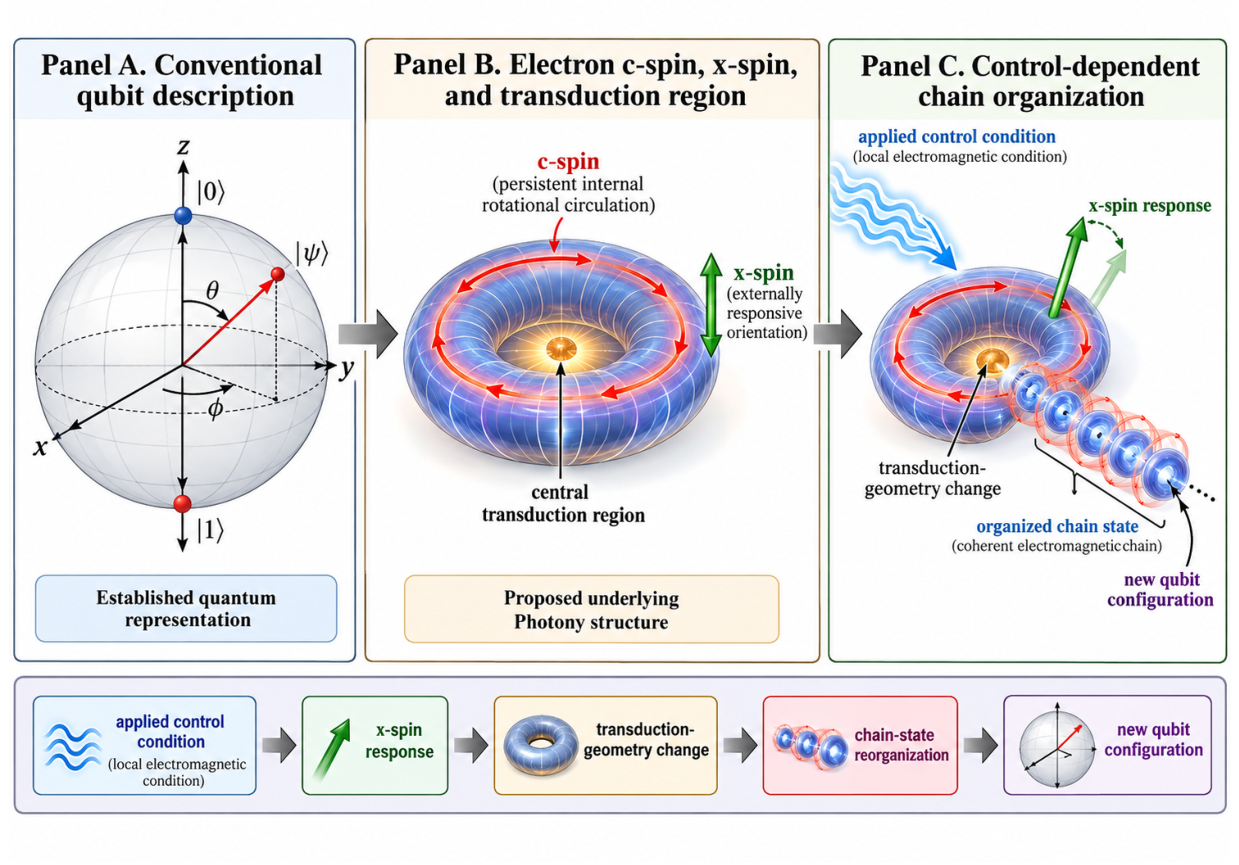
Figure 3 summarizes this central hypothesis.
Figure 3 also illustrates why the Photony proposal requires more than a two-state mechanical switch. The electron or collective electronic structure must support a continuously variable controlled organization capable of preserving both amplitude and phase information.
5.4. Measurement, Randomness, and Reversibility
The structural interpretation must also reproduce basis-dependent measurement. The apparatus selects a measurement condition, but the experimenter cannot generally select the individual result of a quantum measurement [1].
Within the Photony hypothesis, the measurement apparatus changes the local electromagnetic environment encountered by the qubit. That change may alter x-spin or collective electron response and the transduction geometry through which the structural state is interrogated.
The proposed sequence is:
prepared structural condition
↓
selected measurement environment
↓
local transduction response
↓
one realized measurement outcome
The prepared structural condition must not contain a fixed classical answer for every possible measurement basis. Instead, it must support the basis-dependent probabilities established by quantum mechanics.
This requirement is particularly important because x-spin is described as an externally responsive behavior. If x-spin simply followed an applied field in a completely deterministic classical manner, the model could incorrectly predict controllable outcomes where quantum mechanics predicts probabilistic results.
The structural model must, therefore, distinguish controlled state preparation from the control of an individual measurement outcome.
Coherent gate operations impose a second requirement: reversibility. Ideal quantum gates are unitary, so an appropriate inverse operation can recover the original state. The corresponding structural transformation must therefore preserve enough organization to permit controlled reversal while coherence is maintained.
This requirement separates coherent qubit evolution from ordinary irreversible electromagnetic processes, such as resistive heating or breakdown. The relevant Photony regime must therefore permit low-loss, reversible structural reorganization.
5.5. Requirements for a Viable Structural Qubit Model
The single-qubit Photony hypothesis can now be stated concisely. A physically implemented electronic qubit is proposed to involve a controlled structural relationship among electron or collective electronic organization, x-spin response, transduction geometry, and electromagnetic chain state.
The quantum state remains the established predictive description. The Photony structure is viable only if it reproduces that description.
The central mathematical requirement is:
A successful mapping must reproduce, at minimum:
coherent superposition and relative phase
controlled single-qubit evolution
Rabi oscillations
basis-dependent measurement probabilities
local outcome randomness
reversible gate operation
measured relaxation and dephasing behavior
These requirements distinguish a physically testable structural interpretation from a classical analogy.
At present, Photony identifies candidate structural variables but does not yet provide the quantitative mapping in Equation (17). Deriving that mapping is therefore one of the principal unresolved tasks of the theory.
The structural model developed here is intentionally restricted to electronic qubits. The final section examines how this framework bears on multi-qubit coupling and collective electronic systems and identifies the quantitative and experimental requirements needed to test the proposed interpretation.
6. Implications for Quantum Computing, Quantitative Requirements, and Conclusions
The preceding sections developed a proposed structural interpretation of electronic qubits centered on c-spin, x-spin, electron transduction, and organized electromagnetic chain states. The model was considered at two physical scales: the individual electron-spin qubit and the collective superconducting qubit.
The remaining questions are whether this framework can extend consistently to multi-qubit operation, whether collective electron transduction can support the organization required by superconducting circuits, and whether the proposed structural state can ultimately be related quantitatively to the established quantum description.
6.1. Multi-Qubit Coupling and Shared Structural States
General quantum computation requires interactions among qubits. When an entangling operation is applied, the resulting state cannot be represented as a collection of independent single-qubit states [1,9].
The structural implication is direct. If each isolated electronic qubit is associated with a local structural condition , an entangling operation must establish an additional relationship that constrains the combined system.
A preliminary Photony interpretation is:
independent qubit structures
↓
controlled electronic coupling
↓
shared or jointly constrained transduced organization
↓
nonseparable multi-qubit state
The proposed shared organization should not be interpreted automatically as an ordinary signal path connecting two otherwise independent qubits. An entangled state contains information in the relationship between the subsystems themselves. The corresponding Photony hypothesis must therefore permit structural information to belong to the combined organization rather than remain localized independently within each qubit.
For semiconductor electron-spin qubits, the physical coupling may involve exchange interaction or another controlled electromagnetic interaction. The question is whether that interaction can establish a shared transduction condition whose evolution remains consistent with the nonseparable quantum state.
The detailed topology of such a shared structure is not yet derived. It should therefore not be specified prematurely as uniquely electric, magnetic, or otherwise. The essential requirement is that the resulting structural relationship reproduces the experimentally established multi-qubit state rather than reduces it to a classical correlation.
This requirement is stronger than reproducing correlated outcomes in one measurement basis. A viable Photony interpretation must also reproduce the Bell-type correlations exhibited by entangled quantum systems, including violations of bounds satisfied by local hidden-variable models [9]. The proposed shared structural organization , therefore, cannot be interpreted as a pair of predetermined local classical states whose measurement outcomes are merely revealed independently at each qubit.
At the same time, reproduction of those nonclassical correlations must remain consistent with quantum no-signaling. Even if the proposed shared structural relationship constrains the joint state of spatially separated qubits, it cannot permit the measurement setting or outcome at one qubit to be used to control the local outcome probabilities at the other qubit. The structural relationship, therefore, must reproduce the observed joint correlations without becoming a controllable faster-than-light communication channel.
6.2. Collective Electron Transduction in Superconducting Qubits
Superconducting qubits provide the strongest test of whether the Photony framework can extend beyond one electron. In the established description, their quantum states are collective circuit states supported by the superconducting condensate and governed by Josephson dynamics, charge, phase, magnetic flux, microwave control, resonators, and engineered electromagnetic coupling [5,6].
A Photony structural interpretation must therefore explain how its proposed electron-level transduction process could contribute to such a collective circuit state without identifying that state with the behavior of any one electron.
The proposed hierarchy is:
superconducting electron population
↓
coordinated electron transduction
↓
distributed electric and magnetic chain organization
↓
collective electromagnetic circuit condition
↓
qubit response
This proposal is conceptually compatible with the Photony idea that repeated electron transduction can contribute to extended electromagnetic organization [7]. It is not yet a quantitative theory of the superconducting state.
A viable model must reproduce the measured energy-level structure, Josephson behavior, coherent microwave rotations, resonator coupling, gate operation, and coherence properties of the device.
It must also explain how collective transduction can remain sufficiently coherent and reversible to support quantum operations rather than becoming an ordinary dissipative current process.
This distinction is central. Quantum computing operates deliberately in low-loss regimes where phase relationships can persist. If the proposed transduced chain organization participates in the qubit state, it must retain the structural information corresponding to that phase over the observed coherence time.
6.3. Decoherence and Structural Isolation
Environmental interaction provides a direct constraint on the proposed structural state. In conventional quantum theory, uncontrolled coupling distributes coherence into additional degrees of freedom and reduces the coherence accessible within the intended qubit [10,11].
Within the Photony interpretation, this may correspond to loss of isolation of the controlled transduction state. Additional electrons, electromagnetic modes, material defects, lattice motion, or nearby circuit structures could introduce competing transduction relationships and redistribute the original organization.
The proposed interpretation is:
controlled qubit organization
↓
environmental coupling
↓
additional structural relationships
↓
redistribution of the original organization
↓
reduced accessible coherence
This description remains qualitative. The experimentally measured relaxation and dephasing times provide quantitative constraints that any future Photony model must reproduce.
For the present paper, the important point is that decoherence is not treated as an unrelated limitation. It provides a direct test of whether the proposed structural organization behaves consistently with the observed lifetime of the quantum state.
6.4. Quantitative Requirements and Falsification
The central unresolved requirement remains the quantitative mapping between the established quantum state and the proposed structural condition introduced in Equation (17). That mapping must preserve all physically relevant information contained in the quantum state. It must therefore reproduce amplitude, relative phase, coherent evolution, basis dependence, and measurement probabilities.
For electron-spin qubits, the model must reproduce coherent spin rotations, Rabi oscillations, exchange coupling, relaxation, dephasing, and entanglement [4].
For superconducting qubits, it must reproduce coherent microwave control, Josephson dynamics, resonator coupling, state-dependent readout, multi-qubit operations, and measured coherence [5,6].
The minimum requirements for the proposed interpretation are therefore:
complete single-qubit state space
relative phase information
coherent and reversible evolution
Rabi oscillations
basis-dependent measurement probabilities
multi-qubit entanglement
relaxation and dephasing behavior
collective superconducting qubit dynamics
These requirements provide direct falsification criteria.
A structural model that reproduces population changes but cannot preserve relative phase would be insufficient.
A model that treats qubit control as an abrupt classical switch would fail to account for coherent state evolution.
A model that predicts deterministic measurement outcomes, where quantum mechanics predicts probabilistic results, would conflict with experiment.
A multi-qubit model that cannot reproduce entanglement would likewise fail, as would any formulation that permits controllable faster-than-light signaling.
The strongest evidence for the Photony interpretation would require more than agreement with already known quantum results. The model should ultimately produce at least one experimentally distinguishable prediction associated specifically with electron transduction or organized chain structure.
Potential tests could examine whether controlled changes in electron density, material interfaces, electromagnetic boundary conditions, resonator geometry, or collective current organization produce a reproducible qubit effect not already explained by conventional quantum-device physics.
Any such prediction must be quantitative and carefully separated from known electromagnetic, thermal, material, and control-system effects.
6.5. Conclusions
The significance of the proposed Photony interpretation now depends on whether it can progress from a structural hypothesis to a quantitative physical model. A qualitative correspondence between electron transduction, organized electromagnetic structure, and qubit control is not sufficient. The next stage must establish a mathematical relationship between the proposed structural state and the experimentally validated quantum state, including a dynamical law capable of reproducing coherent evolution rather than only identifying possible structural components.
The first priority is, therefore, to determine how the proposed variables within evolve under a controlled electromagnetic environment. That development must account quantitatively for amplitude, relative phase, Rabi frequency, basis-dependent measurement probabilities, relaxation, and dephasing. In particular, relative phase provides a stringent test because any structural model that reproduces population changes while losing phase information cannot reproduce a general qubit. The mapping introduced in Equation (17) must, therefore, become a predictive relationship rather than a conceptual correspondence.
The multi-qubit problem imposes an additional and more demanding constraint. If entanglement is associated with a shared or jointly constrained structural organization, that organization must reproduce nonseparable quantum states, Bell-type correlations, and quantum no-signaling without reducing the system to predetermined local classical variables. Determining the topology, dynamics, and admissible responses of such a shared structure is, therefore, a central theoretical problem for further development.
Experimental discrimination is equally important. The proposed electron-transduction framework will become scientifically consequential only if it produces at least one quantitative prediction that differs from the predictions already obtained from established quantum-device theory. Useful tests may involve controlled changes in electromagnetic boundary conditions, electron density, material interfaces, resonator geometry, or collective current organization while independently measuring coherence, transition frequency, gate response, or entanglement behavior. Any claimed Photony effect must be separable from known electromagnetic, material, thermal, and control-system effects.
Electron-spin and superconducting qubits provide complementary experimental regimes for pursuing this question because they test the proposed mechanism at very different scales of electronic organization. Agreement across both regimes would place substantially stronger constraints on any future quantitative formulation than agreement with either platform alone. Conversely, failure to reproduce the established dynamics of either system would directly constrain or reject the corresponding Photony interpretation.
The value of the present framework, therefore, lies in the testable research program that follows from it. A successful development must connect the proposed electron-scale structure to the measured quantum behavior, preserve all known quantum constraints, and produce a prediction that can distinguish the model experimentally. If those requirements can be met, electron transduction would provide a candidate physical interpretation beneath the established quantum formalism. If they cannot, the proposed structural interpretation must be revised or rejected.
References
- Nielsen, M.A.; Chuang, I.L. Quantum Computation and Quantum Information, 10th anniversary ed.; Cambridge University Press, 2010. [Google Scholar] [CrossRef]
- DiVincenzo, D.P. The Physical Implementation of Quantum Computation. Fortschritte Der Phys. 2000, 48, 771–783. [Google Scholar] [CrossRef]
- Loss, D.; DiVincenzo, D.P. Quantum Computation with Quantum Dots. Phys. Rev. A 1998, 57, 120–126. [Google Scholar] [CrossRef]
- Burkard, G.; Ladd, T.D.; Pan, A.; Nichol, J.M.; Petta, J.R. Semiconductor Spin Qubits. Rev. Mod. Phys. 2023, 95, 025003. [Google Scholar] [CrossRef]
- Krantz, P.; Kjaergaard, M.; Yan, F.; Orlando, T.P.; Gustavsson, S.; Oliver, W.D. A Quantum Engineer’s Guide to Superconducting Qubits. Appl. Phys. Rev. 2019, 6, 021318. [Google Scholar] [CrossRef]
- Kjaergaard, M.; Schwartz, M.E.; Braumüller, J.; Krantz, P.; Wang, J.I.J.; Gustavsson, S.; Oliver, W.D. Superconducting Qubits: Current State of Play. Annu. Rev. Condens. Matter Phys. 2020, 11, 369–395. [Google Scholar] [CrossRef]
- Martin, F.L. Photony Foundations; PC Consulting, 2022. [Google Scholar]
- Sakurai, J.J.; Napolitano, J. Modern Quantum Mechanics, 3rd ed.; Cambridge University Press, 2020. [Google Scholar] [CrossRef]
- Horodecki, R.; Horodecki, P.; Horodecki, M.; Horodecki, K. Quantum Entanglement. Rev. Mod. Phys. 2009, 81, 865–942. [Google Scholar] [CrossRef]
- Zurek, W.H. Decoherence, Einselection, and the Quantum Origins of the Classical. Rev. Mod. Phys. 2003, 75, 715–775. [Google Scholar] [CrossRef]
- Schlosshauer, M. Decoherence, the Measurement Problem, and Interpretations of Quantum Mechanics. Rev. Mod. Phys. 2005, 76, 1267–1305. [Google Scholar] [CrossRef]
Figure 1.
Comparison of the established field-line representation with the proposed Photony chain interpretation. Conventional electric and magnetic fields remain the experimentally established macroscopic description, while Photony proposes organized chain structures as an underlying physical interpretation involving electron transduction.
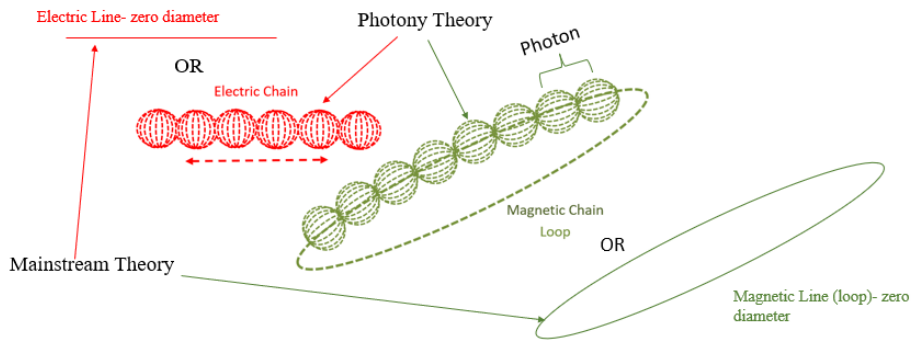
Figure 2.
Proposed Photony electron structure and the complementary processes of transduction and reduction. Persistent c-spin represents the proposed internal rotational organization, x-spin represents an externally responsive orientation, and the central region provides the proposed transduction pathway through which electromagnetic chain organization can be formed or modified. The structural model does not replace the established quantum-mechanical description of electron spin.
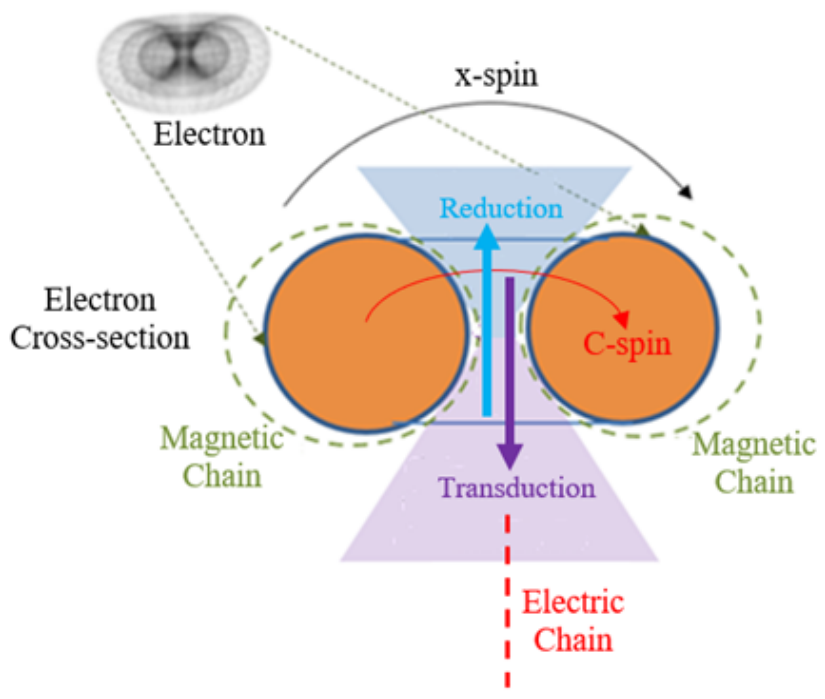
Figure 3.
Proposed relationship between the established quantum representation of a qubit and the underlying structural interpretation considered in Photony Theory. Panel A shows the conventional Bloch-sphere representation. Panel B shows the proposed electron c-spin, x-spin, and central transduction region. Panel C illustrates how an applied control condition may modify x-spin, transduction geometry, and organized chain structure to produce a new admissible qubit configuration. Panels B and C represent the proposed Photony interpretation and do not replace the quantum-mechanical state formalism.
Disclaimer/Publisher’s Note: The statements, opinions and data contained in all publications are solely those of the individual author(s) and contributor(s) and not of MDPI and/or the editor(s). MDPI and/or the editor(s) disclaim responsibility for any injury to people or property resulting from any ideas, methods, instructions or products referred to in the content. |
© 2026 by the authors. Licensee MDPI, Basel, Switzerland. This article is an open access article distributed under the terms and conditions of the Creative Commons Attribution (CC BY) license (http://creativecommons.org/licenses/by/4.0/).
Copyright: This open access article is published under a Creative Commons CC BY 4.0 license, which permit the free download, distribution, and reuse, provided that the author and preprint are cited in any reuse.