

Submitted:
05 October 2026
Posted:
08 October 2026
You are already at the latest version
Abstract
Quantum entanglement produces correlations between spatially separated systems that cannot be reproduced by broad classes of local hidden-variable models and cannot be used for controllable faster-than-light communication. This article develops a proposed Photony interpretation of electron entanglement based on electron structure, c-spin, x-spin, electron transduction, and shared electro-magnetic chain organization. Within Photony Theory, c-spin represents persistent internal rotational handedness, while x-spin provides an externally responsive orientation through which the electron interacts with its local electromagnetic environment. Electron transduction is proposed to organize elemental charge photons into larger chain structures whose directional organization reflects the state of the participating electron. The central hypothesis is that two entangled electrons may remain associated with the same transduced chain after becoming spatially separated. A local measurement may alter the x-spin condition of one electron and thereby reconfigure the rotational state of the shared structure, which in turn constrains the state available to the second electron. This proposed response is treated as a transition of a jointly organized entangled structure rather than as a conventional signal propagating from one particle to the other. The model must preserve local measurement randomness and the quantum no-signaling condition. It must also ultimately reproduce the spin-singlet angular correlation, Bell-inequality violations, and established decoherence behavior. The present work there-fore offers a specific structural hypothesis whose viability depends on future quantitative derivation and experimentally distinguishable predictions.
Keywords:
quantum entanglement
; photony theory
; bell nonlocality
; electron transduction
; c-spin
; x-spin
; electron spin
; nonseparability
; bell inequality
; no-signaling
; hidden variables
; elemental charge photons
; magnetic chains
; quantum measurement
; decoherence
; spin correlation
; Planck Space
1. Introduction
Quantum entanglement is one of the clearest demonstrations that the physical description provided by quantum mechanics cannot, in general, be reduced to independent local properties assigned separately to spatially separated particles. When two particles are prepared in an entangled state, their complete quantum state cannot generally be expressed as independent states belonging separately to the individual particles Horodecki et al. (2009). Measurements performed on the particles can therefore exhibit correlations that are fundamentally different from ordinary classical correlations.
The conceptual difficulty was brought into sharp focus by Einstein, Podolsky, and Rosen, who questioned whether the quantum-mechanical description of physical reality was complete Einstein et al. (1935). Bell later showed that the issue could be placed on an experimentally testable basis. Local theories in which measurement outcomes are determined by pre-existing hidden variables must satisfy statistical inequalities that can be violated by the predictions of quantum mechanics Bell (1964).
Subsequent experiments have repeatedly observed Bell-inequality violations consistent with quantum mechanics.Subsequent experiments have repeatedly observed Bell-inequality violations consistent with quantum mechanics. These include experiments using rapidly changing measurement settings Aspect et al. (1982) and later loophole-free tests involving spatially separated electron spins Hensen et al. (2015). The experimental results place stringent constraints on any proposed physical interpretation of entanglement. A viable model cannot explain the observed correlations simply by assigning each particle an independent predetermined local state. Nor can it explain them by introducing an ordinary signal that travels from one particle to the other after a measurement has been made.
At the same time, quantum entanglement does not provide a controllable faster-than-light communication mechanism. Individual measurement outcomes remain locally unpredictable, and useful information concerning the correlation emerges only when results obtained at the separated locations are subsequently compared. A physical interpretation of entanglement must therefore account simultaneously for nonclassical correlation, spatial separation, local randomness, Bell-inequality violation, and the absence of controllable superluminal signaling Brunner et al. (2014).
These requirements make quantum entanglement an especially demanding problem for any proposed structural interpretation beneath the quantum formalism. Providing a mechanical analogy alone is insufficient. Any deeper model must explain how spatially separated measurement events can remain components of one correlated state without reducing the phenomenon either to classical communication or to predetermined independent local instructions.
Figure 1 illustrates the distinction between the conventional field-line representation of electromagnetic organization and the proposed Photony chain interpretation. Field lines remain the established macroscopic representation of field direction and relative magnitude. Photony does not replace that description, but proposes that an underlying chain structure may provide a physical organization corresponding to the measured field. This distinction is important for the present article because the proposed entanglement mechanism concerns the structural organization associated with electron transduction rather than a modification of the conventional electromagnetic field equations.
Photony Theory provides a possible structural framework in which to examine this problem. The theory proposes that electromagnetic and particle phenomena emerge from organized structures involving elemental charge photons, energy filaments, electron transduction, and an underlying discrete Planck Space Martin (2022). The present article does not attempt to replace the established quantum-mechanical description of entanglement. Instead, it asks whether several existing elements of the Photony electron model can be combined into a structural interpretation that remains subject to the experimental constraints imposed by quantum mechanics.
Three Photony concepts are particularly important to this investigation: c-spin, x-spin, and electron transduction.
Within the Photony model, the electron possesses an intrinsic structural motion identified as c-spin. This motion is associated with the persistent internal structure of the electron and ultimately with the gamma-ray configuration from which the electron is proposed to emerge Martin (2022). The c-spin is therefore treated as an intrinsic property of the electron structure rather than as a transient response to an externally applied electromagnetic condition.
The electron may also undergo an extrinsic orientational response referred to as x-spin. Unlike c-spin, x-spin is proposed to respond to the local electromagnetic environment. It can change electron orientation relative to an externally imposed field or excitation and therefore influence the configuration in which the electron interacts with surrounding elemental charge photons. The distinction is fundamental to the present argument: c-spin supplies a persistent internal rotational structure, whereas x-spin provides a locally responsive degree of orientation.
The third concept is electron transduction. Photony treats the electron not primarily as the source of the electromagnetic energy being organized but as a structural transducer. Elemental charge photons interacting with the electron are proposed to become linked into larger electric or magnetic chain structures. The configuration of the resulting chain depends on the electron’s orientation, location, and surrounding electromagnetic condition Martin (2022).
An additional hypothesis considered in the present work is that a transduced chain inherits a directional or rotational organization from the electron performing the transduction. If the electron’s persistent c-spin possesses a defined handedness, then chain structures assembled through that electron may retain a corresponding circulation sense. The local x-spin orientation can then influence how that intrinsic structural handedness is presented relative to an externally selected measurement axis.
This combination suggests a possible route toward interpreting entanglement without treating it as a signal transmitted between particles.
The central hypothesis of this article is that two particles that become entangled through a common formation or interaction process should not be regarded, at the underlying structural level, as two completely independent systems that subsequently exchange information. Instead, the entangling interaction is proposed to establish a single nonseparable structural state whose spatially separated particle components remain subject to a common constraint.
This proposed structural picture parallels one essential feature of the mainstream quantum description: an entangled state is a joint state that cannot generally be factored into independent states of its constituent particles Horodecki et al. (2009). Photony adds the hypothesis that this mathematical nonseparability may correspond to an underlying physical organization.
For an entangled electron pair, this joint organization is proposed to involve a correlated relationship among the persistent c-spin structures of the two electrons, their allowed x-spin responses, and the transduction configurations available to them. The common state is established during the original interaction rather than generated later when one of the electrons is measured. Spatial separation changes the locations of the observable electron components but does not necessarily require that the underlying correlated state become structurally separable.
This distinction is essential. The proposed mechanism is not that measurement of electron A generates a disturbance that propagates through a magnetic or electric chain to electron B. Such a picture would amount to an ordinary communication mechanism and would not resolve the constraints imposed by Bell experiments. The proposed interpretation instead treats the two electrons as locally accessible components of a single distributed structural condition. Each measurement acts locally on its respective electron, while the observed correlation reflects the joint state established before the measurements are performed.
Within this interpretation, x-spin becomes relevant at the measurement stage. A measurement apparatus establishes a local orientation against which the electron responds. The local interaction is proposed to affect the electron’s x-spin configuration relative to that measurement axis, and the corresponding transduction behavior may provide a structural manifestation of the locally realized outcome. The distant electron undergoes its own local interaction with its own measurement setting. Neither outcome is proposed to be caused by a message sent from the other measurement location.
The resulting picture separates two functions that are often conflated in informal discussions of entanglement. The common entangled state establishes the correlation constraint, while the individual measurement interactions determine how that shared state is locally interrogated. The correlation is therefore attributed to structural nonseparability rather than to measurement-induced communication across the intervening distance.
Planck Space provides a possible substrate for such nonseparability within Photony Theory. In the Photony framework, particles, photons, chains, and their permitted motions are defined within one underlying interconnected spatial structure. An entangled pair could therefore be represented by two spatially separated particle configurations that remain components of one larger admissibility condition within that common substrate. The relevant relationship would not necessarily be a conventional material chain carrying energy between the particles. Instead, it would be a constraint on the joint state from which the locally accessible configurations emerge.
Such a proposal must nevertheless reproduce the quantitative results of quantum mechanics. For a spin-singlet electron pair, measurements along the same axis yield opposite outcomes, while measurements made along different axes display the characteristic angular dependence predicted by quantum theory. A viable Photony interpretation must recover these statistics, including Bell-inequality violations. Merely assigning the two electrons fixed opposite c-spin directions would not be sufficient because a model based only on predetermined local orientations would fall within the class of local hidden-variable descriptions constrained by Bell’s theorem Bell (1964); Brunner et al. (2014).
The challenge is therefore more specific. Photony must determine whether a joint structural state involving c-spin, x-spin, transduction, and Planck Space can possess genuine nonseparability while preserving local measurement randomness and the no-signaling condition.
The model must also distinguish its proposed underlying structural motions from the quantum-mechanical description of electron spin. In standard quantum mechanics, electron spin is an intrinsic quantum angular momentum described by the spin- formalism and is not interpreted as ordinary classical rotation of a spatially extended object Sakurai and Napolitano (2020). Photony c-spin and x-spin must therefore be regarded as proposed underlying structural processes whose validity depends on whether they reproduce established spin- behavior rather than substitute classical rotational mechanics for it.
The present article develops this hypothesis systematically. First, the mainstream quantum-mechanical description of entanglement and the constraints imposed by Bell’s theorem are reviewed. The relevant elements of the Photony electron model are then developed, with particular attention to the proposed gamma-ray origin of the electron, c-spin, x-spin, and electron-mediated transduction. These concepts are subsequently combined into a proposed model of entangled-pair formation, spatial separation, local measurement response, and correlated transduction behavior.
Particular attention is given to distinguishing a nonseparable structural state from a propagating causal signal. The implications for no-signaling, measurement response, decoherence, and the loss of accessible two-particle entanglement are then considered. Finally, the article identifies the quantitative requirements that must be satisfied before the proposed interpretation can progress from a qualitative structural hypothesis to a testable physical model.
The objective is not to claim that Photony Theory presently solves the entanglement problem. The more limited and scientifically useful objective is to determine whether its existing structural concepts can be organized into an interpretation that is internally coherent, compatible with established experimental constraints, and sufficiently specific to identify where quantitative development and experimental falsification are required.
2. Mainstream Description of Quantum Entanglement
Quantum entanglement occurs when two or more quantum systems are described by a joint state that cannot, in general, be separated into independent states assigned individually to each constituent system Horodecki et al. (2009); Nielsen and Chuang (2010); Strečka (2023). The essential feature is therefore not simply correlation. Classical systems can also be strongly correlated. The distinguishing quantum feature is that the complete state contains relationships that cannot be reproduced by assigning each particle an independent local quantum state containing predetermined outcomes for all possible measurements.
For two quantum systems, conventionally labeled A and B, a separable pure state can be written as a product.
In such a state, system A has its own state and system B has its own state . The description of the complete system can therefore be constructed directly from the descriptions of its constituents.
An entangled pure state cannot be written in this form:
The inability to factor the state is the mathematical expression of nonseparability. The complete state belongs to the composite system, while the individual subsystems do not possess independent pure states that fully specify the measurement statistics of the whole Horodecki et al. (2009); Nielsen and Chuang (2010).
This distinction is central to the present article. Spatial separation of the two particles does not, by itself, transform an entangled state into two independent quantum states. Once the particles have interacted and become entangled, quantum mechanics continues to describe their relevant degrees of freedom through the joint state until subsequent interactions, measurements, or environmental coupling alter that state.
The conceptual significance of this result was recognized early in the development of quantum mechanics. Einstein, Podolsky, and Rosen considered a pair of previously interacting systems and questioned whether the quantum-mechanical description could be regarded as complete if measurement of one system allowed predictions concerning the other spatially separated system Einstein et al. (1935). Their argument was motivated in part by the desire to preserve a description in which physical properties belonged independently to spatially separated objects.
For the present work, the most relevant example is entanglement between two spin- systems. Electron spin is described in mainstream quantum mechanics as an intrinsic angular momentum with two possible measurement outcomes along any chosen measurement axis Sakurai and Napolitano (2020). These outcomes are commonly denoted spin-up and spin-down relative to the selected axis.
Importantly, the statement that an electron is spin-up or spin-down is always referenced to a measurement direction. A spin state defined relative to one axis is not generally equivalent to a definite spin state relative to another axis. Changing the analyzer orientation therefore changes the basis in which the state is measured. This measurement-axis dependence is a basic feature of quantum spin and becomes essential when entangled-spin correlations are considered.
A particularly important two-particle state is the spin-singlet state. For any common choice of quantization axis, it can be written as:
The two terms should not be interpreted as representing an ordinary statistical mixture in which the particles secretly possess one configuration or the other before measurement. They form a coherent quantum superposition describing the pair as a whole Nielsen and Chuang (2010); Sakurai and Napolitano (2020).
If both particles in the singlet state are measured along the same axis, the outcomes are perfectly anticorrelated. If particle A is measured as spin-up, particle B will be found spin-down along the same axis, and vice versa. Which member of the pair produces which outcome remains individually unpredictable before measurement.
This combination of local randomness and joint order is one of the most important features of entanglement. Each measurement location independently produces outcomes that appear probabilistic, yet comparison of the two sets of results reveals correlations determined by the joint quantum state.
The local statistical character can be expressed formally through the reduced density operator. For the singlet state, if the degrees of freedom of particle B are not observed, the state available locally for particle A is:
and similarly,
Here I is the identity operator for the two-dimensional spin space. Each individual particle therefore has equal probabilities for the two possible spin outcomes when considered locally, even though the pair as a whole is in a precisely defined pure entangled state Horodecki et al. (2009); Nielsen and Chuang (2010).
This illustrates an important point that will recur throughout this article. The information defining the entangled state is not contained completely in either particle considered independently. Some of the physically meaningful information resides specifically in the relationship between the two components of the composite state.
The correlation becomes more revealing when the two spins are measured along different axes. Let represent the measurement direction selected for particle A and the measurement direction selected for particle B. For the singlet state, quantum mechanics predicts the correlation:
where is the angle between the two measurement directions Sakurai and Napolitano (2020).
This result contains considerably more information than the statement that the spins are simply opposite. When the measurement axes are parallel, , and the correlation is , corresponding to perfect anticorrelation. When the measurement axes are perpendicular, , the correlation is zero. Intermediate angles produce a continuous angular dependence determined by .
The correlation therefore cannot be described merely by imagining two classical objects leaving a source with permanently fixed opposite orientations. The measurement settings themselves are part of the experimental specification, and the statistical relationship between the outcomes depends on the relative orientation of those settings.
This point becomes especially important for any proposed structural interpretation of electron spin. A successful underlying model cannot merely assign each electron a fixed classical rotational axis and then identify that axis with the quantum spin measurement result. It must reproduce the measurement-context dependence and angular correlation predicted by the spin- formalism.
Quantum entanglement also does not require that the two subsystems remain physically adjacent. Once an entangled state has been established, its correlations can persist while the particles are separated, provided the entangled degrees of freedom remain sufficiently isolated from interactions that destroy or redistribute the coherence of the original state Horodecki et al. (2009).
The phrase “spatially separated particles” can therefore be misleading if it is taken to imply “independent quantum states.” Spatial location and quantum-state separability are different concepts. Two particles may occupy widely separated regions of space while their relevant degrees of freedom remain represented by a single nonfactorizable state.
At the same time, mainstream quantum mechanics does not describe the entangled correlation as an ordinary electromagnetic force, mechanical connection, or conventional signal propagating between the particles. The formalism specifies the joint state and the probabilities associated with measurements performed on that state. It does not require a classical communication pathway between the two particles to generate the observed correlations.
This distinction is important for the development of the Photony interpretation later in this article. Any proposed underlying structure must preserve the experimentally established distinction between a joint nonseparable state and an ordinary signal-transfer mechanism.
The mainstream description can therefore be summarized in a physically important way. An entangled pair is created through a common preparation or interaction. After separation, measurements are performed locally on each member of the pair. Each local result is individually probabilistic, but the joint results display correlations determined by the shared quantum state. For entangled spin- particles, those correlations depend on the relative measurement orientation and cannot be understood simply as measurements of two independent, permanently assigned classical spin directions.
Quantum mechanics thus provides a precise mathematical description of what entanglement does. It defines the joint state, predicts the probabilities of individual outcomes, and predicts the correlations observed when separated measurement records are compared Horodecki et al. (2009); Nielsen and Chuang (2010); Sakurai and Napolitano (2020).
Entanglement is also increasingly being generated and controlled within engineered nanoscale systems, including integrated photonic structures, solid-state quantum devices, and mechanical resonators. Direct generation of entangled photon states in nanoscale optical materials and entanglement of mechanical modes demonstrate that quantum entanglement can be created and maintained within deliberately structured physical environments Chou et al. (2025); Weissflog et al. (2024).
What remains more difficult is the question of how such correlations should be interpreted physically. In particular, one may ask whether the nonseparability represented mathematically by the joint state corresponds to some deeper physical organization or whether the quantum state itself is the most fundamental description available.
Before developing the Photony proposal, however, a further experimental constraint must be established. It is not sufficient for a deeper model merely to reproduce the ordinary correlation between two particles. Bell’s theorem shows that specific classes of local models based on predetermined properties cannot reproduce the complete quantum predictions. The nature and importance of that constraint are developed in the following section.
3. Bell Nonlocality and the Constraint on Local Hidden-Variable Models
Bell’s theorem provides the most important experimental constraint on any attempt to construct an underlying physical interpretation of quantum entanglement. Bell transformed what had largely been a conceptual debate about completeness, locality, and physical reality into a question that could be tested experimentally Bell (1964).
The central issue is whether the correlations observed between spatially separated measurements can be explained by assuming that each particle possesses a set of local physical properties established before the measurements occur. In a local hidden-variable description, the measurement result obtained at one location is determined by the local measurement setting together with information carried by that particle, while the result cannot depend on a measurement setting selected at a sufficiently distant location when the two measurement events are space-like separated.
Bell showed that theories satisfying this type of local causal structure place limits on the statistical correlations that can occur between the two measurement locations Bell (1964). Quantum mechanics predicts that entangled states can exceed those limits.
A widely used experimental form of this result is the Clauser-Horne-Shimony-Holt, or CHSH, inequality Clauser et al. (1969). Consider two separated observers, conventionally called Alice and Bob. Alice can choose between two measurement settings, and , while Bob can choose between and . Each measurement produces one of two outcomes, which may be represented numerically as or .
For each pair of settings, a correlation function E is determined from a large number of repeated measurements. The CHSH combination is:
For local hidden-variable models satisfying the assumptions underlying the CHSH construction,
Quantum mechanics predicts that appropriately chosen measurements on a maximally entangled state can instead reach:
with the upper quantum value commonly known as the Tsirelson bound Brunner et al. (2014).
The difference between the local bound of 2 and the quantum limit of is not merely a mathematical curiosity. It provides an experimentally accessible distinction between the correlations permitted by a broad class of local hidden-variable models and those predicted by quantum mechanics.
For a spin-singlet pair, the quantum correlation introduced in Section 2,
provides the angular dependence needed to violate a Bell inequality for appropriate choices of the measurement axes Bell (1964); Brunner et al. (2014). The significance is therefore deeper than the observation that two spins may be opposite when measured along the same axis. The complete angular dependence of the correlations is incompatible with the corresponding limits imposed by local hidden-variable descriptions.
Early experimental tests increasingly supported the quantum prediction. Aspect, Dalibard, and Roger performed an influential experiment in which analyzer settings were changed rapidly during the propagation of entangled photons, strengthening the experimental separation between the measurement processes Aspect et al. (1982). The measured correlations violated the relevant Bell inequality and agreed with quantum-mechanical predictions.
Bell experiments subsequently became progressively more stringent because several experimental issues, commonly called loopholes, had to be addressed. Two are especially important for the present discussion. The locality loophole concerns the possibility that information could travel between the two measurement stations during a trial. To suppress this possibility, the measurement choices and outcomes must be arranged so that the relevant events are sufficiently separated in space and time that an ordinary signal traveling at or below the speed of light cannot communicate the selected setting or outcome from one station to the other before the measurements are completed.
The detection loophole concerns the possibility that the subset of detected particles is not representative of the complete ensemble. Sufficiently high detection efficiency is therefore required to prevent an apparent Bell violation from arising through biased sampling Brunner et al. (2014).
Experiments eventually closed the major loopholes simultaneously. Of particular relevance to the present electron-centered investigation, Hensen et al. performed a loophole-free Bell test using entangled electron spins associated with nitrogen-vacancy centers in diamond separated by approximately km Hensen et al. (2015). The experiment observed correlations incompatible with the tested local-realist description while arranging the measurement events to satisfy stringent locality and detection requirements.
The relevance of this experiment to the present article is substantial. Quantum nonlocal correlations are not restricted to photon polarization. They have been demonstrated using spatially separated systems in which electron spin is the relevant locally measured quantum degree of freedom. Any proposed Photony interpretation involving electron c-spin, x-spin, or electron transduction must therefore reproduce the constraints established by such electron-spin experiments.
More recent experiments have continued to demonstrate Bell nonlocality using substantially different physical platforms. Storz et al. performed a loophole-free Bell test using entangled superconducting circuits at separated measurement stations connected through a cryogenic link Storz et al. (2023). Their results again violated the Bell inequality while closing the principal locality and detection loopholes. Bell-inequality violations have now been demonstrated across substantially different physical platforms, including photons Aspect et al. (1982), spatially separated electron spins Hensen et al. (2015), entangled atomic systems Rosenfeld et al. (2017), and superconducting quantum circuits Storz et al. (2023). This diversity strengthens the conclusion that Bell nonlocality is a general feature of quantum correlations rather than an artifact of one particular experimental platform. It is important, however, to state precisely what Bell experiments establish. They do not show that information can be deliberately transmitted faster than light. They show that the observed joint probabilities cannot be reproduced by the tested class of theories in which the relevant outcomes are determined through local causal variables satisfying the assumptions used to derive the Bell inequality Brunner et al. (2014). This distinction is essential for the Photony interpretation developed in this article.
One tempting structural explanation would be to assume that the two electrons are produced with complementary c-spin orientations and that those orientations predetermine all future measurement outcomes. Such a model would be physically intuitive, but by itself it would not reproduce the Bell correlations. If each electron simply carried a complete set of locally predetermined instructions specifying the result for every possible analyzer orientation, the proposal would fall within the type of local hidden-variable description constrained by Bell’s theorem.
A second tempting explanation would be to assume that measurement of electron A sends a disturbance to electron B that determines the distant result. If that disturbance propagated through an ordinary electric chain, magnetic chain, electromagnetic wave, or other causal pathway after the measurement choice was made, then its propagation would constitute a communication mechanism. A signal limited to the speed of light could not account for Bell experiments in which the relevant measurement events are space-like separated.
It would likewise be scientifically unjustified simply to declare that a Photony chain transmits the required information instantaneously. Such a claim would replace the unexplained quantum correlation with an unexplained superluminal signal and would introduce an additional mechanism for which independent evidence would be required. The structural problem must therefore be formulated differently.
The two particles must be allowed to possess a relationship that is not equivalent to two independent local instruction sets, while the measurement at either location must remain incapable of being deliberately manipulated to transmit a controllable message to the other location. This leads to a critical distinction between nonlocal correlation and superluminal signaling. Bell nonlocality concerns the structure of the joint measurement probabilities. Faster-than-light signaling would require an observer at one location to control some measurable local variable in a way that changes the independently observable statistics at the distant location. Quantum entanglement provides the former but not the latter Brunner et al. (2014). Alice may select her measurement setting, but she cannot select whether her individual outcome will be or . Bob’s local sequence of outcomes likewise remains probabilistic. Only when the two measurement records are later compared does the Bell correlation become apparent.
This feature sharply constrains the proposed roles of c-spin and x-spin. The c-spin cannot simply encode a predetermined answer for every possible measurement orientation. The x-spin response at one measurement location cannot function as a controllable command that determines the distant electron’s measured state. Any transduced chains associated with the local electron likewise cannot be treated as ordinary post-measurement signal carriers responsible for generating the distant correlation. Instead, if Photony is to provide a structural interpretation compatible with Bell experiments, the correlation must arise from a description in which the two separated systems remain components of a common state that cannot be reduced to independent local variables. This requirement does not by itself specify what that common structure must be. Bell’s theorem constrains possible explanations but does not provide a microscopic structural model for the quantum state. The purpose of the following sections is to examine whether the existing Photony concepts of electron structure, c-spin, x-spin, transduction, and Planck Space can supply the elements of such a model without violating the experimentally established Bell constraints.
The required logic can therefore be stated clearly:
entangled preparation
↓
spatially separated local measurements
↓
individually probabilistic outcomes
↓
joint correlations exceeding the local Bell bound
↓
no controllable faster-than-light signaling
A viable Photony interpretation must reproduce all of these features simultaneously.
Bell nonlocality therefore serves as more than background material for the present theory. It establishes a boundary condition on the proposed structural explanation. If the Photony model ultimately reduces to fixed local c-spin instructions, it fails the Bell constraint. If it requires an ordinary signal sent after measurement, it fails the locality conditions of modern Bell tests. If it permits controllable faster-than-light communication, it conflicts with the observed no-signaling behavior of quantum mechanics.
The remaining possibility explored in this article is that entanglement may correspond to a genuinely nonseparable structural state established during the common preparation of the particles, with subsequent measurements acting locally on different components of that already shared state. The following sections develop the electron structures that would be required for such an interpretation.
4. Electron Structure in Photony Theory
Mainstream quantum mechanics treats the electron as a fundamental spin- particle whose measurable properties include charge, mass, magnetic moment, and intrinsic angular momentum. The quantum formalism provides highly successful predictions for electron behavior without requiring a resolved internal mechanical structure Sakurai and Napolitano (2020).
Photony Theory introduces an additional proposed structural interpretation. Rather than treating the electron only through its measurable quantum properties, Photony proposes that the electron structure emerges during pair-production processes involving sufficiently energetic gamma-ray classical photons, with the resulting electron acquiring the additional rotational organization identified as c-spin Martin (2022).
The resulting electron is represented as a toroidal structure containing a central transduction region. Persistent internal motion is retained within the electron, while the central region provides a pathway through which elemental charge photons can interact with the electron structure.
Figure 2 illustrates the proposed electron cross-section and the complementary processes of transduction and reduction. The figure also distinguishes the persistent internal c-spin from the externally responsive x-spin. These features are developed separately in Section 5 and Section 6, but their relationship is important to establish here because electron transduction is proposed to depend on both the persistent internal structure and the instantaneous orientation of the electron.
Within Photony, the electron is therefore not treated merely as a carrier of electric charge. It also functions as a transducer and regulator of electromagnetic organization. Elemental charge photons provide the underlying energy population, while the electron organizes portions of that population into larger electric or magnetic chain structures Martin (2022).
Transduction and reduction are complementary processes. During transduction, elemental charge photons are proposed to become organized into larger linked structures. During reduction, previously organized structures are shortened, released, reorganized, or returned toward less extensively linked elemental configurations. The electron therefore participates not only in the formation of electromagnetic organization but also in its subsequent regulation.
The geometry of the transduced structure depends on the electron’s location, orientation, and electromagnetic environment. In the broader Photony framework, surface-associated electrons predominantly participate in electric chain organization, whereas internal electrons associated with current predominantly participate in magnetic chain organization Martin (2022). The present article is concerned primarily with the more fundamental implication that the electron’s rotational state may influence the orientation and handedness of the structure produced through transduction.
Several distinct structural features must therefore be kept separate. The electron has a persistent underlying organization. The c-spin belongs to that persistent internal structure. The x-spin represents an additional orientation response to the surrounding electromagnetic condition. The transduction region provides the proposed interaction pathway through which elemental charge photons are organized into larger structures.
These relationships are important because the entanglement hypothesis developed in this article requires more than a static electron structure. It requires an electron that possesses a persistent internal state while also remaining capable of responding locally to a measurement environment.
The proposed electron model therefore provides two different kinds of structural information. The persistent internal organization, including c-spin, can potentially retain a relationship established during the common formation or interaction of an entangled pair. The externally responsive x-spin can then provide a means by which each electron reacts to its own local measurement orientation.
Electron transduction supplies the proposed bridge between these rotational properties and an observable electromagnetic response. If the organization produced through transduction depends on the state of the electron performing that transduction, then the local chain configuration can potentially express information about the electron’s instantaneous structural condition.
The important qualification is that this proposed structure must not be identified directly with the quantum-mechanical spin observable. In mainstream quantum mechanics, electron spin is an intrinsic quantum angular momentum and is not interpreted as ordinary classical rotation of an extended object Sakurai and Napolitano (2020). The c-spin, x-spin, and toroidal electron structure are therefore proposed underlying Photony mechanisms. Their physical validity depends on whether they can ultimately reproduce the experimentally established behavior of spin- electrons rather than merely resemble a classical rotating system.
For the entanglement problem, the significance of the electron model is therefore not simply that the electron is proposed to possess internal motion. The more important possibility is that a persistent internal rotational structure, a locally responsive orientation, and a transduction mechanism can coexist within the same particle.
Those three elements provide the structural foundation for the hypothesis developed in the following sections. Section 5 examines the persistent c-spin in greater detail, Section 6 considers the measurement-dependent role of x-spin, and Section 7 develops the proposed relationship between electron rotation and the directional organization of transduced chains.
5. c-spin and the Persistent Electron Structure
Photony Theory assigns the electron a persistent internal rotational behavior identified as c-spin Martin (2022). The c-spin is part of the proposed internal electron structure and is distinct from an externally driven change in electron orientation. It therefore represents a persistent structural property of the electron rather than a temporary response to an applied field or measurement apparatus.
Within the Photony electron model, the electron emerges from the structural reorganization of a sufficiently energetic gamma-ray classical photon. The internal motion carried by that photon is proposed to remain incorporated within the resulting toroidal electron structure. The c-spin represents the persistent rotational sense associated with this internal organization Martin (2022).
This distinction is important because the c-spin is not proposed merely as a label corresponding to the conventional quantum-mechanical spin observable. It is intended to describe an underlying physical motion within the Photony electron structure. Mainstream quantum mechanics, by contrast, treats electron spin as intrinsic angular momentum with spin- measurement properties and does not interpret it as the ordinary classical rotation of an extended body Sakurai and Napolitano (2020). Any relationship between c-spin and measured quantum spin must therefore be demonstrated rather than assumed.
For the present entanglement hypothesis, the most important property of c-spin is its persistence. Once an electron has formed, its underlying rotational organization is proposed to remain part of the electron unless the electron itself is transformed or destroyed. This provides a candidate structural feature through which information about a common formation or interaction history could remain physically represented after two particles separate.
The c-spin also provides a proposed handedness for electron-mediated transduction. As illustrated in Figure 2, elemental charge photons passing through the electron’s transduction region are proposed to become organized into larger chain structures. Within the present interpretation, the circulation sense of a newly transduced chain is not arbitrary. It is proposed to inherit its rotational sense from the persistent c-spin of the electron performing the transduction.
Conceptually, the relationship is
persistent electron structure
↓
c-spin rotational sense
↓
electron transduction
↓
corresponding rotational sense of the transduced chain
This proposed inheritance of rotational sense provides an important link between the internal electron structure and the electromagnetic organization that the electron produces. It means that c-spin is not confined to an unobservable internal motion. Through transduction, its handedness may be expressed in the directional organization of the electric or magnetic chains formed by the electron.
The distinction between handedness and spatial orientation is important. A persistent rotational sense does not require that the electron maintain one fixed axis relative to an external laboratory coordinate system. The electron may change its orientation while retaining the same underlying c-spin handedness. This provides a natural separation between c-spin and the x-spin developed in the following section. The c-spin supplies the persistent internal rotational character, while x-spin allows the electron’s orientation relative to an external electromagnetic condition to change.
This distinction is especially significant for quantum entanglement. If c-spin were treated simply as a fixed classical vector pointing in a predetermined direction, then a pair of electrons could be imagined to leave their source carrying fixed instructions for all future measurements. Such a model would fall directly into the class of local hidden-variable interpretations constrained by Bell’s theorem Bell (1964); Brunner et al. (2014).
The role proposed here is different. The c-spin supplies persistent internal structure, but it does not by itself specify the outcome that will be obtained for every possible measurement axis. The actual measurement response is proposed to depend on the relationship between the persistent c-spin structure, the locally imposed measurement orientation, and the resulting x-spin and transduction response.
For an entangled electron pair, the hypothesis is therefore not that the two electrons simply possess two fixed classical rotational directions. Instead, the common entangling interaction is proposed to establish a constrained relationship between their persistent internal structures. The individual c-spins remain associated with their respective electrons after separation, but the relation between those structures belongs to the joint entangled state.
The exact form of this relationship must depend on the quantum state in which the pair is prepared. For a spin-singlet state, same-axis measurements produce opposite outcomes. A viable Photony description must therefore permit the two c-spin structures and their subsequent local responses to produce that perfect anticorrelation without assuming a predetermined result for every possible analyzer orientation.
The c-spin should therefore be understood as a candidate structural carrier of persistent handedness rather than as a complete hidden specification of future measurements. Its proposed significance lies in retaining an internal relationship established during the common history of the entangled pair while still allowing each electron to respond contextually to a later local measurement.
This interpretation also clarifies why transduction is important. If transduced chains inherit their rotational sense from c-spin, then the electron possesses a mechanism through which its persistent internal structure can influence a locally generated electromagnetic organization. The chain does not create the c-spin, nor does it determine the distant particle’s state. It expresses the rotational character of the electron that locally performs the transduction.
For entanglement, this opens a possible structural sequence:
common entangling interaction
↓
constrained relationship between persistent electron structures
↓
spatial separation
↓
retention of individual c-spin handedness within the joint state
↓
local measurement-dependent response
The final step cannot be supplied by c-spin alone. A local measurement changes the physical orientation against which the electron is interrogated. The Photony model therefore requires a second rotational behavior capable of responding to that local condition. That role is assigned to x-spin and is developed in Section 6.
The distinction between persistent c-spin and responsive x-spin is central to the proposed entanglement mechanism. The c-spin provides continuity of internal electron structure through time and spatial separation, while x-spin provides the locally variable orientation through which that persistent structure can interact with different measurement settings.
Whether this combination can reproduce the exact statistics of quantum spin remains an open quantitative requirement. In particular, the model must ultimately derive the spin-singlet correlation and Bell-inequality violations without reducing c-spin to a predetermined local hidden variable. Until such a derivation is obtained, the proposed c-spin role should be regarded as a structural hypothesis constrained by established quantum measurements rather than as a replacement for the quantum-mechanical description of spin.
6. x-Spin and Measurement-Dependent Electron Response
Photony Theory distinguishes the persistent internal c-spin of the electron from a second rotational behavior identified as x-spin Martin (2022). Whereas c-spin is proposed to remain part of the intrinsic electron structure, x-spin represents an externally responsive change in electron orientation produced by the surrounding electromagnetic condition.
This distinction is important for the present entanglement hypothesis because a quantum spin measurement is defined relative to a selected measurement axis. In mainstream quantum mechanics, the probabilities of the possible spin- outcomes depend on the relationship between the prepared quantum state and the measurement basis selected by the apparatus Nielsen and Chuang (2010); Sakurai and Napolitano (2020). Changing the measurement axis therefore changes the basis in which the electron is interrogated.
Photony proposes that this externally imposed orientation can have a physical counterpart in the electron’s local structural response. The measurement apparatus establishes an electromagnetic environment at the location of the electron, and the electron is proposed to respond by changing its x-spin orientation relative to that environment.
The x-spin should not be interpreted as replacing the persistent c-spin. Instead, the two motions have different proposed functions. The c-spin retains the electron’s intrinsic rotational handedness, while the x-spin changes the orientation through which that persistent structure interacts with an externally imposed condition.
The relationship can be represented conceptually as:
persistent internal electron structure
↓
c-spin handedness
↓
locally imposed measurement orientation
↓
x-spin response
↓
locally available transduction configuration
This separation between persistent structure and responsive orientation is especially useful for an interpretation of entangled-spin measurements. If the electron possessed only a fixed classical rotational axis, then the measurement apparatus could merely reveal a direction that was already completely specified before the measurement. Such an interpretation would be insufficient to reproduce the full measurement-axis dependence of quantum spin and, when applied to an entangled pair as a set of predetermined local instructions, would encounter the Bell constraints discussed in Section 3.
The x-spin introduces a different possibility. The electron may retain a persistent internal c-spin while responding differently to different local measurement orientations. The local measurement setting therefore becomes a physical part of the interaction rather than merely a passive observation of a permanently fixed classical direction.
This proposed response should be distinguished carefully from the statement that the measurement apparatus arbitrarily determines the outcome. Mainstream quantum mechanics assigns probabilities to the possible results according to the prepared state and the selected measurement basis Sakurai and Napolitano (2020). The Photony hypothesis must ultimately reproduce those probabilities. The proposed x-spin supplies a possible structural response to the local measurement setting, but it does not by itself specify the statistical rule governing which outcome is realized.
This distinction is essential. If x-spin were assumed to produce a deterministic outcome for every possible measurement direction according to a pre-existing local rule, then the model could again become a local hidden-variable theory of the type constrained by Bell experiments Bell (1964); Brunner et al. (2014). The x-spin must therefore participate in a measurement-dependent response without functioning as a hidden table of predetermined answers.
Within the Photony framework, x-spin is also linked to electron transduction. As illustrated in Figure 2, the orientation of the electron influences how elemental charge photons interact with the transduction region. A change in x-spin can therefore alter the orientation, direction, or configuration in which new chain organization is produced.
This gives x-spin a role that is different from simply rotating the electron as a rigid classical object. Its significance lies in changing the orientation of the electron’s transduction geometry relative to the local electromagnetic environment.
The proposed sequence is therefore
local electromagnetic condition
↓
x-spin orientation response
↓
change in transduction geometry
↓
change in locally organized chain configuration
For the entanglement problem, the locality of this response is particularly important. Electron A responds to the measurement environment at location A, while electron B responds to the independently selected measurement environment at location B. The x-spin of electron A is not proposed to mechanically rotate electron B, and the x-spin response at one location is not itself the mechanism by which a signal is transmitted to the other location.
Instead, the later sections of this article propose that the two local responses remain correlated because both electrons are components of a previously established nonseparable state. The x-spin supplies the local measurement-dependent response, while the common entangled state supplies the constraint relating the two measurements.
This division of roles can be summarized as
joint entangled state → correlation constraint
local measurement setting → local x-spin response
The distinction is important because it prevents the x-spin from being assigned two incompatible functions. It need not carry information between the particles. Its proposed role is local: it allows the persistent electron structure to respond to the measurement orientation encountered at that location.
The relationship between c-spin and x-spin can therefore be understood as a combination of continuity and adaptability. The c-spin provides persistent internal handedness carried by the electron through its history. The x-spin allows that electron to assume different orientations relative to different external electromagnetic conditions without requiring the underlying c-spin handedness itself to disappear.
This distinction may also help explain why repeated measurements made in different bases cannot be interpreted simply as observations of one unchanging classical direction. A change in the measurement environment is proposed to alter the electron’s x-spin condition and therefore the transduction geometry available during the new interaction. The structural response is consequently contextual to the local measurement arrangement, while the persistent c-spin remains part of the underlying electron.
The term contextual is used here in the limited physical sense that the electron response depends on the locally imposed measurement condition. It should not, at this stage, be interpreted as a completed mathematical model of quantum contextuality. Demonstrating such a relationship would require a more complete formal treatment of the measurement probabilities and their dependence on the available measurement settings.
For the present article, the important point is narrower. Photony already contains two proposed rotational behaviors with different functions. The persistent c-spin provides an internal structural continuity that may retain a relationship established during entanglement. The x-spin provides a local response to the selected measurement orientation. Electron transduction then offers a possible mechanism through which that local orientation can be expressed in a newly organized electromagnetic structure.
The next section develops that final connection in greater detail by examining how c-spin handedness and x-spin orientation may influence the directional organization of transduced chains.
7. Electron Transduction and Rotationally Organized Chains
Electron transduction provides the proposed physical connection between the internal structure of the electron and the larger electromagnetic organization produced through its interaction with elemental charge photons. Within Photony Theory, the electron does not supply the energy contained in a transduced chain. Instead, the participating elemental charge photons provide the underlying energy population, while the electron performs the organizational function Martin (2022).
As discussed in Section 4, elemental charge photons entering the electron’s transduction region are proposed to become interlinked into larger electric or magnetic chain structures. The resulting organization depends on the location of the electron, its orientation, the surrounding electromagnetic condition, and the state of the electron performing the transduction.
For the entanglement hypothesis developed here, an additional structural relationship is proposed. The rotational sense of a transduced chain is not assumed to arise independently of the electron. Instead, the chain is proposed to inherit its circulation sense from the persistent c-spin of the electron that performs the transduction.
The origin of that rotational relationship lies in the proposed Photony electron structure. The c-spin is associated with the persistent internal motion inherited from the gamma-ray classical photon involved in electron formation. When elemental charge photons are subsequently organized by that electron, the resulting chain is proposed to acquire the same rotational handedness as the electron’s c-spin Martin (2022).
The proposed relationship is therefore:
gamma-ray structural motion
↓
electron c-spin
↓
electron transduction
↓
chain circulation with corresponding handedness
This relationship is important because it provides a possible mechanism by which the persistent internal structure of the electron can become expressed in a larger electromagnetic organization.
The proposed chain should not be pictured as a rigid object rotating bodily through space. Photony instead treats the chain as an organized sequence of linked elemental structures whose circulation and directional organization reflect the rotational sense imposed during transduction. The relevant property for the present argument is therefore handedness or circulation sense, not classical rotation of the complete chain as a solid object.
This distinction is consistent with the Photony motion rule, under which energy filaments move through locally admissible pathways rather than through arbitrary lateral motion. The rotational organization of the chain arises from the geometry and ordering of its linked constituents rather than from a simple jump-rope rotation of an entire filament structure Martin (2022).
The c-spin and x-spin contribute differently to this process. The c-spin provides the persistent rotational handedness inherited from the electron’s internal structure. The x-spin changes the orientation of the electron relative to the surrounding electromagnetic condition. Transduction then occurs through the electron in the locally available orientation.
The combined relationship can be represented as:
persistent c-spin → rotational handedness
local electromagnetic condition → x-spin orientation
c-spin handedness + x-spin orientation → local transduction geometry
local transduction geometry → directionally organized chain
The distinction between handedness and orientation is central. An electron may change its x-spin orientation relative to an external measurement axis without requiring the persistent c-spin handedness itself to reverse. The same underlying rotational sense can therefore be expressed through different spatial orientations as the electron responds to different local conditions.
This provides a potential structural counterpart to an important feature of quantum spin measurement. In mainstream quantum mechanics, the outcome probabilities depend on the relationship between the quantum state and the selected measurement basis rather than on the exposure of a permanently fixed classical spatial vector Nielsen and Chuang (2010); Sakurai and Napolitano (2020). In the proposed Photony interpretation, c-spin supplies persistent internal structure while x-spin changes the local orientation through which that structure participates in transduction.
The transduced chain can therefore be viewed as a local expression of the electron’s structural state at the time of the interaction.
This does not mean that the chain itself is the quantum spin observable. Nor does it mean that measuring a chain directly reveals a predetermined quantum outcome. The proposed relationship is more limited: the directional and rotational organization produced through transduction is assumed to depend on the internal and orientational state of the electron that performs the transduction.
For an isolated electron, this provides a possible mechanism through which persistent c-spin and local x-spin orientation influence the electromagnetic organization generated around that electron.
For an entangled electron pair, however, the implication is potentially more significant.
If two electrons are produced in a common entangled state, their persistent internal structures are proposed later in this article to remain components of one jointly constrained state. Each electron subsequently performs transduction locally, but the structural state from which those local responses emerge is not assumed to be completely independent.
The locally produced chains may therefore reflect two levels of information. First, each chain reflects the c-spin handedness and x-spin orientation of the electron that transduced it. Second, if the electron belongs to an entangled pair, the permitted local electron state remains constrained by the common entangled state.
The proposed sequence becomes:
common entangled state
↓
persistent relationship between electron structures
↓
local c-spin handedness and x-spin orientation
↓
local electron transduction
↓
locally organized chain state
The chains are therefore proposed to express the local manifestation of the electron state rather than to create the entanglement itself.
This distinction is essential.
The entanglement must already exist before the local transduction response is produced. A chain generated at electron A is not proposed to travel to electron B after measurement and instruct it how to respond. Likewise, a chain generated at electron B is not required to transmit information back to electron A.
Such a communication model would conflict with the Bell-test constraints developed in Section 3 if the correlation depended on an ordinary post-measurement signal between space-like separated measurement locations.
Instead, the proposed role of the transduced chains is local. They provide a possible physical expression of the electron’s response to the measurement condition at that location.
The correlation between the two locations must originate at a deeper level, in the common nonseparable state of the pair.
This distinction can be stated as
transduced chain ≠ communication link between entangled particles
transduced chain → local structural expression of the participating electron state
This interpretation also clarifies the role of reduction shown in Figure 2. Transduction is not proposed to create ever-increasing chain organization without limit. Previously formed structures may be shortened, reorganized, released, or reduced as the local electromagnetic condition changes. Transduction and reduction therefore provide complementary mechanisms through which the electron can continuously adjust its surrounding electromagnetic organization.
Such reversibility may be especially relevant during a measurement interaction. As the local apparatus changes the electromagnetic environment experienced by the electron, the x-spin orientation and available transduction geometry may change. Previously organized structures may be reduced while new structures consistent with the locally available configuration are transduced.
The proposed response is therefore dynamic rather than simply a passive reading of a pre-existing chain.
This point helps distinguish the present hypothesis from a conventional hidden-variable model. If every possible chain orientation were completely specified in advance by c-spin alone, then the chain structure could become little more than a physical encoding of predetermined answers. Bell’s theorem places strong constraints on such local predetermined models Bell (1964); Brunner et al. (2014).
The Photony hypothesis considered here instead requires an interaction among persistent c-spin, locally responsive x-spin, the measurement environment, and the joint entangled state. The local chain organization emerges from that interaction.
At this stage, the relationship remains qualitative. A complete theory would need to specify mathematically how c-spin handedness, x-spin orientation, and the measurement basis determine the probabilities of the possible local transduction states. More importantly, when two electrons are entangled, the combined model must reproduce the experimentally observed joint spin correlations rather than merely produce complementary-looking chain structures.
The significance of electron transduction for the present article is therefore specific. It provides a proposed local structural mechanism through which the internal state of an electron can be expressed in electromagnetic organization. Persistent c-spin determines the underlying rotational handedness, x-spin determines the locally responsive orientation, and transduction converts those conditions into organized chain structure.
The next step is to determine how two such electron structures might become jointly constrained during the formation of an entangled pair. That question is developed in Section 8.
8. Formation of an Entangled Pair as a Joint Structural State
The central Photony proposal developed in this article begins at the formation of the entangled pair. When two electrons become entangled through a common creation or interaction process, they are proposed not to emerge as two fully independent structures carrying separate predetermined instructions. Instead, their interaction establishes a jointly constrained physical organization that can remain structurally connected after the observable electrons become spatially separated.
Within the Photony framework, one possible realization of this joint organization is that the two electrons become associated with, and may subsequently ride upon, the same transduced electromagnetic chain. Electron riding is distinct from electron transduction. Transduction forms or reorganizes the chain, whereas riding describes the subsequent motion or association of an electron along a previously established chain Martin (2022).
This distinction provides a more specific physical interpretation of the entangled state, but the shared organization need not be established in only one way. The Photony hypothesis must accommodate at least two physically different preparation pathways.
In the first pathway, two particles may emerge from a common creation or interaction process while already participating in a shared transduced organization. The particles can then become spatially separated while retaining their association with that common structure.
common creation or interaction
↓
formation of a shared transduced organization
↓
association of both electrons with the common structure
↓
spatial separation
↓
continued participation in one jointly constrained state
In the second pathway, the electron-bearing systems may already be spatially separated before the final entangled state is established. A subsequent entangling interaction can then create or select the shared structural relationship linking the two previously separated systems.
spatially separated electron-bearing systems
↓
common entangling interaction
↓
formation or selection of a shared structural relationship
↓
jointly constrained entangled state
The second pathway is particularly important because loophole-free Bell experiments have demonstrated entanglement between electron-spin systems located at spatially separated nodes Hensen et al. (2015). The shared-chain hypothesis therefore cannot require that two electrons begin adjacent to one another and physically carry a pre-existing chain outward as they separate. More generally, it must allow the entangling process itself to establish the common structural organization between systems that are already spatially distinct.
In either pathway, the essential Photony proposition is the same: once entanglement has been established, the two local electron states are no longer treated as structurally independent but as components of one jointly constrained organization.
The importance of the shared chain is that it provides more than a historical correlation established at the source. It provides a continuing structural relationship between the two electrons.
Each electron retains its own persistent c-spin structure, but the two electrons are proposed to interact with the same rotationally organized chain. The circulation of that chain is determined by the transduction history and by the rotational state of the electrons participating in its organization.
For an entangled pair, the common chain therefore provides a candidate physical structure through which the relationship between the two local electron states can be maintained.
The term shared transduced chain is used here as a provisional structural description. The present article does not yet establish whether the entanglement-supporting organization corresponds uniquely to an electric chain, a magnetic chain, or a more fundamental transduced-chain configuration within the Photony hierarchy. What is required by the present hypothesis is a common rotationally organized structure to which both entangled electrons remain coupled. The detailed topology, formation conditions, and relation of that structure to the established electric and magnetic chain categories remain to be derived. Until those properties are established, the term shared transduced chain refers specifically to this proposed common organization without assigning it prematurely to a particular macroscopic electric or magnetic regime.
The present mechanism is developed most directly for entangled electrons because electrons are the proposed transducers of electromagnetic chain organization within Photony Theory. This does not require every type of entangled quantum system to perform electron-like transduction itself. In more complex systems, photons, atoms, ions, lattice vibrations, or other quantum degrees of freedom may instead couple indirectly to a transduced chain through the electrons and the electromagnetic environment of the source, material, interface, cavity, or surrounding structure. The electron-centered shared-chain model developed here should therefore be regarded as the direct case, while possible indirect coupling to other entangled systems is considered later in Section 12.
This possibility becomes especially important when one of the electrons undergoes an x-spin response during measurement.
Suppose electron A encounters a locally imposed measurement condition. The interaction may produce an x-spin reorientation or, where permitted by the local configuration, a more complete x-spin reversal. Because electron A remains coupled to the shared chain, the resulting change in its local transduction condition is proposed to alter the rotational organization available to the common structure.
The shared-chain response therefore need not be restricted to a binary reversal. Depending on the relationship between the existing electron state and the selected measurement orientation, the response may involve a reorientation, reversal, or other allowed changes in the joint rotational configuration. The corresponding effect at electron B is likewise proposed to be a constrained local x-spin response rather than an automatic mechanical flip.
The proposed sequence is:
local measurement at electron A
↓
x-spin reorientation or reversal permitted by the local interaction
↓
change in the shared-chain rotational condition
↓
changed structural condition encountered by electron B
↓
corresponding constrained x-spin response at electron B
This more general response is required because the correlations of an entangled spin- pair depend continuously on the relative orientations of the two measurement axes rather than on a simple rule in which every measurement produces a binary physical reversal Brunner et al. (2014); Sakurai and Napolitano (2020).
In this interpretation, the chain provides the physical relationship through which the state of one electron can become linked to the state available to the other electron.
This is more specific than merely stating that the two electrons belong to a common state. The hypothesis proposes that the common state may possess a physical carrier: a shared transduced chain whose rotational condition is experienced by both electrons.
The term communication must nevertheless be used carefully.
The proposed effect is not equivalent to sending a conventional electromagnetic pulse from electron A to electron B. The shared chain is already present before either measurement occurs. The electrons therefore do not first become connected when the first electron is measured.
Instead, both electrons are proposed to occupy different portions of one pre-existing structural organization.
The change communicated through the chain is therefore better understood as a change in the state of a common structure rather than the launching of a new signal through otherwise independent space.
This distinction is critical because Bell experiments constrain explanations in which one particle waits for a subluminal message from the other before determining its outcome Bell (1964); Hensen et al. (2015); Storz et al. (2023).
The Photony proposal considered here is that the chain itself is part of the jointly constrained entangled system.
If its rotational condition is a property of the entire chain, then a local interaction that changes that condition cannot necessarily be described as a disturbance beginning at one end and subsequently traveling toward the other. It may instead represent a reconfiguration of one distributed structure.
This provides a possible Photony interpretation of the apparent spooky action at a distance.
The distant electron does not need to receive a newly emitted photon or an ordinary electromagnetic wave from the first electron. It is already participating in the same chain organization. When the admissible rotational state of that structure changes, the local condition encountered by the second electron changes with it.
The relationship can be represented conceptually as
electron A ⟷ shared transduced chain ⟷ electron B
The arrows in this representation do not signify two independent signals traveling in opposite directions. They indicate that both electrons participate in one common structural state.
The proposed rotational relationship also provides a possible way to preserve the complementary behavior required for a spin-singlet state.
The two electrons do not need to possess identical local orientations. Their c-spin and x-spin conditions may be complementary while both remain coupled to the same chain organization. A change in the shared-chain rotational state can therefore produce corresponding but not necessarily identical local responses at the two electrons. For same-axis measurements of a spin-singlet pair, those responses must preserve the experimentally observed anticorrelation. For differently oriented analyzers, the allowed responses must instead reproduce the angular dependence required by the joint quantum state.
Flipping both local structural states does not require the two measured outcomes to become identical. If their relationship is initially complementary, a common reversal can preserve that complementarity.
This is important for the spin-singlet case, in which same-axis measurements produce opposite outcomes. The proposed chain-mediated coupling must preserve that experimentally established anticorrelation rather than simply force both electrons into the same measured state Nielsen and Chuang (2010); Sakurai and Napolitano (2020).
The hypothesis also provides a possible role for the persistence of c-spin. The c-spin of each electron can determine the handedness with which that electron interacts with the common chain, while x-spin determines its locally responsive orientation. The shared chain then couples those local orientational states without erasing the distinct c-spin structures of the two electrons.
The resulting relationship involves three levels:
persistent c-spin relationship
↓
shared transduced-chain organization
↓
local x-spin responses at the two measurement locations
This structure differs fundamentally from a model in which each electron carries a complete list of predetermined measurement results. The local measurement setting still participates in determining the x-spin response. The shared chain constrains the relationship between the two local responses rather than supplying a fixed answer independently of the measurement context.
The model must also preserve the quantum no-signaling condition. Even if a change in one electron’s x-spin is structurally communicated through the shared chain, an observer cannot use that relationship to transmit a chosen message unless the observer can control the local measurement outcome.
Quantum experiments show that the individual outcome is not controllable in that way Brunner et al. (2014). The experimenter may choose the measurement orientation but cannot choose whether a particular measurement produces one of the two possible outcomes.
The corresponding Photony requirement is that an observer may influence the local measurement condition but cannot arbitrarily determine how the complete entangled chain resolves. The shared-chain transition may correlate the two measurements, but it cannot function as a controllable communication channel or permit operational faster-than-light signaling. This places a strong constraint on the timing and nature of the proposed chain response. If a reversal initiated at electron A were to propagate sequentially along the chain at a finite speed, the associated propagation time would become experimentally relevant, whereas modern Bell tests are specifically arranged so that ordinary causal communication at or below the speed of light cannot account for the observed correlations Hensen et al. (2015); Storz et al. (2023). The stronger Photony hypothesis must therefore treat the shared chain not as a conventional transmission line carrying a disturbance from one particle to the other, but as a single entangled structure whose rotational state belongs to the complete system. A reversal would then represent a transition of the joint chain state rather than a message progressively transmitted along its length.
This proposed global structural response is not yet derived from the present Photony dynamics and must therefore be identified explicitly as a hypothesis.
This proposed joint-state response must also be distinguished from ordinary Photony energy transport. In the established Photony framework, energy filaments and propagating electromagnetic organization advance through locally admissible pathways and are not assumed to undergo unrestricted instantaneous transport across spatial separation. The present entanglement hypothesis does not alter that local propagation rule. Instead, it proposes that the entangled-chain state includes a joint structural constraint whose rotational condition belongs to the complete correlated system. A change in that joint condition is therefore not identified here with the instantaneous transport of a filament, photon, or finite packet of electromagnetic energy from electron A to electron B.
This distinction is essential. Local energy transport remains propagative, whereas the proposed entangled-chain correlation is treated as a property of the shared state. The model must eventually explain mathematically how those two descriptions coexist without introducing hidden superluminal energy transport or contradicting the local motion rules already used elsewhere in Photony Theory.
A complete theory will need to explain how a chain extending between widely separated particles can maintain a single rotational admissibility condition, how an x-spin interaction changes that condition, and why the transition does not transport controllable energy or information in conflict with established relativistic constraints.
A shared chain that merely forces a fixed response at electron B whenever electron A changes state would not by itself be sufficient. The measured relationship depends on the relative orientations of the two independently chosen analyzers, as developed in Section 2 and Section 3. The shared-chain mechanism must therefore permit measurement-dependent local responses at both locations while preserving the joint correlation required by the entangled state. In particular, the response must ultimately reproduce the experimentally observed angular dependence of spin-singlet correlations rather than reduce the interaction to a simple rule in which a change at one electron automatically produces a fixed corresponding change at the other.
The proposed picture is consequently stated more accurately as follows. The shared transduced chain maintains the structural relationship between the two electrons. A measurement changes the local x-spin condition of the electron being interrogated. That local change can reconfigure or reverse the rotational state of the shared chain. The changed chain condition then alters the admissible x-spin response of the second electron while preserving the joint constraints of the entangled state.
This gives the proposed entangled pair a definite structural architecture:
electron A
↕
shared rotationally organized chain
↕
electron B
The electrons may become widely separated, but the proposed chain remains one physical organization connecting their states.
Spatial separation, therefore, does not necessarily imply structural independence.
This shared-chain hypothesis provides a specific physical mechanism to be examined in the following sections. Section 9 considers how such a common structure might persist during increasing spatial separation, while later sections examine measurement response, no-signaling, Bell correlations, and the experimental conditions that could support or falsify the proposed mechanism.
9. Spatial Separation Without Structural Independence
Spatial separation of two entangled particles does not, in mainstream quantum mechanics, imply that their joint state becomes separable. The particles may occupy widely separated locations while the relevant degrees of freedom remain described by a single nonfactorizable state Horodecki et al. (2009); Strečka (2023).
Within the Photony interpretation developed here, that nonseparability is given a proposed structural meaning. If two entangled electrons remain associated with the same transduced chain, increasing the distance between the electrons does not necessarily divide that chain into two independent structures. Instead, the electrons may occupy different regions of one extended rotationally organized chain while continuing to participate in the same joint structural state.
Planck Space provides the proposed underlying substrate for this extended organization. Photony treats particles, elemental charge photons, and chain structures as configurations within a common discrete Planck-space lattice Martin (2022). The shared chain may therefore extend through spatially separated regions while remaining one continuously organized structure rather than becoming two unrelated local systems.
The important distinction is therefore:
spatial separation ≠ structural independence
The distance between the observable electrons can increase while their structural relationship remains associated with the same transduced chain. In this interpretation, what persists is not merely a memory of the original interaction but an ongoing shared organization whose rotational state remains relevant to both electrons.
This does not require the electrons themselves to move instantaneously or to exchange newly emitted particles across the intervening distance. Each electron remains localized at its own position. The proposed nonlocal aspect resides instead in the fact that both electrons continue to participate in one extended chain state.
The shared-chain hypothesis therefore provides a specific Photony interpretation of the mainstream distinction between spatial location and quantum separability. The particles may be locally separated while the structure relating them remains distributed across the complete entangled system.
The central unresolved requirement is whether such a shared chain can retain a single rotational admissibility condition over large separations while remaining consistent with Bell-test results and the absence of controllable faster-than-light signaling. The following section develops how a local measurement may interact with this shared structure through x-spin and electron transduction.
10. Measurement as Local x-Spin and Transduction Response
Within the proposed Photony interpretation, measurement begins as a local interaction between the electron and the electromagnetic environment of the measurement apparatus. The analyzer establishes a selected orientation, and the electron responds to that local condition through its x-spin Martin (2022). This preserves the mainstream requirement that spin measurement depends on the selected measurement basis Nielsen and Chuang (2010); Sakurai and Napolitano (2020).
Suppose electron A is one member of an entangled pair associated with the shared transduced chain developed in Section 8 and Section 9. When the measurement apparatus acts on electron A, the locally imposed orientation can change its x-spin condition. That change alters the electron’s transduction geometry and, under the shared-chain hypothesis, can alter or reverse the rotational organization of the common chain.
The proposed sequence is:
local measurement orientation at electron A
↓
local x-spin response
↓
change in local transduction condition
↓
reconfiguration or reversal of the shared-chain state
↓
corresponding change in the structural condition encountered by electron B
Electron B remains locally situated at its own measurement location. It is not proposed to be mechanically rotated directly by electron A. Instead, electron B remains associated with the same extended chain structure, so a change in the rotational state of that shared structure changes the local condition under which electron B can undergo its own x-spin and transduction response.
This distinction is important. The first electron does not emit a new classical signal that subsequently travels through otherwise independent space to the second electron. The proposed correlation arises because both electrons are already participating in one jointly organized chain state. Measurement at either location interacts locally with an electron, while the shared chain preserves the structural relationship between the two local responses.
The model must nevertheless preserve the quantum requirement that individual measurement outcomes remain probabilistic. The experimenter may choose the orientation of the local analyzer but cannot arbitrarily choose the outcome that will be obtained. The Photony mechanism must therefore allow the local measurement setting to influence x-spin and chain organization without becoming a means of deliberately commanding the distant result.
The proposed measurement process can therefore be summarized as a local interaction embedded within a nonseparable structure. Each apparatus acts locally on its respective electron, while the shared transduced chain provides the common rotational organization through which the two responses remain correlated. The following section considers why such structural coupling must not become a controllable faster-than-light communication mechanism.
11. Why the Mechanism Is Not Faster-Than-Light Signaling
The proposed interpretation must be distinguished explicitly from faster-than-light communication.
A measurement performed on electron A is not proposed to launch a signal, chain disturbance, electromagnetic pulse, or mechanical rotation that travels to electron B and forces it into a selected state.
Such an explanation would constitute a communication mechanism and would reintroduce precisely the type of ordinary causal picture that fails to account adequately for Bell correlations.
Instead, the correlation is attributed to the fact that both measurements act on different local components of one previously established nonseparable state.
This interpretation remains compatible with the quantum no-signaling condition. Although the joint outcomes are correlated, the individual result observed at either location cannot be selected at will. An experimenter at one location therefore cannot encode a controllable message into the measurement result and transmit that information instantaneously to the other location Brunner et al. (2014).
Within the Photony interpretation, neither c-spin nor transduction can therefore be used to deliberately control the remote electron.
The local observer encounters a probabilistic result determined through the local measurement interaction. Only when the results from the separated locations are later compared does the nonclassical correlation become apparent.
The proposed distributed structural constraint is consequently not an energy-transfer pathway.
It is a property of the joint state.
12. Quantitative Requirements, Decoherence, and Testability
12.1. Quantitative Bell Requirements
The most important requirement for the proposed Photony interpretation is that it reproduce the experimentally established correlations of entangled spin- systems. A structural connection between two electrons is not sufficient by itself. The proposed mechanism must ultimately produce the same measurement statistics predicted by quantum mechanics and observed in Bell experiments.
For a spin-singlet pair, quantum mechanics predicts
where and represent the two measurement directions and is the angle between them Brunner et al. (2014); Sakurai and Napolitano (2020).
This angular dependence is essential. When the two measurement axes are parallel, the outcomes are perfectly anticorrelated. As the relative angle between the axes changes, the correlation changes continuously according to the quantum prediction. The behavior therefore cannot be explained merely by assigning the two electrons fixed opposite classical orientations.
The experimental requirement is even stronger. Appropriate combinations of measurement orientations produce correlations that violate Bell inequalities and exceed the limits permitted by local hidden-variable models Bell (1964); Clauser et al. (1969); Hensen et al. (2015); Storz et al. (2023). Any viable Photony interpretation must therefore reproduce both the singlet correlation and the corresponding Bell-inequality violations.
At the present stage, the shared-chain hypothesis does not yet provide a mathematical derivation of these probabilities. It proposes a physical relationship through which two electrons may remain associated with one entangled structure, but the quantitative rule connecting that shared structure to the probabilities of the possible measurement outcomes remains to be developed.
A complete treatment must reproduce several established features simultaneously. Individual measurement outcomes must remain locally probabilistic. Same-axis measurements of a singlet pair must remain perfectly anticorrelated. Measurements along different axes must reproduce the observed angular dependence. The resulting joint statistics must violate Bell inequalities while remaining consistent with the no-signaling condition.
12.2. Decoherence and Environmental Coupling
The behavior of the proposed shared structure during decoherence provides an additional constraint. In mainstream quantum theory, interaction with an environment can distribute quantum correlations into additional degrees of freedom, reducing the coherence that remains accessible within the original two-particle system Schlosshauer (2005); Zurek (2003).
Within the Photony interpretation, decoherence may be viewed structurally as a loss of the exclusive relationship between the two electrons and their shared chain. Environmental interactions could introduce additional electrons, photons, fields, or material structures into the transduction environment, thereby producing additional interactions and competing structural relationships.
Environmental coupling is a well-established mechanism through which quantum coherence becomes distributed into additional degrees of freedom, making the control of the surrounding electromagnetic, thermal, and material environment important for preserving experimentally accessible entanglement Schlosshauer (2005); Zurek (2003). Recent nanoscale experiments provide direct examples of this requirement in engineered solid-state systems. Chou et al., for example, demonstrated deterministic multi-phonon entanglement between mechanical resonators on separate substrates, illustrating the preservation and measurement of entanglement within a coupled mechanical and superconducting quantum platform Chou et al. (2025). For the present Photony hypothesis, such experiments provide an important constraint: changes in the local electromagnetic or material environment should affect the lifetime or accessibility of any proposed shared structural organization in a manner consistent with measured decoherence behavior.
The original two-electron system would then no longer behave as an isolated shared-chain state. Its organization would become coupled to a larger environment, reducing the ability of measurements on the original pair to reveal the previously established entangled correlation.
Conceptually, the transition may be represented as
isolated entangled pair
↓
shared-chain structural correlation
↓
environmental interaction
↓
additional structural and transduction relationships
↓
reduced accessible two-electron correlation
This interpretation does not require the underlying organization simply to disappear. Instead, the original correlation may become incorporated into a larger system whose complete structure is no longer accessible through measurements of the original electron pair alone.
12.3. Extension Beyond Electron Pairs
The observation of entanglement in systems other than isolated electron pairs provides an additional constraint and a possible extension of the proposed Photony interpretation. Entangled photons, atomic states, superconducting circuits, and mechanical phonon modes demonstrate that the experimentally accessible entangled degree of freedom need not itself be a free electron. Recent experiments have extended this control into engineered solid-state and nanoscale environments, including entangled mechanical resonators and integrated photon-pair sources Chou et al. (2025); Trovatello et al. (2025).
Within Photony Theory, this does not require each of these quantum objects to transduce electromagnetic chains in the same manner as an electron. A more general possibility is that electrons associated with the source, material, interface, conductor, cavity, or surrounding structure establish and regulate the electromagnetic chain organization to which the measured quantum degree of freedom is coupled. The entangled object may therefore interact with the shared organization indirectly through an electron-mediated electromagnetic environment.
For a photon pair generated within a material, for example, the electronic polarization and electromagnetic response of the generating medium participate in establishing the conditions under which the photons are produced. In the Photony interpretation, electron transduction within that medium could contribute to a common chain organization associated with the pair-generation process. The emitted photons would then interact with or emerge from that shared organization without themselves being required to function as electron transducers.
A similar distinction may apply to phonons. A phonon represents a collective quantized vibration of a material lattice. Lattice displacement changes the local electronic, polarization, and electromagnetic environment, while those electronic degrees of freedom can in turn couple to the lattice motion. Photony therefore permits the possibility that an entangled phonon state is indirectly related to transduced chain organization through the electrons of the material rather than through direct phonon transduction.
Atomic and ionic systems provide another possible intermediate case. Their measured quantum states may involve electronic, nuclear, or collective degrees of freedom, but their preparation and interrogation commonly involve electromagnetic interactions with the surrounding electron structure. The relevant Photony chain organization could therefore be established or modified through those electrons while remaining coupled to the larger atomic state.
Superconducting quantum circuits provide an especially direct extension because their operation involves collective electronic states, charge, current, capacitance, inductance, and electromagnetic modes. Within Photony, such systems could naturally involve distributed electric and magnetic chain organization produced and regulated by the participating electron population.
The broader proposed relationship is, therefore:
electron-containing source or environment
↓
electron transduction and chain organization
↓
coupling to photon, atomic, phonon, or collective quantum state
↓
jointly constrained entangled system
The coupling may also be reciprocal. A photon, phonon, atomic transition, or collective excitation can modify local polarization, charge distribution, current, or field conditions, thereby changing the environment experienced by nearby electrons and consequently altering their transduction behavior. The proposed chain organization and the non-electron quantum degree of freedom may therefore participate in a coupled system rather than in a strictly one-directional interaction.
This extension remains hypothetical and should not be interpreted as evidence that a common Photony chain mechanism has already been demonstrated across all entangled platforms. Its importance is that it provides a possible route for the electron-transduction framework to remain compatible with the broad experimental observation of entanglement in electronic, photonic, atomic, mechanical, and collective solid-state systems. Any generalized model must ultimately reproduce the established quantum correlations independently for each physical platform.
12.4. Testability and Falsification
The shared-chain hypothesis, therefore, makes several requirements that can be compared with established observations. Increasing spatial separation by itself should not eliminate entanglement if the joint structure remains sufficiently isolated. Environmental interaction should reduce observable entanglement in a manner consistent with measured decoherence behavior. Individual local outcomes must remain probabilistic, and the shared structural response must not provide a means of controlling the distant measurement result.
The proposed mechanism must also avoid introducing detectable energy transfer that is absent from conventional entanglement experiments. If reversal or reorganization of the shared chain required an ordinary electromagnetic pulse to propagate between the two measurement locations, such a mechanism would be constrained by both the timing of Bell experiments and conventional electromagnetic detection.
The strongest future test would be a prediction that differs measurably from standard quantum mechanics. Such a prediction might involve a dependence of entanglement lifetime, correlation strength, or decoherence rate on a physical parameter specifically associated with electron transduction, shared-chain organization, or the surrounding electromagnetic environment.
Any such prediction would need to be quantitative and experimentally distinguishable from conventional environmental decoherence.
Conversely, several outcomes would directly challenge the proposed interpretation. Failure to reproduce the spin correlation would rule out the present mechanism. Failure to reproduce Bell-inequality violations would likewise be incompatible with experiment. A prediction of controllable faster-than-light signaling would contradict established no-signaling behavior. Evidence that the proposed shared structural response necessarily requires ordinary propagating communication between space-like separated measurements would also invalidate the mechanism in its present form.
The scientific value of the shared-chain hypothesis, therefore, depends not merely on providing an intuitive picture of entanglement, but on becoming quantitatively constrained. The model must reproduce what is already known before any additional structural interpretation can be considered viable.
At present, the hypothesis provides a proposed physical architecture: entangled electrons may remain associated with a shared transduced chain, local measurements may interact with that structure through x-spin and electron transduction, and the joint organization may preserve correlated responses without providing controllable signaling. The next stage of development is to determine whether that architecture can reproduce the quantitative correlations of quantum mechanics and whether it leads to any new experimentally testable consequences.
13. Conclusions
Quantum entanglement requires any proposed physical interpretation to account for correlations that cannot be reproduced by broad classes of local hidden-variable models. At the same time, the interpretation must preserve the experimentally established absence of controllable faster-than-light signaling. Bell experiments therefore provide a stringent boundary condition for any attempt to assign an underlying physical structure to entangled systems Bell (1964); Brunner et al. (2014); Hensen et al. (2015); Storz et al. (2023).
This article has developed a proposed Photony interpretation centered on electron structure, c-spin, x-spin, electron transduction, and a shared transduced chain. The central hypothesis is that two entangled electrons may remain associated with the same extended chain structure after spatial separation. Their continuing correlation would then arise not because one electron creates a new connection to the other during measurement, but because both remain components of a physical structure established during the entangling interaction.
Within this interpretation, c-spin provides the persistent rotational handedness of the electron structure. The x-spin provides an externally responsive orientation through which the electron interacts with its local measurement environment. Electron transduction provides the proposed mechanism by which those structural conditions become expressed in organized electromagnetic chains. The transduced chain can therefore serve as a physical link between the persistent electron structure and the locally responsive measurement condition.
The shared-chain hypothesis extends this mechanism to an entangled pair. The two electrons are proposed to occupy different regions of the same rotationally organized chain and may ride that common structure as they become spatially separated. A local x-spin change at one electron can alter the rotational organization of the shared chain, thereby changing the structural condition encountered by the second electron. The resulting response is proposed to be a transition of the joint chain state rather than the propagation of a newly emitted conventional signal between otherwise independent particles.
This distinction is essential. If the proposed chain acted merely as an ordinary transmission line carrying information from one measurement station to another, the mechanism would remain subject to the causal timing constraints already excluded as explanations for modern Bell experiments. The stronger Photony proposition is that the rotational state belongs to the complete shared structure. The observed correlation would therefore arise from the reorganization of an already nonseparable system rather than from the later establishment of communication between two independent systems.
The model must nevertheless preserve the no-signaling condition. An observer may select the local measurement orientation but cannot arbitrarily select the individual quantum outcome. The shared-chain response may therefore correlate the two measurement results without becoming a controllable communication channel. Any version of the model that permits deliberate manipulation of the distant local statistics would be inconsistent with established quantum behavior.
The most important unresolved requirement is quantitative. For a spin-singlet pair, the proposed mechanism must reproduce the observed angular dependence of the spin correlation, the corresponding Bell-inequality violations, the probabilistic character of individual local measurements, and the absence of controllable superluminal signaling. A qualitative shared-chain picture is not sufficient unless these results can ultimately be derived from the proposed c-spin, x-spin, transduction, and chain dynamics.
Decoherence provides an additional constraint. If the entangled relationship depends on an isolated shared structural organization, interaction with the environment should reduce the accessible two-electron correlation in a manner consistent with established decoherence behavior. The Photony model must therefore account not only for the formation and persistence of the shared state, but also for the conditions under which that state becomes distributed into a larger environmental system.
The present work should consequently be regarded as a structural hypothesis rather than a completed theory of quantum entanglement. Its value lies in replacing an undefined notion of “spooky action at a distance” with a specific physical proposal that can be examined and constrained: two entangled electrons may remain components of the same transduced chain, local measurements may act through x-spin and electron transduction, and changes in the common rotational state may preserve the observed correlation without requiring a controllable signal between the measurement locations.
References
- Aspect, A., Dalibard, J., Roger, G. (1982). Experimental Test of Bell’s Inequalities Using Time-Varying Analyzers. Physical Review Letters, 49, 1804–1807. [CrossRef]
- Bell, J. S. (1964). On the Einstein Podolsky Rosen Paradox. Physics, 1(3), 195–200. [CrossRef]
- Brunner, N., Cavalcanti, D., Pironio, S., Scarani, V., Wehner, S. (2014). Bell Nonlocality. Reviews of Modern Physics, 86, 419–478. [CrossRef]
- Chou, M.-H., Qiao, H., Yan, H., Andersson, G., Conner, C. R., Grebel, J., Joshi, Y. J., Miller, J. M., Povey, R. G., Wu, X., Cleland, A. N. (2025). Deterministic Multi-Phonon Entanglement Between Two Mechanical Resonators on Separate Substrates. Nature Communications, 16, 1450. [CrossRef]
- Clauser, J. F., Horne, M. A., Shimony, A., Holt, R. A. (1969). Proposed Experiment to Test Local Hidden-Variable Theories. Physical Review Letters, 23(15), 880–884. [CrossRef]
- Einstein, A., Podolsky, B., Rosen, N. (1935). Can Quantum-Mechanical Description of Physical Reality Be Considered Complete? Physical Review, 47, 777–780. [CrossRef]
- Hensen, B., Bernien, H., Dréau, A. E., et al. (2015). Loophole-Free Bell Inequality Violation Using Electron Spins Separated by 1.3 Kilometres. Nature, 526, 682–686. [CrossRef]
- Horodecki, R., Horodecki, P., Horodecki, M., Horodecki, K. (2009). Quantum Entanglement. Reviews of Modern Physics, 81(2), 865–942. [CrossRef]
- Martin, F. L. (2022). Photony Foundations Photony foundations. PC Consulting.
- Nielsen, M. A., Chuang, I. L. (2010). Quantum Computation and Quantum Information Quantum computation and quantum information (10th Anniversary ed.). Cambridge University Press.
- Rosenfeld, W., Burchardt, D., Garthoff, R., Redeker, K., Ortegel, N., Rau, M., Weinfurter, H. (2017). Event-Ready Bell Test Using Entangled Atoms Simultaneously Closing Detection and Locality Loopholes. Physical Review Letters, 119(1), 010402. [CrossRef]
- Sakurai, J. J., Napolitano, J. (2020). Modern Quantum Mechanics Modern quantum mechanics (3rd ed.). Cambridge University Press.
- Schlosshauer, M. (2005). Decoherence, the Measurement Problem, and Interpretations of Quantum Mechanics. Reviews of Modern Physics, 76(4), 1267–1305. [CrossRef]
- Storz, S., Schär, J., Kulikov, A., Magnard, P., Kurpiers, P., Lütolf, J., Walter, T., Copetudo, A., Reuer, K., Akin, A., Besse, J.-C., Gabureac, M., Norris, G. J., Rosario, A., Martin, F., Martinez, J., Amaya, W., Mitchell, M. W., Abellan, C.,... Wallraff, A. (2023). Loophole-Free Bell Inequality Violation with Superconducting Circuits. Nature, 617, 265–270. [CrossRef]
- Strečka, J. (2023). A Bird’s Eye View of a Quantum Entanglement: From Spooky Action at a Distance Towards Cornerstone of Novel Quantum Technologies. Physica B: Condensed Matter, 653, 414483. [CrossRef]
- Trovatello, C., Ferrante, C., Yang, B., Bajo, J., Braun, B., Peng, Z. H., Xu, X., Jenke, P. K., Ye, A., Delor, M., et al. (2025). Quasi-Phase-Matched Up- and Down-Conversion in Periodically Poled Layered Semiconductors. Nature Photonics. [CrossRef]
- Weissflog, M. A., Fedotova, A., Tang, Y., Santos, E. A., Laudert, B., Shinde, S., Abtahi, F., Afsharnia, M., Pérez Pérez, I., Ritter, S., Qin, H., Janousek, J., Shradha, S., Staude, I., Saravi, S., Pertsch, T., Setzpfandt, F., Lu, Y., Eilenberger, F. (2024). A Tunable Transition Metal Dichalcogenide Entangled Photon-Pair Source. Nature Communications, 15, 7600. [CrossRef]
- Zurek, W. H. (2003). Decoherence, Einselection, and the Quantum Origins of the Classical. Reviews of Modern Physics, 75(3), 715–775. [CrossRef]
Figure 1.
Comparison of the conventional field-line representation with the proposed Photony chain interpretation. Field lines provide the established macroscopic description of electromagnetic field direction and relative magnitude, while Photony proposes physically organized chain structures as an underlying structural interpretation. The two representations serve different purposes and should not be treated as competing descriptions of the measured electromagnetic field.
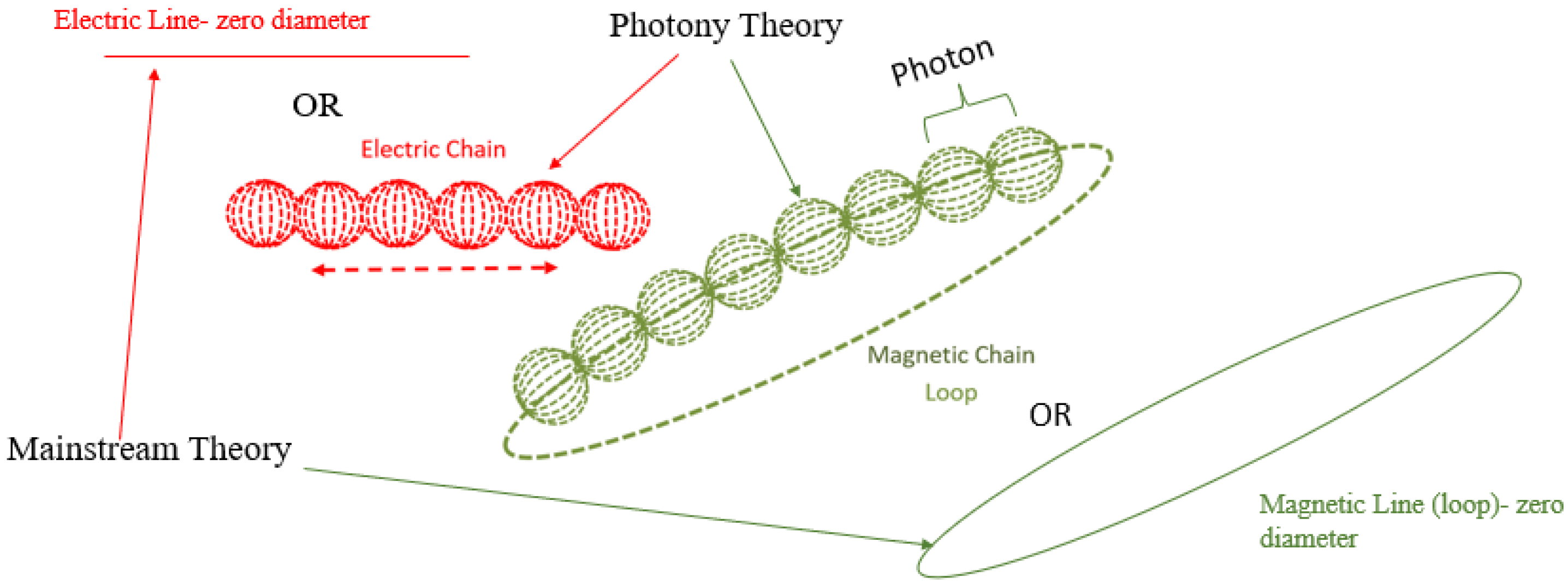
Figure 2.
Proposed electron-mediated transduction and reduction of electromagnetic chain structures. The cross-sectional electron representation identifies the persistent internal c-spin and the externally responsive x-spin. During transduction, elemental charge photons are proposed to become organized into larger chain structures, while reduction represents the complementary decrease, release, or disassembly of previously organized chains. In the present entanglement hypothesis, the rotational state and orientation of the electron are proposed to influence the directional organization of the structures it transduces.
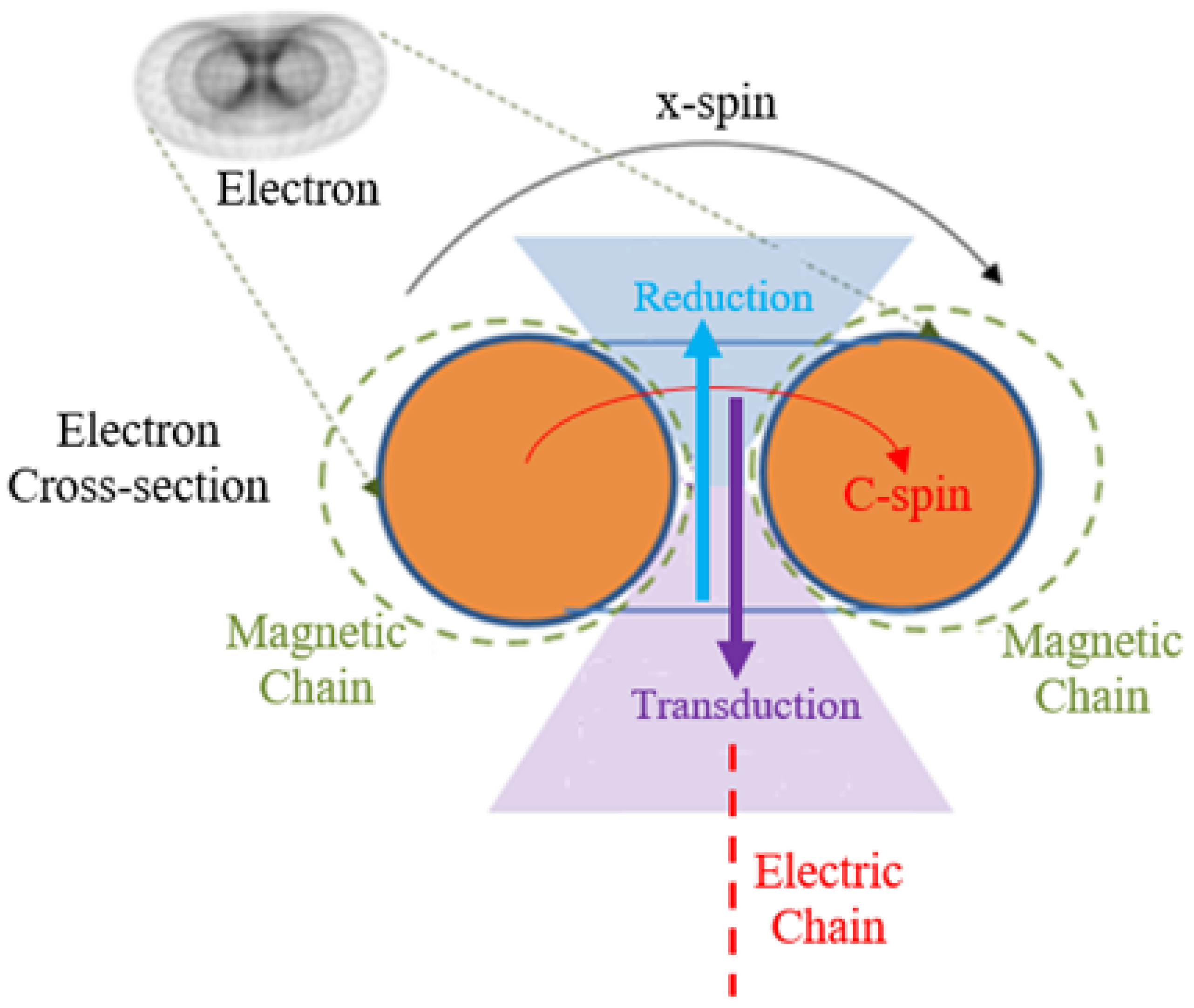
Disclaimer/Publisher’s Note: The statements, opinions and data contained in all publications are solely those of the individual author(s) and contributor(s) and not of MDPI and/or the editor(s). MDPI and/or the editor(s) disclaim responsibility for any injury to people or property resulting from any ideas, methods, instructions or products referred to in the content. |
© 2026 by the authors. Licensee MDPI, Basel, Switzerland. This article is an open access article distributed under the terms and conditions of the Creative Commons Attribution (CC BY) license (http://creativecommons.org/licenses/by/4.0/).
Copyright: This open access article is published under a Creative Commons CC BY 4.0 license, which permit the free download, distribution, and reuse, provided that the author and preprint are cited in any reuse.