

Submitted:
04 October 2026
Posted:
08 October 2026
You are already at the latest version
Abstract
Military capability increasingly depends on electrical energy for sensing, communications, computing, autonomy, mobility, protection, electronic warfare, and electrically enabled weapons. However, the value of a battery or energy-storage technology cannot be judged from chemistry or cell-level energy density alone. This review develops a mission-driven framework linking cell chemistry → module/pack → power electronics and thermal management → platform integration → mission effect → operational energy and contested logistics. It distinguishes energy from power and organizes military systems into four analytical battery roles: battery-integral, battery-dependent, battery-buffered, and battery-secondary. The framework is applied across soldier systems, smart munitions, unmanned systems, tactical vehicles, naval platforms, and high-power electrically enabled systems. The review finds that no universal “best military battery” exists; technology selection must reflect mission duty cycle, power demand, environmental exposure, survivability, recharge or resupply conditions, and system integration. Cell-level advantages can be reduced by pack overhead, protection, thermal management, power conversion, degradation, maintainability, and logistics. The review also proposes a cross-level evidence framework that distinguishes cell, pack, platform, modeled, demonstrated, operational, and fielded evidence. These findings support a mission-driven transition roadmap and strategic implications for force design, acquisition, research priorities, and operational-energy planning.
Keywords:
military energy systems
; batteries
; energy storage
; operational energy
; hybrid power systems
; contested logistics
; mission-energy architecture
1. Introduction
Electrical energy is no longer a background utility for military forces. It enables the sensing, computation, communications, control, and actuation that turn platforms into networked combat systems. Ground-vehicle assessments identify rising electrical-power demand from sensors, computing, communications (C4ISR) equipment, weapon systems, and increasingly electrified auxiliary functions, creating a need for integrated vehicle-level power-generation and management architectures [1]. Department of Defense operational-energy strategy likewise treats energy as a mission-enabling resource and emphasizes that growing demand, vulnerable supply lines, and dependence on energy infrastructure can increase operational risk and constrain military effectiveness [2]. Loss of electrical power can therefore degrade the ability to detect, decide, maneuver, protect, and engage.
This dependence spans the force. At the dismounted edge, batteries sustain radios, navigation, night vision, sensors, and digital mission equipment; the relevant burden arises from the soldier, equipment suite, and mission together [3]. In tactical vehicles, electric machines and stored energy can support auxiliaries, silent watch, low-signature movement, mission loads, and export power, but compete with mobility reserve, pack mass, and thermal margin [4]. Naval integrated electrical systems allocate common generation across propulsion, sensors, and weapons [5]. Electricity thus links mobility, sensing, communications, computing, autonomy, electronic warfare, protection, and strike as a shared combat resource.
An electrically powered military system is not necessarily battery powered. Prime movers, generators, fuel cells, turbine-driven alternators, microgrids, and other conversion systems may supply electrical energy. Batteries may be the primary source, an auxiliary supply, a reserve or activation component, a transient buffer, or one element of a hybrid source. Army power-source programs distinguish primary, rechargeable, reserve/fuze, and pulse batteries and capacitors alongside fuel cells and thermophotovoltaic generation [6]. That role determines whether the dominant problem is endurance, activation, recharge, fuel use, bus stability, pulse formation, damage tolerance, or resupply.
The distinction between energy and power anchors that reasoning. Energy is the amount of work available over time; power is the rate at which work can be delivered. Endurance missions require usable energy after accounting for temperature, state-of-charge reserve, conversion losses, and auxiliary loads. Peak-load missions require instantaneous or short-duration power, voltage stability, switching, and heat management. A battery can provide substantial energy yet be unable to supply a required pulse; conversely, a capacitor, flywheel, or high-power buffer may satisfy a pulse while providing negligible operational endurance. Military vehicle studies formalize this separation by decomposing load into slowly varying static demand and fast, high-magnitude dynamic demand, then assigning energy and power functions to different storage elements [7].
The gap is clearest in electrically powered weapons and advanced naval systems. Electric guns, high-power microwave systems, lasers, pulsed sonar, and ultrawideband radar can demand gigawatt-scale pulses, requiring integrated propulsion, sensor, and weapon energy management rather than isolated subsystem sizing [8]. Naval pulsed-power analyses report stored-energy requirements from tens of kilojoules to several gigajoules and instantaneous power above 20 GW for electromagnetic launch, railguns, and high-energy lasers [9]. Such missions require prime power, intermediate storage, conditioning, distribution, pulse formation, thermal management, controls, and a platform architecture that preserves critical loads through faults.
Cell-level metrics remain necessary but insufficient. Specific energy and energy density influence carried mass, volume, range, and endurance; power density influences pulses and recovery from load transients; safety, aging, temperature response, and recharge behavior determine whether nominal values remain available. One 18650 comparison found higher room-temperature energy density for NMC lithium-ion cells, while a high-power sodium-ion variant retained usable capacity at −40 °C [10]. Another commercial study reported sodium-ion power delivery comparable to LFP and lower self-heating in the tested cells [11]. Material choice must be matched to an operational envelope, load profile, and architecture.
Battery selection cannot be disentangled from the pack. Cells become military energy systems only after coupling into modules and packs with containment, contactors, sensing, management, conversion, cooling, and repair interfaces. Individual-cell safety does not guarantee system safety: propagation research shows that pack design must account for a cell-level event and identifies ambient temperature, spacing, and stacking as influential variables [12,13]. Platform integration then adds mission load sequences, environment, electromagnetic compatibility, damage pathways, and constraints on mass, volume, and heat rejection. The relevant unit of analysis is a mission-energy architecture.
The architecture extends outward to logistics. Electrification can reduce fuel, signature, or idling burdens, but can relocate risk to charge time, charging equipment, spare packs, generators, fuels, or distribution nodes. Comparative military-vehicle analysis finds conventional liquid fuels lowest in total powertrain mass and stored-energy volume, while identifying lithium-ion/diesel hybrids as the most promising near-term alternative [14]. Force-level analysis emphasizes growing demand for energy services, long supply lines, and dispersed operations [15]. The relevant question is whether an architecture improves mission completion and survivability when refueling, recharging, transport, and repair are contested.
Existing public literature seldom follows the full causal path. Battery work is commonly organized by chemistry, cycle life, safety, or thermal behavior; vehicle and ship work by propulsion, conversion, silent watch, distribution, or pulsed power; and operational-energy work by generators, microgrids, fuel use, or resupply. These boundaries obscure how cell chemistry → module/pack → power electronics and thermal management → platform integration → mission effect → logistics determines military value. The gap is especially consequential for hybrid architectures, where a generator or fuel cell supplies average energy while batteries, capacitors, or flywheels protect bus quality and deliver transients. Ship laser models compare these stores because selection depends on transient load and power-system behavior, not a generic energy-density contest [16].
This review addresses that integration problem across soldier systems; smart munitions; unmanned aerial, ground, surface, and underwater systems; tactical and combat vehicles; naval platforms; directed-energy systems; and electromagnetic or electrothermal systems. It treats battery roles through a four-category taxonomy: battery-integral systems, in which the battery is functionally indispensable to a sealed, activated, or one-shot capability; battery-dependent systems, in which stored electrochemical energy supplies the principal mission energy; battery-buffered systems, in which storage absorbs transients, supports pulses, or bridges source interruptions; and battery-secondary systems, in which batteries provide start, reserve, emergency, or limited auxiliary power while another source provides the major energy flow. The roles can coexist within a platform and are intended to expose, rather than conceal, differences in qualification, maintenance, safety, and logistics.
Against this background, the review addresses a connected set of scientific and systems-engineering questions spanning the full path from stored energy to military effect. It examines which cell and storage characteristics determine usable energy, power, safety, aging, and temperature performance; how module design, battery management, protection, thermal control, power electronics, and distribution preserve or erode those characteristics at the system level; and how mission duty cycles translate into requirements for endurance, peak power, pulse delivery, recharge, thermal rejection, signature, and recovery. It further examines how these requirements differ across soldier systems, munitions, unmanned platforms, tactical vehicles, naval systems, and electrically powered weapons; how degradation, thermal propagation, converter faults, cooling loss, bus disturbances, environmental stress, and combat damage can propagate into mission loss; and how survivability, graceful degradation, maintainability, and battle-damage resilience should therefore be evaluated. Finally, the review asks when electrification reduces, relocates, or increases exposure to contested logistics and what level of public evidence is required before a claim can credibly progress from cell performance to pack, platform, operational, and mission relevance.
The central contribution of this review is a mission-driven framework that connects cell chemistry to pack architecture, power conversion and thermal management, platform integration, mission effect, and operational sustainment. The framework combines four analytical battery roles with mission-relevant energy–power–time metrics and a cross-level evidence structure that distinguishes cell measurements, pack demonstrations, platform integration, modeling, operational evaluation, and fielded evidence. Logistics and contested sustainment are treated as part of system performance rather than as downstream consequences. The review is based on public and unclassified peer-reviewed and authoritative technical evidence; demonstrated results are distinguished from modeled outcomes, developmental targets, and forward-looking concepts, and the absence of public evidence is not interpreted as evidence that a capability does not exist. The objective is therefore not to identify a universal battery chemistry, but to determine when an electrical-energy architecture can be integrated, protected, employed, recovered, and sustained in support of a defined military mission.
This review draws primarily on publicly available and unclassified peer-reviewed, military, government, and authoritative technical literature. Evidence from civilian or installation-scale systems is included where it provides transferable technical mechanisms or analytical insight, but is not treated as direct validation under contested military operating conditions. The objective is not an exhaustive catalog of energy-storage technologies, but a critical synthesis of the conditions that determine whether component-level performance can translate into sustainable military capability.
The remainder of the review follows this progression from technology to mission capability. Section 2 establishes the terminology, system boundaries, and four analytical battery roles used throughout the paper. Section 3 translates military mission profiles into energy, power, time, thermal, availability, and logistics requirements. Section 4 evaluates the state of the art in electrochemical storage, high-power buffers, primary sources, and hybrid power architectures. Section 5 applies these concepts across soldier systems, smart munitions, unmanned platforms, tactical and combat vehicles, naval systems, and high-power electrically enabled systems. Section 6 examines integration challenges, cascading failure pathways, survivability, and graceful degradation, while Section 7 extends the analysis to operational energy and contested logistics. Section 8 identifies research gaps and develops a standardized framework for translating evidence from cell and component measurements to pack, platform, operational, and fielded claims. Section 9 uses those evidence requirements to construct a prioritized transition roadmap across near-, mid-, and longer-term opportunities. Section 10 derives the implications for force design, acquisition, research priorities, industrial-base resilience, and operational-energy planning. Section 11 concludes by synthesizing the conditions under which electrical-energy technologies translate into sustainable military capability.
2. Terminology and Taxonomy
Military electrical-energy systems are frequently discussed using overlapping labels such as battery-powered, electrically powered, hybrid-electric, pulsed-power, and directed-energy systems, yet these terms do not describe the same technical boundary or operational function. A battery may supply the principal mission energy, provide only transient power, support emergency or auxiliary loads, or serve as one element within a broader generator-, fuel-cell-, or grid-supported architecture. Likewise, systems with similar platform labels can impose fundamentally different requirements for endurance, peak power, pulse delivery, recharge, thermal management, safety, and sustainment. A consistent terminology is therefore necessary before technologies can be compared meaningfully. This section defines the electrical-system boundary used throughout the review, distinguishes energy sources from storage and power-buffering functions, clarifies the relationship among battery-electric, hybrid-electric, and electrically powered systems, and introduces four analytical battery roles that classify systems by what the battery does within the mission architecture rather than by chemistry or platform type.
2.1. Energy, Power, and the Electrical System Boundary
This review distinguishes energy from power because the two impose fundamentally different requirements on military electrical systems. Energy represents the capacity to perform work over a mission interval, whereas power represents the rate at which that work must be delivered. Endurance therefore depends on usable energy after accounting for reserve state of charge, conversion losses, temperature effects, degradation, and auxiliary loads. By contrast, peak and pulsed missions depend on current delivery, voltage stability, switching behavior, pulse formation, thermal rejection, and recovery over much shorter timescales. Military vehicle analyses accordingly separate slowly varying static loads from fast, high-magnitude dynamic loads and assign these demands to storage elements with different energy and power characteristics [7].
A system can consequently possess substantial stored energy and still be unable to accelerate, actuate, illuminate, jam, fire, or maintain bus voltage at the required instant. Conversely, a capacitor, flywheel, or high-power battery buffer may satisfy a short-duration power demand while contributing relatively little to multi-hour endurance. This distinction becomes particularly important for high-power military loads. Naval studies describe electric guns, high-power microwave systems, lasers, pulsed sonar, and advanced radar as loads that can impose extremely high instantaneous power demands, with relevant stored-energy requirements ranging from tens of kilojoules to several gigajoules depending on the application [8,9]. Such systems cannot therefore be compared meaningfully on the basis of stored watt-hours or cell-level specific energy alone; the timescale, waveform, repetition rate, recovery interval, and associated power architecture are equally important.
The electrical-system boundary adopted in this review is therefore broader than the battery. An electrically powered system is one whose mission function, propulsion, actuation, sensing, control, or weapon effect depends on electrical energy; it is not necessarily battery-powered. Electrical energy may be supplied by an engine-generator, turbine-driven alternator, fuel cell, shore or grid connection, microgrid, renewable source, battery, or a combination of these elements. A battery may provide the principal mission energy, but it may instead function as a reserve source, auxiliary supply, transient store, pulse source, or component of a hybrid architecture. U.S. Army power-source programs similarly distinguish primary and rechargeable batteries, reserve and fuze batteries, pulse batteries and capacitors, fuel cells, and other electrical-generation technologies, demonstrating that the relevant concept of a military power source extends beyond batteries alone [6].
For this reason, several functional elements must be distinguished within the broader electrical-energy architecture. A primary energy source supplies the average energy required over the mission, whether through stored electrochemical energy or conversion from fuel or another energy carrier. Energy storage retains energy for later delivery and may be electrochemical, mechanical, capacitive, or thermal. Auxiliary power supports starting, emergency operation, selected low-duty loads, or temporary operation when the primary source is unavailable or intentionally shut down. A power buffer absorbs or supplies short-duration transients to protect the primary source, maintain bus stability, or satisfy temporary load excursions. Pulsed-power storage is a specialized buffering function in which energy is accumulated and released at the power level, waveform, repetition rate, and timescale required by loads such as electromagnetic launchers, high-power microwave systems, lasers, or electrothermal devices [8,9]. These functions can coexist within the same platform, but they impose different requirements for stored energy, response time, power conversion, thermal management, safety, control, recharge, mass, volume, and sustainment. The distinction among them establishes the system boundary used throughout this review and provides the basis for the battery-role taxonomy developed in the following subsections.
2.2. From Battery Powered to Electrically Powered Systems
A battery-powered system obtains its principal mission energy directly from a battery over the relevant operating interval. A battery-dependent platform, as used in this review, is the broader analytical case in which mission completion materially depends on stored electrochemical energy, even when additional sources or auxiliary functions are present. Dismounted digital systems, small electrically propelled unmanned vehicles, and fully electric mobility systems can fall into this class when endurance, payload, thermal management, and recharge or battery-exchange requirements are closed at the mission level. Individual-soldier power analyses illustrate the mission dependence of this distinction: primary batteries may be appropriate for short, relatively low-energy missions, whereas longer-duration or higher-energy missions can favor alternative or fuel-supported architectures [17].
Battery-electric propulsion is a more specific case. It refers to traction provided by electric motors whose principal stored mission energy is carried in batteries. It is therefore a subset of electrically powered propulsion, not a synonym for it. A platform in which a diesel engine drives a generator that supplies electric traction motors is electrically propelled but not battery-electric. This distinction matters because propulsion architecture determines not only the energy carrier but also refueling or recharge requirements, thermal loads, signature, transient response, and sustainment.
A hybrid-electric platform combines multiple energy-conversion or storage pathways, commonly a liquid-fuel prime mover, generator, rechargeable battery, power electronics, and electric traction motors. In such systems, the battery does not necessarily carry the full endurance burden. It may instead support silent watch or silent movement, absorb regenerative energy, assist acceleration, stabilize the electrical bus, provide export power, or buffer short-duration mission loads. Studies of military hybrid vehicles identify potential advantages including reduced acoustic signature, high low-speed torque, and flexible onboard power, while also emphasizing penalties associated with battery mass, safety, system complexity, and prime-mover power density [18]. A demonstrated series-hybrid military vehicle architecture, for example, combined a diesel engine and generator with a battery bank and in-hub motors while pursuing silent watch, silent movement, and export power as integrated mission functions [4].
These distinctions prevent two common analytical errors. First, the presence of electric motors does not establish battery-electric range, recharge independence, or reduced logistics burden. Second, a battery used within a hybrid architecture should not be evaluated as though it were intended to carry the entire mission energy requirement. Its principal military value may instead lie in transient response, low-signature operation, generator load leveling, power quality, export power, or reserve capability. The appropriate comparison is therefore not simply battery capacity or electric range, but the function performed by each source and storage element within the complete mission architecture.
The same principle applies to high-power military systems. Directed-energy systems produce effects by delivering energy to a target rather than by accelerating a conventional projectile. Electromagnetic systems employ electrical forces or fields for functions such as rail, coil, or induction launch, while electrothermal systems use electrical energy to initiate or control thermochemical or plasma-assisted launch processes. Although these systems share requirements for power conditioning, switching, energy storage, and thermal management, their required waveforms, pulse energies, repetition rates, recovery intervals, and thermal loads can differ substantially. They should therefore be treated as electrically powered mission systems whose battery role, if a battery is present at all, must be determined from the surrounding power architecture rather than from the weapon label itself.
2.3. The Four Battery-Role Categories
The taxonomy used in this review classifies military electrical-energy systems according to the function performed by the battery within the mission architecture, rather than by chemistry, platform type, or propulsion label. This distinction is necessary because batteries can serve fundamentally different operational purposes even within the same platform. The four roles defined here are therefore analytical rather than mutually exclusive: battery-integral, battery-dependent, battery-buffered, and battery-secondary.
- Battery-integral systems are those in which the battery is indispensable to activation or operation and is typically embedded within a sealed, expendable, reserve, or one-shot system. Representative applications include smart-munition fuze and reserve batteries, mines, sonobuoys, torpedo subsystems, and other sealed underwater systems. In these applications, the dominant requirements may include activation reliability, shelf life, storage stability, pulse delivery, environmental tolerance, and safe handling rather than rechargeable cycle life. U.S. Navy battery requirements have historically identified distinct demands across sonobuoys, mines, underwater vehicles, and torpedoes, including energy density, safety, environmental compatibility, operating duration, and availability [19]. The decisive question in this role is therefore whether stored energy remains available and reliable at the moment of activation after the required storage and environmental exposure.
- Battery-dependent platforms rely on stored electrochemical energy as the principal source of mission energy over the relevant operating interval. Mission completion is therefore directly influenced by usable stored energy, discharge power, state of health, thermal behavior, reserve margin, and recharge or battery-exchange availability. Soldier systems and many small unmanned platforms fall within this role when batteries power the mission electronics, propulsion system, or both. Studies of military unmanned aerial systems compare batteries with fuel cells, solar power, and hybrid architectures precisely because endurance depends on the complete source–storage–platform architecture rather than on battery chemistry or nominal capacity alone [20]. In this role, the principal question is whether the battery can sustain the required mission profile while remaining compatible with payload, mass, thermal, recovery, and logistics constraints.
- Battery-buffered electrically powered systems use batteries or other storage devices primarily to manage transient or high-power demands while another source provides much of the average mission energy. The buffer may supply acceleration, absorb regenerative energy, bridge source interruptions, support silent operation, stabilize the electrical bus, or deliver short-duration high-power events. Hybrid tactical vehicles, electrically powered weapons, and naval pulsed-power systems are representative applications. In a hybrid vehicle, a liquid-fuel prime mover may provide sustained mobility while the battery supports silent watch, acceleration, or export power. In a high-power weapon architecture, a generator or integrated power system may supply average energy while a battery, capacitor, or flywheel accumulates and releases the required pulse. Naval laser integration studies compare these storage technologies because pulse duration, recharge rate, mass, power-system interaction, and control requirements are as important as total stored energy [16]. The relevant metric is therefore not endurance alone, but the ability to deliver and recover from repeated transient demands without destabilizing the source or bus. For compactness and consistency with the battery-role taxonomy used throughout this review, the term battery-buffered is retained as the analytical label for this category. The buffering function, however, need not be performed exclusively by a battery; where mission requirements favor different response times, pulse characteristics, cycling behavior, or power density, functionally equivalent storage elements such as capacitors, supercapacitors, or flywheels may perform part or all of the buffering role. The category is therefore defined by the transient-power function within the mission architecture rather than by the specific storage technology used to provide it.
- Battery-secondary systems employ batteries as supporting elements within a broader electrical-power architecture in which another source determines the principal energy flow. Batteries may provide starting power, emergency supply, control continuity, ride-through, blackout recovery, or limited auxiliary operation. Large naval integrated-power systems, generator-supported tactical power systems, deployed microgrids, and some fuel-cell auxiliary-power architectures can fall within this role. Vehicle-microgrid studies illustrate this broader system perspective by treating propulsion, mission equipment, silent watch, state-of-charge management, and vehicle-to-grid power exchange as coupled functions rather than reducing the platform to battery capacity alone [21]. The central requirement in this role is reliable continuity and recovery of critical functions rather than maximum battery endurance.
These four roles can coexist within a single platform or force package. A naval platform, for example, may contain battery-integral sensors or munitions, battery-dependent unmanned vehicles, battery-buffered high-power loads, and battery-secondary emergency or ride-through systems. Likewise, a tactical vehicle may be battery-buffered during propulsion transients, battery-dependent during a limited silent-mobility interval, and battery-secondary when the battery provides only start or emergency support. The role therefore depends on the mission function and system boundary being analyzed rather than on the platform name alone.
This taxonomy prevents the term “military battery system” from collapsing fundamentally different requirements into a single comparison. It also establishes the basis for subsequent analysis: technologies should be compared only when they perform equivalent architectural roles, operate across comparable mission duty cycles, and are evaluated at the same system boundary. The consequences of this distinction for mission-level technology comparison are developed in the following subsection.
2.4. Why the Taxonomy Matters for Mission Analysis
The battery-role taxonomy is useful only if it changes how military electrical-energy systems are evaluated. A meaningful comparison must first identify the primary energy source, the energy-storage function, the power-buffering function, and the power-conversion and distribution architecture. Military power-system analyses distinguish slowly varying energy demands from fast, high-magnitude dynamic loads because these functions impose different requirements on sources and storage devices [7]. The first analytical question is therefore what supplies the average mission energy, for how long, and under what refueling, recharge, or resupply conditions. The second is what energy is stored, at what usable mass and volume, and with what degradation, safety, temperature, and reserve constraints. The third is what element supplies or absorbs short-duration transients and with what response time, pulse duration, recovery interval, and duty cycle. The fourth is how converters, buses, controls, protection, and thermal-management systems transform source energy into the voltage, current, frequency, waveform, and power quality required by the mission load.
This decomposition changes the interpretation of technology performance. A chemistry with higher cell-level specific energy may lose part of that advantage after enclosure, protection, thermal management, wiring, power conversion, reserve margin, and structural integration are included. Conversely, a lower-energy battery may provide greater mission utility if it enables silent operation, absorbs transient loads, improves generator operating conditions, or provides export power. Military hybrid-electric vehicle programs demonstrate this architectural distinction by combining fuel-based generation, batteries, electric traction, silent-watch capability, silent movement, and export power rather than optimizing the system solely for battery-electric range [4]. Likewise, naval high-power-system studies compare batteries, capacitors, and flywheels according to pulse response, recharge characteristics, mass, and platform integration rather than stored energy alone [16]. Technology performance must therefore be interpreted within the function that the technology performs in the complete architecture.
The taxonomy also defines the system boundary required for valid evidence comparison. Cell-level measurements cannot by themselves establish pack, platform, or mission performance because enclosure, protection, conversion efficiency, thermal management, controls, degradation, and reserve requirements alter the usable performance delivered to the load. Comparisons among storage technologies are therefore meaningful only when the technologies perform equivalent functions under comparable duty cycles and boundary conditions. A battery intended to provide multi-hour endurance, for example, should not be compared directly with a capacitor or flywheel optimized for short-duration transient power unless the analysis explicitly accounts for their different architectural roles. The same principle underlies military vehicle power-management studies that allocate different energy and power demands to different storage elements [7].
Mission analysis must then extend beyond the storage device itself. Once the battery role is identified, requirements can be assigned to endurance, peak power, pulse availability, signature, thermal closure, survivability, maintainability, and recovery. Platform integration can be evaluated through bus stability, cooling, protection, fault containment, degraded operation, and interoperability. Naval integrated-power architectures similarly treat propulsion, sensors, service loads, and weapons as competing or coordinated electrical demands within a common power system rather than as independent loads [5]. Vehicle-microgrid studies likewise consider propulsion, mission equipment, silent watch, state-of-charge management, and bidirectional power exchange as coupled functions [21].
Figure 1 summarizes this role-based taxonomy and its relationship to the broader power architecture. Moving from battery-integral to battery-secondary systems, the battery generally becomes less responsible for supplying the full mission-energy requirement and increasingly operates within a wider architecture that includes generators, integrated power systems, power converters, or other energy sources. This progression should not be interpreted as a rigid hierarchy: the roles can coexist within the same platform and may change with mission configuration or with the specific function being analyzed. A naval platform, for example, may simultaneously contain battery-integral devices, battery-dependent unmanned systems, battery-buffered high-power loads, and battery-secondary emergency systems. Figure 1 therefore provides a functional map for interpreting subsequent technology, platform, and logistics comparisons.
The same system boundary must be maintained when assessing sustainment. Electrification may reduce one logistics burden while shifting dependence toward charging infrastructure, spare batteries, power-generation equipment, maintenance, or electrical distribution. The relevant question is therefore not whether a system is simply more or less “electric,” but whether the complete architecture improves mission performance under realistic operational and sustainment constraints. The governing principle used throughout this review is consequently: compare equivalent roles, at the same system boundary, under the same mission duty cycle and operational assumptions.
3. Mission Requirements and Performance Metrics
The taxonomy developed in Section 2 identifies the function performed by a battery or other storage element within a military electrical-energy architecture. The next step is to determine what the mission actually requires from that architecture. Military electrical-energy requirements cannot be defined by battery capacity, specific energy, or nameplate power alone because mission performance depends on when energy is required, how rapidly it must be delivered, how long the demand persists, how often high-power events repeat, and under what environmental, thermal, survivability, and sustainment constraints the system must operate. The appropriate analytical starting point is therefore the mission sequence and its associated electrical load trace. As illustrated in Figure 2, military capability emerges through a continuous translation from cell and material properties through modules and packs, power electronics and thermal management, and platform integration to mission effect, with operational and logistics constraints acting across the entire chain. This section converts that systems architecture into measurable mission requirements by defining energy–power–time relationships, translating component-level characteristics into mission-level performance metrics, and incorporating thermal behavior, safety, interoperability, recovery, and graceful degradation into the evaluation boundary.
3.1. Translate the Mission Sequence into a Load Trace
Mission requirements should begin with the mission sequence, not with a component specification. The sequence defines when a platform must move, sense, communicate, compute, maneuver, remain silent, employ payloads or weapons, recover, recharge, or operate in a degraded state. Each mission event can then be translated into an electrical demand characterized by duration, average power, peak power, repetition rate, recovery interval, and priority relative to other loads. The resulting mission load trace is therefore the electrical representation of the mission. It is more informative than nameplate power or aggregate energy demand because it shows when energy is consumed, when power quality is stressed, when thermal loads accumulate, and whether the source and storage architecture can recover before the next mission event.
This approach is particularly important because military duty cycles are inherently nonuniform. A dismounted soldier may operate radios, navigation equipment, displays, sensors, and computing systems continuously or intermittently over many hours while carrying both the primary energy source and any reserve capacity. A small unmanned aircraft may operate under a relatively high continuous propulsion demand but within a short sortie followed by a defined recharge or battery-replacement window. A tactical vehicle may alternate among movement, acceleration, surveillance, engine-off silent watch, communications, mission-system operation, and export power. Naval platforms can combine sustained propulsion and ship-service loads with intermittent radar, sonar, launch, directed-energy, or electromagnetic events. Dynamic vehicle-power simulations demonstrate why this temporal structure matters: interactions among propulsion, power-system behavior, mobility, and weapon or mission-system loads can be obscured when demand is represented only as a static sum [22].
The mission load trace should also be annotated with environmental, system-health, and operational states. Temperature affects available capacity, internal resistance, charge acceptance, and battery degradation, while aging commonly manifests as capacity loss and increased internal resistance [23]. Mechanical and environmental stresses, including shock, vibration, deformation, and temperature excursions, can alter electrical behavior, accelerate degradation, or initiate failure mechanisms that reduce usable capability [24]. At the system level, qualification therefore requires consideration of mechanical, electrical, and thermal stressors rather than nominal electrochemical performance alone [25]. Likewise, a nominal recharge opportunity does not constitute available mission energy unless its duration, source capacity, protection, accessibility, tactical location, and associated signature are specified. Operational-energy analyses similarly treat the soldier, equipment, energy source, and mission as interacting elements rather than evaluating power technologies independently of the mission context [3].
The resulting trace provides the common input for subsequent energy, power, thermal, and logistics calculations. It identifies not only how much energy must be carried or generated, but also when power must be available, which loads have priority, how long transients persist, how often high-power events repeat, and what recovery opportunities exist between them. This establishes the requirement boundary for the energy–power–time metrics developed in the following subsection.
3.2. Define the Requirement in Energy–Power–Time Terms
Once the mission sequence has been translated into a load trace, the electrical requirement can be expressed in energy–power–time terms. The first quantity is usable mission energy, measured at the platform boundary over a defined temperature range, state-of-charge window, reserve requirement, age, and mission profile. Rated cell energy is only an input to this quantity. Pack enclosure, sensing, contactors, battery-management electronics, thermal control, cabling, protection, and power conversion reduce the energy ultimately available to the mission. The relevant metric is therefore usable platform-level energy rather than nominal cell capacity.
The second quantity is average or continuous power, defined over the interval during which a load must be sustained. Continuous power governs functions such as steady propulsion, sensing, communications, onboard computing, cooling, and electronic-warfare operation. The third is peak power, which governs shorter-duration demands such as acceleration, actuation, transmission bursts, radar or sensor transitions, and weapon preparation. These requirements must be considered separately because an architecture sized for endurance may still be unable to satisfy a short-duration high-power event.
The fourth quantity is pulse duration and duty cycle: how long a high-power event lasts, how frequently it repeats, and whether the source, storage element, converter, electrical bus, and thermal-management system can recover before the next event. This requirement is particularly important for high-power military loads. Naval pulsed-power studies describe electric guns, high-power microwave systems, lasers, pulsed sonar, and advanced radar as loads requiring coordinated management of propulsion, sensor, and weapon energy and, in some cases, gigawatt-scale instantaneous power [8]. Related analyses report stored-energy requirements ranging from tens of kilojoules to several gigajoules and instantaneous power exceeding 20 GW for selected electromagnetic-launch and directed-energy applications [9]. Such systems therefore cannot be characterized meaningfully by total stored energy alone; pulse shape, repetition rate, recharge capability, source–buffer interaction, and thermal recovery are integral parts of the mission requirement.
The fifth quantity is recharge and recovery time. Recovery is broader than electrical recharge and can include thermal cooldown, restoration of source or generator margin, state-of-health protection, source replenishment, battery exchange, and periods during which the platform must remain stationary, connected to support equipment, or otherwise constrained. A system capable of producing a single high-power event but unable to recover before the next required engagement has fundamentally different military utility from one that can repeat the effect at the required interval [8,9]. The same principle applies to mobility and silent-operation missions: a vehicle may satisfy a short silent-watch or silent-mobility requirement yet impose an unacceptable operational penalty if recovery requires engine restart, lengthy charging, or exposure to support infrastructure. Requirements should therefore specify the number and timing of repeatable mission events before recovery, rather than reporting only the energy associated with a single event.
The sixth quantity is power quality and electrical stability. Sufficient stored energy does not guarantee successful operation if a transient load produces unacceptable voltage sag, frequency deviation, harmonic distortion, or bus instability. This issue becomes increasingly important as propulsion, mission systems, power-electronic converters, and high-power loads share a common electrical architecture. Naval integrated-power concepts therefore treat generation, distribution, propulsion, sensors, and weapons as interacting elements whose electrical behavior must be coordinated rather than evaluated independently [5]. Reviews of shipboard microgrids similarly identify voltage and frequency excursions, harmonic distortion, and pulsed-load disturbances as central power-quality challenges and show that appropriately controlled battery, flywheel, or hybrid storage can mitigate these disturbances and support critical loads [26].
Power-conversion efficiency alone is consequently insufficient as a system metric. The architecture must maintain acceptable voltage and frequency, preserve priority loads during load steps or faults, isolate disturbances where possible, and recover rapidly after transient events. A buffer may provide substantial mission value even when it contributes relatively little total energy if it prevents a high-power load from destabilizing the bus, reduces stress on the prime generator, or preserves continuity of critical mission systems [5,26].
Taken together, these quantities define the minimum electrical requirement space for mission analysis: how much usable energy is required, at what continuous and peak power, for what duration and repetition rate, with what recovery interval, and under what power-quality constraints. This formulation shifts comparison away from isolated component ratings and toward the time-dependent electrical behavior required to complete the mission. It also provides the basis for translating component-level characteristics into the mission-level performance metrics developed in the following subsection.
3.3. Convert Component Metrics into Mission Performance
The central analytical error in battery comparison is to treat a single component-level metric, most commonly gravimetric specific energy, as a proxy for military utility. Higher specific energy can reduce carried mass or increase nominal endurance, but it does not by itself reveal peak-power capability, low-temperature performance, charge acceptance, thermal burden, safety requirements, degradation, reserve margin, or the mass and efficiency of the surrounding architecture. Cell-level advantages are therefore conditional rather than absolute. In one cylindrical-cell comparison, NMC lithium-ion cells exhibited the highest room-temperature energy density among the tested cells, whereas a high-power sodium-ion design retained usable capacity even at −40 °C [10]. A separate commercial-cell study reported sodium-ion power capability comparable to LFP together with lower self-heating under the tested conditions [11]. These results do not establish a universal ranking of chemistries; rather, they demonstrate that apparent performance advantages depend on temperature, discharge rate, cell design, duty cycle, and the mission variable being optimized.
Mission analysis should therefore translate component characteristics into platform- and mission-level performance measures. One such measure is delivered mission duration per carried or installed mass, which connects usable endurance to the burden imposed on a soldier or platform. A second is usable platform-level energy, which accounts for enclosure, structural support, sensing, protection, thermal management, power conversion, cabling, reserve state of charge, and other non-cell mass or losses. A third is energy-to-effect efficiency, defined here as the electrical energy required to produce a mission-relevant outcome, such as an observation interval, communications period, autonomous sortie, silent-watch interval, maneuver event, or repeated weapon engagement. This is distinct from electrochemical round-trip efficiency because the system boundary extends through the platform to the mission effect.
A fourth measure is thermal margin: the difference between the heat generated during the mission duty cycle and the heat that can be absorbed, stored, or rejected without derating, shutdown, or loss of required performance. A fifth is mission availability, which captures whether the system is charged, thermally ready, electrically healthy, and capable of initiating and completing the required mission when needed. A sixth is net logistics burden, which includes not only the mass or volume of stored energy but also fuel or charging demand, spare packs, chargers and power-conditioning equipment, maintenance labor, transport, cooling requirements, replacement intervals, and the time and exposure associated with replenishment. These measures shift the comparison from the question of which cell stores the most energy to the broader question of which architecture provides the required capability with the lowest acceptable operational burden.
Different mission classes therefore emphasize different combinations of these metrics. Endurance-dominated missions favor high usable energy, low parasitic demand, limited degradation, and reliable replenishment. Silent-watch and low-signature missions emphasize low continuous power, acoustic and thermal signature, state-of-health management, and recovery without forcing premature engine restart. Maneuver and actuation emphasize peak power, transient response, motor and inverter capability, and the mass distribution of the complete powertrain. Sensing, communications, and computing place greater emphasis on stable power quality, predictable continuous demand, and thermal control. Pulsed or high-power systems emphasize stored pulse energy, peak power, waveform control, repetition rate, bus stability, and thermal recovery. No single cell-level metric can represent all of these objectives simultaneously.
The required system boundary is illustrated by military mobility analyses. Vehicle models that include tractive forces, road grade, drivetrain losses, ancillary loads, and energy-storage mass show that range and logistics depend on the complete propulsion and power architecture rather than battery capacity alone [27]. The same principle applies at smaller scales. Soldier-power assessments span load classes from approximately 1 to 150 W, while wearable hybrid-power studies have optimized architectures for approximately 20–200 W over multiday mission profiles subject to strict carried-mass limits [28,29]. These values should not be interpreted as universal requirements; they demonstrate that technology selection must be conditioned on the mission profile, system boundary, and allowable burden.
The resulting evaluation hierarchy is therefore cell performance → pack performance → platform performance → mission performance. Improvements at one level translate into mission value only when their advantages are retained through subsequent integration levels. A higher-energy cell is advantageous only if its pack can be protected and cooled, its power electronics can deliver the required load, the platform can integrate the associated mass and volume, and the complete system can execute and recover from the required mission sequence. Mission-level comparison should therefore report not only component specifications but also the architecture, duty cycle, boundary conditions, and operational outcome against which those specifications are being judged.
3.4. Include Thermal, Safety, Interoperability, and Graceful Degradation
Energy and power requirements are necessary but not sufficient to define military electrical-system performance. A system may satisfy nominal energy and peak-power demands yet still fail the mission because heat cannot be rejected, a fault propagates through the pack, interfaces prevent energy sharing, or the architecture cannot preserve critical functions after partial damage. Mission-level requirements must therefore include thermal closure, safety, interoperability, and graceful degradation as explicit performance dimensions.
Thermal behavior is a mission variable because every conversion loss ultimately appears as heat, cooling itself consumes power and mass, and accumulated thermal energy limits sustained operation and repetition rate. This is especially important in high-power systems. Directed-energy analyses have identified cooling requirements exceeding 1 MW and shown that thermal storage can reduce peak heat-rejection demand without eliminating the need for eventual rejection [30]. In a simulation of a 100 kW airborne laser operating at 16.9% efficiency, real-time heat rejection alone produced downstream temperatures beyond allowable limits, while thermal storage reduced the transient burden but did not eliminate the underlying thermal-balance requirement [31]. The relevant metric is therefore not component efficiency at a single operating point, but thermal margin over the complete mission duty cycle: whether generated heat can be absorbed, transported, stored, and ultimately rejected without derating, shutdown, or unacceptable signature.
Safety must likewise be evaluated at the system level rather than inferred from nominal cell behavior. Thermal runaway initiated in one cell can propagate through a module or pack, and the severity and propagation rate depend on factors including temperature, cell spacing, stacking configuration, state of charge, enclosure design, and available heat-transfer pathways [12,13]. Mission requirements should therefore specify allowable degradation, fault-detection time, isolation behavior, propagation limits, and the electrical capability that remains after a damaged module or branch is removed. A pack that retains nominal stored energy but cannot safely deliver it following a fault has not preserved mission capability. Safety qualification should therefore assess not only the probability of failure but also fault containment and residual mission function after failure occurs.
Interoperability determines whether available energy can be shared, replenished, or redirected across devices and platforms. A modular smart power unit has demonstrated an architecture in which batteries and converters can accommodate multiple storage technologies while using the converter as a charger through a standardized interface [32]. Soldier-power studies similarly identify non-interchangeable batteries and dedicated chargers as contributors to unnecessary carried mass and sustainment burden, supporting common electrical buses and local voltage conversion where practical [33]. The relevant mission metric is therefore broader than charger efficiency or connector compatibility; it is the extent to which a common energy architecture can sustain multiple mission systems while reducing redundant batteries, chargers, adapters, and support equipment.
Finally, military electrical systems must be designed for graceful degradation rather than binary success or failure. Mission-focused nanogrid and microgrid studies evaluate resilience under loss of primary generation, distribution components, fuel supply, and electrical faults, and assess disruption according to its effect on critical mission functions [34,35]. The same principle should be applied at the platform level. Critical loads should be identified and prioritized; faults should be detected and isolated; reserve energy should be protected; system state should be reported accurately; and degraded operating modes should preserve the highest-value mission functions when full performance is no longer available. In this context, resilience is not merely the ability to survive a disturbance, but the ability to continue, adapt, and recover while preserving mission effect.
Figure 3 summarizes this requirement space in conceptual form. The figure maps representative military mission classes according to usable mission energy, continuous/peak power, and characteristic event timescale, while also indicating the associated recovery requirement after the characteristic event. The purpose is not to assign precise universal coordinates, but to show that different missions occupy distinct regions of the energy–power–time design space and therefore require different storage, conversion, thermal, and recovery architectures. Soldier electronics and computing cluster toward low-to-moderate energy and low continuous power over long durations; small unmanned systems combine moderate energy with sustained propulsion demand over sortie timescales; tactical-vehicle silent watch emphasizes moderate energy with low continuous power over hours; maneuver and actuation impose short-duration but high-power requirements; naval sensing and service loads combine high energy with moderate sustained power over long intervals; and directed-energy or electromagnetic pulse systems are distinguished by very high peak power, short event duration, and repeated engagements separated by recharge and cooldown. The figure therefore reinforces the central argument of this section: mission requirements must be defined not only by how much energy is needed, but by how quickly it must be delivered, for how long, and how rapidly the architecture must recover before the next required event.
Section 3.1, Section 3.2, Section 3.3 and Section 3.4 define a mission-level evaluation framework that extends well beyond nominal battery or component performance. The relevant boundary begins with the mission load trace and includes usable energy, continuous and peak power, pulse duration, recovery interval, power quality, thermal margin, system overhead, interoperability, availability, graceful degradation, and sustainment burden. These variables determine whether electrical energy can be translated into repeatable and resilient mission effect rather than merely delivered under nominal conditions. Table 1 consolidates these metrics and evaluation criteria, links them to their mission significance and representative applications, and establishes the common comparison basis used in the subsequent analysis of storage technologies, power architectures, platform integration, and operational logistics.
4. State of the Art in Storage and Power Architectures
The mission requirements developed in Section 3 provide a stronger basis for evaluating storage and power technologies than chemistry, novelty, or isolated laboratory performance alone. The technology classes considered in this review were selected because they materially affect one or more mission-relevant requirements, including usable energy, continuous and peak power, pulse delivery, thermal margin, safety, recharge and recovery, mass and volume, power quality, survivability, maintainability, or logistics burden. Section 4 therefore examines established and emerging electrochemical storage, high-power buffering technologies, primary and auxiliary power sources, and hybrid power architectures according to the function they perform within the complete military electrical-energy system.
A recurring distinction is necessary throughout this section. Cell- or component-level performance, pack-level capability, and platform-level mission utility are not equivalent. A technology may provide higher specific energy, greater power capability, improved temperature response, or better cycle life under selected conditions while introducing additional penalties in protection, cooling, conversion, packaging, qualification, maintenance, or replenishment. The relevant question is therefore not simply whether one technology outperforms another at the component level, but whether its advantage survives integration and improves the required mission function at the appropriate system boundary.
4.1. Lithium-Ion and Primary Batteries: The Operational Reference
Lithium-ion is the current operational reference for rechargeable military electrical energy because it combines relatively high specific energy, useful power capability, low self-discharge, established cycle and calendar life, and a comparatively mature manufacturing, integration, and qualification base. Its relevance extends well beyond endurance-oriented applications. Military-aircraft studies describe lithium-ion configurations for high-energy and high-power operation, engine starting, load leveling, switching support, and emergency power over wide temperature ranges in qualified or developmental designs [41]. Long-duration NMC/graphite testing provides strong evidence of cell-level durability while also emphasizing that cell format and implementation can introduce losses or degradation mechanisms that are not captured by nominal material performance alone [42]. Lithium-ion should therefore be regarded as the reference architecture against which emerging rechargeable technologies are compared, not as an unconditional optimum across every military mission.
That reference status is itself heterogeneous. High-energy lithium-ion cells generally trade some current capability and thermal margin for stored energy, whereas high-power variants sacrifice specific energy to improve transient response and current delivery. Electrolyte formulation, electrode design, cell geometry, and thermal management can also alter low-temperature and high-rate performance even when room-temperature requirements appear similar [43]. More importantly, military integration occurs at the module and pack level rather than at the isolated cell. Enclosures, contactors, sensing, balancing, protection, wiring, thermal control, structural support, and power conversion all reduce the specific energy and power available at the platform boundary. A military-vehicle cell reported above approximately 225 Wh kg⁻¹ at the cell level, for example, should not be interpreted as equivalent to a complete 6T-format battery pack delivering the same system-level value [44]. Comparisons must therefore identify explicitly whether reported performance refers to the cell, module, pack, or integrated platform boundary.
Rechargeable lithium-ion also does not displace primary batteries in missions where immediate readiness, long shelf life, low self-discharge, activation reliability, storage stability, or high usable energy per carried mass are more important than rechargeability. Army battery-development programs have historically treated safe storage, transport, use, and disposal as critical requirements while pursuing nonrechargeable lithium chemistries for portable command-and-control systems, unattended sensors, and other mission applications [45]. Naval programs likewise identify distinctive safety and handling requirements for primary lithium systems across acquisition, packaging, storage, transportation, use, and disposal [46]. Primary batteries therefore remain relevant where the mission places a premium on long dormant periods followed by reliable activation, or where recharge infrastructure is unavailable, undesirable, or operationally burdensome.
Legacy rechargeable chemistries, including lead-acid, nickel-cadmium, and nickel-metal hydride, can also remain appropriate where starting current, cold-weather robustness, qualification history, predictable failure behavior, low integration risk, or established logistics outweigh the advantages of higher specific energy. Military land-vehicle assessments have concluded that lead-acid systems can remain relevant in the near term while lithium-ion variants continue to require mission-specific integration and qualification [47]. Specialized reserve chemistries likewise retain value where long storage followed by rapid activation is more important than cycling capability.
The operational baseline therefore comprises multiple chemistries and architectures rather than a single universally preferred technology. Lithium-ion currently provides the broadest rechargeable pathway from cell technology to qualified military pack, while primary and legacy chemistries continue to occupy mission roles in which shelf life, activation reliability, safety, starting power, qualification history, or sustainment characteristics dominate. The relevant state-of-the-art question is consequently not which chemistry offers the highest cell-level Wh kg⁻¹, but which technology retains sufficient energy, power, safety, environmental tolerance, maintainability, and supply assurance after integration into the complete mission-energy architecture.
4.2. Emerging Electrochemical Storage: Promise Discounted by Integration
Emerging electrochemical storage technologies are attractive because they may improve one or more attributes that matter to military systems, including specific energy, low-temperature operation, safety, material availability, or supply-chain resilience. Their relevance, however, cannot be inferred from cell-level performance alone. For military applications, a candidate technology must retain its advantages after packaging, protection, thermal management, power conversion, manufacturing, environmental qualification, and mission-duty constraints are imposed. The critical question is therefore not whether an emerging chemistry exceeds lithium-ion in an isolated metric, but whether it provides a measurable advantage at the module, pack, or platform level under the conditions in which the system must operate.
Sodium-ion is among the most technically credible near-term alternatives to lithium-ion where maximum ambient specific energy is not the dominant requirement. Comparative full-cell testing reported approximately 21% higher power for the tested sodium-ion cell at −30 °C and approximately 53% capacity retention at 0 °C, compared with approximately 29% for the lithium-ion comparator [48]. Separate commercial-cell measurements found sodium-ion power capability comparable to LFP and lower self-heating under the reported test conditions [11]. At the same time, other cylindrical-cell studies have demonstrated stronger temperature dependence for particular sodium-ion designs [49]. These results should not be interpreted as evidence of universal superiority. They instead show that sodium-ion performance depends strongly on cell chemistry, format, electrode kinetics, thermal conditions, and duty cycle. Its potential military relevance is therefore likely to be greatest where cold-temperature performance, supply-chain considerations, cost, or stationary and semi-mobile operation outweigh the need for maximum cell-level specific energy.
Lithium-metal, lithium–sulfur, silicon-rich, and solid-state systems target substantially higher specific energy or improved safety, but their most favorable values are often reported before the full penalties of practical integration are included. A lithium–sulfur pouch-cell study approaching 400 Wh kg⁻¹, for example, also observed substantial lithium-metal morphology evolution under practical cycling conditions [50]. Systems-level analyses of lithium–sulfur technology identify lithium excess, electrolyte fraction, sulfur loading, reaction kinetics, and stabilization of the lithium interface as coupled requirements that must be satisfied before high cell-level energy can translate into transport-relevant performance [51]. Silicon-rich and silicon–sulfur configurations can reduce dependence on excess metallic lithium; one silicon-nanowire Li–S full-cell configuration exceeded 450 cycles and retained approximately 80% of its capacity after 150 cycles [52]. These are important demonstrations, but they remain evidence of cell-level progress rather than proof of qualified military-pack performance.
The same maturity distinction applies to solid-state and protected-lithium systems. Solid electrolytes and protected interfaces may eventually improve energy density, safety, or operating-temperature range, but current evidence continues to identify transport limitations, interface stability, cycling behavior, manufacturing challenges, and unresolved safety questions [53]. Development programs for protected-lithium systems have reported ambitious targets for specific energy and cycle life, but target values should be distinguished from independently verified module-, pack-, or platform-level capability [54]. For these technologies, evidence should therefore be labeled according to the level at which performance has actually been demonstrated: material, cell, pouch, module, pack, or mission-relevant platform.
Other chemistries occupy more specialized regions of the design space. Metal-air systems offer high theoretical specific energy but require practical solutions for reactant management, air-electrode stability, power capability, recharge, contamination, and environmental exposure. The public evidence considered in this review does not support treating them as general-purpose replacements for mobile military batteries. Redox-flow and liquid-metal batteries are better aligned with scalable, long-duration storage than with mass-constrained, high-power mobile missions; comparative studies emphasize their scalability and long operating life but do not establish equivalence with mobile high-power packs [55]. Structural batteries could reduce effective packaging mass if energy storage can be integrated into load-bearing structures, but this remains an architectural opportunity rather than a demonstrated military-system advantage in the evidence reviewed here.
Across these emerging technologies, the decisive barriers increasingly move beyond electrochemistry alone. Manufacturability, cell-to-pack translation, thermal control, abuse tolerance, repairability, environmental qualification, interface stability, supply-chain exposure, and evidence maturity can determine whether an apparent cell-level advantage survives at the system boundary. Emerging chemistries should therefore be evaluated not by theoretical energy density or isolated laboratory performance, but by the extent to which their advantages remain measurable after integration into a mission-relevant electrical-energy architecture.
4.3. High-Power Stores and Non-Battery Sources
High-energy and high-power requirements should not be assumed to require the same storage technology. Batteries are generally effective when substantial energy must be delivered over seconds to hours, but very short-duration, high-power events can impose current, voltage, thermal, and cycle-life demands that favor dedicated power-buffering devices. Conversely, generators and fuel cells are better treated as primary energy-conversion sources or range extenders than as storage technologies. Distinguishing these functions is essential because stored energy, transient power, and sustained generation occupy different regions of the mission energy–power–time space developed in Section 3.
Supercapacitors and conventional capacitors provide rapid charge and discharge, high specific power, fast transient response, and very high cycle tolerance. These characteristics make them well suited to pulse support, regenerative-energy capture, bus stabilization, and protection of slower primary sources from rapid load excursions. Their principal limitation is comparatively low specific energy, together with substantial voltage variation during discharge and the associated requirement for power-electronic conditioning. They are therefore most valuable when the mission requires repeated short-duration power events rather than sustained energy delivery.
Flywheels provide another means of separating power from energy. They can absorb and release energy rapidly, tolerate frequent cycling, and support repeated high-power events with limited electrochemical degradation. Their system-level penalties differ fundamentally from those of batteries or capacitors, however, because they require high-speed rotating machinery, bearings or magnetic suspension, containment, vacuum or low-drag enclosures, control electronics, and protection against mechanical failure. Naval laser-integration studies compare batteries, flywheels, and capacitors precisely because technology selection depends on pulse duration, recharge interval, mass, control requirements, and interaction with the platform power system rather than on stored energy alone [16].
The distinction becomes particularly important for electromagnetic and other pulsed-power loads. Large electromagnetic launch systems can require multi-gigawatt instantaneous power and mega-ampere currents, placing the dominant design challenge in energy accumulation, pulse formation, switching, distribution, and recovery rather than in the specific energy of a single storage device [56]. In such applications, the appropriate architecture may consist of a relatively slow primary source feeding an intermediate storage or pulse-forming stage that releases energy over a much shorter timescale. The relevant performance metrics are therefore pulse energy, peak power, waveform control, repetition rate, recharge time, thermal recovery, and bus disturbance rather than battery capacity alone.
Engine-driven generators occupy a different functional role. They convert fuel into electrical energy and can sustain average loads for as long as fuel, cooling, and mechanical support remain available. They can also recharge batteries or other storage devices and thereby decouple mission endurance from onboard electrochemical storage capacity. Their limitations include fuel dependence, acoustic and thermal signature, mechanical maintenance, start-up and transient-response constraints, and the mass and volume of the complete generating system. A generator can therefore provide excellent sustained-energy capability while still requiring a battery or dedicated buffer to satisfy rapid load changes or silent-operation requirements.
Fuel cells similarly act primarily as continuous electrical-energy sources rather than transient storage devices. Depending on chemistry and system design, they can provide quiet auxiliary power and reduce engine-on time, but their practical performance depends on reactant storage, reforming where applicable, start-up behavior, thermal management, water handling, balance-of-plant mass, and transient response. A modeled Bradley Fighting Vehicle auxiliary-power application using a solid-oxide fuel cell reported an 86% reduction in fuel use for the specific silent-watch scenario evaluated [57]. This result demonstrates the potential value of source substitution under a defined duty cycle, but it should not be generalized to other platforms, mission profiles, or fuel-cell architectures without equivalent system-level evidence.
These technologies are therefore best understood as functionally complementary elements of an electrical-energy architecture rather than direct substitutes for one another. Batteries can provide stored mission energy and rapid response; capacitors and supercapacitors can absorb or deliver very fast transients; flywheels can support repeated high-power cycling; and generators or fuel cells can supply sustained energy when fuel or reactants are available. Combining these elements can improve mission performance when the load contains distinct energy and power timescales, but each additional element also introduces conversion losses, controls, thermal interfaces, protection requirements, mass, volume, maintenance, and new failure modes. The appropriate comparison is consequently not which device is intrinsically superior, but which combination of source and storage functions satisfies the required mission load trace with acceptable system-level penalties.
Figure 4 synthesizes the technology classes discussed in Section 4.1, Section 4.2 and Section 4.3 by positioning them qualitatively across three distinct dimensions: stored-energy capability, power-delivery capability, and evidence maturity, while also indicating characteristic response times. The figure is not intended as a quantitative Ragone plot and does not assign universal numerical coordinates, because reported performance depends strongly on chemistry, cell format, system boundary, operating temperature, duty cycle, and integration level. Instead, it illustrates the architectural separation among technologies. High-energy lithium-ion and emerging electrochemical systems occupy the energy-oriented portion of the landscape; high-power lithium-ion, capacitors, supercapacitors, and flywheels increasingly emphasize transient response and repeated power delivery; and generators and fuel cells are separated conceptually because they provide sustained primary energy conversion rather than stored electrochemical energy. The maturity dimension is equally important: technologies with attractive theoretical or cell-level performance should not be interpreted as equivalent to technologies supported by module-, pack-, or platform-level evidence. Figure 4 therefore combines the energy–power distinction developed in Section 3 with the evidence-maturity distinction that governs technology readiness for mission-relevant evaluation [7,16,50,58,59].
Table 2 translates this landscape into a structured comparison at the mission-architecture level. Rather than ranking technologies by a single performance metric, the table identifies the principal architectural role, mission-relevant advantage, dominant limitation, evidence level, and representative mission classes for each technology or hybrid configuration. Primary and reserve batteries are therefore distinguished from rechargeable principal-energy sources; high-power storage devices are distinguished from endurance-oriented storage; and generator–battery or fuel-cell–battery systems are treated as integrated source–storage architectures rather than as competing battery chemistries. The table also makes explicit that evidence maturity varies independently of theoretical performance: an emerging chemistry may offer compelling cell-level characteristics while remaining poorly validated at the pack or platform level, whereas a lower-specific-energy technology may retain greater mission relevance because its integration, qualification, and failure behavior are better established. Table 2 should therefore be read as a mission-context comparison framework, not as a universal technology ranking.
5. Mission and Platform Applications
The technologies reviewed in Section 4 acquire military relevance only when they are integrated into a specific mission and platform architecture. The same battery chemistry, storage device, or primary source can perform fundamentally different functions depending on whether it supports a dismounted soldier, activates an expendable munition, propels an unmanned vehicle, buffers a tactical-vehicle powertrain, sustains a naval electrical bus, or supplies a pulsed weapon. The appropriate system boundary therefore shifts from the storage technology itself to the interaction among mission profile, battery role, platform constraints, power architecture, recovery requirements, and sustainment conditions. This section applies the battery-role taxonomy and mission-performance metrics developed in Section 2 and Section 3 to representative military applications, examining how energy, power, thermal, integration, survivability, and recovery requirements change across dismounted systems, smart munitions, unmanned platforms, tactical and combat vehicles, naval systems, and high-power electrically enabled weapons.
5.1. Dismounted Soldiers, Smart Munitions, and Expendable Systems
For the dismounted soldier, the central requirement is not simply greater battery capacity, but sustained mission capability under a strict carried-mass constraint. Communications, navigation, night vision, sensing, computing, targeting, and electronic-support functions must remain available while the soldier also carries the associated energy source, spare batteries, cables, chargers, and conversion hardware. Soldier-power analyses therefore treat electrical energy as a coupled problem involving mission demand, source selection, energy management, and carried burden, while systems-level studies define the soldier, equipment suite, and mission as a single operational-energy system [3,64]. The dominant metrics are consequently mission duration per carried mass, usable energy at the equipment boundary, connector and charger interoperability, power quality, state-of-charge visibility, and the time and exposure associated with battery exchange or recharge.
In this application, the battery is primarily battery-dependent, because mission electronics rely directly on stored electrochemical energy over the operating interval. The optimum architecture, however, is not determined by chemistry alone. Separate device-specific packs and chargers increase mass, interfaces, and failure opportunities, whereas a common power bus with local DC/DC conversion can allow multiple loads to share interchangeable sources and reduce the need to size each battery around the peak demand of a single device [33]. Small-unit power studies have also reported benefits from energy conservation, conformal batteries, appropriately employed portable generation, and avoiding inefficient battery-replacement practices [65]. These findings reinforce the importance of system architecture and mission energy management rather than establishing a universal advantage for any one battery or energy-harvesting technology.
Mechanical and environmental integration are equally important. Soldier-carried packs, connectors, converters, and cables must tolerate repeated handling, movement, impact, abrasion, moisture, temperature variation, and electromagnetic exposure while remaining electrically safe and operationally unobtrusive. A higher-energy cell provides limited mission benefit if connectors fail, state of charge is uncertain, cables interfere with movement, or the power architecture increases acoustic, thermal, or visual signature. Dismounted-system performance must therefore be evaluated at the complete carried-energy-system boundary rather than at the cell alone.
Smart munitions, fuzes, expendable sensors, and other sealed or one-shot systems impose a fundamentally different requirement. Their batteries are typically battery-integral: the stored-energy device may remain dormant for an extended period and then be required to activate a fuze, seeker, guidance package, communications node, actuator, or other mission function with very high reliability. In these systems, long shelf life, activation probability, stored-energy retention, pulse voltage, insulation integrity, and environmental survivability can be more important than rechargeable cycle life. The battery may also be subjected to severe shock, acceleration, spin, vibration, temperature excursions, or packaging constraints immediately before or during activation.
Military battery requirements have historically distinguished reserve and fuze batteries, longer-life batteries for smart munitions, and pulse batteries or capacitive elements for short-duration high-power applications [66]. Naval requirements for sonobuoys, mines, underwater systems, and torpedoes similarly combine energy density with safety, operating duration, environmental exposure, and availability [19]. These applications illustrate why the appropriate performance metric depends on battery role: a reserve battery intended to remain dormant for years and deliver a reliable activation pulse should not be evaluated by the same criteria used for a rechargeable vehicle or soldier battery.
For expendable and activation-critical systems, the recharge burden is replaced by requirements for manufacturing consistency, storage stability, transport, inspection, environmental qualification, and disposal. Primary lithium can therefore remain advantageous even when rechargeability is absent, because immediate readiness, low self-discharge, and long shelf life may dominate the mission requirement [45,46]. Open literature provides strong evidence on component behavior and general application requirements, but detailed public data on current munition-specific architectures and full-system activation reliability remain limited. The correct system-level question is therefore whether the stored-energy device can remain safe and stable through the required dormant interval and then deliver the required energy and power at the moment of use.
5.2. Unmanned Air, Ground, Surface, and Underwater Systems
Unmanned systems expose the coupling among propulsion, payload, endurance, signature, recovery, and mission tempo particularly clearly. Although these platforms are often discussed collectively, their electrical-energy requirements differ substantially across air, ground, surface, and underwater domains. The battery may serve as the principal mission-energy source, a transient buffer, an activation source, or one element within a hybrid architecture depending on the platform and mission profile. Technology selection must therefore be based on the complete source–storage–propulsion–payload architecture rather than on a generic requirement for greater battery energy density.
For unmanned aerial systems, the battery is commonly battery-dependent because stored electrochemical energy supplies both propulsion and payload electronics over the sortie. The dominant trade is therefore among usable energy, takeoff mass, payload fraction, climb and loiter power, thermal conditions, and recovery or battery-exchange time. Military UAV studies identify electrical power availability as a principal endurance constraint and compare battery, fuel-cell, solar, and hybrid architectures for this reason [20]. A short-range agile vehicle, a persistent surveillance platform, and a loitering munition can consequently require different energy architectures even when nominally using the same battery chemistry. Increasing stored energy may extend endurance but also increases mass, structural burden, thermal requirements, and recharge time, while a range extender can improve persistence at the cost of additional conversion hardware, reactant or fuel storage, signature, and maintenance.
For unmanned ground systems, the mission load is more strongly influenced by traction transients, terrain, obstacle negotiation, stationary sensing, communications, payload operation, and export power. The battery may be battery-dependent during short missions or battery-buffered when an engine-generator, tether, or other source supplies much of the average energy. A single sortie can combine low-speed maneuver, short high-power traction events, prolonged stationary sensing, silent movement, and external power delivery. The relevant metrics therefore include usable mission energy, peak traction power, silent-operation duration, payload and export-power availability, thermal margin, and the time required to recharge, refuel, or recover the vehicle.
Unmanned surface systems impose a different combination of propulsion and environmental constraints. Propulsion energy must be balanced against station keeping, sensing, communications, payload operation, sea state, corrosion, and recovery. The electrical architecture must also accommodate changing hydrodynamic loads and potentially long periods of low-speed or stationary operation. As with ground systems, the battery can be either the principal mission-energy source or a buffer within a hybrid architecture, and the appropriate design depends on the relative importance of endurance, low signature, transient propulsion, payload demand, and refueling or recharge access.
Unmanned underwater systems introduce additional constraints associated with hydrostatic pressure, seawater isolation, buoyancy, enclosure mass, thermal rejection, acoustic signature, and uncertain recovery. Naval battery requirements identify sonobuoys, mines, underwater vehicles, and torpedoes as distinct application classes with differing demands for power, energy density, operating time, safety, and availability [19]. The battery may be battery-integral in a sealed expendable system or battery-dependent in a recoverable underwater vehicle. Pressure-tolerant packaging and seawater protection add mass and volume, while heat rejection can be constrained by the enclosure and surrounding environment. Because recovery following power loss may be difficult or impossible, usable submerged endurance, payload-energy fraction, acoustic and thermal signature, safe storage, and recovery probability become mission-critical metrics.
Across all four domains, recharge and recovery are part of the energy architecture rather than downstream support considerations. A sortie is operationally repeatable only if the platform can return, exchange a battery, connect to a charger, refuel a range extender, or receive energy in the field at a rate consistent with mission tempo. Cell tests establish electrochemical behavior; pack tests establish integrated storage performance; prototypes demonstrate a vehicle configuration; and simulations explore design trade spaces. Operational trials are still required to establish sortie generation, recovery rate, reliability, and maintenance burden under realistic conditions [67,68]. The available evidence therefore supports a domain-specific interpretation: no single unmanned platform class, battery chemistry, or endurance metric can represent the energy requirements of unmanned systems as a whole.
5.3. Tactical and Combat Vehicles
Military vehicle electrification should not be treated as direct substitution of a civilian battery-electric drivetrain for a conventional diesel powertrain. A tactical or combat vehicle must simultaneously satisfy mobility, sensing, communications, protection, mission-system power, export-power, signature, survivability, and recovery requirements while preserving sufficient reserve for continued operation. Ground-vehicle studies identify growing electrical demand from auxiliary systems, silent watch, unmanned systems, unattended sensors, C4ISR equipment, and weapon loads [1]. In this context, the battery is commonly battery-buffered or battery-secondary within a hybrid architecture, although smaller or shorter-duration platforms may operate in a battery-dependent mode.
The principal military value of electrification may therefore lie in functions other than maximum battery-electric range. A generator can provide average mission energy while a battery supports engine-off sensing and communications, limited silent mobility, acceleration, regenerative-energy capture, transient mission loads, and export power. A demonstrated series-hybrid military vehicle combined a diesel engine, generator, battery bank, and in-hub motors while pursuing silent watch, silent movement, export power, survivability, and maintainability as integrated system functions [4]. Vehicle-microgrid analyses similarly treat propulsion, mission equipment, silent watch, and bidirectional power exchange as coupled state-of-charge and power-allocation problems rather than as a single range calculation [69]. These architectures illustrate why the battery should be evaluated according to the mission function it performs rather than by stored energy alone.
The resulting design trade space is strongly mission-dependent. Silent watch emphasizes low continuous power, low acoustic and thermal signature, reserve-state management, and the duration for which sensors, communications, and mission electronics can operate without the prime mover. Silent mobility adds traction power, inverter and motor performance, thermal loading, and the need to preserve sufficient energy for subsequent mission phases. Maneuver and acceleration emphasize transient power and response time, while export power requires sufficient electrical capacity, interface compatibility, and reserve management to support external loads without compromising mobility or survivability. These functions can compete for the same stored energy, so battery capacity alone does not define vehicle capability.
The integration penalties are substantial. Batteries compete directly with armor, fuel, ammunition, payload, and mission equipment for mass and volume. Motors, inverters, cabling, high-voltage isolation, protection, cooling, contactors, and control systems introduce additional interfaces and failure modes. A comparative assessment of military vehicle energy carriers found conventional liquid fuels lowest in total powertrain mass and stored-energy volume, while lithium-ion/diesel hybrids were identified as the most promising near-term alternative among the architectures evaluated [14]. This result supports hybridization under defined mission assumptions; it does not establish that full battery-electric propulsion is technically or operationally preferable for all combat vehicles. Other assessments similarly identify battery mass, system complexity, safety, technology maturity, and prime-mover power density as important unresolved constraints [18,70].
Vehicle-level evidence also illustrates the importance of distinguishing demonstrations from generalizable capability. Series-hybrid demonstrators have accumulated substantial test experience, including more than 20,000 hours in reported testing, and have demonstrated functions such as export power and hybrid propulsion [4]. However, specific values such as a reported 30 kW export-power capability belong to the configuration and test conditions of a particular demonstrator and should not be generalized across vehicle classes. Hybridized High Mobility Multipurpose Wheeled Vehicle (HMMWV) studies likewise report vehicle-specific outcomes for acceleration, silent watch, silent mobility, and export power, while other analyses remain simulation-based [71]. The evidence must therefore be interpreted at the level at which it was generated: component, subsystem, demonstrator, vehicle, or operational trial.
For tactical and combat vehicles, the appropriate mission metrics extend beyond battery capacity or electric range. Relevant measures include silent-watch duration, silent-mobility duration, peak traction reserve, export-power availability, mobility retained after electrical faults, thermal margin, recharge or refuel time, and fuel consumed per mission effect. These metrics capture the central systems question: whether electrification improves mission capability while preserving mobility, survivability, recoverability, and sustainment under the complete mission duty cycle.
5.4. Naval Platforms and Electrically Powered Weapons
Naval platforms provide the clearest example of electrical energy functioning as a shared combat resource rather than as an isolated subsystem input. Integrated power architectures convert prime-mover energy into electrical power that can be allocated among propulsion, sensors, communications, ship services, mission systems, and weapons according to operating state and priority. Naval integrated-power concepts therefore seek to make electrical power dynamically available across the platform rather than permanently assigning separate generation assets to individual loads [5]. Within this architecture, batteries may operate as battery-secondary systems for blackout support, ride-through, control continuity, or emergency power, or as battery-buffered systems when transient or pulsed loads must be isolated from the prime source.
The principal requirement is not simply generation capacity, but continuity of critical electrical function under changing loads, faults, and damage. A naval platform must preserve essential propulsion, navigation, sensing, communications, and damage-control loads when a generator trips, a feeder is isolated, a high-power mission load is activated, or part of the distribution network is damaged. Electromagnetic-launcher integration studies therefore treat the weapon as part of the ship’s common electrical architecture, where transient demand interacts directly with propulsion and service loads [39]. Dominant performance measures include bus stability, fault-isolation time, blackout recovery, critical-load survival, cooling margin, power-quality preservation, and the ability to support repeated high-power events without destabilizing the rest of the platform.
This distinction becomes even more important for directed-energy, electromagnetic, and electrothermal systems, where the relevant chain is not simply battery-to-load but prime power → intermediate storage or buffer → conditioning → distribution → thermal management → mission load. Naval studies describe electromagnetic launchers, high-energy lasers, and related pulsed systems as requiring stored energies ranging from tens of kilojoules to several gigajoules and, in some cases, instantaneous power exceeding 20 GW [9]. These loads therefore cannot be evaluated through battery specific energy or capacity alone. The architecture must accumulate energy at one timescale, release it at another, preserve waveform and bus quality, and then recover before the next required event.
Electrothermal and electromagnetic systems similarly require mission-specific selection of prime power, intermediate storage, switching, pulse-forming networks, and power conditioning rather than assuming that the battery is the primary energy source [72]. Shipboard laser studies compare batteries, flywheels, and capacitors because their suitability depends on pulse duration, recharge interval, mass, repetition rate, and interaction with the electrical bus [16]. In this context, the battery role may be buffered or secondary even when the weapon itself is entirely electrically powered.
Thermal management can become a dominant system constraint. A modeled 100 kW airborne laser operating at 16.9% efficiency produced downstream temperatures beyond allowable limits under real-time heat rejection, while thermal storage reduced peak excursions without eliminating the total heat-rejection requirement [31]. Separate directed-energy studies report heat loads exceeding 1 MW in selected systems and identify thermal storage, liquid cooling, microchannel heat transfer, and downstream rejection as coupled elements of the architecture [30]. These results illustrate that weapon effectiveness depends not only on electrical power availability but also on whether the complete system can absorb, transport, reject, and recover from the associated thermal load.
The broader application relationships developed across Section 5 are summarized in Figure 5. The figure maps representative military mission classes to dominant battery role, characteristic energy and power profile, principal integration constraint, and recovery or logistics burden. Its purpose is to show that the same storage technology can occupy fundamentally different architectural roles depending on the mission. Soldier systems emphasize carried endurance and interoperability; smart munitions emphasize dormant readiness and activation; unmanned systems couple propulsion, payload, signature, and recovery; tactical vehicles use storage for silent watch, maneuver support, and export power; naval platforms distribute energy across shared critical buses; and directed-energy, electromagnetic, and electrothermal systems require coordinated prime-power and pulse-storage architectures. Figure 5 therefore provides a mission-to-architecture synthesis rather than a platform ranking.
Table 3 formalizes this comparison by identifying, for each major application class, the dominant battery role, mission-energy profile, performance metrics, integration and logistics constraints, evidence maturity, and supporting references. Whereas Figure 5 emphasizes the qualitative mapping from mission class to architecture, Table 3 provides the structured comparison needed to distinguish endurance-dominated, pulse-dominated, activation-critical, and hybrid applications at a common analytical boundary. The table also reinforces a central conclusion of this section: battery role, mission duty cycle, platform integration, and recovery requirements must be evaluated together, because no single chemistry, storage metric, or platform label is sufficient to characterize military electrical-energy performance.
For naval platforms and electrically powered weapons, the resulting system-level question is therefore whether the complete architecture can generate, store, condition, distribute, protect, cool, and recover electrical energy at the timescale required by the mission while preserving critical platform functions. Mission utility depends on the full source–storage–bus–thermal–control architecture rather than on any individual battery or pulse-storage technology.
6. Integration Challenges and Failure Pathways
The preceding sections show that military electrical-energy performance depends not only on the intrinsic properties of a cell, storage device, or power source, but on how that technology is integrated into the pack, power-conversion, thermal-management, electrical-distribution, control, protection, and platform architecture. Advantages demonstrated at the component level can be reduced or lost when the system is exposed to realistic mission loads, environmental stress, aging, high-power transients, damage, cooling limitations, or faults elsewhere in the electrical architecture.
The central integration question is therefore not simply whether an energy technology can meet nominal energy or power requirements, but how local degradation or failure propagates through the complete system and affects mission capability. A cell fault can become a thermal-propagation event; a converter limitation can become a bus-voltage disturbance; loss of cooling can force derating or shutdown; environmental or combat damage can compromise multiple electrical and thermal functions simultaneously; and incorrect sensing or control can misallocate otherwise available energy. This section examines those pathways from initiating stressor to system consequence, with particular emphasis on thermal propagation, aging and imbalance, environmental and combat damage, electrical-bus interaction, control dependence, fault isolation, graceful degradation, and recovery.
6.1. From Initiating Stressor to Mission Consequence
Military electrical-energy failures are best understood as cascading system events rather than isolated component faults. The relevant sequence is initiating stressor → local physical or electrical response → propagation pathway → platform consequence → mission effect → mitigation or graceful degradation. A transient load can expose cell impedance or converter-current limits; low temperature can reduce available power; impact or penetration can initiate an internal short or sever a feeder; saltwater can degrade insulation; and a sensing or control fault can misallocate reserve energy. Whether any of these events remains local or develops into mission loss depends on pack topology, thermal pathways, electrical protection, bus segmentation, load prioritization, sensing, control logic, and the availability of recovery modes.
The cascade often begins at the cell or storage element. High current, overcharge, low-temperature operation, mechanical deformation, internal defects, or aging can produce heat generation, voltage depression, gas evolution, localized current concentration, impedance growth, or internal shorting [74,75,76]. These responses alter not only the performance of the affected cell but also the electrical and thermal boundary conditions experienced by neighboring cells and downstream components. At the pack level, series-cell imbalance can reduce usable voltage or capacity, while parallel-cell imbalance can redistribute current and increase stress on healthier cells. Pack-level degradation models therefore treat cell-to-cell current interaction, state-of-health dispersion, and imbalance as coupled reliability variables rather than as independent cell properties [77].
The next propagation stage is the power-electronic interface. Increased source resistance or reduced voltage can force converters to draw higher current to maintain output power, increasing switching and conduction losses and reducing thermal margin [78,79]. A converter operating near its current, voltage, switching, or temperature limit can therefore transform a local storage limitation into a wider electrical disturbance. Conversely, converter or control faults can impose abnormal voltage, current, or switching behavior on an otherwise healthy storage system. The source and converter should consequently be treated as a coupled subsystem when evaluating fault propagation.
The electrical bus and distribution architecture then determine whether the disturbance remains confined or propagates to other mission loads. Voltage sag, frequency deviation, harmonic distortion, protection trips, or control instability can interrupt sensing, communications, propulsion, actuation, or weapon functions even when substantial stored energy remains available. In shared vehicle or ship architectures, a high-power event can also compete directly with propulsion, sensing, communications, protection, and damage-control loads. Naval electromagnetic-launcher studies therefore treat the weapon as part of the common ship electrical system, where power quality, stability, battle-damage tolerance, and critical-load continuity must be managed together [39]. Military ship-power models likewise examine weapon interaction, system stability, and fault mitigation under mission scenarios rather than under nominal steady-state loading alone [38].
The resulting mission consequence is not necessarily immediate shutdown. A disturbed architecture may continue operating with reduced range, fewer available pulses, lower sensor performance, restricted maneuver, increased thermal or acoustic signature, or loss of selected noncritical loads. A partially degraded system may retain substantial combat utility if faults are detected and isolated, reserve energy is protected, and critical functions are prioritized [34,35]. Conversely, an architecture optimized only for nominal efficiency can reduce mission survivability if it exhausts the reserve required for extraction, cooling, emergency communications, or restart.
Failure analysis should therefore identify not only the initiating fault but also the propagation thresholds and decision points that determine whether the system proceeds toward mission loss or contained continuation. These include thermal and electrical isolation, converter protection, bus segmentation, load shedding, reserve allocation, state estimation, and operator response. The appropriate unit of analysis is thus the complete electrical-energy architecture, because mission outcome depends on how disturbances move across the cell–pack–converter–bus–platform chain rather than on the behavior of any component considered in isolation.
6.2. Heat, Aging, and Abuse Propagate Across the Pack
Thermal and electrochemical degradation in military battery systems should be treated as a coupled feedback process rather than as independent aging mechanisms. High-rate discharge and charging generate heat; elevated temperature accelerates degradation; degradation increases internal resistance; and increased resistance produces additional heat at a given current. Repeated high-power pulses can progressively consume thermal and electrochemical margin, while fast charging before or between missions can introduce lithium plating, interfacial stress, or other degradation mechanisms. These interactions are further complicated by nonuniform state of charge, cell-to-cell variation, contact resistance, cooling effectiveness, and local mechanical constraints. Pack-level failure frameworks therefore treat electrical, thermal, and mechanical abuse as a coupled multiphysics problem rather than as isolated cell phenomena [74].
Thermal runaway illustrates why cell-level safety evidence cannot be translated directly into platform survivability. A fault initiated in one cell can transfer heat, gas, flame, electrical current, or mechanical stress to adjacent cells, converting a local event into module- or pack-level failure. Experiments on parallel-connected lithium-ion cells have shown that a single-cell failure can escalate into failure of the full string, while reduced state of charge, increased spacing, and physical separation can alter the severity and propagation pathway [80]. Other experiments have shown that cell geometry, arrangement, and electrical connectivity strongly influence propagation behavior; under the reported test conditions, pouch-cell modules propagated through the tested configurations in approximately 60–80 s, whereas selected cylindrical-cell arrangements exhibited lower propagation susceptibility [81]. These values are specific to the tested cells, geometry, state of charge, and boundary conditions and should not be interpreted as universal propagation times for military battery packs.
Experimental and modeling studies converge on the importance of thermal contact, spacing, heat capacity, barriers, enclosure design, and heat-removal pathways. Propagation becomes more likely when reaction heat exceeds the local capacity for absorption or rejection, whereas increased thermal separation, heat capacity, or engineered barriers can delay or prevent transfer to adjacent cells [82,83]. Barrier-performance studies further show that pack reliability depends on the number and location of failed cells, local temperature gradients, and the effectiveness of thermal and physical isolation [84]. From a mission perspective, the critical distinction is therefore not simply whether a fault occurs, but whether the architecture can contain that fault before it removes the entire energy system from service.
Containment is only useful if it preserves residual electrical capability. A damaged module or branch should be detectable, electrically isolated, and thermally separated while allowing unaffected sections of the pack or platform bus to continue supporting critical loads where safe operation remains possible. Effective mitigation can therefore convert a potentially platform-level cascade into a localized fault, but only when sensing, protection, isolation, ventilation, fire suppression, and post-event handling are designed as an integrated system. A battery enclosure that delays propagation but leaves the platform unable to identify the damaged section, disconnect it safely, or maintain critical power has not achieved graceful degradation.
Thermal failure can also occur without thermal runaway. Cooling saturation is a separate system-level pathway in which the electrical architecture remains capable of supplying the required load while the thermal-management system reaches its heat-transport or rejection limit. Repeated vehicle transients, high-rate charging, power-electronic losses, or directed-energy operation can accumulate heat faster than it can be removed. Directed-energy studies evaluate thermal storage, liquid cooling, microchannels, and downstream heat rejection precisely because thermal storage shifts the timing of heat rejection but does not eliminate the accumulated heat [30]. In a modeled 100 kW airborne laser operating at 16.9% efficiency, thermal storage reduced transient downstream temperature excursions but did not by itself achieve complete thermal closure [31].
The mission consequence of thermal saturation may therefore be derating, reduced pulse repetition rate, restricted maneuver, delayed recharge, increased thermal signature, shortened component life, or temporary loss of a mission function rather than catastrophic failure. These outcomes reinforce the distinction between electrical capability and usable mission capability: sufficient stored energy and power are irrelevant if the architecture cannot maintain temperature within allowable limits over the required duty cycle.
Thermal and aging qualification should consequently extend beyond nominal cell performance to include combined duty-cycle heating, cell imbalance, propagation resistance, cooling degradation, state-of-charge dependence, repeated pulses, and post-fault residual capability. The relevant question is not merely whether an individual cell survives abuse, but whether the pack can limit propagation, preserve thermal margin, isolate damaged elements, and retain sufficient electrical function to support the mission after partial degradation.
6.3. Environment, Combat Damage, and Maintainability
Qualification under isolated laboratory conditions is not equivalent to operational survivability. Military electrical-energy systems are exposed to combinations of thermal, mechanical, electrical, environmental, and combat-induced stresses that may occur sequentially or simultaneously. Extreme cold can increase internal resistance and reduce available power, while elevated temperature accelerates degradation and reduces thermal margin [23]. Shock, vibration, deformation, and related mechanical stresses can alter electrical behavior, accelerate degradation, or initiate failure mechanisms in cells and their interconnections [24]. At the integrated-system level, these effects interact with pack protection, thermal management, power electronics, and structural constraints, requiring qualification beyond nominal electrochemical performance alone [25]. Pressure, seawater exposure, humidity, dust, and corrosion introduce additional enclosure, insulation, sealing, and heat-rejection challenges, while electromagnetic interference can disrupt sensing, communications, or control even when the electrochemical storage element remains physically intact. The relevant qualification problem is therefore not simply whether a component survives each stress independently, but whether the integrated architecture retains critical function after representative combinations and sequences of stress.
Sequential loading is particularly important because one stressor can change the system state encountered by the next. A tactical vehicle, unmanned platform, or naval system may experience vibration, partial discharge, rapid recharge, heat soak, shock, environmental exposure, and a high-power transient within the same mission cycle. Vibration or deformation can alter electrical contacts or cell structure; aging and partial discharge can change impedance and thermal margin; charging can modify electrochemical state; and a subsequent impact or power pulse can then initiate failure under conditions substantially different from those of a pristine component [24,75,76]. Qualification methods that examine individual stressors independently can therefore miss coupled failure pathways produced by accumulated mechanical, electrical, electrochemical, and thermal degradation.
Combat damage introduces a second class of initiating events in which mechanical disruption, electrical faults, and thermal propagation can occur simultaneously. Penetration, crushing, or fragment impact can generate internal shorts or structural deformation; severed feeders can interrupt critical loads or create arcing; damaged coolant lines can remove thermal capacity; converter damage can introduce abnormal voltage or fault current; and water ingress can reduce insulation resistance or create unintended current paths. Whether such damage remains local depends on pack segmentation, conductor routing, protection coordination, thermal barriers, bus architecture, and the ability to isolate affected branches while preserving power to critical loads.
These interactions require analysis beyond the individual cell. Coupled mechanical, electrical, electrochemical, and thermal models are increasingly used because cell-only models cannot represent the propagation of structural damage, internal short circuits, heat transfer, current redistribution, and electrical faults across modules and packs [75]. Mechanically induced failure studies likewise show the value of validated Multiphysics approaches for linking deformation and fracture to internal shorting, heat generation, and propagation in electrically connected cells [76]. Such models are most valuable when used to identify failure pathways, define test conditions, and interpret experiments; they should complement rather than replace module-, pack-, and platform-level testing.
Survivability also includes signature management. Cooling fans, pumps, generators, hot surfaces, venting, arcing, switching, and damaged insulation can increase acoustic, thermal, visual, or electromagnetic observability. Conversely, suppressing those signatures can reduce airflow, ventilation, cooling capacity, or generator use and thereby narrow safety or performance margins. Signature reduction and energy-system protection must therefore be treated as coupled design requirements rather than independent objectives. A configuration that minimizes acoustic or thermal signature under nominal operation may be unacceptable if it increases thermal accumulation, delays fault detection, or prevents safe venting during a damaged condition.
Post-fault behavior is equally important. Fire response must account for stored electrical and chemical energy, vent gases, re-ignition potential, access restrictions, damaged conductors, and the tactical risk associated with approaching or recovering a compromised platform. A fault that is successfully contained electrically may still impose substantial operational cost if the damaged module cannot be identified, disconnected, removed, transported, quarantined, or replaced safely. Maintainability is therefore part of survivability: a localized failure that produces extended platform downtime, hazardous recovery, or specialized logistics can have a mission consequence far greater than the physical extent of the initial damage.
Modularity, diagnostics, and standardized interfaces can reduce this recovery burden. Smart power-unit concepts integrate storage, conversion, protection, and standardized charging interfaces to improve compatibility and replacement flexibility across storage technologies [32]. Pack-level propagation experiments also show the value of monitoring multiple observables, including temperature, voltage, gas generation, and pressure, because no single parameter reliably captures all stages of a developing fault [85]. At the mission level, the desired outcome is therefore not merely a higher-energy-density pack, but a power module that can detect abnormal conditions, isolate damaged elements, communicate a reliable safe state, and be replaced or recovered without disabling the entire platform.
The appropriate qualification target is consequently retained mission capability after realistic combined stress and damage, not component survival under isolated test conditions. Environmental qualification, combat-damage tolerance, signature control, fault isolation, diagnostics, repairability, and safe handling should be evaluated as parts of the same architecture. A military electrical-energy system is resilient only when it can prevent local damage from propagating, preserve critical loads where possible, and support safe recovery and restoration after degradation occurs.
6.4. Bus Control, Cyber-Physical Dependence, and Graceful Degradation
As military platforms become more electrically dependent, control and observability become part of the energy architecture itself. Battery-management systems (BMS), power-management controllers, converters, protection devices, and supervisory controls determine how energy is measured, allocated, limited, isolated, and restored across the platform. They provide state estimation, balancing, charge and discharge limits, thermal protection, source coordination, fault detection, and load shedding, but they also introduce dependencies on sensors, firmware, communications, timing, calibration, and control logic. Vehicle electrical-power-management research anticipates increasing architectural complexity as military functions become more electrically coupled and consequently emphasizes enhanced monitoring and coordinated control [78]. Hybrid-energy studies similarly show that complementary storage technologies can improve transient response and power delivery only when their operating limits and state transitions are controlled correctly [79]. Thus, additional storage or generation capacity does not necessarily translate into greater mission resilience if the control architecture cannot observe and allocate that capability reliably.
A central vulnerability is loss of observability. State of charge, state of health, temperature, insulation condition, available pulse power, and remaining thermal margin are generally inferred rather than measured directly. A failed or drifting sensor can therefore indicate adequate reserve while a cell or module is overheated, imbalanced, or degraded. Conversely, a false alarm can trigger unnecessary load shedding, converter derating, battery isolation, or prime-mover restart. Stale data, communication loss, timing errors, corrupted commands, or an incorrect state estimate can similarly produce an energy-allocation failure even when the storage devices, converters, and distribution hardware remain physically intact. In this sense, a cyber-physical or control fault can enter the same failure chain as a mechanical, thermal, or electrical disturbance.
The available public evidence supports the importance of monitoring, control, protection, and fault management, but it does not justify a universal claim about the cybersecurity performance of military BMS or energy-management systems. Cyber-physical resilience should therefore be treated as a qualification requirement rather than as an assumed property. Relevant design principles include independent plausibility checks, bounded local control, authenticated configuration and software updates, safe operating states, and the ability to maintain essential functions during degraded or unavailable communications. The objective is not simply to prevent incorrect commands but to ensure that a control or communications fault cannot silently exhaust reserve energy, disable necessary protection, or convert a recoverable disturbance into mission interruption.
Graceful degradation requires explicit mission priorities before the fault occurs. Essential functions such as propulsion control, navigation, communications, damage control, medical or life-support loads, and selected mission-critical sensors should receive different protection and reserve policies from discretionary sensing, comfort loads, battery charging, or export power. Fault isolation should preserve healthy portions of the distribution architecture; reserve energy should remain available for extraction, recovery, restart, or emergency communications; and thermal or state-of-health limits should be represented to operators as actionable constraints rather than as an optimistic percentage of remaining charge. Mission-oriented microgrid and nanogrid studies apply the same logic by evaluating resilience according to the ability to sustain critical missions after loss of generation, fuel supply, distribution elements, or other electrical components [34,35]. The principle applies equally to a soldier power architecture, unmanned platform, tactical vehicle, ship, or electrically enabled weapon.
The distinction between nominal optimization and mission assurance is therefore fundamental. An architecture can minimize fuel use yet be unable to restart following isolation of a source; maximize pulse power while consuming the thermal margin needed for repeated engagements; maximize usable battery capacity while leaving insufficient reserve for recovery; or reduce mass while making damage isolation and safe handling more difficult. Such designs may perform well against isolated efficiency or performance metrics while being inferior under realistic mission disruption. The appropriate optimization target is consequently the preservation of critical mission effect across both normal and degraded operating states.
Figure 6 synthesizes the failure logic developed throughout Section 6.1, Section 6.2, Section 6.3 and Section 6.4 as a causal architecture rather than as a collection of independent hazards. The figure begins with initiating stressors, including peak loads, thermal extremes, fast charging and aging, mechanical and environmental exposure, combat damage, and control or software faults, and follows their progression through cell response and pack response. The pathway then separates into interacting thermal and electrical branches: thermal propagation includes cooling saturation, runaway, fire, and increased signature, while the electrical branch includes converter limitation, bus disturbance, fault current, and loss of pulse-recovery capability. These pathways reconverge at the platform level through effects such as load shedding, source trips, reduced mobility or sensing, and increased signature before producing mission-level consequences. The final branch is deliberately binary: the architecture either achieves contained continuation through isolation, reserve allocation, load prioritization, and degraded operation, or progresses toward mission interruption requiring firefighting, recovery, repair, resupply, or redesign. Experimental and modeling evidence supports individual propagation mechanisms, but the complete pathway remains platform- and architecture-specific [34,76,80,82].
Figure 6 also emphasizes that the pathways are coupled rather than sequential in only one direction. Increased cell resistance can increase heat generation; rising temperature can trigger BMS or converter derating; derating can change current allocation across a shared bus; and bus disturbance can then alter the loading of remaining sources and mission systems. Similarly, mechanical damage can produce both thermal and electrical consequences, while a control response intended to contain one failure mode may increase stress elsewhere. The practical value of the figure is therefore to identify the points at which sensing, isolation, thermal containment, reserve management, or load prioritization can interrupt an otherwise cascading chain.
Table 4 complements Figure 6 by converting the causal framework into a structured failure-analysis matrix. For each major initiating stressor, the table links the physical or control failure mechanism to an observable precursor, platform-level consequence, mission effect, mitigation or containment strategy, and the maturity of the supporting evidence. The table distinguishes several fundamentally different pathways: peak or repeated pulse loading can progress through impedance-driven voltage sag, converter limits, and bus instability; high-rate cycling and aging can reduce usable energy and pulse margin through impedance growth and imbalance; overcharge, internal shorting, penetration, or crushing can initiate thermal runaway and cell-to-cell propagation; loss of cooling can produce thermal saturation without immediate electrochemical failure; environmental or sequential stresses can create latent connector, insulation, enclosure, or structural damage; combat damage can sever feeders or cooling paths and force bus segmentation; control, sensor, EMI, software, or communications faults can misallocate energy without physical cell failure; and residual post-event heat or damaged modules can extend the consequence into recovery, transportation, repair, and disposal.
The evidence-maturity column in Table 4 is particularly important. It prevents experimentally observed cell or module phenomena from being interpreted automatically as quantified platform or combat outcomes. Thermal-runaway propagation is supported by controlled experiments and validated models; power-system interactions are supported by modeling and selected integration studies; environmental and combat-damage evidence remains platform-specific; and public military cyber-physical evidence is comparatively limited. The table therefore serves not only as a failure taxonomy but also as an evidence-boundary map, identifying where causal mechanisms are well established and where mission-level conclusions still require platform-specific qualification.
According to Figure 6 and Table 4, resilience is determined not by whether failures can be eliminated, but by whether the architecture can detect, contain, reconfigure around, and recover from them before critical mission functions are lost. Mission assurance therefore requires coordinated design of the storage system, power electronics, distribution bus, thermal management, protection, controls, diagnostics, reserve policy, maintenance, and recovery procedures. The relevant measure of robustness is not uninterrupted nominal performance, but the ability to preserve essential capability when part of the electrical-energy architecture is degraded, damaged, or unavailable.
7. Operational Energy and Contested Logistics
Electrical energy becomes operationally meaningful only when it can be generated, stored, transported, distributed, protected, replenished, and restored at the tempo required by the mission. Electrification can reduce dependence on some fuel-intensive functions, but it does not eliminate the logistics burden; instead, it redistributes that burden across batteries, fuels, generators, chargers, power electronics, microgrids, maintenance, and recovery infrastructure. Under contested conditions, the central question is therefore whether the complete energy-delivery architecture can preserve mission availability when resupply routes, fixed infrastructure, communications, maintenance capacity, generation assets, or energy nodes are disrupted. This section addresses that operational question by examining recharge and resupply, forward generation, microgrids and energy sharing, logistics exposure, infrastructure dependence, node vulnerability, reserve requirements, and recovery. Its focus is the performance of the energy network under contested sustainment conditions; the separate question of what evidence is required to substantiate technology- or mission-level claims is addressed in Section 8.
7.1. Energy Delivery Is a Mission Architecture
The relevant logistics boundary extends beyond any individual battery, generator, fuel tanker, or charging station. It encompasses the complete pathway from primary energy or fuel supply through transport, conversion, storage, charging or refueling, platform distribution, maintenance, recovery, and ultimately the supported mission load. Operational-energy analysis similarly treats energy together with the systems, information, and processes required to move and sustain military forces [86]. The relevant question is therefore not simply how efficiently a platform consumes energy, but how reliably the complete energy-delivery architecture sustains the mission.
This distinction is particularly important because electrification can reduce, relocate, or increase logistics exposure depending on the architecture and mission. It can reduce exposure when batteries, hybridization, efficiency improvements, or local generation decrease generator operating hours, engine-on time, fuel movement, or the frequency of resupply. It can relocate exposure when reduced platform fuel demand is exchanged for generators, charging equipment, spare battery packs, power converters, cooling systems, trained maintainers, or new handling and recovery requirements. It can increase exposure when those new energy nodes are concentrated, capacity-limited, difficult to repair, signature-intensive, dependent on specialized components, or unable to replenish platforms at the required operational tempo. Energy technologies should therefore be evaluated in relation to the mission and its sustainment conditions rather than by point-of-use efficiency alone [3,86].
The correct system boundary must also include the energy required to deliver energy. Liquid fuels retain substantial operational utility because they provide high transported energy density and can be moved, stored, transferred, and replenished through mature handling systems. Their use, however, imposes transport, storage, protection, handling, and convoy requirements. Electrical architectures introduce different burdens rather than automatically smaller ones. A systems analysis of forward-operating-base energy demonstrated the importance of this distinction by extending the accounting boundary beyond fuel consumed at the point of use: under the modeled conditions, the fuel required to transport and sustain additional photovoltaic and storage equipment could offset or exceed local fuel savings, and the optimum configuration minimized total supply-chain fuel rather than generator consumption alone [87]. The implication is broader than that specific scenario: an energy architecture should be judged at the complete logistics boundary, not solely at the platform or generator boundary.
Accordingly, the most useful operational metrics are not simply battery capacity, platform fuel consumption, or generator efficiency. They include energy or fuel moved per mission effect, generator operating hours, charge or refuel time, replacement frequency, infrastructure dependence, maintenance burden, critical-load availability, recovery time, and the probability that usable energy can be restored before the next mission requirement. These metrics capture both the amount of energy required and the exposure created by delivering it.
The central principle is therefore that energy delivery is itself a mission architecture. A platform that consumes less fuel but requires heavy or vulnerable charging infrastructure may not reduce net logistics burden; conversely, an architecture with lower component-level efficiency may provide greater operational value if its energy can be replenished, repaired, distributed, and recovered more reliably under contested conditions. The appropriate comparison is the amount of sustained mission effect obtained from the complete energy network under the actual threat, tempo, infrastructure, and recovery constraints.
7.2. Charging, Exchange, Reactants, and Energy Nodes
Electrification changes not only what energy is supplied, but also when, where, and how rapidly it can be restored to the platform. Liquid-fuel refueling, electrical charging, battery exchange, and fuel-cell reactant replenishment impose different temporal, infrastructure, handling, and protection requirements. Their operational value therefore depends on more than nominal energy-transfer efficiency. The relevant variables include replenishment time, source capacity, platform dwell time, interface compatibility, thermal limits, spare inventory, maintenance burden, signature, and the vulnerability of the energy node itself.
Electrical charging introduces a particularly important time constraint. A platform can only recover usable energy at the rate permitted by the upstream source, charger and converter capacity, battery charge acceptance, thermal-management capability, and available dwell time. Increasing charger power does not remove these limits if the electrical source cannot support the load, the battery must be derated thermally, or multiple platforms compete for the same node. Charging should therefore be evaluated as a coupled source–converter–battery–platform process, not as a charger rating in isolation. A nominally large battery can become operationally restrictive if its required recharge interval or dwell time is incompatible with sortie, patrol, or maneuver tempo.
Battery exchange trades charging time for inventory and handling burden. Rapid replacement can reduce platform dwell time and separate vehicle availability from pack recharge duration, but the logistics requirement shifts toward spare-pack production, transportation, charging, state-of-health tracking, storage, interface commonality, damaged-pack quarantine, and safe handling. Exchange is therefore most advantageous when packs are sufficiently standardized, accessible, diagnosable, and available in adequate numbers. Otherwise, the architecture may simply relocate the delay from platform charging to pack inventory management and redistribution.
Fuel-cell and other reactant-based systems create a different replenishment pathway. They can extend quiet or persistent electrical operation, but their logistics must include the reactant itself together with storage, transfer, balance-of-plant support, start-up behavior, water or by-product management where relevant, and maintenance of the conversion system. Such architectures should therefore be compared with batteries and liquid fuels using the same mission boundary: time to restore usable mission energy, infrastructure required, material moved, maintenance burden, and vulnerability of the replenishment chain. No replenishment mode is inherently resilient merely because the energy carrier differs.
The physical location of replenishment also matters. Charging hubs, fuel points, exchange sites, and microgrids become operational energy nodes, and concentrating energy transfer at those nodes creates both efficiencies and vulnerabilities. Concentrated infrastructure can simplify maintenance, improve utilization of generators or grid connections, and reduce duplication of equipment. At the same time, it can aggregate platforms, create queueing and capacity bottlenecks, and increase acoustic, thermal, electromagnetic, visual, or traffic signatures. Failure of a feeder, converter, generator, communications link, or protection device can then reduce the availability of multiple supported platforms simultaneously.
Distributed replenishment reduces dependence on a single node but creates a different burden. More generators, chargers, controllers, spares, and maintenance locations may be required, while coordination and protection become more complex. The relevant trade is therefore not simply centralized versus distributed, but the balance among efficiency, redundancy, recoverability, signature, maintenance, and the consequence of node loss. Under contested conditions, an architecture with lower nominal efficiency may provide greater mission availability if energy can be rerouted around a damaged or unavailable node.
The available modeling evidence illustrates this distinction but should not be overstated. A mobile hybrid-microgrid study examined a standardized Triple Container (TriCon)-based architecture constrained to approximately 10,000 lb and an average 10 kW load over a two-week period; the result demonstrated feasibility under assumed load, irradiance, and fuel conditions rather than proving contested-recharge performance [88]. Likewise, a modeled expeditionary outpost architecture evolved from batteries to gasoline and then diesel generation over a 72-hour scenario. Vehicle-export assets could reduce material movement, but their departure for mobility produced power deficits and required prioritized load shedding [89]. These studies demonstrate the importance of architecture and scheduling, but their conclusions remain dependent on the modeled mission, load profile, resource availability, and operating assumptions.
Vehicle export power further shows why an energy node cannot be evaluated independently of the platform supplying it. A vehicle that supports an external load may improve local resilience, but doing so can reduce its mobility reserve, increase battery cycling, accelerate degradation, or force it to remain stationary when the mission requires movement. The correct question is therefore not simply whether export power is technically possible, but whether it increases net critical-load availability without compromising the source platform’s own mission.
The central design requirement is consequently replenishment resilience: the ability to restore usable mission energy at the required tempo despite limited source capacity, damaged infrastructure, competing loads, maintenance constraints, and adversary disruption. Charging, exchange, reactant supply, and distributed generation should therefore be compared according to mission availability, recovery time, infrastructure dependence, signature, spare burden, and the consequence of losing a node, not according to energy-transfer efficiency alone.
7.3. Demand Reduction, Commonality, and Distributed Generation
Reducing demand is often the most direct way to reduce operational-energy burden because every avoided watt decreases requirements for generation, conversion, storage, cooling, transport, protection, and maintenance. Unlike a new source or storage technology, demand reduction acts across the entire energy architecture. Lower continuous loads can reduce generator operating hours and fuel consumption; lower peak demand can reduce converter, storage, and thermal-management requirements; and improved scheduling can reduce the need to maintain excess reserve capacity. The operational value of efficiency should therefore be measured not only as energy saved at the load but also as the upstream generation, storage, logistics, and infrastructure that no longer have to be provided.
Modeling of contingency-base power systems illustrates why architecture and operating policy can matter as much as additional hardware. In one mixed-integer optimization study, removing spinning-reserve constraints and operating generators nearer rated output reduced generator run-hours, whereas adding battery storage produced little or no fuel or run-hour benefit under the specific scenarios evaluated; photovoltaic performance varied with location and season [40]. This result should not be interpreted as evidence that storage lacks military value. Rather, it demonstrates that storage value depends strongly on the load profile, reserve policy, generator efficiency, dispatch strategy, renewable availability, and mission schedule. Storage should therefore be introduced to solve a defined architectural problem, such as peak buffering, silent operation, source ride-through, or renewable integration, rather than assumed to produce savings automatically.
Efficiency measures can also improve resilience before energy-source substitution occurs. Modeling of thermally efficient structures and photovoltaic generation at forward operating bases found reductions in energy consumption, required generation capacity, and diesel use under the evaluated conditions [90]. Such interventions can have compound effects: reducing cooling demand lowers both electrical consumption and generator burden, while reducing peak loads can shrink the required generation and storage infrastructure. Operational-energy strategy likewise emphasizes lower system mass, improved generation and distribution efficiency, reduced demand, power-source density, commonality, and greater energy awareness [86]. These principles reinforce the broader conclusion that resilience begins with the shape and magnitude of the demand, not only with the technology used to supply it.
Commonality reduces logistics complexity even when it does not directly reduce energy consumption. Standardized connectors, chargers, converters, voltage interfaces, software protocols, and replaceable modules can reduce the number of unique spares, tools, training requirements, and recovery procedures required across a force. Conversely, proprietary packs, incompatible charging interfaces, or platform-specific power electronics can turn a local component failure into a broader supply-chain problem. Commonality therefore provides a form of logistics resilience by increasing substitution options and reducing the probability that mission availability depends on a single specialized part or interface.
Distributed generation provides another pathway to resilience, but it should be understood as an exposure trade rather than as elimination of logistics. Solar, wind, wave, tidal, batteries, and mobile generators can reduce the frequency or quantity of fuel movement to remote nodes, but they introduce dependence on weather, geography, land or shore access, converters, storage, maintenance, and protection. Their value is therefore conditional on whether locally generated energy is available when critical loads require it. An expeditionary advanced-base analysis proposed a 2.8 MW wave-energy contribution together with a 30% reduction in consumption, but the result was an analytical concept rather than an operationally demonstrated capability [91]. Such estimates should therefore be treated as scenario-dependent potential, not as field-proven logistics reduction.
The relevant metric for distributed generation is consequently not installed renewable capacity, but critical-load energy delivered under mission-relevant conditions. A renewable source that produces substantial annual energy may have limited operational value if its output is unavailable during a high-priority mission window, if storage is insufficient to bridge intermittency, or if environmental or adversary conditions deny access to the resource. Conversely, even a comparatively modest local source may be highly valuable if it preserves communications, sensing, command-and-control, or other critical loads during disruption of the primary supply chain.
Microgrids and nanogrids provide the control architecture needed to translate diverse sources into resilient mission support. They can coordinate generation, storage, loads, reserve energy, and islanding while prioritizing essential functions after disruption. Military nanogrid research evaluates resilience under loss of primary generation, fuel supply, distribution components, and electrical faults [34]. Mission-focused microgrid studies similarly assess resilience according to the effect of disruption on supported missions and model extended islanded operation under explicit equipment-reliability assumptions [35]. These frameworks are valuable because they connect power-system performance to mission consequence, but modeled resilience should not be interpreted as field-proven survivability.
The broader design principle is therefore reducing demand first, standardize wherever practical, and distribute generation when it increases net mission resilience. These interventions should not be ranked independently. Demand reduction can make distributed generation more effective; standardized interfaces can make storage and generation more interchangeable; and microgrid control can coordinate heterogeneous sources while preserving critical loads. The appropriate architecture is the one that provides the greatest mission availability with the lowest combined burden of energy movement, infrastructure, maintenance, signature, and recovery under the expected operating environment.
7.4. Mission Availability, Vehicle Export, and Contested Sustainment
The ultimate purpose of an operational-energy architecture is not to maximize stored energy, minimize fuel consumption, or optimize generator efficiency in isolation, but to preserve mission availability under disruption. Electrical energy is consumed through mission outputs: a dismounted unit without sufficient radio power loses communications persistence; an unmanned aircraft without a timely charge or battery exchange loses sortie generation; a tactical vehicle without protected reserve energy can lose silent mobility or recovery capability; a naval platform with degraded electrical distribution can lose sensing, propulsion, or weapon availability; and a high-power electrically enabled system without adequate recharge and thermal recovery loses repeated-engagement depth. Operational-energy metrics should therefore connect energy delivery directly to mission availability rather than stop at the source or platform boundary.
Appropriate measures include critical-load hours, sorties per replenishment interval, platform-hours supported per generator hour, repeated engagements before recovery, energy delivered per unit mass transported, recharge or refuel recovery time, reserve-energy margin, and the probability that replenishment occurs before mission capability falls below an acceptable threshold. These measures distinguish energy availability from nominal energy inventory. A platform may carry substantial stored energy yet remain operationally constrained if replenishment is too slow, recovery infrastructure is unavailable, or reserve must be withheld for extraction, restart, or emergency functions.
Vehicle export power illustrates this coupling particularly well. Vehicle-supported microgrid studies model peer-to-peer energy exchange and generator operation near efficient loading points as mechanisms for reducing fuel use and supporting outpost loads [92]. However, the vehicle supplying energy does not cease to be a military platform. Exported energy consumes battery throughput, can accelerate cycling degradation, may reduce mobility or silent-watch reserve, and can require the vehicle to remain connected when it would otherwise be available for movement. Earlier expeditionary-power modeling likewise showed that vehicle-export resources could reduce material movement but that vehicle departure for mobility could create power deficits and force prioritized load shedding [89]. The relevant optimization problem is therefore joint platform and network availability, not maximum exported kilowatt-hours.
Reserve policy is consequently as important as export capability. A vehicle, battery pack, generator, or microgrid node should not be treated as having fully available energy merely because that energy is physically present. Some fraction may need to remain unavailable to external loads in order to guarantee mobility, restart, thermal management, communications, extraction, or other mission-essential functions. Energy-management logic should therefore distinguish between total stored energy, allocable energy, protected reserve, and degraded-operation reserve. The correct export decision depends on the expected value of supporting the external load relative to the mission risk created by reducing the source platform’s reserve.
Maintenance and recovery must also be included in this availability calculation. Distributed architectures can improve redundancy but may increase the number of converters, controllers, protection devices, connectors, and maintenance locations. Concentrated infrastructure may require fewer assets but can create specialized spares and high-consequence failure points. Damaged battery systems may require electrical isolation, thermal monitoring, continued cooling, firefighting precautions, controlled transport, quarantine, and disposal before the platform or energy node can return to service. Fuel-cell systems introduce their own reactant-storage and balance-of-plant maintenance requirements. A nominally efficient architecture that cannot be repaired, reconfigured, or safely handled near the mission area can therefore deliver lower operational availability than a less efficient but more maintainable architecture.
Figure 7 synthesizes this logic by representing operational energy as a network rather than as a linear fuel or battery supply chain. Energy originates from sources such as liquid fuel, fuel-cell reactants, grid power, renewable resources, and mobile generation; it then passes through conversion and storage elements including generators, fuel cells, batteries, power buffers, and associated conversion hardware. From there, energy is routed through operational nodes such as fuel points, charging hubs, battery-exchange locations, mobile microgrids, nanogrids, and vehicle-export links before reaching platforms and their critical mission loads. The figure therefore extends the analytical boundary developed in Section 7.1, Section 7.2 and Section 7.3 from individual replenishment technologies to the complete source → conversion/storage → energy node → platform → mission-load architecture.
The disruption pathways in Figure 7 are equally important. Convoy interdiction, loss of a charging or fuel node, generator or fuel shortage, weather-dependent generation loss, feeder damage, battery damage, cyber or control faults, and delayed repair can interrupt different parts of the network even when other energy resources remain physically available. Concentrated nodes may offer higher utilization and simpler coordination but can create bottlenecks and high-consequence failure points, whereas distributed sources and vehicle export can reduce dependence on a single node while increasing coordination, maintenance, protection, and control requirements. Figure 7 therefore illustrates that contested-logistics resilience depends on path diversity, recoverability, reserve allocation, and critical-load prioritization, not simply on the total amount of energy present in the system.
The feedback path in Figure 7 is also deliberate. Mission availability should influence source scheduling, load prioritization, reserve policy, and replenishment decisions rather than being treated only as an output of the energy network. A reduction in platform availability may require greater reserve protection, load shedding, redistribution of mobile generation, postponement of discretionary charging, or rerouting of energy through alternate nodes. Operational energy is therefore a closed-loop mission-support system in which energy state affects operational decisions and operational priorities in turn reshape energy allocation.
Table 5 complements Figure 7 by comparing the principal operational-energy interventions according to logistics mechanism, mission benefit, new dependency or vulnerability, relevant metric, and evidence maturity. The table makes explicit that every intervention changes the logistics architecture rather than simply removing burden. Liquid-fuel delivery provides rapid replenishment and sustained average power but retains convoy, storage, protection, and generator-maintenance exposure. Charging hubs can reduce platform engine-on time and coordinate electrical replenishment, but they introduce dwell time, feeder dependence, capacity limits, fixed-node signature, and node-loss consequences. Battery exchange can shorten platform dwell but requires standardized packs, inventory, state-of-health tracking, transportation, and damaged-pack handling. Fuel-cell architectures substitute reactant and balance-of-plant requirements for some battery or generator burden. Mobile hybrid microgrids improve source diversity but add setup, weather, conversion, and node-management dependencies. Vehicle export increases distributed power flexibility while consuming mobility reserve and battery life. Demand reduction lowers the size of the energy system itself, while renewable generation and distributed microgrids can reduce dependence on centralized supply at the cost of intermittency, controls, protection, and maintenance complexity.
The evidence-maturity dimension in Table 5 is essential because the interventions are not supported at equivalent levels. Liquid-fuel logistics are operationally established, although their total supply-chain vulnerability remains scenario-dependent [87,93]. Charging hubs and expeditionary microgrids are supported primarily by modeling and architectural studies [88,89]. Fuel-cell applications include modeled and prototype evidence rather than universal field performance [57]. Vehicle export and vehicle-to-grid concepts are supported by simulation and selected system studies [89,92]. Demand reduction is supported by modeled base and camp analyses [40,90,94]. Distributed renewable concepts remain predominantly analytical or modeled in the cited evidence [87,91], while microgrid and nanogrid resilience is supported by resilience methods and simulation frameworks with limited combat validation [34,35]. Table 5 should therefore be read as a comparative logistics-and-evidence framework, not as a ranking of technologies.
As demonstrated in Figure 7 and Table 5, electrification improves contested sustainment only when the complete energy network delivers greater mission availability after replenishment time, infrastructure dependence, node vulnerability, reserve requirements, maintenance, signatures, spares, and recovery are included. Lower fuel consumption at a platform or generator is insufficient evidence of reduced operational burden if that saving is offset by vulnerable charging infrastructure, specialized support equipment, limited repairability, or slower restoration of usable energy.
The appropriate decision criterion is therefore not “less fuel” or “more battery” in the abstract, but more sustained mission effect per unit of exposed energy logistics under the actual threat, tempo, infrastructure, and recovery conditions. Energy architectures should be preferred when they preserve critical loads, replenish at the required tempo, tolerate disruption, reroute or reallocate energy after node loss, and recover quickly enough to sustain the mission. Section 7 thus establishes the operational boundary within which electrical-energy architectures must perform. The next question is evidentiary: what level and quality of evidence are required before performance demonstrated at the cell, pack, power-system, or platform level can credibly support claims of operational capability? Section 8 addresses that translation problem.
8. Research Gaps and Standardized Evidence Framework
The principal uncertainties in military electrical-energy technology increasingly arise not from isolated cell performance, but from the translation of evidence across cell, pack, power-system, platform, operational, and fielded boundaries. Published results are difficult to compare because studies employ different duty cycles, environmental conditions, system boundaries, failure criteria, reporting practices, and maturity definitions. Consequently, strong laboratory or modeled performance can be mistaken for pack readiness, platform capability, or operational effectiveness.
This section identifies the most consequential evidence gaps and develops a standardized framework for evaluating technologies under realistic mission loads, environmental stresses, integration constraints, failure conditions, and sustainment requirements. Its purpose is to establish what evidence is required, at what system boundary, and with what reporting quality before a claim can credibly advance from component performance toward mission-level capability. These evidence requirements subsequently provide the basis for the prioritization and transition roadmap developed in Section 9.
8.1. The Translation Gap Across Evidence Levels
The central research gap in military electrical-energy systems is not a shortage of promising technologies, but a persistent translation gap between evidence levels. Performance demonstrated at one analytical boundary does not automatically establish performance at the next. Materials or cell data do not establish module or pack performance; pack testing does not establish power-system integration; platform demonstrations do not establish operational availability; and modeling does not establish field effectiveness. Each transition introduces new mass, volume, thermal, electrical, control, environmental, maintenance, and logistics effects that can substantially alter the apparent advantage observed at a lower level.
The cell-to-pack transition is the most immediate example. A cell with high specific energy or power may lose a significant portion of that advantage after the addition of enclosure, busbars, protection, battery-management electronics, contactors, wiring, thermal barriers, cooling hardware, structural support, and power conversion. Safety conclusions are similarly boundary-dependent: satisfactory behavior of an individual cell under a defined test does not establish that a module or pack will prevent propagation, preserve isolation, or remain controllable after a fault. Pack-level safety methods therefore require explicit propagation criteria and integrated testing rather than assuming that component qualification closes the system-level safety case [12].
Emerging chemistries make this translation problem particularly visible. Reported sodium-ion performance varies with cell design, temperature, cycling protocol, and manufacturer, and published cycle-life results do not always reproduce headline or manufacturer-level claims [95]. Lithium–sulfur analysis likewise shows that laboratory cells can achieve attractive performance partly through excess lithium or electrolyte that imposes substantial penalties when translated to practical pouch-cell architectures [96]. The appropriate question is therefore not whether a chemistry has demonstrated an impressive laboratory metric, but which fraction of that advantage survives realistic packaging, protection, thermal management, cycling, safety, and mission-duty constraints.
The same problem occurs between pack and platform evidence. A pack that survives a prescribed abuse test may still perform differently when exposed to a mission sequence combining vibration, cold soak, partial discharge, rapid recharge, high-power pulses, shock, and accumulated aging. Integration with converters and electrical buses introduces additional limits associated with voltage stability, current capability, power quality, fault isolation, cooling, control, and recovery. Military vehicle literature illustrates this heterogeneity: some studies compare candidate energy carriers theoretically, whereas others report measured subsystem, demonstrator, or vehicle behavior, and these evidence boundaries cannot be treated as interchangeable [14,97].
A further translation occurs between platform demonstration and operational effectiveness. A simulation may accurately predict range, silent-watch duration, bus behavior, or critical-load survival under its assumed boundary conditions while omitting maintenance delays, operator decisions, damaged-component handling, repair time, infrastructure loss, adversary disruption, or resupply probability. Similarly, a successful prototype demonstration establishes that a particular configuration can function under the demonstrated conditions; it does not by itself establish sortie generation, mission availability, maintainability, survivability, or logistics performance across representative operations. Hardware-in-the-loop and model-based development can reduce integration risk when they are validated against measured data, but they complement rather than replace platform and operational evaluation [100].
For this reason, evidence level and evidence quality should be reported as separate dimensions. Evidence level describes where in the technology-to-mission chain the claim has been demonstrated: materials or cell, relevant-environment cell, module or pack, integrated power system, platform, operational evaluation, or fielded use. Evidence quality describes how strongly the available evidence supports the claim at that level. Relevant attributes include replication, methodological traceability, independent validation, uncertainty reporting, sample size, representativeness of the mission duty cycle and environmental conditions, completeness of system-boundary reporting, and independence from manufacturer claims.
These two dimensions should not be conflated. A rigorously validated model can provide high-quality modeled evidence for architecture trade studies while remaining modeled evidence. Conversely, a system may be fielded while the publicly available evidence remains weak because operating conditions, failure histories, maintenance burden, or mission outcomes are not reported. Likewise, a mature commercial cell can have strong cell-level evidence while remaining developmental when integrated into a military pack, platform, or mission role.
The appropriate interpretation is therefore claim-specific rather than technology-specific. Evidence should state precisely what has been demonstrated, at what system boundary, under which duty cycle and environmental conditions, and with what uncertainty. Claims should not migrate upward, from cell to pack, pack to platform, or platform to mission, without corresponding evidence at the higher boundary. This discipline preserves the value of laboratory, modeled, and prototype results while preventing them from being misrepresented as evidence of operational readiness or mission effectiveness.
8.2. Gaps in Realistic Loading, Environments, and Failure Response
The most consequential research gaps in military electrical-energy systems arise at the interfaces among mission loading, environmental exposure, degradation, power conversion, control, and failure response. Many studies characterize technologies using nominal capacity, average power, isolated temperature conditions, or standardized single-stressor tests. These measurements are useful for component characterization but do not reproduce the sequence of electrical, thermal, mechanical, and operational conditions experienced during a military mission. Mission-relevant evaluation therefore requires realistic time-resolved voltage, current, temperature, and power profiles together with the environmental and system states under which those loads occur.
A central gap is the limited use of combined and sequential stress testing. A battery or power system may experience cold soak, vibration, partial discharge, rapid charging, high-power pulses, shock, thermal accumulation, saltwater or dust exposure, and mechanical damage within one operational sequence. Each stressor can modify the state presented to the next: mechanical deformation can alter electrical behavior and safety response [24], while thermal, electrical, and mechanical effects can interact at the integrated-system level [25]. Testing these conditions independently can therefore miss degradation or failure pathways that emerge only after prior stress has reduced thermal, electrical, or structural margin. The relevant research need is not simply harsher testing, but mission-ordered environmental sequences coupled to realistic load traces.
Thermal-propagation research illustrates why test definition matters. Comparative studies show that the method used to initiate failure can change the initial event and measured time to propagation [98]. Pack experiments further demonstrate that cell arrangement, state of charge, electrical connectivity, spacing, and thermal barriers can determine whether a local failure remains contained or develops into cascading propagation [80,83]. An assessment of multiple battery packs using a draft propagation framework found that the approach was feasible but that repeatability still required improvement [99]. Safety evidence should therefore report, at minimum, the initiation method, pack topology, cell format, state of charge, thermal boundary conditions, detection threshold, propagation criterion, and time to detection, isolation, and containment.
The same rigor is needed for battery state estimation and degradation evidence. State-of-health and remaining-energy algorithms should be validated under mission-relevant pulse profiles, partial cycling, prolonged storage, temperature excursions, cell imbalance, and aging rather than only under repetitive laboratory cycles. Cell-to-cell current interaction and imbalance can materially affect pack degradation and usable reserve [77]. The relevant performance measures should therefore include prediction error, false-alarm and missed-fault rates, remaining usable mission energy, and the accuracy of reserve estimates under degraded conditions, not merely laboratory capacity-retention error.
Power electronics and electrical buses represent another under-tested boundary. Stored energy can remain physically available while mission capability is lost because converters reach current or thermal limits, protection devices trip, bus voltage departs allowable bounds, or recovery after a pulse or fault is too slow. Military ship-power and electromagnetic-launcher studies demonstrate the importance of dynamic load interaction, bus stability, critical-load quality, and fault mitigation at the system level [38,39]. Research should therefore include repeated-pulse testing, source and converter transients, fault-current behavior, restart performance, protection coordination, bus segmentation, power-quality disturbance, and survival of prioritized loads after partial source or feeder loss.
Control systems require similarly realistic degraded-mode evaluation. BMS and power-management performance should be tested not only under nominal communication and sensing conditions but also with missing or drifting sensors, stale data, communication interruption, source loss, conflicting state estimates, and operator override. Existing military vehicle power-management studies recognize the increasing dependence of electrical architectures on monitoring and coordinated control [78], while hybrid-energy research shows that the benefit of complementary storage depends on correct control of source states and operating limits [79]. A control strategy should therefore be evaluated by whether it preserves safe and mission-prioritized operation after information or hardware degradation, not only by its efficiency under nominal conditions.
The research boundary must also extend beyond fault initiation to post-fault recovery and maintainability. Platform-level testing should capture fault detection, isolation, degraded operation, module replacement, damaged-battery handling, firefighting, continued monitoring, safe transport, quarantine, repair, and disposal. A system that survives an electrical or thermal event but cannot be safely returned to service may still impose substantial mission and logistics penalties. Post-fault performance should therefore be measured in terms of time to detection, isolation, safe state, repair or replacement, restoration of critical loads, and return to mission availability.
These gaps reveal a broader methodological requirement: mission-relevant qualification must reproduce both the stress sequence and the response sequence. Testing should not stop when a component survives a defined event. It should determine whether the complete architecture can detect degradation, tolerate realistic combined loads and environments, contain faults, preserve critical functions, and recover within the operational time available. The absence of such evidence should be interpreted as uncertainty at the relevant system boundary, not as proof that a technology is either suitable or unsuitable for military use.
8.3. Standardized Reporting and Evidence Framework
A mission-relevant study should report not only the performance result, but also the complete object being tested, the system boundary at which the result applies, the conditions under which it was obtained, and the uncertainty associated with the claim. Without this information, results from different technologies, architectures, or platforms cannot be compared meaningfully, and evidence generated at one level can be mistaken for evidence at another. Standardized reporting is therefore necessary both for scientific reproducibility and for credible translation from laboratory performance to mission capability.
At the cell level, reporting should include chemistry, electrode design where relevant, cell format, manufacturer or provenance, nominal and usable capacity, temperature, C-rate, state-of-charge window, depth of discharge, charge protocol, replicate count, age or cycle history, failure criterion, and uncertainty. Where abuse or safety performance is evaluated, the initiation method, thermal boundary conditions, state of charge, and criteria for failure or propagation should also be stated. These variables materially affect measured electrochemical and safety behavior and determine whether results can be compared across studies.
At the module and pack level, the reporting boundary must expand beyond the cells themselves. Required information should include total system mass and volume, enclosure, electrical topology, BMS, contactors, wiring, fusing, protection, thermal barriers, cooling hardware, converter or interface hardware where included, and usable energy or power at the stated system boundary. Pack-safety methods already demonstrate the importance of explicit propagation criteria and integrated validation rather than assuming that successful cell-level qualification establishes pack safety [24]. Pack performance should therefore be reported in terms of the complete integrated assembly rather than reconstructed from nominal cell specifications.
At the power-system and platform level, reporting should describe source architecture, bus voltage, converter ratings and efficiencies, protection strategy, control logic, load priorities, mission load traces, and time-resolved voltage, current, temperature, and power data. Power-quality behavior, thermal boundary conditions, fault response, isolation behavior, restart capability, and graceful-degradation state should also be included where relevant. Hardware-in-the-loop and model-based approaches can provide valuable integration evidence when validated against measured data, but they do not substitute for platform or operational evaluation [100].
At the mission and logistics level, reporting should extend to replenishment source, recharge or refuel time, infrastructure requirements, replacement frequency, maintenance labor, spares, environmental conditions, threat assumptions, recovery procedures, and resulting mission outcomes. Relevant outputs may include mission hours, sorties, silent-watch duration, repeated engagements, critical-load hours, recovery time, platform availability, or other measures directly tied to mission effect. This level is essential because an architecture that performs well electrically may still impose unacceptable maintenance, replenishment, recovery, or logistics burdens.
To prevent evidence from being conflated across analytical boundaries, this review distinguishes eight evidence classes within a staged translation framework. These classes span interacting dimensions of evidence modality, system boundary, and operational context and should therefore not be interpreted as a single scalar measure of technology maturity:
- Conceptual evidence: an architecture, chemistry, or mission-requirement hypothesis without demonstrated hardware.
- Modeled evidence: analytical, physics-based, optimization, or simulation results with stated assumptions, validation basis, and sensitivity.
- Laboratory evidence: measured materials, cell, or component behavior under controlled conditions.
- Relevant-environment evidence: laboratory or subsystem testing under representative temperature, vibration, shock, pressure, electromagnetic interference, saltwater exposure, or other mission-relevant environmental or abuse conditions.
- Module/pack demonstration: integrated storage incorporating protection, BMS, thermal management, and defined mission or fault loads.
- Power-system/platform demonstration: source, conversion, distribution bus, controls, thermal management, and mission load integrated in hardware or validated hardware-in-the-loop.
- Operational evaluation: representative users, duty cycles, maintenance actions, replenishment, environmental exposure, degraded operation, and mission-relevant outcomes.
- Fielded evidence: deployed or routinely operated systems with documented availability, failure history, maintenance, logistics, and mission performance.
This framework should not be interpreted as a single linear technology-readiness ladder. The eight evidence classes describe different but interacting aspects of evidentiary progression, including how a result was generated, the system boundary at which it was demonstrated, and the operational context represented by the evidence. Evidence maturity is therefore claim- and application-specific. A technology may be fielded in one role while remaining conceptual in another; a mature commercial cell may still be developmental when integrated into a combat-vehicle pack; and a validated model may provide strong evidence for a specific architecture question without constituting experimental or operational demonstration. Evidence quality should consequently be assessed separately from evidence class using replication, methodological traceability, uncertainty reporting, independent validation, mission representativeness, completeness of system-boundary reporting, and independence from manufacturer claims.
Evidence quality should be assessed using criteria such as replication, traceability of methods, independent validation, uncertainty reporting, representative duty cycles, completeness of system-boundary reporting, and independence from manufacturer claims. These criteria determine confidence in the result without changing the evidence level itself. A high-quality model remains modeled evidence; a poorly documented fielded system remains fielded evidence with low public evidentiary quality.
The resulting reporting discipline creates a more defensible transition path from laboratory performance to mission capability. Claims should advance to a higher evidence level only when the corresponding system boundary has actually been demonstrated. Cell-level energy density should not be reported as pack-level specific energy; pack-level abuse tolerance should not be interpreted as platform survivability; platform demonstration should not be reported as operational effectiveness; and simulation should not be described as field validation. Standardizing these distinctions would improve comparability across studies and make research gaps visible before unsupported performance claims propagate into higher-level conclusions.
8.4. Research-Gap Matrix and Transition Logic
The most important research gaps are not necessarily those associated with the largest improvement in an isolated laboratory metric. They are the gaps that prevent credible transition from one evidence level to the next. A technology with exceptional cell-level performance may remain unsuitable for platform integration if pack overhead, thermal propagation, converter interaction, environmental durability, or maintainability remain unresolved. Conversely, a technology with more modest intrinsic performance may have greater transition value if its integration behavior, qualification pathway, supply chain, and operational support requirements are already well characterized. Research prioritization should therefore focus on the evidence required to close the next unresolved system boundary.
For cell and chemistry research, the critical transition is from intrinsic performance to credible pack-level capability. Claims of higher specific energy, power, cycle life, or safety should be validated after accounting for enclosure, electrical topology, protection, BMS, thermal management, wiring, contactors, converters, and structural overhead. The relevant evidence target is not projected cell performance propagated mathematically to a pack, but measured usable pack-level energy and power, thermal margin, fault behavior, and propagation outcome. This distinction reduces the risk that a chemistry is advanced prematurely on the basis of performance that does not survive integration [100].
Environmental qualification requires a similar transition from isolated-stressor testing to mission-sequenced stress evidence. Cold, heat, vibration, shock, saltwater exposure, charging, aging, and high-power operation can alter one another when encountered sequentially. The appropriate research target is therefore retained availability and degraded-mode performance after defined environmental sequences coupled to representative mission load traces. This type of evidence supports relevant-environment qualification more directly than a collection of independent pass/fail component tests [101].
Thermal propagation and damaged-system handling represent another transition barrier. Research should extend beyond whether propagation occurs to determine how rapidly a fault is detected, whether it can be isolated, how far it propagates, what residual electrical capability remains, and how safely the damaged system can be handled and recovered. Barrier performance, venting, sensing, firefighting, quarantine, and repair should therefore be evaluated together. Pack-level propagation studies and barrier research demonstrate that topology, thermal paths, and mitigation strongly affect system outcome [80,84]. The transition criterion should be the establishment of a defensible pack- or platform-level safety case rather than successful cell containment alone.
For high-power architectures, the dominant transition gap often lies between stored energy and usable mission power. Power-electronic limits, bus dynamics, converter restart, fault isolation, and repeated-pulse recovery can interrupt critical loads even when substantial energy remains available. Research should therefore include fault injection, repeated-pulse testing, bus-voltage response, power-quality measurements, converter thermal behavior, protection coordination, and survival of prioritized loads. Naval and high-power electrical-system studies illustrate why these interactions must be evaluated at the integrated power-system boundary rather than inferred from storage capability alone [38,39].
State-of-health estimation requires transition from laboratory prediction accuracy to mission-relevant reserve estimation. Algorithms should be validated under military duty cycles, partial cycling, temperature variation, aging, and cell imbalance. The meaningful evidence targets are prediction error, false-alarm and missed-fault rates, and accuracy of remaining usable mission energy rather than generic state-estimation accuracy. Cell-to-cell interaction and imbalance make this especially important at pack level [77]. Reliable state estimation is therefore not merely a diagnostics problem; it directly affects dispatch, reserve protection, maintenance, and mission availability.
Interfaces and modularity represent a different type of evidence gap because their value emerges across platforms rather than within a single component. Claims of commonality should be validated through cross-platform module, connector, charger, and converter trials spanning soldier systems, unmanned platforms, tactical vehicles, naval systems, and expeditionary power architectures where commonality is intended. The relevant measures include interchangeability rate, replacement time, fault-isolation performance, common-spares reduction, and reduction in training or maintenance burden. Standardized power-unit concepts provide a basis for this approach, but commonality should be demonstrated operationally rather than inferred from nominal interface compatibility [32,101].
Recharge and replenishment claims require an equally explicit transition to operational tempo. Charging or battery-exchange technologies should be tested under constraints representative of contested operations, including limited source capacity, weather, maintenance, damaged infrastructure, competing loads, node exposure, and resupply uncertainty. The appropriate metrics include charge or swap time, platforms serviced per node-hour, critical-load hours supported, sortie generation, reserve depletion, and probability of replenishment before mission demand exceeds available energy. Existing expeditionary charging and outpost studies provide useful architectural evidence, but their modeled conditions should not be generalized beyond the scenarios evaluated [88,89].
Manufacturing and supply-chain research must also move beyond prototype performance. A technology cannot provide reliable military capability if laboratory advantages disappear through low yield, high process variation, material criticality, single-source dependence, repair difficulty, or long replacement lead times. Research should therefore report process yield, quality variation, lead time, alternate or domestic sourcing, repairability, and cost per mission-ready unit, not simply cost per cell or laboratory prototype. These measures determine whether a technically attractive technology can transition into a sustainable capability [102].
Figure 8 integrates these transitions into a single evidence pathway from cell chemistry to mission capability. The figure is intentionally structured as a sequence of gated evidence stages, from materials and chemistry through cells, relevant-environment testing, module and pack integration, power and thermal systems, platform or hardware-in-the-loop demonstration, operational evaluation, and fielded evidence. Each gate adds new system elements and new uncertainties, including packaging, protection, BMS behavior, thermal management, conversion, bus dynamics, platform loads, users, maintenance, threat exposure, and logistics. The central rule represented by the figure is that evidence can inform the next gate but cannot substitute for it: a successful cell test does not prove pack performance, a successful pack test does not prove platform capability, and a validated model does not prove operational effectiveness.
Figure 8 also separates evidence maturity from evidence quality. The maturity pathway moves from conceptual and modeled work toward demonstrated, operational, and fielded evidence, while the quality dimension evaluates replication, traceability, uncertainty, independent validation, mission representativeness, maintainability, logistics realism, and evidence independence. This separation is important because maturity and quality answer different questions: maturity identifies where a claim has been demonstrated, whereas quality determines how strongly the available evidence supports that claim. The feedback arrows from operational evaluation to lower-level design and manufacturing requirements further emphasize that transition is not strictly one-way; operational evidence should refine requirements for cells, packs, controls, interfaces, and production. Cell and pack safety studies, military hardware-in-the-loop work, and platform technology assessments support this staged logic [80,100,103].
Table 6 operationalizes the same framework by defining the minimum evidence required for mission-relevant claims at each level. For conceptual work, the essential information is the architecture boundary, assumed source or storage role, mission hypothesis, and governing constraints; such evidence can frame requirements but cannot establish readiness. Modeled evidence should report equations or optimization formulation, input data, validation cases, sensitivity, uncertainty, and the applied load trace because model-form error and omitted faults or logistics remain central uncertainties [22,100]. Laboratory cell evidence should report the electrochemical and test conditions needed to reproduce the result, while relevant-environment evidence must add representative shock, vibration, pressure, saltwater exposure, electromagnetic interference, thermal sequences, and abuse initiation [11,42,98,101].
At higher levels, Table 6 requires increasingly complete system evidence. A module or pack demonstration should report total mass and volume, enclosure, protection, BMS, wiring, cooling, barriers, topology, converters where applicable, and time-resolved performance, because scaling, fault propagation, and repairability remain unresolved at this boundary [12,75]. A power-system or platform demonstration must add source and bus architecture, converter ratings, control logic, thermal boundaries, priority loads, mission profile, and fault or damage response; such evidence establishes an integrated architecture but not operational effectiveness [100,104]. Operational evaluation then requires representative users, tempo, replenishment, maintenance, environment, threat, degraded modes, and mission outcomes, whereas fielded evidence requires documented fleet population, mission hours, failures, availability, repairs, spares, disposal, logistics, and environmental history [3,21,44,89].
Figure 8 shows the direction and gating logic of evidence translation; Table 6 defines what must be reported before a claim at each gate can be considered credible. Together, Figure 8 and Table 6 convert the research-gap discussion into a practical transition framework: identify the highest level actually demonstrated, determine which unresolved uncertainty prevents progression to the next boundary, design the experiment, model validation, integration test, or operational evaluation required to close that uncertainty, and report the result at the corresponding evidence level.
The resulting principle is straightforward: evidence should advance only when the next consequential uncertainty in the cell-to-mission chain has been closed at the appropriate system boundary. Section 8 therefore establishes the rules for credible transition; it does not determine which technologies should receive priority or when they should advance. Section 9 applies these evidence rules together with mission impact, technical feasibility, manufacturability, supply-chain exposure, logistics benefit, and transition probability to determine how future research and transition priorities should be sequenced.
A limitation of this review is that its evidence framework is necessarily based on publicly available and unclassified information. Military electrical-energy technologies may be more mature in classified, operationally sensitive, or program-specific contexts than can be demonstrated from the open literature. Public reporting is also uneven across technology classes and platform types, and fielded systems may have limited disclosure of operating conditions, failure history, maintenance burden, logistics performance, or mission outcomes. Manufacturer and developer claims likewise vary in transparency, reproducibility, and independence, while older defense reports may describe architectures or performance states that have subsequently evolved. The evidence levels used in this review should therefore be interpreted as the strength and maturity of publicly supportable claims at a given system boundary, not as definitive measures of the actual maturity or existence of a military capability. Accordingly, absence of higher-level public evidence is treated as uncertainty at that evidentiary boundary rather than as evidence that the corresponding capability is absent, immature, or ineffective.
9. Future Directions and Prioritized Roadmap
Section 7 and Section 8 establish two complementary conditions for technology transition: military electrical-energy architectures must provide mission value under realistic operational and contested-logistics conditions and claims of that value must be supported by evidence appropriate to the relevant system boundary. Section 9 uses those conditions as the basis for prioritization. Future progress should therefore be judged not only by the magnitude of a laboratory performance improvement, but by the mission gap a technology can close and the probability that its advantage can survive integration, qualification, manufacturing, sustainment, and operational use.
Based on the evidence and transition constraints synthesized in this review, priority should reflect the combined effects of operational impact, technical feasibility, evidence maturity, transition probability, qualification burden, manufacturability, supply-chain exposure, logistics benefit, and urgency. This section organizes future directions across near-, mid-, and longer-term horizons. It distinguishes technologies whose remaining uncertainties are primarily integration and qualification challenges from those that still require substantial advances in materials, architecture, manufacturing, or evidence before credible military transition is possible. The roadmap therefore applies the evidence framework of Section 8 rather than redefining it, using evidence maturity as one factor within a broader mission-driven transition decision.
9.1. Mission-Driven Prioritization of Future Energy Technologies
In a mission-driven framework, future military energy technologies are most compelling when they close a defined mission capability gap rather than merely occupying a favorable position on an isolated laboratory metric such as specific energy, specific power, or cycle life. Accordingly, the roadmap developed here ranks candidate technologies according to their ability to translate technical performance into operationally relevant capability. Priority is therefore evaluated in terms of mission effect after system-level penalties rather than intrinsic component performance alone.
Four judgments should be kept separate. Opportunity asks whether a technology could materially improve a mission outcome. Maturity asks what has actually been demonstrated and at what evidence level. Transition potential asks whether the technology can be manufactured, integrated, qualified, maintained, supplied, and supported in a defined military role. Deployment timing asks when a capability might realistically enter operational use. These questions are related but not interchangeable. A technology can offer high mission value while remaining immature, and a mature technology can have limited operational relevance if it does not solve an important mission problem. Likewise, high transition potential does not justify a precise deployment forecast when public evidence on qualification, acquisition, production scale, and operational evaluation remains incomplete.
This distinction is especially important for military electrical-energy systems because performance advantages can erode as evidence moves upward through the cell → pack → power-system → platform → operational chain. A chemistry that delivers higher laboratory specific energy may lose much of that advantage after protection, cooling, structural support, BMS, power conversion, and qualification are included. Conversely, an architecture using less novel components may provide greater military value if it can be integrated rapidly, supported with existing infrastructure, qualified under representative environments, and repaired or replenished under contested conditions. Priority should therefore reflect mission effect after system-level penalties, not intrinsic component performance alone.
For this reason, the highest near-term priority should generally be assigned to integration and qualification of technologies whose mission value and transition path are both already credible. Military energy research has repeatedly emphasized the need to combine high-energy and high-power storage elements and to size electrical architectures against dynamic load profiles rather than static ratings [7,22]. Comparative military-storage studies based on measured behavior across temperature and loading conditions also provide stronger transition evidence than chemistry-only comparisons because they more directly expose the conditions under which nominal advantages persist or disappear [97].
A second priority is qualification infrastructure and evidence standardization. Shared interfaces, repeatable mission-load traces, relevant environmental sequences, integrated safety testing, and standardized reporting can accelerate transition across multiple technology classes simultaneously. Such infrastructure reduces uncertainty not by favoring a particular chemistry, but by making competing technologies comparable at equivalent system boundaries. This is especially important where laboratory performance is already strong but pack-level, platform-level, or operational evidence remains incomplete.
A third priority is selective technology diversification rather than wholesale replacement of incumbent systems. Alternative chemistries or architectures should advance when they provide a distinct mission-relevant advantage, such as improved low-temperature performance, lower critical-material dependence, better shelf life, higher pulse capability, reduced mass, quieter operation, or improved survivability, that justifies their additional integration and qualification burden. Diversification is therefore mission-specific: the same technology may merit high priority for one application and low priority for another.
The roadmap should consequently avoid treating maturity, novelty, or theoretical performance as proxies for strategic value. A high-priority technology is one for which the mission gap is important, the technical advantage survives realistic integration, the required evidence can be generated, the supply and manufacturing pathway is credible, and the resulting architecture reduces rather than relocates unacceptable operational burden. This framework provides the basis for the near-, mid-, and longer-term priorities developed in the following subsections.
The three transition horizons used in this review are intended as evidence-based transition categories rather than deterministic deployment forecasts. Near-term priorities (0–5 years) are defined as technologies or architectures for which military relevance is already reasonably established and the dominant remaining barriers are integration, qualification, interoperability, control, safety, or platform-level validation rather than fundamental scientific feasibility. Mid-term priorities (5–10 years) include technologies that demonstrate credible component- or subsystem-level advantages but still require substantial evidence that those advantages survive module, pack, platform, manufacturing, qualification, and sustainment constraints in a defined military application. Longer-term priorities (>10 years) are those whose potential value depends primarily on broader platform-, network-, or force-level architectural change and for which end-to-end operational evidence, infrastructure requirements, survivability, manufacturability, or contested-sustainment performance remain substantially unresolved. These horizons therefore represent relative transition logic under the public evidence available at the time of this review; a technology may advance more rapidly in a narrowly defined mission niche when higher-level evidence is already available, while another application of the same technology may remain developmental.
9.2. Near-Term Priorities: Integrate, Standardize, and Qualify Existing Technologies (0–5 Years)
Near-term investment should concentrate on technologies for which operational relevance is already clear and the dominant barriers are integration, qualification, interoperability, safety, and control rather than fundamental materials discovery. The objective over the next five years should therefore not be wholesale replacement of incumbent energy technologies, but systematic improvement of the architectures already capable of supporting military missions. The highest-value opportunities are those that can increase mission availability, reduce logistics or thermal burden, improve fault tolerance, or enable new electrical loads while retaining a credible path through manufacturing, qualification, maintenance, and platform integration.
The first priority is safer and more resilient lithium-ion pack integration. Lithium-ion is likely to remain a major rechargeable military reference technology in the near term because of its established performance, manufacturing maturity, and broad integration experience. The relevant research target is therefore not simply higher cell energy density, but improved pack-level safety, thermal margin, fault containment, and residual mission capability. Thermal-management strategies can expand the allowable combination of discharge rate, ambient temperature, and thermal-runaway protection in military battery systems [105]. Passive propagation resistance, cell spacing, thermal barriers, venting, sensing, and compartmentation should be evaluated at module and pack scale because satisfactory cell behavior does not establish pack-level survivability [106,107].
Qualification must also reproduce battlefield-relevant abuse rather than relying solely on benign laboratory cycling. Representative tests should include mechanical impact, penetration or fragment-like damage, rapid and slow heating, electrical abuse, and combined thermal-mechanical conditions where appropriate. Military battery-module research has already applied MIL-STD-2105D- and STANAG-based safety methods to conditions such as projectile or fragment impact and cook-off, demonstrating the importance of qualification at the integrated module level [108]. The near-term transition criterion should therefore be demonstrated containment, fault isolation, and retained safe-state behavior under defined mission-relevant abuse conditions, not simply successful cell qualification.
The second priority is standardized modular energy-storage and power interfaces. The objective should not be a universal battery, but a family of common electrical, mechanical, communication, charging, and diagnostic interfaces that permits platform-specific sizing while reducing redesign, spares, integration time, and training burden. A U.S. Army-led modular high-voltage specification is explicitly intended to support adaptable energy-storage modules across approximately 50–1000 V, including operation in austere environments and combinations of energy- and power-oriented modules [101]. The transition target should therefore be interoperable, replaceable, diagnosable modulesthat can be integrated across multiple platform classes without requiring complete redesign of the surrounding energy architecture.
The third priority is mission-qualified BMS and power-management control. As military electrical architectures become more integrated, performance increasingly depends on accurate state estimation, fault detection, source coordination, load prioritization, and safe degraded operation. Qualification should therefore use representative mission load traces rather than steady or repetitive laboratory cycles. Required evidence should include state-of-health and remaining-energy error under temperature variation and pulse cycling, cell-imbalance detection, fault-isolation time, converter restart, bus-voltage recovery, priority-load survival, and safe local behavior after communications or sensor degradation. Model-based development and hardware-in-the-loop testing can reduce integration risk when validated against measured data, but they should feed platform testing rather than substitute for it [100].
Fast charging belongs within this control-and-integration problem rather than being treated as an isolated charging metric. High advertised charge rate has limited operational value if it causes accelerated aging, thermal saturation, excessive infrastructure demand, increased signature, or long queueing at recharge nodes. Near-term fast-charge evaluation should therefore measure usable recovery time at the platform boundary, including source capacity, thermal limits, battery degradation, charger mass, node availability, and mission dwell time.
The fourth priority is mission-specific hybridization of complementary energy and power sources. Generator–battery, fuel-cell–battery, battery–supercapacitor, and battery–flywheel architectures can separate sustained-energy demand from transient-power demand and thereby improve silent operation, acceleration support, export power, pulse buffering, or generator loading. Their value, however, depends on system integration rather than component performance considered separately. Near-term qualification should therefore require complete mission demonstrations that measure total energy consumption, transient response, thermal margin, converter behavior, fault recovery, maintenance burden, reserve margin, and the resulting mobility or sortie capability. Existing hybrid-vehicle studies support the technical feasibility of such architectures while also showing that platform-specific integration remains essential [4,21].
These four priorities are mutually reinforcing. Safer packs reduce the risk associated with higher electrical dependence; standardized interfaces accelerate integration and replacement; robust controls make heterogeneous sources manageable; and hybrid architectures exploit the complementary strengths of those sources. The near-term objective should therefore be architecture maturity rather than chemistry substitution.
A credible five-year transition should be judged by measurable outcomes at the pack and platform boundaries: reduced propagation risk, increased thermal and electrical margin, shorter fault-isolation and recovery times, verified interoperability, lower integration burden, reliable state estimation, preserved critical-load operation, and demonstrated mission benefit under representative load and environmental conditions. Technologies that cannot demonstrate these outcomes should not receive near-term priority merely because they offer superior nominal component metrics.
The central near-term principle is therefore straightforward: integrate what is already technically credible, standardize the interfaces that limit reuse, and qualify the complete architecture under realistic mission conditions. This pathway offers the highest probability of converting existing electrical-energy technology into measurable military capability within the 0–5-year horizon.
9.3. Mid-Term Priorities: Transition Mission-Specific Chemistries and Architectures (5–10 Years)
Mid-term investment should focus on technologies that offer distinct mission-specific advantages but still require substantial evidence to cross from promising component performance to qualified platform capability. Unlike the near-term priorities in Section 9.2, where the dominant barriers are integration and qualification of largely mature technologies, the 5–10-year horizon includes chemistries and architectures for which performance, manufacturability, safety, or system-level value remain less certain. Advancement should therefore be conditional on a clearly defined mission niche and a gated cell → pack → platform transition pathway.
Selected sodium-ion applications provide one of the more credible mid-term diversification pathways, particularly where low-temperature behavior, material availability, thermal characteristics, or reduced critical-material exposure could outweigh lower or more variable energy density. Experimental full-cell studies have reported favorable low-temperature power and capacity-retention behavior in selected sodium-ion designs, while evaluations of commercial cells also show substantial temperature dependence [48,49]. The relevant transition question is therefore not whether sodium-ion can match lithium-ion on a single room-temperature metric, but whether it delivers a reproducible mission advantage after pack integration under the temperature, pulse-power, storage, abuse, and recharge conditions associated with the intended application. The decisive evidence gate should be replicated pouch- or prismatic-cell testing followed by module- and pack-level validation under mission-representative conditions.
Lithium-metal, lithium–sulfur, silicon-rich, and solid-state systems occupy a different region of the mid-term roadmap: they offer potentially large gains in specific energy or other performance dimensions, but generally carry lower transition probability because several integration and manufacturing uncertainties remain unresolved. Lithium–sulfur pouch-cell research demonstrates that sulfur loading, electrolyte fraction, lithium morphology, and cycling conditions strongly influence practical performance [50]. Solid-state lithium–sulfur reviews identify continuing challenges in ion transport, interface stability, cycling, safety, and manufacturability [53]. Silicon-enabled lithium–sulfur cells have demonstrated extended cycling in selected full-cell configurations, but such results do not establish pack durability, manufacturability, or military qualification [52].
For these technologies, the mid-term transition gate should therefore require more than another record cell result. A credible pathway should demonstrate a reproducible cell cohort, practical areal loading and electrolyte fraction, realistic pouch or prismatic formats, module-level thermal and abuse behavior, manufacturing yield, storage stability, and a defined platform duty cycle. The mission benefit should then be demonstrated after accounting for protection, containment, BMS, balancing, thermal management, converter losses, and other pack-level overhead. A chemistry should advance only if the integrated architecture retains an advantage large enough to justify the additional qualification and sustainment burden.
The same principle applies to protected lithium and other advanced cell designs. Manufacturer or developer targets should be treated as opportunity statements until independently reproduced under transparent test conditions. The transition question is not whether an exceptional performance value can be achieved once, but whether the advantage survives manufacturing variation, environmental exposure, storage, cycling, containment, cooling, repair, and repeated mission use. Multi-criteria assessments reinforce this requirement by showing that supply-chain and sustainability considerations can materially alter the attractiveness of alternative chemistries: sodium-ion may reduce exposure to selected critical materials, whereas solid-state and lithium–sulfur systems can introduce cost, scalability, or material-criticality tradeoffs [102].
Mid-term diversification should also include advanced fuel-cell–battery architectures, but only for mission profiles in which their operating characteristics create a clear system-level advantage. Fuel cells can potentially extend silent watch, persistent auxiliary power, or low-signature operation, yet their evaluation must include reactant storage, water management where applicable, start-up behavior, balance-of-plant mass, thermal management, controls, maintenance, and replenishment logistics. Their value should therefore be judged as a complete architecture rather than by stack efficiency or specific power alone.
Structural and multifunctional energy storage deserves parallel investigation because it could reduce the traditional penalty of carrying separate structure and energy-storage mass. Its potential value is highest where load-bearing elements can safely perform both structural and electrical functions without unacceptable penalties in durability, impact tolerance, repairability, fault isolation, or maintainability. However, the evidence reviewed here does not support a general military transition claim. The critical gate is demonstration that multifunctionality produces a net platform-level mass or volume advantage after protection, interfaces, repair provisions, and damage tolerance are included.
Across all of these mid-term technologies, manufacturability and supply-chain resilience should be treated as technical requirements rather than downstream acquisition concerns. Laboratory performance that depends on low-yield processing, tightly controlled materials, specialized suppliers, or fragile fabrication routes may not survive transition to mission-ready production. Relevant evidence should therefore include process yield, lot-to-lot variation, supplier diversity, material criticality, quality-control requirements, storage life, repairability, and cost per mission-ready module rather than cost per laboratory cell.
The central mid-term decision rule is therefore transition by niche, not by novelty. Sodium-ion, lithium-metal, lithium–sulfur, silicon-rich, solid-state, fuel-cell–battery, and structural-storage technologies should move forward only when a specific military application provides a sufficiently strong advantage to justify the remaining evidence, qualification, manufacturing, and logistics burden. Technologies that cannot demonstrate this advantage at the pack and platform boundary should remain developmental even if their cell-level performance is scientifically compelling.
The 5–10-year objective is thus not to identify a universal successor to lithium-ion. It is to establish a diversified set of mission-specific energy architectures, each supported by evidence that the relevant technical advantage survives realistic packaging, environmental exposure, fault conditions, manufacturing variability, maintenance, and operational sustainment.
9.4. Long-Term Priorities: Co-Design the Force-Level Energy Network (>10 Years)
Long-term research should focus on technologies and architectures capable of changing the structure of the military energy network itself, rather than merely improving the performance of an individual battery or platform. At this horizon, the central question is no longer which storage technology provides the highest isolated energy or power density, but how generation, storage, replenishment, distribution, mobility, sensing, protection, and electrically enabled effects can be co-designed across platforms and operating locations. The potential operational gains are substantial, but so are the uncertainties in safety, manufacturability, infrastructure dependence, survivability, and adversary interaction. Long-term concepts should therefore remain evidence-gated research directions rather than deployment forecasts.
The most defensible long-term objective is a resilient distributed energy network in which platforms, mobile generation, local sources, storage, microgrids, and expeditionary nodes can exchange and allocate power according to mission priority. Mobile microgrids, nanogrids, vehicle–base power sharing, local renewable generation, and energy-aware control can reduce dependence on a single generator, charging hub, or fuel route. Existing studies demonstrate the analytical value of islanding, prioritized loads, vehicle export power, and disruption-aware control, but they do not establish combat survivability [34,35,92]. The decisive evidence gate should therefore be repeated operational evaluation under node loss, fuel interruption, weather variability, cyber-physical faults, damaged feeders, maintenance delays, and constrained mobility, with measured critical-load continuity and recovery time.
Within this architecture, platform–base power sharing could allow tactical vehicles, unmanned systems, expeditionary generators, storage assets, and local generation to act as both sources and loads. The value of such an approach is not simply increased available electrical capacity, but the ability to reroute energy after disruption and allocate reserve according to mission importance. That flexibility must be balanced against battery aging, mobility reserve, control interoperability, connector and voltage compatibility, and the tactical cost of keeping mobile assets connected to fixed loads. Long-term transition should therefore target network behavior, continuity after node loss, reconfiguration time, reserve preservation, and mission availability, rather than exported kilowatt-hours alone.
More speculative concepts such as autonomous recharge, wireless or beamed power, and metal-air systems could further alter how energy reaches dispersed or persistent forces. Metal-air technologies offer potentially high theoretical energy but remain constrained by reactant management, recharge or regeneration pathways, power capability, and system integration. Wireless or beamed-power concepts could reduce dependence on physical connectors or fixed charging positions, but their military value depends on end-to-end conversion efficiency, target acquisition and tracking, transfer safety, weather, geometry, signature, and susceptibility to disruption or interference. Autonomous recharge could extend persistence for unmanned platforms, but its value depends on reliable rendezvous or docking, communications, recovery logic, environmental tolerance, and secure operation. The available evidence supports continued exploration of these concepts, not confident deployment timelines [55,62].
These concepts should therefore be advanced through end-to-end demonstrations, not component milestones alone. A beamed-power demonstration, for example, should include acquisition, tracking, transfer efficiency, thermal behavior, safe interruption, receiver integration, and recovery under realistic geometry and atmospheric conditions. Autonomous recharge should demonstrate navigation, alignment, charging, reserve management, failure recovery, and repeated mission cycles. Metal-air systems should be evaluated at the complete architecture boundary, including reactant handling, regeneration or replacement, thermal management, packaging, and logistics. The relevant question in every case is whether the proposed technology reduces dependence on vulnerable energy infrastructure without creating an equally severe new dependency elsewhere.
Multifunctional and structural energy systems represent another long-term direction because they could blur the distinction between energy storage and platform structure. If load-bearing materials can simultaneously store energy, the traditional mass penalty associated with carrying separate structure and batteries could potentially be reduced. However, military viability requires far more than structural specific energy. Such systems must retain load-bearing capability, electrical function, inspectability, fault isolation, repairability, and safe damaged-state behavior after impact, fatigue, environmental exposure, and partial structural failure. Until these conditions are demonstrated at component, substructure, and platform levels, multifunctional storage should remain a gated research concept rather than a presumed mass-saving solution.
A parallel long-term priority is the co-design of high-power electrically enabled weapons with the platform energy architecture. Electromagnetic launchers, electrothermal guns, high-power microwave systems, and lasers impose requirements that cannot be treated as independent weapon loads. Prime generation, intermediate storage, pulse conditioning, bus stability, switching, thermal rejection, signature, protection, and battle-damage isolation must be designed as a coupled system. Electromagnetic-launcher analysis demonstrates that pulsed-power density and efficiency must be considered together with launcher efficiency, while electrothermal-gun studies similarly treat prime power, intermediate storage, and pulse conditioning as interconnected mission choices [36,72]. The relevant metric is not a single successful pulse, but repeated engagement depth with thermal closure, power recovery, fault tolerance, and preservation of other critical platform loads.
The long-term transition target is therefore not a single “all-electric” platform. It is a force-level energy architecture capable of sensing its own energy state, prioritizing critical loads, moving energy among platforms and nodes, preserving reserve after disruption, and supporting repeated mission effects without concentrating logistics vulnerability. Achieving that outcome will require more than technology maturation. It will require common interfaces, multiple suppliers, domestic or allied material pathways, repairable designs, validated digital models, interoperable controls, and sufficient evidence to support acquisition and sustainment decisions.
Figure 9 synthesizes the full transition roadmap across the three-time horizons developed in Section 9.2, Section 9.3 and Section 9.4. The near-term lane emphasizes integration and qualification of existing technologies, including safer lithium-ion packs, propagation control, BMS, modular high-voltage interfaces, fault isolation, hybrid controls, thermal management, and mission-load qualification. The mid-term lane shifts toward mission-specific transition of sodium-ion, lithium-metal, lithium–sulfur, silicon-rich, solid-state, fuel-cell–battery, and structural-storage technologies. The long-term lane expands the system boundary to distributed energy networks, platform–base power sharing, autonomous recharge, wireless or beamed power, multifunctional structures, metal-air systems, and co-designed high-power weapons.
The arrows and gates in Figure 9 should not be interpreted as deployment forecasts. They represent transition logic. Near-term directions have comparatively high transition probability because they build on established components and primarily require integration and qualification. Mid-term technologies remain conditional on evidence that cell-level advantages survive pouch-, module-, pack-, and platform-level integration. Longer-term concepts can potentially reshape the force-level energy network but carry greater uncertainty in infrastructure, safety, manufacturability, logistics, and adversary interaction. Every pathway therefore passes through successive evidence gates, relevant environment → module/pack → platform/HIL → operational evaluation → fielded evidence, before a capability claim can credibly advance.
Table 7 converts this roadmap into a prioritized transition matrix. The first four actions address near-term integration: safer lithium-ion packs, modular high-voltage interfaces, mission-aware hybrid controls and power buffers, and shared environmental and mission-load qualification. These actions seek high operational impact with comparatively high transition probability because their principal uncertainties lie in system integration and qualification rather than fundamental scientific feasibility.
The mid-term rows in Table 7 shift the evidence burden toward chemistry- and architecture-specific transition. Sodium-ion must demonstrate reproducible pouch-to-pack performance under cold, high-rate, storage, abuse, and logistics conditions, while lithium-metal, lithium–sulfur, silicon-rich, and solid-state systems require independent module-level evidence, manufacturability data, abuse testing, and mission-duty demonstrations before platform transition. Advanced fuel-cell–battery and structural-storage architectures similarly require complete energy, thermal, maintenance, damage, refueling, and logistics trials rather than isolated component demonstrations.
The final rows of Table 7 capture the long-term architecture described in this subsection. Resilient distributed networks and platform–base power sharing must progress through repeated operational evaluations involving node loss, fuel interruption, cyber-physical faults, and measured mission continuity [34,35,92]. Autonomous recharge, wireless or beamed power, multifunctional structures, and metal-air systems remain earlier-stage opportunities requiring end-to-end relevant-environment demonstrations before credible deployment claims [55,62]. High-power weapons require integrated mission demonstrations that close the loop among prime generation, pulse storage, thermal management, fault recovery, bus stability, and repeated engagement [8,36,72].
Figure 9 shows the temporal and evidentiary structure of the roadmap. Table 7 defines the mission benefit, principal barrier, decisive evidence requirement, and maturity target for each priority action. Together, Figure 9 and Table 7 indicate that research progression is most defensible when it is guided by the next evidence required to establish mission capability, rather than by novelty or laboratory performance alone.
The long-term objective is consequently not maximum electrification. It is adaptive energy availability: a force able to generate, store, move, allocate, protect, recover, and reconfigure electrical energy at the tempo required by the mission. Technologies become increasingly credible candidates for transition as evidence demonstrates that their advantages survive the full chain from component performance to architecture resilience, operational sustainment, and mission effect.
10. Strategic Implications
The analysis in this review suggests that military electrical energy should be treated not as a collection of individual battery or power technologies, but as a strategic capability architecture linking materials, storage, power conversion, platforms, logistics, infrastructure, and mission effects. Decisions about electrification therefore influence more than endurance or platform performance; they affect force resilience, sustainment, interoperability, industrial-base dependence, vulnerability to disruption, and the ability to generate repeated mission effects. This section examines the broader implications of that shift for force design, acquisition, technology transition, operational-energy planning, and future military advantage.
10.1. Electrical Energy as a Managed Combat Resource
A central strategic implication of the reviewed evidence is that electrical energy can be usefully treated as a managed combat resource, alongside fuel, ammunition, communications capacity, maintenance, and other resources that constrain mission execution. As military systems become more distributed, autonomous, sensor-intensive, computationally dependent, and electrically power-dense, mission capability increasingly depends not simply on how much energy is stored, but on whether usable energy and power are available where, when, and in the form required by the mission. Army operational-energy strategy already identifies power and energy as enabling mobility, weapons, surveillance, communications, heating, and cooling while recognizing logistics and infrastructure vulnerability as persistent constraints [2]. Analyses of joint-force electrification similarly connect expanding electrical demand with increasingly distributed operations, larger equipment inventories, and more complex supply networks [15].
For this reason, state of charge alone is an inadequate measure of combat energy state. A more mission-relevant representation of energy status therefore includes usable energy, available continuous and pulse power, state of health, thermal margin, predicted load, recharge or refuel access, fault condition, recovery time, and the probability of replenishment before capability falls below a mission threshold. A platform can retain substantial stored energy yet be operationally constrained because its battery cannot safely deliver the required pulse, its converter has reached a thermal limit, its cooling system cannot support another engagement, or its remaining reserve must be protected for recovery. Conversely, a hybrid platform with less stored battery energy may retain greater mission utility if it can regenerate energy, buffer high-power loads, isolate faults, preserve priority systems, and restore electrical capability at the required tempo.
This changes the meaning of energy availability. The relevant question for a commander is not simply “how much battery remains?” but whether the force can continue the functions that produce mission effect: communications, sensing, computing, autonomous operations, mobility, silent watch, protection, electronic warfare, or repeated engagement. Energy-state information should therefore be translated into mission-relevant predictions such as remaining critical-load hours, available sorties, silent-operation duration, engagement depth, mobility reserve, expected recovery time, and confidence of replenishment. In this sense, electrical-energy management becomes part of mission management rather than a background engineering function.
The four analytical battery roles developed in this review reinforce this distinction because each creates a different operational dependency. Battery-integral systems, including many smart munitions and expendable devices, depend on shelf life, activation reliability, pulse delivery, storage safety, and predictable end-of-life behavior. Battery-dependent systems require sufficient endurance together with credible recharge, exchange, recovery, and maintenance pathways. Battery-buffered systems rely on storage to absorb or deliver power faster than the prime source can respond and must therefore be evaluated in terms of pulse repetition, bus stability, thermal closure, and coordinated source control. Battery-secondary systems depend on batteries primarily for starting, reserve power, ride-through, emergency operation, or transient support within a larger generator-, fuel-cell-, ship-, or microgrid-based architecture.
These roles should not be treated as interchangeable. A battery technology optimized for long-duration endurance may be poorly suited to repeated high-power pulses; a chemistry with exceptional shelf life may be inappropriate for frequent cycling; and an architecture suitable for emergency reserve may provide little value for sustained propulsion. The strategic implication is that technology selection must begin with the mission role of electrical storage rather than with a preferred chemistry or universal pack standard. Requirements should specify what the battery or power system must accomplish within the mission architecture before selecting the technology used to accomplish it.
Managing electrical energy as a combat resource also requires explicit treatment of reserve and degraded operation. Not all stored energy should necessarily be considered available for discretionary loads. Portions may need to be protected for recovery, communications, active protection, emergency propulsion, cooling, fault isolation, or safe return. The relevant reserve policy will differ by platform and mission, but the underlying principle is common: energy allocation should reflect the consequence of losing each load, not merely its instantaneous electrical demand.
The resulting strategic shift is from managing batteries as isolated hardware to managing energy availability as a dynamic mission state. Electrical energy must be sensed, predicted, allocated, protected, replenished, and restored according to mission priority. That approach connects cell and pack performance directly to platform availability and operational decision-making and provides the foundation for the force-design, acquisition, and sustainment implications developed in the following subsections.
10.2. Force Design Through Mission-Energy Requirements
Electrification changes force design because power architecture becomes part of the platform’s combat geometry. The ability to generate, store, distribute, buffer, recover, and share electrical power increasingly shapes where a platform can operate, which loads it can sustain, how long it can remain effective, and how resilient it remains after disruption. Distributed formations therefore require energy architectures that can move, island, reconfigure, repair, and exchange power without creating a single high-consequence dependency. Autonomous and unmanned systems require not only endurance, but also recovery, recharge or exchange, maintenance, and sortie-generation concepts that can scale operationally. Tactical vehicles require silent watch, low-signature movement, acceleration support, export power, and high-power mission loads rather than a civilian-style range metric alone.
Naval platforms illustrate this shift particularly clearly. Their electrical architecture must allocate power among propulsion, sensors, communications, ship services, and increasingly power-intensive weapons. The electric-warship concept developed by the Naval Research Advisory Committee explicitly treats common electrical power as an enabling condition for future propulsion, sensors, and weapons [5]. The strategic implication is that generation, storage, conversion, thermal management, and load allocation cannot be treated as independent subsystems; they form a shared mission-energy architecture.
Platform requirements should therefore move from primarily component-level key performance parameters toward mission-energy performance parameters. Relevant requirements include critical-load endurance, mission availability after source or feeder loss, silent-operation duration, allowable thermal or acoustic signature, pulse-recovery time, repeated engagements before recharge, protected reserve after damage, recharge or refuel recovery time, and the mass and volume of the complete energy architecture. These measures connect hardware directly to the military function it must sustain.
For tactical vehicles, this means specifying propulsion, sensing, communications, computing, active protection, export power, and weapon loads as a coupled duty cycle rather than as separate subsystem maxima. Early all-electric combat-vehicle analysis demonstrates why this matters: insufficient pulsed-energy capability can simultaneously degrade mobility and firing performance when both compete for power during a dynamic mission profile [22]. A vehicle that meets a nominal range requirement but cannot sustain protection, sensing, mobility, and weapon loads together may satisfy a component specification while failing the mission-level requirement.
The same principle applies to shipboard and other high-power architectures. As electrical loads increase, requirements must capture not only total generation capacity but also distribution voltage, converter capability, transient stability, power quality, load prioritization, thermal rejection, and fault recovery. Ship-power concepts already emphasize supervisory control capable of directing the appropriate amount and quality of power to the required load at the required time [110]. This becomes increasingly important as platforms combine propulsion, sensing, electronic warfare, computing, and high-power weapons on a common electrical bus.
Directed-energy, electromagnetic-launch, and electrothermal systems make this systems-level requirement unavoidable. Their mission value depends on prime generation, intermediate or pulse storage, conditioning, bus stability, thermal management, and repeated engagement depth. In such systems, a battery may serve primarily as a buffer rather than the ultimate energy source. The relevant capability is therefore not whether the weapon can produce a single high-power event, but whether the platform can recover electrically and thermally, preserve other critical loads, and support the required sequence of engagements. High-power weapons should consequently be co-designed with platform generation, storage, distribution, and cooling from the outset rather than added after the weapon’s nominal performance target has been fixed [8,72].
Mission-energy requirements should also incorporate degraded and contested operation. A platform should be evaluated not only at nominal capacity but after partial source loss, damaged feeders, thermal limitation, degraded batteries, failed converters, or communications loss. Requirements should define which loads must survive, how quickly power can be reconfigured, how much reserve is protected, and what level of degraded capability is acceptable. This is especially important for distributed forces because electrical resilience increasingly depends on the ability to shed noncritical loads while preserving communications, mobility, sensing, protection, and recovery functions.
The broader force-design implication is that electrical architecture should be treated as a cross-platform design variable rather than an internal subsystem choice. Common voltage domains, modular storage interfaces, interoperable chargers and converters, shared diagnostics, and compatible power-export functions can increase flexibility across platforms while reducing spares, training, and integration burden. At the same time, commonality should not imply identical batteries or architectures across all missions; it should provide standardized interfaces within which platform-specific energy and power solutions can evolve.
The result is a different requirement discipline. Instead of asking whether a platform carries enough battery capacity or peak generator power, force designers should ask whether the complete energy architecture can sustain the required sequence of mission functions, recover after disruption, and preserve critical loads under realistic environmental and operational conditions. That shift links electrification directly to force structure, survivability, operational tempo, and mission availability.
10.3. R&D Investment, Acquisition, and Industrial-Base Resilience
The strategic value of military electrical-energy research depends on whether technical advances can be translated into qualified, manufacturable, supportable, and operationally useful capability. The reviewed evidence therefore favors evaluating R&D progress through evidence translation rather than isolated record values. The appropriate unit of assessment is not the cell or chemistry alone, but the complete chain from cell → pack → power architecture → platform → mission → logistics. A laboratory breakthrough becomes increasingly relevant to transition as its advantage persists through realistic loading, packaging, protection, thermal management, power conversion, manufacturing variation, maintenance, and sustainment. Modeling and simulation can reduce design risk and illuminate trade spaces, but their assumptions, validation basis, and uncertainty must remain explicit [100].
This logic supports a layered interpretation of investment opportunity. The first layer consists of near-term integration and qualification of technologies with already credible mission value, including safer lithium-ion packs, propagation control, robust BMS, modular high-voltage interfaces, fault isolation, hybrid controls, fast-charge variants, and shared mission-load qualification. These directions offer comparatively high transition probability because they improve architectures supported by existing manufacturing and sustainment ecosystems. Their value lies less in scientific novelty than in reducing the gap between available technology and mission-ready capability.
The second layer is mission-specific diversification. Sodium-ion, lithium-metal, lithium–sulfur, silicon-rich, solid-state, and advanced fuel-cell–battery systems are most compelling for transition when they provide a sufficiently large advantage in a defined mission, such as low-temperature performance, mass-constrained endurance, safety, shelf life, silent operation, or supply resilience, to justify the associated qualification, integration, and sustainment burden. Multi-criteria assessments illustrate why this distinction matters: sodium-ion may reduce exposure to selected critical materials, whereas solid-state and lithium–sulfur systems can introduce cost, scalability, or material-criticality tradeoffs [102].
The third layer is force-level energy architecture. Modular storage standards, interoperable chargers and converters, distributed generation, vehicle–base power sharing, resilient microgrids, and co-designed high-power weapons can create value across multiple platforms rather than within a single technology class. U.S. Army work on modular high-voltage energy-storage modules illustrates the potential acquisition value of common and scalable interfaces across different platform and austere-use contexts [101]. The reviewed evidence therefore supports standardization strategies that reduce integration friction while preserving flexibility in chemistry, topology, controls, and manufacturing processes.
Transition readiness also appears distinct from technical maturity. A technology may have strong cell- or component-level evidence while still lacking the manufacturing yield, supplier depth, repairability, qualification data, or platform integration required for adoption. Conversely, a less novel architecture may provide greater military value when it can be manufactured reliably, supported across multiple platforms, and restored rapidly after failure. Evidence appropriate to the system boundary being claimed therefore provides a more defensible basis for transition decisions than lower-level technical maturity alone.
Industrial-base resilience likewise emerges from the reviewed literature as a mission-relevant attribute rather than solely an economic or sustainability consideration. Dependence on narrow material supplies, specialized manufacturing processes, proprietary control layers, single qualified suppliers, or difficult-to-replace components can increase operational fragility even when nominal technical performance improves. Transition assessments can therefore benefit from considering supplier diversity, material pathways, process yield, manufacturing throughput, repairability, disposal, software transparency, diagnostic access, and substitutability alongside conventional performance metrics.
Taken together, these findings support an investment logic in which resource emphasis follows mission value and the evidence required to make that value credible at the next system boundary. Near-term opportunities are concentrated in integration and qualification where transition probability is comparatively high; mid-term opportunities arise where mission-specific diversification offers a sufficiently distinct advantage; and longer-term opportunities are associated increasingly with force-level architectures whose value depends on interoperability, resilience, and energy sharing. Across all three horizons, industrial-base resilience, interface commonality, manufacturability, and sustainment remain integral to technology transition rather than purely downstream considerations.
10.4. Operational Employment, Resilience, and Strategic Choice
The operational value of electrification ultimately depends on how electrical energy is allocated, protected, replenished, and recovered during mission execution. Energy state must therefore be treated as operational information rather than as a maintenance parameter. Commanders and energy managers need to understand how load prioritization changes persistence, how export power reduces mobility reserve, how charging or exchange nodes affect tempo and signature, and how battery or power-system damage alters recovery, firefighting, repair, and mission continuation. The Energy to the Edge effort is instructive because reported benefits extended beyond fuel reduction to include lower maintenance burden and improved operational reliability [111]. The broader implication is that energy architecture can influence personnel burden, availability, and unit employment when sustainment is designed as part of the mission system.
Operational resilience should therefore be defined as mission continuity under disruption, not simply as additional generation or storage capacity. A microgrid, vehicle-export network, local renewable source, battery reserve, or mobile generator is strategically useful only if it preserves priority functions through source loss, feeder damage, fuel interruption, weather variability, control failure, maintenance delay, or other relevant disruptions. Distributed architectures can reduce dependence on a single node, but they also introduce additional controllers, interfaces, spares, communication dependencies, and maintenance actions. Concentrated architectures can improve efficiency and simplify control while creating high-consequence bottlenecks. The appropriate comparison is therefore mission-centered: critical-load hours, recovery time, resupply probability, energy moved, generator operating hours, signature, maintenance burden, and mission availability should be evaluated under comparable disruption scenarios.
This evidence base favors a differentiated strategic treatment of energy architectures. Proven architectures present the strongest near-term opportunities where additional integration and qualification can improve mission availability or reduce logistics exposure without introducing disproportionate new dependencies. Chemistry diversification becomes most compelling where a specific mission advantage, such as cold-temperature performance, shelf life, lower critical-material exposure, higher pulse capability, or reduced mass, survives pack and platform integration and justifies the associated qualification burden. Common interfaces and evidence standards can reduce the risk that each new storage technology creates a separate charging, maintenance, and spares ecosystem. More speculative concepts, including autonomous recharge, beamed power, multifunctional structures, metal-air systems, and highly integrated high-power weapon architectures, remain best interpreted as evidence-gated opportunities until their safety, control, manufacturing, logistics, and survivability cases are demonstrated.
The strategic objective is therefore not maximum electrification. It is a force that can allocate energy deliberately across platforms and operating locations, preserve essential functions after disruption, and convert electrical power into mission effect without creating a more vulnerable sustainment architecture. Technology improvement becomes capability transition only when the complete chain is demonstrated to be maintainable, interoperable, recoverable, and useful under the environmental, operational, and logistics conditions of the intended mission.
Figure 10 summarizes this causal chain from technology choice to force-level outcome. The figure begins with the energy source or storage technology, chemistry, primary battery, hybrid source, pulse buffer, generator, fuel cell, or distributed generation, and then traces how that choice is transformed through the platform architecture, including pack and BMS design, power electronics, electrical buses, thermal management, modular interfaces, and fault isolation. These architectural choices determine operational capabilities such as endurance, peak power, silent operation, sensor and electronic-warfare persistence, autonomy, repeated engagement, and electrical magazine depth. Those capabilities are then constrained or enabled by the logistics layer: recharge access, maintenance, spares, supply-chain security, node dispersion, signature, and recovery time. The resulting force-level outcomes are mission availability, distributed persistence, survivability, operational reach, and strategic flexibility.
The evidence gates shown in Figure 10 are equally important. Cell-level performance must survive pack integration; pack-level performance must survive platform integration; platform capability must survive mission conditions; and mission performance must remain supportable in fielded sustainment. The feedback arrows from logistics and force-level outcomes to requirements and R&D emphasize that the architecture is not a one-way technology pipeline. Mission need, threat, resupply vulnerability, industrial-base constraints, maintainability, and survivability should reshape technical requirements and investment priorities. The red integration-failure pathway illustrates the converse: thermal, bus, control, logistics, or survivability failure can interrupt the technology-to-mission chain even when the underlying component performs as intended. Public defense analyses linking operational energy to mobility, weapons, surveillance, communications, distributed operations, and supply-chain design support this systems-level interpretation [14,17,27,93].
Table 8 translates this strategic framework into concrete implications for research, acquisition, and force design. The first implication is that energy should be treated as a managed combat resource, with mission-energy key performance indicators and decision thresholds that combine energy, pulse power, thermal margin, state of health, and recovery rather than reporting state of charge alone [7,86]. The second is that acquisition must remain role-specific: battery-integral, battery-dependent, battery-buffered, and battery-secondary systems have different dominant metrics and should not be forced into a single chemistry or pack solution [4,19]. The third is that cell-level results cannot establish pack, platform, or operational performance; transition should therefore be gated by traceable cross-level evidence [21,100].
Table 8 also highlights the strategic value of modularity and hybridization. Common high-voltage modules, connectors, chargers, and converters can reduce spares and repair burden while enabling cross-platform replacement, provided that standards define interfaces without freezing cell innovation [32,101]. Hybrid architectures can separate high-energy and high-power functions to support propulsion, silent watch, export power, and repeated effects, but they must be co-designed across generator, battery, buffer, control, and thermal subsystems [4,7].
A further implication is that distributed operations and autonomy increase both capability and energy-service complexity. More dispersed and capable systems require credible concepts for recovery, recharge, exchange, and degraded operation; energy availability should therefore be represented explicitly in concepts of operations and force-level simulations [3,15]. Naval integrated-power systems and high-power weapons reinforce the same principle: propulsion, sensing, ship services, and weapons compete for common electrical resources, so prime power, pulse storage, conditioning, cooling, and survivability must be co-designed and demonstrated under repeated-pulse conditions [5,8].
Finally, Table 8 makes two strategic dependencies explicit. First, electrification relocates logistics rather than eliminating them: lower fuel use can coexist with new dependencies on charging, generation, maintenance, spares, and targetable energy nodes. Evaluation should therefore compare total energy moved, recovery time, signature, and resupply probability rather than point efficiency alone [86,87,88]. Second, industrial-base resilience and graceful degradation are part of combat capability. Material criticality, supplier concentration, manufacturing yield, repairability, and disposal affect transition probability, while fault isolation, reserve allocation, and prioritized loads determine whether a platform can continue a reduced mission after disruption [34,35,86,102].
Figure 10 shows the causal pathway by which technology choices become, or fail to become, force-level military advantage; Table 8 defines the strategic decisions required at each point in that pathway. Together, Figure 10 and Table 8 exhibit that military electrification is valuable only when technology, platform architecture, logistics, industrial base, and operational employment are designed as a single mission-energy system.
11. Conclusions
Military electrical energy has become a determinant of combat capability because modern forces increasingly depend on electricity to sense, communicate, compute, move, protect, persist, and generate effects. The central conclusion of this review is that batteries and other electrical-energy technologies should be evaluated as components of a complete mission-energy architecture, extending from cell chemistry → module/pack → power electronics and thermal management → platform integration → mission effect → operational energy and contested logistics. Performance gains can be amplified, reduced, or lost at any point along that chain.
The distinction between energy and power is fundamental, and no universal “best military battery” exists. Battery-integral, battery-dependent, battery-buffered, and battery-secondary systems impose different requirements for endurance, pulse capability, shelf life, recharge, reserve, safety, thermal management, and sustainment. Technology selection should therefore begin with the mission role and duty cycle, not with chemistry or cell-level specific energy alone.
System integration is equally important. Pack protection, BMS, converters, cooling, structural support, fault isolation, degradation, environmental stress, combat damage, and maintenance can materially alter the value of an otherwise superior cell. Mission assurance consequently depends on fault containment, protected reserve, load prioritization, graceful degradation, recoverability, and realistic qualification, not efficiency or energy density alone.
Electrification also transforms rather than eliminates logistics. Reduced fuel dependence may be accompanied by greater dependence on charging, generation, exchangeable packs, reactants, spares, maintainers, and energy nodes. The relevant operational question is therefore whether the complete energy architecture improves mission availability and resilience under contested conditions, rather than whether a platform or component is more efficient in isolation.
The evidence framework developed in this review reinforces that discipline. Cell evidence does not establish pack performance; pack evidence does not establish platform capability; and platform demonstration does not establish operational effectiveness. Future transition should therefore proceed through explicit evidence gates from laboratory performance to relevant-environment testing, module/pack validation, platform integration, operational evaluation, and fielded use.
The resulting roadmap is deliberately staged: near-term priorities should emphasize safer, modular, fault-tolerant, and hybrid architectures; mid-term efforts should transition alternative chemistries only where a defined mission advantage justifies the qualification burden; and longer-term concepts should focus on resilient distributed energy, autonomous replenishment, advanced power transfer, multifunctional systems, and co-designed high-power weapons. The strategic objective is not maximum electrification or a universal battery, but a force able to generate, store, allocate, protect, recover, and reconfigure electrical energy at the tempo required by the mission. Military electrical-energy technologies create durable advantage only when their benefits survive the full chain from component performance to operational sustainment and mission effect.
Author Contributions
The author was responsible for the conceptualization, literature search, data synthesis, drafting, and critical revision of this review manuscript.
Data Availability Statement
Not applicable.
Acknowledgments
During the preparation of this manuscript, the author used generative artificial intelligence tools to assist with proofreading, language editing, and improvement of the visual clarity and presentation quality of selected figures. AI tools were not used to generate experimental data, perform scientific analyses, or independently formulate the conclusions of this review. All AI-assisted edits and figure modifications were reviewed and verified by the author, who takes full responsibility for the accuracy, integrity, and final content of the manuscript.
Conflicts of Interest
The author declares no conflict of interest.
References
- Pesch, K. I.; Boice, K. J. Integrated Power Generation for Directed Energy Applications. 2014 Ground Vehicle Systems Engineering and Technology Symposium, Novi, MI, USA, Aug. 13, 2014. [Google Scholar] [CrossRef]
- U.S. Department of Defense. Energy for the Warfighter: Operational Energy Strategy. Office of the Assistant Secretary of Defense for Operational Energy Plans and Programs: Washington, DC, May 2011. [Google Scholar]
- Leemans, R.; Mittal, V. A systems approach for analyzing operational energy requirements for the warfighter. Proc. 2019 IEEE International Systems Conference (SysCon), 2019. [Google Scholar] [CrossRef]
- Nederhoed, R.; Walker, G. W. Development and testing of series hybrid drive vehicles for military applications. ECS Trans. 2009, vol. 16(no. 16), 1–10. [Google Scholar] [CrossRef]
- Weldon, W. F.; et al. 2002. Roadmap to an Electric Naval Force, Naval Research Advisory Committee, Report NRAC 02-01. Arlington, VA. [Google Scholar]
- Hamlen, R. P.; Christopher, H. A.; Gilman, S. U.S. Army battery needs—present and future. In IEEE Aerospace and Electronic Systems Magazine; 1995. [Google Scholar] [CrossRef]
- Gao, Y.; Moghbelli, H.; Ehsani, M.; Frazier, G.; Kajs, J. P.; Bayne, S. Investigation of high-energy and high-power hybrid energy storage systems for military vehicle application. Future Transportation Technology Conference & Exposition, Costa Mesa, CA, USA, June 23, 2003. [Google Scholar] [CrossRef]
- van der Burgt, J. J. A.; van Gelder, P.; van Dijk, E. Pulsed power requirements for future naval ships. Digest of Technical Papers, 12th IEEE International Pulsed Power Conference, Monterey, CA, USA, June 27–30, 1999; vol. 2, pp. 1357–1360. [Google Scholar] [CrossRef]
- Beach, F. C.; McNab, I. R. Present and future naval applications for pulsed power. Proc. 2005 IEEE Pulsed Power Conference, Monterey, CA, USA, June 13–15, 2005; pp. 1–7. [Google Scholar] [CrossRef]
- Kasper, J.; et al. Low-temperature discharging performance comparison of sodium-ion and lithium-ion cylindrical batteries. Monatshefte Für Chem.-Chem. Mon. 2026, vol. 157(no. 6), 851–857. [Google Scholar] [CrossRef]
- Rodríguez-Iturriaga, P.; Thatipamula, S.; Onori, S. Electrical characterization of a commercial sodium-ion cell with enhanced Ragone plot analysis compared to lithium-ion cells. Future Batter. 2025, vol. 6, Art.(no. 100056). [Google Scholar] [CrossRef]
- Gao, S.; Feng, X.; Lu, L.; Ouyang, M.; Ren, D. A test approach for evaluating the safety considering thermal runaway propagation within the battery pack. ECS Trans. 2017, vol. 77(no. 11), 225–236. [Google Scholar] [CrossRef]
- Jia, Y.; Uddin, M.; Li, Y.; Xu, J. Thermal runaway propagation behavior within 18650 lithium-ion battery packs: A modeling study. J. Energy Storage 2020, vol. 31, Art. no. 101668. [Google Scholar] [CrossRef]
- Mansfield, A. B.; Boehman, A. L.; Gorsich, D. Assessment of conventional and alternative energy carriers for use in military vehicle platforms. J. Energy Resour. Technol. 2021, vol. 143(no. 4), Art. no. 041302. [Google Scholar] [CrossRef]
- Simulcik, J. D.; Villalobos, F. E.; Bazilian, M. D. Electrification of the joint force: Challenges and opportunities for competition in the Pacific and Arctic theaters. Electr. J. vol. 38(no. 1), Art. no. 107458, 2025. [CrossRef]
- Gattozzi, A. L.; et al. Power system and energy storage models for laser integration on naval platforms. Proc. 2015 IEEE Electric Ship Technologies Symposium (ESTS), 2015; pp. 173–180. [Google Scholar] [CrossRef]
- Raskovich, E. (Ed.) Front End Analysis of Soldier Individual Power Systems; U.S. Army Belvoir Research, Development and Engineering Center, Report USA-BRDEC-TR//2541: Fort Belvoir, VA, May 1993. [Google Scholar]
- Mittal, V.; Novoselich, B.; Rodriguez, A. Hybridization of U.S. Army combat vehicles. WCX SAE World Congress Experience, Detroit & Online, MI, USA, Apr. 5, 2022. [Google Scholar] [CrossRef]
- Smith, P. H.; James, S. D.; Keller, P. B. U.S. Navy battery requirements and development efforts. Proc. Tenth Annual Battery Conference on Applications and Advances, 1995. [Google Scholar] [CrossRef]
- Shi, Z. Advance of power supply for military UAV. Chin. J. Power Sources 2012, vol. 36(no. 5), 762–763. [Google Scholar]
- Rizzo, D. M. Military Vehicle Optimization and Control. Ph.D. dissertation, Department of Mechanical Engineering–Engineering Mechanics, Michigan Technological University, Houghton, MI, 2014. [Google Scholar] [CrossRef]
- Fish, S. Power simulation for all electric combat vehicles. SIMULATION 1995, vol. 65(no. 6), 393–397. [Google Scholar] [CrossRef]
- Guo, J.; Li, Y.; Pedersen, K.; Stroe, D.-I. Lithium-ion battery operation, degradation, and aging mechanism in electric vehicles: An overview. Energies 2021, vol. 14(no. 17), Art. no. 5220. [Google Scholar] [CrossRef]
- Spielbauer, M.; Soellner, J.; Berg, P.; Koch, K.; Keil, P.; Rosenmüller, C.; Bohlen, O.; Jossen, A. Experimental investigation of the impact of mechanical deformation on aging, safety and electrical behavior of 18650 lithium-ion battery cells. J. Energy Storage 2022, vol. 55, Art. no. 105564. [Google Scholar] [CrossRef]
- Tran, M.-K.; Mevawalla, A.; Aziz, A.; Panchal, S.; Xie, Y.; Fowler, M. A review of lithium-ion battery thermal runaway modeling and diagnosis approaches. Processes 2022, vol. 10(no. 6), Art. no. 1192. [Google Scholar] [CrossRef]
- Vu, T. V.; Gonsoulin, D.; Diaz, F.; Edrington, C. S.; El-Mezyani, T. Energy storage systems for shipboard microgrids—a review. Energies 2018, vol. 11(no. 12), Art. no. 3492. [Google Scholar] [CrossRef]
- Mittal, V.; Figueroa-Santos, M. Modeling and analysis of fully electric and hydrogen-powered Bradley fighting vehicles. WCX SAE World Congress Experience, Detroit, MI, USA, Apr. 18, 2023. [Google Scholar] [CrossRef]
- Wattenbarger, J. F. Portable power sources for the Special Operations Command. Proc. MILCOM ’94 1994, vol. 1, 202. [Google Scholar] [CrossRef]
- Kovačević, F.; Kolar, J. W.; Round, S. D.; Vasić, M. Mission profile based optimization of a wearable power system. EPE J. 2013, vol. 23(no. 3), 36–47. [Google Scholar] [CrossRef]
- Patel, V.; Koerner, M.; Loeffelholz, D. Thermal management and power generation for directed energy weapons. Power Systems Conference, Fort Worth, TX, USA, Nov. 2, 2010. [Google Scholar] [CrossRef]
- Gvozdich, G. G. Modeling the Effects of Transient High Energy Weapon Subsystems on High-Performance Aerospace Systems. M.S. thesis, Department of Mechanical Engineering, Virginia Polytechnic Institute and State University, Blacksburg, VA, 2011. [Google Scholar]
- O’Connell, T. C.; et al. A modular power system architecture for military and commercial electric vehicles. Power Systems Conference, Fort Worth, TX, USA, Nov. 2, 2010. [Google Scholar] [CrossRef]
- Raadschelders, J. W.; Jansen, T. Energy sources for the future dismounted soldier, the total integration of the energy consumption within the soldier system. J. Power Sources 2001, vol. 96(no. 1), 160–166. [Google Scholar] [CrossRef]
- Barry, N. G.; Santoso, S.; Vitale, J. J. A resilience evaluation concept for permanently islanded military nanogrids. Proc. 2022 IEEE/PES Transmission and Distribution Conference and Exposition (T&D), 2022. [Google Scholar] [CrossRef]
- Peterson, C. J.; Van Bossuyt, D. L.; Giachetti, R. E.; Oriti, G. Analyzing mission impact of military installations microgrid for resilience. Systems 2021, vol. 9(no. 3), Art. no. 69. [Google Scholar] [CrossRef]
- Taylor, R. J. Influence of combat vehicle system constraints on EML technology development. IEEE Trans. Magn. 1999, vol. 35(no. 1), 473–478. [Google Scholar] [CrossRef]
- Fish, S.; Redding, E. Prime power and pulsed energy storage for EM gun equipped tank combat missions. IEEE Trans. Magn. 1997, vol. 33(no. 1), 642–646. [Google Scholar] [CrossRef]
- Beno, J. H.; Ouroua, A.; Flynn, M. M. Effects of EM weapons requirements on the electric ship power system. presented at the IMarEST Engine as a Weapon Symposium, Bristol, UK, June 9–10, 2004; Available online: http://hdl.handle.net/2152/33087.
- Challita, A.; Barber, J. P.; Ykema, J. I.; Allen, C. Integrating electromagnetic launchers on ships. Proc. 12th Symposium on Electromagnetic Launch Technology, 2004. [Google Scholar] [CrossRef]
- Kiser, E. E. The Impact of Technologies and Missions on Contingency Base Fuel Consumption. M.S. thesis, Applied Mathematics, Naval Postgraduate School, Monterey, CA, June 2018. [Google Scholar]
- Briscoe, J. D.; Raman, N. S. Lithium ion batteries: Power sources for military aircraft. Power Systems Conference, Coral Springs, FL, USA, Oct. 29, 2002. [Google Scholar] [CrossRef]
- Harlow, J. E.; et al. A wide range of testing results on an excellent lithium-ion cell chemistry to be used as benchmarks for new battery technologies. J. Electrochem. Soc. 2019, vol. 166(no. 13), A3031–A3044. [Google Scholar] [CrossRef]
- Visco, V.; Tsukamoto, H.; Tomcsi, M. R. Expanding the temperature range of high power lithium-ion chemistry. SAE Int. J. Aerosp. 2009, vol. 1(no. 1), 1024–1027. [Google Scholar] [CrossRef]
- Hondred, J. A.; Henslee, B. E.; Thampan, T.; Ding, Y.; Toomey, L.; Less, G. Advanced nonflammable battery. 2022 NDIA Michigan Chapter Ground Vehicle Systems Engineering and Technology Symposium, Novi, MI, USA, Aug. 13, 2022. [Google Scholar] [CrossRef]
- Christopher, H. A. Present status of Army battery technology. Proc. MILCOM ’94, 1994. [Google Scholar] [CrossRef]
- Shuler, S. C.; Moranski, J. W. Naval lithium battery safety program. Nav. Eng. J. 1989, vol. 101(no. 3), 260–266. [Google Scholar] [CrossRef]
- Sims, B.; Crase, S. Review of Battery Technologies for Military Land Vehicles. Technical Note DST-Group-TN-1597, Australia, Jan. 2017; Defence Science and Technology Group. [Google Scholar]
- Mukai, K.; Inoue, T.; Kato, Y.; Shirai, S. Superior low-temperature power and cycle performances of Na-Ion battery over Li-Ion battery. ACS Omega 2017, vol. 2(no. 3), 864–872. [Google Scholar] [CrossRef]
- Droese, D.; Luc, P.-M.; Otto, M.; Schlösser, A.; Evans, D.; Kowal, J. Evaluation of commercial sodium-ion batteries by state-of-the-art lithium-ion battery configurations. Batteries 2025, vol. 11(no. 11, Art. no. 420). [Google Scholar] [CrossRef]
- Ye, G.; et al. Evaluation on a 400 Wh kg−1 lithium–sulfur pouch cell. J. Energy Chem. 2022, vol. 66, 24–29. [Google Scholar] [CrossRef]
- Eroglu, D.; Zavadil, K. R.; Gallagher, K. G. Critical link between materials chemistry and cell-level design for high energy density and low cost lithium-sulfur transportation battery. J. Electrochem. Soc. 2015, vol. 162(no. 6), A982–A990. [Google Scholar] [CrossRef]
- Krause, A.; et al. High area capacity lithium-sulfur full-cell battery with prelitiathed silicon nanowire-carbon anodes for long cycling stability. Sci. Rep. 2016, vol. 6, Art. no. 27982. [Google Scholar] [CrossRef]
- Ding, B.; Wang, J.; Fan, Z.; Chen, S.; Lin, Q.; Lu, X.; Dou, H.; Nanjundan, A. K.; Yushin, G.; Zhang, X.; Yamauchi, Y. Solid-state lithium–sulfur batteries: Advances, challenges and perspectives. Mater. Today 2020, vol. 40, 114–131. [Google Scholar] [CrossRef]
- Mikhaylik, Y. Sion Power’s Licerion® high energy batteries. ECS Meet. Abstr. 2016, vol. MA2016-03(no. 2), 397. [Google Scholar] [CrossRef]
- Liu, S.; et al. The analysis and comparison on service performance of next generation of sustainable electrochemical energy storage: From materials to technologies. Adv. Sustain. Syst. 2026, vol. 10(no. 3), Art. no. e01186. [Google Scholar] [CrossRef]
- McNab, R. Pulsed power options for large EM launchers. IEEE Trans. Plasma Sci. 2015, vol. 43(no. 5), 1352–1357. [Google Scholar] [CrossRef]
- Conover, J. J.; Husted, H.; MacBain, J.; McKee, H. Logistics and capability implications of a Bradley Fighting Vehicle with a fuel cell auxiliary power unit. SAE 2004 World Congress & Exhibition, Detroit, MI, USA, Mar. 8, 2004. [Google Scholar] [CrossRef]
- Bischof, K.; et al. Evaluation of commercial 18650 and 26700 sodium-ion cells and comparison with well-established lithium-ion cells. J. Power Sources Adv. 2024, vol. 27, Art.(no. 100148). [Google Scholar] [CrossRef]
- Hondred, J. A.; Zalar, F. M.; Nikolaev, P.; Henslee, B. E. High-power, low temperature Li-metal battery cell for military vehicle applications. 2023 NDIA Michigan Chapter Ground Vehicle Systems Engineering and Technology Symposium, Novi, MI, USA, Aug. 13, 2023. [Google Scholar] [CrossRef]
- Iwan, A.; et al. The safety engineering of sodium-ion batteries used as an energy storage system for the military. Energies 2025, vol. 18(no. 4), Art. no. 978. [Google Scholar] [CrossRef]
- Chen, Z.-X.; Zhao, M.; Hou, L.-P.; Zhang, X.-Q.; Li, B.-Q.; Huang, J.-Q. Toward practical high-energy-density lithium-sulfur pouch cells: A review. Adv. Mater. 2022, vol. 34(no. 35), Art. no. e2201555. [Google Scholar] [CrossRef]
- Bi, X.; Jiang, Y.; Chen, R.; Du, Y.; Zheng, Y.; Yang, R.; Wang, R.; Wang, J.; Wang, X.; Chen, Z. Rechargeable zinc–air versus lithium–air battery: From fundamental promises toward technological potentials. Adv. Energy Mater. 2024, vol. 14(no. 6), Art. no. 2302388. [Google Scholar] [CrossRef]
- Jin, T.; Singer, G.; Liang, K.; Yang, Y. Structural batteries: Advances, challenges and perspectives. Mater. Today 2023, vol. 62, 151–167. [Google Scholar] [CrossRef]
- Bailey, M. B.; Sanders, D.; Özer Arnas, A. Meeting military energy demands. Proc. ASME 2003 International Solar Energy Conference, 2003. [Google Scholar] [CrossRef]
- Aten, C.; Michalowski, A.; Williams, M. G.; Stamm, C.; Evangelista, P. Soldier power operational benefit analysis. Ind. Syst. Eng. Rev. 2015, vol. 3(no. 2), 82–90. [Google Scholar] [CrossRef]
- Hamlen, R. P.; Christopher, H. A.; Gilman, S. U.S. Army battery needs—present and future. Proc. Tenth Annual Battery Conference on Applications and Advances, 1995; pp. 123–127. [Google Scholar] [CrossRef]
- U.S. Government Accountability Office. Unmanned Aircraft Systems: DOD Needs to More Effectively Promote Interoperability and Improve Performance Assessments. Washington, DC, Dec 2005; p. GAO-06-49.
- Congressional Budget Office. Usage Patterns and Costs of Unmanned Aerial Systems. Washington, DC, June 2021. [Google Scholar]
- Rizzo, D.; Parker, G. G. State of charge optimization for military hybrid vehicle microgrids. Proc. 2013 IEEE PES Innovative Smart Grid Technologies Conference (ISGT), 2013. [Google Scholar] [CrossRef]
- McCown, E. E. Systems Engineering Technology Readiness Assessment of Hybrid-Electric Technologies for Tactical Wheeled Vehicles. M.S. thesis, Systems Engineering Management, Naval Postgraduate School, Monterey, CA, 2014. Available online: http://hdl.handle.net/10945/43955.
- Worm, Z. T.; et al. Development and assessment of a performance enhanced HMMWV with onboard vehicle power. 2025 NDIA Michigan Chapter Ground Vehicle Systems Engineering and Technology Symposium, Novi, MI, USA, Aug. 12, 2025. [Google Scholar] [CrossRef]
- Gully, J. H.; Spann, M. L.; Pratap, S. B. “Power systems for electrothermal guns,” presented at the 26th JANNAF Combustion Meeting. Pasadena, CA, USA, Oct. 23–27, 1989; Available online: http://hdl.handle.net/2152/32999.
- Raadschelders, J. W.; van de Bospoort, E. D.; Wendrich, H. Different optimisation routes for the soldiers battery burden: The D2S2 and the 11 AMB approach. Proc. 24th International Power Sources Symposium and Exhibition, 2005; p. 577. [Google Scholar]
- Gundlapally, S. R.; Holcomb, B.; Artuković, D. Modeling thermal runaway of lithium-ion batteries at cell and module level using predictive chemistry. SAE Int. J. Electrified Veh. 2023, vol. 12(no. 3), 413–424. [Google Scholar] [CrossRef]
- Deng, J.; Bae, C.; Marcicki, J.; Masias, A.; Miller, T. Safety modelling and testing of lithium-ion batteries in electrified vehicles. Nat. Energy 2018, vol. 3, 261–266. [Google Scholar] [CrossRef]
- Mallarapu, A.; et al. Numerical and experimental analysis of mechanically induced failure in electric vehicle battery modules. J. Power Sources 2025, vol. 645, Art. no. 237245. [Google Scholar] [CrossRef]
- Santana, M. J. A.; Silva, J. C. A.; Almeida, V. S.; Maciel, P. Stochastic battery degradation modeling considering cell-to-cell current interactions. Proc. 2025 IEEE International Conference on Systems, Man, and Cybernetics (SMC), 2025. [Google Scholar] [CrossRef]
- Salazar, M.; Ertuğrul, N. Potential enhancements for vehicle electrical power management systems in military vehicles. Proc. 23rd Australasian Universities Power Engineering Conference (AUPEC), Hobart, Australia, 2013; pp. 1–6. [Google Scholar] [CrossRef]
- Shu-mei, C.; De-wen, T.; Qian-fan, Z. Study of hybrid energy control strategy for hybrid electric drive system in all electric combat vehicles. Proc. 2008 IEEE Vehicle Power and Propulsion Conference (VPPC), 2008. [Google Scholar] [CrossRef]
- Lamb, J.; Torres-Castro, L.; Steele, L. A. M. Examining and controlling the behavior of thermal runaway in multi cell systems. ECS Meet. Abstr. 2018, vol. MA2018-01(no. 3), 275. [Google Scholar] [CrossRef]
- Lamb, J.; Orendorff, C. J.; Steele, L. A. M.; Spangler, S. W. Failure propagation in multi-cell lithium ion batteries. J. Power Sources 2015, vol. 283, 517–523. [Google Scholar] [CrossRef]
- Shurtz, R. C.; Hewson, J. C. Modeling cascading failure of thermal runaway in stacks of Li-ion pouch cells with variation in cooling attributes. ECS Meet. Abstr. 2018, vol. MA2018-01(no. 3), 369. [Google Scholar] [CrossRef]
- Torres-Castro, L.; Kurzawski, A. J.; Hewson, J. C.; Lamb, J. Passive mitigation of cascading propagation in multi-cell lithium ion batteries. J. Electrochem. Soc. 2020, vol. 167(no. 9), Art. no. 090515. [Google Scholar] [CrossRef]
- Xie, L.; Ustolin, F.; Lundteigen, M. A.; Li, T.; Liu, Y. Performance analysis of safety barriers against cascading failures in a battery pack. Reliab. Eng. Syst. Saf. 2022, vol. 228, Art. no. 108804. [Google Scholar] [CrossRef]
- Zhang, X.; et al. Experimental and simulation investigation of thermal runaway propagation in lithium-ion battery pack systems. J. Energy Storage 2024, vol. 77, Art.(no. 109868). [Google Scholar] [CrossRef]
- Vane, M. A.; Roege, P. E. The Army’s operational energy challenge; ARMY, May 2011; pp. 36–43. [Google Scholar]
- Prado, V.; Seager, T. P.; Mechtenberg, A. R.; Bennett, E. R. A systemic thermodynamic analysis of fuel consumption at forward operating bases. Proc. 2011 IEEE International Symposium on Sustainable Systems and Technology (ISSST), 2011. [Google Scholar] [CrossRef]
- Varley, D. W.; Van Bossuyt, D. L.; Pollman, A. Feasibility analysis of a mobile microgrid design to support DoD energy resilience goals. Systems 2022, vol. 10(no. 3, Art. no. 74). [Google Scholar] [CrossRef]
- Jane, R.; Parker, G. G.; Weaver, W. W.; Matthews, R. C.; Rizzo, D.; Cook, M. D. Optimal power management of vehicle sourced military outposts. SAE Int. J. Commer. Veh. 2017, vol. 10(no. 1), 132–143. [Google Scholar] [CrossRef]
- Eichenberg, N.; Leger, A. St.; Spruce, J. Impacts of thermally efficient structures and photovoltaic sources in military microgrids. Proc. 2016 Clemson University Power Systems Conference (PSC), 2016. [Google Scholar] [CrossRef]
- Cusack, C. Tidal and wave renewable energy: In support of Marines during expeditionary advanced base operations. Exped. With MCUP 2023. [Google Scholar] [CrossRef]
- Jane, R. S.; Parker, G. G.; Weaver, W.; Rizzo, D. M. Fuel-optimal strategies for vehicle supported military microgrids. SAE 2016 World Congress and Exhibition, Detroit, MI, USA, Apr. 12, 2016. [Google Scholar] [CrossRef]
- U.S. Department of Defense. Fiscal Year 2014 Operational Energy Annual Report. Office of the Assistant Secretary of Defense for Operational Energy Plans and Programs: Washington, DC, June 2015. [Google Scholar]
- Ghanmi, A. Energy management in military operational camps: A cost-benefit analysis. Proc. 2014 5th International Renewable Energy Congress (IREC), 2014. [Google Scholar] [CrossRef]
- Kannan, D. R. R.; Yap, J.; Premnath, V.; Jeevarajan, J. Characterizing the performance of commercial sodium-ion batteries. In ECS Meeting Abstracts; 2026. [Google Scholar] [CrossRef]
- Dörfler, S.; Althues, H.; Härtel, P.; Abendroth, T.; Schumm, B.; Kaskel, S. Challenges and key parameters of lithium-sulfur batteries on pouch cell level. Joule 2020, vol. 4(no. 3), 539–554. [Google Scholar] [CrossRef]
- Pham, N. N.; Bloudíček, R.; Leuchter, J.; Rydlo, S.; Dong, Q. H. Comparative analysis of energy storage and buffer units for electric military vehicle: Survey of experimental results. Batteries 2024, vol. 10(no. 2), Art. no. 43. [Google Scholar] [CrossRef]
- Lamb, J., Torres-Castro, L., Karulkar, M. P., Stanley, J., Grosso, C., Eds.; Evaluating the impact of initiation methods on propagating thermal runaway in lithium ion batteries. ECS Meet. Abstr. 2018, vol. MA2018-02(no. 7), 473. [Google Scholar] [CrossRef]
- Gao, S.; et al. Thermal runaway propagation assessment of different battery pack designs using the TF5 draft as framework. J. Electrochem. Soc. 2019, vol. 166(no. 8), A1653–A1659. [Google Scholar] [CrossRef]
- Carmen, D.; Marcel, M.; Alexander, L. Modeling and simulation of high power battery cells—ensuring safe, reliable power for the warfighter in various applications. 2011 Ground Vehicle Systems Engineering and Technology Symposium, Novi, MI, USA, Aug. 13, 2011. [Google Scholar] [CrossRef]
- Thampan, T.; Hundich, A.; Skalny, D.; Toomey, L.; Wong, B.; Zwally, J. Leveraging COTS technologies to accelerate Department of Defense’s capabilities via modular high voltage battery standardization. WCX SAE World Congress Experience, Detroit & Online, MI, USA, Apr. 5, 2022. [Google Scholar] [CrossRef]
- Widayat, A. A.; Offer, G.; Edge, J. S.; Kallitsis, E. Power play: A multi-criteria analysis of present and future battery technologies. J. Clean. Prod. 2026, vol. 573, Art.(no. 149024). [Google Scholar] [CrossRef]
- Freeman, M. M. Perspective on hybrid electric technology for future for Army vehicles. Conference Record of the Twenty-Sixth International Power Modulator Symposium and 2004 High-Voltage Workshop, 2004. [Google Scholar] [CrossRef]
- NATO Research and Technology Organisation; All Electric Combat Vehicles (AECV) for Future Applications. RTO Technical Report TR-AVT-047, Applied Vehicle Technology Panel, Task Group AVT-047 (WG-015); Neuilly-sur-Seine, France, 2004; ISBN 92-837-1110-6. [Google Scholar]
- Fogg, D. W.; Kaszeta, R. W.; Yang, C. Safer Li-ion batteries through better thermal management. 2017 Ground Vehicle Systems Engineering and Technology Symposium, Novi, MI, USA, Aug. 13, 2017. [Google Scholar] [CrossRef]
- Quinn, A.; et al. Achieving passive thermal runaway propagation resistance in Li-ion battery packs. Electrochem. Soc. Interface 2024, vol. 33(no. 3), 55–62. [Google Scholar] [CrossRef]
- Bravo Diaz, L.; et al. Review—meta-review of fire safety of lithium-ion batteries: Industry challenges and research contributions. J. Electrochem. Soc. 2020, vol. 167(no. 9), Art. no. 090559. [Google Scholar] [CrossRef]
- Yoo, E. J. A study on safety evaluation method of lithium secondary battery module for military operation. J. Korea Inst. Mil. Sci. Technol. 2014, vol. 17(no. 3), 378–386. [Google Scholar] [CrossRef]
- Sivakumar, P.; Reginald, R.; Venkatesan, G. K. D. P.; Viswanath, H.; Selvathai, T. Configuration study of hybrid electric power pack for tracked combat vehicles. Def. Sci. J. 2017, vol. 67(no. 4), 354–359. [Google Scholar] [CrossRef]
- Petersen, L. J.; Hoffman, D. J.; Borraccini, J. P.; Swindler, S. B. Next-generation power and energy: Maybe not so next generation. Nav. Eng. J. 2010, vol. 122(no. 4), 59–74. [Google Scholar] [CrossRef]
- Brygider, B.; Bloodworth, B.; Barniak, J.; Fisher, D.; Amadee, J. DTIC Accession No. ADA622120; Energy to the Edge (E2E) Equipment Assessment, U.S. Army Rapid Equipping Force, Washington, DC. 2014.
Figure 1.
Analytical battery roles in military electrical-energy systems. The four roles are defined by the function performed by the battery within the broader mission architecture rather than by chemistry or platform class. Battery-integral systems require the battery for activation or operation; battery-dependent platforms obtain their principal mission energy from batteries; battery-buffered systems use batteries or other storage elements for transient power, silent operation, or pulsed loads while another source supplies much of the average energy; and battery-secondary systems use batteries primarily for starting, emergency power, ride-through, or limited auxiliary functions within a broader power architecture. Representative systems are illustrative rather than prescriptive because multiple roles may coexist within a single platform or shift with mission configuration. The taxonomy is consistent with evidence that military electrical loads impose distinct energy and dynamic-power requirements, hybrid architectures combine propulsion, silent-watch, and export-power functions, and integrated naval systems distribute electrical power among propulsion, sensors, mission systems, and weapons [4,5,7].
Figure 1.
Analytical battery roles in military electrical-energy systems. The four roles are defined by the function performed by the battery within the broader mission architecture rather than by chemistry or platform class. Battery-integral systems require the battery for activation or operation; battery-dependent platforms obtain their principal mission energy from batteries; battery-buffered systems use batteries or other storage elements for transient power, silent operation, or pulsed loads while another source supplies much of the average energy; and battery-secondary systems use batteries primarily for starting, emergency power, ride-through, or limited auxiliary functions within a broader power architecture. Representative systems are illustrative rather than prescriptive because multiple roles may coexist within a single platform or shift with mission configuration. The taxonomy is consistent with evidence that military electrical loads impose distinct energy and dynamic-power requirements, hybrid architectures combine propulsion, silent-watch, and export-power functions, and integrated naval systems distribute electrical power among propulsion, sensors, mission systems, and weapons [4,5,7].
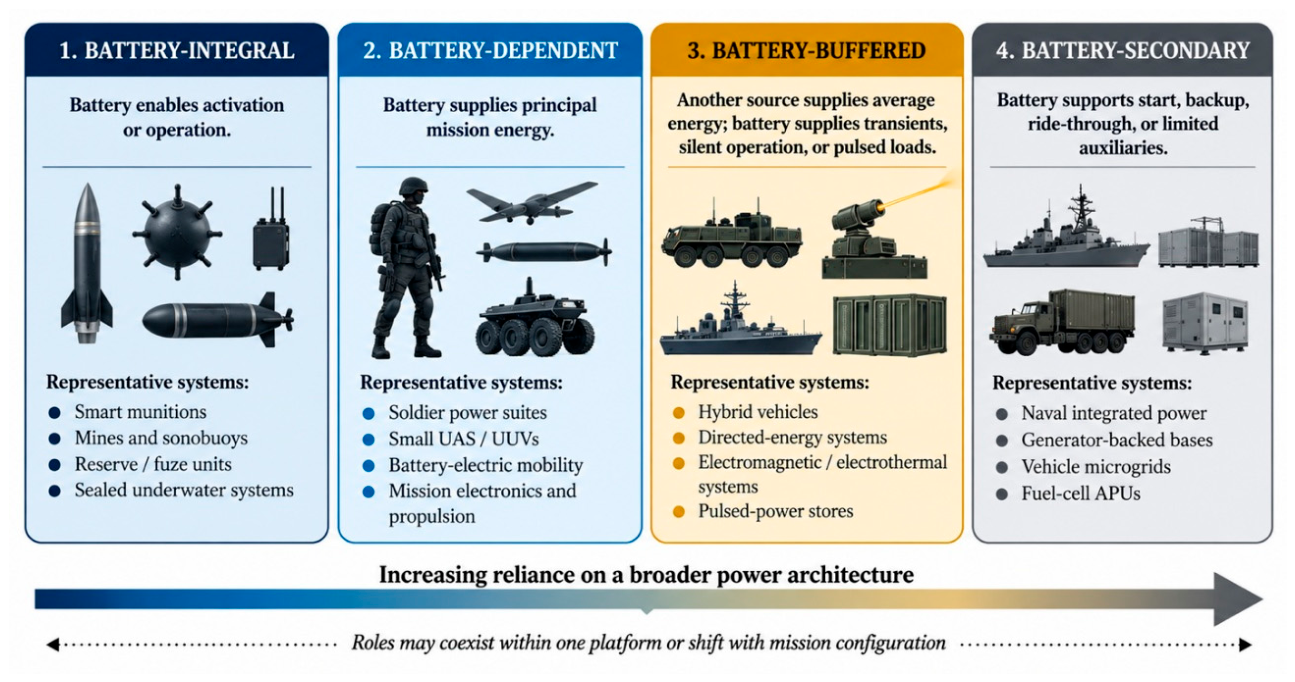
Figure 2.
Mission-Driven Translation of Electrical-Energy Technology into Military Capability. Military capability emerges through the progressive translation of cell and material properties into module- and pack-level performance, power conversion and thermal management, platform integration, and ultimately mission effect under operational and logistics constraints. The architecture emphasizes that improvements at the cell level do not translate directly into military advantage unless they survive system-level penalties associated with packaging, protection, conversion, cooling, controls, and integration. Mission duty cycle, environment, threat, and rules of engagement feedback across every stage and shape the requirements imposed on the electrical-energy architecture. The framework therefore links technology performance to mission effectiveness, sustainment, resilience, and contested-logistics considerations [3,5].
Figure 2.
Mission-Driven Translation of Electrical-Energy Technology into Military Capability. Military capability emerges through the progressive translation of cell and material properties into module- and pack-level performance, power conversion and thermal management, platform integration, and ultimately mission effect under operational and logistics constraints. The architecture emphasizes that improvements at the cell level do not translate directly into military advantage unless they survive system-level penalties associated with packaging, protection, conversion, cooling, controls, and integration. Mission duty cycle, environment, threat, and rules of engagement feedback across every stage and shape the requirements imposed on the electrical-energy architecture. The framework therefore links technology performance to mission effectiveness, sustainment, resilience, and contested-logistics considerations [3,5].
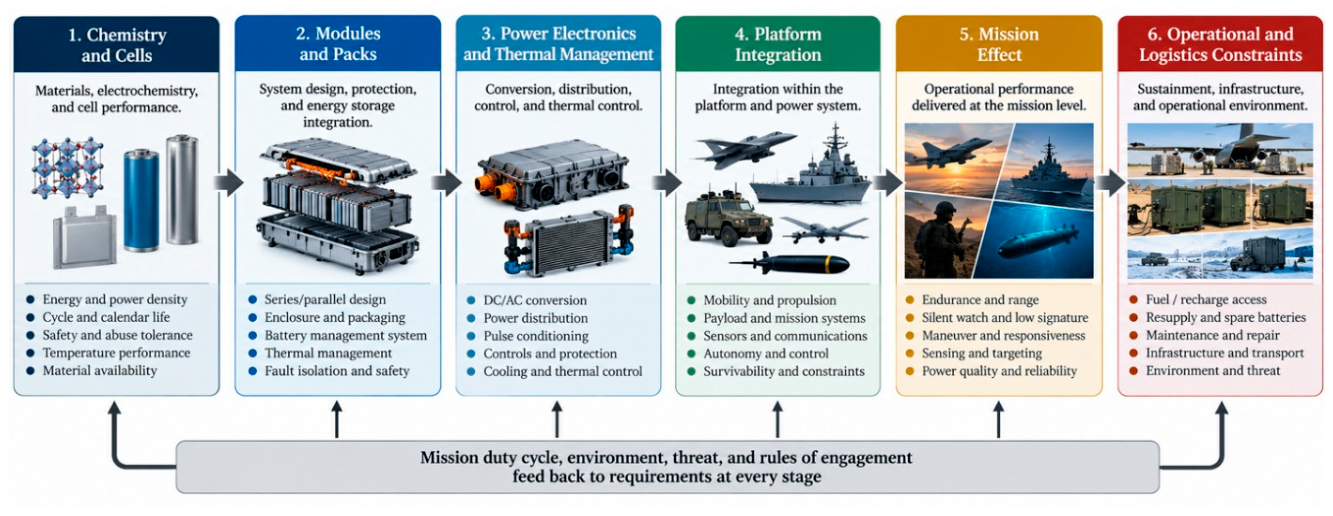
Figure 3.
Mission Requirements in Energy–Power–Time Space. Conceptual mapping of representative military mission classes in terms of usable mission energy, continuous/peak power, and characteristic event timescale, with the associated recovery requirement indicated in each callout. The plotted regions are illustrative rather than quantitative and are intended to show relative requirement patterns, not exact performance values. Soldier electronics and computing emphasize low-to-moderate energy and low continuous power over long intervals; small unmanned systems combine moderate energy with sustained propulsion power over sortie timescales; tactical-vehicle silent watch requires moderate energy and low continuous power over hours; maneuver and actuation involve short-duration, high-power transients with rapid recovery; naval sensing and service loads combine high energy with moderate sustained power over long intervals; and directed-energy or electromagnetic pulse systems emphasize very high peak power, short events, repeated engagements, and recharge/cooldown constraints. The figure highlights that military missions occupy different regions of the energy–power–time space and therefore require different storage, conversion, thermal-management, and recovery architectures [3,7,8].
Figure 3.
Mission Requirements in Energy–Power–Time Space. Conceptual mapping of representative military mission classes in terms of usable mission energy, continuous/peak power, and characteristic event timescale, with the associated recovery requirement indicated in each callout. The plotted regions are illustrative rather than quantitative and are intended to show relative requirement patterns, not exact performance values. Soldier electronics and computing emphasize low-to-moderate energy and low continuous power over long intervals; small unmanned systems combine moderate energy with sustained propulsion power over sortie timescales; tactical-vehicle silent watch requires moderate energy and low continuous power over hours; maneuver and actuation involve short-duration, high-power transients with rapid recovery; naval sensing and service loads combine high energy with moderate sustained power over long intervals; and directed-energy or electromagnetic pulse systems emphasize very high peak power, short events, repeated engagements, and recharge/cooldown constraints. The figure highlights that military missions occupy different regions of the energy–power–time space and therefore require different storage, conversion, thermal-management, and recovery architectures [3,7,8].
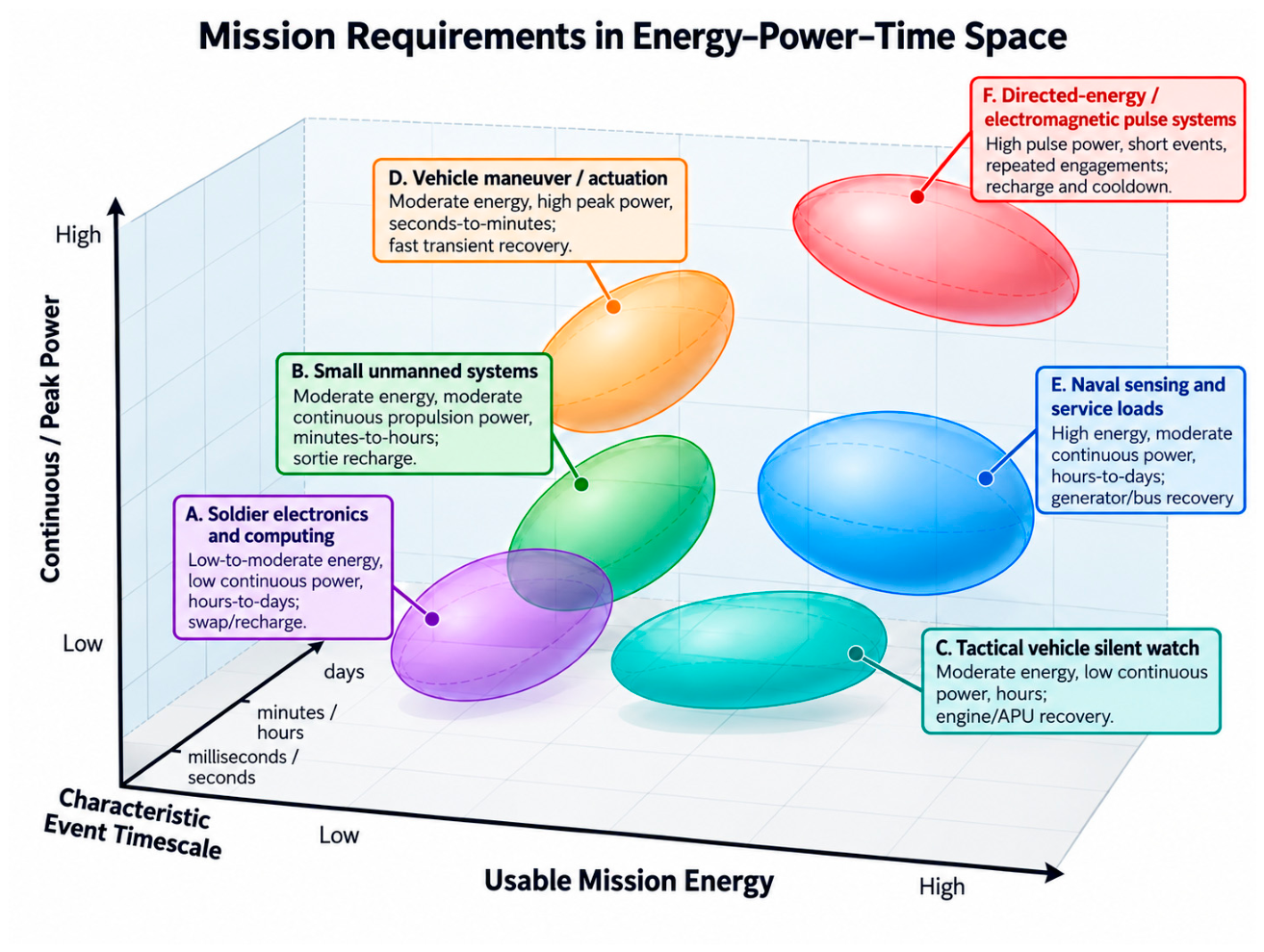
Figure 4.
Energy–Power–Maturity Landscape of Military Storage and Power Technologies. Qualitative comparison of representative military energy-storage and power technologies across specific energy capability and specific power capability, with bubble color indicating the maturity of the available evidence and annotations indicating characteristic response time. Green denotes fielded or widely qualified technologies, blue denotes demonstrated prototypes, amber denotes developmental technologies, and gray denotes exploratory or application-dependent concepts. Generators and fuel cells are shown separately as primary electrical sources or range extenders rather than electrochemical storage devices, while flow and structural batteries are identified as application-dependent technologies. The dashed region labeled “mobile military evidence strongest” highlights technologies for which the public evidence base is comparatively stronger at the pack, prototype, or platform level. Bubble positions are conceptual rather than quantitative and should not be interpreted as measured Ragone-plot coordinates. The figure emphasizes that military technology selection depends jointly on energy capability, power capability, response time, integration role, and evidence maturity rather than on a single cell-level performance metric [7,16,50,58,59].
Figure 4.
Energy–Power–Maturity Landscape of Military Storage and Power Technologies. Qualitative comparison of representative military energy-storage and power technologies across specific energy capability and specific power capability, with bubble color indicating the maturity of the available evidence and annotations indicating characteristic response time. Green denotes fielded or widely qualified technologies, blue denotes demonstrated prototypes, amber denotes developmental technologies, and gray denotes exploratory or application-dependent concepts. Generators and fuel cells are shown separately as primary electrical sources or range extenders rather than electrochemical storage devices, while flow and structural batteries are identified as application-dependent technologies. The dashed region labeled “mobile military evidence strongest” highlights technologies for which the public evidence base is comparatively stronger at the pack, prototype, or platform level. Bubble positions are conceptual rather than quantitative and should not be interpreted as measured Ragone-plot coordinates. The figure emphasizes that military technology selection depends jointly on energy capability, power capability, response time, integration role, and evidence maturity rather than on a single cell-level performance metric [7,16,50,58,59].
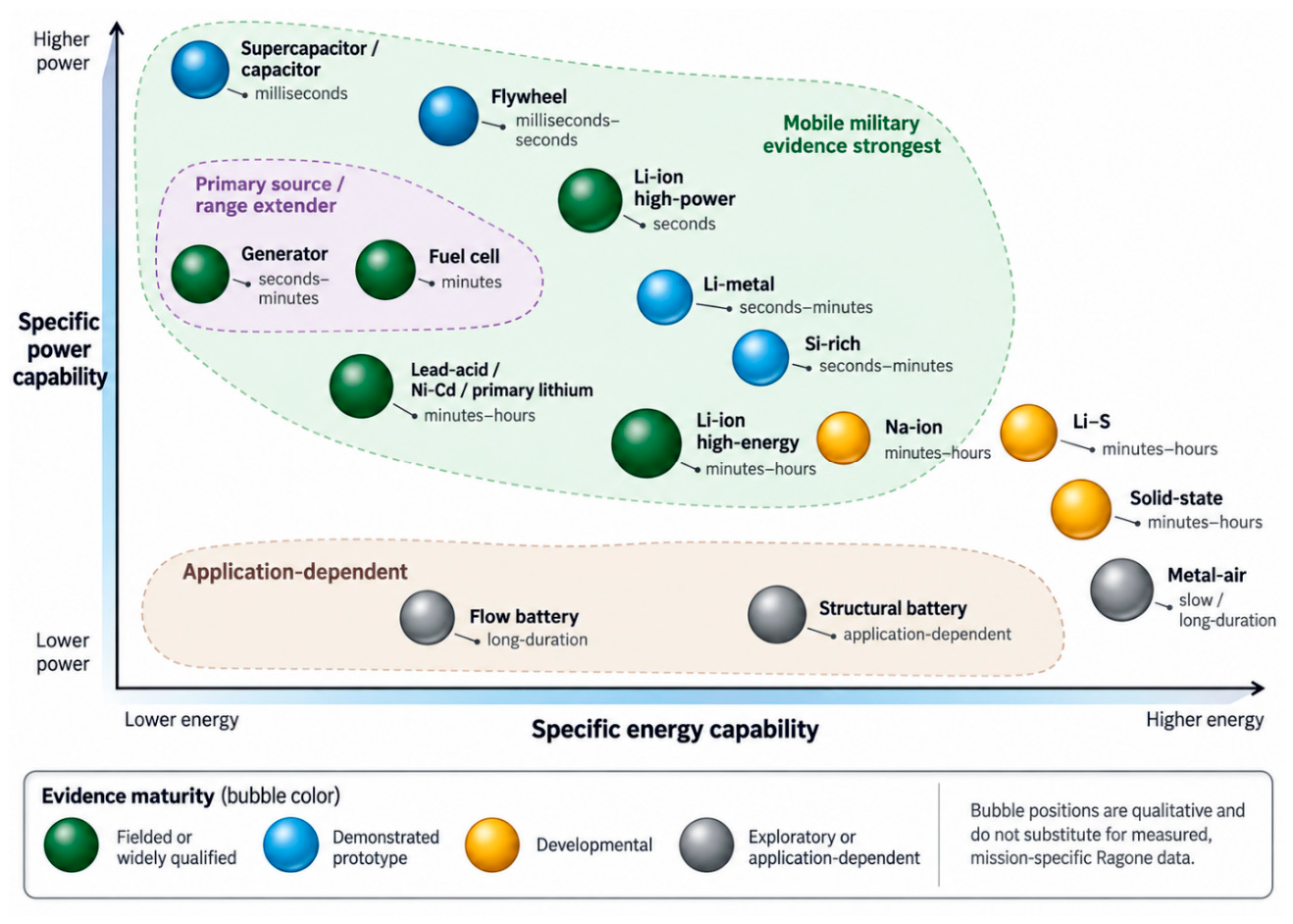
Figure 5.
Mission-to-Architecture Map for Battery-Dependent and Electrically Powered Military Systems. Qualitative mapping of representative military mission classes to their dominant battery role, characteristic energy and power profile, principal integration constraint, and recovery or logistics burden. The figure illustrates that identical storage technologies can perform different architectural functions depending on mission context: soldier systems emphasize carried endurance and interoperability; smart munitions and expendables emphasize stored readiness and activation reliability; unmanned aerial, ground, surface, and underwater systems couple propulsion, payload, endurance, signature, and recovery; tactical vehicles use batteries primarily for buffering, silent operation, transient support, and auxiliary functions; naval platforms distribute electrical energy across shared critical loads; and directed-energy, electromagnetic, and electrothermal systems rely on coordinated prime-power, pulse-storage, conditioning, and thermal-management architectures. The colored role markers correspond to the four analytical battery roles defined in Section 2, battery-integral, battery-dependent, battery-buffered, and battery-secondary. Energy and power profiles are schematic rather than quantitative and are intended to emphasize dominant timescales and load characteristics rather than measured platform capability. The figure reinforces that mission requirements, integration constraints, and recovery conditions determine the appropriate battery role and electrical-energy architecture [3,4,5,8].
Figure 5.
Mission-to-Architecture Map for Battery-Dependent and Electrically Powered Military Systems. Qualitative mapping of representative military mission classes to their dominant battery role, characteristic energy and power profile, principal integration constraint, and recovery or logistics burden. The figure illustrates that identical storage technologies can perform different architectural functions depending on mission context: soldier systems emphasize carried endurance and interoperability; smart munitions and expendables emphasize stored readiness and activation reliability; unmanned aerial, ground, surface, and underwater systems couple propulsion, payload, endurance, signature, and recovery; tactical vehicles use batteries primarily for buffering, silent operation, transient support, and auxiliary functions; naval platforms distribute electrical energy across shared critical loads; and directed-energy, electromagnetic, and electrothermal systems rely on coordinated prime-power, pulse-storage, conditioning, and thermal-management architectures. The colored role markers correspond to the four analytical battery roles defined in Section 2, battery-integral, battery-dependent, battery-buffered, and battery-secondary. Energy and power profiles are schematic rather than quantitative and are intended to emphasize dominant timescales and load characteristics rather than measured platform capability. The figure reinforces that mission requirements, integration constraints, and recovery conditions determine the appropriate battery role and electrical-energy architecture [3,4,5,8].
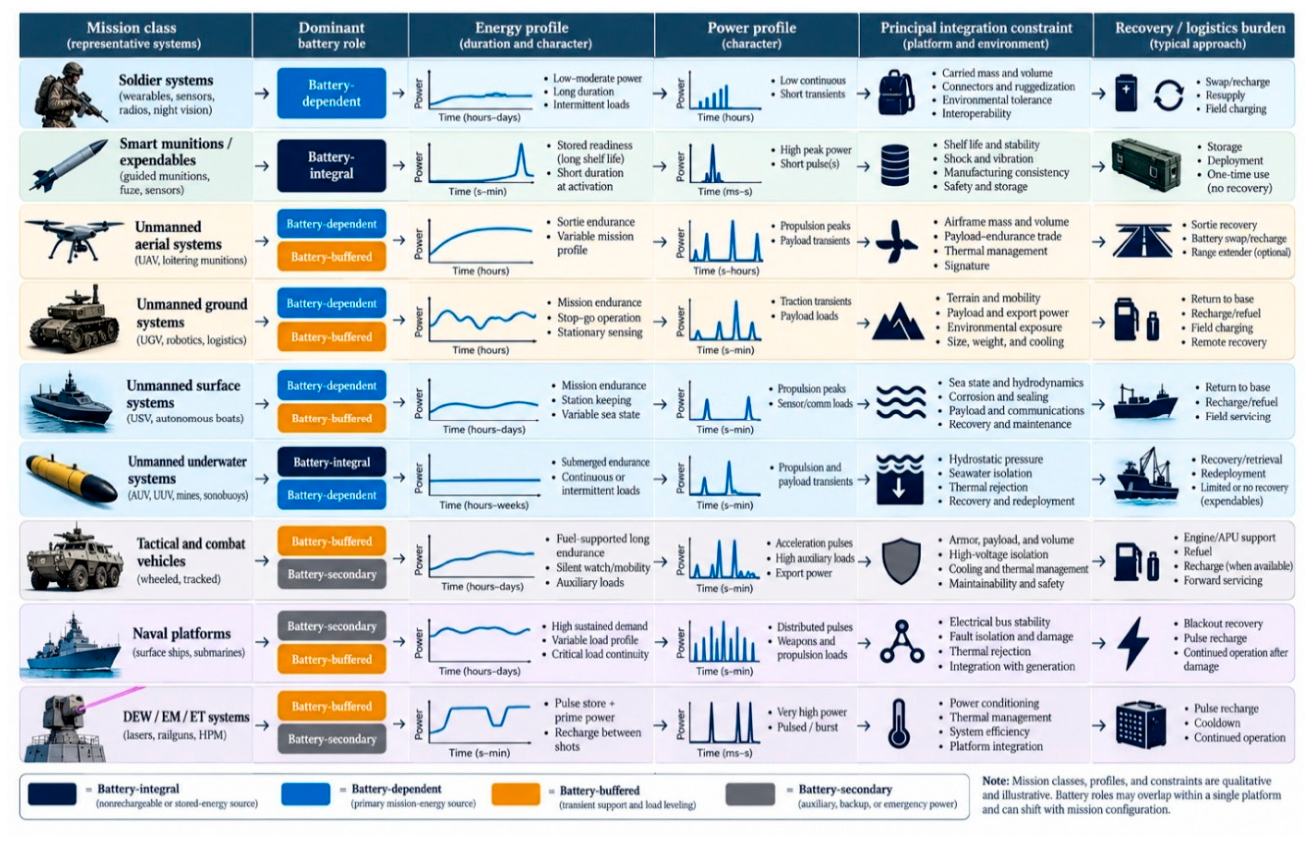
Figure 6.
Cascading Failure Pathways in Military Electrical-Energy Architectures. Systems-level representation of how initiating stressors can propagate through military electrical-energy architectures from local component response to mission consequence. Representative stressors include peak electrical loads, thermal extremes, fast charging and aging, mechanical and environmental exposure, combat damage, and control or software faults. These disturbances first alter cell and pack behavior through mechanisms such as impedance growth, imbalance, internal shorting, current redistribution, thermal propagation, BMS derating, isolation, or venting. Propagation can then proceed through interacting thermal and electrical pathways, including cooling saturation, thermal runaway, converter limitation, bus droop, fault current, and reduced pulse-recovery capability. At the platform level, these mechanisms can produce load shedding, source trips, reduced mobility or sensing, increased signature, and ultimately critical-load loss, missed engagement, recovery delay, or maintenance and disposal burden. The final branch distinguishes contained continuation, achieved through fault isolation, reserve-energy preservation, load prioritization, degraded-mode operation, and repair or recovery, from mission interruption, which may require firefighting, towing or recovery, resupply, or redesign. The pathways are coupled rather than strictly linear; thermal, electrical, control, and mechanical effects can reinforce one another across the architecture. Experimental and modeling studies support individual propagation mechanisms, while the complete mission-level outcome remains platform- and architecture-specific [34,76,80,82].
Figure 6.
Cascading Failure Pathways in Military Electrical-Energy Architectures. Systems-level representation of how initiating stressors can propagate through military electrical-energy architectures from local component response to mission consequence. Representative stressors include peak electrical loads, thermal extremes, fast charging and aging, mechanical and environmental exposure, combat damage, and control or software faults. These disturbances first alter cell and pack behavior through mechanisms such as impedance growth, imbalance, internal shorting, current redistribution, thermal propagation, BMS derating, isolation, or venting. Propagation can then proceed through interacting thermal and electrical pathways, including cooling saturation, thermal runaway, converter limitation, bus droop, fault current, and reduced pulse-recovery capability. At the platform level, these mechanisms can produce load shedding, source trips, reduced mobility or sensing, increased signature, and ultimately critical-load loss, missed engagement, recovery delay, or maintenance and disposal burden. The final branch distinguishes contained continuation, achieved through fault isolation, reserve-energy preservation, load prioritization, degraded-mode operation, and repair or recovery, from mission interruption, which may require firefighting, towing or recovery, resupply, or redesign. The pathways are coupled rather than strictly linear; thermal, electrical, control, and mechanical effects can reinforce one another across the architecture. Experimental and modeling studies support individual propagation mechanisms, while the complete mission-level outcome remains platform- and architecture-specific [34,76,80,82].
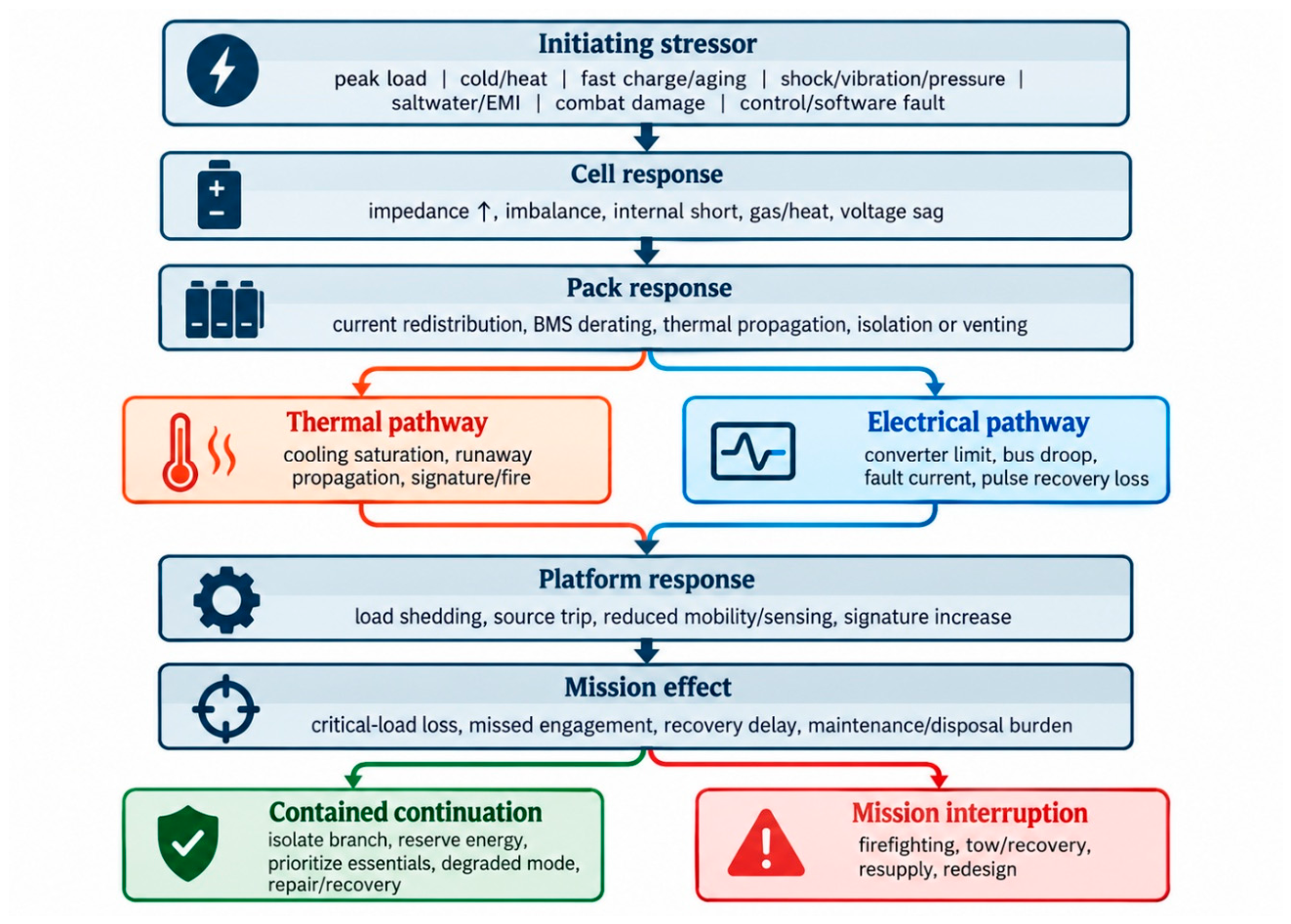
Figure 7.
Operational Energy Network Under Contested Logistics. Systems-level representation of how military mission energy moves through a network of sources, conversion and storage elements, energy nodes, platforms, and critical mission loads. Solid blue arrows indicate nominal energy flow, while dashed red pathways identify representative disruptions including convoy interdiction, generator or fuel shortage, charging-node loss, weather-dependent generation loss, damaged batteries or feeders, cyber or control faults, and delayed repair. Line thickness distinguishes concentrated, higher-capacity nodes from more distributed, lower-capacity paths. Node annotations represent three mission-relevant attributes: energy moved, time to recover, and signature or exposure. The architecture illustrates that concentrated fuel and charging nodes may improve efficiency and coordination but can create bottlenecks and high-consequence failure points, whereas distributed generation, microgrids, nanogrids, and vehicle-export links can reduce dependence on a single node while increasing coordination, protection, maintenance, and control requirements. The feedback pathway from mission availability to source scheduling, load prioritization, and energy-node management emphasizes that operational energy is a closed-loop mission-support system rather than a one-way supply chain. The network should therefore be evaluated using mission-oriented measures such as critical-load availability, replenishment and recovery time, infrastructure dependence, signature, energy moved, and resupply probability. The framework is grounded in forward-base supply-chain analysis, mobile-microgrid studies, vehicle-supported power architectures, and mission-focused resilience methods [34,35,87,88,92].
Figure 7.
Operational Energy Network Under Contested Logistics. Systems-level representation of how military mission energy moves through a network of sources, conversion and storage elements, energy nodes, platforms, and critical mission loads. Solid blue arrows indicate nominal energy flow, while dashed red pathways identify representative disruptions including convoy interdiction, generator or fuel shortage, charging-node loss, weather-dependent generation loss, damaged batteries or feeders, cyber or control faults, and delayed repair. Line thickness distinguishes concentrated, higher-capacity nodes from more distributed, lower-capacity paths. Node annotations represent three mission-relevant attributes: energy moved, time to recover, and signature or exposure. The architecture illustrates that concentrated fuel and charging nodes may improve efficiency and coordination but can create bottlenecks and high-consequence failure points, whereas distributed generation, microgrids, nanogrids, and vehicle-export links can reduce dependence on a single node while increasing coordination, protection, maintenance, and control requirements. The feedback pathway from mission availability to source scheduling, load prioritization, and energy-node management emphasizes that operational energy is a closed-loop mission-support system rather than a one-way supply chain. The network should therefore be evaluated using mission-oriented measures such as critical-load availability, replenishment and recovery time, infrastructure dependence, signature, energy moved, and resupply probability. The framework is grounded in forward-base supply-chain analysis, mobile-microgrid studies, vehicle-supported power architectures, and mission-focused resilience methods [34,35,87,88,92].
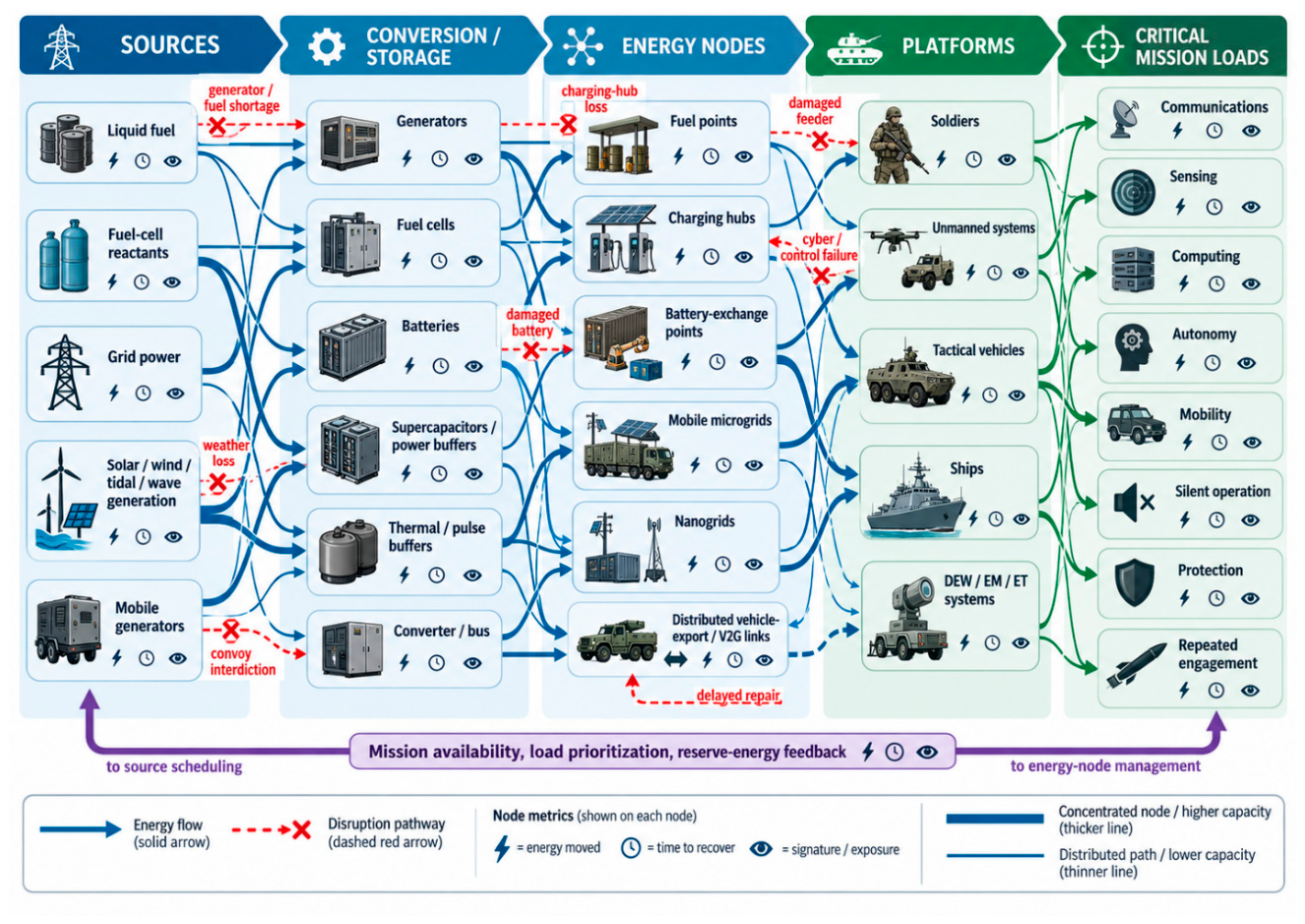
Figure 8.
Evidence Translation from Cell to Mission Capability. Gated framework for translating electrical-energy evidence from materials and chemistry → cell → relevant-environment cell → module/pack → power electronics and thermal system → platform/hardware-in-the-loop → operational evaluation → fielded evidence. Each stage identifies both what is measured and what remains unproven, while the intervening “do not skip” gates emphasize that evidence generated at one system boundary cannot by itself establish performance at the next. The maturity bar distinguishes conceptual, modeled, demonstrated, operational, and fielded evidence and highlights that modeled evidence can inform subsequent decisions but cannot substitute for operational validation. The lower quality-dimensions strip evaluates replication, traceability, uncertainty, independent validation, mission representativeness, maintainability, logistics realism, and evidence independence as dimensions separate from maturity. Feedback arrows from operational evaluation to lower-level cell, pack, control, and system requirements emphasize that evidence translation is iterative rather than strictly linear. The framework therefore requires claims to advance only when the corresponding integration, environmental, fault-response, maintainability, and mission uncertainties have been addressed at the appropriate boundary. Cell and pack safety studies, military hardware-in-the-loop development, and platform technology assessments support this staged evidence approach [80,100,103].
Figure 8.
Evidence Translation from Cell to Mission Capability. Gated framework for translating electrical-energy evidence from materials and chemistry → cell → relevant-environment cell → module/pack → power electronics and thermal system → platform/hardware-in-the-loop → operational evaluation → fielded evidence. Each stage identifies both what is measured and what remains unproven, while the intervening “do not skip” gates emphasize that evidence generated at one system boundary cannot by itself establish performance at the next. The maturity bar distinguishes conceptual, modeled, demonstrated, operational, and fielded evidence and highlights that modeled evidence can inform subsequent decisions but cannot substitute for operational validation. The lower quality-dimensions strip evaluates replication, traceability, uncertainty, independent validation, mission representativeness, maintainability, logistics realism, and evidence independence as dimensions separate from maturity. Feedback arrows from operational evaluation to lower-level cell, pack, control, and system requirements emphasize that evidence translation is iterative rather than strictly linear. The framework therefore requires claims to advance only when the corresponding integration, environmental, fault-response, maintainability, and mission uncertainties have been addressed at the appropriate boundary. Cell and pack safety studies, military hardware-in-the-loop development, and platform technology assessments support this staged evidence approach [80,100,103].
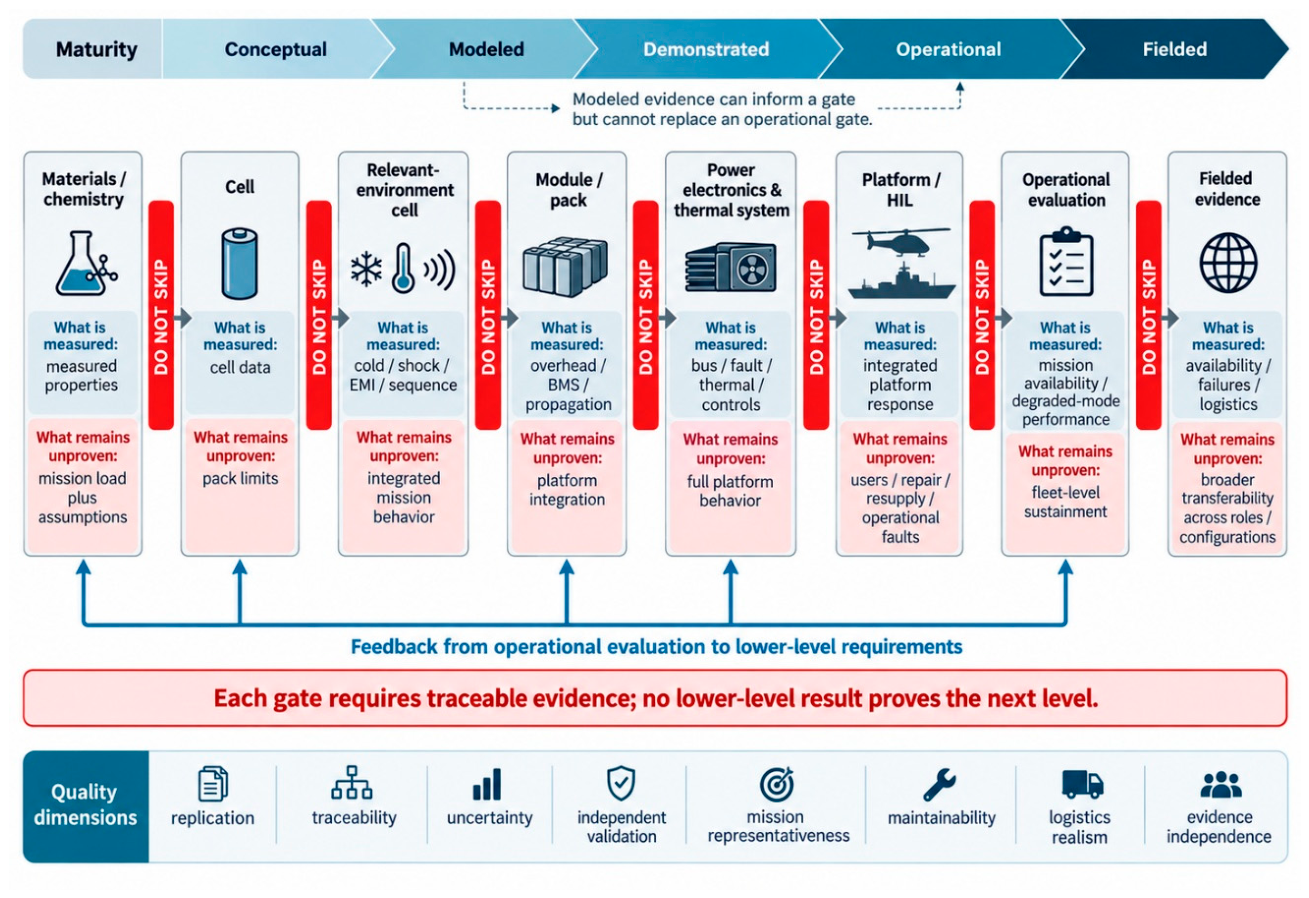
Figure 9.
Prioritized Transition Roadmap for Military Electrical-Energy Systems. Three-horizon roadmap organizing future military electrical-energy priorities by transition probability, mission relevance, and evidence maturity. The near-term horizon (0–5 years) emphasizes integration and qualification of comparatively mature technologies, including safer lithium-ion packs, propagation control, battery-management systems, modular high-voltage interfaces, fault isolation, hybrid controls, mission-load qualification, and thermal management. The mid-term horizon (5–10 years) focuses on mission-specific transition of sodium-ion, lithium-metal, lithium–sulfur, silicon-rich, solid-state, fuel-cell–battery, and structural-storage technologies, each subject to pouch-, pack-, and platform-level evidence gates. The longer-term horizon (>10 years) extends the system boundary to resilient distributed energy networks, platform–base power sharing, autonomous recharge, wireless or beamed power, multifunctional structures, metal-air systems, and co-designed high-power weapons. Progress across all horizons requires sequential evidence at the relevant-environment, module/pack, platform or hardware-in-the-loop, operational-evaluation, and fielded-evidence levels. The roadmap therefore represents transition logic rather than predicted deployment dates: near-term actions have higher transition probability because they improve existing architectures, mid-term options remain conditional on demonstrating that component advantages survive system integration, and longer-term concepts carry greater uncertainty in safety, manufacturability, infrastructure dependence, logistics, and adversary interaction. Expected benefits include improved endurance, peak-power capability, repeated engagement, survivability, availability, logistics resilience, interoperability, and industrial-base security. The sequencing is supported by evidence on military hybrid-power transition, modular high-voltage standardization, cell-to-pack safety, and integrated pulsed-power architectures [21,36,100,101].
Figure 9.
Prioritized Transition Roadmap for Military Electrical-Energy Systems. Three-horizon roadmap organizing future military electrical-energy priorities by transition probability, mission relevance, and evidence maturity. The near-term horizon (0–5 years) emphasizes integration and qualification of comparatively mature technologies, including safer lithium-ion packs, propagation control, battery-management systems, modular high-voltage interfaces, fault isolation, hybrid controls, mission-load qualification, and thermal management. The mid-term horizon (5–10 years) focuses on mission-specific transition of sodium-ion, lithium-metal, lithium–sulfur, silicon-rich, solid-state, fuel-cell–battery, and structural-storage technologies, each subject to pouch-, pack-, and platform-level evidence gates. The longer-term horizon (>10 years) extends the system boundary to resilient distributed energy networks, platform–base power sharing, autonomous recharge, wireless or beamed power, multifunctional structures, metal-air systems, and co-designed high-power weapons. Progress across all horizons requires sequential evidence at the relevant-environment, module/pack, platform or hardware-in-the-loop, operational-evaluation, and fielded-evidence levels. The roadmap therefore represents transition logic rather than predicted deployment dates: near-term actions have higher transition probability because they improve existing architectures, mid-term options remain conditional on demonstrating that component advantages survive system integration, and longer-term concepts carry greater uncertainty in safety, manufacturability, infrastructure dependence, logistics, and adversary interaction. Expected benefits include improved endurance, peak-power capability, repeated engagement, survivability, availability, logistics resilience, interoperability, and industrial-base security. The sequencing is supported by evidence on military hybrid-power transition, modular high-voltage standardization, cell-to-pack safety, and integrated pulsed-power architectures [21,36,100,101].
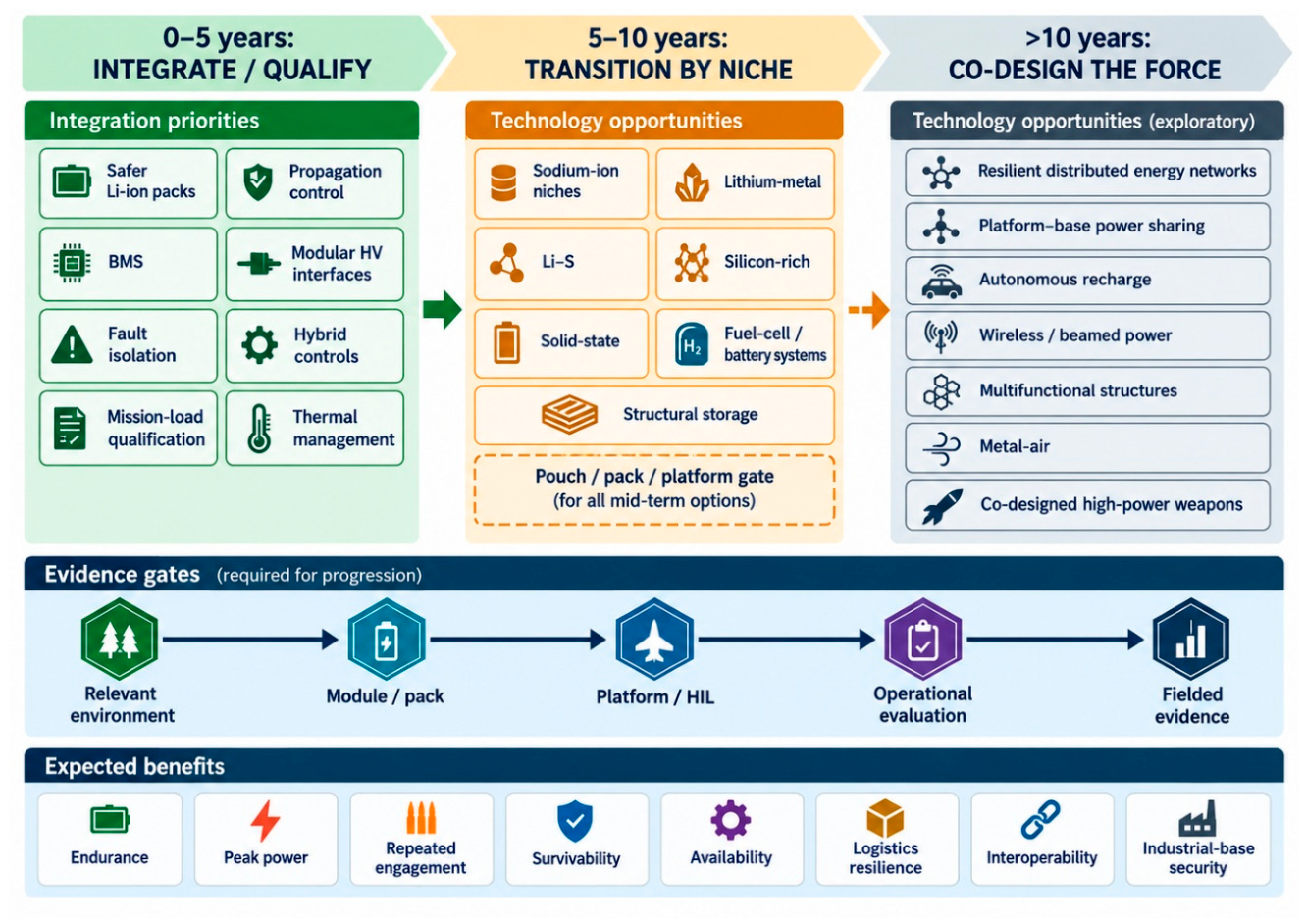
Figure 10.
Strategic Implications of Military Electrification from Technology to Force Design. Causal framework showing how military electrical-energy technologies generate force-level value only when they are successfully translated through platform architecture, operational capability, logistics resilience, and fielded sustainment. Technology choices, including electrochemical storage, hybrid sources, generators, fuel cells, pulse buffers, and distributed generation, must first survive integration with pack/BMS design, power electronics, electrical buses, thermal management, modular interfaces, and fault isolation before they can produce mission effects such as endurance, peak power, silent operation, sensor and electronic-warfare persistence, autonomy, repeated engagement, and electrical magazine depth. These capabilities remain operationally meaningful only when supported by recharge access, maintenance, spares, supply-chain security, distributed energy nodes, acceptable signature, and recoverability. The resulting force-level outcomes include mission availability, distributed persistence, survivability, operational reach, and strategic flexibility. Evidence gates at the cell, pack, platform, mission, and fielded-sustainment boundaries emphasize that performance demonstrated at one level does not establish capability at the next. The red failure pathway illustrates how thermal, bus, control, logistics, or survivability deficiencies can interrupt translation from technology to mission effect, while the feedback pathway shows how mission need, threat, logistics, and industrial-base constraints should reshape requirements and R&D. Dark blue denotes evidence-supported current capability, amber indicates transition opportunity, and gray denotes longer-term concepts with greater uncertainty. The framework is consistent with public defense analyses linking operational energy to mobility, weapons, surveillance, communications, distributed operations, and supply-chain resilience [2,5,15,86].
Figure 10.
Strategic Implications of Military Electrification from Technology to Force Design. Causal framework showing how military electrical-energy technologies generate force-level value only when they are successfully translated through platform architecture, operational capability, logistics resilience, and fielded sustainment. Technology choices, including electrochemical storage, hybrid sources, generators, fuel cells, pulse buffers, and distributed generation, must first survive integration with pack/BMS design, power electronics, electrical buses, thermal management, modular interfaces, and fault isolation before they can produce mission effects such as endurance, peak power, silent operation, sensor and electronic-warfare persistence, autonomy, repeated engagement, and electrical magazine depth. These capabilities remain operationally meaningful only when supported by recharge access, maintenance, spares, supply-chain security, distributed energy nodes, acceptable signature, and recoverability. The resulting force-level outcomes include mission availability, distributed persistence, survivability, operational reach, and strategic flexibility. Evidence gates at the cell, pack, platform, mission, and fielded-sustainment boundaries emphasize that performance demonstrated at one level does not establish capability at the next. The red failure pathway illustrates how thermal, bus, control, logistics, or survivability deficiencies can interrupt translation from technology to mission effect, while the feedback pathway shows how mission need, threat, logistics, and industrial-base constraints should reshape requirements and R&D. Dark blue denotes evidence-supported current capability, amber indicates transition opportunity, and gray denotes longer-term concepts with greater uncertainty. The framework is consistent with public defense analyses linking operational energy to mobility, weapons, surveillance, communications, distributed operations, and supply-chain resilience [2,5,15,86].
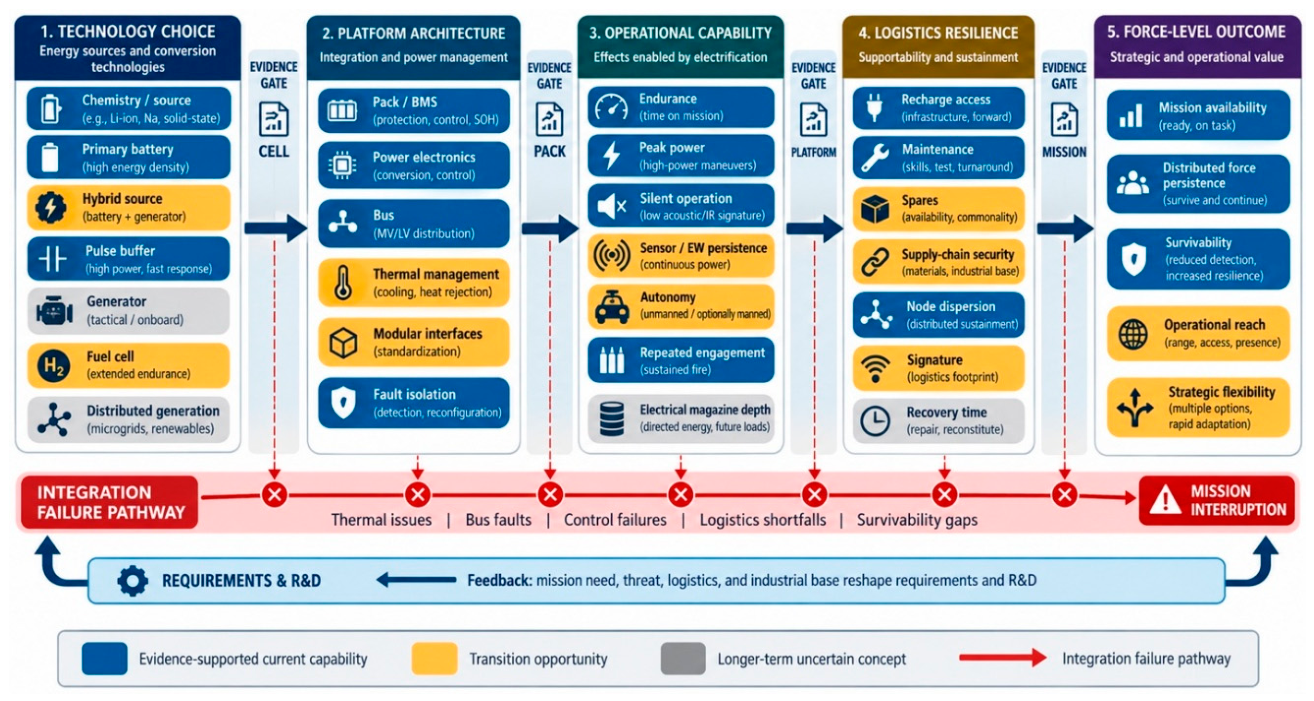

Table 1.
Mission-Relevant Electrical-Energy Performance Metrics and Evaluation Criteria.
| Metric / criterion | Definition or measurement basis | Mission significance | Consequence if omitted | Representative applications |
|
Mission load trace [3,22] |
Time-resolved sequence of mission loads, including duration, average and peak power, event repetition, load priority, and recovery opportunities under defined operating conditions | Establishes when energy and power are required and exposes interactions among propulsion, mission systems, thermal accumulation, and recovery | Static load sums can conceal transient limitations, competing loads, and mission-phase constraints | Vehicles; unmanned systems; soldier systems; naval platforms |
|
Usable mission energy [3,7,27] |
Energy available at the platform boundary, in J or Wh, over a specified temperature range, state-of-charge window, reserve requirement, age, and duty cycle | Determines endurance, sortie duration, silent-watch time, and retained recovery energy | Rated cell capacity can overstate actual mission endurance | Soldier systems; UAS/UUV; silent watch; naval service loads |
|
Average / continuous power [1,7,20] |
Sustained electrical power, in W or kW, required over the relevant mission interval | Sizes generation, conversion, cabling, cooling, and sustained propulsion or mission-system operation | Insufficient continuous capability forces derating, loss of endurance, or shutdown despite adequate stored energy | Soldier electronics; propulsion; sensing; communications; ship-service loads |
|
Peak power and pulse energy [8,9,36,37] |
Maximum instantaneous or short-duration power and associated delivered energy over the event duration | Governs acceleration, actuation, transmit bursts, pulsed sensing, and high-power weapon operation | Voltage collapse, missed engagement, impaired maneuver, or interference among competing loads | Tactical vehicles; radar; directed energy; EM/ET systems |
|
Duty cycle and recovery interval [8,9,16] |
Event duration, repetition rate, and time required for electrical recharge, thermal recovery, source restoration, or replenishment | Determines repeatable mission tempo rather than one-time demonstration capability | A system may meet a single event requirement but fail repeated mission demands | Directed energy; electromagnetic launch; hybrid propulsion; repeated high-power loads |
|
Power quality and electrical stability [5,26,38,39] |
Voltage and frequency regulation, transient response, harmonic behavior, fault response, and bus recovery | Preserves critical loads during switching, pulses, source transitions, or faults | Mission systems may fail even when sufficient total energy remains available | Naval integrated power; vehicle mission buses; microgrids; pulsed loads |
|
Delivered mission duration per carried / installed mass [14,27] |
Mission operating time achieved per unit mass of the complete energy architecture rather than active-cell mass alone | Connects endurance directly to soldier burden, payload penalty, platform mass, and mobility | Cell-specific energy can be mistaken for actual system-level endurance benefit | Soldier-carried power; UAS; tactical vehicles |
|
Mass and volume overhead [14,32] |
Non-cell mass and volume from enclosure, BMS, contactors, wiring, protection, cooling, converters, structural support, and packaging | Determines whether cell-level performance survives pack and platform integration | Cell-level specific energy or power produces misleading platform comparisons | Soldier systems; vehicles; UAS; naval storage |
|
Energy-to-effect efficiency (Framework developed in this review) |
Electrical energy consumed to produce a defined mission outcome, such as surveillance time, silent-watch duration, autonomous sortie, maneuver event, or repeated engagement | Connects electrical consumption to mission output rather than electrochemical efficiency alone | High component efficiency may be interpreted as high military utility without demonstrating useful mission output | Sensing; autonomy; silent watch; mobility; electrically enabled weapons |
|
Thermal margin [30,31] |
Difference between heat generated across the duty cycle and heat that can be absorbed, stored, transported, or rejected before derating or shutdown | Sets sustained power, repetition rate, component life, safety, and potentially platform signature | Thermal saturation causes derating, delayed recovery, damage, or mission unavailability | Directed energy; high-rate batteries; propulsion; power electronics |
|
Safety and fault containment [12,13] |
Ability to detect, isolate, and contain electrical, electrochemical, or thermal faults while limiting propagation and retaining usable capability | Prevents a local failure from becoming platform-level mission loss | Nominal stored energy may become unusable or hazardous after a fault | Battery packs; confined platforms; aircraft; naval systems; high-energy storage |
|
Interoperability and energy sharing [32,33] |
Compatibility of electrical interfaces, buses, chargers, converters, and storage elements across devices or platforms | Enables energy sharing, reduces redundant batteries and support equipment, and increases flexibility during sustainment | Incompatible packs and dedicated chargers increase carried burden and restrict recovery options | Soldier systems; modular packs; vehicle microgrids; expeditionary power |
|
Reserve margin and graceful degradation [34,35] |
Energy and power retained after aging, fault isolation, battle damage, source loss, or load prioritization | Preserves critical functions and supports reduced mission capability after disruption | A single fault can escalate directly into mission loss | Vehicles; microgrids; distributed platforms; integrated power systems |
|
Mission availability and maintainability [32,33] |
Probability that the system is electrically, thermally, and mechanically ready when required, together with the time, tools, interfaces, spares, and training needed to restore service | Determines sortie generation, readiness, operational tempo, and force-level sustainment | High nominal performance can coexist with poor operational availability | Soldier equipment; modular packs; hybrid vehicles; deployed systems |
|
Net logistics burden [14,15,40] |
Fuel, charging, spare batteries, transport, maintenance, infrastructure, cooling support, replacement demand, signature, and exposure required per mission effect | Determines whether electrification actually reduces, redistributes, or increases sustainment risk | Local efficiency gains can be mistaken for lower contested-logistics burden | Expeditionary bases; vehicles; mobile microgrids; distributed operations |
Note: The metrics are intentionally evaluated at different levels of the cell–pack–platform–mission hierarchy. They should not be interpreted independently: for example, higher usable energy may increase endurance while simultaneously increasing mass, cooling demand, recharge time, or logistics burden. The appropriate metric set therefore depends on the mission duty cycle and the analytical battery role defined in Section 2.
Table 2.
Storage, Source, and Hybrid Power Architectures in Mission Context.
| Technology / architecture | Principal architectural role | Mission-relevant advantages | Dominant limitations | Evidence maturity | Representative mission contexts |
|
Primary lithium / reserve batteries [19,45,46] |
Battery-integral or principal stored-energy source for nonrechargeable and activation-critical systems | High specific energy; low self-discharge; long shelf life; immediate readiness; reliable activation after extended storage | Safety and handling requirements; transport and disposal constraints; generally nonrechargeable | Fielded and qualified in multiple military applications | Smart munitions; fuzes; mines; sonobuoys; unattended sensors; sealed or dormant systems |
|
Lithium-ion, high-energy [12,41,44,47] |
Rechargeable principal mission-energy source | Relatively high specific energy; mature manufacturing; established cycling behavior; broad integration experience | Thermal-runaway risk; cold-temperature and charging limitations; pack protection and thermal-management overhead; cell-to-pack performance loss | Current practical reference for rechargeable mobile systems; qualification varies by format and application | Soldier systems; UAS/UUV; tactical vehicles; aircraft; auxiliary and reserve power |
|
Lithium-ion, high-power [41,43] |
Rechargeable source and/or transient-power element | High-rate discharge; rapid transient response; load leveling; starting; switching; regenerative-energy capture | Lower specific energy than high-energy variants; thermal burden; temperature and storage trade-offs | Mature or demonstrated in selected formats and applications | Hybrid vehicles; aircraft starting; actuation; silent watch; high-dynamic-load systems |
|
Lead-acid / Ni-Cd / NiMH [47] |
Starting, auxiliary, reserve, or lower-specific-energy rechargeable source | High starting current; established qualification history; predictable behavior; robustness in selected environments | Low specific energy relative to lithium-ion; mass and volume penalties; chemistry-specific maintenance or environmental constraints | Mature and fielded; mission relevance remains application-specific | Vehicle starting; auxiliary systems; legacy aircraft or ground platforms; low-risk integration |
|
Sodium-ion [11,48,49,60] |
Rechargeable principal or auxiliary source where maximum specific energy is not dominant | Potential advantages in material availability, selected cold-temperature conditions, power capability, and thermal behavior | Lower or variable specific energy; design-dependent temperature response; limited military pack/platform qualification | Emerging commercial and prototype evidence; military qualification incomplete | Cold-region systems; stationary or semi-mobile storage; selected mobile platforms where mass is less restrictive |
|
Lithium-metal / lithium–sulfur [50,51,61] |
Developmental high-specific-energy source | Potential for substantially increased specific energy and reduced inactive mass | Lithium morphology and dendrite behavior; polysulfide transport; electrolyte demand; realistic-loading constraints; interface stability | Developmental; strong material/cell and selected pouch/full-cell evidence, limited qualified pack evidence | Future mass-constrained UAS; long-endurance mobile systems; weight-sensitive platforms if pack-qualified |
|
Silicon-rich / silicon–sulfur [52] |
Developmental high-energy source | Reduced dependence on excess metallic lithium; potential high energy with demonstrated cycling in selected cell configurations | Silicon volume change; interface degradation; manufacturing complexity; pack-level validation | Developmental cell and full-cell demonstrations | Future UAS and other mass-sensitive mobile platforms |
|
Solid-state batteries [53,54] |
Developmental energy and safety pathway | Potential increases in specific energy and electrolyte stability; possible reduction of selected liquid-electrolyte hazards | Ionic transport; solid–solid interfaces; cycling stability; manufacturability; scale-up; unresolved system-level safety questions | Developmental; evidence concentrated at material, cell, and review level | Future mobile or protected platforms where integration advantages can be demonstrated |
|
Metal-air [62] |
Application-dependent high-theoretical-energy storage | Very high theoretical specific energy | Reactant and air management; contamination sensitivity; limited power capability; recharge complexity; environmental exposure | Exploratory to developmental | Specialized long-endurance applications where environmental and reactant constraints can be controlled |
|
Redox-flow / liquid-metal batteries [55] |
Long-duration stationary or semi-mobile energy storage | Scalability; long-duration storage; potentially long operating life and deep cycling | Low specific power and system-level mass/volume relative to mobile packs; pumps, tanks, containment, or high-temperature requirements depending on chemistry | Application-dependent; stronger stationary than mobile evidence | Bases; microgrids; stationary or semi-mobile long-duration energy storage |
|
Structural batteries [63] |
Integrated load-bearing energy-storage concept | Potential reduction of separate structural and battery mass through multifunctional design | Mechanical–electrochemical trade-offs; damage tolerance; manufacturability; inspection and repair; limited military-system validation | Exploratory / architecture-dependent | Future weight- and volume-constrained platforms where structural integration can be validated |
|
Supercapacitor / capacitor [16,56] |
High-power buffer, transient store, or pulse-forming element | Millisecond-scale response; very high specific power; high cycle tolerance; repeated transient support; bus stabilization | Low stored energy; voltage variation during discharge; required conversion and control | Mature component technology; mission integration is architecture-specific | Pulsed loads; acceleration; regenerative capture; actuation; bus stabilization; power-quality support |
|
Flywheel [16] |
High-power buffer and repeated-cycle storage | Rapid charge/discharge; high cycle tolerance; separation of transient power from primary source | Rotating machinery; containment; bearings or magnetic suspension; vibration; control complexity; mechanical fault modes | Demonstrated and modeled; qualification is platform-specific | Naval pulsed loads; hybrid systems; repeated high-power events |
|
Engine-driven generator [5,15] |
Primary electrical-energy source and battery-recharge source | Sustained electrical energy from high-energy-density liquid fuel; mature technology; supports long-duration loads | Fuel logistics; acoustic and thermal signature; mechanical maintenance; startup and transient-response limits | Mature and widely fielded; integration varies by platform | Tactical power; vehicles; bases; naval systems; battery charging; expeditionary systems |
|
Fuel cell [57] |
Primary or auxiliary electrical-energy source / range extender | Quiet operation; sustained energy; potential reduction in engine-on time; potentially high efficiency under suitable duty cycles | Reactant storage; reforming where applicable; water and thermal management; start-up behavior; balance-of-plant mass and complexity | Prototype to demonstrated depending on chemistry and platform | Silent watch; auxiliary power; selected range-extension and low-signature applications |
|
Generator–battery hybrid [4,21] |
Sustained primary source plus rechargeable energy and power buffer | Generator can supply average energy while battery supports silent watch, acceleration, regenerative capture, load leveling, rapid transients, and export power | Added battery mass; control complexity; thermal coupling; battery aging; multiple failure modes | Demonstrated at vehicle and system level; maturity is application-specific | Tactical and combat vehicles; mobile microgrids; onboard power systems |
|
Fuel-cell–battery hybrid [57] |
Quiet sustained source plus rechargeable buffer | Extends low-signature operation while battery handles transients and peak loads; can reduce engine operation | Reactant logistics; start-up and thermal constraints; balance-of-plant and control burden | Prototype/modeling evidence; platform maturity remains application-specific | Silent watch; auxiliary power; low-signature operation; selected range-extension missions |
|
Battery–supercapacitor hybrid [7,16] |
Energy-oriented battery plus high-power transient buffer | Reduces high-frequency current stress on the battery; improves transient response; can improve bus stability and potentially extend battery life | Additional converter, controls, mass, volume, and state-coordination requirements | Demonstrated broadly at component/system level; military evidence is application-dependent | Vehicles; actuation; regenerative braking; pulsed mission loads; power-quality support |
|
Battery–flywheel hybrid [16] |
Stored mission energy plus repeated high-power buffer | Separates endurance from repeated transient power; supports rapid cycling without imposing full pulse demand on battery | Mechanical containment, vibration, conversion, control, safety, and integration complexity | Demonstrated/modelled; platform-specific | Naval pulsed-power systems; repeated high-power loads; selected hybrid platforms |
|
Shore power / microgrid-supported architecture [5,15,21] |
External or distributed primary electrical source with local storage and load management | Reduces need to carry all mission energy onboard; supports distributed generation, storage, recharge, and prioritized loads | Infrastructure dependence; distribution vulnerability; interoperability; connection and protection requirements | Mature at system level, with mission-specific architectures varying widely | Bases; ports; expeditionary microgrids; vehicle-to-grid systems; distributed operations |
Note: The entries should not be interpreted as a technology ranking. Technologies occupy different architectural roles and should be compared only when they satisfy equivalent mission functions, operate under comparable duty cycles and environmental conditions, and are evaluated at the same cell, pack, platform, or system boundary. Evidence maturity is also independent of theoretical performance: a technology with attractive cell-level characteristics may remain less mission-ready than a lower-performing technology whose pack integration, qualification, durability, and failure behavior are better established.
Table 3.
Battery Roles and Dominant Metrics Across Military Applications.
| Application | Battery role | Mission-energy profile | Dominant performance metrics | Primary integration / logistics constraints | Evidence maturity |
|
Dismounted soldier systems [3,33,65,73] |
Battery-dependent | Low-to-moderate continuous demand over hours to days; carried energy directly contributes to soldier burden | Mission duration per carried mass; usable energy; interoperability; state-of-charge visibility; power quality; signature | Multiple packs and chargers; connector reliability; cable management; human carriage; battery swaps; recharge and resupply exposure | Systems models, controlled mission tests, and operational-benefit analyses; no single universal architecture |
|
Smart munitions and expendable sensors [19,46,66] |
Battery-integral | Long dormant or shelf interval followed by short-duration activation and pulse delivery | Shelf life; activation reliability; stored-energy retention; pulse voltage and energy; shock, vibration, and environmental tolerance | Packaging; storage; inspection; transport; safety; manufacturing consistency; disposal; no-recharge logistics | Strong component and application-requirement evidence; detailed system-specific reliability data are often not publicly available |
|
Unmanned aerial systems and loitering munitions [20,67,68] |
Battery-dependent or battery-buffered | Sortie endurance coupled to propulsion and payload demand; recovery or battery exchange determines repeatability | Usable energy per mass; propulsion power; payload fraction; thermal behavior; signature; recharge or swap time | Airframe mass; payload trade; launch and recovery; charging; weather; range-extender complexity | Review, modeling, and systems-analysis evidence; platform maturity remains mission- and configuration-specific |
|
Unmanned ground and surface systems [1,4] |
Battery-dependent or battery-buffered | Mission endurance combined with traction, station keeping, sensing, communications, and export power | Peak traction or propulsion power; endurance; silent movement; payload power; export power; recovery rate | Terrain or sea state; corrosion; low-signature operation; remote recovery; recharge or refuel access | Architecture studies and demonstrator evidence; cross-domain operational comparisons remain limited |
|
Unmanned underwater systems [19] |
Battery-integral or battery-dependent | Submerged endurance with sealed or pressure-tolerant electrical-energy storage and constrained recovery | Usable energy; pressure-tolerant packaging; propulsion and payload power; acoustic and thermal signature; safety; recovery probability | Hydrostatic pressure; seawater isolation; enclosure mass; thermal rejection; retrieval and redeployment | Requirement and battery-development evidence is established; public vehicle-level demonstration evidence is comparatively limited |
|
Tactical and combat vehicles [4,14,69,71] |
Battery-buffered or battery-secondary; occasionally battery-dependent | Fuel-supported endurance with silent watch, silent mobility, acceleration support, mission loads, and export power | Silent-watch duration; silent-mobility duration; peak traction reserve; export-power availability; range; thermal margin; recharge or refuel time; fuel per mission effect | Competition with armor, fuel, ammunition, and payload; high-voltage isolation; cooling; safety; maintenance; contested recharge or refueling | Demonstrators, simulations, and vehicle-specific testing; evidence should not be generalized directly across vehicle classes |
|
Naval integrated-power platforms [5,39] |
Battery-secondary or battery-buffered | High sustained prime-power demand with distributed propulsion, service, sensing, and weapon loads | Bus stability; power quality; fault-isolation time; blackout recovery; critical-load survival; cooling margin; repeated pulse availability | Battle damage; feeder isolation; thermal rejection; generator and storage integration; signature; distribution resilience | Strong architecture and systems-study evidence; integration maturity remains platform-specific |
|
Directed-energy, electromagnetic, and electrothermal systems [9,16,31,72] |
Battery-buffered or battery-secondary | Prime power combined with stored pulse energy; short high-power events separated by recharge and cooldown | Pulse energy; peak power; waveform control; repetition rate; conditioning efficiency; thermal closure; recovery time | Prime-power extraction; pulse-forming network; bus disturbance; switching; thermal management; battle damage; cooldown and recharge | Predominantly modeling, integration studies, and system-specific demonstrations; claims remain architecture- and mission-specific |
Note: Battery role is determined by the function performed within the mission architecture rather than by chemistry or platform label. A single platform can contain multiple battery roles simultaneously, and the dominant role can change with mission configuration. Comparisons should therefore be made at equivalent system boundaries and under comparable duty cycles, environmental conditions, and recovery assumptions.
Table 4.
Integration Failure Pathways and Mission-Focused Mitigations.
| Initiating stressor | Failure mechanism | Observable precursor | Platform-level consequence | Mission effect | Mitigation / containment strategy | Evidence maturity |
|
Peak load or repeated pulse [38,39] |
Impedance-driven voltage sag; converter current or thermal limit; bus instability | Voltage deviation; current limiting; frequency or power-quality alarm; converter derating | Load shedding; source trip; propulsion–weapon interference; degraded bus performance | Missed engagement; reduced mobility; loss of sensing or communications function | Separate energy and power stores; buffer sizing; priority logic; transient validation; bus segmentation | Modeled and platform-integration evidence; mission response remains architecture-specific |
|
High-rate cycling, fast charging, or aging [42,77] |
Impedance growth; capacity loss; cell imbalance; increased heat generation | Resistance rise; unequal cell voltage or temperature; reduced charge acceptance; declining usable energy | Pack derating; reduced available power; premature replacement; reduced reserve | Reduced range, pulse margin, endurance, or sortie generation | Health-aware dispatch; balancing; charge limits; reserve margin; replaceable modules; state-of-health monitoring | Experimental cell and pack evidence plus degradation modeling |
|
Overcharge, internal short, penetration, or crush [80,82,85] |
Local exothermic reaction; internal shorting; thermal runaway; cell-to-cell propagation | Rapid temperature rise; voltage collapse; gas or pressure increase; venting | Fire; toxic or flammable venting; module or pack propagation; loss of electrical isolation | Mission loss; firefighting requirement; damaged-battery handling; potential platform abandonment | Cell spacing and barriers; thermal capacity; isolation; venting; multi-parameter detection; response procedures | Strong experimental and validated modeling evidence at cell and pack levels; platform consequences remain configuration-specific |
|
Cooling loss or thermal saturation [30,31] |
Heat generation exceeds storage, transport, or rejection capability | Temperature rise; coolant-flow or pressure change; thermal alarm; reduced thermal margin | Power derating; component trip; increased thermal signature; restricted duty cycle | Weapon cooldown; reduced endurance; loss or delay of high-power mission function | Thermal storage; redundant cooling; duty-cycle limits; heat-path isolation; thermal-margin monitoring | Modeled and experimental thermal-management evidence |
|
Shock, vibration, pressure, saltwater exposure, or sequential environmental stress [24,25,75,76] |
Connector, busbar, enclosure, insulation, seal, or structural degradation; accumulated cross-domain damage | Intermittent voltage; insulation decrease; leakage; abnormal vibration or pressure; connector or seal degradation | Hidden fault; short circuit; converter trip; seawater ingress; degraded sensing or propulsion | Recovery failure; unreliable mission-system operation; increased maintenance burden | Environmental-sequence testing; sealing; isolation; inspection; structural qualification; modular replacement | Platform-specific qualification required; public evidence is heterogeneous |
|
Combat damage or feeder fault [34,39,75,76] |
Cable or feeder open/short; coolant loss; fault current; structural or electrical branch damage | Arc, insulation, or current alarm; branch-voltage loss; coolant loss; protection trip | Bus segmentation; source trip; loss of branch power; cascading redistribution | Critical-load loss; increased signature; degraded mobility or sensing; recovery requirement | Fast isolation; segmented bus; redundant paths; reserve allocation; manual fallback; local safe states | Naval and microgrid modeling plus component-level damage studies; combat validation remains limited |
|
EMI, sensor, software, communications, or control fault [78,79] |
Incorrect BMS state estimate or power-management command; corrupted or stale data; control instability | Sensor disagreement; stale data; unexpected shedding; implausible state of charge or health | Energy misallocation; unnecessary derating; loss of coordination; potentially unsafe operating state | Hidden reserve depletion; avoidable mission interruption; loss of critical loads despite physically intact hardware | Independent plausibility checks; bounded local control; safe states; offline fallback; authenticated updates; redundant sensing where justified | Control-system studies support the mechanisms; public military cyber-physical evidence remains limited |
|
Residual thermal event after mission or damage [12,85] |
Re-ignition; residual heat; continued gas generation; unsafe damaged-module state | Persistent temperature, gas, pressure, voltage, or damaged-module indicators | Delayed firefighting, transport, repair, or disposal; restricted access to platform | Prolonged platform unavailability; logistics exposure; hazardous recovery | Quarantine; continued cooling and monitoring; damaged-battery handling procedures; repair doctrine; transparent status indication | Pack experiments and battery-safety engineering are established; field doctrine and platform implementation vary |
Note: The pathways should not be interpreted as independent or mutually exclusive. A single initiating stressor can activate multiple electrical, thermal, mechanical, and control mechanisms, and one pathway can alter the susceptibility of another. Evidence maturity also varies by level: experimentally established cell- or pack-level mechanisms do not automatically establish platform-level or mission-level outcomes.
Table 5.
Operational-Energy Interventions Under Contested Logistics.
| Intervention | Logistics mechanism | Mission benefit | New dependency or vulnerability | Relevant mission-oriented metric | Evidence maturity |
|
Liquid-fuel delivery and generator power [87,93] |
Transports high-energy-density fuel to generators and platforms through established storage and handling infrastructure | Rapid replenishment; sustained average power; mature support architecture where fuel access remains available | Convoy exposure; storage and protection burden; generator maintenance; fuel signature; dependence on protected delivery routes | Fuel moved per mission effect; generator run-hours; resupply probability; critical-load hours | Operationally established; total supply-chain cost and vulnerability remain strongly scenario-dependent |
|
Electrical charging hubs [88,89] |
Concentrates generation, conversion, and charging capacity to replenish platform batteries | Coordinated charging; reduced platform engine-on time; potential support for multiple electrically powered platforms | Fixed-node signature; feeder or generator failure; queueing and capacity bottlenecks; platform dwell time; targetability | Charge time; vehicles charged per node-hour; critical-load hours supported; node availability; recovery time after node loss | Primarily modeled and architectural evidence; contested field performance not established |
|
Battery exchange [32,33] |
Replaces depleted batteries or modules rather than waiting for onboard recharge | Shorter platform dwell; potentially higher sortie or mission-generation rate | Spare-pack mass and inventory; commonality requirements; state-of-health tracking; storage; transport; damaged-pack handling | Swap time; packs transported; replacement frequency; sortie or mission rate; pack availability | Supported by modular and soldier-system architecture evidence; effectiveness remains platform- and interface-specific |
|
Fuel-cell source with battery buffer [57] |
Supplies average electrical energy through stored reactants while the battery supports transient power | Quiet auxiliary operation; extended silent-watch or persistence potential in selected architectures | Reactant and water logistics; start-up time; balance-of-plant complexity; thermal management; specialized maintenance | Silent-watch hours; reactant mass; start time; maintenance hours; mission energy delivered per reactant mass | Modeled and prototype vehicle evidence; no basis for universal field-performance claims |
|
Mobile hybrid microgrid [88] |
Combines generator, photovoltaic source, batteries, and conversion hardware in a transportable energy node | Supports prioritized loads; source diversification; potential reduction in generator use under fuel constraints | Container mass; setup and recovery time; weather dependence; fuel requirement; converter failure; node signature | Critical-load hours; fuel consumed; setup/recovery time; node availability; fraction of load served | Demonstrated primarily through simulation under defined TriCon, load, irradiance, and fuel assumptions |
|
Vehicle export power / V2G [89,92] |
Uses tactical vehicles as distributed electrical sources within an outpost or microgrid architecture | Distributed generation; improved local load support; potentially more efficient generator dispatch | Reduced mobility reserve; additional battery cycling and aging; disconnection risk; control coordination; platform unavailability while exporting | Exported energy; mobility reserve; outpost fuel/run-hours; source-platform availability; critical-load hours | Simulation and selected system-level studies; operational generalization remains limited |
|
Demand reduction and efficient structures [40,90,94] |
Reduces load before source substitution through efficiency, scheduling, insulation, and lower-demand equipment | Lower generation, fuel, storage, and cooling requirements; more critical-load hours from existing sources | Up-front retrofit or construction burden; possible mission tradeoffs if reduction depends on discretionary load shedding | Demand energy; generator run-hours; fuel consumed; required source capacity; critical-load availability | Supported by modeled base and camp studies; mission outcomes depend on demand profile and operating assumptions |
|
Local renewable generation [87,91] |
Produces energy near the load using solar, wind, tidal, wave, or related resources | Reduced fuel transport; persistence at remote nodes; diversification of primary energy sources | Weather and resource variability; land or shore access; storage dependence; maintenance; signature; environmental exposure | Renewable critical-load hours; fuel displaced; storage reserve; source availability; recovery time | Predominantly modeled and analytical evidence in the cited literature; limited operational demonstration |
|
Distributed microgrid / nanogrid [34,35] |
Coordinates multiple sources, storage devices, and prioritized loads with islanding and fault management | Mission continuity after loss of grid, source, or distribution elements; improved fault containment | Increased control, protection, interoperability, communications, and maintenance complexity | Mission-continuity score; island duration; fault-recovery time; load-shed fraction; critical-load survival | Strong resilience-method and simulation evidence; combat validation remains limited |
Note: The interventions are not mutually exclusive and should not be interpreted as a ranking. A resilient architecture may combine demand reduction, liquid-fuel generation, storage, renewables, microgrids, charging, battery exchange, and vehicle export. Comparison should be made at the complete mission-logistics boundary and should include replenishment time, infrastructure dependence, signature, maintenance burden, reserve requirements, node-loss consequences, and evidence maturity.
Table 6.
Minimum Evidence Requirements for Mission-Relevant Claims.
| Evidence level | Minimum required reporting | Principal unresolved uncertainty | What the evidence can support | What it does not establish |
|
Conceptual evidence [104] |
Architecture boundary; assumed energy-storage or source role; mission hypothesis; governing constraints; expected duty cycle; assumed environment; key dependencies | No demonstrated physical behavior; assumptions dominate outcome | Requirement definition; architecture framing; identification of candidate technologies and trade spaces | Readiness, integration feasibility, safety, platform performance, or operational effectiveness |
|
Modeled evidence [22,100] |
Governing equations or optimization formulation; input data; assumptions; mission load trace; parameter ranges; validation cases; sensitivity analysis; uncertainty treatment | Model-form error; incomplete physics; uncertain inputs; omitted degradation, faults, maintenance, users, or logistics | Sizing; architecture comparison; sensitivity analysis; trade-space screening; hypothesis generation | Demonstrated hardware performance, qualification, platform capability, or field effectiveness |
|
Laboratory material / cell evidence [11,42] |
Chemistry; electrode design where relevant; cell format; manufacturer/provenance; temperature; C-rate; SOC window; depth of discharge; charge protocol; replicate count; age/cycle history; failure criterion; uncertainty | Scaling to modules and packs; representative duty cycle; system overhead; environmental interaction; integrated safety | Intrinsic material or cell behavior; electrochemical mechanisms; cell-level energy, power, degradation, or safety behavior under stated conditions | Pack-level specific energy or power, platform endurance, mission suitability, or system survivability |
|
Relevant-environment cell / subsystem evidence [98,101] |
All laboratory fields plus representative temperature sequence, shock, vibration, pressure, saltwater or humidity exposure, EMI where relevant, abuse-initiation method, instrumentation, stress sequence, and acceptance criteria | Combined and sequential stress interactions; pack topology; system controls; platform coupling | Environmental plausibility; identification of stress-sensitive failure modes; pre-integration qualification evidence | Pack or platform performance, operational survivability, or mission availability |
|
Module / pack demonstration [12,75] |
Total mass and volume; enclosure; cell topology; BMS; contactors; wiring; fusing; protection; thermal barriers; cooling; converter/interface hardware where applicable; usable energy and power; time-resolved voltage/current/temperature data; propagation and fault criteria | Platform interactions; bus behavior; mission-level loading; operator action; repair logistics; external system failures | Integrated pack energy and power; pack-level thermal behavior; fault isolation; propagation resistance; degraded pack performance | Platform readiness, operational effectiveness, mission persistence, or combat survivability |
|
Power-system / platform demonstration [100,104] |
Source architecture; bus voltage; converter ratings and efficiencies; protection strategy; control logic; thermal boundaries; mission load trace; priority loads; power-quality data; fault injection; restart behavior; degraded-mode response; integrated hardware configuration | Representative users; operational tempo; maintenance; resupply; infrastructure loss; adversary disruption; statistical field variability | Integrated platform architecture; bus and converter performance; thermal closure; power quality; fault response; prioritized-load survival | Operational availability, sortie generation, sustainment performance, or field effectiveness |
|
Operational evaluation [3,89] |
Representative users; realistic tempo; mission sequence; recharge or refuel source and time; maintenance actions; weather/environment; infrastructure; threat assumptions; degraded modes; resupply; recovery; mission outcomes | External validity across units, theaters, climates, operators, configurations, and longer time horizons | Mission availability; persistence; sortie generation; silent-watch duration; critical-load survival; recovery burden; logistics performance under evaluated conditions | Broad fleet-wide effectiveness or transferability beyond the evaluated mission and configuration |
|
Fielded evidence [21,47] |
Fleet population; mission hours; failures; availability; repairs; spare consumption; replacement frequency; disposal; logistics burden; environmental history; configuration history; operational outcomes | Reporting bias; classification; incomplete failure data; configuration changes; differences among missions or theaters | Actual sustainment behavior and mission effect for the reported role and configuration; field availability and reliability trends | Universal performance across all platforms, missions, environments, or future configurations |
Note: Evidence level and evidence quality are separate dimensions. A result should be assigned to the highest level actually demonstrated, while confidence within that level should be assessed using replication, methodological traceability, uncertainty reporting, independent validation, mission representativeness, maintainability, logistics realism, and independence from manufacturer claims. Evidence at one level may inform the design of the next stage, but it does not substitute for evidence at that higher boundary.
Table 7.
Prioritized Roadmap for Military Electrical-Energy Systems.
| Priority action | Transition horizon | Expected mission benefit | Principal barrier | Decisive evidence required | Maturity target |
|
1. Qualify safer lithium-ion packs, propagation resistance, and thermal management [12,105,108] |
0–5 years | Higher availability; safer endurance; wider temperature and power envelope; reduced platform-loss risk | Thermal runaway; propagation; pack overhead; damaged-pack handling; firefighting and repair burden | Replicated module/pack abuse, thermal, environmental, and mission-load testing with time-resolved voltage, current, temperature, propagation, isolation, and post-fault recovery data | Relevant-environment → platform demonstration |
|
2. Standardize modular high-voltage storage, converters, chargers, connectors, and BMS interfaces [32,101] |
0–5 years | Interoperability; common spares; faster replacement; reduced integration and acquisition burden | Platform-specific voltage, mechanical, safety, communication, cyber-physical, and qualification requirements | Cross-platform replacement, charging, communication, isolation, and fault-injection demonstrations using common interfaces under representative loads and environments | Platform demonstration + common-interface qualification |
|
3. Validate mission-aware hybrid controls and high-power buffers [4,7,16] |
0–5 years | Silent watch; acceleration support; export power; improved pulse response; generator efficiency; reserve flexibility | Control complexity; source coordination; thermal coupling; reserve allocation; battery aging | Hardware-in-the-loop and platform trials using representative mission load traces, repeated pulses, source loss, communications degradation, and safe degraded modes | Platform demonstration → operational evaluation for selected missions |
|
4. Establish shared environmental-sequence and mission-load qualification methods [104,105] |
0–5 years | Comparable evidence across technologies; fewer integration surprises; faster qualification | Cost, instrumentation, repeatability, and protection of representative mission data | Repeatable sequences combining cold/heat, shock, vibration, EMI, damage, charge, pulse loads, aging, and maintenance with defined pass/fail and uncertainty criteria | Relevant-environment + module/pack evidence |
|
5. Transition sodium-ion for defined cold, reserve, or supply-resilience niches [48,49,60] |
5–10 years | Cold-climate availability; material and supply diversification; potential safety advantages in selected roles | Lower or variable energy density; temperature-dependent performance; incomplete military qualification | Replicated pouch-to-pack testing at low temperature, high rate, storage, abuse, recharge, and logistics conditions, followed by a bounded platform mission demonstration | Pack/platform demonstration in a defined mission niche |
|
6. Mature lithium-metal, Li–S, silicon-rich, and solid-state systems selectively [50,52,53] |
5–10 years | Potential endurance gains for mass-constrained systems; possible safety or packaging advantages in selected architectures | Interfaces; realistic loading; cycle life; manufacturing scale; protection overhead; reproducibility | Independent practical-format cell and module results; manufacturing-variation data; abuse testing; pack protection; thermal closure; mission-duty demonstration after all system overhead | Module/pack demonstration before platform transition |
|
7. Develop advanced fuel-cell–battery and structural-storage architectures [57,109] |
5–10 years | Longer silent operation; range extension; lower engine use; packaging or export-power benefits | Reactant logistics; water and balance of plant; start-up; structural durability; damage tolerance; repairability | Complete platform trials measuring energy, thermal behavior, maintenance, refuel/replenishment burden, damage response, repair, and logistics under mission-representative operation | Platform demonstration with operationally relevant maintenance and replenishment |
|
8. Build resilient distributed energy networks and platform–base power sharing [34,35,92] |
>10 years, with earlier pilots | Critical-load continuity; reduced single-node dependence; energy rerouting; operational flexibility; improved logistics resilience | Control interoperability; node protection; infrastructure loss; fuel/weather dependence; mobility reserve; cyber-physical vulnerability | Repeated operational evaluations with node loss, fuel interruption, weather variability, cyber/control faults, damaged feeders, repair delays, and measured critical-load continuity and recovery | Operational evaluation → fielded network architecture |
|
9. Assess autonomous recharge, wireless/beamed power, multifunctional structures, and metal-air systems [55,62] |
>10 years | Persistent unmanned operation; reduced physical charging dependence; potential mass or endurance benefits | Safety; end-to-end efficiency; weather; acquisition/tracking; reactant handling; manufacturability; repair; adversary interference | End-to-end relevant-environment demonstrations including acquisition, transfer or recharge, thermal behavior, safe interruption, recovery, repeated cycles, and logistics | Conceptual/modeled → relevant-environment evidence; no deployment forecast |
|
10. Co-design high-power weapons with prime generation, pulse storage, buses, and thermal systems [8,36,72] |
5–10 years for demonstrations; >10 years for force-level integration | Repeated engagement; electrical magazine depth; preserved platform capability; survivability; mission effect | Very high pulse power; conditioning; cooling; bus stability; signature; battle damage; competition with other critical loads | Integrated mission demonstrations with thermal closure, repeated pulses, recharge time, bus recovery, fault isolation, battle-damage response, and preservation of priority platform loads | Platform demonstration → operational evaluation |
Note: The transition horizons indicate research and evidence priorities, not predicted deployment dates. Technologies should advance only when the decisive evidence demonstrates that the proposed mission advantage survives the relevant system boundary, including packaging, protection, thermal management, controls, platform integration, environmental exposure, maintenance, replenishment, and logistics. Near-term actions therefore emphasize integration and qualification of established technologies; mid-term actions require mission-specific pouch-to-platform transition; and longer-term concepts remain gated by operational evidence demonstrating resilience, sustainment, and mission effect.
Table 8.
Strategic Implications for Research, Acquisition, and Force Design.
| Strategic issue | Technical finding | Operational implication | Acquisition / force-design implication | Potential implementation implication |
|
Energy as a managed combat resource [7,86] |
Usable energy, pulse power, thermal margin, state of health, reserve, and recovery time jointly determine mission availability. | State of charge alone cannot indicate whether critical functions can be sustained. | Energy-state and mission-availability measures should be treated as formal requirements rather than diagnostic extras. | Use of mission-energy KPIs, reserve policies, decision thresholds, and degraded-mode criteria. |
|
Role-specific energy architecture [4,19] |
Battery-integral, battery-dependent, battery-buffered, and battery-secondary systems have different dominant energy, power, safety, and sustainment requirements. | A single chemistry or pack configuration cannot optimize all mission roles. | Technology should be selected after the architectural role and mission duty cycle are defined. | Role-specific requirements, qualification methods, and acceptance criteria. |
|
Cell-to-mission evidence translation [21,100] |
Cell-level performance does not establish pack, platform, operational, or logistics performance. | Integration penalties can erase nominal chemistry advantages before they reach the mission. | Transition decisions should be gated by evidence at the system boundary being claimed. | Traceable cell → pack → platform → mission evidence progression. |
|
Modular interoperability [32,101] |
Common high-voltage modules, connectors, chargers, converters, diagnostics, and communication interfaces can support multiple platforms. | Modularity can reduce spares burden, accelerate repair, and enable cross-platform energy sharing or replacement. | Standards should define interfaces and qualification without prescribing one chemistry or internal design. | Modular energy-storage, charging, conversion, diagnostic, and fault-isolation interfaces. |
|
Hybrid energy architectures [4,7] |
Separating sustained-energy and transient-power functions can improve silent operation, propulsion support, export power, and pulse response. | Hybrid systems can retain mission capability under load profiles that challenge a single source. | Generator, battery, buffer, converter, control, and thermal systems should be acquired as a coupled architecture. | Demonstrate complete hybrid systems under representative mission load traces and degraded modes. |
|
Distributed operations and autonomy [3,15] |
More dispersed, autonomous, and electrically capable systems increase energy-service demand and supply-network complexity. | Persistence and sortie generation increasingly depend on recovery, recharge, exchange, and local energy access. | Energy availability must be included in platform concepts, force structure, and operational modeling. | Include recharge, recovery, exchange, reserve, and degraded-operation concepts in CONOPS and force simulations. |
|
Naval integrated power and high-power weapons [5,8,72] |
Propulsion, sensors, ship services, and high-power weapons increasingly compete for common generation, storage, distribution, and cooling resources. | Bus stability, thermal closure, pulse recovery, and electrical magazine depth constrain repeated combat effect. | Weapon and platform power architectures should be co-designed from the outset. | Require integrated repeated-pulse demonstrations including generation, storage, conditioning, cooling, fault recovery, and priority-load preservation. |
|
Contested logistics and energy resilience [86,87,88] |
Electrification can reduce some fuel demand while shifting dependence toward charging, generation, maintenance, spares, and energy nodes. | New energy infrastructure can become a bottleneck or target even when point efficiency improves. | Evaluation must consider the complete energy-delivery chain rather than platform efficiency alone. | Compare total energy moved, recharge/refuel recovery, node exposure, signature, maintenance burden, and resupply probability under disruption. |
|
Industrial-base resilience [86,102] |
Material criticality, manufacturing yield, supplier concentration, proprietary controls, and commonality influence transition probability. | A high-performing but fragile supply chain can reduce strategic flexibility and mission availability. | Industrial-base resilience should be evaluated as part of capability, not as a downstream sourcing issue. | Assess alternate suppliers, domestic/allied pathways, process yield, repairability, replacement time, recyclability, and disposal. |
|
Graceful degradation and survivability [34,35] |
Fault isolation, reserve allocation, prioritized loads, and distributed control can preserve partial capability after disruption. | A platform or energy network may continue a reduced mission instead of failing completely. | Qualification should test damaged and degraded states, not only nominal operation. | Require battle-damage, node-loss, fault-injection, load-shedding, recovery, and mission-continuity testing. |
Note: Strategic value emerges only when technical performance survives translation across the full technology → architecture → platform → mission → logistics chain. The table therefore distinguishes component performance from mission capability and emphasizes role-specific requirements, evidence-gated transition, interoperability, contested sustainment, industrial-base resilience, and graceful degradation as coequal dimensions of military electrical-energy design.
Disclaimer/Publisher’s Note: The statements, opinions and data contained in all publications are solely those of the individual author(s) and contributor(s) and not of MDPI and/or the editor(s). MDPI and/or the editor(s) disclaim responsibility for any injury to people or property resulting from any ideas, methods, instructions or products referred to in the content. |
© 2026 by the author. Licensee MDPI, Basel, Switzerland. This article is an open access article distributed under the terms and conditions of the Creative Commons Attribution (CC BY) license.
Copyright: This open access article is published under a Creative Commons CC BY 4.0 license, which permit the free download, distribution, and reuse, provided that the author and preprint are cited in any reuse.