

Submitted:
04 October 2026
Posted:
07 October 2026
Read the latest preprint version here
Abstract
The communication of consciousness between neurons within a single synapse is an underspecified occurrence, chemical transmission is essential for neural propagation, and neural propagation is essential within many existing measurements of consciousness. The development and plasticity of consciousness throughout an animal's lifetime requires grounded chemical distinctions of executive and non-executive processing and transmission. This paper's hypotheses propose chemical-conscious correlates between neurons, considered alongside established cognitive and environmental interaction, to specify how consciousness and its continuum are chemically produced at global scales, and developed ontogenetically during continuous environmental rationalization and neural propagation. Single-synaptic phasic transmitter transients may have evolved to allow executive function and selective consolidation within reflexive processing. These transmitter releases may be the chemical events through which subconscious stimulation allows phenomenal expression between neurons. This framing is consistent with phasic dynamics and tonic modulation of baseline synaptic stimulation, with each transmitter being differentiated by function. Phasic transients are further suggested to direct cortical spreading under tonic, epigenetic, and synaptic allowance. Because phasic releases fundamentally affect synaptic plasticity, while synapses determine the threshold and magnitude of phasic responses, this framing allows a developmental and individually variable model of consciousness. This development has potential to ground GWT/GNWT, IIT, Predictive Processing, and Affective Neuroscience, extending each framework by approaching phasic response as a mechanism of conscious variation and transmission at the scale of individual synapses. Because each hypothesis is specific and falsifiable, provided predictions and experimental directions can assist to determine the accuracy of each claim; given hypotheses are precise enough to fail and many of their correlating experiments are practical enough to proceed. If this account holds, it points toward practical improvements in depression treatments, therapeutics, memory rehabilitation, learning environment refinement strategies, and early developmental interventions.
Keywords:
conscious development
; subconscious neural processing
; phasic neurotransmitter signalling
; tonic-phasic dopamine dynamics
; metacognitive development
; synaptic density
; global neuronal workspace theory
; cognitive development
; ontogeny of consciousness
; predictive processing and memory theory of consciousness
; experience-dependent neural plasticity
; memory reconsolidation
2. Introduction
Consciousness is broadly understood as the subjective state of qualitative experience; the capacity to experience, perceive, and reflect on one’s own mental states (Lagercrantz, 2014; Seth & Bayne, 2022). What produces it, how it evolved, how it operates, and why it varies across individuals remain among the most contested questions in neuroscience and philosophy. Recent decades have seen progress in identifying neural correlates of conscious experience, alongside formal theories of how consciousness should be defined and where it likely resides. What has received less attention is specifically how the mechanisms of consciousness are developed ontogenetically, and where non-conscious processing resides in relation to qualitative experience biologically. Subjective variation, thought generation, interpretation of environmental stimuli, and the effects of stimuli deprivation and variation are also underspecified phenomena.
Major theories approach consciousness through its properties, correlates, or its experienced computations. Global Workspace Theory proposes a capacity-limited central workspace broadcasting information to unconscious specialized processors (Baars et al., 2021); GNWT specifies late cortical ignition and long-distance prefrontal-parietal broadcasting (Mashour et al., 2020). Integrated Information Theory (IIT) quantifies consciousness through the intrinsic information integration of a physical system (Tononi et al., 2016); Predictive processing describes it as arising from hierarchical prediction error minimization (Clark, 2013; Friston, 2010); and Higher-order theories propose consciousness requires meta-representations monitoring first-order states (Lau & Rosenthal, 2011). These frameworks attempt to specify what consciousness does, where it is seen, and what likely characterizes it. Each acknowledges to varying degrees that experience and environments shape cognition.
Bayesian and predictive processing frameworks propose the brain is a prediction machine, continuously generating expectations about incoming stimuli based on prior experience, and updating these predictions when they fail (Friston, 2010; Clark, 2013). Individual variation in conscious experience in this account follows from individual variation in prior beliefs, shaped by environmental exposure. What predictive processing specifies is how existing priors update; what it does not specify is what physically constitutes those priors, how they develop in a given individual, or what distinguishes prediction-error processing that becomes felt from prediction-error processing that remains subconscious. This paper addresses these gaps neurobiologically and independently.
Several questions also largely remain open across these frameworks. Why do individuals process identical sensory input differently in relation to their consolidation history, and how does this variation affect qualitative experience? Why does sensory deprivation cause experience to malfunction? How does consciousness develop throughout a lifetime, and what allows its development? How is consciousness transmitted between individual neurons? How does conscious experience correspond to the generation and intensity of emotion? Why can emotions and consciousness both affect behavior? And how can consciousness be allowed through non-conscious processing? Seth and Bayne (2022) note that what distinguishes one conscious experience from another has received substantially less theoretical attention than what distinguishes consciousness from unconscious processing. Individual variation in conscious experience is universally acknowledged as a phenomenon without being mechanistically attached as a product of neurobiology.
Neural signaling is the process through which neurons communicate information within neural circuits through electrical activity and chemical transmission. At chemical synapses, this communication involves the release of neurotransmitters from one neuron and its action on the receptors of a following neuron (Lovinger, 2008). Neurotransmitter signaling can occur as phasic and tonic, different patterns of chemical communication (Kirischuk et al., 2016; Aponte-Santiago & Littleton, 2020). Neurotransmitter release is a specific form of chemical neural signaling, whereas neurochemical signaling is a broader term that includes neurotransmitters and other chemical messengers. Neural activity is closely associated with consciousness, with conscious and unconscious states characterized by differences in the activity and organization of large-scale neural networks (Koch et al., 2016); (Mashour, 2022). Neurotransmitter release contributes to the neuronal communication that generates and regulates these patterns of neural activity, but its specific role in conscious experience is not fully established (Storm et al., 2017). Phasic neurotransmitter release is transient, whereas tonic signaling is a low and sustained baseline of neurotransmitter activity between these transient events ((Medrihan et al., 2015; Zhang et al., 2025).
Existing gene-environment frameworks establish that environmental factors modify gene expression through methylation and histone modification, that early experience allows lasting changes in stress-reactivity genes; and that identical genetic material produces measurably different behavioral outcomes within different developmental contexts (Meaney, 2001; Weaver et al., 2004; Fraga et al., 2005). These frameworks identify environmental input as the trigger of epigenetic change, This paper adds that subconscious processing triggers phasic responses which may reconsolidate epigenetic expressions corresponding to phasic signal intensity, present synapses, present presynaptic epigenetics, and tonic stimulation. In this paper, experience is hypothesised as a mechanism prior to and crucial for epigenetic change; correlating with phasic signals expressing their established evolutionary purpose of neural and synaptic adaptation, and hypothetical purpose of chemical-executive control over subsequent neural spreading. Presented mechanisms also clarify how conscious depth and development is allowed through accumulated environmental interpretations, by scaling along phasic allowance within synaptic wiring. These hypotheses position subconscious interpretation between environmental stimuli and subsequent consolidation and experience.
“Subconscious” selectively replaces “unconscious” within this paper, encouraging consciousness as being mechanistically allowed through (instead of existing in parallel) to non-conscious processing.
3. Empirical & Theoretical Constraints on Memory & Conscious Access, with Fundamental Connections to Existing Frameworks
3.1. Cognitive Variation & Variation’s Effects on Experience
Recorded environmental influences, within genetic capacity, suggest environmental interaction is fundamental to cognitive development; with environments shaping processing, behavior, and experience. Understanding how cognition interacts with stimuli may constrain the abilities of conscious and subconscious processing.
Closing one eye of a kitten during an early critical period causes visual cortex neurons to permanently stop responding to the closed eye; the same deprivation in adult cats produces virtually no lasting effect (Hubel & Wiesel, 1970). This observation likely extends to humans; congenitally deaf individuals show activation of their auditory cortexes during visual motion tasks, a region responding exclusively to sound in hearing individuals (Finney et al., 2001); demonstrating that cortical territory normally reserved for one sensory system is colonized by another when environmental input changes, while colonization seems to be more plastic relative to prematurity. Furthermore, humans trained in echolocation develop functional activation in their visual cortex in response to sound-based spatial information (Thaler et al., 2011), a region with no evolutionary specification of this purpose. The CNS allows stimulus to provide and constrain its architecture, affecting future processing.
Interestingly, feral children develop locomotion patterns, feeding strategies, and behavioral understandings that correspond entirely to their environmental content, rather than universal human patterns (Candland, 1993; Newton, 2002). This extends cognitive variation by suggesting environments affect subjective experience; observable through behavior and articulation.
This is consistent with evidence that absorbed environmental content, including language, produces measurable differences in how the same physical stimulus is perceived and processed. Russian language maintains distinct lexical categories for light and dark blue, Russian speakers discriminate these shades faster and show different electrophysiological responses compared to English speakers, with the effect lateralized to the language-dominant hemisphere (Winawer et al., 2007). Therefore, absorbed linguistic categories, and hypothetically other symbolic articulation methods, physically reshape how stimulus can be processed between individuals. This demonstrates that consciousness is affected by early-development ontogenetic adaptation; but does not by itself demonstrate that qualia is affected.
Since environments seem to determine use of genetic capacities to the extent of irregular wiring and processing, stimuli may fundamentally direct physical changes that subsequently constrain or allow the abilities of consciousness. Humans have successfully supported vast geographical and agricultural development, technological use, language, and abstract concepts such as mathematics, legal systems, and philosophy (Gopnik, 2011; Henrich, 2015; Tomasello, 2014). Human populations have constructed many of these symbolic systems within generations, while maintaining genetic continuity (Richerson & Boyd, 2005); indicating that environmental learning is a crucial variable in human behavior.
If environmental stimuli physically develop the substrate and connections through which all subsequent neural processing occurs, then conscious processing depends on a variable neural environment. This will be connected to phasic release in later sections.
3.2. Evolutionary & Developmental Evidence of Consciousness Within A Reflexive Cognition
Consciousness develops within subconscious systems ontogenetically and evolutionarily. Peripheral sensory receptors develop around 20 weeks gestation and reflexive processing operates for weeks before thalamocortical connectivity allows substrate for any form of consciousness around 29-31 weeks, with meta-awareness not appearing until the second year of life (Lagercrantz, 2014; Rochat, 2024).
This developmental sequence is acknowledged across several existing frameworks; GNWT proposes a gradual emergence, with minimal consciousness around 25-30 weeks gestation, recursive consciousness in newborns, and explicit self-consciousness by the end of year 2 (Dehaene & Changeux, 2011). Higher Order Theories similarly require meta-representational capacity before consciousness is possible (Lau & Rosenthal, 2011). In developmental studies, consciousness is operationalized through behavioral proxies; and in evolutionary records, consciousness is inferred from neural complexity and comparative behavioral evaluations (Feinberg & Mallatt, 2016).
Metacognition, the capacity to monitor and evaluate one’s own mental states, is consistently treated in consciousness research as a reliable behavioral indicator of conscious access, since it requires a self-referential depth that conscious awareness supports (Fleming & Dolan, 2012; Seth and Bayne 2022). Its measurable improvement through training and its variation across cultural contexts also make it a useful indicator of conscious processing differences between individuals; metacognitive training measurably increases conscious observational depth and produces structural changes in the prefrontal-parietal networks supporting it (Tang et al., 2015; Valk et al., 2017). Mindfulness practices enhance self-referential awareness (Schooler et al., 2011), and cultural transmission of introspective techniques produces varying metacognitive sophistication (Lillard, 1998).
Engrams (sparse networks of neurons) in early-life are more plastic and less stable than engrams in adults, with infantile amnesia likely reflecting developmental differences in consolidation (Yu & DeNardo, 2025). Synapses are maximally sensitive to environmental input during specific developmental windows because minimal density allows new stimuli to integrate foundationally without competing against established consolidation (Hensch, 2004). Metacognitive depth develops as this density accumulates; improving across adolescence in tandem with mesocortical dopamine maturation, peaking in late adolescence, and plateauing with individual variability reflecting different consolidation histories (Weil et al., 2013; Peters & Naneix, 2022; Tseng & O’Donnell, 2007). This theoretically allows consciousness scaling alongside synaptic density. Synaptic density may allow greater meta-representations; with density determining the magnitude and selection of phasic events available for self-referential processing, and thereby the depth of conscious access at any developmental stage. However, density is established as a developmental variable for memory consolidation specifically; its role as a developmental constraint on consciousness is hypothetical (H4.2). Synaptic density may determine not only what triggers phasic communication but also its magnitude and reach; conscious depth may be a direct developmental product of consolidation history.
Crucially, behavioral competence consistently precedes reflective awareness. Mirror self-recognition emerges between 18-24 months, while social cognition and environmental responsiveness appear earlier (Amsterdam, 1972; Rochat, 2003); and neural correlates of self-recognition appear before mirror recognition (Rigato et al., 2024). Anticipatory motor planning is also demonstrable in infancy before reflective consciousness develops (Lockman, 1984). Timing evidence also suggests consciousness is mechanistically downstream of subconscious propagation; non-conscious neural activity precedes conscious reports by hundreds of milliseconds to seconds, with spontaneous neural fluctuations predicting attentional decisions before awareness (Libet, 1985; Soon et al., 2008; Bengson et al., 2014).
Evolutionarily, primitive reflexive systems existed hundreds of millions of years before conscious correlates appeared. Complex consciousness is thought to have emerged as the Cambrian explosion produced the first centralized nervous systems, built upon pre-existing reflexive architectures (Feinberg & Mallatt, 2016; Feinberg & Mallatt, 2013).
Figure 1.
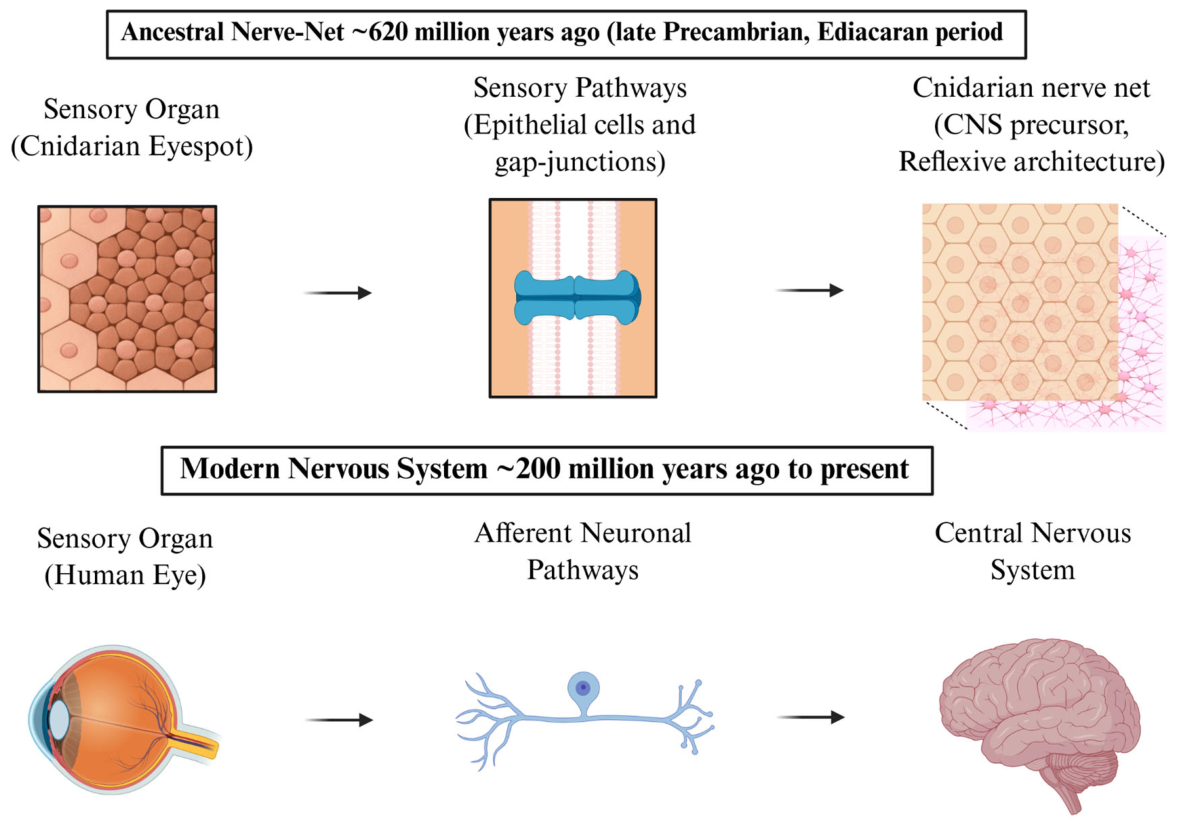
The evolutionary record leading to a centralized nervous systems and present-day consciousness spans millions years of progressive neural elaboration; subcortical affective systems appear first, with cortical elaboration and metacognitive capacity emerging substantially later and tracking increases in neural architectural complexity (Feinberg & Mallatt, 2016; Panksepp, 1998). Several cognitive capacities have been proposed as exapted, contribution to consciousness; working memory, selective attention, and metacognition are among the most discussed candidates, with affective consciousness emerging alongside subcortical elaboration receiving the most comparative and phylogenetic support. Higher-order metacognitive accounts are more contested, given their dependence on cortical structures with shorter evolutionary histories (Feinberg & Mallatt, 2016; Baars et al., 2021; Lau & Rosenthal, 2011). Which exaptation account is correct remains empirically open; the account this paper presents is consistent with affective consciousness emerging early through subcortical phasic signaling, and with metacognitive depth elaborating later through mesocortical dopaminergic maturation.
This section establishes that cognition exists prior to consciousness evolutionarily and developmentally. Consciousness is therefore derivative of non-conscious systems genetically and ontogenetically; suggesting consciousness may emerge and depend on fundamental subconscious or reflexive processing/stimulation, the next section will expand on this in relation to stimuli.
3.3. Sensory Organs, Stimuli Rationalization, Environmental Deprivation, & Consolidatory Significance Correlating with Experience
What consciousness can access at any moment appears to be constrained by what prior experience has subjectively triggered and consolidated. The nervous system is physically connected to every sensory organ, wired from the environment inward through afferent pathways to the CNS; the nervous system has evolved for environmental input processing (Richter et al., 2024). Stimuli enter the CNS and are interpreted against previous encounters, memory relays the outcomes of prior environmental interpretation, and those wiring outcomes shape how subsequent input is processed (Josselyn & Tonegawa, 2020).
Figure 2.
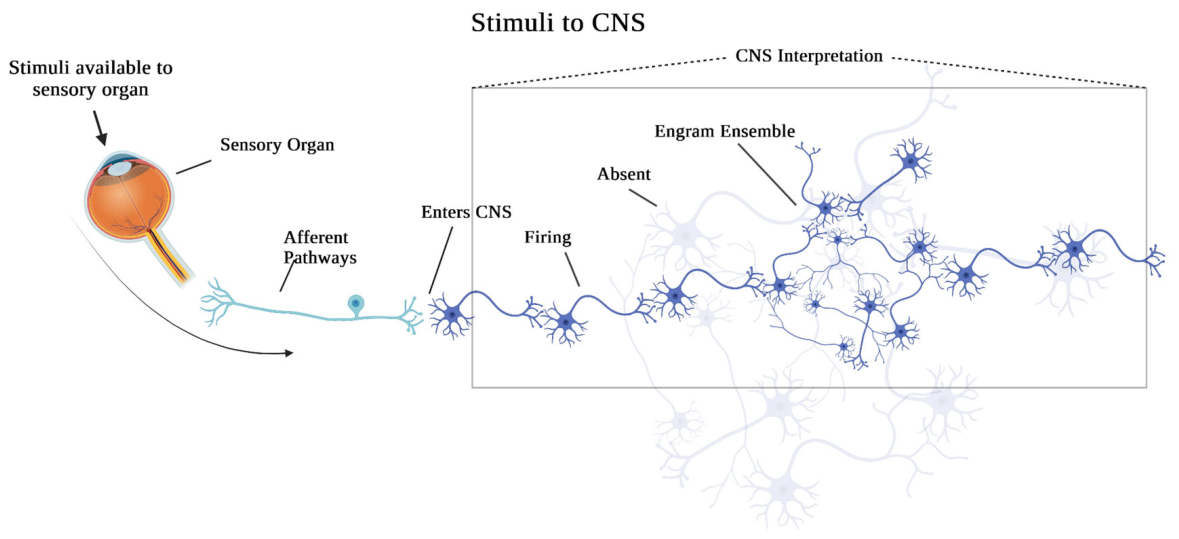
The effects of stagnant environmental input may constrain the mechanisms of experience as stimuli-dependant during waking states. Ganzfeld conditions (completely uniform sensory input) induces hallucinations, perceptual distortions, and dissociative experience within 10-15 minutes of initiation, reversing immediately when varied input is restored (Wackermann et al., 2008). Longer timescales have more serious effects, prolonged solitary confinement produces progressive memory deficits and perceptual dysfunction correlating with isolation duration (Grassian, 1983; Haney, 2003; Smith, 2006).
Figure 3.
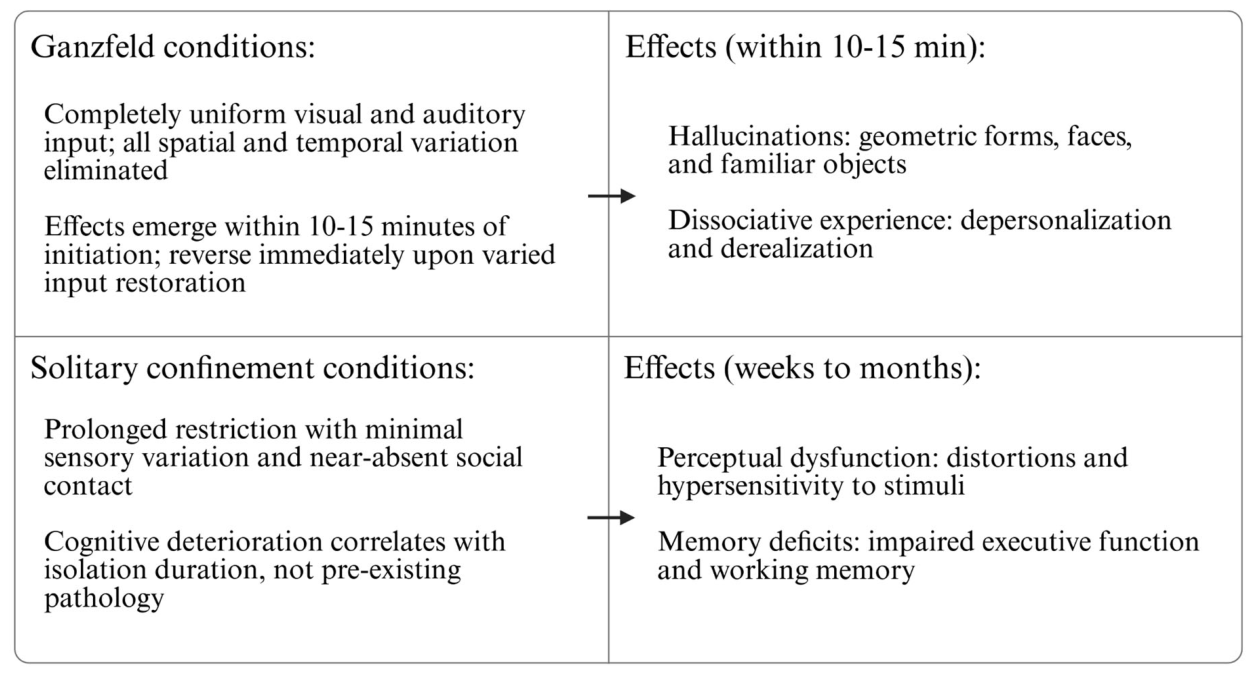
This suggests environmental rationalization is so fundamental to cognition, that without varied input in waking states, cognition and perception malfunction correspondingly.
Memory’s modern adaptive benefits are primarily error avoidance, predictive processing, and long-term storage (Cahill & McGaugh, 1995; Bubic et al., 2010), consolidation and encoding are selective (McGaugh, 2004; Josselyn & Tonegawa, 2020); and this consolidatory selection varies individually (McGaugh, 2004).
Memories are consolidated interpretations of stimulus; without memory consolidating experienced errors or predictions, behavioral systems would repeat failed or reflexive strategies indefinitely. Furthermore, without accurate-enough consolidation, past experiences would dysfunctionally affect present processing, negatively affecting survival, and likely not persisting through natural selection.
Since memory is variable between individuals, stimuli is processed uniquely; if stimuli processing in the CNS is individually determined, then the experience of neural propagation’s psychological content may be dependently subjective.
Spreading activation describes how retrieving one memory automatically activates conceptually related memories through associative networks, with each reactivation capable of triggering further retrieval chains (Collins & Loftus, 1975). At the cellular level, engrams holding temporally proximate experiences share overlapping neuronal populations; activations propagate through shared neurons to associated engrams, with neuronal excitability at encoding allowing co-allocation between separate encodings (Yokose et al., 2017; Rashid et al., 2016; Cai et al., 2016). Phasic activity increases memory consolidation (McGaugh, 2004; Tully et al., 2007), biases and gates activity (Grace, 1991, 1995; Seamans & Yang, 2004), is required for cortical response, and may also be required for emotional experience (Damasio, 1994; Panksepp, 1998) considering tonic-dominant states correspond to reduced emotional intensity and conscious depth (Grace, 1991, 1995; Rouault et al., 2018; Fox et al., 2023). What is available to conscious experience at any moment may therefore be triggered by present stimuli, and retrieved from what environmental interpretation has previously consolidated, to further adapt and reconsolidate neural architectures. This suggests consciousness is fundamentally tied to reconsolidation.
The brain’s interpretation of incoming stimuli against existing synaptic architecture before consolidation occurs is consistent with the Bayesian inference; where prior beliefs generate predictions, and incoming stimuli evaluate against those predictions (Friston, 2010; Clark, 2013; Rao & Ballard, 1999). Existing engram connectivity may constitute the substrate of these priors; the degree to which incoming stimuli can be resolved against existing wiring determines what consolidates, and generates further processing.
If phasic neurotransmitter release determines what achieves consolidation, and consolidation determines what subsequent processing can access or become, then phasic release may control what becomes available to conscious experience chronologically. Precision weighting is the mechanism predictive processing proposes to determine which prediction errors are amplified; this mechanism may correspond to phasic significance signaling; with the degree of phasic departure determining which unresolved processing achieves conscious access. The developmental process will be explained in later sections. The observations within this section constrain conscious experience to a mechanism that is selective, architecturally specified, and dependent on ongoing environmental input in waking states.
3.4. Phasic Feedback As an Executive Signal
This section theoretically allows phasic response as the feedback of consciousness between neurons. Consciousness’ relationship with neuromodulators and neurotransmitters is discussed alongside neurochemical effects on consolidation, behavior, gamma-band synchrony, and emotion. This section also theoretically extends phasic signalling as constitutive of general cortical spreading.
Sustained, distributed cortical activity is an established signature of conscious access. When a stimulus crosses the threshold for conscious processing, early feedforward activity transitions into a late self-sustaining reverberant state across prefrontal and associative cortices, this is characterized by increased gamma-band synchrony between distant regions (approximately 250-300 milliseconds) after stimulus onset (Dehaene et al., 2003; Del Cul et al., 2007; Dehaene & Changeux, 2011). This sustained reverberant state is maintained through NMDA-mediated feedback connections amplifying their own inputs. Cortical ignition requires NMDA/AMPA receptor distributions that match those measured experimentally across the cortical hierarchy (Klatzmann et al., 2025). Once ignited, the network remains in the active state through its own intrinsic recurrent activity, non-dependent on the original trigger.
Multiple experimentally and clinically established manipulations of consciousness alter specific neurotransmitter systems, and pharmacological restoration of consciousness can involve modulation of those same neurotransmitter systems. General anesthetics alter the activity of several neurotransmitter systems, including GABAergic, glutamatergic, cholinergic, and dopaminergic systems (Müller et al., 2011; Lyu et al., 2022). Dopaminergic connectivity is similarly altered during both pharmacologically induced and pathological disruptions of consciousness, while dopaminergic interventions can promote recovery (Spindler et al., 2021; Barra et al., 2024). This establish a strong association between neurotransmitter systems and conscious state, but do not by themselves demonstrate that neurotransmitter activity is the direct or fundamental cause of consciousness.
Figure 4 depicts a constrained phasic dopamine single-synaptic vesicle docking event. This graph presents a reconstructed estimate of dopamine molecule dynamics within a 5nm radius centered at the vesicle fusion site. The peak range (~2,000–5,000 molecules) reflects some experimentally observed variability in vesicular dopamine content from amperometric measurements (Pothos et al., 1998; Bruns & Jahn, 1995), and the right skewed rise is consistent with measured fusion pore kinetics and delayed full release (Chow et al., 1992). The post-peak decay is controlled primarily by diffusion through a tortuous extracellular environment (Nicholson & Syková, 1998). Transporter-mediated reuptake is not included in the earliest phase (<~0.5 ms), as diffusion dominates clearance in this timescale (Cragg & Rice, 2004). Accordingly, each feature of this phasic graph reflects independent empirics.
Contrasting Figure 4, Figure 5 depicts tonic conditions that have a molecule value that is 50 times lower than the estimated phasic peak; while being estimated from a volume that is 2 million times larger. The baseline value of ~60 expected molecules is a scaling choice from converting a representative tonic extracellular dopamine concentration (~100 nM) into molecule occupancy within a defined 1 µm³ sampling volume (roughly hundreds of synaptic cleft volumes); derived from experimentally measured tonic dopamine concentrations, which vary across methods and brain regions due to differences in sampling resolution and detection techniques (Parsons & Justice, 1992; Atcherley et al., 2015; Oh et al., 2018).
Phasic and tonic transmitter release exists inherently within Global Workspace theories, and this paper’s phasic/tonic distinctions and mechanisms allow ignition to be sustained by phasic events with communication to subcortical regions. Phasic transients may also act as signals which gate whether ignition occurs, and to what magnitude. The distributed phasic reverberant activity that follows ignition is what conscious access may derive from; the activity following ignition remains the established empirical account, while what selects which processing ignites is what phasic significance signaling is proposed to specify. The human brain contains approximately 86 billion neurons across roughly 150 trillion synaptic connections (Azevedo et al., 2009). Gamma-band synchrony characterizing conscious ignition occurs at 30-80 Hz across prefrontal and associative cortical networks (Dehaene et al., 2003; Del Cul et al., 2007); at even conservative fractions of approximately 16-19 billion cortical neurons, hundreds of millions of coordinated phasic discharge events occur per second, during any moment of conscious access (Azevedo et al., 2009). Therefore, phasic-executive experiments will either support or constrain the ignition mechanisms of Global Workspace theories, relative to experimental outcomes.
GNWT interprets empirical ideas through workspace-broadcasting; the empirical phenomenon (late, sustained, distributed cortical reverberance) is independently established. GNWT identifies neuromodulatory systems as contributors to the ignition and broadcasting of workspace content, without specifying which neurochemical event constitutes the selective trigger (Mashour et al., 2020).
Dominant frameworks carry an implicit or explicit cortical emphasis. GNWT confines the constitutive event of conscious access to global cortical broadcasting (Mashour et al., 2020); IIT’s highest-Φ systems are consistently identified with cortical rather than subcortical networks (Tononi et al., 2016); Higher Order Theories require meta-representational capacity implemented in prefrontal regions (Lau & Rosenthal, 2011).
Whether this cortical emphasis reflects biological primacy or measurement accessibility is not fully established. Subcortical structures are substantially less accessible to non-invasive neuroimaging, and the extent to which experience-dependent plasticity detected at cortical levels corresponds to reorganization distributed across subcortical circuits remains incompletely established (Ewall et al., 2021). Cross-modal plasticity research demonstrates that architectural change following sensory deprivation is not cortically confined; echolocation training produces functional reorganization in visual cortical areas without evolutionary specification (Thaler et al., 2011), and visual deprivation drives reorganization in both cortical and subcortical circuits through multiple pathways (Ewall et al., 2021; Bavelier & Neville, 2002).
Whether subcortical phasic events such as in the amygdala and hippocampus constitute qualitative experience directly, or only contribute to what subsequent distributed cortical activity produces, should remain an open empirical question. If phasic significance signaling constitutes conscious communication, then phasic high-frequency activity in the hippocampus and amygdala tracking emotionally significant conscious experience in recordings (Qasim et al., 2023) provides evidence that qualitative experience is not exclusively cortical. Whether there exists a hierarchy within subcortical phasic events is an open question alongside this.
The coordination between amygdala theta phase and hippocampal gamma bursts during emotional encoding, with encoding-related amygdala activity patterns reproduced in the hippocampus during retrieval twenty-four hours later, suggests these structures operate as coupled or non-sequential. Distinguishing between these possibilities is important empirically, specific research directions are available in section 5.
Other frameworks implicate neurochemical systems in conscious experience. Integrated Information Theory proposes consciousness scales with the intrinsic information integration of a physical system, with neuromodulatory systems contributing to the integration conditions enabling it (Tononi et al., 2016). Affective neuroscience identifies subcortical systems as the base of conscious experience, with primary process emotional systems constituting the earliest phylogenetic form of felt experience (Panksepp, 1998). However, these theories don’t specify which property of neurochemical signaling (or other temporal or concentration-dependent feature) could constitute the specific events through which subconscious processing becomes phenomenal.
Evolutionary accounts can constrain the possibilities. The evolution of monoaminergic systems suggest phasic signaling developed as a neuromodulatory capacity prior to the Cambrian diversification of centralized nervous systems; most genes required for monoamine production and modulation originated in, or before, the bilaterian stem group, predating the Cambrian explosion (Goulty et al., 2023). This trait developed through vertebrate evolution; dopamine neurotransmission predates the divergence of chordates with biosynthetic enzymes, transporters, and receptors shared across chordate monoamine systems, while near vertebrate emergence (the ancestral monoamine transporter) duplicated to produce separate dopamine and norepinephrine transporters, extending monoaminergic signaling beyond what protochordates possessed (Yamamoto & Vernier, 2011). Phasic dopamine specifically serving value-based decisions and motor learning is conserved from lamprey to mammals, with basal ganglia transmitters, connectivity, and membrane properties virtually identical across this range (Grillner & Robertson, 2016).
Figure 6 tracks monoaminergic signaling from pre-neural chemical precursors to the proposed mechanism of conscious access. Before nervous systems evolved, trace amines could have provided a primitive form of chemical signaling; in the neuronless placozoan trichoplax adhaerens, aromatic L-amino acid decarboxylase (AADC) supports tyramine synthesis, endogenous tyramine, tryptamine, and phenethylamine are detectable, and these amines alter behavior; the absence of vesicular monoamine transporters (VMATs) further suggests that trace amines may be released by passive diffusion rather than vesicular exocytosis (Yáñez-Guerra et al., 2026). The full monoaminergic biosynthetic pathway (TH, TPH, DBH, and VMAT) elaborated in the bilaterian stem group, is represented in this table by Kimberella quadrata (~555 Mya; Fedonkin & Waggoner, 1997; Goulty et al., 2023); however, pre-bilaterian trace amine signaling in Trichoplax places the chemical origin earlier than this elaboration.
Centralized nervous systems in the Cambrian period enabled tonic baselines and phasic burst firing for the first time, supported by fossilized brain and optic lobes in Fuxianhuia protensa and preserved neural tissue in Canadia spinosa (Ma et al., 2012; Parry & Caron, 2019). During vertebrate evolution, dopamine and norepinephrine systems diversified, giving rise to distinct dopaminergic and noradrenergic pathways (Grillner & Robertson, 2016; Yamamoto & Vernier, 2011). In humans, expansion of prefrontal dopamine pathways is accompanied by prolonged maturation through adolescence, with greater phasic capacity hypothesized to support the development of metacognition and conscious access (Peters & Naneix, 2022; Weil et al., 2013; Fink & Reis, 1981; Dreher et al., 2009).
Monoamines are required for plasticity, learning, and memory formation throughout the animal kingdom (Goulty et al., 2023). Neural processing without these mechanisms would consolidate maladaptive outcomes, providing no selective advantage over reflexive undirected processing. The evolutionary development of phasic monoaminergic release alongside behavioral flexibility and selective consolidation is consistent with phasic release having evolved to determine consolidation. Phasic neurotransmitter releases are fundamental for consolidation (McGaugh, 2004; Schultz et al., 1997), while spreading direction is allowed by present wiring through presynaptic facilitation and vesicle availability; which effects phasic release (Baars & Gage, 2012; Kim & Park, 2025). When a memory is retrieved, its neurons reproduce the phasic firing patterns established during encoding; encoding-related phasic patterns of amygdala and hippocampal activity have been directly measured as reproduced during short-term recall (Costa et al., 2025). Connecting this hypothetically to qualia; the felt quality of consciously accessing a memory may be allowed by the original phasic significance event, operating within present wiring parameters, to reliably update itself. This remains hypothetical, however it’s consistent with evidence that engrams of individual memories distribute simultaneously across hundreds of regions, including the hippocampus, amygdala, thalamus, cortex, and brainstem (Behrendt, 2013; Roy et al., 2022). Retrieval-induced reconsolidation is established, with reactivated memories becoming temporarily labile and subject to modification upon retrieval (Nader & Hardt, 2009); this retrieval reproduces encoding-related phasic responses (Costa et al., 2025).
Primitive organisms with neurochemical significance signals had greater consolidatory processing, outcompeting undirected processing through natural selection. Phasic transmitter release may enable conscious experience as tonic conditions and wiring drive phasic events to prioritize individually adaptive processing and adaptation.
Neural systems that encode emotional and motivational significance are consistently implicated in conscious awareness across pharmacological, pathological, and developmental contexts (Mashour & Hudetz, 2017; Damasio, 1994; Weil et al., 2013), suggesting that consciousness is closely tied to the brain’s mechanisms for prioritizing and evaluating significance.
Dopamine phasic release constitutes a high-concentration signal driven by behaviorally relevant stimuli, encoding adaptive significance (Grace, 1991, 1995; Schultz et al., 1997; Schultz, 1998). Mice rendered dopamine-deficient through genetic manipulation demonstrate severely impaired conscious behavior; restoration of dopaminergic signaling reversed the associated deficits, suggesting dopaminergic activity may be necessary for conscious behavior (Spindler et al., 2021). Dopaminergic stimulation of medial prefrontal circuits (in humans specifically) increases confidence in conscious perception and improves self-referential awareness, these effects are not attributable to general arousal (Lou et al., 2020; Joensson et al., 2015).
Serotonergic neurons fire tonically at 0.5-2 Hz but exhibit phasic burst firing in response to punishment outcomes and reward-predicting cues, with most serotonergic neurons phasically excited by punishment and some phasically excited by reward-related stimuli (Huang et al., 2025). Tryptophan depletion, which reduces central serotonin availability, selectively enhances sensitivity to punishment while leaving reward processing intact (Daw et al., 2002; Robinson et al., 2012). Psilocybin and LSD, acting through 5-HT2A receptor agonism, produce dramatic alterations in conscious experience including perceptual distortion and altered self-referential processing, demonstrating that serotonergic activation powerfully modulates the content and structure of conscious experience (Carhart-Harris et al., 2016). Serotonin’s precise contribution to conscious access is more contested than dopamine’s; its involvement in hedonic experience, mood, and self-reflection is undisputed while a unifying mechanistic account remains unestablished (Dayan & Huys, 2015); but its phasic firing in response to punishment outcomes is consistent with phasic significance signaling.
In the case of locus coeruleus (LC) norepinephrine neurons; tonic firing fluctuates with arousal and behavioral state, and phasic bursts of 10-20 Hz arise from novel and salient stimuli alongside decision processes (Aston-Jones & Cohen, 2005; Devilbiss & Waterhouse, 2011). Phasic LC signals salience and allows behavioral responses to significant stimuli, while tonic LC activity sets an arousal baseline within which phasic departures occur. Norepinephrine released by the amygdala during emotional arousal additionally gates long-term potentiation, allowing emotionally significant experiences to consolidate more strongly than neutral experience (McGaugh, 2004; Tully et al., 2007). These are two norepinephrine mechanisms in different locations; LC phasic bursts signal salience and cortical gain, and amygdala norepinephrine gates synaptic consolidation. Both suggest norepinephrine as a signal which can affect what achieves neural change.
Selective noradrenergic stimulation via atomoxetine produces neurophysiological changes but does not restore consciousness from anesthesia, while dextroamphetamine (which elevates both dopamine and norepinephrine) does; suggesting that while norepinephrine contributes to the conditions enabling conscious access, it may not constitute consciousness in isolation (Solt et al., 2014). This is an important nuance, and is specific to norepinephrine.
GABAergic inhibition allows excitatory and inhibitory balance signals within departure above tonic, disruptions to this balance producing corresponding alterations in conscious state (Barra et al., 2024; Bliss & Collingridge, 1993). Basal forebrain cholinergic neurons fire tonically during waking and phasically in response to salient events, with cortical muscarinic activation shaping which parallel subconscious processing enters the conscious stream (Hasselmo & Sarter, 2011). Cholinergic activity peaks during REM, supporting vivid conscious content through direct inhibition of dorsolateral prefrontal neurons (Muzur et al., 2002), yet metacognitive self-monitoring is markedly reduced relative to waking despite comparable cortical activation; metacognitive capacity being strikingly reduced even during aesthetically and emotionally rich dream experiences (Gott et al., 2024). This suggests acetylcholine is necessary for the stream of conscious content but not sufficient for the self-referential monitoring individually. Glutamate also holds a unique function. As the primary excitatory neurotransmitter in the central nervous system, glutamate may carry signals subsequently via calcium-dependent exocytosis. Long-term potentiation is induced through NMDA glutamate receptor activation, with postsynaptic calcium influx driving the structural changes that constitute the physical encoding of engrams (Bliss & Collingridge, 1993; Malenka & Bear, 2004). NMDA receptor blockades via ketamine have been shown to produce measurable deterioration of metacognitive sensitivity; suggesting glutamatergic NMDA functions specifically support conscious self-evaluation (Lehmann et al., 2021).
Figure 7.
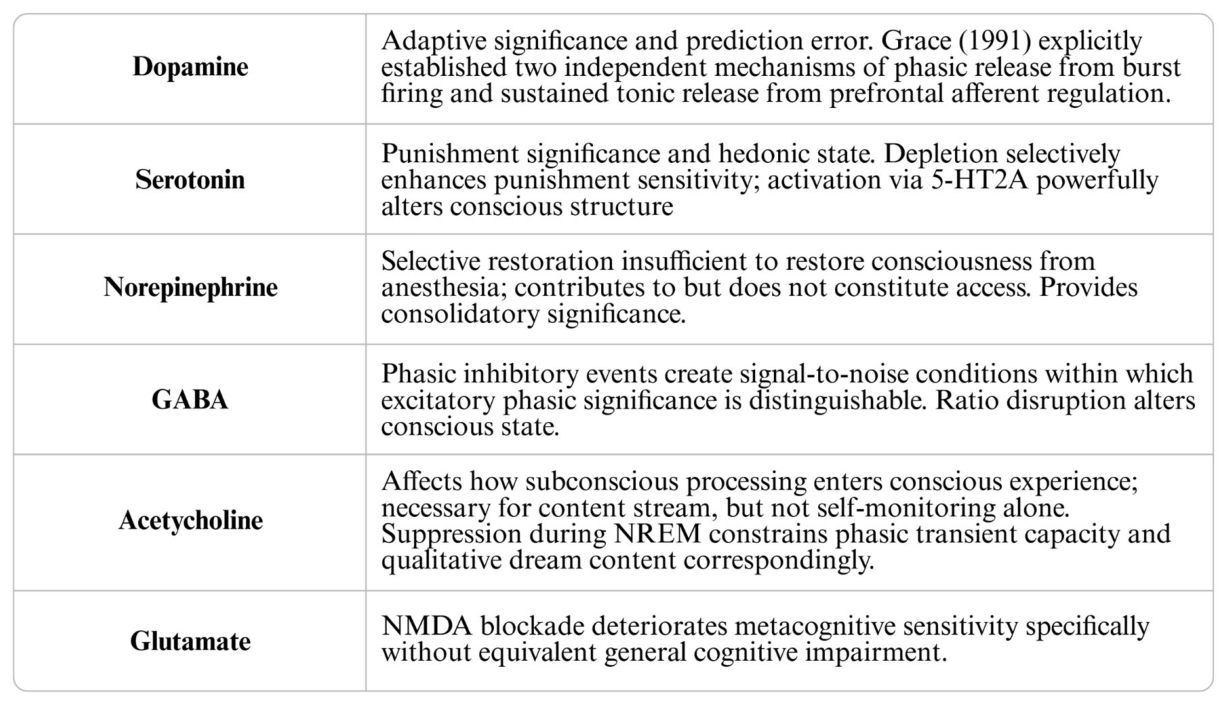
What is consistent seems to be that disrupting any of these chemicals alters the selectivity of what achieves cognitive relevance. Different anesthetic agents disrupting different neurochemical components produce equivalent consciousness loss; this is consistent with conscious experience depending on neurochemical architectural integrity broadly (Mashour & Hudetz, 2017). Patients with ventromedial prefrontal damage retain intact general cognition while losing the felt dimension of emotional response; and they simultaneously lose adaptive decision-making capacity (Damasio, 1994; Bechara et al., 1997). The functional and felt dimensions of emotional significance do not dissociate cleanly under this damage. Disruption of dopaminergic and serotonergic function in depression corresponds to measurable reductions in conscious observational depth. Blank-mindedness, dissociation, and impaired metacognitive capacity correlate with symptom severity and recover as neurochemical function improves with treatment (Rouault et al., 2018; Fox et al., 2023). When the signal:noise ratio of chemical significance encoding degrades, what achieves conscious access seems to degrade accordingly.
In the first months of life, primary process emotional systems are genetically specified and functionally present, yet conscious depth is minimal and meta-awareness is entirely absent (Lagercrantz, 2014; Rochat, 2024). The mesocortical dopamine pathway undergoes a uniquely protracted postnatal maturation, with dopaminergic innervation of the medial prefrontal cortex continuing to develop into early adulthood (Peters & Naneix, 2022; Islam et al., 2021; Tseng & O’Donnell, 2007). Metacognitive ability follows an identical developmental arc, improving across adolescence, peaking in late adolescence, and plateauing with considerable individual variability (Valk et al. 2017; Weil et al., 2013). Individual variation in dopamine cell number produces variation in synaptic dopamine availability independent of environmental exposure (Fink & Reis, 1981); genetics appears to set the ceiling for phasic signaling capacity, while environment seems to determine what develops within it (Reynolds & Flores, 2021).
The mechanisms through which phasic neurotransmitter release may allow conscious access are suggested from many directions; transmitter manipulation affects conscious access consistently, developmental maturation of phasic capacity tracks metacognitive depth, and degraded phasic signaling in depression degrades conscious observational capacity correspondingly.
3.5. Phasic-Consciousness to Qualia; Phasic-Emotion and Phasic-Electricity
Qualia are the subjective phenomenal characters of experience; what it is like to see red, or feel pain, distinct from the functional processing producing those states. Phasic events are not constitutive of qualia independently, phasic transmission is inter-neuronal, located in the synapse; phasic events mediate existing quantifications of experience under this framing (see section 4).
This section is the most speculative, attaching phasic significance independently to emotion and electricity, attempting to put forward the possibility of chemical qualia through existing emotion and electromagnetic frameworks.
Consciousness and emotion are often conceptually related, but the direction and mechanisms of their relationship remain unresolved and highly contested. Basic emotion theories propose emotional categories with innate biological substrate, and reasonable universal expression (Ekman, 1992). Constructivism claims emotions are constructed as feeling through more primitive affective and cognitive components, in context (Barrett, 2017). Appraisal theories propose that emotions arise from an individual’s evaluation of what a stimulus means for personal goals and wellbeing, with the same event producing different emotional responses across individuals; depending on how the emotion is appraised (automatically or deliberately), at multiple levels of processing (Lazarus, 1991; Scherer, 2001).
Affective neuroscience identifies primary process emotional systems as shared across closely related species. Affective neuroscience also establishes that subcortical systems, such as the limbic system, produce consistent affective-behavioral processing (Panksepp, 1998). What remains unspecified within Panksepp’s account is the mechanism through which subcortical circuit activation becomes experienced or consciously accessed beyond functional subconsciousness, Affective neuroscience does not claim to answer this question.
Emotional responses are associated with activation of subcortical structures including the amygdala, hypothalamus, and brainstem nuclei, with the amygdala specifically implicated in assigning affective significance to incoming stimuli and modulating consolidation of specific emotionally relevant experiences (LeDoux, 1996; McGaugh, 2004). These subcortical systems project to cortical regions and influence the degree to which cortical processing is amplified or suppressed, depending on the affective significance of the stimulus (Pessoa, 2008). Dopaminergic and noradrenergic systems modulate the intensity of this affective amplification; with phasic dopamine encoding prediction error, and phasic norepinephrine gating synaptic strengthening during arousal (Schultz et al., 1997; McGaugh, 2004).
High-arousal emotional states enhance memory consolidation through stress-hormone activation of the amygdala. McGaugh (2004, 2013) establishes that adrenal stress hormones (epinephrine and corticosterone) released during emotional arousal regulate long-term consolidation through the amygdala. Arousal-induced noradrenergic activation within the basolateral amygdala is undoubtedly essential for stress hormone effects on subsequent consolidation (Roozendaal et al., 2006); if phasic transmission constitutes conscious communication, then this suggests hormones may regulate consciousness, to the capacities that present wiring and past experiences specify. McIntyre et al. (2003) confirmed that both the release of adrenal stress hormones and noradrenergic signaling within the amygdala converge and strengthen memory of emotionally arousing experiences. Roozendaal et al. (2002) further demonstrated that arousal-induced emotional significance is a prerequisite for glucocorticoid enhancement of memory, establishing arousal level as a key contributor of consolidation.
The significant signals of experience and emotion may exist to amplify within-lifetime environmental adaptation; allowing greater perceptual variation and fitness.
The qualia of an emotional response may correspond to the magnitude of phasic activity within architecturally specified wiring, suggesting individual differences in qualitative emotional intensity reflects differences in consolidation history under genetic constraints.
This neurochemical account of emotion being directly related to conscious communication may explain why emotions can manifest directly into behavior from the synaptic level; providing increased recognition of events that current wiring deems important. Attaching qualia to emotion and consolidation would allow further specification of why humans cry, become angry, happy, or frightened in relation to experienced events or relative phasic release post-stimulus during subjective spreading; since architecturally effective qualia may allow selective emotional significance to promote individually specific synaptic and epigenetic change through consciousness.
Emotions may correspond to the quantity and magnitude of phasic events between cortical and subcortical regions, having evolved to produce a more effective consolidatory and behavioral signal.
Crucially, this does not blur the separation between individual emotions or between emotions and consciousness. The claim of consciousness existing as the result of phasic transmitter release is independent of emotion being hypothetically intertwined in the production of qualia. This perspective would require redefining the origin of emotion; therefore it should remain speculative and be practically falsifiable. A corresponding hypothesis is available in section 4 stage 3 as QH.1.
3.5.1. Connecting Phasic Signaling to Electric Qualia in Existing Frameworks
Neurochemical events are electric by nature and electricity is present within some existing quantifications of qualia, including electromagnetic (EM) theories, IIT, GWT, Orch-OR, and Panpsychism. These theories suggest consciousness exists following electric activity; where activity only becomes conscious when it’s integrated, globally coordinated, physically structured, causally interdependent, or electromagnetically coherent (Dehaene & Changeux, 2011; Casali et al., 2013; Tononi & Koch, 2015; Hunt et al., 2024; Hunt & Jones, 2023).
Tonic conditions produce continuous electrical activity throughout the CNS; this activity does not uniformly produce conscious experience, indicating that continuous electrical activity alone is not sufficient.
The phasic and tonic Figure 4 and Figure 5 depict distinctions at the molecular level; an estimated single-synaptic phasic dopamine transient produces approximately 2,000-5,000 molecules within a 5nm radius over sub-milliseconds to milliseconds, while tonic conditions maintain approximately 60 molecules across a sampling volume 2 million times larger. These molecular events are intrinsically electric; vesicular fusion triggers membrane depolarization, producing an action potential that propagates electrically through the cell, constituting the specific electrical event each framework below identifies as necessary for conscious access. Crucially, phasic events and action potentials specifically are not equivalent mechanisms; therefore this electric-qualia framing would suggest phasic events gate experience rather than constitute it, though phasic events may remain hypothetically executive within spreading.
Electromagnetic theories propose that consciousness is constituted by the brain’s unified EM field; neurons firing in synchrony generate larger oscillating EM fields whose dynamics constitute experience (McFadden, 2002; Hunt & Schooler, 2019; Hunt et al., 2024). Phasic neurochemical events are consistent with this account as the events generating those specific field dynamics; they also address the difficulty EM theories face in specifying why some EM dynamics carry qualitative significance and others do not, without appealing to panpsychism (Hunt & Jones, 2023). IIT similarly locates consciousness in the electrical substrate implementing integrated information; phasic-driven LTP directly modifies synaptic connectivity and therefore the causal structure Φ measures, while tonic conditions maintain the background integration level within which phasic events produce discrete structural changes (Tononi & Koch, 2015). GNWT identifies gamma-band reverberance as the established electrical signature of conscious access but does not specify which chemical events constitute triggers of cortical ignition. Phasic transients are again proposed here as the trigger, with the reverberance being the electrical consequence of phasic events, rather than their cause; (Dehaene & Changeux, 2011; Mashour et al., 2020).
Panpsychist frameworks propose consciousness is fundamental to matter, with biological systems integrating proto-conscious EM properties into consciousness; phasic significance signaling may specify which proto-phenomenal EM states achieve experience, though this connection remains speculative and extends beyond what this paper’s proposed methods can currently test (Hunt & Schooler, 2019).
What these frameworks identify as the electrical event through which consciousness occurs may be specified at the chemical level by phasic molecular activity. If phasic molecular activity specifies the electrical events these frameworks identify, their predictions become testable at the chemical level; experiments targeting phasic release would simultaneously constrain EM field dynamics, integrated information structure, and cortical ignition mechanisms within one experimental framework. These frameworks may therefore not be complementary, with the electrical and chemical descriptions converging on phasic release as a common substrate.
4. Mechanisms
Consider you (agent 1) hear something familiar in a crowded and noisy room full of people, such as your friend’s voice, you may experience and associate to the sound of your friend, your wiring may allow propagation based on your associated memories and other relevant stimuli in your environment, and your experience follows.
Figure 8.
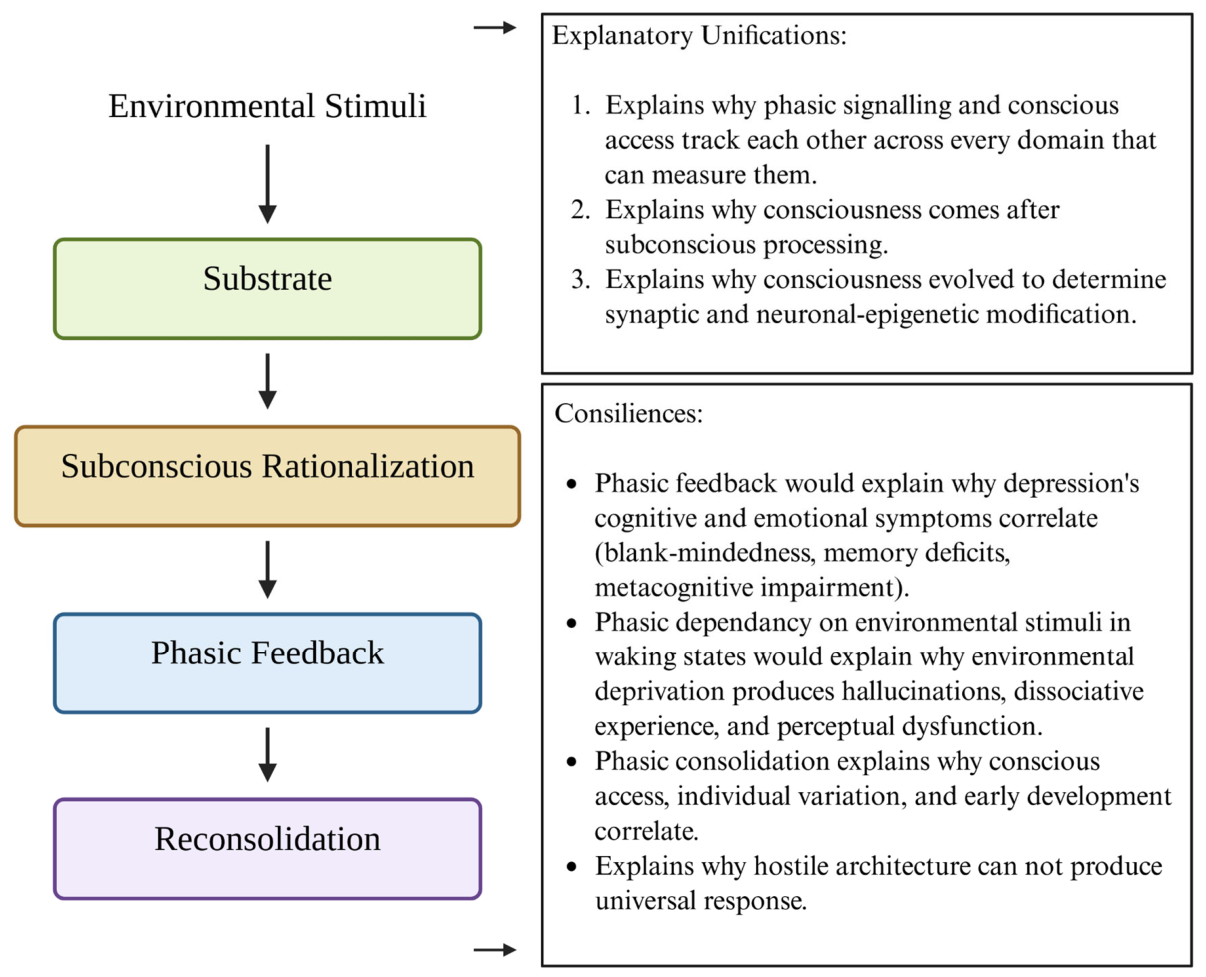
When someone else beside you (agent 2), with no shared memories, hears the same crowd, there is a lower chance that they will become consciously aware of your friend. Their experience propagates independently based on stimuli which trigger their phasic responses, therefore their experience and future memories differ from yours because of prior experience and individual genetic expression.
Now, imagine your friend yells at the top of their lungs, agent 2 at last becomes consciously aware of your friends voice, but experiences the yell uniquely, they may be frightened or annoyed; while you may be amused or curious, the different memories that follow these experiences will be correspondingly unique. This is an oversimplified example of the 4 stage developmental process loop explained below.
Stage 1: Substrate Access
Genetically specified cortical and subcortical sensory regions, subcortical emotional systems, and epigenetically modifiable neurons determine the parameters of how environmental input can be processed within the CNS (Panksepp, 1998; Meaney, 2001; Richter et al., 2024; Fink & Reis, 1981).
The outward-facing CNS architecture receiving environmental input is genetically allowed before any input arrives, with sensory organ substrate also affecting what afferent signals can reach the CNS. Afferent pathways carry sensory information from the environment inward to the central nervous system, where it encounters existing neural architecture before any conscious access occurs (Richter et al., 2024).
Genetics also specify sensitivity thresholds, neurotransmitter system responsiveness, and subcortical primary emotional systems through which environmental input is first organized. Panksepp’s affective neuroscience identified seven primary processes, SEEKING, FEAR, RAGE, LUST, CARE, PANIC, PLAY, that are genetically specified, phylogenetically conserved, and present across mammalian species prior to any environmental experience (Panksepp, 1998).
Genetic variation in dopaminergic transmission produces measurable individual differences in reward system responsiveness and novelty-seeking, independent of environmental exposure, with COMT polymorphisms accounting for significant proportions of interindividual variability in phasic dopamine availability (Dreher et al., 2009); serotonergic receptor polymorphisms produce corresponding differences in hippocampal novelty processing and recognition memory encoding (Schott et al., 2011). Substrate variation therefore determines the phasic threshold at which environmental input triggers significance signaling; the same stimulus encountering different substrate parameters produces different initial phasic responses and different consolidation outcomes (Fink & Reis, 1981; Belsky & Pluess, 2009).
The individual variation in expression thresholds of these systems determines the intensity and salience with which environmental input is initially processed, without directly determining what that input means subjectively within the CNS, or what it subsequently reconsolidates.
Stage 2: Subconscious Rationalization & Tonic Modulation
Recurring subconscious environmental rationalization operates as sensory input enters the CNS and propagates through present synapses below conscious awareness and within tonic neurochemical conditions. This architecturally specified rationalization mediates stage 3 phasic release, and possibly phasic modification of epigenetics.
After stage 1, activation is guided throughout the CNS, being directly representative of present wiring and baseline stimulation (Collins & Loftus, 1975; Josselyn & Tonegawa, 2020). The processing of environmental stimuli in the CNS may be initially and primarily subconscious (Dehaene et al., 1998; Kouider & Dehaene, 2007).
The hippocampus actively modulates phasic dopamine neuron activation intensity through afferent VTA input, and prefrontal cortical afferents regulate tonic dopamine in subcortical regions through a separate pathway; tonic conditions are therefore regulated by ongoing subconscious processing (Lodge & Grace, 2006; Grace, 1991).
Somatodendritic autoreceptors reduce dopamine neuron firing when tonic levels rise and presynaptic terminal autoreceptors simultaneously suppress vesicular release probability, both operating in parallel to further modulate phasic capacity under elevated tonic conditions (Grace, 1991, 1995; Seamans & Yang, 2004).
Crucially, tonic and phasic release may share more mechanistic continuity than their functional distinction initially implies; once vesicles enter the synapse, tonic and phasic differentiation is largely in molecule amount alone, with the postsynaptic membrane responding proportionally to local neurotransmitter concentration. Phasic release constitutes a greater amount of the same stimulation.
Phasic magnitude crosses the threshold for NMDA activation and downstream structural change, casual sustained tonic concentrations cannot reach this magnitude.
The postsynaptic significance of phasic release also depends on vesicle availability; amplified tonic release depletes what remains available for phasic bursts, narrowing the effective departure and reducing postsynaptic consequence, and crucially, without necessarily suppressing phasic signal frequency (Grace, 1991, 1995).
Hypotheses
H2.1: Neural propagation consistently precedes phasic vesicle release and transmitter-specific conscious access during initial stimulus processing, with the timing of consciousness corresponding with the onset of coordinated phasic events. Falsified if: Phasic release onset precedes or is simultaneous with spreading initiation, such proving that phasic events do not consistently result from initial tonic stimulation.
H2.2: Subconscious neural processing operates within continuous casual tonic conditions, with subconscious being defined as processing absent of conscious reportability. Falsified if: Subconscious processing requires phasic transmitter activity to propagate between neurons, or if conscious access occurs without phasic transmission. Note: Amplified tonic conditions are not equivalent to non-amplified tonic conditions; refer to this stage’s specifications of synaptic neurotransmitter concentration dynamics.
Stage 3: Phasic Neurotransmitter Feedback
Single-synaptic phasic neurotransmitter transients are proposed as the stimulated events through which initially subconscious processing communicates conscious experience between neurons; where tonic propagation and stimulation, alongside neuronal epigenetics, contribute to phasic responses.
Phasic neurotransmitter release triggers consolidation of what achieves significance, modifies engram connectivity toward what reactivated, and reproduces encoding-related phasic patterns during subsequent retrieval (McGaugh, 2004; Josselyn & Tonegawa, 2020; Costa et al., 2025; Schultz et al., 1997).
Phasic synaptic conditions are more likely to enable epigenetic modifications than tonic conditions, primarily because they allow a large postsynaptic calcium influx that activates enzymatic pathways for histone and DNA remodeling (Corner & Ramakers, 1992; Cortés-Mendoza et al., 2013; Lim et al., 2017; Jetti et al., 2023). Corner and Ramakers (1992) originally established that spontaneous phasic discharges act as an “epigenetic factor” accelerating cortical synapse maturation; Cortés-Mendoza et al. (2013) reviewed how phasic activity-dependent transcription directly drives histone acetylation, phosphorylation, and DNA methylation. Lim et al. (2017) establishes that phasic short-term plasticity requires LSD1 (a histone demethylase that modifies gene expression), and Jetti et al. (2023) provides evidence that phasic synapses possess more compact active zones and enhanced Ca2+ influx relative to tonic. Therefore, phasic events may produce epigenetic change; with calcium influx enabling LTP and epigenetic modification.
Figure 9.
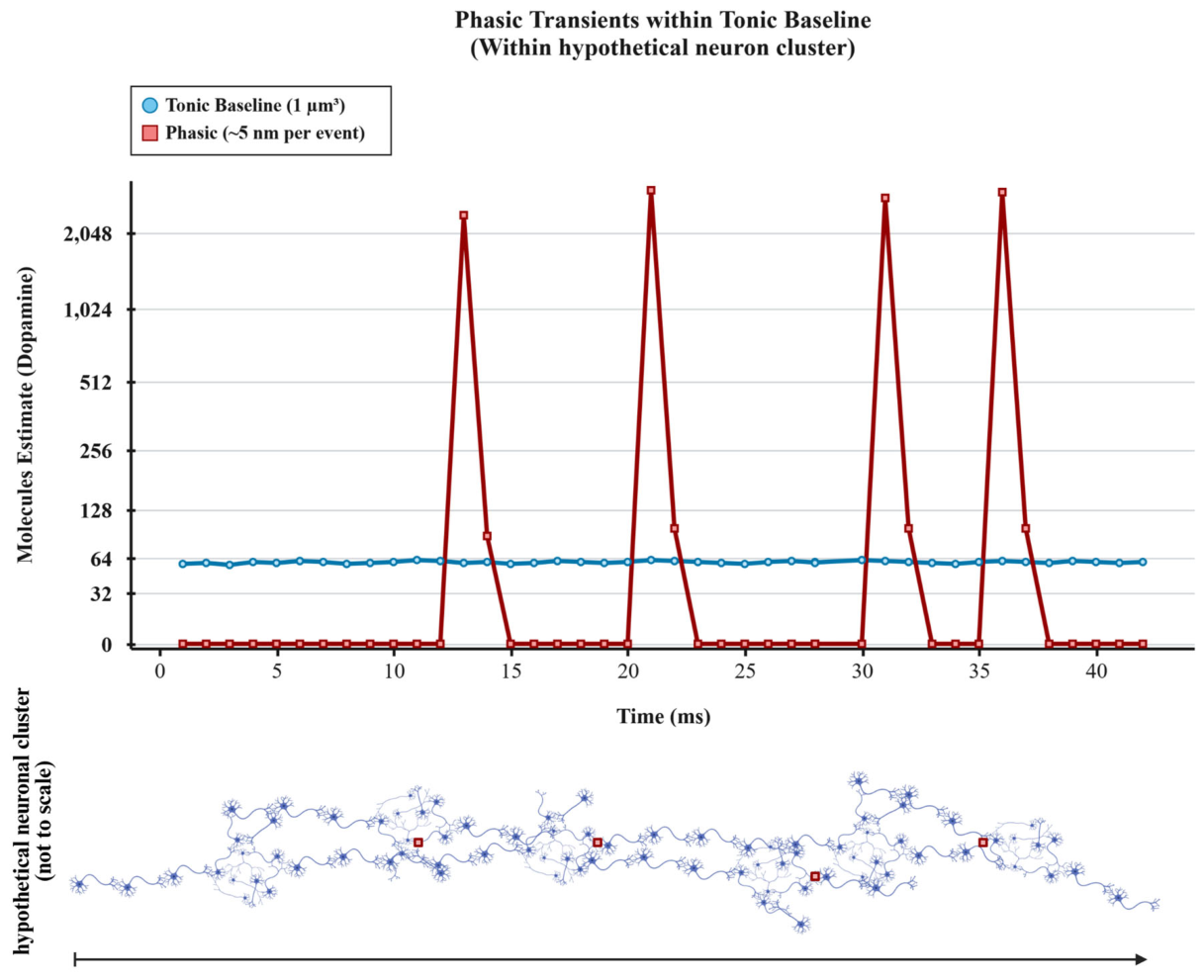
This figure uses the previous tonic and phasic molecule estimates in Figure 4 and Figure 5. This neuronal cluster is hypothetical, phasic events are dependant on many variables, none of which are displayed besides tonic stimulation within 1µm³. This tonic stimulation can be assumed as present within every synaptic cleft in the hypothetical cluster, but is not a direct measurement. Due to the measurement differences and unspecified cluster origins, the visual neuronal cluster is not to scale.
Synaptic strength determines the firing threshold and activity magnitude of each phasic release (Bliss & Collingridge, 1993; Josselyn & Tonegawa, 2020). Engrams organize synapses into co-activation groups; within these groups, coordinated synaptic activity between colonized neurons and subsequent phasic releases may recurrently modulate synaptic excitability and consolidation within specified engrams, influencing further propagation and re-consolidation within and consequently of the engram.
NMDA receptor activation and calcium influx trigger LTP; the cellular basis of memory (Collingridge et al., 2004; Malinow & Malenka, 2002); this establishes glutamate as a trigger for structural change. D1 receptor activation directly enhances NMDA receptor current at the same synapse glutamate is activating (Calabresi et al., 2007); this means the hypothetical significance signal and the structural mechanism converge at one synapse, and seem to correlate. This convergence should be required only at induction. Blocking NMDA receptors after LTP has already been induced does not affect its expression or maintenance (Collingridge et al., 1983; Miserendino et al., 1990); this means the signal that initiates structural change seems to be no longer necessary once its effects have occurred. Norepinephrine released during emotional arousal seems to determine what achieves consciousness, the same norepinephrine that gates synaptic strengthening at connections that would otherwise remain subthreshold (McGaugh, 2004; Tully et al., 2007). This allows the hypothesis of induction convergence being the molecular substrate behind conscious access with consolidation existing as the same event. Though this requires rigorous further confirmation, the temporal restriction to induction is consistent with Collingridge et al. (1983) and Miserendino et al. (1990), while being directly testable.
Crucially, phasic events allow propagation beyond initial stimulus; each phasic reactivation activates associated engrams through shared neuronal populations (Collins & Loftus, 1975; Cai et al., 2016); this suggests consolidatory events may determine memory accessibility, allowing a clear mechanism in which phasic response hypothetically directs propagation.
Single-vesicle dopamine release events from midbrain neurons, measured amperometrically at high temporal resolution, produce spikes with half-widths spanning sub-millisecond to a few milliseconds, with a lower bound of approximately 0.5ms (Pothos et al., 1998; Bruns & Jahn, 1995). Phasic dopamine release is excitatory within ongoing spreading activation; D1 receptor activation enhances NMDA current at the synapse glutamate is already activating, amplifying propagation through architecturally connected pathways at the moment of release (Calabresi et al., 2007). Therefore the executive effects of phasic response may not be separable in time from the propagation they amplify.
Additionally phasic dense-core vesicle release may redirect propagation trajectory beyond synaptically specified pathways; where relevant neuropeptides and receptors are expressed, but no direct wired connection exists. Sub-second phasic release produces acute calcium transients at distance (McGregor et al., 2026), extending phasic-subsequents beyond what tonic synaptic stimulation alone may determine; further experiments may specify to what degree.
Mechanistic Hypotheses:
H3.1: Phasic neuromodulation determines which processing becomes motivationally significant and preferentially achieves conscious communication between neurons. Falsified if: Phasic modulation does not predict which architecture gains conscious access.
H3.2: Pharmacological elevation of tonic dopamine, through autoreceptor-mediated suppression of phasic burst capacity, reduces metacognitive depth independently of general cognitive performance. Falsified if: Tonic elevation produces equivalent reduction in metacognitive depth and general cognitive performance, or if metacognitive depth is unaffected under confirmed phasic suppression.
H3.3: Phasic dopamine transient magnitudes correlate positively and continuously with gamma-band coherence amplitude and metacognitive sensitivity, independent of tonic baseline and general cognitive performance, such that conscious depth represents a continuous function of phasic signal magnitudes. Falsified if: gamma-band coherence or metacognitive sensitivity does not scale incrementally with phasic magnitude across the full measured range, or if gamma coherence amplitude correlates with tonic baseline rather than phasic magnitudes.
H3.4: Single-synaptic phasic vesicle releases direct cortical spreading trajectory, such that single-synaptic phasic events selectively amplify propagation through architecturally connected downstream engrams over equally available but non-phasically activated pathways. Falsified if: Spreading activation direction following a single-synaptic phasic event is statistically equivalent to tonic spreading direction through the same architecture without phasic triggering, indicating phasic events at individual synapses do not redirect propagation beyond what present wiring determines passively. Note: Dopamine transmits volumetrically, diffusing beyond the release site across broader extracellular territory than synapse-specific signaling would require (Liu et al., 2021; Cragg & Rice, 2004); this broadens the proposed effect.
H3.5 Epigenetic Hypothesis: Phasic synaptic events produce preferential epigenetic modification at activity-regulated genomic loci relative to tonic stimulation of equivalent duration. Falsified if: Optogenetically induced phasic stimulation produces equivalent histone acetylation at BDNF exon IV and Arc loci as tonic stimulation when total calcium influx is statistically controlled, or if calcium chelation during phasic events eliminates the modification difference between conditions.
Qualia Hypotheses:
Qualia cannot be directly compared across subjects; the hypotheses below test whether phasic magnitude predicts phenomenal richness ratings. Continuous reports of experiential vividness and intensity, validated against physiological correlates including pupil dilation and skin conductance, could act as proxy for qualitative character. However, correlation between phasic transient magnitude and subjective experience ratings does not establish that phasic events are qualia, only that they may covary in the direction predicted.
QH.1 Phasic-Emotion Qualia: Phasic dopamine transient magnitude, indexed by voltammetric peak amplitude, predicts subjective experience ratings and emotional intensity independently of stimulus type and arousal level. Falsified if: Phasic transient magnitude does not predict subjective experience ratings when stimulus type and arousal are statistically controlled, or if physiological correlates of emotional intensity dissociate from transient magnitude under statistically controlled stimulus conditions.
QH.2 Phasic-Electric Qualia: Gamma-band coherence (30-80 Hz) during confirmed phasic dopamine transient events, measured via concurrent MEG, predicts within-subject subjective experience ratings independently of task performance and arousal under pharmacologically varied transient frequency. Falsified if: Gamma-band coherence during confirmed phasic transients is statistically equivalent to coherence during tonic periods when task performance and arousal are statistically controlled, or if subjective experience ratings are independent of coherence magnitude when transient frequency is pharmacologically varied. Note: Simultaneous voltammetric transient confirmation and MEG requires methodological development; H3.3 confirmation should precede direct testing of QH.2.
Stage 4: Reconsolidation
This stage emphasizes how memory determines future phasic releases. Phasic release is fundamental to synaptic reconsolidation, and synaptic connectivity determines how future processing propagates; affecting consciously available content and processing variations.
What becomes conscious shapes what gets consolidated, and what gets consolidated shapes what can subsequently become conscious; this ontogenetic adaptation loop is broken at every iteration by incoming stimuli, and displays the continuum of cognitive processing and consciousness as a result of reflexive subconscious environmentally interactive processing. Additionally, the mechanisms of experience during sleep states are less environmentally driven and will be specified later in this stage under the same tonic modulation.
Synaptic density is the accumulated synaptic strength and engram connectivity within a given neuronal region. Stronger and more densely connected engrams reactivate at lower stimulus thresholds, produce larger phasic responses, and bias propagation toward associated networks (Josselyn & Tonegawa, 2020; Bliss & Collingridge, 1993). Density is also domain-specific; engrams reactivated frequently and with high valence accumulate greater strength through repeated LTP, while rarely activated or low-valence engrams maintain weaker connectivity (McGaugh, 2004). Higher density therefore lowers reactivation thresholds and increases phasic response magnitudes for associated stimuli.
Phasic firing patterns differentially regulate gene expression relative to tonic firing of equivalent total activity; phasic bursts selectively drive BDNF secretion, Arc transcription through MEF2, and growth-promoting factor expression in ways tonic firing does not (Bhatt et al., 2009). This provides a specific developmental mechanism through which prior phasic communication events modify the architecture determining future phasic responses; phasic history may construct the consolidation density that determines what phasic communication occurs next.
Figure 10.
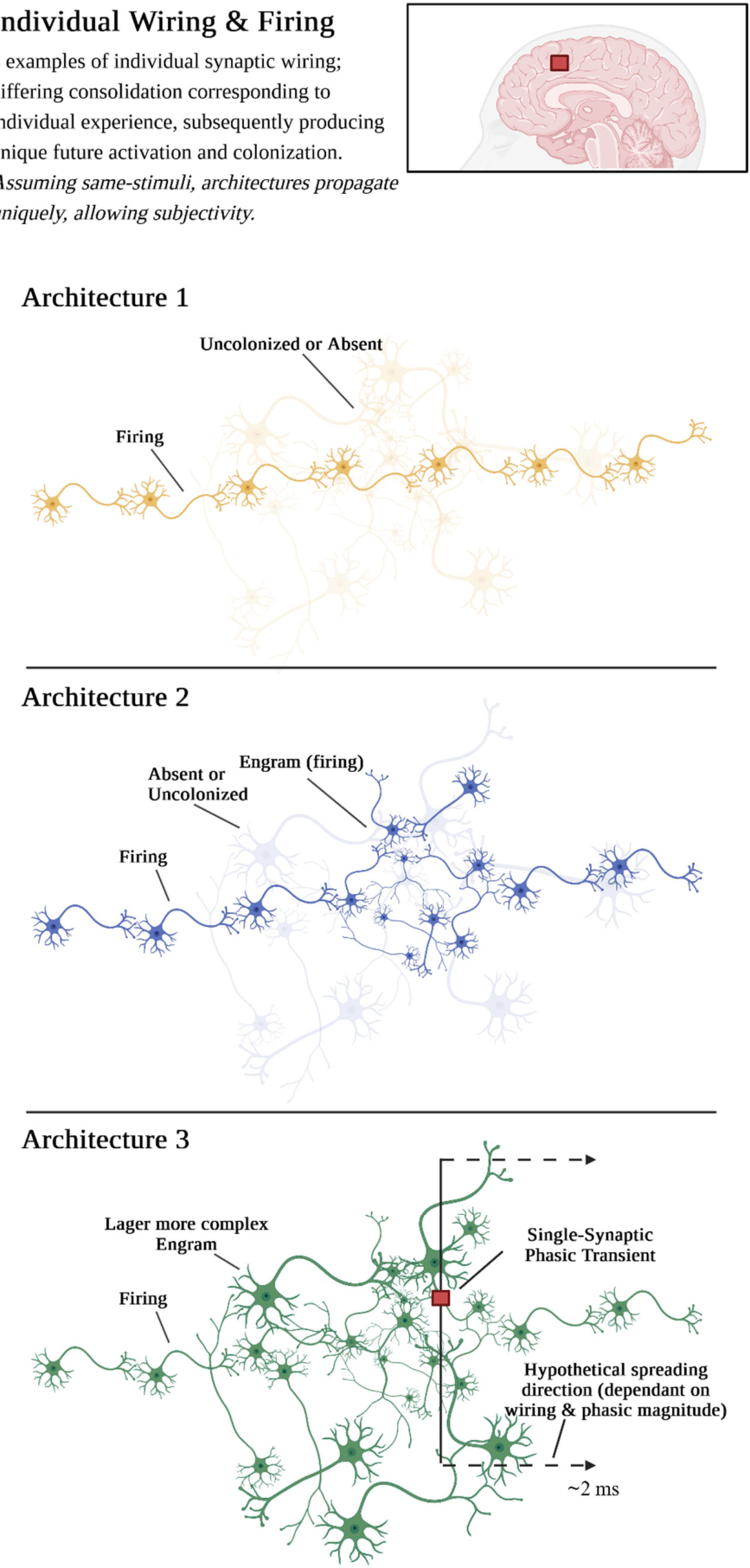
Figure 10 depicts three architectures with differing synaptic density receiving identical environmental stimuli; architectures with lower density reasonably require greater stimulus intensity to produce equivalent phasic departure. Low density architectures retrieve fewer associated engrams and may produce poor conscious access from the same stimulus. Architecture with higher density produces phasic departure at lower thresholds, reactivate more extensively connected engram networks, and possibly generate richer phenomenal content in comparison.
Experience and consolidation during sleep may operate through the same phasic mechanisms, but function distinctly within sleep’s constitutive and uniquely variable tonic conditions. Sleep manages what waking experience encodes; synaptic homeostasis restores signal-to-noise ratio degraded by waking potentiation, and active consolidation replays hippocampal traces for cortical transfer (Tononi & Cirelli, 2006; Rasch & Born, 2013). Tonic neurochemical conditions change during sleep for this consolidatory function, with NE, serotonin, and histamine all suppressed during NREM and REM, while ACh and phasic dopamine are prominent during REM and both further reduced during NREM (Saper et al., 2010; Steriade & McCarley, 2005); phasic dopamine in the nucleus accumbens promotes REM while tonic dopamine in the same region suppresses it, and a transient phasic dopamine increase in the basolateral amygdala terminates NREM and initiates REM (Toth & Burgess, 2025; Hasegawa et al., 2022).
Interestingly, environmental input still enters the CNS during sleep; the auditory cortex responds robustly during both NREM and REM (Hayat et al., 2022), with architectural significance determining whether input disrupts consolidation, affects dream content, or triggers arousal (Perrin et al., 1999; Guo et al., 2023). Dreams are reconstructions of prior experience, yet to some extent are themselves experienced; phenomenal content exists during sleep without environmental grounding (Budson & Paller, 2025; Scarpelli et al., 2019), and white dreams may demonstrate phenomenal access occurring below the consolidation threshold (Fazekas & Nemeth, 2018). Dream content is attributed to prior experience because sleeping tonic conditions support replay of existing engram networks rather than the rationalization of new stimuli; genetically specified tonic states are the floor, though epigenetic modification and consolidation can alter them, as suppressing negative-memory reactivation in chronically stressed animals restores more normal sleep (Yu et al., 2026); though these claims need further confirmation.
Phasic transients during sleep may still be the events through which phenomenal experience is communicated, while sleep-specific tonic conditions change them; during NREM, tonic monoamine suppression reduces phasic event capacity, consistent with reduced phenomenal access and low dream recall; during REM, elevated tonic ACh alongside prominent phasic dopamine transients supports phenomenal content, consistent with vivid dreaming (Bhagya et al., 2023; Toth & Burgess, 2025). White dreams may suggest phasic events occurring below the consolidation threshold can produce phenomenal access, consistent with experience and consolidation being dissociable aspects of the same mechanism. REM subdivides into phasic and tonic substates; external stimulus processing is substantially attenuated during phasic REM while auditory cortex responses during tonic REM approaches waking levels (Wehrle et al., 2007; Tamaki et al., 2019). Anatomically specific phasic and tonic distinctions will be crucial for identifying and establishing their corresponding conscious functions.
Metacognitive access is markedly reduced under normal REM, with prefrontal regions supporting waking self-monitoring deactivated (Hobson & Pace-Schott, 2002; Dresler et al., 2012); cholinergic activity substantially exceeds NREM levels during waking and REM, with fluctuations correlating with metacognitive changes during sleep, though the causal relationship remains incompletely understood (Gott et al., 2023). Acetylcholinesterase inhibitors elevating tonic ACh during REM produce lucid dreams in the majority of participants, and targeted reactivation of pre-sleep metacognitive memories during REM triggers lucidity through consolidated engram reactivation (LaBerge et al., 2018; Vallat & Ruby, 2019; Wolk et al., 2024); this is consistent with tonic conditions constraining phenomenal form and consolidation determining what phasic reactivation can access. Whether this constitutes the same prefrontal access as waking consciousness remains an open empirical question.
Hypotheses
H4.1: Present synaptic-density, indexed by dendritic spine morphology or resting-state connectivity strength, positively predicts phasic neurochemical response magnitude when related stimuli are subsequently encountered, independent of stimulus novelty. Falsified if: Phasic response magnitude in response to stimuli is independent of prior engram synaptic density, or if stimulus novelty alone predicts phasic magnitude regardless of architectural history.
H4.2: Prefrontal-parietal resting-state connectivity strength positively predicts metacognitive sensitivity measured via M-ratio across the developmental window of approximately 8-25 years, independently of chronological age. Falsified if: The partial correlation between resting-state connectivity and M-ratio is non-significant when chronological age is statistically controlled, or if age accounts for M-ratio variance without connectivity adding predictive power beyond it. Note: Resting-state connectivity is an indirect density proxy; post-mortem spine morphology studies should validate this measure against direct structural density in comparative developmental samples.
H4.3: Acetylcholinesterase inhibition during confirmed REM periods prolongs phasic cholinergic transients within a tonic ACh background that enables rather than suppresses them, increasing qualitative conscious content indexed by lucid dreaming frequency and post-awakening dream report detail independently of REM duration and arousal at awakening. Falsified if: AChE inhibition during confirmed REM does not increase phasic cholinergic transient duration or frequency under concurrent measurement, or if lucid dreaming frequency and dream report detail are equivalent between AChE inhibitor and placebo conditions when REM duration and arousal at awakening are statistically controlled. Note: LaBerge et al. (2018) and Vallat & Ruby (2019) measured behavioral outcomes without directly measuring phasic cholinergic transients; direct transient measurement during AChE inhibition is required for mechanistic confirmation.
H4.4a: Monoaminergic suppression depth during confirmed NREM inversely predicts dream recall rate and qualitative dream content upon standardized awakening, independently of slow-wave activity power and total sleep duration. Falsified if: Monoamine suppression depth is independent of dream recall rate when slow-wave activity power is statistically controlled, or if qualitative dream content varies independently of suppression depth when slow-wave activity power is statistically controlled.
H4.4b: Partial pharmacological restoration of monoaminergic tone during confirmed NREM, at doses maintaining slow-wave activity power within 20% of unmanipulated baseline, increases phasic transient frequency and qualitative dream content without disrupting consolidatory architecture. Falsified if: Monoamine restoration during confirmed NREM produces equivalent dream recall and qualitative content as placebo when slow-wave activity power is statistically controlled, or if restoration disrupts slow-wave activity power beyond the pre-specified threshold. Note: NREM consolidation depends on monoamine suppression (Tononi & Cirelli, 2006); the restoration dose must be pre-specified with slow-wave activity power.
5. Experimental Directions
5.1. Timing and Propagation
H2.1 proposes that neural propagation through present wiring precedes phasic release during initial stimulus processing, and H2.2 proposes that subconscious processing operates within tonic conditions absent of phasic departure. Both predictions concern the temporal relationship between spreading activation and phasic events, and both may be approached through recordings that simultaneously capture propagation onset and phasic release timing in response to controlled stimulus presentation. Voltammetric measurement of dopamine release alongside electrophysiological measurement of spreading activity could determine whether propagation consistently precedes phasic onset, and whether spreading proceeds without detectable phasic departure during subconscious processing intervals.
H2.2 may also be approached behaviorally in humans; subconscious semantic processing is measurable below conscious reportability through priming effects on reaction time, and electrophysiological responses. Whether this processing persists when phasic burst probability is pharmacologically reduced, without elevating tonic dopamine toward concentrations that approach phasic postsynaptic effects, would test whether subconscious processing requires phasic departure, or proceeds within tonic conditions as H2.2 predicts.
5.2. Phasic magnitude and conscious access
H3.1 proposes that phasic neuromodulation determines which processing achieves conscious communication, H3.2 proposes that narrowing the tonic/phasic concentration departure reduces metacognitive depth independently of general task performance, and H3.3 proposes that phasic transient magnitude continuously predicts conscious depth. These hypotheses concern how phasic magnitude and the tonic/phasic differential determine what achieves conscious access and to what depth.
H3.1 can be approached causally in animal models through dopaminergic stimulation during subthreshold stimulus presentation, which tests whether phasic release selectively enables conscious reportability; evidence of dopaminergic stimulation increasing perceptual confidence provides support for this (Lou et al., 2020; Joensson et al., 2015). H3.2 and H3.3 share a pharmacological approach in humans; varying the dopamine tonic/phasic balance with 12+ sessions while measuring metacognitive sensitivity and gamma-band coherence at each level could address both. H3.2 is falsified if metacognitive depth and general performance decrease equivalently under tonic elevation, and H3.3 falsified if metacognitive sensitivity does not scale incrementally with phasic magnitude across the full range measured.
Tonic elevation must be dosed carefully to avoid approaching phasic concentrations, as postsynaptic effects at elevated tonic levels can begin to resemble those produced by phasic signaling and would confound the concentration departure specified by both hypotheses; existing evidence that catecholamine antagonism improves metacognitive sensitivity from the opposite direction may support the direction of phasic responses (Ershadmanesh et al., 2025).
5.3. Spreading direction and neural architectures
H3.4 proposes that single-synaptic phasic vesicle releases selectively amplify neuronal propagation through architecturally connected downstream pathways over equally available pathways that receive no phasic input, and that this executive effect extends through volumetric dopamine diffusion. Testing this requires distinguishing the direction of phasic spreading from the direction of tonic spreading through the same neural architectures.
Hippocampal slice preparations, with two independent inputs to the same neuronal population, may be a practical approach. Calcium imaging of spreading activation direction before and after phasic stimulation to one input, compared against matched tonic stimulation of equivalent total dopamine to the same input, could determine whether phasic events selectively amplify propagation through the stimulated pathway. Baseline equivalence of both pathways under tonic conditions should be confirmed prior to any phasic manipulation, as pre-existing architectural differences between pathways would confound directional effects. The volumetric note within H3.4 suggests imaging should extend beyond the immediate release site to determine whether spreading amplification follows the dopamine diffusion radius (McGregor et al., 2026; Cragg & Rice, 2004).
An indirect human approach could connect H3.4 to H4.1, domain experts with dense architectural networks in specific domains may show more directionally specific spreading to domain-relevant networks under phasic dopaminergic conditions relative to novices, measurable through functional connectivity during pharmacologically confirmed phasic states; through crucially, this comparison would need to account for dopaminergic biases other than wiring, such as novelty-related dopaminergic stimulation in novice groups.
5.4. Epigenetics and developmental
H3.5 proposes that phasic synaptic events produce preferential epigenetic modification at activity-regulated genomic loci relative to tonic stimulation of equivalent duration, and H4.1 proposes that prior synaptic density positively predicts phasic response magnitude to related stimuli independently of stimulus novelty; these hypotheses concern the developmental loop through which phasic events build the architecture determining future phasic responses. H4.2 proposes that prefrontal-parietal connectivity strength positively predicts metacognitive sensitivity across the supported developmental window of approximately 8-25 years, independently of chronological age; a complete or partial developmental study.
H3.5 may be approached through optogenetic phasic versus tonic stimulation in rodent hippocampi, while controlling total calcium influx between conditions. Histone acetylation at BDNF exon IV and Arc loci measured through ChIP-seq afterward would determine whether phasic firing patterns produce preferential epigenetic modification beyond what unmanipulated and molecule-equivalent tonic stimulation produces over larger timescales.
H4.1 may connect to H3.5 on the same animals; testing whether density accumulated following phasic stimulation predicts larger phasic responses to related stimuli in subsequent testing would close the developmental loop H3.5 and H4.1 jointly describe. In human participants, domain experts and novices receiving the same domain-relevant stimuli (with novelty matched) may test H4.1; pupillometry as a phasic neuromodulatory proxy could determine whether prior architectural density predicts phasic response magnitude independently of novelty, though novelty should be confirmed through independent rating rather than assumed to differ between groups.
H4.2 may be the most immediately approachable hypothesis in this paper; resting-state prefrontal-parietal connectivity and metacognitive sensitivity measured through M-ratio across participants aged 8-25 years, with chronological age statistically controlled, would directly test whether connectivity predicts metacognitive depth independently of maturation. Existing longitudinal neuroimaging datasets may already contain both measurements, making H4.2 testable without additional data collection. Resting-state connectivity remains an indirect density proxy; post-mortem spine morphology validation against connectivity measures in comparative samples would be required before H4.2 results can be interpreted as density effects specifically, as the note within H4.2 specifies.
5.5. Sleep studies
H4.3, H4.4a, and H4.4b concern how tonic neurochemical conditions during sleep constrain phasic capacity and therefore phenomenal content, extending the tonic/phasic distinction in Stage 4 to sleep states directly. All three require polysomnography confirming sleep stage, pharmacological manipulation or measurement during confirmed stages, and standardized dream report upon awakening; slow-wave activity power should be monitored throughout.
H4.3 proposes that acetylcholinesterase inhibition during confirmed REM prolongs phasic cholinergic transients, increasing conscious content, indexed through lucid dreaming frequency and dream report; the behavioral prediction is partially supported (LaBerge et al., 2018; Vallat & Ruby, 2019), but mechanistic confirmation requires direct phasic cholinergic transient measurement during inhibition, which may be more practically approached in animal models than human participants, given the invasiveness of transient measurement during sleep. Whether animal transient measurements generalize to human lucid dreaming specifically remains an open question.
H4.4a may be the most immediately approachable hypothesis in this group; monoaminergic suppression depth during confirmed NREM, measured indirectly through pharmacological dose or available biomarkers, compared against dream recall rate and qualitative content upon standardized awakening. This would test the inverse relationship H4.4a predicts, without requiring direct monoamine measurement, since direct monoamine measurement during human NREM at sufficient temporal resolution is technically demanding and may require animal microdialysis for mechanistic specificity.
H4.4b extends H4.4a and should follow its confirmation; partial pharmacological restoration of monoaminergic tone during confirmed NREM, and pre-titrated to maintain slow-wave activity power within 20% of unmanipulated baseline would test whether phasic transient frequency and conscious content increase without disrupting consolidatory architecture. Whether a restoration dose simultaneously sufficient to increase phasic transient frequency and insufficient to collapse slow-wave power is achievable requires dose-finding studies prior to the main test; this constraint makes H4.4b the most technically demanding hypothesis in this group, and its feasibility should not be assumed.
5.6. Qualia measurement
QH.1 and QH.2 concern whether phasic transient magnitude predicts phenomenal richness ratings in the direction the theory predicts; neither hypothesis establishes phasic events as qualia. Qualia cannot be compared across subjects, and available proxies including pupil dilation and skin conductance confirm arousal-correlated responses; this constraint should be held when interpreting results from either hypothesis.
QH.1 proposes that phasic dopamine transient magnitudes predict subjective experience ratings and emotional intensity independently of stimulus type and arousal; DBS patients with implanted electrodes may offer the only currently practical human context for simultaneous transient magnitude measurement and experience rating, though this population carries pathological dopaminergic function by definition and generalizability to healthy conscious experience requires caution. Whether the transient-experience correlation observed in this population reflects the same relationship in healthy participants remains an open question. A correlation between transient magnitude and experience ratings controlling for stimulus arousal would support QH.1; dissociation between physiological arousal proxies and transient magnitude under controlled stimulus conditions would falsify it.
QH.2 proposes that gamma-band coherence during confirmed phasic dopamine transient events predict subjective experience ratings independently of task performance and arousal; simultaneous voltammetric transient confirmation and MEG is not currently achievable in standard human participants, as the note within QH.2 specifies, suggesting a pharmacological approach varying dopaminergic state across sessions while measuring gamma coherence and experience ratings may be more practical, at the cost of losing direct transient confirmation.
Whether gamma coherence during pharmacologically elevated phasic states predicts experience ratings independently of arousal would test QH.2’s prediction indirectly; if H3.3 holds but QH.2 does not, this would suggest phasic magnitude predicts conscious access depth without determining qualitative character specifically, an important theoretical distinction. QH.1 confirmation should precede QH.2, and H3.3 confirmation should precede both.
Conclusions
This paper proposed that phasic neurotransmitter release may specify the chemical events through which subconscious neural propagation becomes consciously communicated between neurons; tonic conditions determining the modulated baseline within which phasic departures are distinguishable, and synaptic density determining the threshold and magnitude of those departures within genetic constraints.
The distinction between tonic and phasic release is not intended to suggest that phasic activity independently produces subjective experience, but that it may specify the chemical events through which particular neural processing achieves conscious expression while contributing to the selective consolidation that shapes subsequent processing.
The relationship between phasic release and consolidation raises a broader question. Individual differences in conscious depth may reflect the accumulated architecture of prior experience, within a history that is itself partially a product of prior conscious experience. The developmental hypotheses provided are designed to test whether this density-dependent account is empirically traceable across the developmental window where mesocortical dopaminergic maturation and metacognitive depth track each other most directly.
The sleep hypotheses extend this framework to internally generated experience, and the qualia hypotheses acknowledge that subjective phenomenal character may not be fully captured by available proxies. If consciousness does not simply emerge from a CNS, but instead participates in building the CNS, then phasic release may constitute its development. This remains the most speculative implication of phasic-consciousness, requiring the most careful empirical development before it can be evaluated.
Whether phasic neurotransmitter release communicates consciousness, constitutes it, or merely tracks it remain the most important unanswered questions. a communication account predicts that altering phasic events changes what achieves conscious access while leaving the capacity for experience intact, while a constitution account predicts that eliminating phasic events eliminates experience itself. Designing experiments capable of distinguishing these possibilities is the most important methodological challenge this framework initiates.
This theory’s hypotheses and experiments were crafted to allow future testing that will help establish the distinctions of neurotransmission in conscious processing and propagation. Future experimental outcomes will contribute significantly to neuroscientific accounts of consciousness, regardless of whether their corresponding hypotheses are correct.
References
- Amsterdam, B. Mirror self-image reactions before age two. Dev. Psychobiol. 1972, 5(4), 297–305. [Google Scholar] [CrossRef]
- Aponte-Santiago, N. A.; Littleton, J. T. Synaptic properties and plasticity mechanisms of invertebrate tonic and phasic neurons. Front. Physiol. 2020, 11, 611982. [Google Scholar] [CrossRef]
- Aston-Jones, G.; Cohen, J. D. An integrative theory of locus coeruleus-norepinephrine function: Adaptive gain and optimal performance. Annu. Rev. Neurosci. 2005, 28, 403–450. [Google Scholar] [CrossRef]
- Atcherley, C. W.; Laude, N. D.; Monroe, E. B.; Wood, K. M.; Hashemi, P.; Heien, M. L. Improved calibration of voltammetric sensors for studying pharmacological effects on dopamine transporter kinetics in vivo. ACS Chem. Neurosci. 2015, 6(9), 1509–1516. [Google Scholar] [CrossRef]
- Azevedo, F. A. C.; Carvalho, L. R. B.; Grinberg, L. T.; Farfel, J. M.; Ferretti, R. E. L.; Leite, R. E. P.; Jacob Filho, W.; Lent, R.; Herculano-Houzel, S. Equal numbers of neuronal and nonneuronal cells make the human brain an isometrically scaled-up primate brain. J. Comp. Neurol. 2009, 513(5), 532–541. [Google Scholar] [CrossRef]
- Baars, B. J.; Geld, N.; Kozma, R. Global workspace theory (GWT) and prefrontal cortex: Recent developments. Front. Psychol. 2021, 12, 749868. [Google Scholar] [CrossRef]
- Baars, B. J.; Gage, N. M. Cognition, brain, and consciousness: Introduction to cognitive neuroscience, 2nd ed.; Elsevier, 2012. [Google Scholar]
- Barra, M. E.; Solt, K.; Yu, X.; Edlow, B. L. Restoring consciousness with pharmacologic therapy: Mechanisms, targets, and future directions. Neurotherapeutics 2024, 21(4), e00374. [Google Scholar] [CrossRef]
- Barrett, L. F. The theory of constructed emotion: An active inference account of interoception and categorization. Soc. Cogn. Affect. Neurosci. 2017, 12(1), 1–23. [Google Scholar] [CrossRef]
- Bavelier, D.; Neville, H. J. Cross-modal plasticity: Where and how? Nat. Rev. Neurosci. 2002, 3(6), 443–452. [Google Scholar] [CrossRef]
- Bechara, A.; Damasio, H.; Tranel, D.; Damasio, A. R. Deciding advantageously before knowing the advantageous strategy. Science 1997, 275(5304), 1293–1295. [Google Scholar] [CrossRef]
- Behrendt, R.-P. Hippocampus and consciousness. Rev. Neurosci. 2013, 24(3), 239–266. [Google Scholar] [CrossRef]
- Belsky, J.; Pluess, M. Beyond diathesis stress: Differential susceptibility to environmental influences. Psychol. Bull. 2009, 135(6), 885–908. [Google Scholar] [CrossRef]
- Bengson, J. J.; Kelley, T. A.; Zhang, X.; Wang, J. L.; Mangun, G. R. Spontaneous neural fluctuations predict decisions to attend. J. Cogn. Neurosci. 2014, 26(11), 2578–2584. [Google Scholar] [CrossRef]
- Bhagya, V. R.; et al. Dopamine release in the nucleus accumbens promotes REM sleep and cataplexy. iScience 2023, 26(9), 107613. [Google Scholar] [CrossRef]
- Bhatt, D. H.; Zhang, S.; Gan, W.-B. Dendritic spine dynamics. Annu. Rev. Physiol. 2009, 71, 261–282. [Google Scholar] [CrossRef]
- Bliss, T. V. P.; Collingridge, G. L. A synaptic model of memory: Long-term potentiation in the hippocampus. Nature 1993, 361(6407), 31–39. [Google Scholar] [CrossRef]
- Bruns, D.; Jahn, R. Real-time measurement of transmitter release from single synaptic vesicles. Nature 1995, 377(6544), 62–65. [Google Scholar] [CrossRef]
- Bubic, A.; von Cramon, D. Y.; Schubotz, R. I. Prediction, cognition and the brain. Front. Hum. Neurosci. 2010, 4, 25. [Google Scholar] [CrossRef]
- Budson, A. E.; Paller, K. A. Memory, sleep, dreams, and consciousness: A perspective based on the memory theory of consciousness. Nat. Sci. Sleep 2025, 17, 1957–1972. [Google Scholar] [CrossRef]
- Cahill, L.; McGaugh, J. L. A novel demonstration of enhanced memory associated with emotional arousal. Conscious. Cogn. 1995, 4(4), 410–421. [Google Scholar] [CrossRef]
- Cai, D. J.; Aharoni, D.; Shuman, T.; Shobe, J.; Biane, J.; Song, W.; Wei, B.; Veshkini, M.; La-Vu, M.; Lou, J.; …; Silva, A. J. A shared neural ensemble links distinct contextual memories encoded close in time. Nature 2016, 534(7605), 115–118. [Google Scholar] [CrossRef]
- Calabresi, P.; Picconi, B.; Tozzi, A.; Di Filippo, M. Dopamine-mediated regulation of corticostriatal synaptic plasticity. Trends Neurosci. 2007, 30(5), 211–219. [Google Scholar] [CrossRef]
- Candland, D. K. Feral children and clever animals: Reflections on human nature; Oxford University Press, 1993. [Google Scholar]
- Carhart-Harris, R. L.; Muthukumaraswamy, S.; Roseman, L.; Kaelen, M.; Droog, W.; Murphy, K.; Tagliazucchi, E.; Schenberg, E. E.; Nest, T.; Orban, C.; Leech, R.; Williams, L. T.; Williams, T. M.; Bolstridge, M.; Sessa, B.; McGonigle, J.; Sereno, M. I.; Nichols, D.; Hellyer, P. J.; …; Nutt, D. J. Neural correlates of the LSD experience revealed by multimodal neuroimaging. Proc. Natl. Acad. Sci. 2016, 113(17), 4853–4858. [Google Scholar] [CrossRef]
- Casali, A. G.; Gosseries, O.; Rosanova, M.; Boly, M.; Sarasso, S.; Casali, K. R.; Casarotto, S.; Bruno, M.-A.; Laureys, S.; Tononi, G.; Massimini, M. A theoretically based index of consciousness independent of sensory processing and behavior. Sci. Transl. Med. 2013, 5(198), 198ra105. [Google Scholar] [CrossRef]
- Chow, R. H.; von Rüden, L.; Neher, E. Delay in vesicle fusion revealed by electrochemical monitoring of single secretory events in adrenal chromaffin cells. Nature 1992, 356(6364), 60–63. [Google Scholar] [CrossRef]
- Clark, A. Whatever next? Predictive brains, situated agents, and the future of cognitive science. Behav. Brain Sci. 2013, 36(3), 181–204. [Google Scholar] [CrossRef]
- Collingridge, G. L.; Kehl, S. J.; McLennan, H. Excitatory amino acids in synaptic transmission in the Schaffer collateral-commissural pathway of the rat hippocampus. J. Physiol. 1983, 334(1), 33–46. [Google Scholar] [CrossRef]
- Collingridge, G. L.; Isaac, J. T. R.; Wang, Y. T. Receptor trafficking and synaptic plasticity. Nat. Rev. Neurosci. 2004, 5(12), 952–962. [Google Scholar] [CrossRef]
- Collins, A. M.; Loftus, E. F. A spreading-activation theory of semantic processing. Psychol. Rev. 1975, 82(6), 407–428. [Google Scholar] [CrossRef]
- Corner, M. A.; Ramakers, G. J. A. Spontaneous firing as an epigenetic factor in brain development—Physiological consequences of chronic tetrodotoxin and picrotoxin exposure on cultured rat neocortex neurons. Dev. Brain Res. 1992, 65(1), 57–64. [Google Scholar] [CrossRef]
- Cortés-Mendoza, J.; Díaz de León-Guerrero, S.; Pedraza-Alva, G.; Pérez-Martínez, L. Shaping synaptic plasticity: The role of activity-mediated epigenetic regulation on gene transcription. Int. J. Dev. Neurosci. 2013, 31(6), 359–369. [Google Scholar] [CrossRef]
- Costa, M.; Pacheco-Estefan, D.; Gil-Nagel, A.; Toledano, R.; Imbach, L.; Sarnthein, J.; Strange, B. A. Human hippocampal reactivation of amygdala encoding-related gamma patterns during aversive memory retrieval. Nat. Commun. 2025, 16(1), 6820. [Google Scholar] [CrossRef]
- Cragg, S. J.; Rice, M. E. DAncing past the DAT at a DA synapse. Trends Neurosci. 2004, 27(5), 270–277. [Google Scholar] [CrossRef]
- Damasio, A. R. Descartes’ error: Emotion, reason, and the human brain; Putnam, 1994. [Google Scholar]
- Daw, N. D.; Kakade, S.; Dayan, P. Opponent interactions between serotonin and dopamine. Neural Netw. 2002, 15(4–6), 603–616. [Google Scholar] [CrossRef]
- Dayan, P.; Huys, Q. J. M. Serotonin’s many meanings elude simple theories. eLife 2015, 4, e07390. [Google Scholar] [CrossRef]
- Dehaene, S.; Changeux, J.-P. Experimental and theoretical approaches to conscious processing. Neuron 2011, 70(2), 200–227. [Google Scholar] [CrossRef]
- Dehaene, S.; Naccache, L.; Le Clec’H, G.; Koechlin, E.; Mueller, M.; Dehaene-Lambertz, G.; van de Moortele, P. F.; Le Bihan, D. Imaging unconscious semantic priming. Nature 1998, 395(6702), 597–600. [Google Scholar] [CrossRef]
- Dehaene, S.; Sergent, C.; Changeux, J.-P. A neuronal network model linking subjective reports and objective physiological data during conscious perception. Proc. Natl. Acad. Sci. 2003, 100(14), 8520–8525. [Google Scholar] [CrossRef]
- Del Cul, A.; Baillet, S.; Dehaene, S. Brain dynamics underlying the nonlinear threshold for access to consciousness. PLoS Biol. 2007, 5(10), e260. [Google Scholar] [CrossRef]
- Devilbiss, D. M.; Waterhouse, B. D. Phasic and tonic patterns of locus coeruleus output differentially modulate sensory network function in the awake rat. J. Neurophysiol. 2011, 105(1), 69–87. [Google Scholar] [CrossRef]
- Dreher, J.-C.; Kohn, P.; Kolachana, B.; Weinberger, D. R.; Berman, K. F. Variation in dopamine genes influences responsivity of the human reward system. Proc. Natl. Acad. Sci. 2009, 106(2), 617–622. [Google Scholar] [CrossRef]
- Dresler, M.; Wehrle, R.; Spoormaker, V. I.; Koch, S. P.; Holsboer, F.; Steiger, A.; Obrig, H.; Sämann, P. G.; Czisch, M. Neural correlates of dream lucidity obtained from contrasting lucid versus non-lucid REM sleep: A combined EEG/fMRI case study. Sleep 2012, 35(7), 1017–1020. [Google Scholar] [CrossRef]
- Ekman, P. An argument for basic emotions. Cogn. Emot. 1992, 6(3–4), 169–200. [Google Scholar] [CrossRef]
- Ershadmanesh, S.; Rajabi, S.; Rostami, R.; Moran, R.; Dayan, P. Noradrenergic and dopaminergic modulation of meta-cognition and meta-control. PLoS Comput. Biol. 2025, 21(2), e1012675. [Google Scholar] [CrossRef]
- Ewall, G.; Parkins, S.; Lin, A.; Jaoui, Y.; Lee, H.-K. Cortical and subcortical circuits for cross-modal plasticity induced by loss of vision. Front. Neural Circuits 2021, 15, 665009. [Google Scholar] [CrossRef]
- Fazekas, P.; Nemeth, G. Dream experiences and the neural correlates of perceptual consciousness and cognitive access. Philos. Trans. R. Soc. B Biol. Sci. 2018, 373(1755), 20170356. [Google Scholar] [CrossRef]
- Fedonkin, M. A.; Waggoner, B. M. The Late Precambrian fossil Kimberella is a mollusc-like bilaterian organism. Nature 1997, 388(6645), 868–871. [Google Scholar] [CrossRef]
- Feinberg, T. E.; Mallatt, J. The evolutionary and genetic origins of consciousness in the Cambrian Period over 500 million years ago. Front. Psychol. 2013, 4, 667. [Google Scholar] [CrossRef]
- Feinberg, T. E.; Mallatt, J. The nature of primary consciousness: A new synthesis. Conscious. Cogn. 2016, 43, 113–127. [Google Scholar] [CrossRef]
- Fink, J. S.; Reis, D. J. Genetic variations in midbrain dopamine cell number: Parallel with differences in responses to dopaminergic agonists and in naturalistic behaviors mediated by central dopaminergic systems. Brain Res. 1981, 222(2), 335–349. [Google Scholar] [CrossRef]
- Finney, E. M.; Fine, I.; Dobkins, K. R. Visual stimuli activate auditory cortex in the deaf. Nat. Neurosci. 2001, 4(12), 1171–1173. [Google Scholar] [CrossRef]
- Fleming, S. M.; Dolan, R. J. The neural basis of metacognitive ability. Philos. Trans. R. Soc. B Biol. Sci. 2012, 367(1594), 1338–1349. [Google Scholar] [CrossRef]
- Fox, C. A.; Lee, C. T.; Hanlon, A. K.; Seow, T. X. F.; Lynch, K.; Harty, S.; Richards, D.; Palacios, J.; O’Keane, V.; Stephan, K. E.; Gillan, C. M. An observational treatment study of metacognition in anxious-depression. eLife 2023, 12, RP87193. [Google Scholar] [CrossRef]
- Fraga, M. F.; Ballestar, E.; Paz, M. F.; Ropero, S.; Setien, F.; Ballestar, M. L.; Heine-Suñer, D.; Cigudosa, J. C.; Urioste, M.; Benitez, J.; Boix-Chornet, M.; Sanchez-Aguilera, A.; Ling, C.; Carlsson, E.; Poulsen, P.; Vaag, A.; Stephan, Z.; Spector, T. D.; Wu, Y.-Z.; …; Esteller, M. Epigenetic differences arise during the lifetime of monozygotic twins. Proc. Natl. Acad. Sci. 2005, 102(30), 10604–10609. [Google Scholar] [CrossRef]
- Friston, K. The free-energy principle: A unified brain theory? Nat. Rev. Neurosci. 2010, 11(2), 127–138. [Google Scholar] [CrossRef]
- Gopnik, A. The philosophical baby: What children’s minds tell us about truth, love & the meaning of life; Random House, 2011. [Google Scholar]
- Gott, J. A.; Stücker, S.; Kanske, P.; Haaker, J.; Dresler, M. Acetylcholine and metacognition during sleep. Conscious. Cogn. 2024, 117, 103608. [Google Scholar] [CrossRef]
- Goulty, M.; Botton-Amiot, G.; Rosato, E.; Sprecher, S. G.; Feuda, R. The monoaminergic system is a bilaterian innovation. Nat. Commun. 2023, 14(1), 3284. [Google Scholar] [CrossRef]
- Grace, A. A. Phasic versus tonic dopamine release and the modulation of dopamine system responsivity: A hypothesis for the etiology of schizophrenia. Neuroscience 1991, 41(1), 1–24. [Google Scholar] [CrossRef]
- Grace, A. A. The tonic/phasic model of dopamine system regulation: Its relevance for understanding how stimulant abuse can alter basal ganglia function. Drug Alcohol Depend. 1995, 37(2), 111–129. [Google Scholar] [CrossRef]
- Grassian, S. Psychopathological effects of solitary confinement. Am. J. Psychiatry 1983, 140(11), 1450–1454. [Google Scholar] [CrossRef]
- Grillner, S.; Robertson, B. The basal ganglia over 500 million years. Curr. Biol. 2016, 26(20), R1088–R1100. [Google Scholar] [CrossRef]
- Guo, Y.; Zou, G.; Shao, Y.; Chen, J.; Li, Y.; Liu, J.; Yao, P.; Zhou, S.; Xu, J.; Hu, S.; Gao, J.-H.; Zou, Q.; Sun, H. Increased connectivity of the anterior cingulate cortex is associated with the tendency to awakening during N2 sleep in patients with insomnia disorder. Sleep 2023, 46(3), zsac290. [Google Scholar] [CrossRef]
- Haney, C. Mental health issues in long-term solitary and “supermax” confinement. Crime. Delinq. 2003, 49(1), 124–156. [Google Scholar] [CrossRef]
- Hasegawa, E.; Miyasaka, A.; Sakurai, K.; Cherasse, Y.; Li, Y.; Sakurai, T. Rapid eye movement sleep is initiated by basolateral amygdala dopamine signaling in mice. Science 2022, 375(6584), 994–1000. [Google Scholar] [CrossRef]
- Hasselmo, M. E.; Sarter, M. Modes and models of forebrain cholinergic neuromodulation of cognition. Neuropsychopharmacology 2011, 36(1), 52–73. [Google Scholar] [CrossRef]
- Hayat, H.; Marmelshtein, A.; Krom, A. J.; Sela, Y.; Tankus, A.; Strauss, I.; Fahoum, F.; Fried, I.; Nir, Y. Reduced neural feedback signaling despite robust neuron and gamma auditory responses during human sleep. Nat. Neurosci. 2022, 25(7), 935–943. [Google Scholar] [CrossRef]
- Henrich, J. The secret of our success: How culture is driving human evolution, domesticating our species, and making us smart; Princeton University Press, 2015. [Google Scholar]
- Hensch, T. K. Critical period regulation. Annu. Rev. Neurosci. 2004, 27, 549–579. [Google Scholar] [CrossRef]
- Hobson, J. A.; Pace-Schott, E. F. The cognitive neuroscience of sleep: Neuronal systems, consciousness and learning. Nat. Rev. Neurosci. 2002, 3(9), 679–693. [Google Scholar] [CrossRef]
- Huang, Y.-J.; et al. Ultraslow serotonin oscillations in the hippocampus delineate substates across NREM and waking. eLife 2025, 13, RP101105. [Google Scholar] [CrossRef]
- Hubel, D. H.; Wiesel, T. N. The period of susceptibility to the physiological effects of unilateral eye closure in kittens. J. Physiol. 1970, 206(2), 419–436. [Google Scholar] [CrossRef]
- Hunt, T.; Jones, M. Fields or firings? Comparing the spike code and the electromagnetic field hypothesis. Front. Psychol. 2023, 14, 1029715. [Google Scholar] [CrossRef]
- Hunt, T.; Jones, M.; McFadden, J.; Delorme, A.; Hales, C. G.; Ericson, M.; Schooler, J. Editorial: Electromagnetic field theories of consciousness: Opportunities and obstacles. Front. Hum. Neurosci. 2024, 17, 1342634. [Google Scholar] [CrossRef]
- Hunt, T.; Schooler, J. W. The easy part of the hard problem: A resonance theory of consciousness. Front. Hum. Neurosci. 2019, 13, 378. [Google Scholar] [CrossRef]
- Islam, K. U. S.; Meli, N.; Blaess, S. The development of the mesoprefrontal dopaminergic system in health and disease. Front. Neural Circuits 2021, 15, 746582. [Google Scholar] [CrossRef]
- Jetti, S. K.; Crane, A. B.; Akbergenova, Y.; Aponte-Santiago, N. A.; Cunningham, K. L.; Whittaker, C. A.; Littleton, J. T. Molecular logic of synaptic diversity between Drosophila tonic and phasic motoneurons. Neuron 2023, 111(22), 3554–3569.e7. [Google Scholar] [CrossRef]
- Joensson, M.; Thomsen, K. R.; Andersen, L. M.; Gross, J.; Mouridsen, K.; Sandberg, K.; Østergaard, L.; Lou, H. C. Making sense: Dopamine activates conscious self-monitoring through medial prefrontal cortex. Hum. Brain Mapp. 2015, 36(5), 1866–1877. [Google Scholar] [CrossRef]
- Jones, M. W.; Hunt, T. Electromagnetic-field theories of qualia: Can they improve upon standard neuroscience? Front. Psychol. 2023, 14, 1015967. [Google Scholar] [CrossRef]
- Josselyn, S. A.; Tonegawa, S. Memory engrams: Recalling the past and imagining the future. Science 2020, 367(6473), eaaw4325. [Google Scholar] [CrossRef]
- Kim, K.; Park, M. AMPA receptors in synaptic plasticity and learning and memory. In Learning and Memory: A Comprehensive Reference; Elsevier, 2025; pp. 406–433. [Google Scholar]
- Kirischuk, S.; Héja, L.; Kardos, J.; Billups, B. Astrocyte sodium signaling and the regulation of neurotransmission. Glia 2016, 64(10), 1655–1666. [Google Scholar] [CrossRef]
- Klatzmann, U.; Froudist-Walsh, S.; Bliss, D. P.; Theodoni, P.; Mejías, J.; Niu, M.; Rapan, L.; Palomero-Gallagher, N.; Sergent, C.; Dehaene, S.; Wang, X.-J. A dynamic bifurcation mechanism explains cortex-wide neural correlates of conscious access. Cell Rep. 2025, 44(3), 115372. [Google Scholar] [CrossRef]
- Koch, C.; Massimini, M.; Boly, M.; Tononi, G. Neural correlates of consciousness: Progress and problems. Nat. Rev. Neurosci. 2016, 17(5), 307–321. [Google Scholar] [CrossRef]
- Kouider, S.; Dehaene, S. Levels of processing during non-conscious perception: A critical review of visual masking. Philos. Trans. R. Soc. B Biol. Sci. 2007, 362(1481), 857–875. [Google Scholar] [CrossRef]
- LaBerge, S.; LaMarca, K.; Baird, B. Pre-sleep treatment with galantamine stimulates lucid dreaming: A double-blind, placebo-controlled, crossover study. PLoS ONE 2018, 13(8), e0201246. [Google Scholar] [CrossRef]
- Lagercrantz, H. The emergence of consciousness: Science and ethics. Semin. Fetal Neonatal Med. 2014, 19(5), 300–305. [Google Scholar] [CrossRef]
- Lau, H.; Rosenthal, D. Empirical support for higher-order theories of conscious awareness. Trends Cogn. Sci. 2011, 15(8), 365–373. [Google Scholar] [CrossRef]
- Lazarus, R. S. Cognition and motivation in emotion. Am. Psychol. 1991, 46(4), 352–367. [Google Scholar] [CrossRef]
- LeDoux, J. E. The emotional brain: The mysterious underpinnings of emotional life; Simon & Schuster, 1996. [Google Scholar]
- Lehmann, M.; Neumann, C.; Wasserthal, S.; Schultz, J.; Delis, A.; Trautner, P.; Hurlemann, R.; Ettinger, U. Effects of ketamine on brain function during metacognition of episodic memory. Neurosci. Conscious. 2021, 2021(1), niaa028. [Google Scholar] [CrossRef]
- Libet, B. Unconscious cerebral initiative and the role of conscious will in voluntary action. Behav. Brain Sci. 1985, 8(4), 529–539. [Google Scholar] [CrossRef]
- Lillard, A. Ethnopsychologies: Cultural variations in theories of mind. Psychol. Bull. 1998, 123(1), 3–32. [Google Scholar] [CrossRef]
- Lim, C.-S.; Nam, H. J.; Lee, J.; Kim, D.; Choi, J. E.; Kang, S. J.; Kim, S.; Kim, H.; Kwak, C.; Shim, K.-W.; Kim, S.; Ko, H.-G.; Lee, R.-U.; Jang, E.-H.; Yoo, J.; Shim, J.; Islam, M. A.; Lee, Y.-S.; …; Kaang, B.-K. PKCα-mediated phosphorylation of LSD1 is required for presynaptic plasticity and hippocampal learning and memory. Sci. Rep. 2017, 7(1), 4912. [Google Scholar] [CrossRef]
- Liu, C.; Goel, P.; Kaeser, P. S. Spatial and temporal scales of dopamine transmission. Nat. Rev. Neurosci. 2021, 22(6), 345–358. [Google Scholar] [CrossRef]
- Lockman, J. J. The development of detour ability during infancy. Child Dev. 1984, 55(2), 482–491. [Google Scholar] [CrossRef]
- Lodge, D. J.; Grace, A. A. The hippocampus modulates dopamine neuron responsivity by regulating the intensity of phasic neuron activation. Neuropsychopharmacology 2006, 31(7), 1356–1361. [Google Scholar] [CrossRef]
- Lou, H. C.; Rømer Thomsen, K.; Changeux, J.-P. The molecular organization of self-awareness: Paralimbic dopamine-GABA interaction. Front. Syst. Neurosci. 2020, 14, 3. [Google Scholar] [CrossRef]
- Lovinger, D. M. Communication networks in the brain: Neurons, receptors, neurotransmitters, and alcohol. Alcohol Res. Health 2008, 31(3), 196–214. [Google Scholar]
- Lyu, J.; Cai, H.; Chen, Y.; Chen, G. Brain areas modulation in consciousness during sevoflurane anesthesia. Front. Integr. Neurosci. 2022, 16, 1031613. [Google Scholar] [CrossRef]
- Ma, X.; Hou, X.; Edgecombe, G. D.; Strausfeld, N. J. Complex brain and optic lobes in an early Cambrian arthropod. Nature 2012, 490(7419), 258–261. [Google Scholar] [CrossRef]
- Malenka, R. C.; Bear, M. F. LTP and LTD: An embarrassment of riches. Neuron 2004, 44(1), 5–21. [Google Scholar] [CrossRef]
- Malinow, R.; Malenka, R. C. AMPA receptor trafficking and synaptic plasticity. Annu. Rev. Neurosci. 2002, 25, 103–126. [Google Scholar] [CrossRef]
- Mashour, G. A. Consciousness. Anesth. Analg. 2022, 134(6), 1118–1125. [Google Scholar] [CrossRef]
- Mashour, G. A.; Hudetz, A. G. Bottom-up and top-down mechanisms of general anesthetics modulate different dimensions of consciousness. Front. Neural Circuits 2017, 11, 44. [Google Scholar] [CrossRef]
- Mashour, G. A.; Roelfsema, P.; Changeux, J.-P.; Dehaene, S. Conscious processing and the global neuronal workspace hypothesis. Neuron 2020, 105(5), 776–798. [Google Scholar] [CrossRef]
- McFadden, J. Synchronous firing and its influence on the brain’s electromagnetic field: Evidence for an electromagnetic field theory of consciousness. J. Conscious. Stud. 2002, 9(4), 23–50. [Google Scholar]
- McGaugh, J. L. The amygdala modulates the consolidation of memories of emotionally arousing experiences. Annu. Rev. Neurosci. 2004, 27, 1–28. [Google Scholar] [CrossRef]
- McGaugh, J. L. Making lasting memories: Remembering the significant. Proc. Natl. Acad. Sci. 2013, 110 (Suppl. 2), 10402–10407. [Google Scholar] [CrossRef]
- McGregor, M. M.; Yee, A. G.; Ekici, S.; Power, S. K.; Melani, R.; Adler, J.; Winborn, C. S.; Kennedy, M. J.; Tritsch, N. X.; Ford, C. P. Distinct forms of dopamine transmission control locomotion and learning. bioRxiv 2026. [Google Scholar] [CrossRef]
- McIntyre, C. K.; Power, A. E.; Roozendaal, B.; McGaugh, J. L. Role of the basolateral amygdala in memory consolidation. Ann. N. Y. Acad. Sci. 2003, 985(1), 273–293. [Google Scholar] [CrossRef]
- Meaney, M. J. Maternal care, gene expression, and the transmission of individual differences in stress reactivity across generations. Annu. Rev. Neurosci. 2001, 24, 1161–1192. [Google Scholar] [CrossRef]
- Medrihan, L.; Ferrea, E.; Greco, B.; Baldelli, P.; Benfenati, F. Asynchronous GABA release is a key determinant of tonic inhibition and controls neuronal excitability: A study in the Synapsin II−/− mouse. Cereb. Cortex 2015, 25(10), 3356–3368. [Google Scholar] [CrossRef]
- Miserendino, M. J. D.; Sananes, C. B.; Melia, K. R.; Davis, M. Blocking of acquisition but not expression of conditioned fear-potentiated startle by NMDA antagonists in the amygdala. Nature 1990, 345(6277), 716–718. [Google Scholar] [CrossRef]
- Müller, C. P.; Pum, M. E.; Amato, D.; Schüttler, J.; Huston, J. P.; De Souza Silva, M. A. The in vivo neurochemistry of the brain during general anesthesia. J. Neurochem. 2011, 119(3), 419–446. [Google Scholar] [CrossRef]
- Mussini, G.; Smith, M. P.; Vinther, J.; Rahman, I. A.; Murdock, D. J. E.; Harper, D. A. T.; Dunn, F. S. A new interpretation of Pikaia reveals the origins of the chordate body plan. Curr. Biol. 2024, 34(13), 2980–2989.e2. [Google Scholar] [CrossRef]
- Muzur, A.; Pace-Schott, E. F.; Hobson, J. A. The prefrontal cortex in sleep. Trends Cogn. Sci. 2002, 6(11), 475–481. [Google Scholar] [CrossRef]
- Nader, K.; Hardt, O. A single standard for memory: The case for reconsolidation. Nat. Rev. Neurosci. 2009, 10(3), 224–234. [Google Scholar] [CrossRef]
- Newton, M. Savage girls and wild boys: A history of feral children; Faber and Faber, 2002. [Google Scholar]
- Nicholson, C.; Syková, E. Extracellular space structure revealed by diffusion analysis. Trends Neurosci. 1998, 21(5), 207–215. [Google Scholar] [CrossRef]
- Oh, Y.; Heien, M. L.; Park, C.; Kang, Y. M.; Kim, J.; Boschen, S. L.; Shin, H.; Cho, H. U.; Blaha, C. D.; Bennet, K. E.; Lee, H. K.; Jung, S. J.; Kim, I. Y.; Jang, D. P. Tracking tonic dopamine levels in vivo using multiple cyclic square wave voltammetry. Biosens. Bioelectron. 2018, 121, 174–182. [Google Scholar] [CrossRef]
- Panksepp, J. Affective neuroscience: The foundations of human and animal emotions; Oxford University Press, 1998. [Google Scholar] [CrossRef]
- Parry, L.; Caron, J.-B. Canadia spinosa and the early evolution of the annelid nervous system. Sci. Adv. 2019, 5(9), eaax5858. [Google Scholar] [CrossRef]
- Parsons, L. H.; Justice, J. B. Extracellular concentration and in vivo recovery of dopamine in the nucleus accumbens using microdialysis. J. Neurochem. 1992, 58(1), 212–218. [Google Scholar] [CrossRef]
- Perrin, F.; García-Larrea, L.; Mauguière, F.; Bastuji, H. A differential brain response to the subject’s own name persists during sleep. Clin. Neurophysiol. 1999, 110(12), 2153–2164. [Google Scholar] [CrossRef]
- Pessoa, L. On the relationship between emotion and cognition. Nat. Rev. Neurosci. 2008, 9(2), 148–158. [Google Scholar] [CrossRef]
- Peters, K. Z.; Naneix, F. The role of dopamine and endocannabinoid systems in prefrontal cortex development: Adolescence as a critical period. Front. Neural Circuits 2022, 16, 939235. [Google Scholar] [CrossRef]
- Pothos, E. N.; Davila, V.; Sulzer, D. Presynaptic recording of quanta from midbrain dopamine neurons and modulation of the quantal size. J. Neurosci. 1998, 18(11), 4106–4118. [Google Scholar] [CrossRef]
- Qasim, S. E.; Mohan, U. R.; Stein, J. M.; Jacobs, J. Neuronal activity in the human amygdala and hippocampus enhances emotional memory encoding. Nat. Hum. Behav. 2023, 7(5), 754–764. [Google Scholar] [CrossRef]
- Rao, R. P. N.; Ballard, D. H. Predictive coding in the visual cortex: A functional interpretation of some extra-classical receptive-field effects. Nat. Neurosci. 1999, 2(1), 79–87. [Google Scholar] [CrossRef]
- Rasch, B.; Born, J. About sleep’s role in memory. Physiol. Rev. 2013, 93(2), 681–766. [Google Scholar] [CrossRef]
- Rashid, A. J.; Yan, C.; Mercaldo, V.; Hsiang, H.-L. L.; Park, S.; Cole, C. J.; De Cristofaro, A.; Yu, J.; Ramakrishnan, C.; Lee, S. Y.; Deisseroth, K.; Frankland, P. W.; Josselyn, S. A. Competition between engrams influences fear memory formation and recall. Science 2016, 353(6297), 383–387. [Google Scholar] [CrossRef]
- Reynolds, L. M.; Flores, C. Mesocorticolimbic dopamine pathways across adolescence: Diversity in development. Front. Neural Circuits 2021, 15, 735625. [Google Scholar] [CrossRef]
- Richerson, P. J.; Boyd, R. The origin and evolution of cultures; Oxford University Press, 2005. [Google Scholar] [CrossRef]
- Richter, D.; Kietzmann, T. C.; de Lange, F. P. High-level visual prediction errors in early visual cortex. PLoS Biol. 2024, 22(11), e3002829. [Google Scholar] [CrossRef]
- Rigato, S.; De Sepulveda, R.; Richardson, E.; Filippetti, M. L. This is me! Neural correlates of self-recognition in 6- to 8-month-old infants. Child Dev. 2024, 95(5), 1797–1810. [Google Scholar] [CrossRef]
- Robinson, O. J.; Cools, R.; Sahakian, B. J. Tryptophan depletion disinhibits punishment but not reward prediction: Implications for resilience. Psychopharmacology 2012, 219(2), 599–605. [Google Scholar] [CrossRef]
- Rochat, P. Five levels of self-awareness as they unfold early in life. Conscious. Cogn. 2003, 12(4), 717–731. [Google Scholar] [CrossRef]
- Rochat, P. Developmental roots of human self-consciousness. J. Cogn. Neurosci. 2024, 36(8), 1610–1619. [Google Scholar] [CrossRef]
- Roozendaal, B. Stress and memory: Opposing effects of glucocorticoids on memory consolidation and memory retrieval. Neurobiol. Learn. Mem. 2002, 78(3), 578–595. [Google Scholar] [CrossRef]
- Roozendaal, B.; Okuda, S.; Van der Zee, E. A.; McGaugh, J. L. Glucocorticoid enhancement of memory requires arousal-induced noradrenergic activation in the basolateral amygdala. Proc. Natl. Acad. Sci. 2006, 103(17), 6741–6746. [Google Scholar] [CrossRef]
- Rouault, M.; Seow, T.; Gillan, C. M.; Fleming, S. M. Psychiatric symptom dimensions are associated with dissociable shifts in metacognition but not task performance. Biol. Psychiatry 2018, 84(6), 443–451. [Google Scholar] [CrossRef]
- Roy, D. S.; Park, Y.-G.; Kim, M. E.; Zhang, Y.; Ogawa, S. K.; DiNapoli, N.; Gu, X.; Cho, J. H.; Choi, H.; Kamentsky, L.; Martin, J.; Mosto, O.; Aida, T.; Chung, K.; Tonegawa, S. Brain-wide mapping reveals that engrams for a single memory are distributed across multiple brain regions. Nat. Commun. 2022, 13(1), 1799. [Google Scholar] [CrossRef]
- Saper, C. B.; Fuller, P. M.; Pedersen, N. P.; Lu, J.; Scammell, T. E. Sleep state switching. Neuron 2010, 68(6), 1023–1042. [Google Scholar] [CrossRef]
- Scarpelli, S.; Bartolacci, C.; D’Atri, A.; Gorgoni, M.; De Gennaro, L. The functional role of dreaming in emotional processes. Front. Psychol. 2019, 10, 459. [Google Scholar] [CrossRef]
- Scherer, K. R. Appraisal considered as a process of multilevel sequential checking. In Appraisal processes in emotion: Theory, methods, research; Scherer, K. R., Schorr, A., Johnstone, T., Eds.; Oxford University Press, 2001; pp. 92–120. [Google Scholar] [CrossRef]
- Schooler, J. W.; Smallwood, J.; Christoff, K.; Handy, T. C.; Reichle, E. D.; Sayette, M. A. Meta-awareness, perceptual decoupling and the wandering mind. Trends Cogn. Sci. 2011, 15(7), 319–326. [Google Scholar] [CrossRef]
- Schott, B. H.; Seidenbecher, C. I.; Richter, S.; Wüstenberg, T.; Debska-Vielhaber, G.; Schubert, H.; Heinze, H.-J.; Richardson-Klavehn, A.; Düzel, E. Genetic variation of the serotonin 2a receptor affects hippocampal novelty processing in humans. PLoS ONE 2011, 6(1), e15984. [Google Scholar] [CrossRef]
- Schultz, W. Predictive reward signal of dopamine neurons. J. Neurophysiol. 1998, 80(1), 1–27. [Google Scholar] [CrossRef]
- Schultz, W.; Dayan, P.; Montague, P. R. A neural substrate of prediction and reward. Science 1997, 275(5306), 1593–1599. [Google Scholar] [CrossRef]
- Seamans, J. K.; Yang, C. R. The principal features and mechanisms of dopamine modulation in the prefrontal cortex. Prog. Neurobiol. 2004, 74(1), 1–58. [Google Scholar] [CrossRef]
- Seth, A. K.; Bayne, T. Theories of consciousness. Nat. Rev. Neurosci. 2022, 23(7), 439–452. [Google Scholar] [CrossRef]
- Smith, P. S. The effects of solitary confinement on prison inmates: A brief history and review of the literature. Crime. Justice 2006, 34(1), 441–528. [Google Scholar] [CrossRef]
- Solt, K.; Van Dort, C. J.; Chemali, J. J.; Taylor, N. E.; Kenny, J. D.; Brown, E. N. Electrical stimulation of the ventral tegmental area induces reanimation from general anesthesia. Anesthesiology 2014, 121(2), 311–319. [Google Scholar] [CrossRef]
- Soon, C. S.; Brass, M.; Heinze, H.-J.; Haynes, J.-D. Unconscious determinants of free decisions in the human brain. Nat. Neurosci. 2008, 11(5), 543–545. [Google Scholar] [CrossRef]
- Spindler, L. R. B.; Luppi, A. I.; Adapa, R. M.; Craig, M. M.; Coppola, P.; Peattie, A. R. D.; Manktelow, A. E.; Finoia, P.; Menon, D. K.; Stamatakis, E. A. Dopaminergic brainstem disconnection is common to pharmacological and pathological consciousness perturbation. Proc. Natl. Acad. Sci. 2021, 118(30), e2026289118. [Google Scholar] [CrossRef]
- Steriade, M.; McCarley, R. W. Brain control of wakefulness and sleep, 2nd ed.; Springer, 2005. [Google Scholar] [CrossRef]
- Storm, J. F.; Boly, M.; Casali, A. G.; Massimini, M.; Olcese, U.; Pennartz, C. M. A.; Wilke, M. Consciousness regained: Disentangling mechanisms, brain systems, and behavioral responses. J. Neurosci. 2017, 37(45), 10882–10893. [Google Scholar] [CrossRef]
- Tamaki, M.; Sasaki, Y. Surveillance during REM sleep for the first-night effect. Front. Neurosci. 2019, 13, 1161. [Google Scholar] [CrossRef]
- Tang, Y.-Y.; Hölzel, B. K.; Posner, M. I. The neuroscience of mindfulness meditation. Nat. Rev. Neurosci. 2015, 16(4), 213–225. [Google Scholar] [CrossRef]
- Thaler, L.; Arnott, S. R.; Goodale, M. A. Neural correlates of natural human echolocation in early and late blind echolocation experts. PLoS ONE 2011, 6(5), e20162. [Google Scholar] [CrossRef]
- Tomasello, M. A natural history of human thinking; Harvard University Press, 2014. [Google Scholar] [CrossRef]
- Tononi, G.; Boly, M.; Massimini, M.; Koch, C. Integrated information theory: From consciousness to its physical substrate. Nat. Rev. Neurosci. 2016, 17(7), 450–461. [Google Scholar] [CrossRef]
- Tononi, G.; Cirelli, C. Sleep function and synaptic homeostasis. Sleep Med. Rev. 2006, 10(1), 49–62. [Google Scholar] [CrossRef]
- Tononi, G.; Koch, C. Consciousness: Here, there and everywhere? Philos. Trans. R. Soc. B Biol. Sci. 2015, 370(1668), 20140167. [Google Scholar] [CrossRef]
- Toth, B. A.; Burgess, C. R. Phasic dopamine release in the nucleus accumbens influences REM sleep timing. J. Neurosci. 2025, 45(9), e1374242024. [Google Scholar] [CrossRef]
- Tseng, K.-Y.; O’Donnell, P. Dopamine modulation of prefrontal cortical interneurons changes during adolescence. Cereb. Cortex 2007, 17(5), 1235–1240. [Google Scholar] [CrossRef]
- Tully, K.; Li, Y.; Tsvetkov, E.; Bolshakov, V. Y. Norepinephrine enables the induction of associative long-term potentiation at thalamo-amygdala synapses. Proc. Natl. Acad. Sci. 2007, 104(35), 14146–14150. [Google Scholar] [CrossRef]
- Valk, S. L.; Bernhardt, B. C.; Trautwein, F.-M.; Böckler, A.; Kanske, P.; Guizard, N.; Collins, D. L.; Singer, T. Structural plasticity of the social brain: Differential change after socio-affective and cognitive mental training. Sci. Adv. 2017, 3(10), e1700489. [Google Scholar] [CrossRef]
- Vallat, R.; Ruby, P. M. Is it a good idea to cultivate lucid dreaming? Front. Psychol. 2019, 10, 2585. [Google Scholar] [CrossRef]
- Wackermann, J.; Pütz, P.; Allefeld, C. Ganzfeld-induced hallucinatory experience, its phenomenology and cerebral electrophysiology. Cortex 2008, 44(10), 1364–1378. [Google Scholar] [CrossRef]
- Weaver, I. C. G.; Cervoni, N.; Champagne, F. A.; D’Alessio, A. C.; Sharma, S.; Seckl, J. R.; Dymov, S.; Szyf, M.; Meaney, M. J. Epigenetic programming by maternal behavior. Nat. Neurosci. 2004, 7(8), 847–854. [Google Scholar] [CrossRef]
- Wehrle, R.; Kaufmann, C.; Wetter, T. C.; Holsboer, F.; Auer, D. P.; Pollmächer, T.; Czisch, M. Functional microstates within human REM sleep: First evidence from fMRI of a thalamocortical network specific for phasic REM periods. Eur. J. Neurosci. 2007, 25(3), 863–871. [Google Scholar] [CrossRef]
- Weil, L. G.; Fleming, S. M.; Dumontheil, I.; Kilford, E. J.; Weil, R. S.; Rees, G.; Dolan, R. J.; Blakemore, S.-J. The development of metacognitive ability in adolescence. Conscious. Cogn. 2013, 22(1), 264–271. [Google Scholar] [CrossRef]
- Winawer, J.; Witthoft, N.; Frank, M. C.; Wu, L.; Wade, A. R.; Boroditsky, L. Russian blues reveal effects of language on color discrimination. Proc. Natl. Acad. Sci. 2007, 104(19), 7780–7785. [Google Scholar] [CrossRef]
- Wolk, N.; Morris, D.; Nahas, Y.; Konkoly, K.; Carr, M.; Paller, K. A.; Mallett, R. Lucid dreams from reactivating mindfulness during REM sleep: A pilot study. Int. J. Dream. Res. 2024, 17(2), 224–227. [Google Scholar] [CrossRef]
- Yamamoto, K.; Vernier, P. The evolution of dopamine systems in chordates. Front. Neuroanat. 2011, 5, 21. [Google Scholar] [CrossRef]
- Yáñez-Guerra, L. A.; Mayorova, T. D.; Duruz, J.; Muralidhara, I.; Hardege, I.; Guan, L.; Hongo, Y.; Nakano, H.; Wijnen, H.; Senatore, A.; Watanabe, H.; Jékely, G. Prebilaterian origin of monoaminergic signaling. Curr. Biol. 2026, 36(15), 3719–3733.e8. [Google Scholar] [CrossRef]
- Yokose, J.; Okubo-Suzuki, R.; Nomoto, M.; Ohkawa, N.; Nishizono, H.; Suzuki, A.; Matsuo, M.; Tsujimura, S.; Takahashi, Y.; Nagase, M.; Saitoh, K.; Inokuchi, K.; Goshima, Y.; Inokuchi, K. Overlapping memory trace indispensable for linking, but not recalling, individual memories. Science 2017, 355(6323), 398–403. [Google Scholar] [CrossRef]
- Yu, A. L.; DeNardo, L. A. Long-term memory engrams from development to adulthood. Hippocampus 2025, 35(5), e70032. [Google Scholar] [CrossRef]
- Yu, M.; Wang, J.; et al. Memory reactivation underlies experience-dependent adaptive regulation of sleep. Science 2026, 392(6700), eadf8630. [Google Scholar] [CrossRef]
- Zhang, Y.-F.; Luan, P.; Qiao, Q.; He, Y.; Zatka-Haas, P.; Zhang, G.; Lin, M. Z.; Lak, A.; Jing, M.; Mann, E. O.; Cragg, S. J. An axonal brake on striatal dopamine output by cholinergic interneurons. Nat. Neurosci. 2025, 28(4), 783–794. [Google Scholar] [CrossRef]
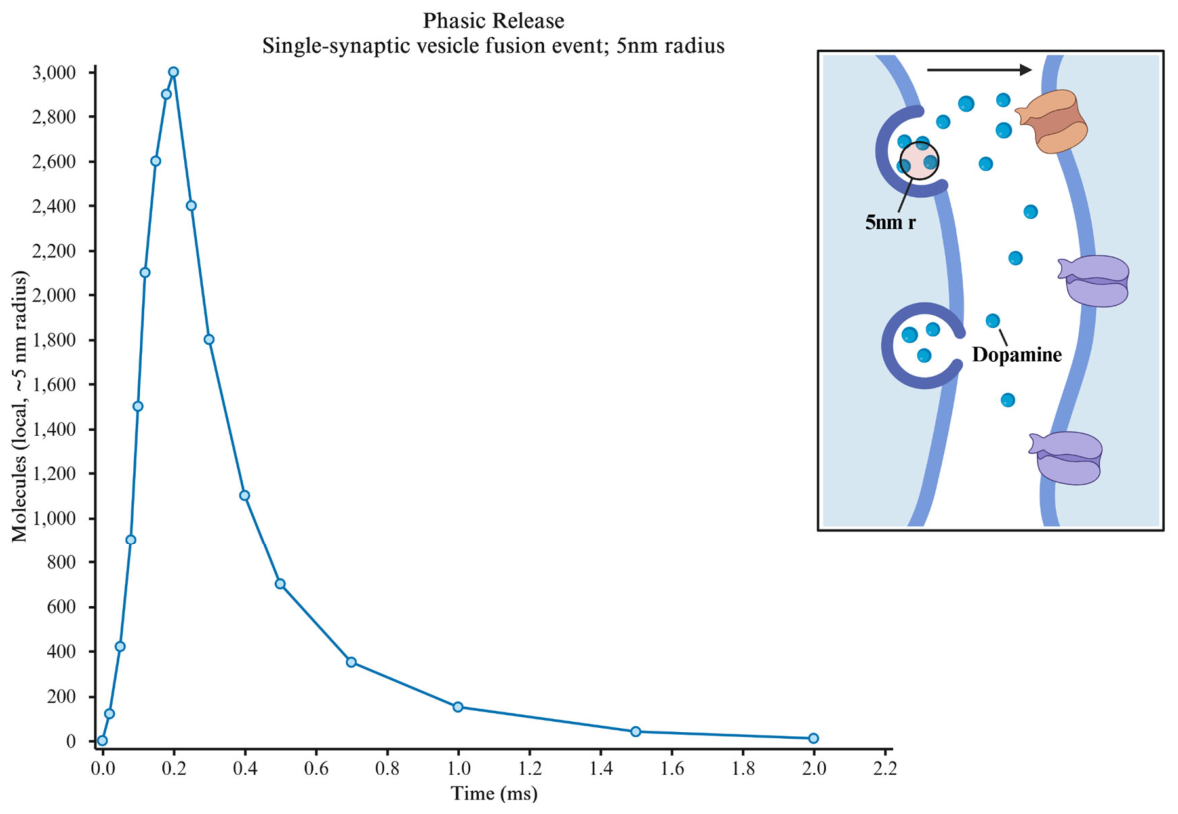
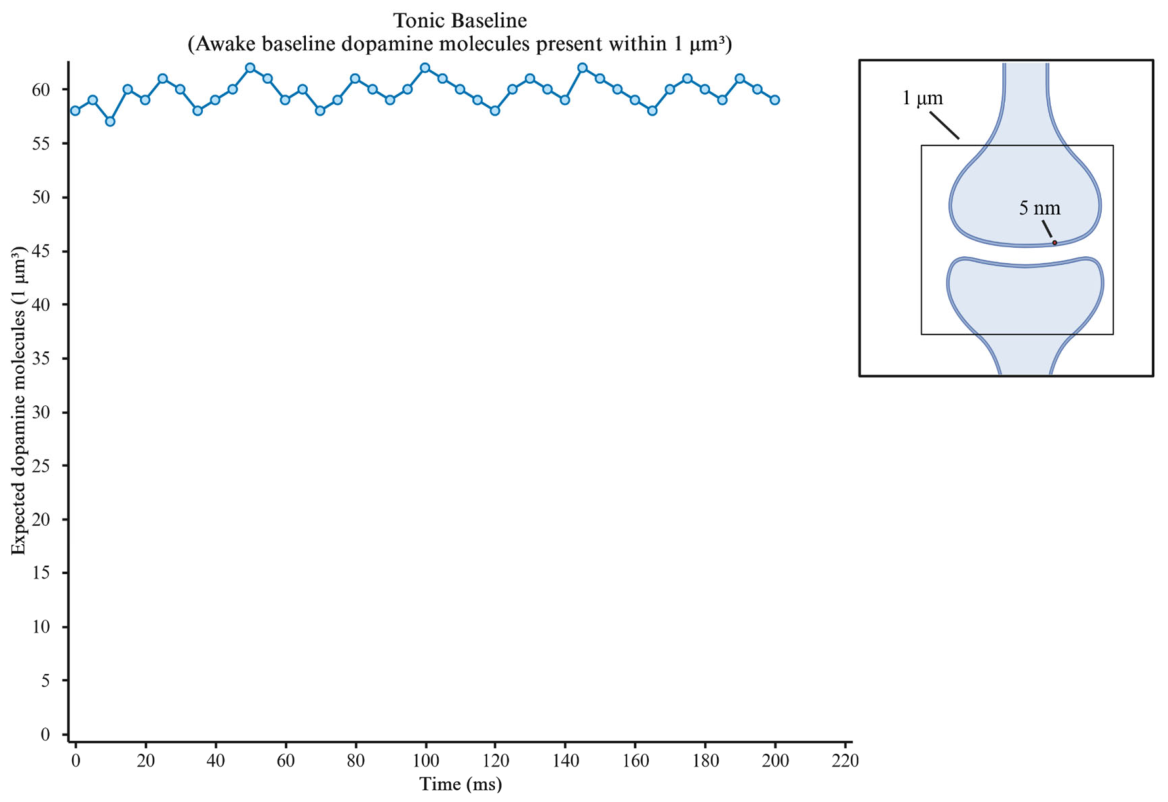
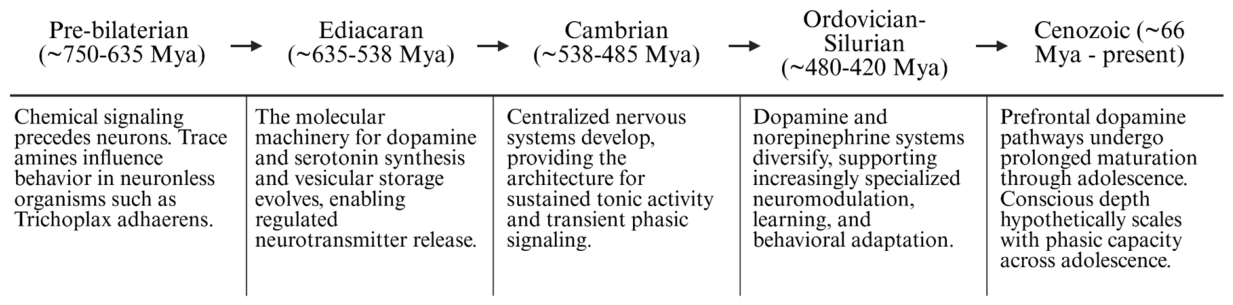
Disclaimer/Publisher’s Note: The statements, opinions and data contained in all publications are solely those of the individual author(s) and contributor(s) and not of MDPI and/or the editor(s). MDPI and/or the editor(s) disclaim responsibility for any injury to people or property resulting from any ideas, methods, instructions or products referred to in the content. |
© 2026 by the author. Licensee MDPI, Basel, Switzerland. This article is an open access article distributed under the terms and conditions of the Creative Commons Attribution (CC BY) license.
Copyright: This open access article is published under a Creative Commons CC BY 4.0 license, which permit the free download, distribution, and reuse, provided that the author and preprint are cited in any reuse.