

Submitted:
04 October 2026
Posted:
07 October 2026
You are already at the latest version
Abstract
Psychrophilic dinoflagellates are a group of microalgae that, together with psychrophilic diatoms, contribute to the functioning of cold-water ecosystems. One of the important species in these ecosystems is Peridiniella catenata, which is capable of developing both in under-ice waters and within sea ice. The species has been reported from northern marine waters ranging from the Baltic Sea to the coast of Canada. In the present study, we provide the first 18S and ITS2 rDNA sequences for this species and clarify its phylogenetic position based on three ribosomal markers (18S, ITS2, and 28S rDNA). We confirm the ability of P. catenata to develop under very low-salinity conditions. An extensive search for P. catenata-like sequences in DNA metabarcoding datasets indicates a broad distribution of closely related Peridiniella taxa. In particular, our results suggest that P. catenata or a closely related Peridiniella species may occur not only in the Northern Hemisphere but also in Antarctic waters.
Keywords:
Dinophyceae
; psychrophilic protists
; winter bloom
; Baltic Sea
; Antarctica
Introduction
Photosynthetic organisms are an integral component of low-temperature ecosystems, including habitats such as sea ice and the underlying waters, where only a small fraction of incident solar radiation penetrates [1]. One of the dominant phytoplankton species during the spring bloom in the Baltic Sea is the dinoflagellate Peridiniella catenata (originally described as Peridinium catenatum) [2,3,4,5]. In the northern Baltic Sea, its blooms occur from April to May, reaching on the order of 105 cells L−1, and terminate following nitrogen depletion, accompanied by cyst formation, which occurs to a large extent in deeper water layers [6]. In addition to the Baltic Sea, this species has been reported from almost all coastal regions of the Arctic seas, occurring not only in the plankton but also in sea-ice samples [7]. Okolodkov [8] characterized P. catenata as a cold-water, euryhaline, brackish-to-marine, planktonic-sympagic (ice-associated), Arctic-boreal species whose distribution is closely linked to its biological association with sea ice.
Environmental records of P. catenata demonstrate not only its ability to persist under low-temperature conditions but also its high tolerance to a wide range of salinities, which may contribute to its occurrence in sea ice. The salinity of the surrounding waters in which P. catenata was recorded as a dominant species in sea-ice samples ranged from 4.1 to 33.6 [8]. The species has also been reported from waters with a salinity of approximately 2 [9]. Considering the occurrence of active P. catenata blooms in coastal Arctic waters near river mouths [10], as well as throughout the Baltic Sea, including regions with salinities of 4–6 [11,12], the species may be better characterized as brackish-water rather than strictly marine.
To date, P. catenata is one of the few candidates for a strictly psychrophilic species, i.e., a species unable to grow at temperatures above 10 °C. However, further observations from non-Arctic ecosystems are required to substantiate this classification [13]. Although the species has been known since 1894 [14], its taxonomic position remains unclear. Molecular data for P. catenata have been limited, with only a fragment of the 28S rRNA gene available, which has hampered reliable placement of the species in phylogenetic analyses [15]. The lack of an 18S rRNA reference sequence also limits its reliable identification in environmental samples, where the 18S rRNA gene is commonly used as a metabarcoding marker. For example, in [16] it was suggested that an abundant ASV detected in their 18S rRNA gene metabarcoding study of Baltic Sea ice and under-ice waters might represent P. catenata. However, because no P. catenata 18S rRNA reference sequence was available, the identity of this ASV could not be confirmed. In the present study, we provide new data on P. catenata that contribute both to clarifying its taxonomic position and to improving its detection and monitoring in natural communities.
Materials and Methods
Sampling and Microscopy
Samples were taken 29 March 2026 near the Finish Bay shore (59.97925, 29.122457) and in the lake Gorovaldayskoe (59.57797, 29.07353) using plankton net. Both water bodies still had a partial ice cover. The physico-chemical parameters of the water were measured using Combo pH/Conductivity/TDS Tester (HANNA HI98130). Both living cells and cells preserved in 1.5% Lugol solution were investigated under the light microscope (DM2500, Leica). A clonal non-axenic culture f Peridinella catenata was isolated from single-cells and cultured in f/2 medium (salinity 4) based on artificial seawater.
DNA Sequencing and Phylogenetic Analysis
For PCR amplification from a single cell, an isolated dinoflagellate cell was first photographed and then subjected to several freeze–thaw cycles, after which the lysate was directly used as the PCR template. Dinoflagellate-specific primers and PCR conditions were as described in a previous study [17]. The nucleotide sequences of the obtained 18S rDNA and 5.8S–ITS2–28S rDNA fragments were determined by Syntol. The newly obtained DNA sequences were deposited in GenBank under accession numbers: QB097459 and QB113398.
For phylogenetic analysis, sequences closely related to the obtained DNA fragments were identified by BLAST searches against GenBank. In addition, species belonging to the same major clades as P. catenata according to [18] and [15] were included in the analysis. The alignment matrix was generated from concatenated 18S–ITS2–28S rDNA regions using MAFFT [19] and TrimAl [20]. A maximum-likelihood (ML) phylogenetic tree was reconstructed using IQ-TREE, which selected GTR+F+R6 as the best-fit evolutionary model [21]. Branch support was assessed using SH-like approximate likelihood ratio tests (SH-aLRT) with 1,000 replicates [22] and ultrafast bootstrap (UFBoot) with 1,000 replicates with 1,000 replicates [23]. Bayesian inference (BI) analyses were performed in MrBayes v3.2 [24] using GTR+G as the evolutionary model. The analysis was run for 5 × 10⁶ generations using six Markov chain Monte Carlo (MCMC) chains (two heated and four cold chains), starting from a random tree. Trees were sampled every 1,000 generations, and the first 35% of sampled trees were discarded as burn-in.
Sequence Search in the PR2 Database
Sequencing of the 18S rDNA region enabled us to search for the V4 region among DNA metabarcoding data available in the PR2 database, version 4.0.0 [25]. For this analysis, the boundaries of the V4 region were defined according to the convention used in the database rather than by the primer positions, because sequences in metaPR2 are trimmed three nucleotides upstream of the V4 region defined by the primers [26]. Although sequence differences were evaluated only within positions 205–583, each ASV was aligned against the complete 1,272-bp reference sequence rather than against the extracted V4 region. This approach was used because different datasets in metaPR2 apply different trimming procedures, resulting in variation in amplicon length. A global alignment against a fixed-length V4 reference could therefore exclude genuine matches because of differences in the length and boundaries of the deposited ASVs. Because some datasets contain ASVs in the reverse-complement orientation, both the original and reverse-complement sequences were aligned for each ASV. As an additional validation, the target sequence was searched against a database comprising all 229,313 ASVs using BLAST+ with -perc_identity 99 and -qcov_hsp_perc 98. The results were consistent with those obtained from the alignment-based search.
To analyze the occurrence of the target DNA fragment in samples collected at different temperatures, occurrence was normalized for sampling effort because the database contains substantially more samples from surface waters and temperate regions than from deep waters and polar regions. For each temperature interval, we calculated the proportion of samples containing the target sequence among all V4 samples with an available temperature measurement (9,241 of 24,839 samples). A 95% Wilson confidence interval was calculated for each proportion. Because occurrence indicates only whether a sample contained at least several reads of the target sequence, we additionally calculated, for the same temperature intervals, the median, 90th percentile, and maximum relative abundance of the target sequence within samples, as well as the proportion of all target-sequence reads contributed by each temperature interval. To generate figures based on the data obtained, custom python codes were used.
Results and Discussion
Occurrence and Active Growth of Peridiniella catenata at Low Salinity
Morphological and molecular genetic analyses of dinoflagellates from a coastal sample collected in the Gulf of Finland revealed the presence of Apocalatium malmogiense and Peridiniella catenata. Peridiniella catenata (Figure 1) visually dominated the net sample and was actively developing, forming chains of 4–8 cells. Both species are well known as important components of the under-ice plankton of the Baltic Sea [6]. The presence of ice and a water temperature of 3.6 °C provided conditions suitable for the development of these species. It is important to note, however, that although the ability of A. malmogiense to develop at salinities ranging from 0 to 30 has been experimentally demonstrated [27], comparable experimental data are not available for P. catenata. In natural samples, P. catenata is generally recorded at salinities of 2–4 and higher [8].
The salinity of our sample was 1.6 PSU, with a pH of 8.6 — even below the salinity range previously reported for active development of P. catenata. The active development of P. catenata at such a low salinity demonstrates its pronounced euryhalinity. However, the species was not detected in the freshwater lake closest to the sampling site, where similarly suitable low-temperature conditions were present. Thus, complete crossing of the marine–freshwater boundary by P. catenata has still not been demonstrated, consistent with the previously suggested difficulty of crossing this boundary [28].
Global Distribution of P. catenata-like 18S rRNA Sequences
P. catenata is a cultivable species [29,30], and a culture was also established from the sample analyzed in the present study. However, although P. catenata is one of the important dinoflagellates of Arctic phytoplankton [31], until recently only a 985-bp fragment of the 28S rRNA gene from a single strain had been sequenced. The lack of 18S rRNA gene data has limited reliable identification of this species in numerous studies based on 18S rRNA gene metabarcoding. Here we obtained a 1,272-bp fragment of the 18S rRNA gene and made its extencive search within 18S rDNA environmental datasets.
Distribution and Abundance in GenBank and metaPR² Databases
A search of GenBank using the 18S rRNA sequence showed that three sequences of unidentified dinoflagellates reported by [32] are completely identical to our P. catenata sequence. Approximately 30 additional sequences from the same study show 99.84–99.92% identity. According to [32], this 18S rRNA sequence belonged to the only dinoflagellate detected simultaneously in four different types of samples collected in the Baltic Sea: water, pancake ice, winter ice, and spring ice. This observation is consistent with [8] view that P. catenata is closely associated with sea ice and that ice may play an important role in its life cycle. We suggest that P. catenata may also be capable of developing within the brine channels or other microhabitats of sea ice. Similar behavior has been demonstrated for the freshwater psychrophilic dinoflagellate Gymnodinium baicalense [33].
The closest Prorocentrum sequences to P. catenata show 99.47% identity. Therefore, to search the metaPR² database, which currently contains 229,313 ASVs (V4 region) from 24,839 samples and 187 datasets, we used strict criteria to identify sequences that could belong to P. catenata or, at least, to closely related species of the same genus. We searched for sequences with either complete identity or a difference of one nucleotide, with a minimum overlap of 95% (this threshold was selected to avoid excluding ASVs that were 8–10 nucleotides shorter than the others because of technical differences among datasets.)
The search identified five ASVs with 100% identity to our P. catenata sequence, representing 1,918,350 reads, and an additional 37 ASVs differing by one nucleotide, representing 2,762,049 reads. The geographical distribution of these sequences (Figure 2A) indicates that they occur widely throughout the marine environment. However, the abundance of the sequence should be considered in addition to its mere occurrence. Taking this into account, we found that the core distribution of the P. catenata-like sequences appears to be concentrated in polar and subpolar waters. Notably, P. catenata-like sequences were detected at various depths. Although most occurrences were concentrated within the upper 100 m, the sequences were also present at appreciable relative abundances down to 1,000 m and were detected at depths exceeding 1,000 m.
For comparison, we examined the distribution of another psychrophilic dinoflagellate, Polarella glacialis, which is known as an ice-associated bipolar species and also forms cysts [34]. Polarella glacialis provides a useful comparison because its resting cysts are known to be released from sea ice during seasonal melting and subsequently exported through the water column. Cysts have been detected in sediment traps at depths of 75–200 m weeks after sea-ice melt, and advection and resuspension have been proposed as possible mechanisms contributing to their distribution [35]. In contrast to the P. catenata-like sequence, the identical marker fragment of P. glacialis was detected exclusively in polar regions (Figure 2B). P. glacialis sequences have likewise been detected in deep-water layers.
Relationship of P. catenata-Like Sequences with Temperature
We also analyzed the relationship between the occurrence of the P. catenata-like sequence and water temperature. This analysis should be interpreted with some caution because temperature was measured unevenly among datasets and was available for only 37% of the samples in the metaPR² database. The presence of the sequence was virtually independent of a particular temperature range (Figure 3A), whereas its abundance showed a clearer relationship with temperature (Figure 3B): in warm waters, the sequence usually occurred only in trace amounts, represented by a few to several tens of reads among tens of thousands of reads, whereas high relative abundances were more frequently observed in cold waters.
Nevertheless, among the 1,273 samples containing P. catenata-like sequences and collected at temperatures of 20 °C or higher, 162 samples were notable for their relatively high abundance. In these samples, the P. catenata-like sequences represented at least 1% of the community, reaching 7.0% in one sample. These samples originated from 14 independent projects, indicating that this pattern is not an artifact of a single dataset. Most were surface samples, with a median sampling depth of 5 m and a median temperature of 24.6 °C. In addition, four samples collected at temperatures above 20 °C, including samples from the Gulf of Mexico, Hawaii, and the coast of Spain, were based on RNA. Because these datasets involved reverse transcription followed by sequencing of the same V4 region, their detection may indicate the presence of metabolically active organisms at these temperatures. However, RNA-based detection alone does not demonstrate active growth. No evidence was found to suggest that a particular sequence predominates at low temperatures whilst another predominates at relatively high temperatures.
Cosmopolitan Dinoflagellate or Cryptic Diversity?
It is unlikely that all of the P. catenata-like sequences (Figure 2A) belong to actively growing P. catenata and that this species is therefore a cosmopolitan organism capable of developing at high temperatures, although preferring temperatures below 10 °C. If this was the case, P. catenata might be expected to continue developing in the Baltic Sea during summer. Instead, the species enters a resting stage extensively at temperatures above 7 °C [12]. Therefore, it is unlikely that P. catenata-like sequences in warmer areas reflect active growth of this species.
The ability to form cysts may explain some detections in warm water as well as in deep area (even at considerable depths), because cysts can be transported independently of active growth. In the Baltic Sea, cyst formation by actively migrating P. catenata has been shown to occur to a considerable extent in deeper layers, below the photic zone [12]. Cysts could potentially be transported from polar or subpolar regions over long distances by ocean currents, settle in deep-water areas, and persist there for extended periods. The occurrence of cysts in warmer waters could potentially result from their transport with sea ice or icebergs and subsequent release during melting. However, the comparison with P. glacialis distribution suggests that cyst formation alone may not fully explain the broad apparent distribution of the P. catenata-like sequence. Despite its capacity for cyst formation and dispersal, P. glacialis has a predominantly bipolar distribution and our analysis supports this. Therefore, cyst-mediated transport alone may not necessarily result in a broadly cosmopolitan distribution of environmental sequences. It is highly desirable to investigate cyst features of particular species, because the potential for long-distance transport of dinoflagellate cysts depends on their sinking velocity, morphology and aggregation state [36,37]. In particular, a slow-sinking cyst can potentially travel much farther horizontally than a fast-sinking cyst (or aggregate-associated cysts of many cysts) under the same current regime [37]. There is no such specific study of P. catenata cysts, thus we keep the idea, that some of found P. catenata-like environmental sequences could belong to cysts and dead cell fragments.
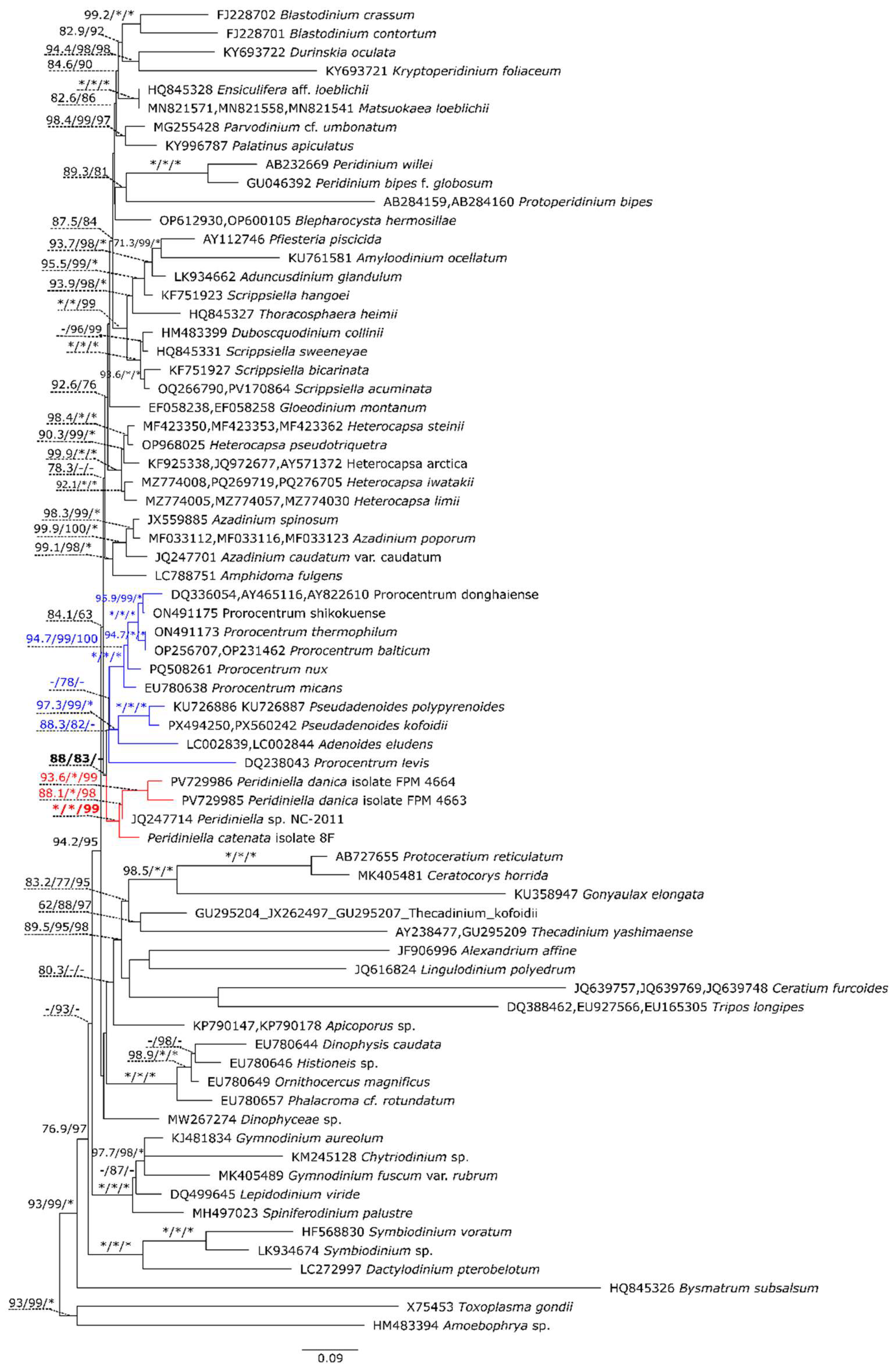
However, cyst formation alone is less readily compatible with samples in which P. catenata-like sequences represented a substantial proportion of the community (1–7%), particularly when the data were derived from RNA. We hypothesized that the broad distribution of the 18S rRNA gene barcode fragment identical to that of P. catenata is more likely explained by the existence of other representatives of the genus Peridiniella whose 18S rRNA sequences are nearly identical to that of P. catenata. At present, four species are assigned to Peridiniella based on morphological characteristics: P. catenata, P. globosa, P. danica, and P. sphaeroidea. P. sphaeroidea occurs in tropical waters [38], whereas Peridiniella danica is distributed in European seas [39,40] and has also been reported from the coast of South America [38]. P. globosa has a broad distribution in the oceans [38,41]. Our phylogenetic analysis based on concatenated 18S rRNA–ITS2–28S rRNA sequences showed that P. catenata clustered with P. danica and Peridiniella sp. JQ247714, with 100% ML and 99% BI support (Figure 4). Thus, the close phylogenetic relationship among these taxa provides an additional reason to consider the possibility that closely related Peridiniella species may share highly similar V4 sequences. The low variability of the V4 region of the 18S rRNA gene among closely related species is a known phenomenon [42]. Thus, there is no surprise, that the P. catenata V4 sequence differs by less than 1% from sequences of some Prorocentrum species, despite these taxa belonging to different genera. We therefore suggest that sequence divergence among closely related Peridiniella species may be similarly low or even insufficient for reliable discrimination using the V4 region alone. The broad temperature range represented by these sequences (Figure 3) could therefore reflect the combined environmental ranges of several species rather than the thermal range of P. catenata alone or its cysts. In turn, P. glacialis is known as the only living member of the genus. Indeed, according to Figure 2B its distribution is restricted to the poles, as is to be expected for this species.
The occurrence of P. catenata-like sequences in Antarctic samples is particularly noteworthy: to our knowledge, P. catenata itself has never previously been reported from Antarctica. This gap most likely reflects the absence, until the present study, of a reliable 18S rRNA reference sequence for identifying the species in metabarcoding data, rather than a genuine absence of the species. Given the strict association of these Antarctic sequences with cold water, and because among the currently described species of the genus Peridiniella only P. catenata is known to be an obligate psychrophile, active at temperatures around 0 °C, we consider it most likely that P. catenata itself, or a very close relative, is present in Antarctica. Although data on the temperature preferences of the other three species are limited, it can be said that P. sphaeroidea and P. globosa are likely thermophilic [15,43]. P. danica may inhabit cold-water seas [39], but its temperature optimum is most likely higher than that of P. catenata [43]. It is clear that further research is needed, both into these species and into the search for new, related species. It has previously been demonstrated that the strict cryophiles P. glacialis and A. malmogiense are active in both the Arctic and the Antarctic [34,44]. If P. catenata joins these dinoflagellates, this would strengthen the view that, for strictly psychrophilic dinoflagellates, cold-water conditions rather than geographic distance are the primary determinant of their distribution, allowing such species to cross vast distances between the poles.
Overall, our data show that the apparent geographical and temperature distributions of P. catenata-like 18S rRNA sequences are substantially broader than the currently known distribution of P. catenata itself. Both cyst-mediated dispersal and the presence of closely related species with nearly identical V4 sequences may contribute to such broad distribution observed in environmental datasets. At present, there is no unambiguous way to distinguish P. catenata from other closely related Peridiniella species using the 18S V4 region alone. For an adequate assessment of the distribution of microalgae, additional information on their physiology and microscopy-based observations is essential. For example, in [45] it was discussed the presence of P. glacialis in deep waters of the warm ocean based on an analysis of expressed genes. However, our data analysis (Figure 2B) showed that 18S rRNA sequences of this species were not detected at any depth in such environments. At the same time, we detected P. catenata 18S rDNA in various warm-water environments, but these findings cannot be used as evidence of its thermotolerance.
Phylogenetic Position of Peridiniella Catenata
The taxonomic position of both P. catenata and the genus Peridiniella among other dinophytes remains unresolved [15]. One of the reasons for this uncertainty is the limited availability of molecular genetic data. In the study by [18], a concatenated 18S–ITS–28S rDNA matrix was used to reconstruct a phylogenetic tree including 161 species and representing all major dinoflagellate groups. However, P. catenata was represented only by a fragment of the 28S rRNA gene, and its position in the tree received no statistical support. In the study by [15], analysis based exclusively on a fragment of the 28S rRNA gene also failed to resolve the position of P. catenata reliably. Moreover, Peridiniella danica was separated from P. catenata, suggesting that the genus Peridiniella may be polyphyletic, while P. catenata was separated from the genus Prorocentrum, with which it had clustered in previous studies [18,30].
In the present study, we obtained a longer 28S rRNA gene fragment (1,146 bp) from our isolate, which was almost identical to that previously known fragment of the 28S rRNA of P. catenata. Additionally, two other conventional molecular markers were sequenced – the partial 18S rRNA gene and the complete ITS2 sequence – which are the first such markers for the genus Peridiniella. We reconstructed an ML phylogenetic tree in which P. catenata was represented by three molecular markers, 18S rDNA, ITS2, and 28S rDNA. The resulting topology for Peridiniella was consistent with that reported by [18]. The clade comprising the genera Peridiniella, Prorocentrum, Adenoides, and Pseudadenoides (Figure 4) received moderate support in the ML analysis (SH-aLRT = 88% and ultrafast bootstrap [UFBoot] = 83%). Bayesian inference (BI) analysis yielded a similar topology for this clade, although with low statistical support. Within this clade, Peridiniella was sister to the group comprising Prorocentrum, Adenoides, and Pseudadenoides. Further taxon sampling, including new and potentially undescribed dinoflagellate species, will likely be necessary to resolve the position of Peridiniella unambiguously.
Notably, P. danica clustered with P. catenata and Peridiniella sp. NC-2011 with strong support (ML = 100%; BI = 99%), which is inconsistent with the hypothesis of a polyphyletic Peridiniella proposed by [15]. However, this result should be interpreted with caution because only a fragment of the 28S rRNA gene is currently available for P. danica and Peridiniella sp. NC-2011. More comprehensive molecular and morphological studies of all potential representatives of Peridiniella are therefore needed before the monophyly of the genus can be conclusively assessed.
Conclusions
Dinoflagellates of the genus Peridiniella are of particular interest because they combine features characteristic of several major dinoflagellate lineages. Although these are relatively large, free-living microalgae, the genus remains a taxon of uncertain phylogenetic position. The new genetic data obtained for perhaps the most intriguing representative of the genus, the psychrophilic P. catenata, provide new opportunities to investigate its phylogenetic relationships and geographical distribution. Despite its ability to adapt to a broad range of salinities, the species apparently has not crossed the brackish–freshwater boundary. However, our data suggest the possibility that P. catenata, or a closely related species, may occur in the Southern Hemisphere, in Antarctic waters.
Author Contributions
Conceptualization, N.V.A.; Methodology, N.V.A. and S.P.Yu.; Software, NVA and SPYu.; Data Curation, S.P.Yu; Writing – Original Draft Preparation, N.V.A.; Writing – Review & Editing, N.V.A. and S.P.Yu; Visualization, N.V.A.; Project Administration, N.V.A.; Funding Acquisition, N.V.A. All authors have read and agreed to the published version of the manuscript.
Funding
This work was carried out as part of RSF grant No. 25-24-00318 (https://rscf.ru/project/25-24-00318/).
Acknowledgments
The authors would like to thank Dr. I. S. Potravnov for his help with water sampling and Dr V. V. Annenkov for his assistance in preparing the illustrative material.
Conflicts of Interest
The authors declare no conflicts of interest.
References
- Montuori, E.; Saggiomo, M.; Lauritano, C. Microalgae from Cold Environments and Their Possible Biotechnological Applications. Mar. Drugs 2023, 21, 292. [Google Scholar] [CrossRef]
- Niemi, Å. Ecology of phytoplankton in the Tvärminne area, SW coast of Finland. II. Primary production and environmental conditions in the archipelago and the sea zone. Acta Bot. Fenn. 1975, 105, 1–73. [Google Scholar]
- Larsson, U.; Hobro, R.; Ulff, W. Dynamics of a phytoplankton spring bloom in a coastal area of the northern Baltic Proper. Contrib. Askö Lab. 1986, 30, 1–32. [Google Scholar]
- Lipsewers, T.; Klais, R.; Camarena-Gómez, M.T.; Spilling, K. Effects of different plankton communities and spring bloom phases on seston C:N:P:Si:chl a ratios in the Baltic Sea. Mar. Ecol. Prog. Ser. 2020, 644, 15–31. [Google Scholar] [CrossRef]
- Wasmund, N.; Nausch, G.; Matthäus, W. Phytoplankton spring blooms in the southern Baltic Sea—spatio-temporal development and long-term trends. J. Plankton Res. 1998, 20, 1099–1117. [Google Scholar] [CrossRef]
- Spilling, K. On the Ecology of Cold-Water Phytoplankton in the Baltic Sea. Ph.D. Thesis, University of Helsinki, Faculty of Biosciences, Helsinki, Finland, 2007. [Google Scholar]
- Okolodkov, Y.B.; Dodge, J.D. Biodiversity and biogeography of planktonic dinoflagellates in the Arctic Ocean. J. Exp. Mar. Biol. Ecol. 1996, 202, 19–27. [Google Scholar] [CrossRef]
- Okolodkov, Y.B. An ice-bound planktonic dinoflagellate Peridiniella catenata (Levander) Balech: Morphology, ecology and distribution. Bot. Mar. 1999, 42, 333–341. [Google Scholar] [CrossRef]
- Iljash, L.V.; Koltsova, T.I. The phytoplankton of Yenisey Bay. Hydrobiol. J. (In Russian with English summary). 1981, 17, 3–8. [Google Scholar]
- Kiselev, I.A. On the algal flora of the Ob’ Inlet with supplement of some data on the algae of the lower Ob’ and Irtysh rivers. In Algae and Fungi of Siberia and the Far East, Part 1(3); (In Russian). Popova, T.G., Vasiljeva, L.N., Eds.; Nauka: Novosibirsk, Russia, 1970; pp. 41–54. [Google Scholar]
- Olli, K.; Heiskanen, A.S. Seasonal stages of phytoplankton community structure and sinking loss in the Gulf of Riga. J. Mar. Syst. 1999, 23, 165–184. [Google Scholar] [CrossRef]
- Spilling, K.; Kremp, A.; Tamelander, T. Vertical distribution and cyst production of Peridiniella catenata (Dinophyceae) during a spring bloom in the Baltic Sea. J. Plankton Res. 2006, 28, 659–665. [Google Scholar] [CrossRef]
- Annenkova, N.V.; Safonov, P.Y. Psychrophilic dinoflagellates: Diversity and future perspectives in molecular biology studies. Protistology 2026, 20, 85–102. [Google Scholar] [CrossRef]
- Levander, K.M. Peridinium catenatum n. sp. Eine kettenbildende Peridinee im finnischen Meerbusen. Acta Soc. Fauna Flora Fenn. 1894, 9, 1–19. [Google Scholar]
- Ruíz-García, U.T.; Okolodkov, Y.B.; Zamudio-Resendiz, M.E.; Núñez-Resendiz, M.L. Morphological and molecular assessment of Peridiniella (Dinophyceae): A polyphyletic genus. Phycologia 2025, 64, 498–505. [Google Scholar] [CrossRef]
- Majaneva, M.; Jääskeläinen, S.; Autio, R.; Blomster, J.; Rintala, J.M. Dynamics of cold-water dinoflagellates in the northern Baltic Sea based on 18S rRNA gene metabarcoding. Mar. Biodivers. 2024, 54, 51. [Google Scholar] [CrossRef]
- Annenkova, N.V.; Hansen, G.; Moestrup, Ø.; Rengefors, K. Recent radiation in a marine and freshwater dinoflagellate species flock. ISME J. 2015, 9, 1821–1834. [Google Scholar] [CrossRef]
- Gottschling, M.; Carbonell-Moore, M.C.; Mertens, K.N.; Kirsch, M.; Elbrächter, M.; Tillmann, U. Fensomea setacea, gen. & sp. nov. (Cladopyxidaceae, Dinophyceae), is neither gonyaulacoid nor peridinioid as inferred from morphological and molecular data. Sci. Rep. 2021, 11, 12824. [Google Scholar] [CrossRef]
- Katoh, K.; Standley, D.M. MAFFT multiple sequence alignment software version 7: Improvements in performance and usability. Mol. Biol. Evol. 2013, 30, 772–780. [Google Scholar] [CrossRef]
- Capella-Gutiérrez, S.; Silla-Martínez, J.M.; Gabaldón, T. trimAl: A tool for automated alignment trimming in large-scale phylogenetic analyses. Bioinformatics 2009, 25, 1972–1973. [Google Scholar] [CrossRef]
- Wong, T.K.F.; Ly-Trong, N.; Ren, H.; Demotte, P.; Baños, H.; Roger, A.J.; Susko, E.; Bielow, C.; De Maio, N.; Goldman, N.; Hahn, M.W.; Dos Reis, M.; Vinh, L.S.; Huttley, G.; Lanfear, R.; Minh, B.Q. IQ-TREE 3: Phylogenomic inference software using complex evolutionary models. Mol. Biol. Evol. 2026, 43, msag117. [Google Scholar] [CrossRef]
- Guindon, S.; Dufayard, J.F.; Lefort, V.; Anisimova, M.; Hordijk, W.; Gascuel, O. New algorithms and methods to estimate maximum-likelihood phylogenies: Assessing the performance of PhyML 3.0. Syst. Biol. 2010, 59, 307–321. [Google Scholar] [CrossRef]
- Hoang, D.T.; Chernomor, O.; von Haeseler, A.; Minh, B.Q.; Vinh, L.S. UFBoot2: Improving the ultrafast bootstrap approximation. Mol. Biol. Evol. 2018, 35, 518–522. [Google Scholar] [CrossRef]
- Ronquist, F.; Teslenko, M.; van der Mark, P.; Ayres, D.L.; Darling, A.; Höhna, S.; Larget, B.; Liu, L.; Suchard, M.A.; Huelsenbeck, J.P. MrBayes 3.2: Efficient Bayesian phylogenetic inference and model choice across a large model space. Syst. Biol. 2012, 61, 539–542. [Google Scholar] [CrossRef]
- Berney, C.; Mahé, F.; Henry, N.; Lara, E.; de Vargas, C.; EukBank Consortium. EukBank 18S V4 dataset. Zenodo 2023. [Google Scholar] [CrossRef]
- Stoeck, T.; Bass, D.; Nebel, M.; Christen, R.; Jones, M.D.; Breiner, H.W.; Richards, T.A. Multiple marker parallel tag environmental DNA sequencing reveals a highly complex eukaryotic community in marine anoxic water. Mol. Ecol. 2010, 19, 21–31. [Google Scholar] [CrossRef]
- Logares, R.; Rengefors, K.; Kremp, A.; et al. Phenotypically different microalgal morphospecies with identical ribosomal DNA: A case of rapid adaptive evolution? Microb. Ecol. 2007, 53, 549–561. [Google Scholar] [CrossRef]
- Logares, R.; Bråte, J.; Bertilsson, S.; Clasen, J.L.; et al. Infrequent marine–freshwater transitions in the microbial world. Trends Microbiol. 2009, 17, 414–422. [Google Scholar] [CrossRef]
- Hansen, G.; Moestrup, Ø. Light and electron microscopical observations on Peridiniella catenata (Dinophyceae). Eur. J. Phycol. 1998, 33, 293–305. [Google Scholar] [CrossRef]
- Daugbjerg, N.; Hansen, G.; Larsen, J.; Moestrup, Ø. Phylogeny of some of the major genera of dinoflagellates based on ultrastructure and partial LSU rDNA sequence data, including the erection of three new genera of unarmoured dinoflagellates. Phycologia 2000, 39, 302–317. [Google Scholar] [CrossRef]
- Okolodkov, Y.B. Biogeography of Arctic-boreal and bipolar dinoflagellates. Bot. J. Russ. Acad. Sci. 1996, 81, 18–30. [Google Scholar] [CrossRef]
- Majaneva, M.; Rintala, J.M.; Piisila, M.; Fewer, D.P.; Blomster, J. Comparison of wintertime eukaryotic community from sea ice and open water in the Baltic Sea, based on sequencing of the 18S rRNA gene. Polar Biol. 2012, 35, 875–889. [Google Scholar] [CrossRef]
- Annenkova, N.V.; Hansen, G.; Rengefors, K. Closely related dinoflagellate species in vastly different habitats–an example of a marine–freshwater transition. Eur. J. Phycol. 2020, 55(4), 478–489. [Google Scholar] [CrossRef]
- Montresor, M.; Lovejoy, C.; Orsini, L.; Procaccini, G.; Roy, S. Bipolar distribution of the cyst-forming dinoflagellate Polarella glacialis. Polar Biol. 2003, 26, 186–194. [Google Scholar] [CrossRef]
- Harðardóttir, S.; Haile, J.S.; Ray, J.L.; et al. Millennial-scale variations in Arctic sea ice are recorded in sedimentary ancient DNA of the microalga Polarella glacialis. Commun. Earth Environ. 2024, 5, 25. [Google Scholar] [CrossRef]
- Anderson, D.M.; Lively, J.J.; Reardon, E.M.; Price, C.A. Sinking characteristics of dinoflagellate cysts. Limnol. Oceanogr. 1985, 30, 1000–1009. [Google Scholar] [CrossRef]
- Nooteboom, P.D.; Bijl, P.K.; van Sebille, E.; von der Heydt, A.S.; Dijkstra, H.A. Transport bias by ocean currents in sedimentary microplankton assemblages: Implications for paleoceanographic reconstructions. Paleoceanogr. Paleoclimatol. 2019, 34, 1178–1194. [Google Scholar] [CrossRef]
- Okolodkov, Y.B.; Gárate-Lizárraga, I. An annotated checklist of dinoflagellates (Dinophyceae) from the Mexican Pacific. Acta Bot. Mex. 2006, 74, 1–154. [Google Scholar] [CrossRef]
- Okolodkov, Y.B.; Dodge, J.D. Redescription of the planktonic dinoflagellate Peridiniella danica (Paulsen) comb. nov. and its distribution in the N.E. Atlantic. Eur. J. Phycol. 1995, 30, 299–306. [Google Scholar] [CrossRef]
- Hällfors, G. Checklist of Baltic Sea phytoplankton species (including some heterotrophic protistan groups). Balt. Sea Environ. Proc. 2004, 95, 1–208. Available online: http://hdl.handle.net/20.500.11822/676.
- Gupta, P. Algae of India. In A Checklist of Dinophyceae (Dinoflagellates); Botanical Survey of India, Ministry of Environment, Forest and Climate Change: Kolkata, India, 2022; Volume 5, pp. 1–74. [Google Scholar]
- Mordret, S.; Piredda, R.; Vaulot, D.; Montresor, M.; Kooistra, W.H.; Sarno, D. DinoREF: A curated dinoflagellate (Dinophyceae) reference database for the 18S rRNA gene. Mol. Ecol. Resour. 2018, 18, 974–987. [Google Scholar] [CrossRef]
- Fabro, E.; Almandoz, G. Field observations on rare or overlooked dinoflagellates from the Argentine Sea. Bol. Soc. Argent. Bot. 2021, 56, 123–140. [Google Scholar] [CrossRef]
- Annenkova, N.V.; Ahrén, D.; Logares, R.; Kremp, A.; Rengefors, K. Delineating closely related dinoflagellate lineages using phylotranscriptomics. J. Phycol. 2018, 54, 571–576. [Google Scholar] [CrossRef]
- Lazo-Murphy, B.M.; Peng, X. Unexpected abundance and gene expression of Polarella from a tropical oxygen deficient zone. Ocean-Land-Atmos. Res. 2025, 4, 0094. [Google Scholar] [CrossRef]
Figure 1.
Peridiniella catenata, light microscopy, the scale bar = 10 µm.
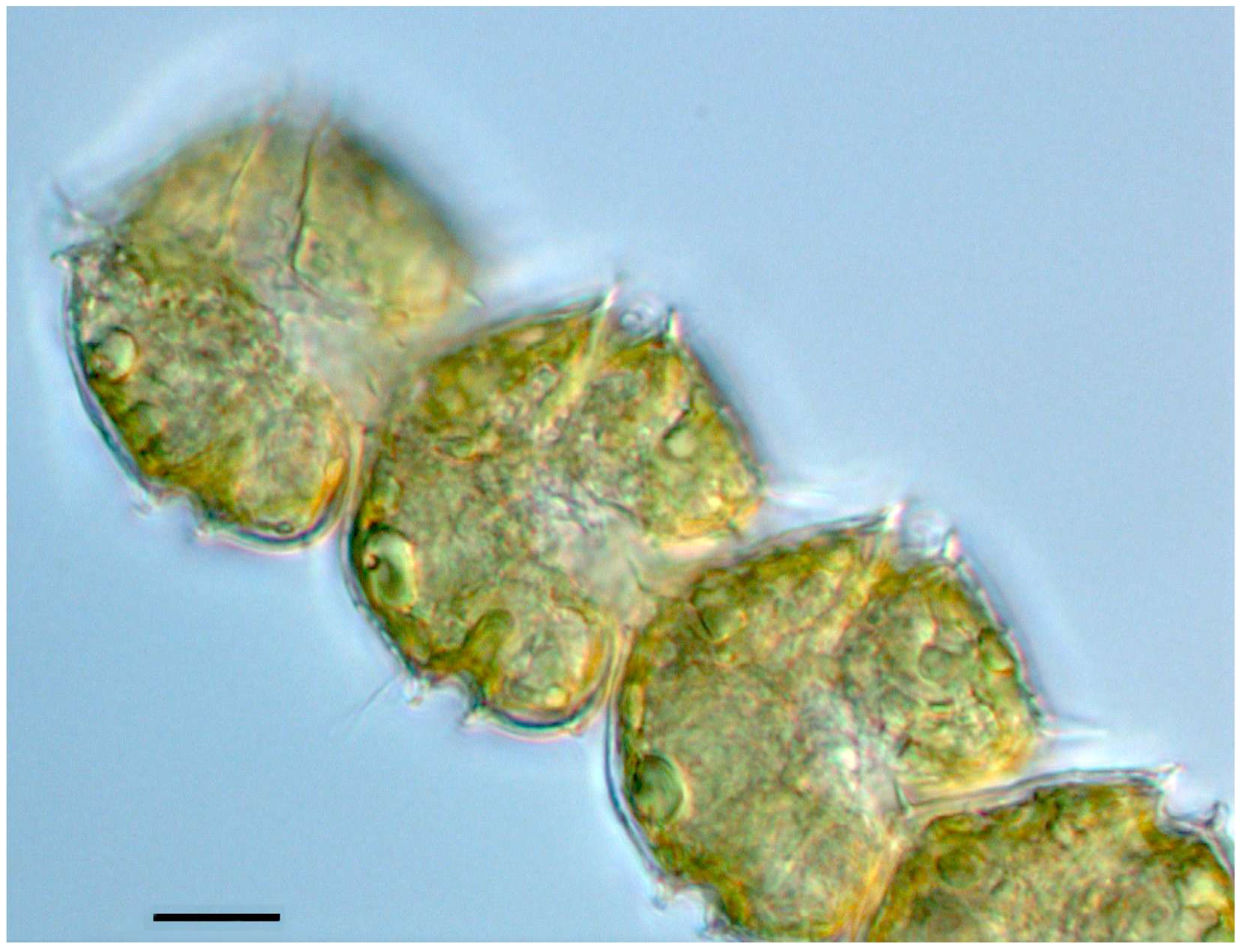
Figure 2.
Geographical distribution of Peridiniella catenata (A) and Polarella glacialis (B). Samples for which the water temperature is known to be ≥ 20 °C and the proportion of P. catenata-like rids is ≥ 1 % are marked with an asterisk *.
Figure 2.
Geographical distribution of Peridiniella catenata (A) and Polarella glacialis (B). Samples for which the water temperature is known to be ≥ 20 °C and the proportion of P. catenata-like rids is ≥ 1 % are marked with an asterisk *.
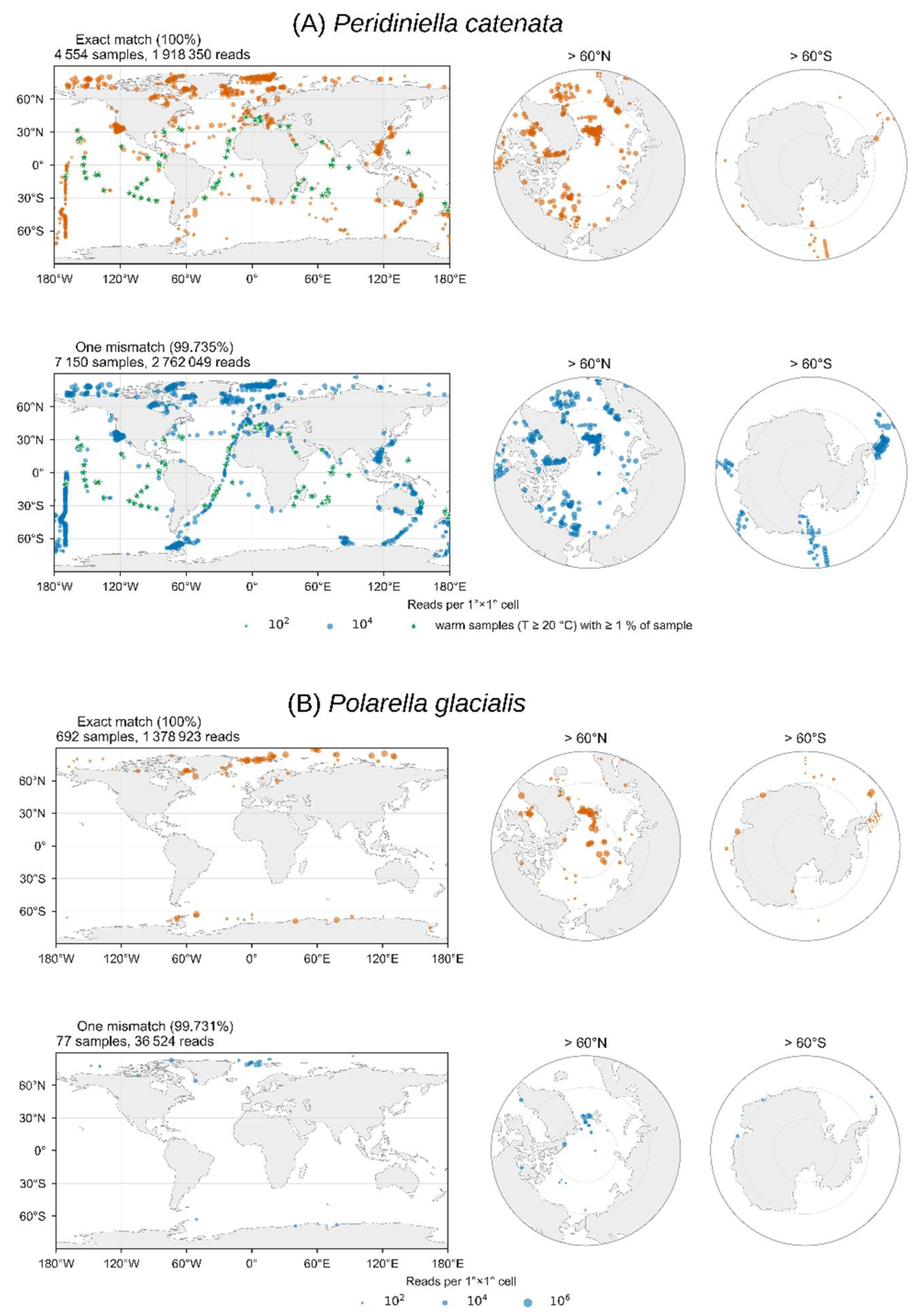
Figure 3.
The occurrence of Peridiniella catenata in waters of varying temperatures. Waters colder than 10 °C account for 32% of all P. catenata sequence reads and up to 24.8% of the community in a single sample, whilst waters warmer than 20 °C account for 13 % of the reads, with a maximum of 7.0 % in a single sample.
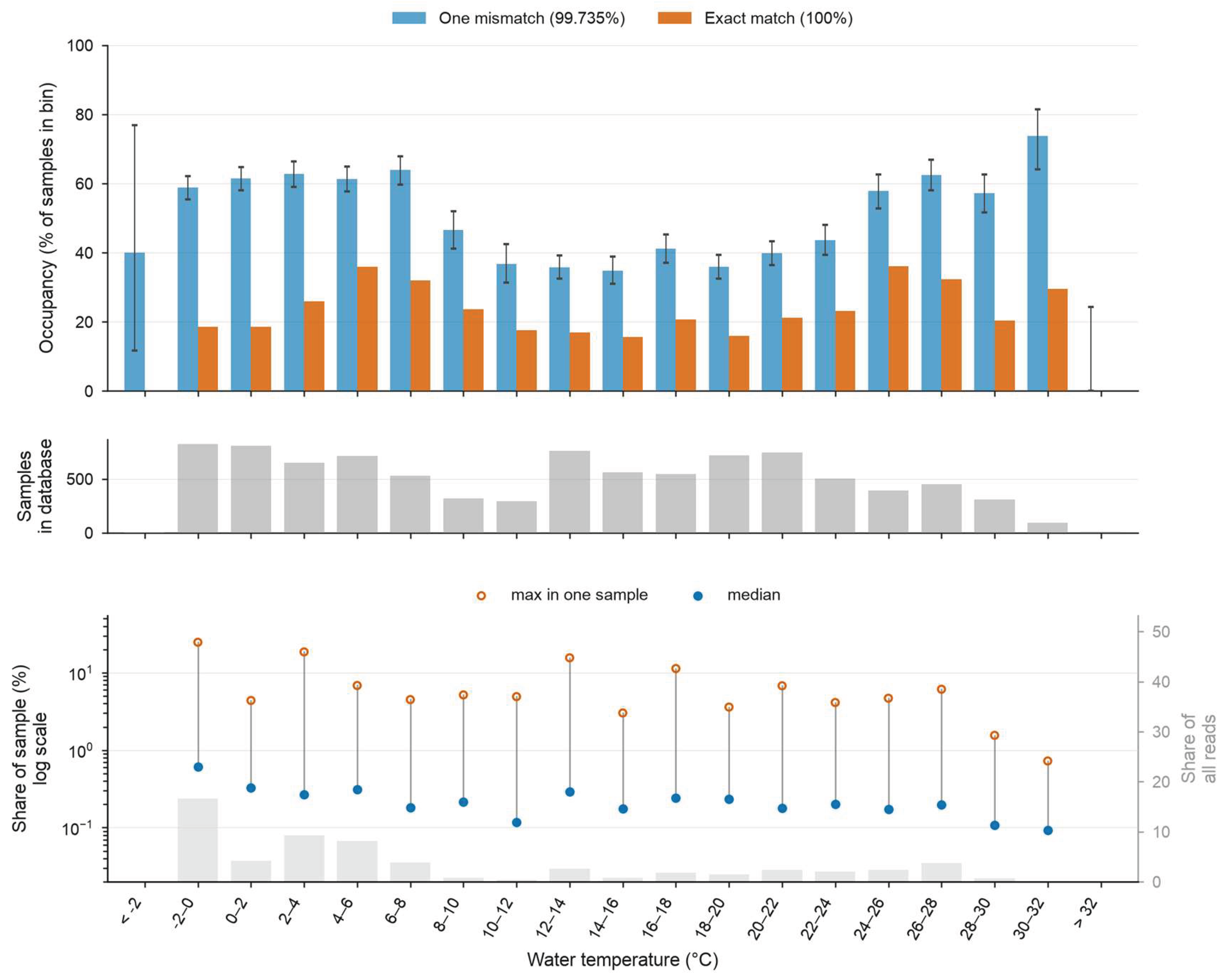
Figure 4.
Maximum likelihood phylogeny based on a partial 5.8S-ITS2-28S rRNA (1485 bp). Samples sequenced in this study are in bold. The numbers above the branches are ML bootstrap values (<70% are not shown) and the numbers below the branches are Bayesian posterior probabilities in percent (<0.90 are not shown).
Disclaimer/Publisher’s Note: The statements, opinions and data contained in all publications are solely those of the individual author(s) and contributor(s) and not of MDPI and/or the editor(s). MDPI and/or the editor(s) disclaim responsibility for any injury to people or property resulting from any ideas, methods, instructions or products referred to in the content. |
© 2026 by the authors. Licensee MDPI, Basel, Switzerland. This article is an open access article distributed under the terms and conditions of the Creative Commons Attribution (CC BY) license (http://creativecommons.org/licenses/by/4.0/).
Copyright: This open access article is published under a Creative Commons CC BY 4.0 license, which permit the free download, distribution, and reuse, provided that the author and preprint are cited in any reuse.