

Submitted:
03 October 2026
Posted:
07 October 2026
You are already at the latest version
Abstract
This hypothesis-generating paper proposes a hybrid theoretical framework for music performance anxiety (MPA) that separates two questions often conflated in the literature: how severe MPA is, and why it occurs. The model treats MPA severity as dimensional while hypothesizing that comparable levels of severity may arise through different dominant causal and maintaining mechanisms. Five provisional mechanistic profiles are proposed: skill-deficit, trait-anxious, social-evaluative, somatic-dominant, and trauma/shame-based MPA. These profiles are not presented as established natural kinds or mutually exclusive diagnostic categories; rather, they are clinically and theory-derived, overlapping configurations intended to generate discriminating empirical predictions. The paper first distinguishes physiological arousal from anxiety and performance impairment and reviews limitations in optimal-arousal, flow, positive/negative and facilitating/debilitating anxiety, and unitary accounts of MPA. It then specifies the causal architecture and core propositions of the hybrid model, proposes a multimethod research assessment battery, and derives profile-specific predictions concerning developmental history, contextual reactivity, psychophysiology, and treatment response. Treatment matching is framed as a testable moderation hypothesis rather than an established clinical algorithm. The model predicts that mechanism-informed treatment selection will explain outcome variance beyond baseline MPA severity. Alternative dimensional, hierarchical, network, and continuous-profile accounts are considered, and a program of taxonometric, latent-profile, longitudinal, experimental, psychophysiological, and stratified intervention research is proposed. The framework is intended as a falsifiable research program for explaining heterogeneity in MPA and improving mechanism-informed intervention.
Keywords:
music performance psychology
; hybrid model
; skill deficit
; trait anxiety
; social evaluative anxiety
; somatic dominant
; trauma/shame
Introduction: The Theoretical Problem
Music performance anxiety (MPA) occurs in very young children and remains prevalent throughout the lifespan of musicians, including highly trained performers. This persistence invites evolutionary, developmental, cognitive, psychophysiological, and relational accounts of why anxiety may continue despite increasing expertise and despite wide variation in objective performance outcomes (Kenny, 2011, 2026b). Existing integrative accounts implicate biological vulnerability, trait anxiety, early trauma and attachment rupture, cognitive appraisal, self-efficacy, perfectionism, self-focused attention, previous performance experiences, technical mastery, and social-evaluative educational environments. The resulting literature is rich but theoretically heterogeneous: different investigators often use the same label, MPA, for phenomena that may share surface symptoms while differing in causal history and maintaining mechanism.
The central theoretical problem addressed here is therefore not simply whether MPA varies in severity. It plainly does. The more consequential question is whether severity alone adequately represents the phenomenon. This paper advances the hypothesis that MPA is dimensional at the level of symptom severity but heterogeneous at the level of causal and maintaining mechanisms. Comparable total anxiety scores may therefore conceal different psychological and psychophysiological configurations, and those configurations may have different developmental histories, contextual triggers, and treatment-response patterns.
Defining the Explanandum: Arousal, Anxiety, and Impairment
For the purposes of this model, MPA is defined as an aversive cognitive-affective state associated with perceived threat in anticipation of, or during, musical performance, usually accompanied to varying degrees by physiological activation, attentional disruption, negative cognitions, and behavioral responses. This definition deliberately separates MPA from two related constructs. First, physiological arousal is not synonymous with anxiety: elevated heart rate, respiration, sweating, tremor, and muscle tension may accompany excitement, challenge, readiness, engagement, or anxiety. Second, performance impairment is a possible consequence of MPA, not part of its definition. Defining anxiety by whether a performance subsequently succeeds or fails makes outcome circularly constitutive of the predictor.
This distinction is consistent with two-factor and appraisal traditions in emotion theory. Physiological activation acquires emotional meaning through appraisal, although appraisal may be rapid, automatic, and outside conscious awareness (Schacter & Singer, 1962; Lazarus, 1991a, 1991b, 1999, 2000; Smith & Kirby, 2012). Challenge states occur when perceived resources are sufficient for demands, whereas threat states occur when demands are appraised as exceeding resources (Blascovich & Mendes, 2001). Accordingly, non-anxious performance activation should be conceptualized as adjacent to, rather than a low-severity form of, MPA.
Conceptual Problems in Prevailing Accounts of MPA
Optimal Arousal and the Problem of the Yerkes-Dodson Legacy
The concept of an optimal level of arousal has exerted a disproportionate influence on theorizing about performance. The Yerkes-Dodson “law” (Yerkes & Dodson, 1908) was derived from animal learning under varying task difficulty and punishment conditions yet the inverted-U has often been generalized to human anxiety-performance relations. In MPA research, this extrapolation is problematic because arousal and anxiety are frequently treated as interchangeable and because the putative ‘optimal’ point is not theoretically fixed, readily measurable, or strategically achievable (Rivera et al., 2025). Its adoption into sports psychology as individualized zones of optimal functioning changed the concept into concern regarding pre-competition affect rather than a temporally specified causal process governing musical performance quality in situ (Jokela & Hanin, 1999).
Empirical findings in music do not require an inverted-U account. Several studies report a negative linear association between anxiety and performance quality (Bissonnette et al., 2015; Yoshie et al., 2009; Yoshie et al., 2009). Anxiety may disrupt attention, memory retrieval, and fine motor execution, while physiological activation may interfere with the precision required for instrumental and vocal performance. These observations support treating anxiety severity as a continuous variable without assuming that anxiety itself becomes beneficial at an intermediate level.
A linear anxiety-performance relationship does not, by itself, establish that MPA is dimensional, because a linear performance decrement is compatible with dimensional, categorical, or mixed latent structures; the structural question is a separate empirical one (see below). It is nevertheless the case that the MPA literature has often implicitly assumed that MPA is a unidimensional construct from “career stress” at one end of the spectrum to “stage fright” at the other, with intensity of essentially somatic symptoms the primary measure of the severity of MPA (Brodsky, 1996; Brugués, 2018).
Flow
Flow originated in a different theoretical tradition concerned with intrinsic motivation and absorption when challenge and skill are well matched (Csikszentmihalyi et al., 2014). It later became entangled with optimal arousal accounts because boredom, flow, and anxiety can be arranged along a challenge-skill continuum. For present purposes, however, flow is not required to explain MPA. Its construct boundaries, causal mechanisms, induction procedures, and measurement remain contested (Farrokh et al., 2024; Lee-Shi & Ley, 2022; Waterman, 2025). “Achieving” flow is easier to describe than to reliably produce via replicable protocols or interventions. An attempted response to critics to rehabilitate flow theory merely highlighted that flow remains a model and the theory remains underspecified (Waterman, 2025). The hybrid model therefore treats flow as a potentially desirable performance state rather than as a component of the explanatory architecture of performance anxiety.
Positive, Negative, Facilitative, and Debilitating Anxiety
Distinctions between ‘positive’ and ‘negative’ MPA, or between ‘facilitative’ and ‘debilitating’ anxiety are descriptions of performers’ beliefs about their internal states but create a definitional problem when anxiety is classified by its consequences. The same physiological state may precede a successful performance on one occasion and an unsuccessful performance on another. If MPA is defined independently of outcome as threat-appraised, aversive activation, then challenge, excitement, and facilitative activation can be studied under their own names rather than redescribed as positive anxiety, which becomes devoid of meaning (Jones & Hanton, 2001; Herman & Clark, 2023).
Any activity that is performed in a social evaluative context will likely increase physiological arousal (Yoshie et al., 2009). When the same arousal is appraised as a challenge or as excitement, it is already adequately described by existing constructs, such as facilitative arousal, challenge appraisal, or eustress (Bosshard et al., 2026). Reappraising arousal as excitement may improve performance under some conditions, but this is a hypothesis about appraisal and regulation, not evidence that anxiety itself is intrinsically positive or facilitative (Sammy et al., 2017; Luan & Zhou, 2026).
Attention, Error Monitoring, and Reinvestment
Contemporary cognitive accounts offer more specific mechanisms linking anxiety to performance disruption. Attentional control theory predicts that anxiety alters the balance between goal-directed and stimulus-driven attention; performance errors may then increase estimates of the probability and cost of future failure, creating a recursive anxiety-error loop (Harris et al., 2023; Akiki et al., 2025). Reinvestment theory provides a complementary account of ‘choking under pressure’: skills practised to automaticity may be disrupted when anxious performers revert to conscious, rule-based monitoring of movements that normally proceed automatically (Masters & Maxwell, 2008). These processes are incorporated in the hybrid model as proximal maintaining mechanisms rather than as mutually exclusive theories of MPA.
MPA: Dimensional, Categorical, or Both?
The dimensional-categorical debate is often posed as an either-or question. A purely dimensional model assumes that MPA is one phenomenon varying principally in intensity; a categorical model assumes qualitatively distinct forms. The present proposal separates level of analysis. MPA severity may be continuous while the mechanisms generating that severity may cluster into recurring configurations. Thus, a musician’s location on a severity continuum and the dominant pathway producing that anxiety are conceptually distinct. Table 1 summarizes the dimensions of the two models.
The Hybrid Model: Severity Plus Mechanistic Heterogeneity
The model makes a deliberately modest ontological claim. The five proposed subtypes are not presented as established psychiatric taxa, mutually exclusive diagnoses, or natural kinds. They are provisional mechanistic profiles derived from converging clinical, developmental, cognitive, psychophysiological, and performance literature. Empirical work may ultimately show that they are best represented as fuzzy classes, continuous profile dimensions, hierarchical facets beneath a general MPA factor such as negative affect (Chang-Arana et al., 2018) or interacting nodes in a network. The theory is useful only if the proposed profiles add explanatory and predictive value beyond a single severity score.
A Common Causal Architecture
The profiles can be located within a common causal architecture: distal vulnerability → proximal trigger or appraisal → maintaining process → response phenotype → functional consequence. This resolves an apparent asymmetry among the proposed profiles. Trait anxiety is primarily a dispositional vulnerability; skill deficit is principally a competence-demand mismatch; social evaluation is a contextual and cognitive threat process; somatic dominance is a response-system phenotype with interoceptive maintenance; and trauma/shame is principally a developmental-relational pathway. They are therefore not five equivalent entities at the same explanatory level. They are five hypothesized dominant pathways through a shared architecture.
Core Propositions of the Hybrid Model
- Severity proposition. MPA severity varies continuously; no categorical diagnostic boundary is required by the model.
- Common-process proposition. Threat appraisal, autonomic activation, attentional disruption, and avoidance can occur across profiles, although their relative weighting differs.
- Heterogeneity proposition. Equivalent levels of MPA severity can arise through different dominant causal and maintaining mechanisms.
- Configurational proposition. These mechanisms recur in sufficiently systematic configurations to yield replicable profiles rather than only idiosyncratic individual variation.
- Non-exclusivity proposition. Profiles may overlap. A musician may show a primary mechanism and one or more secondary mechanisms, and profile weighting may change developmentally or contextually.
- Developmental proposition. Profiles should differ systematically in developmental and learning histories even after controlling for current MPA severity.
- Context-specificity proposition. Social-evaluative MPA should be especially sensitive to manipulations of observation, judgment, audition, examination, and reputational threat.
- Psychophysiological proposition. Somatic-dominant MPA should show relatively greater physiological/interoceptive activation and anxiety sensitivity than would be predicted from cognitive anxiety alone.
- Developmental-relational proposition. Trauma/shame-based MPA should be associated more strongly with attachment insecurity, shame proneness, relational trauma, and humiliation-related meaning than other profiles, independent of severity.
- Treatment-moderation proposition. Treatment outcome should be moderated by mechanistic profile; matching intervention to dominant maintaining mechanism should explain outcome variance beyond baseline severity.
Five Provisional Mechanistic Profiles
The five profile model proposes a shared dimensional core across all profiles; that is, the model assumes a common set of processes that vary in degree: threat appraisal (Lazarus, 1991a; Blascovich & Mendes, 2001), which may operate implicitly (Smith & Kirby, 2012); autonomic arousal; worry and self-focused attention; disrupted attentional control (Eysenck et al., 2007); and, under pressure, reinvestment in explicit control of skills previously learned to automaticity (Masters & Maxwell, 2008). Because the physiological, cognitive and behavioral components of anxiety are only partly concordant (Lang, 1971), severity should ideally be assessed across more than one response system.
1. Skill-Deficit Profile
Skill deficit is included cautiously because anxiety arising from insufficient preparation or task mastery may initially be adaptive rather than pathological. The profile becomes theoretically relevant when an objective or perceived competence-demand mismatch initiates a self-reinforcing cycle: inadequate mastery increases realistic error probability; errors amplify threat appraisal; anxiety promotes self-monitoring and reinvestment; disrupted execution produces further errors; and those errors strengthen future threat expectancy. This profile is expected to be especially common in students, younger musicians, musicians attempting repertoire beyond current mastery, or performers with inefficient practice strategies.
A discriminating prediction follows directly: when technical mastery, practice quality, and repertoire-demand mismatch are corrected, MPA should decline substantially even in the absence of anxiety-focused psychotherapy. Persistence of severe anxiety after demonstrable correction of the skill deficit would suggest either misclassification or an additional mechanism.
2. Trait-Anxious Profile
The trait-anxious profile conceptualizes MPA as one context-specific expression of broader negative affectivity or anxiety proneness. Anxiety should generalize across domains rather than be confined to performance. Family history of anxiety (i.e., generational transmission), chronic worry, heightened threat sensitivity (Valadez et al., 2022), and comorbid generalized anxiety symptoms are therefore expected to be more prominent. The defining feature is not simply high MPA but cross-situational anxiety vulnerability.
This profile is distinguished from social-evaluative MPA by breadth. A trait-anxious musician should remain relatively anxiety-prone across private practice, interpersonal situations, occupational stressors, and performance contexts, whereas the social-evaluative performer should show a sharper context-linked increase when observation and judgment are salient.
3. Social-Evaluative Profile
The social-evaluative profile is organized around fear of negative evaluation, embarrassment, judgment, status loss, and reputational consequences. Cognitive mechanisms derived from social-anxiety models such as biased self-evaluation, self-focused attention, negative imagery, post-event processing, and overestimation of audience scrutiny, are likely to be prominent (Osborne & Franklin, 2002; Dobos et al., 2019; Nicholl & Abbott, 2024). MPA and social anxiety disorder are not equivalent, and a musician may show severe performance-specific evaluative fear without broad social anxiety (Dobos et al., 2019; Nicholl & Abbott, 2024; Wiedemann et al., 2022).
The critical experimental prediction is contextual: manipulating evaluative threat while holding musical task difficulty constant should produce a larger increase in anxiety in this profile than in the trait-anxious or skill-deficit profiles.
4. Somatic-Dominant Profile
The somatic-dominant profile is characterized by pronounced autonomic or motor symptoms such as hand and finger tremor, tachycardia, sweating, dry mouth, respiratory change, or voice instability, and by heightened monitoring or catastrophic interpretation of those sensations (anxiety sensitivity). Lang’s (1971) three-systems model is particularly relevant because physiological, cognitive-verbal, and behavioral fear responses may be only partially concordant and may change at different rates over time. Somatic dominance expressed, for example, through hyperventilation (Studer et al., 2012) or interoceptive processes (Schirmer-Mokwa et al., 2015), is therefore better conceptualized as a pattern of response-system weighting than simply high anxiety with physical symptoms.
The model predicts relative discordance: physiological/interoceptive responding should be elevated relative to cognitive threat indices, and anxiety sensitivity should help explain persistence. Multimethod assessment is therefore essential; self-report alone cannot establish this profile.
5. Trauma/Shame-Based Profile
The trauma/shame-based profile is the most theoretically distinctive and, at present, the least experimentally established component of the model. Psychodynamic and attachment-informed accounts conceptualize severe MPA as performance-activated expression of deeper developmental and relational vulnerabilities rather than solely as a situational fear response (Hoffman, 2019; Kenny, 2025, 2026b; Nagel, 2018; Plaut, 1988; Weisblatt, 1986). Early attachment rupture, traumatic loss, chronic criticism, humiliating pedagogical experiences, conditional approval, or other experiences organized around shame may contribute to enduring self-representations that are reactivated by the evaluative gaze of an audience.
In this pathway, performance may acquire interpersonal meaning beyond the immediate task: exposure may signify rejection, humiliation, abandonment, or collapse of a valued self. Maintenance may involve perfectionism, harsh self-criticism, avoidance, defensive self-presentation, and recurrent activation of unprocessed affect. Qualitative work describing the ‘masquerade’, threatening performance environments, and intergenerational transmission of anxiety is compatible with this account (Miley et al., 2024), as are case-based studies of attachment rupture in severe MPA (Kenny et al., 2014; Kenny & Holmes, 2018).
The epistemic status of this profile should be explicit: current MPA-specific evidence is largely clinical, qualitative, and case-based. The theory therefore generates rather than resolves the empirical question. It predicts that attachment insecurity and shame proneness will discriminate this profile beyond overall MPA severity; that interpersonal meanings of rejection and humiliation will be stronger triggers than task difficulty alone; and that durable improvement will be associated with change in shame, relational functioning, and defensive organization rather than only reduced physiological arousal. Table 2 summarizes the key features of each subtype and Figure 1 summarizes the proposed model.
Alternative Structural Accounts and Boundary Conditions
The hybrid model has been developed from idiographic methods (in depth interviews and psychotherapy with anxious musicians). It should now be tested against plausible alternatives. A hierarchical model may reveal a strong general MPA factor with narrower mechanistic dimensions. A network model may explain covariance through interactions among symptoms and mechanisms without latent subtypes. A continuous multidimensional model may show that musicians vary along several mechanistic axes with no defensible class boundaries. Latent-profile methods can also produce apparent classes from continuous data, so class enumeration alone would not validate categorical subtypes. The model therefore does not require hard categories: its central claim is incremental explanatory value from mechanism configuration beyond severity.
Boundary conditions are equally important. The model is intended for anxiety linked to musical performance, not for ordinary activation appraised as challenge, isolated dissatisfaction with performance quality, or anxiety fully attributable to another acute medical or substance-related condition. Profiles should not be inferred from a single symptom or questionnaire factor, and profile assignment should remain probabilistic until validated.
Assessment: From Proposed Protocol to Research Battery
At this stage, a standardized diagnostic protocol would be premature. Instead, I propose an initial multimethod assessment battery for empirical evaluation of the hybrid model. The purpose is twofold: to locate musicians on a continuous MPA severity dimension and to measure candidate mechanisms independently enough to test whether reproducible profiles exist.

Table 2.
Candidate multimethod research assessment battery.
| Domain | Candidate measurement strategy |
|---|---|
| MPA severity | Kenny Music Performance Anxiety Inventory (K-MPAI; Kenny, 2023, 2026a). Total score provides a dimensional index. Factor scores may generate hypotheses but should not, by themselves, define profile membership. |
| Depression/hopelessness | PHQ-9 or equivalent validated measure, because depressive symptoms may influence severity, treatment response, and interpretation of vulnerability. |
| Trait anxiety | Spielberger State-Trait Anxiety Inventory, trait scale. |
| Generalized anxiety | Validated GAD severity measure. |
| Social-evaluative anxiety | Validated social anxiety severity measure plus performance-specific fear-of-evaluation items. |
| Panic/anxiety sensitivity | Panic severity and anxiety-sensitivity measures, particularly for somatic-dominant hypotheses. |
| Self-efficacy and mastery | General and music-performance self-efficacy, technical readiness, practice quality, repertoire-demand fit, and independent teacher/expert ratings where possible. |
| Attachment and shame | ECR-S or another validated attachment measure, supplemented by validated shame-proneness and developmental adversity measures. |
| Psychophysiology | Where feasible, heart rate/HRV, tremor or motor indices, respiratory measures, and repeated subjective anxiety ratings during standardized performance tasks. |
| Performance quality | Independent blinded ratings of performance quality, because symptom reduction and performance improvement are distinct outcomes. |
A critical methodological safeguard is to avoid circularity. K-MPAI factor scores should not simultaneously define the profiles and serve as evidence that those profiles exist. Profile validation requires independent indicators of developmental history, cognition, context sensitivity, physiology, skill/mastery, attachment, shame, and functional outcome.
Mechanism-Informed Intervention
The clinical implication of the model is a treatment-moderation hypothesis. Existing MPA intervention studies typically estimate average treatment effects across heterogeneous participants. If participants with different dominant mechanisms are combined, a treatment that is highly effective for one profile but minimally effective for another may yield only a modest aggregate effect. This provides one possible explanation for the inconsistent and generally moderate effects reported in the literature, but it remains to be tested (see Kinney et al., 2025 for a review). Accordingly, the interventions below are best described as candidate mechanism-matched treatments, not established or preferred treatments. The model predicts differential response; it does not assume it.
Matching Subtypes with Treatments
Skill-Deficit Pathway: Mastery and Pedagogical Intervention
For musicians whose anxiety is principally driven by a competence-demand mismatch, the primary intervention target is the mismatch itself: technical remediation, repertoire selection, deliberate and distributed practice, performance preparation, and repeated mastery experiences. The relevant literature on pedagogy, practice, motivation, and mastery is extensive (Abrahams, 2005; Cogdill, 2015; Gumm, 2023; Hallam, 2019; Hruska, 2011; Nielsen, 2004; Platz et al., 2014; StGeorge et al., 2012). Anxiety-focused treatment may be unnecessary unless a secondary maintaining mechanism has developed.
Trait-Anxious and Social-Evaluative Pathways: Cognitive-Behavioral (CB) Interventions
CBT offers several mechanisms relevant to trait-anxious and social-evaluative profiles: cognitive restructuring, graded exposure, behavioral experiments, attentional training, acceptance-based strategies, and regulation of avoidance. Cognitive-behavioral accounts locate maintenance in threat appraisal, self-focused attention, maladaptive perfectionism, self-efficacy, and biased interpretation of social evaluation. CB interventions often combine cognitive change methods with graded behavioural exposure (Candia et al., 2023) and performance skill training (see, for example, Chen, 2025). Other programs integrate psychoeducation, goal setting, cognitive restructuring, relaxation training, and behavioural exposure via solo performances with an audience. They report significant improvements in self-reported MPA at post-test for adherent students only, which frames engagement and implementation fidelity as key moderators of benefit (Osborne et al., 2007). Attentional training that teaches performers to identify negative thoughts across performance phases and substituting these negative thoughts with task-focused thoughts has also shown moderate benefit in reducing MPA (Bannon et al., 2026; Buma et al., 2015).
Studies of MPA generally report positive but moderate effects, with methodological limitations concerning heterogeneity, follow-up, mechanism measurement, and absence of performance-quality outcomes (Osborne et al., 2007; Buma et al., 2015; Faur et al., 2023). The hybrid model predicts that CBT components targeting evaluative cognition and self-focused attention should be effective when those mechanisms are elevated, while broader anxiety-management components may be more relevant to trait-anxious presentations. The critical test is not whether CBT reduces MPA on average, but whether measured mechanism predicts response to the component intended to alter it.
Somatic-Dominant Pathway: Interoceptive and Physiological Interventions
Somatic interventions include interoceptive exposure (IE), slow breathing, progressive muscle relaxation, mindfulness, yoga, and biofeedback but with the exception of IE, show low to nil effects on MPA. Their common rationale is regulation, tolerance, or reinterpretation of bodily activation. IE is particularly relevant when musicians fear the sensations of arousal itself. Evidence across MPA studies remains mixed and is constrained by small samples and heterogeneous inclusion criteria, although interventions emphasizing bodily awareness, acceptance, or deliberate exposure to feared sensations appear promising (Studer et al., 2012; Schirmer-Mokwa et al., 2015; Goldberg et al., 2022; Zhang et al., 2026).
Beta-blockers (BB) such as propranolol reduce peripheral sympathetic manifestations such as a racing heart, palpitations, shaking hands, sweating, digestive problems, and voice cracks inter alia. BB do not reduce the subjective experience of anxiety itself but may dull its effects in the absence of somatic expression. Their use requires medical assessment and supervision (for example, asthma and some cardiac conditions are contraindications). The performance-specific evidence base largely dates from several decades ago, and more recent systematic reviews report that the quality of evidence for the efficacy of propranolol is insufficient to support its routine use in the treatment of panic or social anxiety disorder (Steenen et al., 2016) or anxiety disorders generally (Archer et al., 2025). Evidence for use across anxiety disorders is limited (Steenen et al., 2016; Archer et al., 2025), although use among musicians remains common (Kuwabara et al., 2024). The hybrid model predicts that any benefit should be greatest where peripheral somatic activation is a dominant impairment mechanism, rather than where anxiety is primarily cognitive, social-evaluative, or trauma/shame based.
Exposure and Virtual Reality
Virtual reality (VR) is best conceptualized as a delivery platform for controlled exposure and rehearsal rather than as a separate theory of MPA. It can manipulate audience behavior, audition context, and evaluative cues while permitting repeated practice (Orman, 2003; Bissonnette et al., 2015; Nagy et al., 2026; Zhang et al., 2026). Its theoretical value lies in experimentally controlling contextual threat. VR’s utility depends on eliciting cognitive-affective and physiological responses experienced in live performance and enabling desensitization-like processes via repeated exposure (Orman, 2003). VR occupies a transitional space between imaginal and in vivo exposure.
As for most treatment modalities currently, evidence regarding VR effectiveness is mixed, and multiple critiques emphasize subgroup variability, measurement choice, and statistical power constraints. However, one study reported a significant decrease in performance anxiety in a treatment group specifically selected for those with higher state or trait anxiety, women, and musicians with high immersive tendencies, suggesting that baseline severity and individual differences in immersion responsiveness may moderate outcomes (Bissonnette et al., 2015). Of course, the obvious constraint of this approach is that most musicians/music students would not have access to such facilities. The hybrid model predicts greatest utility when anxiety is maintained by avoidant learning and social-evaluative threat, provided the simulation evokes responses that generalize to live performance.
Trauma/Shame Pathway: Attachment-Informed and Psychodynamic Interventions
For the hypothesized trauma/shame profile, psychodynamic and attachment-informed approaches target relational meaning, shame, defensive organization, and unresolved affect rather than immediate performance symptoms. Case-based MPA literature describes work with attachment rupture, traumatic loss, severe shame, and defensive self-organization (Kenny, 2011, 2016, 2025; Kenny et al., 2014, 2016; Kenny & Holmes, 2015, 2018). Broader psychotherapy research supports psychodynamic treatment for several psychological disorders, but this evidence cannot yet be assumed to establish efficacy for MPA specifically (Driessen et al., 2015; Leichsenring & Leibing, 2007; Leichsenring & Rabung, 2008; Leichsenring et al., 2015; Steinert et al., 2017; Leichsenring et al., 2014).
More focused approaches such as intensive short-term dynamic psychotherapy (ISTDP), schema therapy, and EMDR may offer testable therapies where relevant mechanisms are present. However, MPA-specific controlled evidence is sparse, and EMDR evidence from PTSD should not be generalized automatically to MPA. These interventions therefore occupy the status of theoretically motivated candidates requiring direct evaluation. Figure 2 summarizes the proposed MPA profiles and suggested treatments.
A Program for Testing the Model
A theory-building paper should specify not only observations consistent with the model but observations that would challenge it. Table 3 translates the principal propositions into empirical tests and potential falsifiers.
Recommended Research Sequence
An efficient validation program would proceed in stages. First, establish measurement models for severity and candidate mechanisms in large, heterogeneous samples of student, amateur, and professional musicians. Second, test whether mechanistic dimensions or profiles replicate across samples and instruments and whether they predict independent developmental, contextual, psychophysiological, and functional validators. Third, use experimental manipulations to test discriminating mechanisms; for example, evaluation versus task difficulty. Fourth, conduct prospective studies to determine temporal stability and developmental change. Only then should profile-stratified intervention trials test whether treatment matching improves outcome.
Performance quality should be treated as a separate outcome throughout. Reducing subjective anxiety without improving performance may still be clinically meaningful, but it tests a different proposition from improving execution under pressure. Likewise, physiological, cognitive, behavioral, and performance outcomes should be measured repeatedly because response systems may be discordant at one time point and change asynchronously over treatment (Lang, 1971; Allen et al., 2015).
Implications for Treatment Research
The model reframes a persistent problem in the intervention literature. Small average effects may reflect weak interventions, but they may also reflect inappropriate aggregation. If a trial includes musicians whose principal difficulty is technical under-preparation, generalized anxiety, fear of evaluation, interoceptive sensitivity, and developmental shame, no single intervention should be expected to alter every relevant mechanism equally. Conversely, if treatment matching does not improve outcomes after severity and comorbidity are controlled, the precision-treatment implication of the model would be weakened.
This framing also discourages false dichotomies between ‘symptom-based’ and ‘depth’ therapies. CBT, exposure, physiological regulation, attachment-informed therapy, psychodynamic therapy, schema therapy, and other approaches overlap in practice and can affect multiple mechanisms. The theoretically relevant question is one of relative emphasis and mechanism of change: which process is elevated, which intervention alters it, and whether change in that process mediates improvement.
Limitations of the Present Theoretical Synthesis
Several limitations should constrain interpretation. First, the five-profile structure is theory-derived and has not been established by taxometric or mixture modelling. Second, the profiles draw on literature with markedly different evidential maturity: cognitive and exposure mechanisms have a broader experimental base than trauma/shame mechanisms in MPA, which currently rely more heavily on clinical and qualitative evidence. Third, the proposed profiles operate at different explanatory levels, which is why they are framed as pathways through a common causal architecture rather than equivalent diagnostic categories. Fourth, many MPA studies use small, selective samples, inconsistent inclusion criteria, heterogeneous interventions, short follow-up, and self-report outcomes. Fifth, comorbid depression, generalized anxiety, social anxiety, and panic-related phenomena may either constitute vulnerabilities, consequences, or partially independent conditions and must be modelled rather than assumed to define MPA subtypes.
Finally, the model may prove too categorical. Empirical work may favor continuous mechanistic dimensions or a network structure. Such a result would revise the taxonomy without necessarily overturning the central proposition that severity alone is insufficient. The decisive question is whether mechanism measures add reproducible explanatory and predictive value.
Summary and Conclusions
MPA research has accumulated multiple partially overlapping theories of arousal, appraisal, attention, social evaluation, physiology, skill, personality, attachment, and trauma. The present paper proposes that these need not compete as universal explanations of a unitary disorder. Instead, MPA may be dimensional in severity while heterogeneous in the mechanisms through which it develops and persists.
The central hypothesis is therefore not merely that musicians differ in how anxious they are, but that comparable levels of anxiety can arise from different configurations of causal and maintaining processes. Five provisional profiles—skill-deficit, trait-anxious, social-evaluative, somatic-dominant, and trauma/shame-based—are offered as a testable starting taxonomy, not as established natural kinds. Their scientific value depends on whether they replicate, predict independent validators, and explain treatment response beyond total MPA severity.
The strongest derivative prediction is treatment moderation. If mechanism configuration matters, intervention effects should become larger and more coherent when the treatment target corresponds to the dominant maintaining mechanism. If reproducible profiles cannot be identified, if they fail to predict developmental, contextual, physiological, or functional differences, or if treatment effects are independent of profile after severity is controlled, a simpler dimensional account should be preferred.
The proposed framework is therefore intended less as a final classification than as a research program. Its purpose is to convert the field’s acknowledged heterogeneity into falsifiable propositions and to shift the question from ‘Which treatment works for MPA?’ toward the more precise question: Which mechanism is maintaining anxiety in this musician, and does changing that mechanism improve both the experience and the quality of performance?
References
- Abrahams, F. The application of critical pedagogy to music teaching and learning: A literature review. Update: Applications of Research in Music Education 2005, 23(2), 12–22. [Google Scholar] [CrossRef]
- Akiki, T. J.; Jubeir, J.; Bertrand, C.; Tozzi, L.; Williams, L. M. Neural circuit basis of pathological anxiety. Nature Reviews Neuroscience 2025, 26(1), 5–22. [Google Scholar] [CrossRef] [PubMed]
- Allen, K. B.; Allen, B.; Austin, K. E.; Waldron, J. C.; Ollendick, T. H. Synchrony–desynchrony in the tripartite model of fear: Predicting treatment outcome in clinically phobic children. Behaviour Research and Therapy 2015, 71, 54–64. [Google Scholar] [CrossRef] [PubMed]
- Archer, C.; Wiles, N.; Kessler, D.; Turner, K.; Caldwell, D. M. Beta-blockers for the treatment of anxiety disorders: A systematic review and meta-analysis. Journal of Affective Disorders 2025, 368, 90–99. [Google Scholar] [CrossRef] [PubMed]
- Bannon, E. E.; O’Brien, W. H.; Peijsel, C.; Teerapong, T.; Uthayaratana, T.; Boonyarit, I.; Chavanovanich, J. The effects of a brief acceptance and commitment intervention, a traditional cognitive behavioral intervention, and a placebo intervention on evaluation anxiety and working memory performance. International Journal of Cognitive Behavioral Therapy 2026, 19(2), 249–271. [Google Scholar] [CrossRef]
- Bissonnette, J.; Dubé, F.; Provencher, M. D.; Moreno Sala, M. T. Virtual reality exposure training for musicians: Its effect on performance anxiety and quality. Medical Problems of Performing Artists 2015, 30(3), 169–177. [Google Scholar] [CrossRef] [PubMed]
- Blascovich, J.; Mendes, W. B. Challenge and threat appraisals; Cambridge University Press, 2001. [Google Scholar]
- Bosshard, M.; Guttormsen, S.; Nater, U. M.; Schmitz, F.; Gomez, P.; Berendonk, C. Exploring the psychophysiological predictors of performance under stress: insights from a machine learning approach. Royal Society Open Science 2026, 13(2). [Google Scholar] [CrossRef]
- Brodsky, W. Music performance anxiety reconceptualized: A critique of current research practices and findings. Medical Problems of Performing Artists 1996, 11(3), 88–98. [Google Scholar]
- Brugués, A. O. Music performance anxiety: A comprehensive update of the literature; Cambridge Scholars Publishing, 2018. [Google Scholar]
- Buma, L. A.; Bakker, F. C.; Oudejans, R. R. Exploring the thoughts and focus of attention of elite musicians under pressure. Psychology of Music 2015, 43(4), 459–472. [Google Scholar] [CrossRef]
- Candia, V.; Kusserow, M.; Margulies, O.; Hildebrandt, H. Repeated stage exposure reduces music performance anxiety. Frontiers in Psychology 2023, 14, 1146405. [Google Scholar] [CrossRef] [PubMed]
- Chang-Arana, Á. M.; Kenny, D. T.; Burga-León, A. A. Validation of the Kenny Music Performance Anxiety Inventory (K-MPAI): A cross-cultural confirmation of its factorial structure. Psychology of Music 2018, 46(4), 551–567. [Google Scholar] [CrossRef]
- Chen, W. A study on the effectiveness of cognitive behavioral intervention approaches for music performance anxiety. Journal of Social Science and Cultural Development 2025, 2(8). [Google Scholar] [CrossRef]
- Cogdill, S. H. Applying research in motivation and learning to music education: What the experts say. Update: Applications of Research in Music Education 2015, 33(2), 49–57. [Google Scholar] [CrossRef]
- Csikszentmihalyi, M.; Abuhamdeh, S.; Nakamura, J. Flow. In Flow and the foundations of positive psychology: The collected works of Mihaly Csikszentmihalyi; Csikszentmihalyi, M., Ed.; Springer, 2014; pp. 227–238. [Google Scholar]
- Dobos, B.; Piko, B. F.; Kenny, D. T. Music performance anxiety and its relationship with social phobia and dimensions of perfectionism. Research Studies in Music Education 2019, 41(3), 310–326. [Google Scholar] [CrossRef]
- Driessen, E.; Hegelmaier, L. M.; Abbass, A. A.; Barber, J. P.; Dekker, J. J. M.; Van, H. L.; Jansma, E. P.; Cuijpers, P. The efficacy of short-term psychodynamic psychotherapy for depression: A meta-analysis update. Clinical Psychology Review 2015, 42, 1–15. [Google Scholar] [CrossRef] [PubMed]
- Eysenck, M. W.; Derakshan, N.; Santos, R.; Calvo, M. G. Anxiety and cognitive performance: Attentional control theory. Emotion 2007, 7(2), 336–353. [Google Scholar] [CrossRef] [PubMed]
- Farrokh, D.; Stone, J. A.; Davids, K.; Strafford, B. W.; Rumbold, J. L. Why isn’t flow flowing? Metatheoretical issues in explanations of flow. Theory & Psychology 2024, 34(2), 257–276. [Google Scholar] [CrossRef]
- Faur, A. L.; Pintea, S.; Vaida, S.; Opre, A. N. The efficacy of cognitive and behavioral interventions upon music performance anxiety: A meta-analysis. Psychology of Music 2023, 51(2), 357–372. [Google Scholar] [CrossRef]
- Goldberg, S. B.; Riordan, K. M.; Sun, S.; Davidson, R. J. The empirical status of mindfulness-based interventions: A systematic review of 44 meta-analyses of randomized controlled trials. Perspectives on Psychological Science 2022, 17(1), 108–130. [Google Scholar] [CrossRef] [PubMed]
- Gumm, A. J. Music motivation depends on what to motivate: research review of Gumm’s music teaching and conducting models. Frontiers in Psychology 2023, 14, 1293872. [Google Scholar] [CrossRef] [PubMed]
- Hallam, S. The influence of assessment on learning and teaching. In The Oxford handbook of philosophical and qualitative assessment in music education; Elliott, D. J., Silverman, M., McPherson, G., Eds.; Oxford University Press, 2019. [Google Scholar]
- Harris, D. J.; Arthur, T.; Vine, S. J.; Rahman, H. R. A.; Liu, J.; Han, F.; Wilson, M. R. The effect of performance pressure and error-feedback on anxiety and performance in an interceptive task. Frontiers in Psychology 2023, 14–2023. [Google Scholar] [CrossRef] [PubMed]
- Hoffman, T. The psychodynamics of performance anxiety: Psychoanalytic psychotherapy in the treatment of social phobia/social anxiety disorder. Journal of Contemporary Psychotherapy 2019, 49(3), 153–160. [Google Scholar] [CrossRef]
- Hruska, B. J. Using mastery goals in music to increase student motivation. Update: Applications of Research in Music Education 2011, 30(1), 3–9. [Google Scholar] [CrossRef]
- Jokela, M.; Hanin, Y. L. Does the individual zones of optimal functioning model discriminate between successful and less successful athletes? A meta-analysis. Journal of Sports Sciences 1999, 17(11), 873–887. [Google Scholar] [CrossRef] [PubMed]
- Jones, G.; Hanton, S. Pre-competitive feeling states and directional anxiety interpretations. Journal of Sports Sciences 2001, 19(6), 385–395. [Google Scholar] [CrossRef] [PubMed]
- Kenny, D. T. The psychology of music performance anxiety; Oxford University Press, 2011. [Google Scholar]
- Kenny, D. T. The Kenny Music Performance Anxiety Inventory (K-MPAI): Scale construction, cross-cultural validation, theoretical underpinnings, and diagnostic and therapeutic utility. Frontiers in Psychology 2023, 14, 1143359. [Google Scholar] [CrossRef] [PubMed]
- Kenny, D. T. Psychotherapeutic treatment of attachment trauma in musicians with severe music performance anxiety. Behavioral Sciences 2025, 15(9), 1270. [Google Scholar] [CrossRef] [PubMed]
- Kenny, D. T. Kenny Music Performance Anxiety Inventory. In International Handbook of Behavioural Health Assessment; Krägeloh, C. U., Alyami, M., Medvedev, O. N., Eds.; Springer, 2026a. [Google Scholar]
- Kenny, D. T. Music performance anxiety: Evolutionary, developmental, and psychodynamic perspectives. Frontiers in Psychology 2026b, 17, 1787319. [Google Scholar] [CrossRef] [PubMed]
- Kenny, D. T.; Holmes, J. Attachment quality is associated with music performance anxiety in professional musicians: an exploratory narrative study. Polish Psychological Bulletin 2018, 49(3). [Google Scholar] [CrossRef]
- Kenny, D. T.; Arthey, S.; Abbass, A. Intensive short-term dynamic psychotherapy for severe music performance anxiety: Assessment, process, and outcome of psychotherapy with a professional orchestral musician. Medical Problems of Performing Artists 2014, 29(1), 3–7. [Google Scholar] [CrossRef] [PubMed]
- Kenny, D. T.; Arthey, S.; Abbass, A. Identifying attachment ruptures underlying severe music performance anxiety in a professional musician undertaking an assessment and trial therapy of Intensive Short-Term Dynamic Psychotherapy (ISTDP). SpringerPlus 2016, 5(1), 1591–1591. [Google Scholar] [CrossRef] [PubMed]
- Kinney, C.; Saville, P.; Heiderscheit, A.; Himmerich, H. Therapeutic interventions for music performance anxiety: A systematic review and narrative synthesis. Behavioral Sciences 2025, 15(2), 138. [Google Scholar] [CrossRef] [PubMed]
- Kuwabara, A.; Miller Olson, E.; Stanek, J. L. Perceptions and prevalence of anxiolytic medication usage for performance enhancement among musicians. Medical Problems of Performing Artists 2024, 39(4), 155–161. [Google Scholar] [CrossRef] [PubMed]
- Lang, P. J. Physiological assessment of anxiety and fear. In Behavioural assessment: New directions in clinical psychology; Cone, J., Hawkins, R., Eds.; Brunner-Mazel, 1971. [Google Scholar]
- Lazarus, R. S. Cognition and motivation in emotion. American Psychologist 1991a, 46(4), 352–367. [Google Scholar] [CrossRef] [PubMed]
- Lazarus, R. S. Progress on a cognitive-motivational-relational theory of emotion. American Psychologist 1991b, 46(8), 819–834. [Google Scholar] [CrossRef] [PubMed]
- Lazarus, R. S. The cognition-emotion debate: A bit of history. Handbook of cognition and emotion 1999, 5(6), 3–19. [Google Scholar]
- Lazarus, R. S. How emotions influence performance in competitive sports. The Sport Psychologist 2000, 14, 229–252. [Google Scholar] [CrossRef]
- Leichsenring, F.; Leibing, E. Psychodynamic psychotherapy: A systematic review of techniques, indications and empirical evidence. Psychology and Psychotherapy: Theory, Research and Practice 2007, 80(2), 217–228. [Google Scholar] [CrossRef] [PubMed]
- Leichsenring, F.; Rabung, S. Effectiveness of long-term psychodynamic psychotherapy: A meta-analysis. JAMA 2008, 300(13), 1551–1565. [Google Scholar] [CrossRef] [PubMed]
- Leichsenring, F.; Luyten, P.; Hilsenroth, M. J.; Abbass, A.; Barber, J. P.; Keefe, J. R.; Leweke, F.; Rabung, S.; Steinert, C. Psychodynamic therapy meets evidence-based medicine: A systematic review using updated criteria. The Lancet Psychiatry 2015, 2(7), 648–660. [Google Scholar] [CrossRef] [PubMed]
- Leichsenring, F.; Salzer, S.; Beutel, M. E.; Herpertz, S.; Hiller, W.; Hoyer, J.; Huesing, J.; Joraschky, P.; Nolting, B.; Poehlmann, K.; Ritter, V.; Stangier, U.; Strauss, B.; Tefikow, S.; Teismann, T.; Willutzki, U.; Wiltink, J.; Leibing, E. Long-term outcome of psychodynamic therapy and cognitive-behavioral therapy in social anxiety disorder. American Journal of Psychiatry 2014, 171(10), 1074–1082. [Google Scholar] [CrossRef] [PubMed]
- Luan, T.; Zhou, W. The effect of mindfulness training and cognitive restructuring techniques in reducing music performance anxiety and enhancing music performance quality among undergraduate music majors; Mindfulness, 2026. [Google Scholar] [CrossRef]
- Masters, R. S. W.; Maxwell, J. P. The theory of reinvestment. International Review of Sport and Exercise Psychology 2008, 1(2), 160–183. [Google Scholar] [CrossRef]
- Miley, A.; O’Connor, J.; Ní Longphuirt, E. ‘Like a rabbit in the headlights’: A psychoanalytically oriented exploration of performance anxiety in professional musicians. International Journal of Applied Psychoanalytic Studies 2024, 21(4), e1893. [Google Scholar] [CrossRef]
- Nagel, J. J. Memory slip: Stage fright and performing musicians. Journal of the American Psychoanalytic Association 2018, 66(4), 679–700. [Google Scholar] [CrossRef] [PubMed]
- Nicholl, T. J.; Abbott, M. J. Debilitating performance anxiety in musicians and the performance specifier for social anxiety disorder: should we be playing the same tune? Clinical Psychologist 2024, 28(3), 331–345. [Google Scholar] [CrossRef]
- Nielsen, S. G. Strategies and self-efficacy beliefs in instrumental and vocal individual practice: A study of students in higher music education. Psychology of Music 2004, 32(4), 418–431. [Google Scholar] [CrossRef]
- Orman, E. K. Effect of virtual reality graded exposure on heart rate and self-reported anxiety levels of performing saxophonists. Journal of Research in Music Education 2003, 51(4), 302–315. [Google Scholar] [CrossRef] [PubMed]
- Osborne, M. S.; Franklin, J. Cognitive processes in music performance anxiety. Australian Journal of Psychology 2002, 54(2), 86–93. [Google Scholar] [CrossRef]
- Osborne, M. S.; Kenny, D. T.; Cooksey, J. Impact of a cognitive-behavioural treatment program on music performance anxiety in secondary school music students: A pilot study. Musicae Scientiae 2007, 11((2_) suppl, 53–84. [Google Scholar] [CrossRef]
- Pehk, A. Searching for the unknown: A case study with a young woman suffering from music performance anxiety. Approaches: An Interdisciplinary Journal of Music Therapy 2017, 9(2). [Google Scholar] [CrossRef]
- Plaut, E. A. Psychotherapy of performance anxiety. Medical Problems of Performing Artists 1988, 3(3), 113–118. [Google Scholar] [CrossRef] [PubMed]
- Rivera, K. M.; Smyth, L.; West, S.; Pike-Rowney, G. From mice to music: a historical critique of optimal arousal in music performance. Music Performance Research 2025, 13, 1–37. [Google Scholar] [CrossRef]
- Sammy, N.; Anstiss, P. A.; Moore, L. J.; Freeman, P.; Wilson, M. R.; Vine, S. J. The effects of arousal reappraisal on stress responses, performance and attention. Anxiety, Stress, & Coping 2017, 30(6), 619–629. [Google Scholar] [CrossRef] [PubMed]
- Schachter, S.; Singer, J. Cognitive, social, and physiological determinants of emotional state. Psychological Review 1962, 69(5), 379. [Google Scholar] [CrossRef] [PubMed]
- Schirmer-Mokwa, K. L.; Fard, P. R.; Zamorano, A. M.; Finkel, S.; Birbaumer, N.; Kleber, B. A. Evidence for enhanced interoceptive accuracy in professional musicians. Frontiers in Behavioral Neuroscience 2015, 9, 349. [Google Scholar] [CrossRef] [PubMed]
- Smith, C. A.; Kirby, L. D. Affect and cognitive appraisal processes. In Handbook of affect and social cognition; Forgas, J. P., Ed.; Psychology Press, 2012; pp. 76–93. [Google Scholar]
- Steenen, S. A.; Van Wijk, A. J.; Van Der Heijden, G. J.; van Westrhenen, R.; de Lange, J.; de Jongh, A. Propranolol for the treatment of anxiety disorders: Systematic review and meta-analysis. Journal of Psychopharmacology 2016, 30(2), 128–139. [Google Scholar] [CrossRef] [PubMed]
- Steinert, C.; Munder, T.; Rabung, S.; Hoyer, J.; Leichsenring, F. Psychodynamic therapy: as efficacious as other empirically supported treatments? A meta-analysis testing equivalence of outcomes. American Journal of Psychiatry 2017, 174(10), 943–953. [Google Scholar] [CrossRef] [PubMed]
- StGeorge, J. M.; Holbrook, A. P.; Cantwell, R. H. Learning patterns in music practice: Links between disposition, practice strategies and outcomes. Music Education Research 2012, 14(2), 243–263. [Google Scholar] [CrossRef]
- Studer, R. K.; Danuser, B.; Hildebrandt, H.; Arial, M.; Wild, P.; Gomez, P. Hyperventilation in anticipatory music performance anxiety. Psychosomatic Medicine 2012, 74(7), 773–782. [Google Scholar] [CrossRef] [PubMed]
- Valadez, E. A.; Pine, D. S.; Fox, N. A.; Bar-Haim, Y. Attentional biases in human anxiety. Neuroscience & Biobehavioral Reviews 2022, 142, 104917. [Google Scholar] [CrossRef] [PubMed]
- Waterman, A. S. Flow theory re-envisioned: A conceptual analysis and response to critiques; Oxford University Press, 2025. [Google Scholar]
- Weisblatt, S. A psychoanalytic view of performance anxiety. Medical Problems of Performing Artists 1986, 1, 64–67. [Google Scholar]
- Wiedemann, A.; Vogel, D.; Voss, C.; Hoyer, J. How does music performance anxiety relate to other anxiety disorders? Psychology of Music 2022, 50(1), 204–217. [Google Scholar] [CrossRef]
- Yerkes, R. M.; Dodson, J. D. The relation of strength of stimulus to rapidity of habit formation. Journal of Comparative Neurology and Psychology 18 1908, 459–482. [Google Scholar] [CrossRef]
- Yoshie, M.; Kudo, K.; Murakoshi, T.; Ohtsuki, T. Music performance anxiety in skilled pianists: effects of social-evaluative performance situation on subjective, autonomic, and electromyographic reactions. Experimental Brain Research 2009, 199(2), 117–126. [Google Scholar] [CrossRef] [PubMed]
- Yoshie, M.; Shigemasu, K.; Kudo, K.; Ohtsuki, T. Effects of state anxiety on music performance: relationship between the Revised Competitive State Anxiety Inventory-2 subscales and piano performance. Musicae Scientiae 2009, 13(1), 55–84. [Google Scholar] [CrossRef]
- Zhang, M.; Chen, X.; Jiang, Y.; Wang, X.; Ma, X.; Shan, X. Virtual reality exposure training for music performance anxiety under pressure: a cross-cultural study of Chinese and Japanese music students. Frontiers in Psychology 2026, 17, 1847383. [Google Scholar] [CrossRef] [PubMed]
Figure 1.
Hybrid model of music performance anxiety: Integrating a dimensional continuum with categorical subtypes (subtypes are provisional and not mutually exclusive).
Figure 1.
Hybrid model of music performance anxiety: Integrating a dimensional continuum with categorical subtypes (subtypes are provisional and not mutually exclusive).
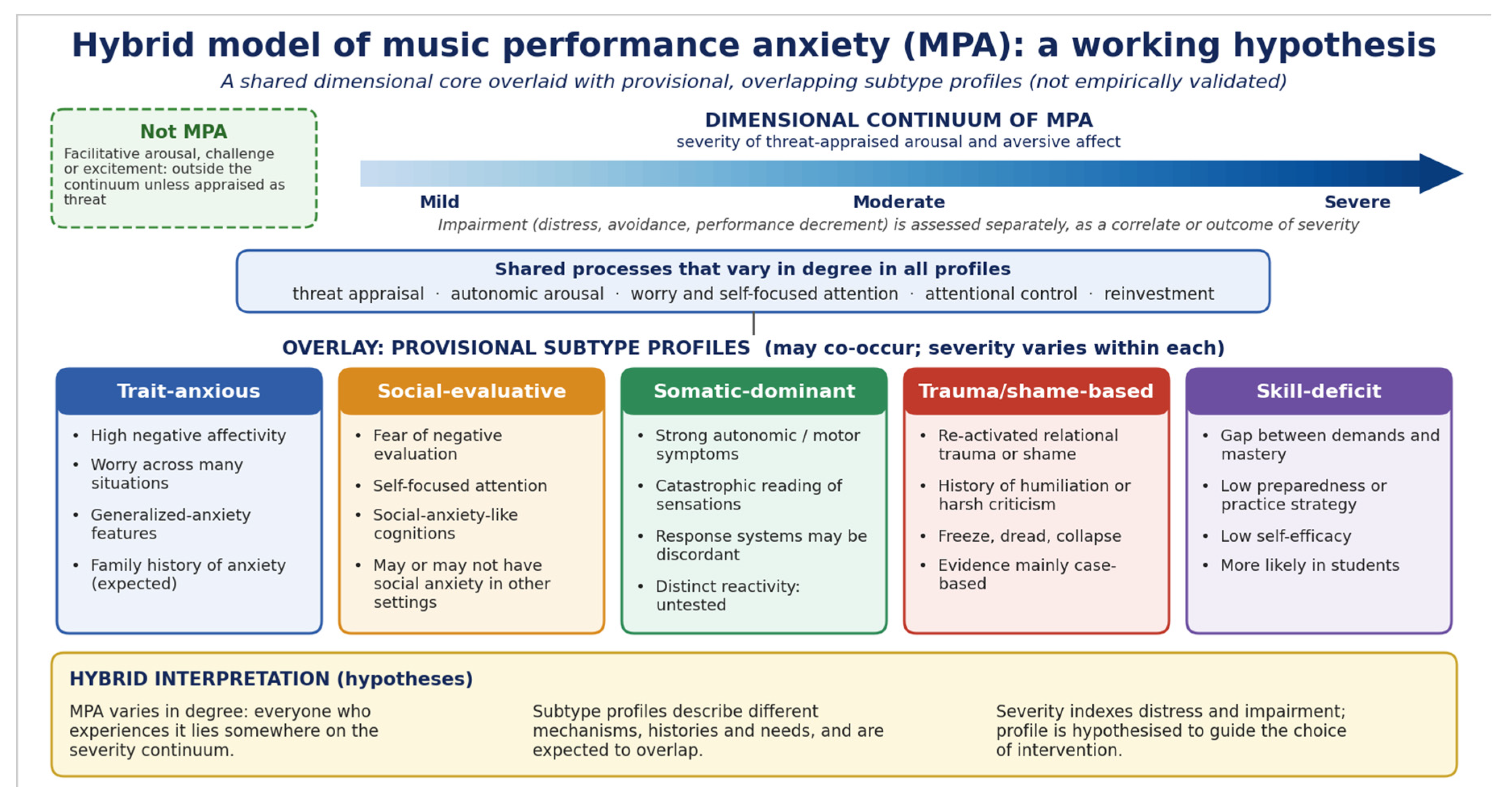
Figure 2.
Hypothesized matches between subtypes and candidate treatments (schematic; not evidence-based recommendations).
Figure 2.
Hypothesized matches between subtypes and candidate treatments (schematic; not evidence-based recommendations).
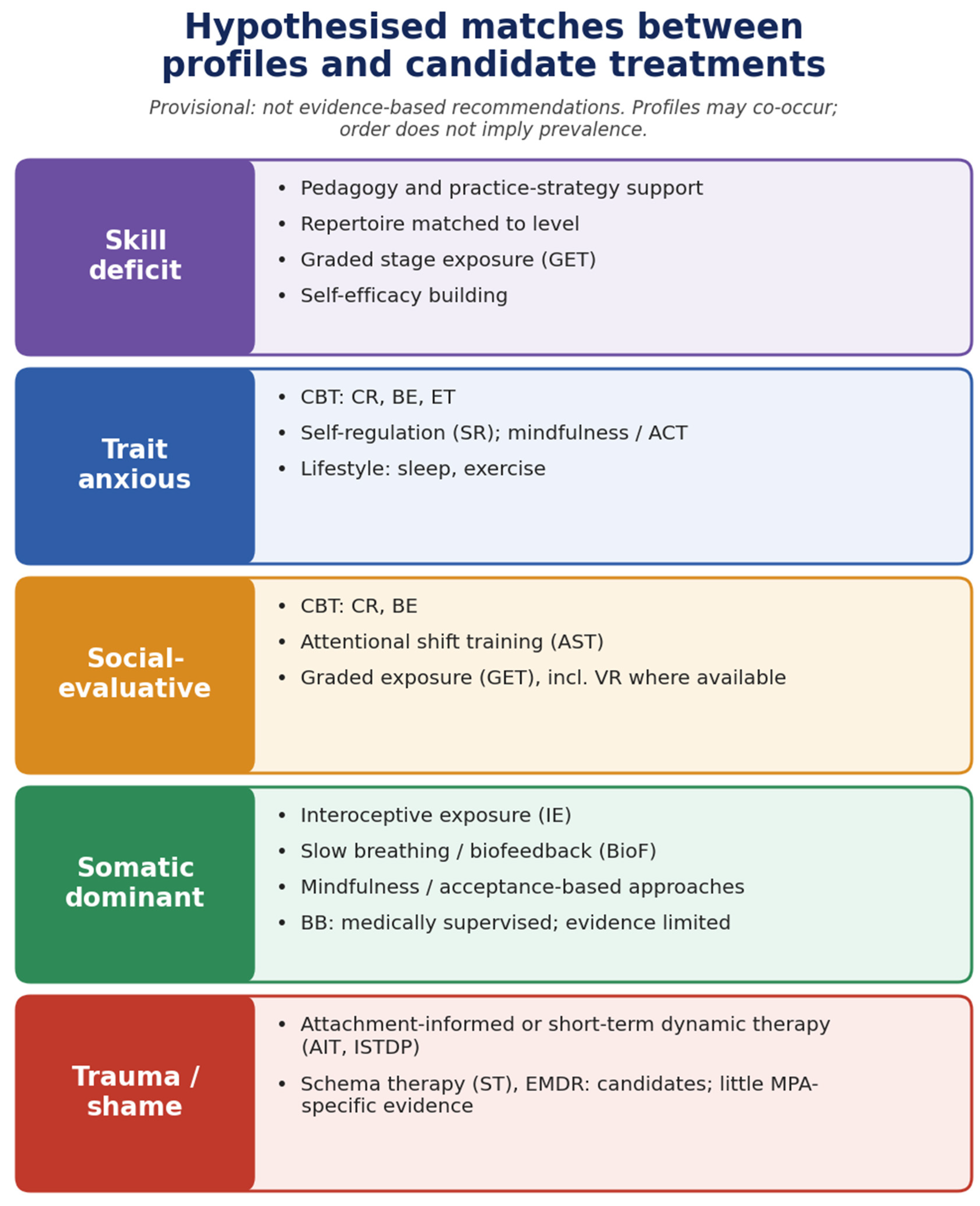
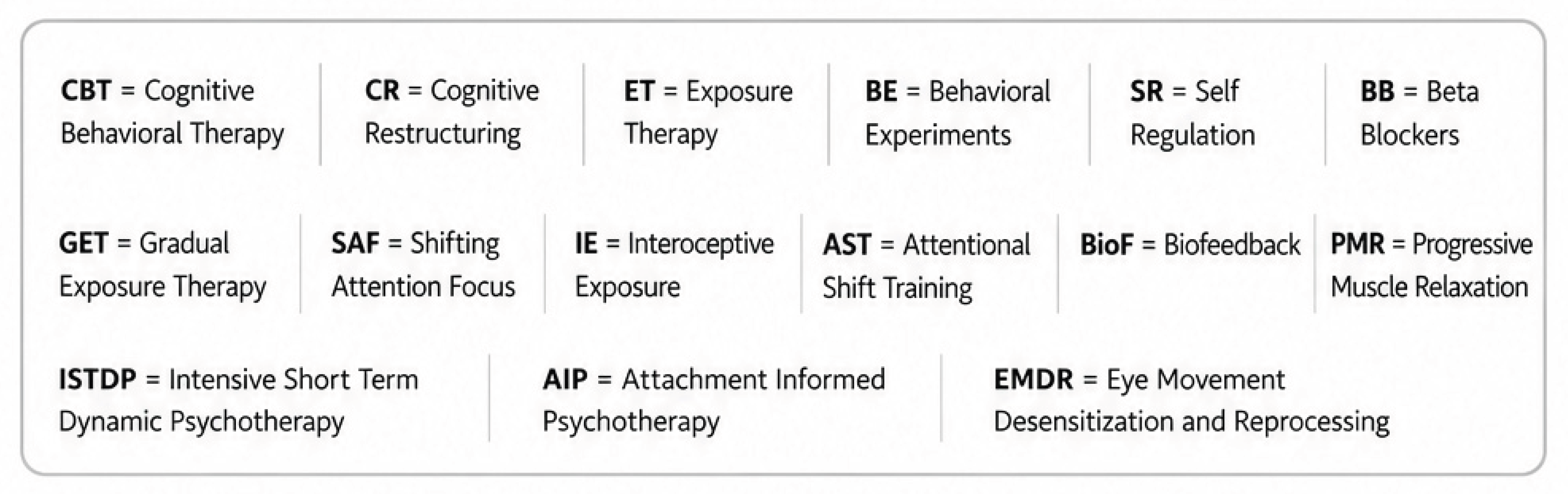
Table 1.
Dimensional and mechanistic-profile accounts of MPA.
| Dimension | Dimensional severity account | Mechanistic-profile account |
|---|---|---|
| Core claim | MPA varies continuously in intensity. | Comparable severity can arise from different dominant causal and maintaining mechanisms. |
| Mechanisms | Common mechanisms vary mainly in magnitude. | Common processes coexist with profile-weighted mechanisms and developmental pathways. |
| Boundaries | No discrete diagnostic threshold is required. | Profiles may be fuzzy, overlapping, or continuous rather than natural kinds. |
| Clinical implication | Treatment intensity may scale with severity. | Treatment response may depend on mechanism as well as severity. |
| Research implication | Model severity with continuous measures. | Test whether profiles add prediction beyond severity and replicate across samples. |
| Critical falsifier | Strong evidence of discrete severity categories. | Failure of profiles to replicate, discriminate, or moderate outcomes beyond severity. |
Table 2.
Hypothesized mechanisms, theoretical accounts and provisional indicators for each proposed subtype.
Table 2.
Hypothesized mechanisms, theoretical accounts and provisional indicators for each proposed subtype.
| Subtype | Hypothesized primary mechanism | Theoretical accounts drawn upon | Provisional indicators |
|---|---|---|---|
| Skill deficit | Gap between performance demands and mastery or preparation; low self-efficacy | Self-efficacy; challenge-threat appraisal; research on practice strategies and deliberate practice | Preparedness and practice-quality ratings; low self-efficacy; anxiety concentrated on under-prepared repertoire; more likely in students |
| Trait anxious | Dispositional negative affectivity; worry that generalizes across situations | Attentional control theory; attentional bias; anxiety sensitivity | High trait anxiety; generalized anxiety severity; anxiety outside performance |
| Social-evaluative | Fear of negative evaluation; self-focused attention and biased self-appraisal | Cognitive models of social anxiety | Social anxiety severity; negative-cognitions factor of the K-MPAI; anxiety greatest with audiences or evaluators |
| Somatic dominant | Strong autonomic and motor reactivity; catastrophic interpretation of sensations | Three-systems model of fear; anxiety sensitivity; interoception | Proximal somatic factor of the K-MPAI; panic severity; physiological or tremor indicators where available |
| Trauma/shame-based | Performance re-activates unprocessed relational trauma or shame | Attachment theory; psychodynamic accounts | Depression/vulnerability factor of the K-MPAI; attachment insecurity; independent trauma and shame measures; clinical interview |
Table 3.
Empirical predictions and potential falsifiers of the hybrid model.
| Proposition | Prediction | Test | Finding that would challenge the model |
|---|---|---|---|
| Severity is dimensional | Continuous MPA distribution without a defensible severity taxon. | Taxometric and factor-analytic modelling. | Replicable evidence of a discrete severity boundary. |
| Mechanistic heterogeneity adds information | Profiles or dimensions predict external validators beyond total MPA severity. | Latent profile/factor-mixture/hierarchical models with out-of-sample validation. | A single severity factor explains developmental, physiological, contextual, and outcome data equally well. |
| Profiles replicate | Similar mechanism configurations recur across independent musician samples. | Large multisite replication and measurement-invariance studies. | Classes/profiles are unstable, sample-specific, or dependent on arbitrary indicators. |
| Social-evaluative specificity | Evaluative threat produces disproportionate anxiety in the social-evaluative profile. | Experimental manipulation of audience judgment with task difficulty held constant. | No profile-specific response to evaluation. |
| Somatic discordance | Physiological activation is elevated relative to cognitive anxiety in somatic-dominant cases. | Repeated multimodal psychophysiology during performance. | No distinctive physiological/interoceptive pattern beyond severity. |
| Trauma/shame specificity | Attachment insecurity and shame predict profile weighting beyond MPA severity. | Longitudinal and multivariate studies with independent developmental measures. | No incremental relation of attachment/shame after controlling severity and general psychopathology. |
| Skill-deficit reversibility | Correcting mastery-demand mismatch reduces anxiety substantially. | Training/repertoire-matching intervention with objective mastery measures. | Anxiety remains unchanged despite corrected mastery in purported skill-deficit cases. |
| Treatment moderation | Mechanism-matched intervention produces greater benefit than unmatched treatment, beyond baseline severity. | Stratified RCT, factorial trial, SMART design, or moderated mediation analysis. | Treatment effects are independent of profile/mechanism and explained by severity alone. |
Disclaimer/Publisher’s Note: The statements, opinions and data contained in all publications are solely those of the individual author(s) and contributor(s) and not of MDPI and/or the editor(s). MDPI and/or the editor(s) disclaim responsibility for any injury to people or property resulting from any ideas, methods, instructions or products referred to in the content. |
© 2026 by the author. Licensee MDPI, Basel, Switzerland. This article is an open access article distributed under the terms and conditions of the Creative Commons Attribution (CC BY) license.
Copyright: This open access article is published under a Creative Commons CC BY 4.0 license, which permit the free download, distribution, and reuse, provided that the author and preprint are cited in any reuse.