

Submitted:
03 October 2026
Posted:
06 October 2026
You are already at the latest version
Abstract
Membraneless compartments assembled by liquid–liquid phase separation have moved rapidly from a curiosity of in vitro biophysics to a working explanation for how crop plants sense temperature, water, ions and pathogens. In this review, we synthesize the physicochemical rules that govern condensate assembly in plant cells, trace how those rules are deployed across the horticultural pathosystems and stress physiologies that matter for food production and evaluate the emerging engineering and chemical toolkits — synthetic scaffolds, optogenetic phase regulators, condensate-targeting phytovirucides and condensate-aware breeding alleles — that aim to convert condensate biology into agronomic gain.
Keywords:
biomolecular condensates
; horticultural and field crops
; liquid–liquid phase separation (LLPS)
; condensatopathy
; dicing body (D-body)
; intrinsically disordered region (IDR)
; processing body (P-body)
; stress granule
; sticker-and-spacer model
; wetting
Key points
- ❖
- Condensate assembly in plant cells follows a sequence-encoded grammar of stickers, spacers and multivalent binding modules; the same grammar sets saturation concentration, material state and client selectivity, and therefore determines whether a condensate acts as a switch, a buffer or a trap.
- ❖
- Plants exploit the steep, nonlinear relationship between environmental variables and saturation concentration to build molecular thermometers, osmometers and pH sensors. Documented crop examples now span nuclear transcriptional hubs, cytoplasmic stress granules, chloroplast RNA-editing condensates and membrane-associated assemblies.
- ❖
- Condensate material state is functionally decisive. Liquid-like assemblies typically accelerate reactions and buffer noise; heat-driven liquid-to-solid transitions can inactivate essential machinery, as seen for chloroplast RNA editing under heat stress.
- ❖
- Plant pathogens are accomplished condensate engineers. Viruses build phase-separated replication factories on cytoskeletal and lipid platforms; fungal effectors dissolve host immune condensates; and host restriction factors counter-attack by sequestering the host proteins that viruses require.
- ❖
- Two Green Revolution loci have now been shown to act through condensates, indicating that historically successful breeding has been unknowingly selecting on phase behavior and that condensate-tuning alleles are a tractable breeding resource.
- ❖
- Synthetic condensates in Nicotiana benthamiana already increase metabolic pathway yield and restrict virus accumulation, and rationally designed small molecules that block viral nucleocapsid phase separation outperform commercial antivirals in glasshouse assays.
- ❖
- Rigorous progress now depends on methodological discipline: orthogonal validation of phase separation, quantitative material-property measurement, and explicit tests of physiological relevance in intact, walled, turgid plant cells.
1. Compartments Without Membranes in the Crop Cell
For most of the twentieth century, the cell biology of crop plants was drawn as a map of membranes. Chloroplasts, vacuoles, peroxisomes, the endomembrane system and the nucleus defined where biochemistry happened, and the lipid bilayer was the boundary that made compartmentalization possible. That map is now demonstrably incomplete. A second class of compartment — condensed, concentrated, membraneless and often short-lived — organizes a large fraction of the reactions that determine whether a plant grows, defends itself or dies [1,2]. These biomolecular condensates form by liquid–liquid phase separation (LLPS) and related phase transitions, in which a solution of macromolecules spontaneously remixes into a dense phase and a dilute phase once a threshold concentration, the saturation concentration, is crossed [3,4].
The appeal of this idea for plant biology is immediate and specific. Plants are sessile. They cannot escape a heatwave, a saline irrigation event or an approaching spore, and they lack the mobile specialized immune cells that animals use to physically deliver a defense response to a site of infection [5]. Every cell must therefore be simultaneously a photosynthetic factory, an environmental sensor and a potential battlefield, and it must switch between these roles on timescales of seconds to minutes without the transcriptional and translational lag that a purely gene-expression-based response would impose. Condensates supply exactly this capability. Because phase separation is a cooperative, threshold-dependent process, a modest change in temperature, ionic strength, crowding or post-translational modification can drive a near-binary change in the spatial distribution of a regulator, and can do so using protein that is already synthesized and already present in the cell [1,6].
The past five years have converted this argument from plausible to documented. Condensates have been shown to control cold tolerance in rice [7], salinity tolerance in rice and wheat [8], saline–alkaline tolerance in rice [9], hyperosmotic stress tolerance in Arabidopsis thaliana [10], chloroplast RNA editing and photosynthetic efficiency under heat [11], meiotic fidelity in heat-stressed male meiocytes [12,13], internode elongation and plant height in wheat [14], floral organ abscission in tomato and petunia [15], autophagosome biogenesis [16] and immune activation [17,18]. In parallel, plant pathogens have emerged as sophisticated manipulators of the same physics, both building their own condensates and dismantling those of the host [19] (Table 1).
This review is organized around three questions that we regard as the load-bearing ones for the field. First, what are the physical rules that determine when a plant protein will condense, what material state the resulting assembly will adopt, and which clients it will recruit? Second, how have crop species — with particular attention to horticultural species and their pathogens — deployed those rules to solve the specific problems of thermal, osmotic, ionic and biotic stress? Third, which of these mechanisms are actually actionable, through breeding, transgenesis, synthetic biology or agrochemistry? We deliberately foreground the distinction between what has been demonstrated in a crop and what has been inferred from Arabidopsis, from animal cells or from in vitro reconstitution, because that distinction is where the field is currently most vulnerable to overreach (Box 1).
Box 1. Establishing that a plant assembly is a condensate.
Plant cells impose obstacles that the animal and in vitro systems in which condensate biology matured did not: rigid walls that resist perturbation and complicate protoplast-free manipulation, turgor pressure that changes cytoplasmic crowding when osmotic conditions shift, intense plastid autofluorescence that contaminates fluorescence channels, an elaborate endomembrane system whose vesicles are easily mistaken for droplets, and acute responsiveness to the handling that imaging itself requires. A community framework assembled by plant condensate researchers sets out the resulting methodological expectations across in silico prediction, in vitro reconstitution, molecular dynamics, live-cell and super-resolution imaging, material-property measurement, membrane-associated condensates and synthetic condensate engineering, and emphasizes orthogonal validation, quantitative interpretation and demonstrated physiological relevance [83].
Minimum evidence. A puncta phenotype is a hypothesis, not a result. Convincing cases combine (i) demonstration that assembly depends on a defined region of the protein, usually an IDR, with a separation-of-function allele rather than a whole-protein deletion; (ii) concentration dependence consistent with a saturation threshold; (iii) internal dynamics measured by fluorescence recovery after photobleaching, together with fusion and, where possible, fission events; (iv) in vitro reconstitution with purified components under defined salt, crowding and temperature; and (v) a genetic test showing that a condensation-deficient variant fails to deliver the biological output while retaining other activities. The TAM work in Arabidopsis meiocytes is a clean exemplar of point (v): swapping the amino terminus of TAM with that of its sister cyclin CYCA1;1 produced an allele that cannot partition to stress granules yet behaves as wild type under non-stress conditions, isolating the condensate-dependent function [12].
Pitfalls. Reagent artefacts are a live risk. Tobacco etch virus protease is routinely assumed to be inert during tag cleavage in reconstitution experiments, but in RNA-containing systems it aggregates in an RNA-dependent manner and alters the resulting condensates — a reminder that the tool used to trigger phase separation can itself join the phase [71]. Purification strategy matters too: minimal, well-behaved constructs comprising defined low-complexity repeats, as developed for the nucleolar protein treacle, avoid the solubility problems of full-length proteins and permit controlled attribution of phase behaviour to specific sequence modules [81]. Finally, scattering-based characterization of dense phases benefits from methods developed for synthetic polyelectrolyte complexes, where small-angle X-ray scattering approaches to macromolecular and self-assembled complex coacervates are well established [80].
2. The Sequence Grammar of Plant Condensates
2.1. Multivalency, Stickers and Spacers
Phase separation of biological polymers is driven by multivalency: each molecule must be able to engage several partners simultaneously, so that association produces a percolating network rather than a discrete complex [3]. In proteins, this multivalency is supplied either by arrays of folded interaction modules or, far more commonly among condensate scaffolds, by intrinsically disordered regions (IDRs) in which short interaction motifs — stickers — are distributed along a flexible chain of spacers [1].
The identity of the stickers sets the chemistry of the network. Aromatic residues (Tyr, Phe) mediate π–π and cation–π contacts; arginine contributes both cation–π and electrostatic interactions; charged blocks drive complex coacervation between oppositely charged segments. Precision-synthesized polyampholytes composed of alternating glutamate and lysine blocks demonstrate this dependence directly: as charge block length increases from two to sixteen residues, the polymer shifts from soluble to phase-separating, and added salt produces a block-length-dependent salting-in effect, implicating both electrostatics and hydrogen bonding in the phase behavior [20]. Spacer chemistry is equally consequential rather than merely permissive. Glycine content tunes backbone flexibility and effective charge density; in designer cationic–aromatic peptide condensates, glycine-poor sequences form the most densely packed condensates while increasing glycine content accelerates internal diffusion [21].
Crucially, sequence encodes not only whether a protein condenses but with whom. A landmark study identified a pair of IDRs that form spatially distinct, non-mixing condensates when co-expressed in cells and that fail to co-partition upon in vitro reconstitution, establishing that condensation specificity is written directly into the polypeptide sequence rather than imposed by cellular context [22]. Computational modelling and mutagenesis in that work resolved the amino acid features governing homotypic versus heterotypic association — effectively an IDR code. For crop engineering this is the single most useful biophysical result available, because it means orthogonal synthetic compartments can in principle be designed to operate in the same cytoplasm without cross-talk (Figure 1a, b).
2.2. What the Dense Phase Is Actually Like
The word "droplet" invites a misleading picture of a homogeneous, featureless interior. Atomistic molecular dynamics simulations of a dense phase built from 24 copies of the arginine- and glycine-rich RGG3 region of human FUS, analyzed with a fractal formalism, show something more interesting: the chains remain highly dynamic, with only a small loss of configurational entropy and a minor slowdown in diffusion relative to the dilute phase, yet they nonetheless adopt a statistically well-defined set of interaction motifs and a robust multi-scale topology of self-associated clusters [23]. The dense phase is therefore dynamic and organized — transient at the level of any individual contact, reproducible at the level of network topology. That analysis also implies the entropy of released water as a significant thermodynamic contributor to condensation, a point with direct relevance to plants, where cellular water activity is itself a regulated variable.
Small ions are not passive spectators either. Sodium-23 NMR, exploiting the ubiquity of sodium in biological samples, provides a quantitative proxy for internal fluidity of condensed phases, and has been used to report the confinement experienced by ions within phenylalanine–glycine peptide hydrogels of the kind that line the nuclear pore [24]. Perhaps most striking, adenosine triphosphate undergoes protein-independent LLPS under macromolecular crowding: at physiological millimolar ATP concentrations in the presence of millimolar magnesium and crowders, ATP alone forms droplets, with pH tuning intermolecular interactions and moderate salt promoting phase separation [25]. Since ATP is a standard constituent of protein-rich condensates and a metabolite whose concentration reports directly on plant energy status, this raises the possibility that metabolite phase behavior contributes to condensate regulation in tissues experiencing hypoxia, darkness or energy stress.
2.3. Liquid, Gel and Solid: Material State as a Functional Variable
Condensates are not restricted to the liquid state, and the transitions between states are frequently the biologically meaningful event. Poly-glycine tracts illustrate the mechanism. Glycine-rich IDRs are common among phase-separating proteins but rarely contain contiguous poly-Gly runs; human FUS is an exception, carrying two ten-residue poly-Gly tracts. Because condensate interiors reach high micromolar to millimolar protein concentrations, the intrinsic insolubility of such tracts becomes relevant, and synthetic 25-residue peptides containing them form twisted-ribbon fibrils or self-supporting gels, whereas a compositionally matched peptide lacking a poly-Gly tract remains soluble across a wide concentration range [26]. Sequence features that are innocuous in the dilute phase can thus become potent drivers of fluid-to-solid conversion once concentrated.
The consequences of such conversion are best documented in human disease, where they have been organized under the proposed framework of condensatopathies: pathologies attributable either to loss of function, when an essential condensate fails to form or hardens inappropriately, or to toxic gain of function, when aberrant solid-like aggregates or oncogenic hubs hijack cellular machinery [27]. Studies of the tumor suppressor p53 in mammalian systems provide a mechanistic template: wild-type p53 forms an anomalous dense liquid phase whose behavior departs from classical expectations [28], and mesoscopic protein-rich clusters serve as the nucleation sites from which mutant p53 amyloid fibrils grow [29]. Liquid condensates, in other words, can act as incubators for the solid states that follow.
Plants are subject to the same physics, and — as Section 3 describes — heat-induced solidification of a chloroplast RNA-editing factor is now a documented cause of photosynthetic impairment [11]. We would emphasize that "solid-like" is not a synonym for "pathological" in plants: an arrested, low-turnover condensate may be an adaptive way to store a protein through a stress episode. Establishing which interpretation applies in any given case requires quantitative measurement rather than morphological inspection.
2.4. Where Condensates Meet Membranes
The membrane and membraneless compartment systems are coupled rather than parallel. Lipid bilayers act as nucleation platforms that can lower the critical concentration for condensate formation by orders of magnitude through anchoring and thermodynamic coupling, generating specialized microenvironments in which enzymatic activity is enhanced; membrane composition, calcium and pH all feed into this regulation [30]. Conversely, condensates can reshape membranes through wetting. In Arabidopsis, ATG18a condensates on the endoplasmic reticulum progress from highly mobile droplets to stable ring-like structures while the ER itself is remodeled, acting together with the ER-shaping protein RHD3 and the linker RABC1 to organize early autophagosome formation [16]. This is a general lesson with a plant-specific edge: the plant cell is dominated by a large central vacuole and an extensive cortical ER, so surface-nucleated condensation may be proportionally more important in plants than in the animal cells where most of the underlying biophysics was worked out.
3. Temperature: Condensates as Molecular Thermometers
3.1. Why Phase Separation Is a Good Thermometer
Temperature enters the free energy of mixing directly, and many biological polymers display either upper or lower critical solution temperature behavior, meaning that a change of a few degrees can move a protein across its saturation concentration without any change in its abundance [1]. For a sessile organism facing an environment in which lethal heat may arrive within an hour, this is an attractive sensing mechanism, and heat stress is accordingly the setting in which plant condensate biology is most developed [31]. A recent authoritative synthesis of plant heat acclimation places condensate formation alongside heat shock factor regulation and chromatin-based thermal memory as one of the three pillars of the heat response [32].
3.2. Stress Granules, Processing Bodies and Translational Triage
The canonical heat-responsive condensates are cytoplasmic ribonucleoprotein granules. Stress granules assemble when translation initiation stalls and untranslated messenger ribonucleoproteins coalesce; processing bodies concentrate decapping and decay machinery [33]. In plants these bodies form the core of a translational triage system, and heat-induced translational reprogramming — modulation of initiation, elongation and termination, alongside RNA modifications and cis-regulatory elements — is now recognized as central to thermal acclimation [34]. Sequestration of transcripts into granules is best interpreted not as a shutdown but as a reallocation: general translation is suppressed while a stress-specific subset continues.
Two lines of evidence establish that this triage is functionally decisive in reproductive tissue, where heat damage translates most directly into yield loss. First, the A-type cyclin TARDY ASYNCHRONOUS MEIOSIS (TAM) is recruited to stress granules in Arabidopsis male meiocytes after heat exposure; the amino terminus of TAM is necessary and sufficient for this localization, and plants expressing a granule-excluded TAM variant prematurely terminate meiosis under heat and produce unreduced gametes, demonstrating that granule partitioning is required for genome stability under thermal stress [12]. Second, and complementarily, natural variation analysis identified heat-sensitive and heat-tolerant TAM alleles and showed that TAM associates with specialized condensates in meiotic cells at high temperature, where — through a mechanism involving THREE DIVISION MUTANT1 — it sustains translation of key meiotic cell-cycle genes, including its own transcript, preventing premature exit from meiosis; boosting TAM translation in heat-sensitive accessions with complementary peptides rescued the defect [13]. Together these studies convert stress granules from a general stress marker into a specific determinant of meiotic fidelity and, by extension, of gamete ploidy and polyploidization.
3.3. Solidification as a Mechanism of Heat Damage
Not every heat-induced condensate is protective. Multiple organellar RNA-editing factor 8 (MORF8) forms condensates with solid-like properties inside Arabidopsis chloroplasts upon heat stress. Condensation is intrinsically heat-dependent and driven principally by the protein's IDR; purified MORF8 condensates partition numerous editing factors including PPR proteins and other MORFs; and genetic and biochemical evidence shows that condensation inhibits chloroplast RNA editing [11]. The physiological consequence is concrete: both heat stress and MORF8 condensation reduce editing of transcripts encoding the NADH dehydrogenase-like complex, impairing NDH activity and photosynthetic efficiency. MORF8 thus behaves as a putative chloroplastic thermosensor whose activation is directly deleterious — a loss-of-function condensatopathy in the plant context [27]. This example is important precisely because it breaks the comfortable assumption that stress-induced condensation is adaptive, and it identifies condensate material state, rather than condensate presence, as the variable to engineer (Figure 1c).
3.4. Transcription Factors and the Heat-Responsive Nucleus
Heat shock factors remain the master transcriptional regulators of the heat response, with conserved DNA-binding, oligomerization and regulatory domains supporting precise and dynamic control, and with functional diversification demonstrated in tomato, rice and wheat as well as Arabidopsis [35]. Their oligomerization requirement makes them natural candidates for multivalency-driven condensation, and heat-responsive transcription in plants is increasingly described in terms of condensate-based hubs [36]. A useful organizing proposal divides plant transcription-factor LLPS into two modes: an activation mode, in which condensates assemble transcriptional hubs enriched in RNA polymerase II and coactivators and thereby accelerate target-gene recognition through localized crowding; and a repression mode, in which condensates sequester repressors away from chromatin or block transcription at target loci. The resulting rheostat model holds that plants tune condensate composition and material properties to balance stress adaptation against development [37]. As the following sections show, crop examples now populate both arms of this dichotomy (Figure 2).
Beyond heat, condensates have been proposed to contribute to the longer-term regulatory memory that underlies cold–drought cross-tolerance, acting alongside chromatin remodeling to link early perception and secondary messengers to DREB/CBF-centered transcriptional reprogramming [38]. A cross-kingdom perspective is instructive here: mammalian GFP-MxA condensates in oral cancer cells are dynamically regulated by both temperature and WNK-SPAK/OSR1 kinases [39], reinforcing the general principle that thermal input and kinase signaling converge on the same phase-behavior variable.
4. Water, Ions and pH: Condensates as Osmometers
4.1. Hyperosmotic Stress and the Crowding Signal
Osmotic stress imposed by drought and salinity is unusual among stresses in that it directly changes the physical parameter — macromolecular crowding — that governs phase separation. The transcriptional regulator SEUSS (SEU) exploits this. In Arabidopsis, SEU rapidly coalesces into liquid-like nuclear condensates when extracellular osmolarity rises; condensation depends on its IDR1, which adopts more compact conformations as crowding increases both in vitro and in cells, with two predicted α-helical peptides required. SEU condensation is indispensable for osmotic stress tolerance, and loss of SEU severely compromises expression of stress tolerance genes [10]. SEU therefore functions as a direct physicochemical osmosensor, converting a change in water activity into a change in transcriptional output with no intervening receptor.
4.2. Cold Tolerance in Rice: Condensation as a Transcriptional Amplifier
Cold limits rice production across temperate and high-elevation growing regions, and condensate biology has supplied a mechanism that is both molecular and immediately breedable. Natural variation at the SIMILAR to RCD ONE gene OsSRO1c confers cold tolerance at both seedling and booting stages. OsSRO1c possesses intrinsic LLPS capability and recruits OsDREB2B, an AP2/ERF transcription factor acting as a positive cold regulator, into nuclear biomolecular condensates, elevating OsDREB2B transcriptional activity. The OsSRO1c–OsDREB2B complex responds directly to low temperature through dynamic phase transitions and regulates key cold-response genes including COLD1. Decisively for translation, introgression of an elite OsSRO1c haplotype into a cold-susceptible indica background significantly increased cold resistance [7]. This is the activation mode of the transcription-factor rheostat model in a crop, and it demonstrates that natural haplotype variation already encodes differences in phase behavior that breeders can select.
4.3. Saline–Alkaline Stress: Dissolving a Repressive Condensate
Saline–alkaline soils impose combined ionic and high-pH stress and constrain rice productivity across large areas of Asia. Here the causal condensate is repressive rather than activating. The WRKY transcription factor OsWRKY1 acts as a central negative regulator of saline–alkaline tolerance: loss of OsWRKY1 markedly enhances tolerance while overexpression causes hypersensitivity, and inducible transcriptomics with DAP-seq show that it directly represses genes for ion transport, nutrient uptake, osmotic adjustment and redox homeostasis. OsWRKY1 undergoes stress-induced nuclear LLPS driven by a long IDR1 that is required for full repressive activity. Saline–alkaline stress specifically induces binding of the β-1,3-glucanase OsGH17 to OsWRKY1; OsGH17 interacts directly with IDR1, reduces DNA binding, decreases condensate formation and relieves repression, with genetic epistasis placing the two in a single pathway [9]. Two general points follow. First, a canonical cell-wall enzyme has been repurposed as a nuclear condensate solvent, which should discourage confident annotation of protein function from domain content alone. Second, condensate dissolution is as legitimate a therapeutic or breeding target as condensate formation.
4.4. The Green Revolution Paradox Resolved Through Condensates
Semi-dwarf cereals bred during the Green Revolution transformed yields under favorable conditions, but their behavior under salinity has long been anomalous. Green Revolution varieties of rice and wheat show significantly enhanced salt tolerance relative to their pre-Green Revolution counterparts, mediated by stress-induced DELLA accumulation. Integrated metabolomic and transcriptomic analysis shows that DELLAs maintain the growth–stress balance by rewiring sugar–amino acid metabolic networks; mechanistically, DELLAs antagonize INDETERMINATE SPIKELET1 (IDS1), a growth-promoting transcription factor that impairs salt tolerance through biomolecular condensation, and structural and functional analyses show that DELLAs physically dissolve IDS1 condensates, reprogramming transcriptional networks. Expressing a dominant-negative OsIDS1 variant that attenuates condensation and transcriptional repression conferred both semi-dwarf architecture and enhanced salt tolerance in non-Green-Revolution backgrounds, outperforming conventional Green Revolution alleles with a 35% yield gain of approximately 170 kg ha⁻¹ in saline fields [8].
This result deserves emphasis beyond its immediate agronomy. It establishes that one of the most consequential breeding programmes in human history was, at the molecular level, selecting on the phase behavior of a transcription factor. It also provides a field-validated yield figure for a condensate-targeted intervention, which remains rare.
5. Development, Architecture and Horticultural Quality
Condensates are not confined to stress physiology; they also govern developmental decisions that determine horticultural value. Two recent studies make the point in crop and ornamental species respectively.
In wheat, the widely deployed semi-dwarfing allele Rht8 encodes RNHL1 (ribonuclease H-Like 1), and its mechanism runs through phase separation. RNHL1 forms nuclear condensates via two of its IDRs and interacts with the ethylene signaling transcription factor TaEIL1 to establish functional transcriptional hubs. These RNHL1–TaEIL1 condensates bind and repress the ethylene response factor gene TaERF1, which in turn suppresses the gibberellin biosynthetic gene TaGA3ox2; genetic analysis confirms that both RNHL1 and TaEIL1 positively regulate plant height, with loss-of-function mutants showing similar dwarf phenotypes and convergent transcriptomes [14]. Together with the DELLA–IDS1 work [8], this means two independent Green Revolution-associated height loci now have condensate-based mechanisms, and it identifies specific IDRs as editable targets for architecture tuning.
In tomato and petunia, BLADE-ON-PETIOLE (BOP) genes control floral organ abscission and senescence through heterotypic condensates. SlBOP transcriptional cofactors undergo phase separation and interact with the transcription factor TFAM1 to form condensates that control abscission zone formation. Knockout of SlBOP genes in tomato caused defective petal abscission and delayed senescence, compromising fruit appearance quality; knockout of PhBOP genes in petunia produced non-abscising corollas with delayed senescence, markedly prolonging floral longevity and enhancing ornamental value [15]. The same condensate, manipulated in the same direction, is a defect in a fruit crop and an improvement in an ornamental — a clean illustration that condensate engineering targets must be defined against species-specific breeding objectives rather than treated as universally good or bad.
These examples sit within a broader pattern in which plant condensates modulate transcriptional outputs as a function of environmental and developmental input, through nucleation events that depend on specific protein–protein interactions rather than on generic disorder [36,37]. Comparative analysis across kingdoms suggests that condensate functions in gene expression, stress response and mitotic control are broadly conserved between plants and animals, whereas those relating to reproductive development and immune regulation diverge substantially, reflecting differences in cell architecture and nutritional strategy [40].
6. Immune Condensates: Spatial Control Without Immune Cells
6.1. The Organizing Logic
Because plants lack mobile immune cells, defense must be coordinated within every cell alongside photosynthesis, growth and development. Subcellular compartmentalization therefore carries an unusually heavy regulatory burden, and condensates supply a mechanism for concentrating immune components, sequestering negative regulators and imposing spatiotemporal specificity on shared signaling molecules [5]. The resulting picture is one in which immune activation is partly a problem of where molecules are rather than how much of them there is (Figure 3).
6.2. NPR1: An Immune Hub Built from Condensates
NONEXPRESSOR OF PATHOGENESIS-RELATED GENES 1 (NPR1) is the best-developed case. Nearly three decades after its identification as an activator of salicylic acid (SA)-mediated immunity, structural work defined NPR1 and its paralogues as SA receptors, with the SA-bound NPR1 dimer inducing transcription by bridging two TGA transcription factor dimers to form an enhanceosome. NPR1 orchestrates its multiple functions — SA-mediated transcriptional reprogramming, stress protein homeostasis and cell survival — through the formation of distinct nuclear and cytoplasmic biomolecular condensates, and it governs crosstalk between SA and other defense and growth hormones [18]. The functional partition between two condensate populations in different compartments is the key architectural feature: it allows one protein to run a transcriptional programme and a proteostatic programme simultaneously without the two interfering.
The temperature sensitivity of this system is agronomically pressing. Extreme temperatures suppress SA biosynthesis and thereby plant immunity, and this suppression can be rescued by optimized expression of master immune regulators [41]. As warming increases the frequency of conditions under which SA-dependent immunity fails, the condensate-level description of NPR1 function becomes a route to engineering thermal robustness into defense rather than merely documenting its loss.
Reactive oxygen species (ROS) signaling, itself capable of oxidatively modifying condensate-resident cysteines, is an actionable rationale for cancer therapy [42], and phase separation of the lipid peroxidase regulator FSP1 promotes ferroptosis, a regulated cell-death pathway with growing relevance to cancer and neurodegeneration [43].
6.3. Condensation of Splicing Machinery as an Immune Switch
A second mechanism operates through controlled condensation of a conserved splicing regulatory complex. Proximity-labelling proteomics of the karyopherin-β KA120, which is required to suppress autoimmunity in Arabidopsis, identified multiple components of the MOS4-associated complex (MAC) as substrates. Unexpectedly, KA120 does not alter the nucleocytoplasmic distribution of MAC proteins; instead, it prevents their condensation in the nucleus. MAC condensation is robustly induced by pathogen infection and is sufficient to activate defense gene expression, possibly by sequestering negative immune regulators through phase transition [17]. KA120 thus performs a non-canonical chaperoning function, holding a condensation-competent complex in a soluble state until infection licenses assembly. Nuclear transport receptors acting as condensation chaperones is a mechanism with obvious generality, and it suggests that karyopherin variation may contribute to autoimmune and hybrid-necrosis phenotypes in crops.
Interpreting such nuclear assemblies benefits from systematic maps of nuclear protein connectivity. Quantitative cross-linking mass spectrometry of soybean nuclei identified 24,140 unique crosslinks and converted 5,340 into 1,297 nuclear protein–protein interactions, 94% of them previously unreported; modularization of orthologous Arabidopsis interactions produced master nuclear PPI modules containing condensate-forming and IDR-containing proteins that successfully captured known nuclear complexes and nuclear bodies, and that assort into higher-order genome and nucleolus communities [44]. Such datasets provide a principled starting point for predicting which crop nuclear assemblies are condensates.
6.4. A Fungal Effector That Dissolves Host Immune Condensates
The clearest demonstration that condensates are a battleground comes from wheat stripe rust. Puccinia striiformis f. sp. tritici deploys the haustorial secreted effector Hasp170 to subvert host LLPS directly. Hasp170 targets IDR1 of the wheat nuclear protein TaPSTE (phase separation protein targeted by effector), which forms LLPS-dependent condensates. Within these condensates TaPSTE recruits the transcription factor TaNF-YC, activating genes that drive the reactive oxygen species burst and calcium influx underpinning resistance. By binding TaPSTE IDR1, Hasp170 impairs condensate formation and prevents TaNF-YC recruitment, suppressing immunity and facilitating parasitism [45] (Box 2).
Box 2. The condensate arms race.
Across viral, fungal, bacterial and oomycete pathosystems, a consistent structure has emerged in which infection outcome depends on the balance between pathogen-induced and host-driven assemblies — a biomolecular condensate battleground [19]. Four recurring moves can be distinguished.
Build. Pathogens construct condensates that concentrate replication machinery: rhabdovirus inclusion bodies [48], tenuivirus and rhabdovirus phosphoprotein factories [49], caulimovirus P6 factories [50] and condensate substructures inside membranous tombusvirus replication organelles [51].
Dissolve. Effectors disassemble protective host condensates, as Hasp170 does to wheat TaPSTE [45] and rice stripe virus SP does to SERRATE [46].
Hijack. Pathogens recruit host proteins into pathogen-controlled condensates, exemplified by cucumber mosaic virus coat protein sequestering the host kinase CDPK7-like [57] and by tombusvirus replication proteins organizing co-opted glycolytic and fermentation enzymes [51].
Restrict. Hosts deploy condensates that withhold resources from the pathogen. Arabidopsis CASC3 forms cytoplasmic condensates distinct from stress granules, P-bodies and aggresomes, and restricts turnip crinkle virus more than tenfold by sequestering Hsp70-1 and GAPDH, two host factors required for tombusvirus replication; the same mechanism restricts unrelated tobacco mosaic virus, and the effect is not shared by other poorly dynamic cytoplasmic condensates such as those of ARF19 [53].
The strategic implication for crop protection is that both formation and dissolution are druggable directions, and that specificity may be achievable because condensate identity is sequence-encoded [22].
This is a virulence strategy aimed at a physical property. It also implies a countermeasure logic: engineering an IDR variant that retains TaNF-YC recruitment while losing Hasp170 binding would produce effector-insensitive immunity without loss of function, an approach conceptually parallel to decoy engineering in NLR biology.
6.5. Viral Interference with Host RNA-Silencing Condensates
Viruses attack condensates too, and with equal precision. The disease-specific protein (SP) of rice stripe virus, a plant bunyavirus, has phase separation potential through its N-terminal IDR1 but does not form independent condensates in vivo. Instead, it uses its phase separation properties to interfere with the phase separation of SERRATE, a core component of Dicing bodies essential for microRNA processing. By disrupting SERRATE phase separation, SP inhibits D-body assembly and miRNA biogenesis [46]. A protein that condenses only in the presence of a target, and whose function is to prevent someone else's condensate from forming, is a genuinely novel effector class; the significance of this dominant-negative phase-separation strategy for host RNA silencing has been discussed in an accompanying commentary [47].
7. Viral Factories: Architecture, Motility and Metabolism
7.1. Liquid Factories on the Cytoskeleton
Plant rhabdovirus inclusion bodies (IBs) provided the first direct demonstration that plant viral factories behave as liquids. Using recombinant tomato yellow mottle-associated virus encoding a fluorescently labelled IB constituent, live-cell imaging in Nicotiana benthamiana showed that IBs are phase-separated condensates, that viral nucleoprotein and phosphoprotein are minimally sufficient for IB formation in vivo and in vitro, and that IBs move along microfilaments, most likely through anchoring of the phosphoprotein to myosin XI motors. Pharmacological disruption of microfilaments or inhibition of myosin XI suppressed IB motility, arrested IB growth and reduced replication efficiency [48]. Motor-driven transport thus promotes coalescence, and coalescence promotes replication — making the cytoskeleton an indirect but effective antiviral target (Table 2).
7.2. Lipid Synthesis and Vesicle Trafficking as Factory Scaffolds
Rice stripe mosaic virus provides the complementary membrane-side mechanism. Its phosphoprotein P forms condensates by LLPS to recruit components of viral replication factories, and interacts directly with OsARF1C, a regulator of the COP I vesicle transport pathway required for replication. This interaction indirectly recruits the OsARF1C partner phosphatidylinositol 4-kinase β (OsPI4KB), driving localized phosphatidylinositol-4-phosphate synthesis; the P protein in turn modulates its own aggregates and droplets through PI4P, expanding the replication site and enhancing replication [49]. The feedback loop between a condensate and the lipid it induces is precisely the membrane–condensate coupling described in general terms elsewhere [30], and it identifies host lipid kinases as antiviral targets.
7.3. A Viral Factory That Is Also a Stress Granule Antagonist
Cauliflower mosaic virus replication complexes are unusual among viral factories in being non-membranous assemblies of RNA and protein, dominated by the viral protein P6. Work in A. thaliana and N. benthamiana revealed a wide dynamic mobility range for host proteins within these viral factories while P6 itself is immobile, acting as the central node of the condensate. The stress granule nucleating factors G3BP7 and UBP1 family members are components of the factories; conversely, ectopically expressed P6 localizes to stress granules and reduces their assembly after stress. Notably, it appears that soluble rather than condensed P6 suppresses stress granule formation and mediates other essential P6 functions, suggesting that progressive condensation over the infection time course accompanies a shift in which P6 activities are executed [50]. The concept that a viral protein partitions its functions between dilute and dense phases, using phase behavior as a temporal programme, is an elegant one and is likely to generalize.
7.4. Condensate Substructures Inside Membranous Replication Organelles
Positive-strand RNA viruses co-opt organellar membranes to build replication organelles (VROs), and tombusviruses additionally recruit cytosolic proteins. In tomato bushy stunt virus (TBSV) and carnation Italian ringspot virus (CIRV) infections of N. benthamiana, the p33 and p36 replication proteins sequester glycolytic and fermentation enzymes into condensate substructures associated with membranous VROs. Both proteins form droplets in vitro driven by their IDRs and organize the partitioning of co-opted host proteins; the resulting condensates are critical for local ATP production supporting replication, and co-opted ER membranes and actin filaments form meshwork within and around them [51]. Membranous and membraneless compartmentalization therefore coexist within a single viral structure, with the replication protein connecting the two.
The same pathosystem shows how condensates intersect with autophagy. TBSV and CIRV co-opt ATG8f and the selective autophagy receptor NBR1, along with core autophagy proteins and the plant-specific SH3P2 adaptor, to recruit VPS34 and enrich phosphatidylethanolamine and PI3P in VRO membranes; a fraction of the subverted ATG8f and NBR1 is sequestered in VRO-associated condensates, and hijacking inhibits autophagic flux [52]. Condensates here act as traps that remove autophagy components from their pathway — a sequestration strategy the mirror image of the host restriction strategy used by CASC3 [53].
7.5. Condensates That Switch off Host Translation
Not all viral condensates build; some disable. The p26 movement protein of pea enation mosaic virus 2 phase separates, and mass spectrometry of affinity-purified p26 condensates showed enrichment of RNA-binding proteins involved in translation and ribosome biogenesis. Puromycin assays and polysome profiling demonstrated that ectopic p26 suppresses ribosome assembly and translation in N. benthamiana, mirroring defects seen in late-stage infection. Despite interacting with the 2′-O-methyltransferase fibrillarin, p26 does not act by altering rRNA methylation but instead binds rRNAs directly and decreases their solubility, potentially promoting replication stages incompatible with translation, including systemic movement [54]. Related logic operates in mammalian systems, where translational control by functional prions and condensates has been formalized as vectorial channeling of ribosomes [55], and where herpes simplex virus ICP22 condensates define virus-induced chaperone-enriched domains that mediate RNA polymerase II deubiquitylation and promote viral transcription [56].
7.6. Hijacking a Host Kinase, and Viroids as Condensate Clients
Cucumber mosaic virus, a major constraint in cucurbit and solanaceous horticulture, hijacks host signaling through phase separation. CMV coat protein interacts with the host kinase CDPK7-like in N. benthamiana, and in an overexpression system this interaction drives LLPS into condensate-like structures that may influence immune signaling. Plants overexpressing CDPK7-like showed enhanced resistance to potato virus Y and pepper mild mottle virus yet increased susceptibility to CMV, indicating virus-specific hijacking of a broadly antiviral factor [57].
Subviral pathogens use condensates as well. DNA ligase I (LIG1) and potato spindle tuber viroid colocalize near the nucleolar region in N. benthamiana protoplasts, and the colocalized region corresponds to the highly condensed region of sense-strand viroid RNA, indicating that viroid RNA and LIG1 form a condensate in which circularization of the RNA progeny occurs [58]. Extending condensate function to viroid biogenesis matters practically — potato spindle tuber viroid and its relatives are quarantine pathogens of potato, tomato and ornamentals — and conceptually, given the thousands of viroid-like RNAs recently identified.
Finally, comparative work reinforces that intrinsic disorder is the common denominator of viral condensation across kingdoms: the Rous sarcoma virus Gag polyprotein forms condensates driven by its IDRs [59], establishing that retroviral assembly obeys the same rules that govern plant viral factories.
8. Fungal Pathogens, Insect Vectors and the Wider Infection Ecology
8.1. Thermal Adaptation of a Postharvest Pathogen
Condensates are not a host-side phenomenon only, and the pathogen's own phase behavior can be a virulence determinant. Colletotrichum gloeosporioides causes anthracnose, one of the most economically damaging diseases of tropical and subtropical horticultural crops and of rubber trees, and its infection cycle is repeatedly interrupted by thermal fluctuation. CgSCE3, an RNA-binding protein homologue highly expressed during both appressorium formation and invasive hyphal growth, contains a predicted RNA recognition motif and three IDRs, and forms phase-separated condensates in vivo under heat shock. Domain deletion analysis showed that all three IDRs and the RRM contribute to phase separation, with IDR2 particularly important, and that CgSCE3 phase separation is required for both thermotolerance and pathogenicity; CgSCE3 also participates in regulating CgPab1-mediated stress granule formation during heat shock [60].
Two implications follow. First, the same physical mechanism that protects host meiocytes [12] protects the pathogen, so thermal stress does not automatically favor the plant. Second, because CgSCE3 condensation is required for virulence, fungal condensation is itself a fungicide target — an appealing prospect for postharvest disease management where residue constraints are severe.
8.2. Vector Immunity and Virus Transmission
Many of the most damaging horticultural viruses — tomato spotted wilt virus, cucumber mosaic virus, rice stripe virus — are transmitted by insects, and the vector's own antiviral condensates therefore influence epidemiology. In leafhoppers, the Toll-pathway transcription factor Dorsal binds the promoter of a myxovirus resistance-like (MxL) protein to activate its transcription; MxL forms biomolecular condensates that promote ubiquitinated degradation of viral capsids [61]. In a parallel mechanism, insect i-type lysozymes regulated by Toll signaling act as proteases that directly cleave viral proteins, with condensate formation central to their antiviral function [62]. Whether such vector condensates can be manipulated — through RNA-based agrochemicals, for instance — to reduce transmission is an open and attractive question.
8.3. Condensates in Microbial Physiology
Beyond pathogenesis, microbial phase behavior shapes traits relevant to agricultural biotechnology. In Priestia megaterium, GvpU binds the C-terminal tail of the core gas vesicle shell protein and undergoes a phase transition in subsaturated solution to form clusters, tuning gas vesicle clustering and directly modulating bacterial fitness; engineered variants with controllable sensitivity to GvpU enable genetically tunable biosensors [63]. Phase transitions of a structural regulator can therefore program the spatial organization of an entire protein organelle — a design principle directly transferable to synthetic plant compartments.
9. Engineering Condensates for Crop Improvement
9.1. Synthetic Condensates as Metabolic Reactors in Planta
The most agronomically advanced application to date is metabolic. N. benthamiana is a leading plant biofactory, but yields are constrained by product toxicity and proteolytic degradation of introduced enzymes. Transient expression of synthetic modular scaffolds generated engineered condensates in N. benthamiana leaves whose in vivo properties were consistent with liquid-like bodies showing thermodynamic features typical of multicomponent phase-separating systems. Recruiting enzymes to these condensates produced several-fold yield increases in both a one-step pathway (citramalate biosynthesis) and a three-step pathway (poly-3-hydroxybutyrate biosynthesis), with retention of PHB within the condensate demonstrated. Notably, enzyme accumulation itself increased several-fold upon condensate targeting, and the authors concluded that enhanced enzyme stability — rather than metabolite channeling alone — is likely the principal driver of improved output [64].
That conclusion is worth dwelling on. Much of the enthusiasm for synthetic condensates has rested on substrate channeling arguments borrowed from metabolon literature. This work suggests a simpler and more robust mechanism: condensates are protective microenvironments that shield heterologous enzymes from proteolysis. If general, this is good news for engineering, because stability is easier to achieve than kinetically productive channeling.
9.2. Engineered Condensates as Antivirals
The same logic has been turned against viruses. Tobacco mosaic virus was engineered to carry MS2 bacteriophage hairpins bound specifically by MS2 coat protein (MCP), and artificial condensates were built using well-characterized IDR scaffolds fused to MCP. Transient expression in N. benthamiana inhibited accumulation of MS2-tagged TMV up to fivefold; condensates based on TAR DNA-binding protein 43 inhibited accumulation more than twofold independently of the global translational repression that accompanied condensate expression. Following manual inoculation of MS2-tagged TMV onto leaves transiently expressing TDP-43:MCP condensates, systemic virus accumulation fell more than tenfold with a significant decrease in symptom severity [65]. This is proof of principle for programmable antiviral compartments; the obvious limitation is the requirement for an engineered virus, and the translational challenge is to substitute an RNA-recognition module directed at authentic viral sequence.
Natural restriction condensates provide the complementary template. CASC3, whose SELOR domain is required both for normal condensate size and for antiviral activity, restricts viruses by limiting availability of Hsp70-1 and GAPDH rather than by targeting viral components directly [53]. Engineering resource-sequestering condensates may therefore achieve broader-spectrum resistance than sequence-directed approaches, at the cost of potential fitness penalties.
9.3. Importing Condensate Function Across Kingdoms
Heterologous condensate proteins can confer stress tolerance on plants. Two human-derived RNA-binding proteins, Heat-resistant obscure 7 (Hero7) and Hero45, enhanced thermotolerance when overexpressed in plants. Under heat stress both undergo phase transitions consistent with LLPS, correlating with formation of larger processing bodies and stress granules, which may protect messenger RNAs from heat-induced degradation [66]. Modulating LLPS is therefore a viable route to engineered thermotolerance, though the study's own framing is appropriately cautious about mechanism.
Related cross-kingdom transfers are instructive. Catalase-containing coacervate microdroplets built from polycation–polyanion pairs have been implanted into living cells as artificial membraneless organelles that retain enzymatic activity, scavenge reactive oxygen species and restore viability under peroxide challenge [67]. In cancer biology, synthetic ZFTA fusion proteins in which IDRs from EWS and FUS were grafted into a fusion oncoprotein restored condensate formation and downstream transcriptional output [68], and systematic screening of 166 fusion oncoproteins found that 58% formed condensates with physicochemical features distinct from condensate-negative fusions, enabling machine-learning prediction of condensation behavior [69]. The transferable lessons for plant engineering are that IDR modules behave as portable functional parts, and that condensation propensity is predictable from sequence features well enough to guide design.
9.4. Programmable Control of Material State
Keeping synthetic condensates liquid throughout a production run is a practical bottleneck. A light-controlled phase regulator addresses it directly: a photoactivatable TEV protease cleaves intrinsically disordered proteins to alter their valency and concentration, enabling programmable control of condensate fluidity, and its deployment in engineered Saccharomyces cerevisiae significantly improved production of squalene and ursolic acid [70]. Transplanting this optogenetic phase regulator into plants is attractive but non-trivial, given plant photoreceptor cross-talk and the light regimes required for photosynthesis; the illumination wavelengths and duty cycles compatible with a crop canopy are an unsolved design constraint. The caveat established for reconstitution work applies here too, since TEV protease is not necessarily inert in RNA-containing systems [71].
9.5. Condensates as CO₂-Fixation Organelles
The pyrenoid is the most developed example of a natural condensate with direct yield relevance. Pyrenoids are eukaryotic CO₂-fixing organelles that are evolutionarily diverse, globally abundant and critical to carbon cycling, and they serve as model biomolecular condensates for investigating fundamental LLPS properties; understanding convergently evolved pyrenoids across lineages is being pursued explicitly to advance efforts to engineer functional pyrenoids into crop plants, enhancing CO₂ fixation for yield improvement and carbon dioxide removal [72]. Pyrenoid engineering unites the two threads of this Review — condensate biophysics and agronomic output — more directly than any other target.
10. Condensate-Directed Chemistry for Crop Protection
10.1. Phytovirucides That Block Nucleocapsid Phase Separation
Chemical control of plant viruses has historically been poor, and phase separation offers a genuinely new target class. Tomato spotted wilt virus (TSWV), one of the most destructive viruses of vegetable and ornamental crops worldwide, has now been targeted twice through this route.
The inhibitor Z9 was rationally designed to interact with amino acids in the nucleic-acid-binding region of the TSWV nucleocapsid (N) protein, disrupting assembly of N and RNA into phase-separated condensates; the resulting reduction in condensate formation destabilizes the N protein [73]. Independently, screening of methyl vanillate derivatives incorporating N-acetyl-D-glucosamine identified compound A10, which showed curative, protective and inactivating activities of 56.9%, 50.5% and 62.2% respectively, with an inactivation EC₅₀ of 181.7 µg ml⁻¹ compared with 748.5 µg ml⁻¹ for the commercial standard ribavirin. Molecular docking, molecular dynamics and bio-layer interferometry identified Arg94, Tyr184 and Lys192 as key binding residues on N, and confocal imaging confirmed that A10 inhibits phase separation and aggregate formation, suppressing ribonucleoprotein proliferation and systemic infection [74].
A third compound arises from the CMV work described above: the coumarin-based LLPS modulator D3 selectively targets Thr52 within CMV coat protein to rescue CDPK7-like from LLPS initiation, and outperformed ribavirin with an EC₅₀ of 70.8 µg ml⁻¹ against 195 µg ml⁻¹ [57]. Three independent compounds against two viruses, each acting on a defined residue set and each beating the incumbent chemistry, constitute a reasonable claim that condensate-directed phytovirucides are a real prospect rather than a proof of concept.
10.2. Disorder as a Druggable Space in Agrochemistry
Underlying this progress is a broader shift in agrochemical thinking. Protein disorder, long treated as undruggable in human medicine, has distinctive conformational features and governs many processes controlling crop productivity and stress resistance in planta; incorporating disorder-directed design into the three emerging agrochemical modalities — RNAs, peptides and nanotechnology — has been proposed as a route to intelligent agrochemicals with tailored functionality [75]. Formulation science from the therapeutic condensate literature is directly relevant: in designer peptide condensates, glycine content and anion valency jointly tune dense-phase concentration, droplet size, encapsulation of small molecules and protease-triggered disassembly, with partitioning of FDA-approved compounds depending on both hydrophobicity and charge state [21]. Coacervate-based delivery vehicles with programmed release are therefore a plausible near-term horticultural technology, independent of whether the payload itself targets a condensate.
Two cautions temper this optimism. First, specificity must be demonstrated against host condensates, since a compound that disrupts viral nucleocapsid assembly may also perturb host stress granules. Second, resistance evolution against a target defined by weak, degenerate, multivalent interactions is largely unstudied; disordered targets may prove either unusually robust, because no single substitution abolishes multivalency, or unusually fragile, because condensation thresholds are sensitive to small changes in valency.
11. The Plant Condensate Toolbox
11.1. Defining Composition
Knowing what is inside a condensate remains the rate-limiting step in most crop studies. Two complementary strategies now exist for plants. For protein composition, immunoprecipitation of a GFP-tagged scaffold followed by on-bead enzymatic digestion and mass spectrometry allows recovery of stress granule proteins from A. thaliana, with candidate localization subsequently validated in N. benthamiana mesophyll protoplasts; the approach circumvents the difficulty that the dynamic, transient stress granule shell is largely lost during conventional purification [76]. For RNA composition, Turbo-RIP couples TurboID-based proximity labelling at 22 °C with formaldehyde crosslinking and streptavidin capture of protein–RNA complexes, and has successfully captured processing-body-associated RNAs with minimal background in both N. benthamiana and A. thaliana, running three to five days from sample to RNA with standard equipment [77]. Proximity labelling is particularly valuable in plants precisely because it does not require the condensate to survive lysis (Table 3).
At the network level, quantitative cross-linking mass spectrometry of intact nuclei provides an orthogonal route to condensate composition, capturing nuclear complexes and nuclear bodies and mapping their hierarchical modular organization [44].
11.2. Imaging Beyond the Diffraction Limit
Most plant condensates are at or below the resolution limit of conventional confocal microscopy, which makes size, number and internal architecture systematically unreliable. Expansion microscopy offers a low-cost solution. ExPOSE achieves robust expansion of plant protoplasts and couples with immunofluorescence and in situ hybridization chain reaction to visualize proteins and mRNAs respectively; it has been applied to biomolecular condensates in Arabidopsis protoplasts and to transcription factors in maize protoplasts, and is inexpensive, fast and simple to implement [78]. Its main limitation is the requirement for protoplasting, which itself imposes osmotic and wounding stress — a serious confounder for stress-responsive condensates that must be controlled explicitly.
For interaction mapping and engineered condensate characterization in live cells, the molecular recruitment colocalization (MRC) platform localizes interacting partners and generates fluorescent signals at designated genomic loci, enabling simultaneous visualization of multi-protein interactions, preliminary estimation of binding affinities, rapid discovery and validation of condensate-forming proteins or domains, programming of phase separation sites, recruitment of target proteins into programmable condensates and probing of condensate physical properties [79]. Adaptation of such platforms to plant nuclei would substantially accelerate crop condensate discovery.
11.3. Measuring Material Properties
Because material state is functionally decisive [11], measurement of material properties should be routine rather than exceptional. Beyond fluorescence recovery after photobleaching, useful approaches include ²³Na NMR as a proxy for internal fluidity of the dense phase [24], small-angle X-ray scattering methods developed for macromolecular and self-assembled polyelectrolyte complexes [80], and atomistic molecular dynamics combined with fractal analysis to characterize network topology and dynamics [23]. Reconstitution should use minimal, well-behaved constructs [81] and should control for reagent-induced artefacts [71].
11.4. Proteostasis as an Experimental Variable
Condensate abundance is a function of protein abundance, and protein abundance in plants is governed largely by the ubiquitin–proteasome system. The 26S proteasome is itself dynamically regulated from synthesis through degradation [82], and any experiment that manipulates condensation by overexpression should be interpreted against the possibility that degradation flux, not phase behavior, has changed. In the saline–alkaline system, for instance, condensate dissolution and reduced DNA binding are separable consequences of OsGH17 binding [9], and only careful genetics distinguished them.
12. Integration: Condensates as Filters for a Noisy Environment
Field environments are not single-stress laboratories. Plants experience overlapping, sequential and recurrent stresses, and the cellular mechanisms that organize responses under these conditions remain incompletely understood. A recent synthesis proposes that condensates contribute to organizing combined and recurrent stress responses by modulating molecular accessibility, transcript fate, proteostasis and regulatory crosstalk, spanning stress granules, processing bodies, nuclear condensates and plastid-associated assemblies, with candidate roles in signal filtering, RNA triage and recovery-associated reprogramming. That synthesis is explicit that while condensates are well supported as rapid stress-responsive organizers, direct evidence for their persistence after recovery, or for causal roles under simultaneous multi-stress conditions, remains limited [6]. We share that assessment; cross-stress condensate memory is currently a hypothesis with a good mechanistic rationale and thin empirical support, and it should be labelled as such.
The most useful formal framework treats saturation concentration thresholds as nonlinear filters that buffer environmental noise. Under this view, condensate assembly transduces temperature, light, redox and nutrient signals through phase-diagram behavior, critical solution temperature properties and sticker-and-spacer architecture, organized within a unified scaffold–client–RNA–metabolite scheme; membrane-associated phase separation may nucleate cytoplasmic condensates, and in many systems current evidence remains insufficient to distinguish bona fide LLPS from alternative assembly mechanisms [1]. The filtering idea explains something that a simple switch model does not: why plants do not mount a full heat-shock response to every transient midday temperature excursion. A threshold-dependent, cooperative assembly process ignores small and brief excursions while responding sharply to large or sustained ones, and the position of that threshold is tunable by sequence, by post-translational modification and by cellular crowding.
This framing also clarifies where crop improvement should intervene. Breeding and engineering can move the threshold (by altering IDR composition or valency), change the slope of the response (by altering scaffold stoichiometry or client affinity), or alter what happens after the threshold is crossed (by changing material state). The rice OsSRO1c haplotypes illustrate threshold tuning [7]; the OsIDS1 dominant-negative variant illustrates slope alteration [8]; and MORF8 solidification illustrates a failure mode of post-threshold material state that engineering should aim to prevent [11] (Figure 1d).
13. Conclusions and Outlook
Condensate biology has passed the point at which it could be dismissed as fashionable relabeling of previously described puncta. In crops, it has delivered mechanistic explanations for cold tolerance in rice [7], for the salinity behavior of Green Revolution germplasm [8], for saline–alkaline tolerance [9], for wheat plant height [14], for heat-induced photosynthetic decline [11], for heat-induced unreduced gamete formation [12,13], for fruit and flower abscission [15], and for a substantial share of what plant viruses and fungi do inside host cells [5,19]. It has also delivered interventions: a field-validated yield gain from a condensate-attenuating allele [8], engineered antiviral compartments [65], enzyme-stabilizing synthetic condensates [64] and three small molecules that outperform incumbent antivirals [57,73,74] (Figure 4).
Five priorities seem to us to determine whether the next phase delivers comparable returns.
Move from Arabidopsis to crops, deliberately. Plant LLPS research has been concentrated in Arabidopsis, with limited direct relevance to agricultural production, even though many potential LLPS proteins exist in crops and may affect growth, development and stress resistance [2]. Horticultural species impose their own biology — fleshy fruit ripening, postharvest physiology, ornamental longevity, grafting, vegetative propagation — none of which has been examined through a condensate lens in any depth.
Measure material state as a phenotype. Since liquid, gel and solid states have opposite functional consequences [11,26], breeding programmes that select on condensate behavior will need scalable assays for fluidity, not just for puncta counts.
Establish causality with separation-of-function alleles. The methodological standard set by the TAM amino-terminal swap [12] and by IDR-specific mutations in TaPSTE [45] and OsWRKY1 [9] should become the norm, supported by the community's practical framework [83].
Exploit sequence-encoded orthogonality. The demonstration that IDR sequence alone can specify non-mixing condensates [22] is the enabling result for building multiple independent synthetic compartments in one crop cell — for example, separating a metabolic reactor [64] from an antiviral trap [65].
Take the pathogen's condensates seriously as targets. Fungal phase separation is required for virulence [60], viral factories depend on host lipid kinases and motors [48,49], and vector antiviral condensates shape transmission [61,62]. Each is a distinct intervention point, and none is currently exploited commercially.
The unifying attraction of this field for crop science is that condensates convert a physical property of the cell into an agronomic trait. Saturation concentration, dense-phase viscosity and client selectivity are quantities that can be measured, predicted from sequence, altered by editing and selected in populations. That combination is unusual, and it is the reason we expect condensate-aware breeding and condensate-directed chemistry to become standard components of the crop improvement toolkit within the decade.
Glossary
Biomolecular condensate A membraneless cellular compartment formed by phase separation or a related phase transition, concentrating specific proteins, nucleic acids and metabolites relative to the surrounding cytoplasm or nucleoplasm.
Client A molecule that partitions into a condensate but is not required for its formation; client identity determines condensate function.
Complex coacervation Phase separation driven by associative electrostatic interactions between oppositely charged polymers.
Condensatopathy A disease state attributable to dysregulated condensate behavior, classified as loss of function (failure to form, or inappropriate hardening) or toxic gain of function (aberrant solid-like or hijacking assemblies).
Critical solution temperature The temperature above (lower critical solution temperature) or below (upper critical solution temperature) which a solution remixes into dense and dilute phases.
Dicing body (D-body) A nuclear condensate containing the microRNA processing machinery, including DICER-LIKE 1, HYPONASTIC LEAVES 1 and SERRATE.
Intrinsically disordered region (IDR) A protein segment lacking stable tertiary structure whose conformational flexibility and distributed interaction motifs commonly drive multivalent association and phase separation.
Liquid–liquid phase separation (LLPS) Spontaneous remixing of a homogeneous solution into coexisting dense and dilute liquid phases once the saturation concentration is exceeded.
Multivalency The capacity of a molecule to engage several binding partners simultaneously; the necessary condition for forming a percolating network rather than a discrete complex.
Processing body (P-body) A cytoplasmic ribonucleoprotein condensate enriched in mRNA decapping and decay machinery.
Saturation concentration The threshold concentration above which a phase-separating component remixes; its value sets the sensitivity of a condensate-based sensor.
Scaffold A molecule whose presence is required for condensate assembly, and which recruits clients.
Separation-of-function allele A variant that abolishes condensation while retaining other biochemical activities, providing the strongest genetic evidence that a phenotype is condensate-dependent.
Sticker-and-spacer model A description of phase-separating polymers in which short cohesive motifs (stickers) are separated by flexible segments (spacers) that modulate their effective concentration and the material properties of the dense phase.
Stress granule A cytoplasmic condensate of untranslated messenger ribonucleoproteins and RNA-binding proteins that assembles when translation initiation is inhibited.
Viral factory / viral replication organelle A subcellular compartment, membranous, membraneless or both, in which viral genome replication and virion assembly are concentrated.
Wetting Spreading of a condensate along a membrane surface; wetting interactions can deform membranes and nucleate condensation at reduced bulk concentration.
Author Contributions
The authors contributed equally to all aspects of the article.
Acknowledgments
We acknowledge Huang Lab members for the fruitful discussion on this topic. Due to space limitations, we apologize to authors whose works were not cited. During the preparation of this work, the authors used Super Intelligence Google Gemini and Claude Design to improve language and readability of figures. After using this tool, the authors reviewed and edited the content as needed and took full responsibility for the content of the publication. This research received no external funding.
Conflicts of Interest
The authors declare no conflict of interest.
References
- P. N. Moschou, D. Staiger, Sensing and filtering environmental fluctuations: The case of biomolecular condensates in plants. Adv. Sci. 13, e75297 (2026).
- Q. Liu, W. Liu, Y. Niu, T. Wang, J. Dong, Liquid-liquid phase separation in plants: Advances and perspectives from model species to crops. Plant Commun. 5, 100663 (2024).
- W. Wang, F. Han, Z. Qi, C. Yan, B. Su, J. Wang, Phase separation: Orchestrating biological adaptations to environmental fluctuations. Int. J. Mol. Sci. 26, 4614 (2025).
- K. C. Pougy, B. A. Brito, G. S. Melo, A. S. Pinheiro, Phase separation as a key mechanism in plant development, environmental adaptation, and abiotic stress response. J. Biol. Chem. 301, 108548 (2025).
- S. Huang, X. Dong, Biomolecular condensates in plant immunity. Cell Host Microbe 33, 1276–1290 (2025).
- S. Ali, Y.-S. Moon, Biomolecular condensates in combined and recurrent plant stresses: Integrating phase separation, signal prioritization, and cross-stress memory. Int. J. Mol. Sci. 27, 4520 (2026).
- D. Hu, Y. Yao, Y. Lv, J. You, Y. Zhang, Q. Lv, J. Li, S. Hutin, H. Xiong, C. Zubieta, X. Lai, L. Xiong, The OsSRO1c-OsDREB2B complex undergoes protein phase transition to enhance cold tolerance in rice. Mol. Plant 17, 1520–1538 (2024).
- X. Cheng, H. Wang, M. Lyu, M. Gao, G. Zhang, Y. Gong, Y. Chen, X. Sun, X. Ma, W. Qiao, F. Zhang, J. Liu, J. Liu, Green revolution-associated DELLA accumulation enhances salt tolerance in cereals by disrupting INDETERMINATE SPIKELET1 biomolecular condensates. Mol. Plant 19, 1059–1079 (2026).
- T.-J. Wang, S. Huang, X. Tian, D. Zhou, J. Xing, W. Liu, W. Xu, S. Xue, S. Li, D.-J. Yun, X. Du, Z.-Y. Xu, A β-1,3-glucanase antagonizes a phase-separating WRKY repressor to confer saline-alkaline tolerance in rice. New Phytol. 251, 3313–3331 (2026).
- B. Wang, H. Zhang, J. Huai, F. Peng, J. Wu, R. Lin, X. Fang, Condensation of SEUSS promotes hyperosmotic stress tolerance in arabidopsis. Nat. Chem. Biol. 18, 1–9 (2022).
- J. Wu, Y. Wang, H. Chen, T. Xu, W. Yang, X. Fang, Solid-like condensation of MORF8 inhibits RNA editing under heat stress in arabidopsis. Nat. Commun. 16, 2789 (2025).
- J. De Jaeger-Braet, M. Hartmann, L. Böttger, C. Yang, T. Hamada, S. Hoth, X. Feng, M. Weingartner, A. Schnittger, The recruitment of the a-type cyclin TAM to stress granules is crucial for meiotic fidelity under heat. Sci. Adv. 11, eadr5694 (2025).
- C. Schindfessel, A. Cairo, P. Mikulková, C. Jin, L. Lamelas, P. A. Wigge, K. Říha, D. Geelen, Heat stress induces the formation of unreduced male gametes by targeting translation in arabidopsis meiocytes. Plant Cell 38, koag098 (2026).
- C. Dong, X. Cheng, M. Yuan, Z. Zhang, Y. Wang, J. Liu, L. Song, H. Wang, Y. Jiang, X. Liu, J. Wu, Y. Yao, Z. Ni, Q. Sun, L. Chai, J. Liu, Phase separation of Rht8-derived RNHL1 integrates ethylene and gibberellin signaling to regulate wheat internode elongation. Plant Cell 38, koag081 (2026).
- N. Xiao, Q. Lyu, T. Zhang, Y. Zou, Y. Xie, D. Yang, C. Xu, X. Huang, BLADE-ON-PETIOLE genes enable genetic bottleneck mitigation through cross-species repurposing of floral persistence traits. Adv. Sci. 13, e17112 (2026).
- Y. Shao, X. Li, B. Shi, S. Wang, Z. Luo, Y. Xu, B. Li, S. Feng, L. Liang, H. Zheng, J. Sun, Biomolecular condensates of ATG18 reshape ER for autophagy in plants. Dev. Cell 0, 133-145.e4 (2025).
- M. Jia, X. Chen, X. Shi, Y. Fang, Y. Gu, Nuclear transport receptor KA120 regulates molecular condensation of MAC3 to coordinate plant immune activation. Cell Host Microbe 31, 1685-1699.e7 (2023).
- R. Zavaliev, X. Dong, NPR1, a key immune regulator for plant survival under biotic and abiotic stresses. Mol. Cell 84, 131–141 (2024).
- J. Zou, B. Zhang, J. Cao, X. Zhang, Z. Zhang, S. Zhang, J. Wu, Liquid-liquid phase separation at the frontline of plant-pathogen battles. Plant Commun. 7, 101633 (2026).
- W. H. Shi, R. S. Adhikari, D. N. Asthagiri, A. B. Marciel, Influence of charge block length on conformation and solution behavior of polyampholytes. ACS Macro Lett. 12, 195–200 (2023).
- S. Veretnik, R. Harris, A. Lampel, Glycine composition and ion valency tune phase behavior and drug encapsulation in designer peptide condensates. ACS Appl. Mater. Interfaces 18, 10820–10831 (2026).
- R. M. Welles, K. A. Sojitra, M. V. Garabedian, B. Xia, W. Wang, M. Guan, R. M. Regy, E. R. Gallagher, D. A. Hammer, J. Mittal, M. C. Good, Determinants that enable disordered protein assembly into discrete condensed phases. Nat. Chem. 16, 1062–1072 (2024).
- A. A. Polyansky, B. Frühbauer, B. Žagrović, Dynamic yet well-defined organization of the FUS RGG3 dense phase. Commun. Chem. 9, 177 (2026).
- J. C. Fuentes-Monteverde, S. Becker, N. Rezaei-Ghaleh, Biomolecular phase separation through the lens of sodium-23 NMR. Protein Sci. Publ. Protein Soc. 30, 1315–1325 (2021).
- R. Dec, W. Dzwolak, R. Winter, Protein-independent liquid-liquid phase separation of adenosine triphosphate under crowded conditions. Chemistry, e71374 (2026).
- M. Kar, A. E. Posey, F. Dar, A. A. Hyman, R. V. Pappu, Glycine-rich peptides from FUS have an intrinsic ability to self-assemble into fibers and networked fibrils. Biochemistry 60, 3213–3222 (2021).
- X. Li, H. Wang, J. Yao, B. Han, X. Zhao, Y. Jiang, H. Chen, Y. Yang, H. Hou, L. Wang, Condensatopathies as a mechanistic framework for disease and integrated theranostic intervention. Theranostics 16, 2684–2704 (2026).
- M. S. Safari, Z. Wang, K. Tailor, A. B. Kolomeisky, J. C. Conrad, P. G. Vekilov, Anomalous dense liquid condensates host the nucleation of tumor suppressor p53 fibrils. iScience 12, 342–355 (2019).
- D. S. Yang, A. Saeedi, A. Davtyan, M. Fathi, M. B. Sherman, M. S. Safari, A. Klindziuk, M. C. Barton, N. Varadarajan, A. B. Kolomeisky, P. G. Vekilov, Mesoscopic protein-rich clusters host the nucleation of mutant p53 amyloid fibrils. Proc. Natl. Acad. Sci. U. S. A. 118, e2015618118 (2021).
- S. Ma, Z. Yang, C. Du, B. Gan, T. Tang, Lipid-mediated assembly of biomolecular condensates: Mechanisms, regulation, and therapeutic implications. Biology 14, 1232 (2025).
- V. Londoño Vélez, F. Alquraish, I. Tarbiyyah, F. Rafique, D. Mao, M. Chodasiewicz, Landscape of biomolecular condensates in heat stress responses. Front. Plant Sci. 13, 1032045 (2022).
- T. Crawford, L. Pratx, I. Bäurle, Principles and mechanisms of plant acclimation to heat stress. Nat. Rev. Mol. Cell Biol., 1–16 (2026).
- M. Chodasiewicz, J. C. Jang, E. Gutierrez-Beltran, Editorial: Biology of stress granules in plants. Front. Plant Sci. 13, 938654 (2022).
- M. Smith, A. Taqrir Akramin, M. Balcerowicz, Translational reprogramming under heat stress: A plant’s perspective. R. Soc. Open Sci. 12, 250132 (2025).
- S. Fragkostefanakis, E. Schleiff, K.-D. Scharf, Back to the basics: The molecular blueprint of plant heat stress transcription factors. Biol. Chem. 406, 173–187 (2025).
- S. Hutin, J. Li, M. D. Tully, X. Lai, C. Zubieta, Transcriptional outputs and condensates – formation and function. New Phytol. 249, 1145–1154 (2026).
- Y. Huang, Z. Liang, P. Xia, Liquid–liquid phase separation of transcription factors facilitates environmental adaptation in plants. Plant Physiol. 199, kiaf377 (2025).
- X. Yang, Z.-C. Jia, Y. Liu, X. Wang, J.-J. Chen, Y.-G. Liu, M.-X. Chen, From shared mechanisms to precision breeding: Engineering cold and drought cross-tolerance in crops. Int. J. Mol. Sci. 27, 2497 (2026).
- P. B. Sehgal, H. Yuan, S. V. DiSenso-Browne, Temperature and WNK-SPAK/OSR1 kinases dynamically regulate antiviral human GFP-MxA biomolecular condensates in oral cancer cells. Cells 14, 947 (2025).
- M. Li, X. Yang, D. Zhang, Y. Tian, Z.-C. Jia, W.-H. Liu, R.-R. Hao, Y.-S. Chen, M.-X. Chen, Y.-G. Liu, A story of two kingdoms: Unravelling the intricacies of protein phase separation in plants and animals. Crit. Rev. Biotechnol. 45, 1019–1039 (2025).
- H. M. Suraj, M. SharathKumar, J. a. L. van Kan, Too hot to defend: A tale of salicylic acid. Trends Plant Sci. 28, 4–6 (2023).
- C. Glorieux, S. Liu, D. Trachootham, P. Huang, Targeting ROS in cancer: rationale and strategies. Nat. Rev. Drug Discov. 23, 583–606 (2024).
- T. Nakamura, C. Hipp, A. Santos Dias Mourão, J. Borggräfe, M. Aldrovandi, B. Henkelmann, J. Wanninger, E. Mishima, E. Lytton, D. Emler, B. Proneth, M. Sattler, M. Conrad, Phase separation of FSP1 promotes ferroptosis. Nature 619, 371–377 (2023).
- S. Dai, S. Liu, C. Zhou, F. Yu, G. Zhu, W. Zhang, H. Deng, A. Burlingame, W. Yu, T. Wang, N. Li, Capturing the hierarchically assorted modules of protein-protein interactions in the organized nucleome. Mol. Plant 16, 930–961 (2023).
- T. Yan, J. Zhao, C. Chen, J. Hu, J. Zhang, J. Wang, S. Wansee, N. Wang, C. Jiang, X. Fang, Z. Kang, L. Yang, C. Tang, X. Wang, Stripe rust fungus subverts wheat phase separation–mediated immunity to promote infection. Proc. Natl. Acad. Sci. 123, e2522267123 (2026).
- J. Zou, S. Zhang, Y. Chen, C. He, X. Pan, Y. Zhang, J. Xu, L. Zheng, H. Guan, M. Wu, D. Xie, Y. Ji, X. Fang, Y. Li, S. Ding, X. Fang, S. Zhao, J. Wu, A plant bunyaviral protein disrupts SERRATE phase separation to modulate microRNA biogenesis during viral pathogenesis. Nat. Commun. 16, 6197 (2025).
- T. Das, A. Prasad, Rice stripe virus and the problem with dicing. Plant Sci. Int. J. Exp. Plant Biol. 362, 112831 (2026).
- Y. Liang, X. Zhang, B. Wu, S. Wang, L. Kang, Y. Deng, L. Xie, Z. Li, Actomyosin-driven motility and coalescence of phase-separated viral inclusion bodies are required for efficient replication of a plant rhabdovirus. New Phytol. 240, 1990–2006 (2023).
- Z. Wang, J. Zhang, J. Huang, G. Sha, X. Song, X. Cao, Z. Yan, C. Liu, S. Chen, Z. Li, X. Huang, Q. Xie, X. Yang, G. Zhou, T. Zhang, Plant negative-strand RNA virus phosphoprotein condensates exploit host trafficking and lipid synthesis for viral factory assembly. Sci. Adv. 11, eadx7905 (2025).
- G. Hoffmann, S. López-González, A. Mahboubi, J. Hanson, A. Hafrén, Cauliflower mosaic virus protein P6 is a multivalent node for RNA granule proteins and interferes with stress granule responses during plant infection. Plant Cell 35, 3363–3382 (2023).
- W. Lin, P. D. Nagy, Co-opted cytosolic proteins form condensate substructures within membranous replication organelles of a positive-strand RNA virus. New Phytol. 243, 1917–1935 (2024).
- Y. Kang, W. Lin, P. D. Nagy, Subversion of selective autophagy for the biogenesis of tombusvirus replication organelles inhibits autophagy. PLoS Pathog. 20, e1012085 (2024).
- D. J. Rademacher, A. I. Bello, J. P. May, CASC3 biomolecular condensates restrict turnip crinkle virus by limiting host factor availability. J. Mol. Biol. 435, 167956 (2023).
- S. L. Brown, J. P. May, Viral condensates formed by pea enation mosaic virus 2 sequester ribosomal components and suppress translation. Virology 601, 110301 (2025).
- X. Gu, N. P. Schafer, P. G. Wolynes, Vectorial channeling as a mechanism for translational control by functional prions and condensates. Proc. Natl. Acad. Sci. U. S. A. 118, e2115904118 (2021).
- H. Qi, M. Yin, F. Xiong, X. Ren, K. Chen, H.-B. Qin, E. Wang, G. Chen, L. Yang, L.-D. Liu, H. Zhang, X. Cao, N. W. Fraser, M.-H. Luo, W.-B. Zeng, J. Zhou, ICP22-defined condensates mediate RNAPII deubiquitylation by UL36 and promote HSV-1 transcription. Cell Rep. 43, 114792 (2024).
- L. Zhao, T. Yang, X. Zhang, C. Zhao, Q. Song, D. Hu, L. Yu, R. Song, Cucumber mosaic virus coat protein sequesters host CDPK7-like into phase-separated condensates to promote viral infection. Mol. Plant Pathol. 27, e70270 (2026).
- Y. Wang, J. Ma, J. Hao, B. Liu, Y. Wang, DNA ligase I circularises potato spindle tuber viroid RNA in a biomolecular condensate. Mol. Plant Pathol. 25, e70047 (2024).
- R. Kaddis Maldonado, G. S. Lambert, B. L. Rice, M. Sudol, J. M. Flanagan, L. J. Parent, The rous sarcoma virus gag polyprotein forms biomolecular condensates driven by intrinsically-disordered regions. J. Mol. Biol. 435, 168182 (2023).
- Z. Zhao, Q. Xie, Y. Zhang, H. Luo, B. An, Q. Wang, Phase separation of CgSCE3 is required for heat stress resistance and pathogenicity of colletotrichum gloeosporioides. Microbiol. Res. 300, 128289 (2025).
- Y. Du, Y. Li, Y. Xiao, D. Jia, T. Wei, Insect antiviral mx-like protein forms biomolecular condensates to promote viral capsid ubiquitinated degradation. Cell Rep. 44, 116146 (2025).
- Y. Du, Y. Xiao, M. Hu, J. Yang, Y. Li, T. Wei, Insect I-type lysozymes function as antiviral proteases by forming biomolecular condensates. Adv. Sci. 13, e14408 (2026).
- Z. Li, Q. Shen, E. T. Usher, A. P. Anderson, M. Iburg, R. Lin, B. Zimmer, M. D. Meyer, A. S. Holehouse, L. You, A. Chilkoti, Y. Dai, G. J. Lu, Phase transition of GvpU regulates gas vesicle clustering in bacteria. Nat. Microbiol. 9, 1021–1035 (2024).
- A. L. Lindström Battle, A. W. Barrett, M. D. Fricker, L. J. Sweetlove, Localising enzymes to biomolecular condensates increases their accumulation and benefits engineered metabolic pathway performance in nicotiana benthamiana. Plant Biotechnol. J. 24, 171–186 (2026).
- A. M. Stanfield, J. P. May, Engineered biomolecular condensates limit tobacco mosaic virus accumulation and symptom development. Mol. Plant Pathol. 26, e70113 (2025).
- Z. Kong, Y. Ke, H. Zhang, D. Miki, Heterologous expression of heat-resistant obscure (hero) proteins enhances thermotolerance in plants. iScience 28, 113249 (2025).
- Y. Chen, M. Yuan, Y. Zhang, S. Zhou, K. Wang, Z. Wu, J. Liu, Enzyme-active liquid coacervate microdroplets as artificial membraneless organelles for intracellular ROS scavenging. Biomater. Sci. 10, 4588–4595 (2022).
- A. Arabzade, H. K. Shirnekhi, S. Varadharajan, S. M. Ippagunta, A. H. Phillips, N. Laboe, D. W. Baggett, Wahiduzzaman, M. Jo, T. Zheng, R. Pathak, D. Gee, D. Bhimsaria, H. Wu, X. Gao, J. Liu, E. Emanus, A. Bland, A. Kardian, A. Hancock, B. Holcomb, T. Wright, T. Bugbee, H. Sun, M. Zhai, E. Caesar, M. Park, S. Tripathi, A. Shirinifard, K. Lowe, A. Khalighifar, R. A. Petersen, S. King, D. Stabley, A. Pitre, G. E. Campbell, C.-G. Park, W. T. Freyaldenhoven, B. Chandra, Y. Xia, E. Bonten, A. Achari, S. Kandikonda, A. Carisey, S. B. Pounds, J. Xu, D. W. Ellison, B. Deneen, K. C. Bertrand, R. W. Kriwacki, S. C. Mack, Synthetic ZFTA fusions pinpoint disordered protein domain acquisition as a mechanism of brain tumorigenesis. Nat. Cell Biol. 27, 1496–1509 (2025).
- S. Tripathi, H. K. Shirnekhi, S. D. Gorman, B. Chandra, D. W. Baggett, C.-G. Park, R. Somjee, B. Lang, S. M. H. Hosseini, B. J. Pioso, Y. Li, I. Iacobucci, Q. Gao, M. N. Edmonson, S. V. Rice, X. Zhou, J. Bollinger, D. M. Mitrea, M. R. White, D. J. McGrail, D. F. Jarosz, S. S. Yi, M. M. Babu, C. G. Mullighan, J. Zhang, N. Sahni, R. W. Kriwacki, Defining the condensate landscape of fusion oncoproteins. Nat. Commun. 14, 6008 (2023).
- K. Jin, W. Yu, Y. Liu, J. Li, G. Du, J. Chen, L. Liu, X. Lv, Light-induced programmable solid-liquid phase transition of biomolecular condensates for improved biosynthesis. Trends Biotechnol. 43, 1403–1424 (2025).
- J. A. Larson, D. Iglesias-Fuller, A. A. Putnam, RNA-dependent aggregation of a common TEV protease variant alters in vitro biomolecular condensate reconstitution. bioRxiv: The Preprint Server for Biology 2026.06.16.732646 [Preprint] (2026). https://doi.org/10.64898/2026.06.16.732646.
- J. Barrett, O. Nam, M. I. S. Naduthodi, L. C. M. Mackinder, Pyrenoid structure, function, evolution, and characterization across diverse lineages. Annu. Rev. Plant Biol. 77, 81–115 (2026).
- N. Zan, J. Li, J. Yao, S. Wu, J. Li, F. Chen, B. Song, R. Song, Rational design of phytovirucide inhibiting nucleocapsid protein aggregation in tomato spotted wilt virus. Nat. Commun. 16, 2034 (2025).
- Q. Ge, Y. Wang, Z. Wang, Y. Yang, T. Yang, C. Zhao, D. Hu, R. Song, Targeting phase separation of TSWV nucleocapsid protein with novel methyl vanillate derivative A10 to inhibit biomacromolecule aggregate formation. Int. J. Biol. Macromol. 351, 151040 (2026).
- A.-S. Hsiao, Agrochemical innovation for crop health: Moving forward through dynamic disorder. Front. Plant Sci. 16, 1719658 (2025).
- J. Solis-Miranda, R. Rubio-Ramos, S. Gonzalez-Rodriguez, E. Gutierrez-Beltran, “Isolation and visualization of plant stress granule-associated components via on-beads digestion and co-localization analysis” in Methods in Molecular Biology, R. Sunkar, Ed. (Springer US, Clifton, N.J., 2024; https://link.springer.com/10.1007/978-1-0716-3973-3_4)vol. 2832, pp. 57–66.
- Z. Zhang, Y. Xu, H. Liu, C. Liu, P. N. Moschou, Turbo-RIP: A protocol for TurboID-based RNA immunopurification to map RNA landscapes in plant biomolecular condensates. Bio-Protoc. 16, e5587 (2026).
- K. L. Cox, S. A. Pardi, L. O’Connor, A. Klebanovych, D. Huss, D. A. Nusinow, B. C. Meyers, K. J. Czymmek, ExPOSE: A comprehensive toolkit to perform expansion microscopy in plant protoplast systems. Plant J. Cell Mol. Biol. 121, e70049 (2025).
- L. Peng, Y. Hou, Y. Zhao, J.-Y. Tang, L. Song, B. Peng, M. Li, D.-B. Wang, X.-E. Zhang, A molecular recruitment colocalization platform for visualizing multi-protein interactions and engineering biomolecular condensates in living cells. Adv. Sci. 12, e05455 (2025).
- A. B. Marciel, S. Srivastava, J. M. Ting, M. V. Tirrell, “SAXS methods for investigating macromolecular and self-assembled polyelectrolyte complexes” in Methods in Enzymology (Elsevier, 2021; https://linkinghub.elsevier.com/retrieve/pii/S0076687920303463)vol. 646, pp. 223–259.
- N. V. Petrova, K. I. Balagurov, S. V. Razin, A. K. Velichko, Protocol for the preparation of a recombinant treacle fragment for liquid-liquid phase separation (LLPS) assays. Bio-Protoc. 15, e5439 (2025).
- R. S. Marshall, R. D. Vierstra, Dynamic regulation of the 26S proteasome: From synthesis to degradation. Front. Mol. Biosci. 6, 40 (2019).
- J. Peng, J. Agudo-Canalejo, M. Chodasiewicz, D. Van Damme, V. Daskalakis, M. González-Fuente, R. Gao, E. Filippidi, H. Guo, S. He, K. Huang, S. Huang, G.-J. Jang, M. Jia, R. L. Knorr, X. Lai, R. Li, Q. Liang, C. Liu, X. Liu, Y. Miao, M. Ouyang, X. Quan, J. Solis-Miranda, L. C. Strader, S. Üstün, S. Wang, W. Wang, Z. Wang, Y. Xiong, C. Xu, G. Xu, H. Ye, C. Zhao, P. Zhu, Y. Zhu, E. Gutierrez-Beltran, P. N. Moschou, X. Fang, A practical guide to investigating biomolecular condensates: A comment from the plant community. Sci. China Life Sci., doi: 10.1007/s11427-026-3459-x (2026).
Figure 1.
The sequence grammar of condensate formation and the three variables it makes available to crop improvement. a | Phase-separating proteins are multivalent chains in which short cohesive motifs (stickers) are distributed along flexible spacers. Aromatic and arginine stickers drive pi-pi and cation-pi contacts, charged blocks drive coacervation, and spacer composition - notably glycine content - tunes packing density and internal diffusion. Sequence specifies not only whether a protein condenses but which partners it will mix with, since distinct IDRs form spatially separate, non-mixing condensates. Assembly requires a percolating network, so valency of at least two on both partners is the minimum condition. b | The saturation concentration boundary separates a one-phase soluble regime from a two-phase regime. Because cellular protein concentration is approximately fixed on short timescales, an environmental variable that moves the boundary relocalizes the protein without new synthesis. The cooperativity of this transition is what allows a condensate to ignore small, brief excursions and respond sharply to large or sustained ones. c | Material state, not condensate presence, determines function. Ageing, poly-glycine tracts and sustained heat drive liquid assemblies toward gel and solid states; in the chloroplast, heat-induced solidification of MORF8 abolishes RNA editing of NDH transcripts and lowers photosynthetic efficiency. d | Three intervention points follow directly from the physics: shifting the threshold, altering the response slope, and controlling post-threshold material state. Each is illustrated by an example discussed in the main text.
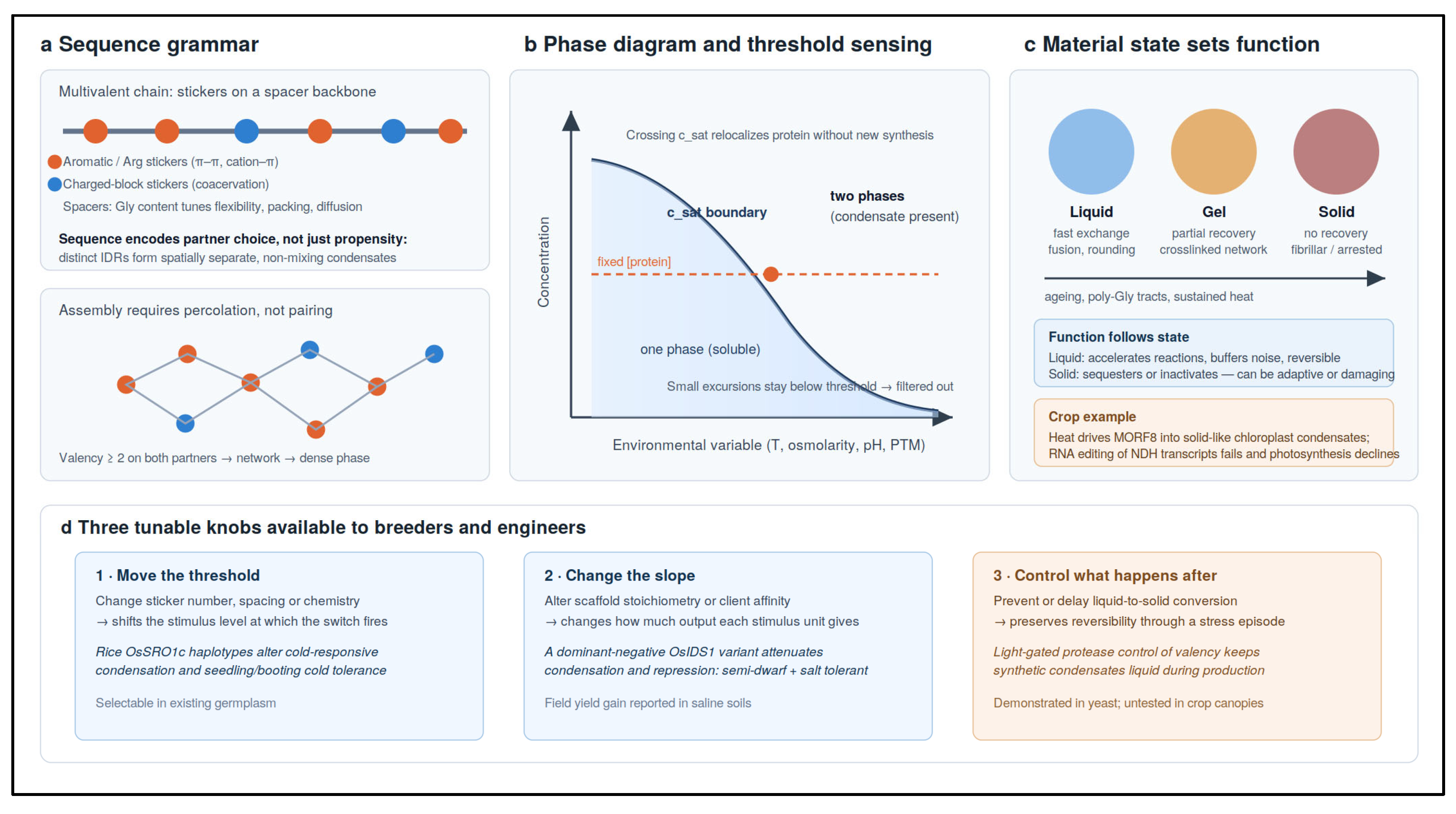
Figure 2.
Condensates as compartment-specific environmental sensors in crop cells. Condensates operate in every major compartment of the plant cell. Nuclear condensates build transcriptional hubs or trap repressors; cytoplasmic stress granules and processing bodies triage messenger RNA; chloroplast condensates can arrest RNA editing when they solidify; and ER-associated condensates reshape membrane by wetting during autophagosome biogenesis. The large central vacuole is not a bystander, because turgor sets the cytoplasmic crowding that governs saturation concentration. The four rows summaries validated signal-to-output paths for heat, cold, osmotic and saline-alkaline stress. Note that assembly and dissolution are equally used as activating events: cold-induced assembly of OsSRO1c raises transcription of the cold regulon, whereas stress-induced dissolution of OsWRKY1 by the beta-1,3-glucanase OsGH17 relieves repression. This is the basis of the activation and repression dichotomy summarized at the foot of the figure. Not drawn in scale.
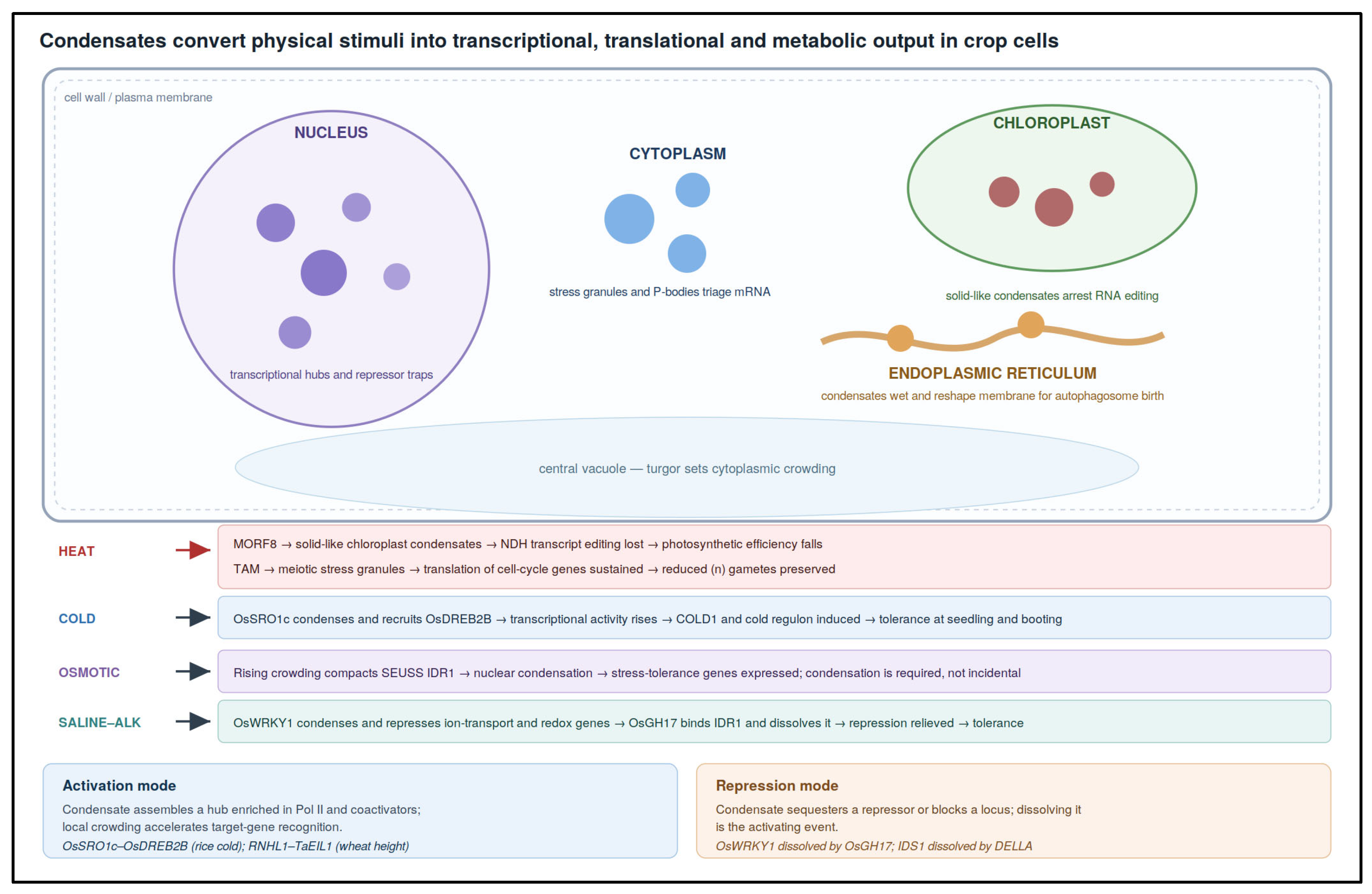
Figure 3.
Four recurring moves in the condensate arms race between crops and their pathogens. Build: pathogens assemble replication factories that depend on host structures, including myosin XI-driven motility along microfilaments, locally synthesized PI4P, and condensate substructures nested inside membranous replication organelles. Dissolve: the stripe rust effector Hasp170 binds the IDR of wheat TaPSTE and prevents recruitment of TaNF-YC, switching off ROS-burst and calcium-influx gene expression; rice stripe virus SP uses the same principle against SERRATE. Hijack: cucumber mosaic virus coat protein pulls the host kinase CDPK7-like into a condensate, which explains why overexpressing that kinase confers resistance to some viruses while increasing susceptibility to CMV. Restrict: Arabidopsis CASC3 condensates withhold Hsp70-1 and GAPDH from viral replication, restricting two unrelated viruses; the fact that ARF19 condensates do not do this shows that restriction depends on client identity rather than on condensation as such.
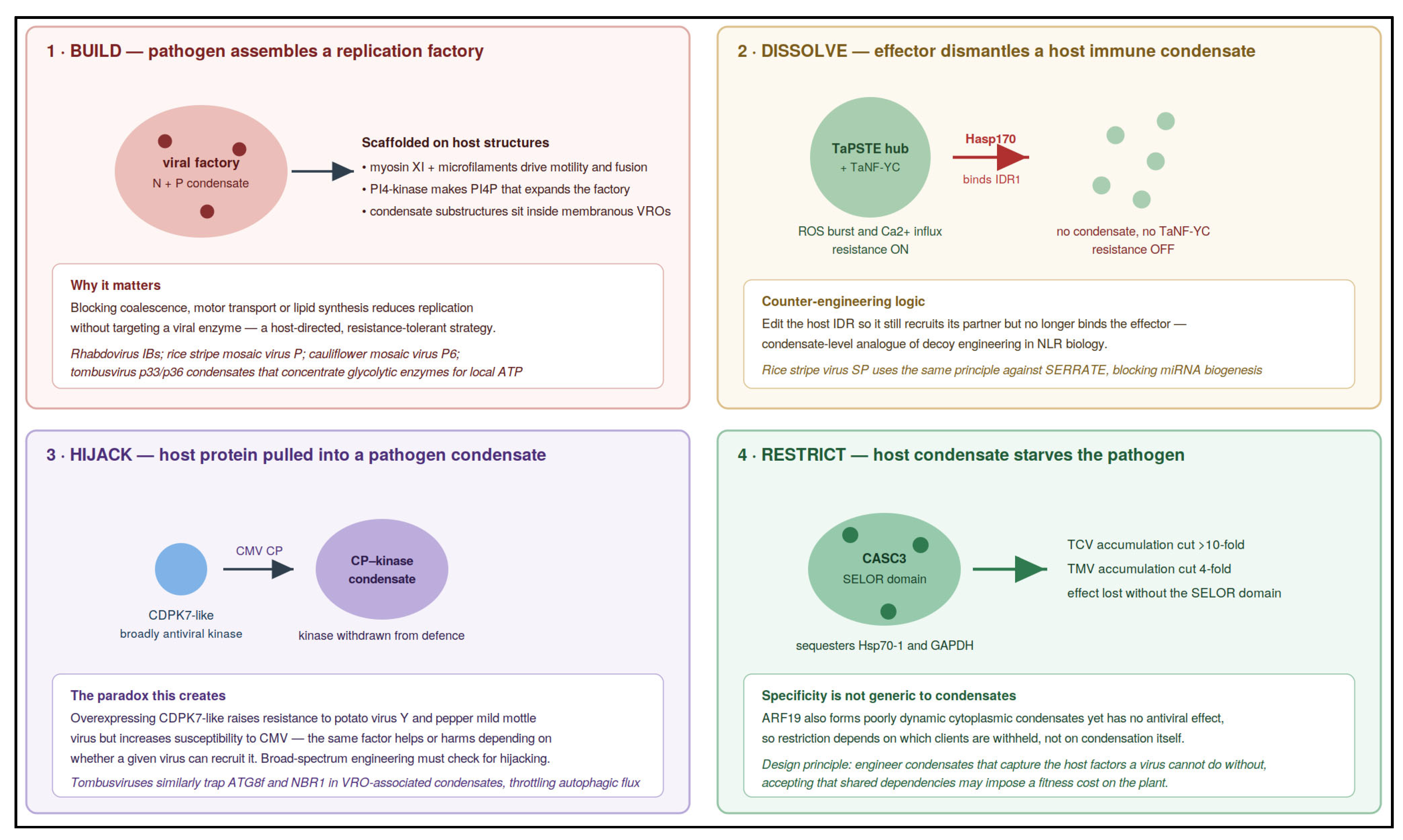
Figure 4.
Four routes from condensate mechanism to agronomic intervention, and the methodological layer they all depend on. Routes are arranged left to right by current evidential maturity. A | Breeding exploits natural haplotype variation that already differs in phase behavior and includes the only field yield figure currently available for a condensate-directed intervention. B | Synthetic compartments built from modular IDR scaffolds raise metabolic pathway output in Nicotiana benthamiana and restrict an engineered virus; notably, the metabolic gain appears to derive principally from enzyme stabilization rather than from substrate channeling. C | Small molecules that block viral nucleocapsid or coat-protein phase separation outperform ribavirin in reported assays, acting on defined residues. D | Cross-kingdom import of condensate proteins and external control of material state remain earlier-stage, with the light-gated phase regulator demonstrated in yeast rather than in plants. The lower panel lists what every route requires from the methods layer: composition, resolution, material-state measurement and causal genetics.
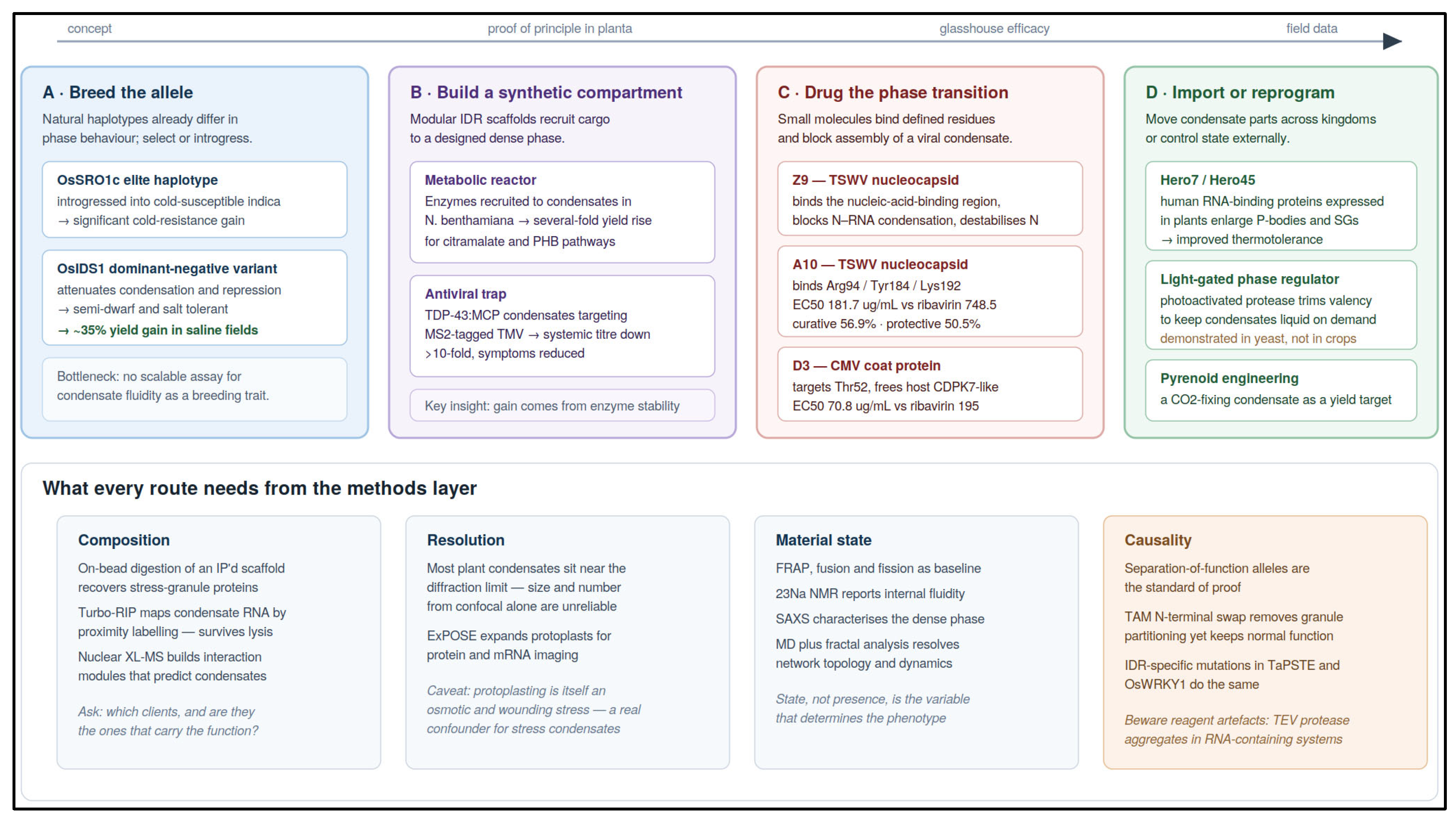

Table 1.
Condensates with demonstrated developmental or stress phenotypes in plants.
| Scaffold (species) | Compartment | Trigger | Behavior | Molecular consequence | Phenotypic outcome | Ref. |
| OsSRO1c + OsDREB2B (rice) | Nucleus | Low temperature | Reversible assembly | Recruits OsDREB2B; raises its transcriptional activity; induces COLD1 and the cold regulon | Cold tolerance at seedling and booting stages; elite haplotype transferable by introgression | [7] |
| OsWRKY1 (rice) | Nucleus | Saline-alkaline stress | Assembly, then dissolution by OsGH17 | IDR1-dependent repression of ion transport, nutrient uptake, osmotic and redox genes; OsGH17 binding lowers DNA binding and dissolves condensates | Loss of OsWRKY1 or action of OsGH17 confers saline-alkaline tolerance | [9] |
| IDS1, antagonized by DELLA (rice, wheat) | Nucleus | Salinity | Dissolution by DELLA | DELLA physically dissolves IDS1 condensates and rewires sugar-amino acid metabolism | Salt tolerance of Green Revolution varieties; dominant-negative OsIDS1 gave ~35% yield gain in saline fields | [8] |
| SEUSS (Arabidopsis) | Nucleus | Raised extracellular osmolarity | Rapid liquid-like coalescence | IDR1 compacts as crowding rises; two predicted alpha-helices required | Condensation is indispensable for hyperosmotic stress tolerance and stress-gene expression | [10] |
| MORF8 (Arabidopsis) | Chloroplast | Heat | Solid-like | Partitions PPR proteins and other MORFs; inhibits chloroplast RNA editing of NDH transcripts | Impaired NDH activity and reduced photosynthetic efficiency - a damaging condensate | [11] |
| TAM / CYCA1;2 (Arabidopsis) | Cytoplasm of male meiocytes | Heat | Recruitment to stress granules | N terminus directs partitioning; sustains translation of meiotic cell-cycle genes via TDM1 | Prevents premature meiotic exit; granule-excluded allele yields unreduced (2n) gametes | [12] |
| RNHL1 + TaEIL1 (wheat, Rht8) | Nucleus | Development | IDR-dependent hubs | Represses TaERF1, relieving suppression of the gibberellin gene TaGA3ox2 | Controls internode elongation and plant height; a Green Revolution semi-dwarfing allele | [14] |
| SlBOP + TFAM1 (tomato, petunia) | Nucleus | Development | Heterotypic condensates | Controls abscission zone formation | Petal abscission and senescence: loss degrades tomato fruit appearance but raises petunia ornamental value | [15] |
| ATG18a (Arabidopsis) | ER membrane | Autophagy induction | Mobile droplets maturing to rings | Acts with RHD3 via the linker RABC1 to reshape ER through wetting | Early autophagosome formation in stress responses | [16] |
| TaPSTE (wheat) | Nucleus | Pathogen attack | LLPS-dependent, disrupted by effector | Recruits TaNF-YC to activate ROS-burst and Ca2+-influx genes | Stripe rust resistance; abolished when Pst effector Hasp170 binds IDR1 | [45] |
| MAC complex, gated by KA120 (Arabidopsis) | Nucleus | Pathogen infection | Induced condensation | KA120 holds MAC soluble; infection licenses condensation, possibly sequestering negative regulators | Condensation is sufficient to activate defense gene expression | [17] |
| NPR1 (Arabidopsis) | Nucleus and cytoplasm | Salicylic acid, stress | Two distinct condensate populations | Separates transcriptional reprogramming from stress proteostasis and cell-survival functions | Broad resistance to biotic and abiotic stress; suppressed by extreme temperature | [18] |
| CgSCE3 (Colletotrichum gloeosporioides) | Fungal cytoplasm | Heat shock | IDR- and RRM-dependent | Regulates CgPab1-mediated stress granule formation | Required for fungal thermotolerance and for pathogenicity on host crops | [60] |
Table 2.
Pathogen-associated condensates and the host machinery they engage.
| Pathogen | Condensate driver | Host system | What the condensate does | Host factor engaged | Ref. |
| Tomato yellow mottle-associated virus (rhabdovirus) | Nucleoprotein + phosphoprotein | Nicotiana benthamiana | Liquid inclusion bodies that must move and coalesce to support replication | Myosin XI motors on microfilaments | [48] |
| Rice stripe mosaic virus (rhabdovirus) | Phosphoprotein P | Rice, N. benthamiana | Recruits replication components and expands the factory via locally synthesized PI4P | OsARF1C (COP I pathway) and OsPI4KB | [49] |
| Cauliflower mosaic virus (pararetrovirus) | Protein P6 | Arabidopsis, N. benthamiana | Non-membranous factory with an immobile P6 core; soluble P6 suppresses stress granules | G3BP7 and UBP1 stress-granule nucleators | [50] |
| Tomato bushy stunt and carnation Italian ringspot virus (+ssRNA) | Replication proteins p33 / p36 | N. benthamiana | Condensate substructures inside membranous replication organelles that generate local ATP | Glycolytic and fermentation enzymes; ER and actin meshwork | [51] |
| Tomato bushy stunt virus (+ssRNA) | p33 with autophagy machinery | N. benthamiana | Traps autophagy proteins in organelle-associated condensates, inhibiting autophagic flux | ATG8f, NBR1, SH3P2, VPS34 | [52] |
| Pea enation mosaic virus 2 (+ssRNA) | Movement protein p26 | N. benthamiana | Sequesters ribosome-biogenesis factors and reduces rRNA solubility, suppressing translation | rRNAs; fibrillarin | [54] |
| Cucumber mosaic virus (+ssRNA) | Coat protein | N. benthamiana | Sequesters a broadly antiviral host kinase, converting resistance into susceptibility | CDPK7-like kinase | [57] |
| Rice stripe virus (bunyavirus) | Disease-specific protein SP | Rice | Does not condense alone; uses phase-separation capacity to block a host condensate | SERRATE, and thereby D-body assembly and miRNA biogenesis | [46] |
| Tomato spotted wilt virus (bunyavirus) | Nucleocapsid N protein | Solanaceous and ornamental hosts | N-RNA condensation stabilizes N and supports ribonucleoprotein proliferation | Viral genomic RNA; druggable at defined residues | [73] |
| Potato spindle tuber viroid (subviral RNA) | Viroid RNA with LIG1 | N. benthamiana protoplasts | Perinucleolar condensate in which sense-strand RNA is circularized | DNA ligase I | [58] |
| Puccinia striiformis f. sp. tritici (fungus) | Effector Hasp170 | Wheat | Dissolves a host immune condensate by binding its IDR | TaPSTE IDR1; blocks TaNF-YC recruitment | [45] |
| Host counter-measure: Arabidopsis CASC3 | SELOR-domain condensates | N. benthamiana | Restricts turnip crinkle virus >10-fold and TMV 4-fold by withholding shared host factors | Hsp70-1 and GAPDH | [53] |
Table 3.
Methods for interrogating plant condensates, and what each can and cannot establish.
| Approach | What it establishes | Principal limitation in plant systems | Ref. |
| On-bead digestion of an immunoprecipitated scaffold | Protein composition of stress granules from Arabidopsis, with candidate validation in protoplasts | The dynamic granule shell is partly lost during lysis, biasing recovery toward core components | [76] |
| Turbo-RIP (TurboID proximity labelling plus RNA immunopurification) | RNA populations associated with condensates; captured P-body RNAs with minimal background | Labelling radius reports proximity, not membership; construct validation takes 2-4 weeks | [77] |
| Quantitative cross-linking mass spectrometry of intact nuclei | Hierarchical nuclear interaction modules containing condensate-forming and IDR-containing proteins | Crosslink-derived modules predict, but do not prove, co-residence in one condensate | [44] |
| ExPOSE expansion microscopy | Nanoscale imaging of condensates and transcription factors in Arabidopsis and maize protoplasts | Requires protoplasting, itself an osmotic and wounding stress that perturbs stress-responsive condensates | [78] |
| Molecular recruitment colocalization (MRC) | Live-cell visualization of multi-protein interactions and engineered condensates at designated loci | Developed in non-plant cells; adaptation to plant nuclei is still required | [79] |
| FRAP with fusion and fission analysis | Internal dynamics and a first estimate of material state | Recovery kinetics are sensitive to bleach geometry and photodamage in autofluorescent plant tissue | [11] |
| Sodium-23 NMR | Internal fluidity of the dense phase, using ubiquitous sodium as a reporter | Requires purified reconstituted phases; not applicable in planta | [24] |
| SAXS of dense phases | Structural characterization of condensed and coacervate phases | Methods derive from synthetic polyelectrolyte complexes; interpretation for multicomponent biological phases is not settled | [80] |
| Atomistic molecular dynamics with fractal analysis | Network topology, contact residence times and solvent contributions in the dense phase | Feasible only for short IDRs and small copy numbers; RNA is often omitted | [23] |
| In vitro reconstitution from minimal constructs | Attribution of phase behavior to defined sequence modules | Reagents are not inert: TEV protease aggregates in RNA-containing systems and alters the reconstituted phase | [71] |
| Separation-of-function alleles | Causal evidence that a phenotype depends on condensation rather than on the protein | Requires a variant that removes partitioning while preserving other activities; rarely available a priori | [12] |
Disclaimer/Publisher’s Note: The statements, opinions and data contained in all publications are solely those of the individual author(s) and contributor(s) and not of MDPI and/or the editor(s). MDPI and/or the editor(s) disclaim responsibility for any injury to people or property resulting from any ideas, methods, instructions or products referred to in the content. |
© 2026 by the authors. Licensee MDPI, Basel, Switzerland. This article is an open access article distributed under the terms and conditions of the Creative Commons Attribution (CC BY) license.
Copyright: This open access article is published under a Creative Commons CC BY 4.0 license, which permit the free download, distribution, and reuse, provided that the author and preprint are cited in any reuse.