

Submitted:
02 October 2026
Posted:
05 October 2026
You are already at the latest version
Abstract
Ribonucleic acid (RNA) foundation models (FMs) are reshaping computational biology, using self-supervised pretraining on massive transcriptomic corpora to acquire generalisable molecular representations. Developed initially for sequence annotation and expression prediction, they are increasingly applied to plant science, supporting tasks from gene function inference to regulatory element discovery and stress-response modelling in both model and orphan crop species. This review surveys RNA FMs with a focus on plant-relevant applications. We catalogue the major model families, including DNABERT-derived RNA adaptations, PlantRNA-FM, and Nucleotide Transformer variants, comparing their pretraining objectives, input modalities, and evaluation protocols. We examine how these models are deployed across plant genomics, transcriptomics, and functional annotation pipelines, highlighting the opportunities and the constraints arising from species-specific data gaps, limited experimental validation, and interpretability challenges. Across applications, the decisive constraint is no longer architecture but data: corpus breadth, condition-resolved benchmarks, and experimentally anchored validation now dominate the marginal gains available from model design. We close with the key open questions and a roadmap for integrating RNA FMs into the plant systems biology toolkit, emphasising benchmark design, cross-species transfer, and experimentally grounded validation. Throughout, every claim about what a model can do is held to three questions of evidence: what data the model was trained on, which benchmark supports the claim, and whether experimental validation in a plant system exists.
Keywords:
RNA foundation models
; deep learning
; plant genomics
; pretraining
; non-coding RNA
; gene regulation
; transcriptomics
1. Introduction
The first complete plant genome sequence, delivered in the early 2000s, opened a data explosion that plant biology is still absorbing [1]. RNA sequencing (RNA-seq), single-cell transcriptomics, and long-read profiling have since flooded the field with nucleic acid data across more than a thousand plant species [2], yet the interpretive bottleneck is worse than ever: the fraction of newly sequenced transcripts carrying experimentally verified function remains vanishingly small [3,4]. Sequence-to-function inference is the escape route from that gap, and three properties of the problem make it a near-perfect target for representation learning. The objects of study are sequences, and sequence encodes function through nested layers of chemical and evolutionary constraint. The labelled fraction, though small, is not random: RNAcentral, Rfam, and plant-specific databases concentrate dense supervision on model species [5,6]. And unlabelled sequence is abundant, exactly the fuel self-supervised pretraining consumes while experimental annotation catches up [7]. Foundation models occupy precisely this intersection, converting unlabelled abundance into transferable representations that labelled, species-specific data can then specialise. The deficit is easiest to see in the resources meant to absorb it: annotation databases remain dominated by a few animal clades, plant entries cluster in model species, and the most heavily curated functional and interaction resources are built around human and mouse [8,9,10].
The resulting knowledge map is deep and narrow at once: exquisitely detailed for Arabidopsis and rice, thin to absent across the thousands of species carrying most of the plant kingdom’s evolutionary and agricultural diversity. Any method that promises to close this gap must therefore prove itself not on average performance but exactly where the deficit lives, in the under-covered branches of the tree. The history explains how the field arrived here. For most of the twentieth century, assigning a function to a plant gene took years of genetic mapping, mutagenesis, and biochemistry, and the resulting knowledge accumulated in a handful of model species. Sequencing then compressed discovery from decades to months and delivered chromosome-scale crop genomes [11], yet annotation never compressed: functional labels still travel slowly, almost entirely by homology, so every lineage-specific innovation enters the literature unannotated and stays that way until someone works on it directly [3,12]. How fast we can sequence versus how slowly we can explain is now the defining tension of plant genomics, and foundation models, large neural networks pretrained on vast unlabelled sequences with objectives such as masked token prediction, contrastive learning, and next-nucleotide forecasting, are the field’s leading bet on resolving it [7]. Once pretrained, they fine-tune on modest labelled datasets and often rival task-specific models trained from scratch, a recipe whose triumph in protein sequence analysis, from ESM to ProtTrans and OmegaFold, has pulled the nucleic acid community down a parallel path [7,13].
The protein era is the right calibration point for RNA, and it rewards close reading. Protein language models earned their influence through large curated corpora, a strong evolutionary signal, and downstream tasks with clean quantitative benchmarks, and their embeddings now drive structure prediction, variant effect estimation, and functional annotation at scale [13,14,15]. RNA breaks that recipe in three ways that matter: a smaller alphabet with weaker correlation structure, functional constraint that runs through structure as much as sequence, and curated databases that over-represent animal and microbial transcripts against plant diversity. None of these is disqualifying, but together they explain why protein-era recipes transplanted straight onto plant RNA have repeatedly underdelivered. RNA foundation models (RNA FMs) hold a distinct niche in this landscape: where DNA FMs encode genomic context and regulatory grammar, RNA FMs must capture linear sequence dependencies together with the structural and functional diversity of transcripts, spanning messenger RNAs (mRNAs), long non-coding RNAs (lncRNAs), small regulatory RNAs, and ribozymes [16,17]. Structure is the load-bearing dimension, because RNA function follows secondary and tertiary folding, and modern RNA FMs build it in through explicit folding layers or attention patterns that learn base-pairing preferences [18,19]. The wider foundation-model trajectory sets the expectations: AlphaFold proved that purpose-built architectures on curated structural data reach experimental accuracy at scale, Geneformer showed that transfer from large single-cell corpora predicts network-level biology with modest supervision, and the RNA-degradation community challenges demonstrated that crowdsourced data and deep learning improve one another in a productive loop [20,21,22,23]. For plant RNA research the lesson is blunt: model capability and data curation advance together, and neither substitutes for the other.
Plant systems are where this dual bet gets tested, and they open distinctive doors. Plants carry some of the largest genomes among multicellular organisms, loaded with repetitive elements, alternative splicing diversity, and a rich non-coding repertoire that regulates development, stress responses, and epigenetic states [24,25], which makes them a demanding but honest testbed for generalisation. The data side is the hard half: Arabidopsis thaliana and Oryza sativa enjoy dense annotation, whereas only 1,124 species had been sampled in the 1KP study against an estimated 450,000–500,000 [2]. Plant-specific RNA biology compounds the difficulty, because trans-splicing, RNA editing, and heavy post-transcriptional modification introduce signals that animal- or bacterial-pretrained models may never have seen [26,27]. Crop genomics captures both sides of the ledger: sequencing multiple wheat genomes exposed the real breadth of global breeding diversity and delivered a pan-genomic reference no single assembly could, and photosynthetic-recovery engineering turned mechanistic insight directly into biomass gains [28,29]. Those wins concentrated resources in flagship crops and deepened the annotation asymmetry everywhere else. Foundation models match this landscape because their transfer capability pays out exactly where local data run thin, provided pretraining corpora reach beyond the flagship species. Converting predictions into breeding outcomes also runs through the surrounding genotype-to-phenotype pipeline: a stress-responsive isoform prediction earns its keep only once it can be scored across a breeding population, using the marker systems, phenotyping platforms, and statistical genetics many programmes already operate [30,31].
Embedding-based predictions feed that pipeline as priors on gene function, shrinking candidate lists before expensive validation, and their errors stay tolerable because human review remains in the loop [21]. The programmes that gain fastest are thus those with mature data infrastructure rather than the newest algorithms, which argues for pairing every model investment with an equal investment in curated, population-scale plant phenotyping. This review surveys RNA foundation models through a plant lens, prioritising studies that evaluate sequence models directly on RNA or plant-genomic tasks and flagging preprints as such where cited. Section 3 and Section 4 cover architectures, pretraining objectives, and the biological knowledge these models encode, because those kingdom-general properties set the ceiling for every plant application. Section 5 and Section 6 then test that ceiling against real plant tasks, and Section 7 and Section 8 examine the evaluation infrastructure and the structural gaps between current capability and routine deployment. The contribution is a plant-task-centred critical synthesis: how plant biological conditions change what these models should be asked to do, how far the evidence actually supports each claimed capability, and which moves research programmes and funders should make now. Every capability claim is held to one standard throughout: what data trained the model, which benchmark supports the claim, and whether any experimental validation in a plant system exists (Figure 1) [20,22].
2. Literature Search, Screening, and Evidence Standard
2.1. Search Execution
The search and screening workflow is reported with per-stage record counts for auditability (Figure 2). Five documented boolean queries, assembled from the concept blocks of this review and listed in the Supplementary Material, were executed on 2 October 2026 against the OpenAlex bibliographic index (title and abstract fields, 2000–2026, journal articles and reviews), returning 984 records (120, 259, 23, 431, and 151 per query). After removal of 149 duplicate records, 835 unique records entered two-stage screening.
2.2. Two-Stage Screening
Stage 1 screened titles and abstracts against three inclusion criteria: a record was retained if it named an RNA-centred subject, reported a computational modelling component, and addressed a sequence-level task; 210 records were excluded (167 without an RNA-centred subject, 15 without a computational modelling component, and 28 without a sequence-level task), leaving 625 records. Stage 2 first applied concrete disqualifiers, excluding 39 records (32 without a retrievable abstract and 7 whose scope was protein-centred) and leaving 586 candidates. A documented title-signal rule was then applied, retaining 205 records whose titles carried at least three of four signals, namely an RNA-centred subject, computational modelling, a sequence-level task, or a plant or crop context, or combined a plant or crop context with an explicit modelling term; the remaining 381 records, whose titles addressed only peripheral themes, were not carried into the corpus.
2.3. Corpus Assembly and Verification
The citation corpus combines the 205 query-retained records with supplementary references identified through backward citation tracking and targeted searches for classic experiments and studies not surfaced by the query terms; after prioritisation for direct relevance and non-redundancy, the review cites 180 references, which are provided as a BibTeX file alongside the manuscript. All 180 cited references carry a digital object identifier and were verified against the Crossref registry; each was additionally checked against the primary source by the authors. Because sequence-similarity between training and test records can inflate apparent accuracy, split design is treated as part of the evidence base rather than a technical detail: homology-aware and species-level splits are required before a generalisation claim is accepted, and the split unit is reported alongside every performance figure discussed below.
2.4. Evidence Standard
To keep claims auditable, every claim of capability in this review faces the same three questions: what data the model was trained on, which benchmark supports the claim, and whether experimental validation in a plant system exists. A claim is treated as plant-validated only when the third question is answered affirmatively; where it is not, the result is reported as a computational result whose transfer to plants remains untested, and no claim of agronomic value is drawn from it. Table 3 applies this standard to the applications surveyed in Section 5 and Section 6, and the Supplementary Material provides the corresponding evaluation checklist. This standard is proposed for this review, adapting the general notion of evidence grading to RNA foundation models in plant science; it is a working convention for this article rather than an established community standard.
Section 2 documents how the literature base was identified and screened, and the evidence standard this review applies to every claim.
3. Anatomy of an RNA Foundation Model: Architecture, Training Objectives, and Input Design
The architecture of an RNA foundation model decides how nucleotide sequences are represented and which features can be pulled from them. Implementations differ widely, yet most RNA FMs share one philosophy: sequences enter as strings of nucleotides (A, U, G, C, and sometimes N for ambiguity), and transformer or convolutional layers learn distributed representations of their biological regularities [7,32,33]. Tokenisation may run on single nucleotides, on k-mers that preserve local chemistry, or on structure-informed units derived from predicted pairing, and the choice fixes what a model can express about a motif before it sees any data [34]. Embedding dimensionality and depth trade capacity against the small-sample regimes plant fine-tuning typically faces.
Attention variants also differ in how they expose relative position, which matters because RNA secondary structure is defined by pairing instead of linear distance. When a paper bundles several design choices without ablations, its gains cannot be attributed, so plant adopters should favour models whose choices are documented and ablated: undocumented decisions become undocumented failure modes the moment a model meets plant data (Figure 3).
3.1. Transformer-Based Architectures
The transformer, originally built for natural language processing (NLP), is now the dominant backbone for nucleic acid FMs [35]. Its self-attention captures long-range dependencies between nucleotides, exactly what RNA needs when base pairing pulls distant sequence elements together; layers typically start from token embeddings per position, optionally seasoned with positional encodings that reflect linear distance [34,36].
Base-paired helices couple positions hundreds of nucleotides apart, and pseudoknots plus tertiary contacts add crossings that fixed-depth local models cannot represent [37]. Attention hands the network a direct mechanism for these couplings, and probing studies report learned attention maps aligning with experimentally determined base-pairing matrices far above chance, most of all for helices conserved across homologues [38]. Positional encoding still matters, because a model that knows only linear distance learns helix proximity only indirectly, which is why relative and rotary encodings and pairing-aware biases borrowed from structure prediction now appear in recent RNA architectures [18,39].
A series of transformer-based RNA FMs marks out the recent landscape. PlantRNA-FM pretrains a transformer encoder with a masked language modelling objective on RNA sequences and structures from 1,124 plant species, predicting masked nucleotides from contextual neighbours in a BERT-style scheme [40], and follow-up work has carried similar architectures into plant-specific applications [40,41,42]. RiNALMo scales masked-language pretraining to hundreds of millions of parameters and reports gains on secondary structure, splice-site, and ncRNA-detection benchmarks [39].
RNAErnie layers motif-level random masking on top of base-level and subsequence-level masking, so the model learns from biologically coherent motif units as well as single nucleotides [43]. RNABERT targets compact base-level embeddings, SpliceBERT specialises in splice junctions across species, and UTR-LM confines itself to untranslated regions where translation-regulating structure runs dense [32,44]. Each sacrifices breadth for resolution inside its chosen slice of RNA biology, so the set reads as a menu of specialisms, not a ladder of ever-better models.
DNABERT and its RNA-adapted descendants form a second lineage. DNABERT was pretrained on the human reference genome with k-mer tokens and a bidirectional transformer, then carried over to RNA by mapping uracil (U) to thymine (T) so RNA sequences could enter its vocabulary, followed by fine-tuning on the RNA task [45]. BERT-RBP demonstrates the pattern directly, adapting DNABERT weights to RNA-binding tasks [46]. The adaptation keeps the model’s grip on k-mer level patterns while retargeting its representations toward RNA-specific features such as splice sites and RNA structure motifs [32,44,45,47]. The Nucleotide Transformer family then pushed this strategy to multi-species scale, integrating 850 genomes and staying accurate in low-data settings, precisely the combination plant genomics needs where annotation is sparse [48]. Pretrained on tens of millions of RNA sequences across diverse taxa, such models build representations that generalise across evolutionary distances and capture conserved regulatory and functional motifs [39,49,50]. Genome-scale DNA models set the instructive upper bound: Evo runs from regulatory elements to whole genomes, generating coding-rich sequences up to 650 kb in silico [51].
For plant RNA the matching corpora simply do not exist at that depth, and plant transcripts carry kingdom-specific processing signals that DNA-only models cannot see. For plant applications the actionable conclusion is that corpus composition and taxonomic breadth, not raw scale, currently decide downstream usefulness, a thread picked up in Section 7 (Table 1).
3.2. Convolutional and Hybrid Architectures
Transformers dominate the conversation, but convolutional neural network (CNN)-based architectures stay relevant wherever local feature extraction wins: learnable filters swept across a sequence catch transcription factor binding sites, splice signals, and structural elements [52]. Their edge is computational efficiency plus an inductive bias toward local patterns, which suits the modular architecture of RNA functional elements.
Plant applications live in the low-data regime, where classifier sample sizes on bulk transcriptomic data run in the hundreds, a cross-task analogy from human bulk disease classification , not a transferable rule [53]. That is exactly where a convolutional inductive bias earns its keep: dilated and multi-scale convolutions stretch the receptive field without full attention’s quadratic cost, and hybrid designs pair convolutional motif extractors with transformer encoders for long-range integration. In plant pipelines the argument is computational: shorter, cheaper inference paths slot into breeding-programme annotation far more easily. Hybrid CNN–transformer architectures have gained traction on comparable logic, CNN layers catching local sequence motifs while transformer layers integrate longer-range dependencies [54,55].
They reach competitive RNA classification performance with fewer parameters than pure transformers [35,56], and state-space and linear-attention models extend the efficiency argument with near-linear scaling and explicit long-range mechanisms [51]. Head-to-head benchmarks of these backbones on identical RNA tasks remain rare, and the existing comparison runs mostly through DNA modelling, where linear architectures match transformers at a fraction of the cost [57]. The plant-relevant reading is pragmatic: a model a breeding institute can fine-tune overnight on one graphics card delivers more annotation value than a frontier transformer only a national lab can train.
3.3. Pretraining Objectives
The pretraining objective may be the single most consequential design choice, because it fixes which biological regularities a model can learn to exploit. Masked nucleotide prediction leads the field: a fraction of positions are randomly masked, and the model must recover the original nucleotide from surrounding context [43], a scheme that teaches contextual dependencies reflecting biochemical and structural constraints [43,45,58].
Objectives of the same masked family yield representations that excel at local chemical plausibility and splice-relevant contexts [13,32]. Motif-aware corruption produces embeddings that cluster by functional class more cleanly than naive masking, at the price of coupling the model to its designers’ motif vocabulary [43]. Causal objectives suit generation, and structure-aware objectives buy large folding gains by injecting thermodynamic knowledge that sequence statistics alone cannot supply [51,59]. For plant applications, ensembling or task-matched model selection therefore beats betting on one universal RNA encoder.
Alternative objectives round out the design space. Next-nucleotide prediction teaches a model to emit the subsequent nucleotide, learning sequential dependencies that may reflect constraints associated with polymerase processivity and co-transcriptional folding [51,60]. Structural pretraining trains models to predict RNA secondary structure from sequence alone [38,61], so representations encode structural information alongside sequence information.
Structurally aware RNA FMs outperform sequence-only counterparts on downstream tasks such as RNA-protein interaction prediction [18,39,50,62]. This wave stands on three decades of groundwork: quantitative assessments charted the promise and failure modes of physics-only structure prediction, RNA-Puzzles blind testing made hindsight-free evaluation the discipline’s gold standard [37,63], thermodynamics-constrained deep networks lifted secondary-structure accuracy while keeping physical interpretability [61], and curated structure repositories now supply pretraining material and benchmarks at scale [64]. Rigorous evaluation infrastructure, more than any single algorithm, converted structure prediction from an art into an engineering discipline.
Pretraining with folding constraints also rewrites what interpretability analyses find. Attention alignment with base-pairing stops being an emergent accident and becomes a design outcome, which makes attention-based explanations more trustworthy in these models than in sequence-only relatives [37]. Coupling learned representations to differentiable thermodynamic layers, as the newest folding systems do, preserves energy-based interpretability while adding sequence-context sensitivity [61].
For plant applications the choice of objective carries extra weight. Plant RNAs show distinctive features, among them extensive alternative splicing, RNA editing, and trans-splicing, that objectives designed around animal or bacterial systems may never capture [24,27,65]. Plant-specific pretraining objectives are therefore an emerging direction: PlantRNA-FM already implements structure-assisted objectives in pretraining, while more plant-mechanism-oriented designs, such as masking plant-specific splice sites, remain proposed, not established [34,42,66].
3.4. Input Modalities and Representation Formats
The input format of an RNA FM sets the granularity and richness of what the model can see. The most basic format reads RNA sequences as strings of individual nucleotides, each a one-hot vector over {A, U, G, C} [47,67,68,69], capturing primary sequence alone and leaving every higher-order feature for the model to learn implicitly. More sophisticated formats fold in additional biological information.
Some models accept paired sequence-structure inputs, carrying predicted or experimentally determined secondary structure alongside the primary sequence. In the ERNIE-RNA study, such a configuration appears only as a downstream comparison baseline, one-hot encoding with icSHAPE structure probes in PrismNet, , not as a foundation-model input; even so, it shows the value of structural channels for RNA-protein interaction prediction [18]. Others fold in epigenetic features such as methylation patterns, particularly relevant for plant RNAs where editing and base modification regulate expression [26,70]. Sequence-to-expression models in the Enformer family instead use measured expression profiles as training targets instead of inference-time inputs, learning associations between sequence features and transcriptional activity [54,71]. Direct RNA sequencing goes further and measures the molecule itself: nanopore platforms resolve base modifications, poly(A) tail length, and full-length isoform sequences in one read, and plant applications have begun exploiting these signals to annotate modification landscapes that orthogonal methods only infer [72].
Models that treat modification channels as first-class input learn from the experimental facts plant RNA biologists actually measure. The constraints are real: throughput trails short-read sequencing, basecalling for modified bases keeps improving but is not settled, and few plant tissues have been profiled deeply. Even so, the alignment between what direct RNA sequencing measures and what RNA FMs predict is unusually clean, and corpus projects pairing the two deserve high priority. The choice of input representation is where domain knowledge enters most directly: chemical modification channels derived from direct RNA sequencing let models separate otherwise identical sequence contexts [73]. Models that inject pairing probabilities from thermodynamic predictors at input time hold a useful middle ground between sequence-only inputs and the co-evolutionary alignments standard in protein modelling, and expression or developmental-stage conditioning gives the model the context a transcript actually functions in, which tasks such as stress-responsive isoform usage demand [74]. Richer inputs buy accuracy but consume exactly the experimental data non-model plants lack, so input design is ultimately a statement about which species a model serves.
For plant applications, input modality is constrained by data availability: Arabidopsis enjoys extensive structural and epigenetic data, while most crop species lack even basic transcriptome annotation [75,76]. Models trained on richly annotated species may therefore fail to transfer to data-poor plants, which is what makes cross-species transfer learning and few-shot adaptation central [21,77].
3.5. Training Scale and Data Sources
The scale of RNA FM pretraining has climbed dramatically: early models trained on tens of thousands to low millions of sequences, while today’s models draw on corpora of tens of millions from NCBI, ENA, and species-specific databases [32,39], a rise driven by larger datasets and the recognition that deeper models need more data to avoid overfitting [17,48,53]. The plant RNA sequence space remains underrepresented against animal and microbial sequences, and dedicated plant ncRNA resources such as the Plant Non-coding RNA Database (PNRD) do not close that gap [6,9,78]. Plant RNA FMs must therefore often lean on cross-species transfer from animal or microbial pretrained models, which raises hard questions about how representations travel across the tree of life [79,80].
The risks of cross-kingdom transfer are not hypothetical. Plant transcripts differ from animal transcripts in splice-site consensus, in the dominance of U-rich introns, in organelle-encoded transcripts that undergo extensive post-transcriptional editing, and in polyadenylation signals that follow no single canonical hexamer [81,82,83]. A model pretrained mostly on animal sequences carries priors that are subtly wrong for every one of these features, and because the priors live in the representations rather than in any single layer, light fine-tuning cannot easily patch them.
The composition of public resources explains much of the shortfall: plant-specific databases deliver excellent gene-model annotation for a handful of species, yet coverage thins quickly outside the models [84,85], and the interaction and modification databases that could support supervised pretraining are heavily animal-weighted [10]. Closing the gap takes deliberate corpus engineering: redundancy-aware sampling across taxa, integration of organelle and chloroplast transcripts most pipelines discard [2], and direct-RNA sequencing data, which carry modification signals that sequence-only corpora lack [72].
Recent efforts have responded by curating plant-specific RNA datasets and training models exclusively on plant sequences; these plant-specific FMs perform better on plant tasks, particularly for non-model species, showing that taxon-specific pretraining captures features that cross-kingdom transfer loses [41,86]. The limited size of plant RNA datasets still caps the model capacity that can be trained effectively, setting up a trade-off between data breadth and representational power [33,53,78]. Scaling behaviour deserves explicit attention, because it is so often invoked to justify ever-larger plant models.
In protein modelling, loss curves follow smooth power laws in parameters, and the protein evidence suggests meaningful emergent capability appears only well beyond the scale plant RNA corpora currently permit [13]. Whether those laws hold for RNA is empirically open: RNA has a smaller alphabet, stronger local chemical constraints, and a corpus whose effective diversity is capped by database redundancy; plant-specific pretraining also competes for limited annotation capacity. The emerging consensus is to scale pretraining corpus breadth across taxa while keeping plant-specific fine-tuning light, preserving generality without overfitting to a handful of well-annotated species (Table 2).
4. What RNA Foundation Models Learn: Sequence Grammar, Structure, and Phylogeny
The central evaluation question for RNA foundation models is what biological knowledge their representations actually encode. Where hand-crafted features spell out known motifs and structural rules, RNA FMs learn implicit representations through self-supervised training. Whether those representations capture biologically meaningful regularities demands probing methodology as careful as the models themselves [87]. The standard toolkit borrows from language-model interpretability, pairing linear probes on frozen embeddings with attention-map analysis, head-level ablations, and comparison against curated feature sets. Every method in that toolkit has known failure modes. Linear probes can detect information the model never uses in its own predictions, attention weights need not be causal explanations, and ablations can be confounded by redundancy across heads [88]. The most convincing studies therefore triangulate: a representation aligns with a biological signal, ablating that signal changes downstream predictions, and the alignment strengthens with pretraining scale the way genuine learned structure would.
Reviews of interpretability practice in biological sequence models converge on exactly this multi-pronged standard (Figure 4) [35].
4.1. Sequence Motifs and Regulatory Elements
Capturing known sequence motifs and regulatory elements is the most studied facet of RNA FM representations. Attention heads in transformer-based RNA FMs concentrate on functionally important regions such as splice sites [40,52], and the evidence is strongest where the motif inventory is densest: heads trained on broad corpora recover canonical splice dinucleotides and branch-point enrichment [32,89]. Plant-specific probing is thinner but consistent, with interpretable plant RNA FMs identifying functional RNA motifs directly from plant transcriptomes [40].
What stays unresolved is depth of understanding: a head can track a motif through positional statistics alone, and separating statistical co-occurrence from mechanistic encoding is the central interpretability question for the next generation of probing studies. It bites hardest in plants, where regulatory grammar diverges enough from animals that inherited heuristics could actively mislead. The motif-recognition capabilities of RNA FMs have accordingly been tested on plant regulatory elements such as splice acceptor and donor sites [86,90]: plant splice-site consensus sequences diverge from the animal patterns that pretraining absorbs [81,90], and plant-specific fine-tuning improves motif recognition even as the extent to which cross-kingdom transfer captures plant regulatory grammar remains open [40].
4.2. Structural Features and Base-Pairing Patterns
Beyond sequence motifs, RNA FMs encode structural information: attention patterns often correlate with base-pairing propensity, indicating that structural constraints are learned from sequence alone [38,58], a capability with clear value for plant RNAs, whose riboswitches and thermosensors regulate genes critically [66,91,92].
Plant structural RNAs also stress the generalisation limits of current models in a scientifically useful way: riboswitch classes characterised in plants and algae often differ from the bacterial archetypes that dominate structural databases, and thermosensors are tuned to host temperature ranges, so models inherit distributional assumptions from their training data [64,91,92]. When a folding model rates a plant structural candidate low-confidence, the failure may be a genuinely disordered transcript or a lineage-specific architecture, and comparative probing across related species tells the two apart: conservation of predicted structure across orthologues supports the biological reading, while divergence flags model uncertainty, not biological noise. Studies comparing attention patterns with experimentally determined secondary structures [18,58] find the correlation strongest for conserved structural elements and weaker for variable regions, so the model prioritises structurally constrained features over sequence-variable ones.
Structural elements conserved across plant lineages are therefore more likely to be recognised accurately than species-specific innovations [66,93,94]. Contemporary folding models couple learned sequence representations with explicit structural or thermodynamic modelling, and their accuracy on non-pseudoknotted secondary structure has climbed substantially [61].
Accuracy concentrates on conserved helices and degrades on lineage-specific features, mirroring the evolutionary signal in the training data; for plant RNAs whose biology depends on structure, model confidence should be read as partly reflecting conservation and training coverage more than calibrated correctness, and low-confidence plant transcripts are exactly the ones worth sending to experimental structure probing [94].
4.3. Phylogenetic and Evolutionary Signal
RNA FMs also capture phylogenetic signal: embeddings from closely related species cluster together in latent space while distant species land further apart [42,95,96], indicating that these models learn the evolutionary constraints on sequence and structure, the conservation patterns purifying selection writes [93,95]. The geometry of these embedding spaces explains both the strengths and the pathologies of transfer: species sharing conserved RNA processing machinery occupy neighbouring regions, and transfer within such neighbourhoods supports functional inference across species [80].
The same geometry, however, concentrates model capacity on well-sampled regions of sequence space, so orphan transcripts, precisely the molecules annotation pipelines most need help with, land in low-density neighbourhoods where nearest-neighbour label transfer is least reliable, and plant genomes are rich in such orphans. Density-aware confidence estimation and out-of-distribution detection give calibrated uncertainty for poorly sampled transcripts, and plant annotation pipelines acting on model output should treat these calibration tools as mandatory, not optional. For plant science the phylogenetic dimension matters doubly, given the evolutionary depth of the plant kingdom: models pretrained on a broad phylogenetic sample generalise better across lineages, while narrow-sample models struggle with out-of-distribution species [96].
Recent work on pretraining dataset composition landed one of the field’s most actionable results: phylogenetic diversity in the training data is an important predictor of cross-species performance [42,50,96]. The finding inverts the scaling intuition inherited from other domains: for cross-taxon transfer, corpus composition can matter as much as size, since a corpus spanning deep phylogenetic distance teaches evolutionary constraints more efficiently than one that redundantly samples a single lineage [42,95]. For plants, whose lineage depth from bryophytes to angiosperms rivals the entire animal kingdom, the implication is concrete: pretraining corpora should span plant diversity deliberately, weighting non-model and early-diverging lineages instead of letting database redundancy decide the distribution [2,9].
4.4. Functional Annotation from Sequence Alone
Predicting functional annotation from sequence alone is the headline capability of RNA FMs. By relating embedding similarity to functional similarity, researchers have shown that sequence-derived embeddings carry enough information to predict gene ontology terms with reasonable accuracy, demonstrated for protein language models combined with homology search and for gene embeddings built on sequence, expression, network, and text representations [15]. That protein-era result is the methodological template RNA studies now replicate. The RNA counterpart is genic-region annotation from sequence alone, where a plant foundation model pretrained on 1,124 species reaches an F1 of 0.974 against 0.639 for the previous best model [40], a leap that matters because most annotated plant genes come from a handful of model species [3,4,9,97]. The accuracy of such prediction, however, depends critically on training data quality and breadth: models trained mostly on animal or microbial data may produce biased predictions on plant sequences, reflecting the taxonomic skew of available annotation [9,41]. Fixing the bias takes either plant-specific fine-tuning or taxon-aware evaluation protocols that account for the uneven distribution of functional annotations across the tree of life [86,95,98,99].
Taxon-aware evaluation also changes how progress itself is measured: a model that lifts average accuracy by exploiting better-covered gene families has not improved anything for the orphan transcripts that motivated its use, so aggregate metrics flatter exactly the models that need scrutiny. Stratified reporting, by functional category, by phylogenetic distance to training data, and by annotation evidence level, is the minimum standard plant-relevant evaluations should adopt [100]. One recent benchmark adds a warning for small studies: performance is highly sensitive to the choice of holdout chromosomes [98].
5. Closing the Annotation Gap: Gene Function and the Non-Coding Genome
The most promising near-term application of RNA FMs in plant science is automated annotation of plant genomes and transcriptomes. Despite decades of sequencing effort, a substantial fraction of plant genomic elements remains unannotated or poorly annotated, particularly non-coding regions and alternatively spliced isoforms [76,97,101,102]. RNA FMs attack the gap directly, predicting functional elements from sequence patterns alone. The economics make the case: manual curation of a single plant gene family is slow and specialist-intensive, so annotation debt compounds [4], while automated prediction shifts human effort from primary labelling to verification of model output. Framing RNA FMs as annotation accelerators rather than annotation oracles is therefore both more accurate and more useful to the resource providers who maintain the reference genomes the entire field depends on (Figure 5); Table 3, summarised after Section 6, grades these applications against the three-question standard of evidence.
5.1. Gene Function Prediction
Gene function prediction from sequence is a longstanding computational challenge. Traditional homology-based annotation transfers functional labels from sequenced to unsequenced genes by sequence similarity [12,15]; effective for well-conserved genes, it fails for rapidly evolving genes, lineage-specific innovations, and genes with multifunctional domains [99,103,104]. Homology transfer also inherits whatever biases the source databases carry, because a transferred label keeps the evidence qualifiers of its source entry instead of being re-derived for the query gene [8]. Domain-level transfer loses context, handing an identical molecular function to every member of a family even when substrate specificity turns on a few residues. And the transfer radius is short: beyond roughly pairwise sequence identity of thirty percent (a boundary that depends on alignment length and task), label transfer becomes unreliable precisely where many plant resistance genes and specialised-metabolism enzymes live [12,105]. Embedding-based predictors are less exposed to these specific failure modes: their errors land in different places and degrade more gently, which is what makes the two families complementary in practice. RNA FMs can therefore predict gene function for genes lacking close homologs of known function [106], a capability plant genomics needs badly, since lineage-specific families such as disease resistance genes and secondary metabolism enzymes are abundant and often poorly annotated [99,103,107]. Resistance-gene annotation shows the opportunity concretely: nucleotide-binding leucine-rich repeat receptors evolve under diversifying selection, their annotation is notoriously error-prone under standard pipelines, and misannotation propagates into breeding decisions when these genes become markers [107]. Classifiers tuned for receptor architecture exploit features motif-counting heuristics ignore, and embedding-based features lift accuracy further in the fragmented regions where these clusters sit; similar reasoning covers specialised-metabolism enzymes, whose substrate promiscuity defeats homology transfer and domain models alike. Because these gene classes sit at the centre of resistance and quality-trait breeding, annotation improvements flow straight into germplasm screening and gene discovery. Recent benchmarks have scored sequence-based language models on plant genomic tasks such as splice-site prediction, alternative polyadenylation site prediction, and regulatory element strength prediction, and on RNA tasks spanning ncRNA classification, m6A prediction, splice-site prediction, and translation efficiency [34,108]. Pretrained genomic language models do not uniformly beat task-specific methods, which stay competitive wherever training data are plentiful. The edge appears mainly when data are limited or imbalanced, and an analogous pattern is expected in plants: competence on conserved families, larger gains on poorly annotated, lineage-specific genes [108]. The same complementarity defines a division of labour: homology remains the method of choice wherever close homologues with experimental labels exist, while embedding-based prediction earns its keep in exactly the complement, lineage-specific expansions and the long tail of genes with no annotated homologue at all [99,104,107].
A hybrid pipeline that runs homology first and routes the unannotated remainder to embedding-based predictors captures both strengths, and benchmarks structured along these lines show the union beating either method alone [15].
5.2. Non-Coding RNA Discovery
Non-coding RNAs (ncRNAs), including microRNAs (miRNAs), small interfering RNAs (siRNAs), long non-coding RNAs (lncRNAs), and circular RNAs (circRNAs), orchestrate plant gene regulation, development, and stress responses [109,110], yet ncRNA annotation remains hard because universal sequence motifs are missing and biogenesis pathways are diverse [101,111,112,113]. The mechanistic vocabulary is well charted: Argonaute proteins mediate the silencing effector step shared by all small-RNA pathways, and target mimicry was identified in plants as a decoy mechanism that sequesters microRNAs and tunes their reach [114,115]. miRBase provides the reference catalogue of microRNA loci, and psRNATarget implements plant-aware target prediction rules [116,117]. RNA FMs contribute by separating coding from non-coding sequences and by picking out structural signatures characteristic of different ncRNA classes [109,113]: classifiers trained on plant data can predict the coding potential of plant lncRNAs, and language-model representations beat task-specific methods where labelled data are limited or imbalanced [108,118]. The unsupervised side of FM representations opens another door entirely, a route to novel ncRNA classes that fit no existing annotation category such as the Rfam families [112,119]. Accuracy claims need reading against class imbalance and label noise: known plant miRNAs are well curated and discriminative models shine there, while classes with few validated examples inherit their training sets’ weaknesses [113,116]. Embedding-based clustering sidesteps imbalance for discovery because it needs no class labels, but raises its own calibration question: clusters map onto structural or functional families only to the extent those families are represented in pretraining. The pragmatic pipeline runs in three stages: embedding-space screening of unannotated transcripts, structural and homology validation of cluster representatives, and experimental confirmation of a few high-value candidates. Run over plant transcriptomes, unsupervised clustering should surface candidate small-RNA loci outside the known miRNA and siRNA families and structured lncRNA clusters no motif model would have proposed, and it is a natural route to the poorly resolved circular-RNA populations, where a single crop species alone yields several thousand loci of recent evolutionary origin [112,120]. Candidates need experimental confirmation before they become biology, through expression validation, structure probing, and loss-of-function assays; the strategic value is that the model cuts the search space from whole transcriptomes to shortlists experimental groups can actually process.
Plant miRNA biology also diverges from animals in biogenesis and target recognition [121,122], and plant lncRNAs are increasingly recognised as regulators of development and stress responses even as their annotation trails animals [25]. RNA FMs pretrained on diverse plant transcriptomes are well positioned to close these gaps [2,40,119]. Plant lncRNA annotation carries a definitional problem: animal-trained coding-potential classifiers misfire on plant transcripts, so plant lncRNA identification leans on dedicated plant-trained classifiers [118], and lncRNA loci are themselves a source of Dicer-like 1-dependent small RNAs, blurring the class boundary [123]. Embedding-based representations sidestep part of the problem by learning transcript-level features closer to the functional definition plant biologists use; with direct functional labels unavailable at scale, supervised approaches lean on indirect labels such as chromatin marks and conservation, and models should report calibrated uncertainty. Plant small-RNA regulation matters for model design too: plant microRNAs recognise targets with near-complementary pairing across the coding region, so animal-style target prediction systematically misses plant interactions and invents spurious ones [116,124], and biogenesis differs through Dicer-like enzymes with distinct structural preferences and lineage-specific small-RNA classes [111,121]. The winning recipe is therefore broad-sequence pretraining for general RNA grammar followed by plant-supervised fine-tuning for the recognition code, the default for plant small-RNA applications. Plant ncRNA resources also lag their animal counterparts, so the three classes, small RNAs, lncRNAs, and circRNAs, sit at very different supervision levels and no single pretraining recipe can serve all three. Closing those resource gaps, particularly structured annotation of plant long RNAs, would remove one of the cheapest bottlenecks in the whole application pipeline.
5.3. Alternative Splicing and Isoform Identification
Alternative splicing is pervasive in plant gene expression, with the majority of multi-exon plant genes producing multiple isoforms [125,126], and its functional consequences make accurate isoform annotation essential [24,65]. Genome-wide mapping studies in Arabidopsis established early that alternative splicing touches a large share of multi-exon genes and responds to environmental cues, and differential-splicing frameworks such as SUPPA2 provide the widely adopted event-level quantification protocol [126,127]. Isoform-level annotation is where plant transcriptomics most needs foundation models: short-read pipelines merge near-identical transcripts by default, discarding exactly the subtle variation that distinguishes stress-responsive isoforms [24,125], while long-read sequencing resolves full-length isoforms but with its own error profile and little plant-tissue coverage [97]. Junction-level deep-learning classifiers now score splice sites accurately enough to flag misannotated introns and splice-altering mutations across taxa [90], and wiring these scorers into plant annotation pipelines would move isoform annotation from majority-vote heuristics to evidence-weighted inference. RNA FMs add two more capabilities: predicting splice site usage from sequence context and identifying splicing regulatory elements such as exonic and intronic splicing enhancers and silencers [90,128]. Transformer-based RNA FMs predict alternative splicing events with accuracy approaching dedicated splicing tools while exposing interpretable attention maps over the regulatory elements driving splicing decisions [32,52,89]. Under stress, alternative splicing becomes even more prevalent, providing rapid regulation without de novo transcription [30,129]; RNA FMs trained on stress-responsive transcriptomes may therefore capture stress-specific splicing regulation [30,130,131]. Stress-induced splicing also exposes a flaw in static benchmarks: a model evaluated on unstressed reference annotations is tested on the easiest part of the distribution, since stress multiplies intron retention and cryptic junction usage [74,127]. Splicing further interacts with the circadian clock and tissue type, so one locus can yield different isoform distributions that no single reference transcriptome reconciles. The evaluation implication is direct: plant splicing benchmarks should include condition-resolved test sets from stress time courses and score condition-specific isoform usage. A handful of rice and Arabidopsis time courses already provide suitable data, making this one of the cheapest near-term upgrades to plant RNA evaluation. Stress-responsive splicing also matters for crop improvement: heat, drought, and salinity each reshape the splicing landscape rapidly and reversibly, and stress combinations produce interaction effects static annotations cannot represent [30,74,127]; models conditioned on stress state would hand breeders candidate-gene shortlists for stress tolerance [131]. The limiting resource is paired condition-resolved transcriptome data across tissues and time points; curating such datasets is unglamorous but, on current evidence, worth more to plant applications than any single architectural improvement (Figure 6).
6. From Reading to Writing: Genome Editing, RNA Modification, and Synthetic Design
Beyond annotation, RNA FMs are starting to guide the engineering of plant genomes and transcriptomes. Predicting the functional consequences of sequence modifications, whether natural variants, induced mutations, or engineered edits, is what makes RNA FMs valuable for precision breeding and synthetic biology [48,79].
6.1. Guide RNA Design for CRISPR-Cas Systems
CRISPR-Cas genome editing has transformed plant biotechnology [132,133,134], and its critical step is guide RNA (gRNA) design, directing Cas nucleases to targets while minimising off-target effects [135,136]. The pace of tool development frames the computational opportunity: prime editing demonstrated search-and-replace modification without double-strand breaks, adenine base editing added precise transition changes without donor templates, and RNA-targeting Cas13 systems brought programmable knockdown and detection to the transcript level [137,138]. On the computational side, analysis frameworks such as CRISPResso2 standardised how editing outcomes are quantified, supplying exactly the high-quality labelled data efficiency predictors need [139]. Together these advances define a design space whose complexity outpaces manual reasoning, the strongest argument for learned guide-design models.
Deep-learning predictors already tackle gRNA design by predicting editing efficiency from guide sequence alone [140]. These models capture the sequence determinants of CRISPR efficiency, including protospacer adjacent motif (PAM) recognition and guide-target complementarity [141], and rank candidate guides by relative efficiency [142]. In plants, guide prediction additionally collides with delivery and regeneration, which pure sequence models ignore entirely: editing outcomes depend on transformation method, tissue culture responsiveness, and genotype-specific repair pathways, factors that dominate success in practice yet appear in no sequence-only predictor [143,144]. Multi-trait cereal programmes treat guide scoring as one input into an engineering plan covering construct design, transformation, and screening [28,132,134]. Embedding-based models can own the sequence-context parts of that plan: promoter and terminator choice, transcript stability of the editing machinery, and guide abundance. Reports should state which parts of the editing workflow the predictor covers, and because the factors that dominate editing success sit outside sequence-only predictors, guide-level scores should be presented as ranking devices, not guarantees, with prediction systems exposing their evidence base.
Plant programmes carry extra challenges in tissue culture, transformation, and regeneration capacity [143]. RNA FMs trained on plant CRISPR data can capture plant guide-sequence context and host-associated biases better than animal-trained models, though delivery and regeneration stay outside sequence-only scope, and limited plant-specific efficiency data constrain performance [143,145]. Recent benchmarking shows deep-learning gRNA predictors degrade on small datasets, which argues for pooling CRISPR screening data across species and transfer learning for data-poor ones [146]. The guide-design literature also models how the field should pool evidence: predictors of Cas9 activity trained on large screening datasets capture sequence context, chromatin state, and enzyme-specific preferences, and species-independent variants extend them across organisms [133,141,147], helped by a conserved core PAM-proximal grammar across hosts.
Off-target prediction remains the weak link, since negative examples are expensive to generate and validation sets are small, so interpretable sequence-based models hold the state of the art while structural and epigenomic features stay an open direction [136]. The recommendation for plant programmes is straightforward: use species-aware predictors where available, validate top candidates with targeted deep screening, and treat guide-level predictions as ranking devices embedded in an engineering plan (Figure 7).
6.2. RNA Editing and Base Modification Prediction
RNA editing, the post-transcriptional rewrite of nucleotide sequences, is widespread in plants, especially in organelles where C-to-U editing dominates and U-to-C conversions appear in some lineages [27]. RNA base modifications, including N6-methyladenosine (m6A) and pseudouridine, add another regulatory layer to plant gene expression [148,149]. Predicting editing and modification sites is hard, with diverse editing enzymes and context-dependent modification patterns [26], and benchmarks need condition metadata before their scores mean anything.
A model scored against a pooled modification map conflates site identity with modification extent, two quantities with different biology and different uses: site identity supports annotation, extent supports mechanism [26,150,151]. The models are ready for condition-aware evaluation; until benchmarks adopt condition-resolved reporting, comparisons between modification predictors will keep measuring dataset choices as much as model quality.
RNA FMs contribute by learning the sequence and structural features that fix editing site identity and modification extent [151]. A deep convolutional network trained on 21 plant mitochondrial genomes predicts C-to-U editing sites with an average precision of 0.96 and an F1 score of 0.92, excluding synonymous sites, outperforming the homology-based predictors PREP-Mt and PREPACT [152]. Dedicated deep-learning models similarly predict m6A sites in plant transcripts, with one trained on japonica rice epigenomic data applied to indica rice and maize [153]. Context-dependent capture is the point: editing and modification landscapes shift across tissues, developmental stages, and conditions [73,154].
C-to-U editing in mitochondria and chloroplasts is specified largely by cis-elements recognised by pentatricopeptide repeat proteins, and sequence-only models reach high accuracy because the specificity code, complex as it is, is learnable [82,155]. What pure sequence models miss is dosage and condition: editing extent varies with tissue, development, and stress, and organelle genomes evolve fast enough that species-level fine-tuning is usually necessary. The most informative current direction couples FM embeddings with PPR-binding models, respecting the biological mechanism while letting the language model absorb contextual regularities; similar logic governs m6A prediction, where plant-specific sequence motifs and tissue-dependent writer expression jointly shape modification landscapes [148,150].
6.3. Synthetic RNA Element Design
Designing synthetic RNA elements that sense small molecules, proteins, or other nucleic acids and actuate a defined cellular output is the emerging frontier [156]. Such elements open routes to conditional gene expression, metabolic pathway control, and biosensing in plants [157]. RNA FMs bring a generative tool to synthetic design [158]: variational autoencoders and similar approaches have already produced aptamers with improved binding affinity and specificity [159]. For plants, these generative approaches build on design pipelines of the kind validated experimentally for plant DNA core promoters, where candidate regulatory elements were tested in tobacco leaves and maize protoplasts [160], and aim at synthetic regulatory elements compatible with plant transcriptional and translational machinery. Language-model-guided generation has already transformed protein design, where the decisive remaining step is thorough experimental validation of model-proposed sequences [161], and that machinery applied to RNA has yielded aptamer candidates with improved in vitro properties [159].
Plant deployment adds constraints in vitro metrics cannot see: designed elements must fold and function in the plant cellular environment, survive plant RNA processing, and avoid triggering silencing [157]. Multi-tier validation before field deployment is the right posture, because generative models can also produce sequences with unintended regulatory activity. The near-term realistic role for RNA FMs in plant synthetic biology is hypothesis generation and library enrichment, not turnkey design. A key challenge is compatibility with plant-specific RNA processing pathways, including splicing, polyadenylation, and nuclear export [162]; RNA FMs trained on plant transcriptomes may capture these constraints better than animal-trained models, but limited plant synthetic RNA datasets remain the bottleneck [41].
Plant processing constraints argue for design models that account for the transcript’s full lifecycle. A designed element that folds correctly in vitro can still trip small-RNA-mediated silencing in planta when its terminator and poly(A) signals are poorly defined, so that fate should be screened with models trained on plant transcriptomes [162]. Screening designed candidates against such models before synthesis is cheap and would filter a substantial fraction of failures, a pattern already standard in protein design where computational filters precede experimental characterisation (Table 3) [158,161]. The plant synthetic-biology community’s multi-tier validation culture pairs naturally with this approach: computational pre-screening narrows the candidate list, and tiered in planta testing confirms function under the conditions that matter for deployment (Figure 8).

Table 3.
Plant RNA foundation model applications discussed in Section 5 and Section 6, graded against the three-question standard of evidence that this review applies throughout.
| Application area | Representative approach | Plant benchmark available | Experimental validation in planta | Evidence tier |
|---|---|---|---|---|
| Gene function prediction | Embedding-based prediction for genes lacking close homologues, and hybrid pipelines that apply homology first and route the unannotated remainder to embedding-based predictors | Partial: recent benchmarks compare language-model predictions against task-specific classifiers and against the leading plant genomic language model, but the plant resources named are annotation resources, not evaluation benchmarks | No: not reported | B |
| Non-coding RNA discovery (miRNA, siRNA, lncRNA, circRNA) | Three-stage pipeline: embedding-space screening of unannotated transcripts, structural and homology validation of cluster representatives, and experimental confirmation of a few high-value candidates | Partial: plant miRNA data support discriminative models, while lncRNA and circRNA ground truth remain incomplete | Rare: findings need experimental confirmation | B |
| Alternative splicing and isoform identification | Junction-level deep-learning scoring to flag misannotated introns and splice-altering mutations across taxa, embedding-based ranking of isoforms by functional plausibility, and attention maps over splicing regulatory elements | No: condition-resolved test sets are recommended but not yet in existence | Rare: no FM-derived isoform call is experimentally confirmed in planta; perturbation assays for splicing regulation and stress-responsive isoform usage are established, so the validation loop is available but unreported | B |
| CRISPR guide RNA efficiency | Deep-learning prediction of editing efficiency from guide sequence alone, covering PAM recognition, guide–target complementarity and enzyme-specific preferences, with transfer learning across plant species | Partial: CRISPR screening data are aggregated across species, but plant-specific efficiency data remain limited | Rare: no plant validation of deep-learning guide designs is reported; validation is prescribed via targeted deep screening, and guide-level predictions are ranking devices rather than guarantees | B |
| CRISPR off-target prediction | Interpretable sequence-based models; structural and epigenomic features remain an open direction | No: negative examples are expensive to generate and experimental validation sets are small | No: not reported | C |
| RNA editing site prediction (organellar) | Sequence-only and convolutional prediction of editing site identity, and coupling of FM embeddings to PPR-binding models | Partial: an average precision of 0.96 and an F1 score of 0.92, excluding synonymous sites, are reported for 21 plant mitochondrial genomes, but condition-resolved reporting is not yet standard | No: not reported; species-level fine-tuning is described as usually necessary | B |
| m6A and base modification prediction | Dedicated deep-learning models for m6A site prediction in plant transcripts | No: no RNA FM is evaluated on a standardised, condition-resolved plant benchmark; pooled modification maps conflate site identity with modification extent | Partial: the dedicated CNN SMEP reports plant cross-validation and m6A-IP-qPCR confirmation of selected sites under heat shock; no RNA FM validation is reported | B |
| Synthetic RNA element design | Generative design of aptamers with variational autoencoders, plus computational pre-screening against plant processing models | No: plant synthetic RNA datasets are small and no plant benchmark is named | No: reported gains are in vitro, and plant deployment adds constraints that in vitro metrics do not capture | C |
Notes: The standard asks three questions of each claim: what data the model was trained on, which benchmark supports the claim, and whether any experimental validation in a plant system exists. Grading rule applied here: A denotes that a standardised plant benchmark and in planta validation both exist; B that at least one of the two is partial; C that neither exists, so the claim rests on animal- or microbe-derived data, on in vitro metrics, or is stated as an open problem. “Rare” in column 4 is counted as partial for grading. Column 3 records whether a standardised plant benchmark is available to the representative approach, and column 4 records in planta validation reported for that approach, distinguishing validation that was performed from experimental infrastructure that merely exists. No application discussed in this review reaches tier A; the m6A row’s partial validation derives from a dedicated deep-learning model (SMEP) and not from an RNA foundation model.
7. Evaluation: The Decisive Gate Between Model Scores and Plant Value
RNA foundation models are moving faster than the evaluation frameworks meant to check them, and the gap between claimed capability and empirically verified performance keeps widening [163]. Plant applications carry extra benchmarking burdens: fragmented plant-specific data, heterogeneous plant RNA biology, and the novelty of many plant-relevant tasks [97]. The generic benchmarking literature names failure modes plant evaluation reproduces faithfully: metrics chosen for convenience rather than decision relevance, test sets sharing homology with training data, and single-split reporting all inflate apparent progress (Table 4) [164]. Cross-validation schemes that split by gene family or by species instead of by transcript are the minimum for generalisation claims, and in cross-species deployment the species split matters most, because the question is performance on a new genome, not on a new transcript from a known one [98,163]. Reviews of biological deep-learning evaluation converge on simple prescriptions, report multiple splits, disclose data provenance, and separate model improvement from evaluation artefacts, and plant RNA benchmarks should adopt these practices from day one; Table S1 in the Supplementary Materials consolidates these requirements into a single checklist.
7.1. Benchmark Datasets and Evaluation Protocols
Standard RNA FM benchmarks draw on curated RNA structure corpora plus long-standing software such as RNAstructure as a prediction baseline [62]; the catch is that these corpora draw mostly on animal and microbial systems, and plant coverage stays shallow [9]. Plant-specific resources such as TAIR, Phytozome, and PlantMine provide valuable annotation, yet none is built as an evaluation benchmark or ships the standardised protocols fair model comparison needs (Table 5) [165,166,167]. The database ecosystem underneath is mature but fragmented: UniProt aggregates protein-level annotation with controlled evidence qualifiers, the Gene Ontology supplies the shared vocabulary for cross-database comparison, and PlantTFDB organises transcription-factor families across dozens of plant genomes [8,85]. None of these was designed for model evaluation, yet each defines conventions, evidence tiers, taxonomic scope, and identifier stability that benchmarks should inherit instead of reinventing; aligning with them would shortcut years of standardisation work and lift comparability immediately. Annotation resources revise continuously, and a model scored against one release cannot be compared fairly with one scored against another unless releases are pinned and documented [8]. Persistent identifiers for datasets and model checkpoints turn unpublished comparisons into reproducible ones [168], and if each published claim named its exact data release, a whole class of ambiguity would vanish from the literature. Talent matters as much as any technical factor: researchers fluent in both plant biology and machine learning are scarce, and shared benchmarks, public model releases, and community challenges lower the entry barrier for plant groups without deep computational expertise [23]. Universities and funders that invest in this training layer now will decide whether the plant community consumes foundation models as a service or builds them as a discipline.
Large plant transcriptome resources now span many species, delivering expression-derived functional annotation across the plant kingdom [75] and supporting RNA FM evaluation on plant gene function prediction [106]. What a plant benchmark must contain follows from the deployment scenarios: species-level splits with held-out lineages test the transfer story the field actually tells. Condition-resolved tasks test whether stress and developmental claims survive contact with time-course data. Stratified metrics keep aggregate scores from masking orphan-transcript failures, and a living benchmark, refreshed as annotation improves, stops a test set from becoming a leaderboard target. None of these components is technically novel; the obstacle is coordination, because benchmark construction earns little publication credit, and community awards, dataset papers with persistent identifiers, and benchmark-registration policies would change that incentive structure. Evaluation protocols must also respect plant RNA biology: alternative splicing, RNA editing, and post-transcriptional modification are condition-dependent [26,65], and polyploidy adds homoeologous transcripts from different subgenomes that may be hard to tell apart computationally (Table 5) [169].
7.2. Cross-Species Generalisation
How well models generalise across species is the pivotal question for plant applications, especially the non-model plants where labelled data are scarce [42,80]. Generalisation tracks three variables: phylogenetic distance between training and target species, conservation of RNA features across lineages, and representation quality [95]. Generalisation claims also need adversarial evaluation: a model can pass a random species split by interpolating within over-represented families, so targeted evaluations should include deliberately distant lineages, early-diverging plants, parasitic plants with reduced genomes, and species with unusual organelle biology, the taxa that break interpolation. Calibration is the decisive diagnostic: a model whose confidence stays honest on distant lineages can be deployed with thresholding, while an overconfident one demands species-specific validation first. Raw confidence scores, their reading as a conservation proxy, and calibrated reliability are distinct quantities, and plant-relevant benchmark reports should ship calibration curves alongside accuracy [163]. Recent evaluations of cross-species generalisation in pretrained genomic language models found that taxonomically diverse training samples improve learned representations [42,95], which argues for broad phylogenetic sampling in pretraining, from bryophytes to angiosperms, over deep sampling within one lineage [2].
Transfer learning sharpens the picture further: fine-tuning a cross-species pretrained model on a small amount of target-species data significantly lifts species-specific performance, with the gain scaling with phylogenetic distance and available fine-tuning data [42,170]. For plants with no transcriptomic data at all, few-shot and zero-shot transfer are the games that matter [77]. Zero-shot evaluation mirrors the deployment situation for the long tail of plant species, and current evidence indicates that partial success is already real: embeddings transfer usefully for conserved functions, while their reliability for lineage-specific biology remains unmapped [42,96]. Mapping these transfer envelopes, which function classes survive which phylogenetic distances, is among the most valuable evaluations the community could produce, letting practitioners predict in advance where a zero-shot annotation is trustworthy.
7.3. Reproducibility and Standardisation
Reproducibility in RNA FM evaluation is undermined by missing standardised protocols, inconsistent metrics, and the habit of reporting only the best-performing configuration [108,163]. A systematic comparison found that identical models on identical tasks under standardised protocols show performance differences smaller than previously reported, meaning some apparent progress reflects evaluation artefacts rather than algorithmic advances [108]. The plant context adds subtleties generic protocols never meet. Polyploid genomes produce homoeologous transcripts that differ subtly across subgenomes, so models scored on collapsed gene models can look accurate while failing on the subgenome-resolved reality breeding programmes face. Organelle transcripts undergo editing that rewrites the transcript relative to the genome, so evaluation pipelines must state whether the model sees the genomic or the complementary DNA (cDNA) representation [155]. Growth stage and tissue specificity complicate reference construction, because transcript boundaries themselves are condition-dependent. Each demands an explicit design decision, and the absence of those decisions is what separates current plant evaluation from the standard the field claims. Current standardisation efforts include curating benchmark datasets with consistent annotation standards and building evaluation pipelines that run uniformly across models [98,108]. Tooling is the dimension plant users feel directly: protocols that exist only as prose cannot be executed reproducibly, whereas containerised suites with pinned dependencies and versioned datasets can [163], and in plant applications, where evaluation-relevant variables multiply fast, runnable protocols are the only realistic way to keep comparisons meaningful. Benchmarking initiatives should treat software engineering as a first-class deliverable. Standardisation must also respect plant lineage diversity: donor splice-site signals distinguish lineages, and protocols should not assume one plant RNA framework [81].
8. From Promise to Practice: Data, Interpretability, Integration, and Responsible Use
For all the progress, significant challenges and knowledge gaps still cap what RNA FMs can do for plant science [46,55], and closing them takes coordinated effort across computational biology, plant genomics, and experimental validation.
8.1. Data Scarcity for Non-Model Plants
The most fundamental gap is the scarcity of high-quality transcriptomic data for non-model plant species [78]. Model organisms such as Arabidopsis thaliana, Oryza sativa, and Zea mays enjoy extensive sequencing and annotation, but only a small fraction of the estimated 350,000+ plant species has a sequenced genome [9,171]. Models trained on model species may therefore fail to generalise to the species that matter agriculturally, ecologically, and evolutionarily [78]. Closing the gap requires large-scale sequencing initiatives that prioritise non-model species, paired with methods that squeeze maximum value from limited data [2].
Few-shot learning, meta-learning, and self-supervised transfer learning all push data requirements down [77], and environmental DNA (eDNA) plus metabarcoding can supplement sequence information for species that resist culture or sampling [172]. Herbarium genomics extends the logic to specimen-backed data, recovering usable sequence from century-old collections and tying predictions to vouchered specimens with known provenance, which matters for conservation and regulatory decisions [173]. Historical specimens yield fragmented genomes and little transcript-level signal, so their job is anchoring taxonomy and provenance instead of training models directly. Proven infrastructure investments extend naturally to plants: telomere-to-telomere programmes deliver reference-quality crop genomes [11], pangenomes capture within-species diversity that single references miss, including regulatory elements [102], and single-cell atlases add the tissue and cell-type dimension [174].
Sequencing by phylogenetic breadth rather than agricultural fame maximises pretraining value, as the Section 4 generalisation results show, and community data-sharing agreements decide whether those datasets become corpus inputs or stay siloed.
8.2. Interpretability and Mechanistic Insight
For all their predictive power, RNA FMs keep their internal representations largely opaque, which limits their use for generating mechanistic hypotheses [175]. For plant biologists who seek to understand the molecular basis of observed phenomena, not mere predictive performance, interpretability is essential [47]. Interpretability methods should be judged by whether they generate testable mechanistic claims, not by whether they produce legible pictures. The most productive current pattern couples attention or attribution analysis with targeted experiments: the model flags a candidate regulatory element, mutations designed around that element get tested, and the outcome feeds back into model evaluation. In plant systems, splicing regulation and stress-responsive isoform usage are where this loop runs most tractably, because perturbation assays are established and interpretable.
The uncoupled alternative, post-hoc explanation without experimental closure, risks producing plausible-looking attention maps with no confirmed mechanism, and reviewers and journals can accelerate the field by requiring at least one experimental anchor for interpretability claims. Current interpretability efforts include attention visualisation, which can identify the sequence features and structural elements driving predictions and generate mechanistic hypotheses [35]. Interpretability carries extra weight in plants, because plant RNA biology involves features such as trans-splicing, RNA editing, and organellar RNA processing that may be poorly understood even in model species [27].
A complementary approach treats RNA FMs as hypothesis-generation engines, with predictions validated experimentally to confirm or refute mechanistic hypotheses [106]. That cycle improves the model and our understanding of plant RNA biology together, exactly as machine-learning-guided protein engineering has shown [161].
8.3. Integration with Experimental Workflows
Practical utility depends on integration into experimental workflows rather than on standing alone as computational tools [100]. Integration needs user-friendly interfaces, interoperability with existing bioinformatics pipelines, and validation against plant experimental data. Open model checkpoints such as PlantRNA-FM hand plant researchers without deep computational expertise direct access to those representations [40].
Integration with established plant genomics platforms such as Gramene places predictions inside existing annotation resources [176], and high-throughput functional assays such as CRISPR screens offer validation at scale [145]. Integration succeeds or fails on implementation details: stable interfaces, format compatibility with plant bioinformatics stacks, versioned model releases with documented training data, and containers that run on institutional hardware are first-class engineering deliverables alongside benchmark scores, and this review treats integration, not benchmark position, as the binding constraint.
Plant research groups differ widely in computational capacity, so the highest-leverage engineering investment is often a small, well-documented service wrapping an existing model more than another increment of model capability. High-throughput validation closes the loop that keeps model improvement empirically grounded: massively parallel reporter assays test thousands of regulatory sequences per experiment, and their plant adaptations scale well to the regulatory questions plant RNA models claim to answer. Pooled CRISPR screens add perturbation evidence connecting predictions to function, and dual screens that perturb candidate regulators while measuring transcriptome response can validate network-level claims [145]. The design principle worth importing from animal genomics is pre-registration of validation sets, choosing the test before seeing the predictions, which blocks the subtle selection effects that have inflated validation claims elsewhere.
Plant groups that adopt this discipline will produce the calibration data the entire field currently lacks.
8.4. Ethical and Biosafety Considerations
Growing capability to predict and design functional RNA elements raises ethical and biosafety questions that plant applications make concrete [177]. Designing novel regulatory RNA elements could serve crop improvement, but that power raises concerns about unintended ecological consequences and dual-use potential [177]. Responsible development requires engagement with biosafety frameworks, community guidelines, and ethical review processes [178], plus transparency about capabilities and limitations and proactive dialogue with policymakers, farmers, and conservationists [179]. The governance questions are concrete: generative models can in principle produce regulatory RNA elements with novel activity, and the very capability that accelerates beneficial design lowers the barrier to constructs with unintended ecological effects, which is why existing gene-editing governance frameworks are the natural anchor [179].
Jurisdictions diverge on whether RNA-guided edited crops fall under transgenic regulation, and computational design tools sit upstream of that classification entirely, a regulatory gap that guidelines for responsible agricultural biotechnology are only beginning to address [180]. Practical measures available now include model-access policies for generative RNA tools, disclosure requirements for designed-sequence provenance in publications, and ecological-risk assessment inside validation pipelines for field trials, all of which shorten the path to the public trust deployment eventually requires.
9. Conclusions: From Promising Publications to Working Infrastructure
RNA foundation models can predict RNA function, structure, and regulatory elements from sequence alone, and this review has tested how the plant-relevant applications, gene annotation, ncRNA discovery, CRISPR gRNA design, and synthetic RNA element engineering, hold up against that capability. Four constraints remain open: data scarcity for non-model species, interpretability limits, the absence of plant-specific benchmarks, and the work of wiring predictions into experimental validation, and all four demand sustained, coordinated investment in data generation, benchmark development, and cross-disciplinary collaboration. The synthesis compresses into three statements we expect to hold on a five-year horizon. Architecture is no longer the bottleneck for current plant-relevant tasks: transformer and hybrid designs with structure-aware objectives already capture the biological regularities these applications need, and incremental architectural novelty will return less than corpus investment [69,96].
Transfer follows phylogeny: fine-tuning a model pretrained on a related species beats training from scratch when target-species data are limited [96], so deliberate assembly of taxonomically balanced plant corpora is the highest-leverage data investment available. And evaluation gates capability: without plant-aware benchmarks and experimental anchors, model scores will keep overstating deployment value, so benchmark construction and validation loops deserve the community effort currently lavished on models [63]. For research groups deciding what to adopt now, the guidance is concrete. Use embedding-based annotation as a triage layer in front of expert curation, treating low-confidence predictions as a prioritisation signal for sequencing and validation, not as failures [21]. Prefer models that publish their training-data composition and calibration behaviour over models with marginally better leaderboard scores and opaque provenance. Where a crop of interest has condition-resolved transcriptome data, invest in fine-tuning against it, since even small plant-specific datasets deliver outsized gains in exactly the site- and isoform-level tasks breeding cares about [42]. And when publishing capability claims, report the three-question evidence standard explicitly: what data, which benchmark, what experimental anchor, so the community accumulates comparable evidence instead of isolated scores. Programmes that internalise these points will convert RNA foundation models from promising publications into working infrastructure for plant science.
Supplementary Materials
The following supporting information can be downloaded at the website of this paper posted on Preprints.org, Table S1, a plant-aware evaluation checklist for RNA foundation model studies; Table S2, the complete list of abbreviations used in this review; and the executed search queries and per-stage record counts underpinning Section 2.
Author Contributions
Conceptualization, T.S., X.W. and J.L.; methodology, T.S., X.W., J.L. and L.L.; investigation, X.W., J.L., L.L., Z.Z., K.L.H., J.N.S., Z.P., Z.M., M.C., W.G. and Y.Y.; data curation, X.W., J.L. and Z.M.; writing—original draft preparation, T.S.; writing—review and editing, all authors; visualization, T.S., Z.Z. and M.H.; supervision, T.S., T.L. and M.H.; project administration, T.S. and T.L. All authors have read and agreed to the published version of the manuscript.
Acknowledgments
Generative AI tools were used to assist with English language editing and copy-editing; all content was reviewed, verified, and edited by the authors, who take full responsibility for the final text.
Funding
This research received no external funding.
Institutional Review Board Statement
Not applicable. This article is a review and involved no studies with human participants or animals.
Informed Consent Statement
Not applicable. This article is a review and involved no human participants.
Data Availability Statement
No new data were created in this review. All findings synthesised here are based on the published literature cited in the reference list.
Conflicts of Interest
The authors declare no conflict of interest.
References
- The Arabidopsis Genome Initiative. Analysis of the genome sequence of the flowering plant Arabidopsis thaliana. Nature 2000, 408, 796–815. [CrossRef]
- Initiative, O.T.P.T. One thousand plant transcriptomes and the phylogenomics of green plants. Nature 2019, 574, 679–685. [CrossRef]
- Xue, B.; Rhee, S.Y. Status of genome function annotation in model organisms and crops. Plant Direct 2023, 7, e499. [CrossRef]
- Rhee, S.Y.; Mutwil, M. Towards revealing the functions of all genes in plants. Trends in Plant Science 2014, 19, 212–221. [CrossRef]
- Griffiths-Jones, S.; et al. Rfam: an RNA family database. Nucleic Acids Research 2003, 31, 439–441. [CrossRef]
- Yi, X.; Zhang, Z.; Ling, Y.; Xu, W.; Su, Z. PNRD: a plant non-coding RNA database. Nucleic Acids Research 2015, 43, D982–D989. [CrossRef]
- Guo, F.; Guan, R.; Li, Y.; Liu, Q.; Wang, X.; Yang, C.; Wang, J. Foundation models in bioinformatics. National Science Review 2025, 12. [CrossRef]
- Consortium, T.U.; Bateman, A.; Martin, M.J.; Orchard, S.; Magrane, M.; Agivetova, R.; Ahmad, S.; Alpi, E.; Bowler-Barnett, E.H.; Britto, R.; et al. UniProt: the universal protein knowledgebase in 2021. Nucleic Acids Research 2020, 49, D480–D489. [CrossRef]
- Marks, R.A.; Hotaling, S.; Frandsen, P.B.; VanBuren, R. Representation and participation across 20 years of plant genome sequencing. Nature Plants 2021, 7, 1571–1578. [CrossRef]
- Yi, Y.; Zhao, Y.; Huang, Y.; Wang, D. A Brief Review of RNA-Protein Interaction Database Resources. Non-Coding RNA 2017, 3, 6. [CrossRef]
- Wang, L.; Zhang, M.; Li, M.; Jiang, X.; Jiao, W.; Song, Q. A telomere-to-telomere gap-free assembly of soybean genome. Molecular Plant 2023, 16, 1711–1714. [CrossRef]
- Cantalapiedra, C.P.; Hernández-Plaza, A.; Letunic, I.; Bork, P.; Huerta-Cepas, J. eggNOG-mapper v2: Functional Annotation, Orthology Assignments, and Domain Prediction at the Metagenomic Scale. Molecular Biology and Evolution 2021, 38, 5825–5829. [CrossRef]
- Lin, Z.; Akin, H.; Rao, R.; Hie, B.; Zhu, Z.; Lu, W.; Smetanin, N.; Verkuil, R.; Kabeli, O.; Shmueli, Y.; et al. Evolutionary-scale prediction of atomic-level protein structure with a language model. Science 2023, 379, 1123–1130. [CrossRef]
- Meier, J.; Rao, R.; Verkuil, R.; Liu, J.; Sercu, T.; Rives, A. Language models enable zero-shot prediction of the effects of mutations on protein function. In Proceedings of the Advances in Neural Information Processing Systems 34 (NeurIPS 2021), 2021. [CrossRef]
- Oliveira, G.B.; Pedrini, H.; Dias, Z. TEMPROT: protein function annotation using transformers embeddings and homology search. BMC Bioinformatics 2023, 24, 242. [CrossRef]
- Budnik, M.; Wawrzyniak, J.; Grala, L.; Kadziński, M.; Szóstak, N. Deep dive into RNA: a systematic literature review on RNA structure prediction using machine learning methods. Artificial Intelligence Review 2024, 57. [CrossRef]
- Benegas, G.; Ye, C.; Albors, C.; Li, J.C.; Song, Y.S. Genomic language models: opportunities and challenges. Trends in Genetics 2025, 41, 286–302. [CrossRef]
- Yin, W.; Zhang, Z.; Zhang, S.; He, L.; Zhang, R.; Jiang, R.; Liu, G.; Wang, J.; et al. ERNIE-RNA: an RNA language model with structure-enhanced representations. Nature Communications 2025, 16. [CrossRef]
- Yu, H.; Ding, Y. AI foundation models for RNA biology. RNA Biology 2026, 23, 1–11. [CrossRef]
- Jumper, J.; Evans, R.; Pritzel, A.; Green, T.; Figurnov, M.; Ronneberger, O.; Tunyasuvunakool, K.; Bates, R.; Žídek, A.; Potapenko, A.; et al. Highly accurate protein structure prediction with AlphaFold. Nature 2021, 596, 583–589. [CrossRef]
- Theodoris, C.V.; Xiao, L.; Chopra, A.; Chaffin, M.D.; Al Sayed, Z.R.; Hill, M.C.; Mantineo, H.; Brydon, E.M.; Zeng, Z.; Liu, X.S.; et al. Transfer learning enables predictions in network biology. Nature 2023, 618, 616–624. [CrossRef]
- Eraslan, G.; Avsec, Ž.; Gagneur, J.; Theis, F.J. Deep learning: new computational modelling techniques for genomics. Nature Reviews Genetics 2019, 20, 389–403. [CrossRef]
- Wayment-Steele, H.K.; Kladwang, W.; Watkins, A.M.; Kim, D.S.; Tunguz, B.; Reade, W.; Demkin, M.; Romano, J.; Wellington-Oguri, R.; Nicol, J.J.; et al. Deep learning models for predicting RNA degradation via dual crowdsourcing. Nature Machine Intelligence 2022, 4, 1174–1184. [CrossRef]
- Tognacca, R.S.; Rodríguez, F.S.; Aballay, F.E.; Cartagena, C.M.; Servi, L.; Petrillo, E. Alternative splicing in plants: current knowledge and future directions for assessing the biological relevance of splice variants. Journal of Experimental Botany 2022, 74, 2251–2272. [CrossRef]
- Bao, X.; Dai, X.; Chen, J.; Li, R. Plant Long Non-Coding RNAs: Multilevel Regulators of Development, Stress Adaptation, and Crop Improvement. Agronomy 2025, 15, 1950. [CrossRef]
- Sharma, B.; Prall, W.; Bhatia, G.; Gregory, B.D. The Diversity and Functions of Plant RNA Modifications: What We Know and Where We Go from Here. Annual Review of Plant Biology 2023, 74, 53–85. [CrossRef]
- Small, I.D.; Schallenberg-Rüdinger, M.; Takenaka, M.; Mireau, H.; Ostersetzer-Biran, O. Plant organellar RNA editing: what 30 years of research has revealed. The Plant Journal 2019, 101, 1040–1056. [CrossRef]
- Walkowiak, S.; Gao, L.; Monat, C.; Haberer, G.; Kassa, M.T.; Brinton, J.; Ramirez-Gonzalez, R.H.; Kolodziej, M.C.; Delorean, E.; Thambugala, D.; et al. Multiple wheat genomes reveal global variation in modern breeding. Nature 2020, 588, 277–283. [CrossRef]
- Kromdijk, J.; Głowacka, K.; Leonelli, L.; Gabilly, S.T.; Iwai, M.; Niyogi, K.K.; Long, S.P. Improving photosynthesis and crop productivity by accelerating recovery from photoprotection. Science 2016, 354, 857–861. [CrossRef]
- Alhabsi, A.; Ling, Y.; Crespi, M.; Reddy, A.S.; Mahfouz, M. Alternative Splicing Dynamics in Plant Adaptive Responses to Stress. Annual Review of Plant Biology 2025, 76, 687–717. [CrossRef]
- Singh, A.; Ganapathysubramanian, B.; Singh, A.K.; Sarkar, S. Machine Learning for High-Throughput Stress Phenotyping in Plants. Trends in Plant Science 2016, 21, 110–124. [CrossRef]
- Chen, K.; Zhou, Y.; Ding, M.; Wang, Y.; Ren, Z.; Yang, Y. Self-supervised learning on millions of primary RNA sequences from 72 vertebrates improves sequence-based RNA splicing prediction. Briefings in Bioinformatics 2024, 25. [CrossRef]
- Li, Q.; Hu, Z.; Wang, Y.; Li, L.; Fan, Y.; King, I.; Jia, G.; Wang, S.; et al. Progress and opportunities of foundation models in bioinformatics. Briefings in Bioinformatics 2024, 25. [CrossRef]
- Suzuki, S.; Horie, K.; Amagasa, T.; Fukuda, N. Genomic language models with k-mer tokenization strategies for plant genome annotation and regulatory element strength prediction. Plant Molecular Biology 2025, 115, 100. [CrossRef]
- Choi, S.R.; Lee, M. Transformer Architecture and Attention Mechanisms in Genome Data Analysis: A Comprehensive Review. Biology 2023, 12, 1033. [CrossRef]
- Fishman, V.; Kuratov, Y.; Shmelev, A.; Petrov, M.; Penzar, D.; Shepelin, D.; Chekanov, N.; Kardymon, O.; et al. GENA-LM: a family of open-source foundational DNA language models for long sequences. Nucleic Acids Research 2025, 53. [CrossRef]
- Miao, Z.; Westhof, E. RNA Structure: Advances and Assessment of 3D Structure Prediction. Annual Review of Biophysics 2017, 46, 483–503. [CrossRef]
- Papazoglou, I.; Chatzigoulas, A.; Tsekenis, G.; Cournia, Z. Predicting RNA Structure Utilizing Attention from Pretrained Language Models. Journal of Chemical Information and Modeling 2025, 65, 6483–6498. [CrossRef]
- Penić, R.J.; Vlašić, T.; Huber, R.G.; Wan, Y.; Šikić, M. RiNALMo: general-purpose RNA language models can generalize well on structure prediction tasks. Nature Communications 2025, 16. [CrossRef]
- Yu, H.; Yang, H.; Sun, W.; Yan, Z.; Yang, X.; Zhang, H.; Ding, Y.; Li, K. An interpretable RNA foundation model for exploring functional RNA motifs in plants. Nature Machine Intelligence 2024, 6, 1616–1625. [CrossRef]
- Mendoza-Revilla, J.; Trop, E.; Gonzalez, L.; Roller, M.; Dalla-Torre, H.; de Almeida, B.P.; Richard, G.; Caton, J.; Lopez Carranza, N.; Skwark, M.; et al. A foundational large language model for edible plant genomes. Communications Biology 2024, 7. [CrossRef]
- Zhai, J.; Gokaslan, A.; Schiff, Y.; Berthel, A.; Liu, Z.Y.; Lai, W.Y.; Miller, Z.R.; Scheben, A.; et al. Cross-species modeling of plant genomes at single-nucleotide resolution using a pretrained DNA language model. Proceedings of the National Academy of Sciences 2025, 122. [CrossRef]
- Wang, N.; Bian, J.; Li, Y.; Li, X.; Mumtaz, S.; Kong, L.; Xiong, H. Multi-purpose RNA language modelling with motif-aware pretraining and type-guided fine-tuning. Nature Machine Intelligence 2024, 6, 548–557. [CrossRef]
- Chu, Y.; Yu, D.; Li, Y.; Huang, K.; Shen, Y.; Cong, L.; Zhang, J.; Wang, M. A 5’ UTR language model for decoding untranslated regions of mRNA and function predictions. Nature Machine Intelligence 2024, 6, 449–460. [CrossRef]
- Ji, Y.; Zhou, Z.; Liu, H.; Davuluri, R.V. DNABERT: pre-trained Bidirectional Encoder Representations from Transformers model for DNA-language in genome. Bioinformatics 2021, 37, 2112–2120. [CrossRef]
- Yamada, K.; Hamada, M. Prediction of RNA-protein interactions using a nucleotide language model. Bioinformatics Advances 2022, 2, vbac023. [CrossRef]
- Upadhyay, U.; Herold, J.; Götz, M.; Schug, A. NucleicBERT interprets RNA sequence space through self-supervised language modelling. Nature Machine Intelligence 2026, 8, 1426–1440. [CrossRef]
- Dalla-Torre, H.; Gonzalez, L.; Mendoza-Revilla, J.; Lopez Carranza, N.; Grzywaczewski, A.H.; Oteri, F.; Dallago, C.; Trop, E.; et al. Nucleotide Transformer: building and evaluating robust foundation models for human genomics. Nature Methods 2024, 22, 287–297. [CrossRef]
- Yang, H.; Li, K. MP-RNA: Unleashing Multi-species RNA Foundation Model via Calibrated Secondary Structure Prediction. Findings of the Association for Computational Linguistics: EMNLP 2024 2024, pp. 5278–5296. [CrossRef]
- Fradkin, P.; Shi, R.; Dalal, T.; Isaev, K.; Frey, B.J.; Lee, L.J.; Morris, Q.; Wang, B. Orthrus: toward evolutionary and functional RNA foundation models. Nature Methods 2026, 23, 935–945. [CrossRef]
- Nguyen, E.; Poli, M.; Durrant, M.G.; Thomas, A.W.; Kang, B.; Sullivan, J.; Ng, M.Y.; Lewis, A.; Patel, A.; Lou, A.; et al. Sequence modeling and design from molecular to genome scale with Evo. Science 2024, 386. [CrossRef]
- YAN, W.; ZHANG, B.; ZUO, M.; ZHANG, Q.; WANG, H.; MAO, D. AttentionSplice: An Interpretable Multi-Head Self-Attention Based Hybrid Deep Learning Model in Splice Site Prediction. Chinese Journal of Electronics 2022, 31, 870–887. [CrossRef]
- Silvey, S.; Olex, A.; Tang, S.; Liu, J. Sample size requirements for machine learning classification of binary outcomes in bulk RNA-Seq data. BMC Bioinformatics 2026, 27, 53. [CrossRef]
- Avsec, Ž.; Agarwal, V.; Visentin, D.; Ledsam, J.R.; Grabska-Barwinska, A.; Taylor, K.R.; Assael, Y.; Jumper, J.; Kohli, P.; Kelley, D.R. Effective gene expression prediction from sequence by integrating long-range interactions. Nature Methods 2021, 18, 1196–1203. [CrossRef]
- Xu, F.; Wu, T.; Qian, C.; Wang, X.; Yan, J. Foundation models in plant molecular biology: advances, challenges, and future directions. Frontiers in Plant Science 2025, 16, 1611992–1611992. [CrossRef]
- Alam, W.; Song, K.D.; Ali, S.; Ahmad, W.; Koziol, M.J. Fusion-m6A: A lightweight hybrid deep learning framework for RNA m6A site prediction. Computers in Biology and Medicine 2026, 208, 111669. [CrossRef]
- Nguyen, E.; Poli, M.; Faizi, M.; Thomas, A.; Wornow, M.; Birch-Sykes, C.; Massaroli, S.; Patel, A.; et al. HyenaDNA: Long-Range Genomic Sequence Modeling at Single Nucleotide Resolution. In Proceedings of the Advances in Neural Information Processing Systems 36, 2023, pp. 43177–43201. [CrossRef]
- Zhang, Y.; Lang, M.; Jiang, J.; Gao, Z.; Xu, F.; Litfin, T.; Chen, K.; Singh, J.; et al. Multiple sequence alignment-based RNA language model and its application to structural inference. Nucleic Acids Research 2023, 52, e3–e3. [CrossRef]
- Akiyama, M.; Sato, K. RNA Secondary Structure Prediction Based on Energy Models. Methods in Molecular Biology 2023, pp. 89–105. [CrossRef]
- Zhao, Y.; Oono, K.; Takizawa, H.; Kotera, M. GenerRNA: A generative pre-trained language model for de novo RNA design. PLOS ONE 2024, 19, e0310814. [CrossRef]
- Sato, K.; Akiyama, M.; Sakakibara, Y. RNA secondary structure prediction using deep learning with thermodynamic integration. Nature Communications 2021, 12. [CrossRef]
- Zablocki, L.I.; Bugnon, L.A.; Gerard, M.; Di Persia, L.; Stegmayer, G.; Milone, D.H. Comprehensive benchmarking of large language models for RNA secondary structure prediction. Briefings in Bioinformatics 2025, 26, bbaf137. [CrossRef]
- Cruz, J.A.; Blanchet, M.F.; Boniecki, M.; Bujnicki, J.M.; Chen, S.J.; Cao, S.; Das, R.; Ding, F.; Dokholyan, N.V.; Flores, S.C.; et al. RNA-Puzzles : A CASP-like evaluation of RNA three-dimensional structure prediction. RNA 2012, 18, 610–625. [CrossRef]
- Adamczyk, B.; Antczak, M.; Szachniuk, M. RNAsolo: a repository of cleaned PDB-derived RNA 3D structures. Bioinformatics 2022, 38, 3668–3670. [CrossRef]
- Chaudhary, S.; Khokhar, W.; Jabre, I.; Reddy, A.S.N.; Byrne, L.J.; Wilson, C.M.; Syed, N.H. Alternative Splicing and Protein Diversity: Plants Versus Animals. Frontiers in Plant Science 2019, 10, 708. [CrossRef]
- Yang, X.; Yang, M.; Deng, H.; Ding, Y. New Era of Studying RNA Secondary Structure and Its Influence on Gene Regulation in Plants. Frontiers in Plant Science 2018, 9, 671. [CrossRef]
- Cakin, H.; Gorgulu, B.; Baydogan, M.G.; Zou, N.; Li, J. A Data Adaptive Biological Sequence Representation for Supervised Learning. Journal of Healthcare Informatics Research 2018, 2, 448–471. [CrossRef]
- Choong, A.C.H.; Lee, N.K. Evaluation of convolutionary neural networks modeling of DNA sequences using ordinal versus one-hot encoding method. In Proceedings of the 2017 International Conference on Computer and Drone Applications (IConDA), 2017, pp. 60–65. [CrossRef]
- Meng, J.; Kang, Q.; Chang, Z.; Luan, Y. PlncRNA-HDeep: plant long noncoding RNA prediction using hybrid deep learning based on two encoding styles. BMC Bioinformatics 2021, 22. [CrossRef]
- Shinde, H.; Dudhate, A.; Kadam, U.S.; Hong, J.C. RNA methylation in plants: An overview. Frontiers in Plant Science 2023, 14. [CrossRef]
- Linder, J.; Srivastava, D.; Yuan, H.; Agarwal, V.; Kelley, D.R. Predicting RNA-seq coverage from DNA sequence as a unifying model of gene regulation. Nature Genetics 2025, 57, 949–961. [CrossRef]
- Parker, M.T.; Knop, K.; Sherwood, A.V.; Schurch, N.J.; Mackinnon, K.; Gould, P.D.; Hall, A.J.; Barton, G.J.; Simpson, G.G. Nanopore direct RNA sequencing maps the complexity of Arabidopsis mRNA processing and m6A modification. eLife 2020, 9. [CrossRef]
- Leger, A.; Amaral, P.P.; Pandolfini, L.; Capitanchik, C.; Capraro, F.; Miano, V.; Migliori, V.; Toolan-Kerr, P.; et al. RNA modifications detection by comparative Nanopore direct RNA sequencing. Nature Communications 2021, 12, 7198. [CrossRef]
- Zhang, H.; Zhu, J.; Gong, Z.; Zhu, J.K. Abiotic stress responses in plants. Nature Reviews Genetics 2021, 23, 104–119. [CrossRef]
- Sreedasyam, A.; Plott, C.; Hossain, M.S.; Lovell, J.T.; Grimwood, J.; Jenkins, J.W.; Daum, C.; Barry, K.; et al. JGI Plant Gene Atlas: an updateable transcriptome resource to improve functional gene descriptions across the plant kingdom. Nucleic Acids Research 2023, 51, 8383–8401. [CrossRef]
- Vuruputoor, V.S.; Monyak, D.; Fetter, K.C.; Webster, C.; Bhattarai, A.; Shrestha, B.; Zaman, S.; Bennett, J.; McEvoy, S.L.; Caballero, M.; et al. Welcome to the big leaves: Best practices for improving genome annotation in non-model plant genomes. Applications in Plant Sciences 2023, 11, e11533. [CrossRef]
- Yang, J.; Guo, X.; Li, Y.; Marinello, F.; Ercisli, S.; Zhang, Z. A survey of few-shot learning in smart agriculture: developments, applications, and challenges. Plant Methods 2022, 18, 28. [CrossRef]
- Street, N.R. Data-driven resources and computational tools in non-model plant species. Physiologia Plantarum 2025, 177, e70133. [CrossRef]
- Benegas, G.; Batra, S.S.; Song, Y.S. DNA language models are powerful predictors of genome-wide variant effects. Proceedings of the National Academy of Sciences 2023, 120. [CrossRef]
- Park, Y.; Muttray, N.P.; Hauschild, A.C. Species-agnostic transfer learning for cross-species transcriptomics data integration without gene orthology. Briefings in Bioinformatics 2024, 25. [CrossRef]
- Beckel, M.S.; Kaufman, B.; Yanovsky, M.; Chernomoretz, A. Conserved and divergent signals in 5’ splice site sequences across fungi, metazoa and plants. PLOS Computational Biology 2023, 19, e1011540. [CrossRef]
- Mach, J. Chloroplast RNA Editing by Pentatricopeptide Repeat Proteins. The Plant Cell 2009, 21, 17–17. [CrossRef]
- Loke, J.C.; Stahlberg, E.A.; Strenski, D.G.; Haas, B.J.; Wood, P.C.; Li, Q.Q. Compilation of mRNA Polyadenylation Signals in Arabidopsis Revealed a New Signal Element and Potential Secondary Structures. Plant Physiology 2005, 138, 1457–1468. [CrossRef]
- Jaiswal, P. Gramene Database: A Hub for Comparative Plant Genomics. Methods in Molecular Biology 2010, pp. 247–275. [CrossRef]
- Jin, J.; Tian, F.; Yang, D.C.; Meng, Y.Q.; Kong, L.; Luo, J.; Gao, G. PlantTFDB 4.0: toward a central hub for transcription factors and regulatory interactions in plants. Nucleic Acids Research 2016, 45, D1040–D1045. [CrossRef]
- Liu, G.; Chen, L.; Wu, Y.; Han, Y.; Bao, Y.; Zhang, T. PDLLMs: A group of tailored DNA large language models for analyzing plant genomes. Molecular Plant 2025, 18, 175–178. [CrossRef]
- Wenzel, M.; Grüner, E.; Strodthoff, N. Insights into the inner workings of transformer models for protein function prediction. Bioinformatics 2024, 40. [CrossRef]
- Jain, S.; Wallace, B.C. Attention is not Explanation. Proceedings of the 2019 Conference of the North American Chapter of the Association for Computational Linguistics: Human Language Technologies, Volume 1 (Long and Short Papers) 2019, pp. 3543–3556. [CrossRef]
- Miyachi, Y.; Nakai, K. SpliceSelectNet: a hierarchical Transformer-based deep learning model for splice site prediction. Nucleic Acids Research 2026, 54, gkag625. [CrossRef]
- Hong, C.; Cheng, W.; Li, Z.; Deng, J.; Li, Y.; Zang, Y.; Gao, H. UniSplicer: A deep-learning framework for accurate splice-site prediction and splice-altering mutation detection across diverse taxa. Plant Communications 2026, 7, 101686. [CrossRef]
- Bocobza, S.E.; Aharoni, A. Small molecules that interact with RNA: riboswitch-based gene control and its involvement in metabolic regulation in plants and algae. The Plant Journal 2014, 79, 693–703. [CrossRef]
- Chung, B.Y.W.; Balcerowicz, M.; Di Antonio, M.; Jaeger, K.E.; Geng, F.; Franaszek, K.; Marriott, P.; Brierley, I.; Firth, A.E.; Wigge, P.A. An RNA thermoswitch regulates daytime growth in Arabidopsis. Nature Plants 2020, 6, 522–532. [CrossRef]
- Smith, M.A.; Gesell, T.; Stadler, P.F.; Mattick, J.S. Widespread purifying selection on RNA structure in mammals. Nucleic Acids Research 2013, 41, 8220–8236. [CrossRef]
- Deng, H.; Cheema, J.; Zhang, H.; Woolfenden, H.; Norris, M.; Liu, Z.; Liu, Q.; Yang, X.; Yang, M.; Deng, X.; et al. Rice In Vivo RNA Structurome Reveals RNA Secondary Structure Conservation and Divergence in Plants. Molecular Plant 2018, 11, 607–622. [CrossRef]
- Karollus, A.; Hingerl, J.; Gankin, D.; Grosshauser, M.; Klemon, K.; Gagneur, J. Species-aware DNA language models capture regulatory elements and their evolution. Genome Biology 2024, 25, 83. [CrossRef]
- Huang, F.; Wang, Y.; Cutkosky, A.; Song, J.H.T. Pretraining improves prediction of genomic datasets across species. Bioinformatics 2026, 42, btag139. [CrossRef]
- Davis, J.M.; Gagalova, K.K.; Sanglard, L.M.V.P.; Cuellar, S.; Gibberd, M.R.; Naim, F. Benchmarking methods for genome annotation using nanopore direct RNA in a non-model crop plant. Bioinformatics Advances 2026, 6, vbag030. [CrossRef]
- Feng, H.; Wu, L.; Zhao, B.; Huff, C.; Zhang, J.; Wu, J.; Lin, L.; Wei, P.; Wu, C. Benchmarking DNA foundation models for genomic and genetic tasks. Nature Communications 2025, 16, 10780. [CrossRef]
- Johnson, B.R. Taxonomically Restricted Genes Are Fundamental to Biology and Evolution. Frontiers in Genetics 2018, 9, 407. [CrossRef]
- Sapoval, N.; Aghazadeh, A.; Nute, M.G.; Antunes, D.A.; Balaji, A.; Baraniuk, R.; Barberan, C.J.; Dannenfelser, R.; et al. Current progress and open challenges for applying deep learning across the biosciences. Nature Communications 2022, 13, 1728. [CrossRef]
- Chekanova, J.A. Long non-coding RNAs and their functions in plants. Current Opinion in Plant Biology 2015, 27, 207–216. [CrossRef]
- Tong, C.; Jia, Y.; Hu, H.; Zeng, Z.; Chapman, B.; Li, C. Pangenome and pantranscriptome as the new reference for gene-family characterization: A case study of basic helix-loop-helix (bHLH) genes in barley. Plant Communications 2025, 6, 101190. [CrossRef]
- Rembeza, E.; Engqvist, M.K.M. Experimental and computational investigation of enzyme functional annotations uncovers misannotation in the EC 1.1.3.15 enzyme class. PLOS Computational Biology 2021, 17, e1009446. [CrossRef]
- Arendsee, Z.W.; Li, L.; Wurtele, E.S. Coming of age: orphan genes in plants. Trends in Plant Science 2014, 19, 698–708. [CrossRef]
- Rost, B. Twilight zone of protein sequence alignments. Protein Engineering, Design and Selection 1999, 12, 85–94. [CrossRef]
- Mahood, E.H.; Kruse, L.H.; Moghe, G.D. Machine learning: A powerful tool for gene function prediction in plants. Applications in Plant Sciences 2020, 8, e11376. [CrossRef]
- van Wersch, S.; Li, X. Stronger When Together: Clustering of Plant NLR Disease resistance Genes. Trends in Plant Science 2019, 24, 688–699. [CrossRef]
- You, N.; Liu, C.; Lin, H.; Wu, S.; Chen, G.; Shen, N. Benchmarking pre-trained genomic language models for RNA sequence-related predictive applications. Nature Communications 2025, 17, 223. [CrossRef]
- Romeijn, L.; Cats, D.; Wolstencroft, K.; Mei, H. LncRNA-BERT: an RNA language model for classifying coding and long non-coding RNA. Connection Science 2026, 38. [CrossRef]
- Ramakrishnaiah, Y.; Morris, A.P.; Dhaliwal, J.; Philip, M.; Kuhlmann, L.; Tyagi, S. Linc2function: A Comprehensive Pipeline and Webserver for Long Non-Coding RNA (lncRNA) Identification and Functional Predictions Using Deep Learning Approaches. Epigenomes 2023, 7, 22. [CrossRef]
- Axtell, M.J. Classification and Comparison of Small RNAs from Plants. Annual Review of Plant Biology 2013, 64, 137–159. [CrossRef]
- Vahab, N.; Tyagi, S. Advancing non-coding RNA annotation with RNA sequence foundation models: structure and function perspectives. BMC Artificial Intelligence 2025, 1, 12. [CrossRef]
- Amin, N.; McGrath, A.; Chen, Y.P.P. Evaluation of deep learning in non-coding RNA classification. Nature Machine Intelligence 2019, 1, 246–256. [CrossRef]
- Peters, L.; Meister, G. Argonaute Proteins: Mediators of RNA Silencing. Molecular Cell 2007, 26, 611–623. [CrossRef]
- Franco-Zorrilla, J.M.; Valli, A.; Todesco, M.; Mateos, I.; Puga, M.I.; Rubio-Somoza, I.; Leyva, A.; Weigel, D.; García, J.A.; Paz-Ares, J. Target mimicry provides a new mechanism for regulation of microRNA activity. Nature Genetics 2007, 39, 1033–1037. [CrossRef]
- Kozomara, A.; Birgaoanu, M.; Griffiths-Jones, S. miRBase: from microRNA sequences to function. Nucleic Acids Research 2018, 47, D155–D162. [CrossRef]
- Dai, X.; Zhao, P.X. psRNATarget: a plant small RNA target analysis server. Nucleic Acids Research 2011, 39, W155–W159. [CrossRef]
- Singh, U.; Khemka, N.; Rajkumar, M.S.; Garg, R.; Jain, M. PLncPRO for prediction of long non-coding RNAs (lncRNAs) in plants and its application for discovery of abiotic stress-responsive lncRNAs in rice and chickpea. Nucleic Acids Research 2017, 45, e183–e183. [CrossRef]
- Tahir ul Qamar, M.; Zhu, X.; Khan, M.S.; Xing, F.; Chen, L.L. Pan-genome: A promising resource for noncoding RNA discovery in plants. The Plant Genome 2020, 13, e20046. [CrossRef]
- Chu, Q.; Ding, Y.; Xu, X.; Ye, C.Y.; Zhu, Q.H.; Guo, L.; Fan, L. Recent origination of circular RNAs in plants. New Phytologist 2021, 233, 515–525. [CrossRef]
- Xu, Y.; Chen, X. microRNA biogenesis and stabilization in plants. Fundamental Research 2023, 3, 707–717. [CrossRef]
- Wong, G.Y.; Millar, A.A. Target landscape of conserved plant microRNAs and the complexities of their ancient microRNA-binding sites. Plant and Cell Physiology 2023, 64, 604–621. [CrossRef]
- Ma, X.; Shao, C.; Jin, Y.; Wang, H.; Meng, Y. Long non-coding RNAs: A novel endogenous source for the generation of Dicer-like 1-dependent small RNAs in Arabidopsis thaliana. RNA Biology 2014, 11, 373–390. [CrossRef]
- Fahlgren, N.; Carrington, J.C. miRNA Target Prediction in Plants. Methods in Molecular Biology 2009, pp. 51–57. [CrossRef]
- Martín, G.; Márquez, Y.; Mantica, F.; Duque, P.; Irimia, M. Alternative splicing landscapes in Arabidopsis thaliana across tissues and stress conditions highlight major functional differences with animals. Genome Biology 2021, 22, 35. [CrossRef]
- Filichkin, S.A.; Priest, H.D.; Givan, S.A.; Shen, R.; Bryant, D.W.; Fox, S.E.; Wong, W.K.; Mockler, T.C. Genome-wide mapping of alternative splicing in Arabidopsis thaliana. Genome Research 2009, 20, 45–58. [CrossRef]
- Trincado, J.L.; Entizne, J.C.; Hysenaj, G.; Singh, B.; Skalic, M.; Elliott, D.J.; Eyras, E. SUPPA2: fast, accurate, and uncertainty-aware differential splicing analysis across multiple conditions. Genome Biology 2018, 19. [CrossRef]
- Cheng, J.; Nguyen, T.Y.D.; Cygan, K.J.; Çelik, M.H.; Fairbrother, W.G.; Avsec, Ž.; Gagneur, J. MMSplice: modular modeling improves the predictions of genetic variant effects on splicing. Genome Biology 2019, 20, 48. [CrossRef]
- Ling, Y.; Mahfouz, M.M.; Zhou, S. Pre-mRNA alternative splicing as a modulator for heat stress response in plants. Trends in Plant Science 2021, 26, 1153–1170. [CrossRef]
- Gracz, J. Alternative splicing in plant stress response. BioTechnologia 2016, 97, 9–17. [CrossRef]
- Punzo, P.; Grillo, S.; Batelli, G. Alternative splicing in plant abiotic stress responses. Biochemical Society Transactions 2020, 48, 2117–2126. [CrossRef]
- Chen, K.; Wang, Y.; Zhang, R.; Zhang, H.; Gao, C. CRISPR/Cas Genome Editing and Precision Plant Breeding in Agriculture. Annual Review of Plant Biology 2019, 70, 667–697. [CrossRef]
- Zhang, G.; Zeng, T.; Dai, Z.; Dai, X. Prediction of CRISPR/Cas9 single guide RNA cleavage efficiency and specificity by attention-based convolutional neural networks. Computational and Structural Biotechnology Journal 2021, 19, 1445–1457. [CrossRef]
- Zhang, D.; Zhang, Z.; Unver, T.; Zhang, B. CRISPR/Cas: A powerful tool for gene function study and crop improvement. Journal of Advanced Research 2021, 29, 207–221. [CrossRef]
- Manghwar, H.; Li, B.; Ding, X.; Hussain, A.; Lindsey, K.; Zhang, X.; Jin, S. CRISPR/Cas Systems in Genome Editing: Methodologies and Tools for sgRNA Design, Off-Target Evaluation, and Strategies to Mitigate Off-Target Effects. Advanced Science 2020, 7, 1902312. [CrossRef]
- Toufikuzzaman, M.; Hassan Samee, M.A.; Sohel Rahman, M. CRISPR-DIPOFF: an interpretable deep learning approach for CRISPR Cas-9 off-target prediction. Briefings in Bioinformatics 2024, 25, bbad530. [CrossRef]
- Gaudelli, N.M.; Komor, A.C.; Rees, H.A.; Packer, M.S.; Badran, A.H.; Bryson, D.I.; Liu, D.R. Programmable base editing of A-T to G-C in genomic DNA without DNA cleavage. Nature 2017, 551, 464–471. [CrossRef]
- Abudayyeh, O.O.; Gootenberg, J.S.; Essletzbichler, P.; Han, S.; Joung, J.; Belanto, J.J.; Verdine, V.; Cox, D.B.T.; Kellner, M.J.; Regev, A.; et al. RNA targeting with CRISPR-Cas13. Nature 2017, 550, 280–284. [CrossRef]
- Clement, K.; Rees, H.; Canver, M.C.; Gehrke, J.M.; Farouni, R.; Hsu, J.Y.; Cole, M.A.; Liu, D.R.; Joung, J.K.; Bauer, D.E.; et al. CRISPResso2 provides accurate and rapid genome editing sequence analysis. Nature Biotechnology 2019, 37, 224–226. [CrossRef]
- Konstantakos, V.; Nentidis, A.; Krithara, A.; Paliouras, G. CRISPR–Cas9 gRNA efficiency prediction: an overview of predictive tools and the role of deep learning. Nucleic Acids Research 2022, 50, 3616–3637. [CrossRef]
- Xiang, X.; Corsi, G.I.; Anthon, C.; Qu, K.; Pan, X.; Liang, X.; Han, P.; Dong, Z.; et al. Enhancing CRISPR-Cas9 gRNA efficiency prediction by data integration and deep learning. Nature Communications 2021, 12, 3238. [CrossRef]
- Liu, G.; Zhang, Y.; Zhang, T. Computational approaches for effective CRISPR guide RNA design and evaluation. Computational and Structural Biotechnology Journal 2019, 18, 35–44. [CrossRef]
- Cardi, T.; Murovec, J.; Bakhsh, A.; Boniecka, J.; Bruegmann, T.; Bull, S.E.; Eeckhaut, T.; Fladung, M.; et al. CRISPR/Cas-mediated plant genome editing: outstanding challenges a decade after implementation. Trends in Plant Science 2023, 28, 1144–1165. [CrossRef]
- Bao, A.; Zhang, C.; Huang, Y.; Chen, H.; Zhou, X.; Cao, D. Genome editing technology and application in soybean improvement. Oil Crop Science 2020, 5, 31–40. [CrossRef]
- Gaillochet, C.; Develtere, W.; Jacobs, T.B. CRISPR screens in plants: approaches, guidelines, and future prospects. The Plant Cell 2021, 33, 794–813. [CrossRef]
- Zhang, G.; Luo, Y.; Dai, X.; Dai, Z. Benchmarking deep learning methods for predicting CRISPR/Cas9 sgRNA on- and off-target activities. Briefings in Bioinformatics 2023, 24, bbad333. [CrossRef]
- Chari, R.; Yeo, N.C.; Chavez, A.; Church, G.M. sgRNA Scorer 2.0: A Species-Independent Model To Predict CRISPR/Cas9 Activity. ACS Synthetic Biology 2017, 6, 902–904. [CrossRef]
- Tang, J.; Chen, S.; Jia, G. Detection, regulation, and functions of RNA N6-methyladenosine modification in plants. Plant Communications 2023, 4, 100546. [CrossRef]
- Khan, A.; Anicet, G.; Asdullah, H.U.; Hassan, M.A.; Song, Y. RNA modification: a contemporary review of pseudouridine (Ψ) and its role in functional plant biology. Plant Science 2025, 356, 112522. [CrossRef]
- Wu, M.; Nie, F.; Liu, H.; Zhang, T.; Li, M.; Song, X.; Chen, W. The evolution of N6-methyladenosine regulators in plants. Methods 2022, 203, 268–275. [CrossRef]
- El Allali, A.; Elhamraoui, Z.; Daoud, R. Machine learning applications in RNA modification sites prediction. Computational and Structural Biotechnology Journal 2021, 19, 5510–5524. [CrossRef]
- Edera, A.A.; Small, I.; Milone, D.H.; Sanchez-Puerta, M.V. Deepred-Mt: Deep representation learning for predicting C-to-U RNA editing in plant mitochondria. Computers in Biology and Medicine 2021, 136, 104682. [CrossRef]
- Wang, Y.; Zhang, P.; Guo, W.; Liu, H.; Li, X.; Zhang, Q.; Du, Z.; Hu, G.; et al. A deep learning approach to automate whole-genome prediction of diverse epigenomic modifications in plants. New Phytologist 2021, 232, 880–897. [CrossRef]
- Prall, W.; Sheikh, A.H.; Bazin, J.; Bigeard, J.; Almeida-Trapp, M.; Crespi, M.; Hirt, H.; Gregory, B.D. Pathogen-induced m6A dynamics affect plant immunity. The Plant Cell 2023, 35, 4155–4172. [CrossRef]
- Bock, R. RNA editing in plant mitochondria and chloroplasts. RNA Editing 2000, pp. 38–60. [CrossRef]
- Dykstra, P.B.; Kaplan, M.; Smolke, C.D. Engineering synthetic RNA devices for cell control. Nature Reviews Genetics 2022, 23, 215–228. [CrossRef]
- Andres, J.; Blomeier, T.; Zurbriggen, M.D. Synthetic Switches and Regulatory Circuits in Plants. Plant Physiology 2019, 179, 862–884. [CrossRef]
- Sumi, S.; Hamada, M.; Saito, H. Deep generative design of RNA family sequences. Nature Methods 2024, 21, 435–443. [CrossRef]
- Iwano, N.; Adachi, T.; Aoki, K.; Nakamura, Y.; Hamada, M. Generative aptamer discovery using RaptGen. Nature Computational Science 2022, 2, 378–386. [CrossRef]
- Jores, T.; Tonnies, J.; Wrightsman, T.; Buckler, E.S.; Cuperus, J.T.; Fields, S.; Queitsch, C. Synthetic promoter designs enabled by a comprehensive analysis of plant core promoters. Nature Plants 2021, 7, 842–855. [CrossRef]
- Kouba, P.; Kohout, P.; Haddadi, F.; Bushuiev, A.; Samusevich, R.; Sedlar, J.; Damborsky, J.; Pluskal, T.; Sivic, J.; Mazurenko, S. Machine Learning-Guided Protein Engineering. ACS Catalysis 2023, 13, 13863–13895. [CrossRef]
- F. de Felippes, F.; McHale, M.; Doran, R.L.; Roden, S.; Eamens, A.L.; Finnegan, E.J.; Waterhouse, P.M. The key role of terminators on the expression and post-transcriptional gene silencing of transgenes. The Plant Journal 2020, 104, 96–112. [CrossRef]
- Kapoor, S.; Narayanan, A. Leakage and the reproducibility crisis in machine-learning-based science. Patterns 2023, 4, 100804. [CrossRef]
- Whalen, S.; Schreiber, J.; Noble, W.S.; Pollard, K.S. Navigating the pitfalls of applying machine learning in genomics. Nature Reviews Genetics 2022, 23, 169–181. [CrossRef]
- Goodstein, D.M.; Shu, S.; Howson, R.; Neupane, R.; Hayes, R.D.; Fazo, J.; Mitros, T.; Dirks, W.; Hellsten, U.; Putnam, N.; et al. Phytozome: a comparative platform for green plant genomics. Nucleic Acids Research 2012, 40, D1178–D1186. [CrossRef]
- Tong, K.; Chen, X.; Yan, S.; Dai, L.; Liao, Y.; Li, Z.; Wang, T. PlantMine: A Machine-Learning Framework to Detect Core SNPs in Rice Genomics. Genes 2024, 15, 603. [CrossRef]
- The 3,000 rice genomes project. The 3,000 rice genomes project. GigaScience 2014, 3, 7. [CrossRef]
- Wilkinson, M.D.; Dumontier, M.; Aalbersberg, I.J.; Appleton, G.; Axton, M.; Baak, A.; et al. The FAIR Guiding Principles for scientific data management and stewardship. Scientific Data 2016, 3, 160018. [CrossRef]
- Hu, G.; Grover, C.E.; Arick, M.A.; Liu, M.; Peterson, D.G.; Wendel, J.F. Homoeologous gene expression and co-expression network analyses and evolutionary inference in allopolyploids. Briefings in Bioinformatics 2020, 22, 1819–1835. [CrossRef]
- Schmirler, R.; Heinzinger, M.; Rost, B. Fine-tuning protein language models boosts predictions across diverse tasks. Nature Communications 2024, 15, 7407. [CrossRef]
- Nic Lughadha, E.; Govaerts, R.; Belyaeva, I.; Black, N.; Lindon, H.; Allkin, R.; Magill, R.E.; Nicolson, N. Counting counts: revised estimates of numbers of accepted species of flowering plants, seed plants, vascular plants and land plants with a review of other recent estimates. Phytotaxa 2016, 272, 82–88. [CrossRef]
- Hassan, S.; Sabreena.; Poczai, P.; Ganai, B.A.; Almalki, W.H.; Gafur, A.; Sayyed, R.Z. Environmental DNA Metabarcoding: A Novel Contrivance for Documenting Terrestrial Biodiversity. Biology 2022, 11, 1297. [CrossRef]
- Eckert, I.; Eckert, L.; Rahn, O.; So, C.; Joly, S.; Pollock, L.J. The utility of herbarium collections for genetic monitoring. BioScience 2026, 76, 787–800. [CrossRef]
- Chen, C.; Ge, Y.; Lu, L. Opportunities and challenges in the application of single-cell and spatial transcriptomics in plants. Frontiers in Plant Science 2023, 14. [CrossRef]
- Conard, A.M.; DenAdel, A.; Crawford, L. A spectrum of explainable and interpretable machine learning approaches for genomic studies. WIREs Computational Statistics 2023, 15. [CrossRef]
- Tello-Ruiz, M.K.; Naithani, S.; Gupta, P.; Olson, A.; Wei, S.; Preece, J.; Jiao, Y.; Wang, B.; et al. Gramene 2021: harnessing the power of comparative genomics and pathways for plant research. Nucleic Acids Research 2020, 49, D1452–D1463. [CrossRef]
- Greene, D.; Alexanian, T.; Palmer, M.J. Mapping variation in dual use risk assessments of synthetic biology projects. Frontiers in Bioengineering and Biotechnology 2025, 13, 1620678. [CrossRef]
- Turnbull, C.; Lillemo, M.; Hvoslef-Eide, T.A.K. Global Regulation of Genetically Modified Crops Amid the Gene Edited Crop Boom – A Review. Frontiers in Plant Science 2021, 12, 630396. [CrossRef]
- Macnaghten, P.; Habets, M.G. Breaking the impasse: Towards a forward-looking governance framework for gene editing with plants. PLANTS, PEOPLE, PLANET 2020, 2, 353–365. [CrossRef]
- Sprink, T.; Hartung, F.; Metje-Sprink, J. Transgene-Free Genome Editing in Plants. Genome Editing 2022, pp. 171–186. [CrossRef]
Figure 1.
Overview of the RNA foundation model workflow as it applies to plant science. The left column follows the pretraining corpus and development pathway, from transformer, hybrid, and structure-aware backbones through transfer learning, fine-tuning, few-shot adaptation, and zero-shot generation. The central column traces sequence input into an RNA FM core and the representations it yields, namely base-pairing signal, embeddings, attention maps, and plant-specific representations, with model families placed at the stage each addresses. The upper ribbon maps the five plant application areas surveyed here, and the right column collects the evaluation dimensions that gate them, from cross-species generalisation and taxonomic balance to stratified metrics, calibration, and open benchmarks. Corpus construction and evaluation infrastructure thus appear as the two ends of one pipeline, the review’s central claim about where the bottleneck lies. Abbreviations used in this figure are defined in the Supplementary Materials (Table S2).
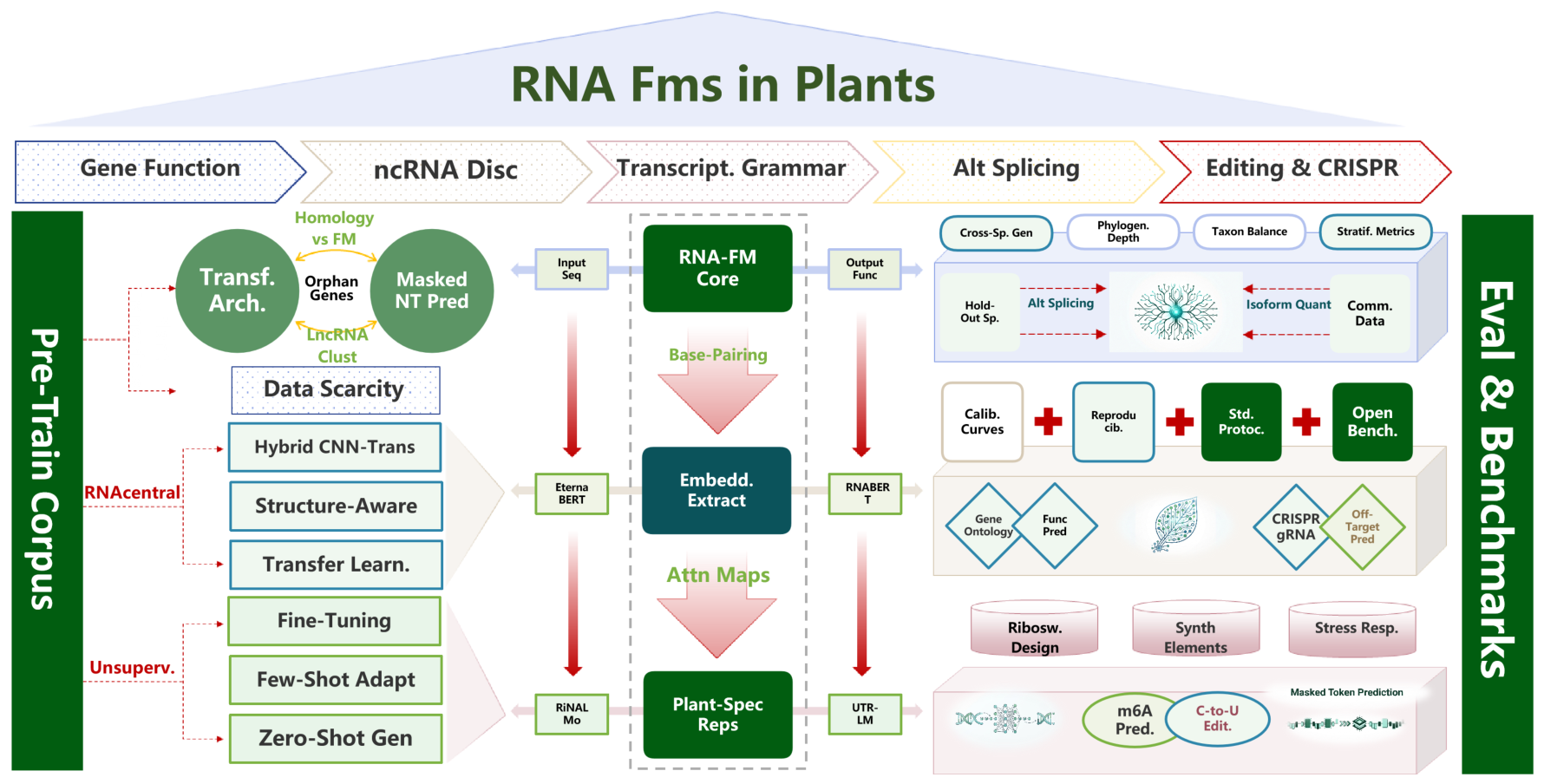
Figure 2.
Literature search and screening workflow with per-stage record counts. Five documented boolean queries were executed on 2 October 2026 against the OpenAlex bibliographic index; duplicate records were removed, and the remaining records passed through two-stage screening against the inclusion criteria shown on the right. Stage 2 comprises abstract-level scoping with concrete disqualifiers, followed by title-signal relevance assessment and corpus assembly; set-aside records were used only as contextual or methodological sources. The final citation corpus comprises 180 references, assembled from the 205 query-retained records together with supplementary tracking-identified studies and prioritised for direct relevance and non-redundancy; all 180 references carry a digital object identifier and were verified against the Crossref registry. Solid arrows denote the record flow at each stage; the dashed arrow indicates that Stage 1 screening was performed against the inclusion-criteria panel.
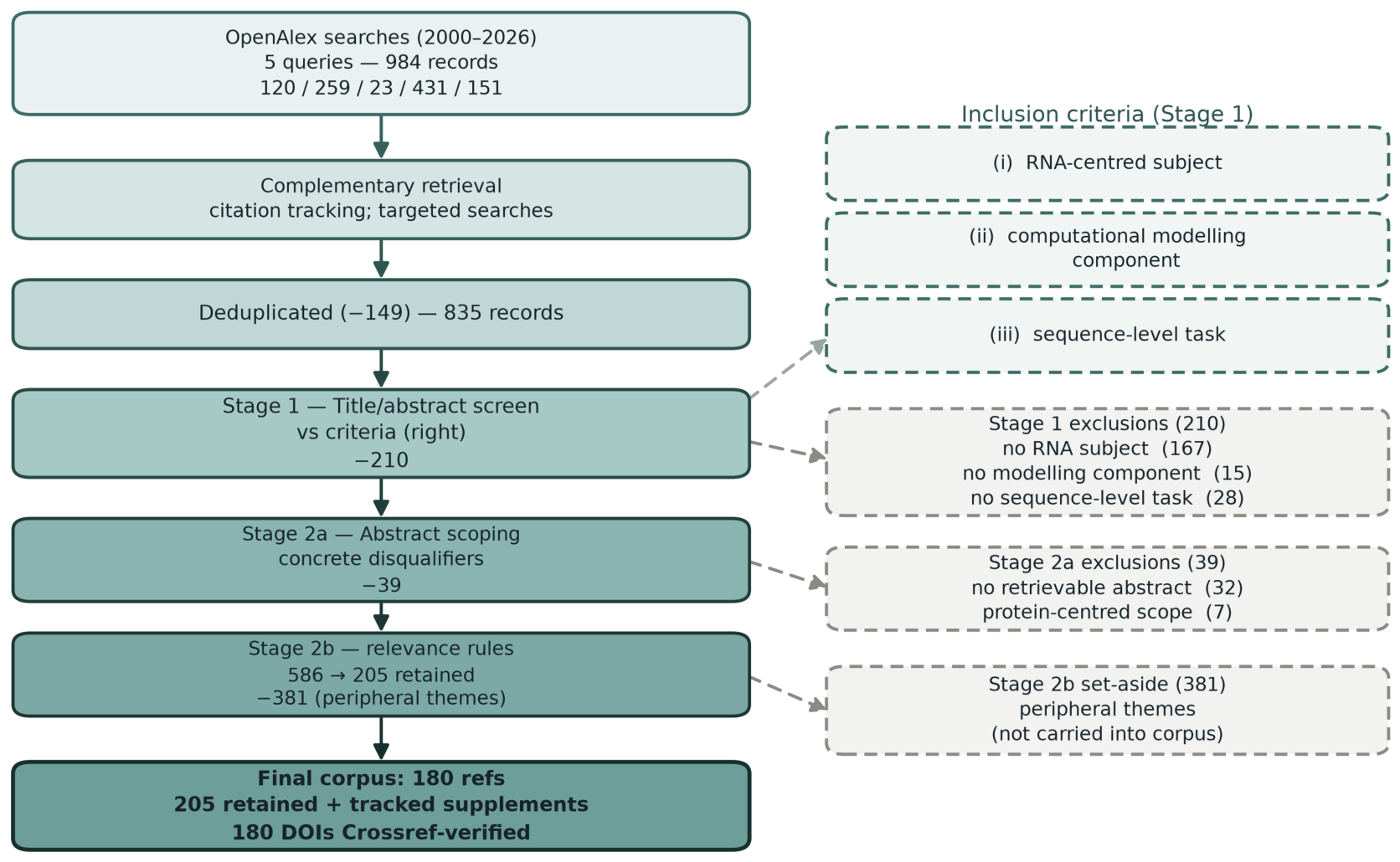
Figure 3.
Anatomy of an RNA foundation model as a chain of design choices spanning inputs, backbones, objectives, and corpus assembly. The upper band separates the three defining decisions: input representation and tokenisation (nucleotide-, k-mer-, and motif-level tokens, one-hot encoding with pairing channels, and structure-annotated data), a backbone built on token embeddings, self-attention, and representation depth, and the pretraining objective (masked nucleotide prediction, structure-aware folding, and contrastive or next-token objectives). The central ellipse magnifies the attention mechanism, whose range, rotary encoding, pairing bias, and dilation learn pairing, position, and local chemistry from raw sequence and yield the RNA representation every downstream use consumes. The lower band traces the corpus-to-deployment pipeline, from NCBI and ENA reads curated through RNAcentral and Rfam into structure-annotated sets, through pretraining and plant fine-tuning, to benchmarking and deployment judged by cross-species, taxonomic-balance, and stratified-metric tests; the bottom strip names the plant application areas these choices qualify. Abbreviations used in this figure are defined in the Supplementary Materials (Table S2).
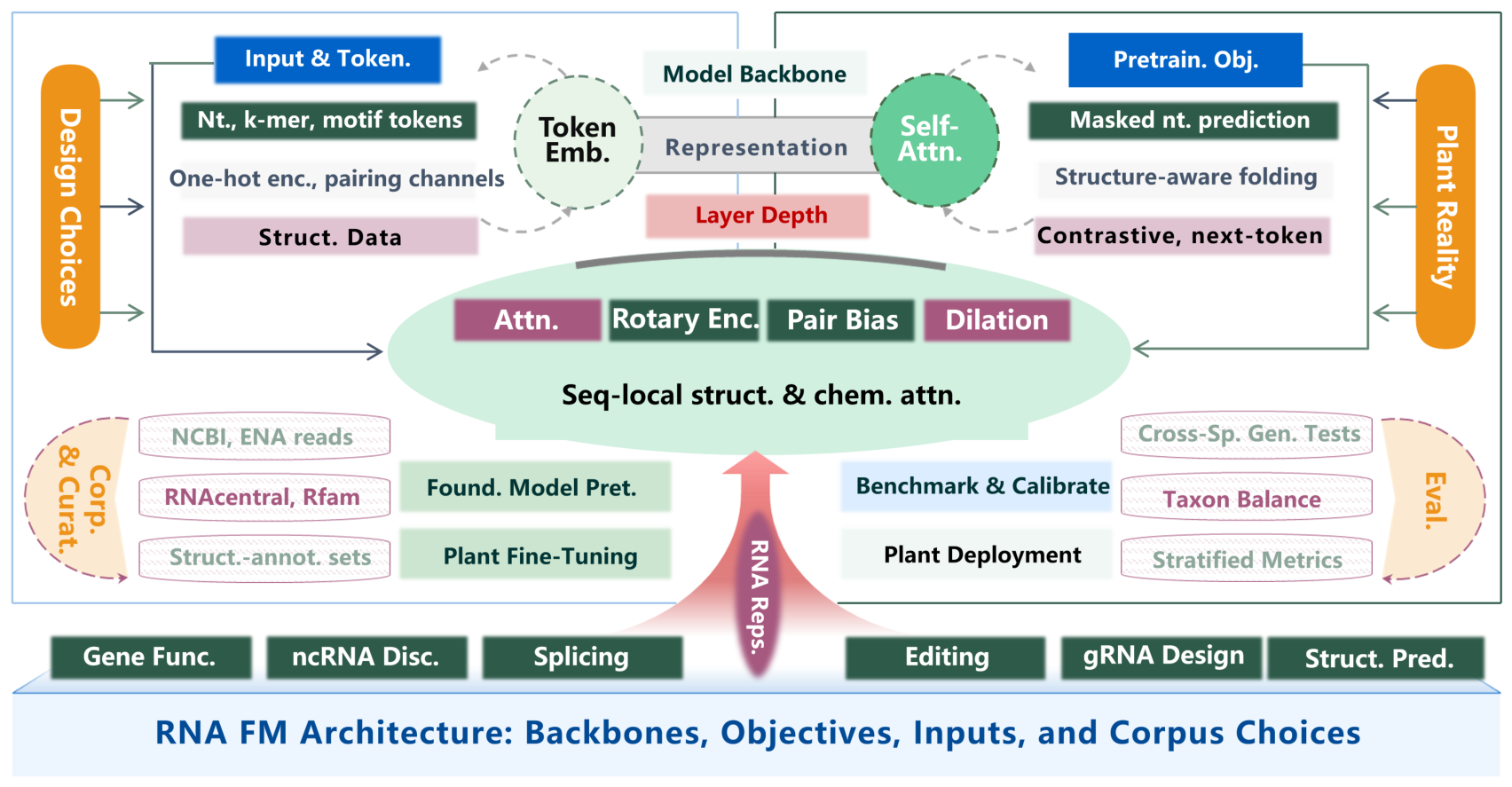
Figure 4.
Decoding RNA grammar with foundation models, and the evidence each decoding level requires. The left column lists the three input classes that drive decoding: sequence and expression context, structure with phylogeny, and splice sites with regulatory motifs and functional context. The central pathway traces grammar decoding through successive representations, from motifs, splice sites, microRNA sites, poly(A) sites, and branch points to secondary structure, functional annotation, and interpretability. The right panel shows the outputs this pathway can support, each reached through a named form of qualifying evidence rather than through model performance alone. Abbreviations used in this figure are defined in the Supplementary Materials (Table S2).
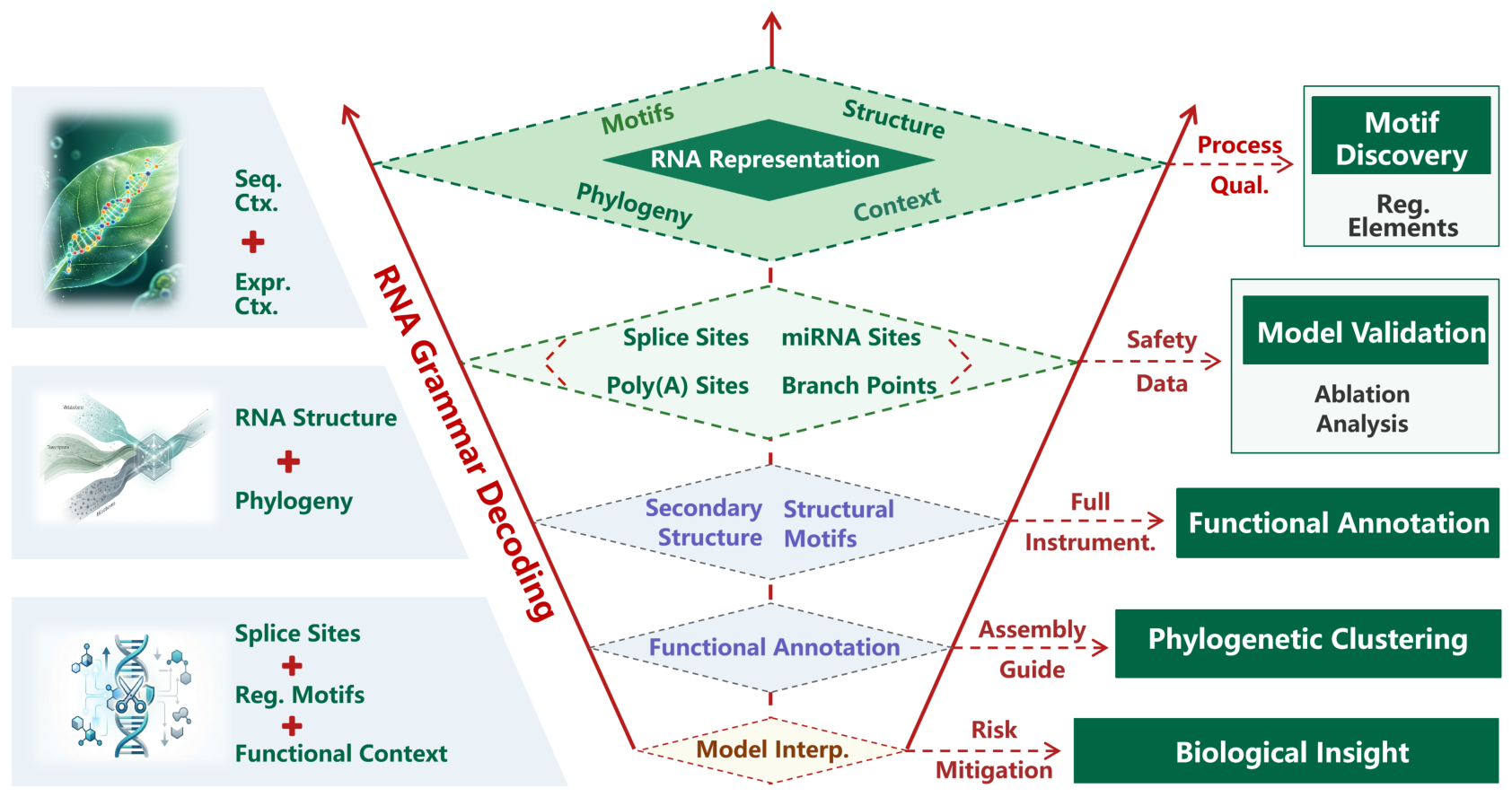
Figure 5.
RNA foundation model annotation across gene function and the non-coding genome, and its phenotypic readout. The upper ribbon distinguishes the regulatory signal classes annotation models must resolve, from signal sensing and transcript degradation to non-coding RNA regulation, turnover, and stress adaptation. The central triangle organises the task into three tiers: gene function prediction, non-coding RNA discovery, and a hybrid pipeline combining both, bounded by sequence context and functional evidence. The left panel details gene-function annotation, contrasting homology evidence, embedding prediction, and functional validation for resistance, metabolic, and poorly annotated genes; the right panel mirrors it for non-coding RNAs, from microRNAs and siRNAs to long non-coding and circular RNAs and target mimicry. The lower section connects annotation output to phenotypic screening, pairing ecological outputs such as root plasticity and exudation with physiological outputs such as drought and salinity tolerance, so embedding-based prediction and homology-based transfer emerge as complementary rather than substitutable. Abbreviations used in this figure are defined in the Supplementary Materials (Table S2).
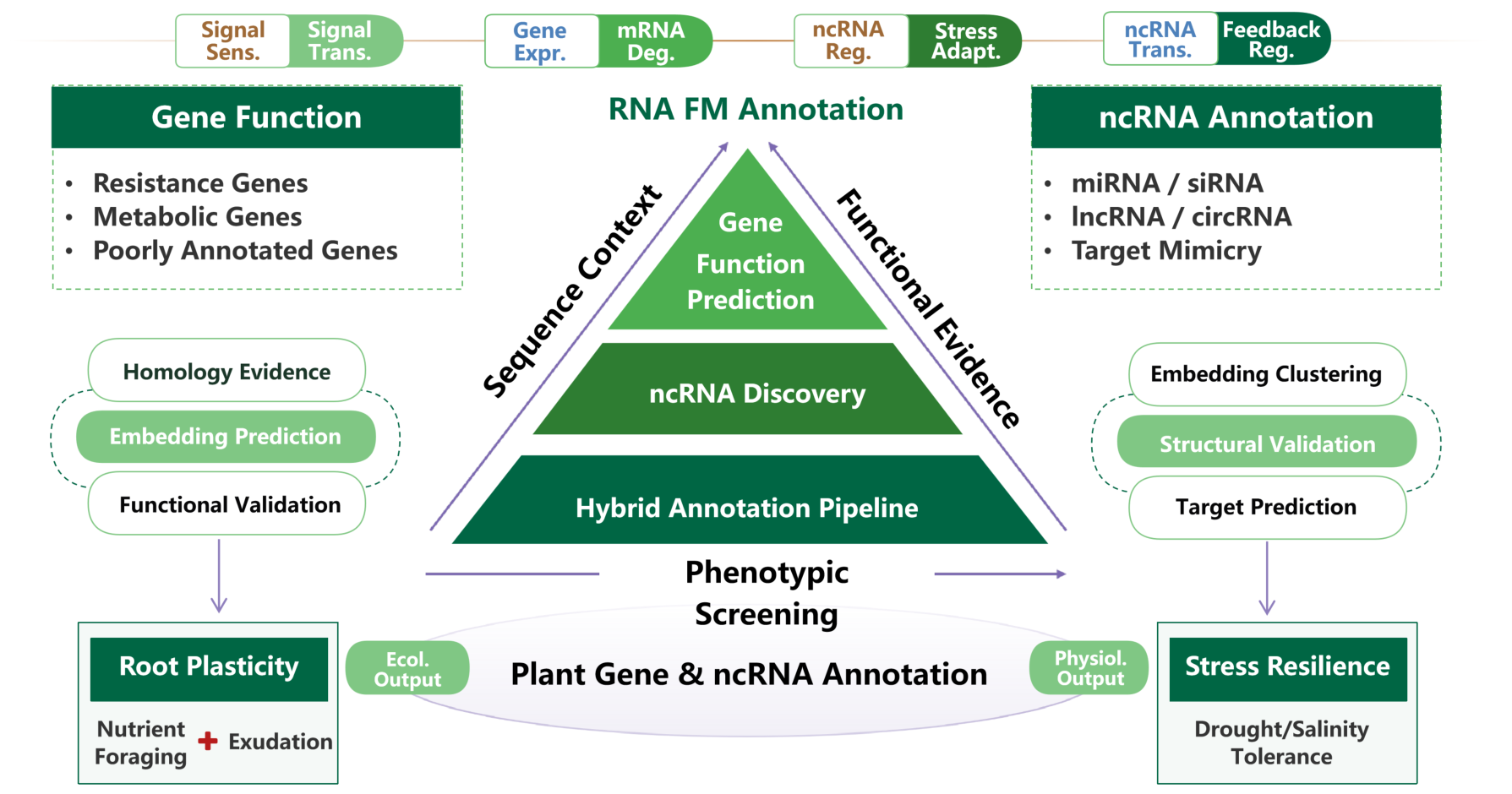
Figure 6.
Alternative splicing and isoform-level modelling with RNA foundation models. At the centre, an RNA FM triangle relates splice sites, isoform usage, and functional impact, surrounded by the three operations it enables: splice scoring, isoform ranking, and regulatory element identification. The inner ring organises the conditioning dimensions, isoform diversity, condition response, functional variants, and tissue context; the outer ring places the model in its experimental setting, from plant transformation and time-course sampling to isoform annotation. The concentric layout makes the point that the value here is a condition-dependent ranking of isoforms carried through to breeding decisions, not a single prediction. Abbreviations used in this figure are defined in the Supplementary Materials (Table S2).
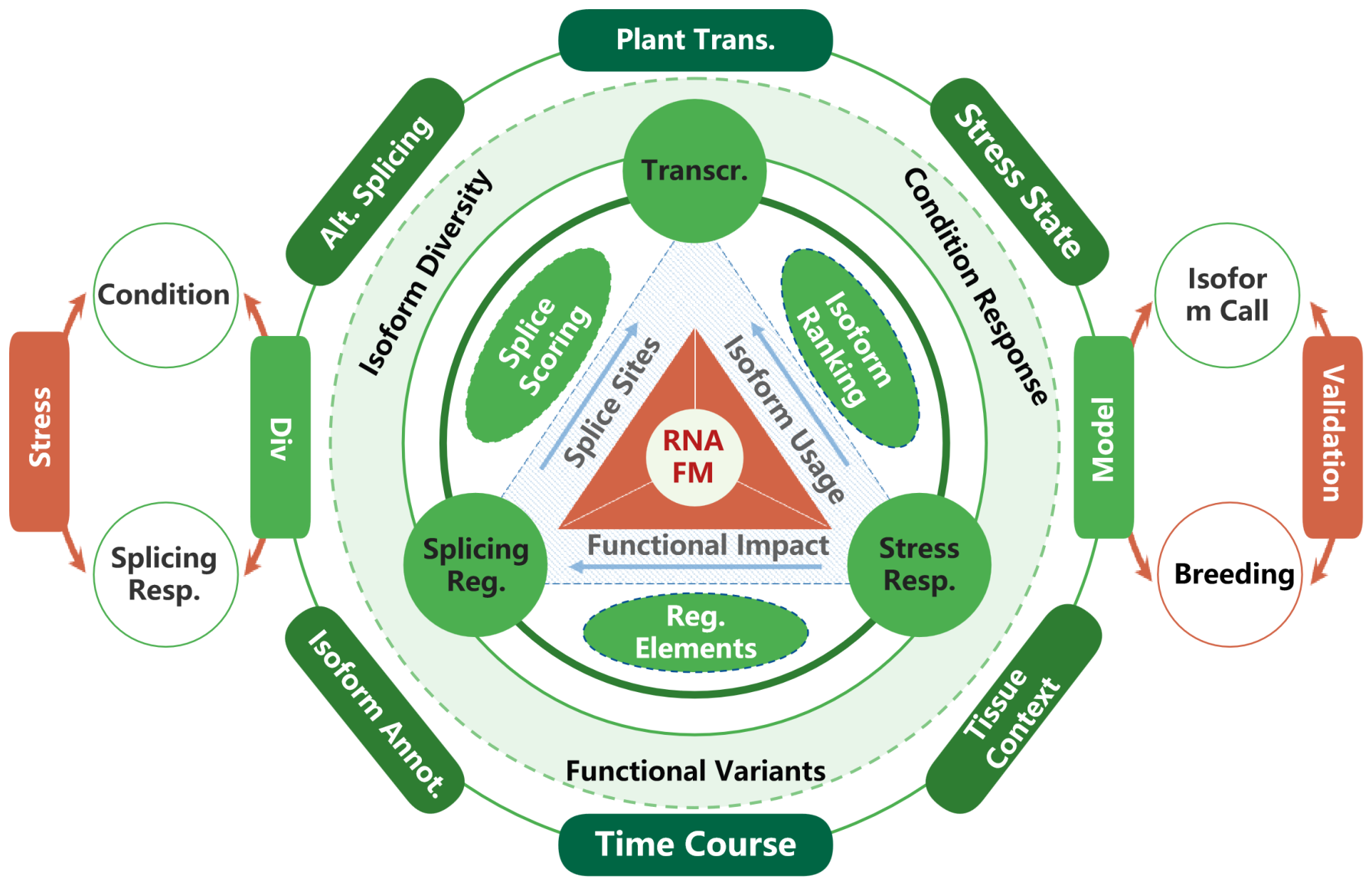
Figure 7.
Guide RNA design as a cyclic pipeline rather than a one-shot prediction. The upper panel introduces the design pipeline, linking the guide sequence to cleavage and to foundation-model efficiency prediction. The left panel situates design within the editing-modality and evidence chain, with in vitro assay, construct design, and guide sequence in a refinement loop plus a transfer-learning path from base and prime editing. The central hexagon organises the decision space along six axes, safety review, specificity, delivery, chromatin context, target picking, and PAM recognition, around the core components of on-target activity, sequence-only input, multi-species training, and a ranked guide list. The right panel shows the two screening modules that qualify a guide list, an off-target matrix and a species-transfer module feeding deep screening, and the lower panel closes the loop through precision editing to phenotype and genotype. Abbreviations used in this figure are defined in the Supplementary Materials (Table S2).
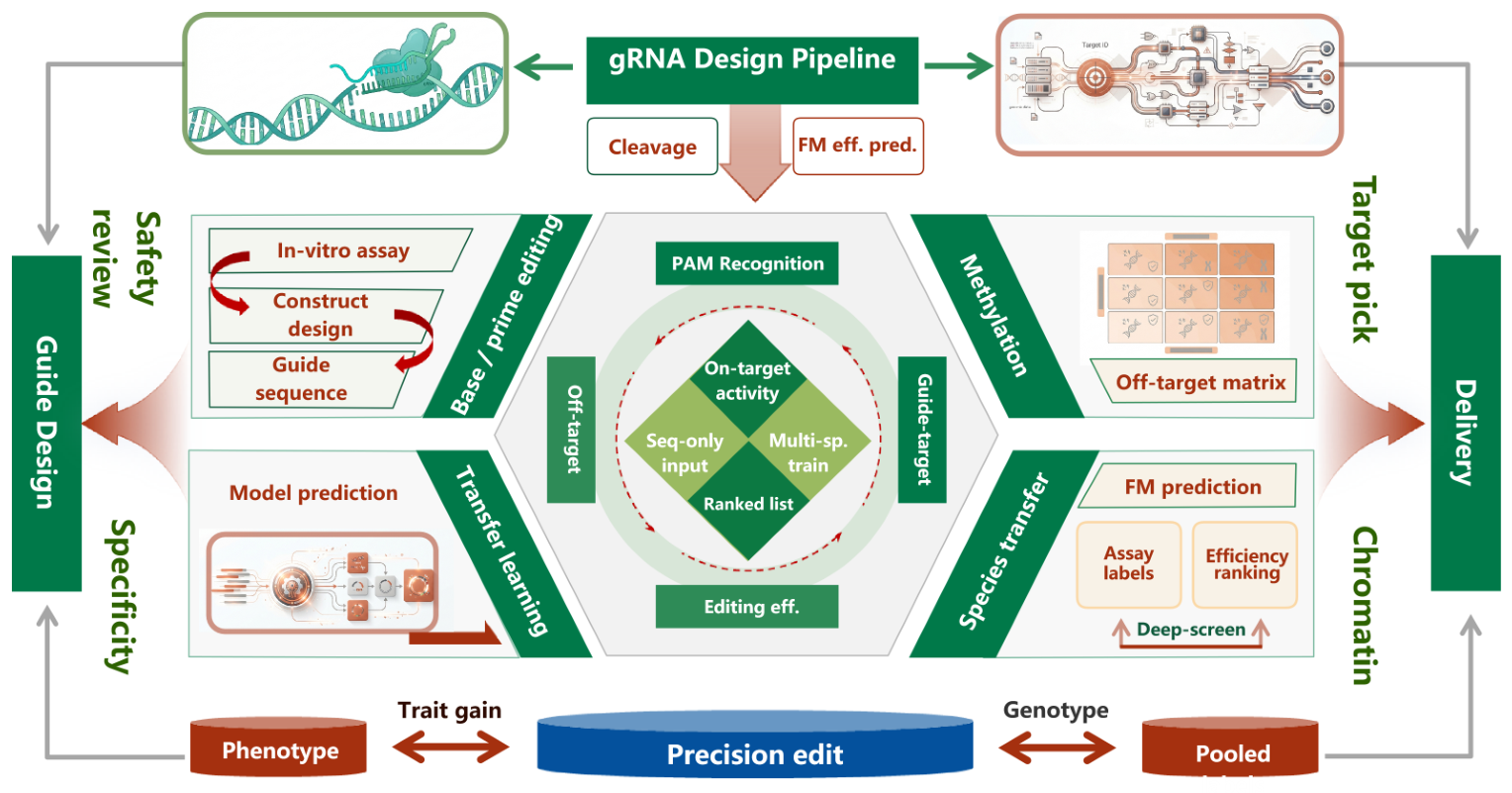
Figure 8.
RNA editing, base modification, and synthetic element design as a shared annotation-to-design cycle. The central disc defines four coupled design variables: editing site identity, modification extent, generative design, and transcript life cycle. The middle ring arranges the workflow into annotation, screening, generation, and hypothesis formation, with editing-site recognition and PPR binding labelling the sequence-level steps and the synthetic and multi-tier arcs marking where designed elements enter and where in planta validation is required. The outer ring separates the editing-side factors, organelle context, enzymes, cis-elements, condition, and developmental stage, from the synthetic-side elements, riboswitches, thermosensors, aptazymes, and aptamers, alongside the modification channel and C-to-U editing. Prediction and generation share one substrate and one validation requirement, so condition-resolved annotation precedes condition-dependent design. Abbreviations used in this figure are defined in the Supplementary Materials (Table S2).
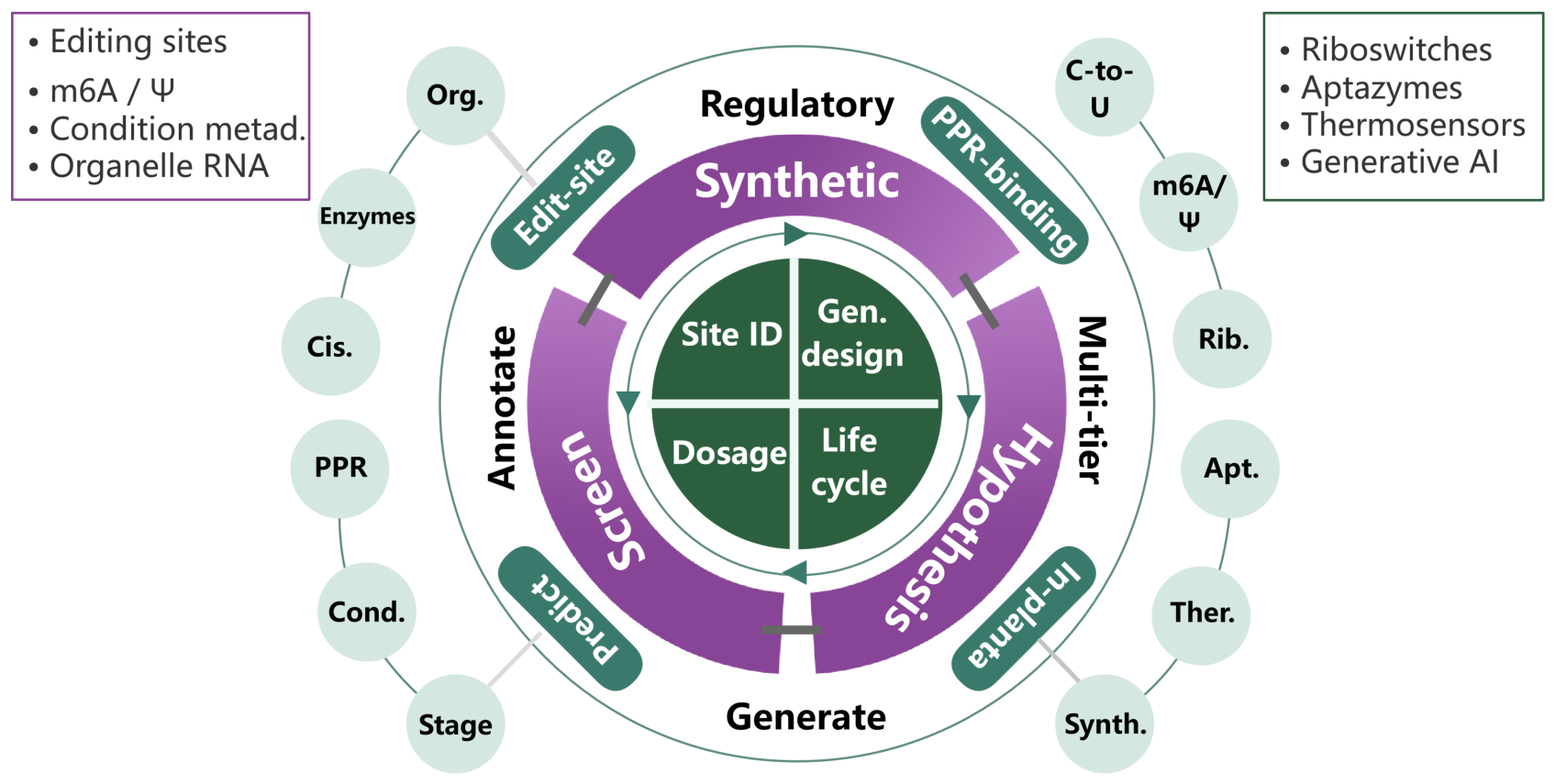
Table 1.
Representative RNA foundation model families named in Section 3, grouped by pretraining corpus rather than by architecture, which is the organising principle this review adopts.
Table 1.
Representative RNA foundation model families named in Section 3, grouped by pretraining corpus rather than by architecture, which is the organising principle this review adopts.
| Model family | Representative model | Backbone | Pretraining objective | Input modality | Plant-relevant limitation |
|---|---|---|---|---|---|
| Plant-corpus transformer | PlantRNA-FM | Transformer encoder | Masked language modelling | RNA sequences and secondary structures (corpus: 1,124 plant species) | Not discussed |
| Broad-corpus transformer | RNA-FM | Transformer, ∼100 million parameters | Masked-token objective | RNA sequences (corpus: RNAcentral) | Not discussed |
| Scaled broad-corpus transformer | RiNALMo | Transformer, hundreds of millions of parameters | Masked-token objective | RNA sequences (corpus: 36 million non-coding RNAs) | Not discussed |
| Motif-aware transformer | RNAErnie | Transformer | Multi-level masking: base, subsequence and motif levels | RNA sequences with RNA-type tokens appended | Couples the model to whichever motif vocabulary its designers chose |
| Task-specialised transformer | RNABERT | Transformer encoder | Masked language modelling | RNA sequences across many families | Scope limited to the RNA families it was trained on |
| Task-specialised transformer | SpliceBERT | Transformer encoder | Masked language modelling | Splice junctions across species | Generality traded for junction-level resolution |
| Task-specialised transformer | UTR-LM | Not reported | Not reported | untranslated regions | Coverage confined to UTRs, where depth replaces breadth |
| DNA-pretrained lineage adapted to RNA | DNABERT and its RNA-adapted variants | Bidirectional transformer | Masked language modelling on k-mer tokens; RNA is mapped into the DNA alphabet by replacing uracil with thymine, then fine-tuned on RNA tasks | Nucleotide sequence; k-mer level patterns retained | Not discussed |
| Multi-species transfer family | Nucleotide Transformer family | Transformer encoder | Masked language modelling | Multi-species DNA sequences | The corresponding plant corpora do not exist at comparable depth |
| Genome-scale DNA model | Evo | Not reported | Next-nucleotide prediction | Whole-genome scale sequences, from regulatory elements up to whole genomes | Plant transcripts carry kingdom-specific processing signals that DNA-only models cannot see |
Notes: Only models named in Section 3 are listed. “Not reported” means the review does not state that attribute for the model; “Not discussed” means the review states no plant-relevant limitation specific to it, in which case the general cross-kingdom caveat applies. Family labels follow the review’s own recommendation to organise models by their pretraining corpus rather than by their architecture.
Table 2.
Plant-specific RNA features that limit the transfer of animal- or microbe-pretrained RNA foundation models to plants, with the failure mode this review attributes to each.
Table 2.
Plant-specific RNA features that limit the transfer of animal- or microbe-pretrained RNA foundation models to plants, with the failure mode this review attributes to each.
| RNA feature | Animal or microbial prior | Plant reality | Consequence for cross-kingdom transfer |
|---|---|---|---|
| Splice-site consensus | Attention heads trained on broad, animal-dominated corpora recover canonical splice dinucleotides and branch-point enrichment without any task-specific supervision | Plant transcripts differ from animal transcripts in splice-site consensus; lineage information is recoverable from donor splice-site composition | Priors from animal sequences are subtly wrong for this feature |
| Intron base composition | Not reported | Dominance of U-rich introns | Priors from animal sequences are subtly wrong for this feature |
| Polyadenylation signal grammar | The mammalian canonical hexamer | Polyadenylation signals that follow no single canonical hexamer | Priors from animal sequences are subtly wrong for this feature |
| Organellar post-transcriptional RNA editing | Not reported | Organelle transcripts undergo extensive post-transcriptional editing; C-to-U editing is common in plant organelles, with U-to-C documented in some lineages, and is specified largely by cis-elements recognised by pentatricopeptide repeat proteins | Organelle transcripts carry editing that the genomic representation does not, so species-level fine-tuning is usually necessary |
| Small-RNA target recognition | The seed-dominated animal model | Plant microRNAs recognise targets with near-complementary pairing across the coding region | Target prediction approaches imported from animal genomics systematically miss plant interactions and invent spurious ones |
| Small-RNA biogenesis | Not reported | Plant microRNAs mature through Dicer-like enzymes with distinct structural preferences, and many plant species elaborate lineage-specific small-RNA classes with no animal counterpart | Models pretrained on animal small-RNA data inherit priors that are wrong in both the recognition and the biogenesis dimensions |
| Condition dependence of splicing and modification | Not reported | Alternative splicing, RNA editing, and modification are strongly condition-dependent, and splicing is particularly prevalent under stress | These features must be considered when designing evaluation tasks; a model evaluated on unstressed reference annotations is being tested on the easiest part of the distribution |
| Polyploid homoeologous transcripts | Not reported | Polyploidy is common in plant genomes, and homoeologous transcripts from different subgenomes may be hard to distinguish computationally | Models evaluated on collapsed gene models can appear accurate while failing on the subgenome-resolved reality that breeding programmes actually confront |
| Coding-potential statistics of long non-coding RNAs | Coding-potential classifiers trained on animal data | Plant transcripts defeat animal-trained coding-potential classifiers, and transcript-level definitions of lncRNA vary across studies | Animal-trained coding-potential classifiers misclassify plant transcripts |
| Circular RNA populations | Not reported in this review | Plant circular RNAs remain poorly resolved, with sparse ground truth | Unsupervised discovery is a natural route to the plant circular-RNA populations that remain poorly resolved |
| Structured regulatory RNA classes | Bacterial archetypes dominate structural databases | Riboswitch classes in plants and algae differ from the bacterial archetypes, and thermosensor elements are tuned to host temperature ranges | Models inherit distributional assumptions from training data; low confidence can reflect a lineage-specific architecture rather than a disordered transcript |
| Trans-splicing | Not reported | Plant-specific RNA biology includes trans-splicing | Such features may not be captured by models pretrained on animal or bacterial data, whether at the representation or the objective level |
Notes: Rows are restricted to features the review discusses explicitly; “Not reported” marks a comparison the review states only from the plant side. The comparison is introduced in Section 3; rows on small-RNA recognition and biogenesis, coding potential, and circular RNAs are discussed further in Section 5, and polyploidy in Section 7.
Table 4.
Benchmark failure modes that plant RNA foundation model evaluation reproduces, and the minimum implementation requirement this review derives for each.
Table 4.
Benchmark failure modes that plant RNA foundation model evaluation reproduces, and the minimum implementation requirement this review derives for each.
| Failure mode | Where it bites plant applications | Minimum implementation requirement |
|---|---|---|
| Metrics chosen for convenience rather than for decision relevance | Inflates apparent progress and flatters models that exploit better-covered gene families | Stratified metrics by functional category, by phylogenetic distance to training data, and by annotation evidence level |
| Test sets that share homology with training data | Homology leakage inflates apparent progress | Cross-validation schemes that split by gene family or by species rather than by transcript |
| Single-split reporting | One split cannot separate model improvement from evaluation artefact | Report multiple splits, disclose data provenance, and separate model improvement from evaluation artefacts |
| Splits that are not species-level | A random species split can be passed by interpolating within over-represented families, while the deployment question is always performance on a new genome | Species-level splits with held-out lineages, and targeted evaluation on deliberately distant lineages, early-diverging plants, parasitic plants with reduced genomes, and species with unusual organelle biology |
| Static benchmark releases | Frozen benchmarks become targets for incremental leaderboard gains not measures of real capability | A living benchmark, refreshed as annotation improves |
| Calibration left unreported | Without calibration, confidence cannot be compared across models or species | Calibration curves reported alongside accuracy in plant-relevant benchmark reports |
| Unpinned releases and missing provenance | A model evaluated against one release cannot be compared fairly with one evaluated against another | Pin and document releases, assign persistent identifiers to datasets and model checkpoints, and name the exact data release in every claim of capability |
| Protocols that exist only as prose | Evaluation cannot be executed reproducibly, and plant variables multiply quickly | Containerised evaluation suites with pinned dependencies and versioned datasets |
| Condition-blind evaluation | Stress conditions multiply intron retention and cryptic junction usage beyond baseline rates, so an unstressed reference annotation tests the easiest part of the distribution | Condition-resolved test sets drawn from stress time-course experiments, scored on condition-specific isoform usage instead of a single merged annotation |
| Ambiguity between genomic and cDNA representation | Organelle transcripts undergo editing that changes the transcript sequence relative to the genome | Evaluation pipelines must state whether the model sees the genomic or the cDNA representation |
| Collapsed gene models in polyploids | Models can appear accurate while failing on the subgenome-resolved reality that breeding programmes confront | Evaluate against subgenome-resolved references not collapsed gene models, and treat homoeologous transcripts explicitly |
| Lineage-uniformity assumption | Donor splice-site signals and small-RNA biogenesis pathways differ across plant lineages | Protocols that account for lineage diversity instead of assuming a single plant RNA framework |
| Reporting only the best-performing configuration | Reproducibility is compromised, and apparent differences shrink when identical models are run on identical tasks | Standardised protocols applied uniformly, with the comparison reported rather than merely the winning configuration |
| Condition-dependent transcript boundaries | Growth-stage and tissue specificity complicate reference construction | An explicit design decision on growth stage and tissue in every plant benchmark reference |
Notes: Author-synthesised recommendations derived from Section 7.
Table 5.
Plant RNA benchmark and data resources named in this review, and the benchmark failure mode each leaves behind.
Table 5.
Plant RNA benchmark and data resources named in this review, and the benchmark failure mode each leaves behind.
| Resource | Type | Taxonomic scope | Tasks supported | Standardised protocol | Key limitation |
|---|---|---|---|---|---|
| RNAstructure | Prediction-baseline software | Organism-agnostic tool | RNA secondary structure prediction | Not reported | Not a curated dataset |
| PlantMine | Core-SNP discovery framework for rice | Rice | Selection of trait-associated SNPs from the 3000 Rice Genomes Project | No: no standardised protocol | Single crop species; genomic selection only |
| TAIR | Plant annotation resource | Plants; model species only | Plant gene function annotation | No: no standardised protocol | Coverage thins outside the models |
| Phytozome | Plant annotation and integration resource | Plants | Gene function annotation; contextualisation of predictions | No: no standardised protocol | Coverage thins outside the models |
| Gramene | Plant genomics platform | Plants | Contextualisation of predictions in existing resources | Not reported | Not discussed |
| UniProt | Protein function annotation with evidence qualifiers | All domains of life | Protein function annotation; conventions and evidence tiers | No: not built for evaluation | Not designed for model evaluation |
| Gene Ontology | Shared controlled vocabulary | All organisms | Cross-database annotation comparison | No: not built for evaluation | Not designed for model evaluation |
| PlantTFDB | Transcription-factor family database | Dozens of plant genomes | Transcription-factor family curation | No: not built for evaluation | Not designed for model evaluation |
| RNAcentral | Sequence repository and ncRNA aggregation | All organisms; all ncRNA types | Pretraining corpus; supervision for model species | Not reported | Under-represents plant lncRNAs |
| Rfam | Curated RNA family database | Curated families across all organisms | Curated labels | Not reported | Plant entries remain concentrated in model species |
| miRBase | Reference catalogue of microRNA loci | 271 organisms in release 22 | microRNA locus reference | Not reported | Classes with few validated examples inherit their training sets |
| psRNATarget | Plant-aware target prediction tool | Plants | Target prediction under near-complementary pairing | Not reported | Not discussed |
| PNRD (Plant Non-coding RNA Database) | Plant-specific sequence resource | Plants; curated ncRNA entries from many species | Training corpora | Not reported | Curated catalogue that does not close the plant sequence-space gap |
| RNA-Puzzles | Blind-testing benchmark for RNA 3D structure | Organism-agnostic benchmark | Hindsight-free structure-prediction evaluation | Yes: the discipline’s gold standard | Not discussed |
| SUPPA2 | Differential-splicing quantification framework | Organism-agnostic tool | Event-level quantification across conditions | Yes: the widely adopted event-level quantification protocol | Not discussed |
| CRISPResso2 | Editing-outcome analysis framework | Organism-agnostic tool | Standardised quantification of editing outcomes | Yes: standardised outcome quantification | Not discussed |
| NCBI and ENA | Public sequence repositories | Plant transcripts as raw reads and assemblies | Pretraining corpora of tens of millions of RNA sequences | Not reported | Not curated or structure-annotated for training |
Notes: “Not reported” means the review does not state that attribute for the resource; “Not discussed” means no limitation is stated for it. Every row here corresponds to a resource the review names; evaluation infrastructure is the gap addressed below.
Disclaimer/Publisher’s Note: The statements, opinions and data contained in all publications are solely those of the individual author(s) and contributor(s) and not of MDPI and/or the editor(s). MDPI and/or the editor(s) disclaim responsibility for any injury to people or property resulting from any ideas, methods, instructions or products referred to in the content. |
© 2026 by the authors. Licensee MDPI, Basel, Switzerland. This article is an open access article distributed under the terms and conditions of the Creative Commons Attribution (CC BY) license (http://creativecommons.org/licenses/by/4.0/).
Copyright: This open access article is published under a Creative Commons CC BY 4.0 license, which permit the free download, distribution, and reuse, provided that the author and preprint are cited in any reuse.