

Submitted:
02 October 2026
Posted:
05 October 2026
You are already at the latest version
Abstract
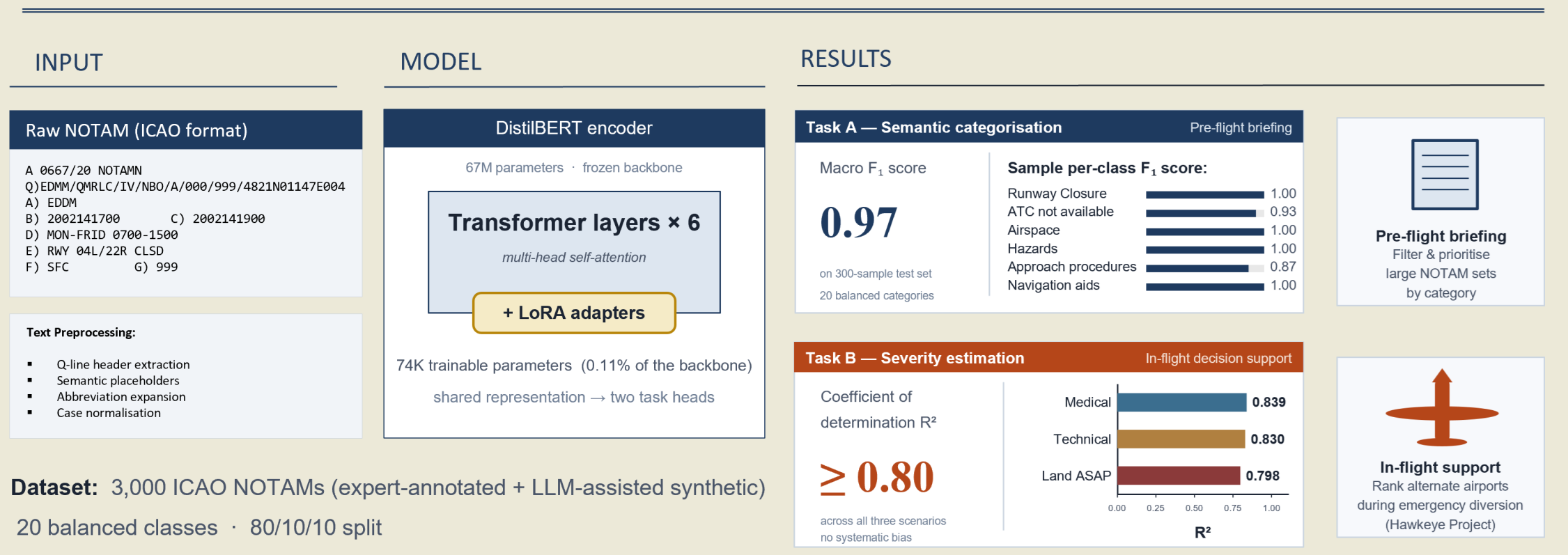
The management of NOTAMs on the flight deck remains a challenge for flight crews, who must process large volumes of dense textual information to identify the notices relevant to their mission. Despite ongoing modernisation efforts, the NOTAM system still relies on a legacy format with limited support for automated filtering and prioritisation, which increases pilot workload and motivates the use of Natural Language Processing techniques for information management. This paper presents an NLP framework based on a shared pre-trained BERT encoder with two task-specific prediction heads, designed to support NOTAM analysis at different stages of the flight. The first task classifies each NOTAM into one of 20 operational categories to support pre-flight briefing. The second task estimates the operational severity of a NOTAM under three emergency diversion scenarios to support in-flight decision-making within cockpit decision-support systems. To address the lack of annotated data and the imbalance across categories, a dataset of 3,000 NOTAMs was built by combining expert annotation with synthetic samples generated under human supervision. The proposed framework, based on a DistilBERT encoder fine-tuned with LoRA, achieves a macro F1-score of 0.97 on classification and R² values at or above 0.80 across the three severity scenarios.
Keywords:
NOTAM
; classification
; BERT
; fine-tuning
; NLP
; artificial intelligence
; Hawkeye
; categorization
1. Introduction
The steady growth of air traffic volume and the increasing complexity of flight operations require flight crews to maintain continuous awareness of changes in the operational environment. Notices to Air Missions (NOTAMs) play a central role in this process, disseminating timely and safety-relevant information that directly supports pre-flight and in-flight decision-making. According to ICAO Annex 15 [1], a NOTAM is defined as an official communication distributed via telecommunications to provide information concerning the establishment, condition, or change of any aeronautical facility, service, procedure, or hazard, the timely knowledge of which is essential to personnel involved in flight operations. NOTAMs therefore constitute a fundamental component of aviation safety and can contribute directly to incident and accident prevention. Despite its central role, the current NOTAM infrastructure exhibits persistent shortcomings that limit its operational usability. Flight crews routinely process extensive pre-flight briefings in which a substantial proportion of messages are operationally irrelevant. This excessive information density has been repeatedly identified as a safety concern, as it increases the risk of overlooking critical information while also contributing to higher perceived pilot workload [2,3]. These inefficiencies stem partly from the fragmented distribution of responsibilities among issuing authorities and back-end operators, who often adopt conservative dissemination practices that effectively transfer the burden of relevance filtering to flight crews. Consequently, NOTAM interpretation is not fully consistent across users, relying instead on individual judgement, training, and operational experience. Some incidents [4,5] have highlighted the operational risks associated with such variability, and addressing these shortcomings has become a priority within recent regulatory initiatives [2]. This has, in turn, motivated the development of automated decision-support tools, which are discussed in the following subsections.
1.1. The NOTAM System
An important structural feature of NOTAM dissemination is the absence of a centralised international management infrastructure. NOTAMs are issued independently by individual states for their airspace and aerodromes, and global datasets are then aggregated and redistributed by a limited number of service providers. No single entity is therefore responsible for systematically monitoring the overall quality, coherence, or volume of NOTAMs [3], and this fragmentation contributes to the operational issues discussed above. From a structural standpoint, NOTAMs follow the ICAO standard format illustrated in Figure 1. The message consists of a sequence of coded fields (A–G), among which the Q-line provides standardised metadata for routing and categorisation, while Field E contains the operational content as free plain text [1,6]. Although this format has proven robust for international information exchange, it remains based on legacy communication conventions characterised by uppercase text, extensive abbreviations, and compressed telegraphic phraseology. These conventions reduce human readability, complicate automated parsing, and increase the risk of misinterpretation. Symmetrically, back-end operators report quality and consistency issues at the issuance stage, as much of the dissemination process remains manual and tied to legacy standards [7].
The gradual transition to Digital NOTAMs (DNOTAMs) represents the most structured long-term response to these limitations. DNOTAMs are digitally coded datasets designed for automatic processing and interpretation: encoded using the Aeronautical Information Exchange Model (AIXM 5) [8], they enable graphical rendering, automated quality checking, and software-level actions not achievable with unstructured text [9]. Significant adoption milestones have been reached, with EUROCONTROL’s eEAD platform entering live DNOTAM operations in 2025 [10]. However, structural factors limit DNOTAMs as a complete solution. First, the specification encodes aeronautical events through a finite set of predefined scenarios, and event types without a corresponding scenario continue to be disseminated only as free-text NOTAMs [9]. Second, adoption remains geographically fragmented: outside the EU regulatory perimeter, most states continue to issue conventional text NOTAMs, and less than half of Asia-Pacific administrations had reached foundational digital data management stages as of 2023 [11]. Third, DNOTAMs are intended to be issued in parallel with conventional text messages generated from the same aeronautical database [9]. This parallel dissemination is designed to support users without digital processing capability, but it also means that free-text NOTAMs will remain in operational circulation even where digital encoding is fully deployed — not as a legacy artefact awaiting phase-out, but as a co-existing channel of the future system. Automated interpretation of free-text NOTAMs therefore remains an operational necessity on a global scale and across an extended time horizon. Artificial Intelligence (AI) has emerged as a viable complementary approach to improve the interpretation of free-text NOTAMs within existing flight-support environments [12]. AI integration can address both ends of the NOTAM information chain: on the back-end side, it can support structuring, validation, and prioritisation before dissemination, although this raises challenges related to governance, certification, and liability; on the front-end side, AI-based filtering and prioritisation can be embedded directly into pilot-facing EFB applications, reducing the information burden on crews without altering the authoritative issuance process. Several modular tools have already been proposed along these lines [13,14,15], and the growing industrial relevance of this direction is confirmed by recent developments in commercial EFB platforms, including Lufthansa Systems’ Lido mPilot [16], Jeppesen FliteDeck Pro [17], and the AI-powered ClearNOTAMs feature introduced in ForeFlight [18]. While these tools demonstrate the practical viability of AI-assisted NOTAM presentation, they do not explicitly address the role of pilot authority in the filtering process. The present study contributes to this front-end direction by framing NOTAM management as an information-organisation problem rather than a decision-automation task. The goal is not to replace pilot judgement, but to reduce the cognitive effort associated with identifying relevant content upstream of the decision process, leaving operational authority entirely to the crew. This positioning is consistent with the EASA AI assistance taxonomy [19], which places pilot-assistance applications within the human–AI collaboration category, and aligns with the broader research trajectory on virtual pilot assistants and the expected roles these are going to have in the research on reduced-crew and single-pilot operations [20,21].
1.2. Related Works
Natural Language Processing (NLP) has become an increasingly important tool for the automated interpretation of Notices to Airmen (NOTAMs), whose highly compressed and domain-specific language poses significant challenges for conventional text processing. While early NLP applications in aviation primarily focused on safety documentation analysis and accident report mining [22,23,24,25], the systematic automated processing of NOTAMs has received attention only more recently. This growing interest reflects both a renewed institutional awareness of NOTAM-related operational risks [2,3] and the advent of transformer-based architectures [26], which for the first time provided the representational capacity needed to handle the hybrid and domain-specific nature of NOTAM language effectively. Early automated NOTAM processing relied mainly on rule-based techniques based on regular expressions, pattern matching, and handcrafted heuristics. These methods proved effective for well-defined tasks such as Q-code prediction [27] and consistency verification [13], but their dependence on manually encoded rules limited their ability to handle the semantic ambiguity and contextual reasoning required by operational NOTAM interpretation [28]. Subsequent machine learning (ML)-based approaches [29,30,31] progressively reduced reliance on manual feature engineering while improving robustness and generalisation. The introduction of transformer-based architectures [26] and, subsequently, of large-scale pre-trained language models such as BERT [32] marked a shift from surface-level information extraction toward contextual language understanding. These models have since been applied to a broad spectrum of NOTAM processing tasks, including functional classification [33], operational tagging [30], attribute extraction [34], knowledge extraction and summarisation [35], and the generation of user-oriented operational messages [14,36]. Aviation-specific adaptations such as SafeAeroBERT [37] have further explored the benefits of domain-adaptive pre-training, tailoring pre-trained language models to aviation terminology and operational constraints. Although these approaches substantially improve classification and information extraction performance, they generally formulate NOTAM understanding as discriminative prediction tasks focused on explicit textual information. Recent work has begun exploring how Large Language Models (LLMs) can move beyond this paradigm by supporting richer inferential reasoning over NOTAM content. Along these lines, Liu et al. [38] discuss the notion of NOTAM semantic parsing as a task requiring models to infer operational implications, resolve abbreviations, and integrate aviation-domain knowledge to produce structured operational representations. In a similar direction, the NOTAM-Evolve framework [28] frames NOTAM interpretation as a deep parsing problem combining external knowledge grounding with schema-guided reasoning. Together, these studies illustrate the ongoing transition from surface-level information extraction toward semantic interpretation, while also highlighting the considerable complexity of achieving reliable operational reasoning.
Another recurring challenge concerns the limited availability of annotated NOTAM corpora. Producing high-quality labels requires substantial domain expertise, and the compressed language of NOTAMs makes annotation particularly difficult for infrequent but operationally critical categories [38]. Semi-supervised learning has therefore emerged as a promising strategy, with Orozco et al. [39] demonstrating that pseudo-labelling can effectively exploit large unlabelled corpora to improve multi-label classification performance. More broadly, data augmentation has been lately considered an established approach for mitigating data scarcity in NLP [40,41], although its application to NOTAM processing remains relatively limited and not proven. Overall, three research gaps emerge from the current literature. First, existing NLP approaches to NOTAM analysis produce context-independent outputs, assigning static labels, structured representations, or single-score criticality values that do not vary with the operational scenario of the flight. However, the operational relevance of a NOTAM is intrinsically context-dependent, and the same notice can carry markedly different implications depending on the phase of flight and the operational conditions under which it is being evaluated. This becomes particularly evident when considering the broader potential use of NOTAMs beyond pre-flight consultation: notices remain a valuable source of information also during flight, for example when supporting in-flight re-planning decisions following unexpected operational events. Current systems do not model this dependency, leaving the burden of contextual interpretation entirely to the crew [3,19]. Second, recent LLM-based frameworks have demonstrated promising semantic reasoning capabilities but remain computationally demanding for resource-constrained operational environments such as cockpit decision-support systems [28,38]. Third, despite the semi-supervised and augmentation-based approaches discussed above, no established augmentation practice yet exists that is specifically validated for the operational and linguistic peculiarities of NOTAM text, leaving under-represented event types particularly exposed. Beyond these gaps, pilot acceptance of AI-assisted NOTAM processing is generally positive, provided that system behaviour remains transparent and its reasoning interpretable [42], adding a requirement of explainability that cuts across all three.
1.3. Contribution
Motivated by the research gaps identified above, this work proposes a computationally efficient multi-task BERT framework for automated NOTAM interpretation. Unlike previous approaches, which typically formulate NOTAM processing as isolated classification or information extraction tasks, the proposed framework jointly learns two complementary objectives within a shared encoder: generic semantic categorisation and scenario-dependent operational severity estimation. The framework is developed within the application context of the Explainable Intelligent Alternate Airport Assistance (EIAAA) solution and its evolution in the Hawkeye project at the German Aerospace Center (DLR) [43,44], an explainable cockpit decision-support system that recommends suitable alternate airports during emergency situations. The proposed framework addresses two complementary usage regimes. The first provides a general-purpose semantic categorisation of NOTAM content that is independent of any downstream application, while the second is tailored to the Hawkeye operational workflow, where NOTAMs contribute to the assessment of candidate alternate airports during emergency diversion:
- Task A — NOTAM Text Categorisation. Each NOTAM is assigned to one of 20 custom-defined operational categories based on its semantic content. This task targets a static interpretation setting, supporting pre-flight briefing through improved organisation, filtering, and prioritisation of large collections of NOTAMs.
- Task B — Scenario-Specific Severity Estimation. Each NOTAM is associated with three continuous severity scores in the range , corresponding to the emergency scenarios considered by the Hawkeye decision-support system (medical emergency, technical emergency, and land as soon as possible). Each score estimates the operational impact of the notice on the suitability of a candidate alternate airport under the corresponding scenario, allowing active NOTAMs to influence the airport ranking process dynamically.
The main contributions of this work are summarised as follows:
- 1.
- A multi-task BERT architecture that jointly performs semantic NOTAM categorisation and scenario-dependent severity estimation using a shared transformer encoder. While previous studies have investigated single-score NOTAM criticality prediction [35], the proposed formulation models severity as a multi-output regression problem conditioned on distinct emergency diversion scenarios, which, to the best of our knowledge, has not previously been investigated.
- 2.
- A carefully curated dataset of 3,000 balanced NOTAMs constructed through a hybrid workflow combining expert annotation with LLM-assisted synthetic data generation, together with a quantitative assessment of the synthetic component using established diversity and coverage metrics.
- 3.
- A comprehensive experimental evaluation demonstrating that lightweight BERT architectures provide an effective trade-off between predictive performance and computational efficiency, supporting deployment in resource-constrained cockpit decision-support systems.
The proposed framework achieves a macro -score of 0.97 on the categorisation task and coefficients of determination () of at least 0.80 across all three severity estimation tasks. To facilitate reproducibility and further research, the fine-tuned models, inference interface, and annotated dataset are publicly released (see the Data Availability Statement). The remainder of this paper is organised as follows. Section 2 describes the proposed methodology, including dataset construction, synthetic data generation, preprocessing, model architecture, and training strategy. Section 3 presents the experimental evaluation and hyperparameter ablation study. Section 4 discusses the limitations of the proposed approach and outlines future research directions, while Section 5 concludes the paper.
2. Materials and Methods
This work addresses NOTAM analysis as a multi-task natural language processing problem involving two complementary objectives: semantic categorisation of NOTAM messages (Task A) and estimation of their operational relevance according to specific flight scenarios (Task B). The proposed methodology is organised into sequential stages summarised in Figure 2: dataset construction, combining real messages retrieved from an operational data service with synthetically generated samples produced under expert supervision; text preprocessing, aimed at reducing linguistic sparsity while preserving operational content; and parameter-efficient fine-tuning of the encoder together with two task-specific prediction heads, followed by evaluation of the resulting model.
2.1. Model Architecture
The internal architecture of the proposed multi-task framework is illustrated in Figure 3. A shared BERT-based encoder receives the tokenised NOTAM text and produces contextualised representations for every input token through a stack of encoder layers, each combining multi-head self-attention with a position-wise feed-forward network. A fixed-dimensional representation of the complete NOTAM is obtained from the final hidden state of the special [CLS] token, which is trained during pre-training to aggregate information from the entire sequence and therefore provides a compact semantic summary of the input message. This sequence-level representation, denoted (with for BERT-base), is shared by two task-specific prediction heads: a classification head for Task A and a regression head for Task B. Sharing a common encoder while optimising both objectives simultaneously exploits the semantic relationship between the two tasks and encourages the encoder to learn richer contextual representations than would be obtained by training the tasks independently, while introducing only a small number of additional trainable parameters beyond those of the pre-trained backbone.
2.1.1. Task A – NOTAM Categorisation
Task A assigns each processed E-field text to one of K predefined operational categories. The taxonomy adopted in this work consists of 20 categories (Table 1), obtained by consolidating the most operationally relevant NOTAM types while minimising semantic overlap. Existing NOTAM label schemas in the literature and in operational practice often adopt highly granular taxonomies [3]; the proposed consolidation was designed to preserve operational discriminative power while remaining tractable for supervised fine-tuning on a limited dataset. Unlike token-level tasks, which predict an output for each individual token, sequence-level prediction assigns a single label to the entire input sequence. In BERT, this requires a fixed-size representation of the complete message rather than the representations of individual tokens — a role fulfilled by the [CLS] token introduced in Section 2.1.
The linear classification head maps its pooled representation to the class logits
where and are learnable parameters. The resulting logits are converted into class probabilities through the Softmax function:
2.1.2. Task B – Scenario-Based Relevance
Task B estimates the operational severity of each NOTAM with respect to the three emergency diversion scenarios summarised in Table 2. A separate linear regression head maps the same [CLS] representation to a vector of scenario-dependent severity scores:
where and are learnable parameters, and denotes the number of scenario-dependent severity scores. Relevance is defined on an ordinal scale from 1 to 9 during annotation and subsequently normalised to the interval for model training; the operational meaning of each ordinal value is reported in Table 3.
The scenario-based structure of Task B was primarily motivated by the objective of aligning the proposed severity estimation with existing alternate-airport evaluation frameworks, most notably the HAWKEYE project developed by the German Aerospace Center (DLR) [43,44]. The predicted severity scores are accordingly intended as a candidate add-on component within such alternate-airport evaluation logic, allowing NOTAM interpretation to inform the ranking of candidate diversion airports. The definition of the specific weighting mechanism through which these scores would be integrated into a complete ranking algorithm lies outside the scope of the present work.
2.2. Dataset Construction
Although BERT provides robust pre-trained representations, the effective adaptation to a target domain depends on building a well-structured, balanced, and noise-free training dataset. As no publicly available annotated corpus exists for the two tasks defined above, a dedicated NOTAM dataset was built from scratch, in which each processed free-text message is paired with a categorical label for Task A and three numerical scores for Task B. The final dataset contains 3,000 ICAO-formatted NOTAM messages, uniformly distributed across the 20 Task A categories (150 samples per class); non-standard message formats, such as US NOTAM structures that differ from the ICAO convention, were excluded to preserve consistency in textual representation. Rather than maximising dataset size, priority was given to annotation consistency and operational relevance. In expert-labelled domain adaptation tasks, high-quality annotations are often more beneficial than simply increasing the number of training examples, while a manageable dataset size enabled systematic human verification of every sample.
2.2.1. Real Data Collection
Real NOTAM messages were retrieved through the Laminar Data Aero developer API [45], selected among several service providers for its structured GeoJSON access to all key subfields and its cost/scalability profile. Two limitations shaped the collection strategy: the API exposes only currently active NOTAMs (no historical access) and provides no semantic filtering, which hinders balanced coverage across Task A categories. To compensate, real data was complemented with synthetically generated samples produced under expert supervision, as described in the next Section.
2.2.2. Synthetic Data Generation
The limited availability of labelled NOTAM datasets is a well-known obstacle for supervised approaches in this domain, especially under the requirement of balanced coverage across operationally meaningful categories. LLM-assisted data generation has recently gained traction in resource-constrained settings where expert annotation is expensive or difficult to scale [46,47], and previous work has already explored the use of LLMs for NOTAM processing tasks such as semantic parsing and translation into human-readable form [35,36]. In this work, synthetic generation was designed as a controlled augmentation process rather than a replacement for real operational data. Human supervision was maintained throughout to identify and remove non-compliant, ambiguous, or unrealistic outputs and to ensure consistency between the generated messages, their assigned categories, and the associated annotations. The generation was carried out within a dedicated ChatGPT project environment in which each interaction thread was bound to a single NOTAM category and followed a three-stage workflow — message generation, annotation verification, and quality evaluation. Splitting the workflow into phases reduced context interference between categories and allowed category-specific instructions and examples to be selectively provided at each interaction.
Generation was supported by a curated set of contextual documents that function as guardrails alongside the instruction prompt, encoding the information required to steer the model towards ICAO-compliant, category-consistent, and operationally realistic outputs. These documents can be grouped along four functional axes: task specification (annotation guidelines and category definitions), domain ontology (emergency scenarios, tag/ID mapping), format compliance (ICAO abbreviations, Q-code decoding table), and exemplars and quality criteria (annotation examples, scoring guidelines). Table 4 lists the individual documents together with their functional role and approximate token footprint. Rather than being manually routed to a specific workflow phase, the documents were all made available to the ChatGPT project and retrieved automatically by the model at each interaction, so that only the fragments most relevant to the current step are pulled into the effective context. This design serves two purposes: it preserves the finite context window against saturation from the full document set (which totals more than tokens), and it exploits the model’s own routing capability to match each phase — generation, annotation, evaluation — with the relevant subset of guardrails.
Generation proceeded progressively. Each category was first expanded to 100 samples, after which additional messages were produced using previously validated examples as new contextual references, reaching the final target of 150 samples per category. Manual quality control considered compliance with ICAO formatting conventions, semantic correctness, operational realism, and consistency between textual content and assigned labels. The token footprints reported in Table 4 are of practical relevance as they determine the effective context load during each phase of the workflow. The annotation phase is the most demanding in this respect: it consumes the output of the preceding generation stage, adds the intermediate annotations produced during Stage 2 itself, and simultaneously relies on the retrieved guidelines and scoring rules — on top of the persistent system prompt. Under conservative assumptions, this combined load can approach or exceed the -token context window of standard ChatGPT tiers at the time of developing. To prevent silent truncation of retrieved documents, which would degrade annotation consistency in a hard-to-detect way, all experiments were carried out using ChatGPT Plus/Pro, whose extended context window absorbs the worst-case load with margin.
2.2.3. Dataset Quality Analysis
While manual review addressed the most evident issues on a message-by-message basis, synthetic data reliability remains a subject of debate given risks related to distributional artefacts, bias amplification, and model-induced errors [46]. The generated corpus was therefore characterised along two distinct axes: first, the degree to which synthetic messages align with the linguistic distribution of real NOTAMs (overlap analysis); second, the amount of intra-class redundancy present in the final augmented corpus that will actually be fed to the model (redundancy analysis). The two analyses answer different questions and are reported separately below.
2.2.3.1. Overlap between real and synthetic data.
Two indicators were adopted to compare the synthetic samples against the real ones. Lexical coverage measures the proportion of the vocabulary observed in real NOTAM messages that is also present in the synthetic dataset, and thus quantifies how effectively generated samples reproduce domain-relevant terminology. Token-level amplification, defined as the ratio between token frequency in the augmented dataset (real + synthetic) and in the real-only dataset, quantifies whether the synthetic samples reinforce existing linguistic patterns or introduce unrelated vocabulary. Both indicators were computed at corpus level on the concatenation of the E-line texts.
The overlap analysis was carried out under two tokenisation schemes chosen to answer two distinct diagnostic questions rather than to provide alternative estimates of the same quantity. The first, a lightweight lexical tokeniser, is defined as a regular expression extracting maximal alphabetic sequences of length two or more from the uppercased text; it retains only interpretable vocabulary items — domain terms and standard ICAO abbreviations — and by construction discards numerals, punctuation, and the semantic placeholders introduced during preprocessing (see Section 2.3), whose surface form contains non-alphabetic characters. This scheme addresses the question of whether the synthetic messages reproduce the domain-relevant operational vocabulary of real NOTAMs. The second is the cl100k_base BPE subword tokeniser [48], applied to the raw text without filtering. This scheme addresses a different question, namely whether the two corpora are structurally comparable in a model-internal token space of the kind on which modern general-purpose language models operate, in which numeric fragments, punctuation, and placeholder markers all contribute to the token stream. Concordance across the two schemes is more informative than either indicator in isolation, since the two can in principle diverge — for example, a synthetic corpus reproducing domain vocabulary but with anomalous formatting would pass the first check while failing the second. Neither of the two tokenisers coincides with the WordPiece tokeniser employed by the target BERT model [32]. This is a deliberate choice: the analysis reported here characterises the dataset, and is meant to remain valid independently of the specific model subsequently selected for fine-tuning. A measurement performed in the WordPiece space would conflate properties of the data with properties of the segmentation policy of one particular model, and would have to be repeated in case of a change of backbone. The two adopted schemes were chosen precisely to bracket the range of interest without committing to a specific downstream model: an interpretable word-level view on one side, and a widely used LLM-oriented subword view on the other.
Under the lexical scheme, synthetic messages covered approximately of the real vocabulary, rising to under BPE. The gap has a straightforward explanation: the lexical scheme is restricted to alphabetic words, so it measures overlap on the substantive domain vocabulary alone; BPE additionally counts numeric substrings, punctuation, and the semantic placeholders, which appear in essentially every message of both corpora by design of the preprocessing pipeline and therefore inflate the overlap through elements that are common by construction rather than by linguistic proximity. The two figures should thus be read as bounds on the effective overlap: the lexical as a lower bound restricted to interpretable domain terms, the BPE as an upper bound in the token space actually consumed by LLMs.
Amplification statistics were consistent across the two schemes, with median values and mean values –8 over the set of tokens shared between real and synthetic vocabularies. As a reference point, if synthetic messages contributed proportionally to the size increase of the corpus — the augmented dataset being roughly twice the real-only one — the expected amplification on shared tokens would be . The observed factor therefore indicates that each shared token is reused at roughly double the rate observed in the real data alone, which is the quantitative signature of a reinforcement regime: the synthetic samples concentrate frequency mass on vocabulary already present in the real corpus rather than distributing it on new terms. The gap between median and mean reflects a long-tailed distribution driven by a small subset of tokens amplified well beyond the typical value; a per-token investigation of this tail is outside the scope of the present analysis. The overall picture is consistent across both tokenisers and supports interpreting the synthetic corpus as a lexical reinforcement mechanism: if new vocabulary were being introduced in substantial amounts, the amplification measured on shared tokens would be correspondingly diluted, which is not observed.
2.2.3.2. Intra-class redundancy on the augmented corpus.
Overlap indicators do not, however, address a separate concern: whether the augmented dataset — the union of real and synthetic samples that is actually used for training — contains excessive redundancy within individual NOTAM categories, which could inflate performance estimates and reduce the effective diversity of the training signal. To this end, three complementary redundancy metrics were computed per category on the full augmented corpus (150 samples per category, real and synthetic combined).
The first two metrics operate at the aggregate level and rely on the TF–IDF representation of each message.1 Mean cosine similarity captures global lexical overlap between message pairs:
where denotes the TF–IDF representations of the N messages associated with tag t. Average trigram overlap, computed as the mean Jaccard similarity between the sets of trigrams of message pairs, quantifies the reuse of local phrase structures:
where denotes the set of trigrams extracted from message . These two indicators are complementary: cosine similarity is sensitive to shared vocabulary regardless of position, while trigram overlap penalises only the reuse of contiguous sub-sequences.
The third metric operates at the message level. A quasi-duplicate rate was computed using the ROUGE–L F1 score, based on the longest common subsequence between token sequences. Because pairwise ROUGE–L evaluation over all pairs within each category would be computationally expensive without altering the outcome for clearly dissimilar pairs, candidate near-duplicates for each message were restricted to its 12 nearest neighbours according to TF–IDF cosine similarity; this cut-off is large enough to include any plausibly redundant pair while keeping the analysis tractable. A message was then flagged as a quasi-duplicate if its ROUGE–L F1 score with at least one such neighbour exceeded a threshold of , adopted as a deliberately conservative criterion so that pairs flagged as quasi-duplicates share not only vocabulary but also substantial ordered content. The quasi-duplicate rate reported in Table 5 is the proportion of messages within each category satisfying this condition.
Table 5 shows a wide dispersion of redundancy across categories, from in Runway Closure down to in Approach Procedures, Communications, and Airspace. The pattern is consistent with the operational nature of each category: highly standardised event types — Runway Closure, Military restrictions, ATC Not Available, Taxiway Closure — produce messages built around a small number of fixed templates, which drives both cosine similarity and quasi-duplicate rate upward. Broader operational categories, whose messages describe heterogeneous situations, show substantially lower surface similarity. Two more subtle patterns are worth noting. First, Runway Closure ( quasi-dup) and Runway Restrictions () diverge sharply despite naming a related object: closures follow a near-boilerplate structure, while restrictions must specify heterogeneous operational conditions (weight, wingspan, time windows) that break the template. Second, Emergency Services combines a high mean cosine (, third overall) with a low quasi-duplicate rate (), indicating that its messages share vocabulary without sharing global structure — a signature of a category with a stable lexical field but variable message layout.
The redundancy observed in standardised categories therefore reflects the intrinsic structure of NOTAM communication rather than a limitation of the generation process, and applying diversity metrics mechanically as a filtering criterion would risk removing samples that are lexically similar but operationally distinct. On the basis of the overlap analysis (synthetic data reinforce rather than perturb the real distribution) and the redundancy analysis (per-category redundancy tracks the natural variability of each NOTAM type and remains bounded in every case), the augmented dataset is considered adequate for supervised fine-tuning, with the caveat that the categories exhibiting the highest quasi-duplicate rates are those for which reported test-set performance should be interpreted most cautiously.
2.3. Text Preprocessing
NOTAM messages are characterised by highly compressed language, extensive use of abbreviations, numerical references, and domain-specific coding conventions, all of which make direct application of general-purpose transformer models a challenging one. A dedicated preprocessing stage was therefore introduced to reduce superficial textual variability while preserving the operational content required for both tasks, aligning the input representation with the linguistic patterns expected by BERT-based architectures. The pipeline combines standard normalisation procedures with NOTAM-specific transformations inspired by previous aviation NLP studies [30,31,49]. The same operations are applied at training and inference time to ensure consistency between the two conditions. The main transformations are:
- Header/Body Structuring — Selected metadata from the NOTAM Q-line (Purpose and Topic fields) are decoded and prepended to Field E as compact informative tags, forming a Header block that is separated from the textual Body by explicit delimiter tokens used to drive more controlled attention allocation during fine-tuning.
- Semantic Placeholders — Numerical and symbolic expressions — including dates, times, coordinates, distances, and flight levels — are replaced with abstract tokens (e.g., <date>, <time>, <fl_low>). This reduces vocabulary fragmentation and encourages the model to focus on operational patterns rather than individual numerical instances. These tokens are added as dedicated entries to the tokenizer vocabulary.
- Abbreviation Expansion — Standard ICAO abbreviations are expanded into their full textual form to improve readability and reduce dependence on domain-specific shorthand. Placeholder tokens are preserved as atomic tokenizer units, and the expansion dictionary excludes entries that could introduce ambiguity (single-letter contractions, cardinal directions, meteorological shorthand).
- Case Normalisation — All text is converted to lowercase to remove capitalisation-driven variability.
Stop words were removed to reduce redundancy, while punctuation was retained to preserve syntactic cues. An example of the resulting transformation is shown in Figure 4.
2.4. Training Phase
This section describes the process leading to the selection of the final training configuration, covering hyperparameters analysis and the evaluation of alternative fine-tuning strategies. The central trade-off considered is between domain adaptation capacity and the risk of overfitting on a limited dataset. A baseline approach restricted to the task-specific heads of the model, with all encoder parameters frozen, was considered but excluded as it would provide insufficient domain adaptation. Three alternative fine-tuning strategies have been therefore evaluated:
- Full Fine-Tuning (FFT) — All encoder parameters, together with the task-specific heads, are updated during training. This provides the highest domain adaptation capacity but proportionally increases the computational cost and, in low-data regimes, the risk of overfitting.
- Partial Fine-Tuning (PFT) — Only the uppermost transformer layers are unfrozen and updated jointly with the task-specific heads, while the lower layers remain frozen. This preserves the general-purpose linguistic representations encoded in the lower layers [50] and restricts adaptation to the higher, more task-specific ones, thus reducing both cost and overfitting risk at the expense of a lower adaptation capacity.
- Parameter-Efficient Fine-Tuning (PEFT) [51] — The pre-trained encoder weights are kept entirely frozen and adaptation is instead achieved by inserting a small number of additional trainable modules into selected transformer layers. Among the available PEFT methods, Low-Rank Adaptation (LoRA) [52] was adopted in this work: it augments the frozen layers with low-rank adapter matrices that constrain learning to a low-dimensional parameter subspace, yielding substantial parameter savings without modifying the original weights.
All three strategies were empirically evaluated on the same dataset and under identical training conditions to enable a fair comparison. The implementation details common to all configurations are described below, while the comparative results and the selection of the final configuration are discussed in Section 3. The pipeline was implemented using the HuggingFace Trainer API [53], combining standard BERT fine-tuning components with several task-specific choices. The dataset is first split into training, validation, and test subsets using an 80/10/10 ratio. Regardless of the split, each input text undergoes the same processing sequence before being fed to the model. Each NOTAM is converted into a numerical sequence via subword tokenisation [54], which maps the text to integer identifiers drawn from the model vocabulary; domain-specific terms absent from the vocabulary are decomposed into smaller units, while the [UNK] token is reserved for cases where no valid decomposition exists. After tokenisation, the sequence is processed through the stacked Transformer encoder layers described in Section 2.1, where self-attention allows each term to be interpreted in the context of the entire message rather than in isolation. A fixed-size sequence-level representation is then extracted from the [CLS] token output (see Section 2.1) and passed through a dropout layer with rate 0.1, which randomly deactivates a fraction of the representation during training to improve generalisation on the limited dataset. Inputs are grouped into batches using dynamic padding to handle variable-length sequences efficiently. During training, a forward pass produces task-specific outputs, which are compared with ground-truth targets to compute the composite loss described in Equation 6. The loss is minimised via back-propagation and AdamW optimisation [55], updating the parameters selected according to the adopted fine-tuning strategy. At inference time, the forward pipeline remains identical, with the loss computation and parameter update steps omitted.
Loss Formulation
Training is achieved through the minimisation of the total loss , defined independently of the adopted fine-tuning strategy. Owing to the multi-task nature of the problem, which combines classification (Task A) and regression (Task B), the training objective was formulated as a weighted composite loss:
where and are weighting coefficients controlling the relative contribution of the two tasks. The classification component quantifies the discrepancy between predicted class probabilities and ground-truth labels via cross-entropy [56]. Given a batch of N samples, let denote the ground-truth class label and the predicted probability vector of the n-th NOTAM:
where is the predicted probability assigned to the correct class, and is an optional per-class weight included to account for class imbalance. Given the balanced dataset described in Section 2.2 (150 samples per class), uniform weights () were adopted. The regression component measures the discrepancy between predicted and target severity scores as mean squared error. Let denote the ground-truth severity targets and the model predictions, with scenario-dependent scores per NOTAM:
While drives parameter updates at each training step, a separate composite score was defined to select the best model checkpoint on the validation set at the end of each epoch:
where is the macro-averaged classification score, the coefficient of determination for regression, and ensures equal contribution of both tasks. Unlike the training loss, which operates on surrogate objectives (cross-entropy and MSE), directly combines the task-level evaluation metrics, providing a more interpretable selection criterion.
Hyperparameter Settings
Training was performed on cloud-based resources; computational efficiency was not a primary objective at this stage, and deployment under more constrained settings is left for future work. Fine-tuning employed mixed-precision training — performing most operations in 16-bit (FP16) arithmetic while retaining 32-bit (FP32) precision where numerically critical — alongside early stopping based on the validation score .
Hyperparameter selection followed standard BERT fine-tuning practices [32] as an initial reference, with a controlled but non-exhaustive exploration of the three most influential variables: learning rate, batch size, and number of training epochs. The results of this ablation are discussed in Section 3.1. The final configuration balances adaptation capability and training efficiency: LoRA reduces the number of trainable parameters to enable effective adaptation despite the limited dataset size, while a warmup-then-cosine-decay schedule — in which the learning rate increases linearly during an initial warm-up phase and then decays smoothly — was adopted to improve convergence stability. An extract of the hyperparameter configuration is reported in Table 6.
3. Results
This section presents the experimental results obtained from the fine-tuning of the BERT-based multi-task model described in Section 2.1, covering both the hyperparameter ablation study and the evaluation of fine-tuning strategies. Performance is reported separately for Task A (NOTAM categorisation) and Task B (scenario-dependent severity estimation), with equal task weighting. The primary metric for Task A is the macro-averaged score (), which assigns equal importance to every category regardless of class frequency and is therefore well suited to balanced multi-class evaluation. Accuracy and weighted are reported as complementary indicators. For Task B, the coefficient of determination () is used as the evaluation metric, providing a normalised measure of explained variance; MSE serves as the training loss but is not reported as a stand-alone performance indicator. The complete metric definitions are given in Table 7.
3.1. Hyperparameters Ablation
The effectiveness of BERT fine-tuning is strongly influenced by hyperparameter choices, whose optimal configuration depends on factors such as dataset size, data distribution, and task characteristics [32]. A preliminary one-factor-at-a-time ablation study was therefore conducted to inform the final configuration reported in Table 6, using full fine-tuning of BERT-base uncased (110M parameters) as the reference setup. The learning rate was analysed first. A cosine annealing schedule was adopted to balance convergence speed and optimisation stability, and only the initial value was varied. As shown in Figure 5, the composite metric increases monotonically with the initial learning rate, reaching its maximum at , suggesting that larger initial steps combined with gradual decay favour domain adaptation. The improvement is primarily driven by the regression task: increases steadily throughout training without saturation, whereas macro- converges rapidly within the first few epochs and remains insensitive to both learning rate and training duration.
With the learning rate fixed at , the effect of training duration was assessed. As shown in Figure 6, additional epochs yield only modest gains in , again driven by the regression component, while classification performance remains on the plateau identified above. The number of epochs was therefore chosen as a compromise between predictive performance and overfitting risk.
The final analysis focused on batch size. Larger batches provide more stable gradient estimates and suit larger datasets, whereas smaller batches introduce higher variance and are generally preferred in low-data regimes [57]. Batch size was varied across 8, 16, and 32; a value of 8 was selected as the best trade-off, consistent with the low-data behaviour illustrated in Figure 7.
All reported outcomes are subject to sources of randomness including parameter initialisation, data shuffling, dropout, and GPU-level non-determinism; numerical results should therefore be interpreted as indicative of general trends rather than exact reproducible values.
3.2. Evaluation of Fine-Tuning Strategies
The training pipeline was evaluated by progressively transitioning from full fine-tuning to lighter strategies, with the goal of identifying a balance between predictive performance and parameter efficiency. Results are summarised in Table 8, where reported values correspond to the best-performing epoch on the validation set as measured by . A first observation is that the number of trainable parameters remains substantial even under partial fine-tuning (≈23M), which is disproportionate with respect to the task-specific heads (≈17K). This imbalance motivated the adoption of LoRA as the final strategy. Among the tested LoRA configurations, lower rank values yield a more compact parametrisation at the cost of reduced adaptation capacity; the scaling factor (see Table 6) modulates the contribution of the low-rank update to ensure stable optimisation within the reduced parameter subspace. The configuration (, , ) achieved the best overall balance and was therefore selected for subsequent experiments. Transitioning to LoRA also required a moderately higher learning rate and additional epochs to account for the altered optimisation dynamics. Beyond BERT-base, two compressed architectures were evaluated to assess the performance–footprint trade-off: DistilBERT [58], retaining approximately 97% of BERT’s language understanding at ∼67M parameters, and TinyBERT [59], a more aggressively compressed variant at ∼13M parameters. For both, only the best-performing LoRA configuration was evaluated, as the objective was to quantify the degradation associated with compression rather than repeat the full strategy comparison.
The results confirm a clear improvement in parameter efficiency when transitioning from full fine-tuning to LoRA, with high predictive performance retained despite the substantial reduction in trainable parameters. The performance loss observed for DistilBERT ( relative to the best BERT-base LoRA configuration) was considered acceptable given the 40% reduction in backbone size, and this configuration was therefore selected for evaluation on the held-out test set.

Table 8.
Comparison of fine-tuning performance across progressively lighter strategies. Nr.P denotes the number of trainable parameters introduced by the LoRA adapters.
Table 8.
Comparison of fine-tuning performance across progressively lighter strategies. Nr.P denotes the number of trainable parameters introduced by the LoRA adapters.
| Model | Metric | Full FT | Partial FT | LoRA | ||
|---|---|---|---|---|---|---|
|
|
|
|
||||
| BERT-base | ||||||
| ∼110M | 0.922 | 0.815 | 0.721 | 0.885 | 0.894 | |
| 0.967 | 0.933 | 0.905 | 0.947 | 0.954 | ||
| 0.877 | 0.697 | 0.536 | 0.823 | 0.835 | ||
| Nr.P | – | – | 442 368 | 442 368 | 221 184 | |
| DistilBERT-base | ||||||
| ∼67M | – | – | – | – | 0.877 | |
| – | – | – | – | 0.944 | ||
| – | – | – | – | 0.810 | ||
| Nr.P | – | – | – | – | 73 728 | |
| TinyBERT-base | ||||||
| ∼13M | – | – | – | – | 0.798 | |
| – | – | – | – | 0.930 | ||
| – | – | – | – | 0.656 | ||
| Nr.P | – | – | – | – | 29 952 | |
3.2.1. Task A: Classification Results
Generalisation was evaluated on the held-out test split of 300 samples. Per-category scores are reported in Table 9, confirming the robustness of the DistilBERT/LoRA configuration with a total accuracy and macro of 0.97 across all 20 categories.
The confusion matrix in Figure 8 provides a detailed view of misclassification patterns. Errors are concentrated among semantically adjacent categories, indicating that misclassifications arise from intrinsic conceptual overlap rather than unstable predictions. The lowest per-class recall (0.87) was observed for Approach Procedures and Flight Procedures (2 misclassifications out of 15 samples each). Approach Procedures NOTAMs were occasionally predicted as Airport Restrictions or ILS — operationally coherent, as an ILS procedure is a subtype of approach procedure, but indicative of a textual boundary that is not always sharply defined. Similarly, Runway Restrictions instances were occasionally classified as Aerodrome Operations and Maintenance, reflecting their semantic proximity within the airport operational domain despite differing in spatial scope.
3.2.2. Task B: Regression Results
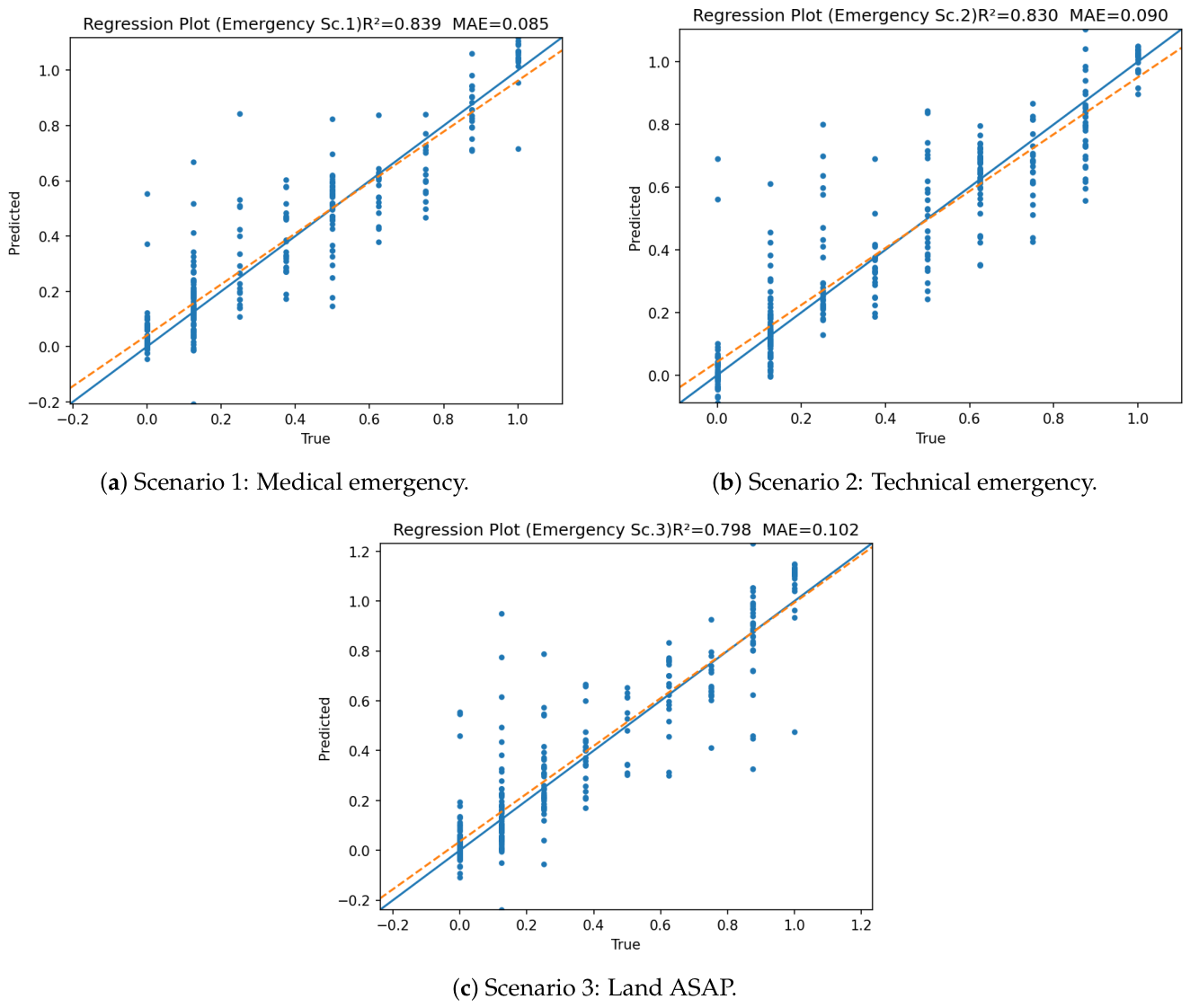
The parity plots in Figure 9 show a clear linear alignment between predicted and ground-truth severity scores across all three scenarios, with values close to or exceeding 0.8. Performance decreases slightly from Scenario 1 (medical emergency) to Scenario 3 (immediate landing), with marginally increased dispersion at intermediate hazard levels; no systematic overestimation or underestimation is observed. The modest degradation in Scenario 3 is likely attributable to intrinsic data characteristics — increased linguistic variability, greater label ambiguity, or distributional imbalance — rather than to architectural limitations. These results confirm that the regression head generalises effectively across diverse emergency conditions.
To facilitate practical evaluation and reproducibility, a lightweight inference interface is publicly available at https://huggingface.co/spaces/kinory24/NOTAManalysis, allowing users to submit arbitrary NOTAM messages and obtain predicted category labels and scenario-dependent severity scores in real time.
Figure 9.
Parity plots for the three emergency scenarios: predicted versus ground-truth severity scores. The diagonal line represents perfect agreement.
Figure 9.
Parity plots for the three emergency scenarios: predicted versus ground-truth severity scores. The diagonal line represents perfect agreement.
4. Limitations and Future Developments
This study prioritised architectural design and proof-of-concept validation over exhaustive optimisation, and several components of the framework remain open to more systematic treatment in future work. The training corpus is limited in size and was annotated by a single operator, increasing subjectivity and the risk of label inconsistency. The proposed 20-class taxonomy represents one possible operationalisation of the NOTAM semantic space; alternative schemes differing in granularity or operational priorities could equally be motivated. Future work should therefore adopt a structured annotation protocol involving multiple domain experts and expand the dataset either manually or through additional synthetic generation. Establishing a community-validated NOTAM categorisation framework remains an open research direction. A further limitation concerns the synthetic data generation pipeline, which relied on a manually engineered prompt not systematically optimised for compactness, controllability, or token efficiency. Iterative or automated prompt optimisation could reduce generation costs and mitigate distributional shifts between synthetic and real data. For large-scale operational deployment, the current dependency on externally hosted language models would need to be replaced by privately hosted infrastructure to satisfy data governance, latency, and aviation-sector confidentiality requirements. Finally, the model assigns labels and severity scores based exclusively on NOTAM text, without incorporating operational context such as aircraft type or meteorological conditions. This has limited impact on Task A but is more consequential for Task B, where scenario-dependent severity inherently depends on situational factors beyond textual semantics. Future work should focus on formally defining and integrating such contextual variables to support more realistic and context-aware prioritisation.
5. Conclusions
This paper presented an NLP framework based on a shared BERT encoder with two task-specific heads for the automated analysis of NOTAM free-text messages. The two tasks are designed to support NOTAM interpretation at different stages of the flight: a classification head assigns each NOTAM to one of 20 operational categories to support pre-flight briefing, while a regression head estimates the operational severity of a NOTAM under three emergency diversion scenarios to support in-flight decision-making. Both heads are trained jointly on top of a DistilBERT encoder adapted through LoRA, resulting in a compact configuration suitable for resource-constrained cockpit environments. A central contribution of this work is the hybrid dataset construction pipeline, which combines manually annotated real NOTAMs with synthetic samples generated under human supervision. This strategy mitigates data scarcity and class imbalance without compromising label coherence, as confirmed by the overlap and redundancy analyses reported in Section 2.2.3. The dedicated preprocessing stage further supports domain adaptation by reducing the structural and lexical variability of NOTAM language. Evaluation on the held-out test set confirms the effectiveness of the proposed approach. The classification head achieves a macro F1-score of 0.97, with residual errors concentrated among semantically adjacent categories. The regression head yields R² values at or above 0.80 across all three emergency scenarios, with no systematic bias. To allow direct interaction with the trained model, a lightweight inference interface is publicly available on HuggingFace2, where arbitrary NOTAM messages can be submitted according to instructions and the corresponding category and severity scores obtained in real time. The proposed framework is intended as a modular building block for cockpit decision-support systems such as Hawkeye, where structured NOTAM interpretation can inform alternate-airport ranking during emergency diversions. The limitations discussed in Section 4 identify the main directions for future work.
Author Contributions
Conceptualization, N.P. and C.N.; methodology, N.P.; software, N.P.; validation, N.P.; formal analysis, N.P.; investigation, N.P.; resources, C.N.; data curation, N.P.; writing—original draft preparation, N.P.; writing—review and editing, N.P, C.N. and G.G.; visualization, N.P.; supervision, C.N. and G.G.; project administration, C.N. and G.G.; funding acquisition, C.N. All authors have read and agreed to the published version of the manuscript.
Funding
This publication is part of the project PNRR-NGEU which has received funding from the MUR – DM 352/2022.
Data Availability Statement
The training dataset and the resulting fine-tuned model are available from the corresponding author upon reasonable request.
Acknowledgments
During the preparation of this manuscript, the author(s) used ChatGPT 5 for the purposes of generate synthetic NOTAMs, thus helping with the dataset creation, and Claude Opus 4.7 (Extra) for image sketch generation. The authors have reviewed and edited the output and take full responsibility for the content of this publication.
Conflicts of Interest
The authors declare no conflicts of interest. The funders had no role in the design of the study; in the collection, analyses, or interpretation of data; in the writing of the manuscript; or in the decision to publish the results.
References
- International Civil Aviation Organization. Annex 15: Aeronautical Information Services. International Civil Aviation Organization (ICAO), 16th ed., 2018. Sixteenth Edition, supersedes previous editions on 8 November 2018; ISBN: 978-92-9258-448-1.
- (EASA), E.U.A.S.A. European Plan for Aviation Safety 2025. Safety plan, European Union Aviation Safety Agency (EASA), Cologne, Germany, 2024. Version extracted from the official EASA publication.
- OPS Group. Taking the Trash Out: Let’s Fix NOTAMs. https://ops.group/blog/taking-the-trash-out-lets-fix-notams/, 2021. Industry blog post on NOTAM usability and information quality. Accessed: 2025-12-10.
- National Transportation Safety Board. Taxiway Overflight: Air Canada Flight 759, Airbus A320-211, C-FKCK, San Francisco, California, July 7, 2017. Aircraft Incident Report NTSB/AIR-18/01, National Transportation Safety Board, Washington, DC, USA, 2018. PB2018-101561.
- Aviation Safety Council. Aircraft Accident Report: Crashed on a Partially Closed Runway During Takeoff – Singapore Airlines Flight 006, Boeing 747-400, 9V-SPK, CKS Airport, Taoyuan, Taiwan, October 31, 2000. Technical report, Aviation Safety Council, Taiwan, Taipei, Taiwan, 2002. Aircraft Accident Investigation Report.
- International Civil Aviation Organization. ICAO Abbreviations and Codes, 9 ed.; Number Doc 8400 in Procedures for Air Navigation Services, International Civil Aviation Organization: Montreal, Canada, 2016.
- Vaidyanathan, K.; Danet, T.; Hein, E. Improving Flight Planning Robustness through NOTAM Q-Code Error Correction. In Proceedings of the Artificial Intelligence and Machine Learning for Multi-Domain Operations Applications V, Orlando, Florida, United States, 2023; Vol. 12538, Proceedings of SPIE, p. 125380A. [CrossRef]
- EUROCONTROL. Aeronautical Information Exchange Model (AIXM). https://www.eurocontrol.int/model/aeronautical-information-exchange-model, 2025. Accessed: 2025-12-09.
- EUROCONTROL. Digital NOTAM Specification. https://ext.eurocontrol.int/aixm_confluence/display/DNOTAM/Digital+NOTAM+Specification, 2025. Accessed: 2025-12-09.
- EUROCONTROL. EUROCONTROL advances digital transformation by deploying enhanced European Aeronautical Information Services Database (eEAD). https://www.eurocontrol.int/news/eurocontrol-advances-digital-transformation-deploying-enhanced-european-aeronautical, 2025. Accessed: 2026-07-28.
- Japan Civil Aviation Bureau. Implementation Status of Digital NOTAM Service in Japan. Technical Report AAITF/19 – WP/20, ICAO Asia/Pacific Aeronautical Information and Infrastructure Task Force, 2024. Accessed: 2026-07-28.
- Demir, G.; Moslem, S.; Duleba, S. Artificial Intelligence in Aviation Safety: Systematic Review and Biometric Analysis. International Journal of Computational Intelligence Systems 2024, 17, 279. Published online: 12 November 2024, . [CrossRef]
- Morărașu, M.M.; Horațiu Roman, C. AI-driven Optimization of Operational NOTAM Management. In Proceedings of the 2024 Integrated Communications, Navigation and Surveillance Conference (ICNS), 2024, pp. 1–6. [CrossRef]
- Bravin, M.; Pfäffli, D.; Mazumder, S.; Pouly, M. Automated Smartification of Notices to Airmen. In Proceedings of the Proceedings of the International Conference on Software, Data and System (SDS), Switzerland, June 2020. [CrossRef]
- Maynard, P.; Clarke, S.; Almache, J.; Kumar, S.; Rajkumar, S.; Kemp, A.; Pai, R. Natural Language Processing (NLP) Techniques for Air Traffic Management Planning. In Proceedings of the AIAA Aviation 2021 Forum, 2021. Virtual event, . [CrossRef]
- Lufthansa Systems. Lido mPilot: A comprehensive navigation solution for pilots on iOS. https://www.lhsystems.com/solutions-services/flight-deck-solutions/lidonavigation/lidompilot, 2026. Accessed: 2026-07-28.
- Jeppesen. FliteDeck Pro: Fully Integrated Electronic Flight Bag. https://ww2.jeppesen.com/navigation-solutions/flitedeck-pro/, 2026. Accessed: 2026-07-28.
- Jeppesen ForeFlight. ClearNOTAMs: AI-powered plain-language NOTAM summaries. https://foreflight.com/blog/foreflights-newest-feature-clearnotams, 2026. Accessed: 2026-07-28.
- Soudain, G. EASA Concept Paper: Guidance for Level 1 & 2 Machine Learning Applications. Technical Report Issue 02, European Union Aviation Safety Agency (EASA), Cologne, Germany, 2024.
- Puca, N.; Guglieri, G. Enabling Civil Single-Pilot Operations: A State-of-the-Art Review. Aerotecnica Missili & Spazio 2025, 104, 187–212. [CrossRef]
- Lopes, N.M.; Aparicio, M.; Costa, C.J.; Neves, F.T.; Bernardino, C. Designing the future of flight: A socio-technical framework for single-pilot operations in commercial aviation. Journal of Air Transport Management 2026, 132, 102939. [CrossRef]
- Rose, R.L.; Puranik, T.G.; Mavris, D.N. Natural Language Processing Based Method for Clustering and Analysis of Aviation Safety Narratives. Aerospace 2020, 7. [CrossRef]
- Rose, R.L.; Puranik, T.G.; Mavris, D.N.; Rao, A.H. Application of structural topic modeling to aviation safety data. Reliability Engineering and System Safety 2022, 224, 108522. [CrossRef]
- Kuhn, K.D. Using structural topic modeling to identify latent topics and trends in aviation incident reports. Transportation Research Part C: Emerging Technologies 2018, 87, 105–122. [CrossRef]
- Madeira, T.; Melício, R.; Valério, D.; Santos, L. Machine Learning and Natural Language Processing for Prediction of Human Factors in Aviation Incident Reports. Aerospace 2021, 8. [CrossRef]
- Vaswani, A.; Shazeer, N.; Parmar, N.; Uszkoreit, J.; Jones, L.; Gomez, A.N.; Kaiser, L.u.; Polosukhin, I. Attention is All you Need. In Proceedings of the Advances in Neural Information Processing Systems; Guyon, I.; Luxburg, U.V.; Bengio, S.; Wallach, H.; Fergus, R.; Vishwanathan, S.; Garnett, R., Eds. Curran Associates, Inc., 2017, Vol. 30.
- Patel, K.K.; Desaulniers, G.; Lodi, A.; Lecue, F. Explainable Prediction of Qcodes for NOTAMs Using Column Generation. Journal of the Operational Research Society 2024, 75, 173–183. [CrossRef]
- Liu, M.; Fang, Q.; Wu, Y.; Zhao, C.; Yang, Y.; Cai, K. NOTAM-Evolve: A Knowledge-Guided Self-Evolving Optimization Framework with LLMs for NOTAM Interpretation. arXiv preprint arXiv:2511.07982, 2025, [arXiv:cs.CL/2511.07982].
- Abdulrahman, R. A Framework for Filtering Irrelevant NOTAMs. Master’s thesis, Rochester Institute of Technology, RIT Dubai, 2024. Advisor: Ehsan Warriach.
- Ilaria Rosa. Leveraging ML and Language Models to Assess Importance of NOTAMs. Master thesis, Norwegian University of Science and Technology, 2024.
- Mogillo-Dettwiller, A. Filtering and Sorting of Notices to Air Missions (NOTAMs). Master, Faculty of Arts and Social Sciences of the University of Zurich, 2024.
- Devlin, J.; Chang, M.W.; Lee, K.; Toutanova, K. BERT: Pre-Training of Deep Bidirectional Transformers for Language Understanding. In Proceedings of the Proceedings of the 2019 Conference of the North American Chapter of the Association for Computational Linguistics: Human Language Technologies, Minneapolis, Minnesota, June 2019; Vol. 1, pp. 4171–4186.
- Szeto, A.C.; Das, A. Classification of Notices to Airmen using Natural Language Processing. In Proceedings of the AIAA SciTech Forum, Orlando, FL, USA, 2024. NASA Technical Report 20230017551.
- Dani, M.N.; Desarkar, M.S. Detecting Attribute Information in Notice to Airman. In Natural Language Processing and Information Systems; Springer, Cham, 2024; Vol. 14763, Lecture Notes in Computer Science, pp. 195–206. [CrossRef]
- Arnold, A.; Ernez, F.; Kobus, C.; Martin, M.C. Knowledge Extraction from Aeronautical Messages (NOTAMs) with Self-Supervised Language Models for Aircraft Pilots. In Proceedings of the Proceedings of the 2022 Conference of the North American Chapter of the Association for Computational Linguistics: Human Language Technologies, Industry Track, Seattle, WA, USA, July 2022; pp. 188–196.
- Dani, M.N.; Maheswaran, A.; Desarkar, M.S. Semantics-Aware Prompting for Translating NOtices To AirMen. In Proceedings of the Findings of the Association for Computational Linguistics: ACL 2025, Vienna, Austria, July 2025; pp. 24407–24417.
- Andrade, S.R.; Walsh, H.S. SafeAeroBERT: Towards a Safety-Informed Aerospace-Specific Language Model. In Proceedings of the AIAA Aviation 2023 Forum, San Diego, CA, USA, June 2023; [20240003131]. Conference Paper, AIAA-2023-3437, . [CrossRef]
- Liu, M.; Fang, Q.; Yang, Y.; Zhao, C.; Cai, K. Knots: A Large-Scale Multi-Agent Enhanced Expert-Annotated Dataset and LLM Prompt Optimization for NOTAM Semantic Parsing. arXiv preprint arXiv:2511.12630, 2025, [arXiv:cs.CL/2511.12630].
- Orozco, O.R.; Dominguez, L.M.V.; Santamía, A.M.; Gonzalez, D.M.; Cantu-Ros, O.G. A Semi-supervised Approach to Multi-label Classification of NOTAMs using BERT. In Proceedings of the Proceedings of the SESAR Innovation Days (SIDs) 2025, Bled, Slovenia, 2025; pp. 1–9. Paper 84.
- Wei, J.; Zou, K. EDA: Easy Data Augmentation Techniques for Boosting Performance on Text Classification Tasks. In Proceedings of the Proceedings of the 2019 Conference on Empirical Methods in Natural Language Processing and the 9th International Joint Conference on Natural Language Processing (EMNLP-IJCNLP), Hong Kong, China, 2019; pp. 6382–6388. [CrossRef]
- Feng, S.Y.; Gangal, V.; Wei, J.; Chandar, S.; Vosoughi, S.; Mitamura, T.; Hovy, E. A Survey of Data Augmentation Approaches for NLP. In Proceedings of the Findings of the Association for Computational Linguistics: ACL-IJCNLP 2021. Association for Computational Linguistics, 2021, pp. 968–988. [CrossRef]
- Dieter, M.; Sprenger, E.; Pasnicu, O.; Staudt, J.; Ellenrieder, N. Virtual flight deck crew assistance utilizing artificial intelligence methods to interpret NOTAMs: a user acceptance study. CEAS Aeronautical Journal 2024, 15, 1137–1144. [CrossRef]
- Niermann, C.; Küls, J.; Findeisen, M.; Karabulut, B.A.; Küppers, R. Development of the Explainable Intelligent Alternate Airport Assistant (EIAAA). In Proceedings of the AIAA Aviation Forum and ASCEND, 2025, July 2025.
- (DLR), G.A.C. HAWKEYE Project. https://www.hawkeye.aero, 2025. Accessed: 2025-12-10.
- Laminar Data. Laminar Data Developer Documentation. https://developer.laminardata.aero/, 2025. Developer documentation for Laminar Data APIs and SDKs.
- Kiran, A.; Kumar, S.S. A Methodology and an Empirical Analysis to Determine the Most Suitable Synthetic Data Generator. IEEE Access 2024, 12, 12209–12228. [CrossRef]
- Hittmeir, M.; Ekelhart, A.; Mayer, R. On the Utility of Synthetic Data: An Empirical Evaluation on Machine Learning Tasks. In Proceedings of the Proceedings of the 14th International Conference on Availability, Reliability and Security (ARES). ACM, August 2019, pp. 1–6. [CrossRef]
- OpenAI. tiktoken: A fast BPE tokeniser for use with OpenAI’s models. https://github.com/openai/tiktoken, 2023. Accessed: 2026-08-04.
- Mi, B.; Fan, Y.; Sun, Y. NOTAM Text Analysis and Classification Based on Attention Mechanism. Journal of Physics: Conference Series 2022, 2171, 012042. [CrossRef]
- Jawahar, G.; Sagot, B.; Seddah, D. What Does BERT Learn about the Structure of Language? In Proceedings of the Proceedings of the 57th Annual Meeting of the Association for Computational Linguistics, Florence, Italy, 2019; pp. 3651–3657. [CrossRef]
- Ding, N.; Qin, Y.; Yang, G.; Wei, F.; Yang, Z.; Su, Y.; Hu, S.; Chen, Y.; Chan, C.M.; Chen, W.; et al. Parameter-efficient fine-tuning of large-scale pre-trained language models. Nature Machine Intelligence 2023, 5, 220–235. [CrossRef]
- Hu, E.J.; Shen, Y.; Wallis, P.; Allen-Zhu, Z.; Li, Y.; Wang, S.; Wang, L.; Chen, W. LoRA: Low-Rank Adaptation of Large Language Models. arXiv preprint 2021, abs/2106.09685. arXiv:2106.09685v2 [cs.CL], . [CrossRef]
- Wolf, T.; Debut, L.; Sanh, V.; Chaumond, J.; Delangue, C.; Moi, A.; Cistac, P.; Rault, T.; Louf, R.; Funtowicz, M.; et al. Transformers: State-of-the-Art Natural Language Processing. In Proceedings of the Proceedings of the 2020 Conference on Empirical Methods in Natural Language Processing: System Demonstrations, 2020, pp. 38–45. [CrossRef]
- Hugging Face. WordPiece Tokenization. https://huggingface.co/learn/llm-course/chapter6/6, 2023. Hugging Face LLM Course, Chapter 6.
- Loshchilov, I.; Hutter, F. Decoupled Weight Decay Regularization. In Proceedings of the Proceedings of the 7th International Conference on Learning Representations, 2019.
- Gordon-Rodriguez, E.; Loaiza-Ganem, G.; Pleiss, G.; Cunningham, J.P. Uses and Abuses of the Cross-Entropy Loss: Case Studies in Modern Deep Learning. In Proceedings of the Proceedings on "I Can’t Believe It’s Not Better!" at NeurIPS Workshops; Zosa Forde, J.; Ruiz, F.; Pradier, M.F.; Schein, A., Eds. PMLR, 12 Dec 2020, Vol. 137, Proceedings of Machine Learning Research, pp. 1–10.
- Eltahier, S.; Dawood, O.; Saeed, I. BERT Fine-Tuning for Software Requirement Classification: Impact of Model Components and Dataset Size. Information 2025, 16, 981. [CrossRef]
- Sanh, V.; Debut, L.; Chaumond, J.; Wolf, T. DistilBERT, a distilled version of BERT: smaller, faster, cheaper and lighter. arXiv preprint arXiv:1910.01108 2019.
- Jiao, X.; Yin, Y.; Shang, L.; Jiang, X.; Chen, X.; Li, L.; Wang, F.; Liu, Q. TinyBERT: Distilling BERT for Natural Language Understanding. In Proceedings of the Findings of the Association for Computational Linguistics: EMNLP 2020, Online, 2020; pp. 4163–4174. [CrossRef]
| 1 | Term Frequency–Inverse Document Frequency (TF–IDF) is a standard bag-of-words weighting scheme in which each message is represented as a vector of term weights, scaled by how frequently a term occurs in the message relative to how common it is across the corpus. |
| 2 |
Figure 1.
Structure of a complete NOTAM according to ICAO prescriptions. The header (series, number, type marker) is followed by the Q-line, which encodes standardised metadata used for routing and basilar categorisation (e.g. FIR identifier, NOTAM code, and traffic type, purpose and scope descriptors). Fields A–G then convey the operational content by specifying the affected location (A), message validity period (B, C), optional schedule information (D), free-text operational message (E), and altitude limits (F, G). The illustrated example reports the temporary closure (CLSD) of runways 04L/22R at aerodrome EDDM.
Figure 1.
Structure of a complete NOTAM according to ICAO prescriptions. The header (series, number, type marker) is followed by the Q-line, which encodes standardised metadata used for routing and basilar categorisation (e.g. FIR identifier, NOTAM code, and traffic type, purpose and scope descriptors). Fields A–G then convey the operational content by specifying the affected location (A), message validity period (B, C), optional schedule information (D), free-text operational message (E), and altitude limits (F, G). The illustrated example reports the temporary closure (CLSD) of runways 04L/22R at aerodrome EDDM.
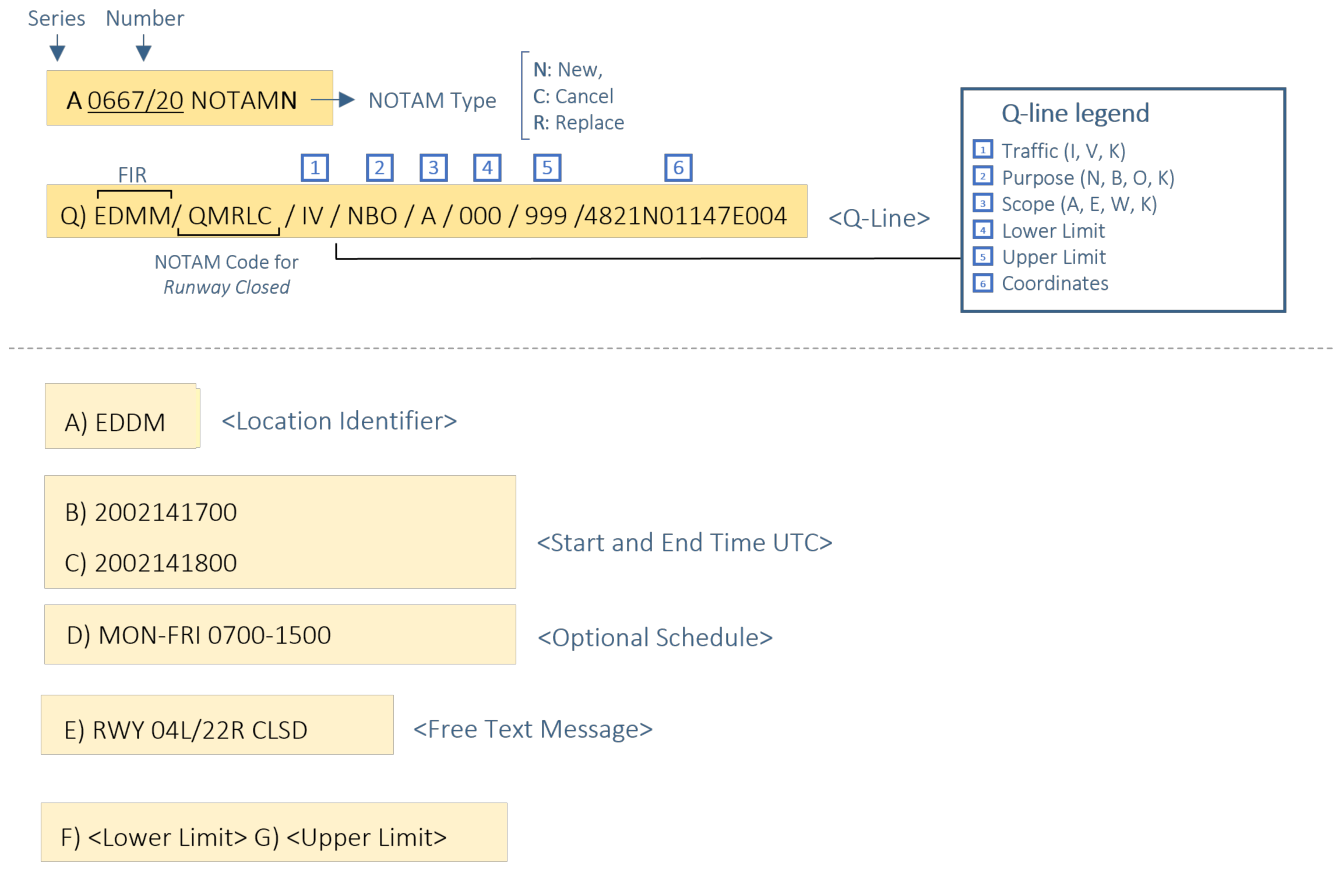
Figure 2.
Overview of the proposed methodology. Real and LLM-assisted synthetic NOTAMs are combined, annotated under expert supervision, preprocessed, and split into training, validation, and test sets. The fine-tuning strategy then is based on adapting a frozen DistilBERT encoder through Low-Rank Adapter (LoRA) matrices. The adapter’s and specific heads’ parameters are the only trainable components.
Figure 2.
Overview of the proposed methodology. Real and LLM-assisted synthetic NOTAMs are combined, annotated under expert supervision, preprocessed, and split into training, validation, and test sets. The fine-tuning strategy then is based on adapting a frozen DistilBERT encoder through Low-Rank Adapter (LoRA) matrices. The adapter’s and specific heads’ parameters are the only trainable components.
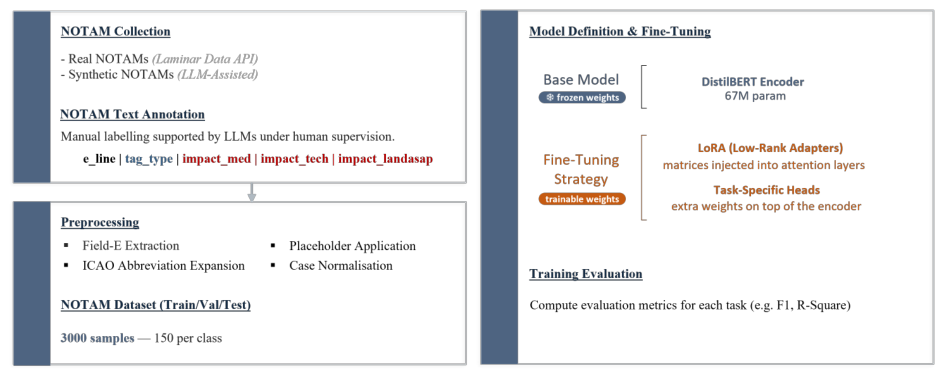
Figure 3.
Internal architecture of the multi-task BERT-based model. Raw NOTAM text is tokenised and passed through a stack of transformer encoder layers, each comprising a multi-head self-attention module and a feed-forward network. The final hidden state of the [CLS] token is extracted as a pooled sequence-level representation and routed to two task-specific heads: a classification layer that assigns each NOTAM to one of K operational categories (Task A), and a regression layer that estimates S scenario-dependent severity scores (Task B).
Figure 3.
Internal architecture of the multi-task BERT-based model. Raw NOTAM text is tokenised and passed through a stack of transformer encoder layers, each comprising a multi-head self-attention module and a feed-forward network. The final hidden state of the [CLS] token is extracted as a pooled sequence-level representation and routed to two task-specific heads: a classification layer that assigns each NOTAM to one of K operational categories (Task A), and a regression layer that estimates S scenario-dependent severity scores (Task B).
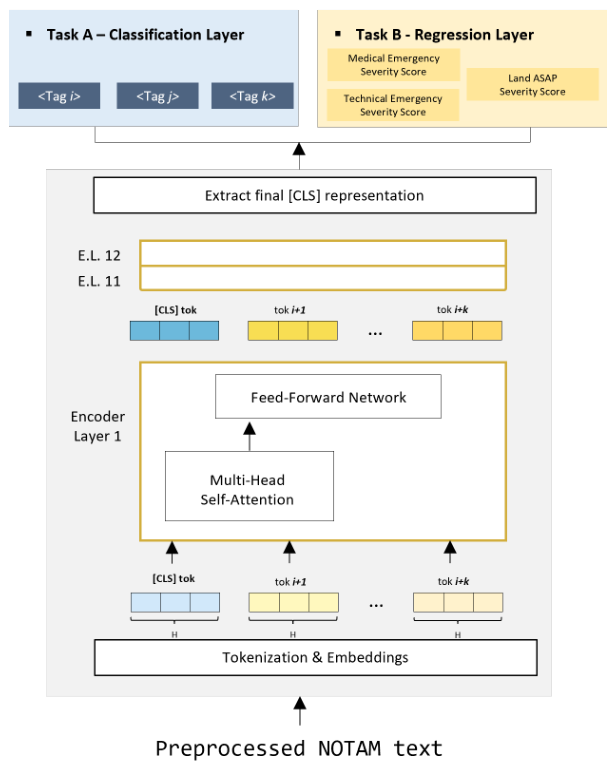
Figure 4.
Example of the preprocessing pipeline applied to a NOTAM message, showing the structured Header and Body output.
Figure 4.
Example of the preprocessing pipeline applied to a NOTAM message, showing the structured Header and Body output.
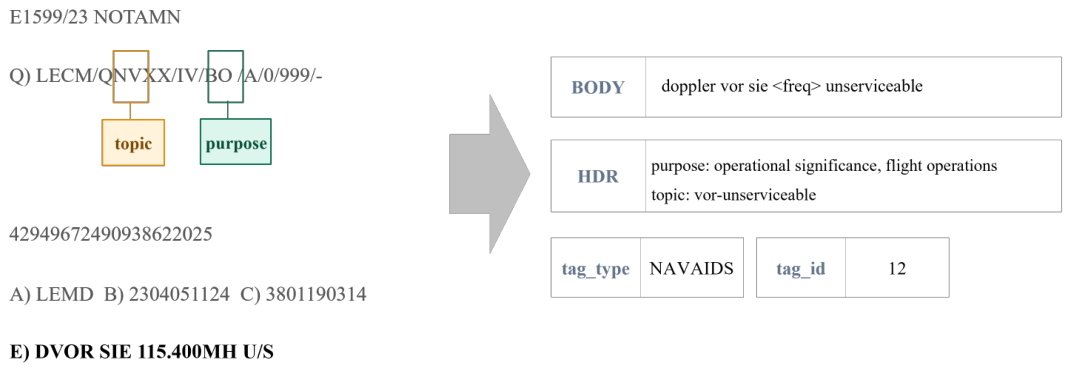
Figure 5.
Learning rate sensitivity analysis. Left: Best overall performance score achieved for each learning rate. Right: Evolution of the individual performance metrics across epochs.
Figure 5.
Learning rate sensitivity analysis. Left: Best overall performance score achieved for each learning rate. Right: Evolution of the individual performance metrics across epochs.
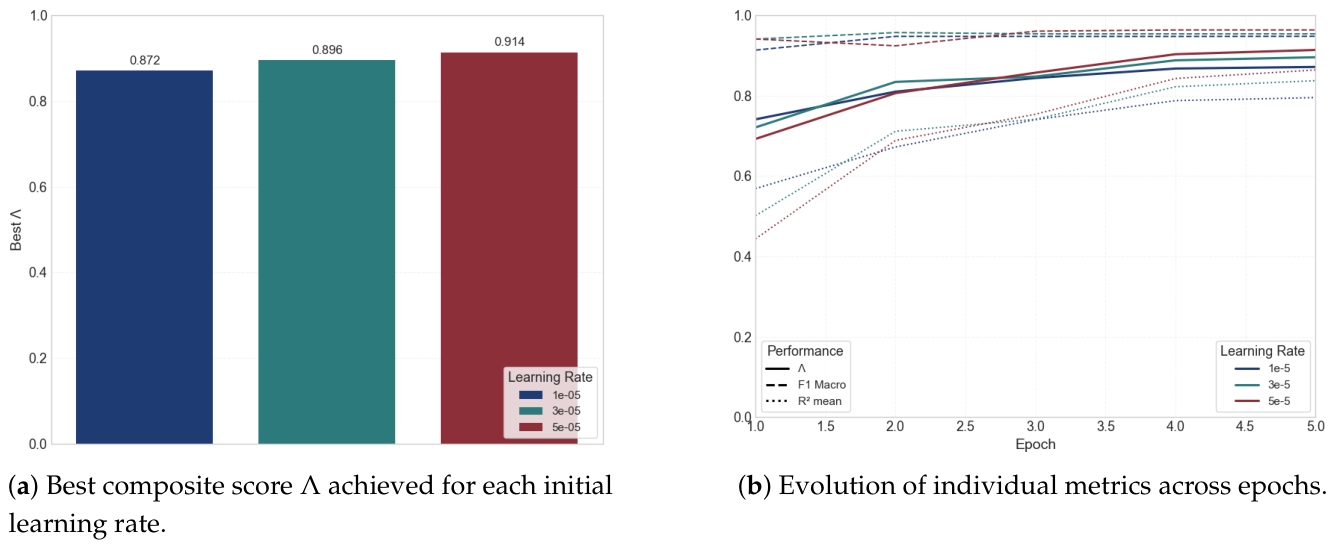
Figure 6.
Training duration sensitivity analysis. Left: best composite score achieved for each number of epochs. Right: evolution of individual metrics across epochs.
Figure 6.
Training duration sensitivity analysis. Left: best composite score achieved for each number of epochs. Right: evolution of individual metrics across epochs.
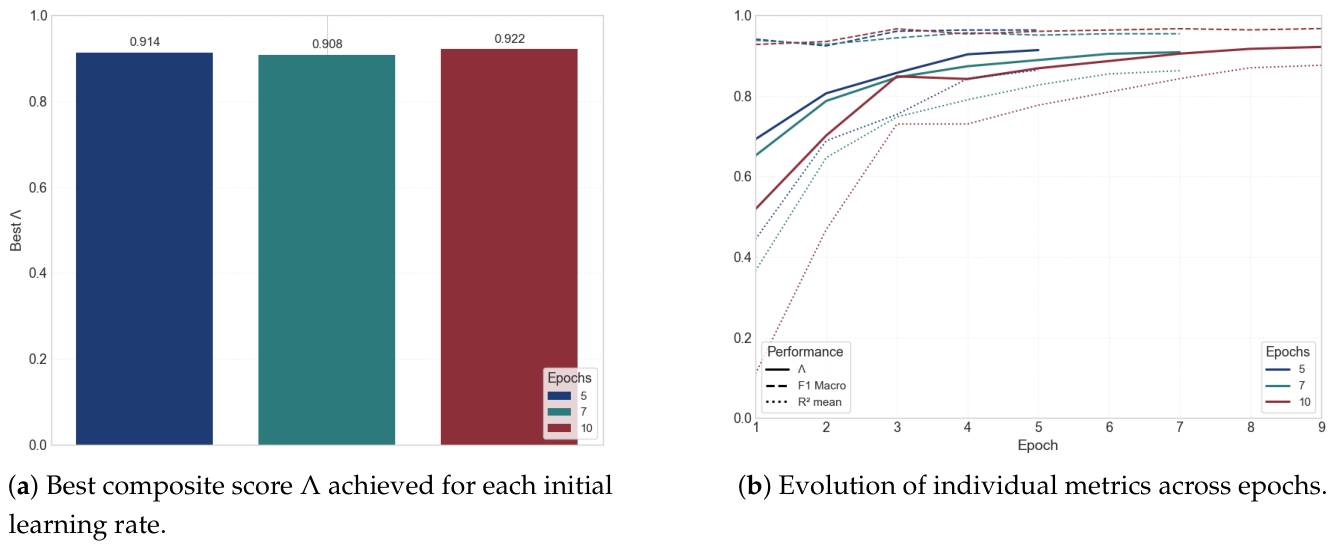
Figure 7.
Batch size sensitivity analysis. Left: best composite score achieved for each batch size. Right: evolution of individual metrics across epochs.
Figure 7.
Batch size sensitivity analysis. Left: best composite score achieved for each batch size. Right: evolution of individual metrics across epochs.
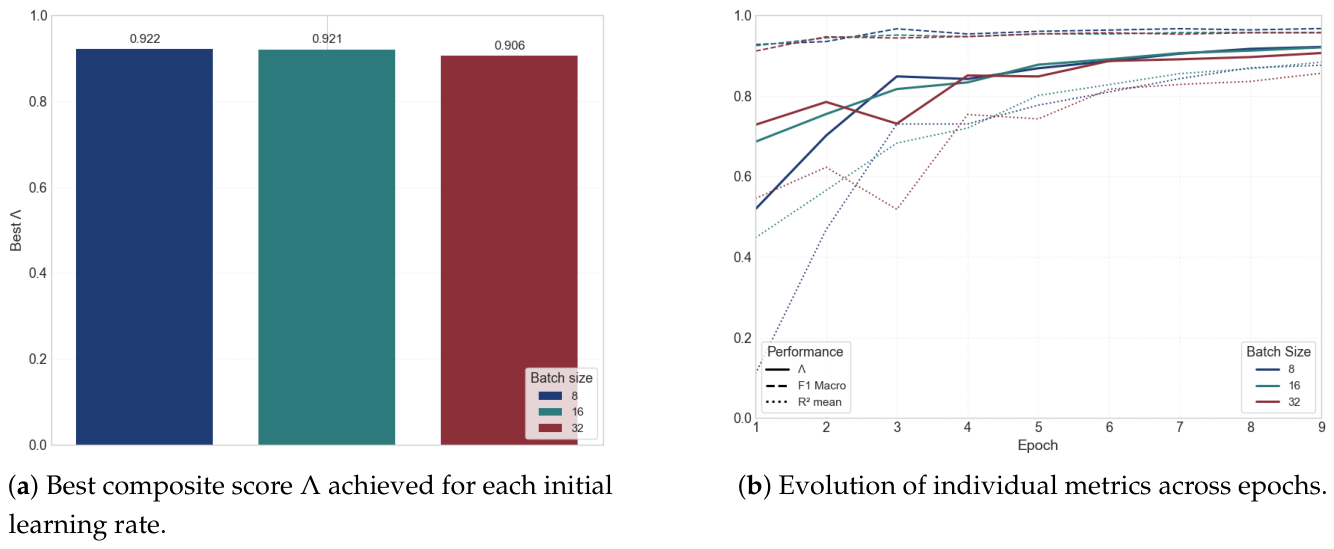
Figure 8.
Row-normalised confusion matrix for Task A on the held-out test set (300 samples, 20 categories). Diagonal values correspond to per-category recall. Off-diagonal entries are concentrated among operationally related categories.
Figure 8.
Row-normalised confusion matrix for Task A on the held-out test set (300 samples, 20 categories). Diagonal values correspond to per-category recall. Off-diagonal entries are concentrated among operationally related categories.
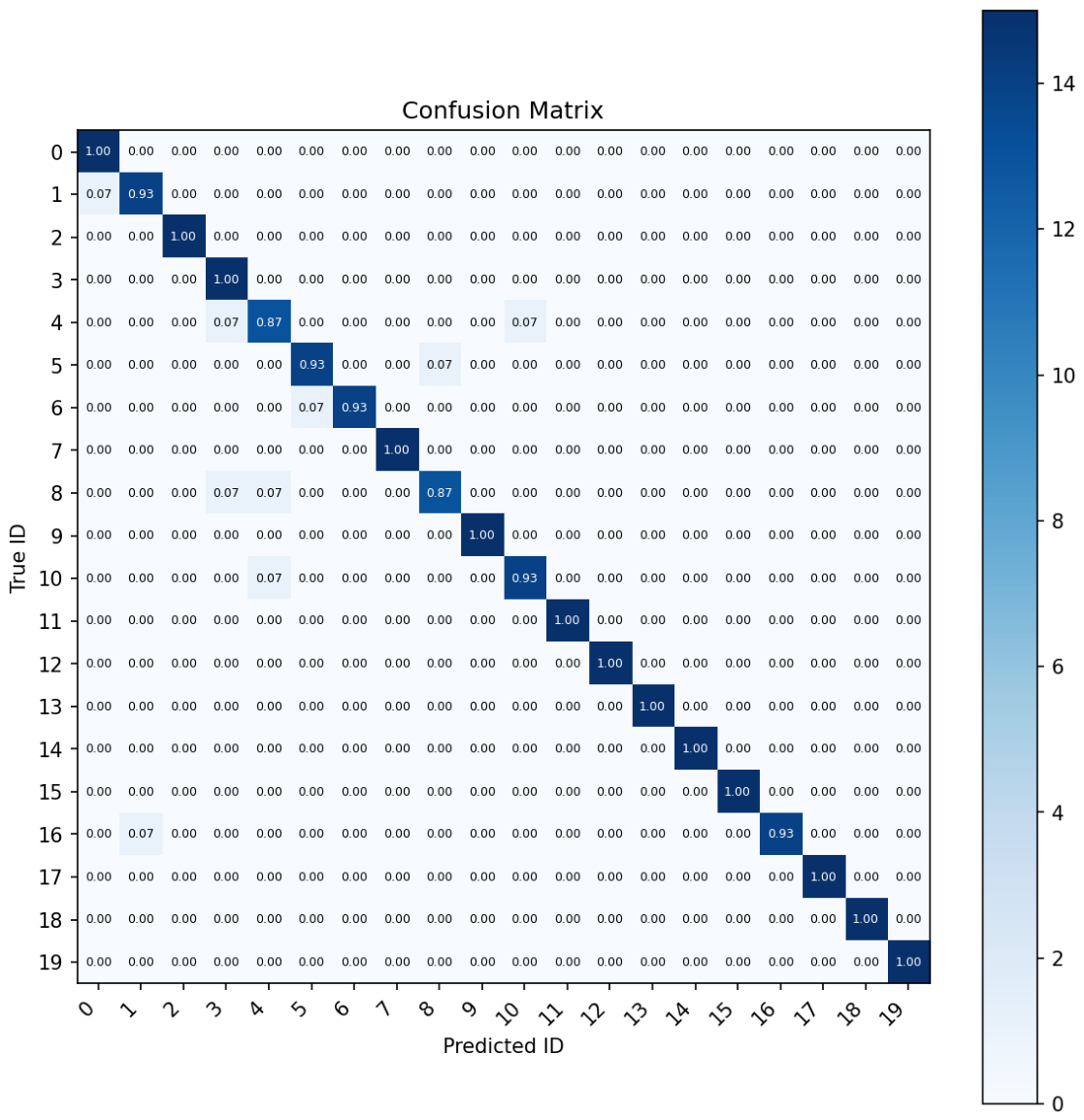
Table 1.
NOTAM classification taxonomy adopted for Task A. The twenty categories were obtained by consolidating operationally relevant NOTAM types into semantically distinct classes, with the aim of preserving discriminative power while remaining tractable for supervised fine-tuning on a limited dataset. The Description column reports the operational scope of each category as used during dataset annotation.
Table 1.
NOTAM classification taxonomy adopted for Task A. The twenty categories were obtained by consolidating operationally relevant NOTAM types into semantically distinct classes, with the aim of preserving discriminative power while remaining tractable for supervised fine-tuning on a limited dataset. The Description column reports the operational scope of each category as used during dataset annotation.
| # | Category | Description |
|---|---|---|
| 1 | Runway Closure | Full unavailability of the runway for all operations regardless of duration or reason. |
| 2 | ATC Not Available | Unavailability or suspension of ATC, AFIS, or FIS services. Severity for Task B varies by facility. |
| 3 | Airport Restrictions | Administrative or operational conditions limiting aerodrome access (curfews, PPR, aircraft type limits, service hours, customs). |
| 4 | ILS | Changes affecting the Instrument Landing System. The resulting severity scales with ILS category. |
| 5 | Airspace | Changes to airspace structure or status, including activation of restricted/prohibited areas, TFRs, CTR modifications, or sector boundary changes. |
| 6 | Hazards | Variable and immediate operational risks from mobile or temporary phenomena (bird activity, drones, lasers, fireworks, volcanic ash, aerobatics). |
| 7 | Radar Services | Information or updates on primary and secondary radar systems (approach radar, SSR, SMR, PAR, TAR). |
| 8 | Emergency Services | Availability, downgrade, or time-limited operation of rescue and firefighting services (RFFS/ARFF). |
| 9 | Taxiway Closure | Closure of one or more regular taxiways (excluding apron taxiways). |
| 10 | Runway Restrictions | Partial limitations on runway usability such as reduced declared distances, lighting degradations, stopway or arresting system issues, surface conditions, or aircraft-type restrictions. Does not imply full closure. |
| 11 | Taxiway Restrictions | Limitations or degradations affecting taxiway usability (markings, lighting, surface, low-visibility procedures, follow-me availability) without full closure. |
| 12 | Navigation Aids | Outages or degradations of navigation aids beyond ILS. |
| 13 | Approach Procedures | Temporary limitations or changes to any instrument approach procedure, such as minima adjustments, missed approach modifications, or circling restrictions. |
| 14 | Flight Procedures | Changes to flight management procedures within the airspace, i.e. SIDs, STARs, holding patterns, routings, altitude restrictions, or slot constraints. |
| 15 | Communications | Changes to air-to-ground radio systems (frequency changes, partial outages, reduced power) that do not constitute a full ATC/AFIS service loss. |
| 16 | Obstacles | Presence of static and predictable obstacles (cranes, antennas, buildings) with position and elevation data. |
| 17 | AD Ops & Maintenance | Maintenance or operational changes within the aerodrome boundary, i.e. apron works, stand modifications, parking changes, lighting updates, refuelling availability, and ramp service corrections. |
| 18 | AIP Change | Announcing or previewing AIP amendments and supplements (Trigger NOTAMs). |
| 19 | Military | Internal military procedural NOTAMs (e.g. US DOD notices, base-only directives) with no relevance to civil flight operations. |
| 20 | Administrative | Informational NOTAMs with no operational or safety impact: contact details, service hours, slot coordination notices. |
Table 2.
Operational diversion scenarios considered for Task B. The scenarios define the operational context in which each NOTAM is interpreted. During relevance assessment, every NOTAM is assumed to originate from a candidate alternate airport and is evaluated according to the operational priorities associated with the corresponding emergency scenario.
Table 2.
Operational diversion scenarios considered for Task B. The scenarios define the operational context in which each NOTAM is interpreted. During relevance assessment, every NOTAM is assumed to originate from a candidate alternate airport and is evaluated according to the operational priorities associated with the corresponding emergency scenario.
| Scenario | Situation Description |
|---|---|
| Medical Emergency | The aircraft is fully serviceable, and the diversion is prompted by a medical condition affecting a passenger or crew member. The primary objective is to reach appropriate medical assistance as quickly as possible while maintaining safe aircraft operation. |
| Technical Emergency | A system malfunction has degraded the aircraft’s capabilities. The crew must conduct a precautionary landing at the nearest suitable airport while preventing further deterioration of the situation. |
| Land As Soon As Possible (ASAP) | The aircraft’s ability to remain airborne is in immediate doubt. Minimising airborne time becomes the overriding priority, requiring a landing at the first available survivable location. |
Table 3.
Operational relevance scale adopted for Task B annotation. Raw scores are assigned on a nine-point scale and subsequently normalised to the interval for model training.
Table 3.
Operational relevance scale adopted for Task B annotation. Raw scores are assigned on a nine-point scale and subsequently normalised to the interval for model training.
| Level | Range | Rationale |
|---|---|---|
| Low | 1–2 | The NOTAM has negligible influence on the suitability of the airport as an alternate and is unlikely to affect diversion planning or operational decision-making. |
| Medium | 3–5 | The NOTAM introduces operational constraints that require consideration but generally do not prevent the airport from being selected as an alternate. |
| High | 6–7 | The NOTAM significantly degrades the operational suitability of the airport and may render it inappropriate for diversion under certain emergency conditions. |
| Critical | 8–9 | The NOTAM severely compromises or precludes the use of the airport as an alternate, except possibly under exceptional circumstances where no safer option is available. |
Table 4.
Contextual documents embedded in the ChatGPT prompt during synthetic data generation, with their functional role and approximate token footprint.
Table 4.
Contextual documents embedded in the ChatGPT prompt during synthetic data generation, with their functional role and approximate token footprint.
| Document | Content and Role | Tokens |
|---|---|---|
| System Prompt | Defines model behaviour, output format, and operational constraints. | ∼1 800 |
| NOTAM Categories | Lists the 20 target categories and their operational definitions, providing the reference taxonomy used across generation and annotation. | ∼2 200 |
| Annotation Guidelines – Task A | Textual criteria mapping message content to the corresponding Task A category, used to reduce ambiguity in category assignment. | ∼730 |
| Annotation Guidelines – Task B | Rules linking NOTAM content and emergency scenarios to severity levels, supporting consistent score assignment for Task B. | ∼280 |
| NOTAM Tag & ID Mapping | Correspondence table between textual category labels and their numeric identifiers used in the exported dataset. | ∼200 |
| Flight Emergency Scenarios | Operational definitions of the three diversion scenarios of Task B, providing the reference context for severity estimation. | ∼590 |
| NOTAM Code Decoding Table | ICAO Q-code decoding reference used to derive Purpose and Topic fields from the raw Q-line during generation. | ∼3 200 |
| ICAO Abbreviations | Approved ICAO abbreviation dictionary, constraining the vocabulary available to the model and reducing the risk of non-standard shorthand. | ∼7 300 |
| Annotation Examples | Curated set of validated NOTAM examples used as few-shot references for structure, length, and information density. | ∼15 000 |
| Scoring Guidelines | Quality criteria used to evaluate generated outputs during the evaluation phase of the workflow. | ∼2 100 |
Table 5.
Intra-class diversity and near-duplicate analysis by NOTAM category.
| Category | Mean Cosine | Trigram Overlap | Quasi-Dup. (%) |
|---|---|---|---|
| Runway Closure | 0.2117 | 0.2698 | 28.67 |
| Military | 0.1362 | 0.1216 | 20.00 |
| ATC Not Available | 0.1251 | 0.1386 | 16.00 |
| Taxiway Closure | 0.1181 | 0.1257 | 14.67 |
| Hazards | 0.0665 | 0.0630 | 8.67 |
| Taxiway Restrictions | 0.1329 | 0.1924 | 8.00 |
| ILS | 0.1068 | 0.0632 | 7.33 |
| Administrative | 0.1202 | 0.1001 | 7.33 |
| AD Ops & Maint. | 0.0413 | 0.0477 | 5.33 |
| AIP Change | 0.0804 | 0.0516 | 3.33 |
| Navigation Aids | 0.0578 | 0.0680 | 3.33 |
| Airport Restrictions | 0.0804 | 0.0843 | 2.67 |
| Emergency Services | 0.1874 | 0.1511 | 2.67 |
| Radar Services | 0.0817 | 0.0509 | 2.67 |
| Obstacles | 0.0746 | 0.0605 | 1.33 |
| Flight Procedures | 0.0422 | 0.0477 | 1.33 |
| Runway Restrictions | 0.0757 | 0.0695 | 1.33 |
| Approach Procedures | 0.0934 | 0.0805 | 0.00 |
| Communications | 0.0562 | 0.0577 | 0.00 |
| Airspace | 0.0720 | 0.0456 | 0.00 |
Table 6.
Hyperparameter configuration adopted for fine-tuning, grouped by functional role. The LoRA scaling factor is distinct from the task-weighting coefficient used for .
Table 6.
Hyperparameter configuration adopted for fine-tuning, grouped by functional role. The LoRA scaling factor is distinct from the task-weighting coefficient used for .
| Parameter | Value |
|---|---|
| Training Setup | |
| Max Sequence Length | 512 |
| Epochs | 15 |
| Batch Size | 8 |
| Gradient Accumulation | 1 |
| Mixed Precision | FP16 |
| Early Stopping Patience | 3 |
| Optimisation | |
| Optimiser | AdamW [55] |
| Learning Rate | |
| Scheduler | Cosine decay with linear warmup |
| Warmup Ratio | 0.08 |
| Weight Decay | 0.01 |
| LoRA Configuration | |
| Rank (r) | 4 |
| Scaling () | 8 |
| Dropout | 0.05 |
Table 7.
Evaluation metrics adopted for Task A (classification) and Task B (regression). Notation: C = number of classes; , , = true positives, false positives, and false negatives for class i; = samples in class i; N = total number of samples; = ground-truth value; = predicted value; = sample mean.
Table 7.
Evaluation metrics adopted for Task A (classification) and Task B (regression). Notation: C = number of classes; , , = true positives, false positives, and false negatives for class i; = samples in class i; N = total number of samples; = ground-truth value; = predicted value; = sample mean.
| Task | Metric | Expression | Description |
|---|---|---|---|
| Classification | Fraction of samples correctly assigned to their true class. | ||
| Unweighted mean of per-class scores; primary evaluation metric for Task A. | |||
| Per-class scores weighted by class frequency; reported as a complementary indicator. | |||
| Regression | MSE | Training loss for Task B; penalises large deviations through squared errors. | |
| Primary evaluation metric for Task B; measures the proportion of target variance explained by the model relative to a mean predictor. |
Table 9.
-scores on the held-out test split, reported at both per-category and global level.
| Category | F1 | Category | F1 |
|---|---|---|---|
| Administrative | 0.9677 | ILS | 0.9333 |
| Aerodrome Ops & Maint. | 0.9333 | Military | 1.0000 |
| AIP Change | 1.0000 | Navigation Aids | 1.0000 |
| Airport Restrictions | 0.9375 | Obstacles | 1.0000 |
| Approach Procedures | 0.8667 | Radar Services | 1.0000 |
| ATC Not Available | 0.9333 | Runway Closure | 1.0000 |
| Communications | 0.9655 | Runway Restrictions | 0.9655 |
| Emergency Services | 1.0000 | Airspace | 1.0000 |
| Flight Procedures | 0.8966 | Taxiway Closure | 1.0000 |
| Hazards | 1.0000 | Taxiway Restr. | 1.0000 |
| Total Accuracy: 0.9700 Total : 0.9700 (300 samples) | |||
Disclaimer/Publisher’s Note: The statements, opinions and data contained in all publications are solely those of the individual author(s) and contributor(s) and not of MDPI and/or the editor(s). MDPI and/or the editor(s) disclaim responsibility for any injury to people or property resulting from any ideas, methods, instructions or products referred to in the content. |
© 2026 by the authors. Licensee MDPI, Basel, Switzerland. This article is an open access article distributed under the terms and conditions of the Creative Commons Attribution (CC BY) license (http://creativecommons.org/licenses/by/4.0/).
Copyright: This open access article is published under a Creative Commons CC BY 4.0 license, which permit the free download, distribution, and reuse, provided that the author and preprint are cited in any reuse.