

Submitted:
30 September 2026
Posted:
04 October 2026
You are already at the latest version
Abstract
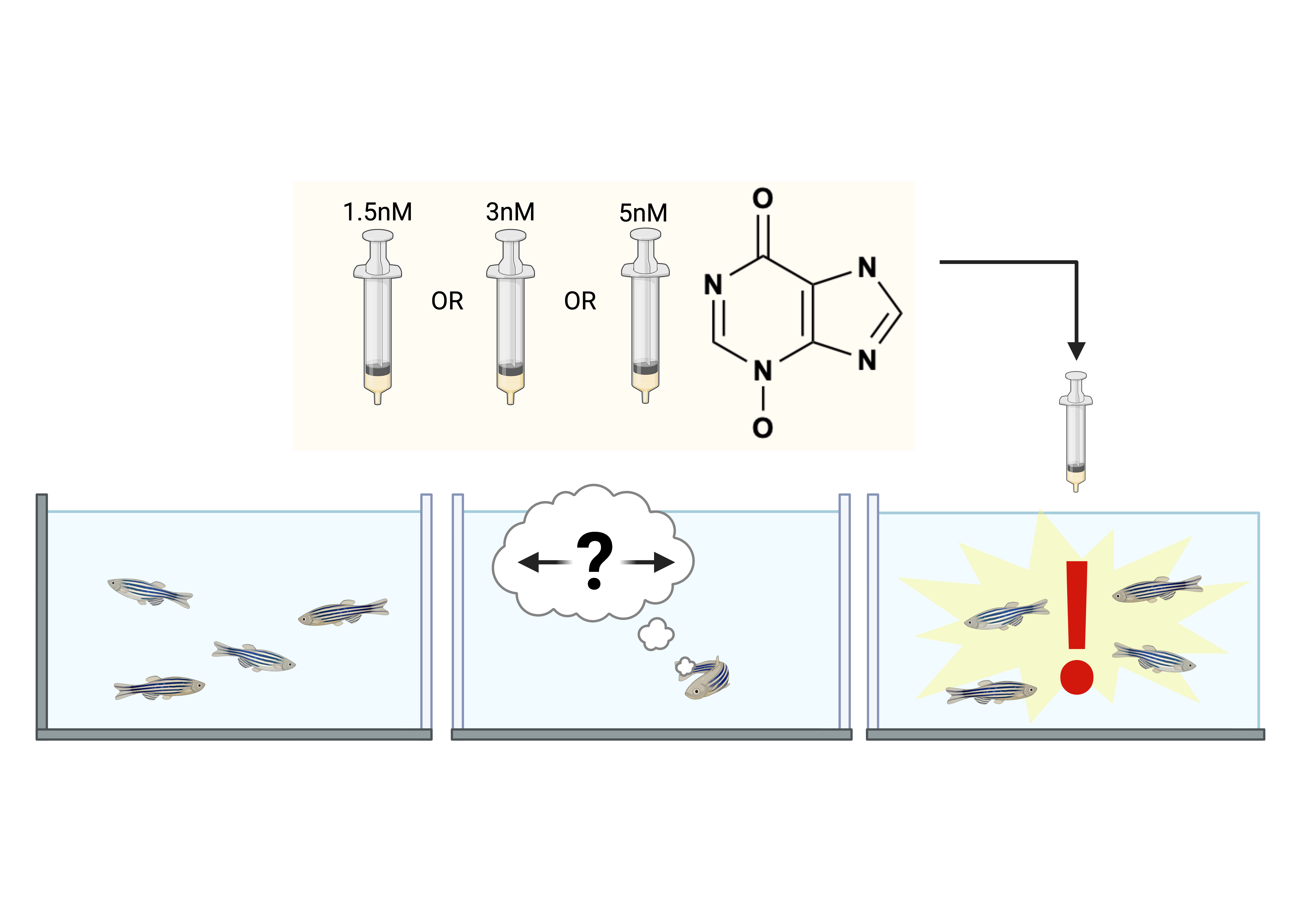
Predation risk is often communicated socially, allowing animals to use a combination of behavioral and chemical cues to assess environmental threats. Zebrafish, a highly social aquatic species, have been shown to exhibit anti-predation behaviors under exposure to the chemical cue hypoxanthine-3N-oxide (H3NO). While concentration-dependent anti-predation responses have been studied, it remains unclear how subjects behave when only visually exposed to shoals alarmed by different concentrations of H3NO. The present study examines whether zebrafish modify their social preference and anxiety-like responding while observing conspecifics exposed to varying H3NO concentrations. Adult male and female zebrafish performed a 3-chamber open-tank free-swim task with visual access to an unlarmed shoal on one side and a shoal exposed to 1.5 nM, 3 nM, or 5 nM H3NO on the other side. Male and female zebrafish exhibit similar behaviors and preference for the unalarmed shoals when exposed to 1.5 nM and 3 nM alarmed shoals. Interestingly, sex differences emerge when subjects are visually exposed to a shoal receiving 5 nM H3NO. At this concentration, males exhibit closer proximity to the alarmed shoal and greater locomotor activity compared to females, whereas females maintain their preference for the unalarmed shoal. These findings indicate that zebrafish can visually extract graded information about predation threat from conspecifics' alarm behavior and modify responding in a sexually dimorphic manner.
Keywords:
zebrafish
; alarm substance
; predation threat
; 3-chamber open-tank free-swim task
; shoaling
; social preference
Copyright: This open access article is published under a Creative Commons CC BY 4.0 license, which permit the free download, distribution, and reuse, provided that the author and preprint are cited in any reuse.