

Submitted:
01 October 2026
Posted:
02 October 2026
You are already at the latest version
Abstract
Orchard intensification has transformed fruit production through the combined adoption of higher planting densities, dwarfing rootstocks, localized irrigation/fertigation, and increasingly mechanized orchard management. While aboveground outcomes are well documented, belowground responses remain fragmented across species, orchard contexts, and measurement approaches. This systematic review synthesizes field-based evidence on how orchard intensification and its main operational drivers are associated with root system architecture (RSA) and root plasticity in fruit trees. Following systematic searching and study selection, we performed a narrative synthesis because heterogeneity in species, orchard age, intensification metrics, root assessment methods, and reported traits precluded robust quantitative meta-analysis. The reviewed evidence was more frequently structured around co-occurring drivers—particularly irrigation geometry, rootstock vigour, and soil physical constraints—than around planting density manipulations alone. Root distributions were often reported as predominantly shallow and spatially concentrated within managed zones, especially along tree rows under localized irrigation, with shifts in vertical and lateral allocation that appeared context-dependent. These responses varied with species, genotype, and pedoclimatic conditions, suggesting that intensification does not impose a single deterministic RSA outcome, but rather constrains the potential root zone volume, defined here as the soil volume theoretically available for root growth, within which root distribution may be plastically modulated. Overall, we propose an interpretative framework that may help organize the available evidence by distinguishing (i) the structural definition of an effective rooting domain under intensive management and (ii) plastic modulation of root distribution within that domain. The review also highlights a major evidence gap: the scarcity of factorial field experiments that isolate planting density from irrigation design, genotype, and soil physical constraints.
Keywords:
high-density orchards
; effective rooting domain
; fine-root distribution
; dwarfing rootstocks
; localized irrigation
; soil spatial heterogeneity
; root–soil interactions
; orchard management
1. Introduction
Over the past few decades, commercial orchard systems have undergone significant changes in their layout, management intensity, and the use of rootstocks [1,2,3,4]. Traditional low-density orchards, which feature wide spacing and less restricted root exploration, have gradually been replaced by intensive and super-intensive systems that use dwarfing rootstocks, narrow planting distances, localized irrigation and fertigation, and increasingly mechanized management practices [5]. These systems aim to maximize productivity per area, improve light capture, and speed up economic returns [2,6]. While considerable research has focused on canopy structure and aboveground productivity, the belowground impacts of orchard intensification across different species and management approaches have been less thoroughly summarized. Intensive orchard systems create a mix of structural and environmental factors that together alter the soil environment around roots. In semi humid Mediterranean climatic conditions, reduced spacing between trees can limit the soil volume available for each tree [7], while in very dry climates with long drought periods, localized irrigation results in specific wet zones and nutrient hotspots instead of even resource distribution [8]. Frequent machinery traffic generates spatial soil compaction gradients, particularly between row and inter-row positions [9,10,11,12]. Widespread use of size-controlling rootstocks also influences the roots’ natural growth potential and ability to explore the soil [13,14].
Together, these factors reshape the physical and resource environment in which root systems develop. Root system architecture (RSA) is inherently responsive to spatial heterogeneity in water, nutrients, and soil mechanical resistance [15,16,17]. In heterogeneous soils, roots typically proliferate preferentially in resource-rich patches and adjust branching density, elongation rates, and fine-root production accordingly [18,19]. However, root responses to environmental heterogeneity may differ depending on whether growth occurs in a relatively open soil or in a rooting space persistently structured by orchard management. In agronomic literature, the term RSA is often used broadly to describe root distribution patterns or density metrics, without consistent reference to its structural meaning [14,20,21]. In this review, we use RSA as an operational concept to describe the spatial configuration of the root system within the effective rooting domain, including vertical stratification, lateral extension along and across the tree row, and the depth framework within which roots are distributed.
By contrast, root plasticity is defined here as the dynamic and potentially reversible adjustment of root growth intensity, fine-root turnover, and localized proliferation in response to heterogeneous soil conditions [18,22,23].
Plastic responses are interpreted here as modulation of root distribution within an existing effective rooting domain, whereas architectural reorganization implies a more persistent modification of that domain. This distinction is critical when interpreting root responses under orchard intensification. Intensive systems may be associated either with changes in the structural rooting template through reduced soil availability and management-imposed boundary conditions, or primarily with localized plastic modulation driven by irrigation geometry and resource gradients [24,25,26,27,28]. Accordingly, root systems of fruit trees cultivated under intensive conditions do not necessarily represent simple scaled-down versions of those observed in lower-density orchards. Instead, intensification may be associated with shallower root distributions, spatial convergence between adjacent trees, modified horizontal expansion patterns, or altered fine-root turnover within localized management-driven domains [29,30,31]. Reduced spacing may also increase belowground interactions among neighbouring trees of the same species, including root overlap, competition for localized resources, and soil-mediated feedbacks, which can be further amplified in replanted orchards by residual roots, homospecific residues, soil-borne pathogens, and altered soil biological activity.
However, whether these patterns represent persistent architectural shifts or context-dependent plastic adjustments remains insufficiently clarified across species and production systems. Despite numerous field investigations, current knowledge remains fragmented across fruit species, orchard ages, pedological conditions, and management strategies. Many studies focus on individual drivers, such as irrigation regime, rootstock vigour, or soil management, without integrating observed responses within a broader intensification framework [32,33,34]. In particular, field studies rarely isolate planting density as an independent experimental factor, and root responses are more often investigated through operational drivers of intensification, especially irrigation geometry. As a result, the interpretation of recurring root patterns in intensive systems remains unresolved across species and production contexts. The objective of this systematic review is to synthesize field evidence on how orchard intensification, and its main operational drivers, are associated with root system architecture and root plasticity in fruit tree species. Specifically, we aim to (i) identify the principal drivers of belowground spatial structuring under orchard intensification, (ii) synthesize evidence on architectural and plastic root responses across species and management contexts, and (iii) evaluate whether recurring root patterns in intensive systems are more consistent with persistent shifts in the effective rooting domain or with plastic modulation of root distribution within that domain. The synthesis is organized into four major thematic areas: (1) root spatial occupation and competition in intensive orchards, including belowground interactions among neighbouring tree root systems, (2) localized irrigation and resource heterogeneity, (3) rootstock-mediated modulation of root spatial distribution, and (4) soil physical, chemical, and biological constraints, including replant-related limitations, as boundary conditions for root development (Figure 1).The introduction should briefly place the study in a broad context and highlight why it is important. It should define the purpose of the work and its significance. The current state of the research field should be carefully reviewed and key publications cited. Please highlight controversial and diverging hypotheses when necessary. Finally, briefly mention the main aim of the work and highlight the principal conclusions. As far as possible, please keep the introduction comprehensible to scientists outside your particular field of research. References should be numbered in order of appearance and indicated by a numeral or numerals in square brackets—e.g., [1] or [2,3], or [4,5,6]. See the end of the document for further details on references.
2. Methodology
2.1. Scope and Eligibility Framework
This systematic review was guided by a predefined eligibility framework. The review focused on field-grown fruit tree orchards exposed to orchard intensification, or to one or more of its main operational drivers, including reduced planting distance or increased tree density, dwarfing rootstocks, localized irrigation or fertigation geometry, and intensified soil or orchard-floor management. Studies were considered eligible when orchard intensification was explicitly described or clearly represented through one or more operational drivers within the study design or orchard context. Planting density was extracted whenever reported, but no universal density threshold was imposed a priori because the expression of intensification is species- and context-dependent. Eligibility was therefore based on the presence of a clearly interpretable intensification-related condition rather than on a fixed numerical threshold. Only field-based studies were included, whereas greenhouse, nursery, hydroponic, and container-based studies were excluded. Eligible studies were required to report quantitative root-related measurements relevant to root distribution, rooting pattern, root system size, or fine-root characteristics. These variables were later synthesized to support an interpretative discussion of RSA and root plasticity under orchard intensification.
2.2. Literature Search Strategy
A comprehensive literature search was conducted using the Web of Science Core Collection and Scopus databases. The search strategy combined three conceptual components: Orchard production context; Root system architecture and root-related traits; Orchard intensification drivers.
No initial restriction on publication year was applied. Database filters were applied to restrict results to English-language peer-reviewed research articles. Review articles and other non-primary publication types were excluded at the database search stage.
The search string was adapted to the syntax requirements of each database (e.g., TITLE-ABS-KEY for Scopus and TS for Web of Science). An example of the query used in Scopus is reported below:
TITLE-ABS-KEY((orchard* OR “fruit tree*”)AND(“root distribution” OR “root architecture” OR “root system” OR “root length density” OR RLD OR “fine root*” OR “specific root length”)AND(rootstock* OR dwarf* OR “high density” OR intensif* OR fertigation OR drip)).
Search results from both databases were exported to Zotero reference management software for further processing.
2.3. Screening and Selection Process
Screening was conducted by the first author and subsequently checked by a second researcher to ensure consistency in the application of the inclusion and exclusion criteria.
All retrieved records were imported into Zotero, where duplicate entries were identified and removed using the built-in duplicate detection tool and manually verified. Screening was conducted in three sequential stages:
- Title screening, to remove clearly irrelevant records;
- Abstract screening, to assess alignment with inclusion criteria;
- Full-text assessment, to confirm eligibility and suitability for data extraction.
Five additional records, identified through complementary literature searches in Scopus and Google Scholar and not retrieved by the main database search, were subsequently assessed using the same eligibility criteria and included in the final corpus.
2.4. Inclusion and Exclusion Criteria
Studies were included if they met all of the following criteria: Conducted in field-grown fruit tree orchards; Orchard intensification was explicitly described and/or contrasted through one or more drivers (e.g., planting configuration/spacing/density, dwarfing rootstocks, localized irrigation/fertigation geometry, or intensified soil and orchard-floor management); Reported at least one quantitative root-related metric relevant to RSA or spatial distribution (e.g., root length density, root biomass, rooting depth, fine-root traits), with spatial descriptors (e.g., depth, distance from trunk, row vs alley position) enabling inference on root distribution.
Studies were excluded if they: Were conducted exclusively in greenhouse, nursery, or container systems; Focused solely on aboveground traits without quantifying root metrics; Reported only pathological or disease incidence data without spatial or architectural root measurements; Investigated non-orchard production systems.
2.5. Data Extraction and Classification
For each included study, the following information was extracted: Species and rootstock; Planting density (trees ha−1); Orchard age at sampling; Intensification driver(s) investigated; Root metrics measured (e.g., RLD, biomass, depth distribution, fine-root traits); Sampling methodology (e.g., soil coring, trenching, excavation, minirhizotron); Relevant orchard-floor management information, when reported, including row and inter-row management, tillage, herbicide strips, grass cover, cover crops, mulching, or other soil-management practices.
Extracted studies were grouped into four thematic areas:
- Root spatial occupation and competition in intensive orchards;
- Localized irrigation and resource heterogeneity;
- Role of dwarfing rootstocks in modulating root spatial distribution;
- Soil physical, chemical, and biological constraints under intensive orchard systems.
Orchard-floor and weed-management practices were not consistently reported across all studies; therefore, when available, this information was considered qualitatively rather than used as a formal classification criterion for all included papers. Given the substantial heterogeneity among studies in species, orchard age, pedoclimatic context, intensification drivers, root sampling methodology, and reported outcome variables, a quantitative meta-analysis was not considered appropriate, and the evidence was synthesized narratively.
3. Results
3.1. Study Selection
The systematic search conducted in Web of Science and Scopus identified a total of 463 records (231 from Web of Science and 232 from Scopus). These records were obtained after applying database filters restricting results to English-language, peer-reviewed research articles and excluding review papers. Removal of duplicate database records led to the exclusion of 169 entries, resulting in 294 unique records subjected to title and abstract screening. Title and abstract screening led to the exclusion of 79 records, leaving 215 reports for full-text assessment. Of these, 181 were excluded because they did not meet the predefined inclusion criteria, specifically due to the absence of field conditions (n = 52), lack of quantitative root-related measurements (n = 93), or orchard systems not matching the intensification context/driver criteria (n = 36), resulting in 34 studies from the systematic database search. An additional five studies identified through complementary sources were assessed using the same eligibility criteria and included in the final corpus. Thus, a total of 39 studies satisfied the eligibility criteria and were included in the qualitative synthesis. The study selection process is illustrated in Figure 2. The main characteristics of the included studies are summarized in Table 1.
3.2. Limitations of the Evidence Base and Implications for Interpretation
The present review is constrained by substantial methodological heterogeneity among the included studies. Root assessment approaches vary widely (soil coring, trench mapping, full excavation, and minirhizotron methods), as do sampling depths, spatial resolution, and reporting units. This variability limits direct comparability and precludes robust quantitative synthesis. The distribution of evidence across intensification drivers is uneven. Irrigation-related contrasts are more frequently investigated than direct manipulations of planting density, which may accentuate the apparent dominance of hydrological geometry in shaping root spatial patterns. In many commercial orchards, intensification drivers co-occur, including high density, dwarfing rootstocks, localized fertigation, and traffic-induced compaction, making it difficult to attribute observed architectural patterns to single factors. Pedoclimatic conditions vary substantially among studies, encompassing contrasting soil textures, structural conditions, drainage regimes, climatic zones, and prior land-use histories. These environmental differences likely influence both the magnitude and direction of root responses, limiting generalization across species and production regions. Orchard age further contributes to variability, as root system expansion and spatial occupation evolve over time and reflect cumulative management effects. Most studies rely on snapshot measurements rather than long-term monitoring of root system development. Functional indicators and direct assessments of belowground competition remain comparatively limited, and spatial distribution patterns should therefore not be automatically equated with functional performance. Accordingly, the present review should be interpreted as a conceptual integration of field-based observations rather than a quantitative meta-analytical assessment. The framework proposed here highlights recurrent structural patterns and principal drivers reported in the literature, while acknowledging the constraints imposed by heterogeneity and limited factorial experimentation. Future multi-factorial, long-term field studies using standardized sampling protocols are required to disentangle the relative contributions of planting density, genotype, irrigation design, and soil structural conditions to root system architecture under orchard intensification.
3.3. Root Spatial Occupation and Competition in Intensive Orchards
Across the reviewed evidence, reduced planting distance can constrain the spatial occupation of individual root systems by decreasing the soil volume available per tree and increasing proximity among neighbouring root systems. However, direct experimental evidence isolating planting density or spacing from other co-occurring intensification drivers remains limited.
Spacing-driven intensification per se often tends to alter the magnitude and horizontal reach of root systems more than to induce a consistent vertical reorganization. However, where dominant management practices impose persistent resource gradients (notably localized irrigation/fertigation), shifts in vertical stratification can become more pronounced and repeatable. In pear, experimental reductions in in-row spacing decreased total root dry weight, cumulative root length, root volume, and lateral soil exploration area, with cultivar-dependent sensitivity, while maximum rooting depth and the overall vertical distribution profile remained broadly comparable among spacing treatments [35]. This suggests that, at least in the studied pome system, higher density may “scale down” the root system more than it consistently shifts rooting depth. A second recurrent finding is that intensification does not automatically translate into uniform occupation or saturation of the available soil volume.
In established eight-year-old intensive cherry orchards grafted on dwarfing rootstocks, root length density was strongly concentrated along the tree row and near the trunk, whereas inter-row zones remained comparatively poorly colonized [36]. This spatial heterogeneity suggests that, even when tree proximity increases, soil occupation can remain structurally uneven, with roots clustered in preferred zones rather than proportionally filling the available space. The extent of horizontal root expansion from the tree row towards the inter-row also appears to be species- and orchard-context dependent.
In super-high-density olive, intensification was associated with progressive occupation first of along-row space, and subsequently enhanced lateral expansion (towards the inter-row) [7], implying that reduced inter-tree distance can coincide with stronger horizontal colonization in some systems.
Similarly, in rain-fed high-density jujube plantations, comparisons among orchards of different ages (2, 6, 10 and 15 years) showed a progressive horizontal expansion and increasing overlap of fine roots among neighbouring trees, suggesting cumulative occupation of the available soil space during orchard development rather than a direct effect of planting density on rooting depth [37]. Taken together, the available evidence indicates that reduced spacing increases the proximity of neighbouring root systems and therefore the potential for belowground overlap. However, direct experimental evidence isolating spacing effects remains limited, and the realized spatial outcome—saturation, partial occupation, progressive overlap, or reduced individual root-system size—appears strongly species-, age-, and context-dependent.
Competition appears to be most evident when closer tree spacing is combined with management practices that concentrate roots and resources within the same soil zones, such as localized irrigation or fertigation, herbicide strips, and contrasting row–inter-row floor management. Under these conditions, a key organizing principle is whether co-occurring root systems resolve competition through spatial segregation or spatial overlap. Although this issue primarily concerns intraspecific competition among neighbouring trees, it can also extend to interspecific interactions where orchard-floor vegetation or intercrops share the same root zone. For example, in apple–legume intercropping, vertical niche segregation reduced direct root overlap but did not eliminate competitive effects, with outcomes depending on the identity of the intercrop species [38]. In peach-based systems, the degree of root overlap with companion species was directly associated with the intensity of suppression of peach vegetative growth, with species exhibiting lower overlap leaving a larger peach root distribution area [39]. These results support the view that management-driven co-occupation does not produce uniform outcomes, and that competitive intensity remains sensitive to the spatial foraging strategies of the interacting root systems.
Overall, the evidence suggests that orchard intensification shapes spatial occupation and competition through two complementary pathways: (i) spacing-driven compression, which increases proximity among neighbouring tree root systems and often reduces root system magnitude without a predictable vertical reorganization, and (ii) management-driven concentration of roots and resources within shared soil zones, particularly under localized irrigation or fertigation and contrasting row–inter-row floor management.
Across systems, the realized belowground outcome is therefore better interpreted not as a uniform “filling” of the available soil space, but as a context- and species-dependent balance among reduced individual root-system size, uneven occupation of preferred zones, progressive overlap during orchard development, and—where multiple species share the soil—niche segregation versus spatial overlap as determinants of competitive intensity.
Spacing-driven effects primarily operate at the architectural level by constraining the potential root zone volume, whereas the realized pattern of occupation within the resulting effective rooting domain reflects plastic modulation of root distribution in response to local resource availability, soil conditions, and orchard management. However, the extent to which neighbouring trees overlap or avoid each other belowground may also vary among species and rootstock combinations, potentially reflecting differences in sensitivity to intraspecific competition, autotoxic or allelopathic effects, and soil-mediated constraints.
3.4. Localized Irrigation and Resource Heterogeneity
Because the included studies involve different fruit tree species and cultivar–rootstock combinations, responses to localized irrigation should be interpreted in light of species-specific rooting habits and genotype-dependent constraints. Inherent differences in rooting depth, horizontal expansion towards the inter-row, sensitivity to neighbouring self-roots, and responsiveness to soil physical and chemical conditions may influence whether localized water supply promotes root overlap, spatial avoidance, or localized proliferation.
Localized irrigation systems appear to be a major source of belowground spatial heterogeneity in intensive orchards. Drip and subsurface drip irrigation tend to create discrete wetted soil volumes characterized by higher moisture availability and, in many cases, elevated nutrient availability relative to adjacent dry zones. This discontinuous distribution of resources can generate hydraulic and nutritional gradients that are frequently associated with spatially structured root proliferation and may, in some contexts, locally constrain the realized pattern of root occupation within an already bounded effective rooting domain. Evidence from apple orchards suggests that roots often concentrate within, or close to, the irrigated band under drip fertigation, with comparatively limited lateral expansion into non-irrigated zones [8]. However, the strength and repeatability of these irrigation-driven patterns should be interpreted in relation to pedoclimatic context. In very dry environments, where growing-season rainfall is limited and water inputs are largely controlled by irrigation, localized water supply may generate more stable and clearly detectable root distribution patterns. In Mediterranean or more variable climates, unpredictable rainfall events may partially disrupt irrigation-induced gradients, making root responses less consistent and more difficult to attribute solely to irrigation layout.
Similarly, in mature drip-irrigated apple systems, root distribution appears strongly aligned with the irrigation line, with greater root density in upper soil layers most directly influenced by water application [40,41]. Recent studies evaluating optimized localized or subsurface irrigation configurations further suggest that irrigation layout, frequency, and timing can modulate vertical distribution and root growth intensity, generally favoring development within the most consistently wetted portions of the soil profile [42,43].
Consistent with this interpretation, in apple–soybean alley-cropping systems, the combination of drip-line layout and soil-surface mulching created contrasting soil-moisture patterns, ranging from more uniform to more banded wetting. These differences were associated with shifts in root proliferation and depth partitioning between apple trees and soybean, suggesting that irrigation geometry and surface soil management can contribute to niche segregation in shared rooting environments [44].
Importantly, localized fertigation can also modify root placement by reinforcing nutrient gradients within the wetted zone. In camu-camu cultivation, under drip fertigation, intermediate nutrient supply promoted a more homogeneous distribution within the sampled profile compared with higher doses, while root proliferation remained spatially biased towards irrigated microsites, consistent with an irrigation–fertigation “resource template” that structures fine-root placement [45]. Comparable patterns have been reported in olive systems. Drip irrigation has been associated with a higher concentration of fine roots within the wetted strip and in close proximity to emitters, often with a predominantly shallow distribution [33]. In super-high-density olive orchards, the extent of the wetted soil volume appears to influence root spatial organization and vegetative performance, suggesting that irrigation geometry may contribute to shaping the realized pattern of root distribution within the effective rooting domain under highly intensified management [46]. In jujube orchards, long-term transition from flood irrigation to drip irrigation was associated with a redistribution of roots towards upper soil layers and reduced exploitation of deeper horizons, alongside improved water-use efficiency [29,47]. Together, these studies suggest that irrigation regime can influence not only total root magnitude but also vertical stratification in accordance with the depth and placement of water supply. High-resolution mapping studies further support the view that localized irrigation generates fine-scale patterns of root placement that track spatial variability in soil water status and, where relevant, salinity.
In a drip-irrigated nectarine orchard, plastic mulching increased soil water content and reduced salinity in the wetted zone, while mean root length density remained broadly similar between mulched and bare soils. Across treatments, roots were strongly concentrated in the upper soil layer and tended to occur preferentially in microsites with higher moisture and lower salinity, with evidence of reduced root proliferation above a salinity threshold [48]. In drip-irrigated citrus, fine-root distribution closely followed the moisture gradient, with a large fraction of root length concentrated within the drip-line strip and minimal rooting in mid-alley positions in the younger orchard, indicating that irrigation geometry can impose pronounced spatial confinement of roots to the wetted domain [49]. These findings are consistent with the interpretation that localized water delivery may create persistent “hotspots” of root activity while leaving substantial portions of the theoretically available soil volume relatively underexploited. Beyond drip systems, engineered water-harvesting and infiltration designs in rain-fed orchards similarly illustrate how spatial redistribution of water can restructure rooting patterns. In a hilly apple orchard on the Loess Plateau, a rainwater collection and infiltration system combined with an anti-seepage layer increased soil water storage and was associated with higher fine-root density across the profile, including deeper fine-root proliferation where water was retained above the impermeable layer, suggesting that hydrological design can shape root distribution in ways analogous to localized irrigation templates [50]. Under controlled water stress conditions, root distribution patterns likewise appear modulated by water availability. In super-high-density plum systems subjected to severe deficit during fruit maturation, changes in root dynamics and plant physiological responses were consistent with an important regulatory role of soil moisture in shaping root distribution within the effective rooting domain [51]. Studies employing partial or spatially asymmetric irrigation further suggest differentiated root responses between wet and dry soil sectors, with greater root production and activity occurring in hydraulically favored zones [52]. Although irrigation dose does not always significantly alter total root length, it may influence the dynamics of newly formed vital roots under specific conditions [28].
Across species and orchard configurations, the cumulative evidence suggests that root spatial distribution in intensive systems is closely associated with irrigation layout and wetted soil geometry, often resulting in uneven occupation of the theoretical soil volume available per tree.
Overall, localized irrigation appears to act primarily as a driver of spatial root responses consistent with plastic modulation within the potential root zone volume: roots tend to concentrate where water is consistently available, whereas maximum rooting depth and horizontal expansion towards the inter-row appear to remain constrained by broader architectural and environmental boundary conditions, including species, cultivar–rootstock combination, soil properties, and planting layout.
3.5. Role of Dwarfing Rootstocks in Modulating Root Spatial Distribution
The adoption of dwarfing rootstocks represents a central structural component of several intensive orchard systems. Across the reviewed evidence, dwarfing rootstocks appear to operate predominantly at the architectural level, often reducing the spatial extent and/or intensity of root occupation within the effective rooting domain, while the distribution of roots within that domain remains subject to plastic modulation driven by irrigation geometry and soil conditions. The available evidence further suggests that these effects are not uniform across species and are frequently filtered by management and pedological context. Evidence from pear, apple, and Prunus systems illustrates both the recurrence of this pattern and its context-dependence.
In intensive ‘Abbé Fétel’ orchards, rootstock genotype influenced root length density (RLD) and root distribution along the tree row and across depths, with responses partly interacting with pedological conditions [53]. The reported differences primarily concerned the intensity of fine-root colonization and vertical concentration, without consistent evidence for systematic differences in maximum rooting depth among rootstocks. A subsequent comparison between ‘Abbé Fétel’ grafted on BA29 and own-rooted ‘Williams’ suggested distinct rooting behavior, with BA29 showing reduced lateral and vertical exploration and stronger root concentration near the trunk, whereas the own-rooted plants exhibited a more uniform distribution within the explored zone; nevertheless, in both cases most root systems remained confined to upper soil layers, indicating a predominantly shallow rooting framework under intensive conditions [54]. Similarly, studies on Quince C in intensive systems described mainly superficial and spatially contained root distributions typical of dwarfing rootstocks, with limited deep penetration and marked fine-root concentration in the upper profile [19]. Evidence from apple systems is broadly consistent with the view that rootstock vigour is linked to root system size and allocation, while the expression of these differences may be contingent on spatial confinement and orchard context. In young apple trees, the less vigorous M.9 rootstock was associated with reduced root dry weight, total root length, and root surface area relative to more vigorous rootstocks (e.g., MM106), alongside differences in dry-matter allocation between above- and belowground components [55]. In the same study, root spread area did not fully saturate the allotted soil surface during the early establishment phase, suggesting that limited overlap among neighbouring root systems may reflect developmental stage and/or context-specific constraints rather than an active avoidance mechanism per se [55]. Consistent with limited early saturation, trench observations in six-year-old orchards on low-vigour rootstocks (apple on M9; plum on Saint Julien A) suggested strong root concentration near the trees and incomplete occupation of the inter-row soil space, with higher root density in tree rows than in inter-rows. The authors also reported no root avoidance behaviour when roots encountered those of neighbouring trees, suggesting that limited inter-row occupation may reflect management- and soil-mediated boundary conditions rather than active repulsion [56].
Complementary evidence from an organic-orchard context also suggests that rootstock can influence root distribution patterns, while RLD varies markedly along the soil profile, with distance from the trunk, and under contrasting orchard-floor management conditions (grass cover vs bare/herbicide strip). In some cases, grass cover increased RLD, and M9 showed relatively high RLD compared with expectations based solely on canopy size, suggesting a partial decoupling between aboveground vigour and belowground root density [57].
Across Prunus systems, several studies suggest that rootstocks may influence not only “how much” root is produced but also “where” it is placed, particularly with respect to lateral extension relative to the tree row and allocation with depth. In cherry and peach, comparisons among Prunus rootstocks indicated that differences can emerge in lateral spread (notably perpendicular to the row) and depth-dependent allocation, even when contrasts in total root mass are not always pronounced, consistent with rootstock-mediated redistribution rather than simple scaling of total root quantity [58]. Mapping-based evidence from a peach rootstock trial similarly suggested rootstock-specific differences in total and fine-root biomass and spatial allocation (including significant interactions with depth and sampling position), while root distributions remained strongly biased towards upper soil layers and within-row positions, implying that orchard-floor conditions can act as boundary constraints on the expression of rootstock traits [59]. In an established cherry orchard grafted on GiSelA5, roots were strongly concentrated near the trunk and along the row; the authors reported no “root avoidance” effect within the in-row soil volume between trees, yet the mid inter-row remained weakly colonized, suggesting that irrigation layout and/or physical constraints in the inter-row can limit lateral occupation independently of tree proximity [36]. Finally, evidence from grafted apple with a fixed dwarfing rootstock suggests that rootstock effects should not be interpreted in isolation from scion genotype and tree age. With M9 held constant, scion genotype was associated with differences in root number and diameter-class structure, and mapped rooting zones were largely confined to a relatively shallow and narrow domain in a high-density setting; root number also declined with tree age, consistent with ontogenetic modulation of the effective rooting system under intensive conditions [60]. Overall, the heterogeneous evidence across species suggests that dwarfing rootstocks often tend to reduce the spatial extent and/or intensity of root occupation and frequently concentrate roots within relatively shallow domains. However, the magnitude and direction of spatial effects (lateral spread, within-row confinement, depth allocation) do not appear uniform across studies and likely depend on interactions with management (orchard-floor vegetation, irrigation geometry, spacing), soil conditions, and the developmental stage or orchard age at the time of observation. Rootstock-mediated modulation should therefore be interpreted as one component of a broader set of boundary conditions that collectively define the effective rooting domain in intensive orchards.
3.6. Soil Physical and Chemical Constraints Under Intensive Orchard Systems
In intensive orchard systems, soil physical, chemical, and biological properties represent key structural factors regulating root spatial distribution. High management intensity, the localized concentration of inputs (water and nutrients) along the tree row, and repeated machinery traffic can generate pronounced heterogeneity between row and inter-row zones, creating pedological domains characterized by contrasting mechanical resistance, aeration, and resource availability. These gradients likely help define the effective rooting domain and can constrain both vertical penetration and lateral expansion of roots. In peach orchards, elevated compaction levels and unfavorable chemical conditions were associated with a reduction in root presence in deeper soil layers and with greater concentration of roots in superficial or less resistant horizons [32]. Under such conditions, the vertical configuration of the root system appears strongly governed by soil structural constraints. Similarly, in high-density peach orchards, physically restricted or structurally confined soil volumes were associated with marked limitations of both vertical and lateral root expansion, illustrating how mechanical constraints can strongly influence root system architecture [25]. Comparable evidence was reported in young high-density peach orchards where combined moderate deficit irrigation and grass competition at plantation did not promote compensatory deep root growth [61]. Despite the exclusion of tree roots from the upper 0–10 cm soil layer due to grass competition, total root biomass was strongly reduced and vertical penetration remained limited. Secondary vertical roots were only beginning to develop after two years, suggesting that structural and carbon-related constraints can override potential environmental stimuli for deeper rooting. Beyond mechanical resistance, soil structural quality and physical fertility can substantially influence root development. In intensive apple orchards, variation in bulk density, organic matter management, and overall soil structural status affected root biomass, fine-root proportion, and vertical distribution [62]. Improvements in soil physical conditions through organic amendments were associated with enhanced fine-root proliferation and, in some cases, greater exploration of deeper soil layers, highlighting the role of structural soil quality in modulating root distribution within the effective rooting domain. Chemical constraints can also shape the effective rooting domain by restricting proliferation in parts of the wetted soil volume. In a drip-irrigated nectarine orchard, fine roots were preferentially located in microsites with higher moisture and lower salinity, and analyses suggested that root proliferation declined above a salinity threshold; notably, plastic mulching reduced salinity and increased soil water content in the wetted zone but did not necessarily increase mean root length density, indicating that chemical constraints and microsite suitability can influence where roots are placed even when water supply is improved [48].
Biological interactions with orchard-floor vegetation may also contribute to spatially structuring tree-root distribution. In an apple–ryegrass intercropping system, intercropping reduced apple root length density relative to sole-cropped trees and resulted in vertical niche differentiation, with apple roots concentrated mainly at 20–40 cm depth and ryegrass roots predominantly in the upper 0–20 cm layer, indicating that belowground competition can modify root spatial occupation within the effective rooting domain [63].
Replant conditions introduce additional biological and chemical constraints. In orchards re-established along previously occupied tree rows, the accumulation of residual roots, persistence of soil-borne pathogens, and potential nutrient imbalances may reduce soil suitability for new root systems. In apple orchards affected by replant disease, pre-plant interventions such as fumigation, deep ripping, and compost incorporation modified root response and fine-root distribution in upper soil layers, demonstrating how biological and structural soil conditions can influence root development [64]. Reduced fine-root formation under replant conditions has likewise been associated with altered soil biological status and decreased root vigour [62]. Long-term intensive management can progressively alter soil properties and create new boundary conditions for root growth. Studies conducted in orchards subjected to prolonged localized irrigation have documented modifications in soil physical and chemical characteristics, including changes in structure, organic matter distribution, and nutrient dynamics [65]. As also noted in sections 3.3 and 3.5, inter-row undercolonization in cherry on GiSelA5 [36] is consistent with physical constraints and management-defined row–inter-row contrasts acting as boundary conditions independently of tree proximity. Overall, the available evidence suggests that in intensive orchard systems both intrinsic soil constraints and management-driven spatial heterogeneity—particularly the localized distribution of inputs along the tree row and the development of contrasting row–inter-row conditions—play a central role in shaping root spatial configuration. In many cases, these factors may substantially influence root depth and lateral distribution, thereby shaping the structural and functional limits within which plastic modulation of root distribution can be expressed. Soil constraints therefore act as primary determinants of the effective rooting domain, setting strong boundaries on depth and lateral extent that may not be fully overcome by plastic fine-root responses alone.
4. General Synthesis
This review suggests that root responses to orchard intensification can be interpreted more coherently by distinguishing two complementary levels: the definition of an effective rooting domain, i.e., the soil volume that is realistically accessible and functionally explored, and the plastic modulation of root distribution within that domain, driven by resource heterogeneity and local constraints. Because most field studies provide snapshot measurements, root plasticity in this review is often inferred from spatial patterns of fine-root proliferation rather than directly observed temporal dynamics. This framework should therefore be considered as an interpretative and heuristic synthesis of heterogeneous field evidence, rather than as a directly tested mechanistic separation between architectural and plastic responses. This distinction helps reconcile divergent findings across species and contexts and avoids interpreting any concentration of roots in managed zones as a persistent whole-system architectural reconfiguration. Taken together, the four thematic areas reviewed converge on a consistent picture. Different components of orchard intensification can constrain the potentially available soil space and reinforce row–inter-row contrasts, but their combined effects do not produce a uniform or deterministic root spatial outcome. Instead, the effective rooting domain is shaped by the interaction among planting geometry, rootstock, irrigation design, and soil physical and chemical conditions.
Within this effective rooting domain, observed patterns of fine-root distribution are consistent with plastic modulation in response to resource gradients, primarily those generated by localized irrigation and fertigation. The relative importance of each driver varies among species and orchard contexts, but their interaction appears more informative than any single factor considered in isolation.
Collectively, this review suggests that intensification primarily shapes an effective rooting domain through combinations of planting geometry, irrigation, rootstock, and soil constraints; within that domain, observed variation in the location and intensity of fine roots is consistent with plastic modulation of root distribution in response to resource opportunities. The key point is that both root system architecture and plastic modulation appear strongly species- and context-dependent. Going forward, the heterogeneity of available evidence supports the need for experimental designs that more clearly separate the effects of key drivers and adopt comparable spatial metrics, to better distinguish architectural domain shifts from intra-domain plastic modulation.
5. Conclusion
Field evidence suggests that orchard intensification can constrain the potential root zone volume through reduced planting distances and reinforce persistent spatial gradients through management practices. As planting density increases, horizontal space becomes progressively constrained, yet the resulting root configurations are strongly shaped by irrigation layout, soil physical conditions, and rootstock genotype. Because responses vary widely among species, soils, orchard ages, and methods, the current literature does not support a single deterministic RSA pattern attributable solely to intensification. Instead, intensification is better interpreted as a multidimensional process that shapes an effective rooting domain within which plastic modulation of root distribution occurs, contingent on genotype and pedo-hydrological context. Drivers frequently emphasized in the literature (localized irrigation, concentrated resource inputs, mechanical resistance) are not unique to intensive and high-density orchards, but their combined occurrence may contribute to increasingly structured belowground conditions under orchard intensification. The evidence base remains fragmented and appears unevenly distributed across the four thematic areas, with a substantial proportion of studies addressing irrigation-related contrasts. This underscores the need for factorial field experiments that disentangle planting density from genotype, irrigation design, and soil structural constraints. Overall, orchard intensification can be understood as a process that constrains the potential root zone volume and shapes an effective rooting domain, within which root system architecture is influenced by structural boundary conditions and root distribution is plastically modulated by local resource gradients.
Author Contributions
Conceptualization, data extraction, data synthesis, and original draft preparation, F.D.A.; literature screening and study selection, F.D.A. and V.G.; critical revision and overall supervision, D.N. All authors have read and agreed to the published version of the manuscript.
Funding
This research received no external funding.
Data Availability Statement
No new data were produced in preparing this manuscript.
Conflicts of Interest
The authors declare no conflicts of interest.
Declaration of AI-assisted technologies
AI-assisted tools were used to refine English language and technical wording. The manuscript was thoroughly reviewed and edited by the author, who takes full responsibility for its content.
References
- Abobatta, W.F. Intensive Fruit Orchards Cultivation. J. Plant Sci. Phytopathol. 2021, 5, 072–075. [Google Scholar] [CrossRef]
- Robinson, T.L.; Lakso, A.N.; Ren, Z. Modifying Apple Tree Canopies for Improved Production Efficiency. HortScience 1991, 26, 1005–1012. [Google Scholar] [CrossRef]
- Muhie, S.H.; Wodajo, S.T.; Seid, J.H.; Mekashaw, M. Optimizing Orchard Productivity: A Comparative Analysis of High-Density and Conventional Planting Systems. Appl. Fruit Sci. 2026, 68. [Google Scholar] [CrossRef]
- Musacchi, S.; Iglesias, I.; Neri, D. Training Systems and Sustainable Orchard Management for European Pear (Pyrus Communis l.) in the Mediterranean Area: A Review. Agronomy 2021, 11. [Google Scholar] [CrossRef]
- Scalisi, A.; O’Connell, M.G.; Stefanelli, D.; Zhou, S.; Pitt, T.; Graetz, D.; Dodds, K.; Han, L.; De Bei, R.; Stanley, J.; et al. Narrow Orchard Systems for Pome and Stone Fruit—a Review. Sci. Hortic. 2024, 338, 113815. [Google Scholar] [CrossRef]
- Elkins, R.B.; Dejong, T.M.; Klonsky, K.; Demoura, R. Economic Evaluation of High Density versus Standard Orchard Configurations; Case Study Using Performance Data for “Golden Russet Bosc” Pears. Acta Hortic. 2008, 800, 739–746. [Google Scholar] [CrossRef]
- Lodolini, E.M.; Giorgi, V.; de Iudicibus, A.; Lucchese, P.G.; Zucchini, M.; Crescenzi, S.; Pacella, M.; Mezrioui, K.; Neri, D. Root Topography in High-Density Olive Orchards. Acta Hortic. 2026, 1446, 199–204. [Google Scholar] [CrossRef]
- Neilsen, G.H.; Parchomchuk, P.; Neilsen, D.; Zebarth, B.J.; Neilsen, P. Drip-Fertigation of Apple Trees Affects Root Distribution and Development of K Deficiency. Can. J. Plant Sci. 2000, 80, 353–361. [Google Scholar] [CrossRef]
- Tolón-Becerra, A.; Botta, G.F.; Lastra-Bravo, X.; Tourn, M.; Rivero, D. Subsoil Compaction from Tractor Traffic in an Olive (Olea Europea L.) Grove in Almería, Spain. Soil Use Manag. 2012, 28, 606–613. [Google Scholar] [CrossRef]
- Singh, J.; Salaria, A.; Kaul, A. Impact of Soil Compaction on Soil Physical Properties and Root Growth: A Review. Int. J. Food Agric. Vet. Sci. 2015, 5, 23–32. [Google Scholar]
- Van Dijck, S.J.E.; Van Asch, T.W.J. Compaction of Loamy Soils Due to Tractor Traffic in Vineyards and Orchards and Its Effect on Infiltration in Southern France. Soil Tillage Res. 2002, 63, 141–153. [Google Scholar] [CrossRef]
- Tolón-Becerra, A.; Botta, G.F.; Bravo, X.L.; Tourn, M.; Melcon, F.B.; Vazquez, J.; Rivero, D.; Linares, P.; Nardon, G. Soil Compaction Distribution under Tractor Traffic in Almond (Prunus Amigdalus L.) Orchard in Almería España. Soil Tillage Res. 2010, 107, 49–56. [Google Scholar] [CrossRef]
- An, H.; Luo, F.; Wu, T.; Wang, Y.; Xu, X.; Zhang, X.; Han, Z. Dwarfing Effect of Apple Rootstocks Is Intimately Associated with Low Number of Fine Roots. HortScience 2017, 52, 503–512. [Google Scholar] [CrossRef]
- Zhang, Z.; Li, M.; Yao, J.; Zhou, Y.; Wang, Y.; Zhang, X.; Li, W.; Wu, T.; Han, Z.; Xu, X.; et al. Root Architecture Characteristics of Differing Size-Controlling Rootstocks and the Influence on the Growth of ‘Red Fuji’ Apple Trees. Sci. Hortic. 2021, 281, 109959. [Google Scholar] [CrossRef]
- Khan, M.A.; Gemenet, D.C.; Villordon, A. Root System Architecture and Abiotic Stress Tolerance: Current Knowledge in Root and Tuber Crops. Front. Plant Sci. 2016, 7, 1584. [Google Scholar] [CrossRef] [PubMed]
- Ranjan, A.; Sinha, R.; Singla-Pareek, S.L.; Pareek, A.; Singh, A.K. Shaping the Root System Architecture in Plants for Adaptation to Drought Stress. Physiol. Plant. 2022, 174, 13651. [Google Scholar] [CrossRef] [PubMed]
- Zhang, Z.; Fan, B.; Song, C.; Zhang, X.; Zhao, Q.; Ye, B. Advances in Root System Architecture: Functionality, Plasticity, and Research Methods. J. Resour. Ecol. 2023, 14, 15–24. [Google Scholar] [CrossRef]
- Hodge, A. The Plastic Plant: Root Responses to Heterogeneous Supplies of Nutrients. New Phytol. 2004, 162, 9–24. [Google Scholar] [CrossRef]
- Quartieri, M.; Castellani, G.; Tagliavini, M.; Baldi, E.; Marangoni, B. Fine Roots Growth and Longevity in a High-Density Pear Orchard on Quince C Rootstock as Affected by Nitrogen Supply. Acta Hortic. 2010, 868, 149–154. [Google Scholar] [CrossRef]
- Ciobanu, A.; Paraschivu, M.; Cotuna, O. Root System Architecture in “Vâlcean” Variety (Prunus Domestica L.) Depending on Rootstocks and Trunk. Horticulture 2022, 66, 40–47. [Google Scholar]
- Lynch, J. Root Architecture and Plant Productivity. Plant Physiol. 1995, 109, 7–13. [Google Scholar] [CrossRef] [PubMed]
- Karlova, R.; Boer, D.; Hayes, S.; Testerink, C. Root Plasticity under Abiotic Stress. Plant Physiol. 2021, 187, 1057–1070. [Google Scholar] [CrossRef] [PubMed]
- Yetgin, A. Exploring the Dynamic Nature of Root Plasticity and Morphology in the Face of Changing Environments. Ecol. Front. 2023, 44, 112–119. [Google Scholar] [CrossRef]
- Bengough, A.G.; McKenzie, B.M.; Hallett, P.D.; Valentine, T.A. Root Elongation, Water Stress, and Mechanical Impedance: A Review of Limiting Stresses and Beneficial Root Tip Traits. J. Exp. Bot. 2011, 62, 59–68. [Google Scholar] [CrossRef] [PubMed]
- Williamson, J.G.; Coston, D.C.; Cornell, J.A. Root Restriction Affects Shoot Development of Peach in a High-Density Orchard. J. Am. Soc. Hortic. Sci. 1992, 117, 362–367. [Google Scholar] [CrossRef]
- Li, Y.; Gong, P.; He, X.; Liu, H.; Li, Z.; Li, L.; Wang, C.; Xu, Q.; Chen, Q.; Wei, J.; et al. Simulating Water and Salt Changes in the Root Zone of Salt–Alkali Fragrant Pear and the Selection of the Optimal Surface Drip Irrigation Mode. Front. Plant Sci. 2024, 15, 1455188. [Google Scholar] [CrossRef] [PubMed]
- Srivastava, A.K.; Malhotra, S.K. Nutrient Use Efficiency in Perennial Fruit Crops—A Review. J. Plant Nutr. 2017, 40, 1928–1953. [Google Scholar] [CrossRef]
- Svoboda, P.; Haberle, J.; Moulik, M.; Raimanová, I.; Kurešová, G.; Mészáros, M. The Effect of Drip Irrigation on the Length and Distribution of Apple Tree Roots. Horticulturae 2023, 9, 405. [Google Scholar] [CrossRef]
- Li, Z.; Zong, R.; Wang, T.; Wang, Z.; Zhang, J. Adapting Root Distribution and Improving Water Use Efficiency via Drip Irrigation in a Jujube (Zizyphus Jujube Mill.) Orchard after Long-Term Flood Irrigation. Agriculture 2021, 11, 1184. [Google Scholar] [CrossRef]
- Ruiz-Sánchez, M.C.; Plana, V.; Ortuño, M.F.; Tapia, L.M.; Abrisqueta, J.M. Spatial Root Distribution of Apricot Trees in Different Soil Tillage Practices. Plant Soil 2005, 272, 211–221. [Google Scholar] [CrossRef]
- Song, X.; Gao, X.; Zhao, X.; Wu, P.; Dyck, M. Spatial Distribution of Soil Moisture and Fine Roots in Rain-Fed Apple Orchards Employing a Rainwater Collection and Infiltration (RWCI) System on the Loess Plateau of China. Agric. Water Manag. 2017, 184, 170–177. [Google Scholar] [CrossRef]
- Petry, H.B.; Mazurana, M.; Marodin, G.A.B.; Levien, R.; Anghinoni, I.; Gianello, C.; Schwarz, S.F. Root Distribution of Peach Rootstocks Affected by Soil Compaction and Acidity. Rev. Bras. Cienc. Solo 2016, 40, 0150135. [Google Scholar] [CrossRef]
- Deng, S.; Yin, Q.; Zhang, S.; Shi, K.; Jia, Z.; Ma, L. Drip Irrigation Affects the Morphology and Distribution of Olive Roots. HortScience 2017, 52, 1298–1306. [Google Scholar] [CrossRef]
- Hou, C.; Ma, L.; Luo, F.; Wang, Y.; Zhang, X.; Han, Z. Impact of Rootstock and Interstems on Fine Root Survivorship and Seasonal Variation in Apple. Sci. Hortic. 2012, 148, 169–176. [Google Scholar] [CrossRef]
- Policarpo, M.; Talluto, G.; Lo Bianco, R. Vegetative and Productive Responses of “Conference” and “Williams” Pear Trees Planted at Different in-Row Spacings. Sci. Hortic. 2006, 109, 322–331. [Google Scholar] [CrossRef]
- Paltineanu, C.; Nicolae, S.; Militaru, M.; Butac, M.; Chitu, E.; Tanasescu, N.; Calinescu, M.; Coman, R. Spatial Distribution of Roots in Medium-Textured Soils in the Case of Cherry Trees Grafted on Gi Sel A5 Rootstock. Sci. Hortic. 2017, 217, 48–54. [Google Scholar] [CrossRef]
- Li, L.; Gao, X.; Wu, P.; Zhao, X.; Li, H.; Ling, Q.; Sun, W. Soil Water Content and Root Patterns in a Rain-Fed Jujube Plantation across Stand Ages on the Loess Plateau of China. Land Degrad. Dev. 2017, 28, 207–216. [Google Scholar] [CrossRef]
- Wei, W.; Liu, T.; Li, Z.; Shen, L.; Li, L.; Zhang, W. Niche Isolation in Apple/Soybean Intercropping More Effectively Alleviates Interspecific Competition Compared to Apple/Alfalfa Intercropping. Field Crops Res. 2026, 339, 110349. [Google Scholar] [CrossRef]
- Muñoz-Ruiz, E.; Santiago-Mejía, H.; Ronquillo-Cedillo, I.; Albino-Garduño, R.; Cortés-Flores, J.I.; Grossman, J. Vegetative Growth of Peach Trees (Prunus Persica L. Batsch) Associated with Native Squash (Cucurbita Pepo. Pepo L.) and Baycote (Phaseolus Coccineus L.) in Milpa Intercropped with Fruit Trees (MIAF) Systems. Agrociencia 2024, 58, 3071. [Google Scholar] [CrossRef]
- Sokalska, D.I.; Haman, D.Z.; Szewczuk, A.; Sobota, J.; Dereń, D. Spatial Root Distribution of Mature Apple Trees under Drip Irrigation System. Agric. Water Manag. 2009, 96, 917–924. [Google Scholar] [CrossRef]
- Watson, W.T.; Appel, D.N.; Arnold, M.A.; Kenerley, C.M. Spatial Distribution of Malus Root Systems in Irrigated, Trellised Orchards. J. Hortic. Sci. Biotechnol. 2006, 81, 745–753. [Google Scholar] [CrossRef]
- Ning, S.; Cai, Y.; Guo, Z.; Liu, K.; Wen, M.; Lu, J.; Liu, B.; Gao, X.; Zhao, X. Optimizing Surge-Root Irrigation Parameters to Enhance Apple Yield and Water Productivity in Arid Regions. Agric. Water Manag. 2025, 319, 109828. [Google Scholar] [CrossRef]
- Liu, J.; Gao, X.; Song, J.; Wen, M.; Wang, J.; Cai, Y.; Zhao, X. Subsurface Drip Irrigation Mitigated Greenhouse Gas Emission and Improved Root Growth and Yield in Apple in Semi-Arid Region. Agric. Water Manag. 2025, 308, 109290. [Google Scholar] [CrossRef]
- Chen, L.; Wang, R.; Xiao, W.; Wang, L. Optimizing Irrigation and Mulching Strategies to Improve Root–Water Relations, Water Use Efficiency, and Yield in Apple–Soybean Alley Cropping Systems on the Loess Plateau, China. Eur. J. Agron. 2025, 168, 127586. [Google Scholar] [CrossRef]
- Melo, V.F.; Chagas, E.A.; Siqueira, R.H. da S.; de Souza, O.M.; de Almeida, L.F.P.; Rossoni, D.F.; Chagas, P.C.; Abanto-Rodríguez, C. Camu-Camu Root Distribution under Different Nitrogen and Potassium Doses through Drip Fertigation. HortScience 2019, 54, 743–748. [Google Scholar] [CrossRef]
- Fernandes, R.D.M.; Egea, G.; Hernandez-Santana, V.; Diaz-Espejo, A.; Fernández, J.E.; Perez-Martin, A.; Cuevas, M. V. Response of Vegetative and Fruit Growth to the Soil Volume Wetted by Irrigation in a Super-High-Density Olive Orchard. Agric. Water Manag. 2021, 258, 107197. [Google Scholar] [CrossRef]
- Liu, H.G.; He, X.L.; Li, J.; Li, F.D.; Gong, P.; Zhang, J.; Yang, G. Effects of Water-Fertilizer Coupling on Root Distribution and Yield of Chinese Jujube Trees in Xinjiang. Int. J. Agric. Biol. Eng. 2017, 10, 103–114. [Google Scholar] [CrossRef]
- Zribi, W.; Faci, J.M.; Medina, E.T.; Aragues, R. Spatial Distribution of Soil Water Content, Soil Salinity and Root Length Density in a Drip Irrigated Nectarine Orchard under Plastic-Mulched and Bare Soils. J. Agric. Sci. Technol. 2017, 19, 1577–1588. [Google Scholar]
- González-Real, M.M.; Egea, G.; Martin-Gorriz, B.; Nortes, P.A.; Baille, A. Spatial Variability of Soil CO2 Efflux in Drip-Irrigated Old and Young Citrus Orchards and Its Dependence on Biotic and Abiotic Factors. Geoderma 2017, 294, 29–37. [Google Scholar] [CrossRef]
- Guo, F.X.; Wang, Y.P.; Hou, T.T.; Zhang, L. Sen; Mu, Y.; Wu, F. yong Variation of Soil Moisture and Fine Roots Distribution Adopts Rainwater Collection, Infiltration Promoting and Soil Anti-Seepage System (RCIP-SA) in Hilly Apple Orchard on the Loess Plateau of China. Agric. Water Manag. 2021, 244, 106573. [Google Scholar] [CrossRef]
- Calderón-Orellana, A.; Plaza-Rojas, G.; Gerding, M.; Huepe, G.; Kuschel-Otárola, M.; Bastías, R.M.; Alvear, T.; Olivos, A.; Calderón-Orellana, M. Productive, Physiological, and Soil Microbiological Responses to Severe Water Stress During Fruit Maturity in a Super High-Density European Plum Orchard. Plants 2025, 14, 1222. [Google Scholar] [CrossRef] [PubMed]
- Eissenstat, D.M.; Neilsen, D.; Neilsen, G.H.; Adams, T.S. Above-and Belowground Responses to Shifts in Soil Moisture in Bearing Apple Trees. HortScience 2018, 53, 1500–1506. [Google Scholar] [CrossRef]
- Giorgi, V.; Guizzardi, M.; Dradi, D.; Crescenzi, S.; Monaci, E.; Chiari, G.; Anconelli, S.; Bortolotti, P.P.; Nannini, R.; Casoli, L.; et al. Root Architecture Affected by Pear Degeneration in Relation to Rootstock and Soil Characteristics. Acta Hortic. 2024, 1403, 229–236. [Google Scholar] [CrossRef]
- Giorgi, V.; Lodolini, E.M.; De Angelis, F.; Mezrioui, K.; Aldini, A.; Biondi, M.; Neri, D. Root Distribution in Fruit Orchards with Conservative Soil Management. Acta Hortic. 2025, 1427, 157–161. [Google Scholar] [CrossRef]
- Lo Bianco, R.; Policarpo, M.; Scariano, L. Effects of Rootstock Vigour and In-Row Spacing on Stem and Root Growth, Conformation and Dry-Matter Distribution of Young Apple Trees. J. Hortic. Sci. Biotechnol. 2003, 78, 828–836. [Google Scholar] [CrossRef]
- Paltineanu, C.; Nicolae, S.; Tanasescu, N.; Chitu, E.; Ancu, S. Investigating Root Density of Plum and Apple Trees Grafted on Low-Vigor Rootstocks to Improve Orchard Management. Erwerbs-Obstbau 2017, 59, 29–37. [Google Scholar] [CrossRef]
- Atkinson, D. Apple Root Systems for Organic Orchards: What Might Be the Contribution of the Rootstock? Acta Hortic. 2018, 1217, 285–292. [Google Scholar] [CrossRef]
- Black, B.L.; Drost, D.; Lindstrom, T.; Reeve, J.; Gunnell, J.; Reighard, G.L. A Comparison of Root Distribution Patterns Among Prunus Rootstocks. J. Am. Pomol. Soc. 2010, 64, 52–62. [Google Scholar] [CrossRef]
- Black, B.L.; Drost, D.; Lindstrom, T.; Reighard, G.L. Sampling to Compare Relative Root Distribution in Fruit Trees. Acta Hortic. 2011, 903, 949–953. [Google Scholar] [CrossRef]
- Thomaj, F.; Kullaj, E. Scion Genotype Controls Biomass Allocation and Root Development in Grafted Apple. Acta Hortic. 2019, 1261, 93–98. [Google Scholar] [CrossRef]
- Forey, O.; Temani, F.; Wery, J.; Jourdan, C.; Metay, A. Effect of Combined Deficit Irrigation and Grass Competition at Plantation on Peach Tree Root Distribution. Eur. J. Agron. 2017, 91, 16–24. [Google Scholar] [CrossRef]
- Polverigiani, S.; Franzina, M.; Neri, D. Effect of Soil Condition on Apple Root Development and Plant Resilience in Intensive Orchards. Appl. Soil Ecol. 2018, 123, 787–792. [Google Scholar] [CrossRef]
- Wei, W.; Liu, T.; Zhang, S.; Shen, L.; Wang, X.; Li, L.; Zhu, Y.; Zhang, W. Root Spatial Distribution and Belowground Competition in an Apple/Ryegrass Agroforestry System. Agric. Syst. 2024, 215, 103869. [Google Scholar] [CrossRef]
- Braun, P.G.; Fuller, K.D.; McRae, K.; Fillmore, S.A.E. Response of “Honeycrisp” Apple Trees to Combinations of Pre-Plant Fumigation, Deep Ripping, and Hog Manure Compost Incorporation in a Soil with Replant Disease. HortScience 2010, 45, 1702–1707. [Google Scholar] [CrossRef]
- Fomenko, T.G.; Popova, V.P.; Chernikov, E.A.; Makarova, A.A.; Yaroshenko, O. V. Effect of Long-Term Drip Irrigation of Fruit Orchard on the Transformation of Properties of Chernozems. Eurasian Soil Sci. 2022, 55, 1266–1277. [Google Scholar] [CrossRef]
Figure 1.
Conceptual framework of the main orchard intensification drivers considered in this review and their expected effects on fruit tree root system architecture and plasticity. This figure was created using Biorender.com (https://www.biorender.com/).
Figure 1.
Conceptual framework of the main orchard intensification drivers considered in this review and their expected effects on fruit tree root system architecture and plasticity. This figure was created using Biorender.com (https://www.biorender.com/).
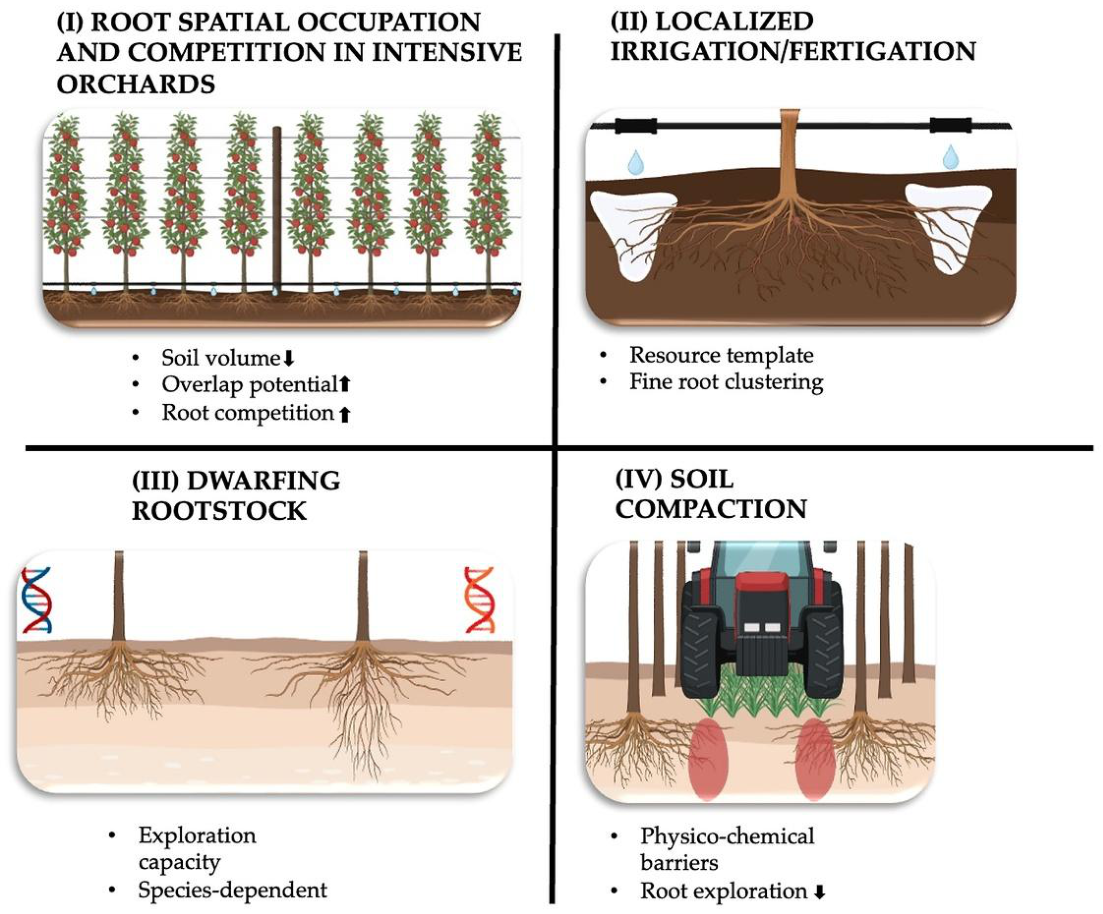
Figure 2.
Flow diagram of the literature search and study selection process, from identification to final inclusion (39 studies).
Figure 2.
Flow diagram of the literature search and study selection process, from identification to final inclusion (39 studies).
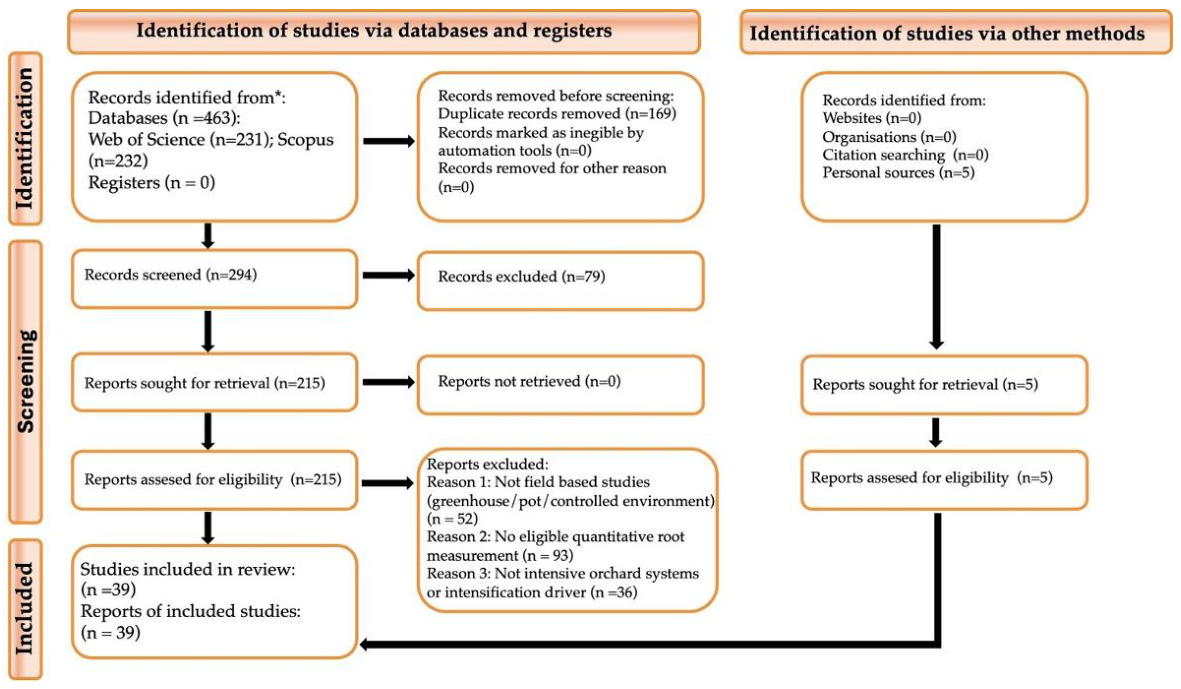

Table 1.
Summary of the main characteristics of the 39 studies included in the qualitative synthesis, including species, orchard age, planting density, and root assessment methodology and thematic areas.
Table 1.
Summary of the main characteristics of the 39 studies included in the qualitative synthesis, including species, orchard age, planting density, and root assessment methodology and thematic areas.
| Author | Species | Orchard age | Planting density | Study Method | Thematic Areas |
|---|---|---|---|---|---|
| Atkinson 2018 | Malus domestica | 11 years | 625 trees/ha | Minirhizotron, soil monoliths | Rootstock modulation |
| Black et al., 2010 |
Prunus cerasus and Prunus persica |
Cherry 10 years Peach 5 years |
Cherry 370 trees/ha Peach 333 trees/ha |
Soil coring | Rootstock modulation |
| Black et al., 2011 | Prunus persica | 5 years | 333 trees/ha | Soil coring | Rootstock modulation |
| Braun et al., 2010 | Malus domestica | 3 years | 1323 trees/ha | Soil trench | Soil Constraints |
| Calderón-Orellana et al., 2025 | Prunus domestica | 6 and 8 years | 1905 trees/ha | Soil trench | Irrigation/Resource heterogeneity |
| Chen et al., 2025 | Malus domestica | 6 years | 400 trees/ha | Soil coring | Irrigation/Resource heterogeneity |
| Deng et al., 2017 | Olea europaea | 3 years | 1111 trees/ha | Soil coring | Irrigation/Resource heterogeneity |
| Eissenstat et al., 2018 | Malus domestica | 21 years | 3333 trees/ha | Soil coring and minirhizotron | Irrigation/Resource heterogeneity |
| Fernandes et al., 2021 | Olea europaea | 10 years | 1667 trees/ha | Soil coring | Irrigation/Resource heterogeneity |
| Fomenko et al., 2022 | Malus domestica | 1 and 5 years | 2500 trees/ha | Pit-wall root mapping , soil coring, 2D soil ion modelling |
Soil Constraints |
| Forey et al., 2017 | Prunus persica | 2 years | 2375 trees/ha | Full root excavation | Soil Constraints |
| Giorgi et al., 2024 | Pyrus communis | From 4 to 18 years | >1000 trees/ha | Soil coring | Rootstock modulation |
| Giorgi et al., 2025 | Pyrus communis | 12 years | 1250 trees/ha | Soil coring | Rootstock modulation |
| González-Real et al., 2017 | Citrus sinensis | 12 years and 32 years | From 416 to 740 trees/ha |
Soil coring | Irrigation/Resource heterogeneity |
| Guo et al., 2021 | Malus domestica | 11 years | 833 trees/ha | Shovel | Irrigation/Resource heterogeneity |
| Li et al., 2017 | Ziziphus jujube | 7, 13 and 19 years | 1666 trees/ha | Soil coring | Spatial occupation |
| Li et al., 2021 | Ziziphus jujube | 11 years | 6253 trees/ha | Soil coring | Irrigation/Resource heterogeneity |
| Liu et al., 2017 | Ziziphus jujuba | 13 years | 1000 trees/ha | Soil coring | Irrigation/Resource heterogeneity |
| Liu et al., 2025 | Malus domestica | 6 years | 1666 trees/ha | Soil coring | Irrigation/Resource heterogeneity |
| Lo Bianco et al., 2003 | Malus domestica | 3 years | From 2857 to 5714 trees/ha |
Full root excavation | Rootstock modulation |
| Lodolini et al., 2026 | Olea europaea | 2 and 10 years | 1250 trees/ha | Soil coring | Spatial occupation |
| Melo et al., 2019 | Myrciaria dubia | 2 years | 2500 trees/ha | Soil trench | Irrigation/Resource heterogeneity |
| Muñoz-Ruiz et al., 2024 | Prunus persica | 1 year | 694 trees/ha | Soil trench | Spatial occupation |
| Neilsen et al., 2000 | Malus domestica | 8 and 5 years | 1250 and 1667 trees/ha | Soil trench | Irrigation/Resource heterogeneity |
| Ning et al., 2025 | Malus domestica | 6 years | 1667 trees/ha | Soil coring | Irrigation/Resource heterogeneity |
| Paltineanu et al., 2017a | Prunus domestica and Malus domestica | 6 years | 1136 trees/ha (plum), 2381 trees/ha (apple) |
Soil trench | Rootstock modulation |
| Paltineanu et al., 2017b | Prunus avium | 8 years | 1250 trees/ha | Soil trench | Spatial occupation Rootstock modulation Soil Constraints |
| Petry et al., 2016 | Prunus persica | 7 years | 1212 trees/ha | Soil coring | Soil Constraints |
| Policarpo et al., 2006 | Pyrus communis | 4 years | From 2000 to 3333 trees/ha |
Full root excavation | Spatial occupation |
| Polverigiani et al., 2018 | Malus domestica | 1 year | 2800 trees/ha | Soil coring | Soil Constraints |
| Quartieri et al., 2010 | Pyrus communis | 2 years | 2924 trees/ha | Minirhizotron | Rootstock modulation |
| Sokalska et al., 2009 | Malus domestica | 12 years | 2381 trees/ha | Soil trench | Irrigation/Resource heterogeneity |
| Svoboda et al., 2023 | Malus domestica | 7 years | 2381 trees/ha | Soil coring | Irrigation/Resource heterogeneity |
| Thomaj & Kullaj, 2019 | Malus domestica | 9 and 14 years | 2020 trees/ha | Soil trench | Rootstock modulation |
| Watson et al., 2006 | Malus domestica | From 1 to 3 years | From 918 to 1543 trees/ha |
Soil coring | Irrigation/Resource heterogeneity |
| Wei et al., 2024 | Malus domestica | 3 years | 2500 trees/ha | Soil coring | Soil Constraints |
| Wei et al., 2026 | Malus domestica | 3 years | 833 trees/ha | Soil coring | Spatial occupation |
| Williamson et al., 1992 | Prunus persica | 3 years | 5000 trees/ha | Soil trench | Soil Constraints |
| Zribi et al., 2017 | Prunus persica | 6 years | 833 trees/ha | Soil coring | Irrigation/Resource heterogeneity Soil Constraints |
Disclaimer/Publisher’s Note: The statements, opinions and data contained in all publications are solely those of the individual author(s) and contributor(s) and not of MDPI and/or the editor(s). MDPI and/or the editor(s) disclaim responsibility for any injury to people or property resulting from any ideas, methods, instructions or products referred to in the content. |
© 2026 by the authors. Licensee MDPI, Basel, Switzerland. This article is an open access article distributed under the terms and conditions of the Creative Commons Attribution (CC BY) license (http://creativecommons.org/licenses/by/4.0/).
Copyright: This open access article is published under a Creative Commons CC BY 4.0 license, which permit the free download, distribution, and reuse, provided that the author and preprint are cited in any reuse.