

Submitted:
29 September 2026
Posted:
30 September 2026
You are already at the latest version
Abstract
Background: Thinking skills, including goal setting, problem solving, decision making, and cognitive self-regulation, are essential for adaptive functioning during late adolescence and emerging adulthood. However, evidence for structured interventions targeting these skills remains limited in low- and middle-income countries. UNICEF’s Basic Life Skills Training Program (BLSTP) aims to strengthen these competencies, but previous evaluations lacked active control conditions. Method: A three-arm randomized controlled trial was conducted with 90 Pakistani university students (18–24 years) reporting at least average executive-functioning difficulties. Participants were randomly assigned to the BLSTP thinking-skills module, an attention-matched active control program, or a waitlist control group. Outcomes included goal setting, decision making and problem solving, critical and creative thinking, executive functioning, and resilience, assessed at baseline, post-test, and one-month follow-up. Results: Mixed-design repeated-measures ANOVA showed significant group × time interactions for all outcomes (all p < 0.001), with medium-to-large effects (Cohen’s d = 0.85–1.49). Improvements were consistently greatest in the BLSTP group, followed by the active control and waitlist groups. Gains in goal setting, decision making and problem solving, and resilience were maintained at follow-up. Conclusion: The BLSTP thinking-skills module appears to be an effective and feasible intervention for enhancing self-regulatory competencies among university students. Findings also emphasize the value of active controls in evaluating life-skills interventions and supporting their scalable implementation.
Keywords:
thinking skills
; life skills education
; executive functioning
; emerging adulthood
; Pakistan
1. Introduction
The world is constantly changing, and the needs of young people are equally complex, demanding that they should be able to make their way and take decisions through life, school, and work with well-developed cognitive skills. The BLSTP implements the life-skills approach first described by the World Health Organization (1997) and then subsequently captured in a structured and competency-based training materials developed by UNICEF (May, 2019; UNICEF, 2019) which focuses on psychosocial development across three interrelated domains: self-awareness, interpersonal skills and decision-making or “thinking” skills. A recent randomized controlled trial in Pakistan demonstrated that the self-awareness component of UNICEF’s Basic Life Skills Training Program (BLSTP) successfully led to substantial long-term gains in self-esteem, stress management, emotional regulation and positive thinking among university students (Sadiq et al., 2026). Little empirical study, instead, has been dedicated to the “thinking skills” strand, although it is central to adaptive functioning. The aim of the present study is to investigate this strand.
This kind of life skills programming falls under a larger global evidence base of experiential, structured methods of youth development: UNICEF worldwide research on life-skills education programs concluded that programs have a high degree of relevance and they are closely tied to national priorities, but that they suffer from inadequate monitoring of individual-level learning outcomes (UNICEF, 2012). A previous narrative systematic review had identified the potential of life-skills education as well as its inconsistencies and inconclusiveness; it found that the effectiveness of life-skills interventions varied significantly between developing and developed countries and that there was a need for interventions that are better integrated into participants’ social and cultural context (Nasheeda et al., 2019).
According to the programme manual, the thinking-skills domain of the BLSTP comprises six subdomains: goal setting, decision making, problem solving, critical and creative thinking, executive functioning, and resilience. Each is defined below in that order.
Goal setting is a self-regulatory process of establishing goals and maintaining motivation to pursue them. A systematic review of goal setting and goal-orientation frameworks in higher education revealed that goal-setting theory still dominates the empirical research in the field of structure, commitment, and implementation of academic and personal goals, and that goal-setting and goal-orientation frameworks are complementary rather than competing explanations of how students pursue goals (Heintalu et al., 2025). Beyond academic attainment, goal setting also operates as a protective factor in young people: a review of 94 studies of adolescent goal content and pursuit concluded that the goals young people hold, and their appraisals of progress toward them, are related to their behaviour, health and well-being, which makes goal setting a defensible target for preventive programming (Massey et al., 2008).
Decision-making is typically thought of in terms of dual-process models, which contrast a fast, affect-driven system with a slower, deliberative system grounded in executive function. In line with this view, a study of adolescents and young adults revealed that executive functioning was directly involved in the quality of risk-related decisions, suggesting a theoretical connection between executive functioning and decision quality that motivates its inclusion as an integrative outcome in the present design (Marquez-Ramos et al., 2023).
Problem-solving, in contrast, is a construct with cognitive components such as information gathering, option generation, and evaluation which, while expressed differently across cultural contexts, appear to function in a similar manner across cultures (Giacomazzi, Fontana, Ngina, et al., 2022). For this reason, it is important to assess problem-solving directly rather than to assume a universal behavioral profile.
Creative thinking and critical thinking skills reflect the capacity to generate novel ideas while critically evaluating information, assumptions, and possible courses of action. Rather than relying on habitual or automatic responses, these complementary cognitive processes enable individuals to approach challenges with flexibility, analyze situations from multiple perspectives, identify alternative solutions, and make informed judgments. The traditional standards of creativity are fluency, flexibility, originality, and elaboration. Behavioral, neuroimaging and training studies indicate that divergent thinking skills continue to mature during adolescence, originality and creative problem-solving skills during early adulthood, and that this competency is trainable in young-adult samples with structured training (Kleibeuker et al., 2016). Evidence from Pakistan itself supports this: in a quasi-experimental study of a structured creative-thinking curriculum delivered in Pakistani public schools, fluency, flexibility, originality and elaboration scores increased significantly relative to a control group (Fazal et al., 2024).
In contrast, critical thinking is a skillfully organized process of reasoning, assessing and combining information. The critical thinking cognitive skills (analysis, inference, and evaluation) were found to be the same across contexts, while the context-specific culture and pedagogical scaffolding vary significantly from one context to the next, making it difficult to transfer critical thinking curricula from Western contexts to non-Western education systems (Giacomazzi, Fontana, & Camilli Trujillo, 2022).
Executive functioning involves higher-order cognitive processes – working memory, inhibitory control, cognitive flexibility, and planning – that support goal-oriented behavior and effective decision making. There is evidence that young adulthood is a developmental window in which executive abilities remain malleable in response to structured training (Ferguson et al., 2021). Because executive functioning has been shown to relate to performance across a range of problem-solving and decision-making tasks (Ferguson et al., 2021; Marquez-Ramos et al., 2023), the present study employs an executive-functioning measure as an integrative indicator of change across the six thinking-skill competencies targeted.
Lastly, resilience, intended as the capacity to adapt to and recover from challenge, has been the focus of considerable conceptual development in recent years. A systematic review and meta-analysis of 38 randomized controlled trials of school-based resilience interventions, including two trials conducted in Pakistan (Amin et al., 2020; Irfan Arif & Mirza, 2017), revealed a small but statistically significant positive effect of structured programming on resilience outcomes in children and adolescents, with the largest effects observed for interventions centered on mindfulness and sport (Cai et al., 2025).
Life-skills programming in Pakistan has begun to extend beyond the thinking-skills literature per se into diverse non-university settings. A life-skills and socioemotional health intervention for young married couples in rural Pakistan incorporated communication, problem-solving, stress management, and decision-making skills to support the transition to early adulthood and parenthood (Atif et al., 2021). A recent Pakistani evaluation of the BLSTP also found improvements in adolescents’ social-emotional competence but did not measure all program domains or include follow-up assessment (Farooq & Alyana, 2025). Taken together with the trial of creative thinking described above (Fazal et al., 2024), this body of work represents a modest but emerging evidence base for structured psychosocial and cognitive-skills interventions in Pakistan – one concentrated on social-emotional rather than cognitive outcomes, and one that has yet to examine the BLSTP’s thinking-sk ills domain specifically or to employ executive functioning as an integrative measure of change across multiple cognitive competencies simultaneously.
A further limitation runs through much of this literature, including the companion self-awareness trial that preceded the present study (Sadiq et al., 2026): the near-universal reliance on waitlist or no-treatment comparison conditions. Where a control group receives nothing, any observed benefit remains open to alternative explanation, since participants in the intervention arm also receive facilitator attention, structured contact time, group interaction, and the expectation of improvement. Methodologists have long argued that psychosocial intervention research should not rest on the classical active-treatment-versus-waitlist design alone but should incorporate an attention-matched arm capable of isolating the specific effect of program content (Popp & Schneider, 2015). The evidence on whether this distinction materially alters conclusions is genuinely unresolved: two meta-analyses of cognitive-intervention studies found no reliable difference between active and passive control conditions, leading their authors to question whether existing active-control paradigms are designed sensitively enough to capture non-specific effects, or whether such effects are simply small in this literature (Au et al., 2020). That uncertainty is itself an argument for direct comparison within a single trial. Including both attention-matched active control and a waitlist control permits the specific contribution of program content to be distinguished from non-specific factors, and simultaneously provides an estimate of how much the choice of comparison condition matters in this population.
These considerations together motivate the present study. Academic and social pressures on contemporary young adults in Pakistan are increasing, yet curricular attention to cognitive and behavioral skills development remains scarce, and the few available curricula rarely bring goal setting, decision making, problem solving, critical and creative thinking, executive functioning, and resilience together within a single, evidence-based model. The present study addresses this gap by delivering and empirically testing a structured BLSTP thinking-skills intervention with Pakistani university students, using executive functioning as an integrative and measurable indicator of cognitive change, and evaluating it against both an attention-matched active control condition and a waitlist control condition. Conducted in the same institutional and cultural context as the companion self-awareness trial (Sadiq et al., 2026), it contributes to a more complete account of the BLSTP’s effectiveness across its cognitive and psychosocial domains.
The study therefore aimed to: (1) evaluate the effectiveness of the thinking-skills domain of the UNICEF BLSTP using a randomized controlled design; (2) examine change across the six thinking-skill subdomains – goal setting, decision-making, problem-solving, critical and creative thinking, executive functioning, and resilience – from pretest to posttest and one-month follow-up; and (3) determine whether any observed gains exceed those produced by an attention-matched active control condition, thereby distinguishing the specific effects of program content from non-specific effects of contact and attention.
In light of the significance of thinking skills for the psychosocial development of late adolescents and emerging adults, and the limited empirical evidence available in the Pakistani context, the following hypotheses were formulated.
H1.
Participants in the experimental group will show a significantly greater increase in the thinking skills subdomains (i.e., goal-setting capacity, decision-making, problem-solving appraisal, critical and creative thinking, executive functioning, resilience) than participants in the active control and waitlist control groups following the BLSTP thinking-skills module.
H2.
Improvements observed in the experimental group will be maintained at one-month follow-up.
2. Materials and Methods
2.1. Study Design
This study employed a three-arm, parallel-group randomized controlled trial with a pretest–posttest–follow-up design and an allocation ratio of 1:1:1. The three arms comprised an experimental group receiving the thinking-skills domain of UNICEF’s Basic Life Skills Training Program (BLSTP), an attention-matched active control group, and a passive (waitlist) control group. Outcomes were assessed at three time points: pretest, post-intervention, and at one-month follow-up. The trial was designed, conducted, and reported in accordance with the CONSORT 2010 guidelines for parallel-group randomized trials (Schulz et al., 2010). The study was conducted from 1 October 2025 to 31 May 2026.
The study was approved by the Ethical Review Committee of Bahria University Lahore, Pakistan and formal permission to collect data was obtained from each participating higher education institution and department. The trial was prospectively registered with thaiclinicaltrials.org (TCTR20250319022). All procedures conformed to the ethical standards of the American Psychological Association.
2.2. Participants
Participants were undergraduate students aged 18 to 24 years recruited from public and private universities in Lahore, Pakistan, using convenience sampling: students were approached in person on campus by the research team and invited to take part. Inclusion criteria were enrolment in a full-time undergraduate program; living with intact families; and a baseline executive-functioning profile indicating at least average difficulty on the screening measure (see Section 2.3). Exclusion criteria were self-reported physical disability or a diagnosed psychological disorder. These criteria were applied to reduce heterogeneity and control for potential confounding in this efficacy-focused trial. Participants were drawn from all socioeconomic strata.
A total of 252 students were approached and screened for eligibility. Of these, 162 were excluded: 54 did not meet the inclusion criteria, 87 declined to participate, and 21 discontinued participations after completing the pretest assessment. Additionally, eligible participants were subsequently approached and screened until the target sample was reached. The final sample comprised 90 participants (N = 90) who were randomly assigned in equal numbers to the experimental group (n = 30), the active control group (n = 30), or the waitlist control group (n = 30). The participant flow diagram is presented in Figure 1.
2.3. Screening Procedure
Recruitment and screening were carried out by the principal investigator under faculty supervision. The Executive Skills Questionnaire–Revised (ESQ-R) (Strait et al., 2020) was administered to all 252 students approached as the screening instrument. The ESQ-R comprises 25 items (e.g., “I act on impulse”) rated on a four-point scale (0 = never or rarely, 1 = sometimes, 2 = often, 3 = very often), yielding a total score between 0 and 75, with higher scores indicating greater executive-functioning difficulty. Within the Dawson and Guare framework (2018) on which the instrument is based, an item average of 2.00 or above denotes a significant executive skill deficit. Applying this item-average logic to the total score yields three interpretive bands: 0–25 (item average below 1.00, low or negligible difficulty), 26–49 (item average 1.04–1.96, average to moderate difficulty), and 50–75 (item average 2.00 or above, high difficulty).
Only students scoring 26 or above were eligible (M = 35.57, SD = 5.45; item average = 1.42), situating the sample predominantly within the average-to-moderate difficulty band to focus the trial on students presenting an identifiable psychosocial–cognitive risk profile. This threshold is justified by evidence that executive-functioning difficulties in student and working populations are associated with elevated perceived stress, depressive and anxiety symptoms, and poorer academic performance (Nasir et al., 2021; Strait et al., 2020; Tan et al., 2022).
2.4. Randomization and Blinding
Following screening and baseline assessment, the 90 eligible participants were randomly allocated to the three arms in a 1:1:1 ratio using the random allocation rule (Lachin, 1988), a restricted randomization procedure in which group sizes are fixed in advance, and participants are randomly permuted across arms, yielding exactly 30 participants per condition. All eligible participants were screened and enrolled before allocation took place, and the complete sample was randomized in a single procedure rather than sequentially as participants entered the study. The allocation was carried out by name in Microsoft Excel: each of the 90 eligible participants was assigned a random number generated with the RAND function, the list was sorted in ascending order of that number, and the first, second, and third sets of 30 participants were assigned to the experimental, active control, and waitlist control conditions, respectively. Because the total sample size was known in advance and allocation was performed simultaneously for the complete pool of eligible participants, restricted procedures designed to maintain balance during sequential accrual, such as permuted blocks, were not required; equal group sizes were fixed by design. Simultaneous allocation of an already-enrolled cohort also removes the potential for selection bias that the random allocation rule can carry in sequentially enrolled unmasked trials, since no participant remained to be recruited once the assignments were determined. Participants were informed of their group assignment only after the randomization procedure was complete. The resulting allocation is summarized in Table 1.
Given the group-based nature of the intervention, a participant-blind design was adopted for the two active conditions. Participants in the experimental and active control arms were informed that they would take part in a program addressing aspects of personal functioning but were not told which condition they had been assigned to, nor which condition was expected to produce specific effects. Participants in the waitlist arm were necessarily aware that they were receiving no intervention during the study period; blinding was therefore partial. The study protocol was approved by the ethical review board. Written informed consent was obtained from all participants prior to randomization, in accordance with the APA Ethical Principles of Psychologists and Code of Conduct (2017), Standards 8.02(a) and 8.02(b), and the Declaration of Helsinki. Participants were informed of random allocation to one of three conditions of the services available to each condition, and of their right to withdraw without penalty. Study hypotheses and the content of non-allocated conditions were not disclosed until debriefing (Standard 8.08). Participants allocated to the delayed-start condition were offered the intervention following the follow-up assessment. Assessments in all three arms were administered by the same researcher, who also facilitated all intervention and active control sessions; assessors were therefore not blind to allocation. To minimize experimenter bias and social desirability effects, assessment administration followed a standardized written protocol, group allocation was not referred to during assessment sessions, outcome measures were collected in identical formats across the three conditions, and no feedback was provided to participants regarding individual scores.
All participants provided written informed consent outlining the nature and purpose of the study, the confidential and anonymous handling of responses, and their right to withdraw at any time without penalty. Participants were encouraged to respond honestly and were reassured that there were no right or wrong answers and that their responses would not affect their participation or study outcomes. No monetary or material compensation was provided.
2.5. Interventions
Experimental condition. The experimental group received the thinking-skills domain of the UNICEF BLSTP, delivered in accordance with the standardized procedures set out in the programme manual (May, 2019). The domain comprises six subdomains — goal setting, decision making, problem solving, critical and creative thinking, executive functioning, and resilience — each addressed in a single (90-minute) experiential session delivered weekly across six weeks, followed by a one-month follow-up assessment. Sessions combined brief psychoeducation with experiential activities including guided group discussion, individual and dyadic reflective exercises, structured skill-rehearsal tasks, role-play of everyday situations, and take-home assignments. Because the experimental arm comprised 30 participants, it was divided into two smaller subgroups based on availability; each session was therefore delivered twice, with identical content presented to each subgroup by the same facilitator to ensure procedural consistency. Contact time per participant was unaffected by this arrangement. All training materials were provided, including a student workbook, manual, and stationery. A description of the content delivered in each session, and the corresponding content delivered to the active control group activities, is provided in Supplementary Material S1.
Active control condition. The active control programme was matched to the experimental programme on contact time, number of sessions, session length, session structure, group size, and facilitator, but its content was unrelated to the thinking-skills subdomains. Six 90-minute sessions were delivered, one matched to each experimental session: balanced nutrition and hydration, sleep cycles and circadian rhythms, campus history and student support services, physical activity guidelines, campus sustainability and recycling, and digital etiquette and online communication norms. Each session followed the same format as the experimental sessions (facilitator-led psychoeducation, small-group discussion, take-home handout) but contained no material on goal setting, decision making, problem solving, critical or creative thinking, executive functioning, or resilience, and no experiential exercise, role-play, guided practice, or skill rehearsal relating to these constructs. This condition was designed to control for non-specific factors hypothesized to influence outcomes - facilitator attention, contact time, group interaction, novelty, and expectancy- so that any difference between the experimental and active control arms could be attributed to the specific content and skill-rehearsal components theorized to be the active ingredients of the intervention. Session handouts for both the experimental and active control programmers are provided in Supplementary Mater 1ial S1.
Waitlist control condition. The waitlist control group received no intervention and no facilitator contact during the study period, attending only for the three scheduled assessments. For ethical reasons, the complete BLSTP thinking-skills module was delivered to this group after follow-up assessments were completed. Intervention fidelity was monitored by attendance records. Attendance across the experimental and active control arms was 100%.
2.6. Measures
Demographic sheet. A researcher-developed form recorded age, gender, city, semester, socioeconomic status, parental education and occupation, family system, number of siblings and birth order, and physical or psychological history.
The six thinking-skills subdomains were assessed as follows: goal setting, critical and creative thinking, executive functioning, and resilience were each assessed by a dedicated measure; while decision making and problem solving were both indexed a unique measure, since the programme addresses them as a single appraisal construct.
Goal-Setting Capacity Scale (GSCS). Goal-setting capacity was assessed with the 8-item Goal-Setting Capacity Scale developed by the Measures for Advancing Gender Equality (MAGNET) Initiative (2024). Items (e.g., “I set short-term goals for myself (example: saving money, writing a resume)”) are rated on a five-point Likert scale from 1 (completely disagree) to 5 (completely agree), producing a total score between 8 and 40, with higher scores indicating greater goal-setting capacity. Cronbach’s α in the present study was at baseline α=.70
Problem-Solving Inventory–20 (PSI-20). Problem-solving appraisal within the Decision Making and Problem Solving domain was assessed with the 20-item (e.g., “After I have solved a problem, I do not analyze what went right and what went wrong”; “I have a systematic method for comparing alternatives and making decisions”) PSI-20 (Pretorius et al., 2023), a short form of the 32-item Problem-Solving Inventory (Heppner & Petersen, 1982) derived using item response theory. The measure retains the original three-factor structure – Problem-Solving Confidence, Approach–Avoidance Style, and Personal Control – with items rated on a six-point Likert scale. Lower total scores indicate a more positive appraisal of one’s problem-solving ability. In the present study, PSI-20 scores were interpreted as an indicator of the problem-solving component of the broader Decision Making and Problem Solving domain targeted by the intervention, rather than as a standalone measure of objective decision-making performance. Cronbach’s α in the present study was at baseline α = .70. The Basic Life Skills intervention conceptualizes problem-solving and decision-making as closely interconnected components of thinking skills; however, importantly, the Problem-Solving lesson explicitly identifies linking problem solving to decision making as a learning objective. The problem-solving sequence includes defining the problem, generating options, weighing the advantages and disadvantages of alternatives, and deciding which option to take. Similarly, the Decision-Making lesson teaches participants to identify decisions, generate alternatives, consider consequences, select an option, and evaluate the outcome. Thus, decision making is incorporated within the broader problem-solving process targeted by the intervention. In the present study, the PSI-20 was therefore used to assess participants’ perceived problem-solving appraisal as an outcome indicator of the broader problem-solving/decision-making component of the intervention.
Runco Ideational Behavior Scale (RIBS). Critical and creative thinking was assessed with the 23-item RIBS (Runco et al., 2001) (example item: “I think about ideas more often than most people”; “I come up with an idea or solution other people have never thought of”), which measures the ideational behavior underlying critical and creative thought on a five-point Likert scale. Higher scores indicate a greater tendency towards ideational and creative behavior. A reliability generalization meta-analysis of 77 studies reported a mean coefficient alpha of .90 (Sen, 2022). Cronbach’s α in the present study was at baseline α =.78. The RIBS indexes ideational behaviour, the generative component shared by critical and creative thought, rather than critical reasoning as a distinct ability; this outcome is therefore reported at the level of the combined subdomain. Critical and creative thinking are treated throughout as a single combined subdomain, following the programme manual, which addresses them in one lesson; they were therefore measured with one instrument and reported as one outcome, and the subdomains are named in this same order in the Introduction, the Measures and the Results.
Executive Skills Questionnaire–Revised (ESQ-R). Executive functioning was assessed with the 25-item ESQ-R (Strait et al., 2020) (example item: “I act on impulse, I say things without thinking”), which yields five factors: plan management, time management, organization, emotional regulation, and behavioral regulation. The original validation study reported excellent internal consistency (α = .91) and adequate test–retest reliability (r =.70). Higher scores indicate greater executive-functioning difficulty. The ESQ-R served both as the screening instrument and as a baseline and outcome measure. Cronbach’s α in the present study was at baseline α=.75.
Brief Resilience Scale (BRS). Resilience, defined as the ability to recover or “bounce back” from stress, was assessed with the 6-item BRS (Smith et al., 2008) (example item: “I tend to bounce back quickly after hard times, I have a hard time making it through stressful events”), rated on a five-point Likert scale with three reverse-scored items. Higher total scores indicate greater resilience. Cronbach’s α in the present study was at baseline α =.52. The Brief Resilience Scale showed relatively low internal consistency in the present sample (Cronbach’s α = .52). This value is below conventional thresholds commonly used to indicate acceptable internal consistency and suggests that the resilience scores should be interpreted with caution.
2.7. Procedure
Following screening, participants meeting the eligibility criterion completed baseline and pretest assessments. The experimental and active control programmes were then delivered concurrently over six weeks, with matched sessions run in the same week for both arms. Post-test assessment was conducted immediately following completion of the programmes, and follow-up assessment was conducted one month later. Identical instruments and administration procedures were used at post-test and follow-up in all three arms.
2.8. Statistical Analysis
Data were analyzed using IBM SPSS Statistics (Version 27). Descriptive statistics (means and standard deviations) were computed for demographic and study variables, and internal consistency was examined using Cronbach’s alpha. Baseline comparability across the three arms was examined using one-way ANOVA for continuous variables (age) and Pearson’s chi-square tests for categorical demographic variables (gender, semester, birth order, family system, and parental education).
Intervention effects were examined using a 3 (Group: experimental, active control, waitlist control) × 3 (Time: pretest, post-test, follow-up) mixed-design repeated-measures ANOVA for each outcome. Partial eta squared (ηp²) was reported as the effect-size index. To facilitate comparison with prior psychological intervention studies reporting standardized mean differences, Cohen’s d was computed by transforming the ηp² of the Group × Time interaction using established conversion formulae, and therefore represents the magnitude of the interaction effect rather than a conventional mean-based between-group difference. All analyses were conducted on the full randomized sample of 90 participants; as there were no missing data, intention-to-treat and per-protocol samples were identical. An alpha level of .05 was adopted throughout.
3. Results
Of the 252 students screened for eligibility, 162 (64.3%) were not enrolled: 54 did not meet the inclusion criteria, 87 declined to take part, and 21 were excluded for other reasons. The remaining 90 students were randomly allocated in equal numbers to the experimental, active control, and waitlist control arms. Retention was complete. Every participant attended all three assessments, so the data reported below are based on the full randomized sample of 90 at every time point. The composition of the three arms is summarized in Table 2.
Table 2 sets out the demographic profile of the sample and the baseline comparisons between arms. The participants were young adults with a mean age of 19.84 years (SD = 1.75), and the three groups were closely matched on age, F(2, 87) = 0.752, p = 0.474. Gender was evenly distributed overall (46 men, 44 women), and chi-square tests revealed no significant differences between arms on gender, semester, birth order, family system, or either parent’s education (all p > 0.05). Randomization therefore produced three comparable groups, and any subsequent divergence between them can be attributed to the conditions themselves rather than to pre-existing differences in composition.
Intervention effects were examined with a 3 (Group) × 3 (Time) mixed-design repeated-measures ANOVA for each of the five outcomes. Table 3 reports the descriptive statistics at each assessment point alongside the main effects of group and time and the group × time interaction. The interaction is the effect of primary interest, since it captures whether the three arms changed differently over the course of the trial. Across all five outcomes, the pattern was the same: the experimental group changed substantially, the active control group changed moderately, and the waitlist control group remained close to its starting position.
Goal setting showed the clearest separation between arms. Participants in the experimental group rose from a baseline mean of 21.40 to 28.87 immediately after the program and held that gain at follow-up (M = 29.13). The active control group improved more modestly, from 21.67 to 23.90, and slipped slightly by follow-up (M = 23.40), while the waitlist group remained flat throughout (21.90, 21.53, 21.33). All three effects were significant: group, F(2, 87) = 36.14, p < 0.001; time, F(2, 86) = 40.04, p < 0.001; and the group × time interaction, F(4, 172) = 18.14, p < 0.001, which represented a large effect (η2p = 0.297). Figure 2 illustrates this divergence.
For decision making and problem solving, it is important to note that lower scores on the Problem-Solving Inventory indicate more effective appraisal, so the downward trajectory of the experimental group represents improvement. That group fell from 68.73 at baseline to 56.43 at post-test and continued to improve through follow-up (M = 54.33). The active control group improved initially, from 66.07 to 59.37, but regressed toward baseline by follow-up (M = 64.47), whereas the waitlist group drifted in the opposite direction across the study period (66.17, 66.70, 69.13). The group main effect was modest, F(2, 87) = 5.90, p = 0.004, but the effect of time, F(2, 86) = 36.88, p < 0.001, and the interaction, F(4, 172) = 27.17, p < 0.001, were both substantial, the latter constituting the largest interaction effect observed in the study (η2p = 0.387). Figure 3 shows the three arms moving in visibly different directions.
Critical and creative thinking produced a familiar peak-and-partial-decay pattern. The experimental group climbed sharply from 63.40 to 78.83 at post-test, then settled at 74.23 by follow-up, still well above where it began. The active control group followed the same shape at a lower amplitude (63.30, 68.90, 65.60), and the waitlist group barely moved (61.93, 62.63, 61.30). The group effect, F(2, 87) = 14.87, p < 0.001, the time effect, F(2, 86) = 22.64, p < 0.001, and the interaction, F(4, 172) = 8.19, p < 0.001, were all significant. The interaction was the smallest of the five domains examined, although it was closely comparable in magnitude to that observed for executive functioning (η2p = 0.160). Figure 4 presents these trajectories.
Executive functioning is scored so that higher values denote greater difficulty, and here too the experimental group moved in the desired direction, falling from 33.17 at baseline to 26.27 at post-test and 25.60 at follow-up. Reported difficulties in the active control group also declined, though less markedly (33.20, 29.27, 29.37), and the waitlist group showed only a small fluctuation that returned to its starting value (34.03, 32.43, 33.17). The analysis yielded significant effects of group, F(2, 87) = 11.50, p < 0.001, time, F(2, 86) = 48.21, p < 0.001, and their interaction, F(4, 172) = 8.48, p < 0.001, with the interaction representing a moderate effect (η2p = 0.165); see Figure 5.
Resilience departed from the pattern seen in the thinking-skills outcomes in one respect worth noting: rather than peaking at post-test and receding, gains continued to accumulate. The experimental group rose from 12.97 to 20.07 immediately after the program and further still to 21.67 at follow-up. The active control group showed the same upward continuation at a smaller magnitude (13.13, 15.63, 16.83), while the waitlist group changed little (13.27, 13.37, 14.07). All three effects reached significance: group, F(2, 87) = 41.48, p < 0.001; time, F(2, 86) = 62.38, p < 0.001; and interaction, F(4, 172) = 16.22, p < 0.001, the last again representing a large effect (η2p = 0.274). Figure 6 shows the sustained upward trend.
Standardized effect sizes for the group × time interaction, expressed as Cohen’s d with 95% confidence intervals, are reported in Table 4.
The effect sizes in Table 4 were large across every outcome, ranging from d = 0.87 for critical and creative thinking to d = 1.59 for decision making and problem solving, and all five confidence intervals excluded zero. Decision making and problem solving (d = 1.59), goal setting (d = 1.30) and resilience (d = 1.23) showed the strongest differential change. Executive functioning (d = 0.89) and critical and creative thinking (d = 0.87) were of comparable and somewhat smaller magnitude, though both remained within the conventionally large range. Because these values were derived from the partial eta squared of the interaction, they should be read as standardized estimates of differential change between groups over time within a repeated-measures framework, rather than as conventional mean-based comparisons between two groups at a single assessment point.
Taken together, the results follow a consistent ordering across all five outcomes: the experimental group improved most, the active control group improved to a lesser degree, and the waitlist control group showed little meaningful change.
4. Discussion
This trial examined whether the thinking-skills domain of UNICEF’s Basic Life Skills Training Program produces measurable gains in Pakistani university students, and whether any such gains can be attributed to the content of the program rather than to the attention, structure, and expectancy that accompany any group intervention. All five hypothesized outcomes moved in the predicted direction, and the pattern was consistent across every measure: the experimental group changed most, the active control group changed to a smaller degree, and the waitlist group changed very little. Because the active control condition was matched to the experimental program on contact hours, session structure, group size, and facilitator, the separation between those two arms is the finding that carries the most weight, suggesting the specific efficacy of the thinking-skills domain program.
As regards the active control condition, results indicate an improvement, but that improvement was consistently smaller than in the experimental arm. Non-specific factors may probably account for part of the observed benefit, consistent with evidence suggesting the role of non-specific factors like socialization, motivation, sense of belongingness in producing effects (Gelder et al., 1973).
Turning to the specific sub-domains of the thinking skills program, goal setting showed the strongest differentiation between the three study arms, with improvements in the experimental group exceeding those observed in both control conditions and remaining evident at follow-up. This pattern suggests that the intervention may have provided participants with a structured and transferable strategy for moving from general intentions to concrete, actionable plans. The goal-setting module targeted several mechanisms considered central to effective goal pursuit, including goal specificity, perceived attainability, commitment, and the translation of intentions into planned behaviours. Psychoeducation on goal processes, comparison of vague versus SMART goals, and individual application through personal SMART goal writing may have contributed to these effects by facilitating the internalization of a practical goal-setting approach, as suggested by the maintenance of improvements at follow-up. These findings have particular relevance for university students in Pakistan, who are navigating academic demands, career decisions, and increasing expectations for independent self-management. Integrating structured goal-setting training within student support initiatives may represent a feasible approach to strengthening skills that help young adults organize priorities, pursue long-term objectives, and translate aspirations into measurable actions (Martins van Jaarsveld et al., 2025).
Decision-making and problem-solving appraisal showed the largest interaction effect in the study, with the experimental group continuing to improve from post-test to follow-up. This pattern suggests that the intervention may have strengthened participants’ ability to approach complex situations through structured cognitive strategies rather than relying only on immediate or intuitive responses. The decision-making module introduced explicit frameworks, including the Head–Heart–Hands–Hope approach and the PAUSE model, which guided participants in considering different dimensions of a decision, evaluating possible consequences, and generating more deliberate responses. Similarly, the problem-solving activities provided participants with a stepwise procedure for identifying problems, considering alternatives, and applying solutions through experiential exercises and real-life scenarios. The continued improvement at follow-up may indicate that these skills were progressively consolidated through application beyond the training setting. Although the active control condition also involved reflection and information processing, it did not provide participants with structured decision-making or problem-solving frameworks, suggesting that the observed effects were likely related to the acquisition of these specific skills rather than to general engagement in group activities. The effectiveness of these components may be particularly relevant for university students in Pakistan, who frequently face complex academic, career, and personal decisions while transitioning toward greater independence (Qazi et al., 2026). Importantly, decision-making within the Pakistani cultural context often occurs within relational and family systems rather than being entirely individual processes (Hassan et al., 2022). Therefore, the benefits observed may not necessarily reflect increased autonomous decision-making, but rather improved abilities to organize information, evaluate options, and communicate decisions within existing social contexts. Integrating structured decision-making and problem-solving skills into student development programs may therefore provide young adults with practical tools to navigate challenges more effectively while considering both personal goals and contextual influences.
Critical and creative thinking showed improvements in the experimental group, although the interaction effect was smaller than for the other domains and some reduction of gains was observed at follow-up. This pattern may reflect the nature of these skills, which involve higher-order cognitive processes that are likely to require repeated practice and reinforcement to become consistently integrated into everyday thinking (Liu & Pásztor, 2022). The intervention targeted complementary aspects of critical and creative thinking by training participants to evaluate information sources, distinguish facts from opinions, and critically examine written content, while also promoting divergent thinking through brainstorming strategies, flexibility exercises, and dilemma-based activities. These components may have contributed to improvements by providing students with explicit strategies for questioning assumptions and generating multiple alternatives from different perspectives. In a rapidly changing world, characterized by accelerated technological development, widespread access to digital information, and the increasing impact of artificial intelligence on education and work environments (Ninghardjanti et al., 2025), the ability to critically evaluate information and adapt to new challenges has become increasingly important. The massive availability of online information provides unprecedented opportunities for learning and connection, but also exposes individuals to conflicting, inaccurate, or misleading information, making critical evaluation skills essential (Huang et al., 2024). At the same time, creative thinking represents an important adaptive resource, enabling individuals to generate new solutions, respond flexibly to uncertainty, and continuously update their knowledge and strategies in response to evolving demands (World Economic Forum, 2025). These skills may be particularly relevant for young people in Pakistan, who are increasingly exposed to new educational, professional, and social contexts, including opportunities that may involve international mobility and interaction with rapidly changing environments. Therefore, integrating critical and creative thinking skills into educational programs may represent an important strategy for strengthening resilience and supporting young adults in navigating complex and evolving realities.
Executive functioning showed a clear reduction in reported difficulties in the experimental group, with improvements maintained at follow-up, whereas the active control group showed smaller changes. These findings suggest that the intervention may have improved students’ ability to apply practical self-regulation strategies in their everyday academic lives. Rather than targeting executive functions through cognitive training, the module focused on the application of strategies designed to support planning, prioritization, and task management: the use of the rocks-pebbles-sand analogy, prioritization exercises, task breakdown activities, and the Pomodoro technique may have helped participants translate broad academic demands into more manageable actions reducing perceived overload and developing more structured approaches to completing tasks. The maintenance of effects at follow-up suggests that participants may have incorporated these strategies into their routine rather than experiencing only a short-term change in awareness. This interpretation is consistent with evidence showing that improvements following cognitive interventions are often stronger for trained strategies and closely related behaviours than for broad changes in underlying cognitive capacity (Sala et al., 2019). Accordingly, the observed effects are more appropriately understood as enhanced use of executive-functioning skills in daily contexts, particularly for academic organization and self-management, rather than as a direct modification of executive capacity itself. (Toplak et al., 2013). These findings are particularly relevant for university students, who commonly face increasing academic demands while transitioning toward greater independence in managing time, responsibilities, and future goals (Aeon et al., 2021). The ability to prioritize tasks and break down complex demands represents an important foundation for academic adaptation and long-term self-management across educational contexts. In contexts such as Pakistan, where many students may experience rapid transitions in educational and professional expectations, strengthening these skills may be especially valuable, therefore providing young adults with accessible tools as resilience factors for their future.
Resilience showed a distinct pattern compared with the other outcomes, with improvements continuing from post-test to follow-up in both intervention arms rather than declining over time. This finding may reflect the nature of resilience as a dynamic process that develops through the interaction between personal resources and experiences within everyday environments, rather than as a fixed characteristic (Ungar & Theron, 2020). The intervention addressed several components that may contribute to resilient functioning, including future-oriented thinking, delayed gratification, reflection on personal strengths, and the identification of resilience qualities applicable to academic and personal challenges. Through discussions, role-plays, group activities, and reflective exercises, participants were encouraged to connect resilience concepts with their own experiences, which may have facilitated the gradual integration of these skills beyond the training context. The continued improvement at follow-up suggests that resilience-related changes may require time to consolidate, as participants encounter real-life situations in which these strategies can be applied and reinforced. This is particularly relevant for university students, who are navigating increasing academic challenges and uncertainty regarding future pathways. In contexts such as Pakistan, where young adults may face additional pressures related to economic uncertainty, employment opportunities, and family expectations, resilience skills may represent an important protective and adaptive resource (Irfan Arif & Mirza, 2017; Cai et al., 2025). Integrating resilience-focused activities into student support and educational programs may therefore represent a valuable strategy to help young adults develop the resources needed to manage challenges and adapt to changing circumstances. Finally, to note, literature suggests that resilience-related changes may be understood within a broader network of psychological resources contributing to students’ adaptation and well-being, including gratitude, spirituality and meaning inl., life (Adeeb, M., et. al., 2026). Future intervention research could therefore examine whether life-skills training produces downstream changes not only in resilience but also in other psychological resources.
4.1. Strengths
The trial has several methodological strengths. The inclusion of an attention-matched active control arm alongside a waitlist condition allowed the specific effects of the program content to be distinguished from non-specific effects related to participation, contact, and attention, which are frequently overlooked in life-skills research conducted in this region. Retention was complete, with all 90 randomized participants assessed at every time point and no missing data across outcomes. Consequently, intention-to-treat and per-protocol samples were identical, and no imputation was required. This level of retention is uncommon for interventions of this duration and reduces the likelihood that attrition bias influenced the findings. Additional strengths include the delivery of the intervention in accordance with the UNICEF manual, the comprehensive assessment of the six thinking-skill domains, and the inclusion of a one-month follow-up assessment, which allowed evaluation of maintenance beyond immediate post-intervention effects. This follow-up period was particularly informative, as patterns of change differed across outcomes, providing insight into which skills may consolidate over time.4.2.
4.2. Limitations
First, executive functioning had a dual role in the study design, as it was used both as an eligibility screening variable and as an outcome measure, with the screening assessment serving as the baseline measure. Because participants were selected based on their initial executive-functioning scores, regression to the mean cannot be entirely excluded. However, such an effect would be expected to occur similarly across study arms and therefore would not explain the observed group × time interaction, which represents the basis of the present conclusions. Moreover, the absence of a decline in the waitlist group across assessments provides further reassurance against a regression-based explanation. Nevertheless, findings related to executive functioning should be interpreted with somewhat greater caution than those for the other outcomes.
Second, the sample was recruited from universities in a single city and included students from intact families without reported psychological diagnoses. Therefore, generalizability to students from other regions, out-of-school youth, or individuals experiencing mental health difficulties remains uncertain. In addition, assessments were conducted by the same researcher who delivered the intervention, meaning that assessors were not fully blinded to group allocation. Although assessments followed a standardized protocol and allocation was not discussed during measurement sessions, the possibility of expectancy effects cannot be completely ruled out. Blinding was also only partial, as participants in the waitlist condition were aware that they were not receiving the intervention during the study period.
A further limitation concerns the internal consistency of the Brief Resilience Scale (BRS), which was relatively low in the present sample (Cronbach’s α = .52). This level of reliability may have introduced measurement error and may therefore have attenuated the observed effects involving resilience. Accordingly, the statistically significant changes observed for the BRS should be interpreted with caution. Future studies should replicate these findings using measures of resilience with stronger internal consistency in comparable populations and should consider examining alternative indices of reliability in addition to Cronbach’s alpha.
Finally, the follow-up period was limited to one month and therefore provides evidence of short-term maintenance rather than long-term sustainability. Given that some outcomes showed partial attenuation at follow-up, future studies with longer follow-up periods are needed to determine whether improvements persist over extended academic periods and whether booster sessions may support continued skill development.
4.3. Implications and Future Directions
Three directions emerge from the present findings. First, the differential maintenance of intervention effects suggests that future research should move beyond treating life skills as a homogeneous construct. Goal setting, decision making and resilience appeared to consolidate after training, whereas gains in critical and creative thinking and executive functioning showed partial attenuation. Rather than adopting uniform reinforcement across all domains, future studies should test adaptive booster interventions targeted specifically at those competencies that appear more vulnerable to decline, and determine the optimal timing and intensity of reinforcement.
Second, the inclusion of an attention-matched active control demonstrated that non-specific aspects of psychosocial interventions – including facilitator attention, group interaction, and structured participation – produce measurable improvements, although these were consistently smaller than those observed following the BLSTP. This finding has methodological implications extending beyond the present intervention. Future evaluations of life-skills programmes, particularly in low- and middle-income countries where waitlist controls remain common, should incorporate active comparison conditions whenever feasible to distinguish programme-specific effects from non-specific intervention effects and to strengthen causal inference.
Third, future research should investigate the mechanisms through which life-skills training produces change. The present study demonstrates improvements across multiple cognitive and psychosocial domains but was not designed to examine whether changes in executive functioning, goal setting, or problem-solving mediate subsequent improvements in resilience or broader psychosocial functioning. Longitudinal studies employing mediation models, together with performance-based cognitive measures, behavioural indicators, and informant reports, would provide a more precise understanding of the processes through which life-skills interventions exert their effects.
Finally, replication in other Pakistani regions, in non-university populations, and among young people with more heterogeneous psychosocial profiles—including those from non-intact families and individuals with existing psychological difficulties—would establish the generalizability of these findings and clarify the contexts in which the BLSTP is most effective.
5. Conclusions
The present trial provides evidence that the thinking-skills domain of UNICEF’s Basic Life Skills Training Program can produce meaningful improvements in goal setting, decision making and problem solving, critical and creative thinking, executive functioning, and resilience among Pakistani university students. Importantly, these improvements consistently exceeded those observed in an attention-matched active control condition, supporting the interpretation that the intervention’s structured content and experiential learning components contributed beyond the non-specific effects of facilitator attention, contact time, and group participation.
The follow-up findings further suggest that thinking-skills competencies differ in the durability of their response to training. Gains in goal setting, decision making and problem solving, and resilience were maintained or continued to improve one month after the intervention, whereas improvements in critical and creative thinking and executive functioning showed partial attenuation, highlighting the potential value of targeted reinforcement for more cognitively demanding skills.
Beyond demonstrating the effectiveness of the BLSTP, this study contributes methodologically to the life-skills literature by showing the importance of evaluating psychosocial interventions against credible attention-matched comparison conditions rather than passive controls alone. In settings where life-skills education is increasingly promoted but rigorous evaluations remain limited, such designs provide a stronger basis for identifying the specific benefits of programme content. Within these boundaries, the present findings suggest that the BLSTP represents a promising and feasible approach for strengthening cognitive and psychosocial competencies among university students in Pakistan.
Author Contributions
Conceptualization, U.S., & K.B.B; methodology, U.S, K.B.B, & L.F.; formal analysis, U.S., M.A, & A.F.; investigation, A.F. & M. A; data curation, A.F, & M.A; writing—original draft preparation, U.S., L.F. & K.B.B; writing—review and editing, K.B.B., & L. F.; supervision, L.F. All authors have read and agreed to the published version of the manuscript.
Funding
This research received no external funding.
Institutional Review Board Statement
The study was conducted in accordance with the Declaration of Helsinki and the APA Ethical Principles of Psychologists and Code of Conduct (2017), and was approved by the Ethical Review Committee of Bahria University Lahore, Pakistan (approval code: BULC/PSY/2025/97; approval date: [13 February, 2025). The trial was prospectively registered with the Thai Clinical Trials Registry (TCTR20250319022).
Informed Consent Statement
Written informed consent was obtained from all participants involved in the study prior to randomization.
Data Availability Statement
The data presented in this study are available on request from the corresponding author. The data are not publicly available due to [privacy/ethical restrictions — insert reason].
Acknowledgments
The authors thank the participating universities, students, and research assistants who supported data collection for this study.
Conflicts of Interest
The authors declare no conflicts of interest.
References
- Adeeb, M.; Ghani, M. A.; Hillaluddin, A. H.; Flesia, L. Meaning in Life Mediates Associations Between Gratitude, Forgiveness, Spirituality, and Mental Health in Postgraduate Students. Eur. J. Investig. Health Psychol. Educ. 2026, 16(2), 25. [Google Scholar] [CrossRef]
- Aeon, B.; Faber, A.; Panaccio, A. Does time management work? A meta-analysis. PLoS ONE 2021, 16(1), e0245066. [Google Scholar] [CrossRef]
- Amin, R.; Nadeem, E.; Iqbal, K.; Asadullah, M. A.; Hussain, B. Support for Students Exposed to Trauma (SSET) program: An approach for building resilience and social support among flood-impacted children. Sch. Ment. Health 12 2020, 493–506. [Google Scholar] [CrossRef]
- Atif, N.; Rahman, A.; Huma, Z.; Hamdani, S. U. Preparing for parenthood: Developing a life-skills and socioemotional health program for young married couples in rural Pakistan. Glob. Health Action 14 2021, 1982485. [Google Scholar] [CrossRef]
- Au, J.; Gibson, B. C.; Bunarjo, K.; Buschkuehl, M.; Jaeggi, S. M. Quantifying the difference between active and passive control groups in cognitive interventions using two meta-analytical approaches. J. Cogn. Enhanc. 4 2020, 192–210. [Google Scholar] [CrossRef]
- Cai, C.; Mei, Z.; Wang, Z.; Luo, S. School-based interventions for resilience in children and adolescents: A systematic review and meta-analysis of randomized controlled trials. Front. Psychiatry 16 2025, 1594658. [Google Scholar] [CrossRef]
- Dawson, P.; Guare, R. Executive skills in children and adolescents: A practical guide to assessment and intervention, 3rd ed.; Guilford Press, 2018. [Google Scholar]
- Farooq, A.; Alyana, S. I. Efficacy of Basic Life Skills Training Program to enhance social emotional competence among adolescent students in Pakistan. Int. Res. J. Arts Humanit. Soc. Sci. 2025, 2(2), 738–749. Available online: https://irjahss.com/index.php/ir/article/view/134 (accessed on 15 September 2026).
- Fazal, K.; Sarwar, U.; Nuralieva, N.; Al-Qadri, A. H.; Yong, Q. Z. Cultivating creative thinking in Pakistani public schools: A quasi-experimental study. Humanit. Soc. Sci. Commun. 11 2024, 1470. [Google Scholar] [CrossRef]
- Ferguson, H. J.; Brunsdon, V. E. A.; Bradford, E. E. F. The developmental trajectories of executive function from adolescence to old age. Sci. Rep. 11 2021, 1382. [Google Scholar] [CrossRef]
- Gelder, M. G.; Bancroft, J. H. J.; Gath, D. H.; Johnston, D. W.; Mathews, A. M.; Shaw, P. M. Specific and non-specific factors in behaviour therapy. Br. J. Psychiatry 1973, 123(4), 445–462. [Google Scholar] [CrossRef]
- Giacomazzi, M.; Fontana, M.; Camilli Trujillo, C. Contextualization of critical thinking in sub-Saharan Africa: A systematic integrative review. Think. Ski. Creat. 43 2022, 100978. [Google Scholar] [CrossRef]
- Giacomazzi, M.; Fontana, M.; Ngina, P.; Mugo, J. K. Problem solving in East Africa: A contextual definition. Think. Ski. Creat. 46 2022, 101180. [Google Scholar] [CrossRef]
- Hassan, M.; Luo, Y.; Gu, J.; Mushtaque, I.; Rizwan, M. Investigating the parental and media influence on gender stereotypes and young student’s career choices in Pakistan. Front. Psychol. 13 2022, 890680. [Google Scholar] [CrossRef]
- Heintalu, K.; Saks, K.; Edisherashvili, N.; Dekker, I. The conceptualisation of goal setting and goal orientation in higher education: A systematic literature review. Educ. Res. Rev. 48 2025, 100709. [Google Scholar] [CrossRef]
- Heppner, P. P.; Petersen, C. H. The development and implications of a personal problem-solving inventory. J. Couns. Psychol. 1982, 29(1), 66–75. [Google Scholar] [CrossRef]
- Huang, G.; Jia, W.; Yu, W. Media literacy interventions improve resilience to misinformation: A meta-analytic investigation of overall effect and moderating factors. In Communication Research; Advance online publication; 2024. [Google Scholar] [CrossRef]
- Irfan Arif, M.; Mirza, M. S. Effectiveness of an intervention program in fostering academic resilience of students at risk of failure at secondary school level. Bull. Educ. Res. 2017, 39(1), 251–264. [Google Scholar]
- Kleibeuker, S. W.; De Dreu, C. K. W.; Crone, E. A. Creativity development in adolescence: Insight from behavior, brain, and training studies. In New Directions for Child and Adolescent Development, 2016; 2016; pp. 73–84. [Google Scholar] [CrossRef]
- Lachin, J. M. Properties of simple randomization in clinical trials. Control. Clin. Trials 9 1988, 312–326. [Google Scholar] [CrossRef]
- Liu, Y.; Pásztor, A. Effects of problem-based learning instructional intervention on critical thinking in higher education: A meta-analysis. Think. Ski. Creat. 45 2022, 101069. [Google Scholar] [CrossRef]
- Marquez-Ramos, F.; Alarcon, D.; Amian, J. G.; Fernandez-Portero, C.; Arenilla-Villalba, M. J.; Sanchez-Medina, J. Risk decision making and executive function among adolescents and young adults. Behav. Sci. 2023, 13(2), 142. [Google Scholar] [CrossRef]
- Martins van Jaarsveld, G.; Wong, J.; Baars, M.; Specht, M.; Paas, F. Goal setting in higher education: How, why, and when are students prompted to set goals? A systematic review. Front. Educ. 9 2025, 1511605. [Google Scholar] [CrossRef]
- Massey, E. K.; Gebhardt, W. A.; Garnefski, N. Adolescent goal content and pursuit: A review of the literature from the past 16 years. Dev. Rev. 2008, 28(4), 421–460. [Google Scholar] [CrossRef]
- May, M. Basic Life Skills Course facilitator’s manual; Ministry of Youth and Sport of the Republic of Azerbaijan & UNICEF Azerbaijan, 2019. [Google Scholar]
- Measures for Advancing Gender Equality (MAGNET) Initiative Goal-setting capacity scale (Version 3) [Data set]; International Food Policy Research Institute; Harvard Dataverse, 2024. [CrossRef]
- Nasheeda, A.; Abdullah, H. B.; Krauss, S. E.; Ahmed, N. B. A narrative systematic review of life skills education: Effectiveness, research gaps and priorities. Int. J. Adolesc. Youth 24 2019, 362–379. [Google Scholar] [CrossRef]
- Nasir, H.; Tan, C. S.; Pheh, K. S. The Executive Skills Questionnaire-Revised: Adaptation and psychometric properties in the working context of Malaysia. Int. J. Environ. Res. Public Health 2021, 18(17), 8978. [Google Scholar] [CrossRef]
- Ninghardjanti, P.; Umam, M. C.; Subarno, A.; Winarno, W.; Langgi, N. R.; Widodo, J. Evaluating the impact of AI on the critical thinking skills among the higher education students by combining the TAM model and critical thinking theory. Front. Educ. 10 2025, 1719625. [Google Scholar] [CrossRef]
- Popp, L.; Schneider, S. Attention placebo control in randomized controlled trials of psychosocial interventions: Theory and practice. Trials 16 2015, 150. [Google Scholar] [CrossRef]
- Pretorius, T. B.; Heppner, P. P.; Padmanabhanunni, A.; Isaacs, S. A. The PSI-20: Development of a viable short form alternative of the Problem Solving Inventory using item response theory. SAGE Open 2023, 13(4). [Google Scholar] [CrossRef]
- Qazi, S.; Ahmad, A.; Shah, S. I.; Khan, A. U.; Amjad, M. U.; Jehan, A. M.; Ahmad, D.; Saman, G.; Rahman, J.; Atif, E.; Mazhar, M. A. Family collective agency in career decision-making among medical and dental students: A qualitative intersectional study in Peshawar, Pakistan. Front. Med. 13 2026, 1755128. [Google Scholar] [CrossRef]
- Runco, M. A.; Plucker, J. A.; Lim, W. Development and psychometric integrity of a measure of ideational behavior. Creat. Res. J. 2001, 13(3–4), 393–400. [Google Scholar] [CrossRef]
- Sadiq, U.; Irfan, A.; Baig, K. B.; Flesia, L. Enhancing self-awareness in late adolescents and emerging adults in Pakistan: A randomized controlled trial of UNICEF’s Basic Life Skills Program. Adolescents 2026, 6(2), 27. [Google Scholar] [CrossRef]
- Sala, G.; Aksayli, N. D.; Tatlidil, K. S.; Tatsumi, T.; Gondo, Y.; Gobet, F. Near and far transfer in cognitive training: A second-order meta-analysis. Collabra Psychol. 2019, 5(1), 18. [Google Scholar] [CrossRef]
- Schulz, K. F.; Altman, D. G.; Moher, D. CONSORT 2010 statement: Updated guidelines for reporting parallel group randomised trials. BMJ 340 2010, c332. [Google Scholar] [CrossRef]
- Sen, S. A reliability generalization meta-analysis of Runco Ideational Behavior Scale. Creat. Res. J. 34 2022, 178–194. [Google Scholar] [CrossRef]
- Smith, B. W.; Dalen, J.; Wiggins, K.; Tooley, E.; Christopher, P.; Bernard, J. The Brief Resilience Scale: Assessing the ability to bounce back. Int. J. Behav. Med. 2008, 15(3), 194–200. [Google Scholar] [CrossRef]
- Strait, J. E.; Dawson, P.; Walther, C. A. P.; Strait, G. G.; Barton, A. K.; Brunson McClain, M. Refinement and psychometric evaluation of the Executive Skills Questionnaire-Revised. Contemp. Sch. Psychol. 2020, 24(4), 378–388. [Google Scholar] [CrossRef]
- Tan, C. S.; Nasir, H.; Pheh, K. S.; Cong, C. W.; Tay, K. W.; Cheong, J. Q. The mediating role of work engagement in the relationship between executive functioning deficits and employee well-being. Int. J. Environ. Res. Public Health 2022, 19(20), 13386. [Google Scholar] [CrossRef]
- Toplak, M. E.; West, R. F.; Stanovich, K. E. Practitioner review: Do performance-based measures and ratings of executive function assess the same construct? J. Child Psychol. Psychiatry 2013, 54(2), 131–143. [Google Scholar] [CrossRef]
- Ungar, M.; Theron, L. Resilience and mental health: How multisystemic processes contribute to positive outcomes. Lancet Psychiatry 2020, 7(5), 441–448. [Google Scholar] [CrossRef]
- UNICEF. Global evaluation of life skills education programmes . Evaluation Office, United Nations Children’s Fund. 2012. Available online: https://gdc.unicef.org/resource/global-evaluation-life-skills-education-programmes-2012 (accessed on 15 September 2026).
- UNICEF. Global framework on transferable skills . United Nations Children’s Fund. 2019. Available online: https://www.unicef.org/media/64751/file/global-framework-on-transferable-skills-2019.pdf (accessed on 15 September 2026).
- World Economic Forum. The future of jobs report 2025 . 2025. Available online: https://reports.weforum.org/docs/WEF_Future_of_Jobs_Report_2025.pdf (accessed on 15 September 2026).
- World Health Organization. Life skills education for children and adolescents in schools (WHO/MNH/PSF/93.7A.Rev.2). Division of Mental Health, World Health Organization. 1997. Available online: https://apps.who.int/iris/handle/10665/63552 (accessed on 15 September 2026).
Figure 1.
Participant flow diagram showing recruitment, screening, and randomization into experimental, active control, and waitlist control groups.
Figure 1.
Participant flow diagram showing recruitment, screening, and randomization into experimental, active control, and waitlist control groups.
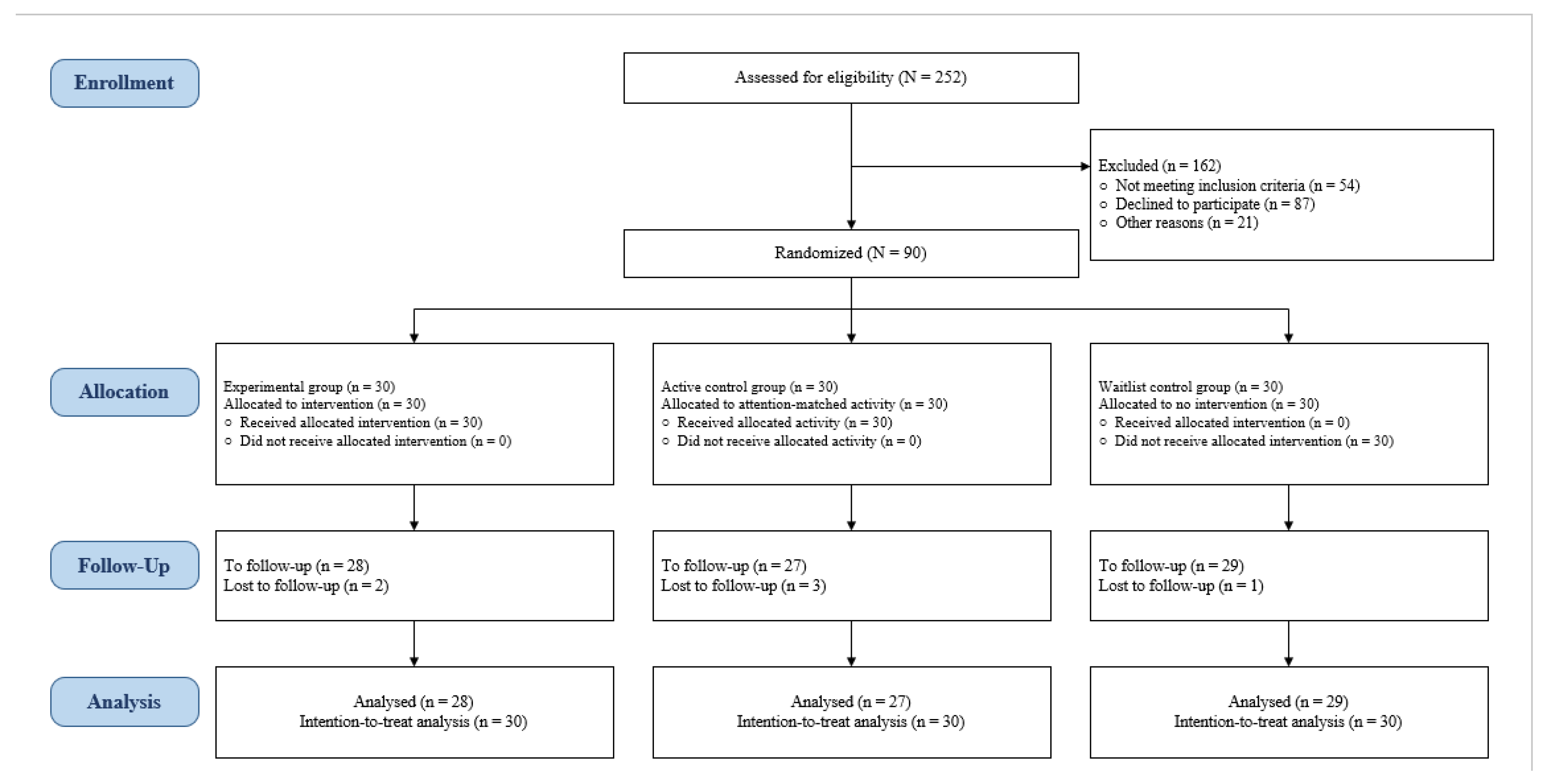
Figure 2.
Goal setting (GSCS) mean scores at pre-test, post-test, and one-month follow-up by study arm.
Figure 2.
Goal setting (GSCS) mean scores at pre-test, post-test, and one-month follow-up by study arm.
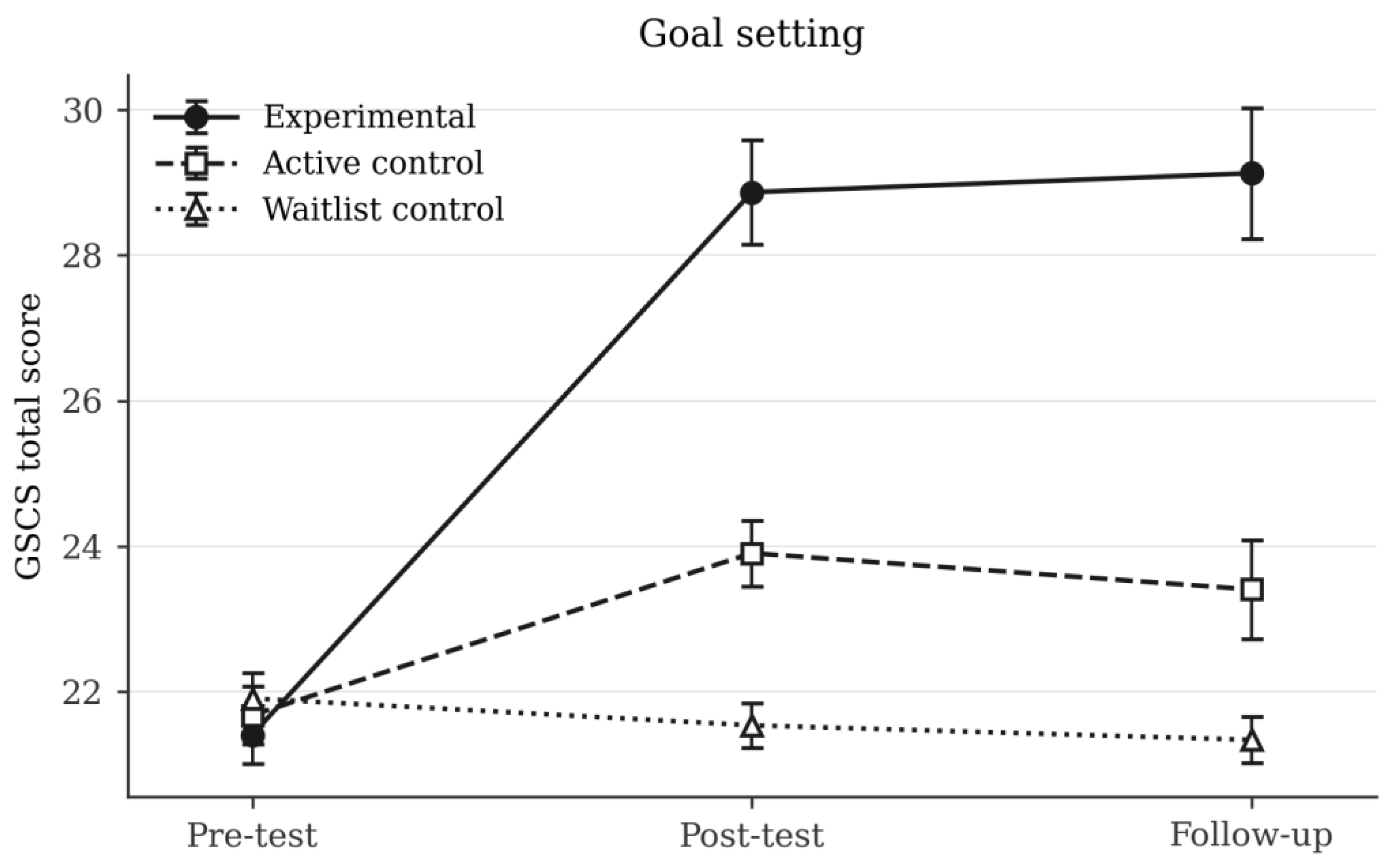
Figure 3.
Decision making and problem solving (PSI-20) mean scores at pre-test, post-test, and one-month follow-up by study arm. Lower scores indicate more effective appraisal.
Figure 3.
Decision making and problem solving (PSI-20) mean scores at pre-test, post-test, and one-month follow-up by study arm. Lower scores indicate more effective appraisal.
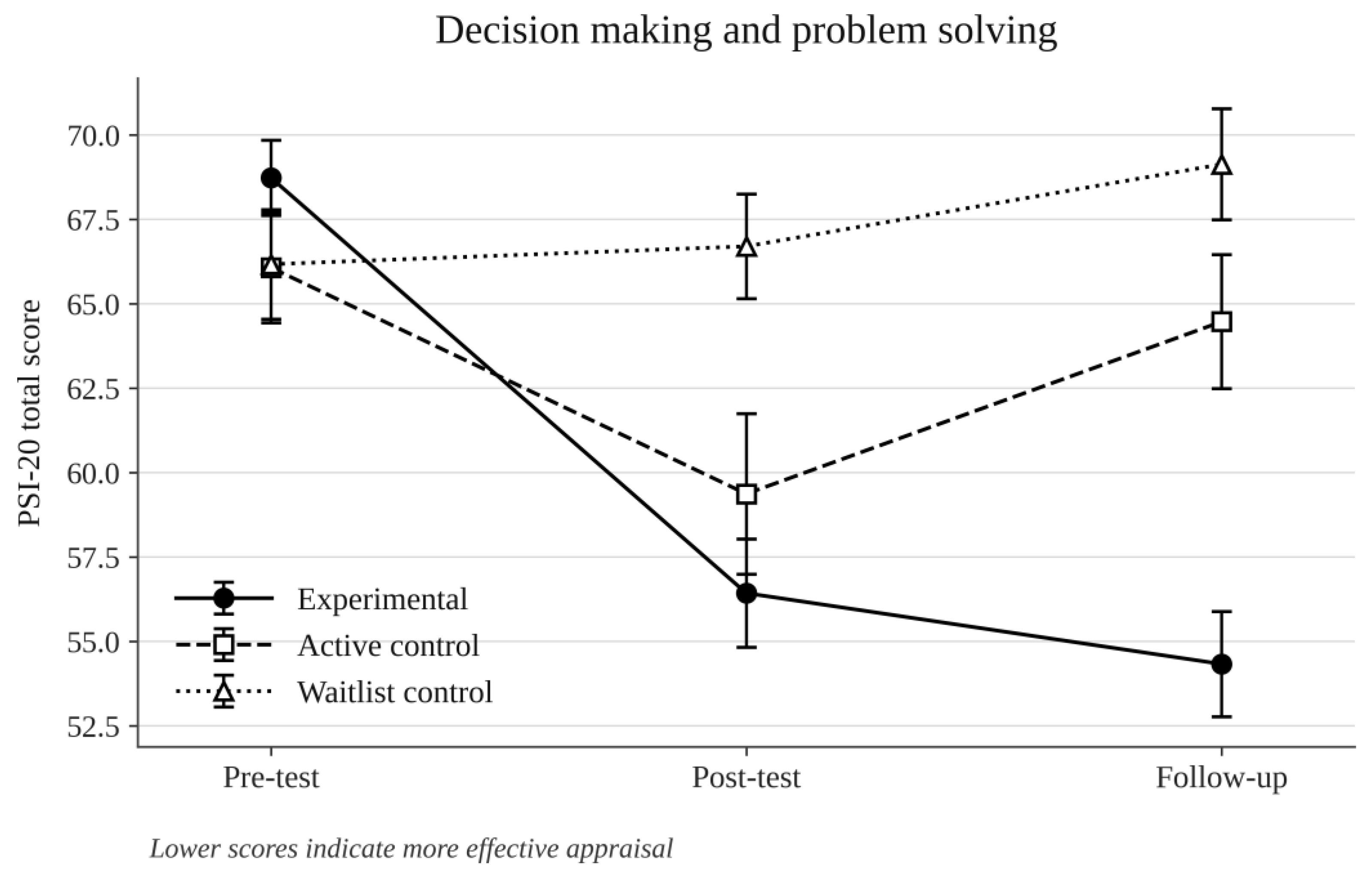
Figure 4.
Critical and creative thinking (RIBS) mean scores at pre-test, post-test, and one-month follow-up by study arm.
Figure 4.
Critical and creative thinking (RIBS) mean scores at pre-test, post-test, and one-month follow-up by study arm.
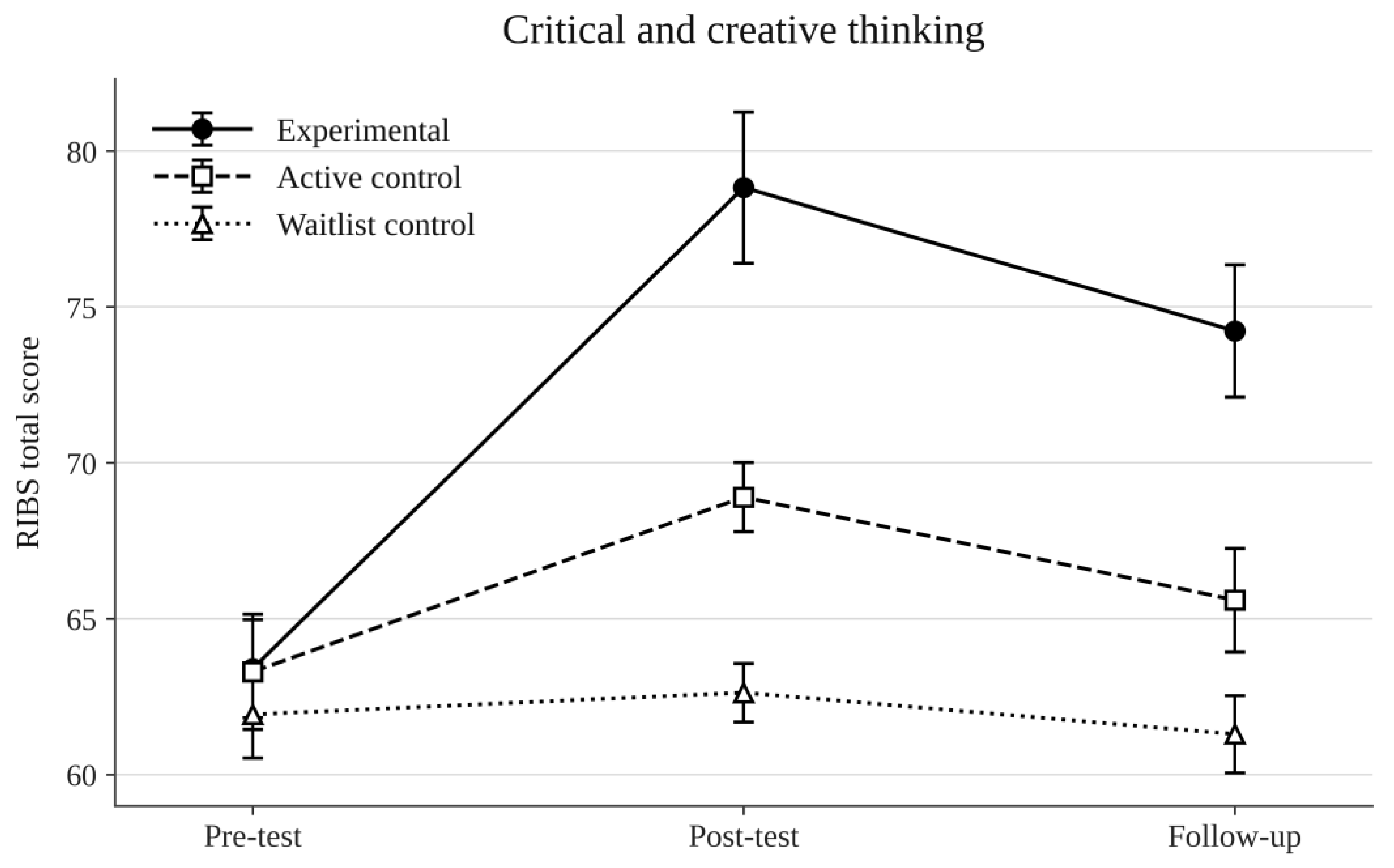
Figure 5.
Executive functioning (ESQ-R) mean scores at pre-test, post-test, and one-month follow-up by study arm. Lower scores indicate fewer reported difficulties.
Figure 5.
Executive functioning (ESQ-R) mean scores at pre-test, post-test, and one-month follow-up by study arm. Lower scores indicate fewer reported difficulties.
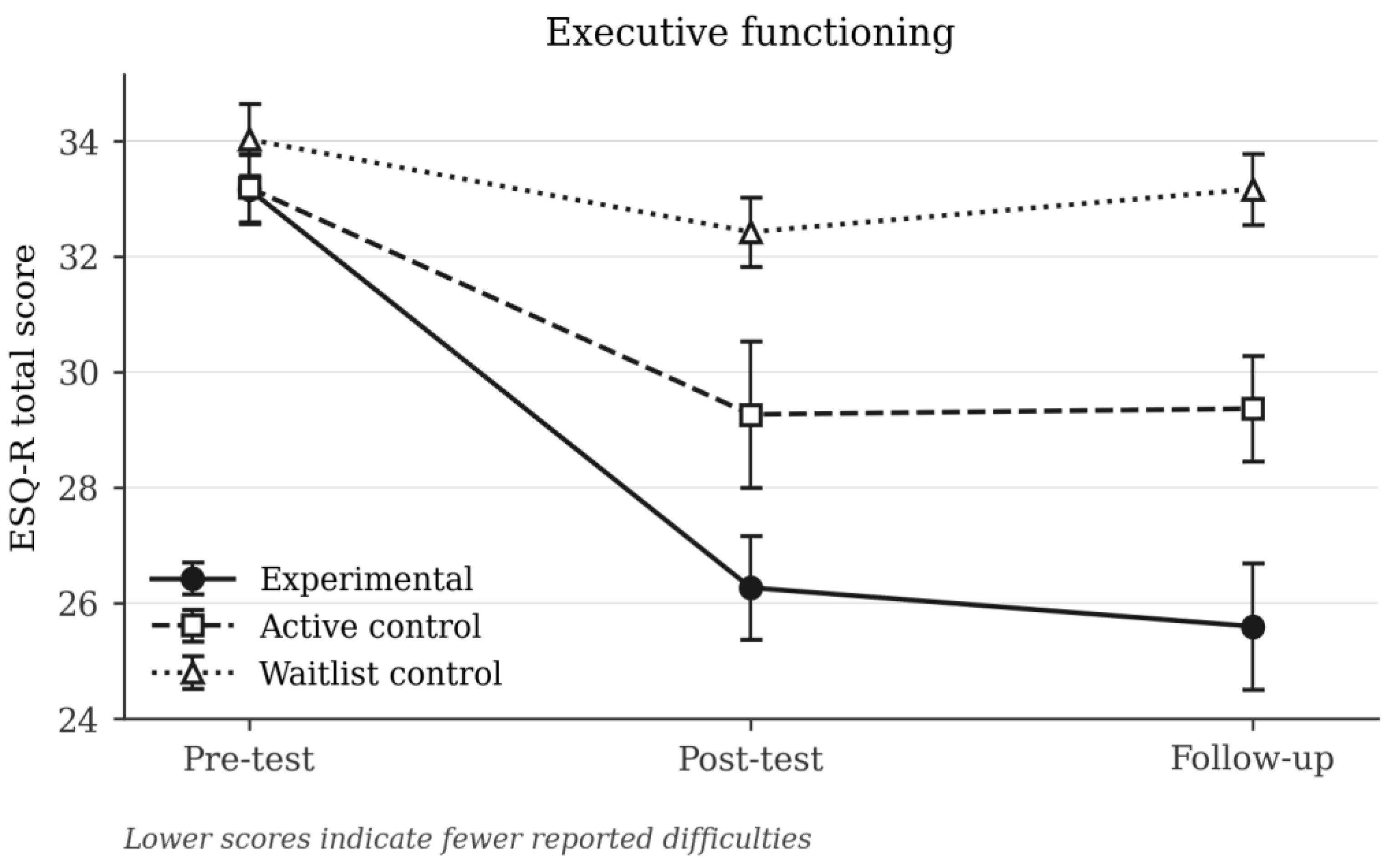
Figure 6.
Resilience (BRS) mean scores at pre-test, post-test, and one-month follow-up by study arm.
Figure 6.
Resilience (BRS) mean scores at pre-test, post-test, and one-month follow-up by study arm.
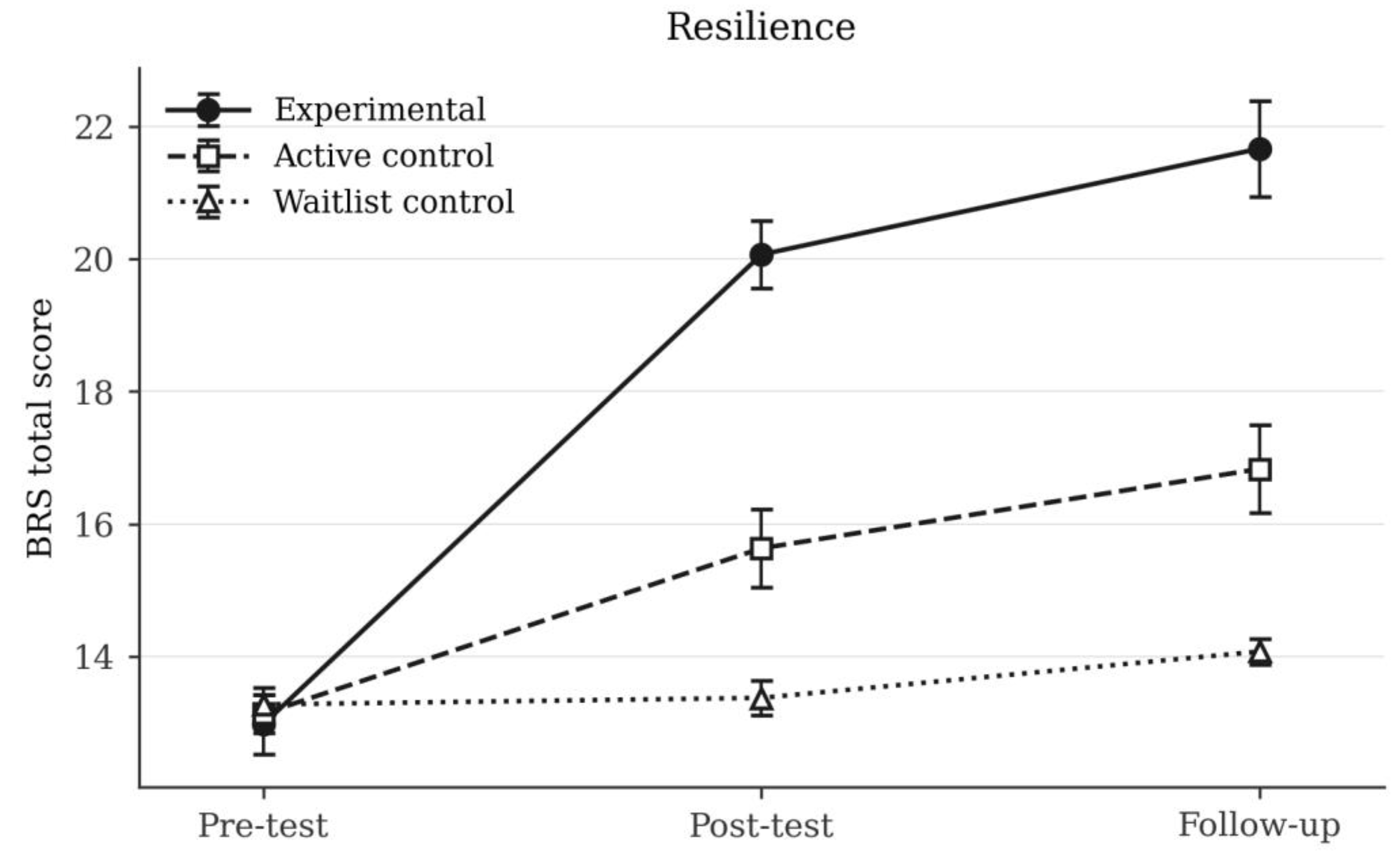

Table 1.
Allocation of participants to study arms.
| Study arm | Condition received | n | % |
| Experimental group | BLSTP thinking-skills module | 30 | 33.3 |
| Active control group | Attention-matched health-topic sessions | 30 | 33.3 |
| Waitlist control group | No intervention during study period | 30 | 33.3 |
| Total | 90 | 100.0 |
Note. Allocation ratio 1:1:1. Randomization was performed once for the complete pool of 90 eligible participants.
Table 2.
Comparison of participants’ demographic characteristics group-wise and overall.
| Variables | Category | Overall | Groups | ||||
| Characteristics | Experimental | Active Control | Waitlist Control | χ2/F | P | ||
| N Total | 252 | ||||||
| N not enrolled | 162 | ||||||
| N allocated | 90 | 30 (33.3%) | 30 (33.3%) | 30 (33.3%) | |||
| Age (M ± SD) | Years | 19.84 (1.75) | 19.53 (1.89) | 19.93 (1.76) | 20.07 (1.60) | 0.752 | 0.474 |
| Gender | Male (n%) | 46 | 18 (20.0%) | 13 (14.4%) | 15 (16.7%) | 1.690 | 0.430 |
| Female (n%) | 44 | 12 (13.3%) | 17 (18.9%) | 15 (16.7%) | |||
| 1st to 2nd (n%) | 27 | 10 (11.1%) | 8 (8.9%) | 9 (10.0%) | 2.647 | 0.852 | |
| Semester | 3rd to 4th (n%) | 19 | 7 (7.8%) | 6 (6.7%) | 6 (6.7%) | ||
| 5th to 6th (n%) | 25 | 9 (10.0%) | 7 (7.8%) | 9 (10.0%) | |||
| 7th to 8th (n%) | 19 | 4 (4.4%) | 9 (10.0%) | 6 (6.7%) | |||
| First (n%) | 23 | 7 (7.8%) | 8 (8.9%) | 8 (8.9%) | 0.357 | 0.986 | |
| Birth Order | Middle (n%) | 47 | 17 (18.9%) | 15 (16.7%) | 15 (16.7%) | ||
| Last (n%) | 20 | 6 (6.7%) | 7 (7.8%) | 7 (7.8%) | |||
| Family System | Nuclear (n%) | 53 | 19 (21.1%) | 16 (17.8%) | 18 (20.0%) | 0.643 | 0.725 |
| Joint (n%) | 37 | 11 (12.2%) | 14 (15.6%) | 12 (13.3%) | |||
| Fathers’ Education | Matric-Intermediate (n%) | 42 | 14 (15.6%) | 17 (18.9%) | 11 (12.2%) | 2.411 | 0.300 |
| Bachelors-Masters (n%) | 48 | 16 (17.8%) | 13 (14.4%) | 19 (21.1%) | |||
| Mothers’ Education | Matric-Intermediate (n%) | 54 | 20 (22.2%) | 16 (17.8%) | 18 (20.0%) | 1.111 | 0.574 |
| Bachelors-Masters (n%) | 36 | 10 (11.1%) | 14 (15.6%) | 12 (13.3%) | |||
Note. N = 90 (n = 30 per arm). Percentages are calculated on the total sample (N = 90). Group differences for categorical variables were tested with Pearson’s chi-square. Age was compared using one-way ANOVA, F(2, 87) = 0.752, p = 0.474, η² = 0.017; age ranged from 18 to 24 years. All p > 0.05, indicating that the three arms did not differ significantly on any demographic characteristic at baseline.
Table 3.
Means (standard deviations) and repeated-measures analysis of variance at pre-test, post-test, and follow-up (BLSTP).
Table 3.
Means (standard deviations) and repeated-measures analysis of variance at pre-test, post-test, and follow-up (BLSTP).
| Groups | Repeated-Measures ANOVA | η2p | ||||||||||||||
| Experimental Group | Active Control Group | Waitlist Control Group | Group | Time | Group × Time | |||||||||||
| Variables | Baseline M (SD) |
Post-Test M (SD) |
Follow-Up M (SD) |
Baseline M (SD) |
Post-Test M (SD) |
Follow-Up M (SD) |
Baseline M (SD) |
Post-Test M (SD) |
Follow-Up M (SD) |
F | p | F | p | F | p | |
| Goal Setting (GSCST) | 21.40 | 28.87 | 29.13 | 21.67 | 23.90 | 23.40 | 21.90 | 21.53 | 21.33 | 36.14 | <.001 | 40.04 | <.001 | 18.14 | <.001 | .297 |
| (2.19) | (3.96) | (4.92) | (2.20) | (2.48) | (3.70) | (1.94) | (1.68) | (1.73) | ||||||||
| Decision Making & Problem Solving (PSIT) | 68.73 | 56.43 | 54.33 | 66.07 | 59.37 | 64.47 | 66.17 | 66.70 | 69.13 | 5.90 | .004 | 36.88 | <.001 | 27.17 | <.001 | .387 |
| (6.09) | (8.77) | (8.54) | (8.93) | (13.04) | (10.86) | (8.87) | (8.48) | (9.01) | ||||||||
| Critical & Creative Thinking (RIBST) | 63.40 | 78.83 | 74.23 | 63.30 | 68.90 | 65.60 | 61.93 | 62.63 | 61.30 | 14.87 | <.001 | 22.64 | <.001 | 8.19 | <.001 | .160 |
| (8.58) | (13.28) | (11.63) | (10.14) | (6.07) | (9.08) | (7.62) | (5.14) | (6.79) | ||||||||
| Executive Functioning (ESQRT) | 33.17 | 26.27 | 25.60 | 33.20 | 29.27 | 29.37 | 34.03 | 32.43 | 33.17 | 11.50 | <.001 | 48.21 | <.001 | 8.48 | <.001 | .165 |
| (3.28) | (4.91) | (5.99) | (3.24) | (6.93) | (4.99) | (3.41) | (3.26) | (3.37) | ||||||||
| Resilience (BRST) | 12.97 | 20.07 | 21.67 | 13.13 | 15.63 | 16.83 | 13.27 | 13.37 | 14.07 | 41.48 | <.001 | 62.38 | <.001 | 16.22 | <.001 | .274 |
| (2.48) | (3.78) | (3.95) | (1.61) | (3.25) | (3.63) | (1.41) | (1.43) | (1.08) | ||||||||
Note. N = 90 (n = 30 per group). Baseline = pre-test, Post-Test = immediately post-intervention, Follow-Up = follow-up assessment. Time and Group × Time were evaluated with multivariate tests (Wilks’ Lambda), F(2, 86) and F(4, 172) respectively; Group is the between-subjects effect, F(2, 87). η²ₚ is the multivariate partial eta-squared for the Group × Time interaction. GSCST = Goal Setting; PSIT = Problem Solving Inventory; RIBST = Critical and Creative Thinking; ESQRT = Executive Functioning; BRST = Brief Resilience Scale.
Table 4.
Cohen’s d values with 95% confidence intervals.
| 95% CI | |||
| Variable | Cohen’s d | LL | UL |
| Goal Setting (GSCST) | 1.30 | 0.74 | 1.86 |
| Decision Making and Problem Solving (PSIT) | 1.59 | 1.01 | 2.17 |
| Critical and Creative Thinking (RIBST) | 0.87 | 0.34 | 1.40 |
| Executive Functioning (ESQRT) | 0.89 | 0.36 | 1.42 |
| Resilience (BRST) | 1.23 | 0.68 | 1.78 |
Note. N = 90 (n = 30 per group). Cohen’s d was computed by transforming the partial eta squared of the Group × Time interaction using d = 2√[η2p / (1 − η2p)]. The reported values therefore represent the magnitude of the Group × Time interaction, reflecting differential change between groups over time rather than simple between-group differences at a single assessment point or within-group change alone. As d was derived from η2p, pooled or baseline standard deviations were not directly used in its calculation. Confidence limits were obtained from SE(d) = √[2/n + d² / (2(2n − 2))] with n = 30, and CI = d ± 1.96 × SE. Accordingly, these values should be interpreted as standardized estimates of the interaction effect within a repeated-measures framework rather than as conventional mean-based Cohen’s d.
Disclaimer/Publisher’s Note: The statements, opinions and data contained in all publications are solely those of the individual author(s) and contributor(s) and not of MDPI and/or the editor(s). MDPI and/or the editor(s) disclaim responsibility for any injury to people or property resulting from any ideas, methods, instructions or products referred to in the content. |
© 2026 by the authors. Licensee MDPI, Basel, Switzerland. This article is an open access article distributed under the terms and conditions of the Creative Commons Attribution (CC BY) license (http://creativecommons.org/licenses/by/4.0/).
Copyright: This open access article is published under a Creative Commons CC BY 4.0 license, which permit the free download, distribution, and reuse, provided that the author and preprint are cited in any reuse.