

Submitted:
29 September 2026
Posted:
30 September 2026
You are already at the latest version
Abstract
Snail farming in Italy has experienced steady growth in recent years, driven by increasing demand in the food and cosmetic sectors. The most commonly reared species include the garden snail (Cornu aspersum) and the Roman snail (Helix pomatia). Despite the occurrence of disease and high mortality outbreaks in snail farming, the aetiological agents remain poorly characterised. To date, no confirmed viral infections have been reported in terrestrial gastropods, although viral sequences have been detected in metagenomic studies and virus-like infections have been described in the Mediterranean snail (Theba pisana). This study investigated the presence of Herpesvirales and Baculoviridae in terrestrial edible snails from three Italian regions, including two farmed species (C. aspersum and H. pomatia) and one wild species (Eobania vermiculata). A total of 83 samples were analysed by PCR. Neither herpesviruses nor baculoviruses were detected. These findings represent the first targeted investigation of these viral groups in Italian terrestrial edible snails and provide baseline data for future virological surveillance. Further studies are needed to characterise viral diversity, assess its epidemiological relevance, and clarify potential implications for snail health and farming systems.
Keywords:
land snail
; virus
; edible snail
1. Introduction
Terrestrial snails have a long history of human consumption and are traditionally collected or reared in several European and African countries [1]. In recent decades, heliciculture has developed as a specialised livestock sector, principally for food production and, increasingly, for other commercial or medical applications. Among the species reared in Europe, Cornu aspersum is one of the most widely farmed, while Helix pomatia is traditionally harvested and reared in several regions [2]. Despite the growing interest in snail farming, knowledge of the diseases affecting terrestrial gastropods remains comparatively limited.
Health disorders and mortality events have been documented in commercial snail farms, sometimes without a definitive aetiological agent being identified [3,4]. In some cases, infectious agents (Rickettsia-like organisms and amoebae) have been detected in association with mortality events in farmed C. aspersum, although their role in disease remains uncertain [4]. More broadly, knowledge of infectious diseases affecting gastropods remains fragmentary, especially with regard to viral agents [5]. Viral infections in terrestrial gastropods are particularly poorly characterised. Metagenomic investigation of the gut microbiome of the land snail Caracolus marginella identified viral sequences among the recovered metagenomic reads [6], although such findings do not necessarily demonstrate active viral infection of the snail host. More direct evidence of a possible viral infection was reported following a mortality event in the terrestrial snail Theba pisana, in which intranuclear virus-like particles were observed by transmission electron microscopy; however, the causative virus was not molecularly identified [5,7].
In contrast, viral diseases constitute a well-recognised health concern in aquatic animals and aquaculture [8], and viral infections are well documented in aquatic molluscs [5,9]. Members of the order Herpesvirales are large double-stranded DNA viruses, and the family Malacoherpesviridae comprises viruses infecting marine molluscs, including oysters, abalones and marine gastropods [10]. Several of these viruses have been associated with disease and mortality in economically important molluscan species [11]. Baculovirus-like particles have also sporadically been described in molluscs. In the Japanese scallop Mizuhopecten yessoensis, such particles were observed in epithelial cells of the digestive gland, although their taxonomic affiliation and pathogenic significance remained uncertain [12,13]. Conversely, recognised members of the family Baculoviridae are associated with insect hosts, particularly members of the orders Lepidoptera, Hymenoptera and Diptera [14].
The limited availability of molecular data on viral agents infecting terrestrial gastropods represents a significant gap in the understanding of their health status and disease aetiology. Molecular screening can represent a valuable approach to investigate the presence of viruses in apparently healthy as well as clinically affected animals. This approach may be particularly relevant in farmed snails, where unexplained mortality events can have a negative impact on production and where the aetiological agents involved often remain undetermined. Furthermore, knowledge of the potential risks to human health associated with the consumption of infected snails is largely focused on parasitic and bacterial agents, whereas the available evidence regarding the zoonotic potential of viruses infecting terrestrial gastropods is currently limited.
Against this background, the present study aimed to screen terrestrial snails from farmed and wild settings in Italy for DNA of members of the order Herpesvirales and the family Baculoviridae, encompassing apparently healthy, moribund and dead individuals and including specimens originating from farms experiencing mortality events.
2. Materials and Methods
2.1. Study Design and Sample Collection
An observational cross-sectional survey was conducted between 2024 and 2025 to investigate the presence of DNA attributable to members of the order Herpesvirales and the family Baculoviridae in edible terrestrial gastropods sampled in Italy. The survey included both farmed and wild snails from three Italian regions. Farmed specimens were obtained from commercial heliciculture farms, whereas wild specimens were collected from natural environments. Two specimens sampled at a farmer consortium in Piedmont originated from stock previously imported from Romania (n = 1) and Croatia (n = 1) and acquired to be reared in local farms. Romanian specimen was dead at the time of sampling, whereas the Croatian specimen was alive. The sampling also included individuals from two C. aspersum farms experiencing mortality events in 2024, allowing investigation of the presence of the targeted viral groups in animals originating from farms with ongoing health problems.
Snails with different health conditions were included, encompassing apparently healthy, moribund and dead individuals. During the first sampling stage, 25 mg of foot tissue were collected from each sample for molecular investigation. In a second sampling stage, following negative results in the first 45 individuals, 100 µl of haemolymph or 25 mg of foot tissue– depending on specimen’s condition and sample availability–were collected for molecular investigation. An additional Helix lucorum specimen was used exclusively during laboratory method setup and was therefore excluded from the study population and from descriptive analyses.
2.2. Sample Processing and DNA Extraction
Living specimens were first anaesthetised through immersion in 10% ethanol solution for 10’ at room temperature. Stunned snails were then promptly removed from their shells in sterility (in accordance with UNI EN ISO 7218:2013) using scissors and euthanised through freezing at -20 °C. 25 mg of foot were collected from euthanised snails.
In the case of haemolymph extraction, 100 µl of haemolymph was extracted immediately after anaesthesia from the main pulmonary vessel of living individuals using a 1 ml sterilised insulin syringe [15]. Haemolymph samples were placed in 1.5 ml Eppendorf and then frozen at -20 °C. DNA extraction was carried out using the ReliaPrep gDNA Tissue Miniprep System kit (Promega, USA) from 25 mg of foot or 100 µl of haemolymph, according to the manufacturer’s instructions. DNA concentration and sample purity were measured by using a Nanodrop spectrophotometer (Sartorius Stedim Biotech, UK).
2.3. PCR Detection
All samples were tested non-diluted, diluted at 1:100 and 1:1000. For Herpesvirus, a field sample was used as positive control. For Baculovirus, a positive sample was provided by the Sericulture laboratory of Padua (Research Centre of Agriculture and Environment).
For Herpesvirus amplification, a two-steps nested PCR was conducted using the following primers:
5’ – GAYTTYGCNAGYYTNTAYCC – 3’ (DFA)
5’ – GTCTTGCTCACCAGNTCNACNCCYTT – 3’ (KG)
5’ – TGTAACTCGGTGTAYGGNTTYACNGGNGT – 3’ (TGV)
5’ – CACAGAGTCCGTRTCNCCRTADAT – 3’ (IYG)
5’ – TCCTGGACAAGCAGCARNYSGCNMTNAA – 3’ (ILK)
For the first step, a mixture was prepared with a total volume of 20 µl, containing 10X buffer, 10 mM dNTP, 50 mM MgCl2, 10 µM primer DFA, 10 µM primer ILK, 10 UM primer KG, 5U/µl Taq DNA polymerase, H20 and 2 µl DNA. The thermal cycling conditions included an initial denaturation at 95 °C for 12’, followed by 10 cycles at 94 °C at 30’’, a gradient from 70 °C to 50 °C for 30’’, 72 °C for 90’’ and 40 cycles of 94 °C for 30’’, 50 °C for 30’’, an extension phase at 72 °C for 90’’ and a final extension at 72 °C for 7’. For the second step, a mixture was prepared with a total volume of 20 µl, containing 10X buffer, 10 mM dNTP, 50 mM MgCl2, 10 µM primer TGV, 10 µM primer IGY, 5U/µl Taq DNA polymerase, 2 µl H20 and DNA (amplified from the first step). The thermal cycling conditions included an initial denaturation at 95 °C for 12’, followed by 10 cycles at 94 °C for 30’’, a gradient from 70 °C to 50 °C for 30’’, 72 °C for 60’’ and 40 cycles at 94 °C for 30’’, 50 °C for 30’’, an extension phase at 72 °C for 60’’ and a final extension of 72 °C for 7’. The PCR products were analysed using a 2% agarose gel electrophoresis. Amplicon size is 225 bp.
For Baculovirus amplification, the following universal primers were used [16]:
5′ – AATCCTAGGCGATCTTACCA – 3′
5′ – CGTTCGTTGATGAACATCTC – 3′
DNA extracted was amplified using the following reaction conditions: 10X buffer, 50 mM MgCl2, 200 µM of each dNTP, 0.3 uM primers, 2.5 U/µL Taq DNA polymerase and 0.5 µL of DNA (50–80 ng), in a final volume of 25 µL reaction mixture. The thermal cycling profile consisted of an initial denaturation at 94 °C for 5’, followed by 35 cycles of denaturation at 94 °C for 30’’, annealing at 60 °C for 30’’, and extension at 72 °C for 30’’, with a final extension at 72 °C for 7’. The PCR products were analysed using a 2% agarose gel electrophoresis. Amplicon size is 261 bp.
2.4. Data Analysis
Descriptive analyses were performed to characterise the sampled population and summarise the virological screening results. Snails were described according to sampling setting, species, geographical area, health status and biological matrix collected. Categorical variables were summarised as absolute frequencies and percentages. The individual snail was considered the primary observational unit, whereas biological matrices were reported separately for the description of laboratory results, as two individuals provided both foot tissue and haemolymph. Virological results were summarised overall and according to species, geographical area, biological matrix and health status, with particular consideration of specimens originating from farms experiencing mortality events. Given the exploratory nature of the survey and the absence of positive detections, no inferential statistical comparisons were performed.
3. Results
A total of 81 snail individuals were included in the survey. Most specimens originated from Piedmont (n= 69), followed by Sardinia (n= 10) and Campania (n= 2) (Figure 1). Farmed snails were collected from 20 commercial farms, including 14 located in Piedmont, five in Sardinia and one in Campania, whereas wild specimens were collected from five sampling sites in Sardinia. Among the commercial farms, two C. aspersum farms experiencing mortality events in 2024 were also included in the survey.
The sampled population comprised three gastropod species: C. aspersum (n = 46), H. pomatia (n = 30), and Eobania vermiculata (n = 5), the last being a species commonly harvested and consumed in several Italian regions. Overall, 83 biological matrices were analysed, consisting of 50 foot tissue and 33 haemolymph samples; two individuals provided both matrices. At the time of sampling, 62 snails were alive, six were moribund and 13 were dead. The distribution of individuals according to sampling setting, species, biological matrix and health status is summarised in Table 1.
All analysed biological matrices tested negative for DNA from members of the order Herpesvirales and the family Baculoviridae. Negative results were consistently observed across all investigated snail species, geographical areas, biological matrices and health-status categories. Similarly, no PCR amplification was detected in specimens originating from the two farms experiencing mortality events.
4. Discussion
The results of the present study provide no evidence for the presence of herpesviruses nor baculoviruses in the examined snails, particularly for Piedmont and Sardinia regions where most of the samples were collected. In addition, the absence of detectable viral DNA in samples collected from live, moribund and dead snails at the two farms affected by high mortality does not support an involvement of the investigated viral groups in these outbreaks.
Herpesviruses are widespread among animal hosts, and members of the family Malacoherpesviridae have been identified in a variety of molluscan species, where some have been associated with severe disease and mortality in economically relevant hosts [11]. However, current knowledge of viruses infecting terrestrial gastropods remains limited. Within this context, the absence of detectable herpesvirus or baculovirus DNA in the samples analysed in the present study may be considered encouraging from a health perspective of farmed snails in the investigated regions, particularly Piedmont and Sardinia that accounted for the majority of samples. Nevertheless, these findings should be considered preliminary and should not be interpreted as evidence that those two viral groups do not represent a health concern for terrestrial gastropods.
Further investigations involving a broader geographical sampling would be needed to discard the hypothesis that herpesviruses or baculoviruses represent a potential health concern for terrestrial snails. Moreover, studies focusing on other viral families or using pan-viral primers could provide a more comprehensive assessment of the viral diversity associated with farmed snails. Indeed, the observations of intranuclear virus-like particles in T. pisana snails made by De Vico et al. [7] leaves open the possibility that viral infections may occur in terrestrial gastropods. Furthermore, numerous studies report viral agents associated with aquatic molluscs [17], and other studies have suggested an association between intensive farming practices and the emergence or spread of infectious diseases [18]. Despite the ecological differences between aquatic and terrestrial molluscs, this evidence should stimulate further viral screenings and research on land snails with a special focus on farmed species. These data would also contribute to a better understanding of the potential biological hazards associated with intensive snail production, thus supporting food safety in the context of snail consumption.
Overall, the present findings provide baseline molecular evidence that detectable DNA of the investigated herpesviruses and baculoviruses was not present in the sampled terrestrial edible snails, including animals associated with mortality events. However, broader geographical and longitudinal surveillance, together with untargeted viromic approaches, will be required to better characterise viral diversity in terrestrial gastropods and assess its potential relevance to snail health and food production.
Author Contributions
Conceptualisation, A.F., S.S. and A.G.; methodology, S.S., S.C. and A.G.; formal analysis, A.G.; investigation, A.F., S.S., S.O., G.M. and C.Z.; resources, A.F., S.S., S.P., S.M.D.T. and M.P.; data curation, A.G.; writing—original draft preparation, A.F. and S.S.; writing—review and editing, S.O., C.M., C.Z., S.C., A.G., S.P. and M.P.; visualisation, A.G.; supervision, A.F.; project administration, A.F., S.M.D.T. and M.P.; funding acquisition, A.F. and S.M.D.T. All authors have read and agreed to the published version of the manuscript.
Funding
This research was funded by the Italian Ministry of Health [Ricerca Corrente IZS PLV 06/23 RC – “Metatassonomica e ricerca contaminanti in Cornu aspersum e Helix pomatia. Allevamenti vs popolazioni selvatiche” – CUP J19I23001610001].
Data Availability Statement
The original contributions presented in this study are included in the article/supplementary material. Further inquiries can be directed to the corresponding author.
Acknowledgments
The authors wish to thank the “Consorzio della chiocciola di Borgo e delle valli circostanti” for their support during sampling and for their efforts to preserve traditional heliciculture.
Conflicts of Interest
The authors declare no conflicts of interest.
Abbreviations
The following abbreviations are used in this manuscript:
| MDPI | Multidisciplinary Digital Publishing Institute |
| DOAJ | Directory of open access journals |
| TLA | Three letter acronym |
| LD | Linear dichroism |
References
- Hardouin, J. Minilivestock: From gathering to controlled production. Biodivers. Conserv. 1995, 4(3), 220–232. [Google Scholar] [CrossRef]
- Rygalo-Galewska, A.; Zglinska, K.; Niemiec, T. Edible Snail Production in Europe. Animals 2022, 12(20). [Google Scholar] [CrossRef] [PubMed]
- Leandri, R.; De Vico, G.; Franzin, A.; Ferraris, C.; Power, K. Histopathological findings in a mass mortality event in a Helix aspersa maxima farm: possible association with calcium metabolism alterations. Vet. Anim. Sci. 2026, 100682. [Google Scholar] [CrossRef] [PubMed]
- Power, K.; Leandri, R.; Fierro, A.; Zottola, T.; De Vico, G. Mass mortality of Cornu aspersum in Italian snail farms: A histopathological survey. J. Invertebr. Pathol. 2024, 206. [Google Scholar] [CrossRef] [PubMed]
- O’Brien, M. F.; Pellett, S. Diseases of Gastropoda. Front. Immunol. 2022, 12, 802920. [Google Scholar] [CrossRef] [PubMed]
- Rabelo-Fernandez, R. J.; Santiago-Morales, K.; Morales-Vale, L.; Rios-Velazquez, C. The metagenome of Caracolus marginella gut microbiome using culture independent approaches and shotgun sequencing. Data Brief. 2018, 16, 501–505. [Google Scholar] [CrossRef] [PubMed]
- De Vico, G.; Tatè, R.; Maio, N.; Costantino, A.; Guida, V.; Villari, G.; Carella, F. Early evidence for a virus-like agent infecting the pest snail Theba pisana (Gastropoda: Pulmonata) in Southern Italy. J. Invertebr. Pathol. 2017, 148, 10–13. [Google Scholar] [CrossRef] [PubMed]
- Zhang, Q.; Gui, J.-F. Virus genomes and virus-host interactions in aquaculture animals. Sci. China Life Sci. 2015, 58(2), 156–169. [Google Scholar] [CrossRef] [PubMed]
- Renault, T.; Novoa, B. Viruses infecting bivalve molluscs. Aquat. Living Resour. 2004, 17(4), 397–409. [Google Scholar] [CrossRef]
- Dotto-Maurel, A.; Arzul, I.; Morga, B.; Chevignon, G. Herpesviruses: Overview of systematics, genomic complexity and life cycle. Virol. J. 2025, 22(1), 155. [Google Scholar] [CrossRef] [PubMed]
- Arzul, I.; Corbeil, S.; Morga, B.; Renault, T. Viruses infecting marine molluscs. J. Invertebr. Pathol. Invertebr. Viruses Food Chain 2017, 147, 118–135. [Google Scholar] [CrossRef] [PubMed]
- Chang, Y. J.; Huh, M.-D.; Oh, M.-J.; Sugawara, Y. Baculovirus-like particles in epithelial cell of digestive diverticula of the scallop, Patinopecten yessoensis. J. Shellfish Res. 2002, 21(1), 109–112. [Google Scholar]
- Gillespie, G. E.; Bower, S. M.; Marcus, K. L.; Kieser, D. Biological synopsises for three exotic molluscs, Manila Clam (Venerupis philippinarum), Pacific Oyster (Crassostrea gigas) and Japanese Scallop. Mizuhopecten yessoensis) licensed for Aquaculture in British Columbia. DFO Can. Sci. Advis. Sec. Res. Doc. 2012/013. v + 97 p. 2012. [Google Scholar]
- Harrison, R. L.; Herniou, E. A.; Jehle, J. A.; Theilmann, D. A.; Burand, J. P.; Becnel, J. J.; Krell, P. J.; van Oers, M. M.; Mowery, J. D.; Bauchan, G. R.; Ictv Report Consortium. ICTV Virus Taxonomy Profile: Baculoviridae. J. General. Virol. 2018, 99(9), 1185–1186. [Google Scholar] [CrossRef] [PubMed]
- Ziętek, J.; Guz, L.; Panasiuk, K.; Winiarczyk, S.; Adaszek, L. New intravital method for hemolymph collection from Cornu aspersum snails and the establishment of standards for selected biochemical parameters of their hemolymph. Med. Weter. 2017, 73, 366–369. [Google Scholar] [CrossRef]
- Surachetpong, W.; Poulos, B.T.; Tang, K.F.J.; Lightner, D.V. Improvement of PCR method for the detection of monodon baculovirus (MBV) in penaeid shrimp. Aquaculture 2005, 249(1–4), 69–75. [Google Scholar] [CrossRef]
- Zannella, C.; Mosca, F.; Mariani, F.; Franci, G.; Folliero, V.; Galdiero, M.; Tiscar, P. G.; Galdiero, M. Microbial diseases of bivalve mollusks: Infections, immunology and antimicrobial defense. Mar. Drugs 2017, 15(6). [Google Scholar] [CrossRef] [PubMed]
- Stevenson, P. Links between industrial livestock production, disease including zoonoses and antimicrobial resistance. Anim. Res. One Health 2023, 1(1), 137–144. [Google Scholar] [CrossRef]
Figure 1.
Geographical distribution of sampled farms and wild sites in Piedmont (n= 14), Sardinia (n= 10) and Campania (n= 2). Note: farm symbols are proportional to the number of individual snails sampled at each location. The specimens originating from imported stock were not represented.
Figure 1.
Geographical distribution of sampled farms and wild sites in Piedmont (n= 14), Sardinia (n= 10) and Campania (n= 2). Note: farm symbols are proportional to the number of individual snails sampled at each location. The specimens originating from imported stock were not represented.
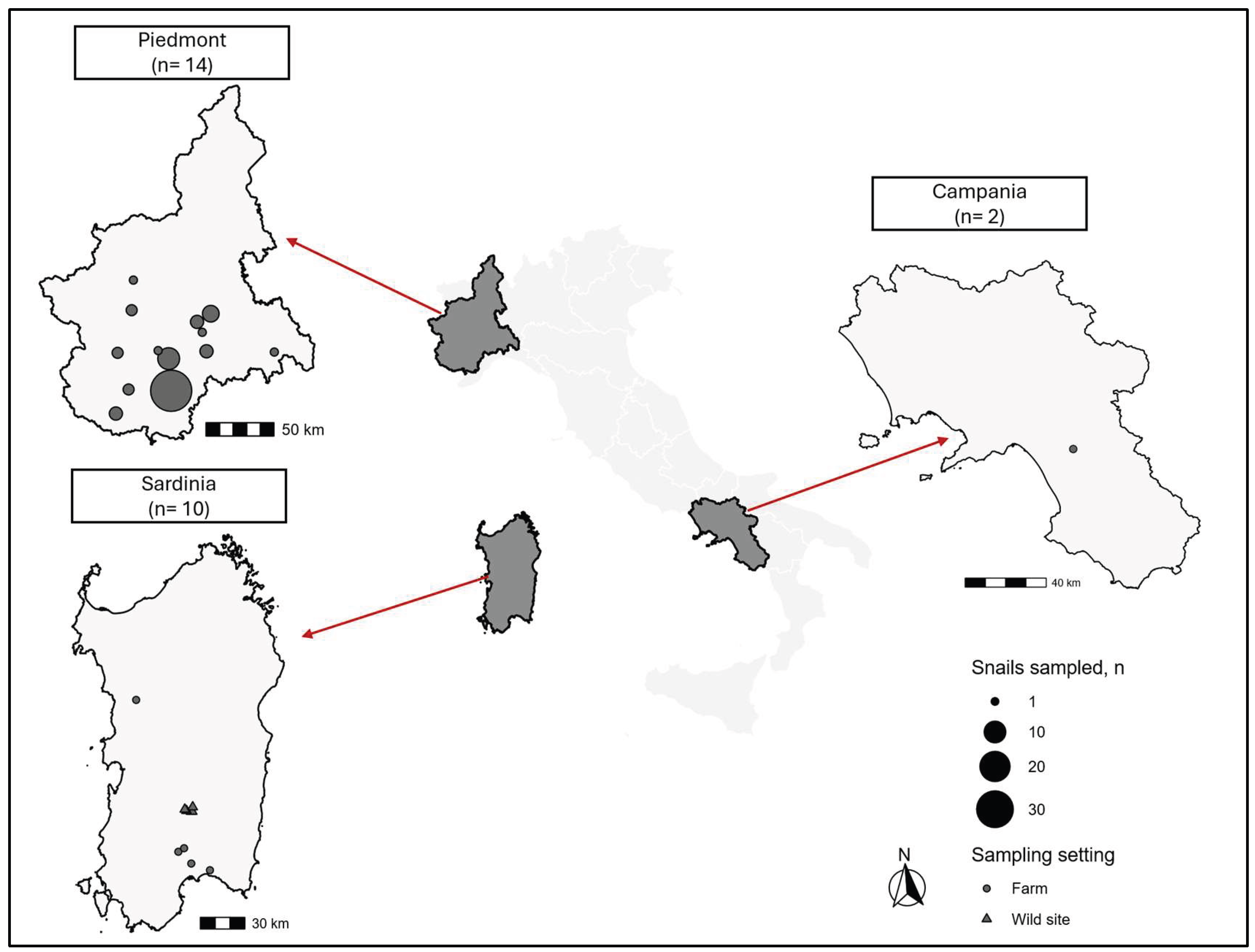

Table 1.
Characteristics of the study snail population, according to sampling setting, species, number of sampling locations, biological matrices analysed and health status.
Table 1.
Characteristics of the study snail population, according to sampling setting, species, number of sampling locations, biological matrices analysed and health status.
| Sampling setting | Species |
Locations (n*) |
No. of Individuals (%) |
Matrices analysed (n) | Health status | |||
| Foot | Haemolymph | Alive | Moribund | Dead | ||||
| Farms | ||||||||
| Cornu aspersum | 14 | 46 (56.8) | 31 | 16 | 36 | 5 | 5 | |
| Helix pomatia | 8 | 30 (37.0) | 14 | 17 | 21 | 1 | 8 | |
| Wild sites | ||||||||
| Eobania vermiculata | 5 | 5 (6.2) | 5 | 0 | 5 | 0 | 0 | |
| Total | — | 81 (100) | 50 | 33 | 62 | 6 | 13 | |
* Number of sampling locations from which each species was obtained; Two farms contributed both C. aspersum and H. pomatia and are therefore counted in both species-specific rows.
Disclaimer/Publisher’s Note: The statements, opinions and data contained in all publications are solely those of the individual author(s) and contributor(s) and not of MDPI and/or the editor(s). MDPI and/or the editor(s) disclaim responsibility for any injury to people or property resulting from any ideas, methods, instructions or products referred to in the content. |
© 2026 by the authors. Licensee MDPI, Basel, Switzerland. This article is an open access article distributed under the terms and conditions of the Creative Commons Attribution (CC BY) license (http://creativecommons.org/licenses/by/4.0/).
Copyright: This open access article is published under a Creative Commons CC BY 4.0 license, which permit the free download, distribution, and reuse, provided that the author and preprint are cited in any reuse.