

Submitted:
29 September 2026
Posted:
30 September 2026
You are already at the latest version
Abstract
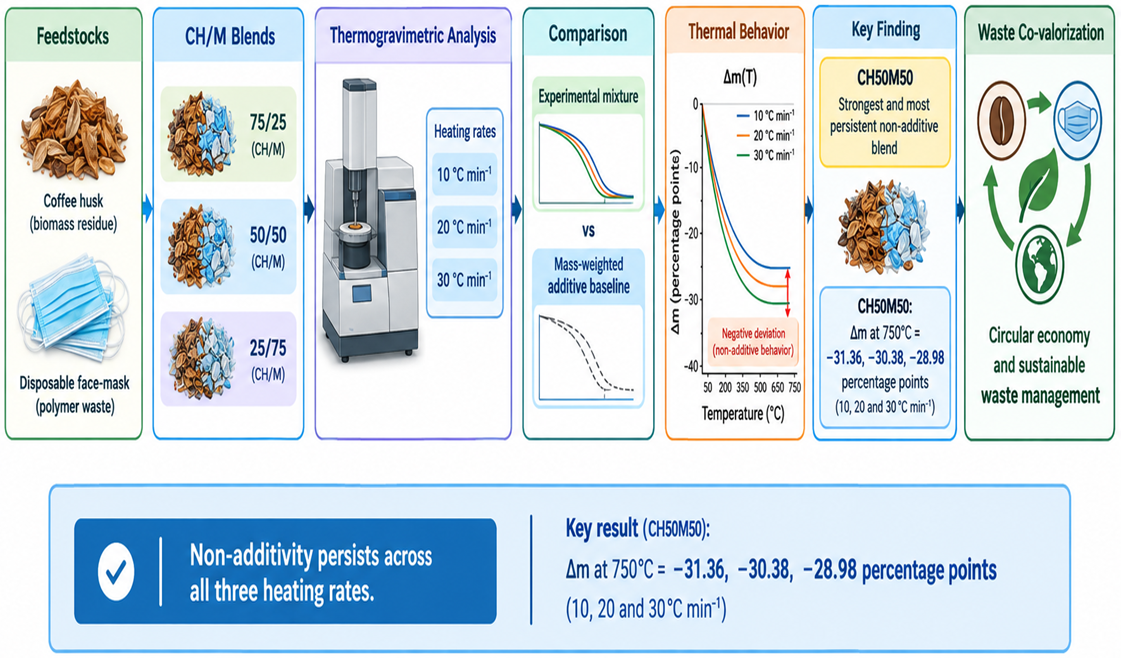
Co-gasifying agricultural waste with polymer-rich single-use trash may boost thermochemical waste valorization. Combination thermal behavior is linear additive. Heat rates of 10, 20, and 30 °C min−1 were assessed using thermogravimetric data on coffee husk, face-mask waste, and CH/M blends (75/25, 50/50). Parent TG data indicated additive baselines, and non-additivity was assessed over 50-750 °C. All feedstocks' principal DTG peaks rose with heating rate in trials. At 10-30 °C/min, CH100 DTG peaks shifted from 314.4 to 336.3 °C and M100 from 403.7 to 432.7. All three combinations lose mass more than expected in most conversion ranges. The highest and longest-lasting non-additive reaction was CH50M50. At 50-750 °C, mean interaction deviation (experimental residual mass minus additive prediction) was -14.31, -13.43, and -12.93 percentage points at 10, 20, and 30 °C min⁻¹ Residual-mass deviations were -31.36%, -30.38%, and -28.98% at 750°C. Negative values result in reduced residual mass and increased apparent conversion at 10, 20, and 30 °C min−1 compared to additive baselines. CH50M50 residual deviations were -31.36, -30.38, and -28.98% at 750 °C. CH/mask co-processing is non-additive and not a thermal program artifact because all three experimental heating speeds interact negatively. Multiple screening rates co-value reactor-scale CH/mask waste.
Keywords:
coffee husk
; disposable face mask
; thermogravimetric analysis
; heating rate
; thermal interaction
; additive baseline
; waste valorization
1. Introduction
Co-management of agricultural leftovers and single-use polymer wastes is becoming important for circular material systems, as the two streams are highly different in composition, thermal stability and resource-recovery potential. Coffee husk is a lignocellulosic residue with proven potential for thermochemical valorization, while disposable face masks are mostly polymer-rich materials, whose widespread usage has generated a continuous stream of plastic trash (Mukherjee et al., 2021; Torres and De-la-Torre, 2021; Selvaranjan et al., 2021; Dharmaraj et al., 2021; Hou et al., 2022; Tamilselvan et al., 2024). Therefore, recent study has focused on cyclical recovery approaches for both coffee-processing wastes and mask-derived polymers rather than their disposal (Jung et al., 2021; Tan et al., 2023; Afessa et al., 2025; Ali and Bhowmik, 2025).
Thermogravimetric analysis (TGA) is a common first-stage method to evaluate decomposition windows, thermal stability, residual-solid formation, and impacts of heating rate. Multi-rate experiments are particularly valuable as thermal lag and reaction-rate variations can alter characteristic temperatures and DTG maxima. Multi-rate experiments can provide a platform for further kinetic analysis where data quality and experimental metadata are appropriate. The breakdown behavior of coffee-husk has been found to be a function of heating rate, sample condition and conversion environment. Recent modeling work has highlighted further roles of particle size, moisture, heat transport and secondary reactions (Mukherjee et al., 2021; Nam et al., 2021; Nanduri et al., 2021; Afessa et al., 2025). The polymer-rich feed of disposable masks is consistently identified by TGA, TG-FTIR-GC-MS, pyrolysis, catalytic cracking and pyrolysis/steam-gasification tests as a thermochemically convertible material and not as an inert disposal waste (Yousef et al., 2021; Salema et al., 2022; Sun et al., 2022; Kiminaitė et al., 2023; Yousef et al., 2023).
Regarding mixed biomass-plastic feeds, the fundamental scientific question revolves not only around the decomposition of each material but also whether the combination acts as the mass-weighted total of its constituent parts. Non-additive behavior is ascribed to overlapping breakdown, contact between molten polymer and other components, heat and mass transfer, hydrogen/radical transfer, catalytic effects of biomass minerals and interactions with nascent char, reported in reviews and experiments (Wang et al., 2021; Ansari et al., 2021; Engamba Esso et al., 2022; Tan et al., 2023; Deng et al., 2025). This behavior has been evaluated by TGA investigations by comparison of experimental mixture curves with theoretical additive curves which indicated that the amount and the sign of the deviation might be dependent on the kind of biomass, type of polymer, blend ratio, heating rate and temperature (Chen et al., 2020; Olalo, 2022; Singh et al., 2022; Stančin et al., 2021; Stančin et al., 2023; Mariyam et al., 2024).
Current research demonstrates the advantages of utilizing a temperature-resolved interaction measure over only focusing on a DTG peak shift or ultimate residue. Synergism can shift from inhibiting to promoting as the temperature increases and a single summary number can hide this transition (Engamba Esso et al., 2022; Prasertpong et al., 2023; Jiang et al., 2025; Fang et al., 2025). Machine learning and blended-rule analyzes further elucidate that temperature, feedstock characteristics, and biomass-to-plastic ratio are significant determinants of co-pyrolysis behavior, emphasizing the necessity to evaluate observed blend performance against a definitive no-interaction reference (Prasertpong et al., 2023; Jiang et al., 2025).
Notwithstanding this advancement, the literature continues to focus on traditional biomass/PE, biomass/PP, biomass/PS, polyurethane, or packaging-plastic frameworks. The investigation of disposable masks has chiefly centered on their use as discrete thermochemical feedstocks, whereas coffee husk has been analyzed largely independently or in various conversion contexts (Yousef et al., 2021; Sun et al., 2022; Kiminaitė et al., 2023; Mukherjee et al., 2021; Afessa et al., 2025). Current assessments and studies persist in underscoring the pronounced dependency of interaction on feedstock identity, heating technique, temperature, blend ratio, and heating rate (Deng et al., 2025; Luo et al., 2026; Zeng et al., 2026). Therefore, there is a deficiency of direct experimental versus additive assessments of coffee-husk/disposable-mask mixes at different blend ratios and different experimental heating rates in a temperature-resolved manner. This gap is significant for material-cycle and waste-management research as it connects two residual streams with a quantitative screening technique for potential co-valorization, rather than supposing additivity of mixed-feed thermal behavior (Fellner and Brunner, 2022; Alsouleman et al., 2026).

Table 1.
Brief literature-based research gap motivating the present CH/disposable-mask blend study.
| Literature area | Representative studies | What is established | Gap addressed here |
|---|---|---|---|
| Coffee-husk thermal conversion | Mukherjee et al. (2021); Afessa et al. (2025) | CH pyrolysis/kinetics and scale-related thermal behavior are documented. | Insufficient data on CH combined with disposable-mask polymer refuse. |
| Disposable-mask thermochemistry | Yousef et al. (2021); Salema et al. (2022); Sun et al. (2022) | Mask pyrolysis windows, kinetics and product recovery have been studied. | Predominantly independent mask feed; lacking CH/mask additive-baseline evaluation. |
| Biomass-plastic synergy | Chen et al. (2020); Singh et al. (2022); Mariyam et al. (2024) | Experimental minus theoretical TG/DTG deviations can reveal non-additivity. | Feedstocks are mainly conventional biomass with PE/PP/PS or packaging plastics. |
| Temperature-dependent interaction | Engamba Esso et al. (2022); Jiang et al. (2025); Fang et al. (2025) | Interaction magnitude and sign depend on temperature and blend ratio. | The interaction of CH/mask temperature-resolved has not been measured in the provided literature. |
| Material-cycle relevance | Fellner and Brunner (2022); Tan et al. (2023) | Circular recovery should reduce residual waste while preserving resource value. | Require a screening connection connecting two residual streams and quantifiable co-conversion behavior. |
This research intends to: (1) delineate the experimental TG and DTG characteristics of coffee husk, disposable face-mask material, and three mass-based mixtures at heating rates of 10, 20, and 30 °C min−1; (2) assess the interaction between experimental and theoretical blends independently at each heating rate utilizing a mass-weighted additive baseline; (3) ascertain if the intensity and temperature position of non-additivity vary with the heating rate; and (4) analyze the results within the framework of material cycling and waste co-valorization while distinctly differentiating measured non-additivity from unverified reaction mechanisms. The proposed hypothesis suggests that at least one CH/M mixture would consistently diverge from the mass-weighted parent response at several heating rates, implying that the behavior of the blend cannot be sufficiently described by straightforward linear superposition.
2. Materials and Methods
2.1. Definitions of Feedstocks and Blends
Coffee husk (CH) and disposable face-mask material (M) were examined as individual materials and in three mass-based combinations (75/25, 50/50, and 25/75 CH/M). The sample codes were CH100, CH75M25, CH50M50, CH25M75 and M100. The accessible proximate and elemental features of the source materials were used merely as a means to contextualize the thermal response. Intermediate mixture values, not presented as independent analytical assessments, were produced by simple mass weighting.
The proximate analysis of coffee husk was done experimentally in the Geological Survey of Ethiopia (GSE), Geochemical Laboratory Directorate, Hydrocarbon Laboratory. The moisture content, volatile matter, fixed carbon, ash content, calorific value and density were determined following the usual analytical procedures of the laboratory. The ultimate composition was predicted by means of known empirical correlations based on the experimentally discovered proximate analysis parameters. This approach of proximate-to-ultimate analysis has been widely used for biomass feedstocks when direct elemental analysis capabilities are not available.
Table 2.
Feedstock and mass-weighted blend indicators employed to contextualize the TGA data (wt.%). Note: ‘VM = volatile matter; FC = fixed carbon; MC = moisture content; all values are quoted on the stated analytical basis.
Table 2.
Feedstock and mass-weighted blend indicators employed to contextualize the TGA data (wt.%). Note: ‘VM = volatile matter; FC = fixed carbon; MC = moisture content; all values are quoted on the stated analytical basis.
| Sample | VM | FC | Ash | MC | C | H | O | N | S |
|---|---|---|---|---|---|---|---|---|---|
| CH100 | 69.93 | 18.15 | 3.92 | 8.00 | 43.34 | 5.27 | 38.76 | 0.64 | 0.064 |
| CH75M25 | 72.77 | 15.91 | 5.32 | 6.00 | 49.39 | 7.25 | 30.96 | 0.56 | 0.531 |
| CH50M50 | 75.62 | 13.68 | 6.71 | 4.00 | 55.43 | 9.22 | 23.16 | 0.48 | 0.997 |
| CH25M75 | 78.46 | 11.44 | 8.11 | 2.00 | 61.48 | 11.19 | 15.36 | 0.39 | 1.464 |
| M100 | 81.30 | 9.20 | 9.50 | 0.00 | 67.52 | 13.16 | 7.56 | 0.14 | 1.930 |
2.2. Acquisition and Processing of Thermogravimetric Information
Thermogravimetric analysis (TGA) was carried out in Bahir Dar University, Bahir Dar Institute of Technology (BiT), Ethiopia with ATAT 2012 thermogravimetric analyzer which is equipped for simultaneous TG/DTA measurement. Sample (10 mg) was heated from ambient temperature to 800 °C at continuous heating rates under controlled atmosphere conditions. The TG and DTA curves were employed to determine the mass loss behavior and thermal degradation features. For each of the five compositions, the experimental workbooks contain thermogravimetric data for three heating rates, namely 10, 20 and 30 °C min−1, for a total of 15 records. The measured temperature, TG mass change, residual mass, normalized residual mass and derivative data are described in the documentation; the 20 °C min-1 sheets additionally retain a DTA signal. The documentation used a sample mass of around 10 mg. In the evaluation, the measured temperature and the standardized mass data were used for each heating rate and not replaced in a mathematical sense with another heating-rate profile.
For cross-rate consistency the TG records were placed on a uniformly distributed temperature grid, smoothed with a cubic Savitzky–Golay filter with an effective window of ∼20 °C and differentiated numerically. The equation for the positive mass-loss-rate signal is given by DTG = −β(dm/dT), where β denotes the designated heating rate. The characteristic temperatures T5, T10, and T50 are associated with 5%, 10%, and 50% mass reduction, respectively. The available workbooks were unable to uphold a consistent identification of purge gas or flow rate; hence, the analysis is atmosphere-neutral and does not associate with atmosphere-specific chemistry or a kinetic triplet.
The experimental workbooks contain the thermogravimetric data for each of the five compositions at three heating rates, i.e., 10, 20 and 30 °C min−1, with a total of 15 records. The documentation includes measured temperature, TG mass change, residual mass, normalized residual mass and derivative data; the 20 °C min-1 sheets also preserve a DTA signal. The submitted paperwork was prepared on the basis of a sample mass of approx. 10 mg. The recorded temperature and the standardized mass data of each heating rate were assessed . No profile at one heating rate was mathematically replaced by another.
For the cross-rates, the TG records were arranged on a uniformly distributed temperature grid, then smoothed using a cubic Savitzky–Golay filter with an effective window of ~20 °C , then differentiated numerically to get the temperature derivatives. The positive mass-loss-rate signal was given by DTG = −β (dm/dT) where −β is the given heating rate. The normal T5, T10 and T50 temperatures are respectively the 5%, 10% and 50% mass drop. The present workbooks were not able to identify the purge gas or the flow rate of the purge gas consistently and therefore the analysis stays atmosphere neutral and does not ascribe atmosphere specific chemistry or a kinetic triplet.
2.3. Additive Baseline and Quantitative Interaction Analyzes
The experimentally obtained CH100 and M100 parent curves at the same heating rate were used to calculate a theoretical non-interacting TG curve for each heating rate. where xCH is the mass fraction of coffee husk, mCH(T,β) and mM(T,β) are the normalized parent masses and madd(T,β) is the additive prediction.
madd (T,β) = xCH mCH (T,β) + (1 − xCH )mM (T,β)
For each heating rate, the temperature-resolved interaction deviation was determined independently as:
Δm(T,β) = mexp(T,β) − madd(T,β)
A negative −Δm implies that the experimental mixture was of lesser mass than calculated from the independent breakdown of the two source feeds, leading to a higher apparent mass conversion relative to the additive baseline. Positive Δm indicates a temporary delay in relation to that baseline. The mass loss in TGA cannot be used to establish the reaction pathway alone hence neither signal provides conclusive proof for a particular chemical synergy mechanism.
To compare the interaction strength at different heating rates on an equal footing, three summary parameters were calculated for each blend and heating rate: the most negative interaction deviation and the corresponding temperature, the largest positive deviation and the corresponding temperature, and the average signed interaction deviation over the common 50–750 °C range.
The non-additivity of residues was also studied at 750 °C, which is included in all the heating-rate data supplied. Since only one run was performed for each composition at every given heating rate, a test of statistical significance was not employed. The numerical metrics correspond to the experimental data supplied rather than population means.
2.4. Comparison of Heating Rate
The heating rate dependency was directly determined from the three experimental methods. Characteristic mass loss temperatures, primary DTG peak temperature and rate, and temperature-resolved interaction metrics were evaluated at heating rates of 10, 20 and 30 °C min−1. The examination is descriptive, not kinetic; no activation energy or reaction model is deduced in this manuscript because the study aims to evaluate the consistency of non-additivity across different heating rates and the requisite replicate uncertainty, atmospheric metadata, and model-selection diagnostics for a distinct kinetic investigation are absent.
3. Results and Discussion
3.1. TG/DTG Behavior with Different Heating Rates
The experimental TG mass profiles and the associated processed DTG curves for CH100, M100, CH75M25, CH50M50 and CH25M75 at a heating rate of 10, 20 and 30 °C min-1 are shown in Figure 1. The profiles are compared to study the effect of heating rate on the characteristic decomposition temperatures, peak mass-loss rates and residual mass of the parent materials and blends.
Experimental results show systematic fluctuation of heating rates as seen in the Figure 1. When increasing the programd rate from 10 to 30 °C min −1, the main degrading features shifted to higher temperatures for all five feedstocks. Simultaneously, the maxima of the mass-loss rate were improved. Such behavior is consistent with the shorter time available for heat transfer and conversion at a given temperature during fast heating, and the present data are used descriptively rather than to fit a kinetic model.
The parent materials kept their distinct thermal properties at all the three heating rates. CH100 had a multi-phase mass decrease and retained a large quantity of carbonaceous/mineral residue, while M100 showed a less concentrated polymer-degradation event. These characteristics were the result of the combinations, but not just intermediary compositions weighted throughout the temperature range. In particular, there was far more late stage mass transition in CH50M50 and CH25M75 than expected from simple visual interpolation between CH100 and M100.
The consistency of the cross-rates is of such importance, since the relative hierarchy of the basic degradation features was kept up, in spite of the fluctuations of their temperatures. The 50/50 and 25/75 combinations consistently showed the lowest residue throughout all three heating methods, confirming that their increased conversion was not dependent on a specific heating rate.
3.2. Heating-Rate Dependence of Characteristic Temperatures and DTG Features
Elevating the heating rate displaced the primary DTG peaks to elevated temperatures across all compositions. CH100 transitioned from 314.4 °C at a rate of 10 °C min−1 to 328.3 °C at 20 °C min−1 and 336.3 °C at 30 °C min−1. M100 progressed from 403.7 °C to 421.6 °C and 432.7 °C, correspondingly. The mixtures exhibited a consistent trend: CH75M25 transitioned from 401.5 to 430.3 °C throughout the rate spectrum, CH50M50 from 420.9 to 451.1 °C, and CH25M75 from 454.8 to 488.4 °C. The primary degradation temperature is thus influenced by the heating rate, necessitating that direct comparisons of peak temperatures among studies consider the established thermal history.
The maximum mass-loss rates rose along with the heating rate. For instance, CH100 rose from 3.78 to 10.55% min−1 between 10 and 30 °C min−1, M100 from 8.52 to 23.50% min−1, and CH25M75 from 12.05 to 33.07% min−1. Additionally, T5, T10, and T50 often shifted to elevated temperatures with an increase in heating rate. These patterns are qualitatively consistent with the thermal-lag and rate effects shown in the multi-rate TGA studies of biomass and polymers (Mukherjee et al., 2021; Salema et al., 2022; Singh et al., 2022; Stančin et al., 2023).
3.3. Experimental-Versus-Theoretical Blend Interaction at 10, 20, and 30 °C min−1
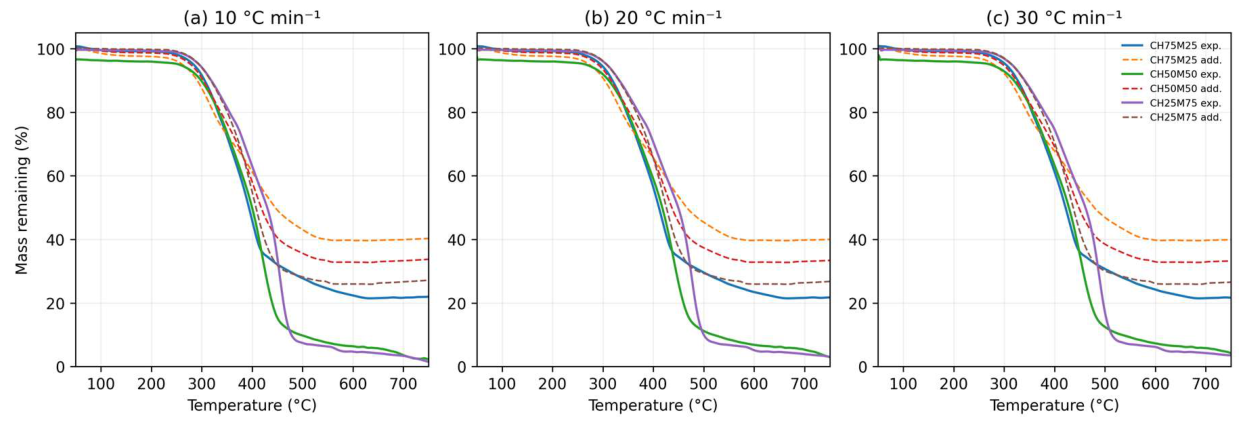
The main quantitative evaluation of the mix non-additivity for the three experimental heating rates is presented in Figure 2. In the case of a purely additive premise, each recorded blend curve should match the associated baseline matched by heating rate. Big variations are seen at 10, 20 and 30 °C min−1, especially during and after the first polymer-rich degradation phase. The constancy of this deviation for different programd heating scenarios supports the idea that the CH/mask mixtures are characterized by non-additivity across the given dataset.
Table 3.
Non-additivity of the three CH/M mixes across the common 50–750 °C region, as a function of heating rate. Negative deviations imply a lower retained mass than the additive parent-curve estimate.
Table 3.
Non-additivity of the three CH/M mixes across the common 50–750 °C region, as a function of heating rate. Negative deviations imply a lower retained mass than the additive parent-curve estimate.
| Heating rate | Blend | Most negative Δm (pp) | Largest positive Δm (pp) | Mean Δm, 50–750 °C (pp) | Additive mass at 750 °C (%) | Observed mass at 750 °C (%) | Δm at 750 °C (pp) |
|---|---|---|---|---|---|---|---|
| 10 °C min−1 | CH75M25 | -19.94 at 418 °C | +4.28 at 314 °C | -8.29 | 40.30 | 21.94 | -18.36 |
| 10 °C min−1 | CH50M50 | -31.39 at 749 °C | -0.63 at 321 °C | -14.31 | 33.73 | 2.37 | -31.36 |
| 10 °C min−1 | CH25M75 | -25.69 at 750 °C | +12.50 at 426 °C | -7.98 | 27.16 | 1.47 | -25.69 |
| 20 °C min−1 | CH75M25 | -19.94 at 437 °C | +4.28 at 328 °C | -7.78 | 39.98 | 21.70 | -18.28 |
| 20 °C min−1 | CH50M50 | -30.38 at 750 °C | -0.63 at 335 °C | -13.43 | 33.36 | 2.98 | -30.38 |
| 20 °C min−1 | CH25M75 | -23.76 at 750 °C | +12.50 at 446 °C | -7.10 | 26.75 | 2.99 | -23.76 |
| 30 °C min−1 | CH75M25 | -19.94 at 449 °C | +4.28 at 336 °C | -7.47 | 39.85 | 21.62 | -18.23 |
| 30 °C min−1 | CH50M50 | -28.98 at 750 °C | -0.63 at 343 °C | -12.93 | 33.19 | 4.21 | -28.98 |
| 30 °C min−1 | CH25M75 | -23.04 at 750 °C | +12.50 at 458 °C | -6.60 | 26.53 | 3.49 | -23.04 |
CH50M50 exhibited the most significant and lasting enhancement at all heating rates. The mean interaction deviation was −14.31 percentage points at 10 °C min−1, −13.43 at 20 °C min−1, and −12.93 at 30 °C min−1. At 750 °C, the experimental residue was 31.36, 30.38, and 28.98 percentage points lower than the respective additive forecast. CH75M25 and CH25M75 maintained adverse mean deviations across all three rates. The extent of the average negative deviation diminished somewhat with an increase in heating rate, indicating that the time-temperature profile affects the perceived interaction intensity, however it does not eradicate the non-additive response.
Figure 3.
Temperature-resolved interaction deviation, Δm = mexp − madd, for the three blends at (a) 10, (b) 20, and (c) 30 °C min−1. Negative values indicate enhanced mass conversion relative to the additive parent-curve baseline; positive values indicate temporary retardation.
Figure 3.
Temperature-resolved interaction deviation, Δm = mexp − madd, for the three blends at (a) 10, (b) 20, and (c) 30 °C min−1. Negative values indicate enhanced mass conversion relative to the additive parent-curve baseline; positive values indicate temporary retardation.
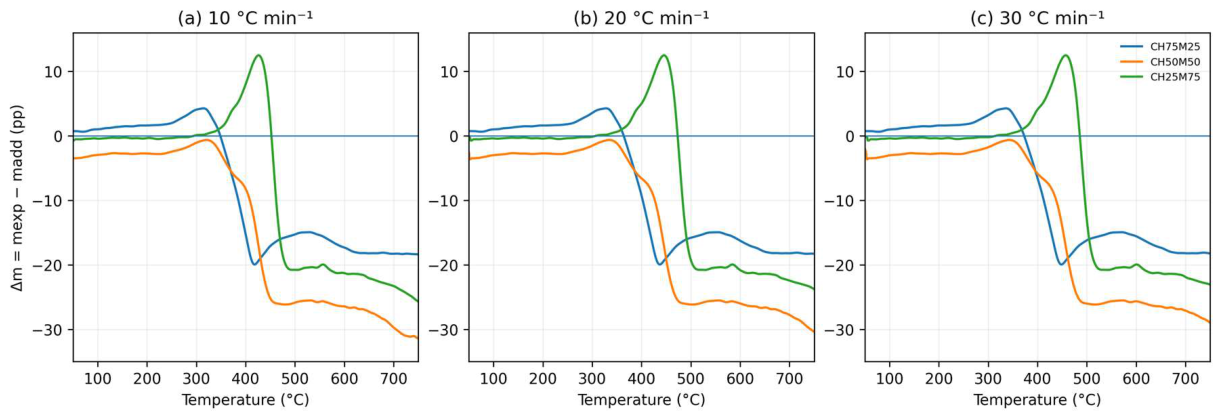
The Δm(T) profiles indicate that the heating rate alters the temperature position of the interaction characteristics while maintaining their overall composition-dependent arrangement. For CH75M25, the most significant negative deviation was seen around 418, 437, and 449 °C when the heating rate escalated from 10 to 30 °C min−1. CH25M75 demonstrated a notable positive phase before a subsequent late-stage negative divergence, with the apex positivity shifting from around 426 to 446 and 458 °C. CH50M50 consistently remained within its additive baseline and demonstrated the most significant lasting adverse response within the same analytical framework.
These temperature changes underscore the need to investigate biomass-plastic interactions with respect to both material composition and thermal treatment. Similar temperature sensitive behavior has been studied for biomass-polyolefin systems including overlapping breakdown, physical contact, radical transfer and char/mineral effects (Chen et al., 2020; Ansari et al., 2021; Engamba Esso et al., 2022; Tan et al., 2023). Without purge-atmosphere information and evolved-gas observations we have only ideas about the mechanisms in the current inquiry.
3.4. Analysis for Waste Co-Utilization
From the perspective of material cycles, the multi-rate interaction study offers deeper understanding than a sole composition-dependent peak shift. The findings indicate that the amalgamation of agricultural byproducts with polymer-laden disposable refuse can significantly alter the residual solid fraction post-thermal processing compared to anticipated additives, and this effect remains consistent across three different heating rates. This discovery advocates for more exploration of combined processing methods for challenging polymer waste and underutilized biomass (Fellner and Brunner, 2022; Hou et al., 2022; Tan et al., 2023; Tamilselvan et al., 2024; Deng et al., 2025). CH50M50 represents the most definitive priority formulation for repeated reactor-scale experimentation due to its demonstration of the most pronounced persistent negative deviation across all heating rates; this screening outcome should not be construed as an established process optimum.
Minimal TGA residue should not be construed as an indication of enhanced useful-energy recovery. TGA assesses mass change, rather than the calorific value, composition, toxicity, or recoverability of vapors, condensates, gasses, or char. Research centered on masks indicates that a significant valuation assessment necessitates product examination and, when applicable, catalytic or gasification study (Jung et al., 2021; Sun et al., 2022; Kiminaitė et al., 2023; Yousef et al., 2023). Similarly, sophisticated biomass-pyrolysis research highlights the need of evolved-gas diagnostics, transport phenomena, and corroborated kinetic models when assertions on mechanisms or scaling are presented (Nanduri et al., 2021; Afessa et al., 2025; ).
The main contribution of this research is a multi-rate, temperature-specific evaluation of non-additivity for a hitherto overlooked combination of coffee husk and disposable masks. Rather than inferring interaction just from peak displacement or a singular heating procedure, the study assesses each measured mixture against a precisely corresponding parent baseline at heating rates of 10, 20, and 30 °C min−1. The uniformity of the same blend ranking across the three programs provides more reliable screening data than a single rate comparison and bolsters research focused on independent mask conversion, coffee-husk kinetics, traditional biomass-plastic mixtures, or catalytic product improvement (Mukherjee et al., 2021; Yousef et al., 2021; Olalo, 2022; Stančin et al., 2023; Alsouleman et al., 2026).
3.5. Examination of Constraints and Prerequisites for Mechanistic Verification
The existence of three distinct experimental heating rates markedly improves thermal assessment and facilitates direct examination of heating-rate displacement. This article intentionally restricts itself to descriptive multi-rate dynamics and additive-baseline interactions. A thorough kinetic analysis requires explicit criteria for model selection, evaluation of uncertainty, and preferably, many trials prior to seeing activation-energy trends as dependable mechanistic signals.
Four limitations remain noteworthy. At first, only one TGA record was available for each composition at every heating rate, rendering statistical assessment of repeatability and experimental uncertainty impractical. Secondly, the identity and consistency of the purge gas were not reliably maintained in the supplied documentation, obstructing atmosphere-specific mechanistic evaluation. Third, the interaction calculation assumes that the normalized parent TG curves at each heating rate operate as appropriate additive references; hence, baseline drift, sample variability, and packing inconsistencies might affect Δm. Fourth, no evolved-gas analysis was performed to determine if the augmented mass conversion is associated with condensable vapors, permanent gasses, or secondary processes.
Thus, the manuscript use ‘apparent thermal interaction’ or ‘non-additivity’ as the primary proof, whilst ‘synergy’ is designated for meticulous contextual examination. The supplied multi-rate recordings demonstrate considerable divergences from the additive baseline, although they do not substantiate a chemical origin. A meticulous follow-up must replicate every formulation at each heat rate within a meticulously documented inert atmosphere and flow, using TGA with FTIR and/or mass-spectrometric evolved-gas analysis. This information would facilitate the examination of statistical uncertainty, isoconversional kinetics, and a more comprehensive mechanistic analysis.
4. Conclusions
Mixtures of coffee husk and disposable masks exhibited notable non-additive thermal properties at experimental heating rates of 10, 20, and 30 °C min−1. Increasing the heating rate resulted in the primary DTG peaks shifting to higher temperatures for all feedstocks and enhanced the corresponding peak mass-loss rates. Despite these alterations, the interaction framework based on composition persisted unaltered. CH50M50 demonstrated the most significant and sustained enhancement relative to its heating-rate-matched additive baseline, with average Δm values of −14.31, −13.43, and −12.93 percentage points at heating rates of 10, 20, and 30 °C min−1, respectively; its residue at 750 °C was 31.36, 30.38, and 28.98 percentage points beneath the additive prediction. CH75M25 and CH25M75 exhibited negative average deviations across all three rates, however CH25M75 had a fleeting positive interaction phase before markedly enhancing late-stage conversion. The findings suggest that the recognized non-additivity is not confined to a particular heating method, and that changes in heating rate affect both the temperature alignment and the strength of interaction without negating it. The study therefore develops a more comprehensive multi-rate screening framework for the selection of CH/mask pairings in waste co-valorization research. Replication, thorough atmospheric data acquisition, evolved-gas analysis, and a targeted kinetic assessment are critical requirements before making mechanistic or scale-up claims.
Author Contributions
Conceptualization, methodology, data curation, formal analysis, visualization, writing original draft, and writing review and editing- All authors.
Funding
Funding for this research was supplied by the support from University of Rostock towards APC payment through ExiST project agreement.
Data Availability Statement
The five provided thermogravimetric workbooks, which include experimental data at 10, 20, and 30 °C min−1 for CH100, CH75M25, CH50M50, CH25M75, and M100, along with the processed data utilized for the temperature-resolved interaction computations, can be obtained from the corresponding author upon reasonable request.
Acknowledgments
Publication support from University of Rostock towards APC payment through ExiST project agreement is gratefully acknowledged.
Conflicts of Interest
The authors declare no conflict of interest.
References
- Afessa, M.M., Locaspi, A., Debiagi, P., Frassoldati, A., Caraccio, R., Ramayya, A.V., & Faravelli, T. (2025). Pyrolysis of large biomass particles: Model validation and application to coffee husks valorization. Journal of Analytical and Applied Pyrolysis, 188, 107028. [CrossRef]
- Ali, M.A., & Bhowmik, S. (2025). Bioactive compounds in coffee husk: extraction, functional properties, applications, and sustainable approach in circular economy. RSC Sustainability, 3, 4410–4425. [CrossRef]
- Alsouleman, K., Pal, S.K., Giridara Srinivaas, M.S., Behrendt, F., & Vinu, R. (2026). Effect of HZSM-5 catalyst on product distribution of pyrolysis of PLA and PBAT/PLA blend. Journal of Material Cycles and Waste Management, 28, 3157–3176. [CrossRef]
- Ansari, K.B., Hassan, S.Z., Bhoi, R., & Ahmad, E. (2021). Co-pyrolysis of biomass and plastic wastes: A review on reactants synergy, catalyst impact, process parameter, hydrocarbon fuel potential, COVID-19. Journal of Environmental Chemical Engineering, 9(6), 106436. [CrossRef]
- Chen, R., Zhang, S., Cong, K., Li, Q., & Zhang, Y. (2020). Insight into synergistic effects of biomass-polypropylene co-pyrolysis using representative biomass constituents. Bioresource Technology, 307, 123243. [CrossRef]
- Deng, J., Yi, B., Mašek, O., Yuan, X., Hwang, S.Y., Ong, H.C., Hua, Z., & Ok, Y.S. (2025). Co-pyrolysis of biomass and plastic waste into carbon materials with environmental applications: a critical review. Green Chemistry, 27, 6320–6341. [CrossRef]
- Dharmaraj, S., Ashokkumar, V., Hariharan, S., Manibharathi, A., Show, P.L., Chong, C.T., & Ngamcharussrivichai, C. (2021). The COVID-19 pandemic face mask waste: A blooming threat to the marine environment. Chemosphere, 272, 129601. [CrossRef]
- Engamba Esso, S.B., Xiong, Z., Chaiwat, W., Kamara, M.F., Longfei, X., Xu, J., Ebako, J., Jiang, L., Su, S., Hu, S., Wang, Y., & Xiang, J. (2022). Review on synergistic effects during co-pyrolysis of biomass and plastic waste: Significance of operating conditions and interaction mechanism. Biomass and Bioenergy, 159, 106415. [CrossRef]
- Fang, Y., Tang, Y., Li, G., Song, M., Ye, C., Guo, W., Wang, L., Cen, J., Ma, J., & Zheng, Y. (2025). Co-pyrolysis of waste biomass and plastics from food packaging waste: Pyrolysis characteristics, synergetic effects, and reaction kinetics. Journal of Environmental Management, 127800. [CrossRef]
- Fellner, J., & Brunner, P.H. (2022). Plastic waste management: is circular economy really the best solution? Journal of Material Cycles and Waste Management, 24, 1–3. [CrossRef]
- Hou, E.J., Hsieh, Y.Y., Hsu, T.W., Huang, C.S., Lee, Y.C., Han, Y.S., & Chu, H.T. (2022). Using the concept of circular economy to reduce the environmental impact of COVID-19 face mask waste. Sustainable Materials and Technologies, 33, e00475. [CrossRef]
- Jiang, P., She, W., Zhang, H., Li, L., Lin, H., Ji, T., Mu, L., Lu, X., & Zhu, J. (2025). Unlocking the synergistic effects in biomass-plastic co-pyrolysis using a hybrid machine learning approach with blended rule descriptors. Biomass and Bioenergy, 201, 108130. [CrossRef]
- Jung, S., Lee, S., Dou, X., & Kwon, E.E. (2021). Valorization of disposable COVID-19 mask through the thermo-chemical process. Chemical Engineering Journal, 405, 126658. [CrossRef]
- Kiminaitė, I., González-Arias, J., Striūgas, N., Eimontas, J., & Seemann, M. (2023). Syngas production from protective face masks through pyrolysis/steam gasification. Energies, 16(14), 5417. [CrossRef]
- Luo, X., Li, J., Xu, K., Fang, Y., Yu, J., & Li, S. (2026). Synergistic co-pyrolysis of biomass and waste plastics for enhanced combustible gas production: A comprehensive review. Process Safety and Environmental Protection, 108954. [CrossRef]
- Mariyam, S., Parthasarathy, P., Pradhan, S., & Al-Ansari, T. (2024). Co-pyrolysis of biomass and binary single-use plastics: synergy, kinetics, and thermodynamics. International Journal of Sustainable Energy, 43(1), 2168003. [CrossRef]
- Mukherjee, A., Okolie, J.A., Tyagi, R., Dalai, A.K., & Niu, C. (2021). Pyrolysis kinetics and activation thermodynamic parameters of exhausted coffee residue and coffee husk using thermogravimetric analysis. The Canadian Journal of Chemical Engineering, 99, 1683–1695. [CrossRef]
- Nam, N.H., Ngoc, C.T.A., & Bay, T.V. (2021). Investigation on gasification of coffee husk in CO2, H2O, and mixed atmospheres. Vietnam Journal of Chemistry, 59(6), 775–780. [CrossRef]
- Nanduri, A., Kulkarni, S.S., & Mills, P.L. (2021). Experimental techniques to gain mechanistic insight into fast pyrolysis of lignocellulosic biomass: A state-of-the-art review. Renewable and Sustainable Energy Reviews, 148, 111262. [CrossRef]
- Olalo, J. (2022). Thermogravimetric and synergy analysis of the co-pyrolysis of coconut husk and laminated plastic packaging for biofuel production. Energy Engineering, 119(2), 555–567. [CrossRef]
- Prasertpong, P., Onsree, T., Khuenkaeo, N., Tippayawong, N., & Lauterbach, J. (2023). Exposing and understanding synergistic effects in co-pyrolysis of biomass and plastic waste via machine learning. Bioresource Technology, 369, 128419. [CrossRef]
- Salema, A.A., Mohd Zaifullizan, Y., & Wong, W.H. (2022). Pyrolysis and combustion kinetics of disposable surgical face mask produced during Covid-19 pandemic. Energy Sources, Part A: Recovery, Utilization, and Environmental Effects, 44(1), 566–576. [CrossRef]
- Selvaranjan, K., Navaratnam, S., Rajeev, P., & Ravintherakumaran, N. (2021). Environmental challenges induced by extensive use of face masks during COVID-19: A review and potential solutions. Environmental Challenges, 3, 100039. [CrossRef]
- Singh, S., Tagade, A., Verma, A., Sharma, A., Tekade, S.P., & Sawarkar, A.N. (2022). Insights into kinetic and thermodynamic analyses of co-pyrolysis of wheat straw and plastic waste via thermogravimetric analysis. Bioresource Technology, 356, 127332. [CrossRef]
- Stančin, H., Mikulčić, H., Manić, N., Stojiljković, D., & Vujanović, M. (2023). Thermogravimetric and kinetic analysis of waste biomass and plastic mixtures. Journal of Sustainable Development of Energy, Water and Environment Systems, 11(4), 1110469. [CrossRef]
- Stančin, H., Mikulčić, H., Manić, N., Stojiljković, D., Vujanović, M., Wang, X., & Duić, N. (2021). Thermogravimetric and kinetic analysis of biomass and polyurethane foam mixtures co-pyrolysis. Energy, 237, 121592. [CrossRef]
- Sun, X., Liu, Z., Shi, L., & Liu, Q. (2022). Pyrolysis of COVID-19 disposable masks and catalytic cracking of the volatiles. Journal of Analytical and Applied Pyrolysis, 163, 105481. [CrossRef]
- Tamilselvan, K., Sundarajan, S., Ramakrishna, S., Amirul, A.-A.A., & Vigneswari, S. (2024). Sustainable valorisation of coffee husk into value added product in the context of circular bioeconomy: Exploring potential biomass-based value webs. Food and Bioproducts Processing, 145, 187–202. [CrossRef]
- Tan, C.H., Arifin, N.A., Hafriz, R.S.R.M., Nomanbhay, S., & Shamsuddin, A.H. (2023). Co-pyrolysis of biomass and plastic: Circularity of wastes and comprehensive review of synergistic mechanism. Results in Engineering, 17, 100989. [CrossRef]
- Torres, F.G., & De-la-Torre, G.E. (2021). Face mask waste generation and management during the COVID-19 pandemic: An overview and the Peruvian case. Science of the Total Environment, 786, 147628. [CrossRef]
- Wang, Z., Burra, K.G., Lei, T., & Gupta, A.K. (2021). Co-pyrolysis of waste plastic and solid biomass for synergistic production of biofuels and chemicals—A review. Progress in Energy and Combustion Science, 84, 100899. [CrossRef]
- Yousef, S., Eimontas, J., Striūgas, N., & Abdelnaby, M.A. (2021). Pyrolysis kinetic behaviour and TG-FTIR-GC–MS analysis of Coronavirus Face Masks. Journal of Analytical and Applied Pyrolysis, 156, 105118. [CrossRef]
- Yousef, S., Eimontas, J., Striūgas, N., et al. (2023). Gasification of end-of-life surgical masks in an updraft gasifier for syngas production. Energy Sources, Part A: Recovery, Utilization, and Environmental Effects, 45(2), 5063–5080. [CrossRef]
- Zeng, Y., Xu, C., Tian, X., Ke, L., Cobb, K., Zhou, N., Liu, Y., Ruan, R., Yang, J., & Wang, Y. (2026). Synergistic effects of biomass-plastic co-pyrolysis: Enhanced performance with microwave assistance and biomass type variability. Energy, 342, 139602. [CrossRef]
Figure 1.
The experimental TGA mass profiles (a–c) and the corresponding processed DTG profiles (d–f) are presented for coffee husk (CH100), disposable face-mask material (M100), and their mixtures (CH75M25, CH50M50, and CH25M75) at heating rates of 10, 20, and 30 °C min−1.
Figure 1.
The experimental TGA mass profiles (a–c) and the corresponding processed DTG profiles (d–f) are presented for coffee husk (CH100), disposable face-mask material (M100), and their mixtures (CH75M25, CH50M50, and CH25M75) at heating rates of 10, 20, and 30 °C min−1.
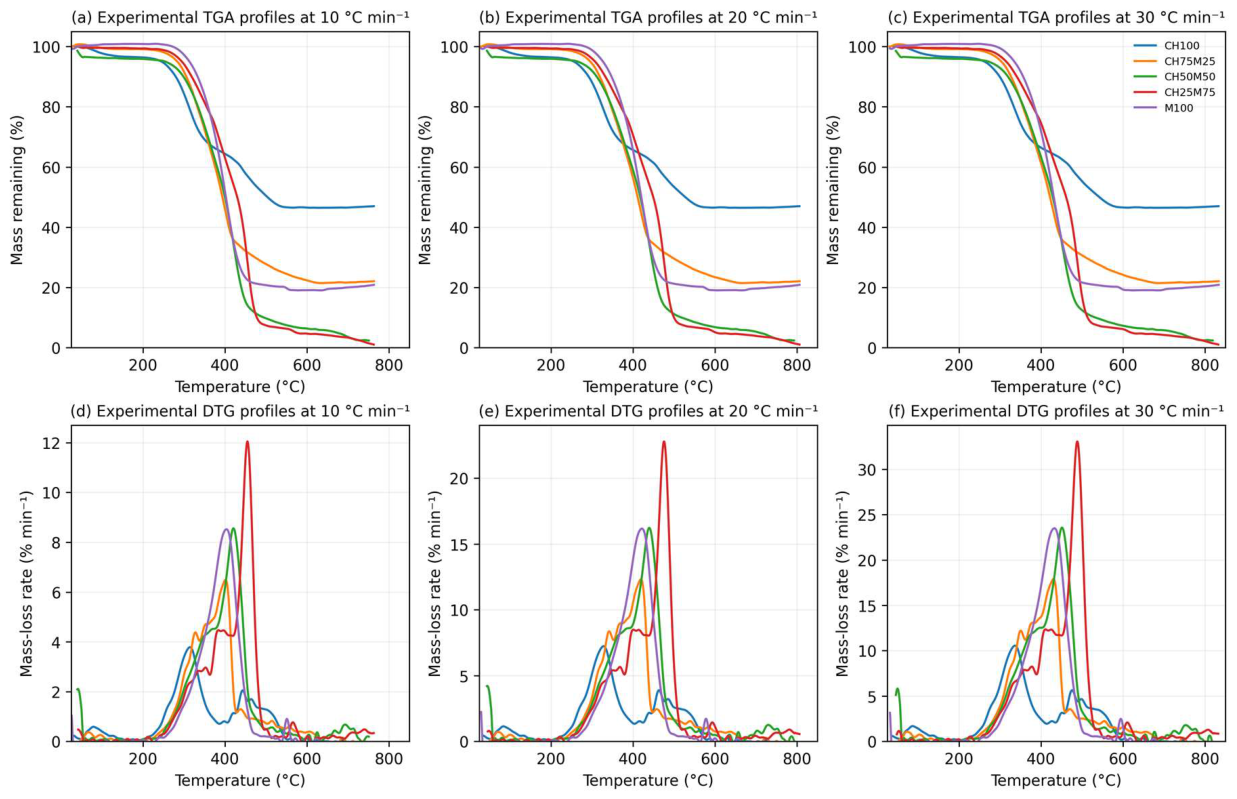
Figure 2.
Experimental TG curves for the three CH/M mixes juxtaposed with mass-weighted additive forecasts derived from the CH100 and M100 parent curves at identical heating rates: (a) 10, (b) 20, and (c) 30 °C min−1. Dashed lines denote the baseline of no interaction.
Figure 2.
Experimental TG curves for the three CH/M mixes juxtaposed with mass-weighted additive forecasts derived from the CH100 and M100 parent curves at identical heating rates: (a) 10, (b) 20, and (c) 30 °C min−1. Dashed lines denote the baseline of no interaction.
Disclaimer/Publisher’s Note: The statements, opinions and data contained in all publications are solely those of the individual author(s) and contributor(s) and not of MDPI and/or the editor(s). MDPI and/or the editor(s) disclaim responsibility for any injury to people or property resulting from any ideas, methods, instructions or products referred to in the content. |
© 2026 by the authors. Licensee MDPI, Basel, Switzerland. This article is an open access article distributed under the terms and conditions of the Creative Commons Attribution (CC BY) license (http://creativecommons.org/licenses/by/4.0/).
Copyright: This open access article is published under a Creative Commons CC BY 4.0 license, which permit the free download, distribution, and reuse, provided that the author and preprint are cited in any reuse.