

Submitted:
28 September 2026
Posted:
29 September 2026
You are already at the latest version
Abstract
The rapid deployment of stationary, distributed, and mobile energy storage exposes a limitation of conventional storage-centred management: installed capacity does not identify the energy and power that a power system can actually access at a required location and time. This paper develops Energy and Power Banking (EPB) as a resource-centred framework for representing and coordinating such qualified availability. A problem-driven conceptual synthesis compares energy storage systems, virtual power plants, distributed-energy-resource aggregation, microgrids, energy hubs, and existing electricity-banking models according to their primary management object, functional boundary, and treatment of resource availability. The analysis identifies a gap: spatially and temporally qualified energy and power resources are generally treated as inputs to asset or portfolio operation rather than as the primary object of end-to-end management. EPB addresses this gap through resource formation, pooling, reservation, allocation, mobilisation, controlled provision, and restoration. Its scientific contribution comprises distinct but coupled representations of energy and power resources; explicit resource states that prevent double commitment; a four-layer functional architecture connecting physical assets with power-system requirements; and compatibility conditions for resource–requirement matching. Unlike an installed storage asset or an operational portfolio schedule, an EPB resource position describes what is available, reserved, allocable, or mobilisable under specified spatial, temporal, technical, and reliability constraints. The framework extends energy-storage management from installed assets to qualified resource availability and provides a testable basis for subsequent operational models and comparative validation.
Keywords:
energy storage systems
; Energy and Power Banking
; resource availability
; storage management
; distributed energy resources
; spatiotemporal coordination
1. Introduction
Electric power systems require generation and consumption to remain continuously balanced. Energy storage introduces temporal flexibility by allowing electricity produced at one moment to be used at another. Once dominated by large pumped-hydro facilities, storage now includes utility-scale and distributed batteries, mobile electric-vehicle assets, and thermal, hydrogen, and hybrid systems.
This development is part of a broader transformation. Variable renewable energy sources are supplying a growing share of electricity, while generation is becoming more distributed and demand more active, flexible, and electrified. Renewable sources are expected to meet more than 90% of global electricity-demand growth between 2025 and 2030, with variable generation rising particularly rapidly [1,2,3]. At the same time, distributed generation, battery storage, electric vehicles, controllable loads, and active consumers are replacing the traditional one-directional structure with a network of interacting producers, consumers, storage systems, mobile assets, and digitally coordinated resources [4].
This expansion creates a challenge broader than storing surplus electricity. Energy may be physically present but unavailable for the task at hand because it is located behind a constrained interface, committed elsewhere, disconnected, or unable to provide the required power and duration. Thus, possession of a storage asset or nameplate capacity does not automatically constitute a usable power-system resource.
Conventional planning and operation are necessarily organised around physical installations and such parameters as rated energy and power, efficiency, state of charge, lifetime, location, and operating schedule. This asset-centred representation remains indispensable, but it becomes insufficient on its own when stationary, distributed, and mobile storage resources with different constraints, ownership, and availability must be coordinated.
At the system level, the relevant question is therefore not only how much storage capacity is installed, but what can actually be mobilised, in what quantity, at which location and time, and under what technical and contractual conditions. Installed capacity describes asset potential; qualified availability describes the usable resource.
That resource description must also distinguish energy from power. Energy availability concerns the amount that can be supplied or absorbed over a specified period, whereas power availability concerns the rate, timing, and speed of response. Equal stored energy can therefore provide different system value when power capability, duration, location, or readiness differs.
Several existing concepts address aspects of this transformation. Battery energy storage systems provide controllable charging and discharging and increasingly support power-system flexibility [5,6,7]. Virtual power plants coordinate geographically distributed energy resources as an integrated operational portfolio; aggregators combine customer loads or generation for market participation; and microgrids coordinate local generation, storage, and demand within defined electrical boundaries [8,9,10]. These concepts provide essential technological, operational, and market functions, but are generally framed around physical storage, virtual coordination, local energy management, or market participation.
What remains less explicit is a framework in which the primary object of management is the spatially and temporally available energy and power resource itself. Such a framework asks what resources are actually accessible, where and when they are available, which portion can be used or reserved, how heterogeneous assets can be represented comparably, and how resources can be pooled, allocated, and mobilised in accordance with current and anticipated power-system needs.
This paper introduces Energy and Power Banking (EPB) as a resource-centred response to these questions. Banking denotes the formation, pooling, reservation, spatial and temporal allocation, controlled mobilisation, and restoration of energy and power resources; it does not refer to a particular storage technology, a conventional battery bank, or a purely financial mechanism. An Energy and Power Bank (hereafter, an EPB system) is the coordinated system that implements these functions across a potentially heterogeneous asset base.
The proposed concept therefore shifts attention from the ownership and operation of individual storage devices to the managed availability of the resources they can provide. Its physical basis may include electrochemical storage, pumped-hydro facilities, hydrogen and thermal storage, second-life electric-vehicle batteries, connected electric vehicles, and other stationary or mobile technologies. The concept is intended to be technologically neutral: the importance of an asset is determined not only by what it is, but by what resource it can provide, where and when that resource can be mobilised, and under which constraints. Recent work on mobile storage and second-life battery qualification illustrates why physical possession of a battery does not by itself guarantee a mobilisable system resource [11,12].
Accordingly, this paper aims to develop and substantiate EPB as a resource-centred extension of energy-storage management for organising spatially and temporally qualified energy and power availability. It addresses three research questions:
- What limitations of the conventional energy-storage paradigm motivate the transition towards a resource-centred perspective?
- How can EPB and an EPB system be conceptually defined?
- Which principles, functions, and structural elements distinguish the proposed concept from adjacent power-system constructs?
The scientific contribution is fourfold. First, the paper identifies the management-object gap between installed storage capability and qualified system resource. Second, it distinguishes energy and power as coupled but non-interchangeable resource categories. Third, it defines EPB through explicit resource states and a recurring management cycle from formation to restoration. Fourth, it proposes a layered architecture and resource–requirement compatibility conditions that make the concept operationally testable and distinguish it from BESSs, virtual power plants, aggregators, microgrids, and energy hubs. The research logic is summarised in Figure 1.
The resulting framework establishes the conceptual variables, system boundary, functional structure, and testable propositions required for subsequent operational formalisation and validation.
2. Analytical Approach and Conceptual Positioning
2.1. Conceptual Research Design
This study applies a problem-driven conceptual synthesis to determine whether the difference between installed storage capability and mobilisable system resource requires a distinct organising construct. The unit of analysis is not an individual technology or market product, but the relationship among a construct’s primary management object, functional boundary, and representation of energy and power availability.
The procedure follows the three linked phases shown in Figure 1. Phase I establishes conceptual positioning. Five adjacent constructs—ESS/BESS, virtual power plants, DER aggregation, microgrids, and energy hubs—were selected using two criteria: each directly organises storage or heterogeneous energy resources, and together they represent the principal technological, portfolio-based, market-oriented, local-system, and multi-carrier logics used for resource coordination. The constructs are compared across five dimensions: primary management object, core organising function, included assets or resources, spatial or system boundary, and treatment of energy and power availability. This comparison identifies the functions already covered by neighbouring constructs and isolates the availability-related gap that remains secondary or implicit.
Phase II derives the EPB construct from that gap. The derivation begins with the shift from device ownership and installed capacity to qualified energy and power resources and then specifies resource categories, availability coordinates, definitions, and organising principles. Phase III converts the construct into a functional representation by defining the system boundary, functional layers and flows, core functions, resource states, resource–requirement compatibility conditions, and possible system configurations.
The framework is checked against three internal criteria: conceptual distinctiveness from adjacent constructs, consistency among definitions and resource representations, and functional coverage from resource formation to restoration. The literature serves an analytical rather than enumerative role: it establishes the adjacent constructs and supports their comparison but is not used for bibliometric or systematic evidence synthesis. The resulting outputs are the comparative positioning in Table 1, the resource model in Section 3, the functional architecture in Section 4, and the system-level interpretation and research agenda in Section 5 and Section 6.
2.2. Existing Storage and Resource-Coordinating Paradigms
Energy storage is commonly defined through its ability to defer the final use of electricity or to convert electricity into a storable form and subsequently reconvert it into electricity or another energy carrier [13,14,15,16]. Within this paradigm, an ESS or BESS is primarily a physical and operational system. Its description normally begins with the storage technology and its parameters: rated energy capacity, rated power, efficiency, state of charge, response time, degradation, lifetime, and operating limits. Planning and control are then directed towards determining where the system should be installed and how it should charge, discharge, and provide specific services.
This asset-centred perspective is technically necessary. Without an accurate representation of the physical system, no reliable resource can be provided. However, the available energy and power are generally derived from the characteristics and current state of the storage facility. They are outputs of asset assessment rather than the primary entities around which the entire system is organised. This distinction becomes more significant when multiple storage technologies, locations, owners, and operational commitments must be coordinated.
A virtual power plant represents a further step towards resource coordination. VPPs combine distributed generation, storage systems, electric vehicles, flexible loads, and other distributed energy resources through digital communication and control [17,18,19,20]. The participating assets may be geographically dispersed and remain physically independent, while their operation is coordinated so that the portfolio can provide grid services, respond to utility requirements, or participate in electricity markets as a larger and more controllable entity.
Among the existing concepts, the VPP is the closest to EPB. Both are technology-neutral, both can integrate heterogeneous and spatially distributed assets, and both depend on information exchange, forecasting, coordination, and control. The distinction lies not in the physical composition of the system but in its conceptual centre of gravity. A VPP is organised primarily as a coordinated operational portfolio capable of behaving as a power-system or market participant. The availability of energy and power is represented because it is necessary for scheduling, bidding, and service delivery. In EPB, by contrast, the formation, reservation, allocation, and mobilisation of that availability constitute the primary organising purpose of the system.
Aggregation of distributed energy resources is closely related to the VPP concept but has a broader regulatory and market meaning [21,22]. Under Directive (EU) 2019/944, aggregation is a function performed by a natural or legal person who combines multiple customer loads or generated electricity for sale, purchase, or auction in an electricity market [23]. Similarly, regulatory frameworks such as FERC Order No. 2222 seek to allow smaller distributed resources to participate collectively in energy, capacity, and ancillary-service markets when they would not qualify individually [24,25].
Aggregation is therefore principally a mechanism that makes multiple small resources visible and usable as a larger portfolio. It may be implemented through a VPP, an aggregator, a utility programme, or another coordination platform. However, aggregation by itself does not define how the underlying energy and power resources should be formed, divided between available and reserved portions, distributed spatially, or maintained over successive time intervals. It is an important mechanism within EPB, but it does not cover the full functional meaning of banking.
A microgrid follows a different organising logic. It combines interconnected loads and distributed energy resources within clearly defined electrical boundaries and can act as a single controllable entity with respect to the wider grid. Depending on its design, it may operate in both grid-connected and islanded modes [26,27]. Storage and controllable generation are managed to balance local production and consumption, maintain power quality, support resilience, and enable autonomous operation when required.
The defining feature of a microgrid is therefore its electrical and spatial boundary. The resources are coordinated in relation to the needs of a particular local system. A microgrid may supply services to the external grid, and an EPB system may be implemented within a microgrid. Nevertheless, EPB is not intrinsically confined to one electrically bounded local system. It may coordinate resources across multiple locations and system levels, including resources that cannot or should not operate as a self-sufficient electrical island.
The energy-hub concept broadens the analysis beyond electricity. An energy hub is generally understood as a system or node in which multiple energy carriers can be produced, converted, stored, and supplied to different forms of demand [28,29,30]. Its principal analytical strength lies in representing the coupling between electricity, heat, gas, hydrogen, and other energy carriers and in optimising the conversion and flow of energy among them.
Energy hubs and EPB systems may include some of the same technologies, particularly thermal storage, hydrogen systems, and hybrid conversion facilities. Their primary questions, however, are different. An energy hub asks how multiple energy carriers can be converted, coupled, and optimally supplied. EPB asks what electrical-energy and power resources can be made available to the power system, where and when they are available, what part should be reserved, and how they can be mobilised. An energy hub may therefore serve as one physical resource provider within an EPB system, but the two constructs are not interchangeable. The comparison is summarised in Table 1.
The comparison does not imply that the existing constructs are incomplete within their intended domains. Each has been developed to solve a particular class of technological, operational, market, or local-system problems. Nor does it imply that the boundaries between them are absolute. A single real-world project may simultaneously function as a BESS, participate in a VPP, be operated by an aggregator, and support a microgrid. The purpose of the comparison is to identify the different organising principles that can be applied to the same or overlapping groups of assets.
2.3. Terminological Precedents and Conceptual Gap
The terms electricity banking, power banking, and energy bank already occur in the electricity-sector literature, but they denote narrower arrangements. Electricity or power banking generally refers to the injection or transfer of electricity for subsequent withdrawal, return delivery, or financial settlement under utility, open-access, or tariff arrangements [31]. Energy bank or energy bank system has also been used for platforms that enable energy sharing, call-auction trading, storage-service exchange, or coordinated interaction among microgrids and distributed energy systems [32,33]. In these formulations, the primary management object is an energy credit, scheduled exchange, transaction, or shared-storage service.
These precedents are related to, but not equivalent to, EPB. Utility electricity or power banking is primarily a temporal exchange and settlement arrangement, whereas published energy-bank models focus on a defined sharing or transaction mechanism among specified participants. In these formulations, neither provides a general resource-centred representation in which spatially and temporally qualified energy and power availability is the primary management object across heterogeneous stationary, distributed, mobile, and sector-coupled resources. Such arrangements may constitute mechanisms or implementation contexts within an EPB system, but they are not synonyms for the broader organising framework developed here.
The current conceptual landscape provides mature ways to describe storage technologies, coordinate distributed portfolios, manage bounded local systems, couple energy carriers, and enable market participation. The gap is therefore not the absence of aggregation, control, optimisation, or flexibility services.
Across these constructs, however, energy and power availability is normally derived, scheduled, traded, or used within a facility, portfolio, market role, local system, or energy-carrier network. It is not consistently treated as the primary object of end-to-end management under explicit spatial, temporal, technical, and commitment conditions.
This distinction can be expressed through the difference between nominal capacity and usable availability. A system may possess a large aggregate storage capacity while only a limited part of that capacity is accessible at a particular moment. Some assets may be fully charged but located behind a congested network interface. Others may have sufficient energy but insufficient discharge power. Mobile assets may be disconnected, customer-owned systems may be unavailable because of prior commitments, and technically capable resources may need to be reserved for reliability purposes. Adding their nameplate ratings does not reveal what the power system can actually mobilise.
EPB reverses the conventional direction of analysis. Instead of beginning with an asset and asking how it should operate, it begins with a system requirement and asks which qualified resources can be formed, pooled, reserved, allocated, mobilised, provided, and restored. Physical technologies remain indispensable, but they enter higher-level coordination through the resources they can actually make available.
The conceptual gap can therefore be stated as follows:
Existing concepts describe storage technologies, operational coordination, market aggregation, local electrical systems, or multi-energy conversion, but do not explicitly and consistently treat the spatially and temporally available energy and power resource as the primary object of management.
EPB is proposed to address this gap. It does not replace BESS, VPPs, aggregators, microgrids, or energy hubs. Rather, it introduces an additional organising perspective through which these and other physical or digital systems may contribute to the formation and controlled provision of energy and power resources. The following section develops this perspective by defining the two resource categories, the banking function, and the EPB system as a system construct.
3. From Energy Storage to Energy and Power Banking
3.1. Shift in the Primary Object of Management
The transition from energy storage to EPB is a change in the primary object of management rather than a transition between technologies.
A storage-centred analysis begins with a facility, its ratings, constraints, and operating schedule. Even coordinated facilities are commonly represented as a portfolio of assets whose charging and discharging are optimised.
EPB begins with the power-system requirement and asks what resources can meet it. An installed asset may nevertheless be unavailable, network-constrained, committed elsewhere, or able to provide energy but not the required power. The transition from asset-centred storage to resource-centred EPB is illustrated in Figure 2.
Figure 2 shows how each stage adds information beyond nameplate ratings: feasible capability reflects asset state and limits; availability adds location, time, access, commitments, and system conditions; reservation protects a share for a specified requirement; and mobilisation converts that share into controlled provision.
Table 2 complements this transition by translating common asset descriptors into the resource characteristics required for higher-level coordination.
This translation complements rather than replaces physical modelling: reliable resources require accurate asset models, while resource-oriented coordination provides the higher level at which different technologies can be matched to a common system need. This separation between technology-specific subsystems and higher-level coordination is consistent with hierarchical and multilevel systems theory [34,35].
3.2. Energy and Power as Distinct Resource Categories
Energy-storage facilities are normally characterised by both energy capacity and power capacity. Energy capacity describes how much energy can be stored, while power capacity describes how rapidly that energy can be charged or discharged [36,37,38]. Their ratio is commonly used to indicate storage duration [39,40,41]. These parameters are related, but they describe different capabilities and should not be collapsed into a single measure.
Moving from asset ratings to system resources makes this distinction operationally decisive.
An energy resource is defined here as electrical energy that can be supplied to or absorbed from the power system at a specified location and within a specified interval, subject to technical, operational, and accessibility constraints.
Direction is explicit because a resource may represent either withdrawal capability or absorption capability, depending on the system requirement and asset state.
A power resource is the capability to inject or absorb electrical power of a specified magnitude at a specified location and time, within a required response time and for a defined duration, subject to available energy and technical constraints.
Energy and power resources are therefore interconnected but not interchangeable. Power cannot be stored as an independent physical quantity. What can be maintained and reserved is the capability to provide or absorb power, supported by sufficient energy, conversion capacity, network access, and operational readiness. Energy can be accumulated, but it has limited system value if it cannot be delivered at the required rate, location, and time.
This distinction also clarifies the meaning of the word banking. EPB does not imply that power itself is deposited and stored in the same way as energy. Energy may be physically accumulated in electrochemical, mechanical, thermal, chemical, or other forms. Power capability is formed by maintaining assets in a condition from which a specified response can be mobilised. It can be pooled across several assets, reserved for a system requirement, allocated to a location or service, and activated when needed. Figure 3 distinguishes energy and power resources, identifies their common coordinates, and shows why equal energy does not imply equal power capability, and vice versa.
For conceptual purposes, resource i over interval Δt is represented by a multidimensional vector rather than by energy and power ratings alone:
In Equation (1), the first four components denote the available delivery and absorption energy and the corresponding injection and absorption power. The remaining components identify the location, availability window, response time, sustainable duration, delivery confidence, and current resource state (for example, free, reserved, active, or under restoration). This representation is descriptive rather than operational; it identifies the attributes that future technology-specific models must formalise, calculate, and validate.
These attributes make resource availability conditional and dynamic. The same physical asset may represent different energy and power resources at different times. A mobile battery changes location; an electrochemical battery changes its state of charge and health; a reservoir is affected by inflows and competing uses; and a customer-owned resource may become unavailable because of user requirements. Resource availability must therefore be continuously or periodically reassessed rather than inferred once from installed capacity. Recent studies of second-life batteries illustrate this time-dependent and condition-dependent resource character particularly clearly [42,43,44,45,46].
3.3. Definitions of Energy and Power Banking and the Energy and Power Bank
The preceding distinction provides the basis for defining the proposed concept.
Energy and Power Banking is defined as:
a resource-centred principle for organising and managing the formation, pooling, reservation, spatial and temporal allocation, controlled mobilisation, and restoration of energy and power resources derived from heterogeneous assets in accordance with current and anticipated power-system needs.
Several elements of this definition are essential.
The term resource-centred indicates that the main object of coordination is the resource available to the power system rather than the physical asset considered in isolation.
Formation translates assessed asset capabilities into qualified energy and power resources under specified conditions.
Pooling combines compatible qualified resources so that multiple contributions can support a common system requirement.
Reservation commits a defined share of the qualified resource to a specified future requirement and protects it from conflicting use.
Spatial and temporal allocation determines where and when qualified resources are assigned in accordance with system requirements and constraints.
Controlled mobilisation converts assigned resource availability into an operationally ready response.
Restoration re-establishes the required resource readiness after provision.
An Energy and Power Bank is defined as:
a coordinated system of physical assets, resource representations, and management functions that implements EPB by forming and maintaining a portfolio of spatially and temporally characterised energy and power resources for controlled interaction with the electric power system.
The EPB system is therefore neither a synonym for a large battery nor simply another term for an aggregated storage portfolio. Its boundary is primarily functional. It includes the assets that provide the resources, the information required to characterise their availability, and the coordination functions through which those resources are pooled, reserved, allocated, mobilised, and restored.
The physical assets do not necessarily have to be located at one site, use one technology, or belong to one owner. A bank may be centralised or distributed, stationary or partly mobile, and organised at local, regional, corporate, or system level. Its exact institutional and ownership structure is not fixed by the conceptual definition and may vary between applications.
Not every storage facility is automatically an EPB system. A storage facility becomes part of a banking system when its capabilities are represented and managed as energy and power resources within the broader banking logic. In the simplest case, a single facility equipped to form, reserve, allocate, and restore its resources could implement a limited form of banking. The full relevance of the concept, however, emerges when heterogeneous assets, locations, time horizons, and system requirements must be coordinated. Regulatory requirements affect the admissibility of second-life battery use [47], while vehicle-to-grid participation depends on charging availability, user behaviour, and distribution-network constraints [48,49,50,51]. These conditions reinforce the need to qualify access and control rights before counting a capability as available.
In concise form, physical assets provide capabilities, EPB organises them as resources, and an EPB system implements the required functions.
3.4. Core Conceptual Principles
The proposed concept is based on seven core principles.
1. Resource orientation
The primary object of management is the available energy or power resource rather than the installed asset. Asset parameters remain the technical foundation, but management decisions are based on what can actually be delivered or absorbed under specified conditions.
2. Dual representation of energy and power
Energy and power are treated as distinct but coupled resource categories. Energy describes the available quantity and duration, while power describes the magnitude, direction, speed, and timing of delivery or absorption. Neither category alone is sufficient to characterise the system value of a resource.
3. Technological neutrality
Resources are represented through the capabilities they can provide rather than through their storage technology alone. Electrochemical batteries, pumped-hydro storage, hydrogen systems, thermal stores, electric vehicles, and other assets may participate if their contribution can be translated into the required energy and power characteristics. Technological neutrality does not mean ignoring technical differences; it means making those differences comparable at the resource-management level.
4. Spatial and temporal specificity
A resource is not fully defined without stating where and when it is available. The same amount of energy may have different value at different network nodes, and the same power capability may be useful in one interval but irrelevant in another. Spatial and temporal coordinates are therefore constitutive characteristics of the resource, not secondary implementation details.
5. Aggregation of heterogeneous resources
The bank may pool resources that differ in scale, technology, duration, response time, mobility, ownership, and reliability. Aggregation is performed on the basis of compatible resource characteristics and system requirements rather than by simple addition of nominal capacities.
6. Reservation and controlled mobilisation
Not every technically available resource should be dispatched immediately. A portion may need to be retained for backup, contingencies, balancing, adequacy, or other anticipated needs. The banking logic therefore distinguishes between the total technically feasible resource, the currently available resource, the reserved resource, and the resource that may be mobilised for a particular task.
7. Coordination with power-system needs
The bank does not form and maintain resources in isolation. Their required quantity, location, timing, duration, and degree of firmness are determined by current and anticipated conditions of the power system. Forecasting, planning, optimisation, and operational control are supporting instruments within this logic. They serve the central purpose of maintaining and mobilising appropriate energy and power resources.
Together, these principles establish EPB as a framework centred on managed resource availability. The next section translates this conceptual foundation into a functional architecture that connects physical assets, resource representation, coordination functions, and interaction with the power system.
4. Functional Model of an Energy and Power Bank
4.1. System Boundaries and Resource Base
An EPB system is defined by the storage-management functions it performs rather than by a single technology, site, or ownership structure. Its boundary includes the assets that provide energy or power capabilities, the information required to qualify those capabilities as resources, and the functions used to form, pool, reserve, allocate, mobilise, and restore them.
The physical resource base may include stationary, distributed, and mobile assets. Electrochemical storage, second-life electric-vehicle batteries, pumped-hydro facilities, hydrogen-based systems, thermal storage coupled with electrical conversion, connected electric vehicles, and hybrid storage configurations may all contribute. However, the purpose of the resource base is not to assemble the largest possible catalogue of technologies. What matters is whether an asset can provide a resource that is observable, quantifiable, accessible, and controllable within the banking system.
An asset may be included in the resource base when the following conditions are satisfied:
- its available energy or power capability can be estimated;
- its location or network connection point is known;
- its period of availability and operating constraints can be identified;
- the bank has an operational or contractual right to use the specified capability;
- the resource can be reserved or allocated without double counting;
- its activation and actual performance can be monitored or verified;
- its state after use can be reassessed for subsequent operation.
These conditions mean that physical ownership is not a necessary criterion. An EPB system may own some assets, coordinate others under contract, and receive qualified resource commitments from independent providers. Only the accessible and authorised part of an asset’s capability belongs to the bank’s resource base. The remainder remains outside its functional boundary.
The electrical network also requires careful treatment. Transmission and distribution infrastructure is not automatically part of the bank merely because energy flows through it. Nevertheless, network topology, congestion, losses, voltage limits, and connection capacity directly affect whether a nominally available resource can be delivered to a particular location. Network constraints therefore enter the representation of resource availability even when the network itself remains external to the organisational boundary of the bank. The increasing diversity and location dependence of distributed resources make this coordination particularly important [52].
The initial EPB formulation is centred on storage-based and storage-coupled resources. Other controllable generation or demand-side assets may contribute qualified power capability only where that capability can be explicitly measured, reserved, mobilised, and restored or released after use. Storage therefore remains the physical basis of temporal resource management, while functional eligibility determines whether complementary assets enter the coordinated resource position.
The boundary is consequently physical (assets and connection points), informational (states, forecasts, commitments, and availability), operational (authorised controllable resources), and functional (formation through restoration). This permits physical distribution with functional coordination.
4.2. Layered Functional Architecture
The layers separate technology-specific physical behaviour from resource-oriented coordination. Each asset may retain its own device or plant controller while exposing a standardised description of the resource it can provide. Interaction between layers is enabled through defined information and control interfaces that exchange resource states, constraints, forecasts, commitments, and coordination signals without prescribing a particular software platform or communication protocol. Digital-twin research illustrates the role of synchronised system representations and model integration, while distributed-resource communication introduces corresponding cybersecurity requirements [53,54,55].
4.2.1. Physical Resource Layer
The physical resource layer contains the installations and devices from which energy and power capabilities originate. It includes storage media, conversion equipment, power-electronic interfaces, local measurement systems, connection infrastructure, and device-level controllers.
At this layer, energy is physically absorbed, converted, stored, released, and delivered. Technical limitations such as state of charge, energy losses, degradation, thermal constraints, reservoir levels, fuel or hydrogen availability, response time, ramp limits, mobility, and connection capacity are determined by the characteristics of the individual asset.
The output of this layer is not yet an aggregated bank resource. It is a set of asset-level capabilities and state measurements from which the available resource can be assessed.
4.2.2. Resource Representation and Aggregation Layer
The second layer converts heterogeneous asset capabilities into comparable resource descriptions. This is the point at which a physical asset is represented not simply by its nameplate rating but by the energy and power it can make available under specified conditions.
This layer performs resource qualification, status updating, standardisation, and aggregation. It distinguishes between nominal, technically feasible, available, reserved, and unavailable capability. It also prevents the same resource from being simultaneously assigned to incompatible purposes.
Aggregation at this layer is not a simple arithmetic addition of rated capacities. Resources can be pooled only after accounting for differences in location, timing, direction, duration, response, and operating constraints. Correlated limitations must also be considered. For example, a group of electric vehicles may have a large combined battery capacity, but their simultaneous availability may be limited by travel schedules, charging connections, user requirements, or local network capacity. Mobile resources add further spatial and transport constraints to the assessment [56,57].
The resulting resource position of EPB system B can be expressed through an aggregation and qualification operator:
In Equation (2), the calligraphic operator denotes aggregation and qualification applied to N resource vectors; its three constraint sets represent network restrictions, technology-specific limitations, and prior commitments. The operator accounts for compatibility, location, timing, correlated limitations, and accessibility. Consequently, the bank resource position cannot generally be obtained by simply adding the nameplate capacities of participating assets.
The layer outputs a structured representation of the current and anticipated resource portfolio.
4.2.3. Management and Coordination Layer
The management and coordination layer links the current and forecast resource portfolio with system requirements. It assesses and forecasts availability, sets reserves, allocates resources across locations and intervals, resolves competing requests, selects resources for mobilisation, plans restoration, and updates decisions as conditions change. Its allocation task can therefore be viewed as a constrained resource-allocation problem in which heterogeneous qualified resources compete for temporally and spatially differentiated requirements [58].
Planning, optimisation, and operational control are instruments for maintaining availability and may be centralised, distributed, or hierarchical [59,60,61]. The layer produces reservations, schedules, activation and allocation decisions, and restoration requirements; control signals move downward while measured states and performance return through the representation layer.
4.2.4. Power-System Interaction Layer
The power-system interaction layer connects the EPB system with transmission or distribution operators, microgrid controllers, utilities, balancing authorities, communities, consumers, or other system actors. It receives requirements characterised by energy, direction and magnitude of power, location, activation, response, duration, reliability, and recovery needs, and communicates available, reserved, and delivered resources. The layered architecture of an EPB system and the three principal flows linking it to the power system are shown in Figure 4.
Market interaction may occur at this layer but is not required: regulated operation, corporate needs, emergency supply, local balancing, and other non-market coordination are also possible. Bidding and settlement are extensions rather than defining features of EPB.
The architecture is functional rather than a rigid software hierarchy. Responsibilities may reside in one platform or be distributed among asset controllers, aggregators, operators, and other actors.
4.3. Energy, Information, and Control Flows
Figure 4 also distinguishes three flows that must not be conflated: physical energy exchange, resource-state and availability information, and control and coordination signals.
Physical energy moves bidirectionally between the resource base and the power system and is constrained by conversion losses, device limits, networks, and operating conditions. It does not pass sequentially through the functional layers; those layers represent, coordinate, and control the exchange.
Information flows carry measurements, estimates, forecasts, commitments, reserves, network conditions, aggregated availability, and performance feedback between asset, management, and external-system actors.
Control flows carry setpoints, limits, reservation and allocation decisions, activation or relocation requests, and restoration schedules. Because provision changes subsequent availability, performance feedback updates the next resource position.
4.4. Basic Functions of Energy and Power Banking
EPB functions form a recurring resource-management cycle rather than a strictly linear sequence. Figure 5 presents the full cycle and the associated transitions among resource states; the distinctions required for the conceptual model are summarised below.
Resource formation converts assessed asset capabilities into qualified resources by specifying technical state, access, location, availability interval, constraints, duration, and confidence. Accumulation makes energy available through charging, pumping, thermal or chemical conversion, or related processes, while readiness maintenance preserves sufficient energy, conversion capacity, network access, and operating headroom for a required power response.
Pooling combines compatible qualified resources without concealing technology-specific or correlated constraints. Reservation then protects a defined share for a future requirement, distinguishing resources that are technically available from those that remain freely allocable. This logic is related to operating-reserve practice, in which capacity is maintained in readiness against uncertain contingencies [62].
Spatial and temporal allocation assigns a qualified resource by considering network accessibility, congestion, losses, mobility, timing, duration, prior commitments, and future readiness. Mobilisation verifies and activates the assigned resource; controlled provision is the monitored supply or absorption of the requested energy and power.
Restoration re-establishes functional readiness through replenishment, headroom recovery, release of reservations, reallocation, repositioning, replacement, portfolio reconfiguration, or schedule revision. The restored position may use a different combination of assets; this resource-level distinction between current position, protected reserve, depletion, and replenishment has an analogue in inventory theory, extended here by network, power, location, and response constraints [63].
The cycle produces a structured bank resource position rather than a single capacity value. At any moment, qualified resources are differentiated by state, location, and time, and maintaining this position against power-system requirements is the central operational purpose of EPB.
To prevent double counting, the qualified resource position can be partitioned into mutually exclusive accounting states:
Equation (3) gives the disjoint accounting partition of the qualified resource position. Figure 5 provides finer operational detail: allocated resources are a committed substate of the reserved partition preceding activation, whereas unavailable capability lies outside the currently qualified position until restored and reassessed.
5. System-Level Positioning and Preliminary Configurations
5.1. Interaction with the Power System
An EPB system occupies the functional space between individual asset capabilities and power-system requirements. It translates heterogeneous capabilities into spatially and temporally characterised resources and matches them with current and anticipated needs.
Matching is bidirectional: the EPB system assesses energy, power, location, availability, response, duration, and confidence, while the power system expresses needs through corresponding characteristics. The matching of the bank resource position with current and anticipated power-system requirements is illustrated in Figure 6.
A system requirement k over interval Δt can be represented through a corresponding requirement vector:
The requirement vector links direction-specific energy and power requirements to location, admissible response time, duration, and minimum delivery confidence. A resource or pool is compatible only when its qualified attributes meet the corresponding thresholds:
Equation (5) states necessary rather than sufficient conditions; direction, network access, ramping, prior reservations, technical limits, and dependencies among assets must also be respected. It formalises matching rather than a complete dispatch model.
The bank does not simply respond to an immediate request. It must also consider how present use affects future availability. Mobilising a battery for balancing may reduce the energy reserved for backup. Maintaining a high state of charge for emergency supply may limit the capacity available to absorb surplus renewable generation. Repeated use of a fast-response resource may affect degradation, restoration time, or future reliability. The interaction is therefore based on both current resource matching and anticipation of subsequent needs.
Depending on its configuration, an EPB system may interact with the power system across several timescales. Fast power resources may support short-term balancing and other rapidly activated services. Multi-hour energy resources may shift electricity between periods of surplus and deficit. Longer-duration resources may support adequacy during extended periods of low renewable generation or high demand. Not every bank must cover all timescales; its contribution is determined by the characteristics of its resource base.
As Figure 6 indicates, compatible resource–requirement matching may contribute to renewable-energy integration, balancing, adequacy, flexibility, and resilience. Storage can absorb renewable surpluses and shift energy [1,5,7,36,41]; qualified bidirectional power can support balancing; energy- and duration-qualified reserves can support adequacy [64,65,66]; observable and mobilisable resources can increase flexibility [67,68]; and distributed or mobile reserves may support constrained areas during disturbances [11,27,56,57,69,70,71,72].
These outcomes are neither defining nor automatic. Their realisation depends on response, duration, location, network access, reliability, communication, interconnection, commitments, restoration capability, and the compatibility of the bank’s resource position with the specific system requirement. EPB does not create generation, firm capacity, flexibility, or resilience by definition; it provides a structure for qualifying and coordinating the resources that may contribute to them.
5.2. Levels of Organisation
EPB systems may operate at different organisational levels, defined by their coordination boundary, the actors whose requirements they serve, and the tasks for which resources are maintained rather than by geographical size alone.
Four preliminary levels are distinguished: local, corporate or municipal, regional, and power-system.
Local systems serve a site or bounded electrical system; corporate or municipal systems coordinate dispersed facilities around shared objectives; regional systems address network conditions, renewable patterns, adequacy risks, and reserve sharing; and power-system-level systems support balancing, adequacy, strategic reservation, or large-scale temporal redistribution. Coordination may be hierarchical, distributed, or based on TSO–DSO and other inter-organisational mechanisms [21,25,52,73,74,75].
The levels may be nested or interconnected. A lower-level bank can transfer a qualified share upward while retaining resources for local requirements, and a regional portfolio can contribute to system-level balancing without disregarding distribution-network constraints. Figure 7 illustrates this partial transfer and aggregation logic.
Figure 7 also combines the multilevel organisation of EPB systems with three independent configuration dimensions.
5.3. Preliminary Configurations of Energy and Power Banks
A complete taxonomy would require separate treatment of technology, ownership, control, markets, and other institutional characteristics. Figure 7 therefore presents three independent dimensions whose combination describes a preliminary EPB configuration.
Resource composition may be energy-oriented, power-oriented, or combined. The first prioritises energy quantity, duration, and restoration; the second prioritises magnitude, response, ramping, and location; and the third maintains both deliverable power and the required energy duration.
Physical organisation may be stationary, distributed, mobile, or hybrid, while functional orientation may emphasise reserve, balancing, or multiple coordinated roles. These axes are not stages: for example, a regional EPB system may be distributed, power-oriented, and balancing-focused, whereas a municipal system for critical services may be hybrid, combined, and reserve-oriented.
An EPB system is therefore defined less by its technology than by the resource maintained, its coordination boundary, and the requirement it addresses.
6. Discussion
6.1. Conceptual Distinctiveness
EPB introduces neither a new storage technology nor a unique control or aggregation mechanism. Its distinctiveness lies in organisation: BESSs centre on facilities, VPPs on coordinated portfolios, aggregators on collective participation, microgrids on bounded local systems, and energy hubs on multi-carrier conversion. EPB instead begins with the system requirement and makes the spatially and temporally available resource position the primary management object.
This perspective is resource-centred and lifecycle-oriented: availability is deliberately formed and maintained from capability assessment through pooling, reservation, allocation, mobilisation, and restoration. The boundary is not exclusive; one platform may simultaneously be a VPP, aggregator, BESS coordinator, and EPB implementation.
A VPP may implement EPB when it deliberately maintains a structured resource position beyond short-term dispatch or bidding. An aggregator may perform banking functions while remaining an actor or coordination mechanism within the broader system. Ownership is not decisive; coordinated access to qualified resources is.
EPB should therefore be treated as an additional organisational perspective, not a replacement for existing constructs. Its validity depends on whether explicit resource formation, reservation, allocation, mobilisation, and restoration improve representation, coordination, or measurable system value—a proposition that remains to be tested.
6.2. Potential System-Level Value
The potential value of EPB lies in converting fragmented storage capabilities into a power-system-readable resource position. Installed potential may otherwise remain inaccessible, spatially misplaced, committed, or unavailable when required. The relevant gain is not additional nameplate capacity but a more accurate and actionable representation of what can actually be supplied or absorbed.
A first source of value is deliberate maintenance of availability: charging before an anticipated deficit, creating absorption headroom before a renewable surplus, positioning a mobile resource near a critical location, or protecting reserve from attractive short-term use. Coordination therefore shifts from discovering capacity at dispatch time to preparing a resource position in advance.
A second source is the comparable representation of heterogeneous resources through common attributes while retaining efficiency, degradation, losses, mobility, reliability, and restoration requirements in technology-specific models. Explicit states—free, reserved, allocated, active, unavailable, and under restoration—make competing claims visible and reduce the risk of double commitment.
A third source is explicit spatiotemporal qualification. Capacity behind a constrained interface cannot necessarily support a deficit elsewhere, and later availability cannot meet a present requirement. EPB therefore seeks a defensible balance between present provision and future readiness rather than maximum utilisation of the portfolio.
These benefits remain conditional on observability, control rights, network access, forecast quality, interoperability, reliable communication, and restoration capability. Whether EPB produces measurable gains over established storage and portfolio-coordination approaches must therefore be tested empirically.
6.3. From Conceptual Framework to Operational Validation
The present study establishes EPB as a conceptual and organisational framework for managing qualified energy and power resources. It does not prescribe a single market design, operator type, tariff, trading product, or optimisation method. This scope is deliberate: an EPB system may be realised through market or non-market arrangements and may use the same physical assets and digital infrastructure as VPPs, DER management systems, flexibility platforms, or aggregators. Its distinguishing feature is the resource position and management lifecycle it maintains rather than a mandatory institutional form.
Operational development requires the conceptual categories introduced here to be translated into measurable and technology-sensitive models. Availability indicators should distinguish nominal capability from free, reserved, allocated, firm, mobilisable, and unavailable resources across location, time, duration, direction, constraints, and uncertainty. A common representation must also retain technology-specific effects, including efficiency, degradation, conversion losses, reliability, restoration time, environmental constraints, and cost. In parallel, control rights, data ownership, interoperability, verification, cybersecurity, and liability must be defined for particular applications.
The framework yields three testable propositions: qualified resource position differs materially from summed nameplate capacity; explicit reservation and state partitioning alter feasible allocations and prevent double commitment; and spatiotemporal compatibility changes which resources can satisfy a system request compared with location- or time-agnostic aggregation. Comparative case studies and simulations should test these propositions against BESS optimisation, VPP scheduling, and DER aggregation and evaluate effects on reliability, renewable-energy utilisation, network support, and economic performance. Such validation will refine the preliminary configurations and establish the practical boundary of EPB. Section 6.4 translates these needs into a research agenda.
6.4. Research Agenda
Further development should address the interconnected questions summarised in Table 3: how spatially and temporally available energy and power can be formed, maintained, and mobilised in accordance with system needs.
The immediate theoretical priority is to formalise and validate resource availability, distinguishing technical capability from accessible, reserved, allocable, and firm resources under location, time, direction, duration, constraints, and uncertainty. Resource liquidity should be developed in parallel to describe how readily a resource position can be mobilised, transferred, reallocated, or transformed into the required response without unacceptable technical or economic loss.
A second priority is to integrate reservation, adequacy, spatial allocation, and multilevel coordination within operational models. These models should account for duration, restorability, correlated unavailability, network topology, mobile-resource location, degradation, restoration cost, future readiness, and lower-level autonomy. Digital architectures must support identification, state estimation, forecasting, communication, control, verification, and prevention of double counting. Economic models should distinguish the value of availability, reservation, mobilisation, provision, restoration, and location; performance-specific service valuation, including fast-frequency-response markets, provides one relevant starting point [76].
Finally, empirical validation should compare EPB-based decisions with BESS optimisation, VPP scheduling, and DER aggregation across real and simulated cases. The critical question is not whether EPB can reproduce existing functions, but whether its resource-centred representation changes allocation, reservation, and restoration decisions and produces measurable reliability, renewable-integration, network, or economic benefits.
7. Conclusions
This paper developed Energy and Power Banking (EPB) as a resource-centred extension of energy-storage management. The proposed transition is from installed assets and nameplate ratings to the qualified energy and power resources that stationary, distributed, and mobile storage can make available at specified locations and times.
Its central proposition is that installed capacity is not equivalent to available resource. Technical condition, location, network access, commitments, response, duration, and reliability determine what can actually be supplied or absorbed. Energy and power are consequently represented as coupled but non-interchangeable resource categories.
EPB was defined through a recurring cycle of resource formation, pooling, reservation, spatial and temporal allocation, mobilisation, controlled provision, and restoration. An EPB system implements this logic through four functional layers and maintains explicit resource states that support resource–requirement matching without double commitment.
The framework complements rather than replaces BESSs, VPPs, aggregators, microgrids, and energy hubs. Its novelty lies in making qualified resource availability and its management lifecycle the conceptual centre of coordination rather than an intermediate input to asset operation, portfolio scheduling, market participation, or local energy management.
Potential outcomes include improved renewable integration, balancing, adequacy, flexibility, and resilience, but none follows automatically from the existence or size of an EPB system. The framework remains conceptual and intentionally exposes the propositions that operational models must test, including the difference between nameplate and qualified resources, the effect of reservation and state partitioning, and the value of spatiotemporal compatibility.
By defining the resource variables, functional boundary, architecture, lifecycle, and compatibility conditions, this study provides a structured foundation for that formalisation and comparative validation.
Declaration of competing interest
The author declares that she has no known competing financial interests or personal relationships that could have appeared to influence the work reported in this paper.
Data availability
No data were used for the research described in the article.
References
- International Energy Agency. Renewables 2025: Analysis and Forecast to 2030; IEA: Paris, 2025; Available online: https://www.iea.org/reports/renewables-2025 (accessed on 29 August 2026).
- International Energy Agency. Electricity 2026: Analysis and Forecast to 2030; IEA: Paris, 2026; Available online: https://www.iea.org/reports/electricity-2026 (accessed on 29 August 2026).
- International Renewable Energy Agency. World Energy Transitions Outlook 2023: 1.5 °C Pathway; IRENA: Abu Dhabi, 2023; Available online: https://www.irena.org/Publications/2023/Jun/World-Energy-Transitions-Outlook-2023 (accessed on 29 August 2026).
- International Energy Agency. Unlocking the Potential of Distributed Energy Resources; IEA: Paris, 2022; Available online: https://www.iea.org/reports/unlocking-the-potential-of-distributed-energy-resources (accessed on 29 August 2026).
- International Energy Agency. Batteries and Secure Energy Transitions; IEA: Paris, 2024; Available online: https://www.iea.org/reports/batteries-and-secure-energy-transitions (accessed on 29 August 2026).
- Elalfy, D.A.; Gouda, E.; Kotb, M.F.; Bureš, V.; Sedhom, B.E. Comprehensive review of energy storage systems technologies, objectives, challenges, and future trends. Energy Strategy Rev. 2024, 54, 101482. [Google Scholar] [CrossRef]
- Zhao, C.; Andersen, P.B.; Træholt, C.; Hashemi, S. Grid-connected battery energy storage system: A review on application and integration. Renew. Sustain. Energy Rev. 2023, 182, 113400. [Google Scholar] [CrossRef]
- Rouzbahani, H.M.; Karimipour, H.; Lei, L. A review on virtual power plant for energy management. Sustain. Energy Technol. Assess. 2021, 47, 101370. [Google Scholar] [CrossRef]
- Strezoski, L. Distributed energy resource management systems—DERMS: State of the art and how to move forward. WIREs Energy Environ. 2023, 12, e460. [Google Scholar] [CrossRef]
- Choudhury, S. Review of energy storage system technologies integration to microgrid: Types, control strategies, issues, and future prospects. J. Energy Storage 2022, 48, 103966. [Google Scholar] [CrossRef]
- Chuangpishit, S.; Katiraei, F.; Chalamala, B.; Novosel, D. Mobile Energy Storage Systems: A Grid-Edge Technology to Enhance Reliability and Resilience. IEEE Power Energy Mag. 2023, 21, 97–105. [Google Scholar] [CrossRef]
- Kostenko, G.; Zaporozhets, A. Transition from electric vehicles to energy storage: Review on targeted lithium-ion battery diagnostics. Energies 2024, 17, 5132. [Google Scholar] [CrossRef]
- Zhang, Z.; Ding, T.; Zhou, Q.; Sun, Y.; Qu, M.; Zeng, Z.; et al. A review of technologies and applications on versatile energy storage systems. Renew. Sustain. Energy Rev. 2021, 148, 111263. [Google Scholar] [CrossRef]
- Hannan, M.A.; Wali, S.B.; Ker, P.J.; Rahman, M.S.A.; Mansor, M.; Ramachandaramurthy, V.K.; et al. Battery energy-storage system: A review of technologies, optimization objectives, constraints, approaches, and outstanding issues. J. Energy Storage 2021, 42, 103023. [Google Scholar] [CrossRef]
- De Carne, G.; Maroufi, S.M.; Beiranvand, H.; De Angelis, V.; D’Arco, S.; Gevorgian, V.; et al. The role of energy storage systems for a secure energy supply: A comprehensive review of system needs and technology solutions. Electr. Power Syst. Res. 2024, 236, 110963. [Google Scholar] [CrossRef]
- Frate, G.F.; Ferrari, L.; Desideri, U. Energy storage for grid-scale applications: Technology review and economic feasibility analysis. Renew. Energy 2021, 163, 1754–1772. [Google Scholar] [CrossRef]
- Bhuiyan, E.A.; Hossain, M.Z.; Muyeen, S.M.; Fahim, S.R.; Sarker, S.K.; Das, S.K. Towards next generation virtual power plant: Technology review and frameworks. Renew. Sustain. Energy Rev. 2021, 150, 111358. [Google Scholar] [CrossRef]
- Naval, N.; Yusta, J.M. Virtual power plant models and electricity markets - A review. Renew. Sustain. Energy Rev. 2021, 149, 111393. [Google Scholar] [CrossRef]
- Gao, H.; Jin, T.; Feng, C.; Li, C.; Chen, Q.; Kang, C. Review of virtual power plant operations: Resource coordination and multidimensional interaction. Appl. Energy 2024, 357, 122284. [Google Scholar] [CrossRef]
- Ruan, G.; Qiu, D.; Sivaranjani, S.; Awad, A.S.A.; Strbac, G. Data-driven energy management of virtual power plants: A review. Adv. Appl. Energy 2024, 14, 100170. [Google Scholar] [CrossRef]
- Strezoski, L.; Padullaparti, H.; Ding, F.; Baggu, M. Integration of Utility Distributed Energy Resource Management System and Aggregators for Evolving Distribution System Operators. J. Mod. Power Syst. Clean Energy 2022, 10, 277–285. [Google Scholar] [CrossRef]
- Poudel, S.; Keene, S.J.; Kini, R.L.; Hanif, S.; Bass, R.B.; Kolln, J.T. Modeling Environment for Testing a Distributed Energy Resource Management System (DERMS) Using GridAPPS-D Platform. IEEE Access. 2022, 10, 77383–77395. [Google Scholar] [CrossRef]
- European Union. Directive (EU) 2019/944 on common rules for the internal market for electricity (recast), consolidated text of 16 July 2024. EUR-Lex. Available online: https://eur-lex.europa.eu/legal-content/EN/TXT/?uri=CELEX:02019L0944-20240716 (accessed on 29 August 2026).
- Federal Energy Regulatory Commission. Participation of Distributed Energy Resource Aggregations in Markets Operated by Regional Transmission Organizations and Independent System Operators. Order No. 2222, 172 FERC ¶ 61,247. FERC: Washington, DC, 2020. Available online: https://www.ferc.gov/ferc-order-no-2222-explainer-facilitating-participation-electricity-markets-distributed-energy (accessed on 29 August 2026).
- Najibi, F.; Apostolopoulou, D.; Alonso, E. TSO-DSO Coordination Schemes to Facilitate Distributed Resources Integration. Sustainability 2021, 13, 7832. [Google Scholar] [CrossRef]
- Rebollal, D.; Carpintero-Rentería, M.; Santos-Martín, D.; Chinchilla, M. Microgrid and Distributed Energy Resources Standards and Guidelines Review: Grid Connection and Operation Technical Requirements. Energies 2021, 14, 523. [Google Scholar] [CrossRef]
- Kostenko, G.; Zaporozhets, A. Enhancing the power system resilience through the application of micro power systems (microgrid) with renewable distributed generation. Syst. Res. Energy 2023, (3), 25–38. [Google Scholar] [CrossRef]
- Aljabery, A.A.M.; Mehrjerdi, H.; Mahdavi, S.; Hemmati, R. Multi carrier energy systems and energy hubs: Comprehensive review, survey and recommendations. Int. J. Hydrogen Energy 2021, 46, 23795–23814. [Google Scholar] [CrossRef]
- Nozari, M.H.; Yaghoubi, M.; Jafarpur, K.; Mansoori, G.A. Development of dynamic energy storage hub concept: A comprehensive literature review of multi storage systems. J. Energy Storage 2022, 48, 103972. [Google Scholar] [CrossRef]
- Azimi, M.; Salami, A. A new approach on quantification of flexibility index in multi-carrier energy systems towards optimally energy hub management. Energy 2021, 232, 120973. [Google Scholar] [CrossRef]
- Jain, S.; Jain, N.K. Cost of electricity banking under open-access arrangement: A case of solar electricity in India. Renew. Energy 2020, 146, 776–788. [Google Scholar] [CrossRef]
- Sun, L.; Qiu, J.; Zhang, W.; Meng, K.; Yin, X.; Dong, Z.Y. Energy sharing strategy based on call auction trading: Energy bank system. Int. J. Electr. Power Energy Syst. 2020, 123, 106320. [Google Scholar] [CrossRef]
- Zhou, Y.; Wang, J.; Wei, C.; Li, Y. Active energy interaction between multiple distributed energy systems with flexible decentralization operation: Energy bank. Sustain. Cities Soc. 2022, 85, 104071. [Google Scholar] [CrossRef]
- Mesarovic, M.D.; Macko, D.; Takahara, Y. Theory of Hierarchical, Multilevel, Systems; Academic Press: New York, 1970. [Google Scholar]
- Findeisen, W. Hierarchical Control Under Uncertainty: Formal and Practical Aspects. IFAC Proc. Vol. 1989, 22(10), 35–42. [Google Scholar] [CrossRef]
- US Department of Energy. Pathways to Commercial Liftoff: Long Duration Energy Storage. Washington, DC: DOE. 2023. Available online: https://www.energy.gov/sites/default/files/2023-08/Pathways%20to%20Commercial%20Liftoff%20Long%20Duration%20Energy%20Storage%20Opportunities.pdf (accessed on 29 August 2026).
- Augustine, C.; Blair, N. Storage Futures Study: Storage Technology Modeling Input Data Report. National Renewable Energy Laboratory: Golden, CO, 2021; NREL/TP-5700-78694. Available online: https://www.nrel.gov/docs/fy21osti/78694.pdf (accessed on 29 August 2026).
- Sepulveda, N.A.; Jenkins, J.D.; Edington, A.; Mallapragada, D.S.; Lester, R.K. The design space for long-duration energy storage in decarbonized power systems. Nat. Energy 2021, 6, 506–516. [Google Scholar] [CrossRef]
- Twitchell, J.; DeSomber, K.; Bhatnagar, D. Defining long duration energy storage. J. Energy Storage 2023, 60, 105787. [Google Scholar] [CrossRef]
- Cole, W.; Denholm, P.; Carag, V.; Frazier, W. The peaking potential of long-duration energy storage in the United States power system. J. Energy Storage 2023, 62, 106932. [Google Scholar] [CrossRef]
- Nayak-Luke, R.; Bañares-Alcántara, R.; Collier, S. Quantifying network flexibility requirements in terms of energy storage. Renew. Energy 2021, 167, 869–882. [Google Scholar] [CrossRef]
- Kostenko, G. Accounting calendar and cyclic ageing factors in diagnostic and prognostic models of second-life EV batteries application in energy storage systems. Syst. Res. Energy 2024, (3), 21–34. [Google Scholar] [CrossRef]
- Kostenko, G.; Zaporozhets, A.; Babak, V.; Uruskyi, O.; Titko, V.; Denisov, V. Second-life EV batteries application in energy storage systems for sustainable and resilient power sector. In Systems, Decision and Control in Energy VII. Studies in Systems, Decision and Control; Babak, V., Zaporozhets, A., Eds.; Springer: Cham, 2025; vol. 595, pp. 3–24. [Google Scholar] [CrossRef]
- Neigum, K.; Wang, Z. Technology, economic, and environmental analysis of second-life batteries as stationary energy storage: A review. J. Energy Storage 2024, 103, 114393. [Google Scholar] [CrossRef]
- White, C.; Swan, L.G. Pack-level performance of electric vehicle batteries in second-life electricity grid energy services. J. Energy Storage 2023, 57, 106265. [Google Scholar] [CrossRef]
- Song, Z.; Nazir, M.S.; Cui, X.; Hiskens, I.A.; Hofmann, H. Benefit assessment of second-life electric vehicle lithium-ion batteries in distributed power grid applications. J. Energy Storage 2022, 56, 105939. [Google Scholar] [CrossRef]
- Kostenko, G.; Zaporozhets, A. World experience of legislative regulation for lithium-ion electric vehicle batteries considering their second-life application in power sector. Syst. Res. Energy 2024, (2), 97–114. [Google Scholar] [CrossRef]
- Zaporozhets, A.; Kostenko, G.; Zgurovets, O. Preconditions and main features of electric vehicles application for frequency regulation in the power system. In Proceedings of the 3rd International Workshop on Information Technologies: Theoretical and Applied Problems (ITTAP 2023); 2023 CEUR Workshop Proceedings, Kryvyi Rih, Ukraine, 2023; 3628, pp. 43–54. Available online: https://ceur-ws.org/Vol-3628/paper4.pdf (accessed on 29 August 2026).
- Jokinen, I.; Lehtonen, M. Flexibility of Electric Vehicle Charging With Demand Response and Vehicle-to-Grid for Power System Benefit. IEEE Access. 2024, 12, 131419–131441. [Google Scholar] [CrossRef]
- Kataoka, R.; Ogimoto, K.; Iwafune, Y. Marginal Value of Vehicle-to-Grid Ancillary Service in a Power System with Variable Renewable Energy Penetration and Grid Side Flexibility. Energies 2021, 14, 7577. [Google Scholar] [CrossRef]
- Liang, Z.; Qian, T.; Korkali, M.; Glatt, R.; Hu, Q. A Vehicle-to-Grid planning framework incorporating electric vehicle user equilibrium and distribution network flexibility enhancement. Appl. Energy 2024, 376, 124231. [Google Scholar] [CrossRef]
- Pourghasem Gavgani, P.; Baghbannovin, S.; Mohseni-Bonab, S.M.; Kamwa, I. Distributed Energy Resources Management System (DERMS) and Its Coordination with Transmission System: A Review and Co-Simulation. Energies 2024, 17, 1353. [Google Scholar] [CrossRef]
- Palensky, P.; Cvetkovic, M.; Gusain, D.; Joseph, A. Digital twins and their use in future power systems. Digit. Twin 2022, 1, 4. [Google Scholar] [CrossRef]
- Shen, Z.; Arraño-Vargas, F.; Konstantinou, G. Artificial intelligence and digital twins in power systems: Trends, synergies and opportunities. Digit. Twin 2023, 1, 11. [Google Scholar] [CrossRef]
- Tsikteris, S.; Diamantopoulos Pantaleon, O.; Tsiropoulou, E. Cybersecurity Certification Requirements for Distributed Energy Resources: A Survey of SunSpec Alliance Standards. Energies 2024, 17, 5017. [Google Scholar] [CrossRef]
- Lacap, J.; Park, J.W.; Beslow, L. Development and Demonstration of Microgrid System Utilizing Second-Life Electric Vehicle Batteries. J. Energy Storage 2021, 41, 102837. [Google Scholar] [CrossRef]
- Kostenko, G. Cluster-based deployment of second-life EV batteries for reliable and sustainable backup power solution in power systems. Syst. Res. Energy 2025, (1), 40–60. [Google Scholar] [CrossRef]
- Katoh, N.; Ibaraki, T. Resource Allocation Problems: Algorithmic Approaches; MIT Press: Cambridge, MA, 1988. [Google Scholar]
- Sager, J.; Nieße, A. Combinatorial chance-constrained economic optimization of distributed energy resources. Energy Inform. 2024, 7, 128. [Google Scholar] [CrossRef]
- Denysov, V.; Babak, V.; Zaporozhets, A.; Nechaieva, T.; Kostenko, G. Energy system optimization potential with consideration of technological limitations. In Nexus of Sustainability. Studies in Systems, Decision and Control; Zagorodny, A., Bogdanov, V., Zaporozhets, A., Eds.; Springer: Cham, 2024; vol. 559, pp. 113–126. [Google Scholar] [CrossRef]
- Kostenko, G.; Zaporozhets, A. Trigger-based PDCA framework for sustainable grid integration of second-life EV batteries. World Electr. Veh. J. 2025, 16, 584. [Google Scholar] [CrossRef]
- Hirst, E.; Kirby, B. Operating reserves and bulk-power reliability. Energy 1998, 23(11), 949–959. [Google Scholar] [CrossRef]
- Hadley, G.; Whitin, T.M. Analysis of Inventory Systems; Prentice-Hall: Englewood Cliffs, NJ, 1963. [Google Scholar]
- North American Electric Reliability Corporation. Ensuring Energy Adequacy with Energy-Constrained Resources; NERC: Atlanta, GA, 2020; Available online: https://www.nerc.com/globalassets/our-work/white-papers/energy_adequacy_white_paper.pdf (accessed on 29 August 2026).
- Borbáth, T.; Van Hertem, D. Appropriate transmission grid representation for European resource adequacy assessments. Appl. Energy 2024, 355, 122378. [Google Scholar] [CrossRef]
- Ho, C.K.; Roesler, E.L.; Nguyen, T.; Ellison, J. Potential Impacts of Climate Change on Renewable Energy and Storage Requirements for Grid Reliability and Resource Adequacy. J. Energy Resour. Technol. 2023, 145, 100904. [Google Scholar] [CrossRef]
- Saarinen, L.; Tokimatsu, K. Flexibility metrics for analysis of power system transition - A case study of Japan and Sweden. Renew. Energy 2021, 170, 764–772. [Google Scholar] [CrossRef]
- Neetzow, P. The effects of power system flexibility on the efficient transition to renewable generation. Appl. Energy 2021, 283, 116278. [Google Scholar] [CrossRef]
- Mishra, D.K.; Ghadi, M.J.; Li, L.; Zhang, J.; Hossain, M.J. Active distribution system resilience quantification and enhancement through multi-microgrid and mobile energy storage. Appl. Energy 2022, 311, 118665. [Google Scholar] [CrossRef]
- Momen, H.; Jadid, S. A novel microgrid formation strategy for resilience enhancement considering energy storage systems based on deep reinforcement learning. J. Energy Storage 2024, 100, 113565. [Google Scholar] [CrossRef]
- Zaporozhets, A.; Babak, V.; Kostenko, G.; Zgurovets, O.; Denisov, V.; Nechaieva, T. Power system resilience: An overview of current metrics and assessment criteria. In Systems, Decision and Control in Energy VI. Studies in Systems, Decision and Control; Babak, V., Zaporozhets, A., Eds.; Springer: Cham, 2024; vol. 561, pp. 35–58. [Google Scholar] [CrossRef]
- Kim, S.; Joo, S.K. Spatiotemporal operation method for mobile virtual power line in power system with mobile energy storage systems. J. Energy Storage 2025, 108, 115196. [Google Scholar] [CrossRef]
- Silva, R.; Alves, E.; Ferreira, R.; Villar, J.; Gouveia, C. Characterization of TSO and DSO Grid System Services and TSO-DSO Basic Coordination Mechanisms in the Current Decarbonization Context. Energies 2021, 14, 4451. [Google Scholar] [CrossRef]
- Nikkhah, S.; Rabiee, A.; Soroudi, A.; Allahham, A.; Taylor, P.C.; Giaouris, D. Distributed flexibility to maintain security margin through decentralised TSO–DSO coordination. Int. J. Electr. Power Energy Syst. 2023, 146, 108735. [Google Scholar] [CrossRef]
- Gu, C.; Wang, J.; Wu, L. Distributed Energy Resource and Energy Storage Investment for Enhancing Flexibility Under a TSO-DSO Coordination Framework. IEEE Trans. Autom. Sci. Eng. 2024, 21, 2961–2973. [Google Scholar] [CrossRef]
- Varhegyi, G.; Nour, M. Advancing Fast Frequency Response Ancillary Services in Renewable-Heavy Grids: A Global Review of Energy Storage-Based Solutions and Market Dynamics. Energies 2024, 17, 3737. [Google Scholar] [CrossRef]
Figure 1.
Research workflow for the conceptual development and positioning of Energy and Power Banking.
Figure 1.
Research workflow for the conceptual development and positioning of Energy and Power Banking.
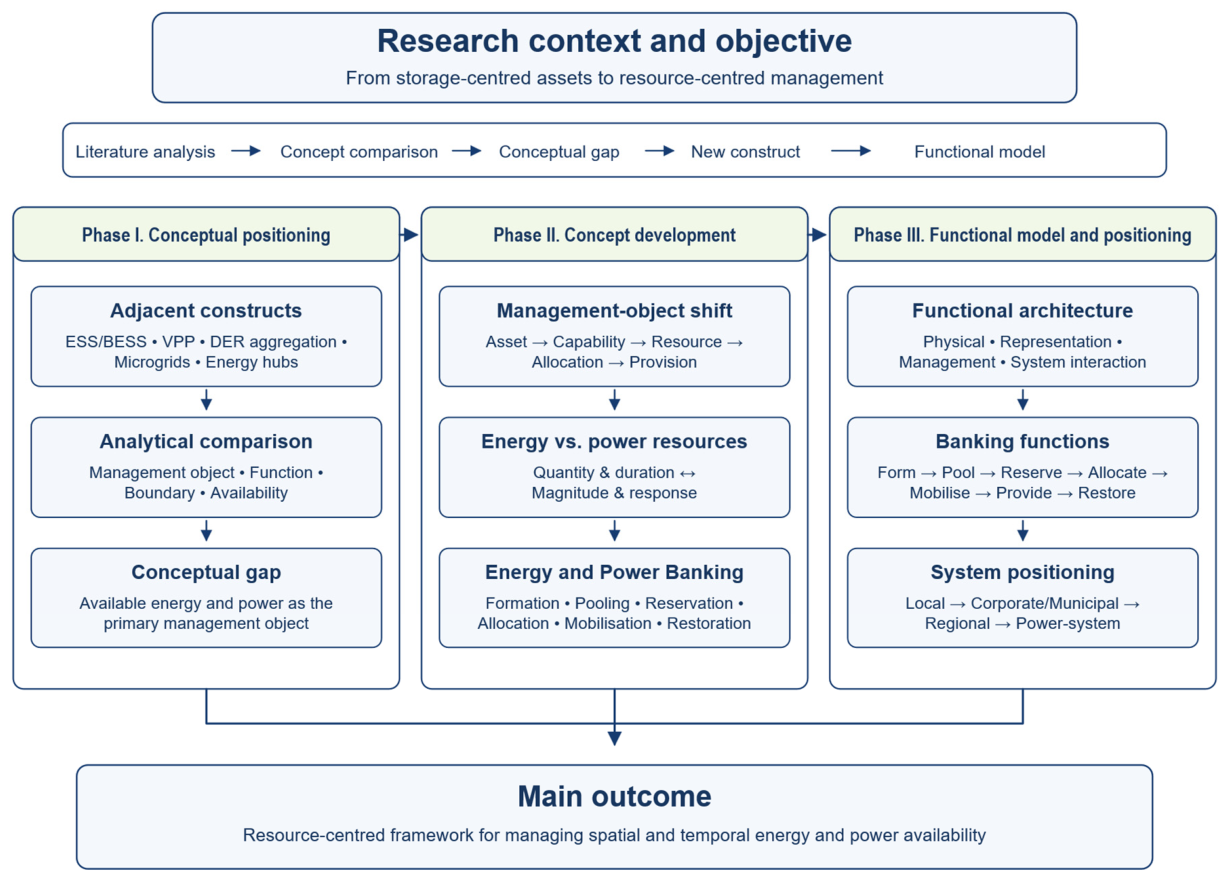
Figure 2.
Conceptual shift from asset-centred energy storage to resource-centred Energy and Power Banking.
Figure 2.
Conceptual shift from asset-centred energy storage to resource-centred Energy and Power Banking.
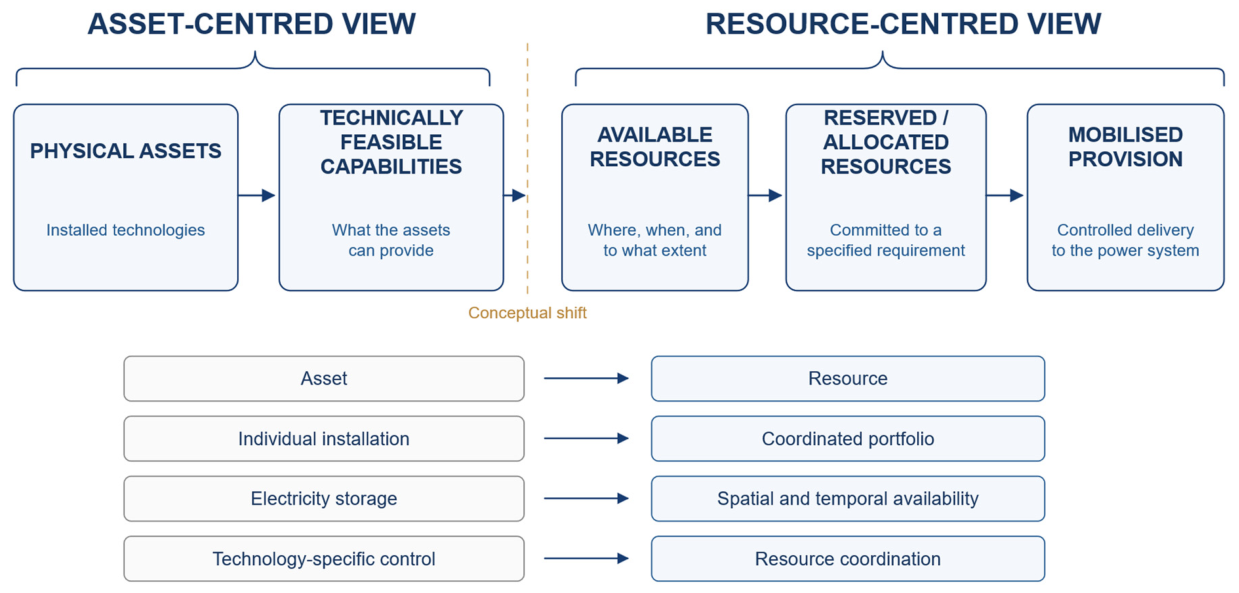
Figure 3.
Energy and power as distinct but interdependent resource categories.
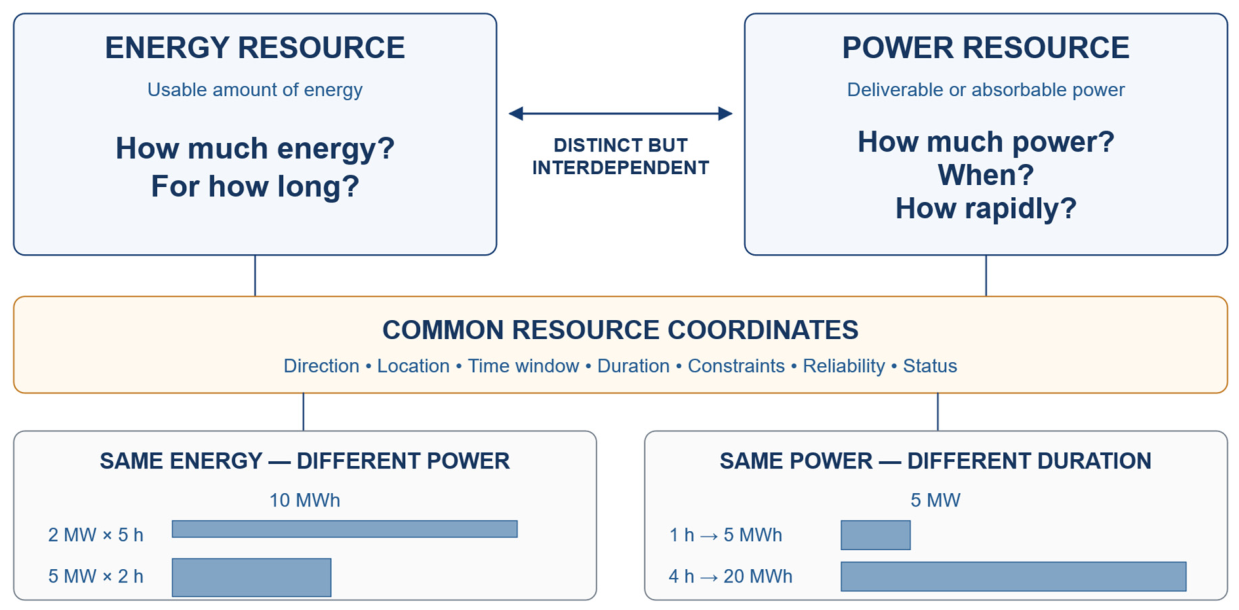
Figure 4.
Layered functional architecture and principal flows of an Energy and Power Bank.
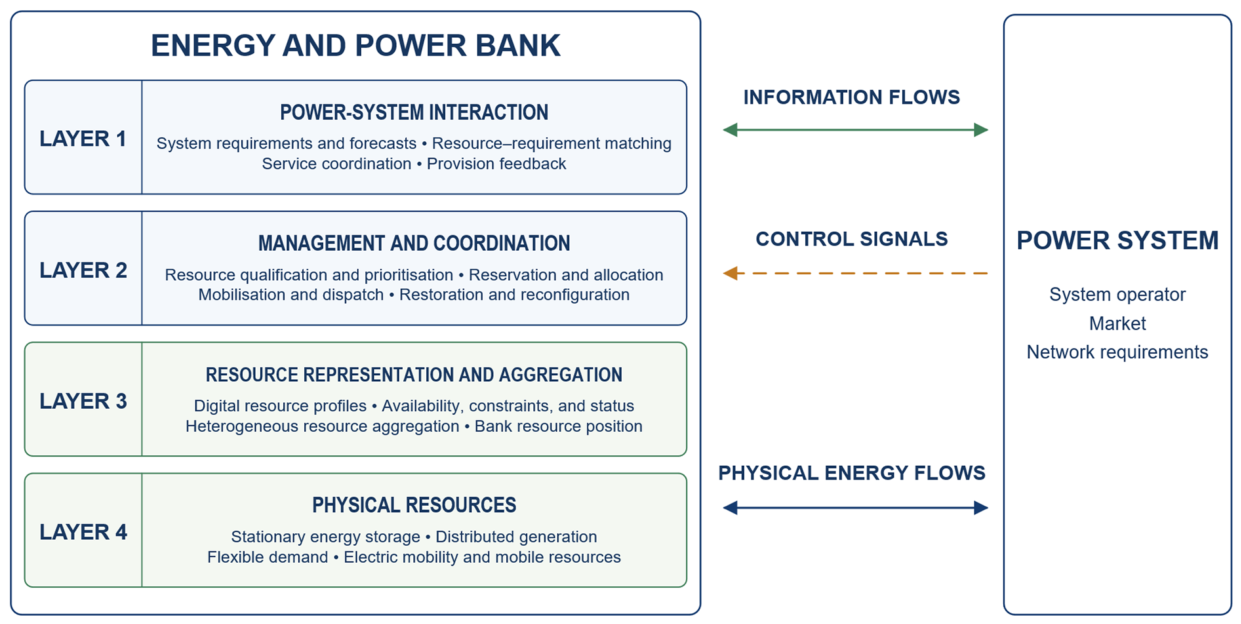
Figure 5.
Recurring functional cycle of Energy and Power Banking and resource-state transitions.
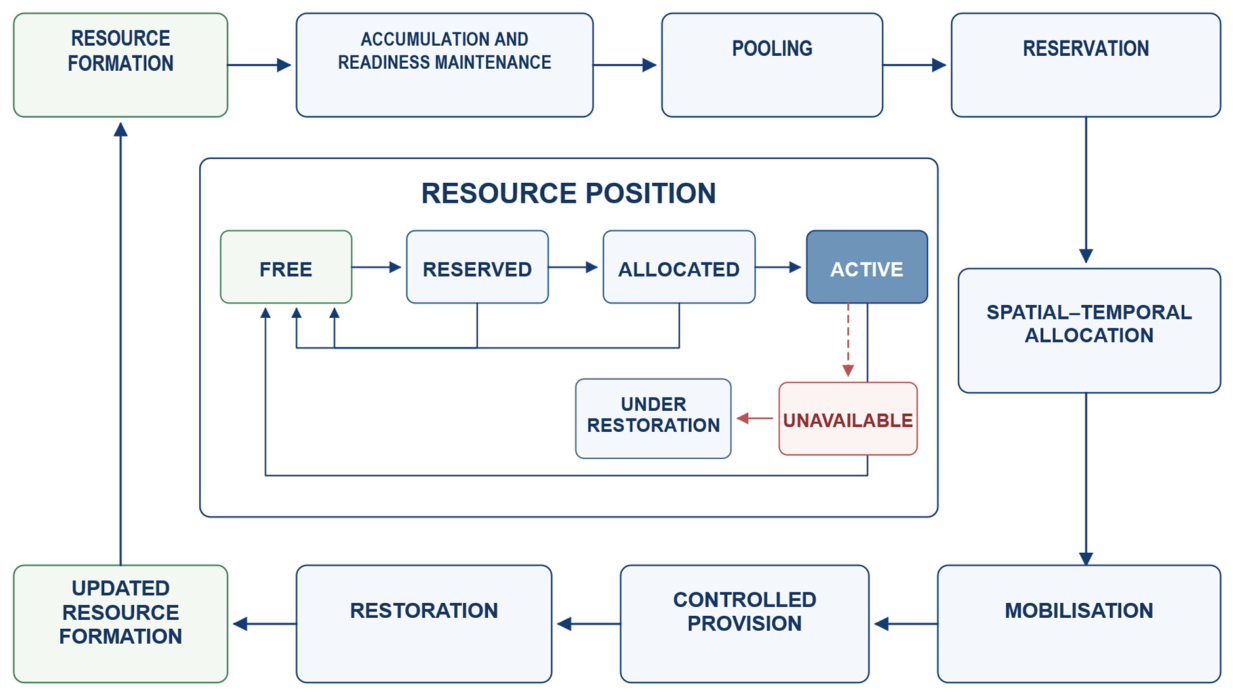
Figure 6.
Matching the bank resource position with power-system requirements.
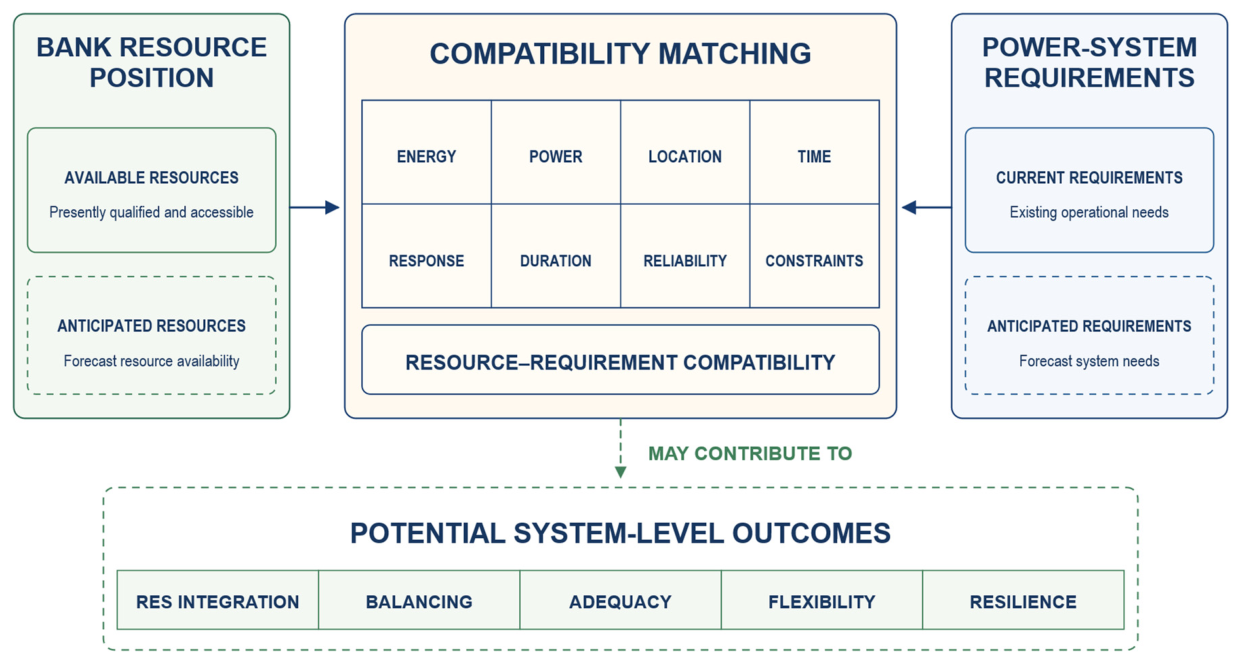
Figure 7.
Multilevel organisation and preliminary configurations of Energy and Power Banks.
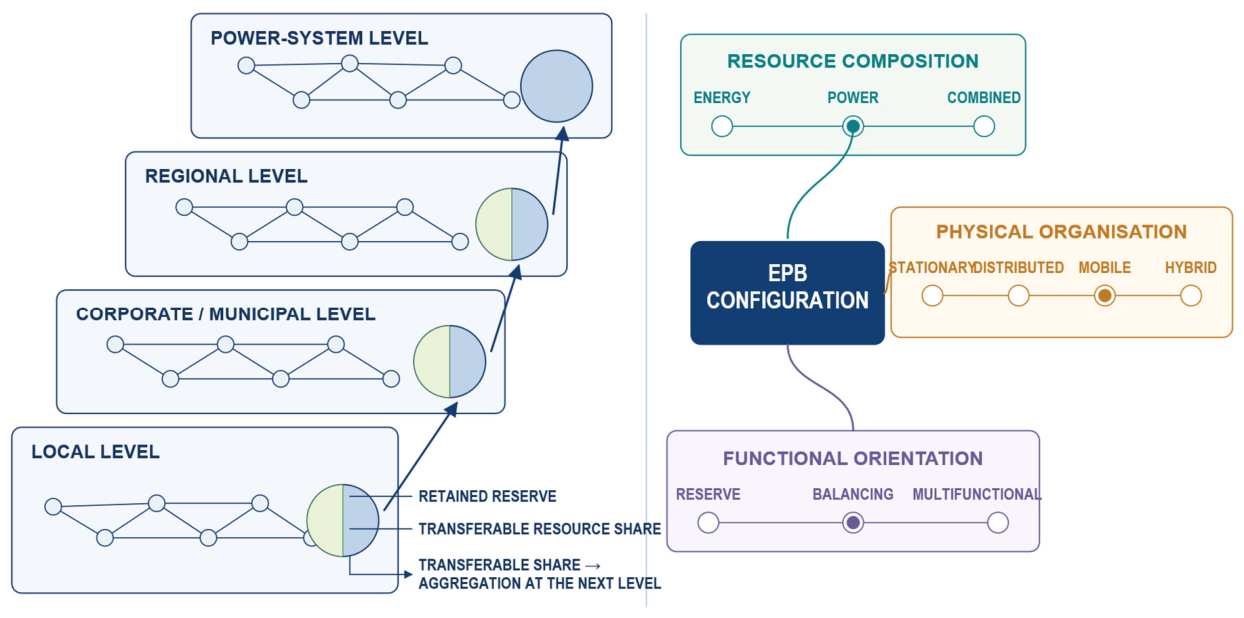

Table 1.
Conceptual positioning of Energy and Power Banking relative to adjacent constructs.
| Concept | Primary object of management | Core organising function | Spatial or system logic | Role of energy and power availability |
|---|---|---|---|---|
| ESS/BESS | Physical storage facility or storage portfolio | Conversion, storage, and time-shifting of electricity; provision of specified services | Usually associated with identified physical installations and connection points | Derived from rated parameters, current state, and operating constraints of the asset |
| Virtual power plant | Digitally coordinated portfolio of distributed energy resources | Scheduling, control, market participation, and provision of grid services | Geographically dispersed assets represented as an integrated operational entity | Represented as an input, constraint, or output of portfolio scheduling and service delivery |
| DER aggregation | Multiple small generation, storage, or demand-side resources | Combining resources to meet operational or market-participation requirements | Defined by market, programme, network, or regulatory eligibility | Combined to satisfy portfolio capacity and performance requirements |
| Microgrid | Interconnected local loads and distributed resources | Local balancing, resilience, energy management, and possible islanded operation | Clearly defined electrical boundary | Managed primarily to meet local demand and maintain local operating capability |
| Energy hub | Multiple energy carriers, conversion units, storage, and demands | Coupling, conversion, storage, and optimisation of multi-energy flows | Physical or conceptual multi-energy node or network | Embedded in the conversion and optimisation of different energy-carrier flows |
| Electricity banking / energy-bank models | Banked electricity credits, scheduled exchanges, energy transactions, or shared-storage services | Deferred withdrawal or settlement; energy sharing, trading, or coordinated exchange | Defined by utility or tariff arrangements, participant groups, trading platforms, or interacting local systems | Represented to enable settlement or exchange, but not treated as the primary object of end-to-end resource formation and management |
| Energy and Power Banking | Spatially and temporally available energy and power resources | Resource formation, accumulation, reservation, pooling, allocation, and controlled mobilisation | Potentially local, distributed, mobile, regional, or system-wide | Treated as the primary object of representation and management |
Table 2.
Transition from asset parameters to resource characteristics.
| Asset-side descriptor | Resource-oriented question | Resulting resource characteristic |
|---|---|---|
| Rated energy capacity | How much energy can actually be supplied or absorbed? | Available energy resource |
| Rated charge and discharge power | What level of power can be injected or absorbed? | Available upward or downward power capability |
| State of charge or stored-energy level | What portion of nominal capacity is currently usable? | Usable resource volume |
| Technical condition and operating limits | Which part of the capability can be used safely? | Technically feasible resource |
| Physical location and network connection | Where can the resource be delivered, and is the network path available? | Spatial accessibility and delivery point |
| Response time and ramping capability | How rapidly can the resource be mobilised? | Mobilisation time |
| Energy-to-power ratio | For how long can the required power be sustained? | Resource duration |
| Operational commitments and ownership constraints | Is the resource free, reserved, or unavailable? | Availability and commitment status |
| Reliability and forecast uncertainty | How confidently can the resource be expected to perform? | Degree of resource firmness |
Table 3.
Research agenda for Energy and Power Banking.
| Research area | Principal questions | Expected development |
|---|---|---|
| Formalisation of resource availability | How should available energy and power be represented across locations, time intervals, directions, durations, and uncertainty levels? | Formal resource model and system of availability indicators |
| Resource liquidity | How readily can an available or reserved resource be converted into the required system response without unacceptable technical or economic losses? | Definition and assessment framework for energy and power resource liquidity |
| Reservation and adequacy | How much energy and power should be reserved, with what duration and firmness, and how should energy-constrained resources contribute to adequacy? | Reservation models and adequacy-oriented resource qualification |
| Spatial allocation | Where should stationary and mobile resources be located or positioned, considering network constraints, losses, and regional needs? | Network-aware and location-sensitive allocation models |
| Multilevel coordination | How should local, municipal, regional, and system-level banks exchange resources without compromising lower-level requirements? | Hierarchical or federated coordination architecture |
| Operational optimisation | How should competing uses, uncertainty, degradation, restoration time, and future readiness be incorporated into resource allocation and mobilisation? | Multi-period and multi-objective optimisation models |
| Digital architecture | Which data, communication, interoperability, resource-registration, control, and verification mechanisms are required? | Digital representation and information-control architecture |
| Economic and market mechanisms | How should resource availability, reservation, mobilisation, restoration, and non-use be valued and compensated? | Economic models, service definitions, and possible market arrangements |
| Heterogeneous asset integration | How can different technologies be represented comparably without losing technically important differences? | Qualification rules and technology-sensitive resource models |
| Empirical validation | Under which conditions does the banking framework outperform or clarify existing BESS, VPP, or aggregation approaches? | Case studies, comparative simulations, and demonstration projects |
Disclaimer/Publisher’s Note: The statements, opinions and data contained in all publications are solely those of the individual author(s) and contributor(s) and not of MDPI and/or the editor(s). MDPI and/or the editor(s) disclaim responsibility for any injury to people or property resulting from any ideas, methods, instructions or products referred to in the content. |
© 2026 by the author. Licensee MDPI, Basel, Switzerland. This article is an open access article distributed under the terms and conditions of the Creative Commons Attribution (CC BY) license.
Copyright: This open access article is published under a Creative Commons CC BY 4.0 license, which permit the free download, distribution, and reuse, provided that the author and preprint are cited in any reuse.